
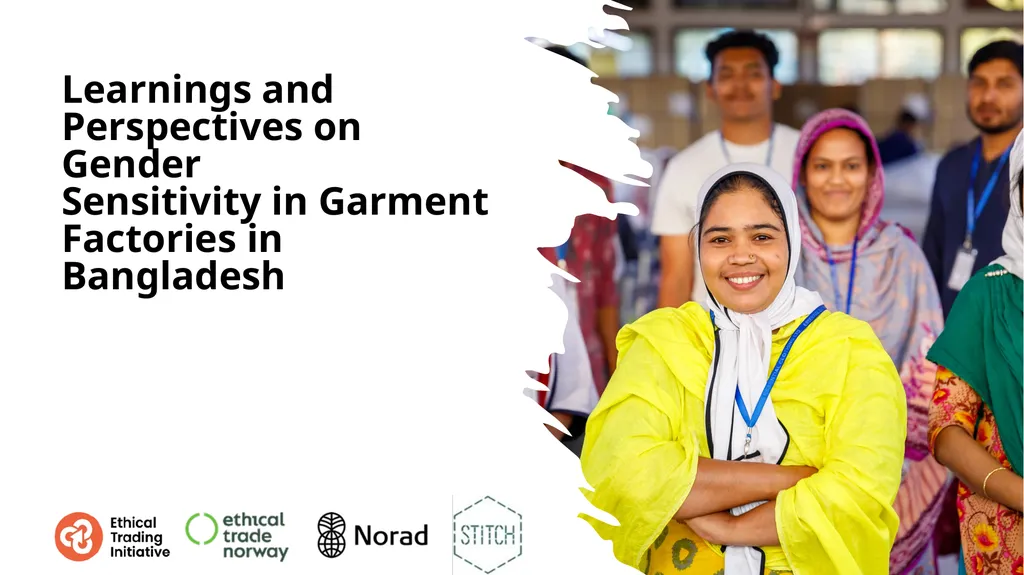
Learnings and Perspectives on Gender Sensitivity
DP
Published · 10 slides · 0 views
1 / 1
Description
Learnings and Perspectives on Gender Sensitivity in Garment Factories in Bangladesh The Ethical Trading Initiative (ETI) is a leading alliance of companies, trade unions and NGOs that promotes respect for workers rights around the globe.
Related Topics
Share
Embed code
Download this presentation From Below
"Learnings and Perspectives on Gender Sensitivity" is the property of its rightful owner. Permission is granted to download and print the materials on this website for personal, non-commercial use only, and to display it on your personal computer provided you do not modify the materials and that you retain all copyright notices contained in the materials. By downloading content from our website, you accept the terms of this agreement.
Presentation Transcript
01
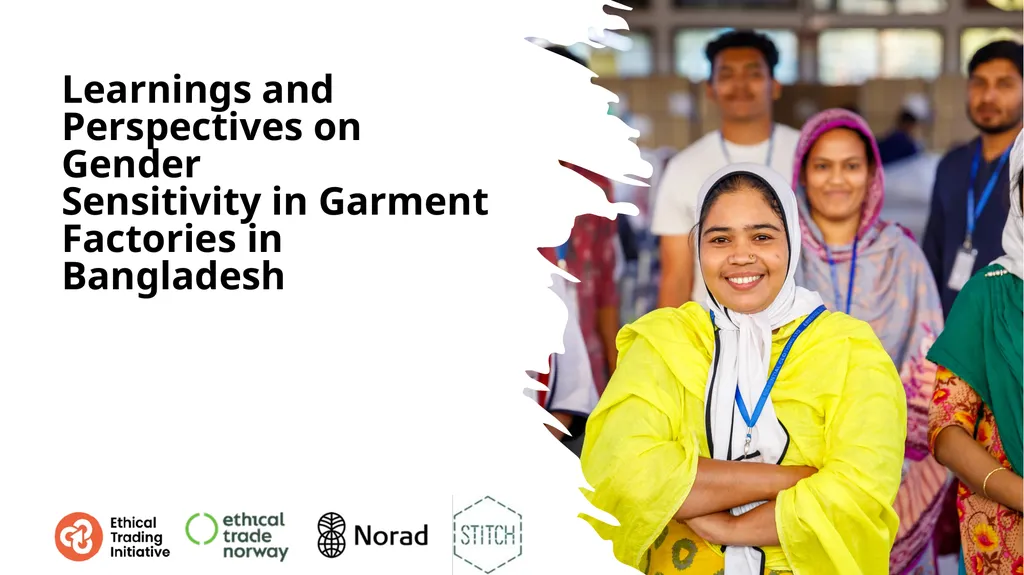
Learnings and
Perspectives on Gender
Sensitivity in Garment
Factories in Bangladesh<br>
02
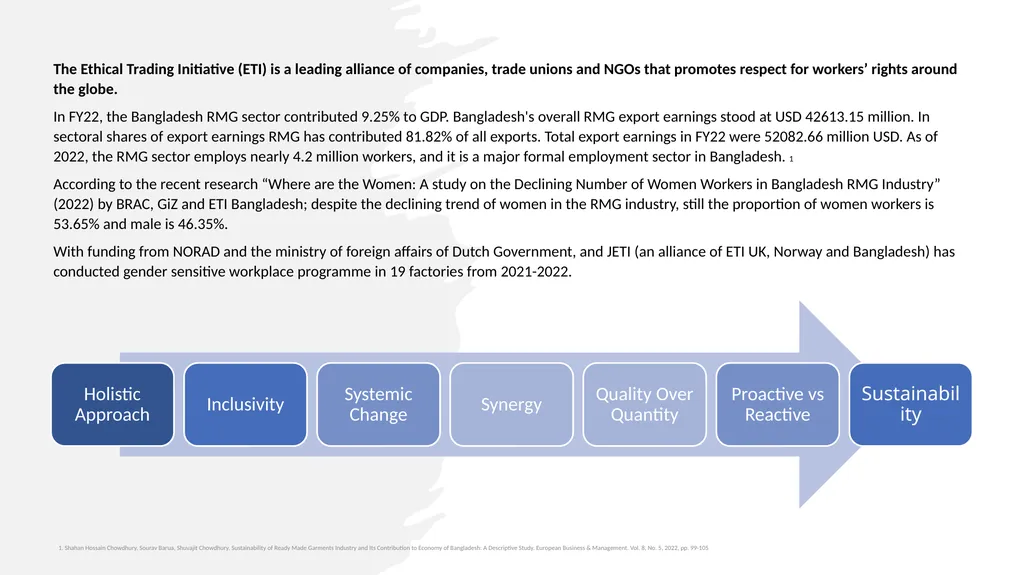
The Ethical Trading Initiative (ETI) is a leading alliance of companies, trade unions and NGOs that promotes respect for workers’ rights around the globe.
In FY22, the Bangladesh RMG sector contributed 9.25% to GDP. Bangladesh's overall RMG export earnings stood at USD 42613.15 million. In sectoral shares of export earnings RMG has contributed 81.82% of all exports. Total export earnings in FY22 were 52082.66 million USD. As of 2022, the RMG sector employs nearly 4.2 million workers, and it is a major formal employment sector in Bangladesh. 1
According to the recent research “Where are the Women: A study on the Declining Number of Women Workers in Bangladesh RMG Industry” (2022) by BRAC, GiZ and ETI Bangladesh; despite the declining trend of women in the RMG industry, still the proportion of women workers is 53.65% and male is 46.35%.
With funding from NORAD and the ministry of foreign affairs of Dutch Government, and JETI (an alliance of ETI UK, Norway and Bangladesh) has conducted gender sensitive workplace programme in 19 factories from 2021-2022. 1. Shahan Hossain Chowdhury, Sourav Barua, Shuvajit Chowdhury. Sustainability of Ready Made Garments Industry and Its Contribution to Economy of Bangladesh: A Descriptive Study. European Business & Management. Vol. 8, No. 5, 2022, pp. 99-105<br>
In FY22, the Bangladesh RMG sector contributed 9.25% to GDP. Bangladesh's overall RMG export earnings stood at USD 42613.15 million. In sectoral shares of export earnings RMG has contributed 81.82% of all exports. Total export earnings in FY22 were 52082.66 million USD. As of 2022, the RMG sector employs nearly 4.2 million workers, and it is a major formal employment sector in Bangladesh. 1
According to the recent research “Where are the Women: A study on the Declining Number of Women Workers in Bangladesh RMG Industry” (2022) by BRAC, GiZ and ETI Bangladesh; despite the declining trend of women in the RMG industry, still the proportion of women workers is 53.65% and male is 46.35%.
With funding from NORAD and the ministry of foreign affairs of Dutch Government, and JETI (an alliance of ETI UK, Norway and Bangladesh) has conducted gender sensitive workplace programme in 19 factories from 2021-2022. 1. Shahan Hossain Chowdhury, Sourav Barua, Shuvajit Chowdhury. Sustainability of Ready Made Garments Industry and Its Contribution to Economy of Bangladesh: A Descriptive Study. European Business & Management. Vol. 8, No. 5, 2022, pp. 99-105<br>
03
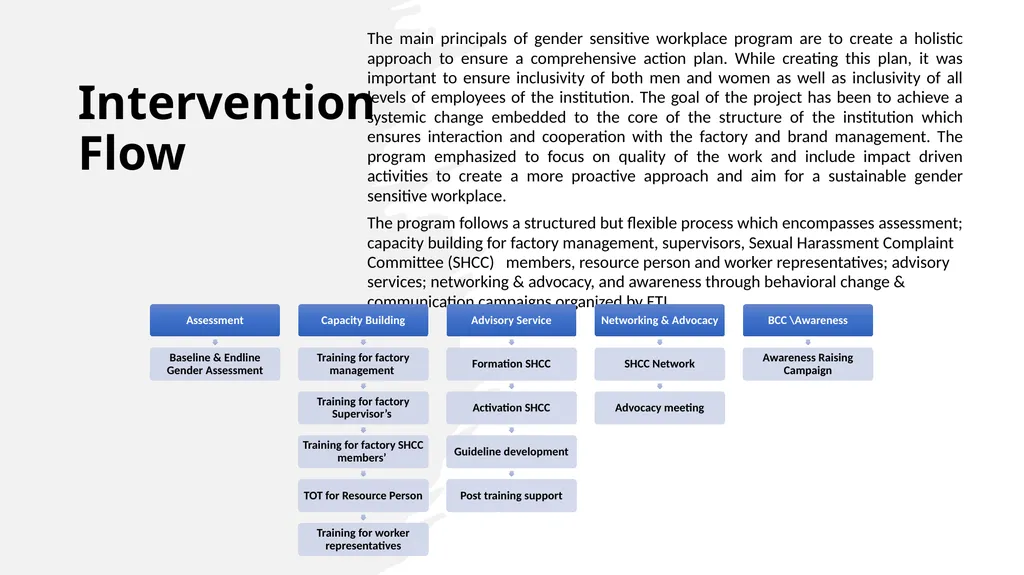
Intervention Flow The main principals of gender sensitive workplace program are to create a holistic approach to ensure a comprehensive action plan. While creating this plan, it was important to ensure inclusivity of both men and women as well as inclusivity of all levels of employees of the institution. The goal of the project has been to achieve a systemic change embedded to the core of the structure of the institution which ensures interaction and cooperation with the factory and brand management. The program emphasized to focus on quality of the work and include impact driven activities to create a more proactive approach and aim for a sustainable gender sensitive workplace.
The program follows a structured but flexible process which encompasses assessment; capacity building for factory management, supervisors, Sexual Harassment Complaint Committee (SHCC) members, resource person and worker representatives; advisory services; networking & advocacy, and awareness through behavioral change & communication campaigns organized by ETI.<br>
The program follows a structured but flexible process which encompasses assessment; capacity building for factory management, supervisors, Sexual Harassment Complaint Committee (SHCC) members, resource person and worker representatives; advisory services; networking & advocacy, and awareness through behavioral change & communication campaigns organized by ETI.<br>
04
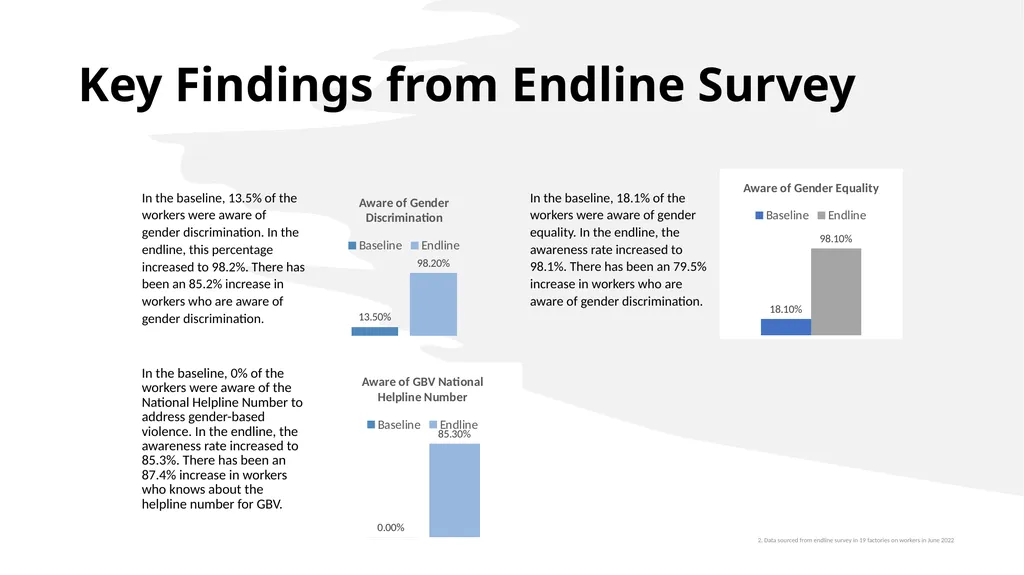
Key Findings from Endline Survey In the baseline, 13.5% of the workers were aware of gender discrimination. In the endline, this percentage increased to 98.2%. There has been an 85.2% increase in workers who are aware of gender discrimination. In the baseline, 18.1% of the workers were aware of gender equality. In the endline, the awareness rate increased to 98.1%. There has been an 79.5% increase in workers who are aware of gender discrimination. In the baseline, 0% of the workers were aware of the National Helpline Number to address gender-based violence. In the endline, the awareness rate increased to 85.3%. There has been an 87.4% increase in workers who knows about the helpline number for GBV. 2. Data sourced from endline survey in 19 factories on workers in June 2022<br>
05
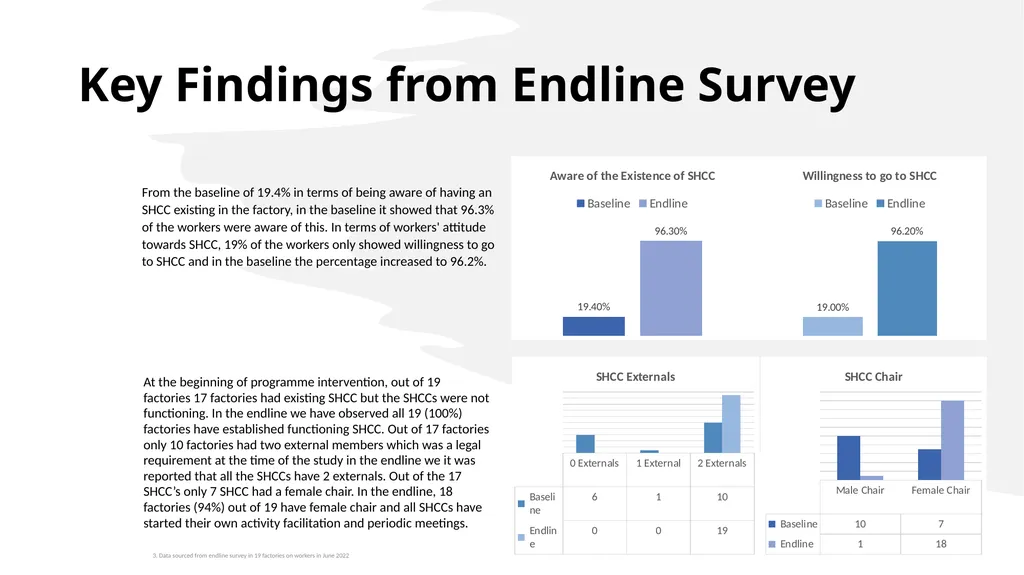
Key Findings from Endline Survey From the baseline of 19.4% in terms of being aware of having an SHCC existing in the factory, in the baseline it showed that 96.3% of the workers were aware of this. In terms of workers' attitude towards SHCC, 19% of the workers only showed willingness to go to SHCC and in the baseline the percentage increased to 96.2%. At the beginning of programme intervention, out of 19 factories 17 factories had existing SHCC but the SHCCs were not functioning. In the endline we have observed all 19 (100%) factories have established functioning SHCC. Out of 17 factories only 10 factories had two external members which was a legal requirement at the time of the study in the endline we it was reported that all the SHCCs have 2 externals. Out of the 17 SHCC’s only 7 SHCC had a female chair. In the endline, 18 factories (94%) out of 19 have female chair and all SHCCs have started their own activity facilitation and periodic meetings. 3. Data sourced from endline survey in 19 factories on workers in June 2022<br>
06
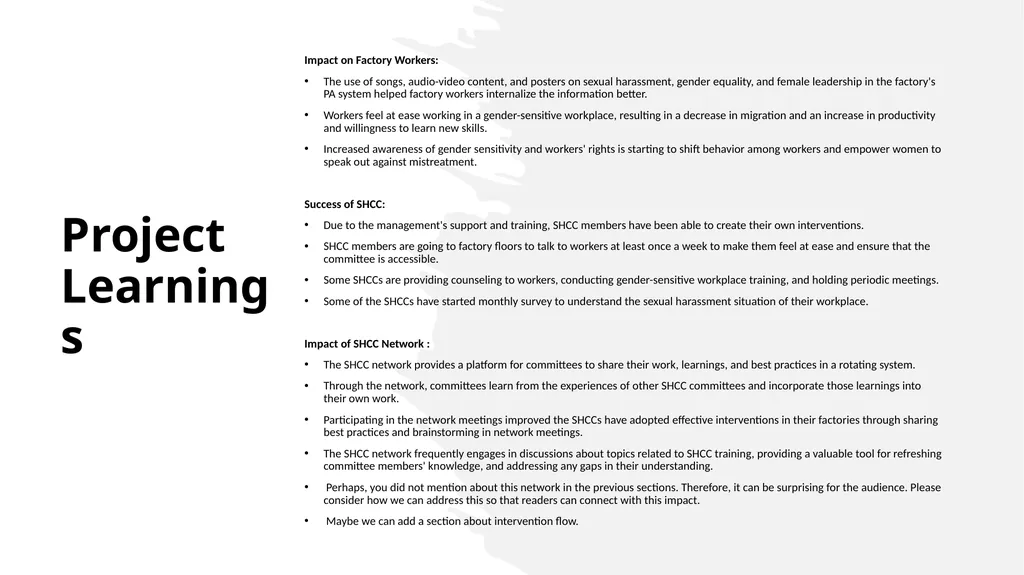
Project Learnings Impact on Factory Workers:
The use of songs, audio-video content, and posters on sexual harassment, gender equality, and female leadership in the factory's PA system helped factory workers internalize the information better.
Workers feel at ease working in a gender-sensitive workplace, resulting in a decrease in migration and an increase in productivity and willingness to learn new skills.
Increased awareness of gender sensitivity and workers' rights is starting to shift behavior among workers and empower women to speak out against mistreatment.
Success of SHCC:
Due to the management's support and training, SHCC members have been able to create their own interventions.
SHCC members are going to factory floors to talk to workers at least once a week to make them feel at ease and ensure that the committee is accessible.
Some SHCCs are providing counseling to workers, conducting gender-sensitive workplace training, and holding periodic meetings.
Some of the SHCCs have started monthly survey to understand the sexual harassment situation of their workplace.
Impact of SHCC Network :
The SHCC network provides a platform for committees to share their work, learnings, and best practices in a rotating system.
Through the network, committees learn from the experiences of other SHCC committees and incorporate those learnings into their own work.
Participating in the network meetings improved the SHCCs have adopted effective interventions in their factories through sharing best practices and brainstorming in network meetings.
The SHCC network frequently engages in discussions about topics related to SHCC training, providing a valuable tool for refreshing committee members' knowledge, and addressing any gaps in their understanding.
Perhaps, you did not mention about this network in the previous sections. Therefore, it can be surprising for the audience. Please consider how we can address this so that readers can connect with this impact.
Maybe we can add a section about intervention flow.<br>
The use of songs, audio-video content, and posters on sexual harassment, gender equality, and female leadership in the factory's PA system helped factory workers internalize the information better.
Workers feel at ease working in a gender-sensitive workplace, resulting in a decrease in migration and an increase in productivity and willingness to learn new skills.
Increased awareness of gender sensitivity and workers' rights is starting to shift behavior among workers and empower women to speak out against mistreatment.
Success of SHCC:
Due to the management's support and training, SHCC members have been able to create their own interventions.
SHCC members are going to factory floors to talk to workers at least once a week to make them feel at ease and ensure that the committee is accessible.
Some SHCCs are providing counseling to workers, conducting gender-sensitive workplace training, and holding periodic meetings.
Some of the SHCCs have started monthly survey to understand the sexual harassment situation of their workplace.
Impact of SHCC Network :
The SHCC network provides a platform for committees to share their work, learnings, and best practices in a rotating system.
Through the network, committees learn from the experiences of other SHCC committees and incorporate those learnings into their own work.
Participating in the network meetings improved the SHCCs have adopted effective interventions in their factories through sharing best practices and brainstorming in network meetings.
The SHCC network frequently engages in discussions about topics related to SHCC training, providing a valuable tool for refreshing committee members' knowledge, and addressing any gaps in their understanding.
Perhaps, you did not mention about this network in the previous sections. Therefore, it can be surprising for the audience. Please consider how we can address this so that readers can connect with this impact.
Maybe we can add a section about intervention flow.<br>
07
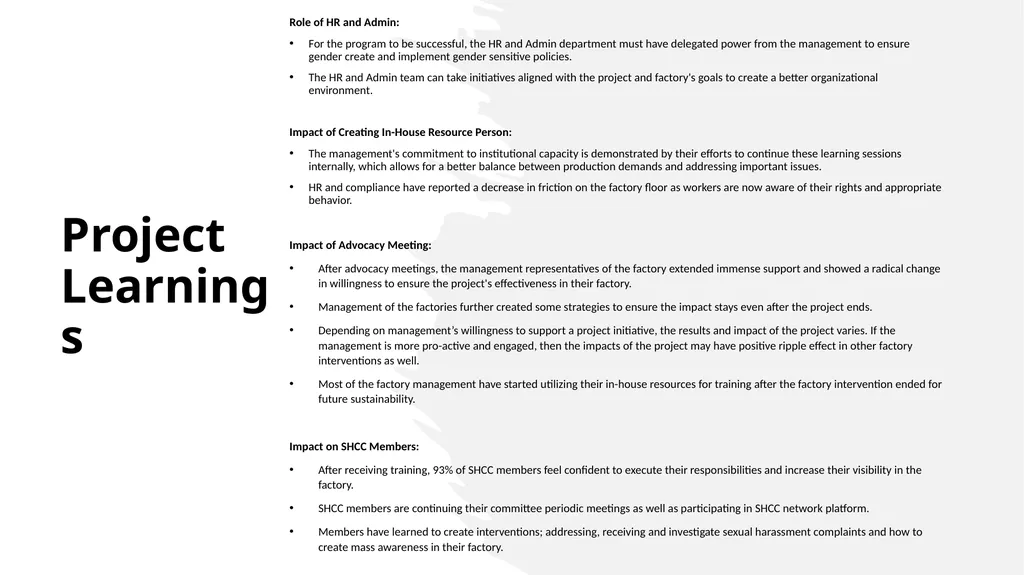
Project Learnings Role of HR and Admin:
For the program to be successful, the HR and Admin department must have delegated power from the management to ensure gender create and implement gender sensitive policies.
The HR and Admin team can take initiatives aligned with the project and factory's goals to create a better organizational environment.
Impact of Creating In-House Resource Person:
The management's commitment to institutional capacity is demonstrated by their efforts to continue these learning sessions internally, which allows for a better balance between production demands and addressing important issues.
HR and compliance have reported a decrease in friction on the factory floor as workers are now aware of their rights and appropriate behavior.
Impact of Advocacy Meeting:
After advocacy meetings, the management representatives of the factory extended immense support and showed a radical change in willingness to ensure the project's effectiveness in their factory.
Management of the factories further created some strategies to ensure the impact stays even after the project ends.
Depending on management’s willingness to support a project initiative, the results and impact of the project varies. If the management is more pro-active and engaged, then the impacts of the project may have positive ripple effect in other factory interventions as well.
Most of the factory management have started utilizing their in-house resources for training after the factory intervention ended for future sustainability.
Impact on SHCC Members:
After receiving training, 93% of SHCC members feel confident to execute their responsibilities and increase their visibility in the factory.
SHCC members are continuing their committee periodic meetings as well as participating in SHCC network platform.
Members have learned to create interventions; addressing, receiving and investigate sexual harassment complaints and how to create mass awareness in their factory.<br>
For the program to be successful, the HR and Admin department must have delegated power from the management to ensure gender create and implement gender sensitive policies.
The HR and Admin team can take initiatives aligned with the project and factory's goals to create a better organizational environment.
Impact of Creating In-House Resource Person:
The management's commitment to institutional capacity is demonstrated by their efforts to continue these learning sessions internally, which allows for a better balance between production demands and addressing important issues.
HR and compliance have reported a decrease in friction on the factory floor as workers are now aware of their rights and appropriate behavior.
Impact of Advocacy Meeting:
After advocacy meetings, the management representatives of the factory extended immense support and showed a radical change in willingness to ensure the project's effectiveness in their factory.
Management of the factories further created some strategies to ensure the impact stays even after the project ends.
Depending on management’s willingness to support a project initiative, the results and impact of the project varies. If the management is more pro-active and engaged, then the impacts of the project may have positive ripple effect in other factory interventions as well.
Most of the factory management have started utilizing their in-house resources for training after the factory intervention ended for future sustainability.
Impact on SHCC Members:
After receiving training, 93% of SHCC members feel confident to execute their responsibilities and increase their visibility in the factory.
SHCC members are continuing their committee periodic meetings as well as participating in SHCC network platform.
Members have learned to create interventions; addressing, receiving and investigate sexual harassment complaints and how to create mass awareness in their factory.<br>
08
Challenges Prioritizing Network Meetings:
The network is still in its early phase and the SHCC members often have busy schedules, and it can be challenging to prioritize attending the network meetings when faced with other pressing tasks, such as factory audits and production pressures. The SHCC network members need coordination support from ETI Bangladesh till the platform matures.
Determining Appropriate Repercussions:
The SHCC members have taken full responsibility for all sexual harassment reports. However, they still require ad hoc on-the-job support to determine appropriate repercussions for the perpetrators. Members of the SHCC have reported that while the high court verdict provides 14 terms, the law still appears vague when it comes to specific actions. It's important to note that sexual harassment complaints in these factories range from sexual intimidation to uncomfortable behavior towards a colleague. Moreover, while working on these cases, the members have gained experience, which has enhanced their ability to identify suitable measures. Nevertheless, there is still room for further training on case handling and interpreting the law to effectively address various scenarios.
Variability in Resolution Time and Loss of Confidence:
The time duration for coming to a resolution for a reported sexual harassment case can vary from factory to factory as well as according to the factory situation. When a case handling process gets delayed, a loss of confidence in SHCC members as observed by the members themselves.<br>
The network is still in its early phase and the SHCC members often have busy schedules, and it can be challenging to prioritize attending the network meetings when faced with other pressing tasks, such as factory audits and production pressures. The SHCC network members need coordination support from ETI Bangladesh till the platform matures.
Determining Appropriate Repercussions:
The SHCC members have taken full responsibility for all sexual harassment reports. However, they still require ad hoc on-the-job support to determine appropriate repercussions for the perpetrators. Members of the SHCC have reported that while the high court verdict provides 14 terms, the law still appears vague when it comes to specific actions. It's important to note that sexual harassment complaints in these factories range from sexual intimidation to uncomfortable behavior towards a colleague. Moreover, while working on these cases, the members have gained experience, which has enhanced their ability to identify suitable measures. Nevertheless, there is still room for further training on case handling and interpreting the law to effectively address various scenarios.
Variability in Resolution Time and Loss of Confidence:
The time duration for coming to a resolution for a reported sexual harassment case can vary from factory to factory as well as according to the factory situation. When a case handling process gets delayed, a loss of confidence in SHCC members as observed by the members themselves.<br>
09
Recommendations Developing a Productivity Index and Measuring Interventions:
To measure the progress of interventions being executed by the factories and understand their impact on worker productivity, the HR team, under the supervision of management, can develop a productivity index. This index will help identify bottlenecks and determine the most successful interventions with the factory workers. It will also inform future strategies for the factory.
Frequent Follow-ups and Human Rights Due Diligence:
Brands need to establish frequent follow-ups with factories to ensure human rights due diligence. This entails identifying and addressing actual and potential human rights risks for workers in operations, supply chains, and services. Collaborative actions throughout the investigation and analysis process, mitigation action identification, remediation for workers impacted by human rights violations, and monitoring, review, and reporting are crucial components of this approach. Additionally, brands should develop mechanisms to financially incentivize factories that maintain good practices as part of their accountability.
Continuation of In-house Resource Person Trainings:
To preserve program knowledge despite worker turnover in factories, in-house resource person trainings should be continued. Furthermore, it is important to include gender-sensitive topics in the regular annual training plans of the factories.<br>
To measure the progress of interventions being executed by the factories and understand their impact on worker productivity, the HR team, under the supervision of management, can develop a productivity index. This index will help identify bottlenecks and determine the most successful interventions with the factory workers. It will also inform future strategies for the factory.
Frequent Follow-ups and Human Rights Due Diligence:
Brands need to establish frequent follow-ups with factories to ensure human rights due diligence. This entails identifying and addressing actual and potential human rights risks for workers in operations, supply chains, and services. Collaborative actions throughout the investigation and analysis process, mitigation action identification, remediation for workers impacted by human rights violations, and monitoring, review, and reporting are crucial components of this approach. Additionally, brands should develop mechanisms to financially incentivize factories that maintain good practices as part of their accountability.
Continuation of In-house Resource Person Trainings:
To preserve program knowledge despite worker turnover in factories, in-house resource person trainings should be continued. Furthermore, it is important to include gender-sensitive topics in the regular annual training plans of the factories.<br>
10
Recommendations Gender Policy Implementation and Brand Role:
Each factory should have a gender policy that plays a pivotal role in ensuring the sustainability of the Sexual Harassment Complaints Committee's (SHCC) work. This policy should promote female leadership, incorporate a zero-tolerance policy against all forms of sexual harassment, and foster a gender-sensitive workplace. Brands can support this effort by actively engaging in the development and implementation of gender policies, integrating them into HR policies and management practices within the organization.
Collaborative Relationship and Independence of SHCC:
The SHCC and management should establish a collaborative relationship, while also granting the committee the necessary independence to carry out its work effectively. The SHCC should have the autonomy to create its action plan, make decisions on interventions, and develop strategies to address sexual harassment in the workplace. Feedback from SHCC members suggests that an independent committee enhances their capacity, confidence, and sense of accountability.
Proactive Role of BGMEA and BKMEA:
BKMEA and BGMEA should develop and implement industry-wide policies and guidelines that prioritize gender equality, prevent harassment, and establish mechanisms to address gender-based violence. These policies should be communicated to member factories and regularly reviewed and updated to ensure their effectiveness in promoting a safe working environment.
.<br>
Each factory should have a gender policy that plays a pivotal role in ensuring the sustainability of the Sexual Harassment Complaints Committee's (SHCC) work. This policy should promote female leadership, incorporate a zero-tolerance policy against all forms of sexual harassment, and foster a gender-sensitive workplace. Brands can support this effort by actively engaging in the development and implementation of gender policies, integrating them into HR policies and management practices within the organization.
Collaborative Relationship and Independence of SHCC:
The SHCC and management should establish a collaborative relationship, while also granting the committee the necessary independence to carry out its work effectively. The SHCC should have the autonomy to create its action plan, make decisions on interventions, and develop strategies to address sexual harassment in the workplace. Feedback from SHCC members suggests that an independent committee enhances their capacity, confidence, and sense of accountability.
Proactive Role of BGMEA and BKMEA:
BKMEA and BGMEA should develop and implement industry-wide policies and guidelines that prioritize gender equality, prevent harassment, and establish mechanisms to address gender-based violence. These policies should be communicated to member factories and regularly reviewed and updated to ensure their effectiveness in promoting a safe working environment.
.<br>