Least Cost Location Theory By Alfred Weber Dr. Kaustuv Mukherjee Asstt. Prof. in Geography Chandidas Mahavidyalaya Introduction: Proposed by : Alfred Weber of Germany Year: 1909 In his Book: Theory of the Location of Industries (Uber
"‘Least Cost Location Theory’ By Alfred Weber Dr." is the property of its rightful owner. Permission is granted to
download and print the materials on this website for personal, non-commercial use only, and to display it
on your personal computer provided you do not modify the materials and that you retain all copyright
notices contained in the materials. By downloading content from our website, you accept the terms of this
agreement.
Presentation Transcript
01
‘Least Cost Location Theory’
By
Alfred Weber Dr. Kaustuv Mukherjee
Asstt. Prof. in Geography
Chandidas Mahavidyalaya<br>
02
Introduction: Proposed by : Alfred Weber of Germany
Year: 1909
In his Book: “Theory of the Location of Industries” (Uber den Standort der Industrien)
His book is translated in English in 1929 and after that this concept became popular.<br>
03
Objectives:
To find out the minimum cost location for Industrial set up based on three factors –
Transport Cost
Labour Cost &
Agglomeration Economies<br>
04
Assumptions: Isotropic Physical and Socio- Economic Landscape
Perfect Competition Market
No Scarcity of Demand
Static labour Position
Uniform and Proportionate Cost Structure
The Entrepreneurs seek to minimize cost
Uneven Distribution of Natural Resources<br>
05
Principles Transport Cost Principle
Labour Cost Principle
Agglomeration Economies Principle<br>
06
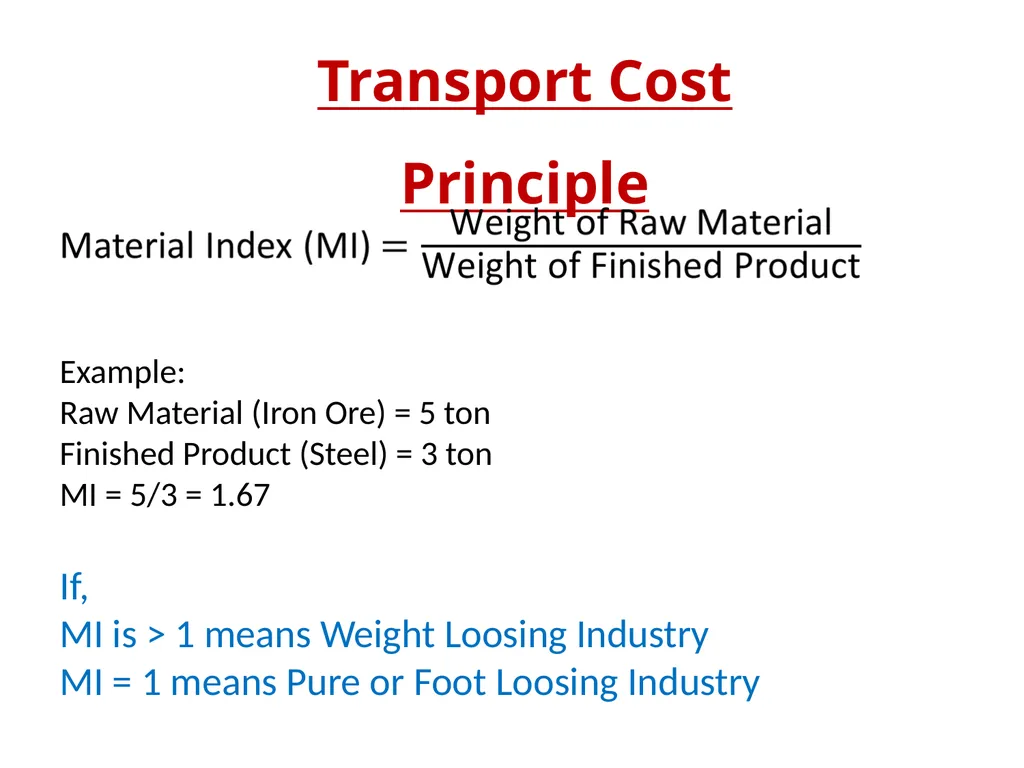
Transport Cost Principle Example:
Raw Material (Iron Ore) = 5 ton
Finished Product (Steel) = 3 ton
MI = 5/3 = 1.67 If,
MI is > 1 means Weight Loosing Industry
MI = 1 means Pure or Foot Loosing Industry<br>
07
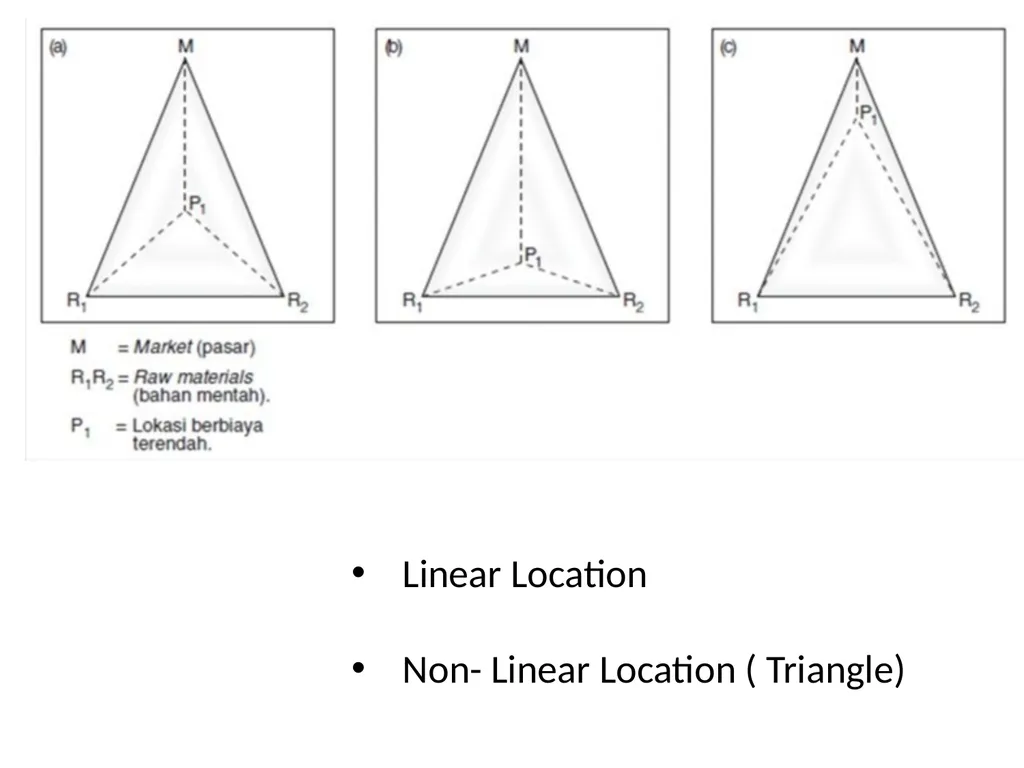
Linear Location
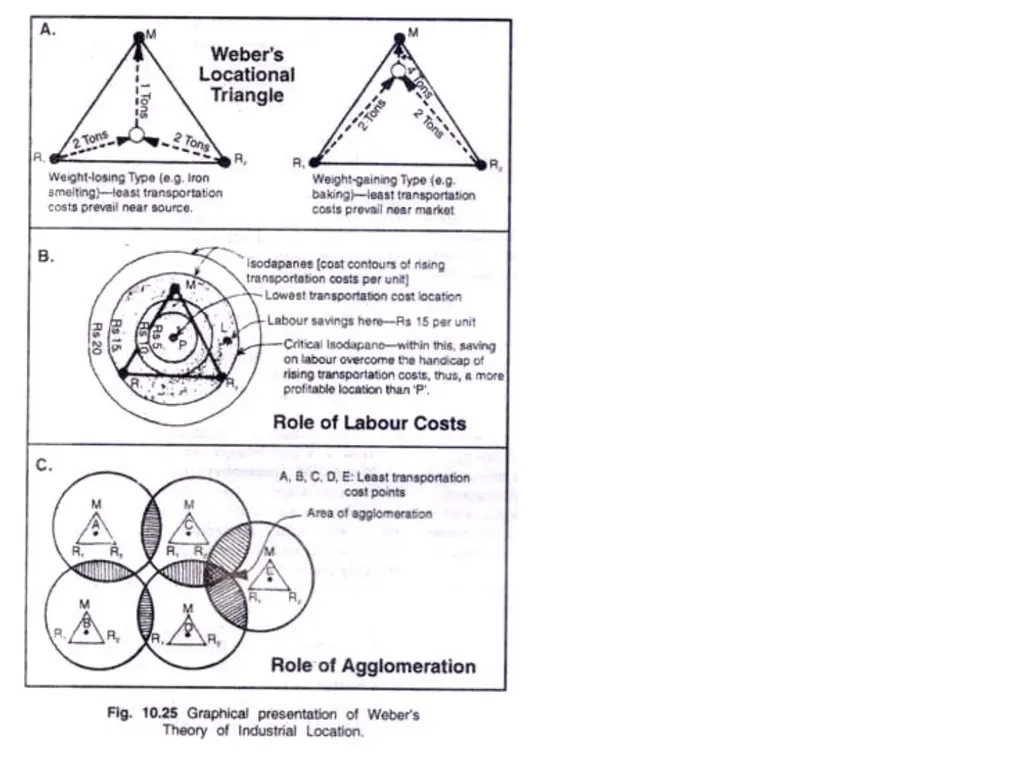
Non- Linear Location ( Triangle)<br>
08
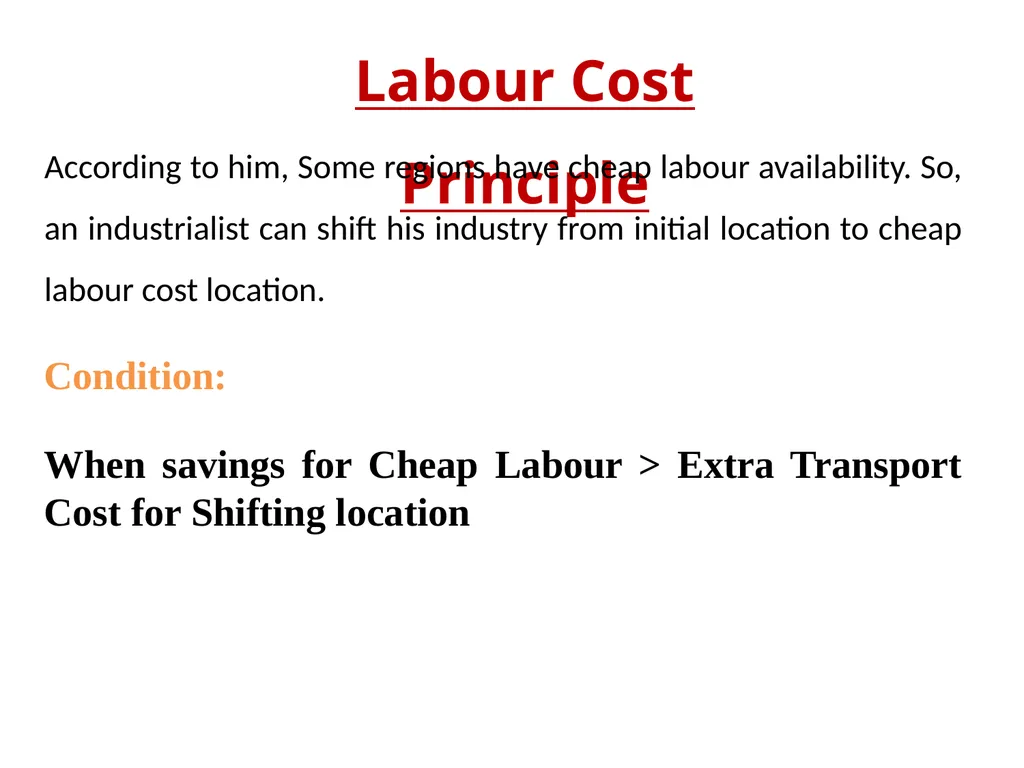
Labour Cost Principle According to him, Some regions have cheap labour availability. So, an industrialist can shift his industry from initial location to cheap labour cost location.
Condition:
When savings for Cheap Labour > Extra Transport Cost for Shifting location<br>
09
Isotim:
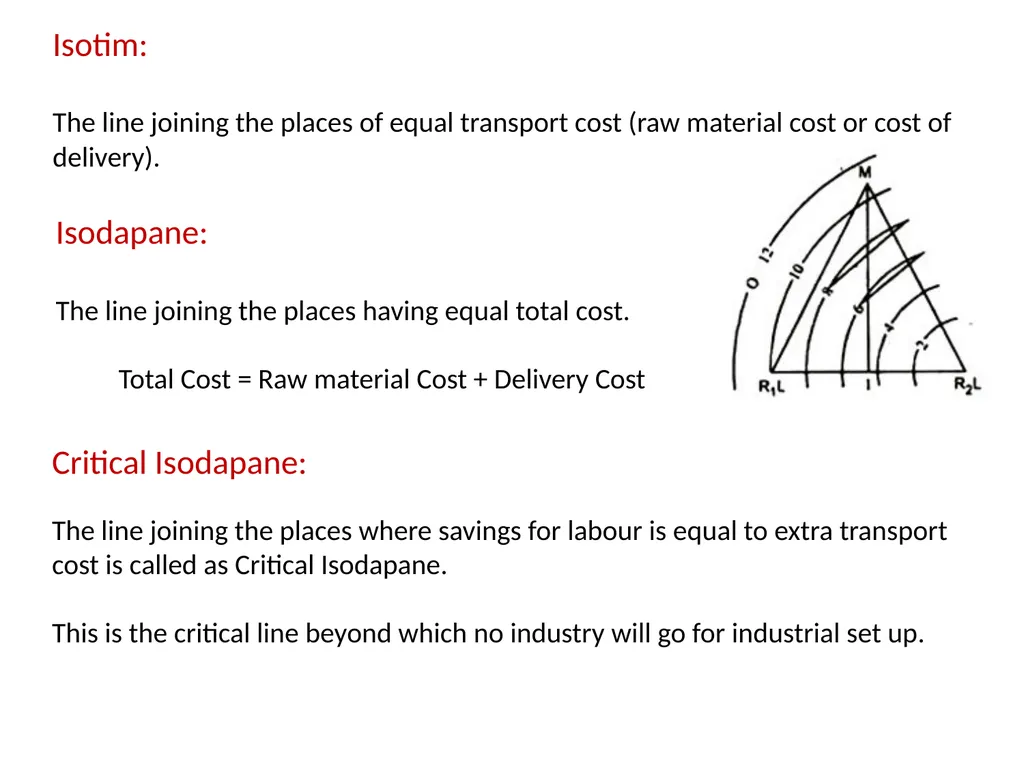
The line joining the places of equal transport cost (raw material cost or cost of delivery). Isodapane:
The line joining the places having equal total cost.
Total Cost = Raw material Cost + Delivery Cost Critical Isodapane:
The line joining the places where savings for labour is equal to extra transport cost is called as Critical Isodapane.
This is the critical line beyond which no industry will go for industrial set up.<br>
10
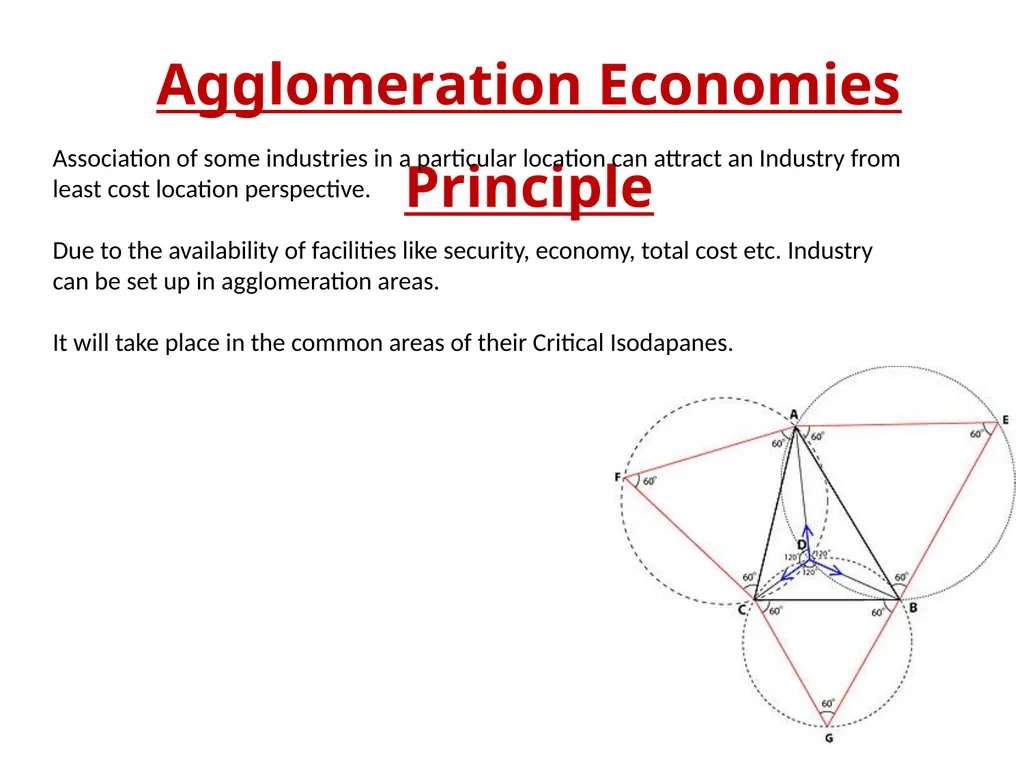
Agglomeration Economies Principle Association of some industries in a particular location can attract an Industry from least cost location perspective.
Due to the availability of facilities like security, economy, total cost etc. Industry can be set up in agglomeration areas.
It will take place in the common areas of their Critical Isodapanes.<br>