"Lecture 01: Introduction Prepared By Dr. Eng." is the property of its rightful owner. Permission is granted to
download and print the materials on this website for personal, non-commercial use only, and to display it
on your personal computer provided you do not modify the materials and that you retain all copyright
notices contained in the materials. By downloading content from our website, you accept the terms of this
agreement.
Presentation Transcript
01
Lecture 01: Introduction Prepared By
Dr. Eng. Sherif Hekal
Assistant Professor, CCE department CCE201: Solid State Electronic Devices 9/30/2017 Lecture 01 1 EEC223: Electronics (1)<br>
02
Course Name: Solid State Electronic Devices
Course Code: CCE201
Course Materials are on my website:
http://www.bu.edu.eg/staff/sherifsalah3 9/30/2017 2 Course Information 1<br>
03
Course Name: Electronics (1)
Course Code: EEC223
Course Materials are on my website:
http://www.bu.edu.eg/staff/sherifsalah3 9/30/2017 3 Course Information 2<br>
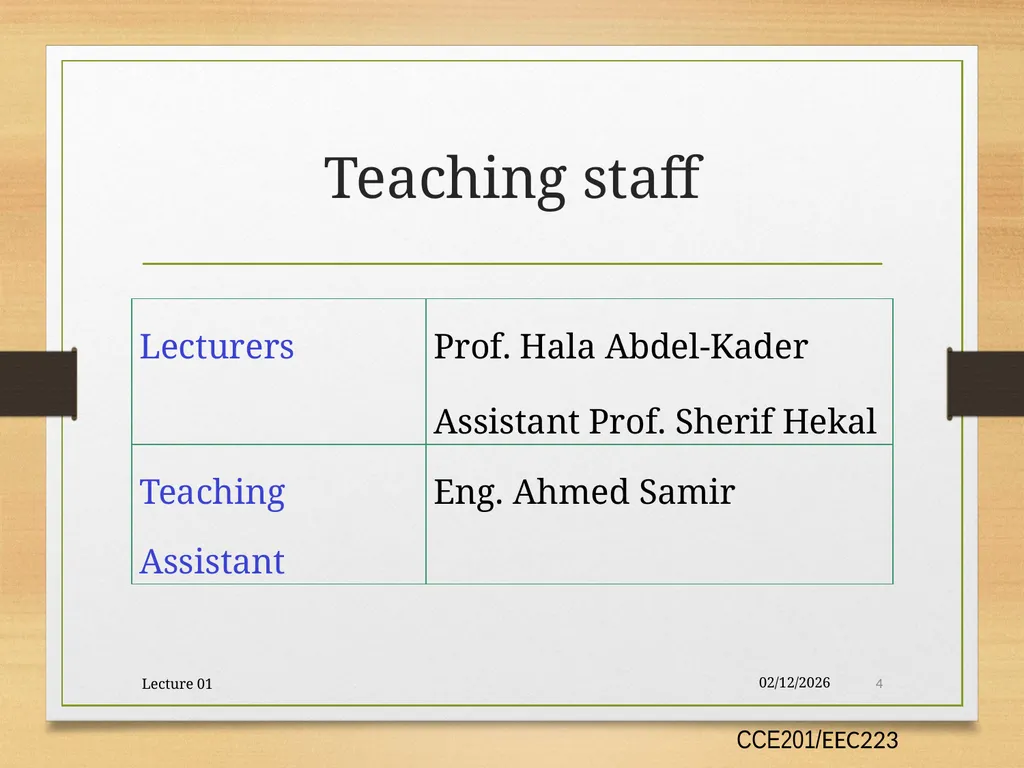
04
Teaching staff 9/30/2017 Lecture 01 4<br>
05
Contact me Dr. Sherif Hekal
Room number : SB5-05
Email address:
Sherif.salah@feng.bu.edu.eg 9/30/2017 Lecture 01 5<br>
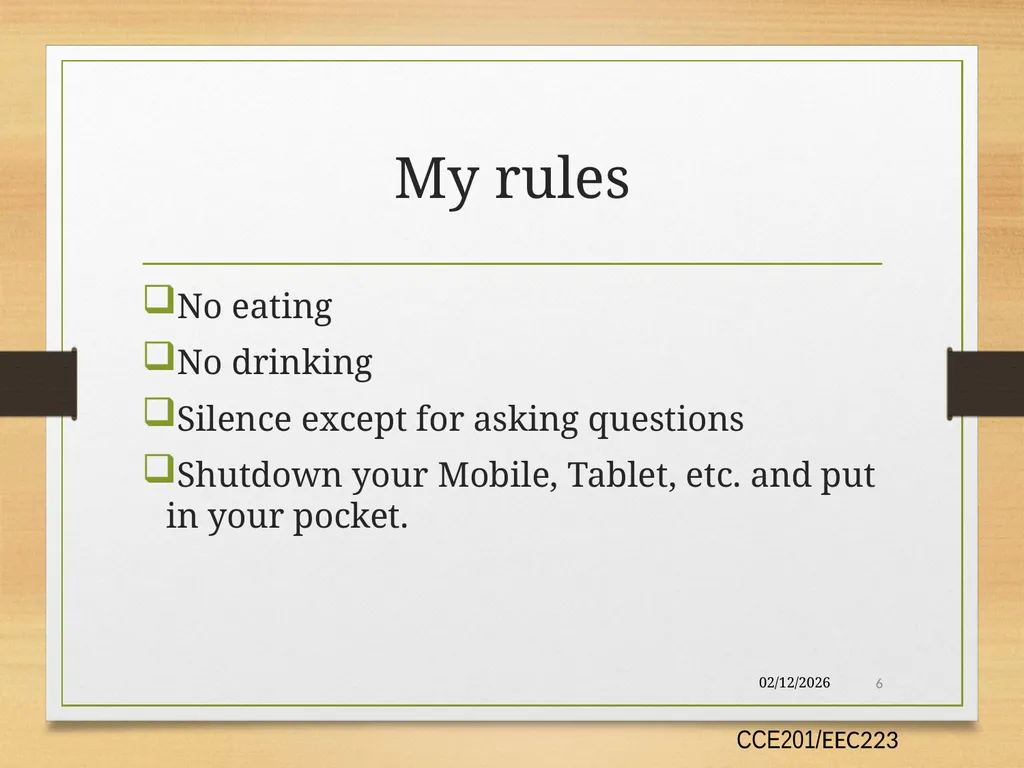
06
My rules No eating
No drinking
Silence except for asking questions
Shutdown your Mobile, Tablet, etc. and put in your pocket. 9/30/2017 6<br>
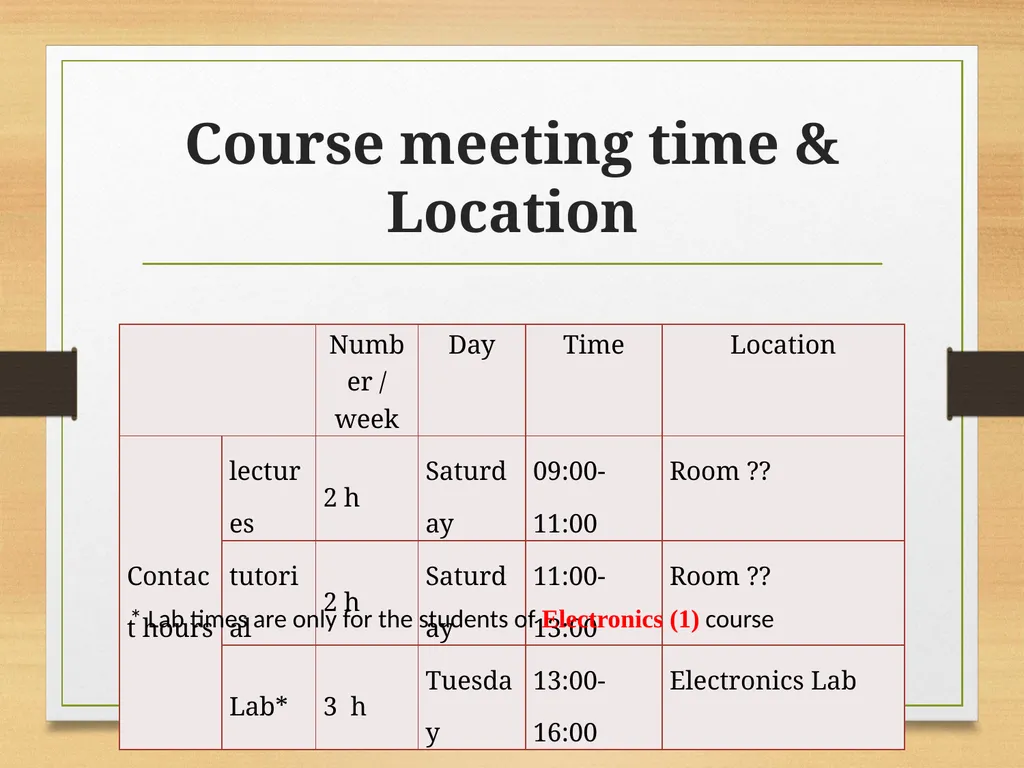
07
Course meeting time & Location 9/30/2017 Lecture 01 7 * Lab times are only for the students of Electronics (1) course<br>
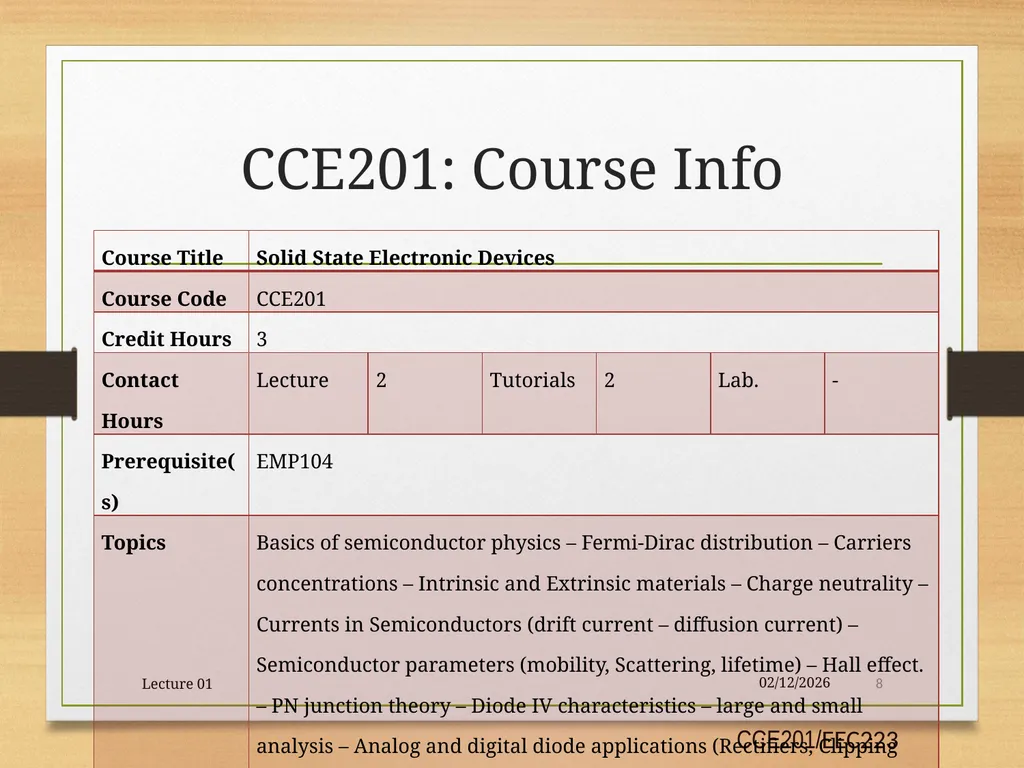
08
CCE201: Course Info 9/30/2017 Lecture 01 8<br>
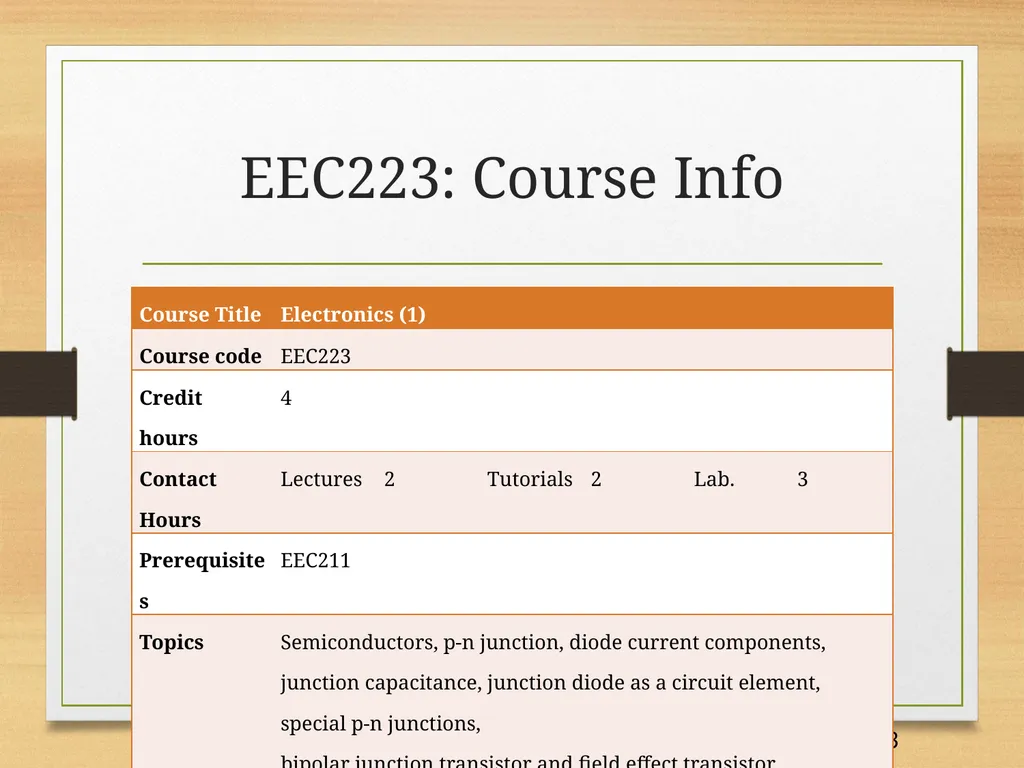
09
EEC223: Course Info 9/30/2017 Lecture 01 9<br>
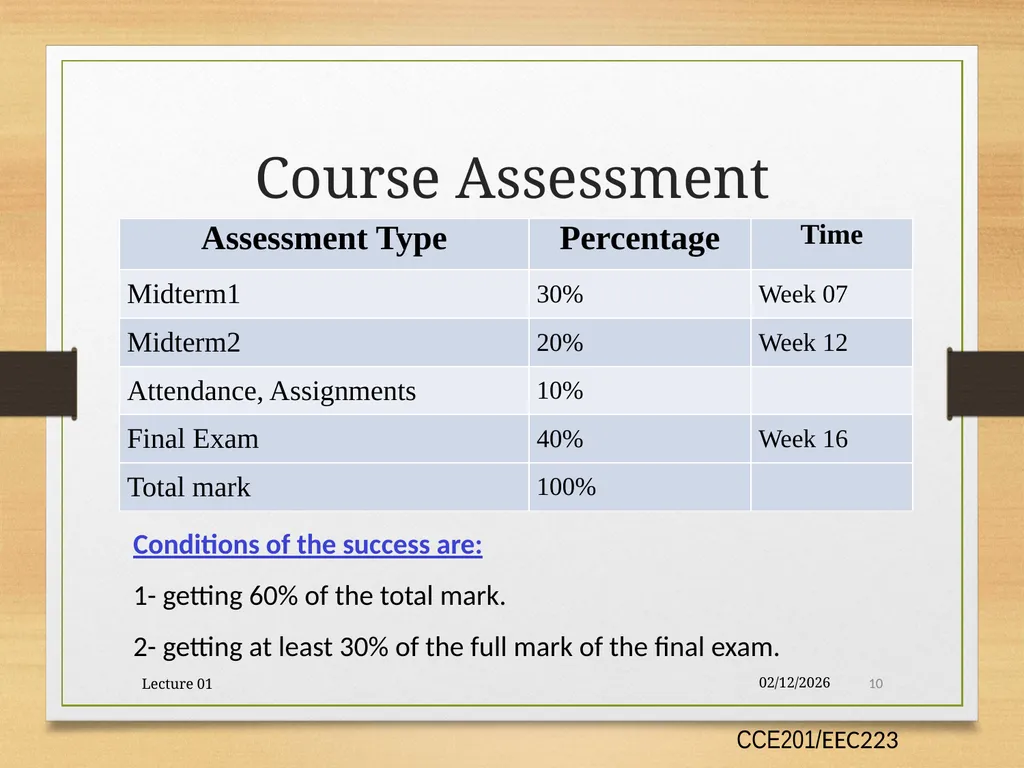
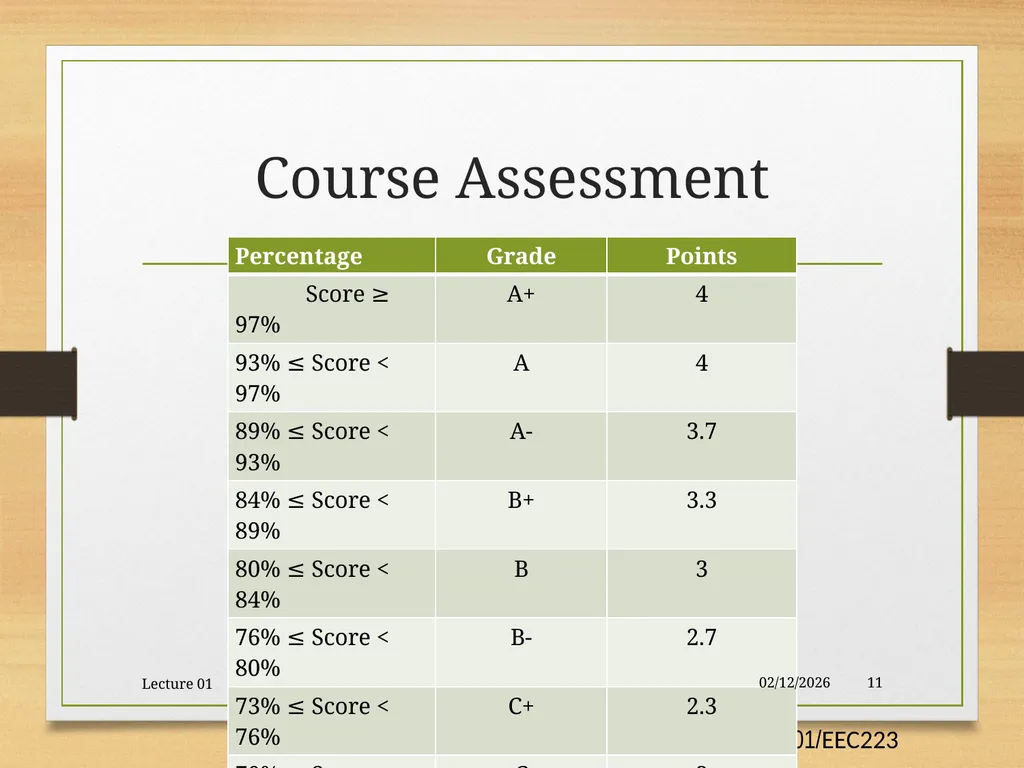
10
Course Assessment 9/30/2017 Lecture 01 10 Conditions of the success are:
1- getting 60% of the total mark.
2- getting at least 30% of the full mark of the final exam.<br>
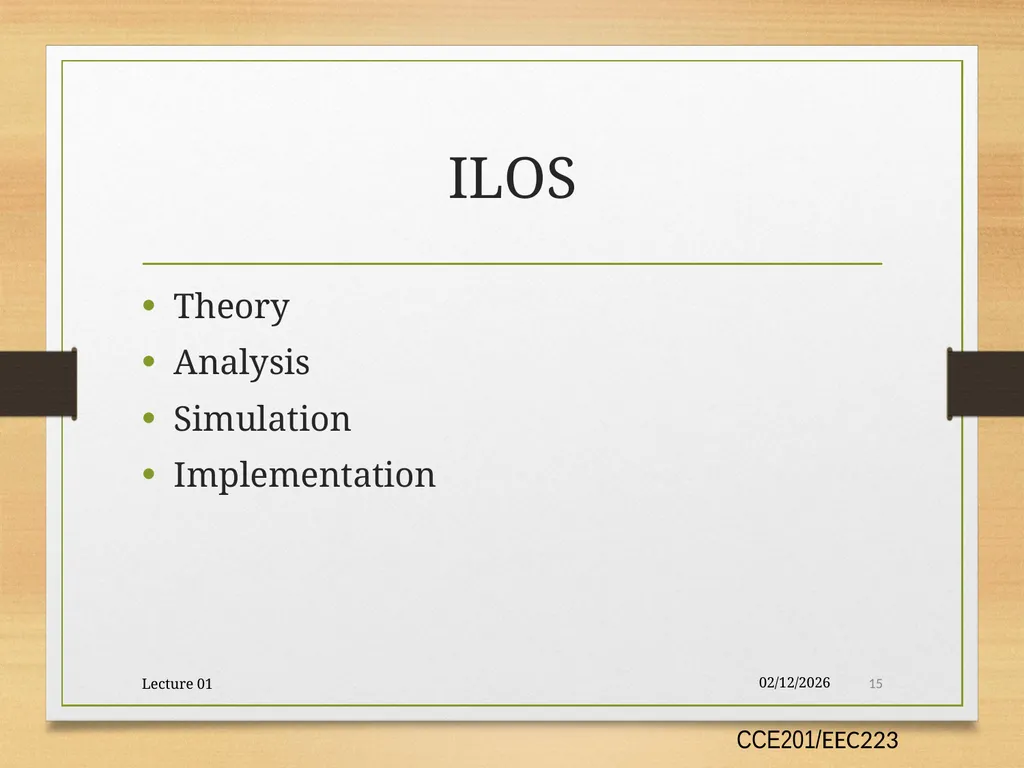
ILOS Theory
Analysis
Simulation
Implementation 9/30/2017 Lecture 01 15<br>
16
ILOS Upon successful completion of the course, students will be able to:
Acquire some understanding in the fundamental electric and electronics principles.
Describe the operation and i-v characteristics of diodes and transistors.
Solve basic problems in electronic circuits.
Implement different applications using basic electronic devices (diodes and transistors).
Read and understand the datasheets of diodes and transistors to use the suitable parts in design.
Design and analyze electronic circuits use computer packages (simulators).
Acquire better skills in performing the laboratory experiments.
Work as a team in laboratory sessions. 9/30/2017 Lecture 01 16<br>
17
Course Objectives 9/30/2017 Lecture 01 17 Identify and describe operation of semiconductor devices through understanding of the semiconductor physics.
Develop an understanding of the PN junction diode and its behavior.
Develop an ability to analyze diode circuits and examine additional applications of the diode.
Develop an understanding of the Bipolar Junction Transistor (BJT) and its operation.
Identify and describe the different BJT configurations, DC biasing, and AC analysis.
Develop an understanding of the Field Effect Transistor (FET) and its operation.
Identify and describe the different FET configurations, DC biasing, and AC analysis.
Develop an ability to analyze and design BJT and FET circuits.<br>
18
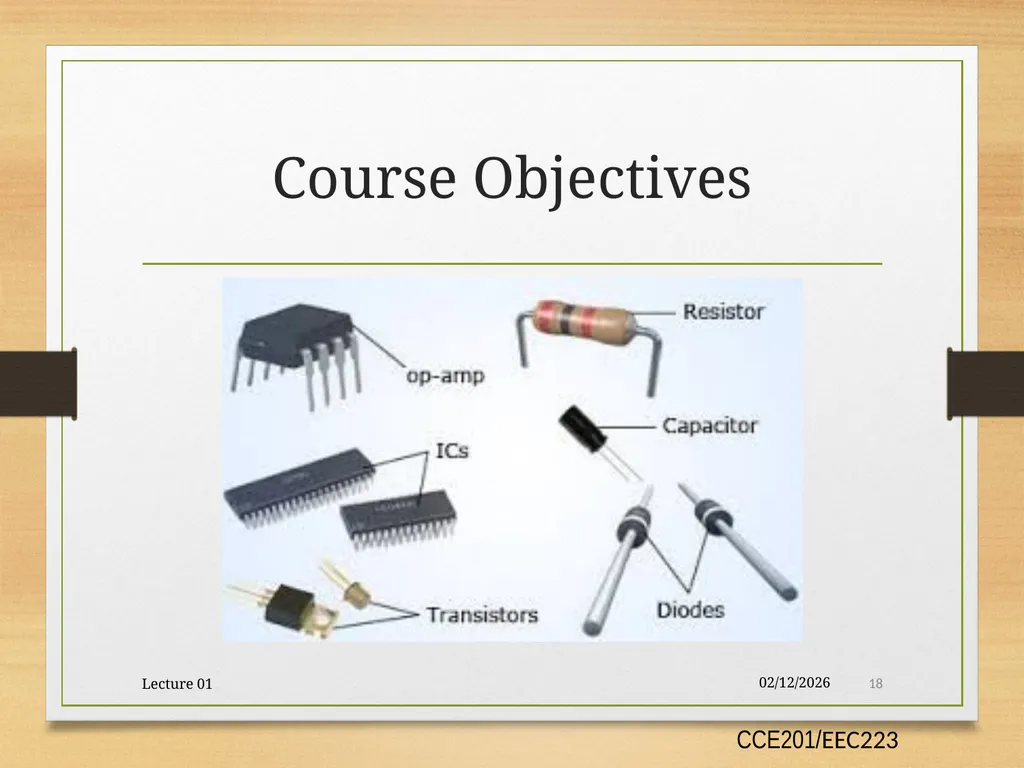
Course Objectives 9/30/2017 Lecture 01 18<br>
19
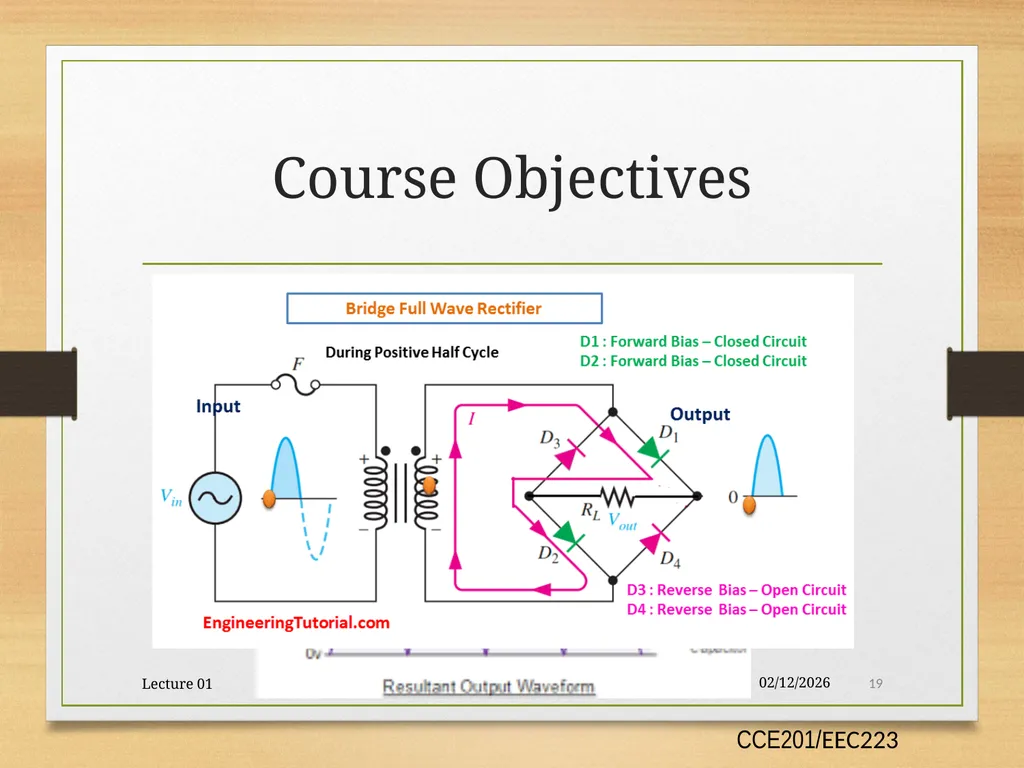
Course Objectives 9/30/2017 Lecture 01 19<br>
20
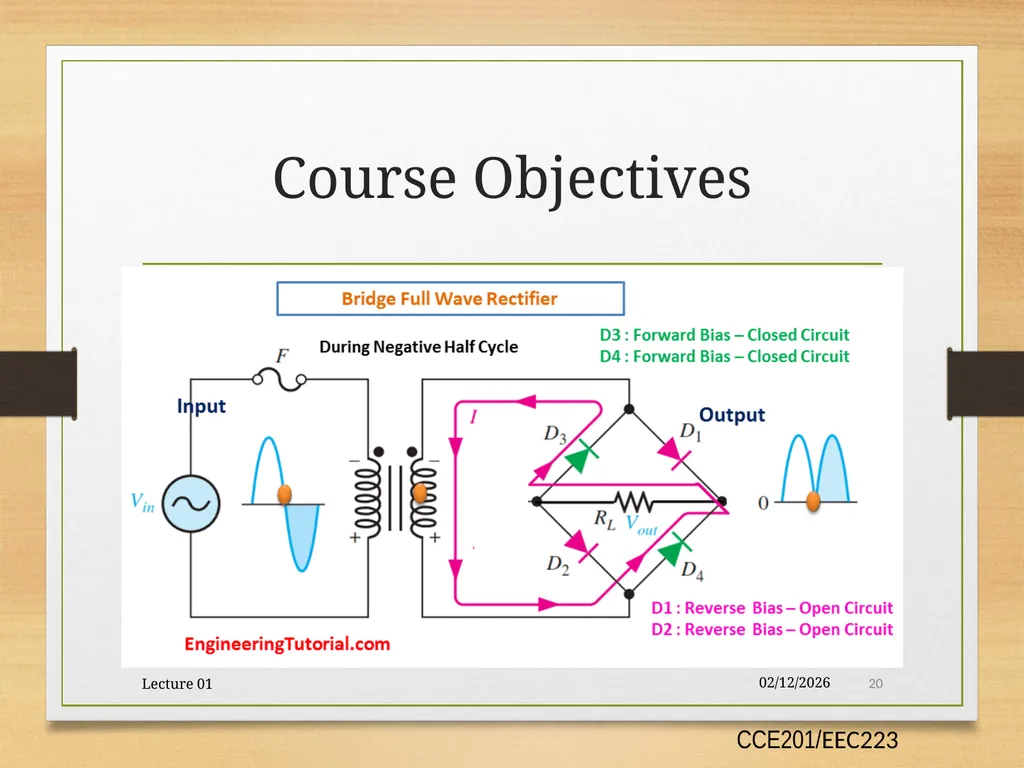
Course Objectives 9/30/2017 Lecture 01 20<br>
21
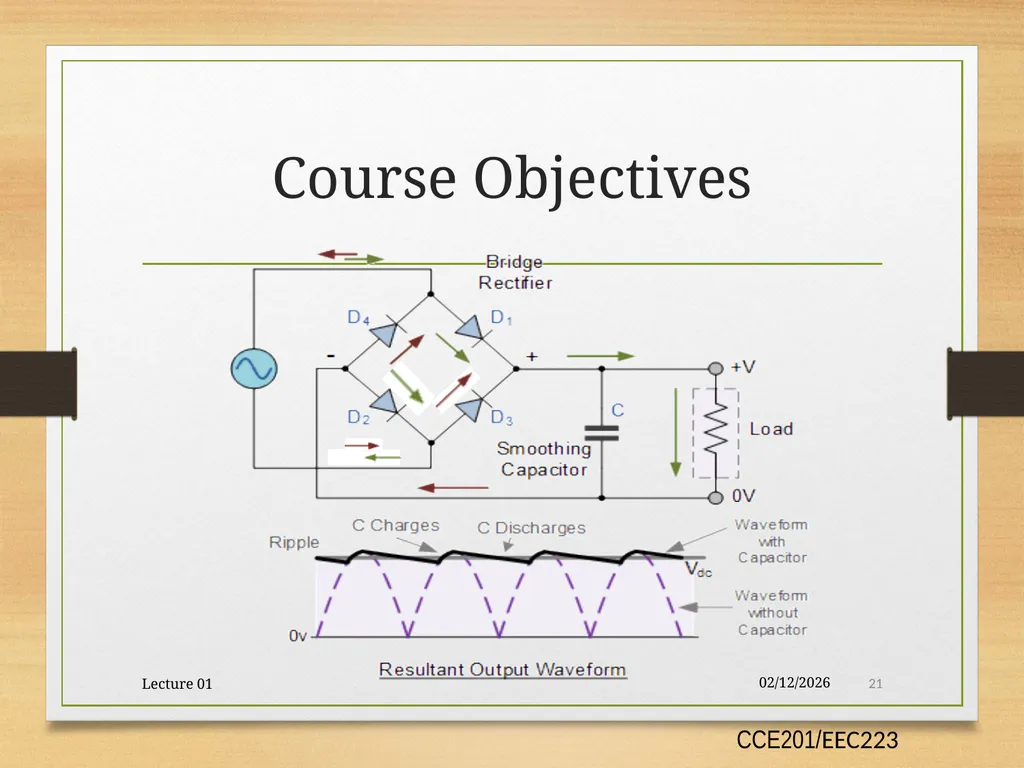
Course Objectives 9/30/2017 Lecture 01 21<br>
22
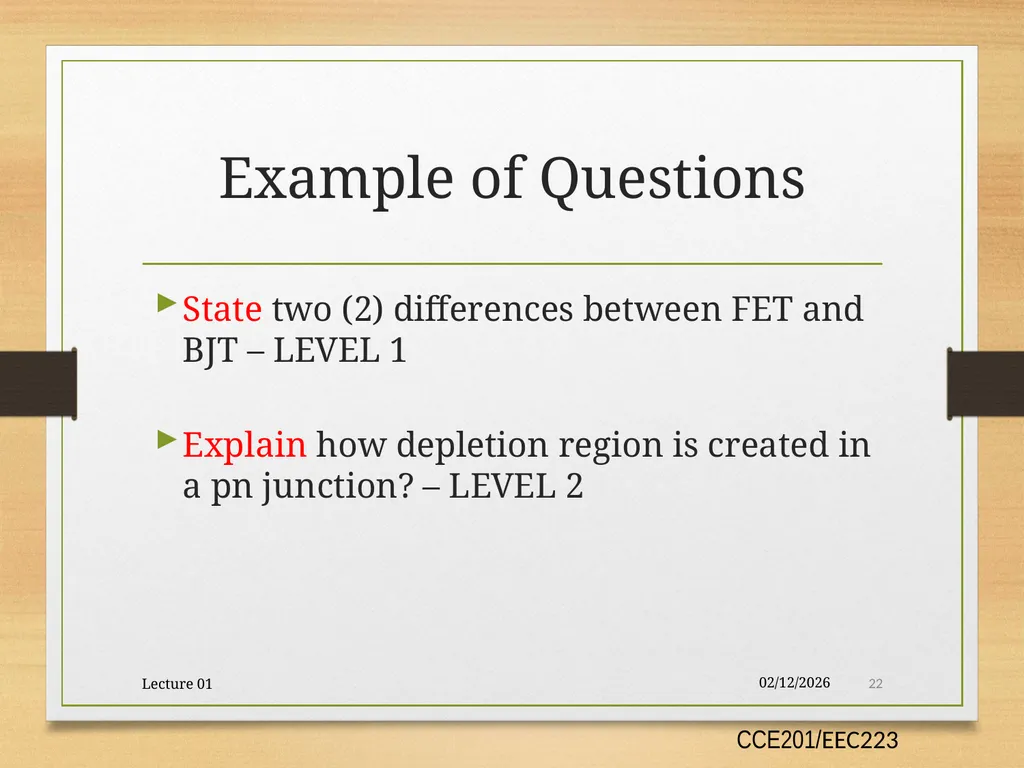
Example of Questions State two (2) differences between FET and BJT – LEVEL 1
Explain how depletion region is created in a pn junction? – LEVEL 2 9/30/2017 Lecture 01 22<br>
23
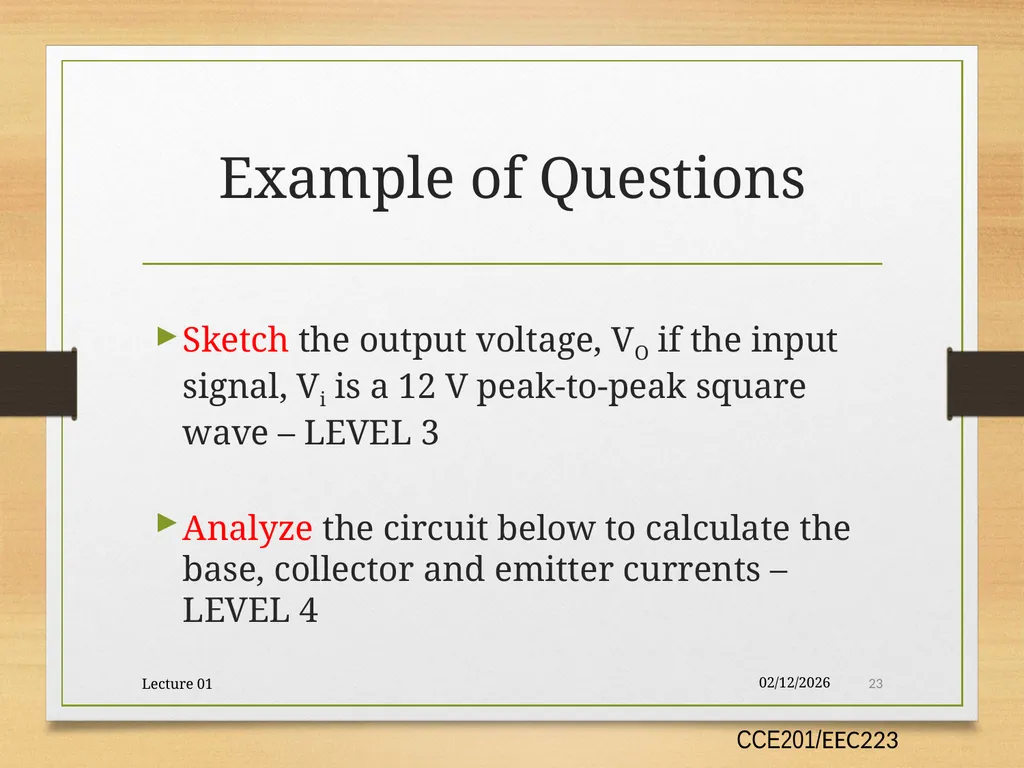
Example of Questions Sketch the output voltage, VO if the input signal, Vi is a 12 V peak-to-peak square wave – LEVEL 3
Analyze the circuit below to calculate the base, collector and emitter currents – LEVEL 4 9/30/2017 Lecture 01 23<br>
24
Example of Questions Compare the two characteristics for a conventional pn-junction diode and a Zener diode – LEVEL 4/5
Evaluate the circuit below to determine whether the BJT is in cut-off, active or saturation mode – LEVEL 5 9/30/2017 Lecture 01 24<br>
25
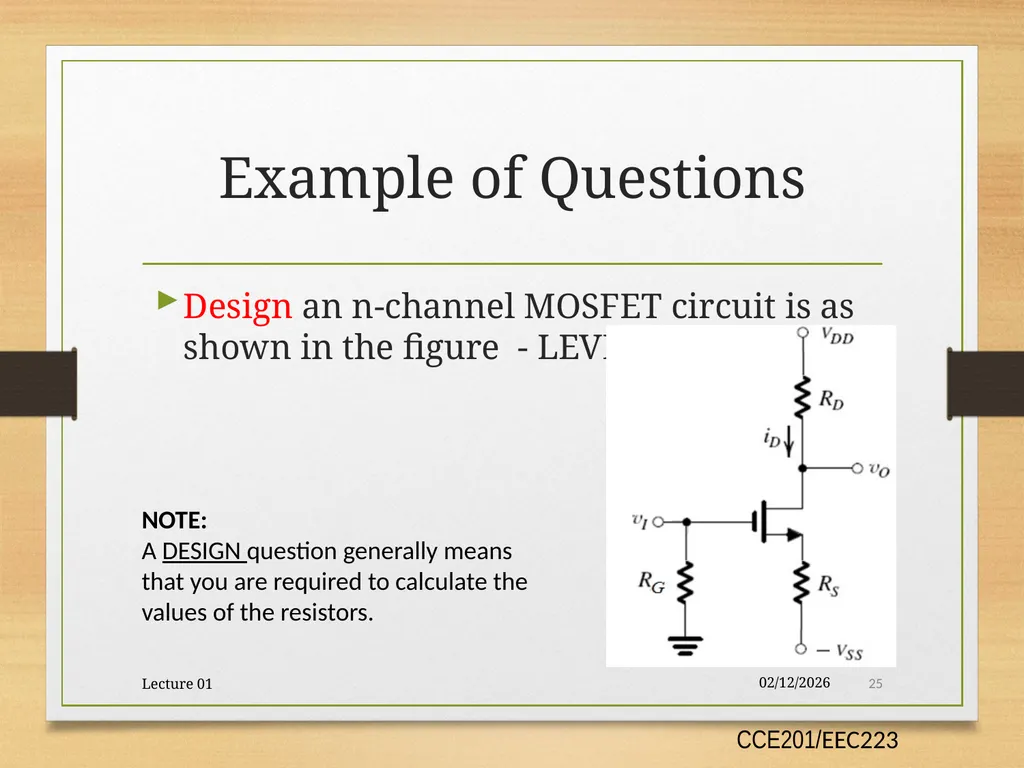
Example of Questions Design an n-channel MOSFET circuit is as shown in the figure - LEVEL 6 9/30/2017 Lecture 01 25 NOTE:
A DESIGN question generally means that you are required to calculate the values of the resistors.<br>