
Lecture 2 Volumetric analysis By M.SC.Elham Faisal



Description: Lecture 2 Volumetric analysis By M.SC.Elham Faisal M.S.c.Wafaa Ajam Analytical chemistry Ministry of higher education and scientific research AL-Mustaqbal University college Department of medical physics Introduction Chemical analysis plays
Related Topics
Download Presentation
"Lecture 2 Volumetric analysis By M.SC.Elham Faisal" is the property of its rightful owner. Permission is granted to download and print the materials on this website for personal, non-commercial use only, and to display it on your personal computer provided you do not modify the materials and that you retain all copyright notices contained in the materials. By downloading content from our website, you accept the terms of this agreement.
Presentation Transcript
slide1. Lecture 2 Volumetric analysis
By
M.SC.Elham Faisal
M.S.c.Wafaa Ajam Analytical chemistry Ministry of higher education and scientific research
AL-Mustaqbal University college
Department of medical physics<br>
slide2. Introduction Chemical analysis plays an important role in
study of composition or constituents of substances or material.
The chemical analysis is broadly divided into
two types:
Qualitative analysis
Quantitative analysis<br>
slide3. The volumetric is a chemical analytical procedure based on measurement of volumes of reaction in solutions.
The weight of the required constituents is indirectly obtained by measuring the volume of a solution of known composition required to react with a known volume of a solution containing an unknown weight of the desired constituent.
This is done by a process known as titration which is divided into four types depending upon the nature of the chemical reaction . The four types are:
a. Acid – base or neutralization methods
b. Precipitation methods
c. Complex metric methods
d. Oxidation – reduction methods<br>
slide4. In volumetric analysis, concentration of substances are found out by volume determination.
The unit used for measurement of volume of a liquid or solution is “litre”.
The litre is defined as:
the volume of one cubic decimeter or one kilogram of water at its maximum density at 4°C.’<br>
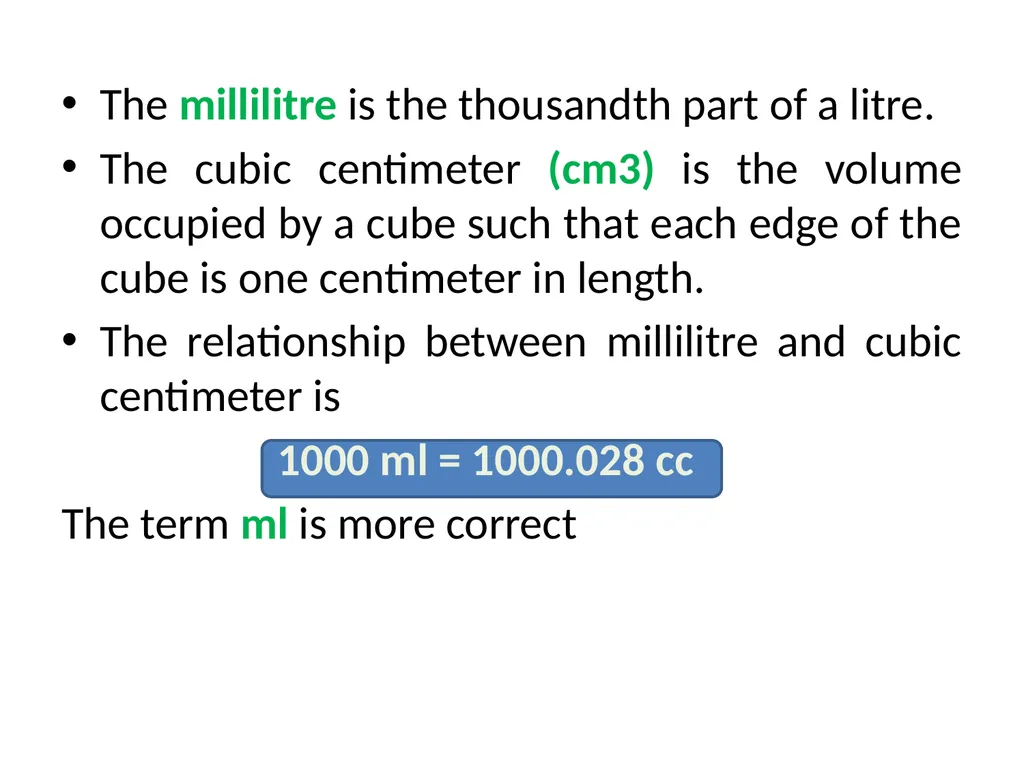
slide5. The millilitre is the thousandth part of a litre.
The cubic centimeter (cm3) is the volume occupied by a cube such that each edge of the cube is one centimeter in length.
The relationship between millilitre and cubic centimeter is
1000 ml = 1000.028 cc
The term ml is more correct<br>
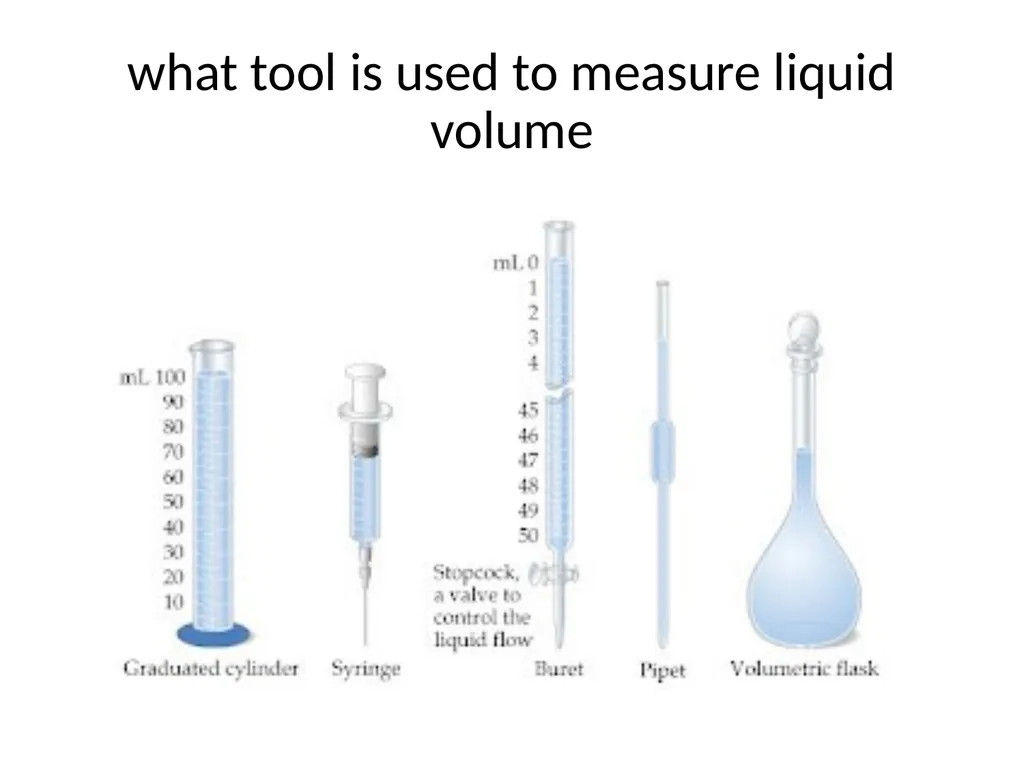
slide6. what tool is used to measure liquid volume<br>
slide7. ACCURACY :is the error associated with how close a measurement is to the true or actual value. If an instrument gives values that are very close to the true value we say that it is ACCURATE.
Example: A graduated cylinder upon measuring the same sample three times gave 566 mL, 584 mL, and 541 mL.The average of these three values is 563.7 mL. If the true value was 563.688 mL, we would say that the average was accurate but the individual measurements were neither accurate nor precise. Accuracy and the Measurement of Volume<br>
slide8. PRECISION : is the error associated with how close several measurements of the same quantity are to each other. If an instrument upon repeated measurements gives values that are very close to each other we say that the instrument is PRECISE.
Example: If the measurements in the above example were 563 mL, 564 mL, and 564 mL (average = 563.7 mL) and the true value was 563.688 mL then the measurements are both precise and accurate. The last case is, ofcourse, the idea<br>
slide9. Methods of Expressing Concentration of solutions There are many systems of expressing the contraction of solutions.
Weight of solute present in a given volume of solution.
Moles of solute present in one litre of solution, called molarity.
Gram equivalents of solute present in one litre of solution, called normality.
Percentage of solute by weight in a solution of known specific gravity.<br>
slide10. In preparation of solution using this system, a known weight of the solute is dissolved and diluted to known volume.
If accuracy is required, the solute is weighed and transferred to a volumetric flask, and diluted to a known volume.
The concentration is usually expressed as grams of solute per millilitre of solution.
Any multiple or fractional part of such solution will contain a known weight of solute. 1-Weight of Solute per Unit Volume of Solution<br>
slide11. 2. Molarity
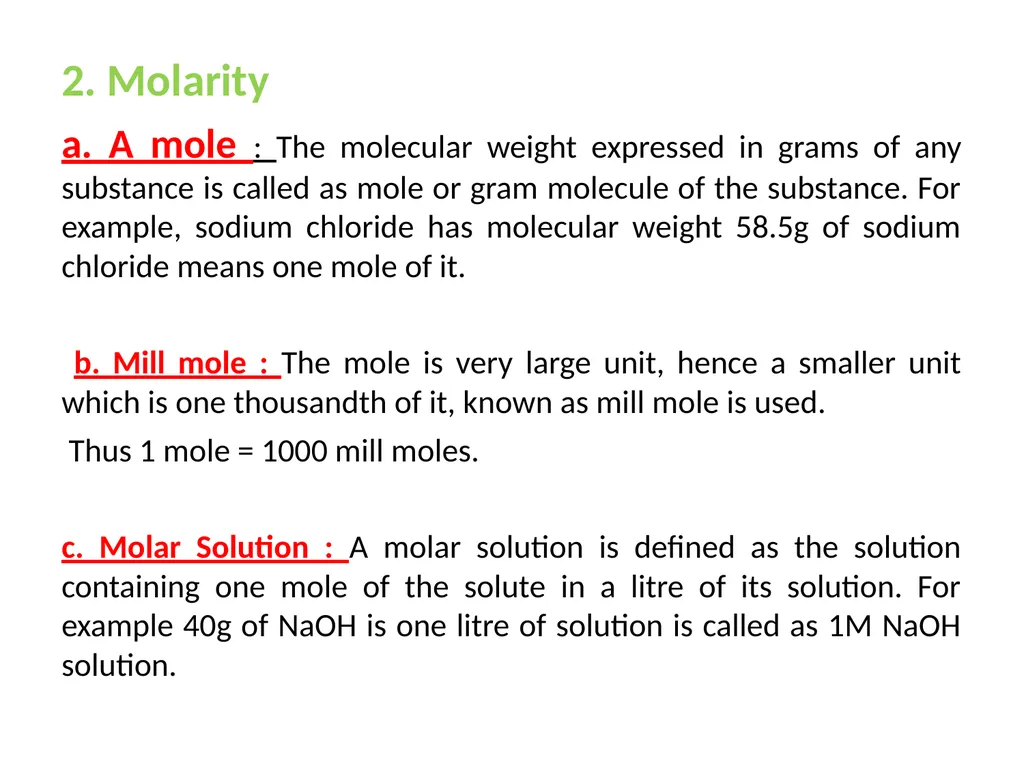
a. A mole : The molecular weight expressed in grams of any substance is called as mole or gram molecule of the substance. For example, sodium chloride has molecular weight 58.5g of sodium chloride means one mole of it.
b. Mill mole : The mole is very large unit, hence a smaller unit which is one thousandth of it, known as mill mole is used.
Thus 1 mole = 1000 mill moles.
c. Molar Solution : A molar solution is defined as the solution containing one mole of the solute in a litre of its solution. For example 40g of NaOH is one litre of solution is called as 1M NaOH solution.<br>
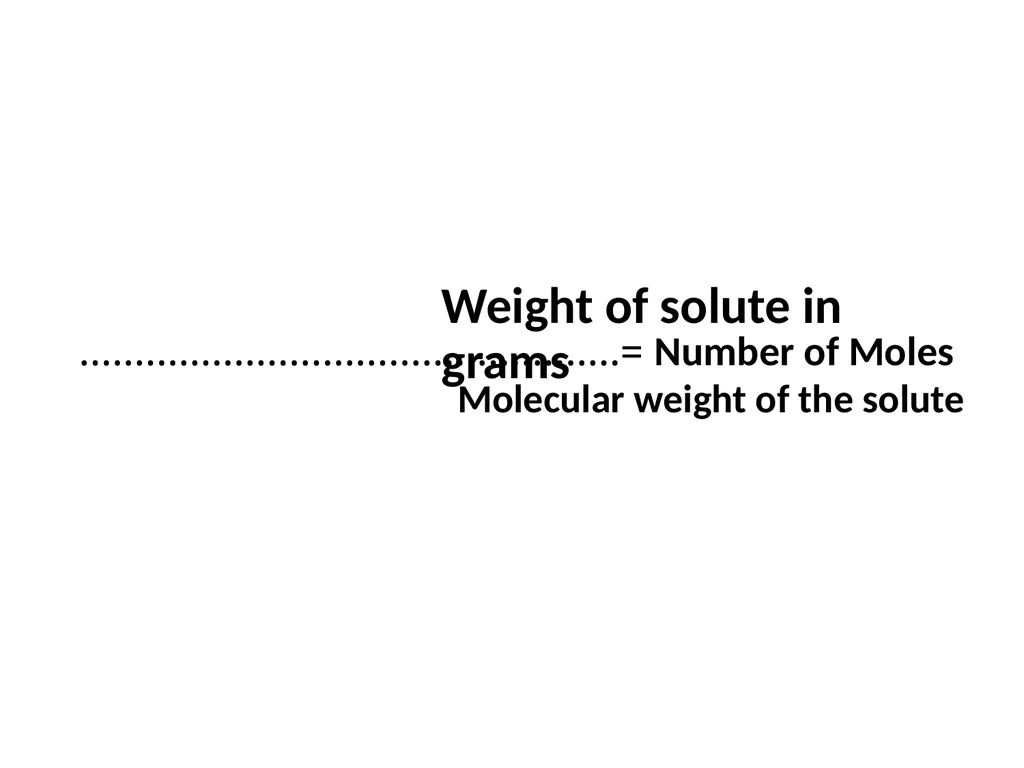
slide12. Weight of solute in grams Number of Moles =…………………………………………. Molecular weight of the solute<br>
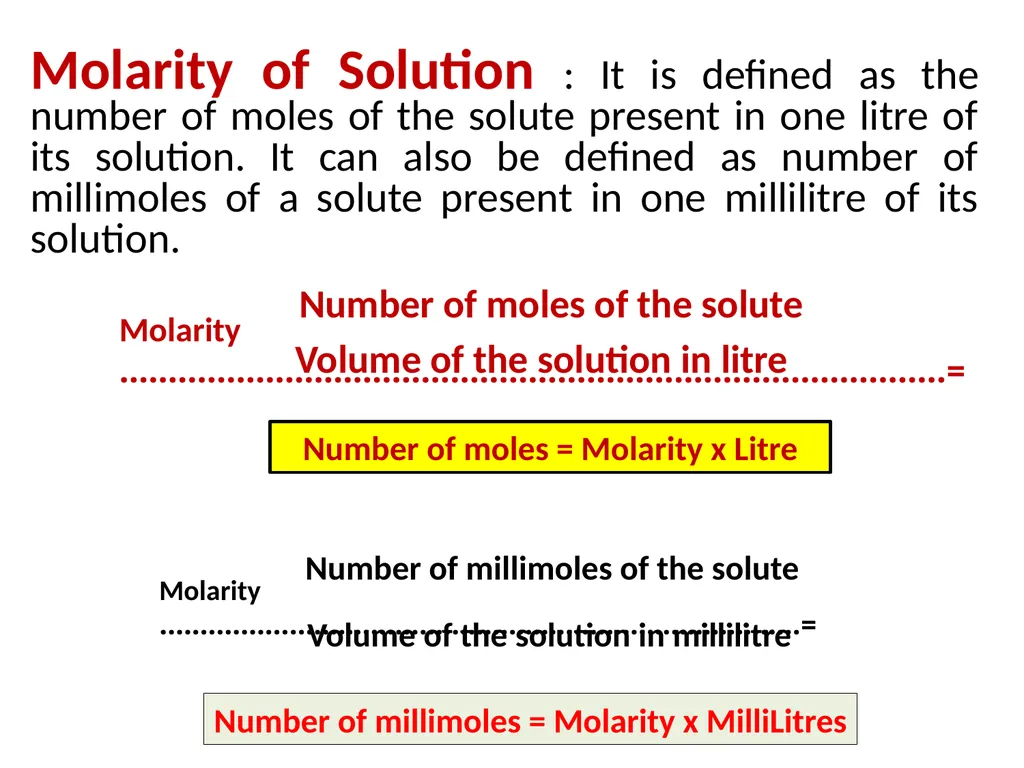
slide13. Molarity of Solution : It is defined as the number of moles of the solute present in one litre of its solution. It can also be defined as number of millimoles of a solute present in one millilitre of its solution. Number of moles = Molarity x Litre Molarity =…………………………………………………………………………. Number of moles of the solute Volume of the solution in litre Molarity =……………………………………………………………………. Number of millimoles of the solute Volume of the solution in millilitre Number of millimoles = Molarity x MilliLitres<br>
slide14. 3. Normality
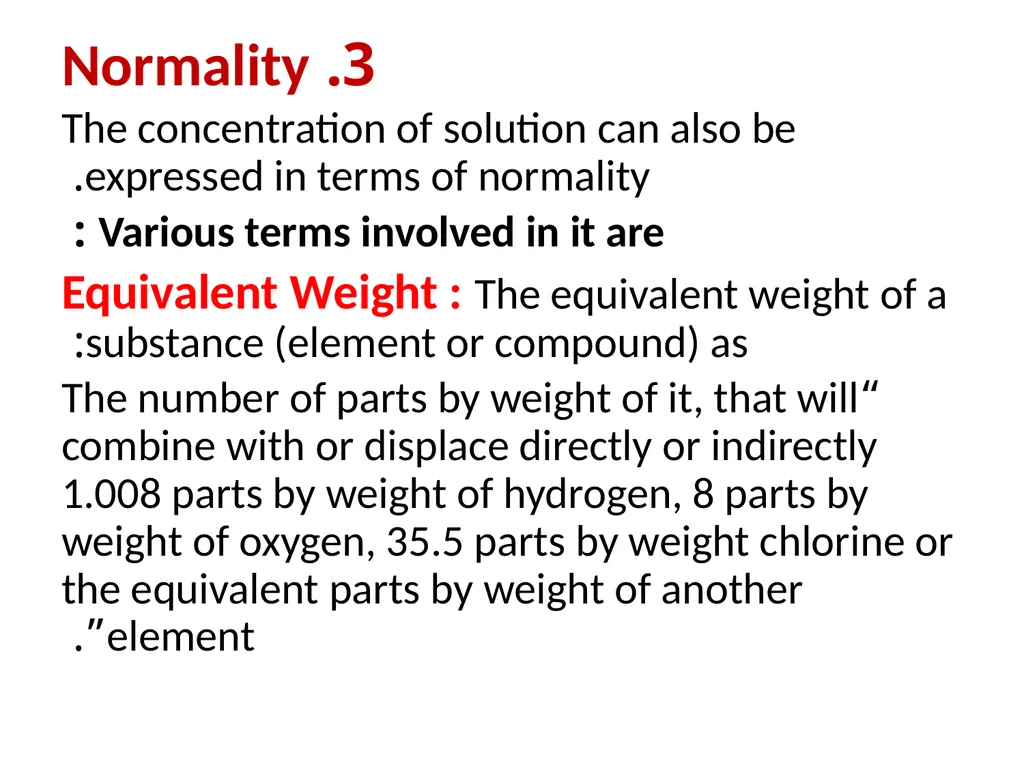
The concentration of solution can also be expressed in terms of normality.
Various terms involved in it are :
Equivalent Weight : The equivalent weight of a substance (element or compound) as:
“The number of parts by weight of it, that will combine with or displace directly or indirectly 1.008 parts by weight of hydrogen, 8 parts by weight of oxygen, 35.5 parts by weight chlorine or the equivalent parts by weight of another element”.<br>
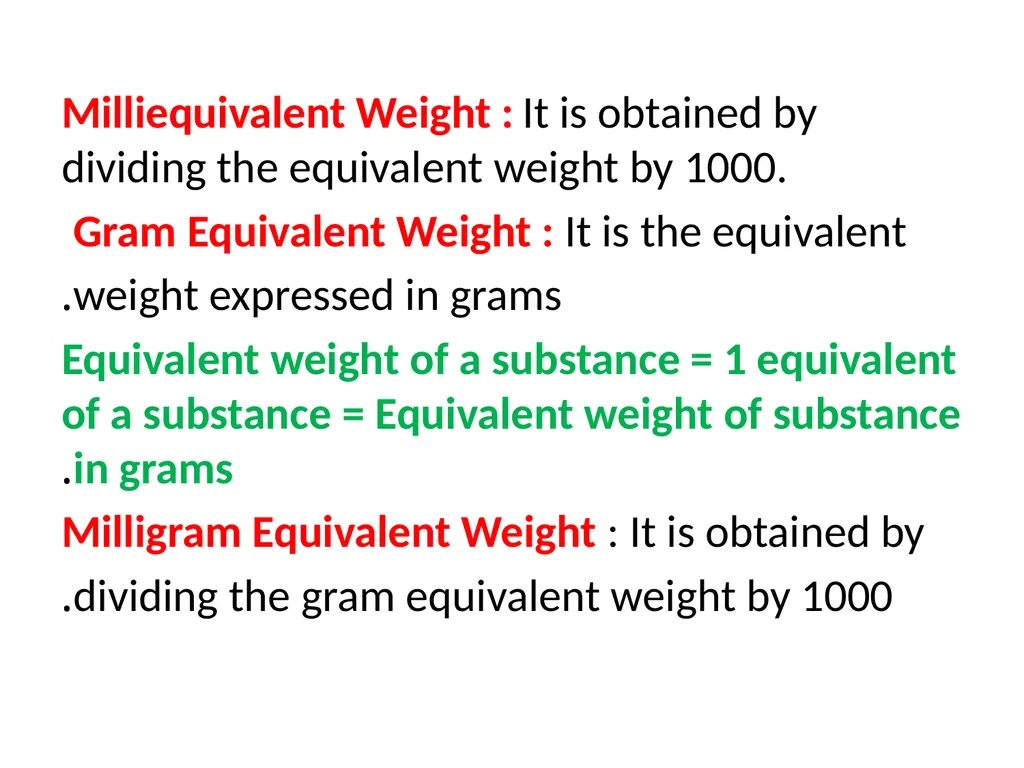
slide15. Milliequivalent Weight : It is obtained by dividing the equivalent weight by 1000.
Gram Equivalent Weight : It is the equivalent
weight expressed in grams.
Equivalent weight of a substance = 1 equivalent of a substance = Equivalent weight of substance in grams.
Milligram Equivalent Weight : It is obtained by
dividing the gram equivalent weight by 1000.<br>
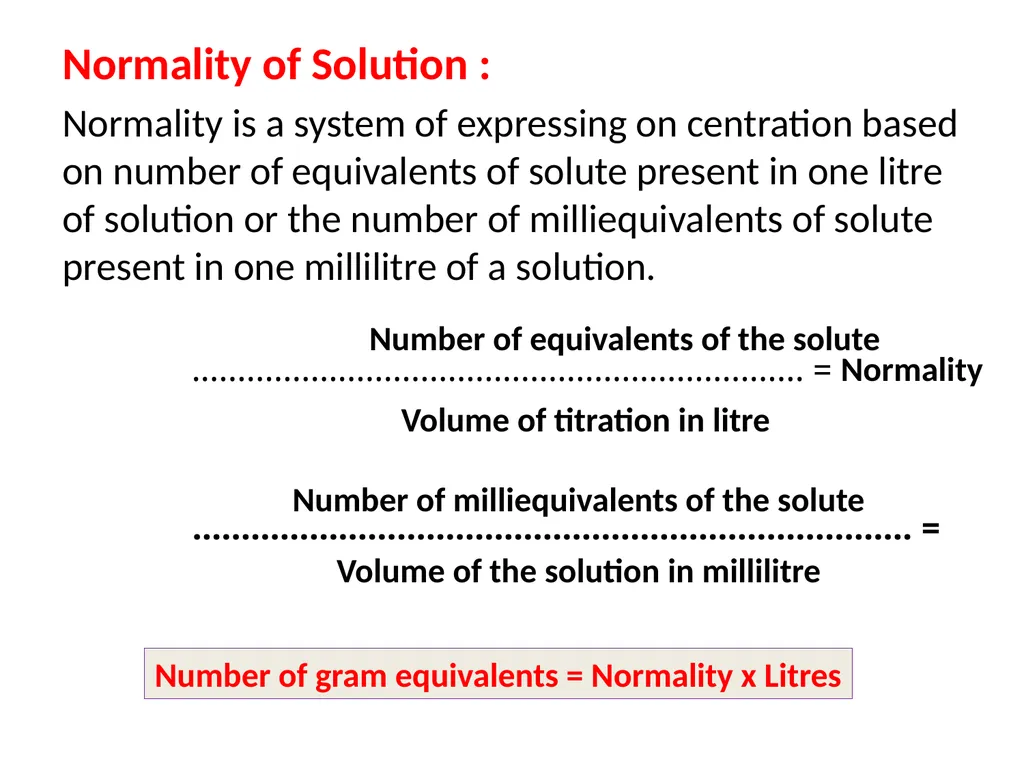
slide16. Number of equivalents of the solute Normality of Solution :
Normality is a system of expressing on centration based on number of equivalents of solute present in one litre of solution or the number of milliequivalents of solute present in one millilitre of a solution. Number of gram equivalents = Normality x Litres Normality = …………………………………………………………. Volume of titration in litre Number of milliequivalents of the solute = ……………………………..………………………………... Volume of the solution in millilitre<br>
By
M.SC.Elham Faisal
M.S.c.Wafaa Ajam Analytical chemistry Ministry of higher education and scientific research
AL-Mustaqbal University college
Department of medical physics<br>
slide2. Introduction Chemical analysis plays an important role in
study of composition or constituents of substances or material.
The chemical analysis is broadly divided into
two types:
Qualitative analysis
Quantitative analysis<br>
slide3. The volumetric is a chemical analytical procedure based on measurement of volumes of reaction in solutions.
The weight of the required constituents is indirectly obtained by measuring the volume of a solution of known composition required to react with a known volume of a solution containing an unknown weight of the desired constituent.
This is done by a process known as titration which is divided into four types depending upon the nature of the chemical reaction . The four types are:
a. Acid – base or neutralization methods
b. Precipitation methods
c. Complex metric methods
d. Oxidation – reduction methods<br>
slide4. In volumetric analysis, concentration of substances are found out by volume determination.
The unit used for measurement of volume of a liquid or solution is “litre”.
The litre is defined as:
the volume of one cubic decimeter or one kilogram of water at its maximum density at 4°C.’<br>
slide5. The millilitre is the thousandth part of a litre.
The cubic centimeter (cm3) is the volume occupied by a cube such that each edge of the cube is one centimeter in length.
The relationship between millilitre and cubic centimeter is
1000 ml = 1000.028 cc
The term ml is more correct<br>
slide6. what tool is used to measure liquid volume<br>
slide7. ACCURACY :is the error associated with how close a measurement is to the true or actual value. If an instrument gives values that are very close to the true value we say that it is ACCURATE.
Example: A graduated cylinder upon measuring the same sample three times gave 566 mL, 584 mL, and 541 mL.The average of these three values is 563.7 mL. If the true value was 563.688 mL, we would say that the average was accurate but the individual measurements were neither accurate nor precise. Accuracy and the Measurement of Volume<br>
slide8. PRECISION : is the error associated with how close several measurements of the same quantity are to each other. If an instrument upon repeated measurements gives values that are very close to each other we say that the instrument is PRECISE.
Example: If the measurements in the above example were 563 mL, 564 mL, and 564 mL (average = 563.7 mL) and the true value was 563.688 mL then the measurements are both precise and accurate. The last case is, ofcourse, the idea<br>
slide9. Methods of Expressing Concentration of solutions There are many systems of expressing the contraction of solutions.
Weight of solute present in a given volume of solution.
Moles of solute present in one litre of solution, called molarity.
Gram equivalents of solute present in one litre of solution, called normality.
Percentage of solute by weight in a solution of known specific gravity.<br>
slide10. In preparation of solution using this system, a known weight of the solute is dissolved and diluted to known volume.
If accuracy is required, the solute is weighed and transferred to a volumetric flask, and diluted to a known volume.
The concentration is usually expressed as grams of solute per millilitre of solution.
Any multiple or fractional part of such solution will contain a known weight of solute. 1-Weight of Solute per Unit Volume of Solution<br>
slide11. 2. Molarity
a. A mole : The molecular weight expressed in grams of any substance is called as mole or gram molecule of the substance. For example, sodium chloride has molecular weight 58.5g of sodium chloride means one mole of it.
b. Mill mole : The mole is very large unit, hence a smaller unit which is one thousandth of it, known as mill mole is used.
Thus 1 mole = 1000 mill moles.
c. Molar Solution : A molar solution is defined as the solution containing one mole of the solute in a litre of its solution. For example 40g of NaOH is one litre of solution is called as 1M NaOH solution.<br>
slide12. Weight of solute in grams Number of Moles =…………………………………………. Molecular weight of the solute<br>
slide13. Molarity of Solution : It is defined as the number of moles of the solute present in one litre of its solution. It can also be defined as number of millimoles of a solute present in one millilitre of its solution. Number of moles = Molarity x Litre Molarity =…………………………………………………………………………. Number of moles of the solute Volume of the solution in litre Molarity =……………………………………………………………………. Number of millimoles of the solute Volume of the solution in millilitre Number of millimoles = Molarity x MilliLitres<br>
slide14. 3. Normality
The concentration of solution can also be expressed in terms of normality.
Various terms involved in it are :
Equivalent Weight : The equivalent weight of a substance (element or compound) as:
“The number of parts by weight of it, that will combine with or displace directly or indirectly 1.008 parts by weight of hydrogen, 8 parts by weight of oxygen, 35.5 parts by weight chlorine or the equivalent parts by weight of another element”.<br>
slide15. Milliequivalent Weight : It is obtained by dividing the equivalent weight by 1000.
Gram Equivalent Weight : It is the equivalent
weight expressed in grams.
Equivalent weight of a substance = 1 equivalent of a substance = Equivalent weight of substance in grams.
Milligram Equivalent Weight : It is obtained by
dividing the gram equivalent weight by 1000.<br>
slide16. Number of equivalents of the solute Normality of Solution :
Normality is a system of expressing on centration based on number of equivalents of solute present in one litre of solution or the number of milliequivalents of solute present in one millilitre of a solution. Number of gram equivalents = Normality x Litres Normality = …………………………………………………………. Volume of titration in litre Number of milliequivalents of the solute = ……………………………..………………………………... Volume of the solution in millilitre<br>