Volumetric Method of Analysis Volumetric method: Its one in which the analysis is completed by measuring the volume of a solution of known concentration needed to react completely with the substance being determined. Titration: Its a
"Volumetric Method of Analysis Volumetric method:" is the property of its rightful owner. Permission is granted to
download and print the materials on this website for personal, non-commercial use only, and to display it
on your personal computer provided you do not modify the materials and that you retain all copyright
notices contained in the materials. By downloading content from our website, you accept the terms of this
agreement.
Presentation Transcript
01
Volumetric Method
of Analysis<br>
02
Volumetric method:
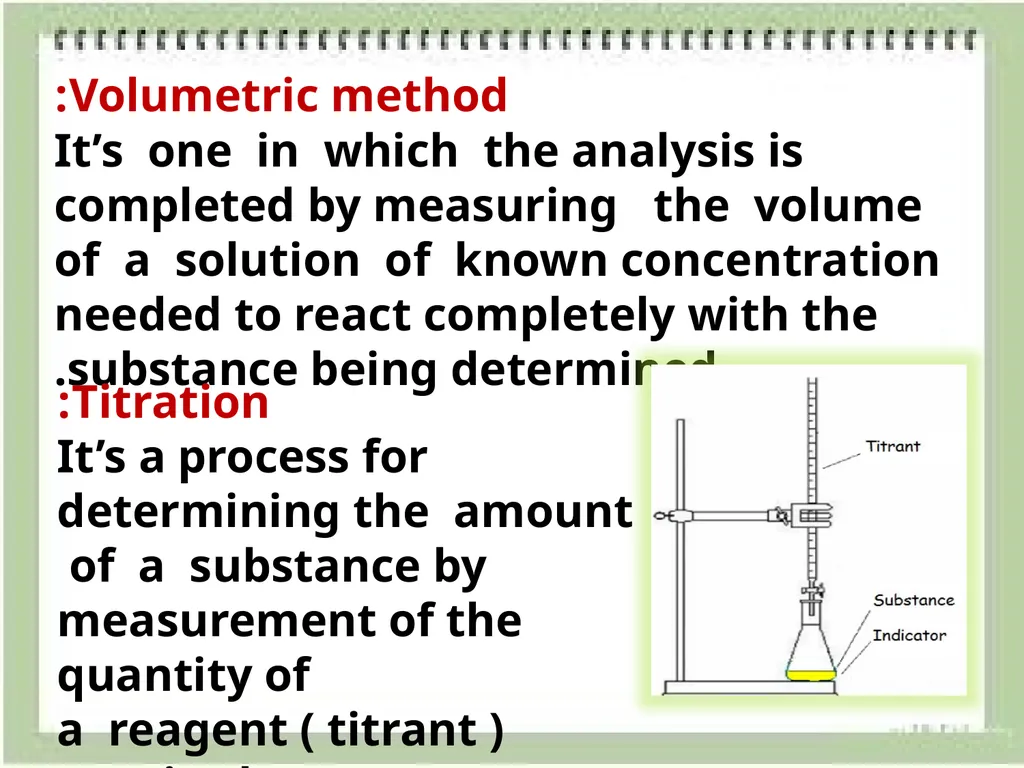
It’s one in which the analysis is completed by measuring the volume of a solution of known concentration needed to react completely with the substance being determined. Titration:
It’s a process for determining the amount of a substance by measurement of the quantity of
a reagent ( titrant ) required to react completely with that subs..<br>
03
Standardization:
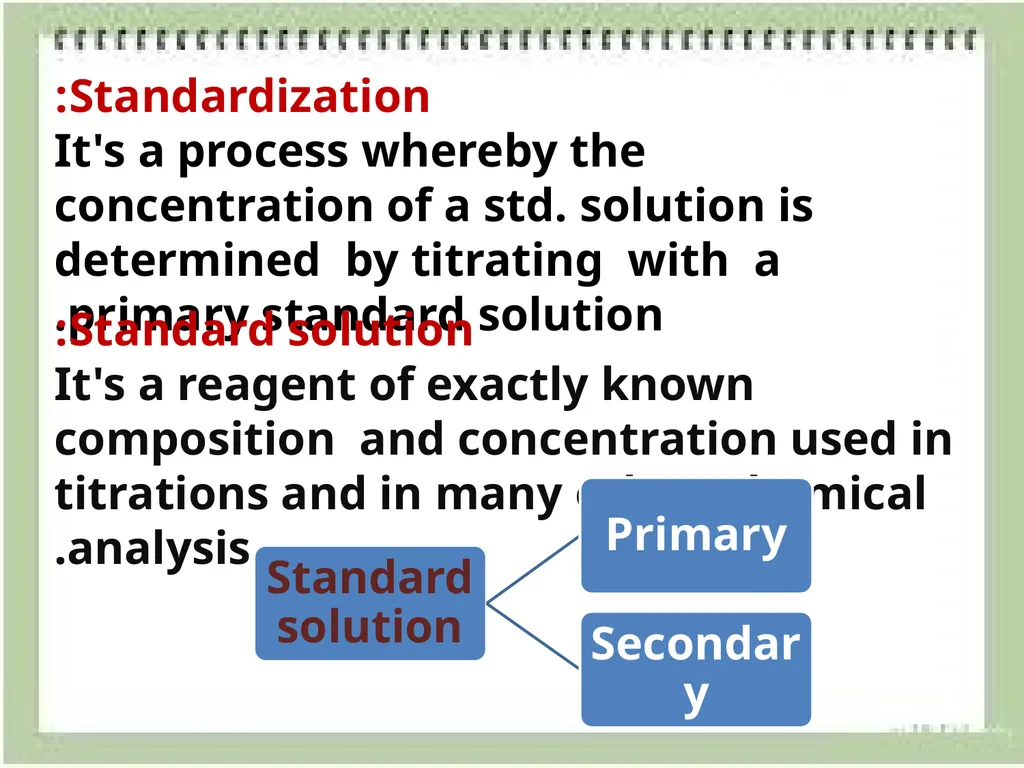
It's a process whereby the concentration of a std. solution is determined by titrating with a primary standard solution. Standard solution:
It's a reagent of exactly known composition and concentration used in titrations and in many other chemical analysis.<br>
04
Primary standard:
It's a highly purified chemical compound that serves as a reference material in titrations and in other analytical methods.
Requirements for a primary standard are the following:
1. It must be of the highest purity.
2. It should be stable and not attacked by atmosphere,
( Atmospheric stability ).
3. It should not be hygroscopic.
4. It should have high equivalence, ( large molar mass ),
to minimize weighing errors.
5. It should be available and not too expensive.<br>
05
Very few compounds meet or even approach
these criteria, and only a limited number of
primary – standard substances are available
commercially. As a consequence,
less pure compounds must sometimes be
used in place of a primary standard.
The purity of such a secondary standard
must be established by careful analysis. Secondary standard:
It is a compound whose purity has been
determined by chemical analysis.
The secondary standard serves as the work -ing standard material for titrations and for many other analysis.<br>
06
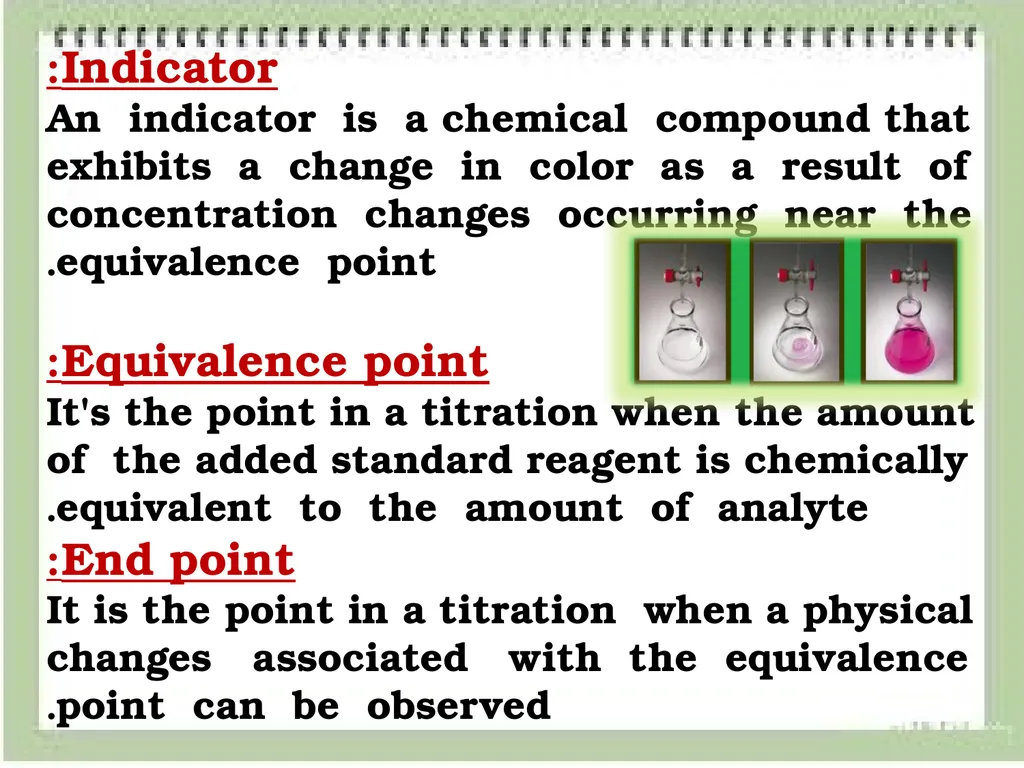
Indicator:
An indicator is a chemical compound that
exhibits a change in color as a result of concentration changes occurring near the equivalence point.
Equivalence point:
It's the point in a titration when the amount of the added standard reagent is chemically equivalent to the amount of analyte.
End point:
It is the point in a titration when a physical
changes associated with the equivalence point can be observed.<br>
07
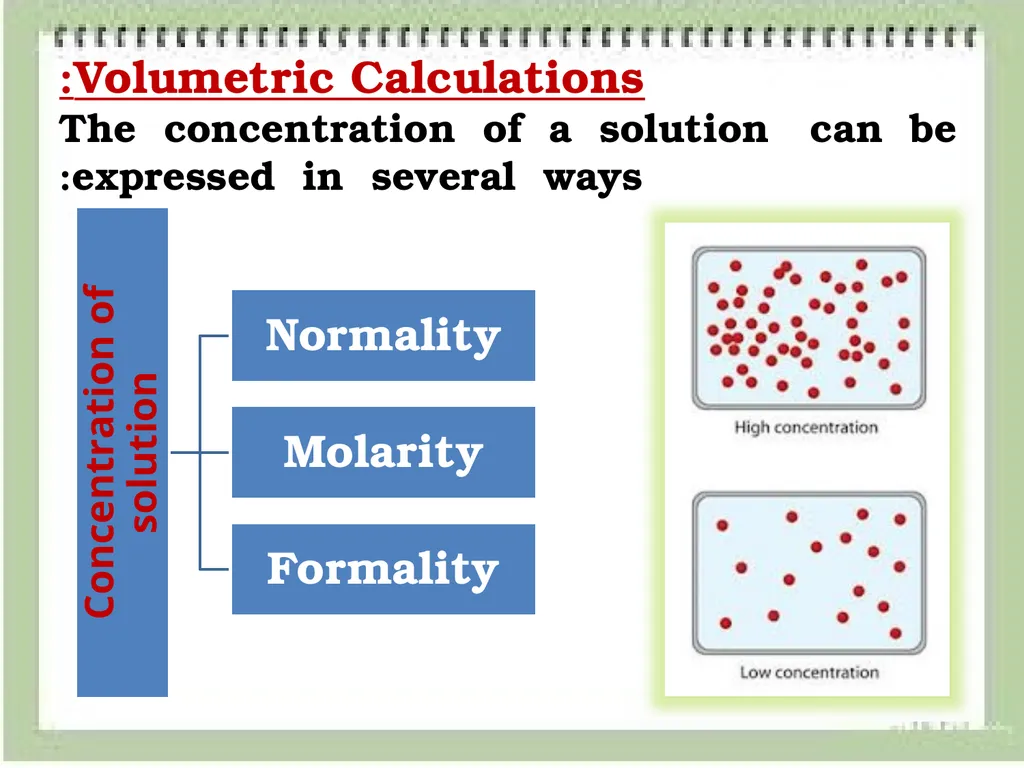
Volumetric Calculations:
The concentration of a solution can be
expressed in several ways:<br>
08
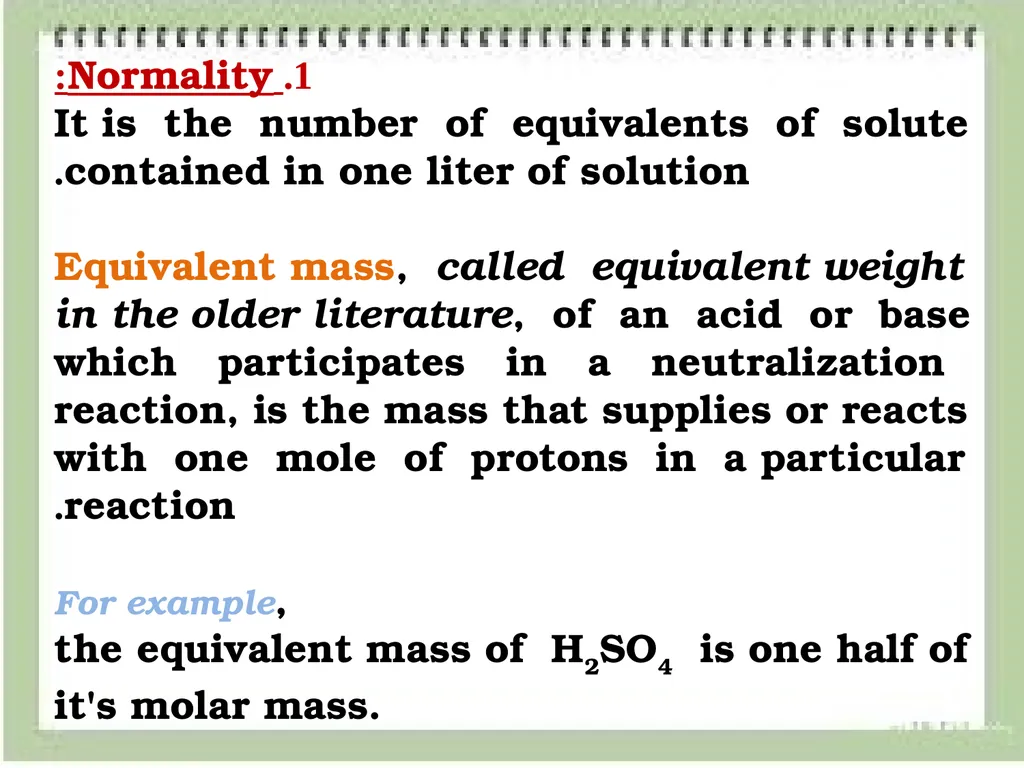
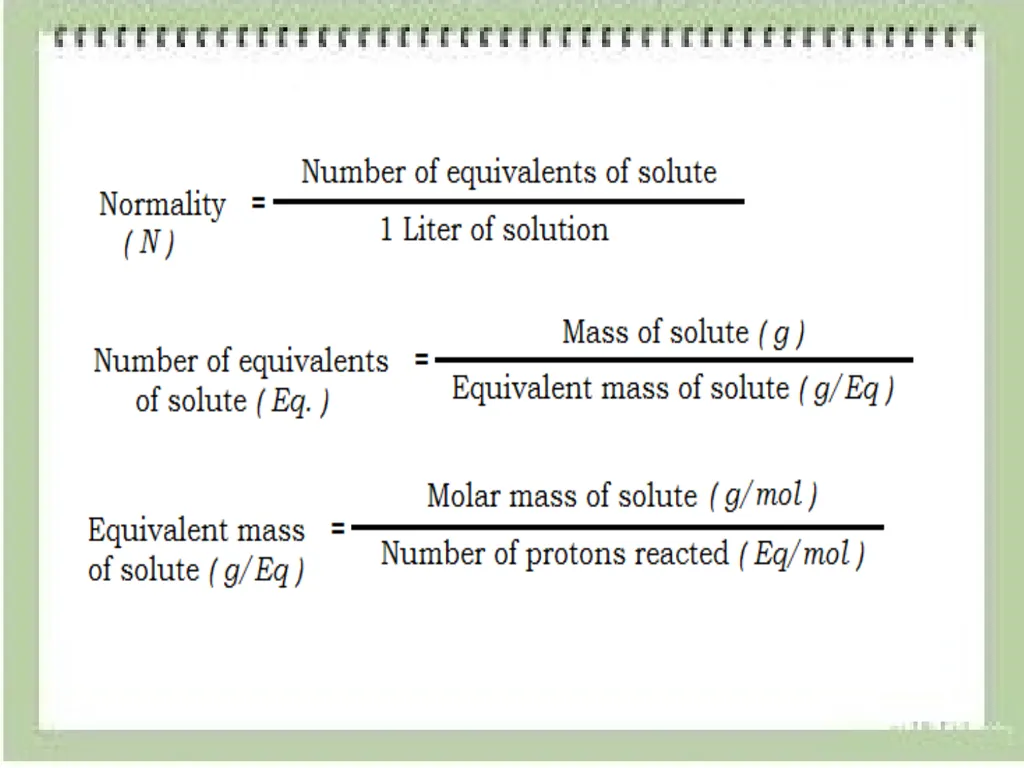
1. Normality:
It is the number of equivalents of solute
contained in one liter of solution.
Equivalent mass, called equivalent weight in the older literature, of an acid or base which participates in a neutralization reaction, is the mass that supplies or reacts with one mole of protons in a particular reaction.
For example,
the equivalent mass of H2SO4 is one half of it's molar mass.<br>
09
2. Molarity:
It is the number of gram molar mass or the number of moles of solute in one liter of solution.<br>
10
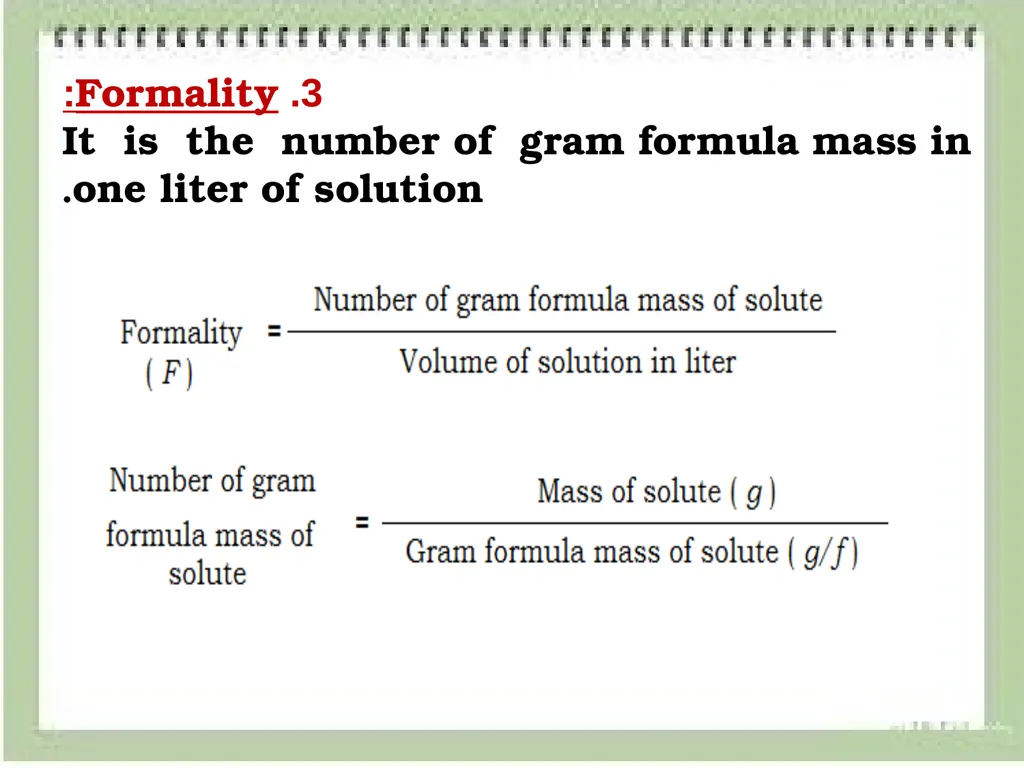
3. Formality:
It is the number of gram formula mass in one liter of solution.<br>
11
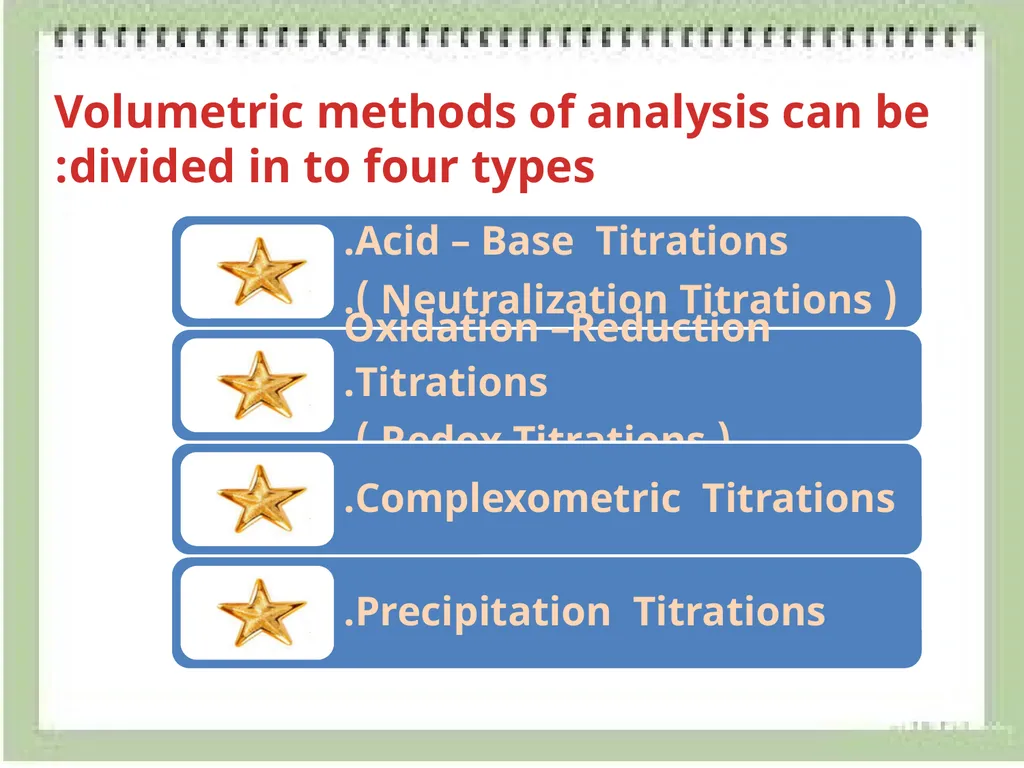
Volumetric methods of analysis can be divided in to four types:<br>
12
Neutralization Titrations
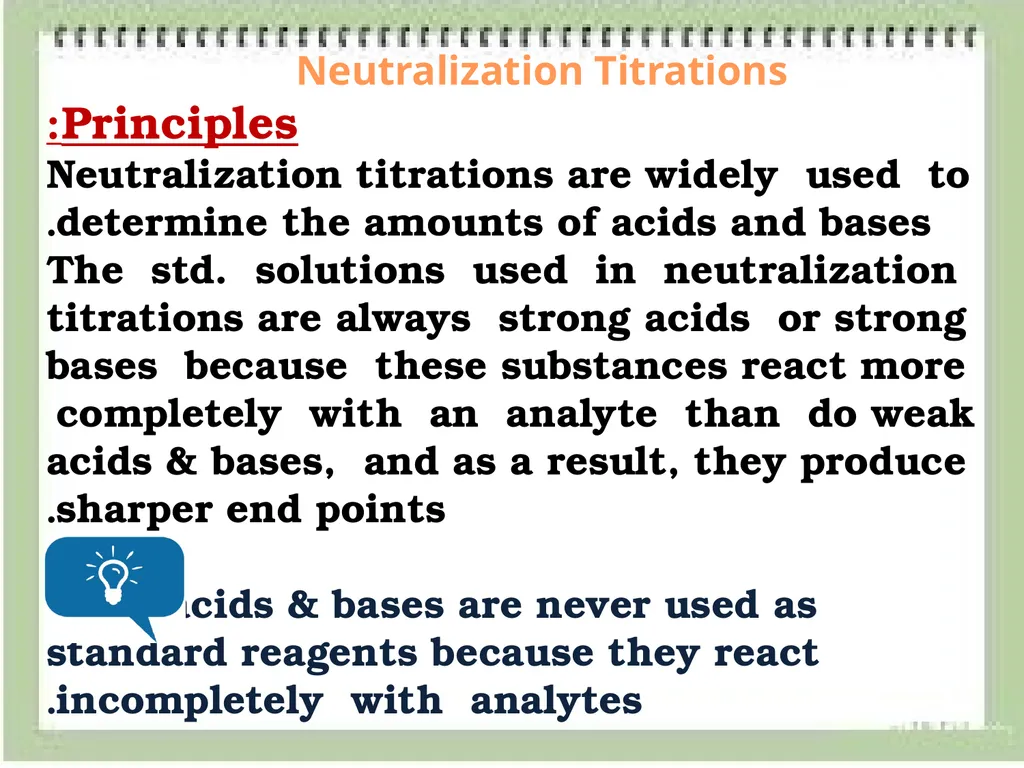
Principles:
Neutralization titrations are widely used to
determine the amounts of acids and bases.
The std. solutions used in neutralization titrations are always strong acids or strong bases because these substances react more
completely with an analyte than do weak
acids & bases, and as a result, they produce sharper end points.
Weak acids & bases are never used as
standard reagents because they react
incompletely with analytes.<br>
13
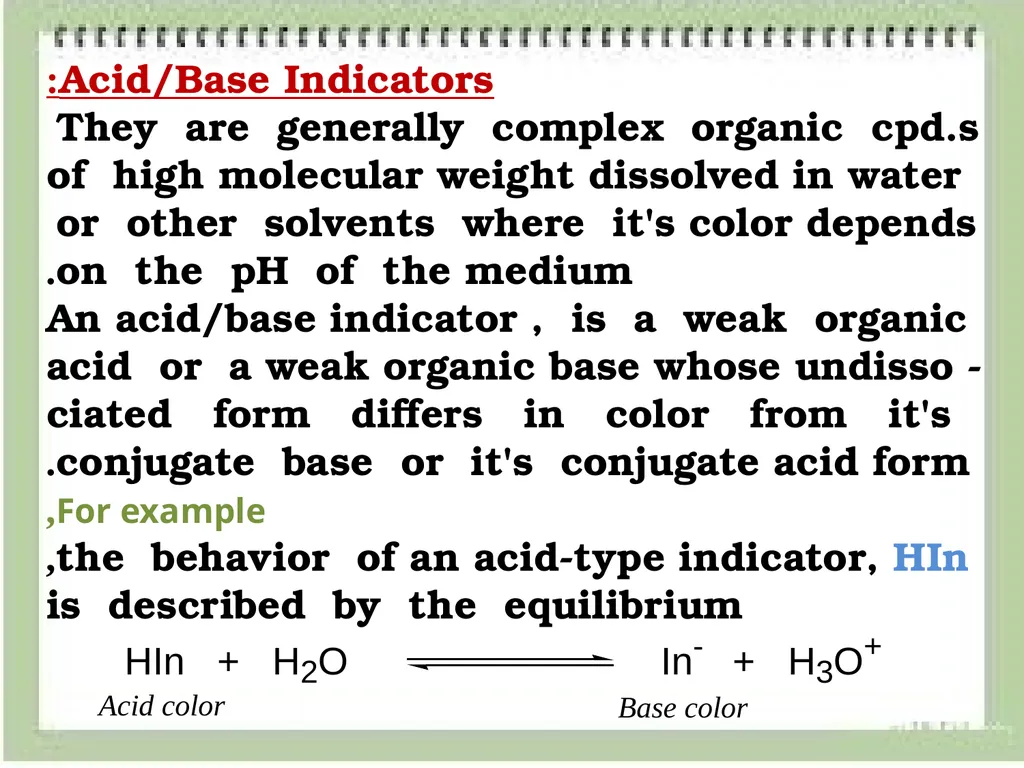
Acid/Base Indicators:
They are generally complex organic cpd.s
of high molecular weight dissolved in water
or other solvents where it's color depends
on the pH of the medium.
An acid/base indicator , is a weak organic
acid or a weak organic base whose undisso - ciated form differs in color from it's
conjugate base or it's conjugate acid form.
For example,
the behavior of an acid-type indicator, HIn,
is described by the equilibrium<br>
14
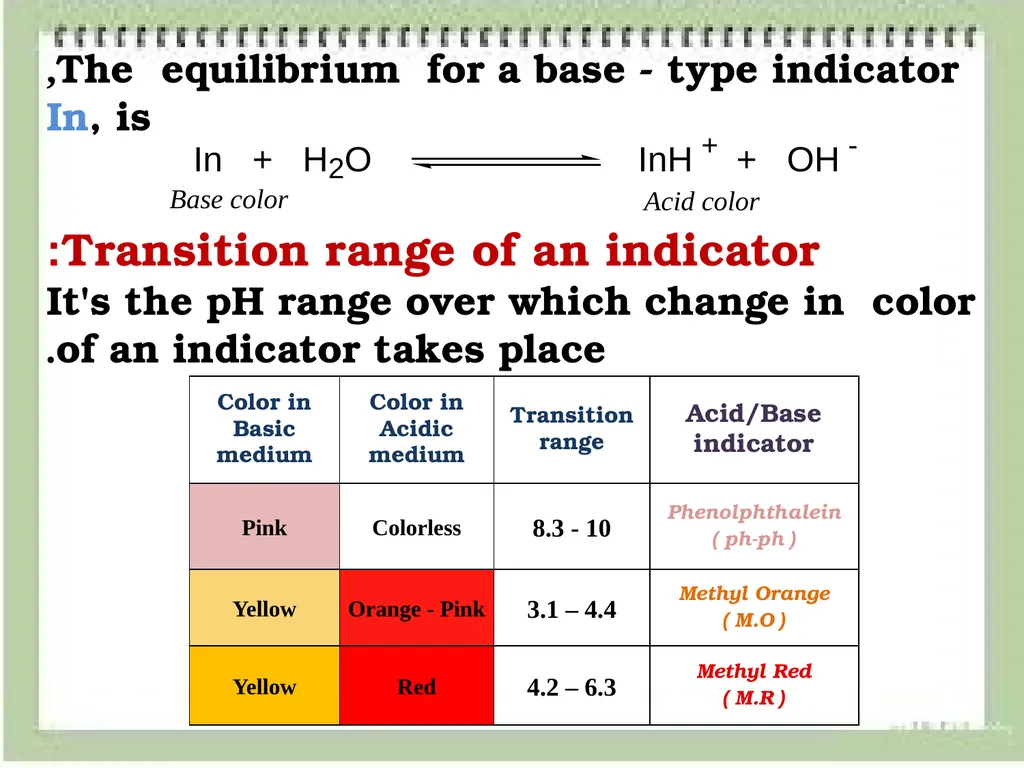
The equilibrium for a base - type indicator,
In, is Transition range of an indicator:
It's the pH range over which change in color
of an indicator takes place.<br>
15
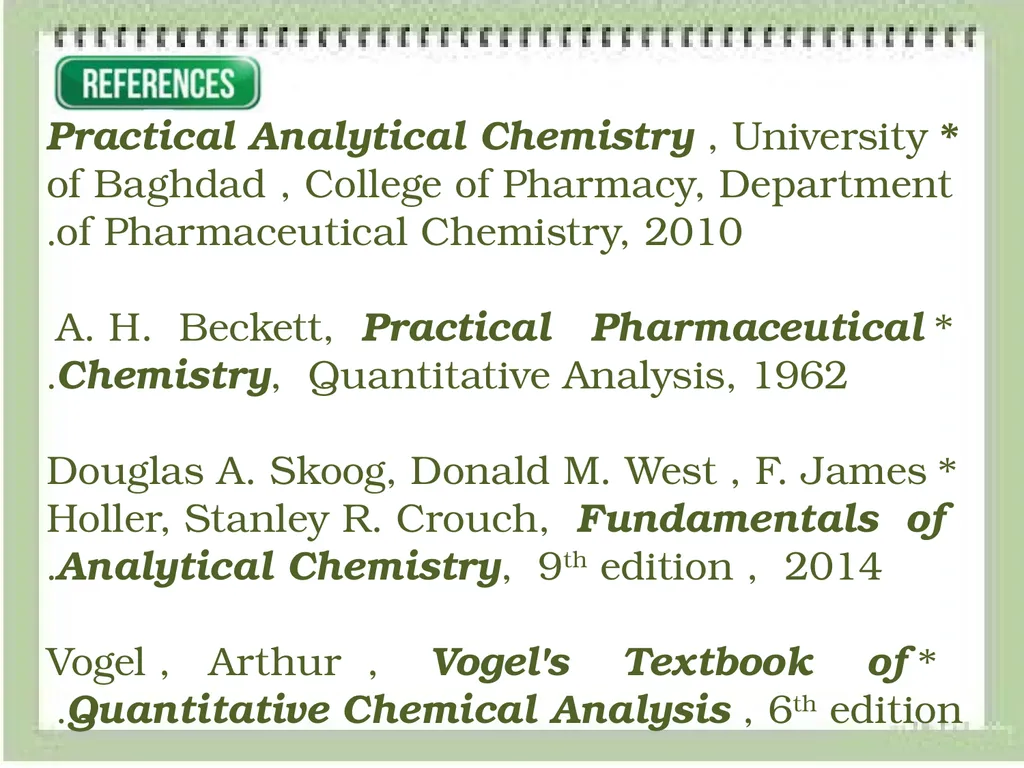
* Practical Analytical Chemistry , University of Baghdad , College of Pharmacy, Department of Pharmaceutical Chemistry, 2010.
* A. H. Beckett, Practical Pharmaceutical
Chemistry, Quantitative Analysis, 1962.
* Douglas A. Skoog, Donald M. West , F. James Holler, Stanley R. Crouch, Fundamentals of Analytical Chemistry, 9th edition , 2014.
* Vogel , Arthur , Vogel's Textbook of Quantitative Chemical Analysis , 6th edition.<br>