
Lecture 3, Term II Biopower and De(constructing)
MY
Published · 20 slides · 0 views
1 / 1



Description
Lecture 3, Term II Biopower and De(constructing) Experience Dr Claudia Stein Recap: Foucault develops his view of modern power AGAINST prevailing ideas of power at the time, mainly Marxists ideas of power: 1. power as manifestations of a
Related Topics
Share
Embed code
Download this presentation From Below
"Lecture 3, Term II Biopower and De(constructing)" is the property of its rightful owner. Permission is granted to download and print the materials on this website for personal, non-commercial use only, and to display it on your personal computer provided you do not modify the materials and that you retain all copyright notices contained in the materials. By downloading content from our website, you accept the terms of this agreement.
Presentation Transcript
01
Lecture 3, Term II
Biopower and De(constructing) Experience
Dr Claudia Stein<br>
Biopower and De(constructing) Experience
Dr Claudia Stein<br>
02
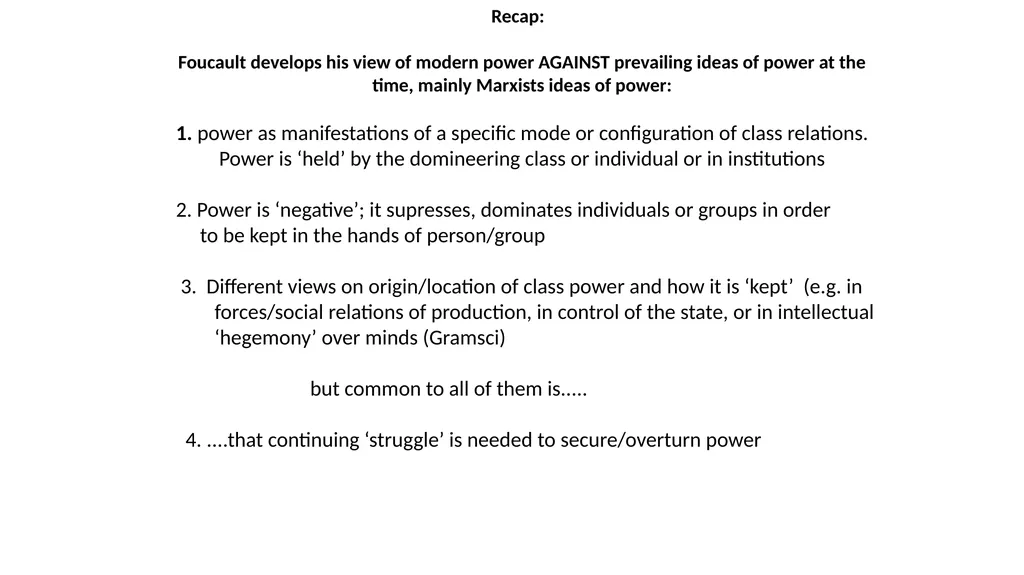
Recap:
Foucault develops his view of modern power AGAINST prevailing ideas of power at the time, mainly Marxists ideas of power:
1. power as manifestations of a specific mode or configuration of class relations. Power is ‘held’ by the domineering class or individual or in institutions
2. Power is ‘negative’; it supresses, dominates individuals or groups in order
to be kept in the hands of person/group
3. Different views on origin/location of class power and how it is ‘kept’ (e.g. in
forces/social relations of production, in control of the state, or in intellectual
‘hegemony’ over minds (Gramsci)
but common to all of them is.....
4. ....that continuing ‘struggle’ is needed to secure/overturn power<br>
Foucault develops his view of modern power AGAINST prevailing ideas of power at the time, mainly Marxists ideas of power:
1. power as manifestations of a specific mode or configuration of class relations. Power is ‘held’ by the domineering class or individual or in institutions
2. Power is ‘negative’; it supresses, dominates individuals or groups in order
to be kept in the hands of person/group
3. Different views on origin/location of class power and how it is ‘kept’ (e.g. in
forces/social relations of production, in control of the state, or in intellectual
‘hegemony’ over minds (Gramsci)
but common to all of them is.....
4. ....that continuing ‘struggle’ is needed to secure/overturn power<br>
03
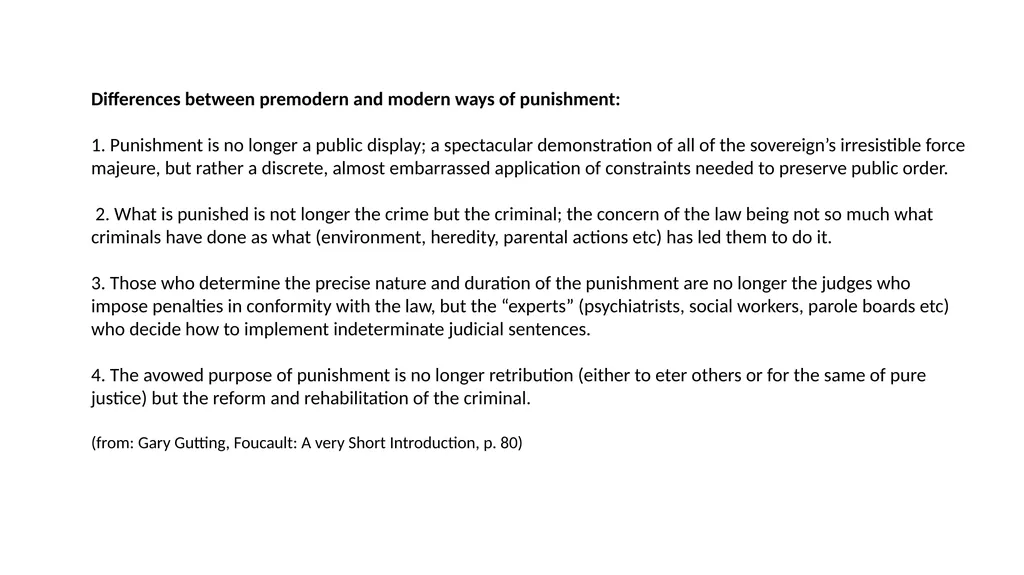
Differences between premodern and modern ways of punishment:
1. Punishment is no longer a public display; a spectacular demonstration of all of the sovereign’s irresistible force majeure, but rather a discrete, almost embarrassed application of constraints needed to preserve public order.
2. What is punished is not longer the crime but the criminal; the concern of the law being not so much what criminals have done as what (environment, heredity, parental actions etc) has led them to do it.
3. Those who determine the precise nature and duration of the punishment are no longer the judges who impose penalties in conformity with the law, but the “experts” (psychiatrists, social workers, parole boards etc) who decide how to implement indeterminate judicial sentences.
4. The avowed purpose of punishment is no longer retribution (either to eter others or for the same of pure justice) but the reform and rehabilitation of the criminal.
(from: Gary Gutting, Foucault: A very Short Introduction, p. 80)<br>
1. Punishment is no longer a public display; a spectacular demonstration of all of the sovereign’s irresistible force majeure, but rather a discrete, almost embarrassed application of constraints needed to preserve public order.
2. What is punished is not longer the crime but the criminal; the concern of the law being not so much what criminals have done as what (environment, heredity, parental actions etc) has led them to do it.
3. Those who determine the precise nature and duration of the punishment are no longer the judges who impose penalties in conformity with the law, but the “experts” (psychiatrists, social workers, parole boards etc) who decide how to implement indeterminate judicial sentences.
4. The avowed purpose of punishment is no longer retribution (either to eter others or for the same of pure justice) but the reform and rehabilitation of the criminal.
(from: Gary Gutting, Foucault: A very Short Introduction, p. 80)<br>
04
Three different forms of how to discipline bodies
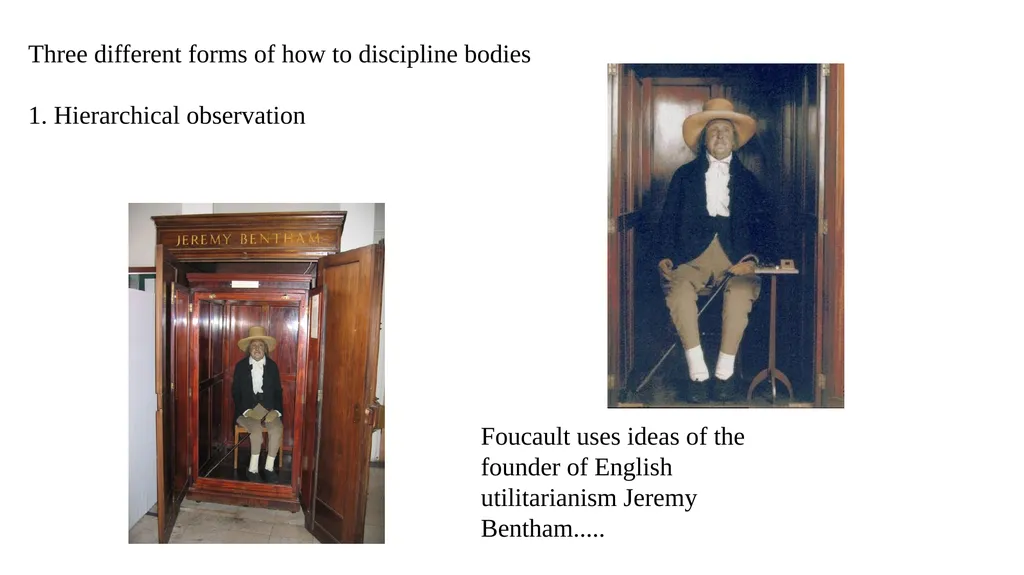
1. Hierarchical observation Foucault uses ideas of the founder of English utilitarianism Jeremy Bentham.....<br>
1. Hierarchical observation Foucault uses ideas of the founder of English utilitarianism Jeremy Bentham.....<br>
05
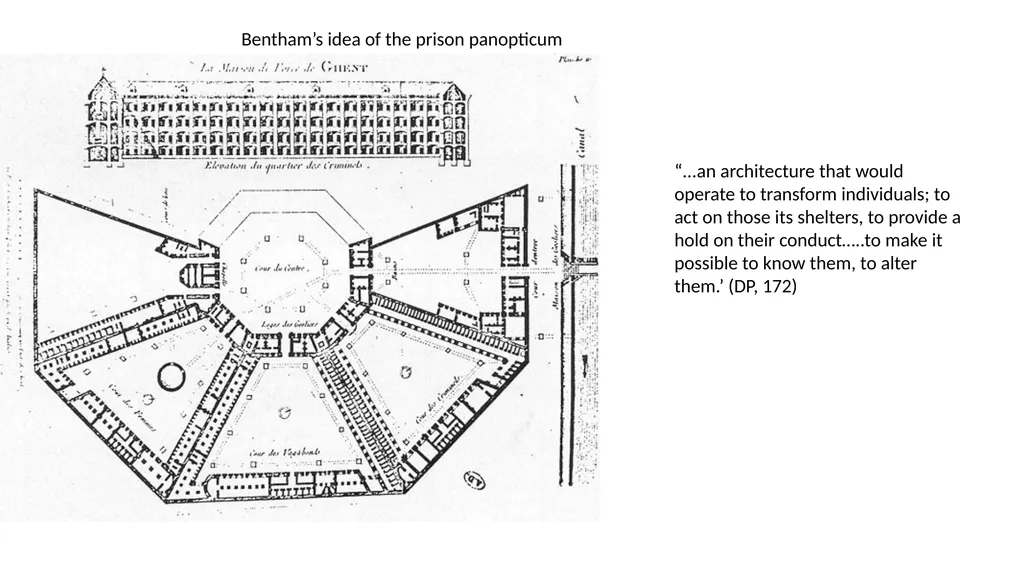
Bentham’s idea of the prison panopticum “...an architecture that would operate to transform individuals; to act on those its shelters, to provide a hold on their conduct…..to make it possible to know them, to alter them.’ (DP, 172)<br>
06
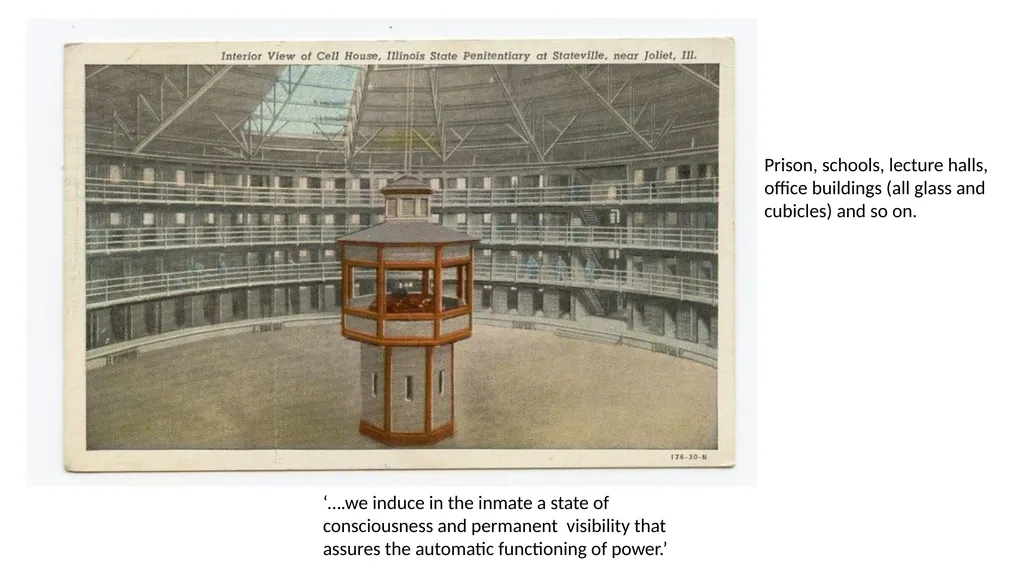
‘….we induce in the inmate a state of consciousness and permanent visibility that assures the automatic functioning of power.’ Prison, schools, lecture halls,
office buildings (all glass and cubicles) and so on.<br>
office buildings (all glass and cubicles) and so on.<br>
07
2. Normalising Judgement
Individuals are judged not by the intrinsic rightness or wrongness of their acts but by where their actions are placed on a ranked scale that compares them to everyone else. We are subjected to a whole set of micro-normalising judgements (regarding time keeping, daily activities, speech, of body, of sexuality). We use discipline to punish non-conformity to the ranked scale system.
We strive to be ‘normal’, not to stick out. We fear that there is no orientation if this system breaks down, so we do all we can to keep it up. Three different forms of how to discipline bodies<br>
Individuals are judged not by the intrinsic rightness or wrongness of their acts but by where their actions are placed on a ranked scale that compares them to everyone else. We are subjected to a whole set of micro-normalising judgements (regarding time keeping, daily activities, speech, of body, of sexuality). We use discipline to punish non-conformity to the ranked scale system.
We strive to be ‘normal’, not to stick out. We fear that there is no orientation if this system breaks down, so we do all we can to keep it up. Three different forms of how to discipline bodies<br>
08
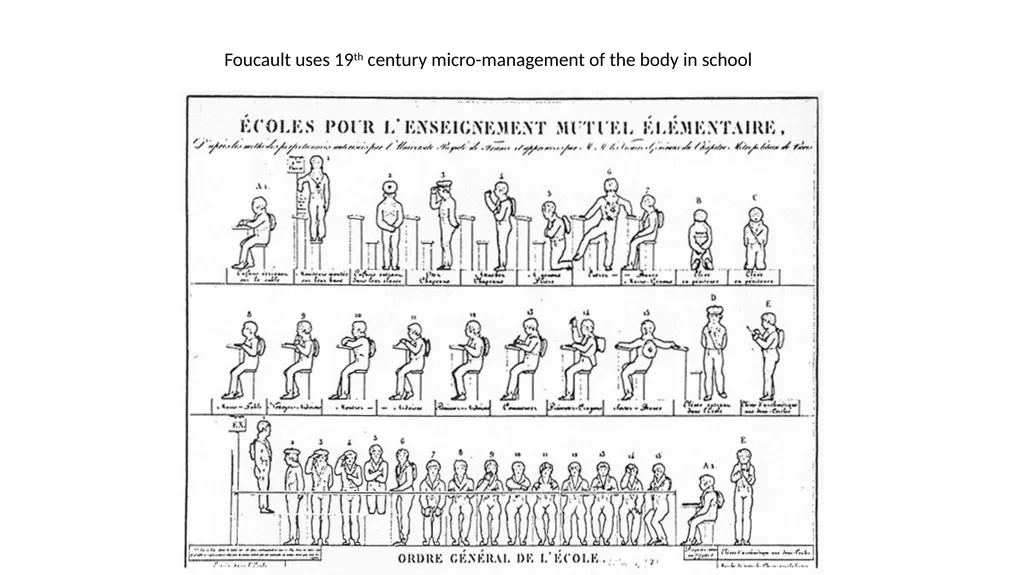
Foucault uses 19th century micro-management of the body in school<br>
09
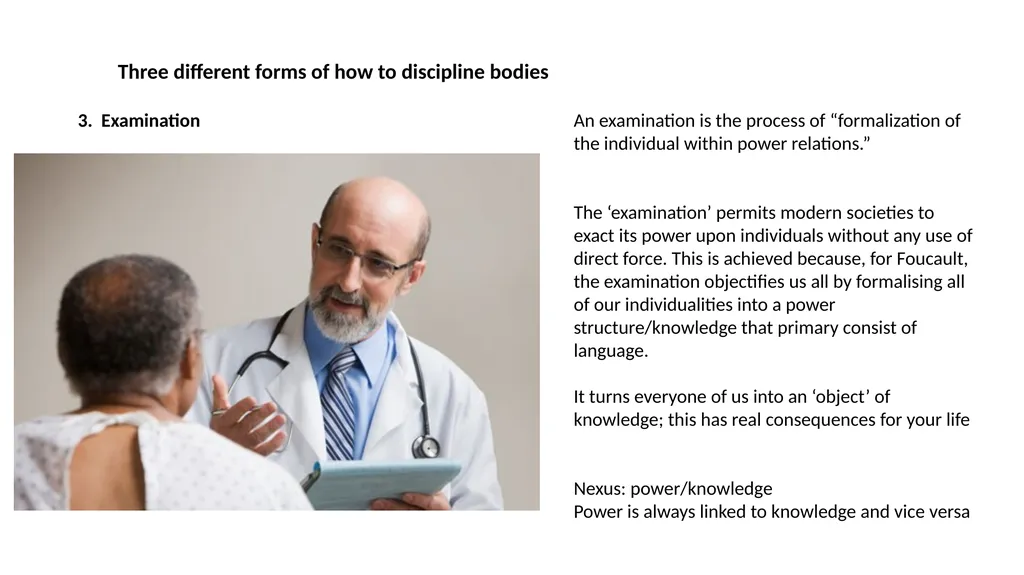
Three different forms of how to discipline bodies 3. Examination An examination is the process of “formalization of the individual within power relations.”
The ‘examination’ permits modern societies to exact its power upon individuals without any use of direct force. This is achieved because, for Foucault, the examination objectifies us all by formalising all of our individualities into a power structure/knowledge that primary consist of language.
It turns everyone of us into an ‘object’ of knowledge; this has real consequences for your life
Nexus: power/knowledge
Power is always linked to knowledge and vice versa<br>
The ‘examination’ permits modern societies to exact its power upon individuals without any use of direct force. This is achieved because, for Foucault, the examination objectifies us all by formalising all of our individualities into a power structure/knowledge that primary consist of language.
It turns everyone of us into an ‘object’ of knowledge; this has real consequences for your life
Nexus: power/knowledge
Power is always linked to knowledge and vice versa<br>
10
Power according to Foucault...
Power is not a commodity or a possession of an individual, a group or a class, rather it circulates through the social body, and is exercised through a net-like organisation in which all are caught; power is strategic.
Therefore analysis of power begins at the micro-level in order to reveal the particular histories, techniques and tactics of power
Power is always directed at the human body
Power produces knowledge and knowledge always produces power (Power/Knowledge nexus)
power is productive and not repressive. It often produces pleasure. So, we need to start investigation into modern power by choosing something we think is ‘good’, ‘pleasurable’; something that we consider ‘normal’; any investigation has to proceed from there
Power always requires resistance; so to resist power actually supports it.<br>
Power is not a commodity or a possession of an individual, a group or a class, rather it circulates through the social body, and is exercised through a net-like organisation in which all are caught; power is strategic.
Therefore analysis of power begins at the micro-level in order to reveal the particular histories, techniques and tactics of power
Power is always directed at the human body
Power produces knowledge and knowledge always produces power (Power/Knowledge nexus)
power is productive and not repressive. It often produces pleasure. So, we need to start investigation into modern power by choosing something we think is ‘good’, ‘pleasurable’; something that we consider ‘normal’; any investigation has to proceed from there
Power always requires resistance; so to resist power actually supports it.<br>
11
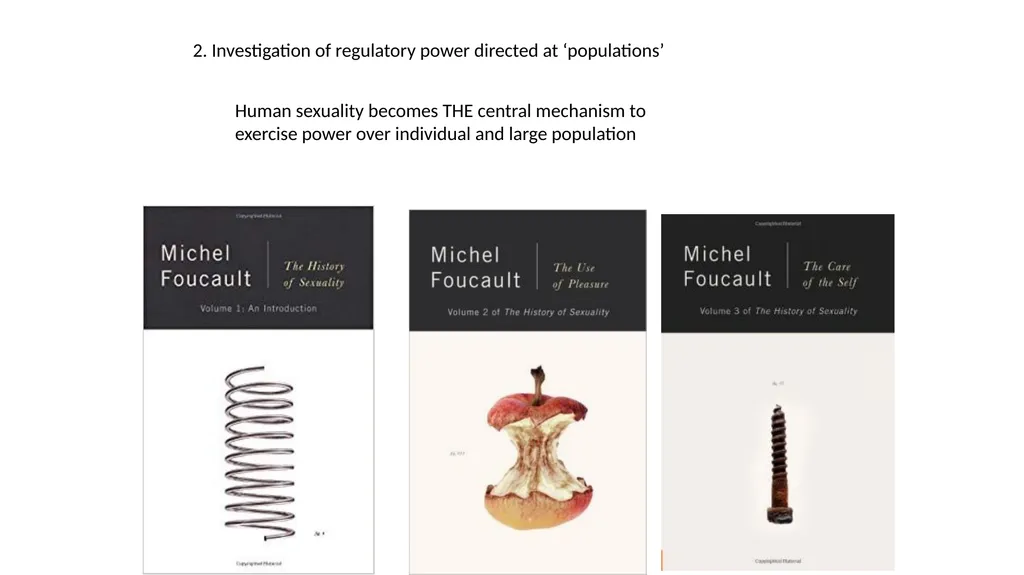
2. Investigation of regulatory power directed at ‘populations’ Human sexuality becomes THE central mechanism to exercise power over individual and large population<br>
12
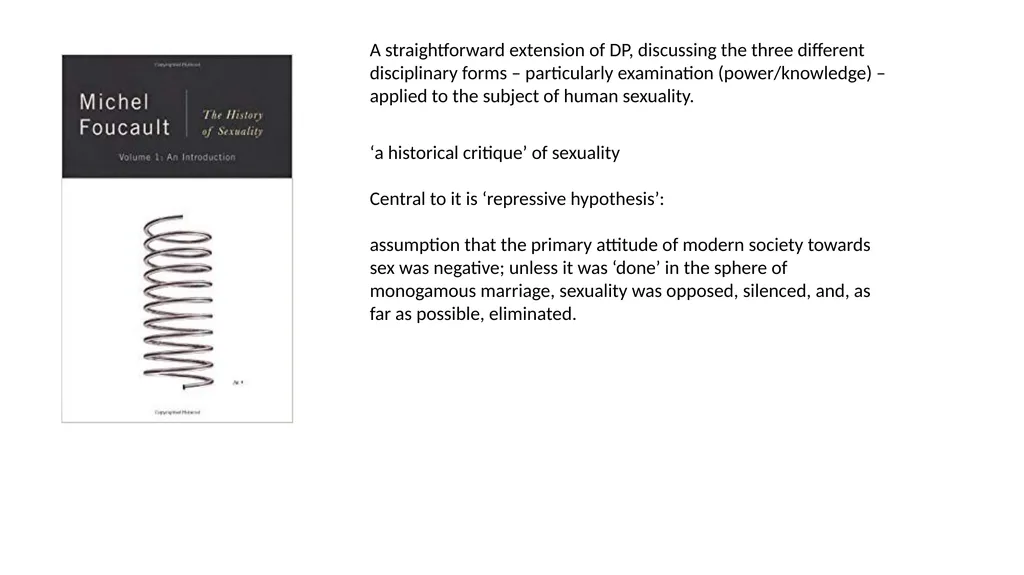
A straightforward extension of DP, discussing the three different disciplinary forms – particularly examination (power/knowledge) – applied to the subject of human sexuality. ‘a historical critique’ of sexuality
Central to it is ‘repressive hypothesis’:
assumption that the primary attitude of modern society towards sex was negative; unless it was ‘done’ in the sphere of monogamous marriage, sexuality was opposed, silenced, and, as far as possible, eliminated.<br>
Central to it is ‘repressive hypothesis’:
assumption that the primary attitude of modern society towards sex was negative; unless it was ‘done’ in the sphere of monogamous marriage, sexuality was opposed, silenced, and, as far as possible, eliminated.<br>
13
‘The question I would like to pose is not ‘Why are we supressed? But rather, Why do we say, with so much passion and so much resentment against our most recent past, against our present, and against ourselves, that we are repressed’?’
(HS, vol. 1, p. 8/9) ‘What is peculiar to modern societies, in fact, is not that they consigned sex to a shadow existence, but that they dedicated themselves to speaking of it ‘ad infinitum’, while exploring it as
the secret.’
(HS, vol. 1, p. 35)<br>
(HS, vol. 1, p. 8/9) ‘What is peculiar to modern societies, in fact, is not that they consigned sex to a shadow existence, but that they dedicated themselves to speaking of it ‘ad infinitum’, while exploring it as
the secret.’
(HS, vol. 1, p. 35)<br>
14
Biopower:
‘I mean a number of phenomena that seem to me to be quite significant, namely, the set of mechanisms through which the basic biological features of the human species became the object of a political strategy, of a general strategy of power, or, in other words, how, starting from the 18th century, modern Western societies took on board the fundamental biological fact that human beings are a species. This is what I have called biopower.’ The book is describing sex and disciplinary power but then he moves to another
characteristic of modern power.....sex has two power poles: Regulatory control: centres on the whole population through technologies such as statistics that traces life/death, disease, productivity,migratation etc.
Disciplinary control: centres on the body as a machine and its disciplining, the optimization of its capabilities, the extortion of its forces, the parallel increase of usefulness and its docility
Biopower<br>
‘I mean a number of phenomena that seem to me to be quite significant, namely, the set of mechanisms through which the basic biological features of the human species became the object of a political strategy, of a general strategy of power, or, in other words, how, starting from the 18th century, modern Western societies took on board the fundamental biological fact that human beings are a species. This is what I have called biopower.’ The book is describing sex and disciplinary power but then he moves to another
characteristic of modern power.....sex has two power poles: Regulatory control: centres on the whole population through technologies such as statistics that traces life/death, disease, productivity,migratation etc.
Disciplinary control: centres on the body as a machine and its disciplining, the optimization of its capabilities, the extortion of its forces, the parallel increase of usefulness and its docility
Biopower<br>
15
Why does biopower emerge from the 18th century? ‘without question an indispensable element of the development of free-market liberal capitalism’
‘This biopower… would not have been possible without the controlled insertion of bodies into the machinery of production and the adjustment of the phenomena of population to economic processes.’
(HS, p. 141)
Governmentality: the history of the art of governing people<br>
‘This biopower… would not have been possible without the controlled insertion of bodies into the machinery of production and the adjustment of the phenomena of population to economic processes.’
(HS, p. 141)
Governmentality: the history of the art of governing people<br>
16
The history of governmentality how to govern people<br>
17
‘French theory’ in the US engages with an entirely different socio-economic and political context
Poststructuralism here helps to rework notions of power and identity in a rapidly globalizing free-market society in which the individual and its self-interest is key
‘Identity’ as a matter of individual choice and performance; a hybrid construct of ‘self-fashioning’; in endless re-construction one the self without a core in order to adapt to new opportunities offered by a globalizing liberal market economy
Robert D. Putman, ‘Bowling Alone: America’s Declining Social Capital’, Journal of Democracy 6 (1995): 65-78.
disappearance of older models/practices of sociability; decline in the use of older notions of power or ‘class’ ‘French Theory’ travels.....and encounters different intellectual needs<br>
Poststructuralism here helps to rework notions of power and identity in a rapidly globalizing free-market society in which the individual and its self-interest is key
‘Identity’ as a matter of individual choice and performance; a hybrid construct of ‘self-fashioning’; in endless re-construction one the self without a core in order to adapt to new opportunities offered by a globalizing liberal market economy
Robert D. Putman, ‘Bowling Alone: America’s Declining Social Capital’, Journal of Democracy 6 (1995): 65-78.
disappearance of older models/practices of sociability; decline in the use of older notions of power or ‘class’ ‘French Theory’ travels.....and encounters different intellectual needs<br>
18
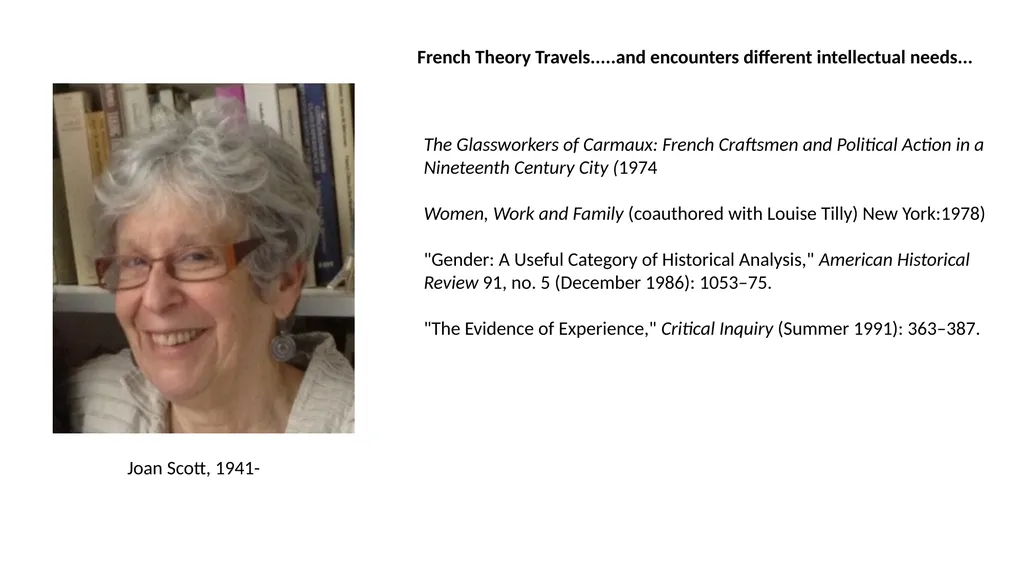
Joan Scott, 1941- The Glassworkers of Carmaux: French Craftsmen and Political Action in a Nineteenth Century City (1974
Women, Work and Family (coauthored with Louise Tilly) New York:1978)
"Gender: A Useful Category of Historical Analysis," American Historical Review 91, no. 5 (December 1986): 1053–75.
"The Evidence of Experience," Critical Inquiry (Summer 1991): 363–387. French Theory Travels.....and encounters different intellectual needs...<br>
Women, Work and Family (coauthored with Louise Tilly) New York:1978)
"Gender: A Useful Category of Historical Analysis," American Historical Review 91, no. 5 (December 1986): 1053–75.
"The Evidence of Experience," Critical Inquiry (Summer 1991): 363–387. French Theory Travels.....and encounters different intellectual needs...<br>
19
My article embodied my growing impatience with my fellow social historians who assumed that experience was transparent, that there was a direct relationship between, say, economic circumstances and political action, that there was no need to ask what counted as experience – we could know what that was from a sociological description of the conditions of life of groups and individuals.
The telling point in Toews’ article (articles she was writing against) was the absence of any definition of the term experience – he assumed we all knew what it meant.
My readings of Foucault, Derrida, Freud, Lacan, Irigaray and others had led me to doubt that words like experience were self-evident;
the point was to ask what kind of work they were doing, how they were establishing meaning, how some things and not others came to be included in the term. When ‘experience’ was alluded to by historians what did they mean by the term? What were they including and excluding? How were they measuring the impact of ‘experience’ on the psyches of individuals? How did an appeal to a common experience create a sense of member- ship in a group?
These were the kinds of questions that seemed to me to be left aside when the meaning of experience was taken to be known by historians.’
Victoria Hesford and Lisa Diedrich, ‘On ‘The evidence of experience’ and its reverberations: An interview with Joan W. Scott’, Feminist Theory 15,2 (2014) 15(2); 199<br>
The telling point in Toews’ article (articles she was writing against) was the absence of any definition of the term experience – he assumed we all knew what it meant.
My readings of Foucault, Derrida, Freud, Lacan, Irigaray and others had led me to doubt that words like experience were self-evident;
the point was to ask what kind of work they were doing, how they were establishing meaning, how some things and not others came to be included in the term. When ‘experience’ was alluded to by historians what did they mean by the term? What were they including and excluding? How were they measuring the impact of ‘experience’ on the psyches of individuals? How did an appeal to a common experience create a sense of member- ship in a group?
These were the kinds of questions that seemed to me to be left aside when the meaning of experience was taken to be known by historians.’
Victoria Hesford and Lisa Diedrich, ‘On ‘The evidence of experience’ and its reverberations: An interview with Joan W. Scott’, Feminist Theory 15,2 (2014) 15(2); 199<br>
20
‘It makes more sense to teach our students and to tell ourselves that identities are historically conferred, that the conferral is ambiguous (though it works precisely and necessarily by imposing a false clarity),
that subjects are produced through multiple identifications, some of which become politically salient for a time in certain contexts,
and that the project of history is not to reify identity but to understand its production as an ongoing process of differentiation, relentless in its repetition, but also….subject to redefinition, resistance, and change.
(Joan Scott, ‘Multiculturalism and the Politics of Identity’, in The Identity Question, ed. John Rajchman (1995), p. 11 What is identity? Scott’s answer....<br>
that subjects are produced through multiple identifications, some of which become politically salient for a time in certain contexts,
and that the project of history is not to reify identity but to understand its production as an ongoing process of differentiation, relentless in its repetition, but also….subject to redefinition, resistance, and change.
(Joan Scott, ‘Multiculturalism and the Politics of Identity’, in The Identity Question, ed. John Rajchman (1995), p. 11 What is identity? Scott’s answer....<br>