04
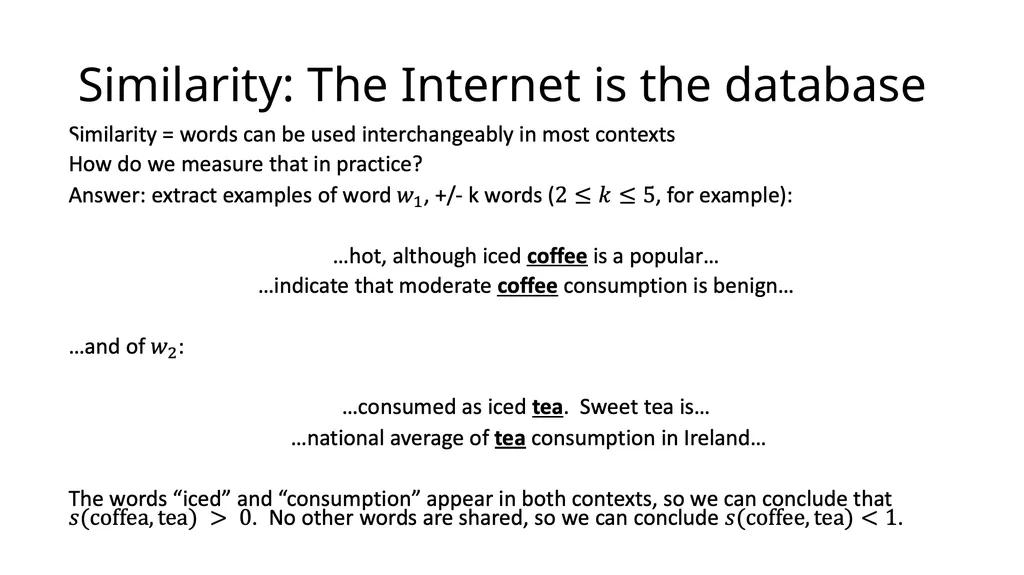
Similarity vs. Relatedness Levy & Goldberg (2014) trained word2vec in three different ways:
k=2
k=5
Context determined by first parsing the sentence to get syntactic dependency structure (Deps)
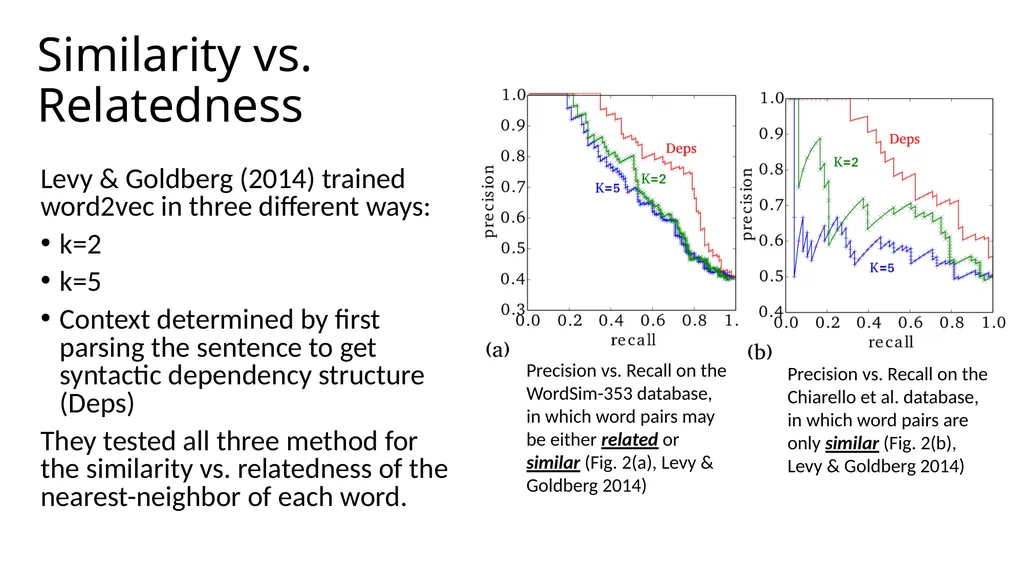
They tested all three method for the similarity vs. relatedness of the nearest-neighbor of each word. Precision vs. Recall on the WordSim-353 database, in which word pairs may be either related or similar (Fig. 2(a), Levy & Goldberg 2014) Precision vs. Recall on the Chiarello et al. database, in which word pairs are only similar (Fig. 2(b), Levy & Goldberg 2014)<br>
05
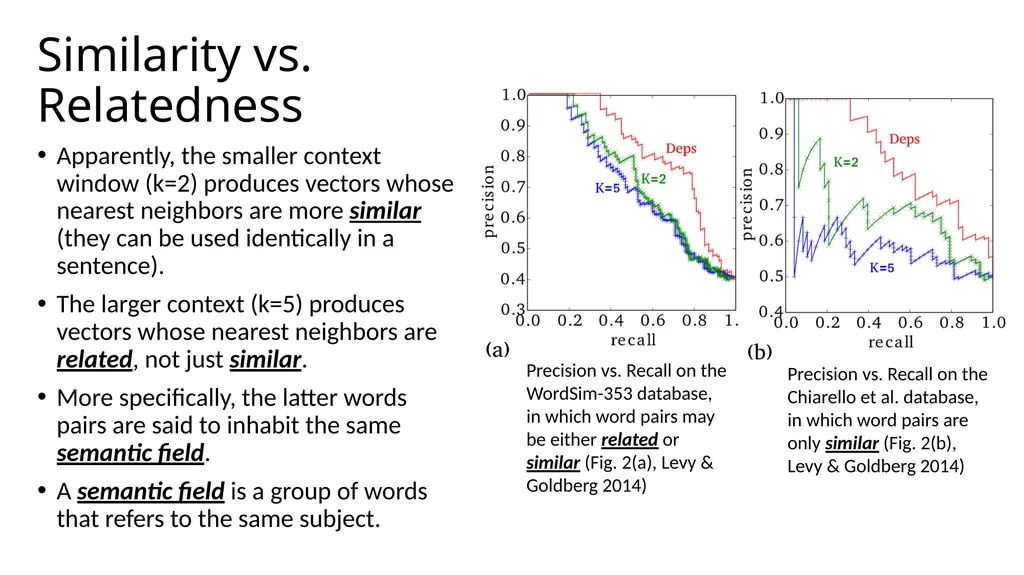
Similarity vs. Relatedness Apparently, the smaller context window (k=2) produces vectors whose nearest neighbors are more similar (they can be used identically in a sentence).
The larger context (k=5) produces vectors whose nearest neighbors are related, not just similar.
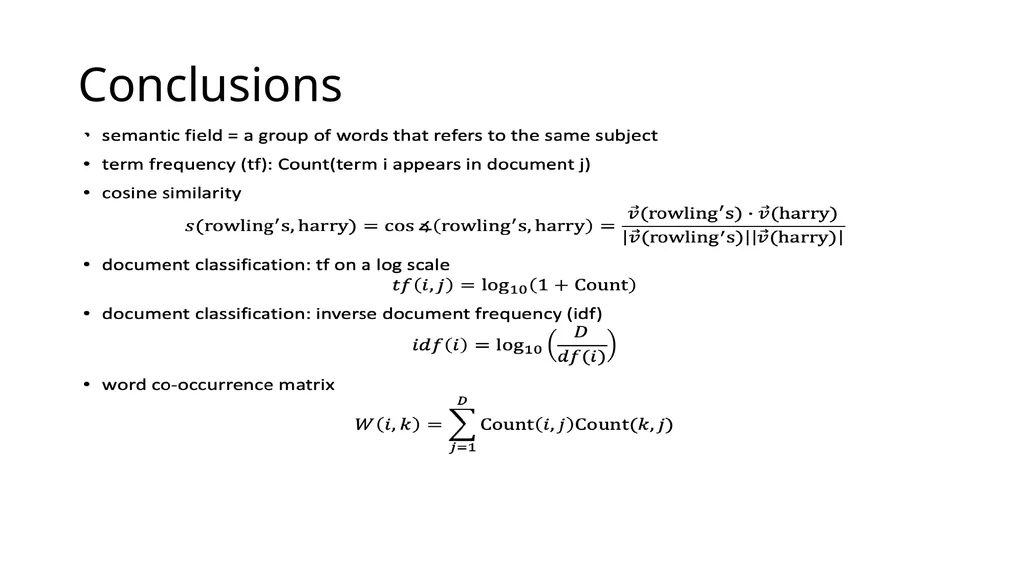
More specifically, the latter words pairs are said to inhabit the same semantic field.
A semantic field is a group of words that refers to the same subject. Precision vs. Recall on the WordSim-353 database, in which word pairs may be either related or similar (Fig. 2(a), Levy & Goldberg 2014) Precision vs. Recall on the Chiarello et al. database, in which word pairs are only similar (Fig. 2(b), Levy & Goldberg 2014)<br>
06
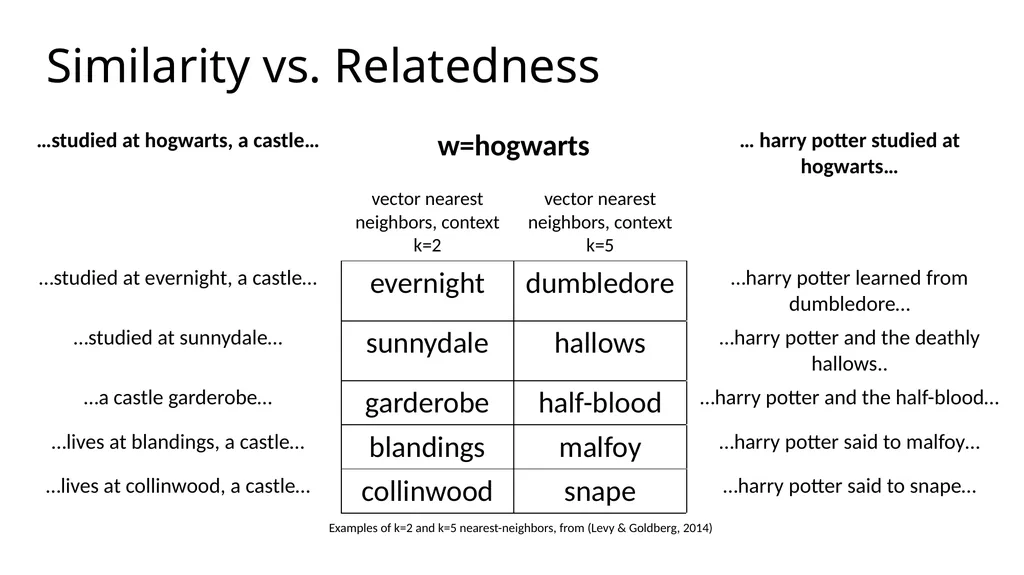
Similarity vs. Relatedness Examples of k=2 and k=5 nearest-neighbors, from (Levy & Goldberg, 2014)<br>
07
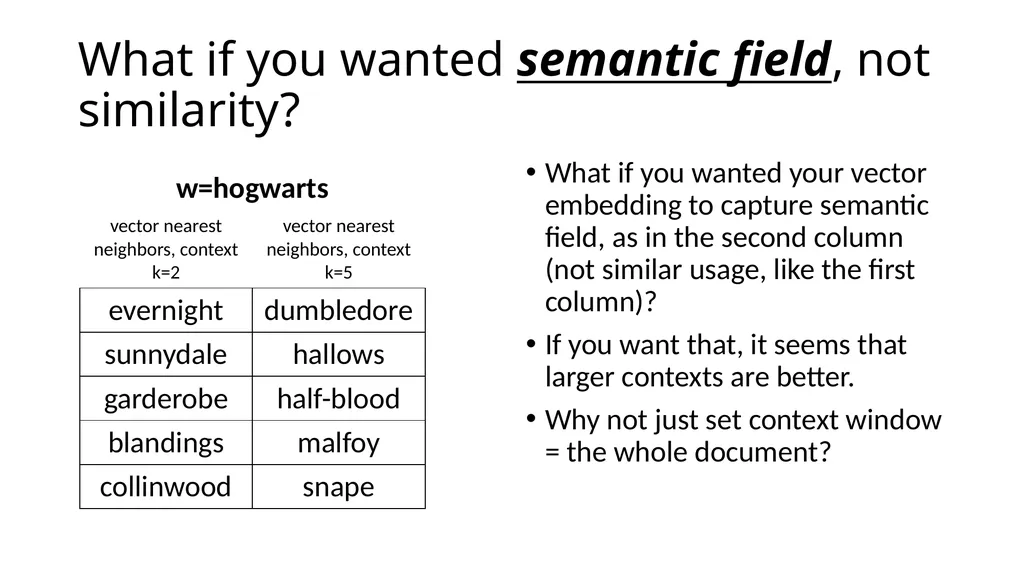
What if you wanted semantic field, not similarity? What if you wanted your vector embedding to capture semantic field, as in the second column (not similar usage, like the first column)?
If you want that, it seems that larger contexts are better.
Why not just set context window = the whole document?<br>
08
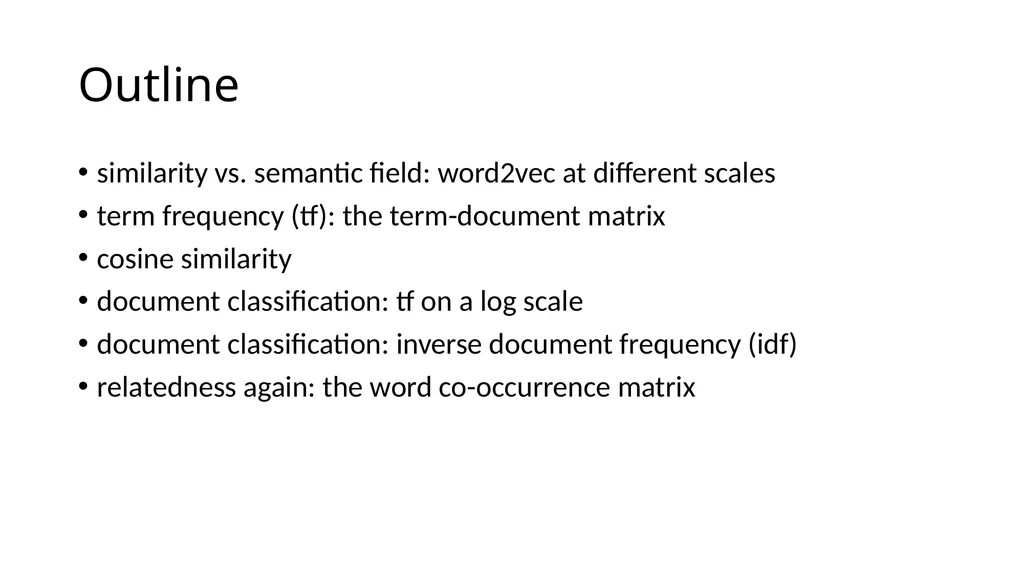
Outline similarity vs. semantic field: word2vec at different scales
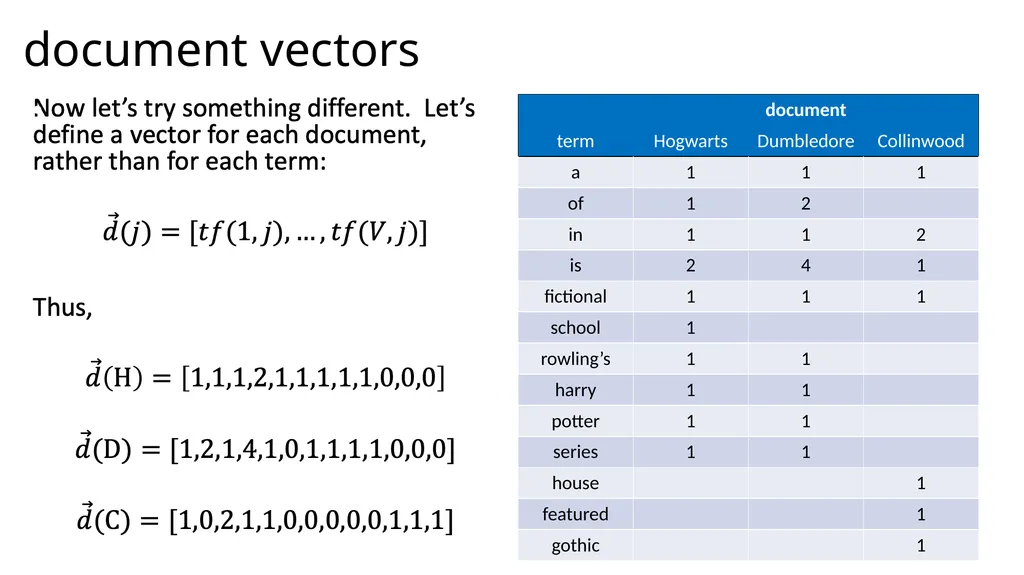
term frequency (tf): the term-document matrix
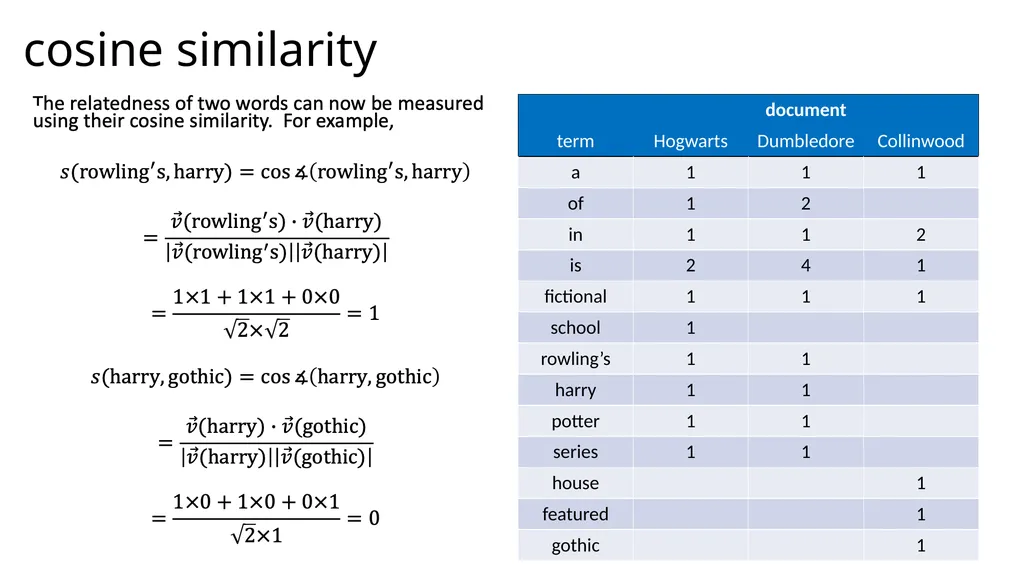
cosine similarity
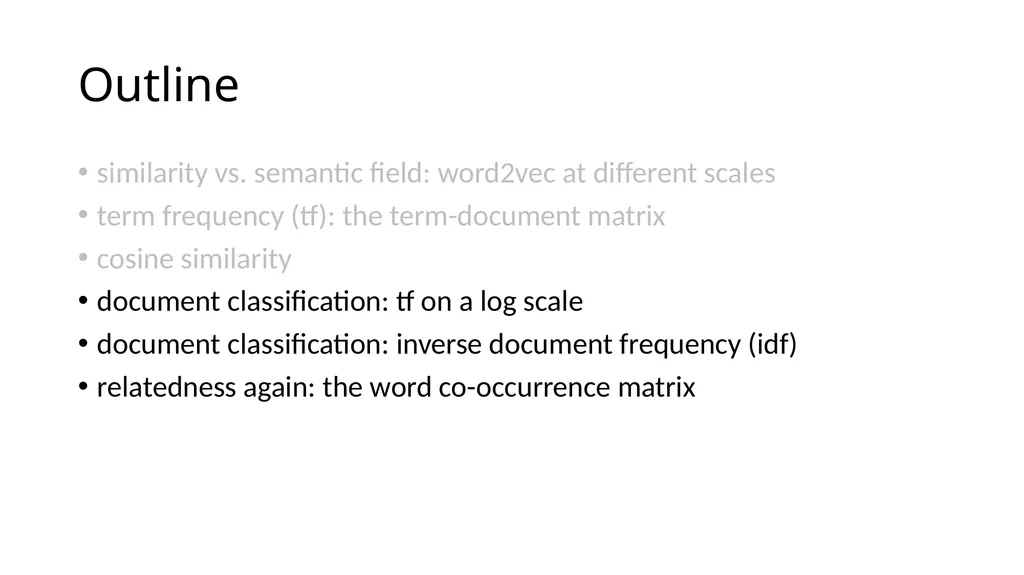
document classification: tf on a log scale
document classification: inverse document frequency (idf)
relatedness again: the word co-occurrence matrix<br>
09
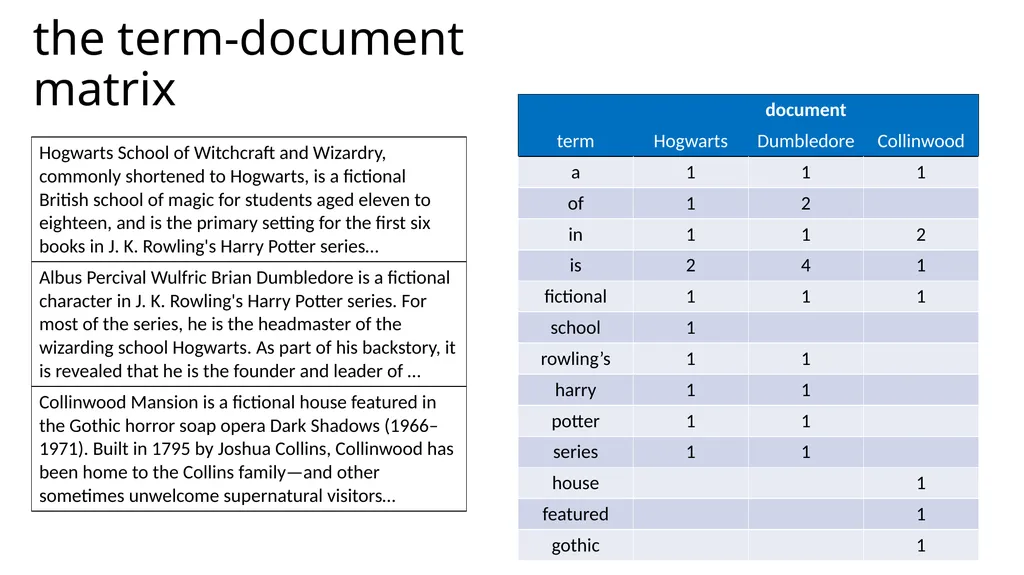
the term-document matrix<br>
10
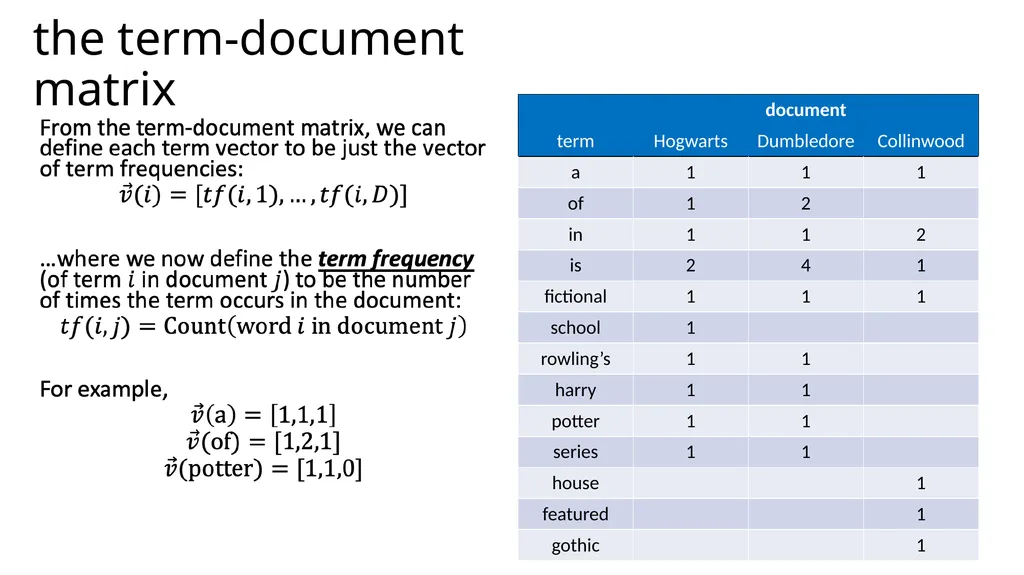
the term-document matrix<br>
11
Outline similarity vs. semantic field: word2vec at different scales
term frequency (tf): the term-document matrix
cosine similarity
document classification: tf on a log scale
document classification: inverse document frequency (idf)
relatedness again: the word co-occurrence matrix<br>
14
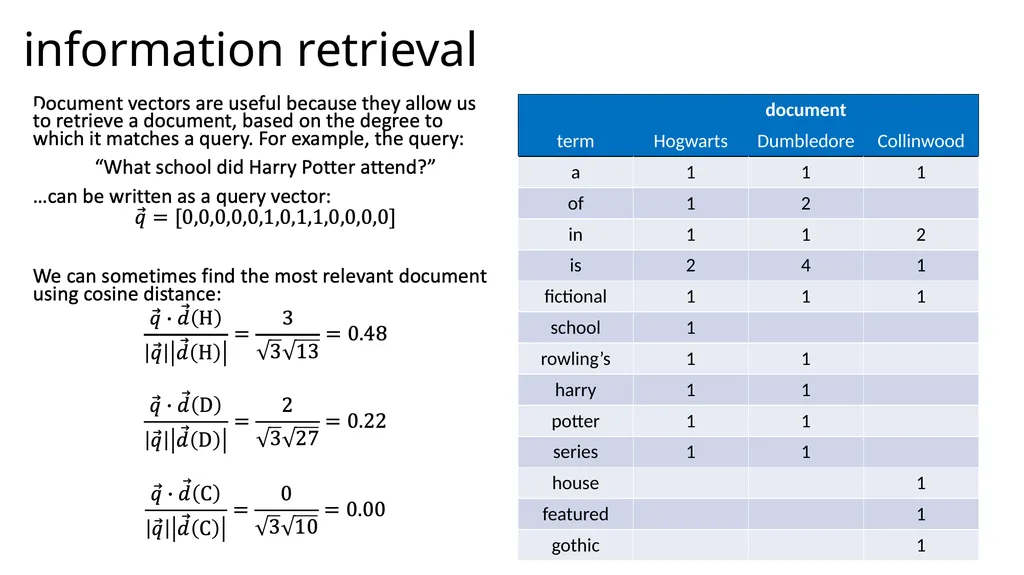
information retrieval<br>
15
Outline similarity vs. semantic field: word2vec at different scales
term frequency (tf): the term-document matrix
cosine similarity
document classification: tf on a log scale
document classification: inverse document frequency (idf)
relatedness again: the word co-occurrence matrix<br>
16
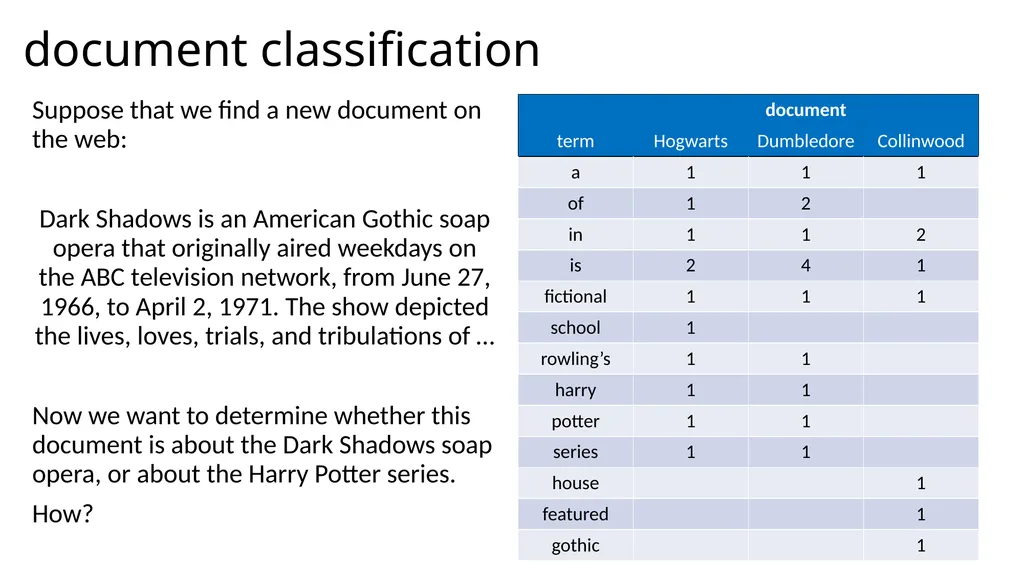
document classification Suppose that we find a new document on the web:
Dark Shadows is an American Gothic soap opera that originally aired weekdays on the ABC television network, from June 27, 1966, to April 2, 1971. The show depicted the lives, loves, trials, and tribulations of …
Now we want to determine whether this document is about the Dark Shadows soap opera, or about the Harry Potter series.
How?<br>
17
document classification<br>
18
document classification<br>
19
document classification<br>
20
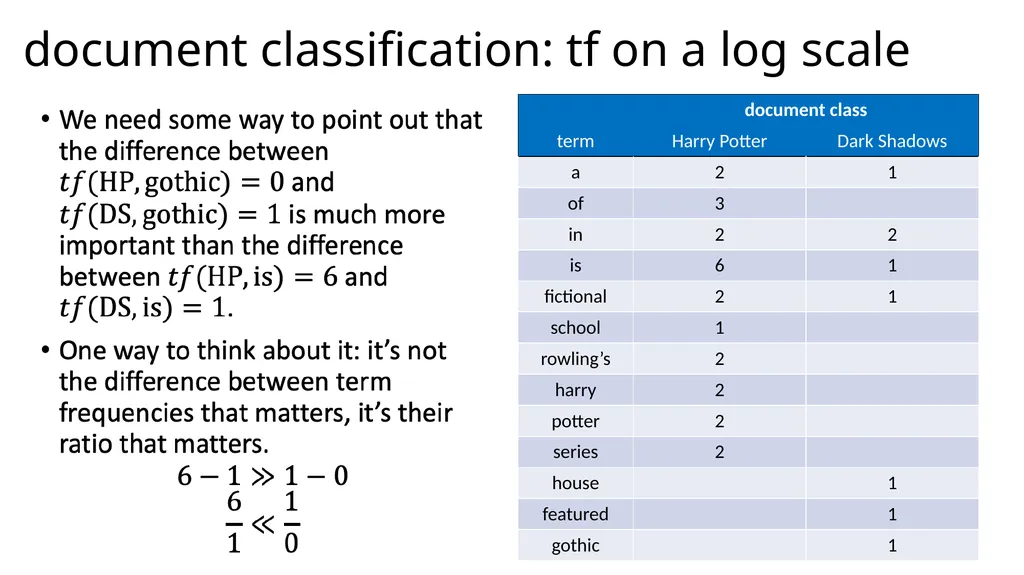
document classification: tf on a log scale<br>
21
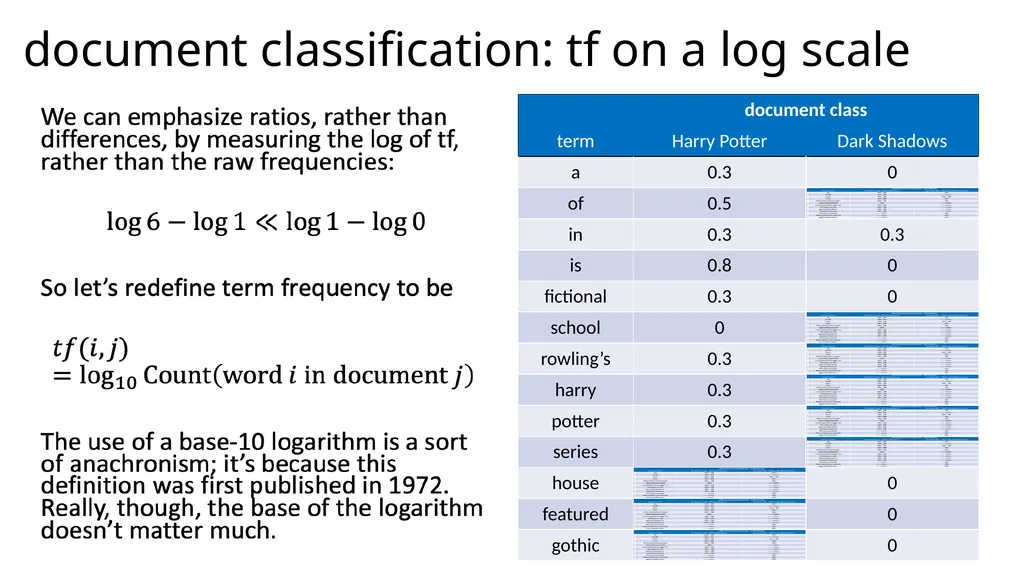
document classification: tf on a log scale<br>
22
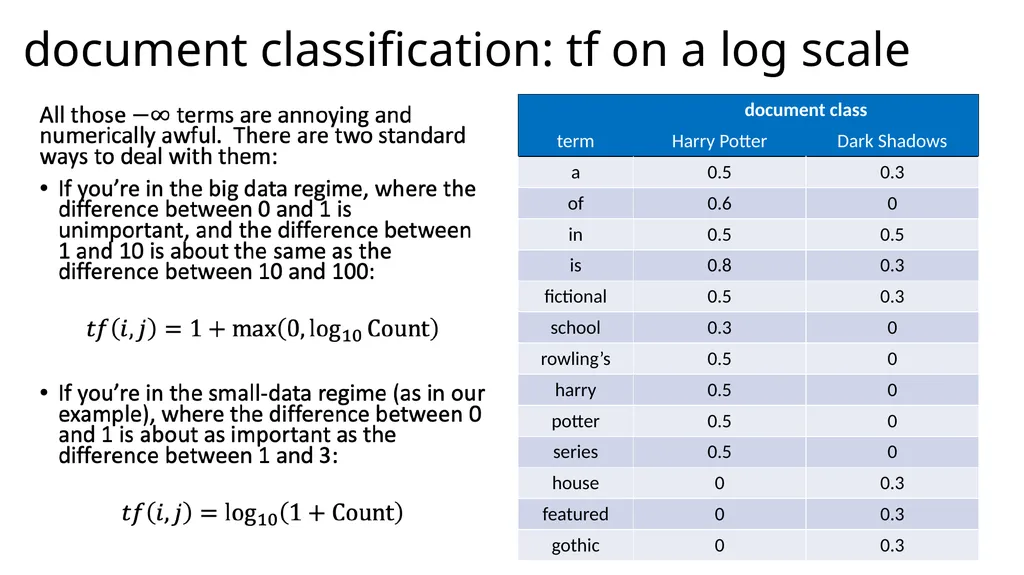
document classification: tf on a log scale<br>
23
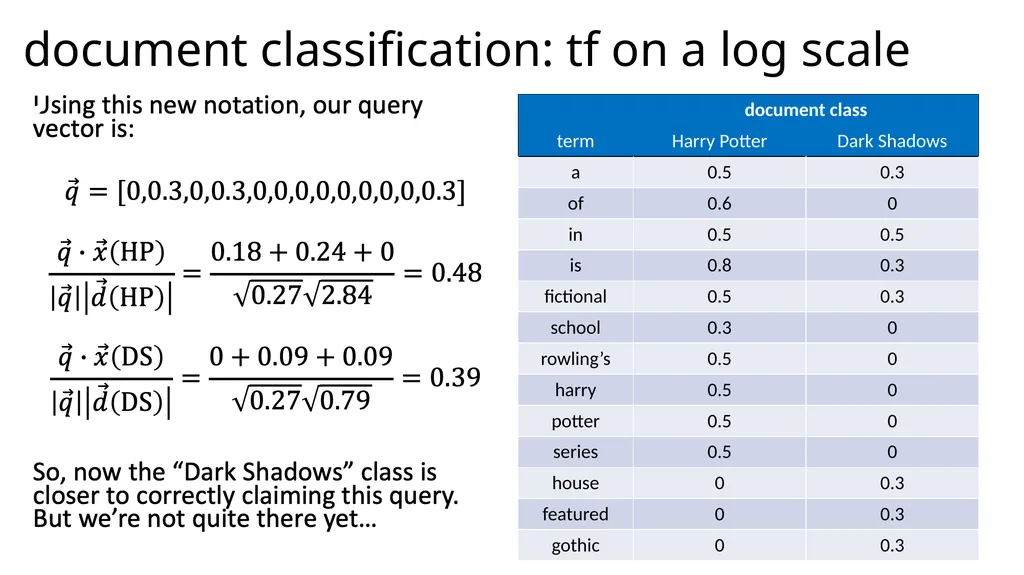
document classification: tf on a log scale<br>
24
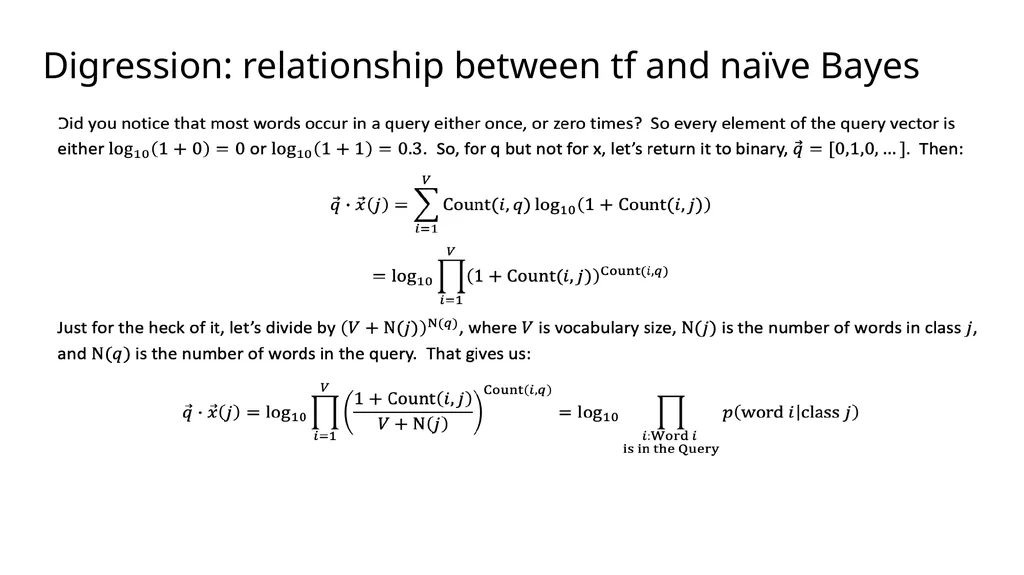
Digression: relationship between tf and naïve Bayes<br>
25
Outline similarity vs. semantic field: word2vec at different scales
term frequency (tf): the term-document matrix
cosine similarity
document classification: tf on a log scale
document classification: inverse document frequency (idf)
relatedness again: the word co-occurrence matrix<br>
26
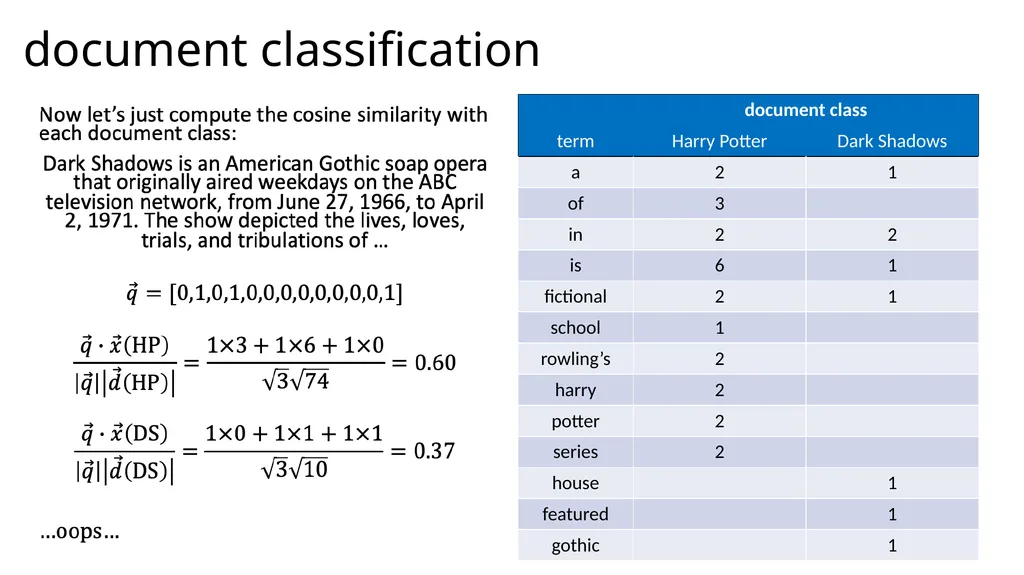
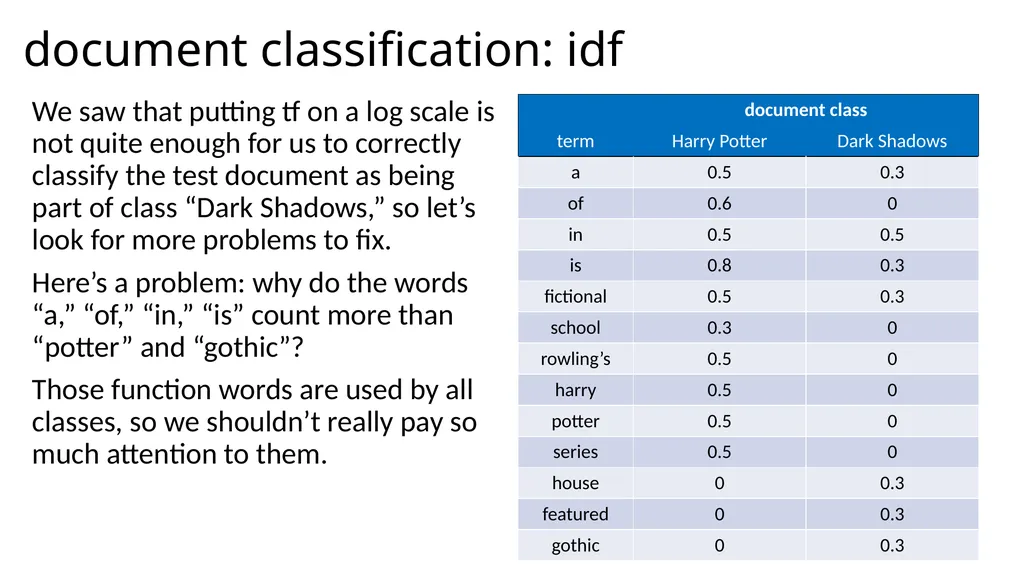
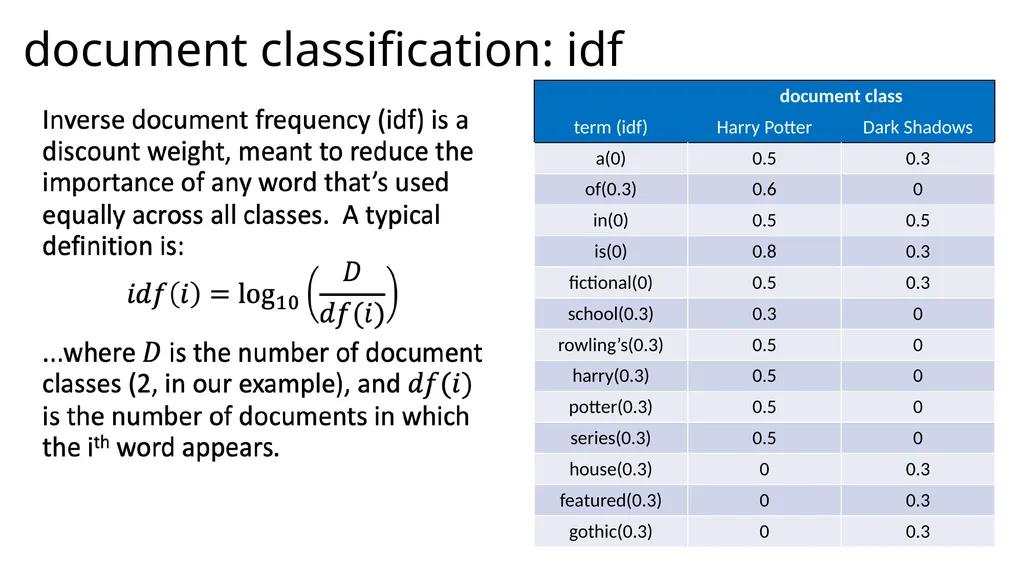
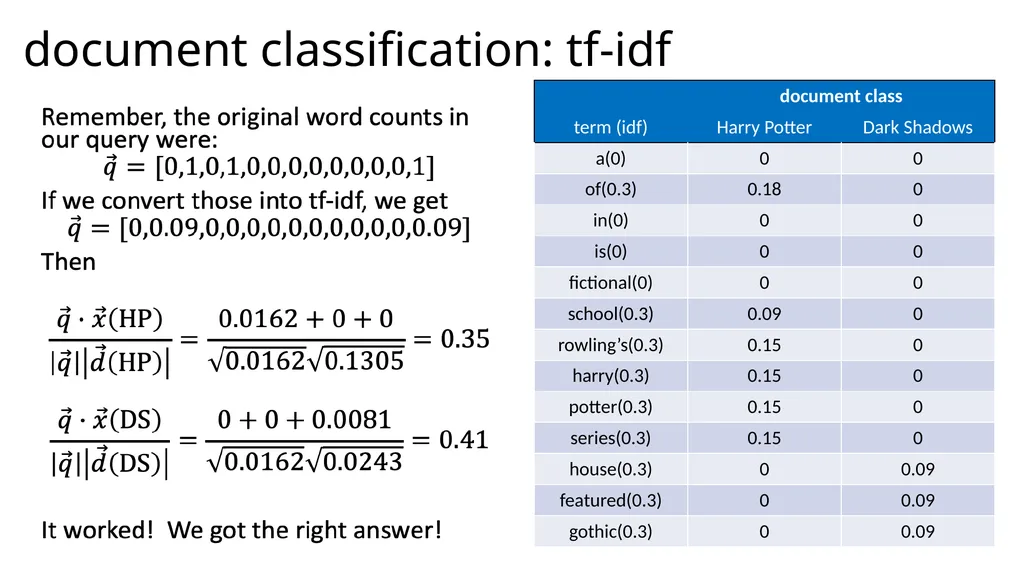
document classification: idf We saw that putting tf on a log scale is not quite enough for us to correctly classify the test document as being part of class “Dark Shadows,” so let’s look for more problems to fix.
Here’s a problem: why do the words “a,” “of,” “in,” “is” count more than “potter” and “gothic”?
Those function words are used by all classes, so we shouldn’t really pay so much attention to them.<br>
27
document classification: idf<br>
28
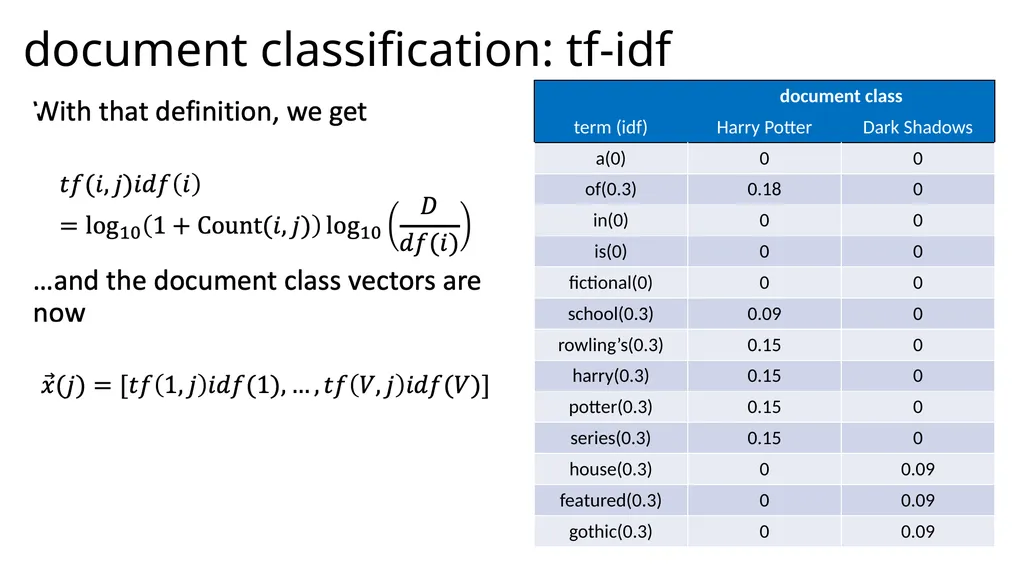
document classification: tf-idf<br>
29
document classification: tf-idf<br>
30
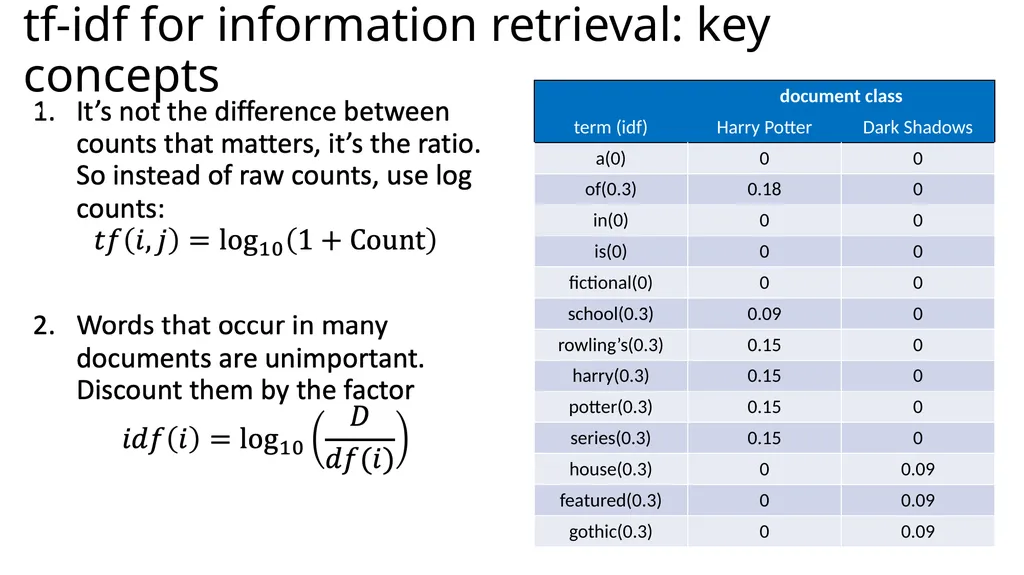
tf-idf for information retrieval: key concepts<br>
31
Outline similarity vs. semantic field: word2vec at different scales
term frequency (tf): the term-document matrix
cosine similarity
document classification: tf on a log scale
document classification: inverse document frequency (idf)
relatedness again: the word co-occurrence matrix<br>
32
The Word Co-Occurrence Matrix Now that we understand information retrieval, let’s go back to our original question:
How can we determine whether or not two words are related?<br>
33
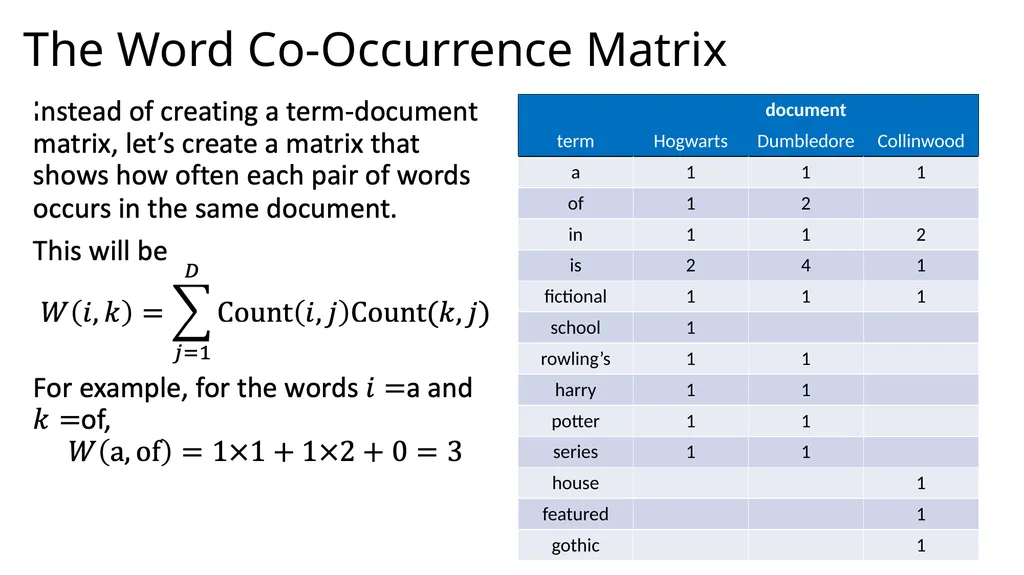
The Word Co-Occurrence Matrix<br>
34
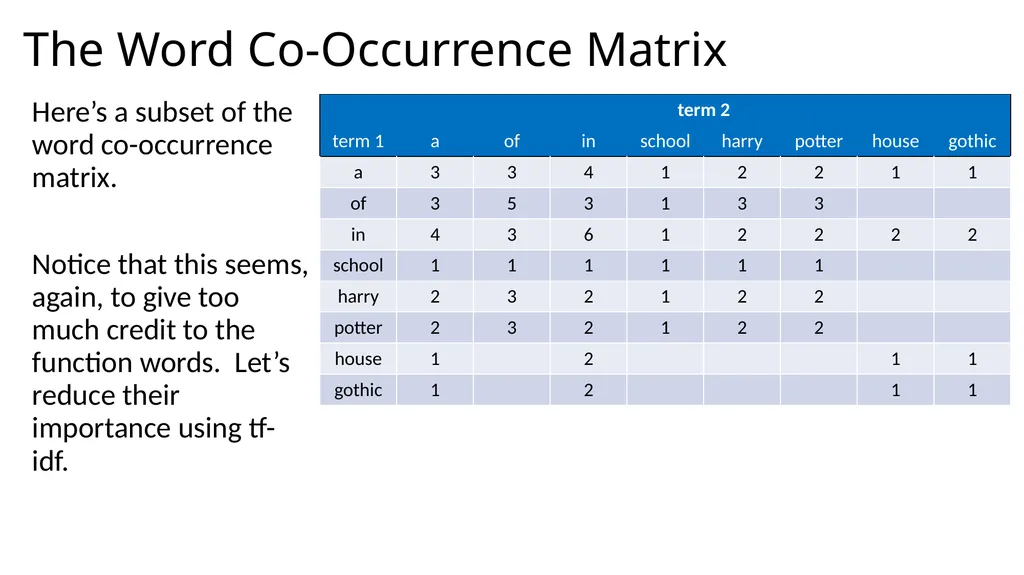
The Word Co-Occurrence Matrix Here’s a subset of the word co-occurrence matrix.
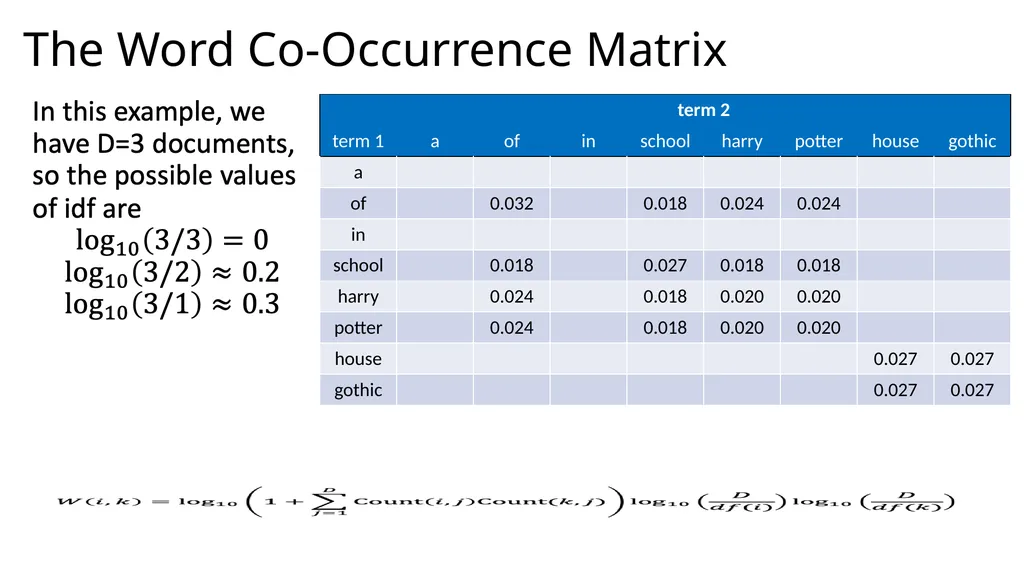
Notice that this seems, again, to give too much credit to the function words. Let’s reduce their importance using tf-idf.<br>
35
The Word Co-Occurrence Matrix<br>