
Lecture Two Exploration: Different terms
AS
Published · 11 slides · 0 views
1 / 1
Description
Lecture Two Exploration: Different terms Discussion of Newmark Newmarks terms semantic translation and communicative translation have generally received far less discussion than Nidas formal and dynamic equivalence.This may be because,
Related Topics
Share
Embed code
Download this presentation From Below
"Lecture Two Exploration: Different terms" is the property of its rightful owner. Permission is granted to download and print the materials on this website for personal, non-commercial use only, and to display it on your personal computer provided you do not modify the materials and that you retain all copyright notices contained in the materials. By downloading content from our website, you accept the terms of this agreement.
Presentation Transcript
01
Lecture Two<br>
02
Exploration: Different terms Discussion of Newmark
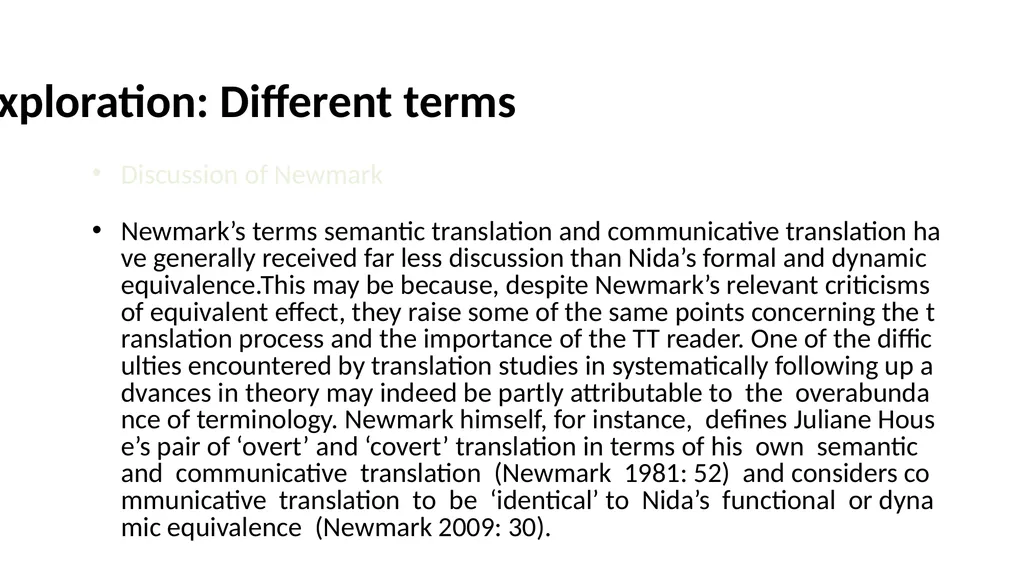
Newmark’s terms semantic translation and communicative translation have generally received far less discussion than Nida’s formal and dynamic equivalence.This may be because, despite Newmark’s relevant criticisms of equivalent effect, they raise some of the same points concerning the translation process and the importance of the TT reader. One of the difficulties encountered by translation studies in systematically following up advances in theory may indeed be partly attributable to the overabundance of terminology. Newmark himself, for instance, defines Juliane House’s pair of ‘overt’ and ‘covert’ translation in terms of his own semantic and communicative translation (Newmark 1981: 52) and considers communicative translation to be ‘identical’ to Nida’s functional or dynamic equivalence (Newmark 2009: 30).<br>
Newmark’s terms semantic translation and communicative translation have generally received far less discussion than Nida’s formal and dynamic equivalence.This may be because, despite Newmark’s relevant criticisms of equivalent effect, they raise some of the same points concerning the translation process and the importance of the TT reader. One of the difficulties encountered by translation studies in systematically following up advances in theory may indeed be partly attributable to the overabundance of terminology. Newmark himself, for instance, defines Juliane House’s pair of ‘overt’ and ‘covert’ translation in terms of his own semantic and communicative translation (Newmark 1981: 52) and considers communicative translation to be ‘identical’ to Nida’s functional or dynamic equivalence (Newmark 2009: 30).<br>
03
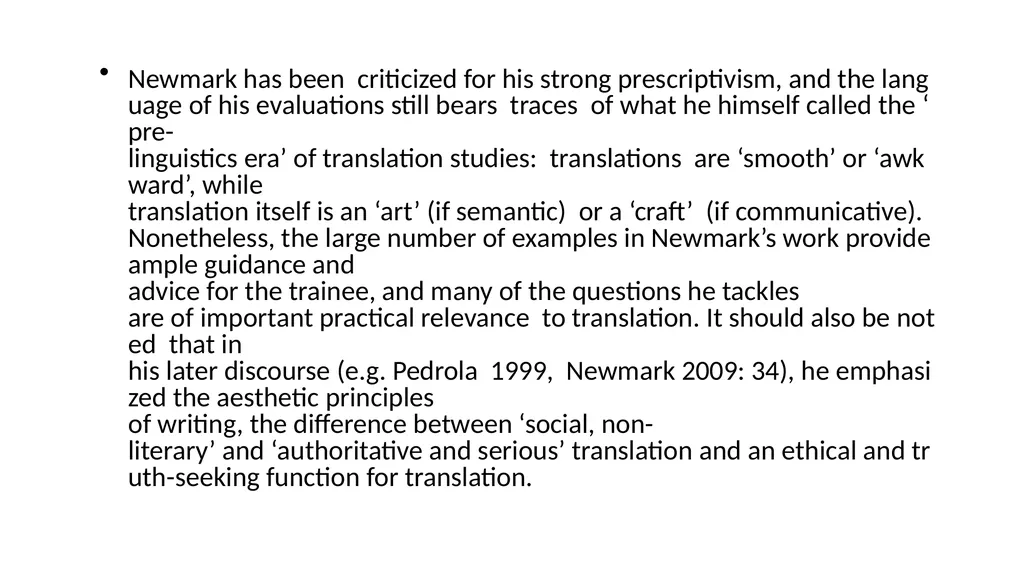
Newmark has been criticized for his strong prescriptivism, and the language of his evaluations still bears traces of what he himself called the ‘pre-linguistics era’ of translation studies: translations are ‘smooth’ or ‘awkward’, while translation itself is an ‘art’ (if semantic) or a ‘craft’ (if communicative). Nonetheless, the large number of examples in Newmark’s work provide ample guidance and advice for the trainee, and many of the questions he tackles are of important practical relevance to translation. It should also be noted that in his later discourse (e.g. Pedrola 1999, Newmark 2009: 34), he emphasized the aesthetic principles of writing, the difference between ‘social, non-literary’ and ‘authoritative and serious’ translation and an ethical and truth-seeking function for translation.<br>
04
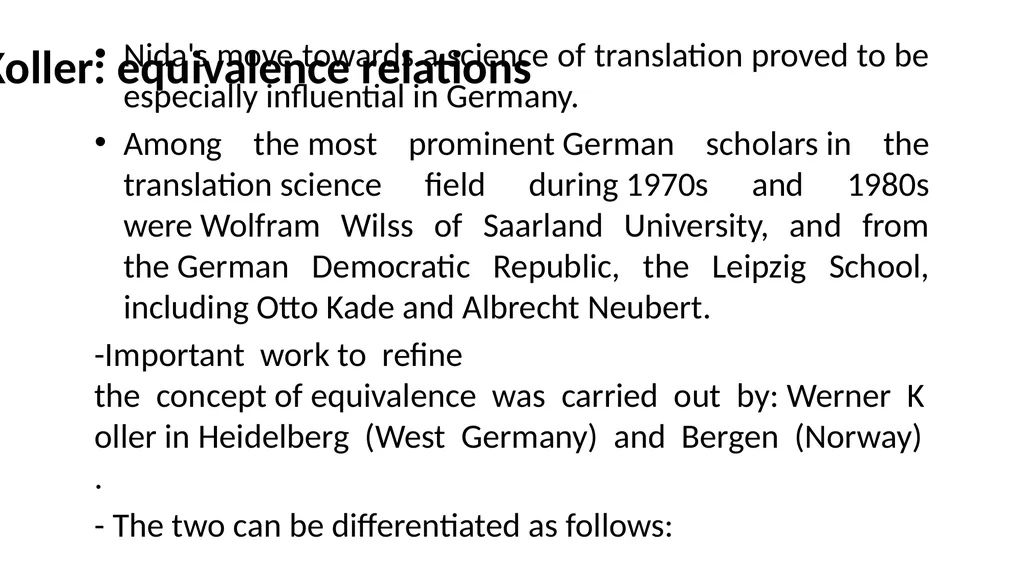
Koller: equivalence relations Nida's move towards a science of translation proved to be especially influential in Germany.
Among the most prominent German scholars in the translation science field during 1970s and 1980s were Wolfram Wilss of Saarland University, and from the German Democratic Republic, the Leipzig School, including Otto Kade and Albrecht Neubert.
-Important work to refine the concept of equivalence was carried out by: Werner Koller in Heidelberg (West Germany) and Bergen (Norway).
- The two can be differentiated as follows:<br>
Among the most prominent German scholars in the translation science field during 1970s and 1980s were Wolfram Wilss of Saarland University, and from the German Democratic Republic, the Leipzig School, including Otto Kade and Albrecht Neubert.
-Important work to refine the concept of equivalence was carried out by: Werner Koller in Heidelberg (West Germany) and Bergen (Norway).
- The two can be differentiated as follows:<br>
05
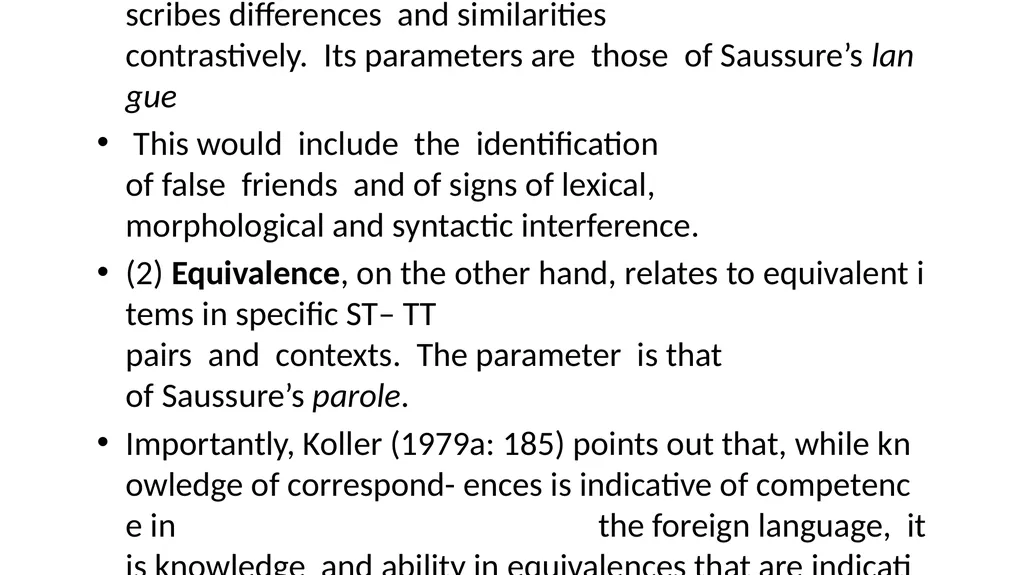
(1) Correspondence falls within the field of contrastive linguistics, which compares two language systems and describes differences and similarities contrastively. Its parameters are those of Saussure’s langue
This would include the identification of false friends and of signs of lexical, morphological and syntactic interference.
(2) Equivalence, on the other hand, relates to equivalent items in specific ST– TT pairs and contexts. The parameter is that of Saussure’s parole.
Importantly, Koller (1979a: 185) points out that, while knowledge of correspond- ences is indicative of competence in the foreign language, it is knowledge and ability in equivalences that are indicative of competence in translation. However, the question still remains as to what exactly has to be equivalent.<br>
This would include the identification of false friends and of signs of lexical, morphological and syntactic interference.
(2) Equivalence, on the other hand, relates to equivalent items in specific ST– TT pairs and contexts. The parameter is that of Saussure’s parole.
Importantly, Koller (1979a: 185) points out that, while knowledge of correspond- ences is indicative of competence in the foreign language, it is knowledge and ability in equivalences that are indicative of competence in translation. However, the question still remains as to what exactly has to be equivalent.<br>
06
In an attempt to answer this question,
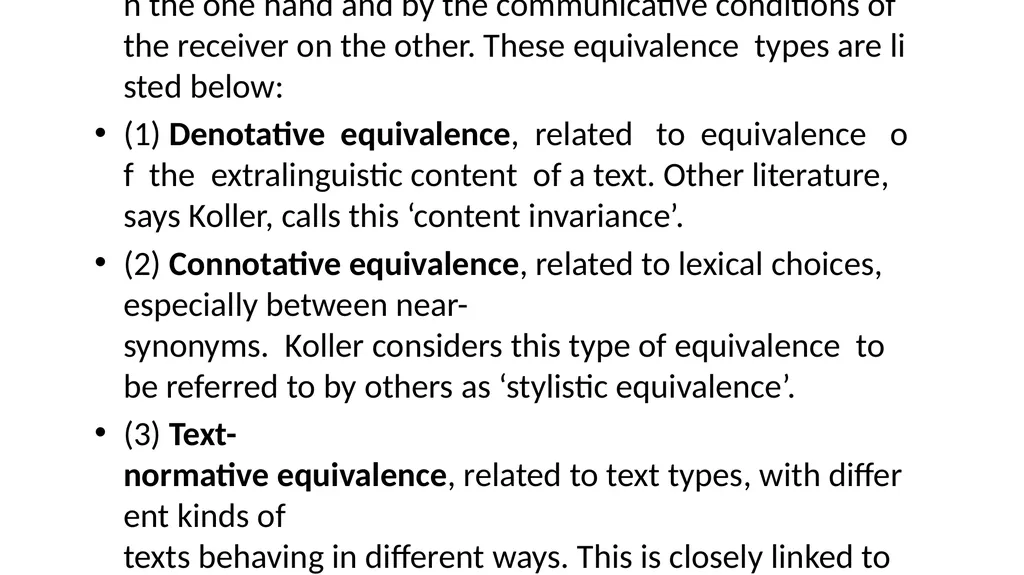
Koller 1995 and Hatim and Munday 2004: 170–4) differentiates five types of equivalence relations, constrained, in what is known as double linkage, by the ST on the one hand and by the communicative conditions of the receiver on the other. These equivalence types are listed below:
(1) Denotative equivalence, related to equivalence of the extralinguistic content of a text. Other literature, says Koller, calls this ‘content invariance’.
(2) Connotative equivalence, related to lexical choices, especially between near-synonyms. Koller considers this type of equivalence to be referred to by others as ‘stylistic equivalence’.
(3) Text-normative equivalence, related to text types, with different kinds of texts behaving in different ways. This is closely linked to work by Katharina Reiss.
(4) Pragmatic equivalence, or ‘communicative equivalence’, is oriented towards the receiver of the text or message. This is Nida’s dynamic equivalence.<br>
Koller 1995 and Hatim and Munday 2004: 170–4) differentiates five types of equivalence relations, constrained, in what is known as double linkage, by the ST on the one hand and by the communicative conditions of the receiver on the other. These equivalence types are listed below:
(1) Denotative equivalence, related to equivalence of the extralinguistic content of a text. Other literature, says Koller, calls this ‘content invariance’.
(2) Connotative equivalence, related to lexical choices, especially between near-synonyms. Koller considers this type of equivalence to be referred to by others as ‘stylistic equivalence’.
(3) Text-normative equivalence, related to text types, with different kinds of texts behaving in different ways. This is closely linked to work by Katharina Reiss.
(4) Pragmatic equivalence, or ‘communicative equivalence’, is oriented towards the receiver of the text or message. This is Nida’s dynamic equivalence.<br>
07
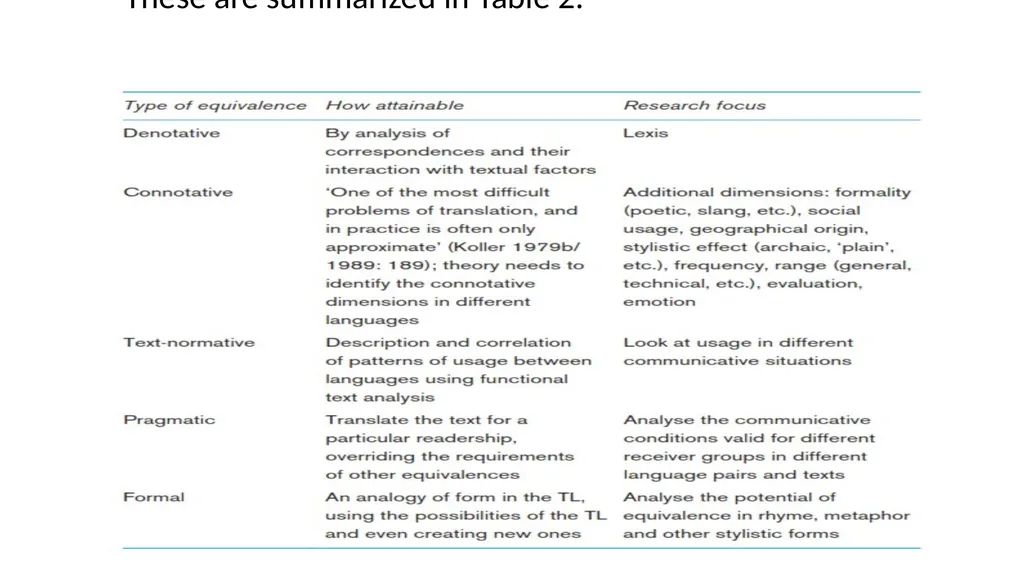
Koller describes the different types of equivalence in terms of their research foci. These are summarized in Table 2.<br>
08
Table 2 Characteristics of research foci for different equivalence types
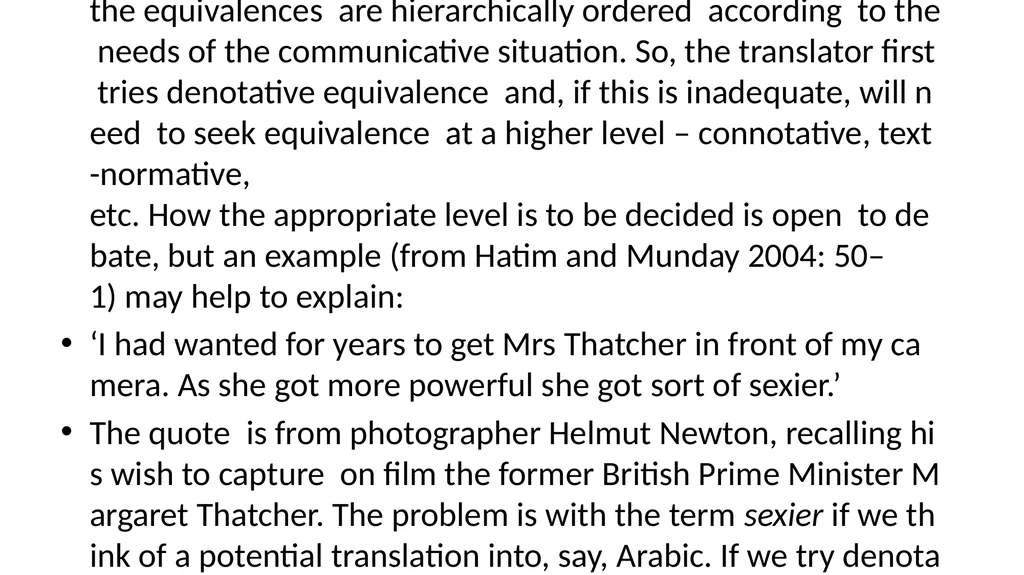
The crucial point again is that, in order to assist the translator, the equivalences are hierarchically ordered according to the needs of the communicative situation. So, the translator first tries denotative equivalence and, if this is inadequate, will need to seek equivalence at a higher level – connotative, text-normative, etc. How the appropriate level is to be decided is open to debate, but an example (from Hatim and Munday 2004: 50–1) may help to explain:
‘I had wanted for years to get Mrs Thatcher in front of my camera. As she got more powerful she got sort of sexier.’
The quote is from photographer Helmut Newton, recalling his wish to capture on film the former British Prime Minister Margaret Thatcher. The problem is with the term sexier if we think of a potential translation into, say, Arabic. If we try denotative equivalence (i.e. translating it by sexy) this might convey the sense of ‘pornographic’. Connotative equivalence (e.g. attractiveness) would be better but it may be too direct for the communicative purpose of this type of text (i.e. it would not achieve text-normative equivalence).<br>
The crucial point again is that, in order to assist the translator, the equivalences are hierarchically ordered according to the needs of the communicative situation. So, the translator first tries denotative equivalence and, if this is inadequate, will need to seek equivalence at a higher level – connotative, text-normative, etc. How the appropriate level is to be decided is open to debate, but an example (from Hatim and Munday 2004: 50–1) may help to explain:
‘I had wanted for years to get Mrs Thatcher in front of my camera. As she got more powerful she got sort of sexier.’
The quote is from photographer Helmut Newton, recalling his wish to capture on film the former British Prime Minister Margaret Thatcher. The problem is with the term sexier if we think of a potential translation into, say, Arabic. If we try denotative equivalence (i.e. translating it by sexy) this might convey the sense of ‘pornographic’. Connotative equivalence (e.g. attractiveness) would be better but it may be too direct for the communicative purpose of this type of text (i.e. it would not achieve text-normative equivalence).<br>
09
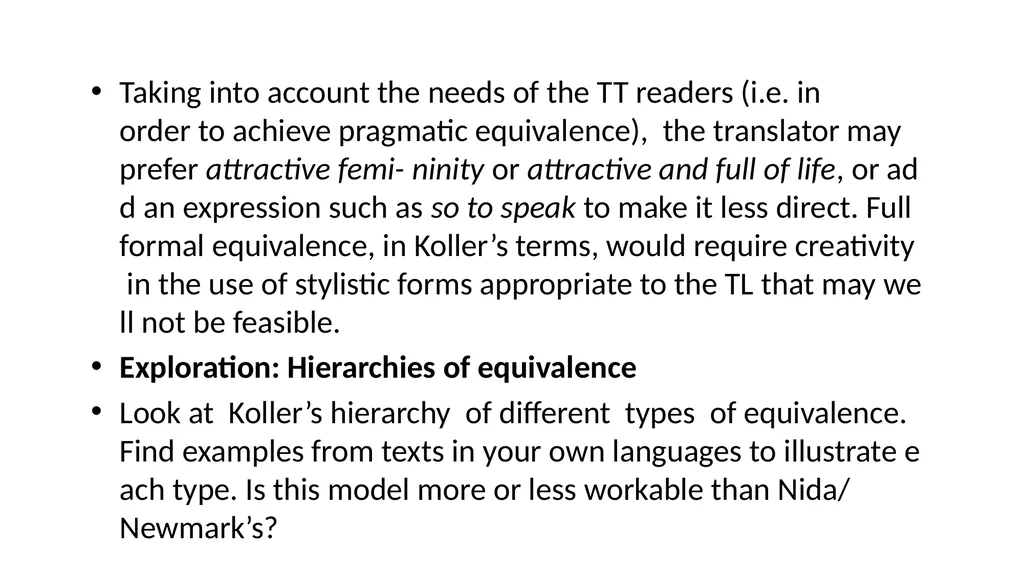
Taking into account the needs of the TT readers (i.e. in order to achieve pragmatic equivalence), the translator may prefer attractive femi- ninity or attractive and full of life, or add an expression such as so to speak to make it less direct. Full formal equivalence, in Koller’s terms, would require creativity in the use of stylistic forms appropriate to the TL that may well not be feasible.
Exploration: Hierarchies of equivalence
Look at Koller’s hierarchy of different types of equivalence. Find examples from texts in your own languages to illustrate each type. Is this model more or less workable than Nida/Newmark’s?<br>
Exploration: Hierarchies of equivalence
Look at Koller’s hierarchy of different types of equivalence. Find examples from texts in your own languages to illustrate each type. Is this model more or less workable than Nida/Newmark’s?<br>
10
Later developments in equivalence
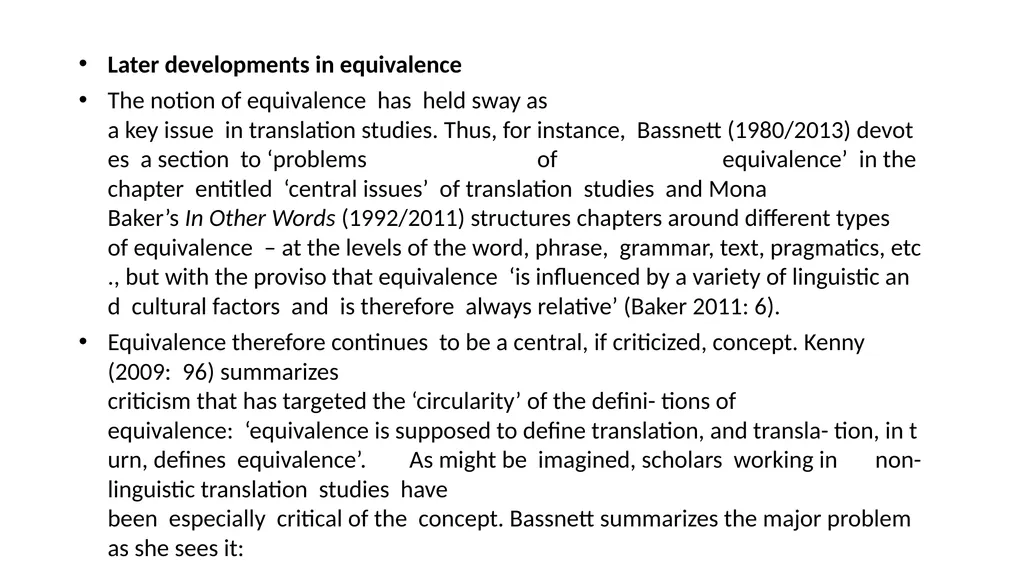
The notion of equivalence has held sway as a key issue in translation studies. Thus, for instance, Bassnett (1980/2013) devotes a section to ‘problems of equivalence’ in the chapter entitled ‘central issues’ of translation studies and Mona Baker’s In Other Words (1992/2011) structures chapters around different types of equivalence – at the levels of the word, phrase, grammar, text, pragmatics, etc., but with the proviso that equivalence ‘is influenced by a variety of linguistic and cultural factors and is therefore always relative’ (Baker 2011: 6).
Equivalence therefore continues to be a central, if criticized, concept. Kenny (2009: 96) summarizes criticism that has targeted the ‘circularity’ of the defini- tions of equivalence: ‘equivalence is supposed to define translation, and transla- tion, in turn, defines equivalence’. As might be imagined, scholars working in non-linguistic translation studies have been especially critical of the concept. Bassnett summarizes the major problem as she sees it:<br>
The notion of equivalence has held sway as a key issue in translation studies. Thus, for instance, Bassnett (1980/2013) devotes a section to ‘problems of equivalence’ in the chapter entitled ‘central issues’ of translation studies and Mona Baker’s In Other Words (1992/2011) structures chapters around different types of equivalence – at the levels of the word, phrase, grammar, text, pragmatics, etc., but with the proviso that equivalence ‘is influenced by a variety of linguistic and cultural factors and is therefore always relative’ (Baker 2011: 6).
Equivalence therefore continues to be a central, if criticized, concept. Kenny (2009: 96) summarizes criticism that has targeted the ‘circularity’ of the defini- tions of equivalence: ‘equivalence is supposed to define translation, and transla- tion, in turn, defines equivalence’. As might be imagined, scholars working in non-linguistic translation studies have been especially critical of the concept. Bassnett summarizes the major problem as she sees it:<br>
11
Translation involves far more than replacement of lexical and grammatical items between languages . . . Once the translator moves away from close linguistic equivalence, the problems of determining the exact nature of the level of equivalence aimed for begin to emerge.
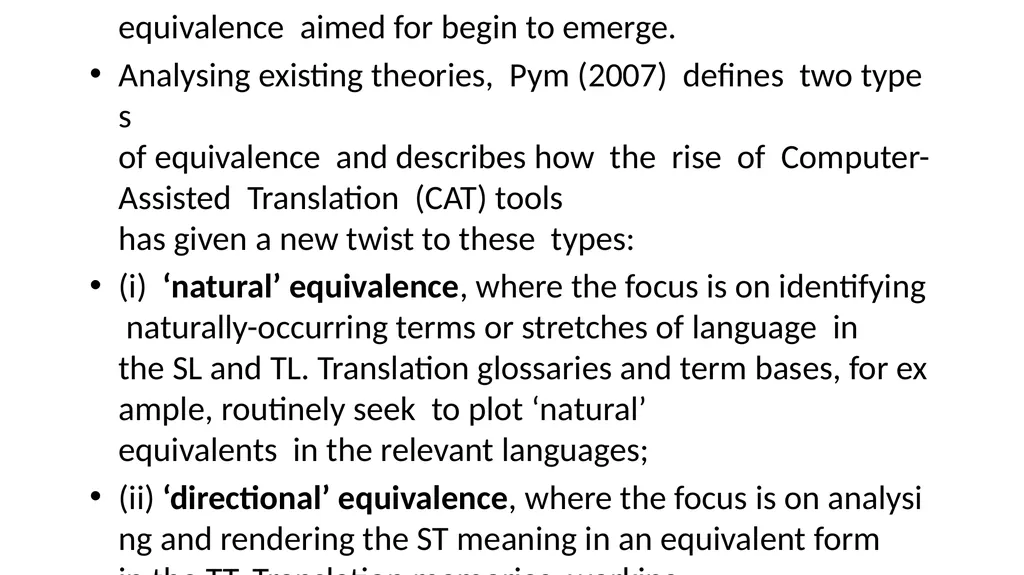
Analysing existing theories, Pym (2007) defines two types of equivalence and describes how the rise of Computer-Assisted Translation (CAT) tools has given a new twist to these types:
(i) ‘natural’ equivalence, where the focus is on identifying naturally-occurring terms or stretches of language in the SL and TL. Translation glossaries and term bases, for example, routinely seek to plot ‘natural’ equivalents in the relevant languages;
(ii) ‘directional’ equivalence, where the focus is on analysing and rendering the ST meaning in an equivalent form in the TT. Translation memories, working on a corpus of already translated material, impose existing ‘directional’ equivalents on the translator through the flagging up of exact and fuzzy matches with stretches of language in the database.<br>
Analysing existing theories, Pym (2007) defines two types of equivalence and describes how the rise of Computer-Assisted Translation (CAT) tools has given a new twist to these types:
(i) ‘natural’ equivalence, where the focus is on identifying naturally-occurring terms or stretches of language in the SL and TL. Translation glossaries and term bases, for example, routinely seek to plot ‘natural’ equivalents in the relevant languages;
(ii) ‘directional’ equivalence, where the focus is on analysing and rendering the ST meaning in an equivalent form in the TT. Translation memories, working on a corpus of already translated material, impose existing ‘directional’ equivalents on the translator through the flagging up of exact and fuzzy matches with stretches of language in the database.<br>