Legal Language Statutory interpretation Maciej Pichlak Department of Legal Theory and Philosophy of Law University of Wroclaw Room 302A maciej.pichlakuwr.edu.pl https:prawo.uni.wroc.pluser12147 Legal interpretation The process of
"Legal Language Statutory interpretation Maciej" is the property of its rightful owner. Permission is granted to
download and print the materials on this website for personal, non-commercial use only, and to display it
on your personal computer provided you do not modify the materials and that you retain all copyright
notices contained in the materials. By downloading content from our website, you accept the terms of this
agreement.
Presentation Transcript
01
Legal Language Statutory interpretation Maciej Pichlak
Department of Legal Theory and Philosophy of Law
University of Wroclaw
Room 302A | maciej.pichlak@uwr.edu.pl
https://prawo.uni.wroc.pl/user/12147<br>
02
Legal interpretation The process of determining the meaning of legal rules.
Lex et ius
Ius:
the totality of law
‚lawyers-made law’
final legal decision
Ius est ars boni et aequi.
Celsus<br>
03
Legal reason – a controversy 'God had endowed His Majesty with excellent science, and great endowments of nature ...' still 'his Majesty was not learned in the laws of his realm of England, and causes which concern the life, or inheritance, or goods, or fortunes of his subjects, are not to be decided by natural reason but by the artificial reason and judgment of law, which law is an art which requires long study and experience, before that a man can attain to the cognisance of it.'
Sir Edward Coke to King James I, in 1607
The first thing we do, let's kill all the lawyers.
W. Shakespeare, Henry The Sixth, Part 2, about 1590<br>
04
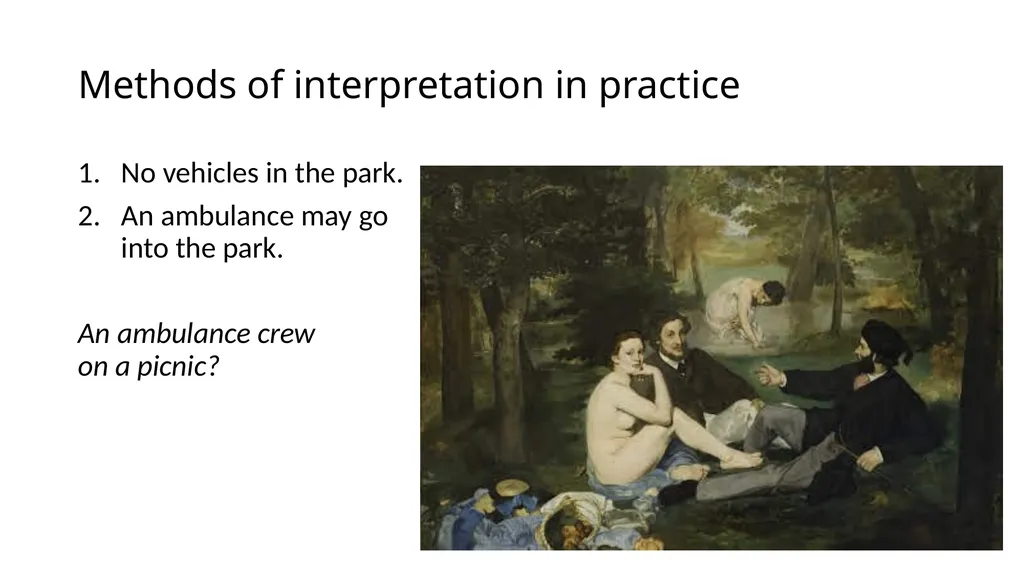
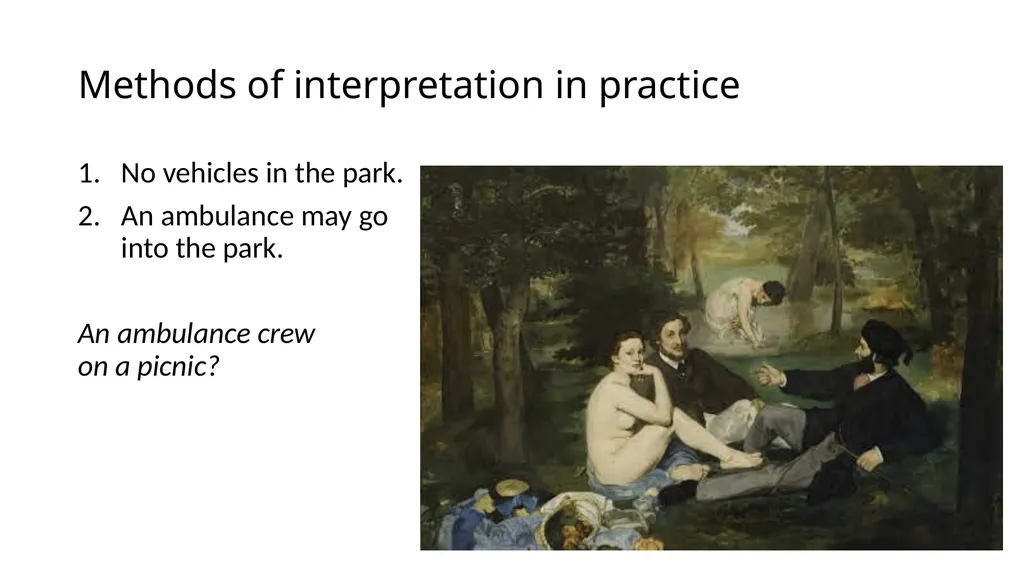
Methods of interpretation in practice No vehicles in the park.
An ambulance may go into the park.
An ambulance crew on a picnic?<br>
05
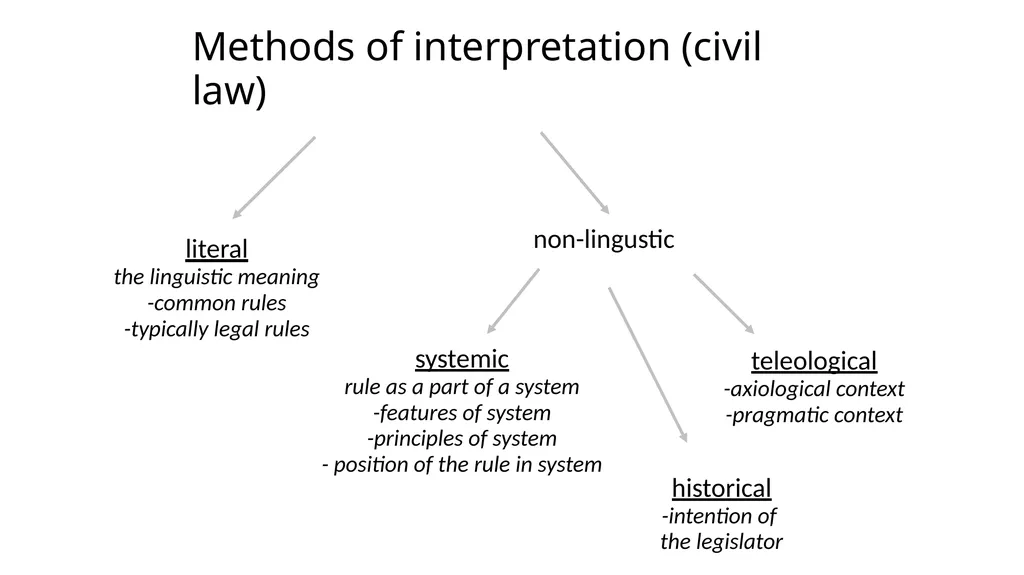
Methods of interpretation (civil law) literal
the linguistic meaning
-common rules
-typically legal rules non-lingustic systemic
rule as a part of a system
-features of system
-principles of system
- position of the rule in system historical
-intention of the legislator teleological
-axiological context
-pragmatic context<br>
06
Literal interpretation (linguistic, grammatical) „Literal interpretation (or textualism) may be defined as the action of explaining what a normative text conveys by looking at the usual meaning of the words contained therein. The literal interpretation of a clear and precise provision is the method of interpretation that best reflects the principle of legal certainty…”
Lenaerts and Gutierrez-Fons 2013
The doctrine of sens clair / acte clair and Clara non sunt interpretanda<br>
07
When language is not enough… Whosoever steps on grass, or destroys plants, shall be subject to penalty of…
Standards of inconsistency or absurdity
Systemic or purposive interpretation<br>
08
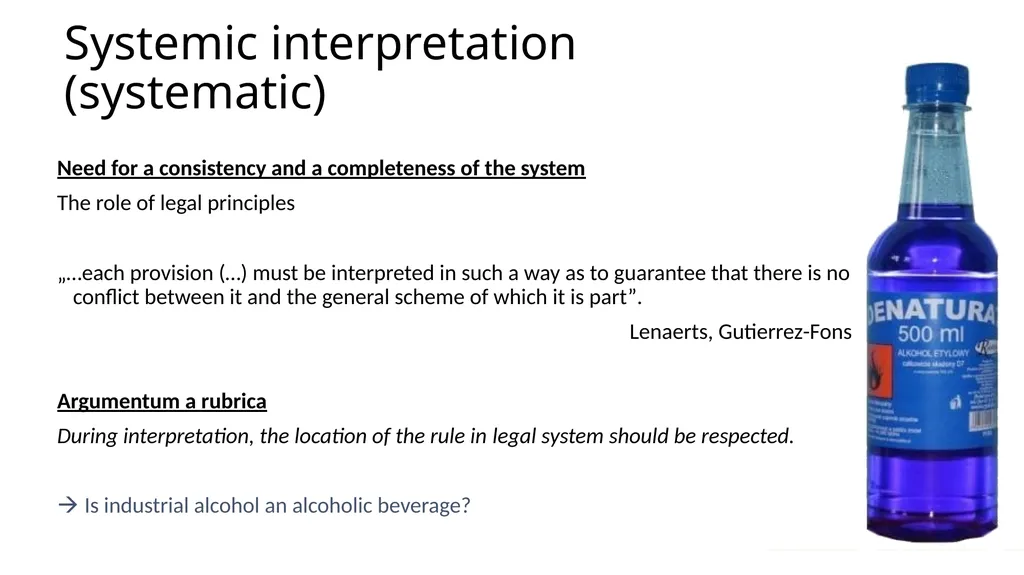
Systemic interpretation (systematic) Need for a consistency and a completeness of the system
The role of legal principles
„…each provision (…) must be interpreted in such a way as to guarantee that there is no conflict between it and the general scheme of which it is part”.
Lenaerts, Gutierrez-Fons
Argumentum a rubrica
During interpretation, the location of the rule in legal system should be respected.
Is industrial alcohol an alcoholic beverage?<br>
09
Teleological interpretation (purposive, functional) Argumentum ad absurdum
One may not choose the interpretation that guides to absurd, ridiculous or unacceptable consequences.
Purpose or ratio legis
The rule should be interpreted in accordance with and with respect to its ratio legis/ purpose.
ratio legis: reasons for enacting the rule (its goal or value it serves)<br>
10
Historical interpretation The intention of historical legislator
The role of travaux préparatoires<br>
11
Outcomes of interpretation literal – narrowing – extensive
The principle of priority of linguistic/ literal/ plain meaning interpretaion<br>
12
Outcomes of interpretation Extensive interpretation is usually restricted:
on exceptions (exceptiones non sunt extendendae)
on lex specialis rule
on rules limitating fundamental rights
in criminal law to disadvantage of the accused<br>
13
Methods of interpretation in practice No vehicles in the park.
An ambulance may go into the park.
An ambulance crew on a picnic?<br>
14
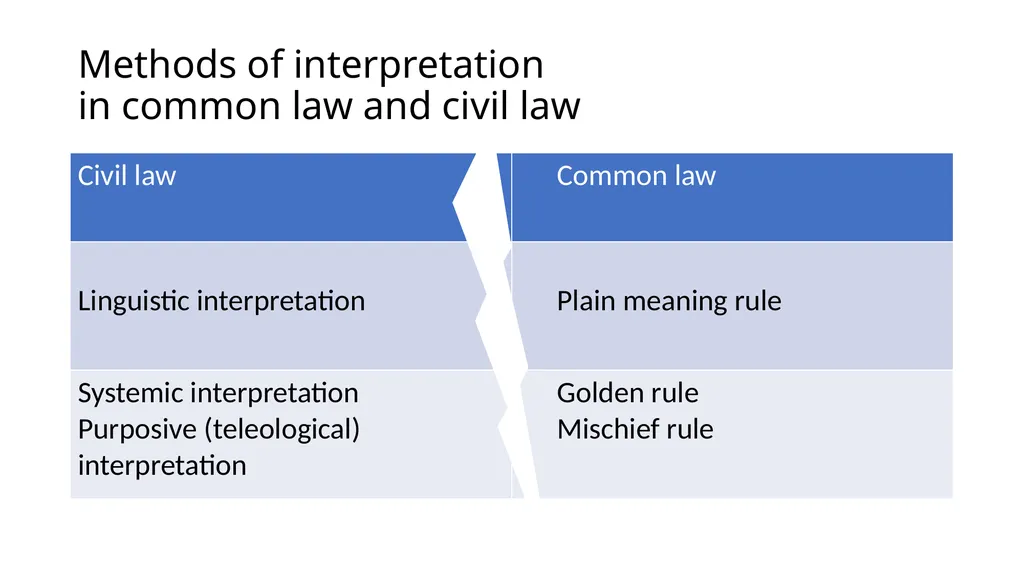
Methods of interpretation in common law and civil law<br>
15
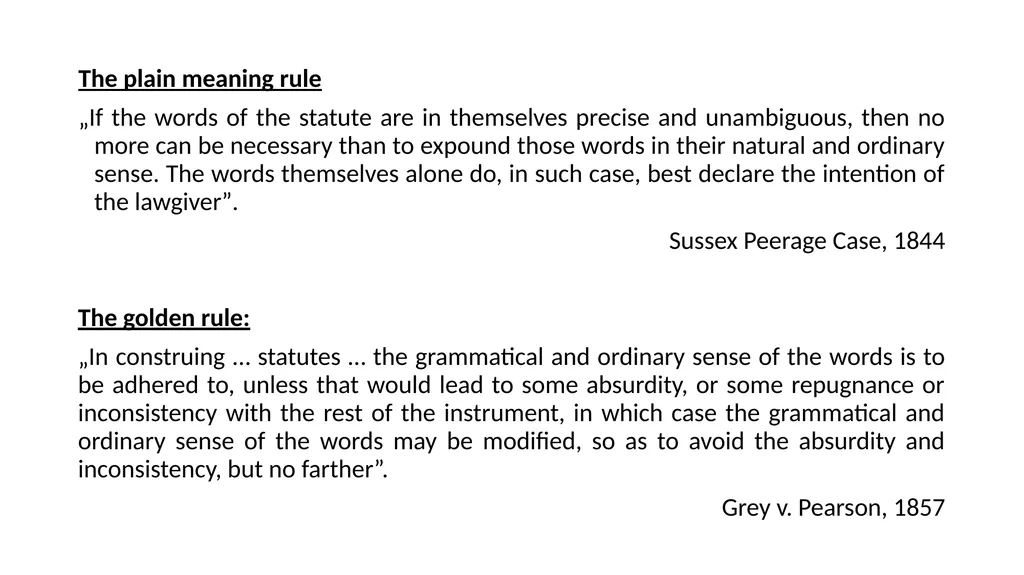
The plain meaning rule
„If the words of the statute are in themselves precise and unambiguous, then no more can be necessary than to expound those words in their natural and ordinary sense. The words themselves alone do, in such case, best declare the intention of the lawgiver”.
Sussex Peerage Case, 1844
The golden rule:
„In construing … statutes … the grammatical and ordinary sense of the words is to be adhered to, unless that would lead to some absurdity, or some repugnance or inconsistency with the rest of the instrument, in which case the grammatical and ordinary sense of the words may be modified, so as to avoid the absurdity and inconsistency, but no farther”.
Grey v. Pearson, 1857<br>
16
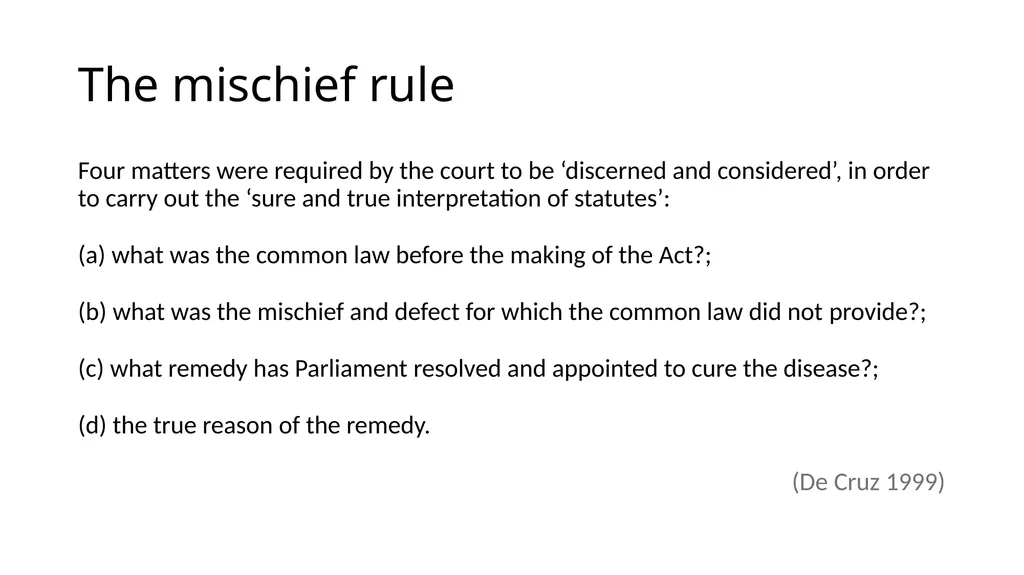
The mischief rule Four matters were required by the court to be ‘discerned and considered’, in order to carry out the ‘sure and true interpretation of statutes’:
(a) what was the common law before the making of the Act?;
(b) what was the mischief and defect for which the common law did not provide?;
(c) what remedy has Parliament resolved and appointed to cure the disease?;
(d) the true reason of the remedy.
(De Cruz 1999)<br>
17
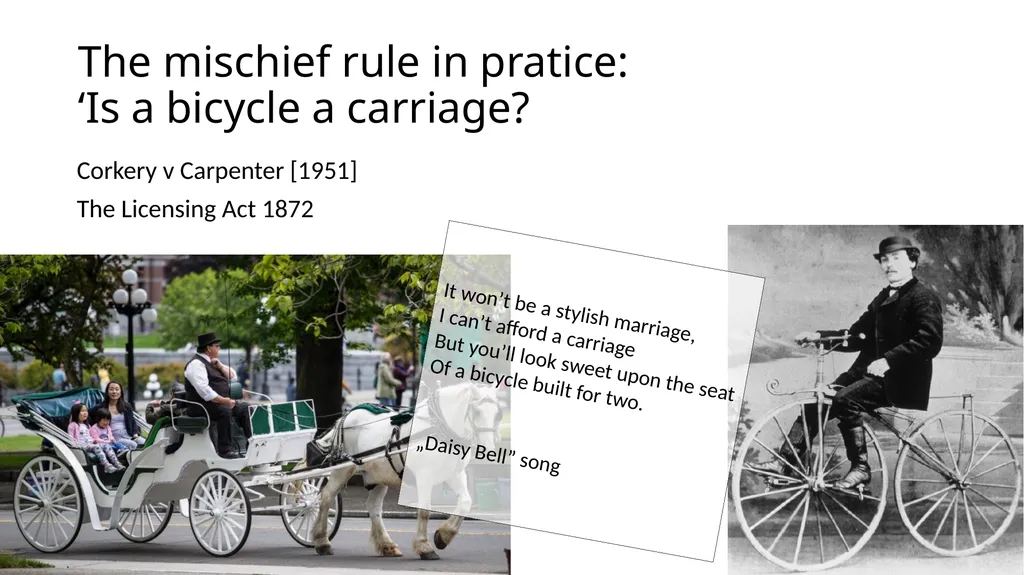
The mischief rule in pratice: ‘Is a bicycle a carriage? Corkery v Carpenter [1951]
The Licensing Act 1872 It won’t be a stylish marriage,
I can’t afford a carriage
But you’ll look sweet upon the seat
Of a bicycle built for two.
„Daisy Bell” song<br>
18
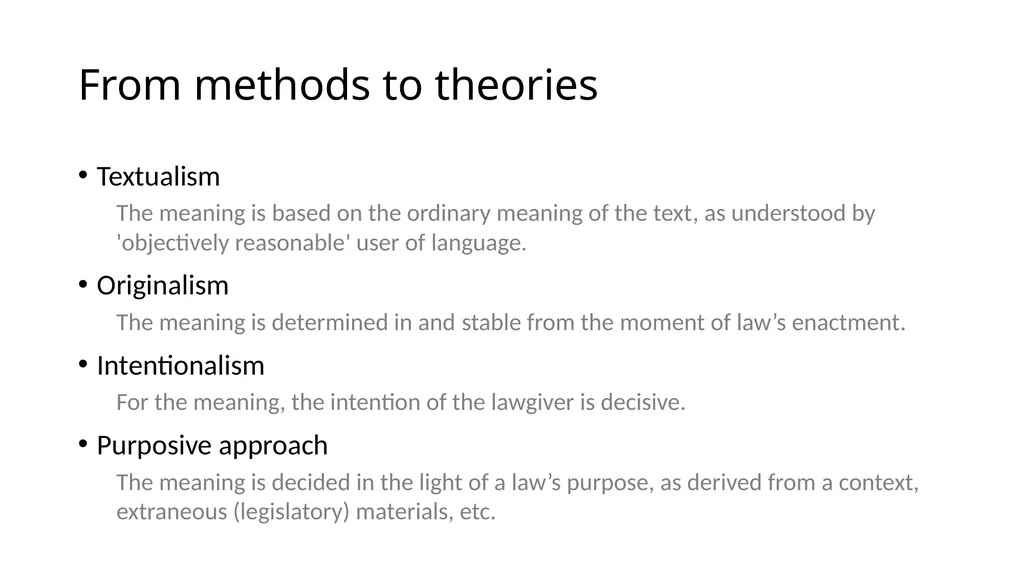
From methods to theories Textualism
The meaning is based on the ordinary meaning of the text, as understood by 'objectively reasonable' user of language.
Originalism
The meaning is determined in and stable from the moment of law’s enactment.
Intentionalism
For the meaning, the intention of the lawgiver is decisive.
Purposive approach
The meaning is decided in the light of a law’s purpose, as derived from a context, extraneous (legislatory) materials, etc.<br>