
Lesson 2: Patient Advocacy Module 5: Enhancing
DP
Published · 37 slides · 0 views

1 / 1


Description
Lesson 2: Patient Advocacy Module 5: Enhancing Communication Oncology Patient Navigator Training: The Fundamentals Acknowledgments This work was supported by Cooperative Agreement 1U38DP004972-02 from the Centers for Disease Control and
Related Topics
Share
Embed code
Download this presentation From Below
"Lesson 2: Patient Advocacy Module 5: Enhancing" is the property of its rightful owner. Permission is granted to download and print the materials on this website for personal, non-commercial use only, and to display it on your personal computer provided you do not modify the materials and that you retain all copyright notices contained in the materials. By downloading content from our website, you accept the terms of this agreement.
Presentation Transcript
01
Lesson 2: Patient Advocacy Module 5: Enhancing Communication
Oncology Patient Navigator Training: The Fundamentals<br>
Oncology Patient Navigator Training: The Fundamentals<br>
02
Acknowledgments This work was supported by Cooperative Agreement #1U38DP004972-02 from the Centers for Disease Control and Prevention. Its contents are solely the responsibility of the authors and do not necessarily represent the official views of the Centers for Disease Control and Prevention.
Portions of this lesson have been adapted with permission from:
The Patient Navigator Training Collaborative of the Colorado School of Public Health
The National Coalition for Cancer Survivorship
We would like to thank:
The GW Clinical Learning and Simulation Skills (CLASS) Center for providing space to film video simulations for this lesson
Patient navigator actors in the simulation videos: Thelma D. Jones and Falasha Culpepper<br>
Portions of this lesson have been adapted with permission from:
The Patient Navigator Training Collaborative of the Colorado School of Public Health
The National Coalition for Cancer Survivorship
We would like to thank:
The GW Clinical Learning and Simulation Skills (CLASS) Center for providing space to film video simulations for this lesson
Patient navigator actors in the simulation videos: Thelma D. Jones and Falasha Culpepper<br>
03
Competencies This lesson covers the following Core Competencies for Patient Navigators:
4.1 Assess patient capacity to self-advocate; Help patients optimize time with their doctors and treatment team (e.g., prioritize questions, clarify information with treatment team)
6.2 Advocate for quality patient care and optimal care systems<br>
4.1 Assess patient capacity to self-advocate; Help patients optimize time with their doctors and treatment team (e.g., prioritize questions, clarify information with treatment team)
6.2 Advocate for quality patient care and optimal care systems<br>
04
Learning Objectives Describe the terms advocacy and self-advocacy
Implement strategies for advocating for your patient
Describe components of self-advocacy
Assess patient capacity to advocate for her or himself
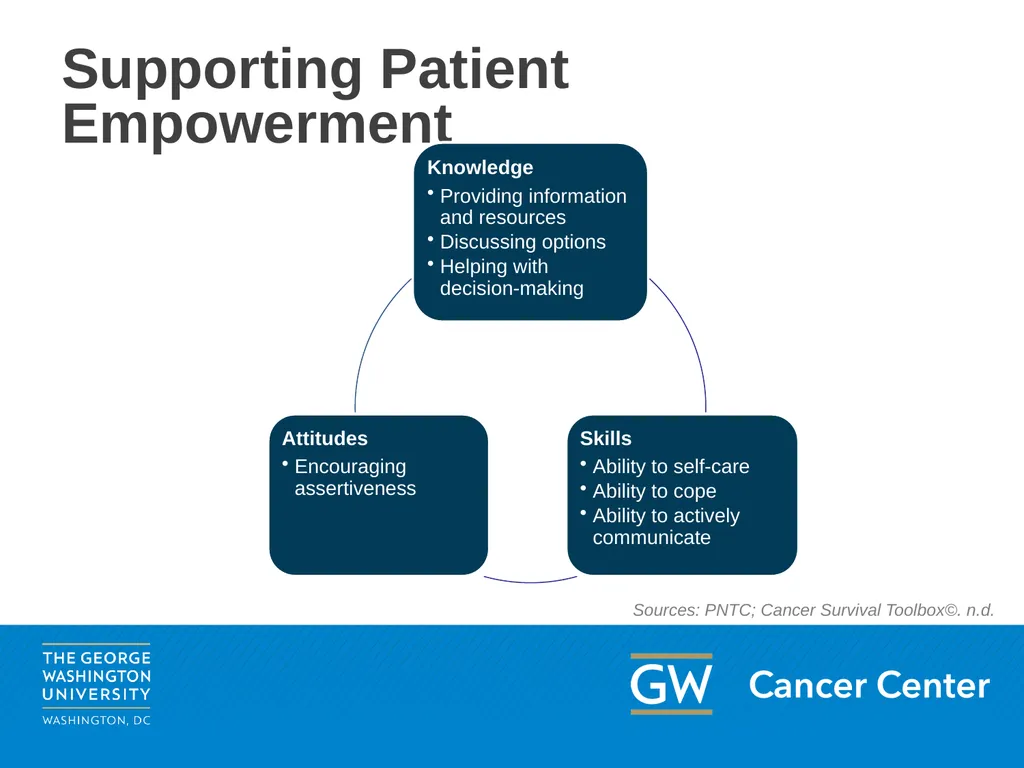
Support patient empowerment to advocate for themselves
Identify self-advocacy tools to support patients
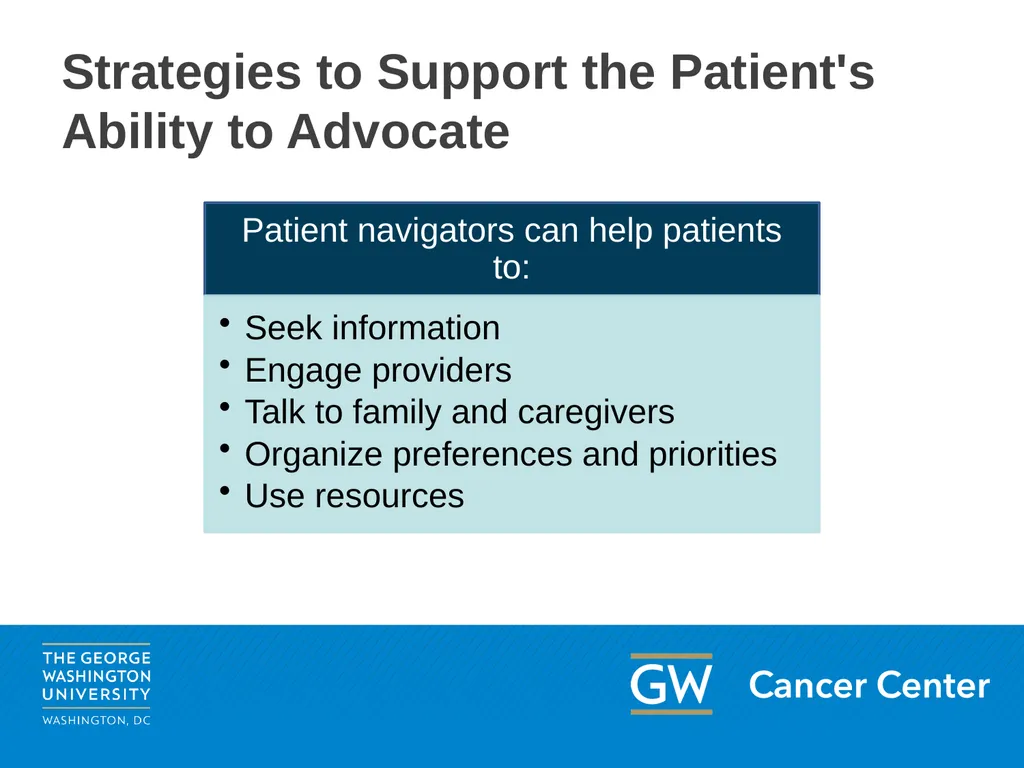
Identify strategies to support the patient's ability to advocate for him or herself and communicate with the medical team
Describe strategies for advocating for quality patient care and optimal patient systems<br>
Implement strategies for advocating for your patient
Describe components of self-advocacy
Assess patient capacity to advocate for her or himself
Support patient empowerment to advocate for themselves
Identify self-advocacy tools to support patients
Identify strategies to support the patient's ability to advocate for him or herself and communicate with the medical team
Describe strategies for advocating for quality patient care and optimal patient systems<br>
05
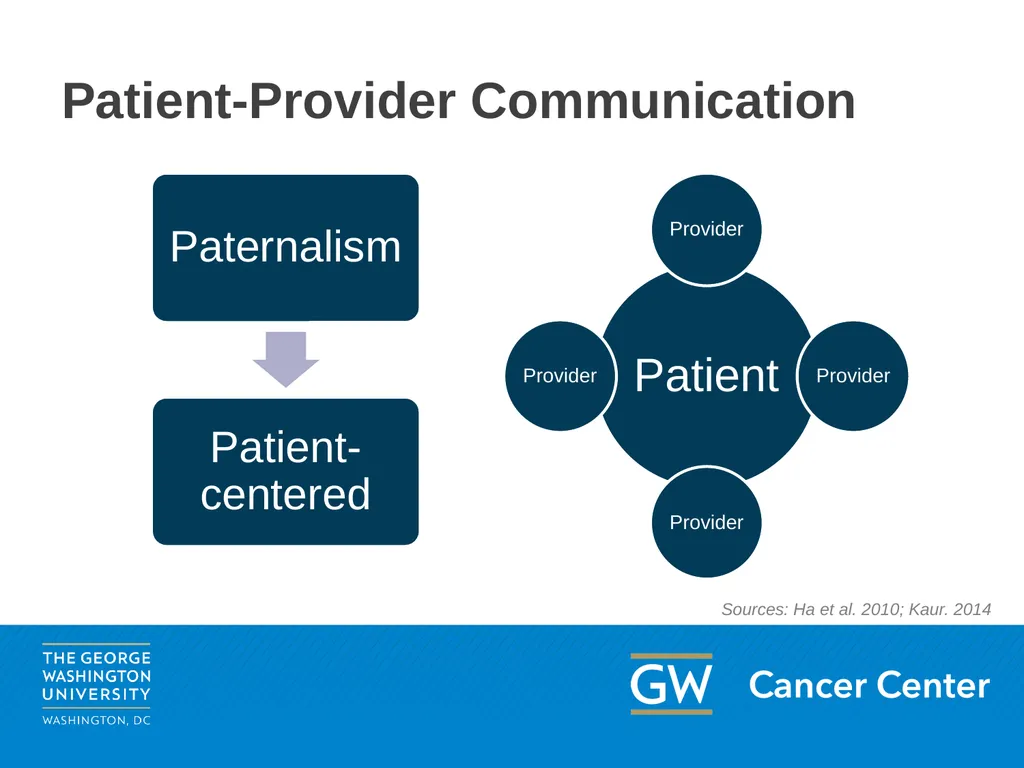
Patient-Provider Communication Sources: Ha et al. 2010; Kaur. 2014<br>
06
Advocacy “The act of pleading for supporting or recommending” - Dictionary.com
“The act or process of supporting a cause or proposal” - Merriam Webster Sources: Dictionary.com. n.d.; Merriam-Webster Online. n.d.<br>
“The act or process of supporting a cause or proposal” - Merriam Webster Sources: Dictionary.com. n.d.; Merriam-Webster Online. n.d.<br>
07
Definition: Patient Advocate “A person who helps a patient work with others who have an effect on the patient's health, including doctors, insurance companies, employers, case managers, and lawyers. A patient advocate helps resolve issues about health care, medical bills, and job discrimination related to a patient's medical condition.” Source: NCI Dictionary of Cancer Terms. n.d.<br>
08
Strategies for Advocating For Your Patient Know your patient’s needs
- Help patient learn more about medical and treatment options
- Help patient’s family come to agreement on decisions that need to be made for a loved one
- Find legal assistance
Determine when to advocate
Balance assertiveness and aggressiveness Source: Ausmed Education. 2014<br>
- Help patient learn more about medical and treatment options
- Help patient’s family come to agreement on decisions that need to be made for a loved one
- Find legal assistance
Determine when to advocate
Balance assertiveness and aggressiveness Source: Ausmed Education. 2014<br>
09
Advocating on Behalf of a Patient Letting a doctor know
Working with internal departments
Speaking up at a team meeting
Helping a patient access services
Writing appeal letters
Calling utilities company<br>
Working with internal departments
Speaking up at a team meeting
Helping a patient access services
Writing appeal letters
Calling utilities company<br>
10
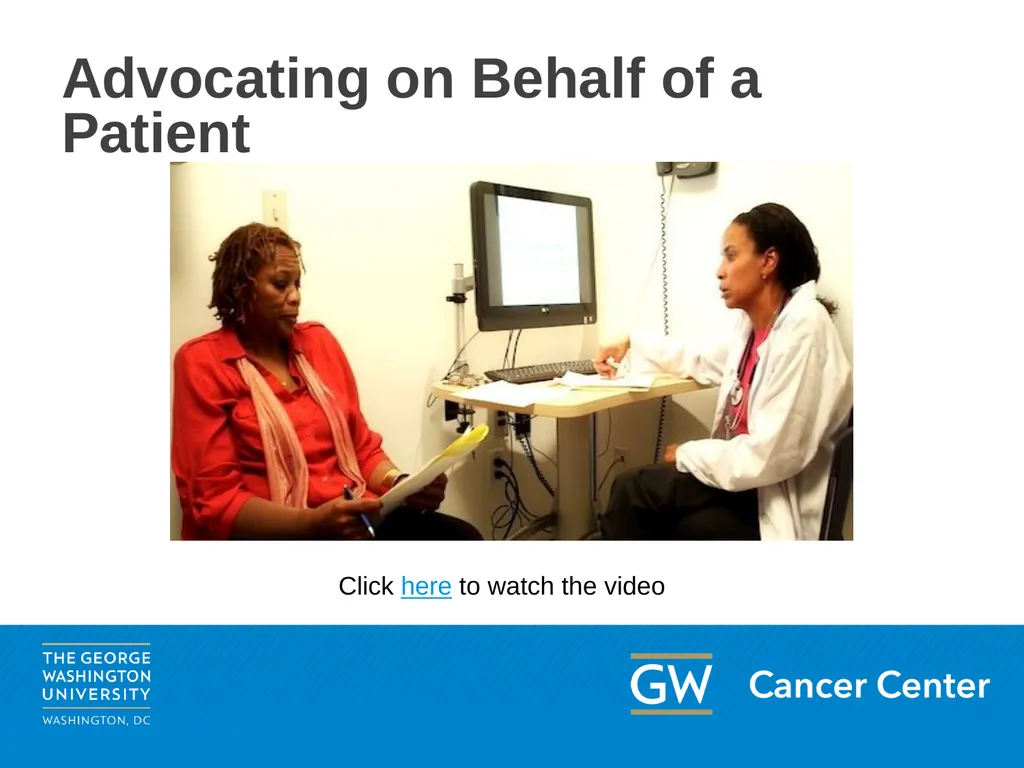
Advocating on Behalf of a Patient Click here to watch the video<br>
11
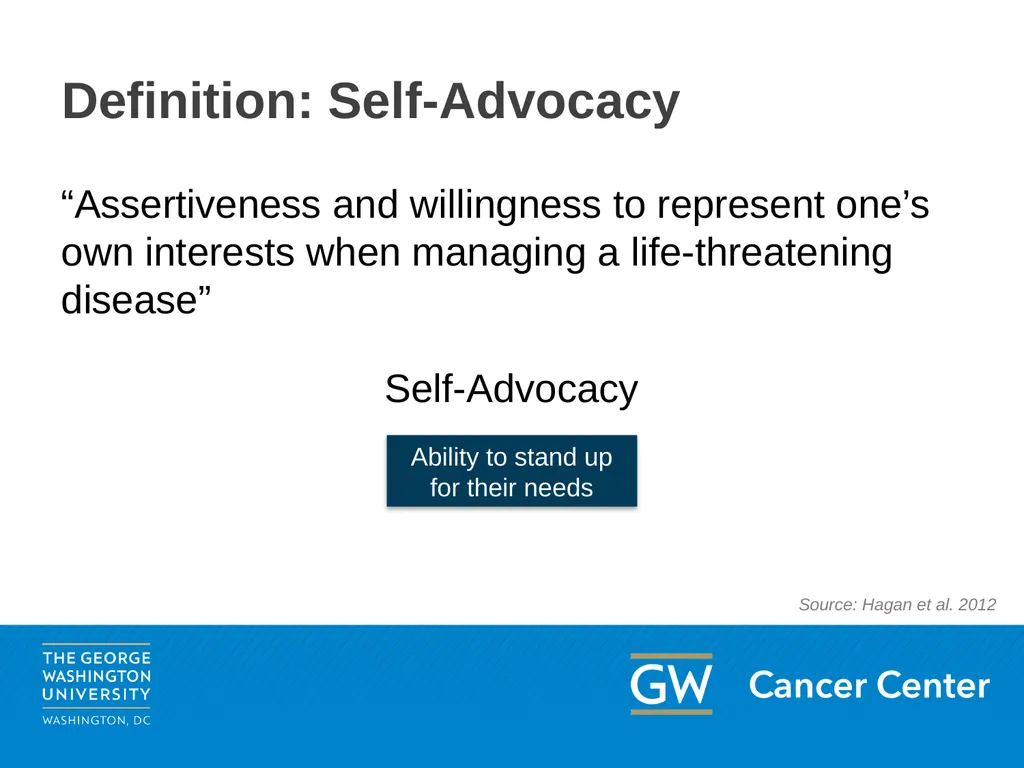
Definition: Self-Advocacy “Assertiveness and willingness to represent one’s own interests when managing a life-threatening disease” Self-Advocacy Ability to stand up for their needs Source: Hagan et al. 2012<br>
12
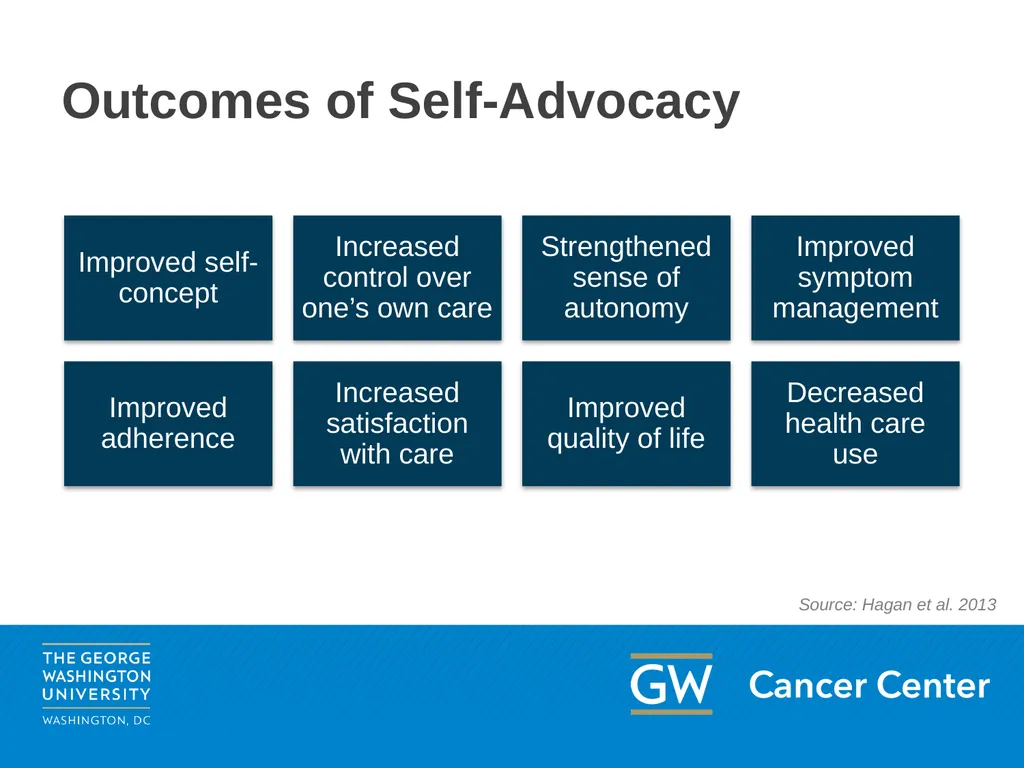
Outcomes of Self-Advocacy Source: Hagan et al. 2013<br>
13
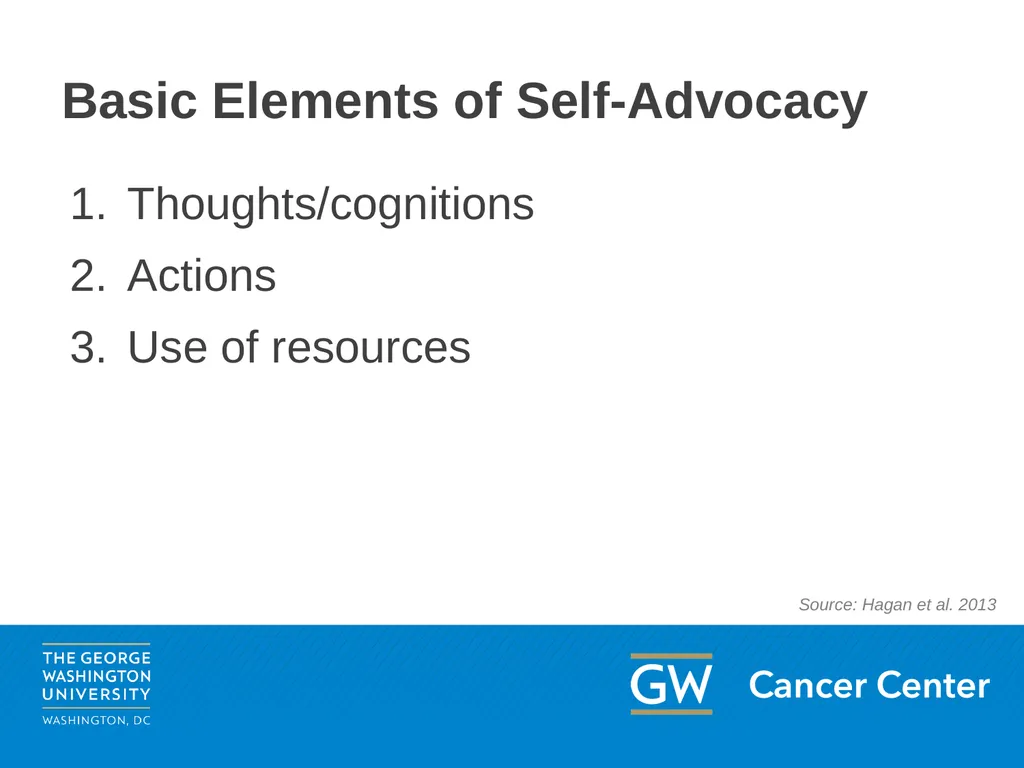
Basic Elements of Self-Advocacy Thoughts/cognitions
Actions
Use of resources Source: Hagan et al. 2013<br>
Actions
Use of resources Source: Hagan et al. 2013<br>
14
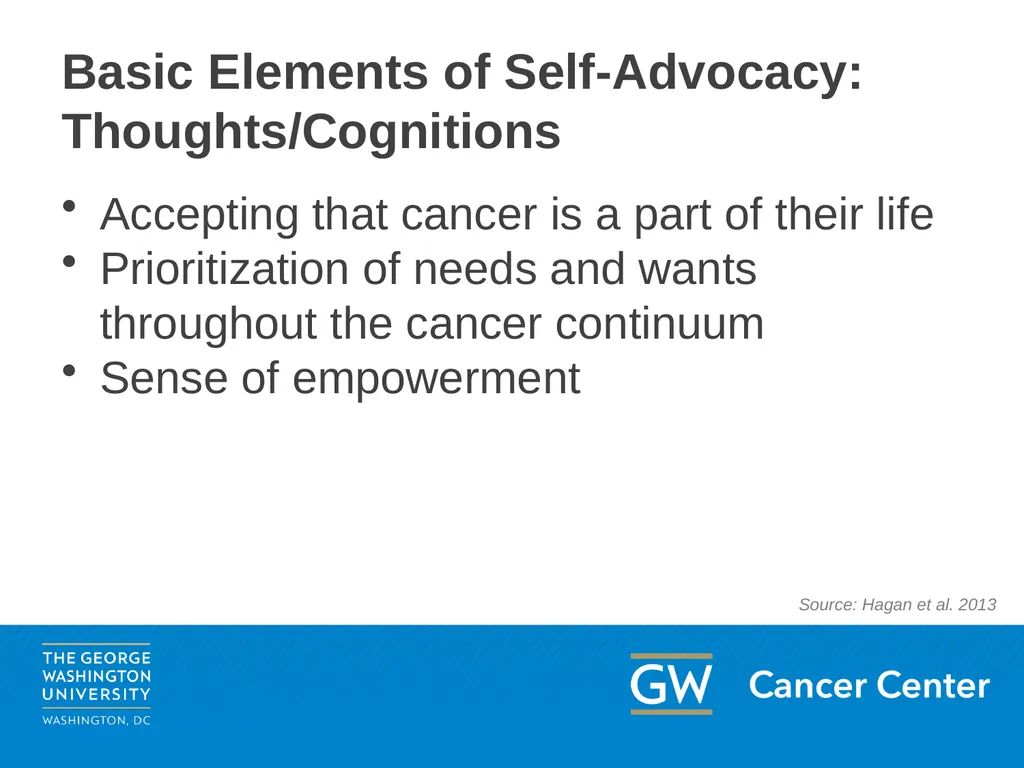
Basic Elements of Self-Advocacy: Thoughts/Cognitions Accepting that cancer is a part of their life
Prioritization of needs and wants throughout the cancer continuum
Sense of empowerment Source: Hagan et al. 2013<br>
Prioritization of needs and wants throughout the cancer continuum
Sense of empowerment Source: Hagan et al. 2013<br>
15
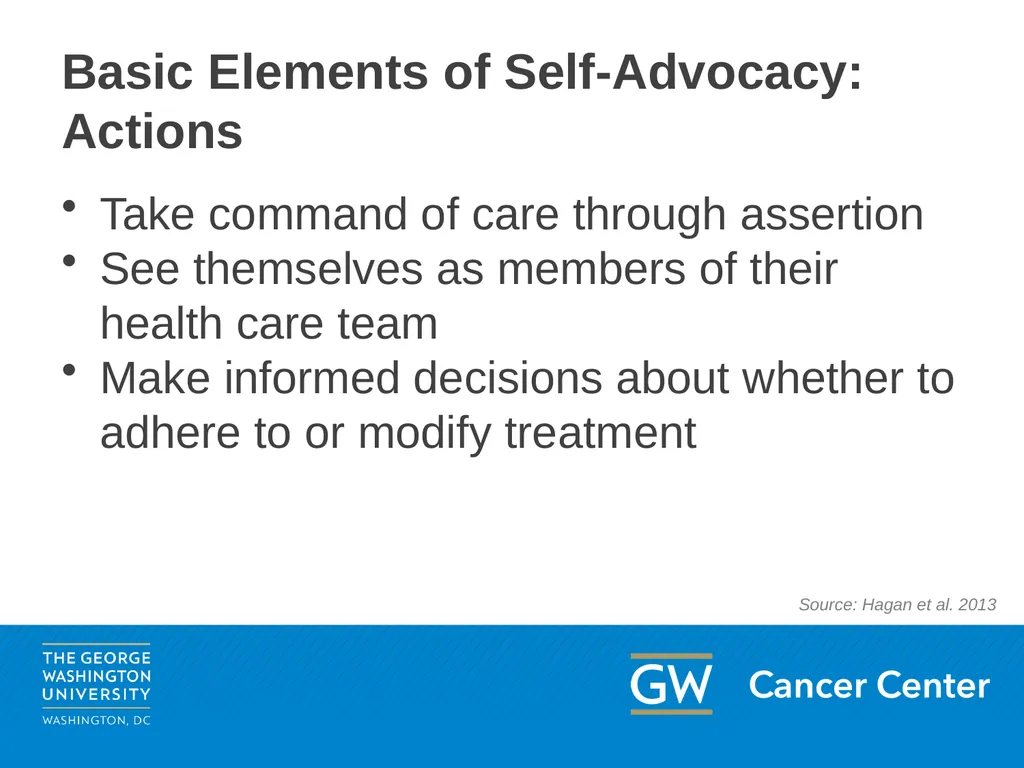
Basic Elements of Self-Advocacy: Actions Take command of care through assertion
See themselves as members of their health care team
Make informed decisions about whether to adhere to or modify treatment Source: Hagan et al. 2013<br>
See themselves as members of their health care team
Make informed decisions about whether to adhere to or modify treatment Source: Hagan et al. 2013<br>
16
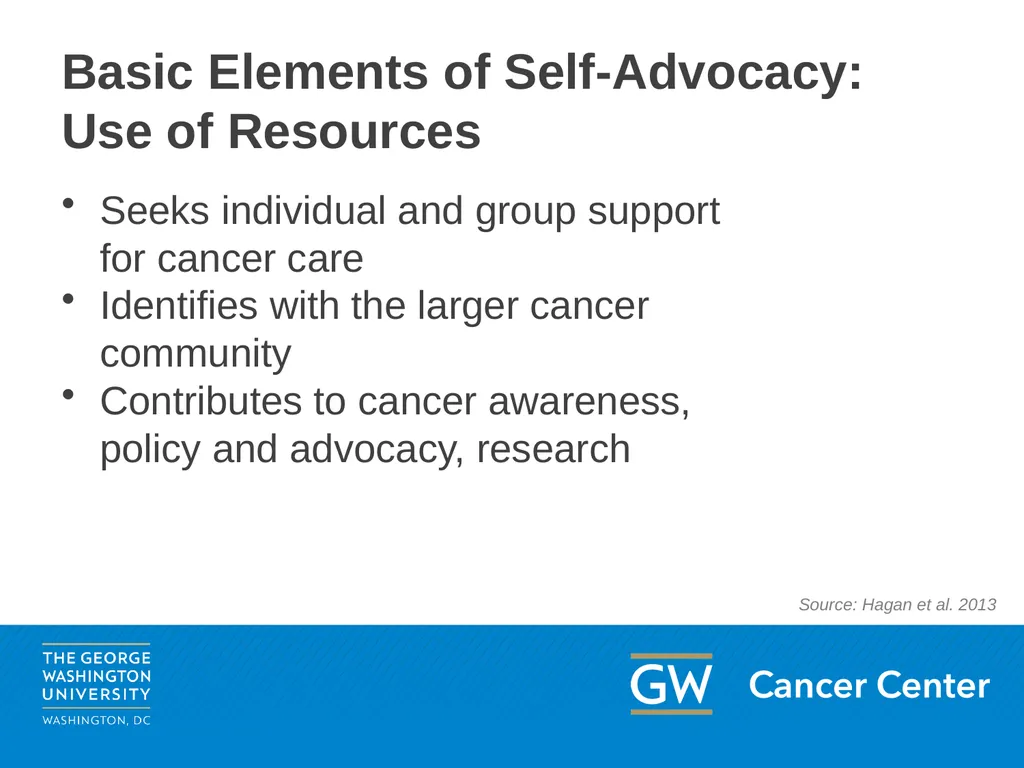
Basic Elements of Self-Advocacy: Use of Resources Seeks individual and group support for cancer care
Identifies with the larger cancer community
Contributes to cancer awareness, policy and advocacy, research Source: Hagan et al. 2013<br>
Identifies with the larger cancer community
Contributes to cancer awareness, policy and advocacy, research Source: Hagan et al. 2013<br>
17
Other Factors for Self-Advocacy Personal characteristics
Learned skills
Attainability of support Source: Hagan et al. 2013<br>
Learned skills
Attainability of support Source: Hagan et al. 2013<br>
18
Other Factors for Self-Advocacy Personal characteristics impact ability to:
Manage symptoms
Make role adjustments
Plan for end of life Source: Hagan et al. 2013<br>
Manage symptoms
Make role adjustments
Plan for end of life Source: Hagan et al. 2013<br>
19
Other Factors for Self-Advocacy Learned skills:
Communication skills
Navigating the health care system
Informed decision-making
Problem-solving skills
Information-seeking skills Source: Hagan et al. 2013<br>
Communication skills
Navigating the health care system
Informed decision-making
Problem-solving skills
Information-seeking skills Source: Hagan et al. 2013<br>
20
Other Factors for Self-Advocacy Attainability of support:
Informal support – family and friends
Formal support – support groups/ organizations Source: Hagan et al. 2013<br>
Informal support – family and friends
Formal support – support groups/ organizations Source: Hagan et al. 2013<br>
21
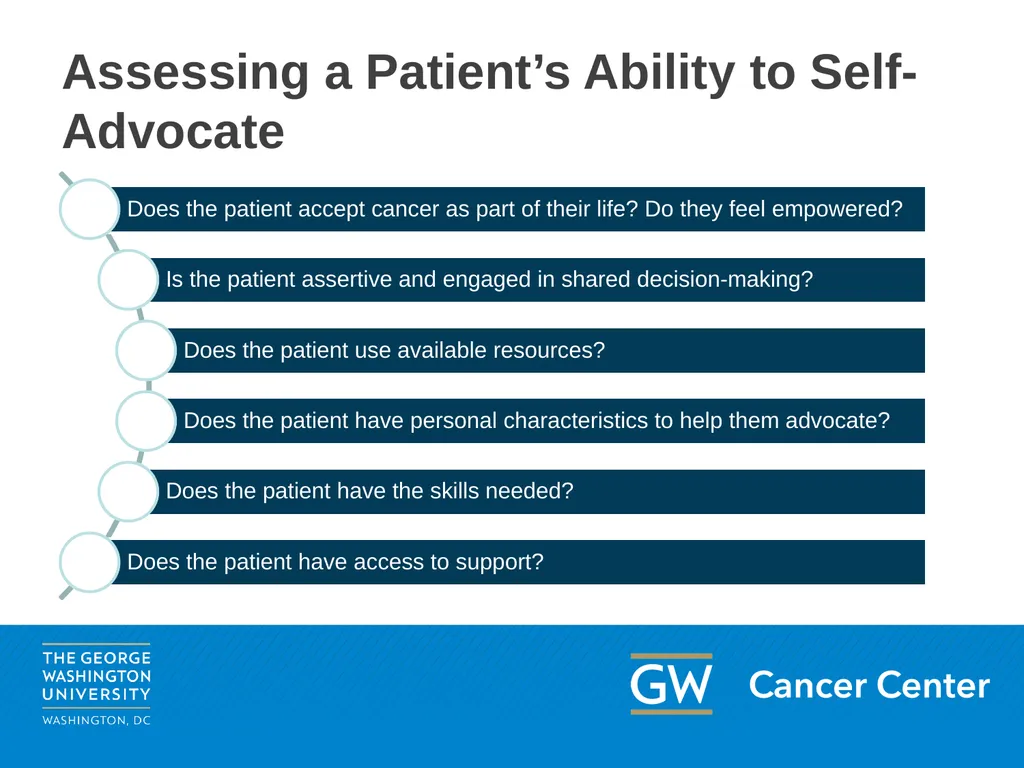
Assessing a Patient’s Ability to Self-Advocate<br>
22
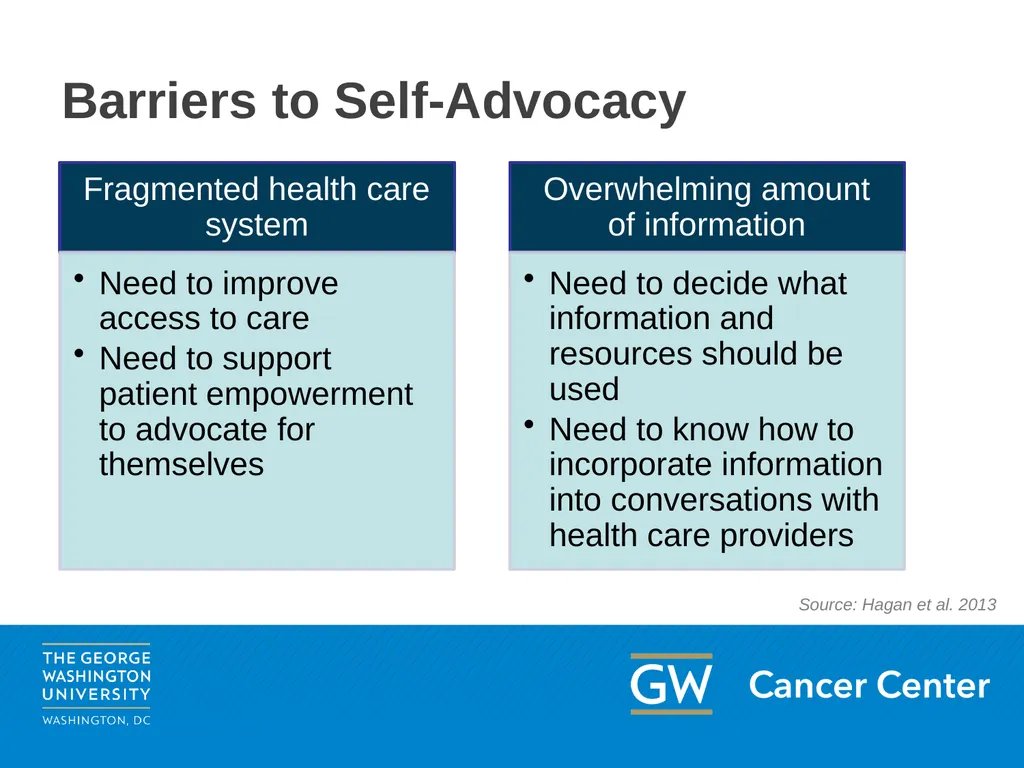
Barriers to Self-Advocacy Source: Hagan et al. 2013<br>
23
Supporting Patient Empowerment Sources: PNTC; Cancer Survival Toolbox©. n.d.<br>
24
Strategies to Support the Patient's Ability to Advocate<br>
25
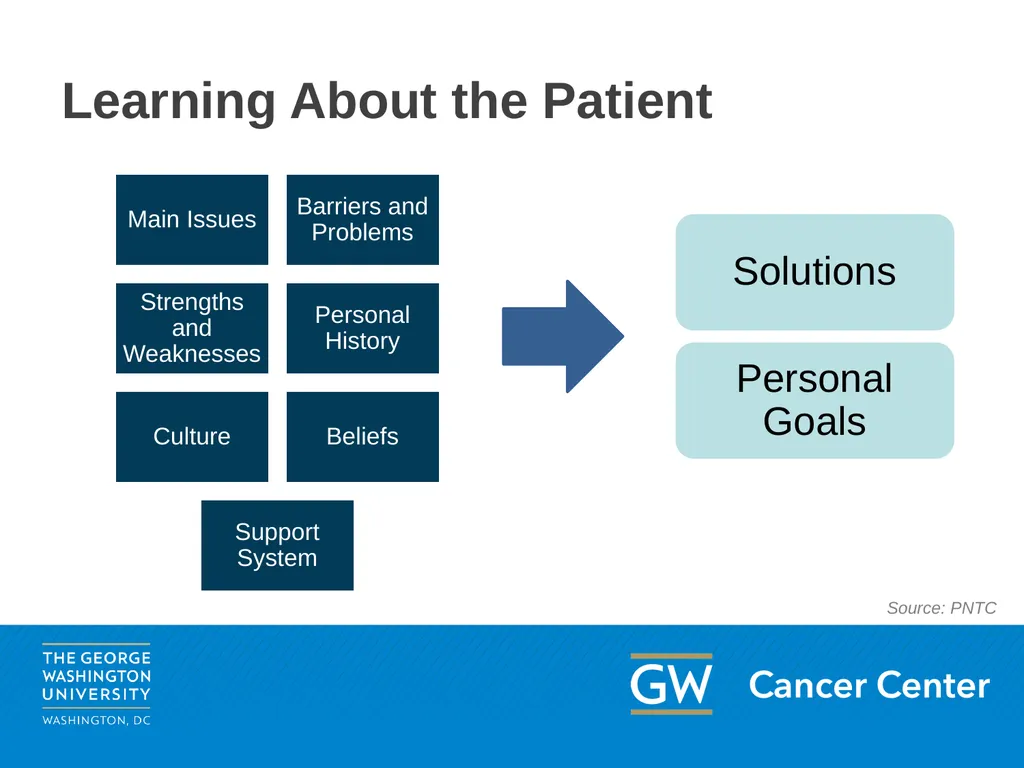
Learning About the Patient Source: PNTC<br>
26
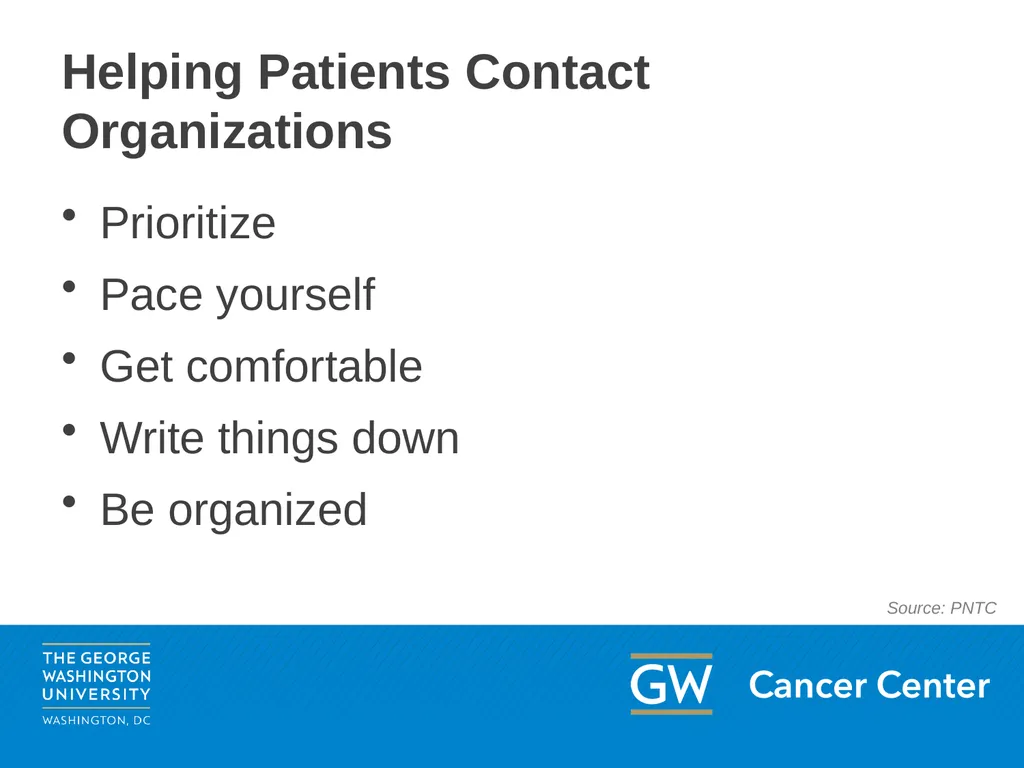
Helping Patients Contact Organizations Prioritize
Pace yourself
Get comfortable
Write things down
Be organized Source: PNTC<br>
Pace yourself
Get comfortable
Write things down
Be organized Source: PNTC<br>
27
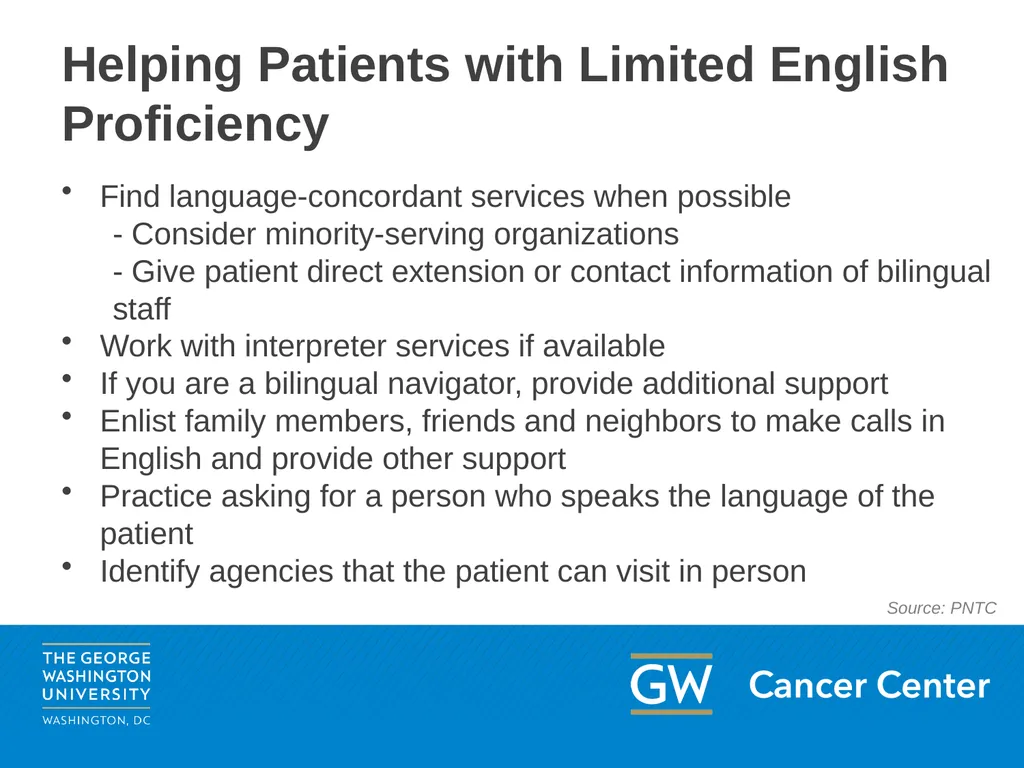
Helping Patients with Limited English Proficiency Find language-concordant services when possible
- Consider minority-serving organizations
- Give patient direct extension or contact information of bilingual staff
Work with interpreter services if available
If you are a bilingual navigator, provide additional support
Enlist family members, friends and neighbors to make calls in English and provide other support
Practice asking for a person who speaks the language of the patient
Identify agencies that the patient can visit in person Source: PNTC<br>
- Consider minority-serving organizations
- Give patient direct extension or contact information of bilingual staff
Work with interpreter services if available
If you are a bilingual navigator, provide additional support
Enlist family members, friends and neighbors to make calls in English and provide other support
Practice asking for a person who speaks the language of the patient
Identify agencies that the patient can visit in person Source: PNTC<br>
28
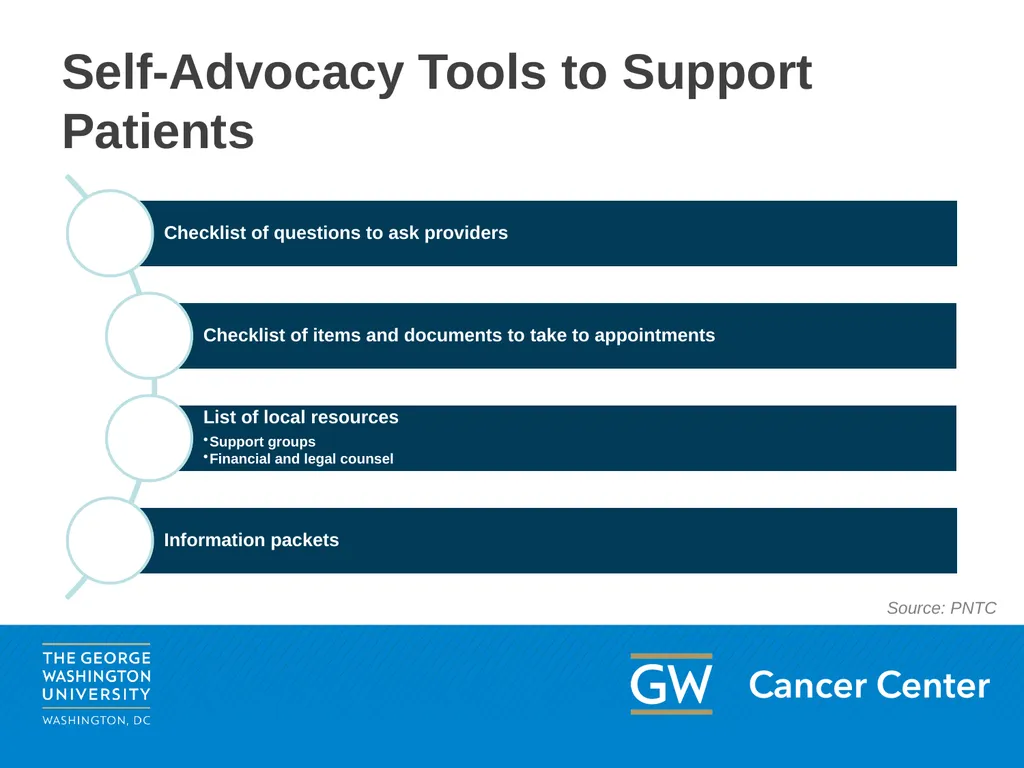
Self-Advocacy Tools to Support Patients Source: PNTC<br>
29
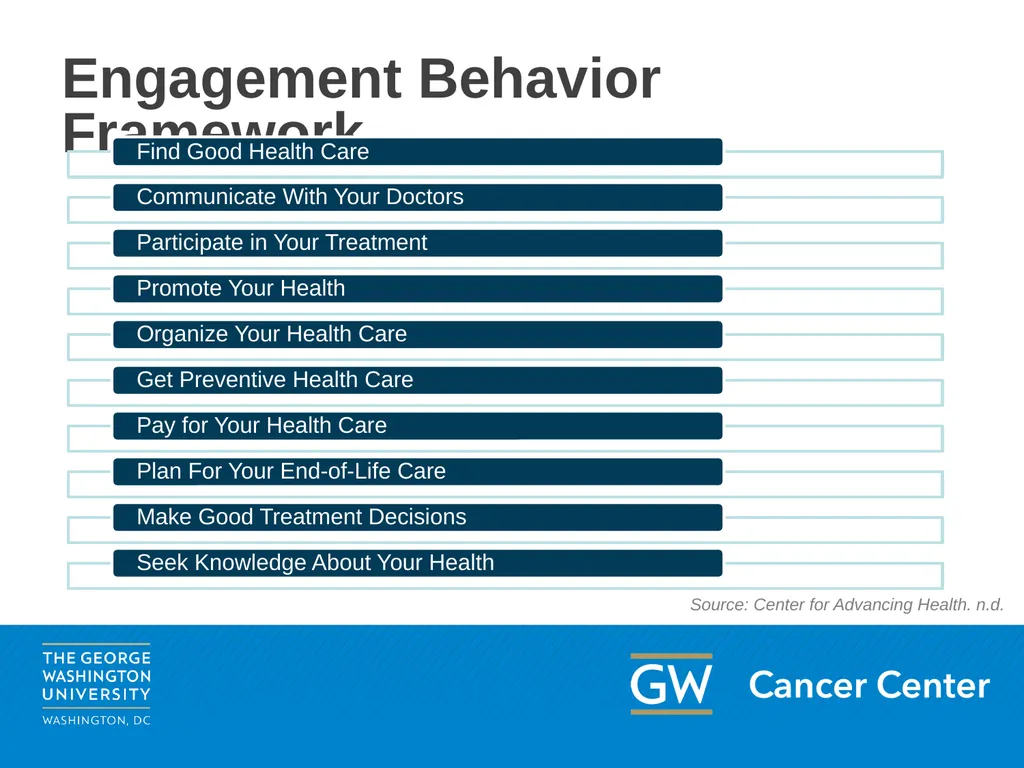
Engagement Behavior Framework Source: Center for Advancing Health. n.d.<br>
30
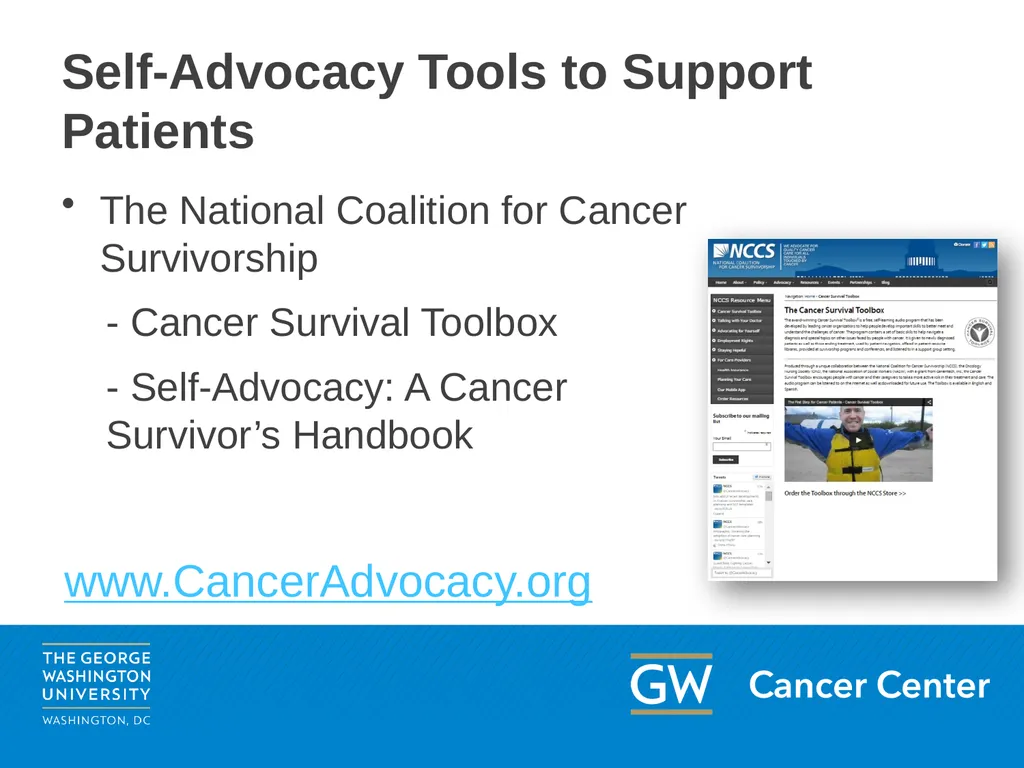
Self-Advocacy Tools to Support Patients The National Coalition for Cancer Survivorship
- Cancer Survival Toolbox
- Self-Advocacy: A Cancer Survivor’s Handbook www.CancerAdvocacy.org<br>
- Cancer Survival Toolbox
- Self-Advocacy: A Cancer Survivor’s Handbook www.CancerAdvocacy.org<br>
31
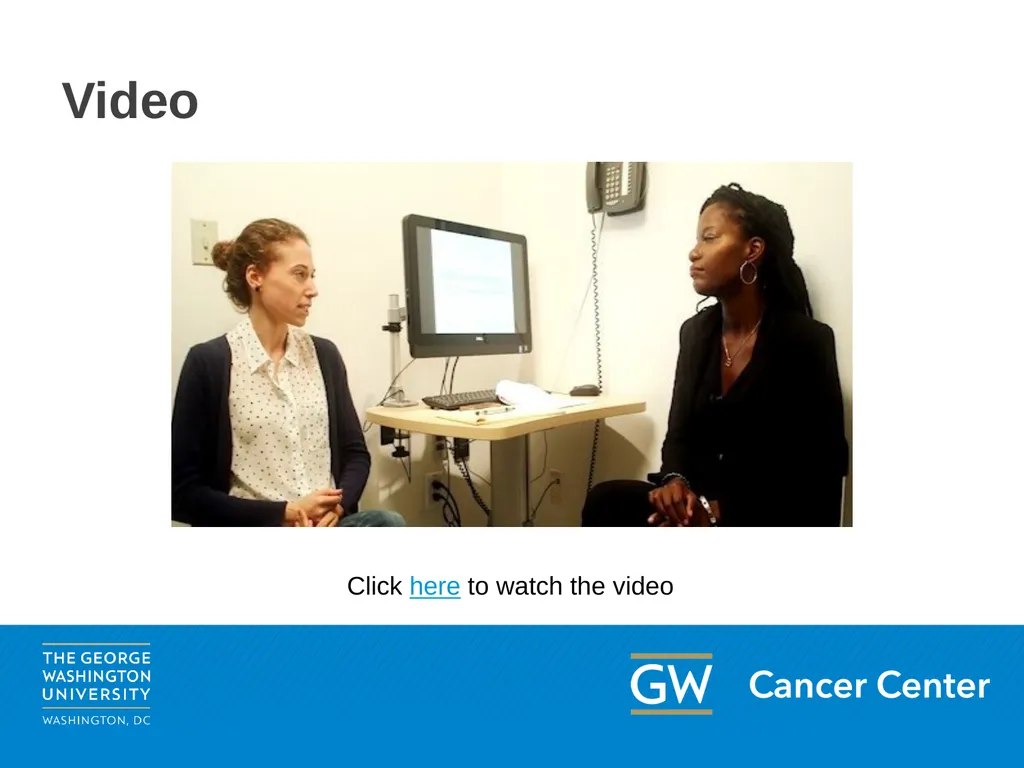
Video Click here to watch the video<br>
32
Supporting Patients Draw from knowledge of medical terms
Remain empathic, encouraging, positive and reassuring
Focus on working with the patient
Gently confront the patient when necessary
Encourage the patient to speak up and ask questions and to make sure she understands all of the treatment options<br>
Remain empathic, encouraging, positive and reassuring
Focus on working with the patient
Gently confront the patient when necessary
Encourage the patient to speak up and ask questions and to make sure she understands all of the treatment options<br>
33
Maintain Communication with the Patient Do not ever promise or guarantee anything that you cannot definitely provide yourself
Always keep your word and follow through
Be open and honest with the patient about realistic outcomes
Keep the patient updated<br>
Always keep your word and follow through
Be open and honest with the patient about realistic outcomes
Keep the patient updated<br>
34
System Advocacy Speak up at tumor boards
Talk with doctors about common issues you see
Convene a meeting
Join a committee or workgroup
Contact local organizations
Call state or national representatives<br>
Talk with doctors about common issues you see
Convene a meeting
Join a committee or workgroup
Contact local organizations
Call state or national representatives<br>
35
Conclusion In this lesson you learned to:
Describe the terms advocacy and self-advocacy
Implement strategies for advocating for your patient
Describe components of self-advocacy
Assess patient capacity to advocate for her or himself
Support patients empowerment to advocate for themselves
Identify self-advocacy tools to support patients
Identify strategies to support the patient's ability to advocate for him or herself and communicate with the medical team
Describe strategies for advocating for quality patient care and optimal patient systems<br>
Describe the terms advocacy and self-advocacy
Implement strategies for advocating for your patient
Describe components of self-advocacy
Assess patient capacity to advocate for her or himself
Support patients empowerment to advocate for themselves
Identify self-advocacy tools to support patients
Identify strategies to support the patient's ability to advocate for him or herself and communicate with the medical team
Describe strategies for advocating for quality patient care and optimal patient systems<br>
36
References Ausmed Education. (2014). How to advocate for your patient. http://www.ausmed.com.au/blog/entry/how‐to‐advocate‐for‐your‐patient.
Center for Advancing Health. (2010). A new definition of patient engagement: What is engagement and why is it important? http://www.cfah.org/file/CFAH_Engagement_Behavior_Framework_current.pdf.
Dictionary.com Unabridged. (2015). http://dictionary.reference.com/.
Ha, J. F. (2010). Doctor‐patient communication: A review. The Ochsner Journal, 10(1):38–43. Retrieved April 15, 2021, from https://www.ncbi.nlm.nih.gov/pmc/articles/PMC3096184/.
Hagan, T., & Donovan, H. (2013). Self‐advocacy and cancer: A concept analysis. Journal of Advanced Nursing, 69(10):2348–2359. doi: 10.1111/jan.12084.
Kaur, J. S. (2014). How should we “empower” cancer patients? Cancer, 120(20):3108‐3110. doi: 10.1002/cncr.28852.
Merriam‐Webster Online Dictionary. (2015). http://www.merriam‐ webster.com/.
National Cancer Institute. (n.d.). Dictionary of cancer terms. http://www.cancer.gov/dictionary.
National Coalition for Cancer Survivorship. (n.d.). Cancer survival toolbox©. http://www.canceradvocacy.org/resources/cancer‐survival‐toolbox/.
Patient Navigator Training Collaborative. (n.d.). http://patientnavigatortraining.org/<br>
Center for Advancing Health. (2010). A new definition of patient engagement: What is engagement and why is it important? http://www.cfah.org/file/CFAH_Engagement_Behavior_Framework_current.pdf.
Dictionary.com Unabridged. (2015). http://dictionary.reference.com/.
Ha, J. F. (2010). Doctor‐patient communication: A review. The Ochsner Journal, 10(1):38–43. Retrieved April 15, 2021, from https://www.ncbi.nlm.nih.gov/pmc/articles/PMC3096184/.
Hagan, T., & Donovan, H. (2013). Self‐advocacy and cancer: A concept analysis. Journal of Advanced Nursing, 69(10):2348–2359. doi: 10.1111/jan.12084.
Kaur, J. S. (2014). How should we “empower” cancer patients? Cancer, 120(20):3108‐3110. doi: 10.1002/cncr.28852.
Merriam‐Webster Online Dictionary. (2015). http://www.merriam‐ webster.com/.
National Cancer Institute. (n.d.). Dictionary of cancer terms. http://www.cancer.gov/dictionary.
National Coalition for Cancer Survivorship. (n.d.). Cancer survival toolbox©. http://www.canceradvocacy.org/resources/cancer‐survival‐toolbox/.
Patient Navigator Training Collaborative. (n.d.). http://patientnavigatortraining.org/<br>
37
Thank you! Follow us on Twitter: @GWCancer
www.gwcancercenter.org Sign-up for the GW Cancer Center’s Patient Navigation and Survivorship E-Newsletter: bit.ly/PNSurvEnews
Sign-up for the GW Cancer Center’s Cancer Control Technical Assistance E-Newsletter: bit.ly/TAPenews<br>
www.gwcancercenter.org Sign-up for the GW Cancer Center’s Patient Navigation and Survivorship E-Newsletter: bit.ly/PNSurvEnews
Sign-up for the GW Cancer Center’s Cancer Control Technical Assistance E-Newsletter: bit.ly/TAPenews<br>