
LESSON 7 The Sharing Decision Every share is a



Description: LESSON 7 The Sharing Decision Every share is a curation choice. Evaluate before you amplify. Anticipation: Your Influence Your Influence Raise your hand if you shared something online this week. Keep your hand up if you evaluated it first.
Related Topics
Download Presentation
"LESSON 7 The Sharing Decision Every share is a" is the property of its rightful owner. Permission is granted to download and print the materials on this website for personal, non-commercial use only, and to display it on your personal computer provided you do not modify the materials and that you retain all copyright notices contained in the materials. By downloading content from our website, you accept the terms of this agreement.
Presentation Transcript
slide1. LESSON 7 The Sharing Decision Every share is a curation choice. Evaluate before you amplify.<br>
slide2. Anticipation: Your Influence<br>
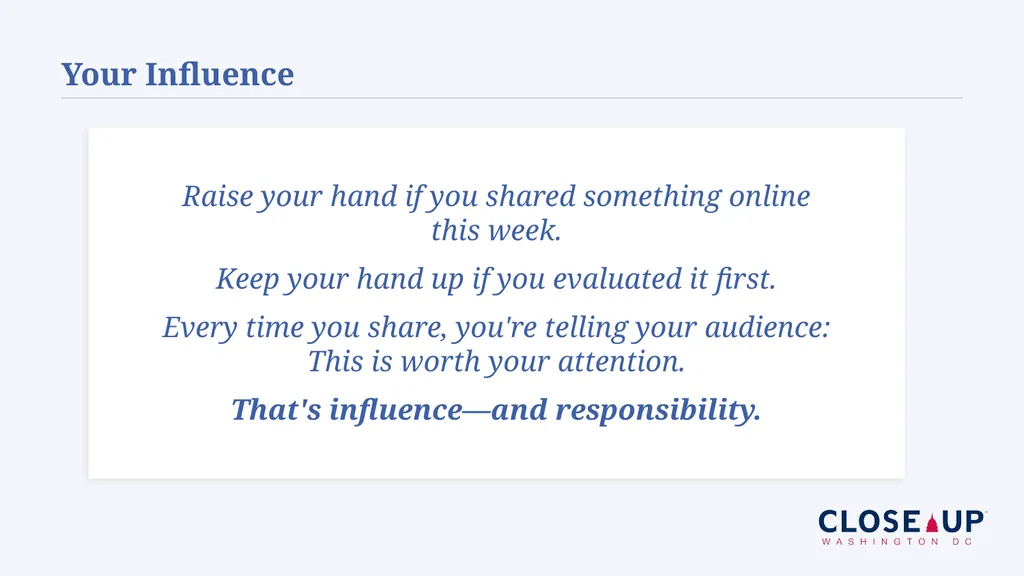
slide3. Your Influence Raise your hand if you shared something online this week.
Keep your hand up if you evaluated it first.
Every time you share, you're telling your audience: This is worth your attention.
That's influence—and responsibility.<br>
slide4. Case Investigation<br>
slide5. Case 1: A Viral Misleading Infographic The Story
A well-designed infographic about education spending goes viral. It uses real data but compares years without adjusting for inflation, making the decline look worse than it is. Teachers’ unions share it widely; it gets 400,000 views. Two weeks later, a fact-check with the correct numbers gets 4,000 views. The creator defends it: “The broader point is true; I just highlighted the problem.”
The Question
What made this go viral? What stopped the fact-check?<br>
slide6. Case B: Credible Report, Nobody Shared The Story
An investigative journalist publishes a 3,000-word article about wage theft, backed by 15 interviews and payroll records. It gets 200 views. The same week, a TikTok creator posts a 30-second emotional rant about the same topic—no sources, no specifics—and gets 400,000 views. The journalist has actionable information. The TikTok has emotion but nothing a viewer can act on.
The Question
What's different? Why would audiences choose to share one over the other?<br>
slide7. Case D: Accurate-But-Harmful Share The Story
An environmental activist shares a report showing contamination in a local lake. The report is accurate, but the activist shares it without context—the contamination levels are still within safe recreational limits. Families stop visiting the lake. Tourism revenue drops by 30%. Local businesses suffer. The activist says: “People deserve to know.”
The Questions
Truth ≠ wisdom. Is it irresponsible to share accurate information?
What context matters? Who should provide it?<br>
slide8. Discussion Questions For each case:
What was the decision?
What happened?
What should have been evaluated first?
What principles guide responsible sharing?<br>
slide9. Virality Reflection<br>
slide10. What Drives Virality Beyond Content Quality
Commercial incentives: Platforms benefit from engagement.
Algorithmic amplification: What gets shown matters more than what exists.
Engagement metrics: Likes/shares/retweets measure reach, not truth.
Critical Questions
Who benefits when civic content goes viral?
Does virality serve the creator, the platform, or both?<br>
slide11. Personal Curation Audit<br>
slide12. Personal Curation Audit: Private Reflection This is private. You will not share your answers.
Reflect On Your Own Sharing
What kinds of content do I typically share?
What criteria do I use—or do I?
How do platform incentives influence what I share?
Have I ever shared something I regretted?
What would responsible curation look like for me?<br>
slide13. Exit Ticket<br>
slide14. A friend sends you a social media post about a state law affecting students. It has alarming claims, cites one unknown source, and has already been shared thousands of times.
What steps would you take before deciding to share? What would make you share? What would make you decide not to?<br>
slide2. Anticipation: Your Influence<br>
slide3. Your Influence Raise your hand if you shared something online this week.
Keep your hand up if you evaluated it first.
Every time you share, you're telling your audience: This is worth your attention.
That's influence—and responsibility.<br>
slide4. Case Investigation<br>
slide5. Case 1: A Viral Misleading Infographic The Story
A well-designed infographic about education spending goes viral. It uses real data but compares years without adjusting for inflation, making the decline look worse than it is. Teachers’ unions share it widely; it gets 400,000 views. Two weeks later, a fact-check with the correct numbers gets 4,000 views. The creator defends it: “The broader point is true; I just highlighted the problem.”
The Question
What made this go viral? What stopped the fact-check?<br>
slide6. Case B: Credible Report, Nobody Shared The Story
An investigative journalist publishes a 3,000-word article about wage theft, backed by 15 interviews and payroll records. It gets 200 views. The same week, a TikTok creator posts a 30-second emotional rant about the same topic—no sources, no specifics—and gets 400,000 views. The journalist has actionable information. The TikTok has emotion but nothing a viewer can act on.
The Question
What's different? Why would audiences choose to share one over the other?<br>
slide7. Case D: Accurate-But-Harmful Share The Story
An environmental activist shares a report showing contamination in a local lake. The report is accurate, but the activist shares it without context—the contamination levels are still within safe recreational limits. Families stop visiting the lake. Tourism revenue drops by 30%. Local businesses suffer. The activist says: “People deserve to know.”
The Questions
Truth ≠ wisdom. Is it irresponsible to share accurate information?
What context matters? Who should provide it?<br>
slide8. Discussion Questions For each case:
What was the decision?
What happened?
What should have been evaluated first?
What principles guide responsible sharing?<br>
slide9. Virality Reflection<br>
slide10. What Drives Virality Beyond Content Quality
Commercial incentives: Platforms benefit from engagement.
Algorithmic amplification: What gets shown matters more than what exists.
Engagement metrics: Likes/shares/retweets measure reach, not truth.
Critical Questions
Who benefits when civic content goes viral?
Does virality serve the creator, the platform, or both?<br>
slide11. Personal Curation Audit<br>
slide12. Personal Curation Audit: Private Reflection This is private. You will not share your answers.
Reflect On Your Own Sharing
What kinds of content do I typically share?
What criteria do I use—or do I?
How do platform incentives influence what I share?
Have I ever shared something I regretted?
What would responsible curation look like for me?<br>
slide13. Exit Ticket<br>
slide14. A friend sends you a social media post about a state law affecting students. It has alarming claims, cites one unknown source, and has already been shared thousands of times.
What steps would you take before deciding to share? What would make you share? What would make you decide not to?<br>