Lesson 9B: Evaluating the Benefits and Costs Unit 9: Borrowing 2017, Minnesota Council on Economic Education. Developed in partnership with the Federal Reserve Bank of St. Louis. 2016 Revised Edition. How does using credit affect net
Related Topics
Share
Embed code
Download this presentation From Below
"Lesson 9B: Evaluating the Benefits and Costs Unit" is the property of its rightful owner. Permission is granted to
download and print the materials on this website for personal, non-commercial use only, and to display it
on your personal computer provided you do not modify the materials and that you retain all copyright
notices contained in the materials. By downloading content from our website, you accept the terms of this
agreement.
How does using credit affect net worth? Compelling Question Lesson 9B<br>
03
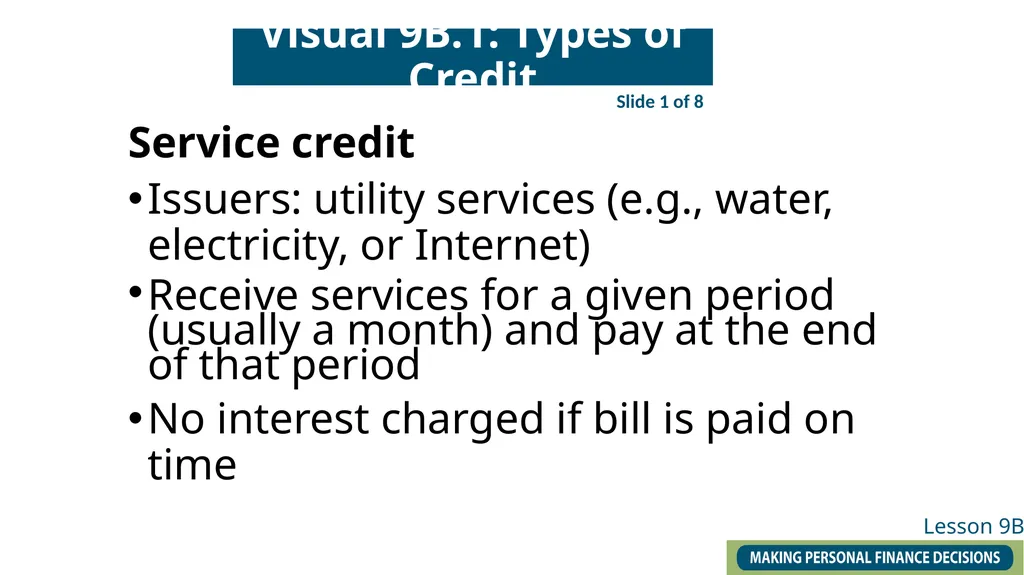
Lesson 9B Visual 9B.1: Types of Credit Slide 1 of 8 Service credit
Issuers: utility services (e.g., water, electricity, or Internet)
Receive services for a given period (usually a month) and pay at the end of that period
No interest charged if bill is paid on time<br>
04
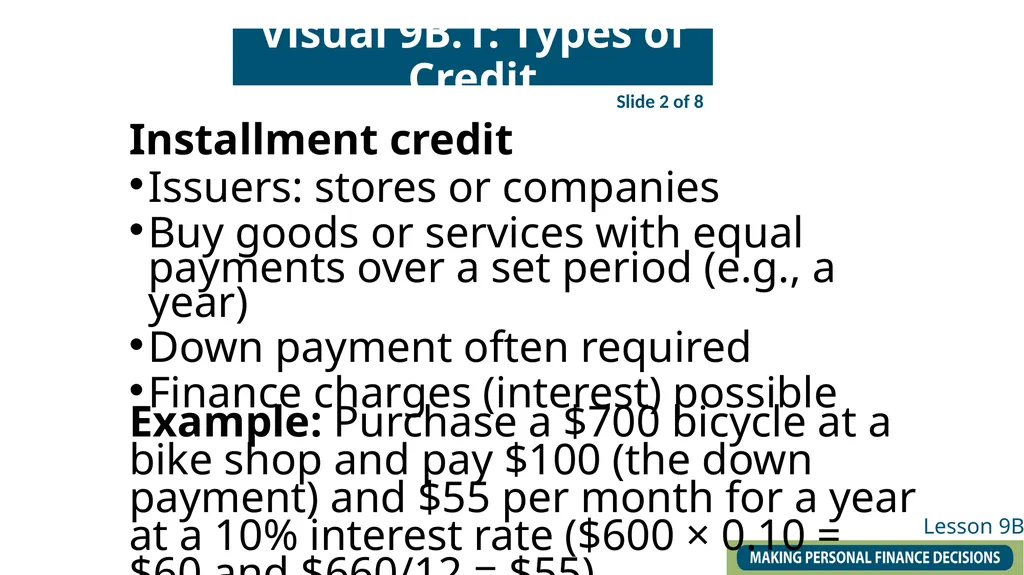
Lesson 9B Installment credit
Issuers: stores or companies
Buy goods or services with equal payments over a set period (e.g., a year)
Down payment often required
Finance charges (interest) possible Visual 9B.1: Types of Credit Slide 2 of 8 Example: Purchase a $700 bicycle at a bike shop and pay $100 (the down payment) and $55 per month for a year at a 10% interest rate ($600 × 0.10 = $60 and $660/12 = $55)<br>
05
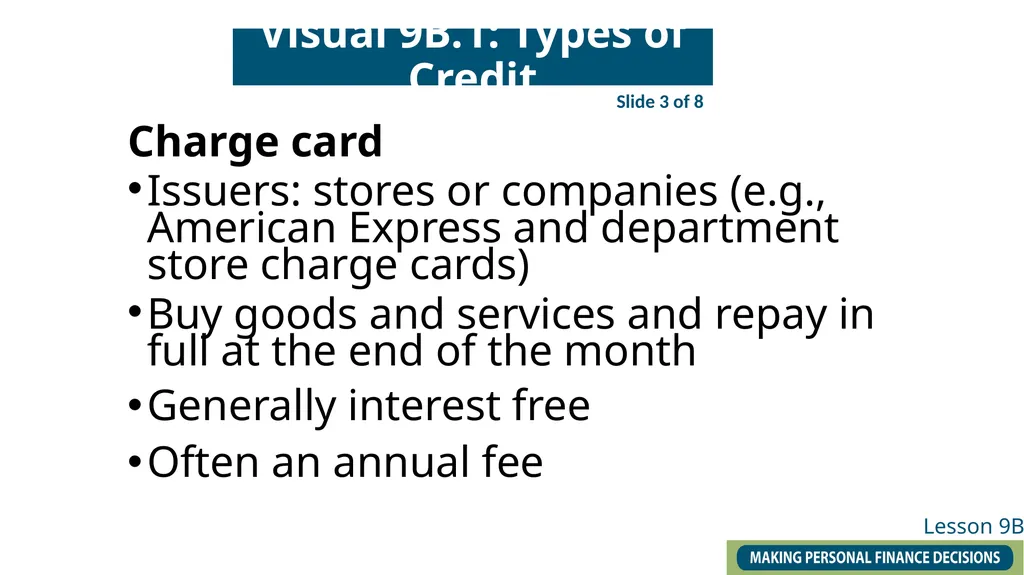
Lesson 9B Charge card
Issuers: stores or companies (e.g., American Express and department store charge cards)
Buy goods and services and repay in full at the end of the month
Generally interest free
Often an annual fee Visual 9B.1: Types of Credit Slide 3 of 8<br>
06
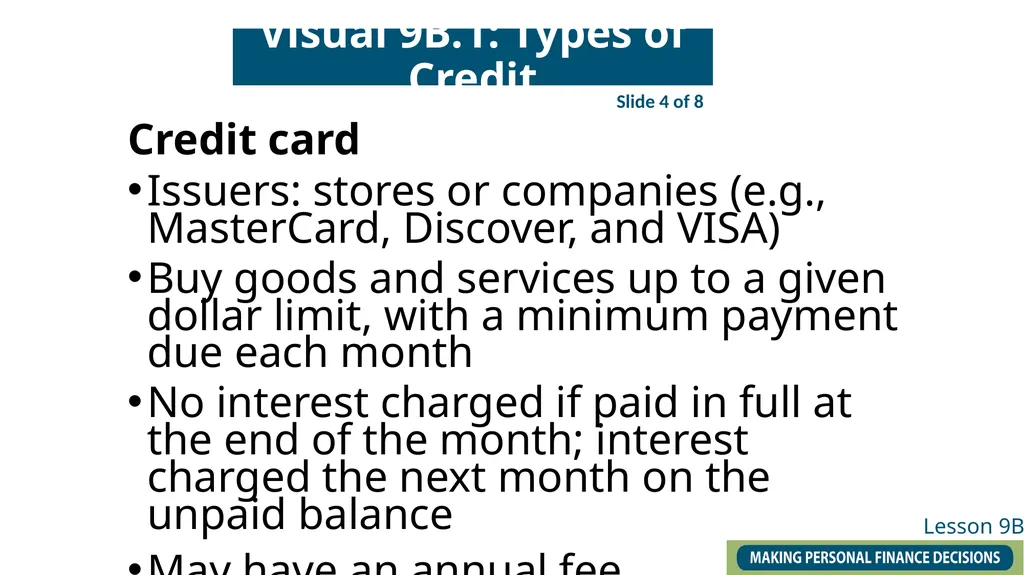
Lesson 9B Credit card
Issuers: stores or companies (e.g., MasterCard, Discover, and VISA)
Buy goods and services up to a given dollar limit, with a minimum payment due each month
No interest charged if paid in full at the end of the month; interest charged the next month on the unpaid balance
May have an annual fee Visual 9B.1: Types of Credit Slide 4 of 8<br>
07
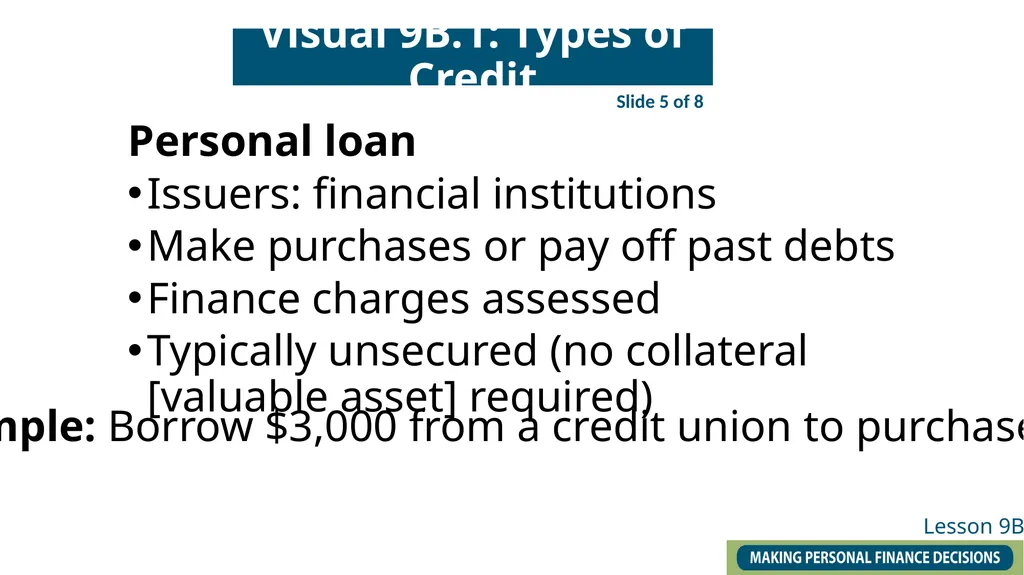
Lesson 9B Personal loan
Issuers: financial institutions
Make purchases or pay off past debts
Finance charges assessed
Typically unsecured (no collateral [valuable asset] required) Visual 9B.1: Types of Credit Slide 5 of 8 Example: Borrow $3,000 from a credit union to purchase a boat<br>
08
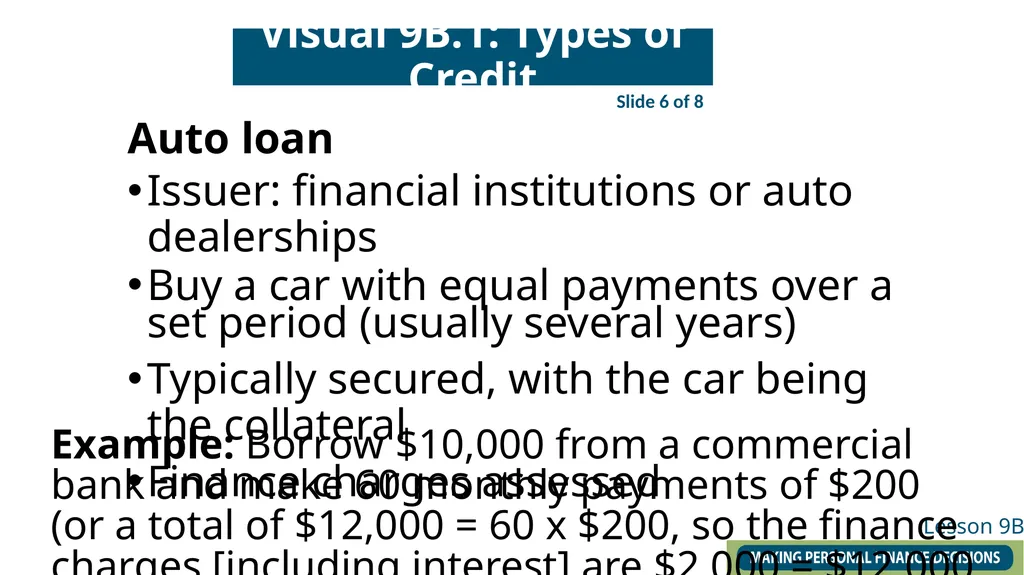
Lesson 9B Auto loan
Issuer: financial institutions or auto dealerships
Buy a car with equal payments over a set period (usually several years)
Typically secured, with the car being the collateral
Finance charges assessed Visul 9B.1: Types of Credit Example: Borrow $10,000 from a commercial bank and make 60 monthly payments of $200 (or a total of $12,000 = 60 x $200, so the finance charges [including interest] are $2,000 = $12,000 – $10,000). Visual 9B.1: Types of Credit Slide 6 of 8<br>
09
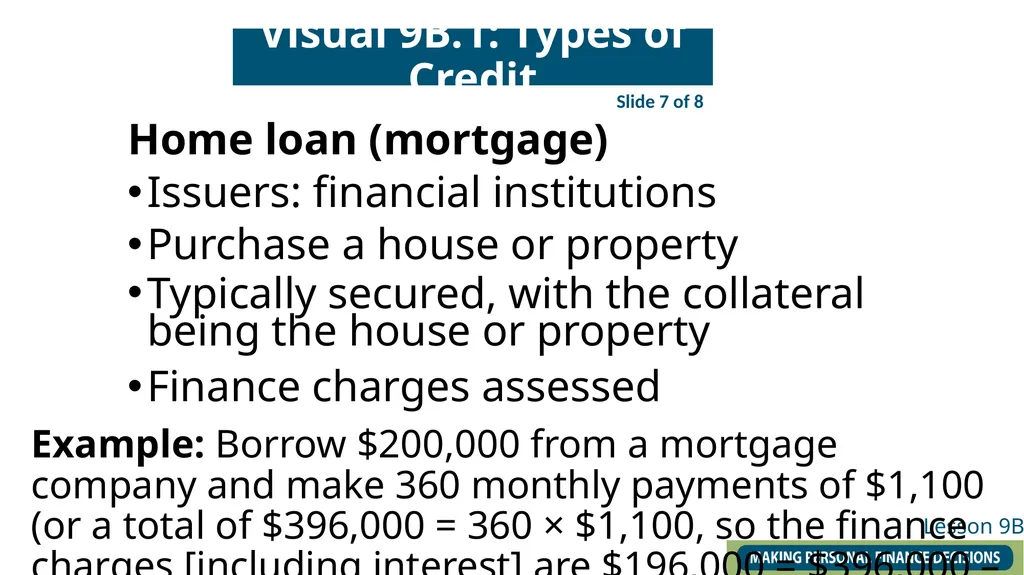
Lesson 9B Home loan (mortgage)
Issuers: financial institutions
Purchase a house or property
Typically secured, with the collateral being the house or property
Finance charges assessed Visual 9B.1: Types of Credit Slide 7 of 8 Example: Borrow $200,000 from a mortgage company and make 360 monthly payments of $1,100 (or a total of $396,000 = 360 × $1,100, so the finance charges [including interest] are $196,000 = $396,000 – $200,000).<br>
10
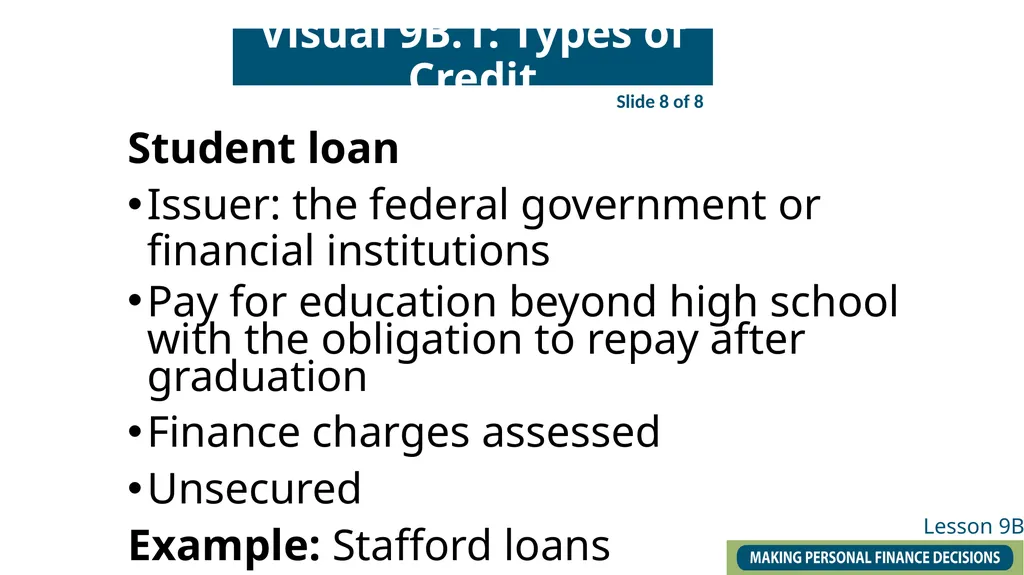
Lesson 9B Student loan
Issuer: the federal government or financial institutions
Pay for education beyond high school with the obligation to repay after graduation
Finance charges assessed
Unsecured
Example: Stafford loans Visual 9B.1: Types of Credit Slide 8 of 8<br>