
Lesson One Do it now Miss Odell is currently
YM
Published · 107 slides · 0 views

1 / 1








Description
Lesson One Do it now Miss Odell is currently reading Date: January 2023 Title: Where do writers get their inspiration? Who is Willy Russell? Recap questions: LLT: What is the difference between a proper noun and a common noun? LLT: What is
Related Topics
Share
Embed code
Download this presentation From Below
"Lesson One Do it now Miss Odell is currently" is the property of its rightful owner. Permission is granted to download and print the materials on this website for personal, non-commercial use only, and to display it on your personal computer provided you do not modify the materials and that you retain all copyright notices contained in the materials. By downloading content from our website, you accept the terms of this agreement.
Presentation Transcript
01
Lesson One<br>
02
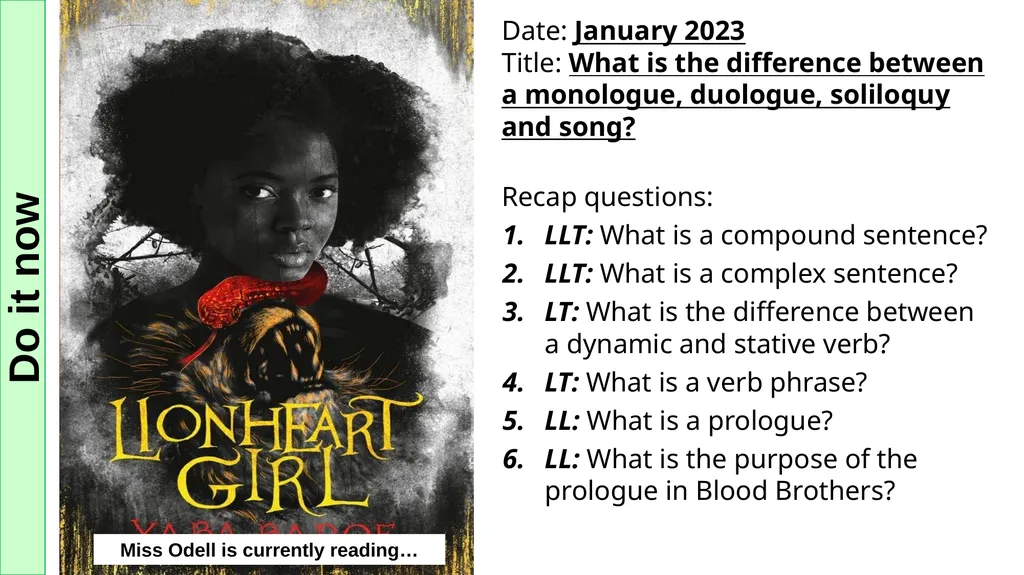
Do it now Miss Odell is currently reading… Date: January 2023
Title: Where do writers get their inspiration? Who is Willy Russell?
Recap questions:
LLT: What is the difference between a proper noun and a common noun?
LLT: What is the difference between a concrete noun and an abstract noun?
LT: What is the difference between prose and poetry?
LT: What is a lyric poem?
LT: What is a stanza?<br>
03
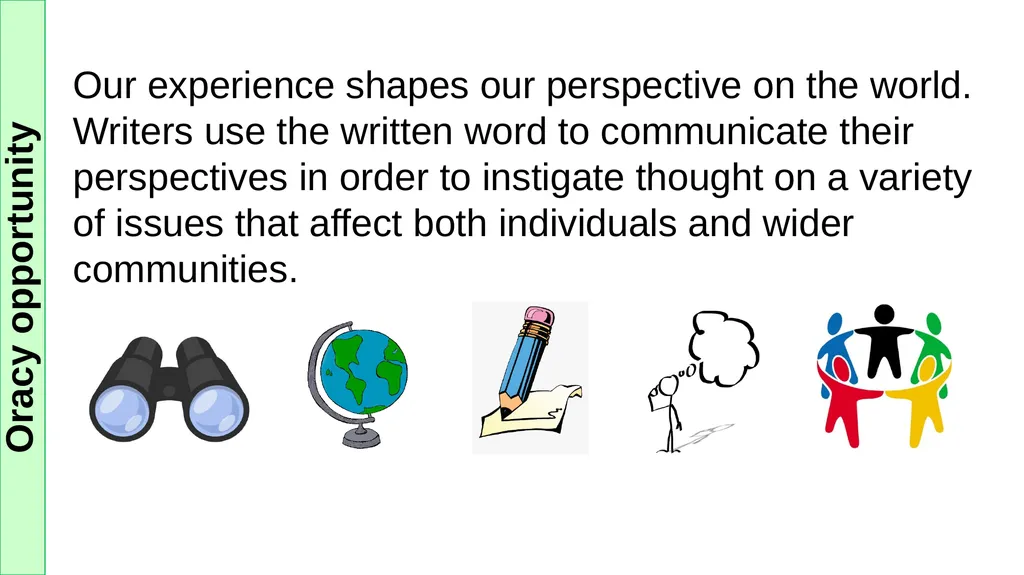
Oracy opportunity Our experience shapes our perspective on the world. Writers use the written word to communicate their perspectives in order to instigate thought on a variety of issues that affect both individuals and wider communities. o<br>
04
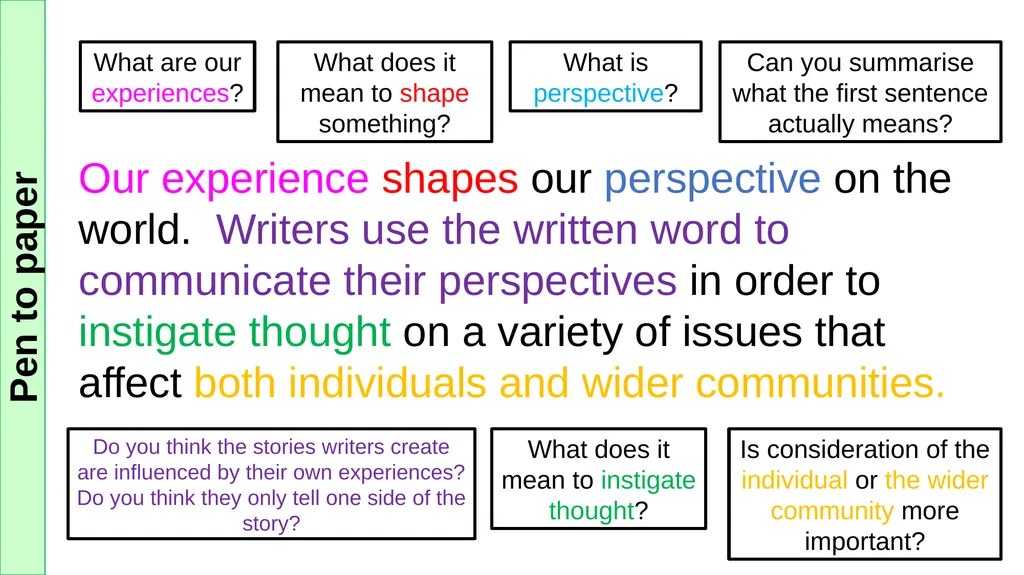
Pen to paper Our experience shapes our perspective on the world. Writers use the written word to communicate their perspectives in order to instigate thought on a variety of issues that affect both individuals and wider communities. What are our experiences? What does it mean to shape something? What is perspective? Can you summarise what the first sentence actually means? Do you think the stories writers create are influenced by their own experiences? Do you think they only tell one side of the story? What does it mean to instigate thought? Is consideration of the individual or the wider community more important?<br>
05
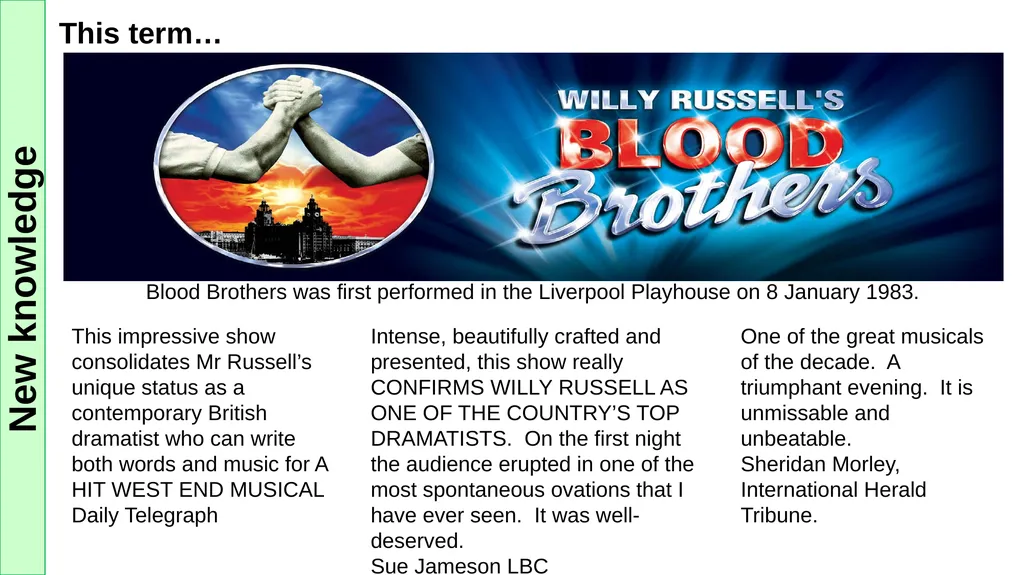
New knowledge This term… Blood Brothers was first performed in the Liverpool Playhouse on 8 January 1983. This impressive show consolidates Mr Russell’s unique status as a contemporary British dramatist who can write both words and music for A HIT WEST END MUSICAL
Daily Telegraph Intense, beautifully crafted and presented, this show really CONFIRMS WILLY RUSSELL AS ONE OF THE COUNTRY’S TOP DRAMATISTS. On the first night the audience erupted in one of the most spontaneous ovations that I have ever seen. It was well-deserved.
Sue Jameson LBC One of the great musicals of the decade. A triumphant evening. It is unmissable and unbeatable.
Sheridan Morley, International Herald Tribune.<br>
06
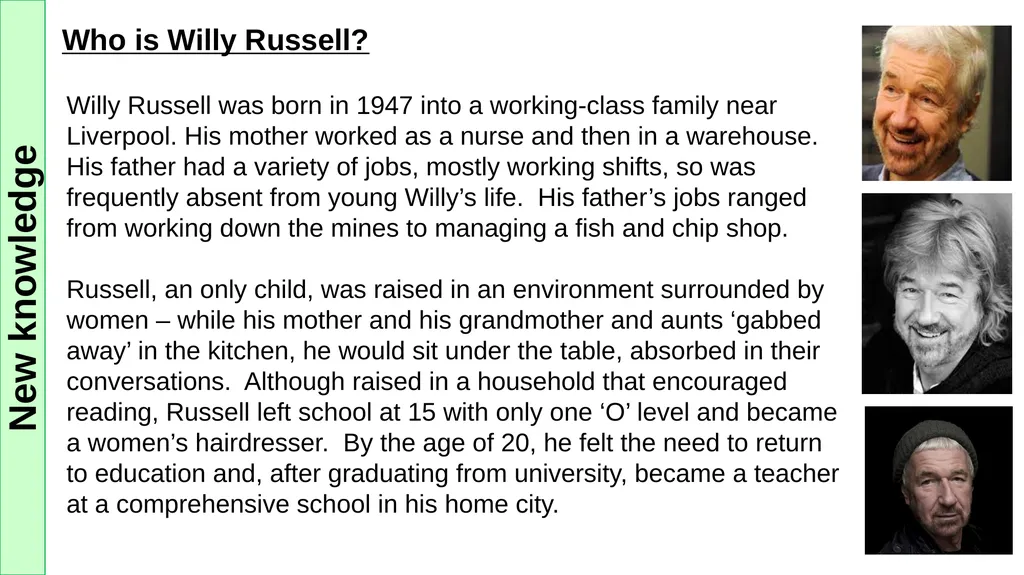
New knowledge Who is Willy Russell? Willy Russell was born in 1947 into a working-class family near Liverpool. His mother worked as a nurse and then in a warehouse. His father had a variety of jobs, mostly working shifts, so was frequently absent from young Willy’s life. His father’s jobs ranged from working down the mines to managing a fish and chip shop.
Russell, an only child, was raised in an environment surrounded by women – while his mother and his grandmother and aunts ‘gabbed away’ in the kitchen, he would sit under the table, absorbed in their conversations. Although raised in a household that encouraged reading, Russell left school at 15 with only one ‘O’ level and became a women’s hairdresser. By the age of 20, he felt the need to return to education and, after graduating from university, became a teacher at a comprehensive school in his home city.<br>
Russell, an only child, was raised in an environment surrounded by women – while his mother and his grandmother and aunts ‘gabbed away’ in the kitchen, he would sit under the table, absorbed in their conversations. Although raised in a household that encouraged reading, Russell left school at 15 with only one ‘O’ level and became a women’s hairdresser. By the age of 20, he felt the need to return to education and, after graduating from university, became a teacher at a comprehensive school in his home city.<br>
07
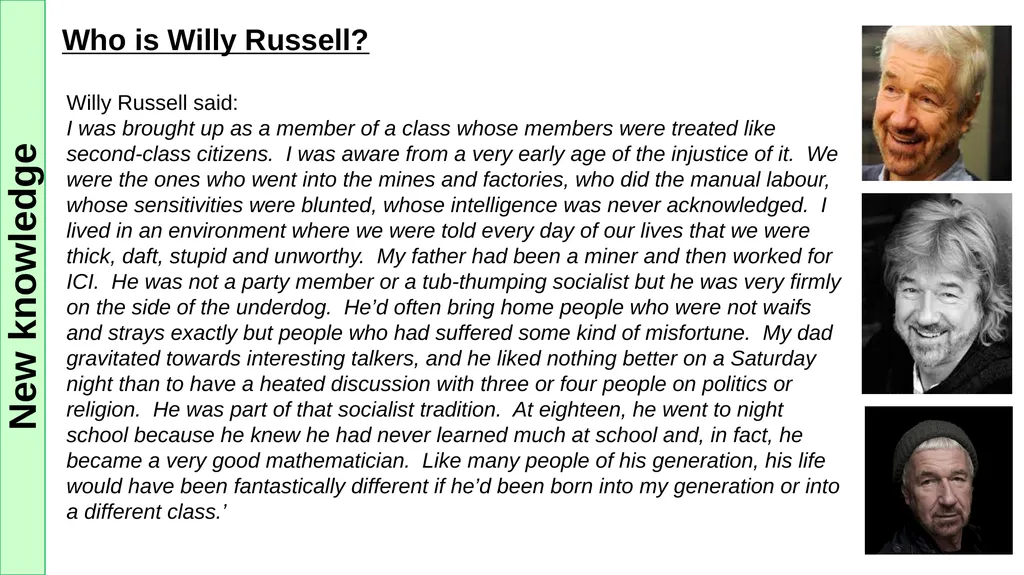
New knowledge Who is Willy Russell? Willy Russell said:
I was brought up as a member of a class whose members were treated like second-class citizens. I was aware from a very early age of the injustice of it. We were the ones who went into the mines and factories, who did the manual labour, whose sensitivities were blunted, whose intelligence was never acknowledged. I lived in an environment where we were told every day of our lives that we were thick, daft, stupid and unworthy. My father had been a miner and then worked for ICI. He was not a party member or a tub-thumping socialist but he was very firmly on the side of the underdog. He’d often bring home people who were not waifs and strays exactly but people who had suffered some kind of misfortune. My dad gravitated towards interesting talkers, and he liked nothing better on a Saturday night than to have a heated discussion with three or four people on politics or religion. He was part of that socialist tradition. At eighteen, he went to night school because he knew he had never learned much at school and, in fact, he became a very good mathematician. Like many people of his generation, his life would have been fantastically different if he’d been born into my generation or into a different class.’<br>
I was brought up as a member of a class whose members were treated like second-class citizens. I was aware from a very early age of the injustice of it. We were the ones who went into the mines and factories, who did the manual labour, whose sensitivities were blunted, whose intelligence was never acknowledged. I lived in an environment where we were told every day of our lives that we were thick, daft, stupid and unworthy. My father had been a miner and then worked for ICI. He was not a party member or a tub-thumping socialist but he was very firmly on the side of the underdog. He’d often bring home people who were not waifs and strays exactly but people who had suffered some kind of misfortune. My dad gravitated towards interesting talkers, and he liked nothing better on a Saturday night than to have a heated discussion with three or four people on politics or religion. He was part of that socialist tradition. At eighteen, he went to night school because he knew he had never learned much at school and, in fact, he became a very good mathematician. Like many people of his generation, his life would have been fantastically different if he’d been born into my generation or into a different class.’<br>
08
Reflection Based upon what you have read about Willy Russell and his experiences, what messages might he want to be communicating through his work? Our experience shapes our perspective on the world. Writers use the written word to communicate their perspectives in order to instigate thought on a variety of issues that affect both individuals and wider communities.<br>
09
Lesson Two<br>
10
Do it now Miss Odell is currently reading… Date: January 2023
Title: What is the purpose of a text if it is considered to be didactic?
Recap questions:
LLT: What is a collective noun?
LLT: What is the difference between a countable and uncountable noun?
LT: What is the difference between a line and a sentence?
LT: What does it mean if a line is end-stopped?
LL: Who is Willy Russell?
LL: Identify two things we learnt about Willy Russell?<br>
11
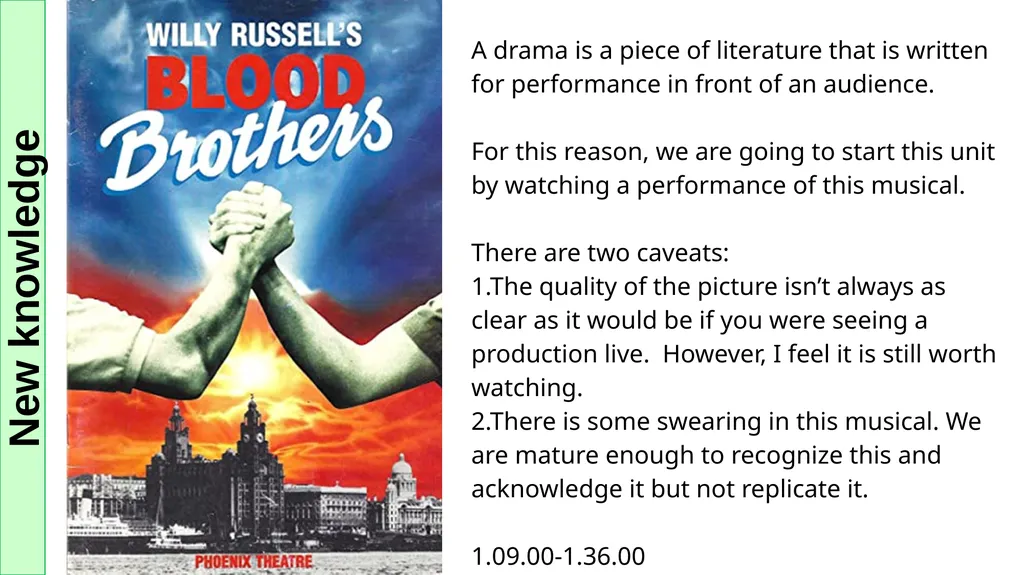
New knowledge A drama is a piece of literature that is written for performance in front of an audience.
For this reason, we are going to start this unit by watching a performance of this musical.
There are two caveats:
1.The quality of the picture isn’t always as clear as it would be if you were seeing a production live. However, I feel it is still worth watching.
2.There is some swearing in this musical. We are mature enough to recognize this and acknowledge it but not replicate it.<br>
12
New knowledge What have we seen today? The musical Blood Brothers begins as its Narrator tells the audience about the Johnstone twins, Mickey and Edward, who were separated at birth and died on the same day. We next meet the twins’ mother, Mrs Johnstone, a lower class woman who was abandoned by her husband after giving birth to five children, and while pregnant with another. She reminisces about the days when she used to go dancing with her husband, who made her feel like Marilyn Monroe. Now, however, her life is a never-ending cycle of unpaid bills and hungry children. She works at the house of Mrs Lyons, a wealthy woman who longs for a child of her own.
Mrs Johnstone is devastated to find that she’s carrying twins. There’s no way she can afford to feed two more mouths. An unlikely solution presents itself, however, in the form of Mrs Lyons, who pleads to take one of the twins – but only if Mrs Johnstone swears, on the Bible, never to reveal to the truth of their bargain. The Narrator warns that misfortunes will follow. Soon after, Mrs Johnstone gives birth, and as Mrs Lyons takes one of her twin boys away, the poorer woman laments all the debts she’s had to pay. When she goes home, she lies to her children, telling them that one of the twins has died.
After Mrs Johnstone returns to work, Mrs Lyons grows jealous and suspicious, believing that Mrs Johnstone is paying too much attention to the new baby. She proceeds to fire Mrs Johnstone – and when the cleaning lady tries to take her baby back, Mrs Lyons, knowing Mrs Johnstone to be superstitious, comes up with a fatal lie. She tells Mrs Johnstone that if two tines, separated at birth, ever learn the truth about their origins, they will die on the spot. Horrified, Mrs Johnstone agrees to keep their secret. The Narrator warns that one day the Devil will come to punish the two women.
(Summary taken from LitCharts https://www.litcharts.com/lit/blood-brothers/summary)<br>
13
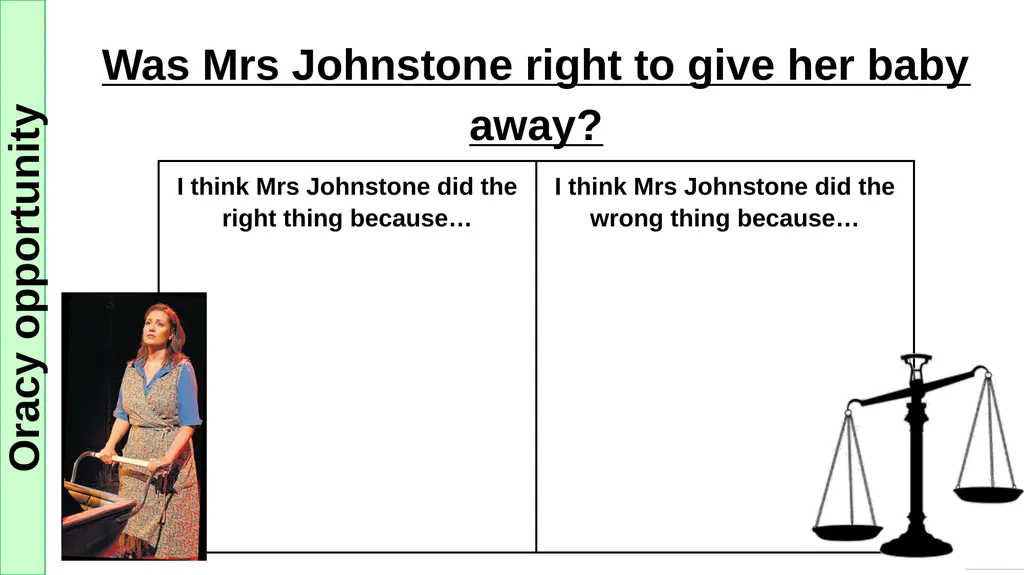
Oracy opportunity Was Mrs Johnstone right to give her baby away?<br>
14
Reviewing prior learning Last lesson, we learnt that Willy Russell was ‘brought up as a member of a class whose members were treated like second-class citizens.’
He felt judged.
A judgement is the process of forming an opinion or evaluation.
Willy Russell felt that a judgement had been made about him based upon his class.
He trusted his judgement.
My judgement is that the plan has not been thought out.<br>
He felt judged.
A judgement is the process of forming an opinion or evaluation.
Willy Russell felt that a judgement had been made about him based upon his class.
He trusted his judgement.
My judgement is that the plan has not been thought out.<br>
15
Reviewing prior learning In the prologue, the narrator speaks the lines:
An’ did y’ never hear of the mother, so cruel,
There’s a stone in place of her heart?
Then bring her on and come judge for yourselves
How she came to play this part.
What is the narrator asking the audience to do at the start of the play?<br>
An’ did y’ never hear of the mother, so cruel,
There’s a stone in place of her heart?
Then bring her on and come judge for yourselves
How she came to play this part.
What is the narrator asking the audience to do at the start of the play?<br>
16
Reflection Blood Brothers is a didactic musical.
A text that is didactic is seeking to educate.
Cobuild says – ‘Something that is didactic is intended to teach people something, especially a moral lesson.’
(https://www.collinsdictionary.com/dictionary/english/didactic)
Based upon the utterance above, what might Willy Russell be trying to educate people about?
Start your sentence with ‘Blood Brothers might be considered a didactic play because Willy Russell could be seeking to educate people about…He uses the narrator to…’<br>
17
Lesson Three<br>
18
Do it now Miss Odell is currently reading… Date: January 2023
Title: What choices do directors make when considering how to present their characters on stage?
Recap questions:
LT: What is enjambment?
LT: What is caesura?
LLT: What is an adjective?
LLT: What is the difference between a comparative and superlative adjective?
LL: What does the word ‘judgement’ mean?
LL: What is a didactic text?<br>
19
New knowledge A drama is a piece of literature that is written for performance in front of an audience.
For this reason, we are going to start this unit by watching a performance of this musical.
There are two caveats:
1.The quality of the picture isn’t always as clear as it would be if you were seeing a production live. However, I feel it is still worth watching.
2.There is some swearing in this musical. We are mature enough to recognize this and acknowledge it but not replicate it.<br>
For this reason, we are going to start this unit by watching a performance of this musical.
There are two caveats:
1.The quality of the picture isn’t always as clear as it would be if you were seeing a production live. However, I feel it is still worth watching.
2.There is some swearing in this musical. We are mature enough to recognize this and acknowledge it but not replicate it.<br>
20
New knowledge What have we seen today? Seven years pass, and Mickey, the twin who stayed with Mrs Johnstone, grows up in a rough-and-tumble environment. Edward, who grew up believing Mrs Lyons to be his mother, matures in the lap of luxury. When the boys meet by chance, they become fast friends. When they find that they share a birthday, they agree to become ‘blood brothers’, allying against Mickey’s bullying older brother, Sammy. When Mrs Johnstone realizes that the two have met, she is horrified, and sends Edward away. Mrs Lyons reacts even more violently and contemplates uprooting her entire family in order to escape.
Despite their mothers’ approval, Mickey and Edward continue to see each other, and we witness a series of children’s games (many involving guns), as the two boys play with their other friend, Linda.
(Summary taken from LitCharts https://www.litcharts.com/lit/blood-brothers/summary)<br>
Despite their mothers’ approval, Mickey and Edward continue to see each other, and we witness a series of children’s games (many involving guns), as the two boys play with their other friend, Linda.
(Summary taken from LitCharts https://www.litcharts.com/lit/blood-brothers/summary)<br>
21
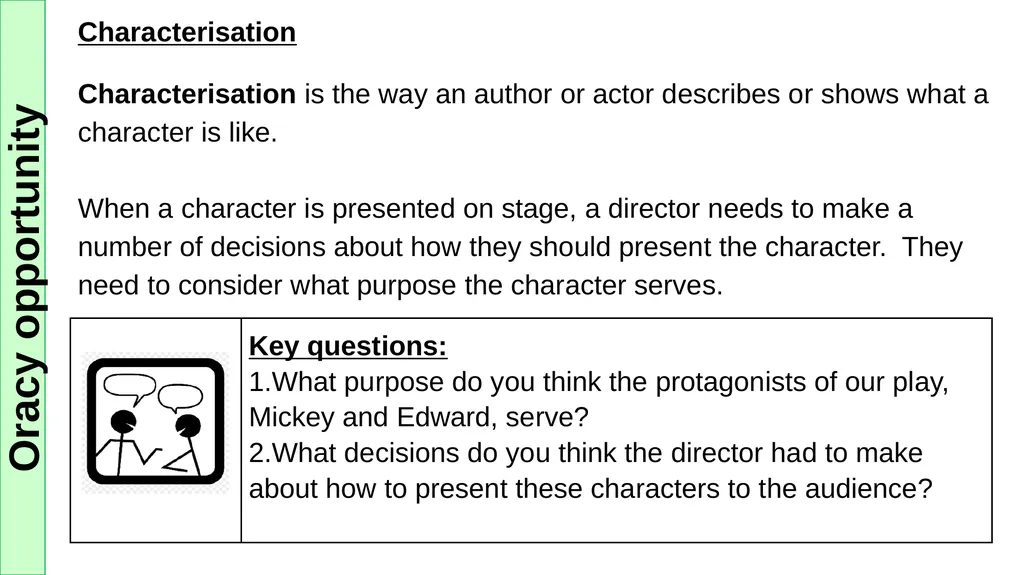
Oracy opportunity Characterisation Characterisation is the way an author or actor describes or shows what a character is like.
When a character is presented on stage, a director needs to make a number of decisions about how they should present the character. They need to consider what purpose the character serves.<br>
When a character is presented on stage, a director needs to make a number of decisions about how they should present the character. They need to consider what purpose the character serves.<br>
22
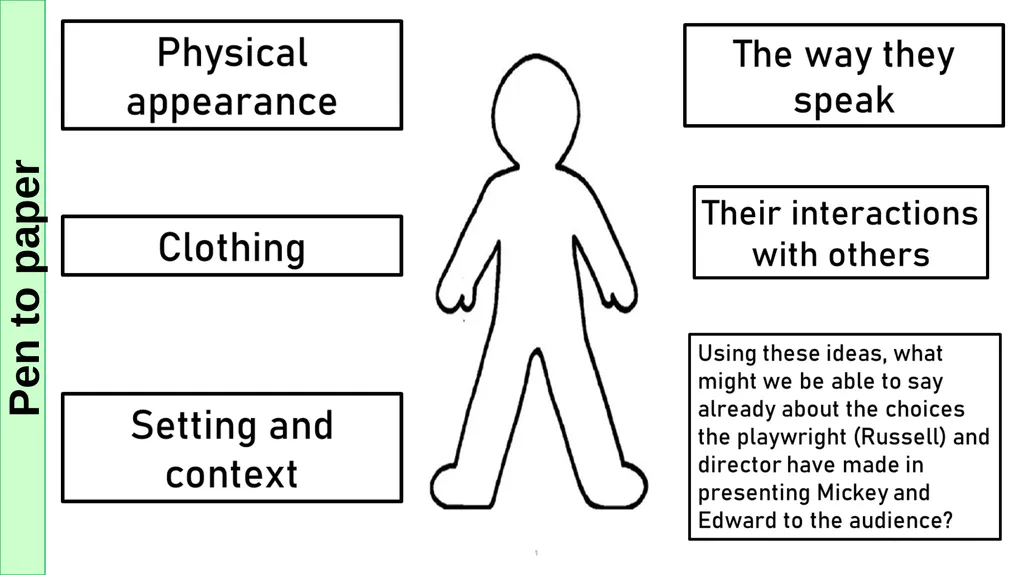
Pen to paper<br>
23
Reflection The juxtaposition of Mickey and Edward When we consider how Mickey and Edward have been presented – i.e. the decisions the playwright / director has made about these characters - we can clearly see that Mickey and Edward have been juxtaposed.
A juxtaposition is a contrast between objects, images or ideas that when placed together, the differences between them are emphasised.
For example: The juxtaposition of London and the Caribbean. The juxtaposition of chilli and ice-cream. The juxtaposition between happiness and sadness.
Key question: Why might we be able to argue that Willy Russell has created a juxtaposition between Mickey and Edward?
Starting sentence: ‘Willy Russell, arguably uses juxtaposition to present the characters of Mickey and Edward to the audience when…’
Challenge question: Why do you think Willy Russell has done this? What purpose do you think this juxtaposition serves?
Starting sentence: ‘The clever use of juxtaposition here helps to reveal…’<br>
24
Lesson Four<br>
25
Do it now Miss Odell is currently reading… Date: January 2023
Title: How are plays structured?
Recap questions:
LLT: What is a phrase?
LLT: What is a noun phrase?
LT: What is alliteration?
LT: What is the difference between assonance and consonance?
LL: What are some of the decisions a director makes when thinking about how to present a character?
LL: How are Mickey and Edward juxtaposed?<br>
26
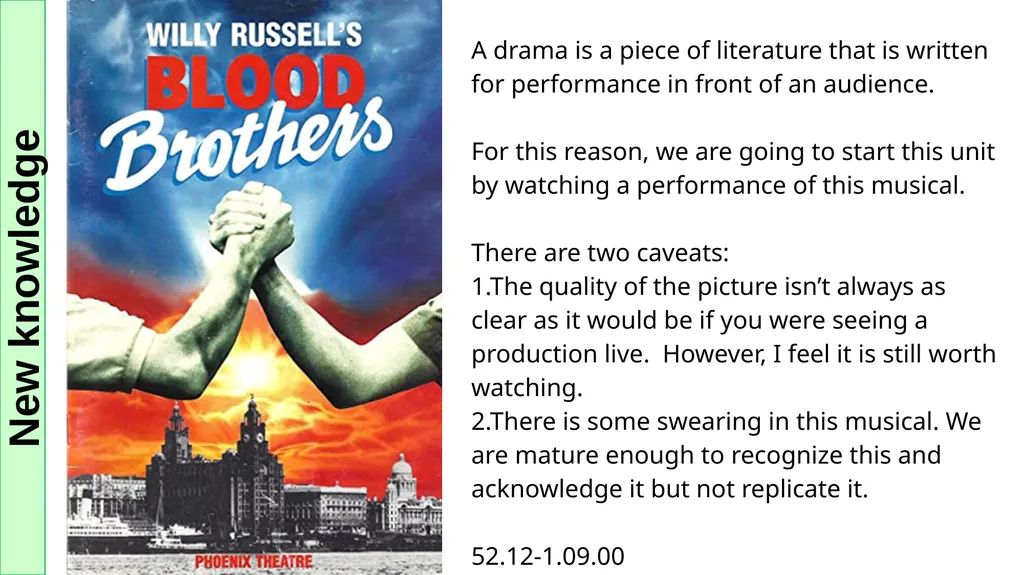
New knowledge A drama is a piece of literature that is written for performance in front of an audience.
For this reason, we are going to start this unit by watching a performance of this musical.
There are two caveats:
1.The quality of the picture isn’t always as clear as it would be if you were seeing a production live. However, I feel it is still worth watching.
2.There is some swearing in this musical. We are mature enough to recognize this and acknowledge it but not replicate it.
52.12-1.09.00<br>
27
New knowledge What have we seen today? Getting more anxious about the situation and the amount of time Edward is spending with Mickey, Mrs Lyons tells her husband she wants to move out of the area. We continue to see the trio getting up to various pranks, eventually drawing the attention of the police, who threaten Mrs. Johnstone while flattering Mr Lyons. Mrs Lyons takes this moment to move her family to the country, despite Edward’s lack of enthusiasm. Before Edward leaves, however, Mrs Johnstone gives him a locket with a picture of herself and Mickey, so that he can always remember them. The boys are lonely without each other, but the first act ends on an optimistic note: Mrs. Johnstone’s family is being relocated to the country as well, a move that she hopes will remove her children from a life of crime and squalor, and will help her to forget the sins of her past.
(Summary taken from LitCharts https://www.litcharts.com/lit/blood-brothers/summary)<br>
(Summary taken from LitCharts https://www.litcharts.com/lit/blood-brothers/summary)<br>
28
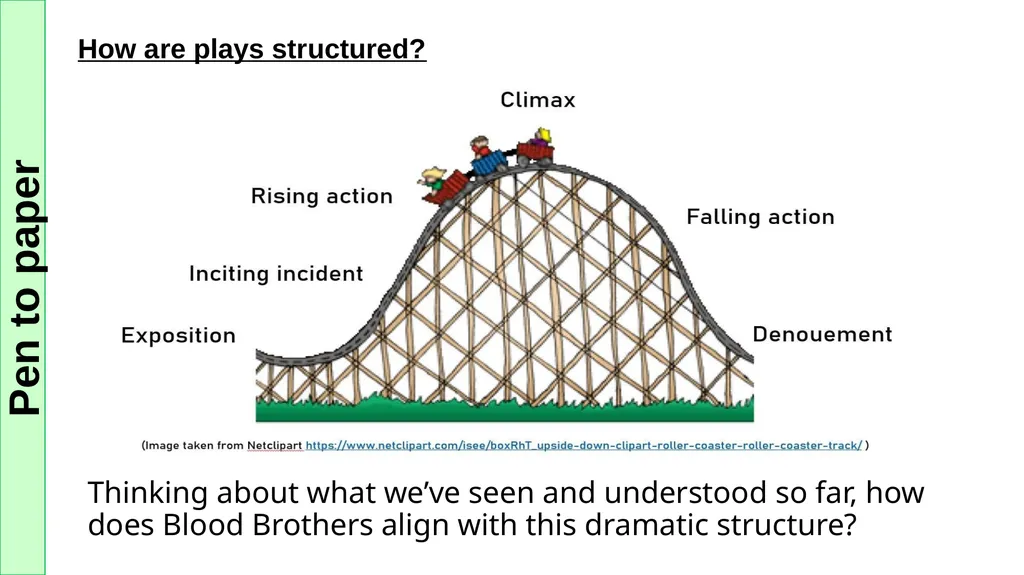
New knowledge How are plays structured? Dramatic structure is an idea, originating in Aristotle’s Poetics, that effective stories can be broken down into elements, usually including exposition, rising action, climax, falling action and resolution and that when writers are constructing a story they should include these five elements.
Freytag’s pyramid is a dramatic structural framework developed by Gustav Freytag, a German playwright and novelist of the mid-nineteenth century. He theorized that effective stories could be broken into two halves: the play and counterplay, with the climax in the middle.
Freytag was chiefly interested in one type of story though: the tragedy. He thought it was the premier form of storytelling. All the novels and plays he wrote were tragedies, which meant that his story structure framework particularly suited the specific dramatic arc of the tragedy.
References:
Bunting.J. Freytag’s Pyramid: Definition, Examples, and How to Use this Dramatic Structure in Your Wriitng. https://thewritepractice.com/freytags-pyramid/<br>
29
Pen to paper How are plays structured? Thinking about what we’ve seen and understood so far, how does Blood Brothers align with this dramatic structure?<br>
30
Reflection Act 1 finishes between the Rising Action and the Climax. Why would this engage an audience watching the musical?<br>
31
Lesson Five<br>
32
Do it now Miss Odell is currently reading… Date: January 2023
Title: Can you ever leave the past behind? How do writers create tension?
Recap questions:
LLT: What is the definite article?
LLT: What is the indefinite article?
LT: What is a rhyme?
LT: What is a rhyming couplet?
LL: According to Freytag’s pyramid, what are the six stages of a drama piece?
LL: Why does Act 1 finish between the rising action and the climax?<br>
33
New knowledge A drama is a piece of literature that is written for performance in front of an audience.
For this reason, we are going to start this unit by watching a performance of this musical.
There are two caveats:
1.The quality of the picture isn’t always as clear as it would be if you were seeing a production live. However, I feel it is still worth watching.
2.There is some swearing in this musical. We are mature enough to recognize this and acknowledge it but not replicate it.
1.09.00-1.36.00<br>
34
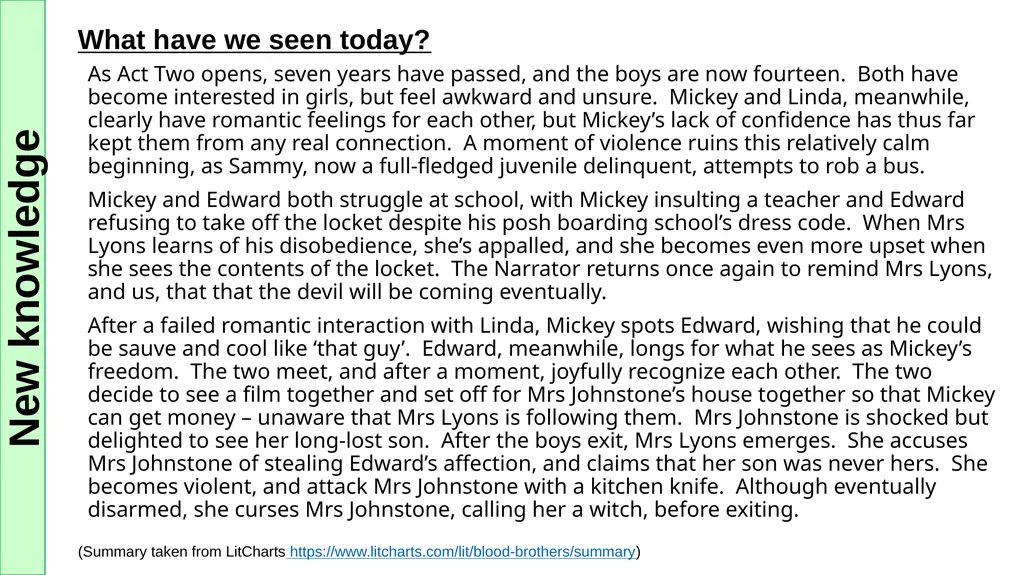
New knowledge What have we seen today? As Act Two opens, seven years have passed, and the boys are now fourteen. Both have become interested in girls, but feel awkward and unsure. Mickey and Linda, meanwhile, clearly have romantic feelings for each other, but Mickey’s lack of confidence has thus far kept them from any real connection. A moment of violence ruins this relatively calm beginning, as Sammy, now a full-fledged juvenile delinquent, attempts to rob a bus.
Mickey and Edward both struggle at school, with Mickey insulting a teacher and Edward refusing to take off the locket despite his posh boarding school’s dress code. When Mrs Lyons learns of his disobedience, she’s appalled, and she becomes even more upset when she sees the contents of the locket. The Narrator returns once again to remind Mrs Lyons, and us, that that the devil will be coming eventually.
After a failed romantic interaction with Linda, Mickey spots Edward, wishing that he could be sauve and cool like ‘that guy’. Edward, meanwhile, longs for what he sees as Mickey’s freedom. The two meet, and after a moment, joyfully recognize each other. The two decide to see a film together and set off for Mrs Johnstone’s house together so that Mickey can get money – unaware that Mrs Lyons is following them. Mrs Johnstone is shocked but delighted to see her long-lost son. After the boys exit, Mrs Lyons emerges. She accuses Mrs Johnstone of stealing Edward’s affection, and claims that her son was never hers. She becomes violent, and attack Mrs Johnstone with a kitchen knife. Although eventually disarmed, she curses Mrs Johnstone, calling her a witch, before exiting.
(Summary taken from LitCharts https://www.litcharts.com/lit/blood-brothers/summary)<br>
35
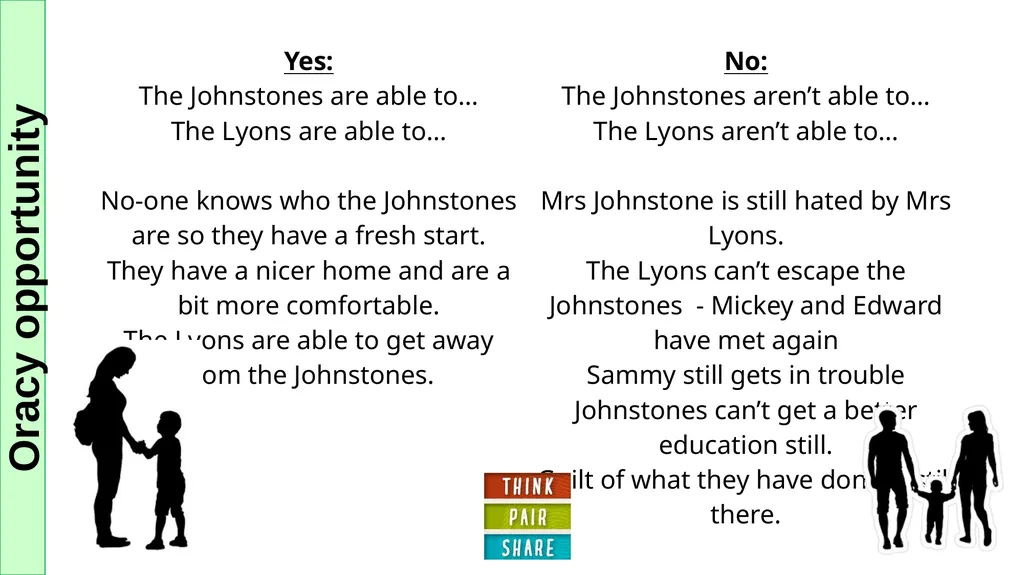
Oracy opportunity<br>
36
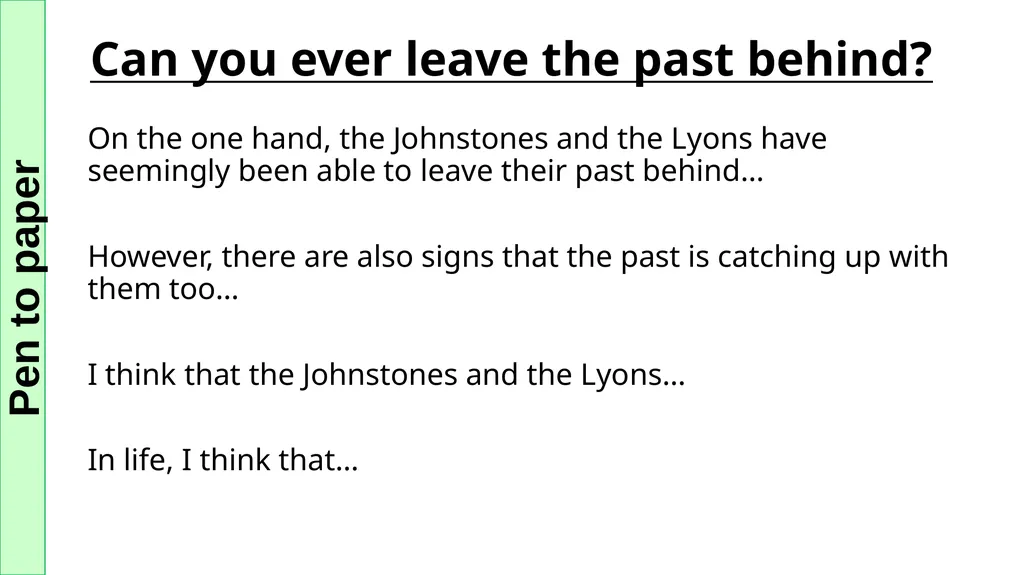
Pen to paper Can you ever leave the past behind? On the one hand, the Johnstones and the Lyons have seemingly been able to leave their past behind…
However, there are also signs that the past is catching up with them too…
I think that the Johnstones and the Lyons…
In life, I think that…<br>
However, there are also signs that the past is catching up with them too…
I think that the Johnstones and the Lyons…
In life, I think that…<br>
37
Reflection Can you ever leave the past behind? To recap, Freytag explored the structure of dramatic works.
One element of this structure is the climax of the play (or the moment of crisis).
A CLIMAX is when the tension within a scene builds to its highest point.
To what extent do you think the TENSION between the past and the present is central to reaching the climax of the play?<br>
One element of this structure is the climax of the play (or the moment of crisis).
A CLIMAX is when the tension within a scene builds to its highest point.
To what extent do you think the TENSION between the past and the present is central to reaching the climax of the play?<br>
38
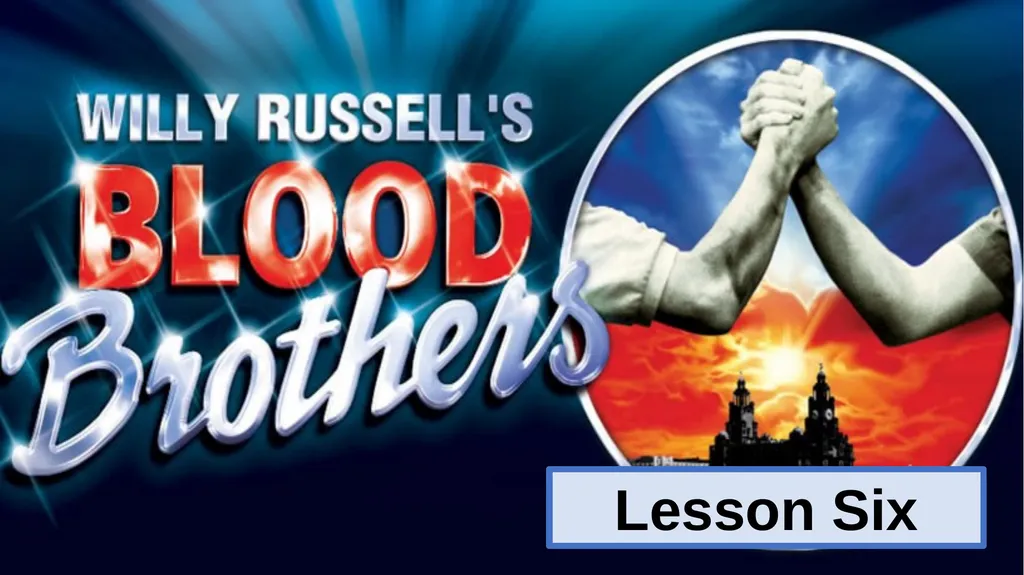
Lesson Six<br>
39
Do it now Miss Odell is currently reading… Date: January 2023
Title: What is an anagnorisis?
Recap questions:
LLT: What are compound words?
LLT: What is the difference between a dynamic and a stative verb?
LT: What is repetition?
LT: What is antithesis?
LL: What is the climax of a narrative?
LL: Do you think the families will be able to leave their pasts behind?<br>
40
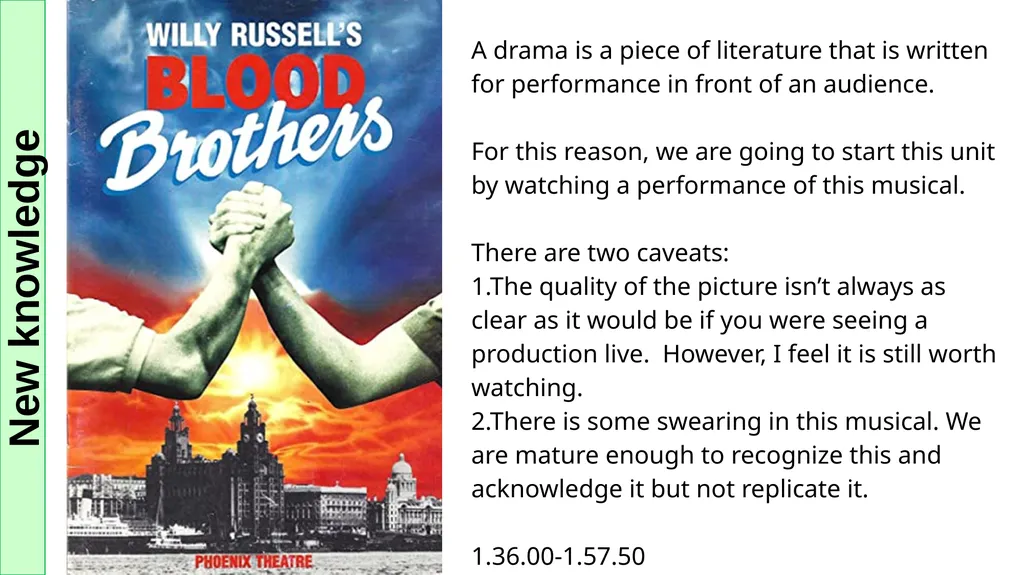
New knowledge A drama is a piece of literature that is written for performance in front of an audience.
For this reason, we are going to start this unit by watching a performance of this musical.
There are two caveats:
1.The quality of the picture isn’t always as clear as it would be if you were seeing a production live. However, I feel it is still worth watching.
2.There is some swearing in this musical. We are mature enough to recognize this and acknowledge it but not replicate it.
1.36.00-1.57.50<br>
41
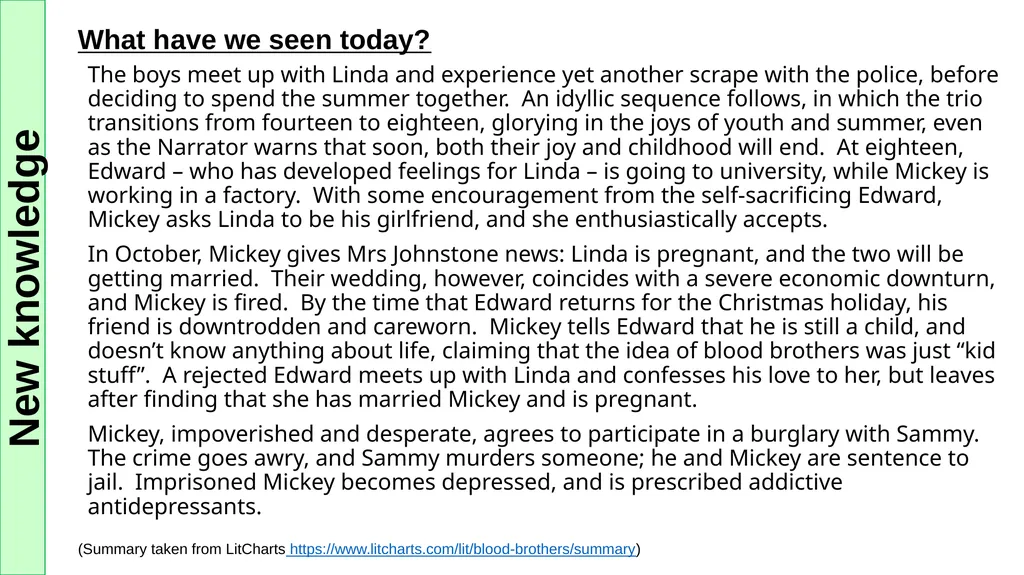
New knowledge What have we seen today? The boys meet up with Linda and experience yet another scrape with the police, before deciding to spend the summer together. An idyllic sequence follows, in which the trio transitions from fourteen to eighteen, glorying in the joys of youth and summer, even as the Narrator warns that soon, both their joy and childhood will end. At eighteen, Edward – who has developed feelings for Linda – is going to university, while Mickey is working in a factory. With some encouragement from the self-sacrificing Edward, Mickey asks Linda to be his girlfriend, and she enthusiastically accepts.
In October, Mickey gives Mrs Johnstone news: Linda is pregnant, and the two will be getting married. Their wedding, however, coincides with a severe economic downturn, and Mickey is fired. By the time that Edward returns for the Christmas holiday, his friend is downtrodden and careworn. Mickey tells Edward that he is still a child, and doesn’t know anything about life, claiming that the idea of blood brothers was just “kid stuff”. A rejected Edward meets up with Linda and confesses his love to her, but leaves after finding that she has married Mickey and is pregnant.
Mickey, impoverished and desperate, agrees to participate in a burglary with Sammy. The crime goes awry, and Sammy murders someone; he and Mickey are sentence to jail. Imprisoned Mickey becomes depressed, and is prescribed addictive antidepressants.
(Summary taken from LitCharts https://www.litcharts.com/lit/blood-brothers/summary)<br>
42
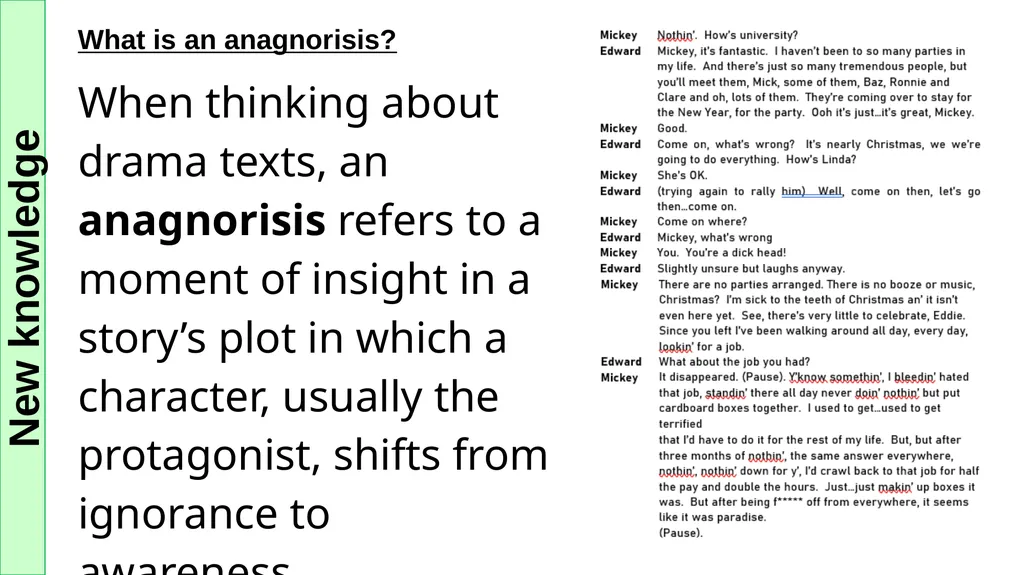
New knowledge What is an anagnorisis? When thinking about drama texts, an anagnorisis refers to a moment of insight in a story’s plot in which a character, usually the protagonist, shifts from ignorance to awareness.<br>
43
Reflection To what extent do we think this moment employs an anagnorisis?<br>
44
Lesson Seven<br>
45
Do it now Miss Odell is currently reading… Date: January 2023
Title: What is an anagnorisis?
Recap questions:
LLT: What is an adverb?
LLT: What is a preposition?
LT: What is a simile?
LT: What is a metaphor?
LL: What is an anagnorisis?
LL: What is Mickey’s anagnorisis?<br>
Title: What is an anagnorisis?
Recap questions:
LLT: What is an adverb?
LLT: What is a preposition?
LT: What is a simile?
LT: What is a metaphor?
LL: What is an anagnorisis?
LL: What is Mickey’s anagnorisis?<br>
46
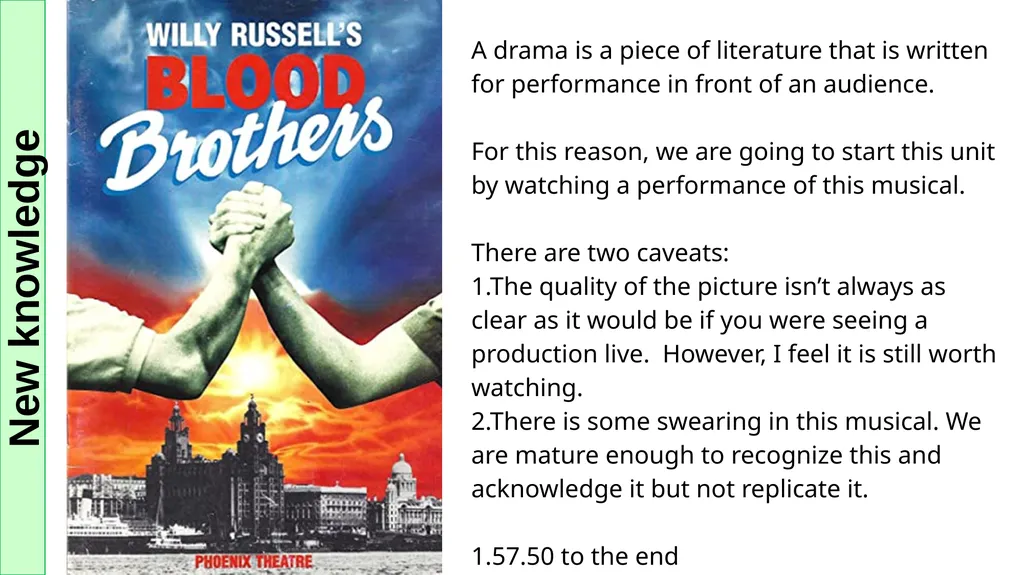
New knowledge A drama is a piece of literature that is written for performance in front of an audience.
For this reason, we are going to start this unit by watching a performance of this musical.
There are two caveats:
1.The quality of the picture isn’t always as clear as it would be if you were seeing a production live. However, I feel it is still worth watching.
2.There is some swearing in this musical. We are mature enough to recognize this and acknowledge it but not replicate it.
1.57.50 to the end<br>
47
New knowledge What have we seen today? After Mickey is released from prison, he continues taking the pills, despite the pleas of his mother and his wife. Eventually, a desperate Linda asks Edward, now a city councilman, for help finding an apartment and getting Mickey a job. After Mickey reacts with anger at her efforts, the devastated Linda seeks comfort with Edward, and begins an affair with him.
As the two carry on their affair, Mickey resolves to stop taking his pills, for Linda’s sake. He’s derailed when Mrs Lyons – fully unhinged – reveals Linda and Edward’s affair. The enraged Mickey finds a gun and sets out to confront Edward, followed by a distraught Linda and Mrs Johnstone. The Narrator warns that the devil has arrived. Finding Edward in the town hall, Mickey accuses him of the affair. As Mickey continues to threaten Edward with the gun, Mrs Johnstone bursts in and tells the young men the truth: that they are twins, separated at birth. This revelation completely unhinges Mickey, however, as he realizes that he could be the one living Edward’s life. As he gesticulates wildly with the gun, he accidentally shoots and kills his twin, and is immediately shot and killed by the police in turn. The play ends with this horrific and bloody tableau, as the Narrator wonders what really killed the twins: superstition, or the British class system?
(Summary taken from LitCharts https://www.litcharts.com/lit/blood-brothers/summary)<br>
48
Reflection Key questions:
What did you think of the ending of the play?
What did you think of the play as a whole?
Who or what do you think was responsible for the deaths of Mickey and Edward?
Why do you think Willy Russell wrote this play? What message did he want to get across?<br>
What did you think of the ending of the play?
What did you think of the play as a whole?
Who or what do you think was responsible for the deaths of Mickey and Edward?
Why do you think Willy Russell wrote this play? What message did he want to get across?<br>
49
Lesson Eight<br>
50
Do it now Miss Odell is currently reading… Date: January 2023
Title: How does a drama text differ from a prose text or a piece of poetry? What are the different parts of a theatre?
Recap questions:
LLT: What is denotation?
LLT: What is connotation?
LT: What is onomatopoeia?
LT: What is personification?
LL: How does the musical Blood Brothers end?<br>
Title: How does a drama text differ from a prose text or a piece of poetry? What are the different parts of a theatre?
Recap questions:
LLT: What is denotation?
LLT: What is connotation?
LT: What is onomatopoeia?
LT: What is personification?
LL: How does the musical Blood Brothers end?<br>
51
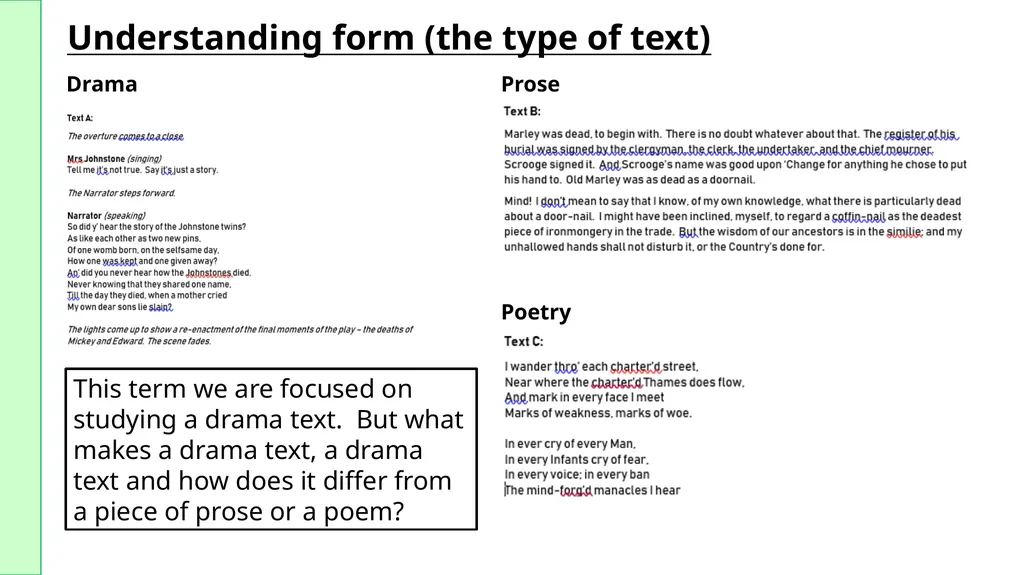
Understanding form (the type of text) Drama Prose Poetry This term we are focused on studying a drama text. But what makes a drama text, a drama text and how does it differ from a piece of prose or a poem?<br>
52
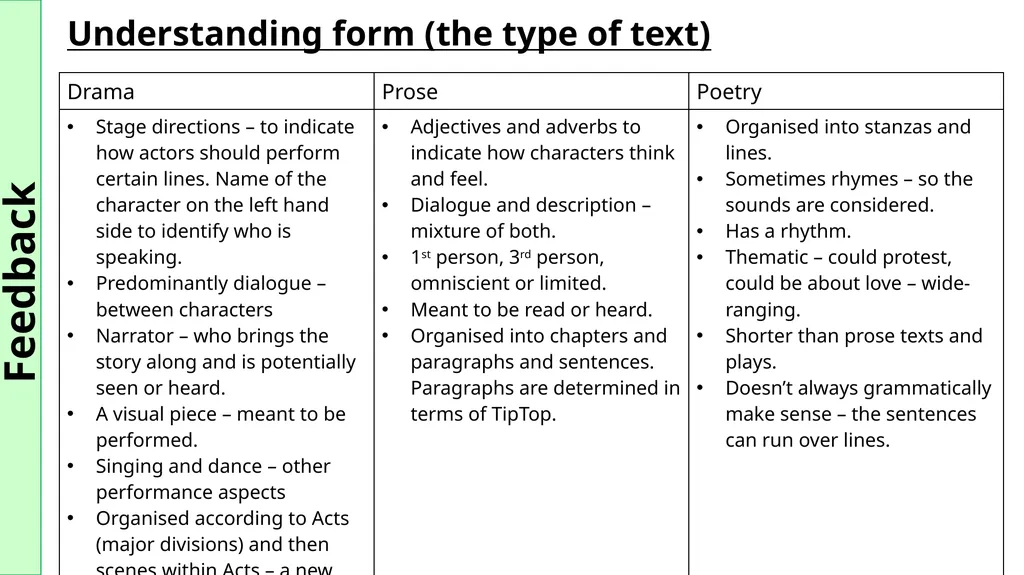
Feedback Understanding form (the type of text)<br>
53
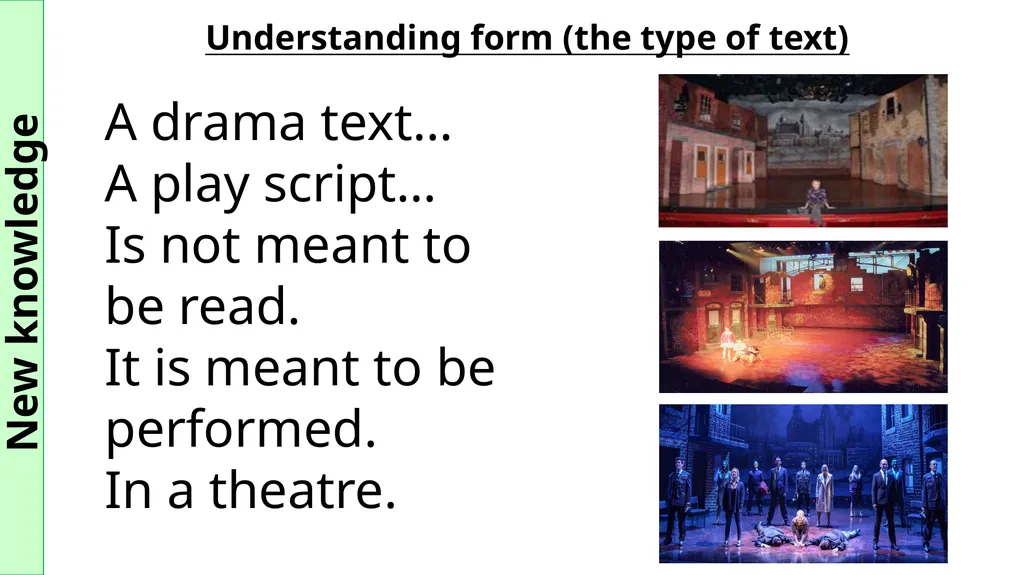
New knowledge Understanding form (the type of text) A drama text…
A play script…
Is not meant to be read.
It is meant to be performed.
In a theatre.<br>
A play script…
Is not meant to be read.
It is meant to be performed.
In a theatre.<br>
54
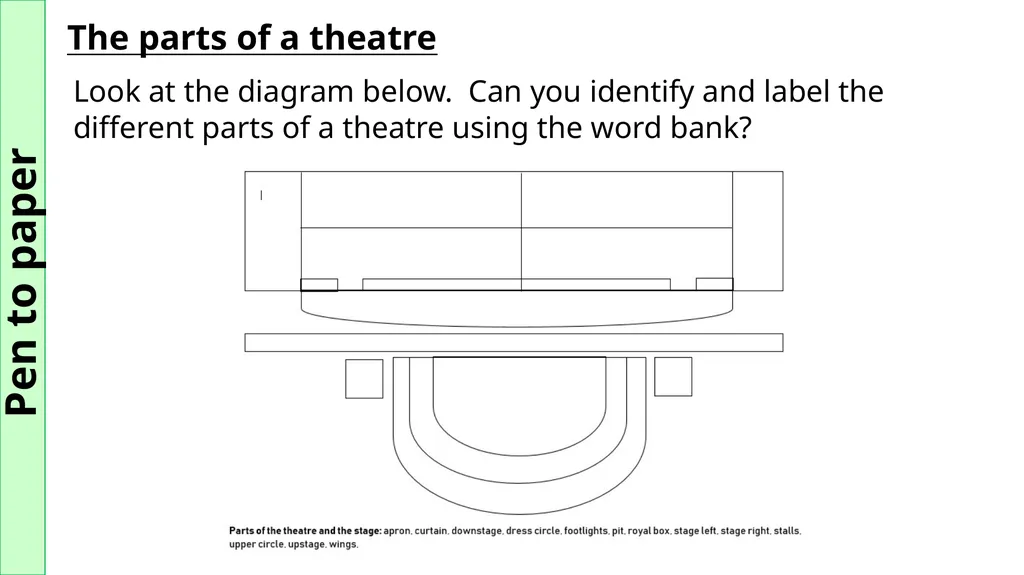
Pen to paper The parts of a theatre Look at the diagram below. Can you identify and label the different parts of a theatre using the word bank?<br>
55
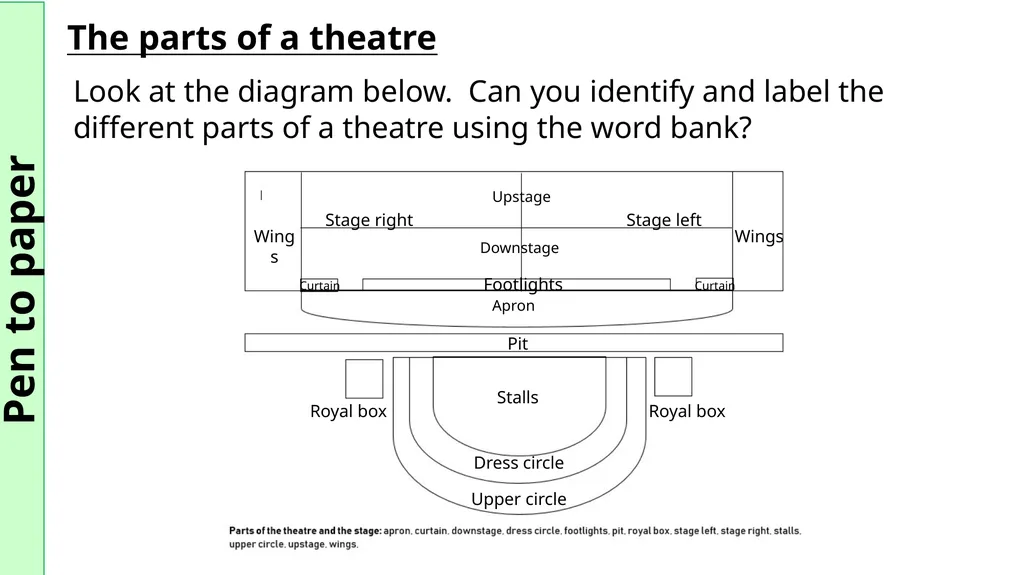
Pen to paper The parts of a theatre Look at the diagram below. Can you identify and label the different parts of a theatre using the word bank? Apron Curtain Curtain Downstage Upstage Dress circle Upper circle Stalls Royal box Royal box Footlights Pit Stage right Stage left Wings Wings<br>
56
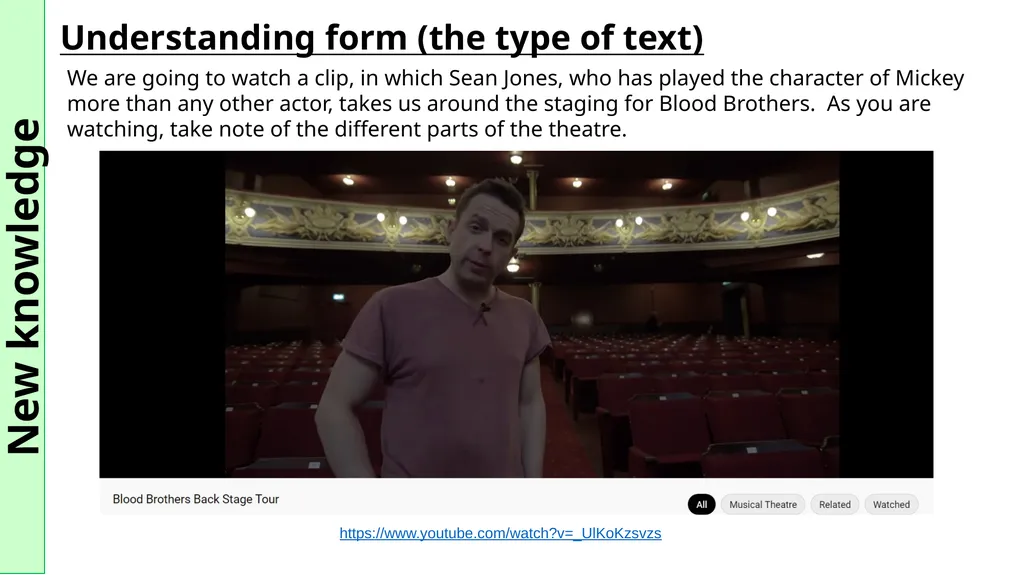
New knowledge Understanding form (the type of text) https://www.youtube.com/watch?v=_UlKoKzsvzs We are going to watch a clip, in which Sean Jones, who has played the character of Mickey more than any other actor, takes us around the staging for Blood Brothers. As you are watching, take note of the different parts of the theatre.<br>
57
Reflection Reflection questions: What have you learnt about drama today and the theatre space?
Have you ever been to the theatre? If so, what was that experience like?<br>
Have you ever been to the theatre? If so, what was that experience like?<br>
58
Lesson Nine<br>
59
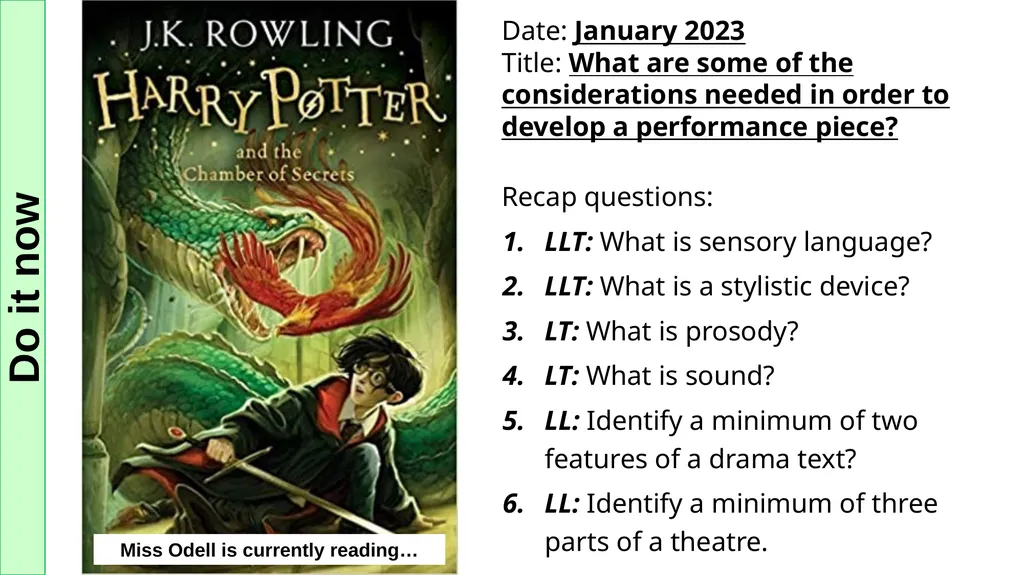
Do it now Miss Odell is currently reading… Date: January 2023
Title: What are some of the considerations needed in order to develop a performance piece?
Recap questions:
LLT: What is sensory language?
LLT: What is a stylistic device?
LT: What is prosody?
LT: What is sound?
LL: Identify a minimum of two features of a drama text?
LL: Identify a minimum of three parts of a theatre.<br>
60
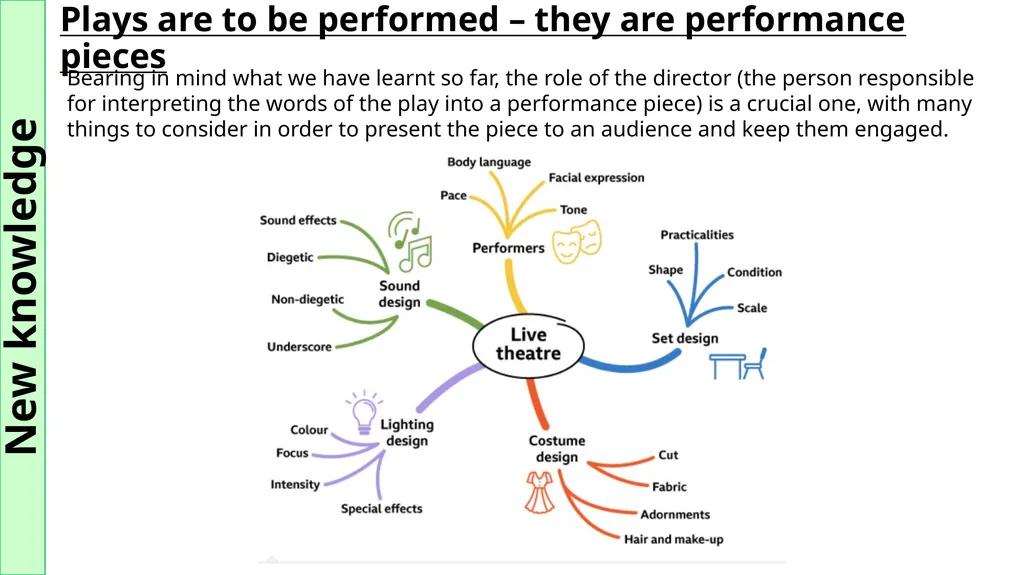
Plays are to be performed – they are performance pieces Bearing in mind what we have learnt so far, the role of the director (the person responsible for interpreting the words of the play into a performance piece) is a crucial one, with many things to consider in order to present the piece to an audience and keep them engaged. New knowledge<br>
61
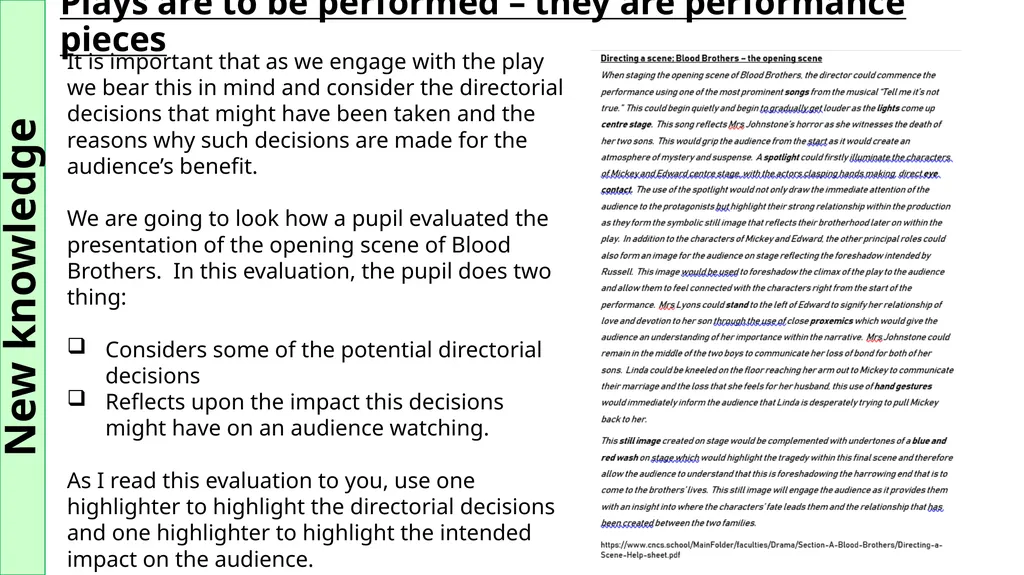
Plays are to be performed – they are performance pieces It is important that as we engage with the play we bear this in mind and consider the directorial decisions that might have been taken and the reasons why such decisions are made for the audience’s benefit.
We are going to look how a pupil evaluated the presentation of the opening scene of Blood Brothers. In this evaluation, the pupil does two thing:
Considers some of the potential directorial decisions
Reflects upon the impact this decisions might have on an audience watching.
As I read this evaluation to you, use one highlighter to highlight the directorial decisions and one highlighter to highlight the intended impact on the audience. New knowledge<br>
62
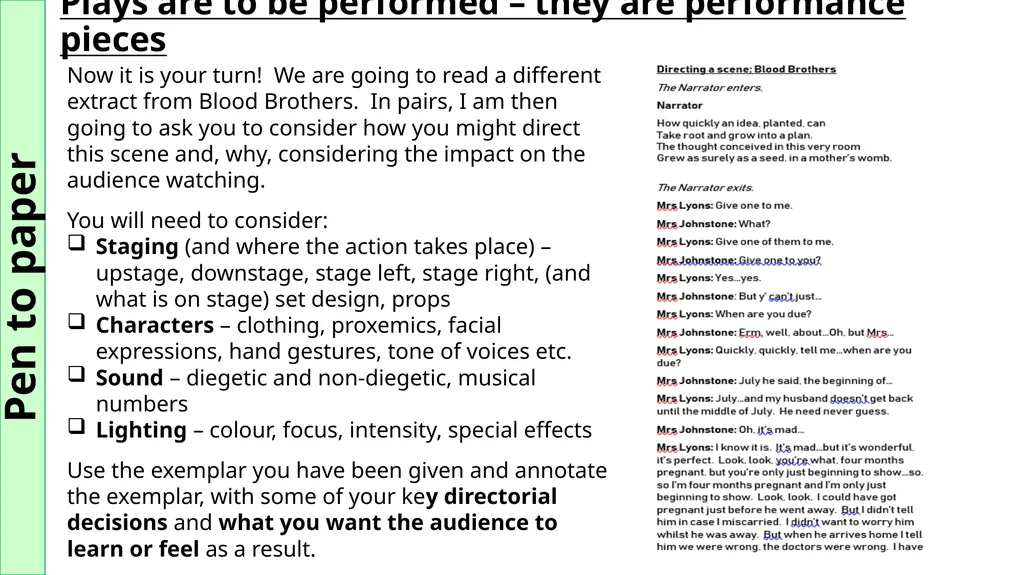
Plays are to be performed – they are performance pieces Now it is your turn! We are going to read a different extract from Blood Brothers. In pairs, I am then going to ask you to consider how you might direct this scene and, why, considering the impact on the audience watching.
You will need to consider:
Staging (and where the action takes place) – upstage, downstage, stage left, stage right, (and what is on stage) set design, props
Characters – clothing, proxemics, facial expressions, hand gestures, tone of voices etc.
Sound – diegetic and non-diegetic, musical numbers
Lighting – colour, focus, intensity, special effects
Use the exemplar you have been given and annotate the exemplar, with some of your key directorial decisions and what you want the audience to learn or feel as a result. Pen to paper<br>
63
Plays are to be performed – they are performance pieces Oracy opportunity Now organise yourself into a group of four.
Share with the other pair in your group your directorial notes.
Explain what directorial decisions you made AND also the intended impact on the audience.
E.g.
We chose to include a _____ because we wanted the audience to _____<br>
Share with the other pair in your group your directorial notes.
Explain what directorial decisions you made AND also the intended impact on the audience.
E.g.
We chose to include a _____ because we wanted the audience to _____<br>
64
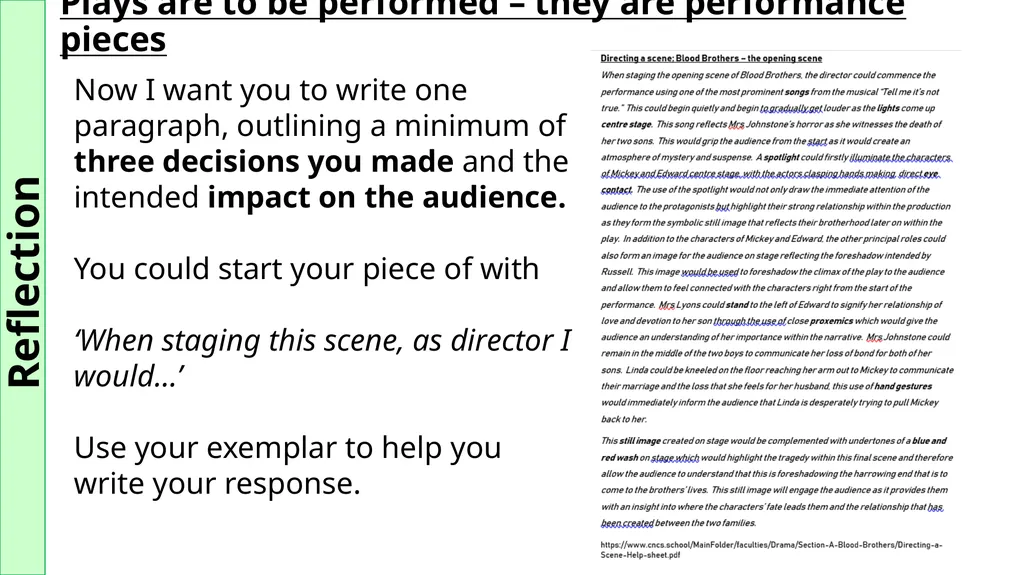
Plays are to be performed – they are performance pieces Now I want you to write one paragraph, outlining a minimum of three decisions you made and the intended impact on the audience.
You could start your piece of with
‘When staging this scene, as director I would…’
Use your exemplar to help you write your response. Reflection<br>
You could start your piece of with
‘When staging this scene, as director I would…’
Use your exemplar to help you write your response. Reflection<br>
65
Lesson Ten<br>
66
Do it now Miss Odell is currently reading… Date: January 2023
Title: To what extent can we argue that Blood Brothers is a tragicomedy?
Recap questions:
LLT: What is the setting of a piece of literature?
LLT: What is pastoral literature?
LT: What is tone?
LT: What is rhythm?
LL: What are some of the decisions a director will make when taking words from the page to the stage?
LL: Why do they need to make these decisions?<br>
67
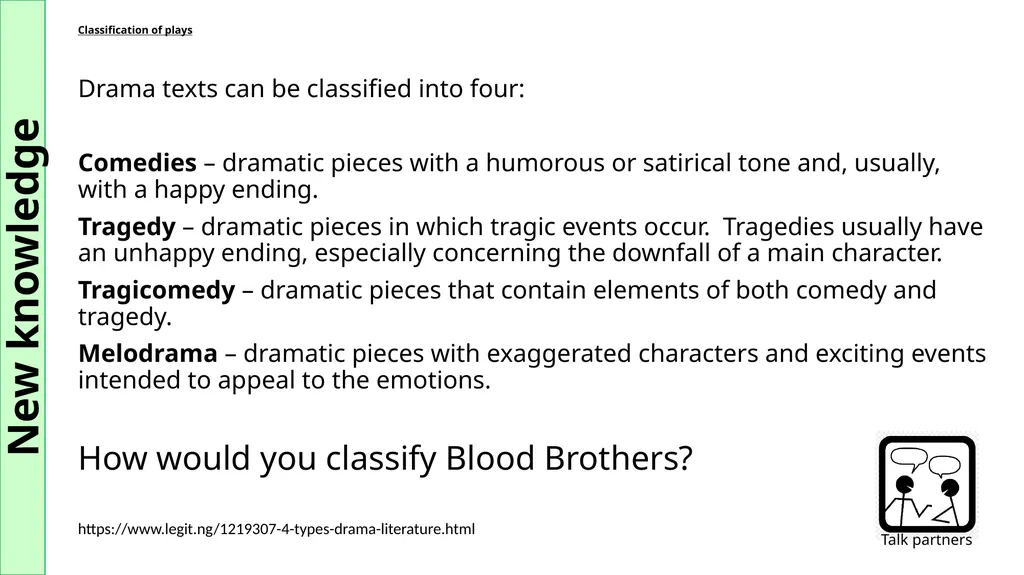
Classification of plays Drama texts can be classified into four:
Comedies – dramatic pieces with a humorous or satirical tone and, usually, with a happy ending.
Tragedy – dramatic pieces in which tragic events occur. Tragedies usually have an unhappy ending, especially concerning the downfall of a main character.
Tragicomedy – dramatic pieces that contain elements of both comedy and tragedy.
Melodrama – dramatic pieces with exaggerated characters and exciting events intended to appeal to the emotions.
How would you classify Blood Brothers?
https://www.legit.ng/1219307-4-types-drama-literature.html Talk partners New knowledge<br>
68
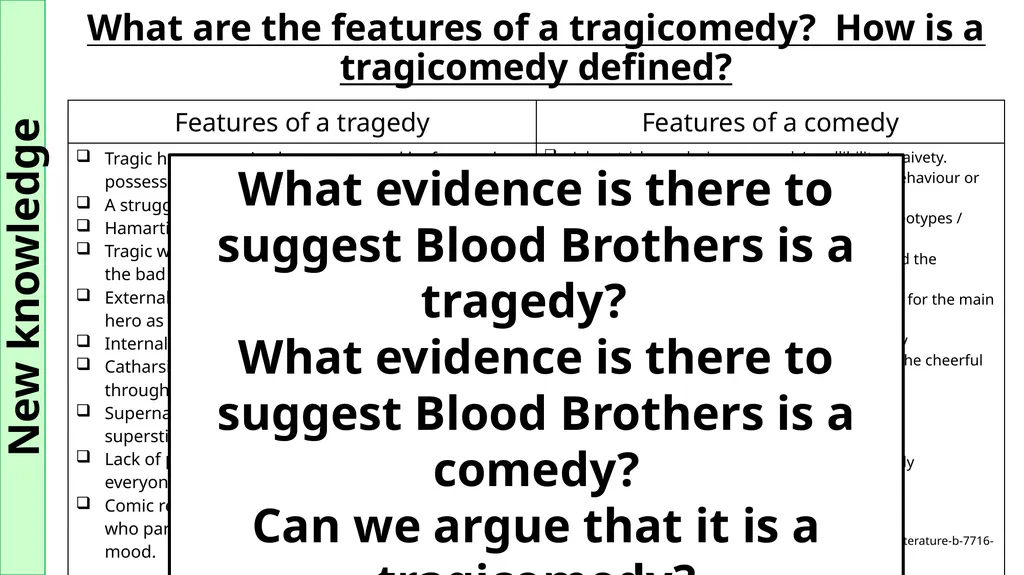
What are the features of a tragicomedy? How is a tragicomedy defined? What evidence is there to suggest Blood Brothers is a tragedy?
What evidence is there to suggest Blood Brothers is a comedy?
Can we argue that it is a tragicomedy? New knowledge<br>
What evidence is there to suggest Blood Brothers is a comedy?
Can we argue that it is a tragicomedy? New knowledge<br>
69
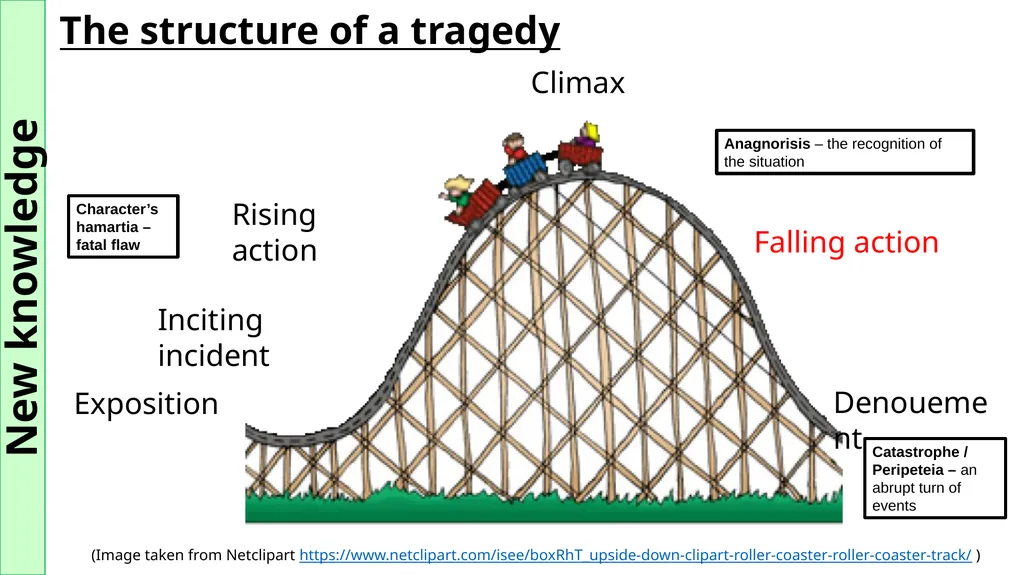
The structure of a tragedy
(Image taken from Netclipart https://www.netclipart.com/isee/boxRhT_upside-down-clipart-roller-coaster-roller-coaster-track/ ) Exposition Inciting incident Rising action Climax Falling action Denouement Character’s hamartia – fatal flaw Anagnorisis – the recognition of the situation Catastrophe / Peripeteia – an abrupt turn of events New knowledge<br>
(Image taken from Netclipart https://www.netclipart.com/isee/boxRhT_upside-down-clipart-roller-coaster-roller-coaster-track/ ) Exposition Inciting incident Rising action Climax Falling action Denouement Character’s hamartia – fatal flaw Anagnorisis – the recognition of the situation Catastrophe / Peripeteia – an abrupt turn of events New knowledge<br>
70
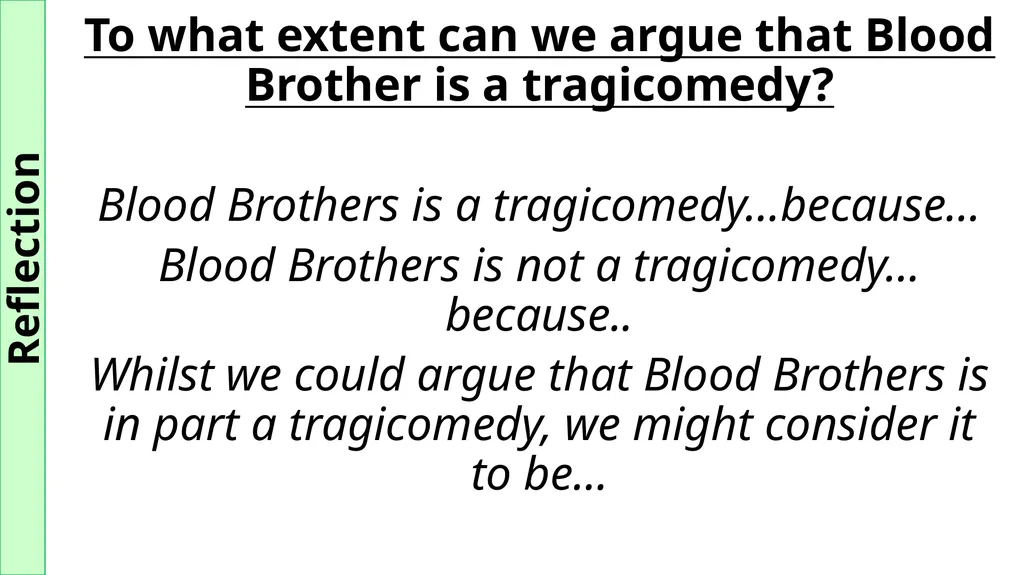
To what extent can we argue that Blood Brother is a tragicomedy?
Blood Brothers is a tragicomedy…because…
Blood Brothers is not a tragicomedy…because..
Whilst we could argue that Blood Brothers is in part a tragicomedy, we might consider it to be… Reflection<br>
Blood Brothers is a tragicomedy…because…
Blood Brothers is not a tragicomedy…because..
Whilst we could argue that Blood Brothers is in part a tragicomedy, we might consider it to be… Reflection<br>
71
Lesson Eleven<br>
72
Do it now Miss Odell is currently reading… Date: January 2023
Title: What is the purpose of a prologue?
Recap questions:
LLT: What is a simple sentence?
LLT: What is a minor sentence?
LT: What is emphatic stress?
LT: What are paralinguistic skills?
LL: Identify two features of a tragedy that you think could be applied to Blood Brothers and two features of a comedy.
LL: To what extent might Blood Brothers be classified as a tragicomedy?<br>
73
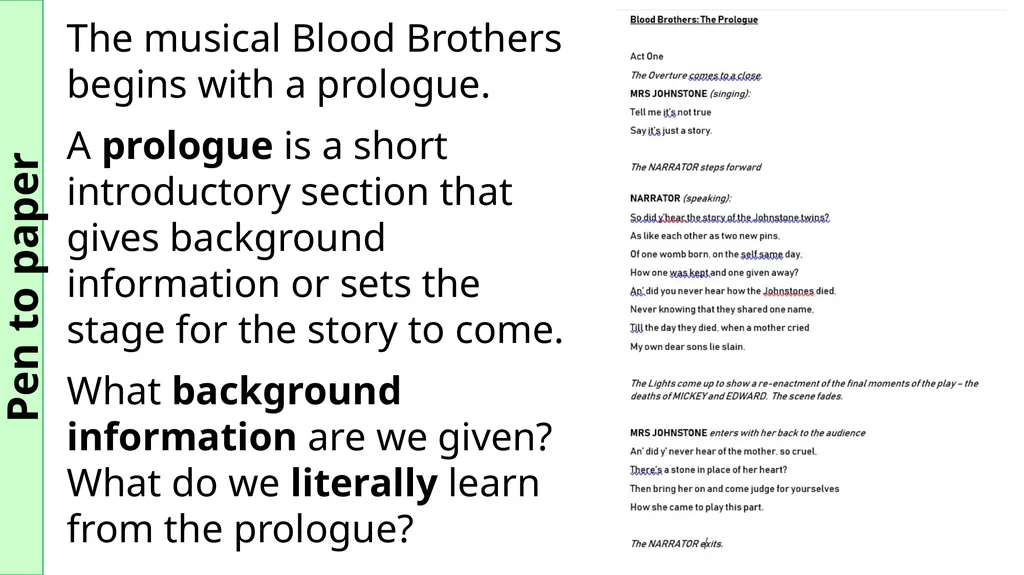
The musical Blood Brothers begins with a prologue.
A prologue is a short introductory section that gives background information or sets the stage for the story to come.
Pro – earlier, before
Logue – discourse of a particular type
Let’s read the prologue to Blood Brothers. New knowledge<br>
A prologue is a short introductory section that gives background information or sets the stage for the story to come.
Pro – earlier, before
Logue – discourse of a particular type
Let’s read the prologue to Blood Brothers. New knowledge<br>
74
The musical Blood Brothers begins with a prologue.
A prologue is a short introductory section that gives background information or sets the stage for the story to come.
What background information are we given? What do we literally learn from the prologue? Pen to paper<br>
A prologue is a short introductory section that gives background information or sets the stage for the story to come.
What background information are we given? What do we literally learn from the prologue? Pen to paper<br>
75
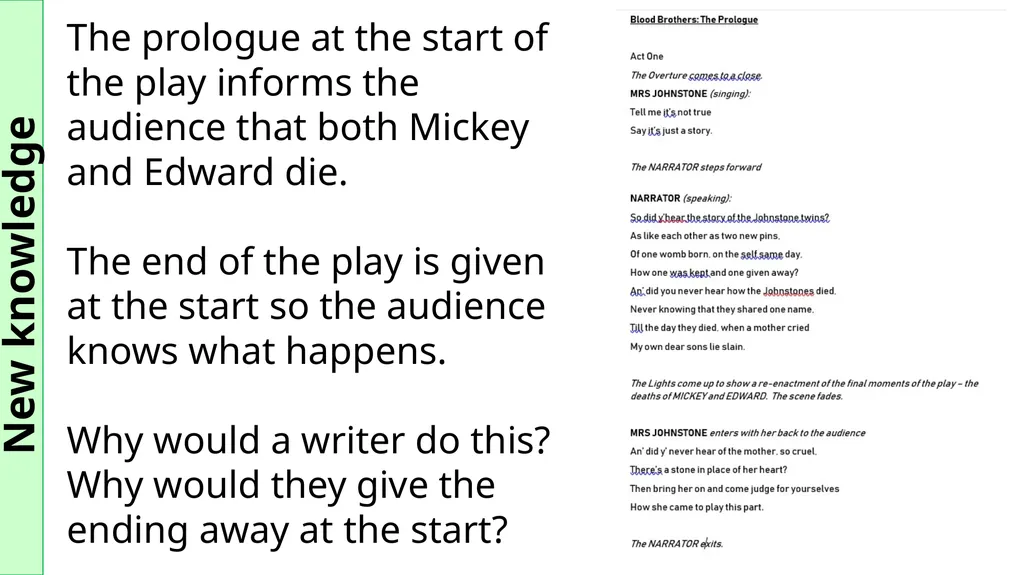
The prologue at the start of the play informs the audience that both Mickey and Edward die.
The end of the play is given at the start so the audience knows what happens.
Why would a writer do this? Why would they give the ending away at the start? New knowledge<br>
The end of the play is given at the start so the audience knows what happens.
Why would a writer do this? Why would they give the ending away at the start? New knowledge<br>
76
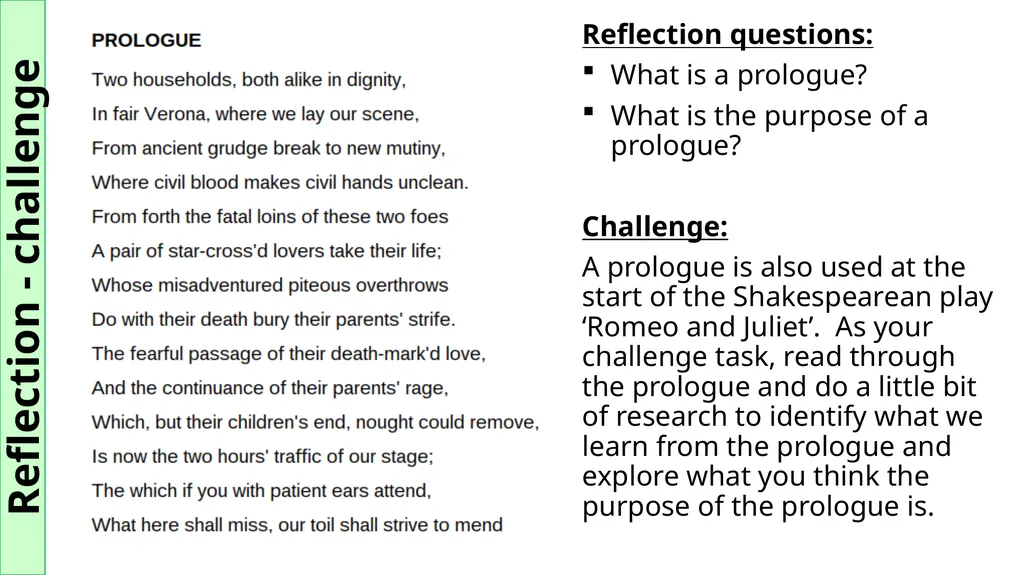
Reflection questions:
What is a prologue?
What is the purpose of a prologue?
Challenge:
A prologue is also used at the start of the Shakespearean play ‘Romeo and Juliet’. As your challenge task, read through the prologue and do a little bit of research to identify what we learn from the prologue and explore what you think the purpose of the prologue is. Reflection - challenge<br>
77
Lesson Twelve<br>
78
Do it now Miss Odell is currently reading… Date: January 2023
Title: What is the difference between a monologue, duologue, soliloquy and song?
Recap questions:
LLT: What is a compound sentence?
LLT: What is a complex sentence?
LT: What is the difference between a dynamic and stative verb?
LT: What is a verb phrase?
LL: What is a prologue?
LL: What is the purpose of the prologue in Blood Brothers?<br>
79
Dramatic terms A monologue is a long speech made by a character in a play as part of a conversation with other characters.
A duologue is a less common word for dialogue. It is a conversation between two characters in a play.
A soliloquy is a long speech made by a character in a play, in which they share their innermost thoughts and feelings with the audience only.
A musical number is a song – e.g. words sung to a tune. Musicals are plays that use singing (and dancing) Revising prior knowlege<br>
80
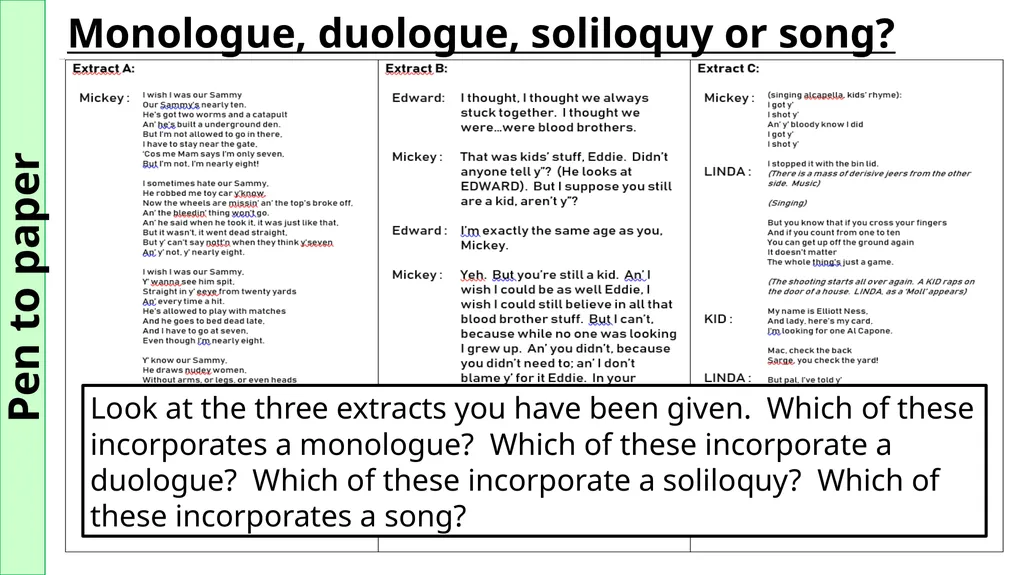
Monologue, duologue, soliloquy or song? Look at the three extracts you have been given. Which of these incorporates a monologue? Which of these incorporate a duologue? Which of these incorporate a soliloquy? Which of these incorporates a song? Pen to paper<br>
81
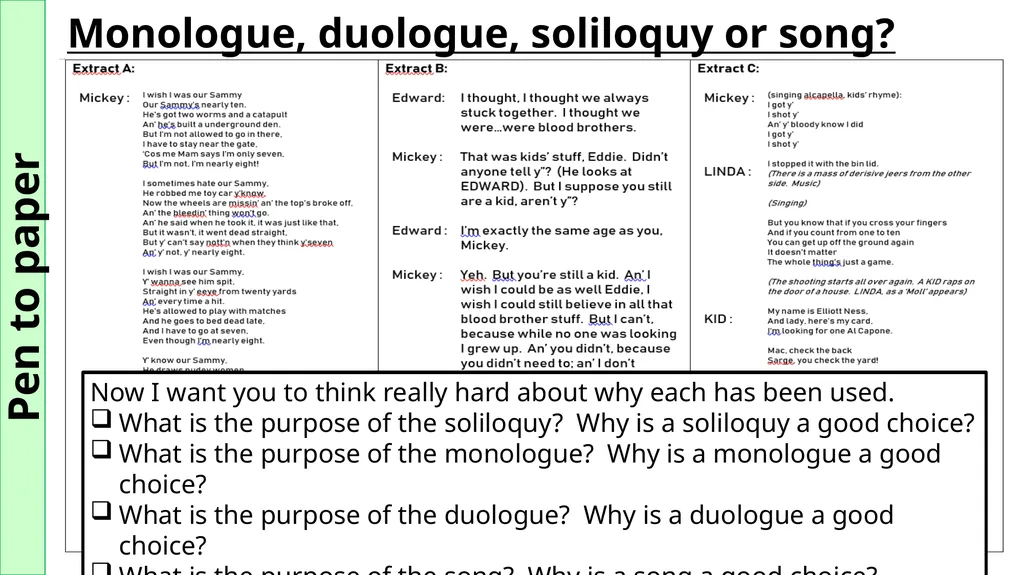
Monologue, duologue, soliloquy or song? Now I want you to think really hard about why each has been used.
What is the purpose of the soliloquy? Why is a soliloquy a good choice?
What is the purpose of the monologue? Why is a monologue a good choice?
What is the purpose of the duologue? Why is a duologue a good choice?
What is the purpose of the song? Why is a song a good choice? Pen to paper<br>
What is the purpose of the soliloquy? Why is a soliloquy a good choice?
What is the purpose of the monologue? Why is a monologue a good choice?
What is the purpose of the duologue? Why is a duologue a good choice?
What is the purpose of the song? Why is a song a good choice? Pen to paper<br>
82
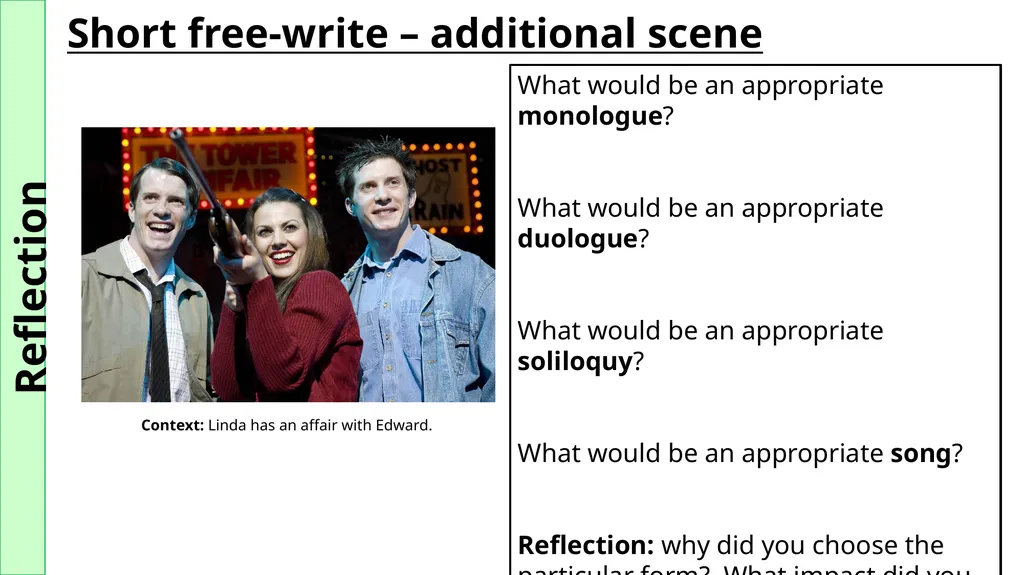
Short free-write – additional scene Context: Linda has an affair with Edward. What would be an appropriate monologue?
What would be an appropriate duologue?
What would be an appropriate soliloquy?
What would be an appropriate song?
Reflection: why did you choose the particular form? What impact did you want it to have on the audience? Reflection<br>
What would be an appropriate duologue?
What would be an appropriate soliloquy?
What would be an appropriate song?
Reflection: why did you choose the particular form? What impact did you want it to have on the audience? Reflection<br>
83
Lesson Thirteen<br>
84
Do it now Miss Odell is currently reading… Date: March 2023
Title: What is a symbol? What is a motif?
Recap questions:
LLT: What is a subordinating conjunction?
LLT: What is a periodic sentence?
LT: What is the infinitive?
LT: What is an imperative verb??
LL: What is the difference between a monologue and a duologue?
LL: What is the difference between a monologue and a soliloquy?<br>
85
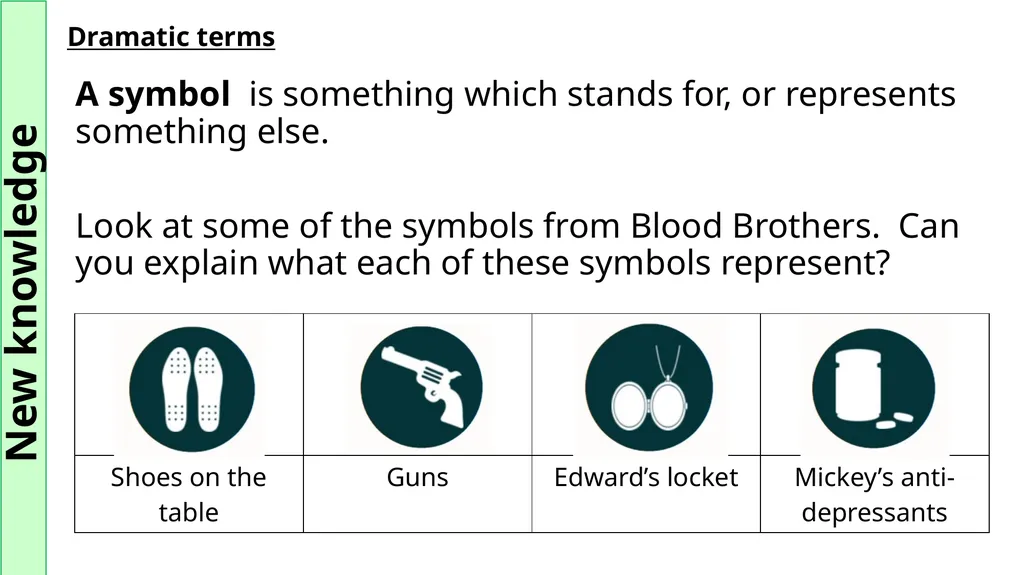
Dramatic terms A symbol is something which stands for, or represents something else.
Look at some of the symbols from Blood Brothers. Can you explain what each of these symbols represent? New knowledge<br>
Look at some of the symbols from Blood Brothers. Can you explain what each of these symbols represent? New knowledge<br>
86
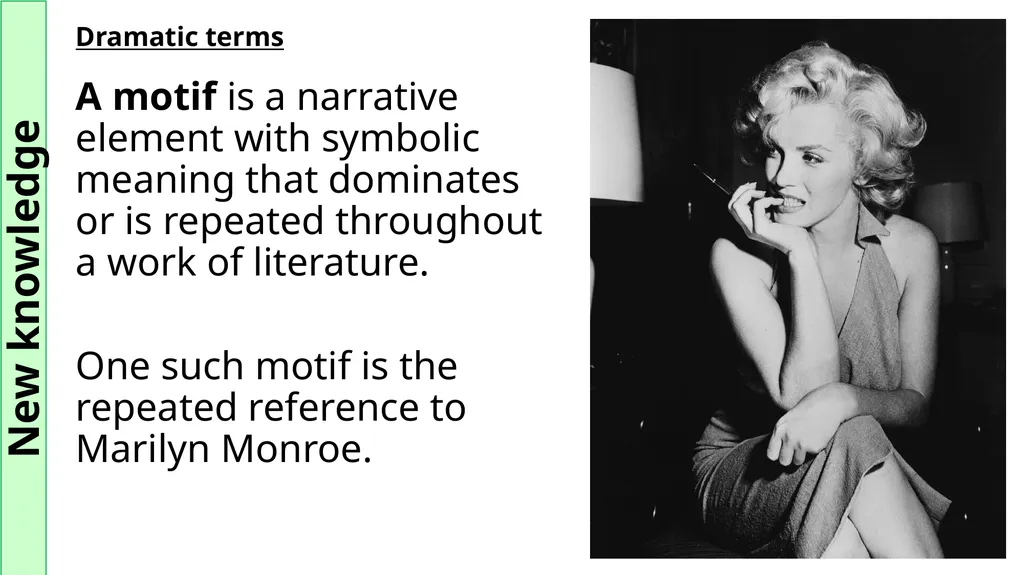
Dramatic terms A motif is a narrative element with symbolic meaning that dominates or is repeated throughout a work of literature.
One such motif is the repeated reference to Marilyn Monroe. New knowledge<br>
One such motif is the repeated reference to Marilyn Monroe. New knowledge<br>
87
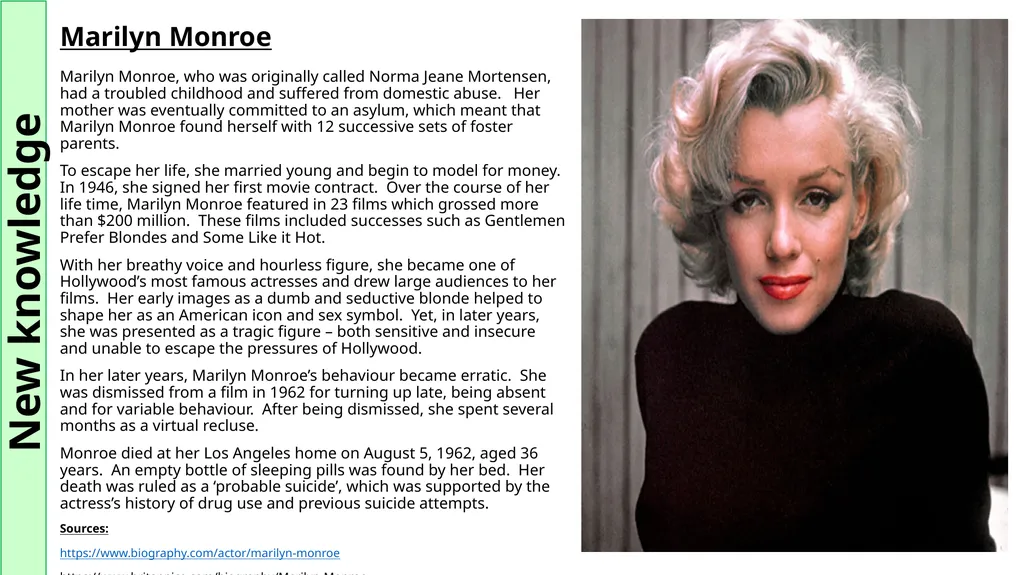
Marilyn Monroe Marilyn Monroe, who was originally called Norma Jeane Mortensen, had a troubled childhood and suffered from domestic abuse. Her mother was eventually committed to an asylum, which meant that Marilyn Monroe found herself with 12 successive sets of foster parents.
To escape her life, she married young and begin to model for money. In 1946, she signed her first movie contract. Over the course of her life time, Marilyn Monroe featured in 23 films which grossed more than $200 million. These films included successes such as Gentlemen Prefer Blondes and Some Like it Hot.
With her breathy voice and hourless figure, she became one of Hollywood’s most famous actresses and drew large audiences to her films. Her early images as a dumb and seductive blonde helped to shape her as an American icon and sex symbol. Yet, in later years, she was presented as a tragic figure – both sensitive and insecure and unable to escape the pressures of Hollywood.
In her later years, Marilyn Monroe’s behaviour became erratic. She was dismissed from a film in 1962 for turning up late, being absent and for variable behaviour. After being dismissed, she spent several months as a virtual recluse.
Monroe died at her Los Angeles home on August 5, 1962, aged 36 years. An empty bottle of sleeping pills was found by her bed. Her death was ruled as a ‘probable suicide’, which was supported by the actress’s history of drug use and previous suicide attempts.
Sources:
https://www.biography.com/actor/marilyn-monroe
https://www.britannica.com/biography/Marilyn-Monroe New knowledge<br>
88
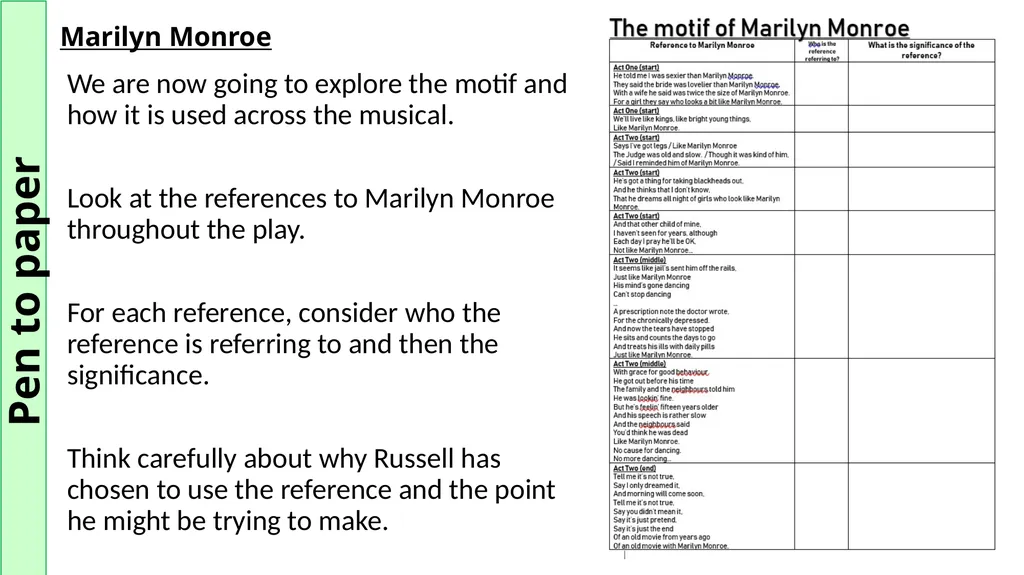
Marilyn Monroe We are now going to explore the motif and how it is used across the musical.
Look at the references to Marilyn Monroe throughout the play.
For each reference, consider who the reference is referring to and then the significance.
Think carefully about why Russell has chosen to use the reference and the point he might be trying to make. Pen to paper<br>
Look at the references to Marilyn Monroe throughout the play.
For each reference, consider who the reference is referring to and then the significance.
Think carefully about why Russell has chosen to use the reference and the point he might be trying to make. Pen to paper<br>
89
Having considered all of the references to Marilyn Monroe throughout the play, do you think the use of the motif is successful in helping Russell to convey key ideas about the Johnstone family? Reflection<br>
90
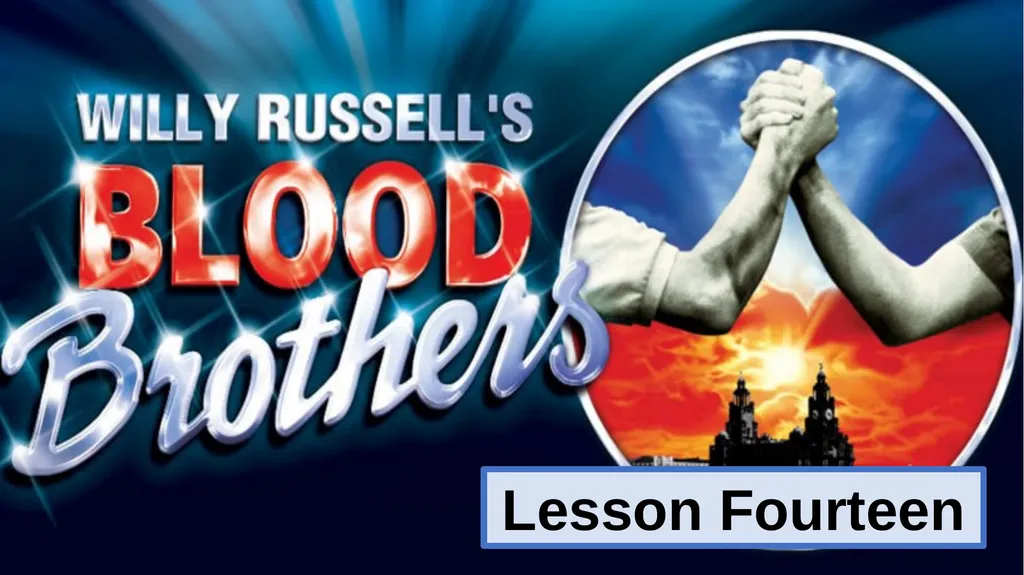
Lesson Fourteen<br>
91
Do it now Miss Odell is currently reading… Date: March 2023
Title: What is the role of the narrator?
Recap questions:
LLT: What is a relative clause?
LLT: What is a compound-complex sentence?
LT: What is a modal verb?
LT: Can you write the past, present and future tense of the verb ‘to run’?
LL: What is a symbol?
LL: What is a motif?<br>
Title: What is the role of the narrator?
Recap questions:
LLT: What is a relative clause?
LLT: What is a compound-complex sentence?
LT: What is a modal verb?
LT: Can you write the past, present and future tense of the verb ‘to run’?
LL: What is a symbol?
LL: What is a motif?<br>
92
What is a narrator? A narrator is the person who tells the story .
There are three main types of narrative voice:
First person – one of the characters is narrating the story and uses the first person pronoun ‘I’.
Second Person – structured around the ‘you’ pronoun but is very rare in novel-length work.
Third person – the narrator is telling the story about the characters and refers to them using the third person pronouns ‘he’ / ‘she’
Third person omniscient – the omniscient narrator knows everything about the story and its characters. They can enter anyone’s mind, move freely through time and give the reader their own opinions and observations as well as those of the characters. This narrator also knows more than the characters – god’s-eye-view.
Third person limited – the third person limited narrator sticks closely to one character but remains in third person. They can see inside one character’s head – their thoughts, feelings and sensations. What type of narrator do you think the narrator is in Blood Brothers? https://www.masterclass.com/articles/complete-guide-to-point-of-view-in-writing-definitions-and-examples#3-types-of-point-of-view Talk partners New knowledge / Pen to Paper<br>
93
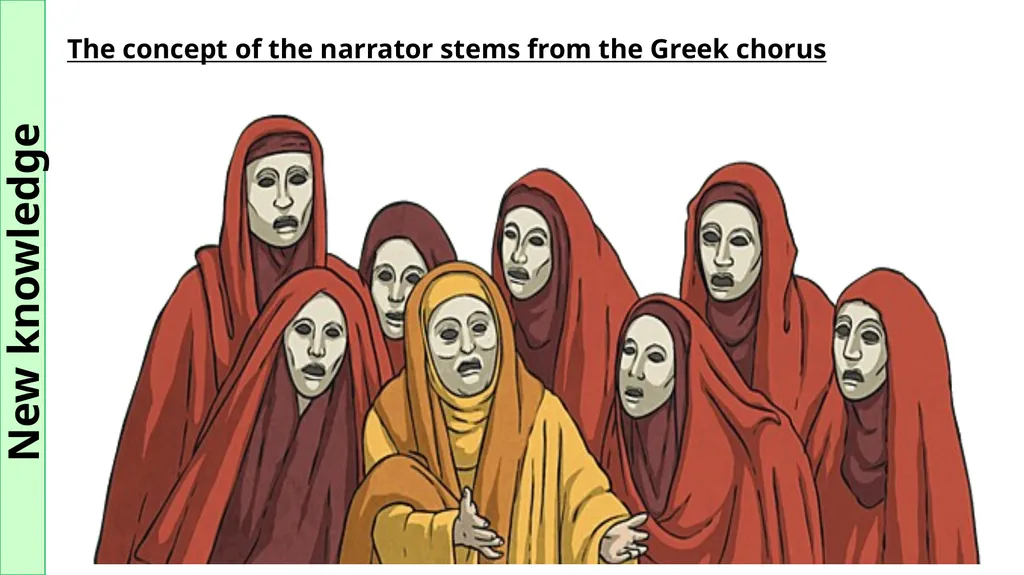
The concept of the narrator stems from the Greek chorus New knowledge<br>
94
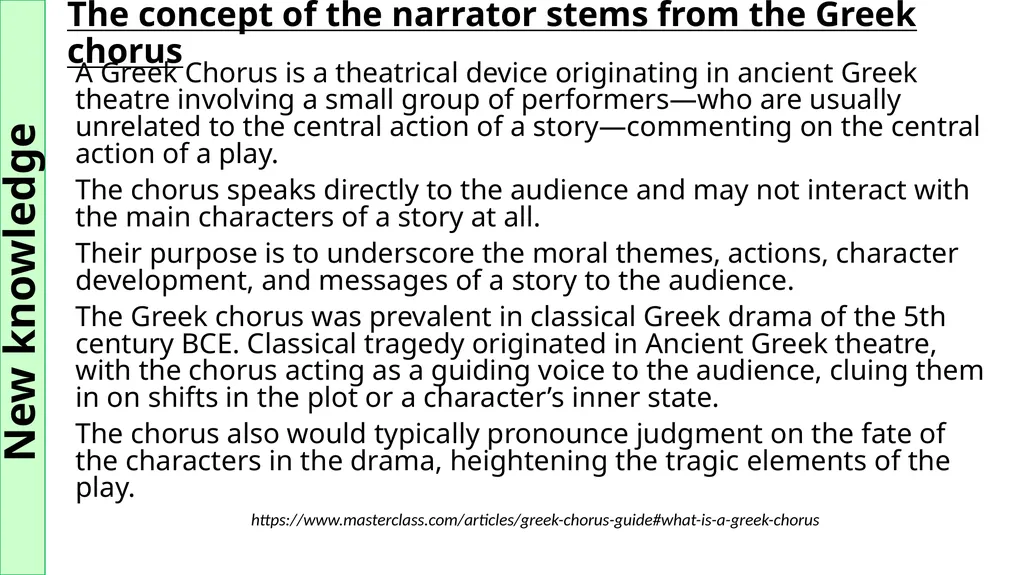
The concept of the narrator stems from the Greek chorus A Greek Chorus is a theatrical device originating in ancient Greek theatre involving a small group of performers—who are usually unrelated to the central action of a story—commenting on the central action of a play.
The chorus speaks directly to the audience and may not interact with the main characters of a story at all.
Their purpose is to underscore the moral themes, actions, character development, and messages of a story to the audience.
The Greek chorus was prevalent in classical Greek drama of the 5th century BCE. Classical tragedy originated in Ancient Greek theatre, with the chorus acting as a guiding voice to the audience, cluing them in on shifts in the plot or a character’s inner state.
The chorus also would typically pronounce judgment on the fate of the characters in the drama, heightening the tragic elements of the play.
https://www.masterclass.com/articles/greek-chorus-guide#what-is-a-greek-chorus New knowledge<br>
95
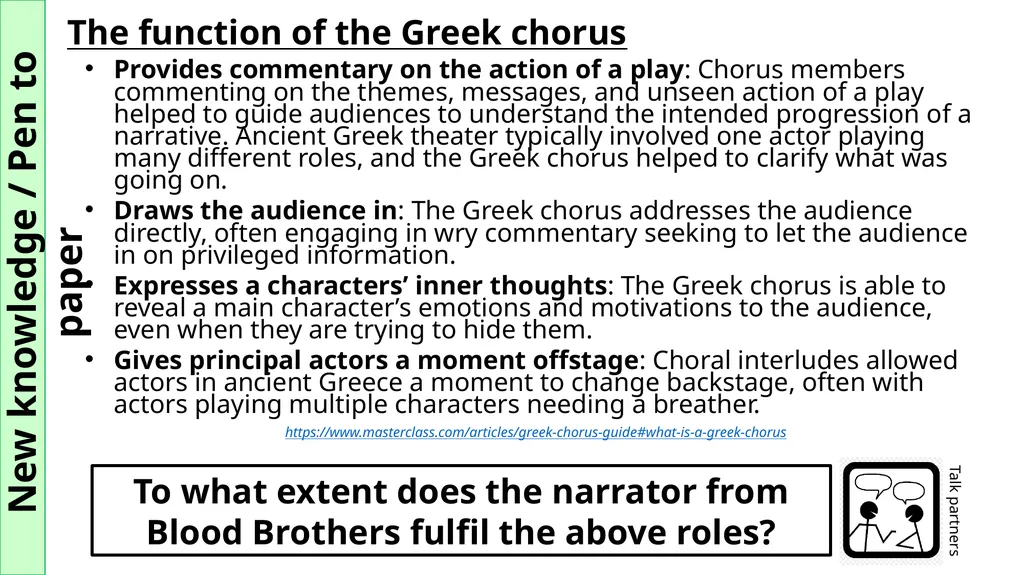
The function of the Greek chorus Provides commentary on the action of a play: Chorus members commenting on the themes, messages, and unseen action of a play helped to guide audiences to understand the intended progression of a narrative. Ancient Greek theater typically involved one actor playing many different roles, and the Greek chorus helped to clarify what was going on.
Draws the audience in: The Greek chorus addresses the audience directly, often engaging in wry commentary seeking to let the audience in on privileged information.
Expresses a characters’ inner thoughts: The Greek chorus is able to reveal a main character’s emotions and motivations to the audience, even when they are trying to hide them.
Gives principal actors a moment offstage: Choral interludes allowed actors in ancient Greece a moment to change backstage, often with actors playing multiple characters needing a breather.
https://www.masterclass.com/articles/greek-chorus-guide#what-is-a-greek-chorus To what extent does the narrator from Blood Brothers fulfil the above roles? Talk partners New knowledge / Pen to paper<br>
96
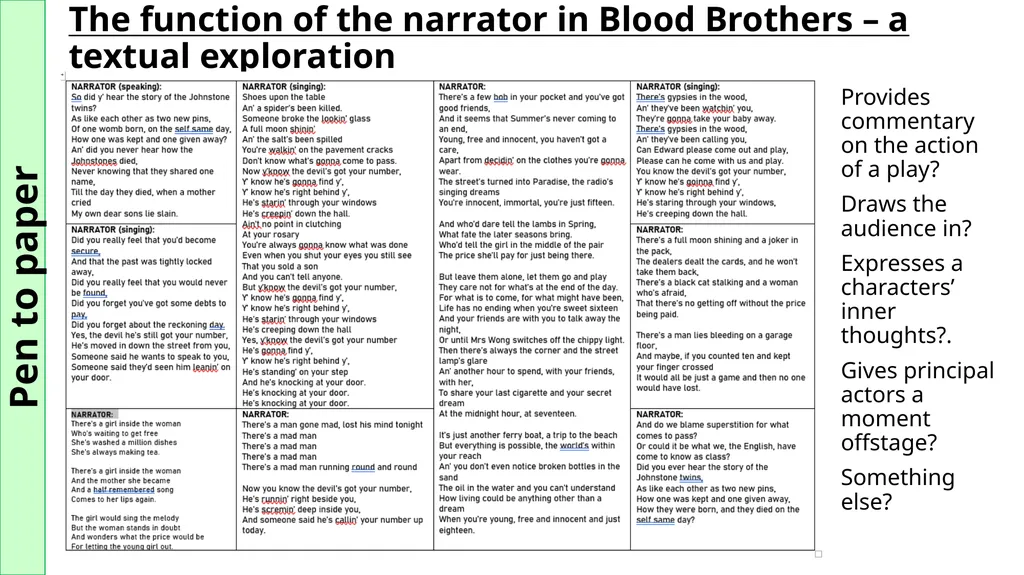
The function of the narrator in Blood Brothers – a textual exploration Provides commentary on the action of a play?
Draws the audience in?
Expresses a characters’ inner thoughts?.
Gives principal actors a moment offstage?
Something else? Pen to paper<br>
Draws the audience in?
Expresses a characters’ inner thoughts?.
Gives principal actors a moment offstage?
Something else? Pen to paper<br>
97
But who is the narrator in Blood Brothers? The Narrator in Blood Brothers represents the public, who are often judgemental and critical when they hear the headline news, before they know all the facts. The Narrator represents Willy Russell. The Narrator acts as the conscience; of the characters in the play and the audience. The Narrator represents the Devil, because he is always ‘right behind’ the characters, an unseen part of their lives. What do you think? Reflection<br>
98
Lesson Fifteen<br>
99
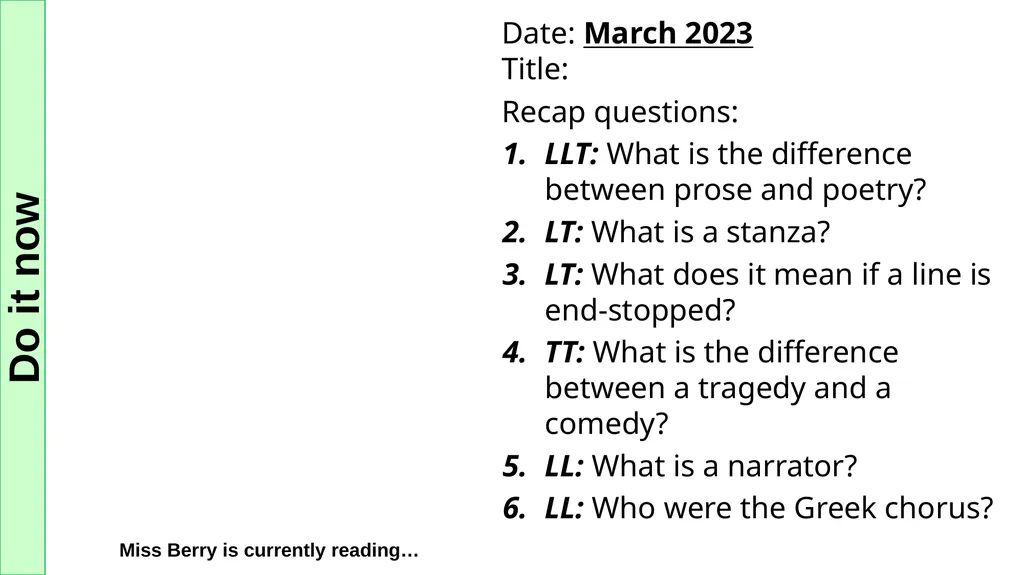
Do it now Miss Berry is currently reading… Date: March 2023
Title:
Recap questions:
LLT: What is the difference between prose and poetry?
LT: What is a stanza?
LT: What does it mean if a line is end-stopped?
TT: What is the difference between a tragedy and a comedy?
LL: What is a narrator?
LL: Who were the Greek chorus?<br>
Title:
Recap questions:
LLT: What is the difference between prose and poetry?
LT: What is a stanza?
LT: What does it mean if a line is end-stopped?
TT: What is the difference between a tragedy and a comedy?
LL: What is a narrator?
LL: Who were the Greek chorus?<br>
100
New knowledge<br>
101
Pen to paper<br>
102
Reflection<br>
103
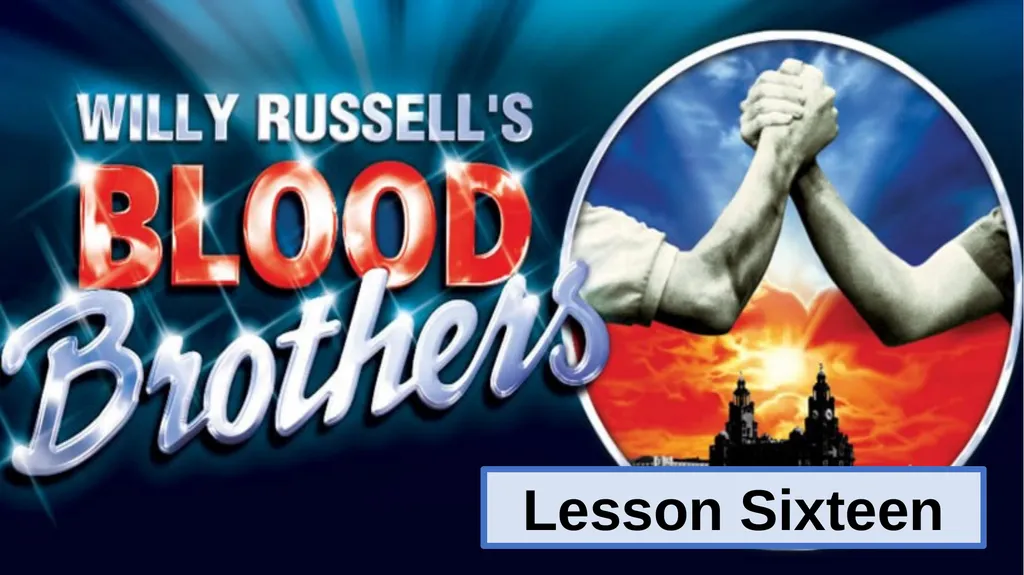
Lesson Sixteen<br>
104
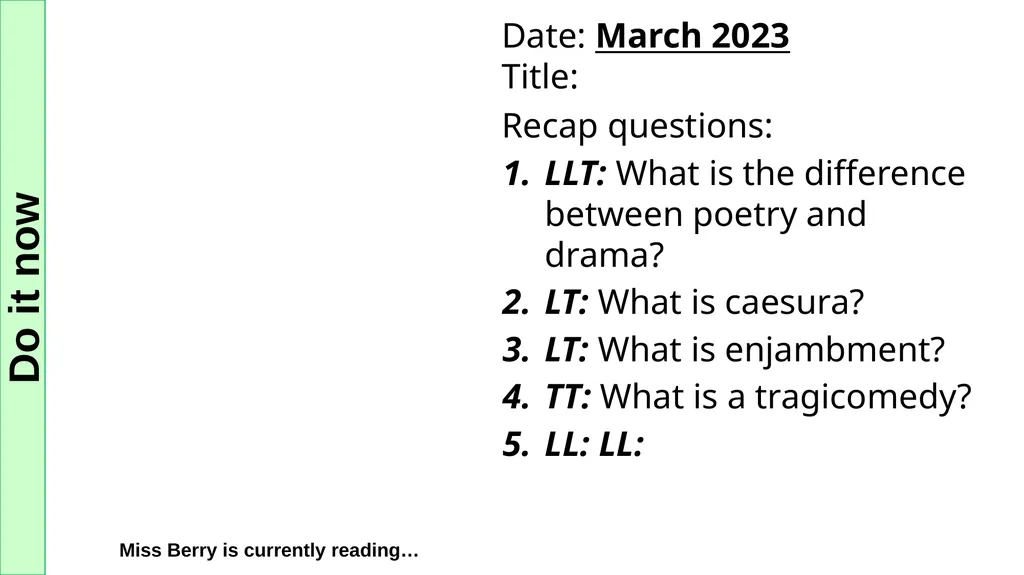
Do it now Miss Berry is currently reading… Date: March 2023
Title:
Recap questions:
LLT: What is the difference between poetry and drama?
LT: What is caesura?
LT: What is enjambment?
TT: What is a tragicomedy?
LL: LL:<br>
Title:
Recap questions:
LLT: What is the difference between poetry and drama?
LT: What is caesura?
LT: What is enjambment?
TT: What is a tragicomedy?
LL: LL:<br>
105
New knowledge<br>
106
Pen to paper<br>
107
Reflection<br>