
Let’s talk about…. Self-harm Toolkit Expectations
MY
Published · 42 slides · 0 views
1 / 1



Description
Lets talk about. Self-harm Toolkit Expectations Respect Confidentiality Anonymity Listen Self-care Aims Stand Up, Sit Down Stand up if: You know a student with a mental health issue You know an adult with a mental health issue You have
Related Topics
Share
Embed code
Download this presentation From Below
"Let’s talk about…. Self-harm Toolkit Expectations" is the property of its rightful owner. Permission is granted to download and print the materials on this website for personal, non-commercial use only, and to display it on your personal computer provided you do not modify the materials and that you retain all copyright notices contained in the materials. By downloading content from our website, you accept the terms of this agreement.
Presentation Transcript
01
Let’s talk about….
Self-harm
Toolkit<br>
Self-harm
Toolkit<br>
02
Expectations Respect
Confidentiality / Anonymity
Listen
Self-care<br>
Confidentiality / Anonymity
Listen
Self-care<br>
03
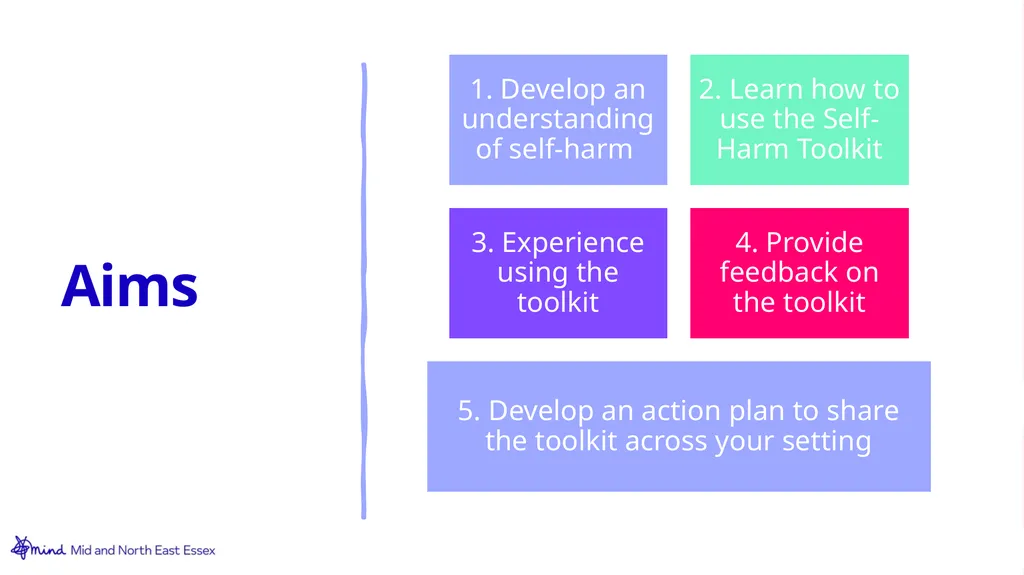
Aims<br>
04
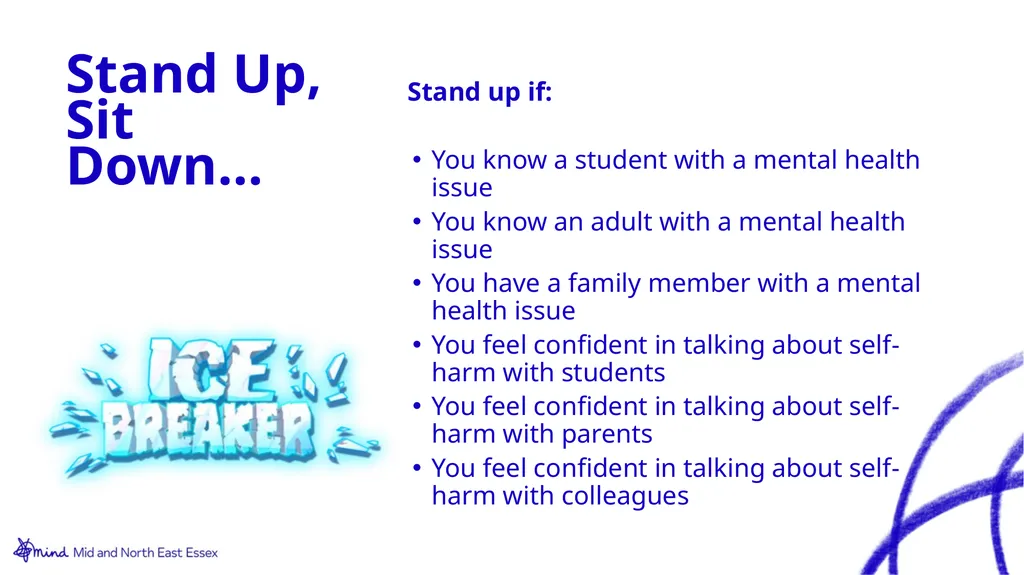
Stand Up, Sit Down… Stand up if:
You know a student with a mental health issue
You know an adult with a mental health issue
You have a family member with a mental health issue
You feel confident in talking about self-harm with students
You feel confident in talking about self-harm with parents
You feel confident in talking about self-harm with colleagues<br>
You know a student with a mental health issue
You know an adult with a mental health issue
You have a family member with a mental health issue
You feel confident in talking about self-harm with students
You feel confident in talking about self-harm with parents
You feel confident in talking about self-harm with colleagues<br>
05
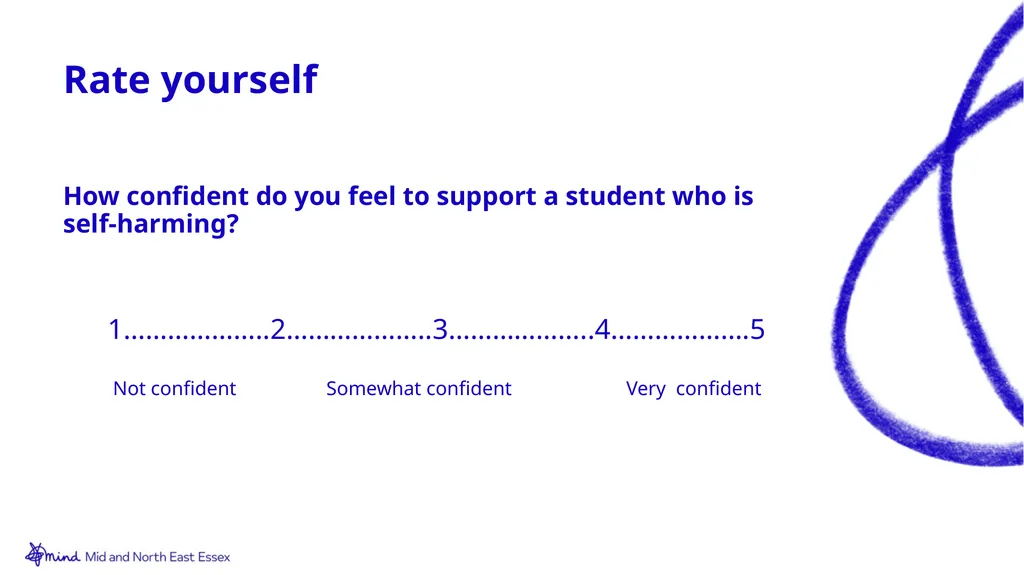
Rate yourself How confident do you feel to support a student who is self-harming?
1………………..2………………..3………………..4……………….5
Not confident Somewhat confident Very confident<br>
1………………..2………………..3………………..4……………….5
Not confident Somewhat confident Very confident<br>
06
Self Care Remember - some of this content may be upsetting – if you feel uncomfortable, please take some time away to reflect and seek support if you need to<br>
07
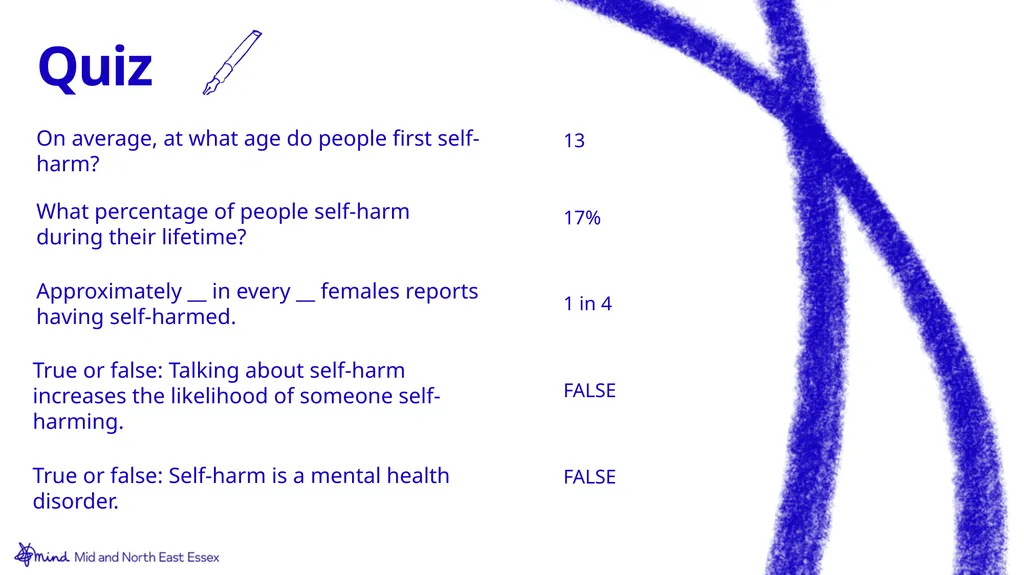
Quiz On average, at what age do people first self-harm? What percentage of people self-harm during their lifetime? Approximately __ in every __ females reports having self-harmed. True or false: Talking about self-harm increases the likelihood of someone self-harming. True or false: Self-harm is a mental health disorder. 13 17% 1 in 4 FALSE FALSE<br>
08
Aim of toolkit This toolkit is to support those working with school-age children and young people under 18 in educational settings and aims to:
• Increase understanding and awareness of self-harm
• Support staff in being aware of risk factors and signs that are associated with self-harm
• Provide tools for educational settings (and staff within them) for responding to students who self-harm
• Raise awareness in educational settings of what support is available locally in responding to self-harm and when/how it can be accesses<br>
• Increase understanding and awareness of self-harm
• Support staff in being aware of risk factors and signs that are associated with self-harm
• Provide tools for educational settings (and staff within them) for responding to students who self-harm
• Raise awareness in educational settings of what support is available locally in responding to self-harm and when/how it can be accesses<br>
09
Understanding self-harm<br>
10
What is self-harm? “An intentional act of damaging or injuring one’s body, irrespective of apparent motivation”<br>
11
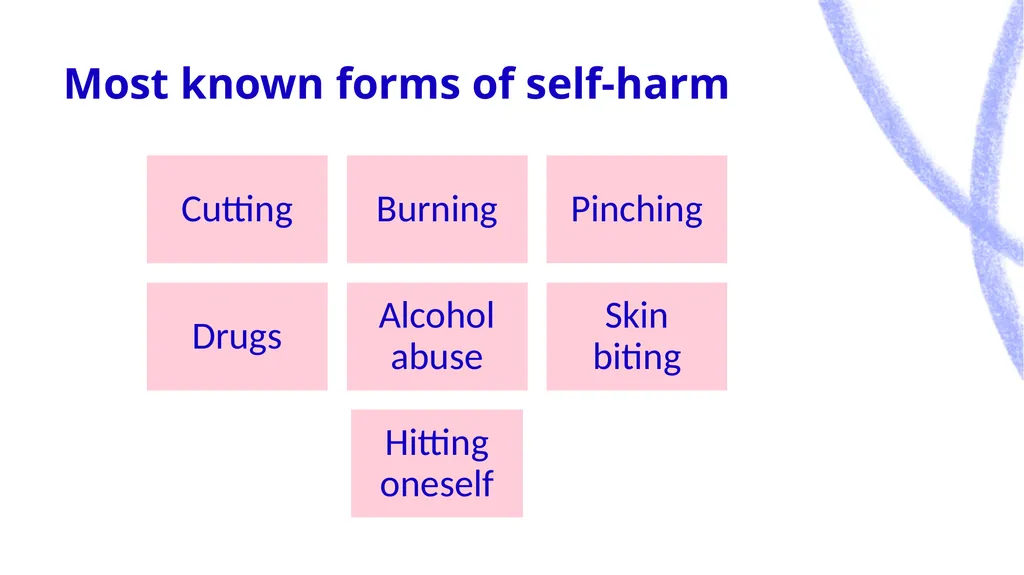
Most known forms of self-harm<br>
12
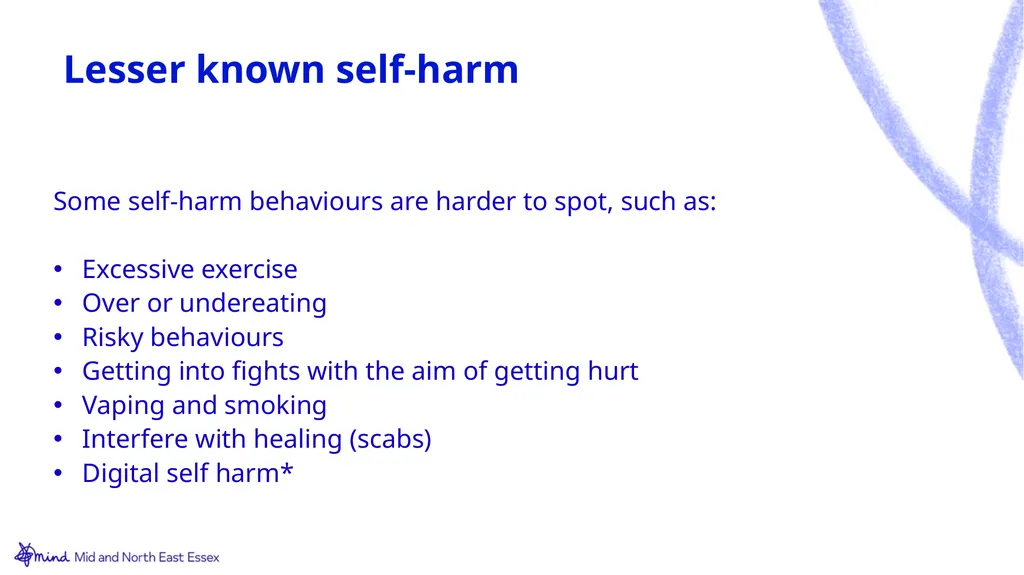
Lesser known self-harm Some self-harm behaviours are harder to spot, such as:
Excessive exercise
Over or undereating
Risky behaviours
Getting into fights with the aim of getting hurt
Vaping and smoking
Interfere with healing (scabs)
Digital self harm*<br>
Excessive exercise
Over or undereating
Risky behaviours
Getting into fights with the aim of getting hurt
Vaping and smoking
Interfere with healing (scabs)
Digital self harm*<br>
13
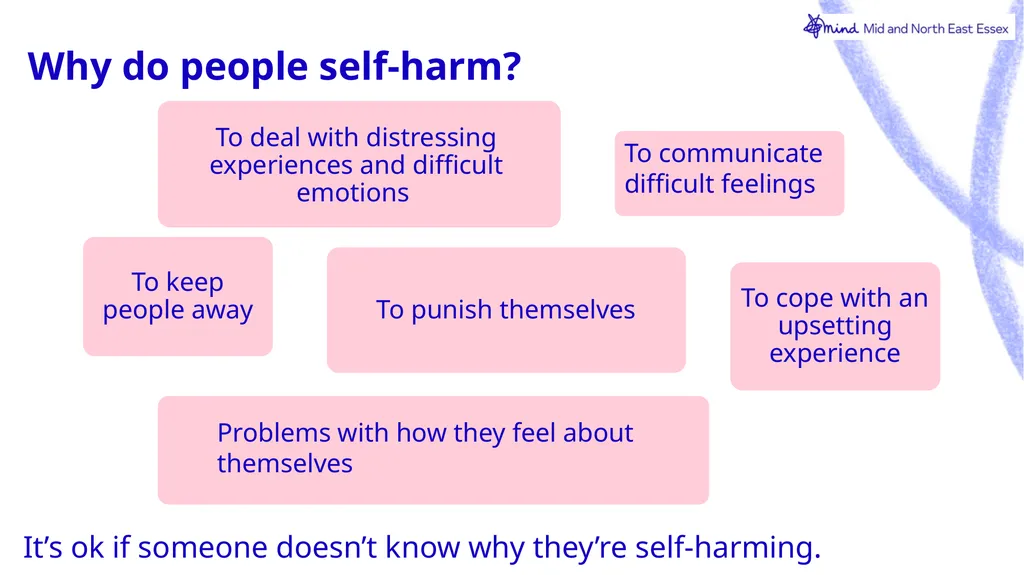
Why do people self-harm? It’s ok if someone doesn’t know why they’re self-harming. To communicate difficult feelings<br>
14
Although some people who have self-harmed are at high risk of suicide, many of those who self-harm do not want to end their lives.<br>
15
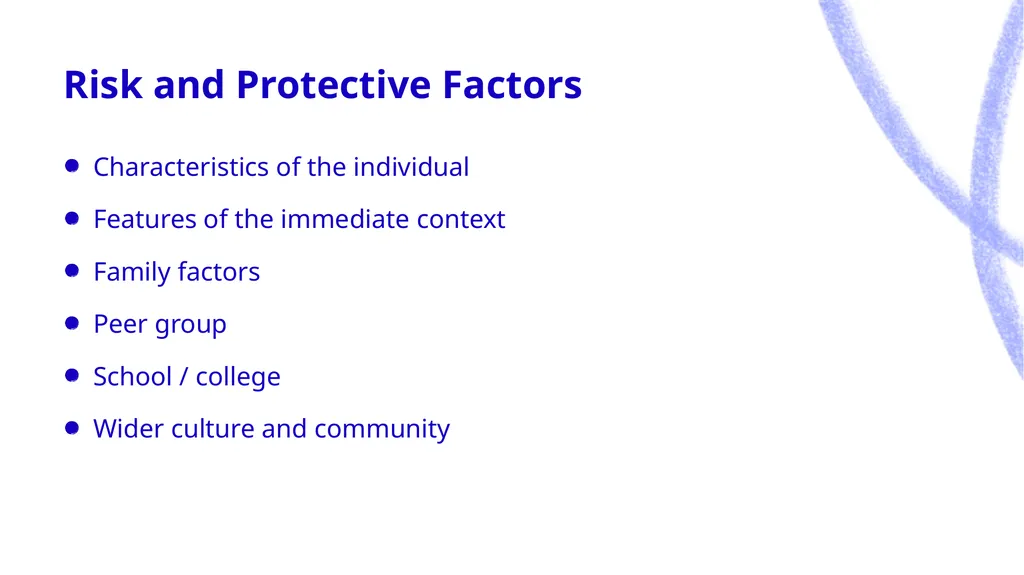
Risk and Protective Factors Characteristics of the individual
Features of the immediate context
Family factors
Peer group
School / college
Wider culture and community<br>
Features of the immediate context
Family factors
Peer group
School / college
Wider culture and community<br>
16
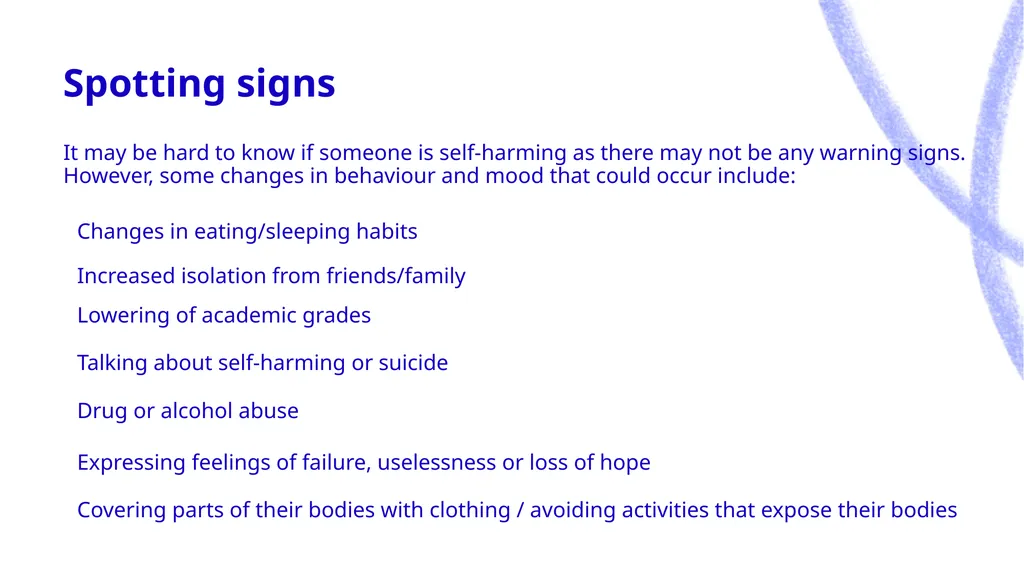
Spotting signs It may be hard to know if someone is self-harming as there may not be any warning signs. However, some changes in behaviour and mood that could occur include: Changes in eating/sleeping habits Increased isolation from friends/family Lowering of academic grades Talking about self-harming or suicide Drug or alcohol abuse Expressing feelings of failure, uselessness or loss of hope Covering parts of their bodies with clothing / avoiding activities that expose their bodies<br>
17
Self-Harm Toolkit<br>
18
Why do we need a self-harm toolkit? National Institute for Clinical Excellence recommends that schools should ensure that all staff are able to:
Identify self-harm behaviours
Assess the needs of the student
Know what to do if a student is self-harming
Support a student’s close friends and peer group
“Self-harm is a growing problem and should be
everyone’s business to tackle – not just those working
in the mental health services.”
Dr Paul Chrisp, NICE<br>
Identify self-harm behaviours
Assess the needs of the student
Know what to do if a student is self-harming
Support a student’s close friends and peer group
“Self-harm is a growing problem and should be
everyone’s business to tackle – not just those working
in the mental health services.”
Dr Paul Chrisp, NICE<br>
19
Who can use the self-harm toolkit? It is designed for use by everyone working with children and young people in schools and colleges
SLT
Safeguarding teams
Teaching staff
Welfare / pastoral teams
SEN departments
Admin staff
All support staff working within the setting
Please refer to your individual organisation’s policies<br>
SLT
Safeguarding teams
Teaching staff
Welfare / pastoral teams
SEN departments
Admin staff
All support staff working within the setting
Please refer to your individual organisation’s policies<br>
20
What’s in the self-harm toolkit? How to identify self-harm
How to identify who is self-harming and who is at risk
How to identify the signs of self-harm
Responding to an incident/suspected incident of self-harm
Pathway of recommended actions
Assessing risk
Confidentiality
Talking to children or young people who are self-harming
Do’s and don’ts for talking to young people about self-harm
Self-harm coping strategies
Self-care for staff
Useful resources / signposting
Appendices<br>
How to identify who is self-harming and who is at risk
How to identify the signs of self-harm
Responding to an incident/suspected incident of self-harm
Pathway of recommended actions
Assessing risk
Confidentiality
Talking to children or young people who are self-harming
Do’s and don’ts for talking to young people about self-harm
Self-harm coping strategies
Self-care for staff
Useful resources / signposting
Appendices<br>
21
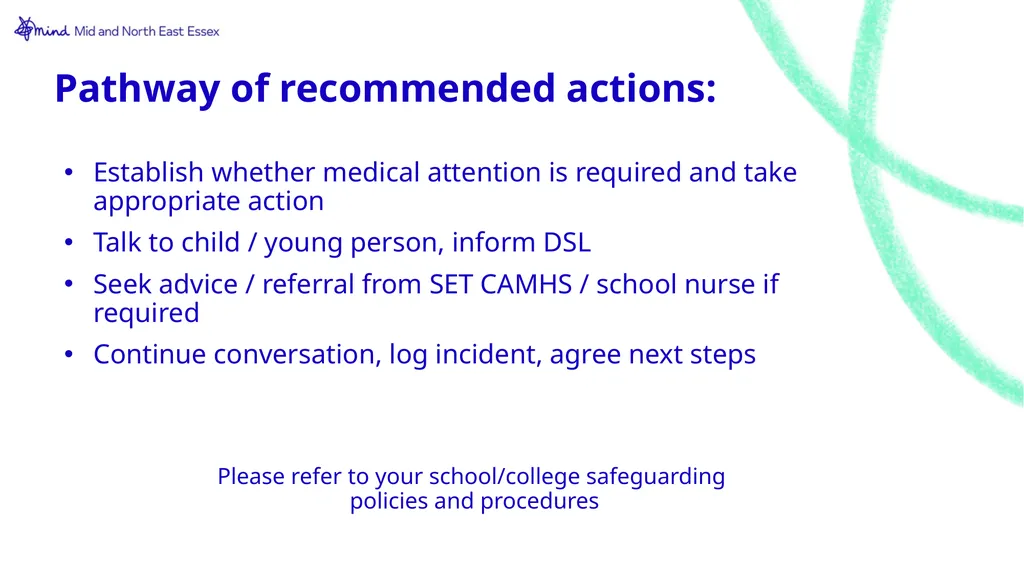
Pathway of recommended actions: Establish whether medical attention is required and take appropriate action
Talk to child / young person, inform DSL
Seek advice / referral from SET CAMHS / school nurse if required
Continue conversation, log incident, agree next steps
Please refer to your school/college safeguarding
policies and procedures<br>
Talk to child / young person, inform DSL
Seek advice / referral from SET CAMHS / school nurse if required
Continue conversation, log incident, agree next steps
Please refer to your school/college safeguarding
policies and procedures<br>
22
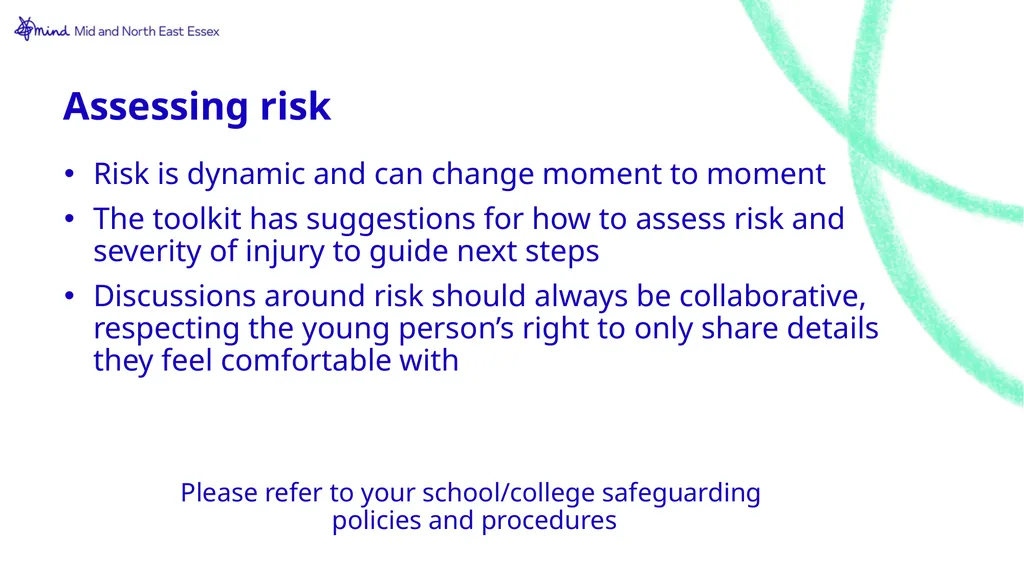
Assessing risk Risk is dynamic and can change moment to moment
The toolkit has suggestions for how to assess risk and severity of injury to guide next steps
Discussions around risk should always be collaborative, respecting the young person’s right to only share details they feel comfortable with
Please refer to your school/college safeguarding
policies and procedures<br>
The toolkit has suggestions for how to assess risk and severity of injury to guide next steps
Discussions around risk should always be collaborative, respecting the young person’s right to only share details they feel comfortable with
Please refer to your school/college safeguarding
policies and procedures<br>
23
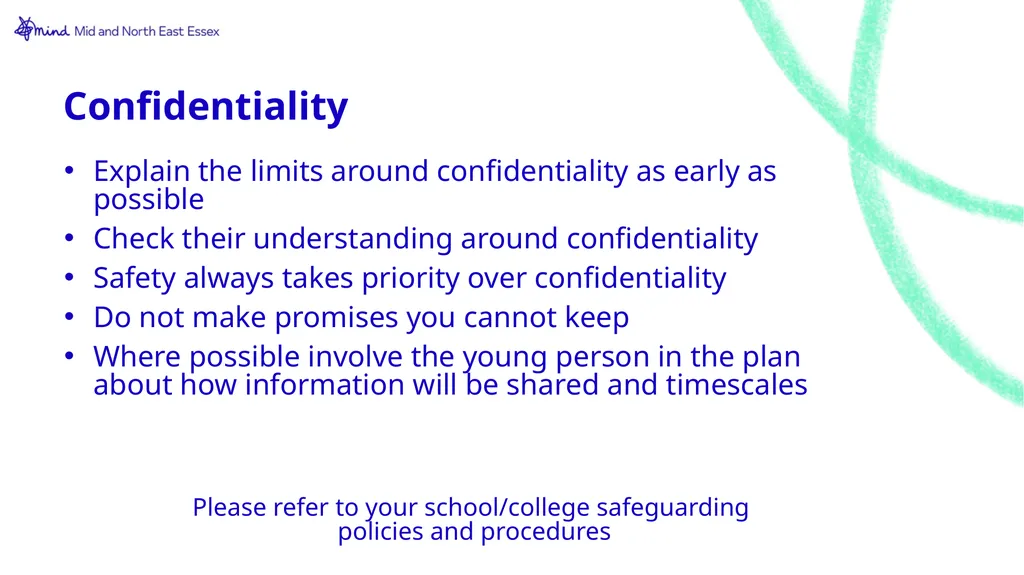
Confidentiality Explain the limits around confidentiality as early as possible
Check their understanding around confidentiality
Safety always takes priority over confidentiality
Do not make promises you cannot keep
Where possible involve the young person in the plan about how information will be shared and timescales
Please refer to your school/college safeguarding
policies and procedures<br>
Check their understanding around confidentiality
Safety always takes priority over confidentiality
Do not make promises you cannot keep
Where possible involve the young person in the plan about how information will be shared and timescales
Please refer to your school/college safeguarding
policies and procedures<br>
24
Talking to young people about self-harm The toolkit has conversation prompts around:
Confidentiality
Establishing rapport
The nature of self-harm
Reasons for self-harm
Coping strategies and support
Speaking to parents
Ongoing support
Do’s and don’ts
Please refer to your school/college safeguarding
policies and procedures<br>
Confidentiality
Establishing rapport
The nature of self-harm
Reasons for self-harm
Coping strategies and support
Speaking to parents
Ongoing support
Do’s and don’ts
Please refer to your school/college safeguarding
policies and procedures<br>
25
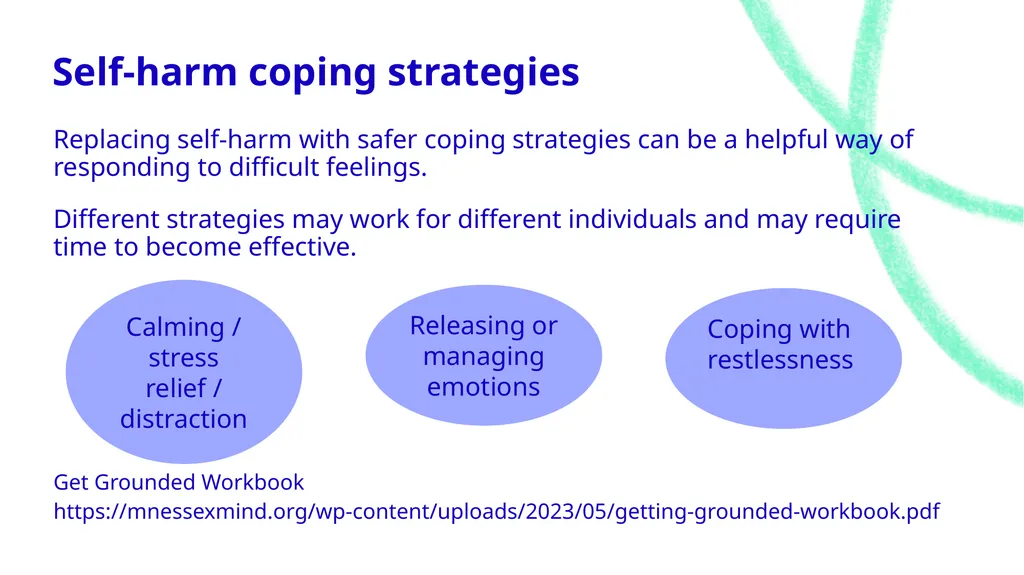
Self-harm coping strategies Replacing self-harm with safer coping strategies can be a helpful way of responding to difficult feelings.
Different strategies may work for different individuals and may require time to become effective.
Get Grounded Workbook
https://mnessexmind.org/wp-content/uploads/2023/05/getting-grounded-workbook.pdf Calming / stress relief / distraction Releasing or managing emotions Coping with restlessness<br>
Different strategies may work for different individuals and may require time to become effective.
Get Grounded Workbook
https://mnessexmind.org/wp-content/uploads/2023/05/getting-grounded-workbook.pdf Calming / stress relief / distraction Releasing or managing emotions Coping with restlessness<br>
26
Useful resources / signposting SET CAMHS have a professional consultation line, Monday-Thursday 10am-12: 0300 300 1996. This number is for professionals only and should not be shared with parents or young people.
You can also contact SET CAMHS via their Single Point of Access number during normal working hours: 0800 953 0222
If a child is already open to SET CAMHS please contact them to update around any change in risk: 0800 953 0222 and choose your locality option
For out of hours and weekend Crisis Support Service, call NELFT Mental Health Direct on 0800 995 1000<br>
You can also contact SET CAMHS via their Single Point of Access number during normal working hours: 0800 953 0222
If a child is already open to SET CAMHS please contact them to update around any change in risk: 0800 953 0222 and choose your locality option
For out of hours and weekend Crisis Support Service, call NELFT Mental Health Direct on 0800 995 1000<br>
27
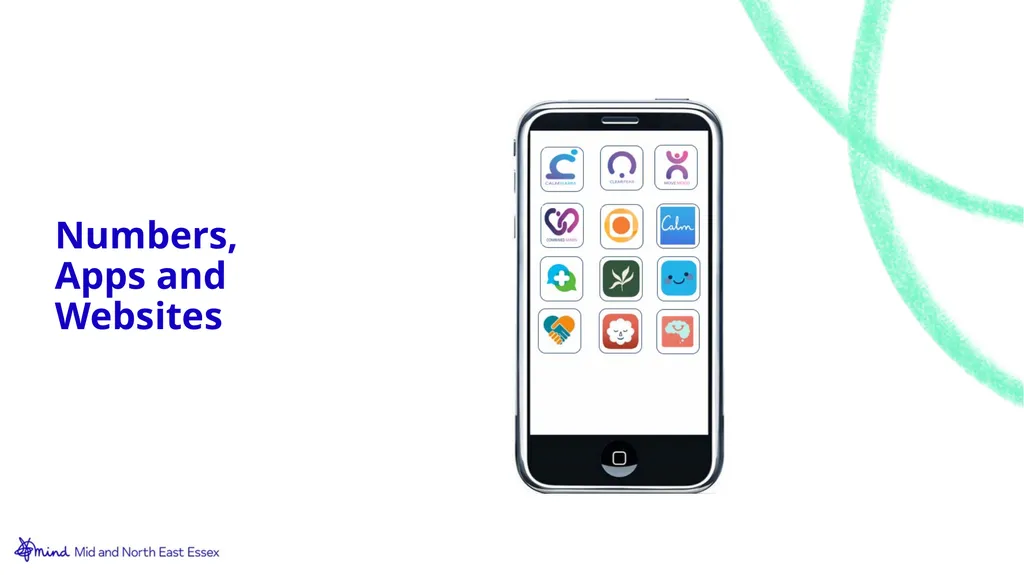
Numbers,
Apps and
Websites<br>
28
Numbers Samaritans: 116 123
Childline: 0800 1111
SET CAMHS: 0800 953 0222
Papyrus: 0800 068 4141 (or text 07860039967)
NHS: 111 (Press 2 for Mental Health Crisis)
Text SHOUT to 85258<br>
Childline: 0800 1111
SET CAMHS: 0800 953 0222
Papyrus: 0800 068 4141 (or text 07860039967)
NHS: 111 (Press 2 for Mental Health Crisis)
Text SHOUT to 85258<br>
29
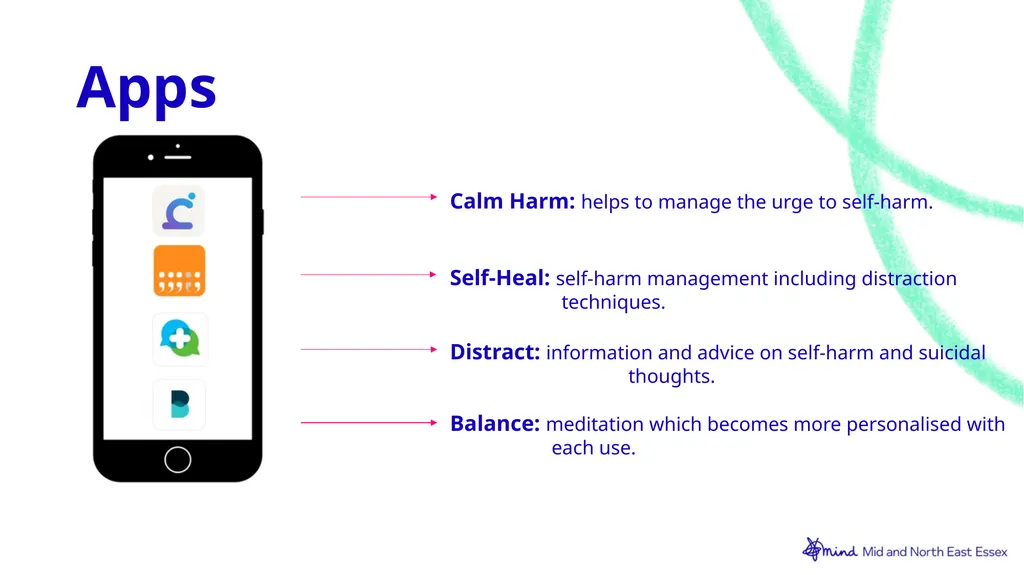
Apps Calm Harm: helps to manage the urge to self-harm.
Self-Heal: self-harm management including distraction techniques.
Distract: information and advice on self-harm and suicidal thoughts.
Balance: meditation which becomes more personalised with each use. Apps<br>
Self-Heal: self-harm management including distraction techniques.
Distract: information and advice on self-harm and suicidal thoughts.
Balance: meditation which becomes more personalised with each use. Apps<br>
30
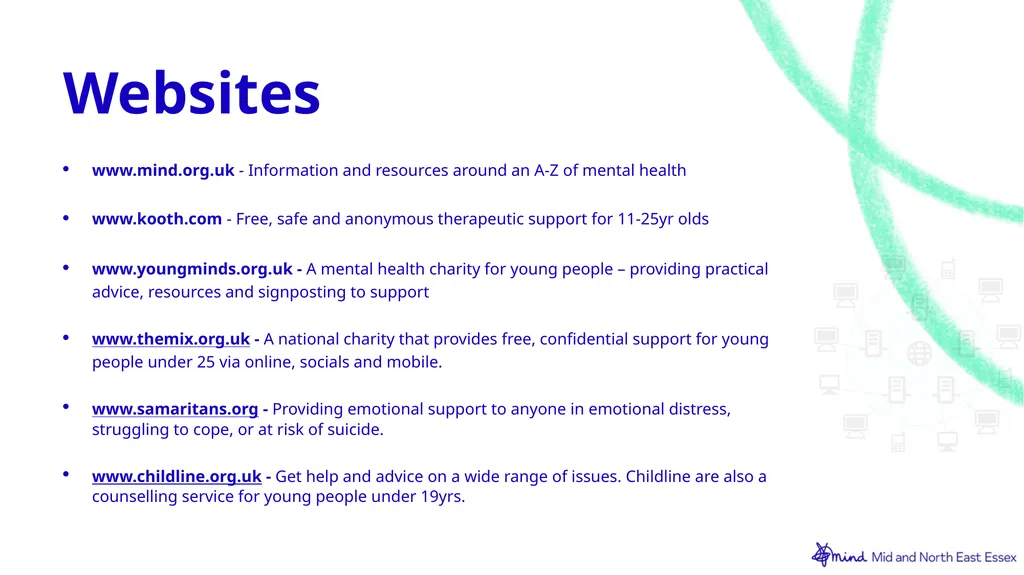
Websites www.mind.org.uk - Information and resources around an A-Z of mental health
www.kooth.com - Free, safe and anonymous therapeutic support for 11-25yr olds
www.youngminds.org.uk - A mental health charity for young people – providing practical advice, resources and signposting to support
www.themix.org.uk - A national charity that provides free, confidential support for young people under 25 via online, socials and mobile.
www.samaritans.org - Providing emotional support to anyone in emotional distress, struggling to cope, or at risk of suicide.
www.childline.org.uk - Get help and advice on a wide range of issues. Childline are also a counselling service for young people under 19yrs.<br>
www.kooth.com - Free, safe and anonymous therapeutic support for 11-25yr olds
www.youngminds.org.uk - A mental health charity for young people – providing practical advice, resources and signposting to support
www.themix.org.uk - A national charity that provides free, confidential support for young people under 25 via online, socials and mobile.
www.samaritans.org - Providing emotional support to anyone in emotional distress, struggling to cope, or at risk of suicide.
www.childline.org.uk - Get help and advice on a wide range of issues. Childline are also a counselling service for young people under 19yrs.<br>
31
Appendices Self-harm incident recording form
Leaflet for parents
Leaflet for young people
Letter template
Risk Management Plan<br>
Leaflet for parents
Leaflet for young people
Letter template
Risk Management Plan<br>
32
Self-harm can be distressing for school staff. You may experience emotions such as sadness, shock, anger, fear, disgust, frustration and helplessness. Impact of self harm on school staff Be honest with yourself about your emotions
Discuss your feelings with colleagues or supervisors/ managers
Prioritise your own health and wellbeing
Recognise that you can offer tools and support but you cannot be responsible for the actions of others
Remember that recovery from self-harm is not linear
You are not alone in supporting the young person – there is a range of support available to them<br>
Discuss your feelings with colleagues or supervisors/ managers
Prioritise your own health and wellbeing
Recognise that you can offer tools and support but you cannot be responsible for the actions of others
Remember that recovery from self-harm is not linear
You are not alone in supporting the young person – there is a range of support available to them<br>
33
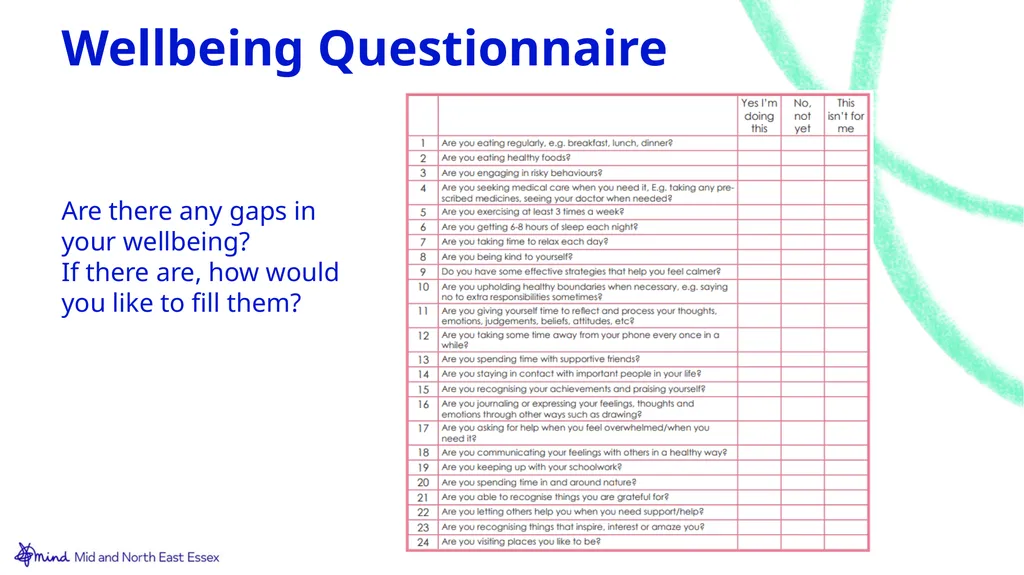
Wellbeing Questionnaire Are there any gaps in your wellbeing?
If there are, how would you like to fill them?<br>
If there are, how would you like to fill them?<br>
34
Support for staff Staff counselling service for all eligible Essex schools https://schools.essex.gov.uk/staff/Pages/default.aspx
Phone number: 03330 135859
Education Support Helpline 08000 562 561 https://www.educationsupport.org.uk/
GP - For additional support or referral to counselling/
mental health services, please contact your GP<br>
Phone number: 03330 135859
Education Support Helpline 08000 562 561 https://www.educationsupport.org.uk/
GP - For additional support or referral to counselling/
mental health services, please contact your GP<br>
35
Rate yourself How confident do you feel to support a student who is self-harming?
1………………..2………………..3………………..4……………….5
Not confident Somewhat confident Very confident<br>
1………………..2………………..3………………..4……………….5
Not confident Somewhat confident Very confident<br>
36
https://www.mind.org.uk/information-support/helping-someone-else/supporting-someone-who-feels-suicidal/how-to-help/<br>
37
Thank you for listening!
Take a break!<br>
38
Welcome back!
Discussion and feedback<br>
39
Toolkit practice Read the vignette on your table and, working as a group, use the toolkit and appendices to answer the following:
What would you do immediately?
What would you do next?
Use the feedback sheet to note anything that you would change or is missing from the toolkit.
(20 mins)<br>
What would you do immediately?
What would you do next?
Use the feedback sheet to note anything that you would change or is missing from the toolkit.
(20 mins)<br>
40
Sharing the toolkit As a group discuss:
How will you cascade this training within your setting?
How will you keep self-harm on the agenda?
What potential barriers might you face?
How might you resolve these?
Create your own, individual action plan to take away.
(20mins)<br>
How will you cascade this training within your setting?
How will you keep self-harm on the agenda?
What potential barriers might you face?
How might you resolve these?
Create your own, individual action plan to take away.
(20mins)<br>
41
Q and A<br>
42
Thank you!
Any further feedback or questions please contact us at:
Mid and North East Essex Mind
enquiries@mnessexmind.org
01206 764600<br>