
Let the Babies Eat: Instilling Confidence

Description: Let the Babies Eat: Instilling Confidence Surrounding Early Introduction of Allergenic Foods Mimi Tang, PhD Faculty Presenter Director of Allergy Translation, Murdoch Childrens Research Institute Allergy Immunology, The Royal Childrens
Related Topics
Download Presentation
"Let the Babies Eat: Instilling Confidence" is the property of its rightful owner. Permission is granted to download and print the materials on this website for personal, non-commercial use only, and to display it on your personal computer provided you do not modify the materials and that you retain all copyright notices contained in the materials. By downloading content from our website, you accept the terms of this agreement.
Presentation Transcript
slide1. Let the Babies Eat: Instilling Confidence Surrounding Early Introduction of Allergenic Foods Mimi Tang, PhD<br>
slide2. Faculty Presenter Director of Allergy Translation, Murdoch Children’s Research Institute
Allergy Immunology, The Royal Children’s Hospital Melbourne
Department of Paediatrics, The University of Melbourne Professor Mimi Tang<br>
slide3. Faculty Disclosures<br>
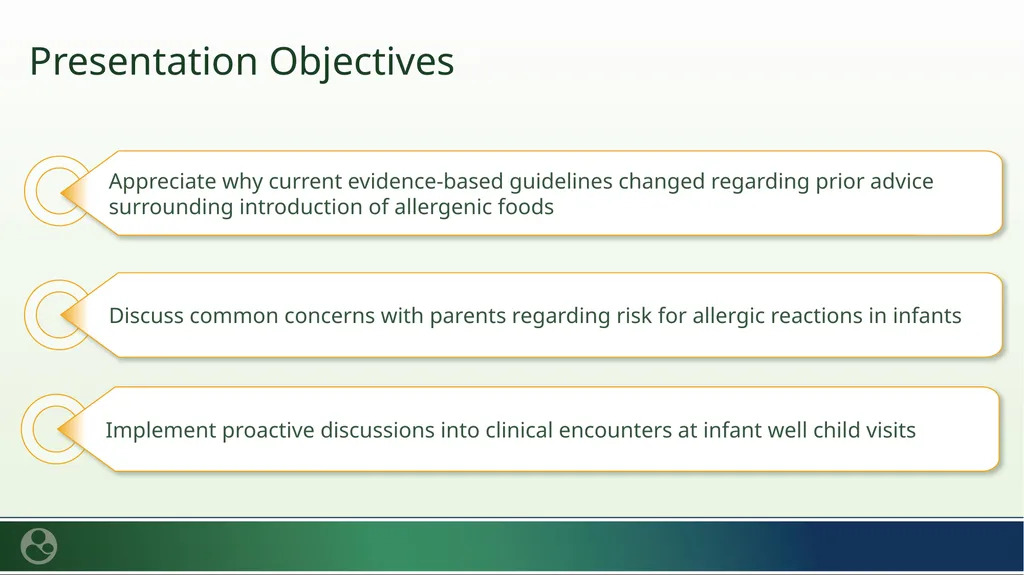
slide4. Presentation Objectives Appreciate why current evidence-based guidelines changed regarding prior advice surrounding introduction of allergenic foods Discuss common concerns with parents regarding risk for allergic reactions in infants Implement proactive discussions into clinical encounters at infant well child visits<br>
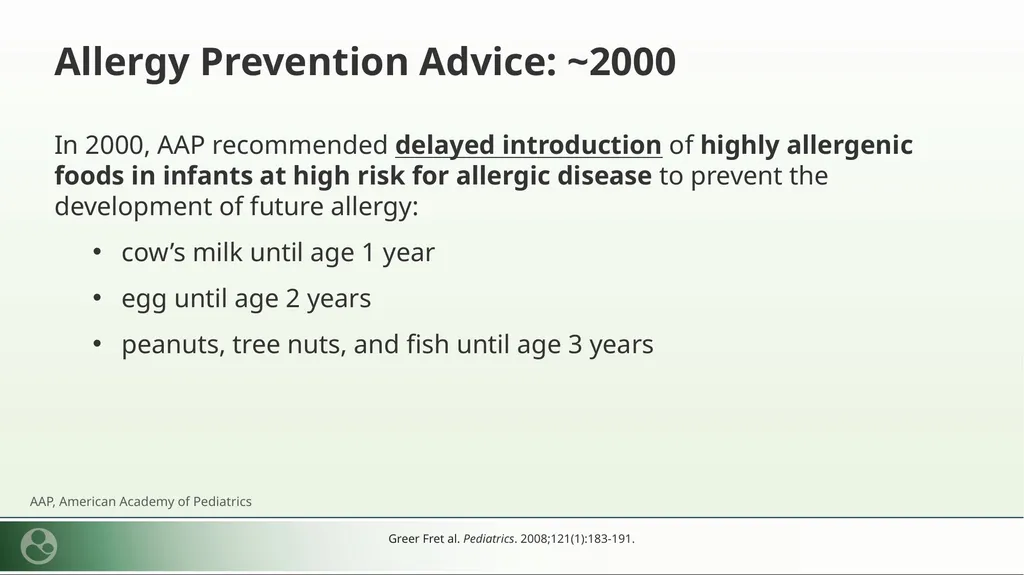
slide5. Allergy Prevention Advice: ~2000 In 2000, AAP recommended delayed introduction of highly allergenic foods in infants at high risk for allergic disease to prevent the development of future allergy:
cow’s milk until age 1 year
egg until age 2 years
peanuts, tree nuts, and fish until age 3 years Greer Fret al. Pediatrics. 2008;121(1):183-191. AAP, American Academy of Pediatrics<br>
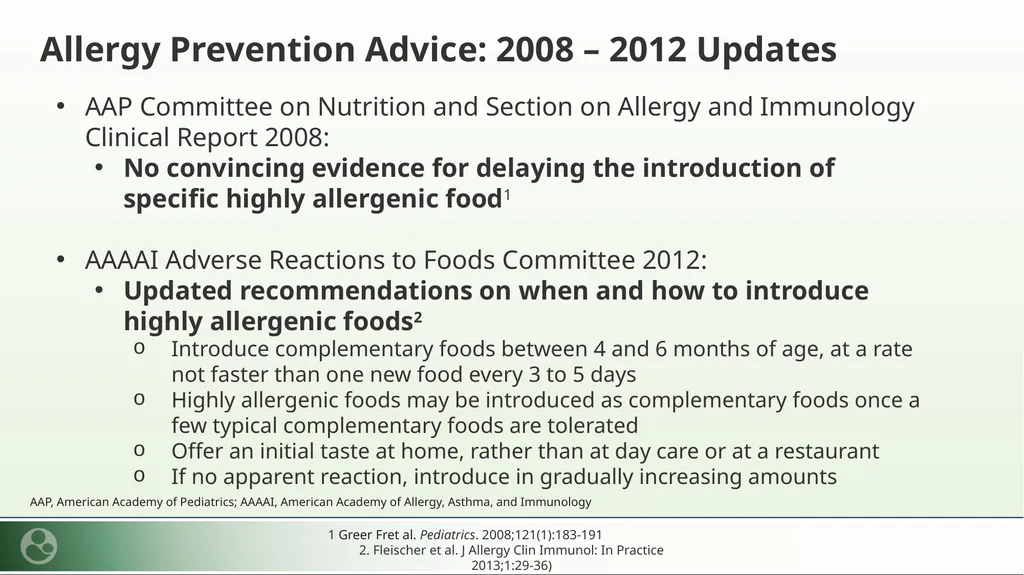
slide6. Allergy Prevention Advice: 2008 – 2012 Updates AAP Committee on Nutrition and Section on Allergy and Immunology Clinical Report 2008:
No convincing evidence for delaying the introduction of specific highly allergenic food1
AAAAI Adverse Reactions to Foods Committee 2012:
Updated recommendations on when and how to introduce highly allergenic foods2
Introduce complementary foods between 4 and 6 months of age, at a rate not faster than one new food every 3 to 5 days
Highly allergenic foods may be introduced as complementary foods once a few typical complementary foods are tolerated
Offer an initial taste at home, rather than at day care or at a restaurant
If no apparent reaction, introduce in gradually increasing amounts 1 Greer Fret al. Pediatrics. 2008;121(1):183-191
2. Fleischer et al. J Allergy Clin Immunol: In Practice 2013;1:29-36) AAP, American Academy of Pediatrics; AAAAI, American Academy of Allergy, Asthma, and Immunology<br>
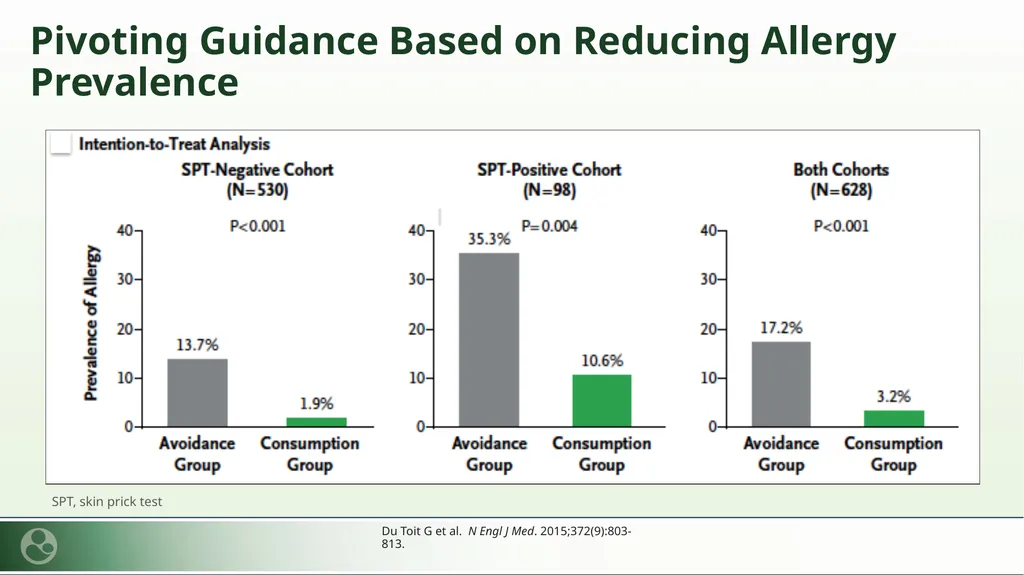
slide7. Pivoting Guidance Based on Reducing Allergy Prevalence Du Toit G et al. N Engl J Med. 2015;372(9):803-813. SPT, skin prick test<br>
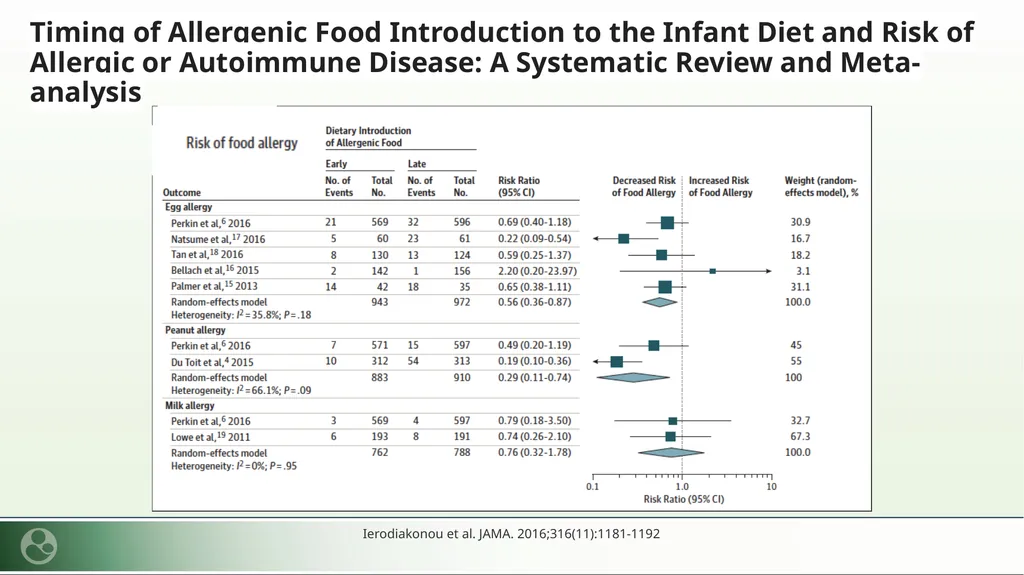
slide8. Ierodiakonou et al. JAMA. 2016;316(11):1181-1192 Timing of Allergenic Food Introduction to the Infant Diet and Risk of Allergic or Autoimmune Disease: A Systematic Review and Meta-analysis<br>
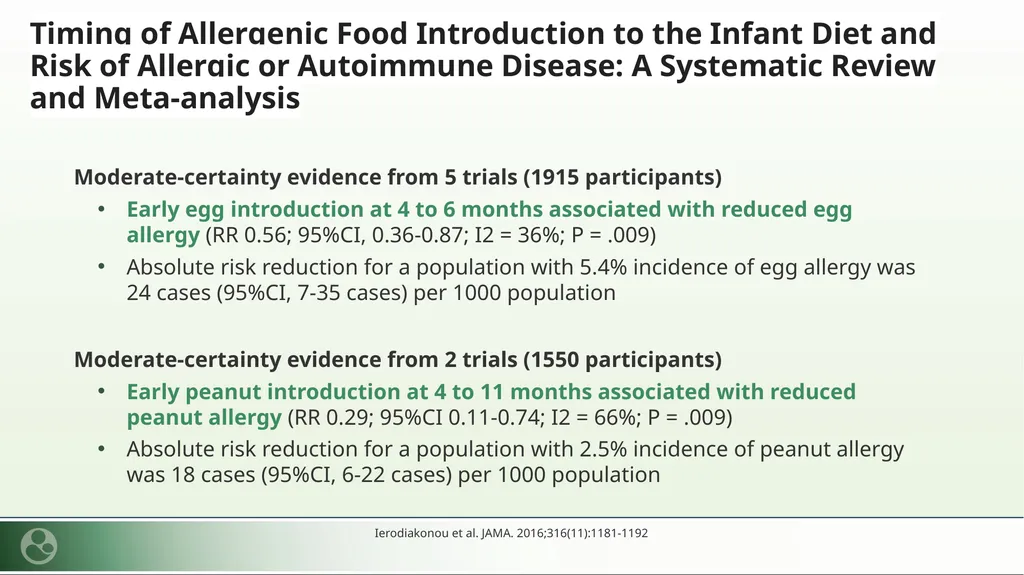
slide9. Ierodiakonou et al. JAMA. 2016;316(11):1181-1192 Moderate-certainty evidence from 5 trials (1915 participants)
Early egg introduction at 4 to 6 months associated with reduced egg allergy (RR 0.56; 95%CI, 0.36-0.87; I2 = 36%; P = .009)
Absolute risk reduction for a population with 5.4% incidence of egg allergy was 24 cases (95%CI, 7-35 cases) per 1000 population
Moderate-certainty evidence from 2 trials (1550 participants)
Early peanut introduction at 4 to 11 months associated with reduced peanut allergy (RR 0.29; 95%CI 0.11-0.74; I2 = 66%; P = .009)
Absolute risk reduction for a population with 2.5% incidence of peanut allergy was 18 cases (95%CI, 6-22 cases) per 1000 population Timing of Allergenic Food Introduction to the Infant Diet and Risk of Allergic or Autoimmune Disease: A Systematic Review and Meta-analysis<br>
slide10. Current US Recommendations for Allergen Introduction Fleischer DM et al. Allergy, Asthma & Clinical Immunology (2015) 11:23
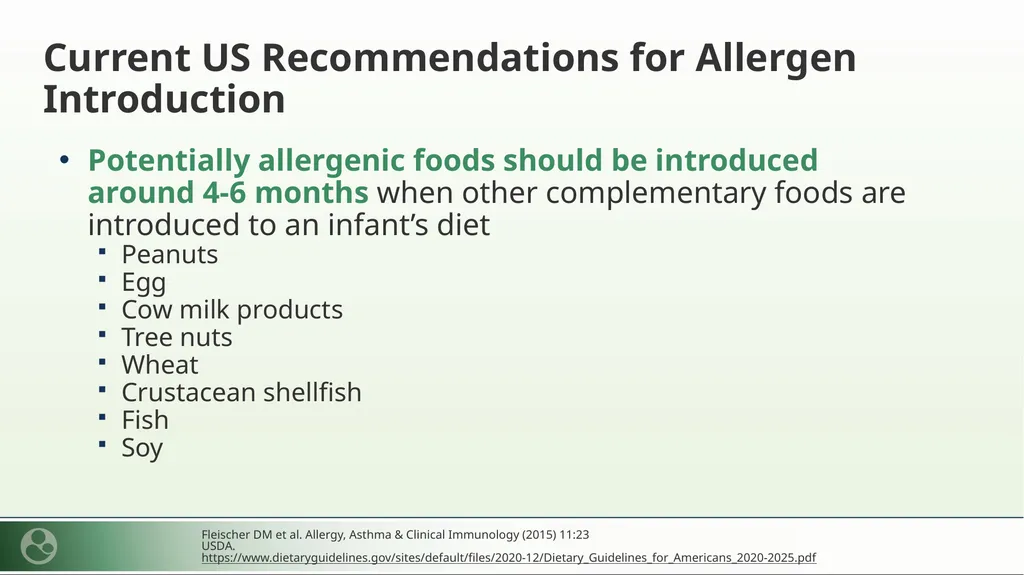
USDA. https://www.dietaryguidelines.gov/sites/default/files/2020-12/Dietary_Guidelines_for_Americans_2020-2025.pdf Potentially allergenic foods should be introduced around 4-6 months when other complementary foods are introduced to an infant’s diet
Peanuts
Egg
Cow milk products
Tree nuts
Wheat
Crustacean shellfish
Fish
Soy<br>
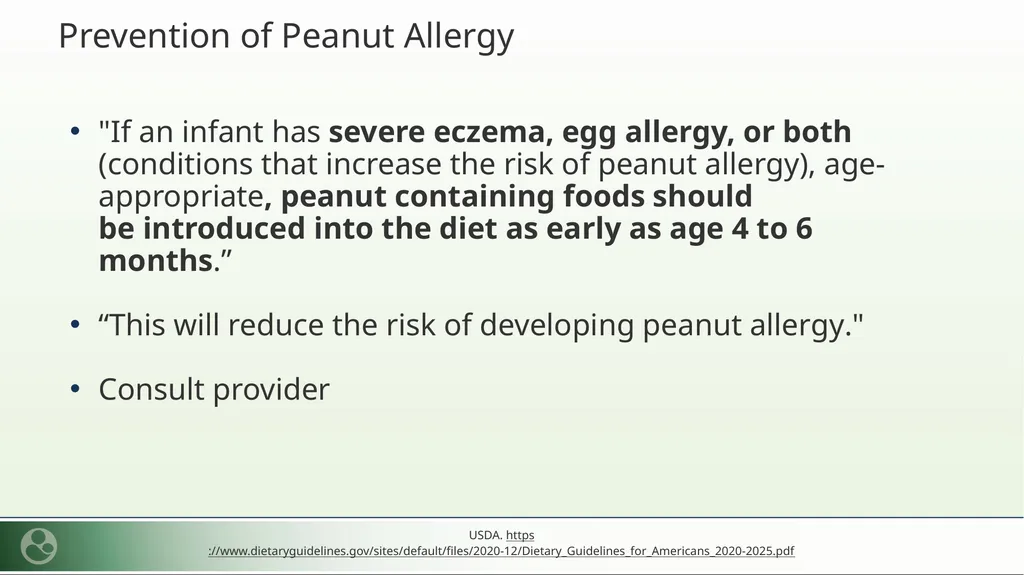
slide11. Prevention of Peanut Allergy USDA. https://www.dietaryguidelines.gov/sites/default/files/2020-12/Dietary_Guidelines_for_Americans_2020-2025.pdf "If an infant has severe eczema, egg allergy, or both (conditions that increase the risk of peanut allergy), age-appropriate, peanut containing foods should be introduced into the diet as early as age 4 to 6 months.”
“This will reduce the risk of developing peanut allergy."
Consult provider<br>
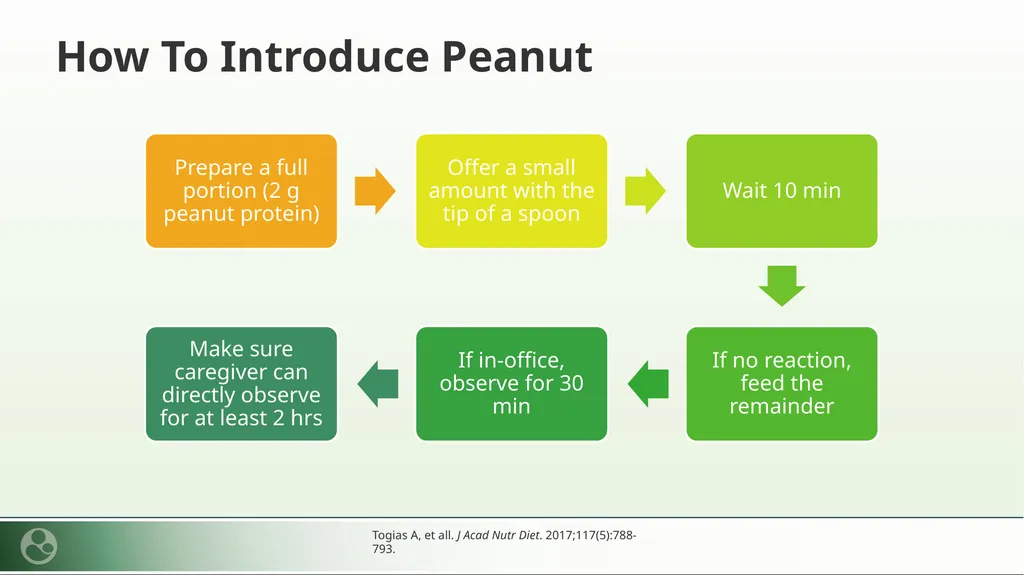
slide12. How To Introduce Peanut Togias A, et all. J Acad Nutr Diet. 2017;117(5):788-793.<br>
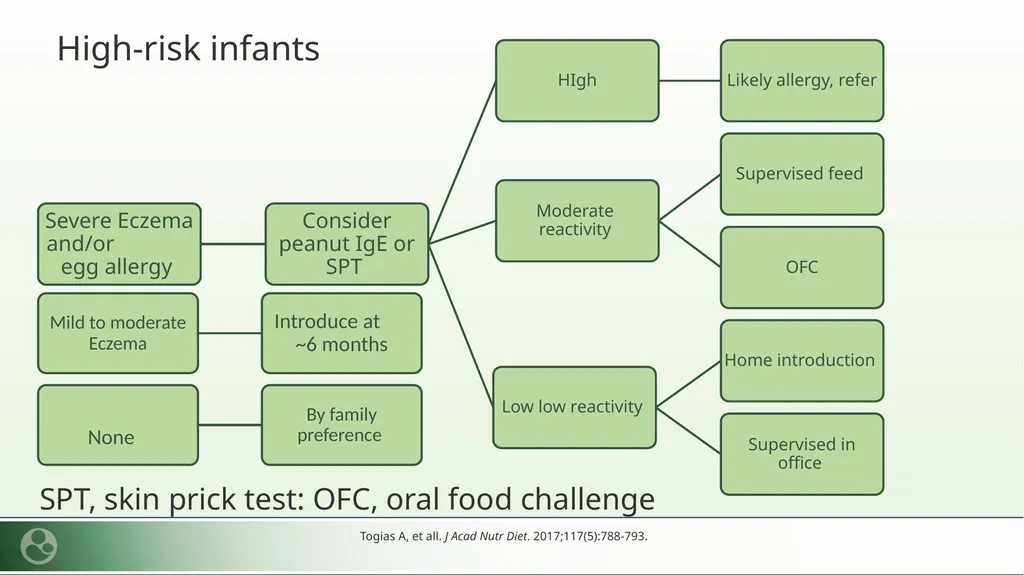
slide13. High-risk infants Togias A, et all. J Acad Nutr Diet. 2017;117(5):788-793. SPT, skin prick test: OFC, oral food challenge<br>
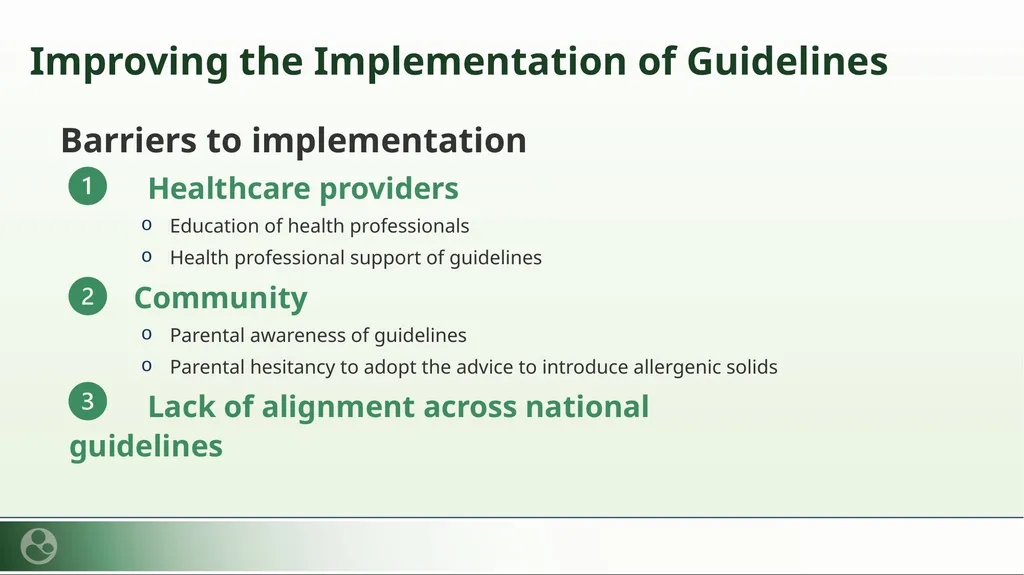
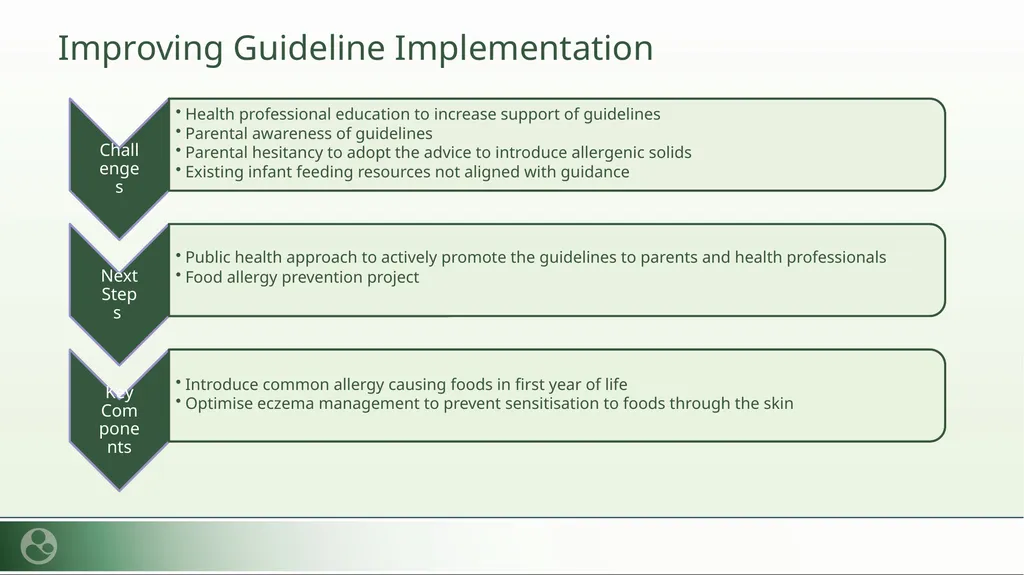
slide14. Improving the Implementation of Guidelines Barriers to implementation
Healthcare providers
Education of health professionals
Health professional support of guidelines
Community
Parental awareness of guidelines
Parental hesitancy to adopt the advice to introduce allergenic solids
Lack of alignment across national guidelines<br>
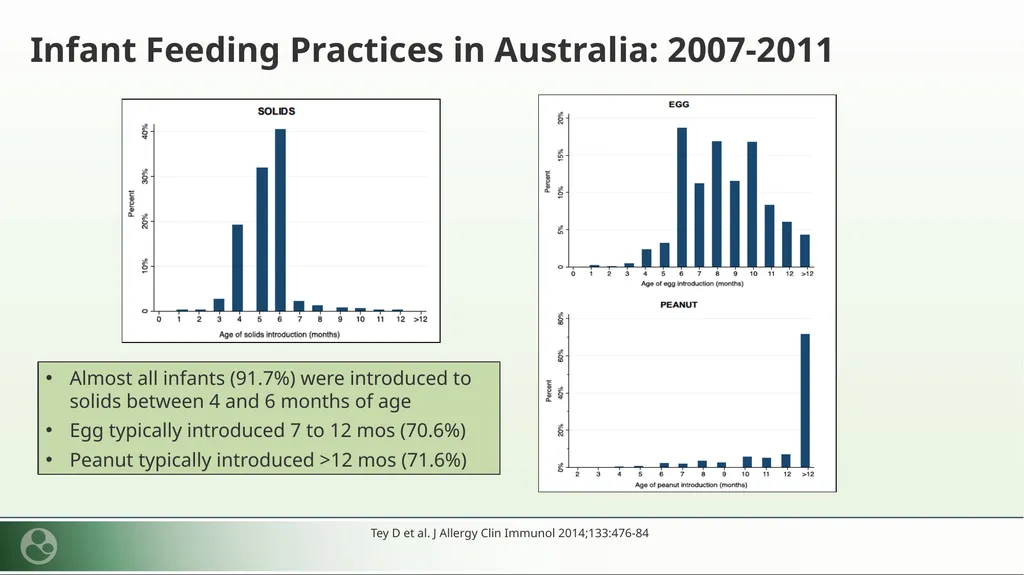
slide15. Infant Feeding Practices in Australia: 2007-2011 Almost all infants (91.7%) were introduced to solids between 4 and 6 months of age
Egg typically introduced 7 to 12 mos (70.6%)
Peanut typically introduced >12 mos (71.6%) Tey D et al. J Allergy Clin Immunol 2014;133:476-84<br>
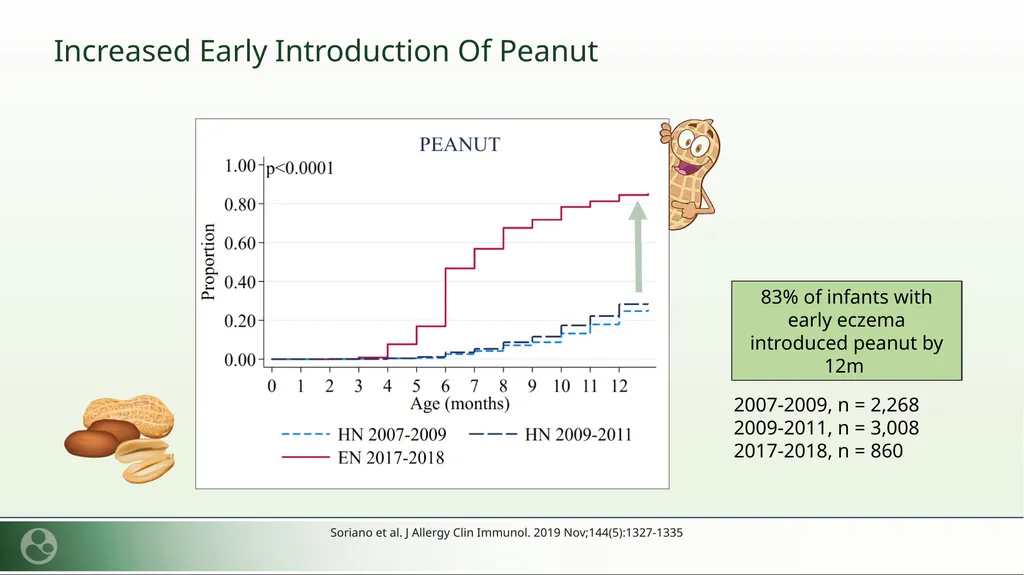
slide16. Increased Early Introduction Of Peanut 2007-2009, n = 2,268
2009-2011, n = 3,008
2017-2018, n = 860 83% of infants with early eczema introduced peanut by 12m Soriano et al. J Allergy Clin Immunol. 2019 Nov;144(5):1327-1335<br>
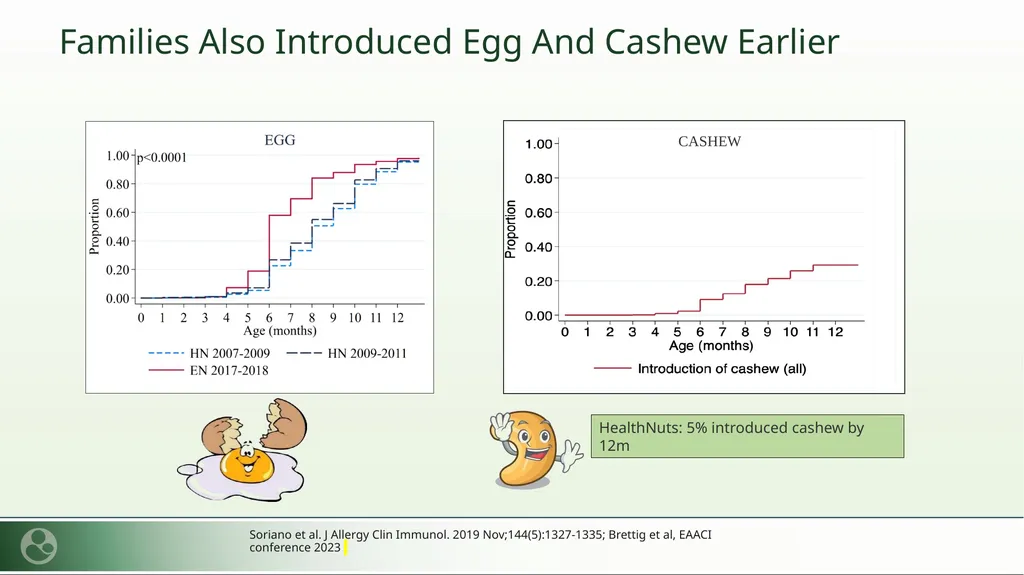
slide17. Families Also Introduced Egg And Cashew Earlier Soriano et al. J Allergy Clin Immunol. 2019 Nov;144(5):1327-1335; Brettig et al, EAACI conference 2023 HealthNuts: 5% introduced cashew by 12m CASHEW<br>
slide18. Improving Guideline Implementation<br>
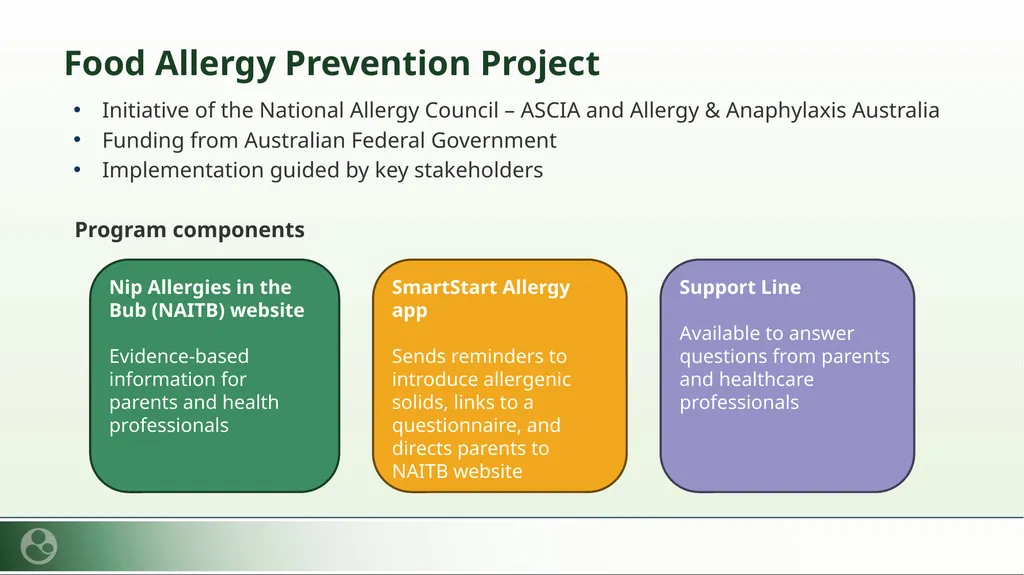
slide19. Food Allergy Prevention Project Initiative of the National Allergy Council – ASCIA and Allergy & Anaphylaxis Australia
Funding from Australian Federal Government
Implementation guided by key stakeholders
Program components Nip Allergies in the Bub (NAITB) website
Evidence-based information for parents and health professionals SmartStart Allergy app
Sends reminders to introduce allergenic solids, links to a questionnaire, and directs parents to NAITB website Support Line
Available to answer questions from parents and healthcare professionals<br>
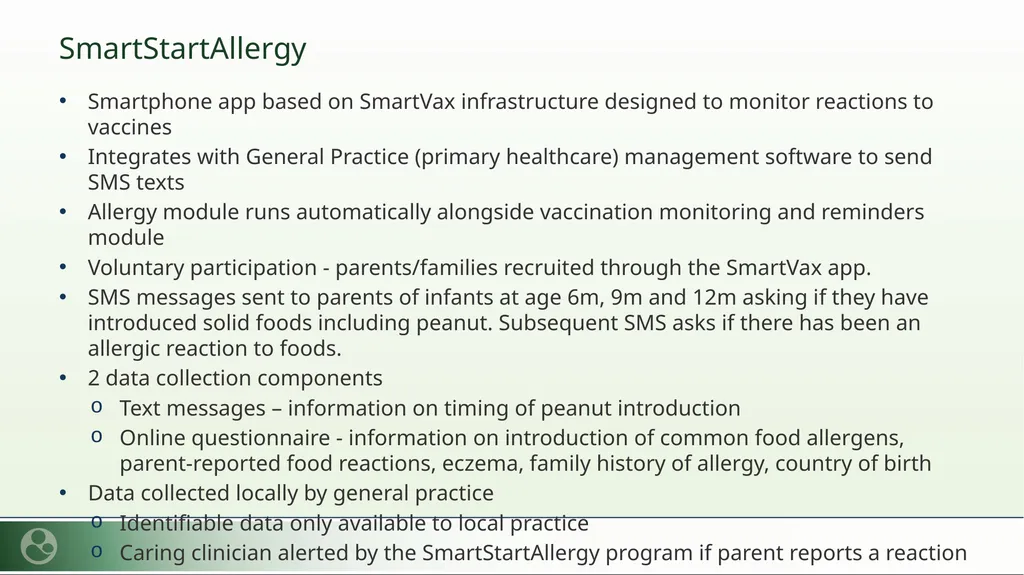
slide20. SmartStartAllergy Smartphone app based on SmartVax infrastructure designed to monitor reactions to vaccines
Integrates with General Practice (primary healthcare) management software to send SMS texts
Allergy module runs automatically alongside vaccination monitoring and reminders module
Voluntary participation - parents/families recruited through the SmartVax app.
SMS messages sent to parents of infants at age 6m, 9m and 12m asking if they have introduced solid foods including peanut. Subsequent SMS asks if there has been an allergic reaction to foods.
2 data collection components
Text messages – information on timing of peanut introduction
Online questionnaire - information on introduction of common food allergens, parent-reported food reactions, eczema, family history of allergy, country of birth
Data collected locally by general practice
Identifiable data only available to local practice
Caring clinician alerted by the SmartStartAllergy program if parent reports a reaction<br>
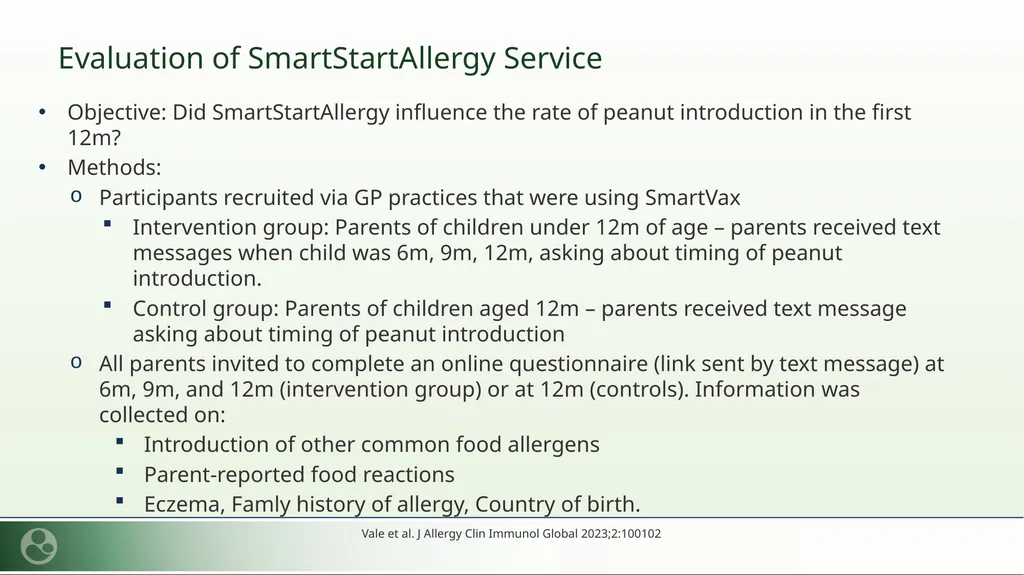
slide21. Evaluation of SmartStartAllergy Service Objective: Did SmartStartAllergy influence the rate of peanut introduction in the first 12m?
Methods:
Participants recruited via GP practices that were using SmartVax
Intervention group: Parents of children under 12m of age – parents received text messages when child was 6m, 9m, 12m, asking about timing of peanut introduction.
Control group: Parents of children aged 12m – parents received text message asking about timing of peanut introduction
All parents invited to complete an online questionnaire (link sent by text message) at 6m, 9m, and 12m (intervention group) or at 12m (controls). Information was collected on:
Introduction of other common food allergens
Parent-reported food reactions
Eczema, Famly history of allergy, Country of birth. Vale et al. J Allergy Clin Immunol Global 2023;2:100102<br>
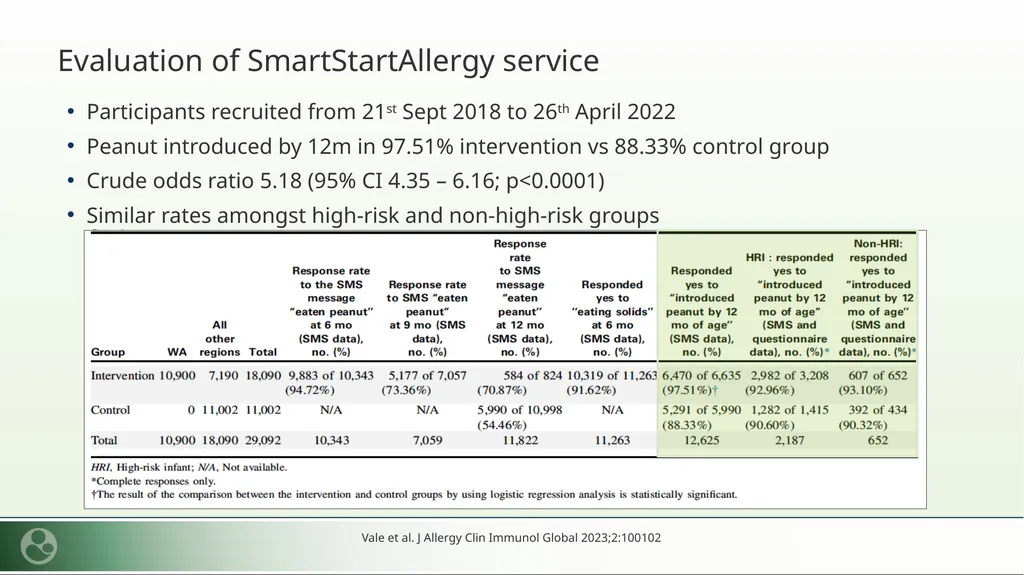
slide22. Evaluation of SmartStartAllergy service Participants recruited from 21st Sept 2018 to 26th April 2022
Peanut introduced by 12m in 97.51% intervention vs 88.33% control group
Crude odds ratio 5.18 (95% CI 4.35 – 6.16; p<0.0001)
Similar rates amongst high-risk and non-high-risk groups Vale et al. J Allergy Clin Immunol Global 2023;2:100102<br>
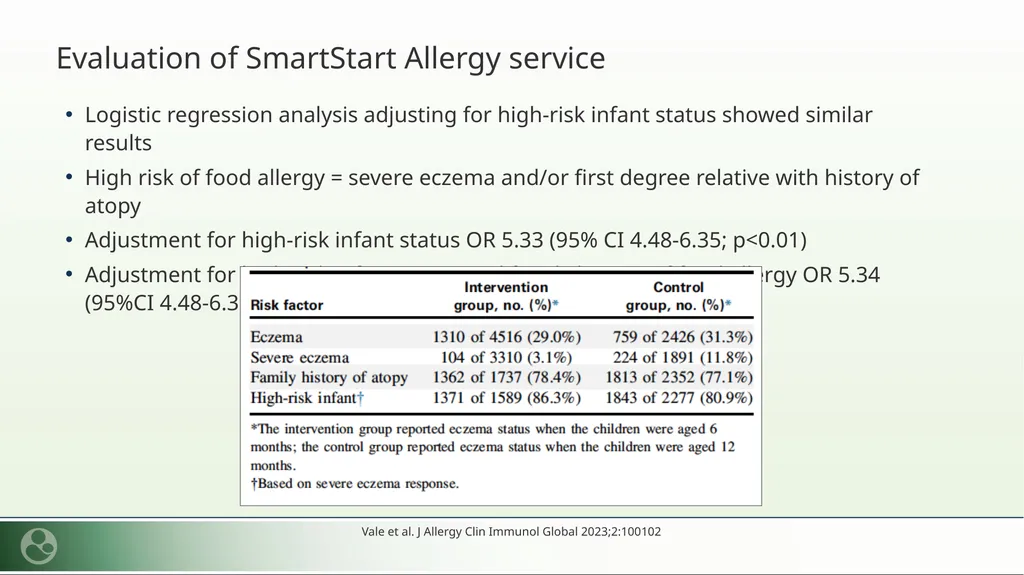
slide23. Evaluation of SmartStart Allergy service Logistic regression analysis adjusting for high-risk infant status showed similar results
High risk of food allergy = severe eczema and/or first degree relative with history of atopy
Adjustment for high-risk infant status OR 5.33 (95% CI 4.48-6.35; p<0.01)
Adjustment for high-risk infant status and family history of food allergy OR 5.34 (95%CI 4.48-6.37; p<0.01) Vale et al. J Allergy Clin Immunol Global 2023;2:100102<br>
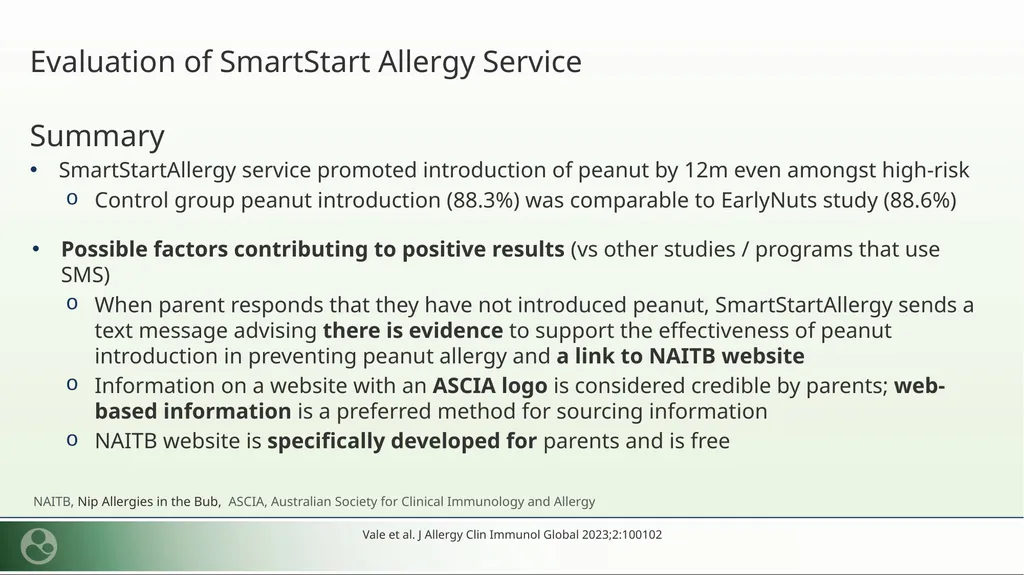
slide24. Evaluation of SmartStart Allergy Service Summary
SmartStartAllergy service promoted introduction of peanut by 12m even amongst high-risk
Control group peanut introduction (88.3%) was comparable to EarlyNuts study (88.6%)
Possible factors contributing to positive results (vs other studies / programs that use SMS)
When parent responds that they have not introduced peanut, SmartStartAllergy sends a text message advising there is evidence to support the effectiveness of peanut introduction in preventing peanut allergy and a link to NAITB website
Information on a website with an ASCIA logo is considered credible by parents; web-based information is a preferred method for sourcing information
NAITB website is specifically developed for parents and is free NAITB, Nip Allergies in the Bub, ASCIA, Australian Society for Clinical Immunology and Allergy Vale et al. J Allergy Clin Immunol Global 2023;2:100102<br>
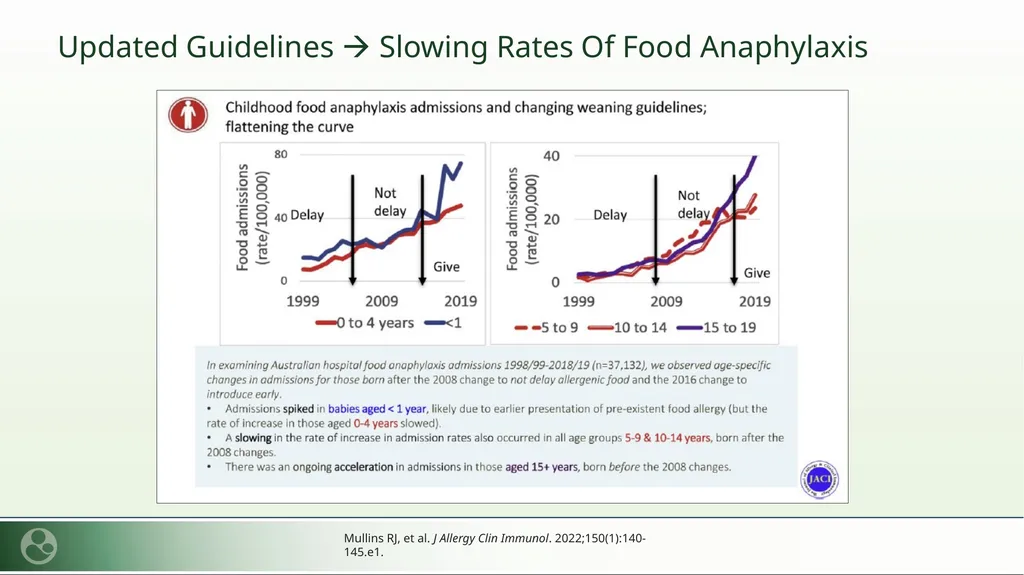
slide25. Updated Guidelines Slowing Rates Of Food Anaphylaxis Mullins RJ, et al. J Allergy Clin Immunol. 2022;150(1):140-145.e1.<br>
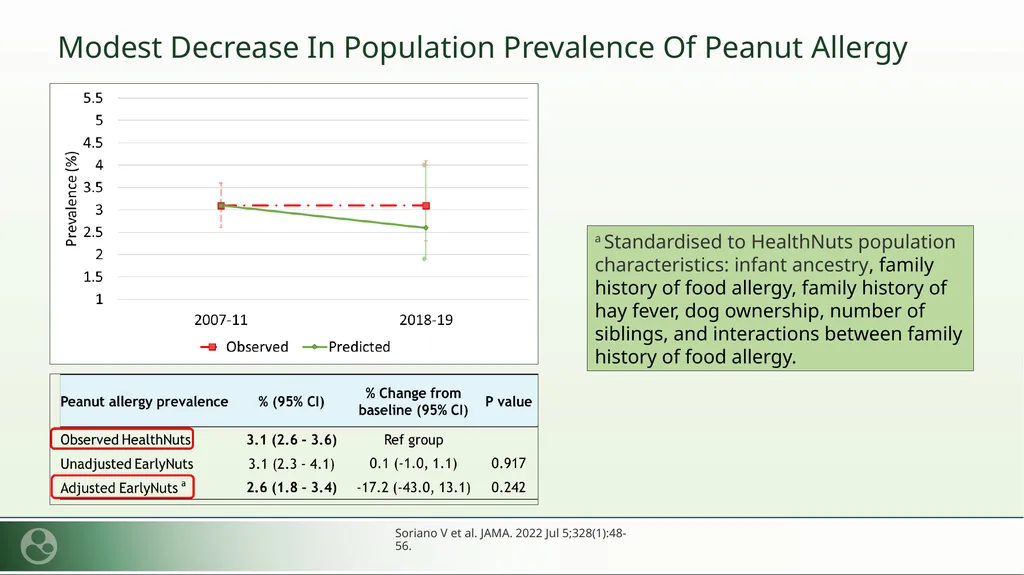
slide26. Modest Decrease In Population Prevalence Of Peanut Allergy Soriano V et al. JAMA. 2022 Jul 5;328(1):48-56. a Standardised to HealthNuts population characteristics: infant ancestry, family history of food allergy, family history of hay fever, dog ownership, number of siblings, and interactions between family history of food allergy.<br>
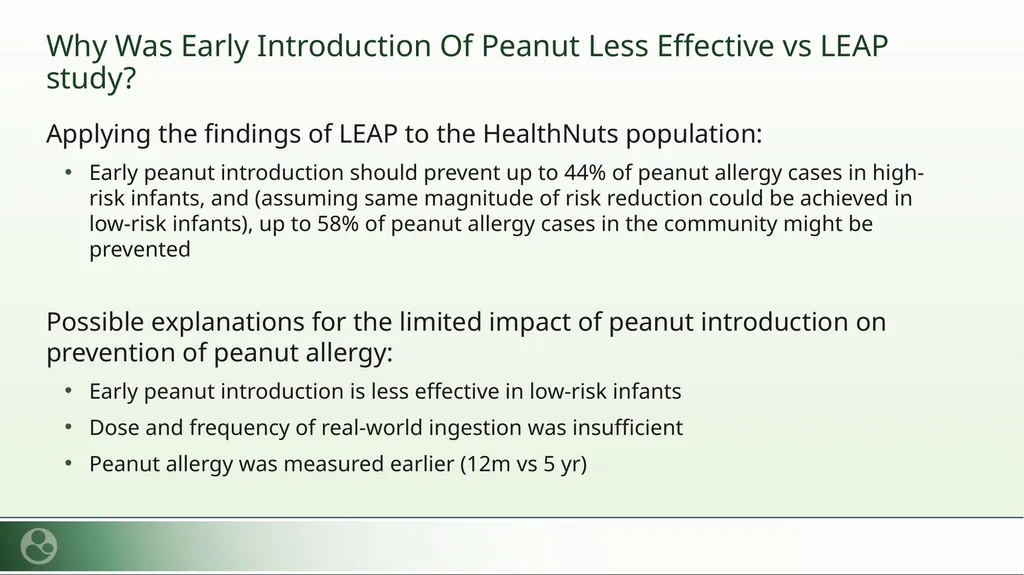
slide27. Why Was Early Introduction Of Peanut Less Effective vs LEAP study? Applying the findings of LEAP to the HealthNuts population:
Early peanut introduction should prevent up to 44% of peanut allergy cases in high-risk infants, and (assuming same magnitude of risk reduction could be achieved in low-risk infants), up to 58% of peanut allergy cases in the community might be prevented
Possible explanations for the limited impact of peanut introduction on prevention of peanut allergy:
Early peanut introduction is less effective in low-risk infants
Dose and frequency of real-world ingestion was insufficient
Peanut allergy was measured earlier (12m vs 5 yr)<br>
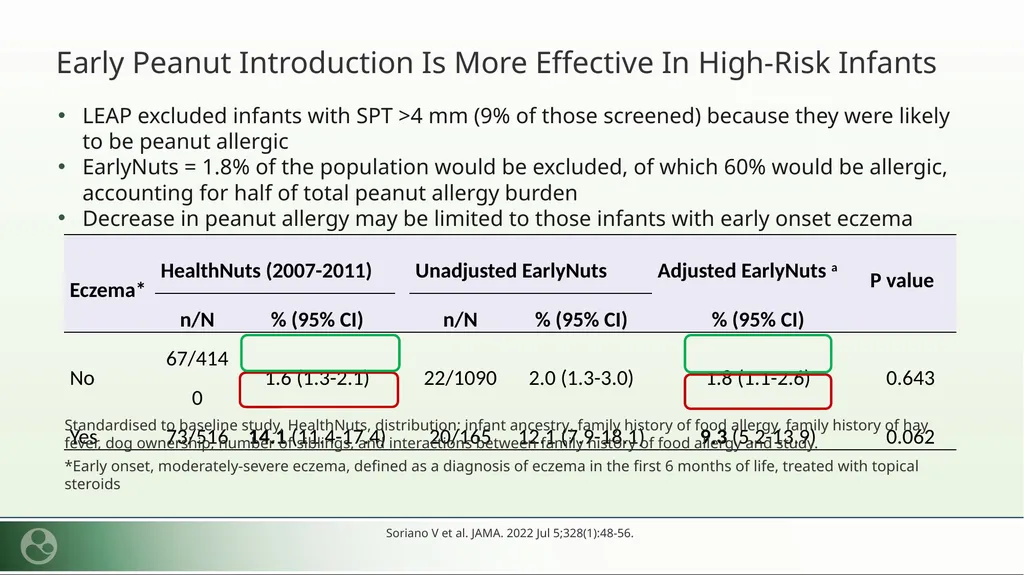
slide28. Early Peanut Introduction Is More Effective In High-Risk Infants Standardised to baseline study, HealthNuts, distribution: infant ancestry, family history of food allergy, family history of hay fever, dog ownership, number of siblings, and interactions between family history of food allergy and study. *Early onset, moderately-severe eczema, defined as a diagnosis of eczema in the first 6 months of life, treated with topical steroids LEAP excluded infants with SPT >4 mm (9% of those screened) because they were likely to be peanut allergic
EarlyNuts = 1.8% of the population would be excluded, of which 60% would be allergic, accounting for half of total peanut allergy burden
Decrease in peanut allergy may be limited to those infants with early onset eczema Soriano V et al. JAMA. 2022 Jul 5;328(1):48-56.<br>
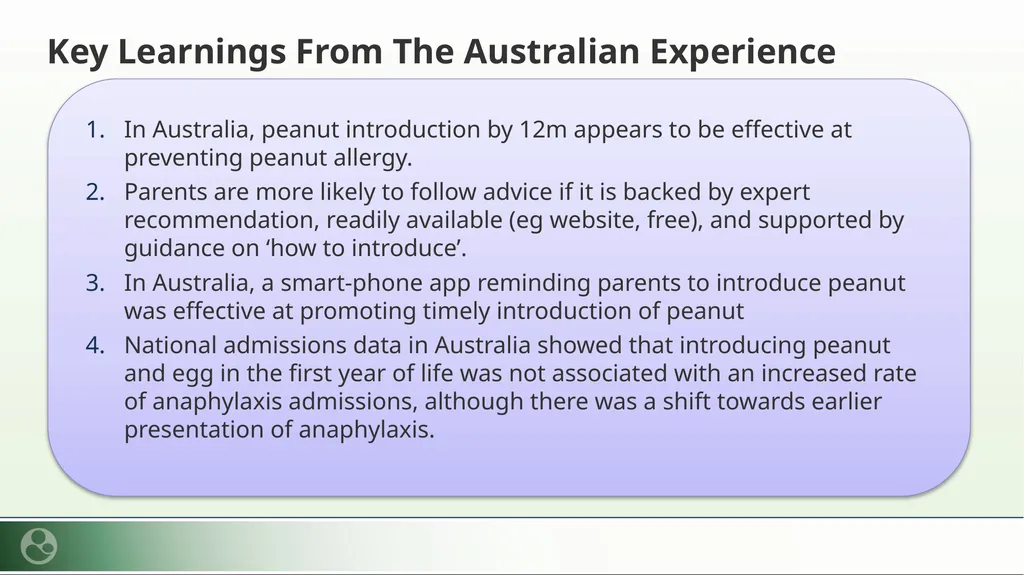
slide29. Key Learnings From The Australian Experience In Australia, peanut introduction by 12m appears to be effective at preventing peanut allergy.
Parents are more likely to follow advice if it is backed by expert recommendation, readily available (eg website, free), and supported by guidance on ‘how to introduce’.
In Australia, a smart-phone app reminding parents to introduce peanut was effective at promoting timely introduction of peanut
National admissions data in Australia showed that introducing peanut and egg in the first year of life was not associated with an increased rate of anaphylaxis admissions, although there was a shift towards earlier presentation of anaphylaxis.<br>
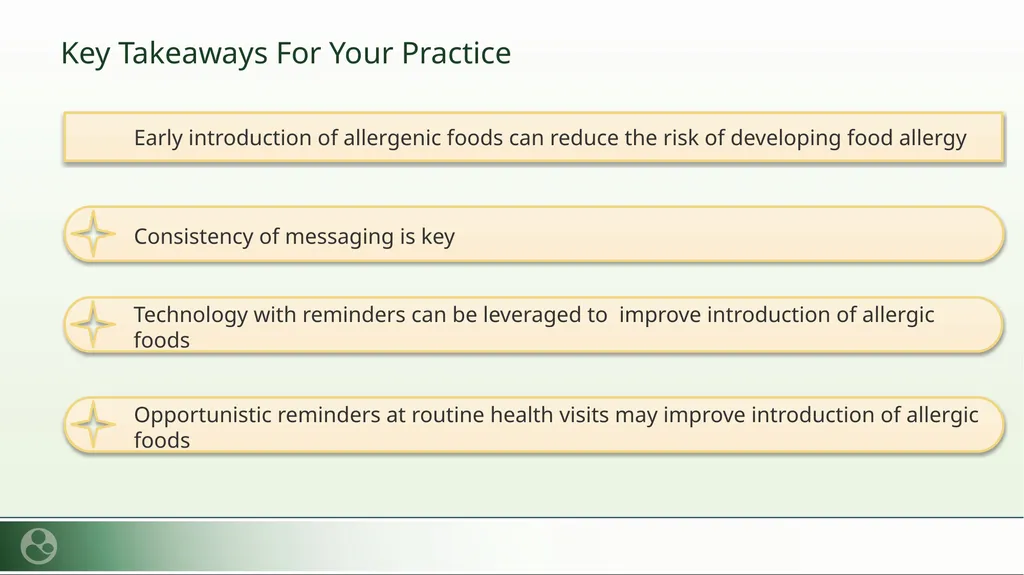
slide30. Key Takeaways For Your Practice Early introduction of allergenic foods can reduce the risk of developing food allergy Consistency of messaging is key Opportunistic reminders at routine health visits may improve introduction of allergic foods Technology with reminders can be leveraged to improve introduction of allergic foods<br>
slide2. Faculty Presenter Director of Allergy Translation, Murdoch Children’s Research Institute
Allergy Immunology, The Royal Children’s Hospital Melbourne
Department of Paediatrics, The University of Melbourne Professor Mimi Tang<br>
slide3. Faculty Disclosures<br>
slide4. Presentation Objectives Appreciate why current evidence-based guidelines changed regarding prior advice surrounding introduction of allergenic foods Discuss common concerns with parents regarding risk for allergic reactions in infants Implement proactive discussions into clinical encounters at infant well child visits<br>
slide5. Allergy Prevention Advice: ~2000 In 2000, AAP recommended delayed introduction of highly allergenic foods in infants at high risk for allergic disease to prevent the development of future allergy:
cow’s milk until age 1 year
egg until age 2 years
peanuts, tree nuts, and fish until age 3 years Greer Fret al. Pediatrics. 2008;121(1):183-191. AAP, American Academy of Pediatrics<br>
slide6. Allergy Prevention Advice: 2008 – 2012 Updates AAP Committee on Nutrition and Section on Allergy and Immunology Clinical Report 2008:
No convincing evidence for delaying the introduction of specific highly allergenic food1
AAAAI Adverse Reactions to Foods Committee 2012:
Updated recommendations on when and how to introduce highly allergenic foods2
Introduce complementary foods between 4 and 6 months of age, at a rate not faster than one new food every 3 to 5 days
Highly allergenic foods may be introduced as complementary foods once a few typical complementary foods are tolerated
Offer an initial taste at home, rather than at day care or at a restaurant
If no apparent reaction, introduce in gradually increasing amounts 1 Greer Fret al. Pediatrics. 2008;121(1):183-191
2. Fleischer et al. J Allergy Clin Immunol: In Practice 2013;1:29-36) AAP, American Academy of Pediatrics; AAAAI, American Academy of Allergy, Asthma, and Immunology<br>
slide7. Pivoting Guidance Based on Reducing Allergy Prevalence Du Toit G et al. N Engl J Med. 2015;372(9):803-813. SPT, skin prick test<br>
slide8. Ierodiakonou et al. JAMA. 2016;316(11):1181-1192 Timing of Allergenic Food Introduction to the Infant Diet and Risk of Allergic or Autoimmune Disease: A Systematic Review and Meta-analysis<br>
slide9. Ierodiakonou et al. JAMA. 2016;316(11):1181-1192 Moderate-certainty evidence from 5 trials (1915 participants)
Early egg introduction at 4 to 6 months associated with reduced egg allergy (RR 0.56; 95%CI, 0.36-0.87; I2 = 36%; P = .009)
Absolute risk reduction for a population with 5.4% incidence of egg allergy was 24 cases (95%CI, 7-35 cases) per 1000 population
Moderate-certainty evidence from 2 trials (1550 participants)
Early peanut introduction at 4 to 11 months associated with reduced peanut allergy (RR 0.29; 95%CI 0.11-0.74; I2 = 66%; P = .009)
Absolute risk reduction for a population with 2.5% incidence of peanut allergy was 18 cases (95%CI, 6-22 cases) per 1000 population Timing of Allergenic Food Introduction to the Infant Diet and Risk of Allergic or Autoimmune Disease: A Systematic Review and Meta-analysis<br>
slide10. Current US Recommendations for Allergen Introduction Fleischer DM et al. Allergy, Asthma & Clinical Immunology (2015) 11:23
USDA. https://www.dietaryguidelines.gov/sites/default/files/2020-12/Dietary_Guidelines_for_Americans_2020-2025.pdf Potentially allergenic foods should be introduced around 4-6 months when other complementary foods are introduced to an infant’s diet
Peanuts
Egg
Cow milk products
Tree nuts
Wheat
Crustacean shellfish
Fish
Soy<br>
slide11. Prevention of Peanut Allergy USDA. https://www.dietaryguidelines.gov/sites/default/files/2020-12/Dietary_Guidelines_for_Americans_2020-2025.pdf "If an infant has severe eczema, egg allergy, or both (conditions that increase the risk of peanut allergy), age-appropriate, peanut containing foods should be introduced into the diet as early as age 4 to 6 months.”
“This will reduce the risk of developing peanut allergy."
Consult provider<br>
slide12. How To Introduce Peanut Togias A, et all. J Acad Nutr Diet. 2017;117(5):788-793.<br>
slide13. High-risk infants Togias A, et all. J Acad Nutr Diet. 2017;117(5):788-793. SPT, skin prick test: OFC, oral food challenge<br>
slide14. Improving the Implementation of Guidelines Barriers to implementation
Healthcare providers
Education of health professionals
Health professional support of guidelines
Community
Parental awareness of guidelines
Parental hesitancy to adopt the advice to introduce allergenic solids
Lack of alignment across national guidelines<br>
slide15. Infant Feeding Practices in Australia: 2007-2011 Almost all infants (91.7%) were introduced to solids between 4 and 6 months of age
Egg typically introduced 7 to 12 mos (70.6%)
Peanut typically introduced >12 mos (71.6%) Tey D et al. J Allergy Clin Immunol 2014;133:476-84<br>
slide16. Increased Early Introduction Of Peanut 2007-2009, n = 2,268
2009-2011, n = 3,008
2017-2018, n = 860 83% of infants with early eczema introduced peanut by 12m Soriano et al. J Allergy Clin Immunol. 2019 Nov;144(5):1327-1335<br>
slide17. Families Also Introduced Egg And Cashew Earlier Soriano et al. J Allergy Clin Immunol. 2019 Nov;144(5):1327-1335; Brettig et al, EAACI conference 2023 HealthNuts: 5% introduced cashew by 12m CASHEW<br>
slide18. Improving Guideline Implementation<br>
slide19. Food Allergy Prevention Project Initiative of the National Allergy Council – ASCIA and Allergy & Anaphylaxis Australia
Funding from Australian Federal Government
Implementation guided by key stakeholders
Program components Nip Allergies in the Bub (NAITB) website
Evidence-based information for parents and health professionals SmartStart Allergy app
Sends reminders to introduce allergenic solids, links to a questionnaire, and directs parents to NAITB website Support Line
Available to answer questions from parents and healthcare professionals<br>
slide20. SmartStartAllergy Smartphone app based on SmartVax infrastructure designed to monitor reactions to vaccines
Integrates with General Practice (primary healthcare) management software to send SMS texts
Allergy module runs automatically alongside vaccination monitoring and reminders module
Voluntary participation - parents/families recruited through the SmartVax app.
SMS messages sent to parents of infants at age 6m, 9m and 12m asking if they have introduced solid foods including peanut. Subsequent SMS asks if there has been an allergic reaction to foods.
2 data collection components
Text messages – information on timing of peanut introduction
Online questionnaire - information on introduction of common food allergens, parent-reported food reactions, eczema, family history of allergy, country of birth
Data collected locally by general practice
Identifiable data only available to local practice
Caring clinician alerted by the SmartStartAllergy program if parent reports a reaction<br>
slide21. Evaluation of SmartStartAllergy Service Objective: Did SmartStartAllergy influence the rate of peanut introduction in the first 12m?
Methods:
Participants recruited via GP practices that were using SmartVax
Intervention group: Parents of children under 12m of age – parents received text messages when child was 6m, 9m, 12m, asking about timing of peanut introduction.
Control group: Parents of children aged 12m – parents received text message asking about timing of peanut introduction
All parents invited to complete an online questionnaire (link sent by text message) at 6m, 9m, and 12m (intervention group) or at 12m (controls). Information was collected on:
Introduction of other common food allergens
Parent-reported food reactions
Eczema, Famly history of allergy, Country of birth. Vale et al. J Allergy Clin Immunol Global 2023;2:100102<br>
slide22. Evaluation of SmartStartAllergy service Participants recruited from 21st Sept 2018 to 26th April 2022
Peanut introduced by 12m in 97.51% intervention vs 88.33% control group
Crude odds ratio 5.18 (95% CI 4.35 – 6.16; p<0.0001)
Similar rates amongst high-risk and non-high-risk groups Vale et al. J Allergy Clin Immunol Global 2023;2:100102<br>
slide23. Evaluation of SmartStart Allergy service Logistic regression analysis adjusting for high-risk infant status showed similar results
High risk of food allergy = severe eczema and/or first degree relative with history of atopy
Adjustment for high-risk infant status OR 5.33 (95% CI 4.48-6.35; p<0.01)
Adjustment for high-risk infant status and family history of food allergy OR 5.34 (95%CI 4.48-6.37; p<0.01) Vale et al. J Allergy Clin Immunol Global 2023;2:100102<br>
slide24. Evaluation of SmartStart Allergy Service Summary
SmartStartAllergy service promoted introduction of peanut by 12m even amongst high-risk
Control group peanut introduction (88.3%) was comparable to EarlyNuts study (88.6%)
Possible factors contributing to positive results (vs other studies / programs that use SMS)
When parent responds that they have not introduced peanut, SmartStartAllergy sends a text message advising there is evidence to support the effectiveness of peanut introduction in preventing peanut allergy and a link to NAITB website
Information on a website with an ASCIA logo is considered credible by parents; web-based information is a preferred method for sourcing information
NAITB website is specifically developed for parents and is free NAITB, Nip Allergies in the Bub, ASCIA, Australian Society for Clinical Immunology and Allergy Vale et al. J Allergy Clin Immunol Global 2023;2:100102<br>
slide25. Updated Guidelines Slowing Rates Of Food Anaphylaxis Mullins RJ, et al. J Allergy Clin Immunol. 2022;150(1):140-145.e1.<br>
slide26. Modest Decrease In Population Prevalence Of Peanut Allergy Soriano V et al. JAMA. 2022 Jul 5;328(1):48-56. a Standardised to HealthNuts population characteristics: infant ancestry, family history of food allergy, family history of hay fever, dog ownership, number of siblings, and interactions between family history of food allergy.<br>
slide27. Why Was Early Introduction Of Peanut Less Effective vs LEAP study? Applying the findings of LEAP to the HealthNuts population:
Early peanut introduction should prevent up to 44% of peanut allergy cases in high-risk infants, and (assuming same magnitude of risk reduction could be achieved in low-risk infants), up to 58% of peanut allergy cases in the community might be prevented
Possible explanations for the limited impact of peanut introduction on prevention of peanut allergy:
Early peanut introduction is less effective in low-risk infants
Dose and frequency of real-world ingestion was insufficient
Peanut allergy was measured earlier (12m vs 5 yr)<br>
slide28. Early Peanut Introduction Is More Effective In High-Risk Infants Standardised to baseline study, HealthNuts, distribution: infant ancestry, family history of food allergy, family history of hay fever, dog ownership, number of siblings, and interactions between family history of food allergy and study. *Early onset, moderately-severe eczema, defined as a diagnosis of eczema in the first 6 months of life, treated with topical steroids LEAP excluded infants with SPT >4 mm (9% of those screened) because they were likely to be peanut allergic
EarlyNuts = 1.8% of the population would be excluded, of which 60% would be allergic, accounting for half of total peanut allergy burden
Decrease in peanut allergy may be limited to those infants with early onset eczema Soriano V et al. JAMA. 2022 Jul 5;328(1):48-56.<br>
slide29. Key Learnings From The Australian Experience In Australia, peanut introduction by 12m appears to be effective at preventing peanut allergy.
Parents are more likely to follow advice if it is backed by expert recommendation, readily available (eg website, free), and supported by guidance on ‘how to introduce’.
In Australia, a smart-phone app reminding parents to introduce peanut was effective at promoting timely introduction of peanut
National admissions data in Australia showed that introducing peanut and egg in the first year of life was not associated with an increased rate of anaphylaxis admissions, although there was a shift towards earlier presentation of anaphylaxis.<br>
slide30. Key Takeaways For Your Practice Early introduction of allergenic foods can reduce the risk of developing food allergy Consistency of messaging is key Opportunistic reminders at routine health visits may improve introduction of allergic foods Technology with reminders can be leveraged to improve introduction of allergic foods<br>