?Liberation or rather Liberations Examining the concept of liberation (vimuttivimokkha) in the early Buddhism Aviran Ben David Liberation as a final goal in the Nikāyas Release From Saṃsāra, Ending Rebirth: Source 1: When he knows and
"?Liberation or rather Liberations Examining the" is the property of its rightful owner. Permission is granted to
download and print the materials on this website for personal, non-commercial use only, and to display it
on your personal computer provided you do not modify the materials and that you retain all copyright
notices contained in the materials. By downloading content from our website, you accept the terms of this
agreement.
Presentation Transcript
01
?Liberation or rather Liberations Examining the concept of liberation (vimutti\vimokkha) in the early Buddhism Aviran Ben David<br>
02
Liberation as a final goal in the Nikāyas Release From Saṃsāra, Ending Rebirth:
Source 1:
“When he knows and sees thus, his mind is liberated from the taint of sensual desire, from the taint of being, and from the taint of ignorance. When it is liberated there comes the knowledge: ‘It is liberated.’ He understands: ‘Birth is destroyed, the holy life has been lived, what had to be done has been done, there is no more coming to any state of being.’
(MN 51/ MN i 349 - Kandaraka sutta).
Source 2:
"The knowledge and vision arose in me: Unshakable is my liberation of mind, this is my last birth; now there is no more renewed existence."
(SN 14:31/ SN ii 171 -Pubbesambodha sutta)<br>
03
Discription of an arahant in the nikayas Source 3:
arahant, one whose taints are destroyed, who has lived the holy life, done what had to be done, laid down the burden, reached his own goal, utterly destroyed the fetters of existence, one completely liberated through final knowledge.“
(SN 22:110/SN iii 161- Arahanta sutta).<br>
04
THE DIFFERENT CASES OF LIBERATION(vimutti( Liberation as Nibbāna
Sourc 4
“What is the counterpart of Liberation? “Nibbana, friend, is the counterpart of Liberation.”
(MN 44 / MN i 304 - Cūḷavedalla sutta).<br>
05
Three kinds of liberation/ Deliverance (Vimokkha) Source 5
"And what, bhikkhus, is carnal deliverance? Deliverance connected with the form sphere is carnal deliverance . "And what, bhikkhus, is spiritual deliverance ? deliverance connected with the formless sphere is spiritual deliverance . "And what, bhikkhus, is deliverance more spiritual than the spiritual? When a bhikkhu whose taints are destroyed reviews his mind liberated from lust, liberated from hatred, liberated from delusion, there arises deliverance . This is called deliverance more spiritual than the spiritual." (SN 36.31/ SN iv 23 - Nirāmisa sutta)<br>
06
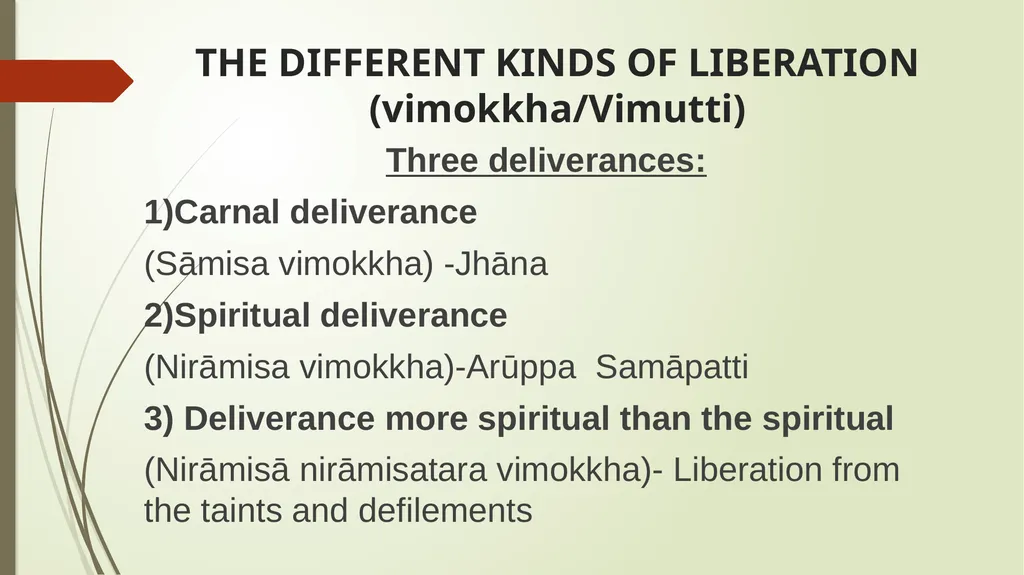
THE DIFFERENT KINDS OF LIBERATION (vimokkha/Vimutti) Three deliverances:
1)Carnal deliverance
(Sāmisa vimokkha) -Jhāna
2)Spiritual deliverance
(Nirāmisa vimokkha)-Arūppa Samāpatti
3) Deliverance more spiritual than the spiritual
(Nirāmisā nirāmisatara vimokkha)- Liberation from the taints and defilements<br>
07
Source 6:
(Mahāsuññata Sutta MN 122)
1)Deliverance of mind that is temporary or pleasant (sāmāyikaṃ vā kantaṃ cetovimutti).- meditative attainments
2)Deliverance of mind that is perpetual or unshakeable- Nibbana/ Becoming an Arahant.
(asāmāyikaṃ vā akuppaṃ cetovimutti).
Source 7:
(Godhika sutta, SN 4:23/ SN I 121)
Then, while the Venerable Godhika was dwelling diligent, ardent, and resolute, he reached temporary liberation of mind, but he fell away from that temporary liberation of mind. A second time, while the Venerable Godhika was dwelling diligent, ardent, and resolute, he reached temporary liberation of mind, but he fell away from that temporary liberation of mind. A third time ... A fourth time ... A fifth time ... A sixth…seventh time, while the Venerable Godhika was dwelling diligent, ardent, and resolute, he reached temporary liberation of mind. Then it occurred to the Venerable Godhika: "Six times already I have fallen away from temporary liberation of mind. Let me use the knife,“<br>
08
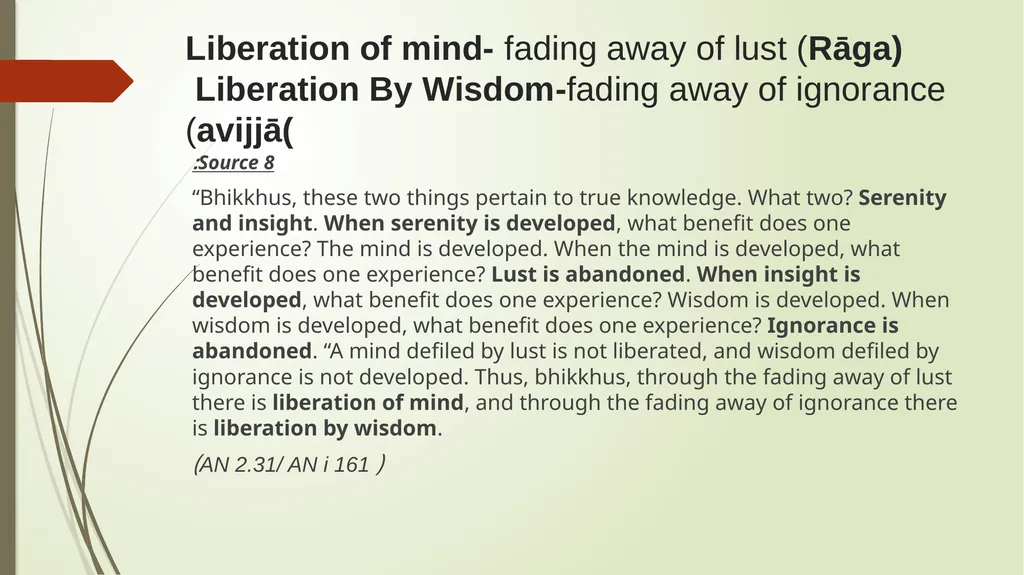
Liberation of mind- fading away of lust (Rāga) Liberation By Wisdom-fading away of ignorance (avijjā( Source 8:
“Bhikkhus, these two things pertain to true knowledge. What two? Serenity and insight. When serenity is developed, what benefit does one experience? The mind is developed. When the mind is developed, what benefit does one experience? Lust is abandoned. When insight is developed, what benefit does one experience? Wisdom is developed. When wisdom is developed, what benefit does one experience? Ignorance is abandoned. “A mind defiled by lust is not liberated, and wisdom defiled by ignorance is not developed. Thus, bhikkhus, through the fading away of lust there is liberation of mind, and through the fading away of ignorance there is liberation by wisdom.
( AN 2.31/ AN i 161)<br>
09
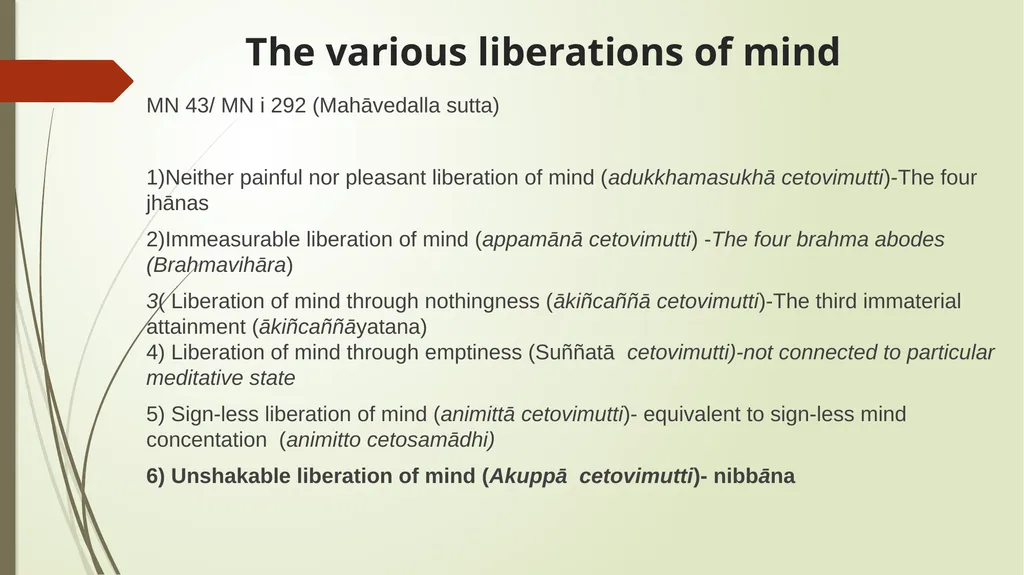
The various liberations of mind MN 43/ MN i 292 (Mahāvedalla sutta)
1)Neither painful nor pleasant liberation of mind (adukkhamasukhā cetovimutti)-The four jhānas
2)Immeasurable liberation of mind (appamānā cetovimutti) -The four brahma abodes (Brahmavihāra)
3( Liberation of mind through nothingness (ākiñcaññā cetovimutti)-The third immaterial attainment (ākiñcaññāyatana) 4) Liberation of mind through emptiness (Suññatā cetovimutti)-not connected to particular meditative state
5) Sign-less liberation of mind (animittā cetovimutti)- equivalent to sign-less mind concentation (animitto cetosamādhi)
6) Unshakable liberation of mind (Akuppā cetovimutti)- nibbāna<br>
10
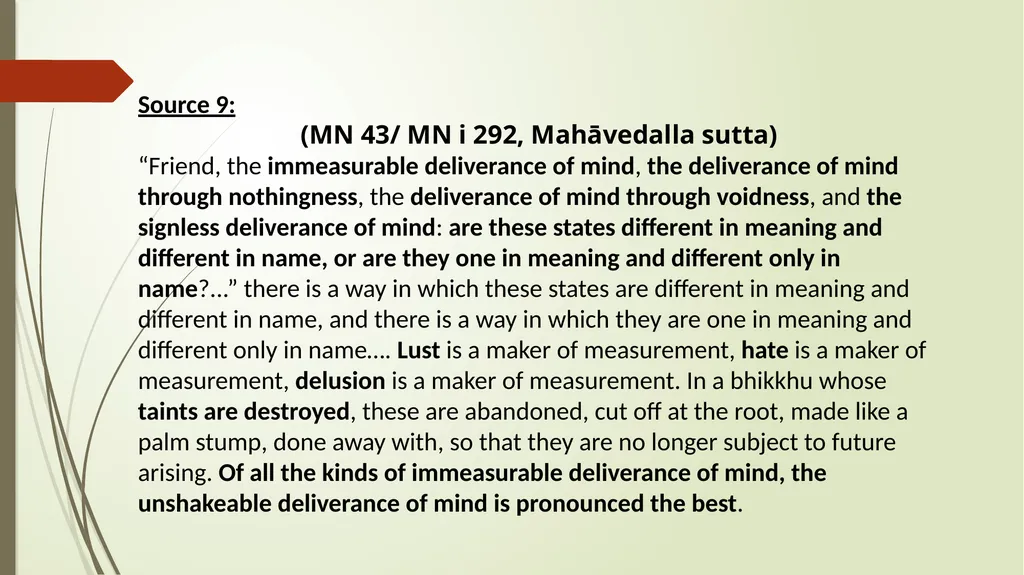
Source 9:
(MN 43/ MN i 292, Mahāvedalla sutta)
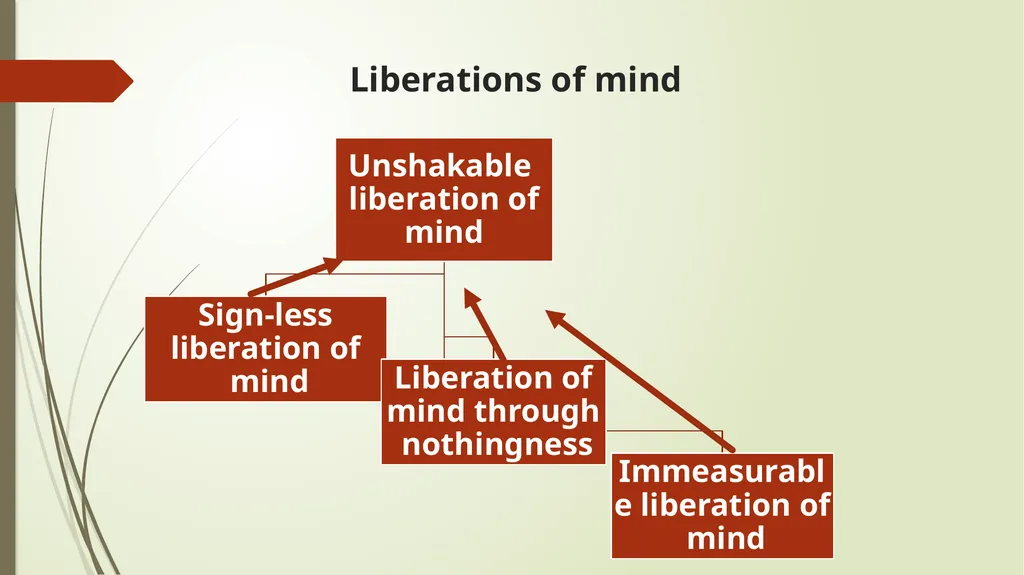
“Friend, the immeasurable deliverance of mind, the deliverance of mind through nothingness, the deliverance of mind through voidness, and the signless deliverance of mind: are these states different in meaning and different in name, or are they one in meaning and different only in name?...” there is a way in which these states are different in meaning and different in name, and there is a way in which they are one in meaning and different only in name…. Lust is a maker of measurement, hate is a maker of measurement, delusion is a maker of measurement. In a bhikkhu whose taints are destroyed, these are abandoned, cut off at the root, made like a palm stump, done away with, so that they are no longer subject to future arising. Of all the kinds of immeasurable deliverance of mind, the unshakeable deliverance of mind is pronounced the best.<br>
11
Liberations of mind<br>
12
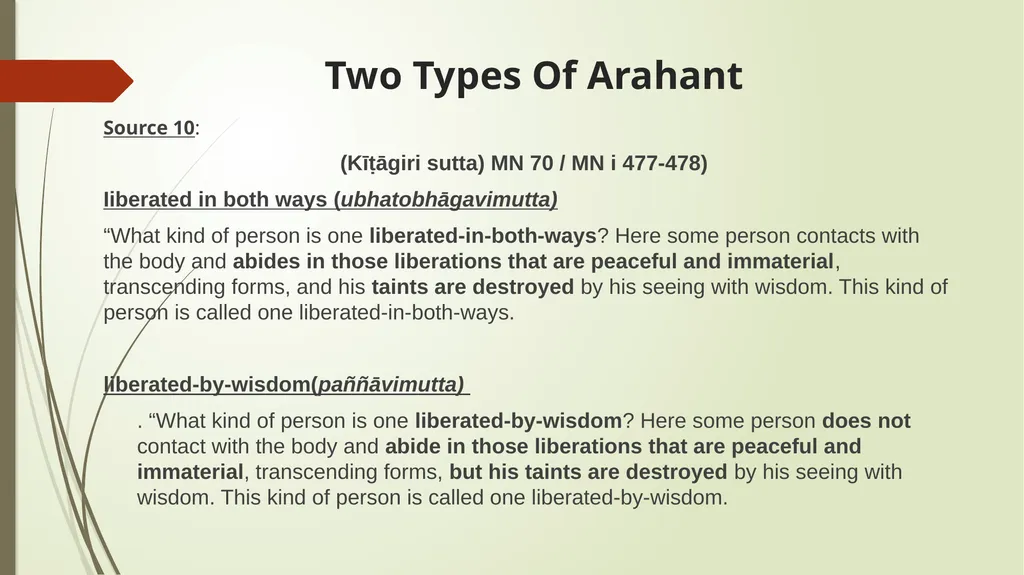
Two Types Of Arahant Source 10:
(Kīṭāgiri sutta) MN 70 / MN i 477-478)
Iiberated in both ways (ubhatobhāgavimutta)
“What kind of person is one liberated-in-both-ways? Here some person contacts with the body and abides in those liberations that are peaceful and immaterial, transcending forms, and his taints are destroyed by his seeing with wisdom. This kind of person is called one liberated-in-both-ways.
liberated-by-wisdom(paññāvimutta)
. “What kind of person is one liberated-by-wisdom? Here some person does not contact with the body and abide in those liberations that are peaceful and immaterial, transcending forms, but his taints are destroyed by his seeing with wisdom. This kind of person is called one liberated-by-wisdom.<br>
13
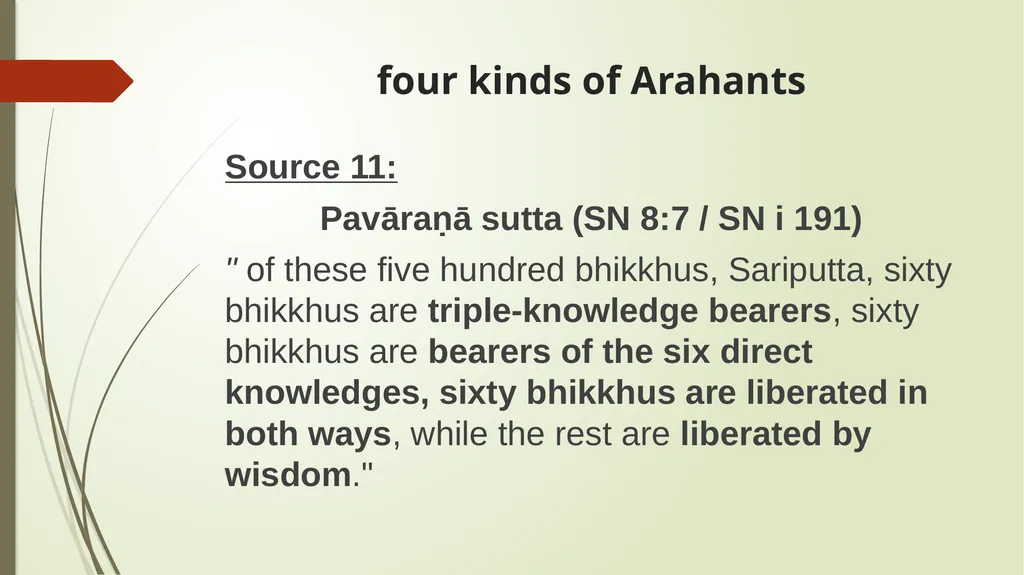
four kinds of Arahants Source 11:
Pavāraṇā sutta (SN 8:7 / SN i 191)
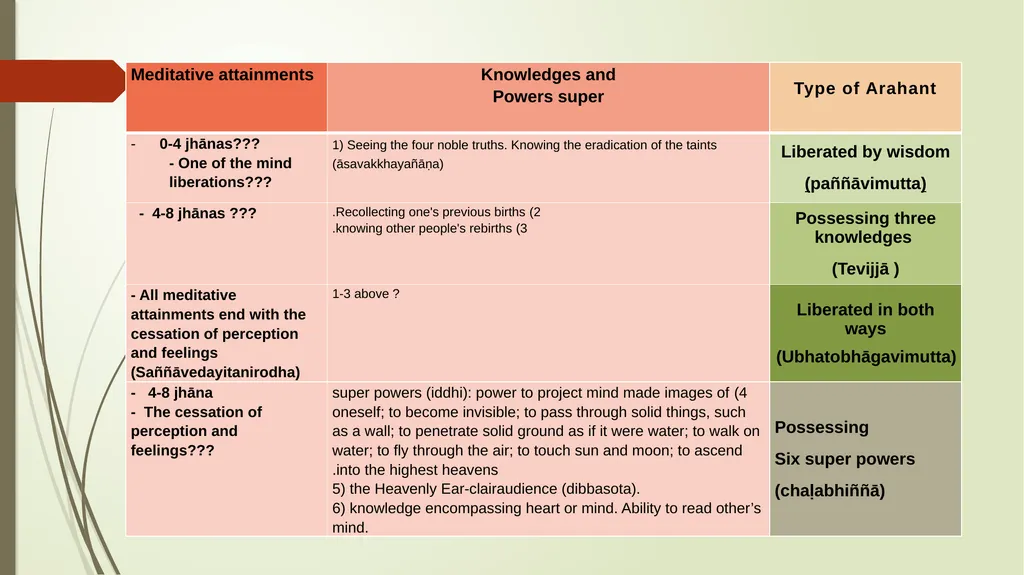
" of these five hundred bhikkhus, Sariputta, sixty bhikkhus are triple-knowledge bearers, sixty bhikkhus are bearers of the six direct knowledges, sixty bhikkhus are liberated in both ways, while the rest are liberated by wisdom."<br>