
Life Reinsurance – How the landscape is evolving
FD
Published · 15 slides · 0 views

1 / 1

Description
Life Reinsurance How the landscape is evolving and what future holds R. Srinivasa Rao Managing Director, Life Health, Munich Re India 7th Seminar on Enterprise Risk Management Hotel Sea Princess 01 September 2023 Agenda Reinsurance
Related Topics
Share
Embed code
Download this presentation From Below
"Life Reinsurance – How the landscape is evolving" is the property of its rightful owner. Permission is granted to download and print the materials on this website for personal, non-commercial use only, and to display it on your personal computer provided you do not modify the materials and that you retain all copyright notices contained in the materials. By downloading content from our website, you accept the terms of this agreement.
Presentation Transcript
01
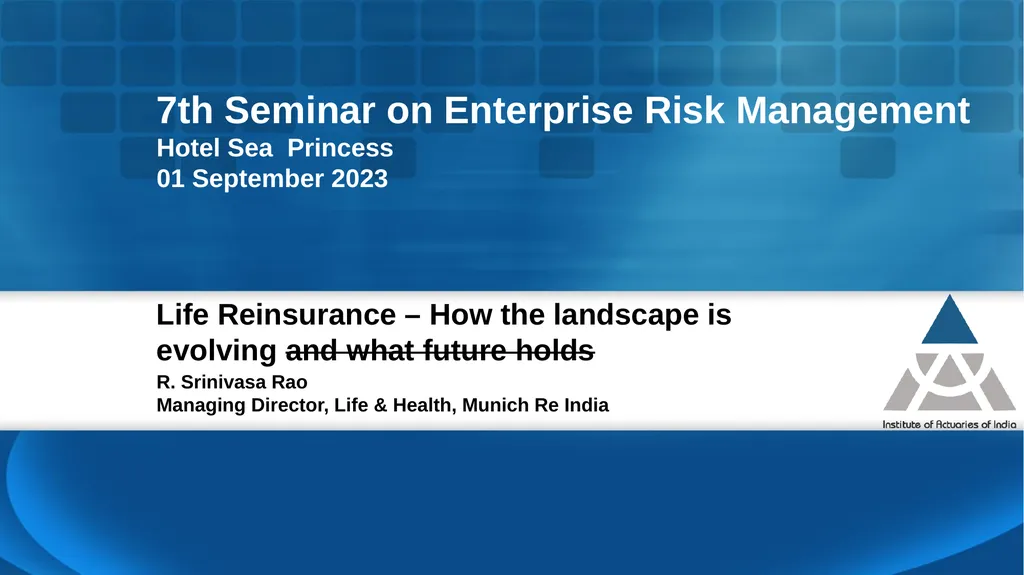
Life Reinsurance – How the landscape is evolving and what future holds R. Srinivasa Rao
Managing Director, Life & Health, Munich Re India 7th Seminar on Enterprise Risk Management
Hotel Sea Princess
01 September 2023<br>
Managing Director, Life & Health, Munich Re India 7th Seminar on Enterprise Risk Management
Hotel Sea Princess
01 September 2023<br>
02
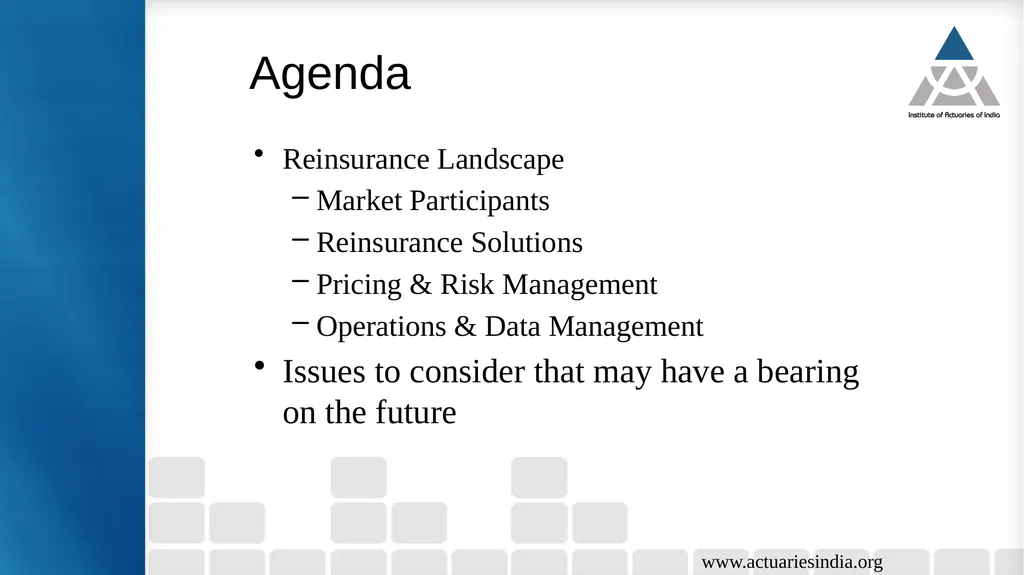
Agenda Reinsurance Landscape
Market Participants
Reinsurance Solutions
Pricing & Risk Management
Operations & Data Management
Issues to consider that may have a bearing on the future www.actuariesindia.org<br>
Market Participants
Reinsurance Solutions
Pricing & Risk Management
Operations & Data Management
Issues to consider that may have a bearing on the future www.actuariesindia.org<br>
03
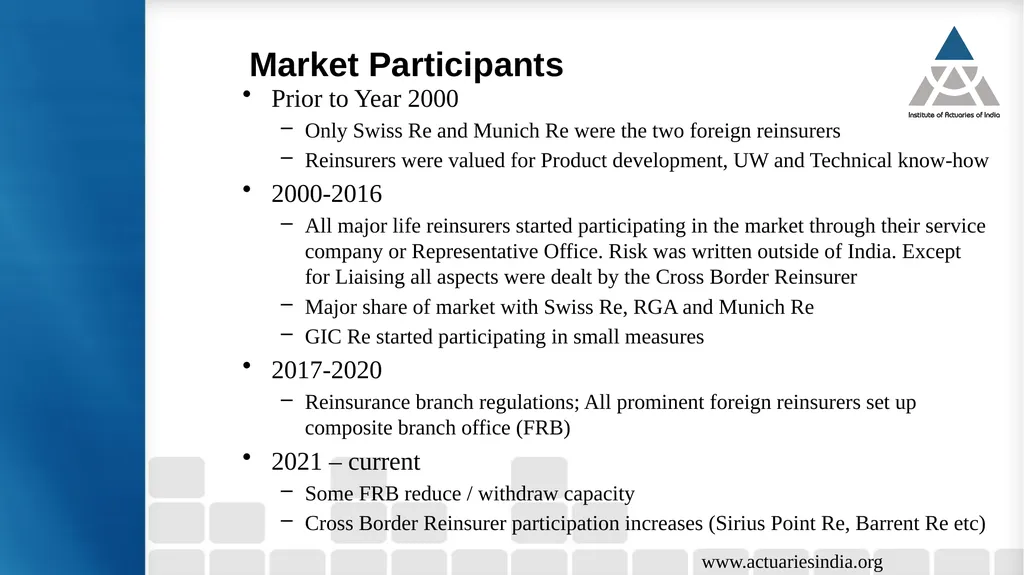
Market Participants Prior to Year 2000
Only Swiss Re and Munich Re were the two foreign reinsurers
Reinsurers were valued for Product development, UW and Technical know-how
2000-2016
All major life reinsurers started participating in the market through their service company or Representative Office. Risk was written outside of India. Except for Liaising all aspects were dealt by the Cross Border Reinsurer
Major share of market with Swiss Re, RGA and Munich Re
GIC Re started participating in small measures
2017-2020
Reinsurance branch regulations; All prominent foreign reinsurers set up composite branch office (FRB)
2021 – current
Some FRB reduce / withdraw capacity
Cross Border Reinsurer participation increases (Sirius Point Re, Barrent Re etc) www.actuariesindia.org<br>
Only Swiss Re and Munich Re were the two foreign reinsurers
Reinsurers were valued for Product development, UW and Technical know-how
2000-2016
All major life reinsurers started participating in the market through their service company or Representative Office. Risk was written outside of India. Except for Liaising all aspects were dealt by the Cross Border Reinsurer
Major share of market with Swiss Re, RGA and Munich Re
GIC Re started participating in small measures
2017-2020
Reinsurance branch regulations; All prominent foreign reinsurers set up composite branch office (FRB)
2021 – current
Some FRB reduce / withdraw capacity
Cross Border Reinsurer participation increases (Sirius Point Re, Barrent Re etc) www.actuariesindia.org<br>
04
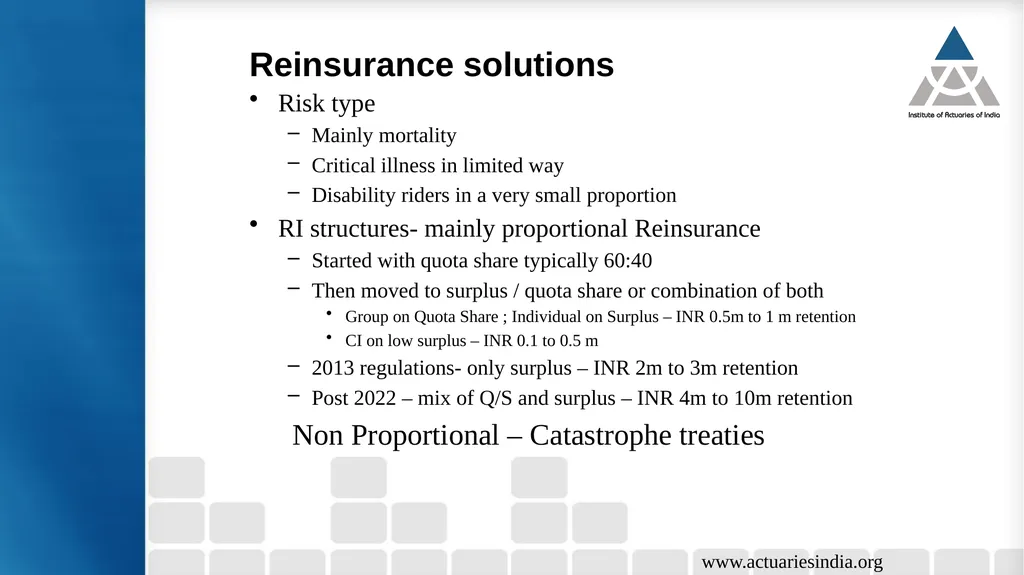
Reinsurance solutions Risk type
Mainly mortality
Critical illness in limited way
Disability riders in a very small proportion
RI structures- mainly proportional Reinsurance
Started with quota share typically 60:40
Then moved to surplus / quota share or combination of both
Group on Quota Share ; Individual on Surplus – INR 0.5m to 1 m retention
CI on low surplus – INR 0.1 to 0.5 m
2013 regulations- only surplus – INR 2m to 3m retention
Post 2022 – mix of Q/S and surplus – INR 4m to 10m retention
Non Proportional – Catastrophe treaties www.actuariesindia.org<br>
Mainly mortality
Critical illness in limited way
Disability riders in a very small proportion
RI structures- mainly proportional Reinsurance
Started with quota share typically 60:40
Then moved to surplus / quota share or combination of both
Group on Quota Share ; Individual on Surplus – INR 0.5m to 1 m retention
CI on low surplus – INR 0.1 to 0.5 m
2013 regulations- only surplus – INR 2m to 3m retention
Post 2022 – mix of Q/S and surplus – INR 4m to 10m retention
Non Proportional – Catastrophe treaties www.actuariesindia.org<br>
05
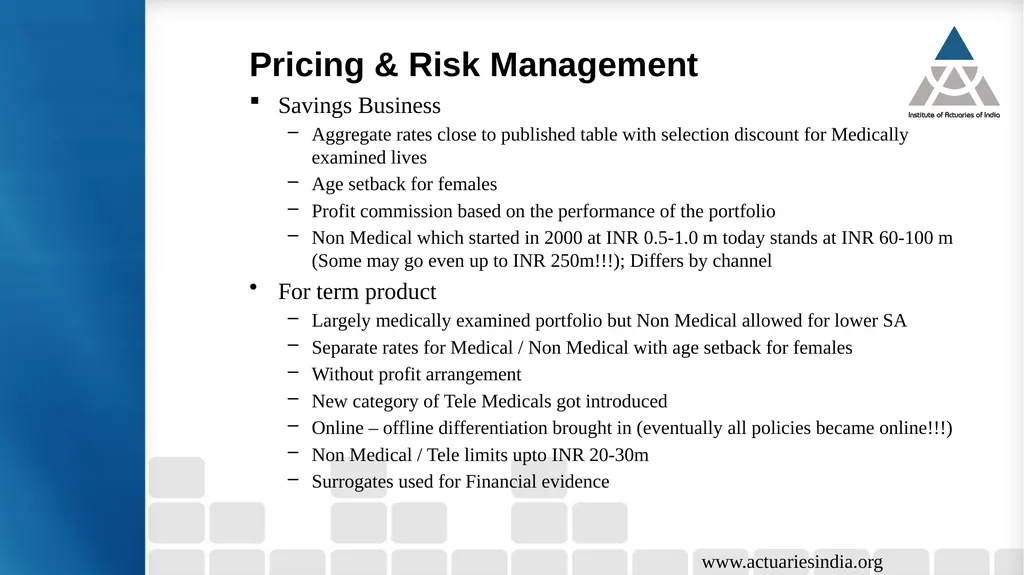
Pricing & Risk Management Savings Business
Aggregate rates close to published table with selection discount for Medically examined lives
Age setback for females
Profit commission based on the performance of the portfolio
Non Medical which started in 2000 at INR 0.5-1.0 m today stands at INR 60-100 m (Some may go even up to INR 250m!!!); Differs by channel
For term product
Largely medically examined portfolio but Non Medical allowed for lower SA
Separate rates for Medical / Non Medical with age setback for females
Without profit arrangement
New category of Tele Medicals got introduced
Online – offline differentiation brought in (eventually all policies became online!!!)
Non Medical / Tele limits upto INR 20-30m
Surrogates used for Financial evidence www.actuariesindia.org<br>
Aggregate rates close to published table with selection discount for Medically examined lives
Age setback for females
Profit commission based on the performance of the portfolio
Non Medical which started in 2000 at INR 0.5-1.0 m today stands at INR 60-100 m (Some may go even up to INR 250m!!!); Differs by channel
For term product
Largely medically examined portfolio but Non Medical allowed for lower SA
Separate rates for Medical / Non Medical with age setback for females
Without profit arrangement
New category of Tele Medicals got introduced
Online – offline differentiation brought in (eventually all policies became online!!!)
Non Medical / Tele limits upto INR 20-30m
Surrogates used for Financial evidence www.actuariesindia.org<br>
06
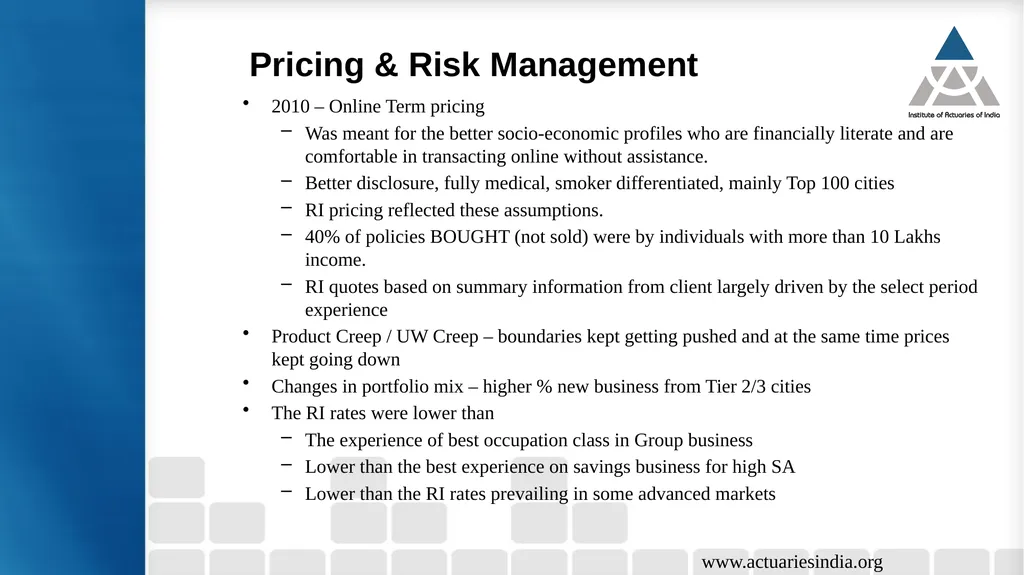
Pricing & Risk Management 2010 – Online Term pricing
Was meant for the better socio-economic profiles who are financially literate and are comfortable in transacting online without assistance.
Better disclosure, fully medical, smoker differentiated, mainly Top 100 cities
RI pricing reflected these assumptions.
40% of policies BOUGHT (not sold) were by individuals with more than 10 Lakhs income.
RI quotes based on summary information from client largely driven by the select period experience
Product Creep / UW Creep – boundaries kept getting pushed and at the same time prices kept going down
Changes in portfolio mix – higher % new business from Tier 2/3 cities
The RI rates were lower than
The experience of best occupation class in Group business
Lower than the best experience on savings business for high SA
Lower than the RI rates prevailing in some advanced markets www.actuariesindia.org<br>
Was meant for the better socio-economic profiles who are financially literate and are comfortable in transacting online without assistance.
Better disclosure, fully medical, smoker differentiated, mainly Top 100 cities
RI pricing reflected these assumptions.
40% of policies BOUGHT (not sold) were by individuals with more than 10 Lakhs income.
RI quotes based on summary information from client largely driven by the select period experience
Product Creep / UW Creep – boundaries kept getting pushed and at the same time prices kept going down
Changes in portfolio mix – higher % new business from Tier 2/3 cities
The RI rates were lower than
The experience of best occupation class in Group business
Lower than the best experience on savings business for high SA
Lower than the RI rates prevailing in some advanced markets www.actuariesindia.org<br>
07
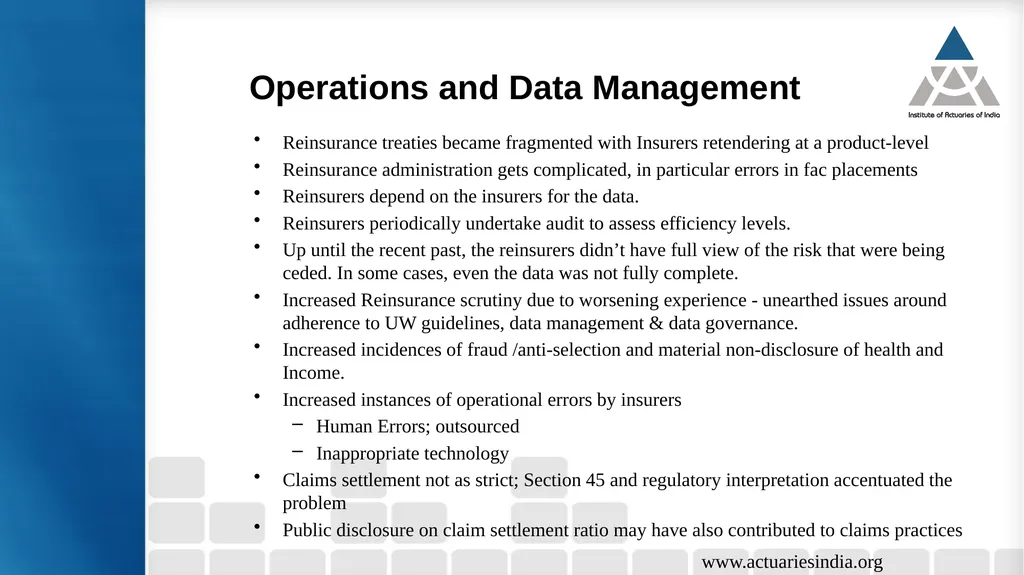
Operations and Data Management Reinsurance treaties became fragmented with Insurers retendering at a product-level
Reinsurance administration gets complicated, in particular errors in fac placements
Reinsurers depend on the insurers for the data.
Reinsurers periodically undertake audit to assess efficiency levels.
Up until the recent past, the reinsurers didn’t have full view of the risk that were being ceded. In some cases, even the data was not fully complete.
Increased Reinsurance scrutiny due to worsening experience - unearthed issues around adherence to UW guidelines, data management & data governance.
Increased incidences of fraud /anti-selection and material non-disclosure of health and Income.
Increased instances of operational errors by insurers
Human Errors; outsourced
Inappropriate technology
Claims settlement not as strict; Section 45 and regulatory interpretation accentuated the problem
Public disclosure on claim settlement ratio may have also contributed to claims practices www.actuariesindia.org<br>
Reinsurance administration gets complicated, in particular errors in fac placements
Reinsurers depend on the insurers for the data.
Reinsurers periodically undertake audit to assess efficiency levels.
Up until the recent past, the reinsurers didn’t have full view of the risk that were being ceded. In some cases, even the data was not fully complete.
Increased Reinsurance scrutiny due to worsening experience - unearthed issues around adherence to UW guidelines, data management & data governance.
Increased incidences of fraud /anti-selection and material non-disclosure of health and Income.
Increased instances of operational errors by insurers
Human Errors; outsourced
Inappropriate technology
Claims settlement not as strict; Section 45 and regulatory interpretation accentuated the problem
Public disclosure on claim settlement ratio may have also contributed to claims practices www.actuariesindia.org<br>
08
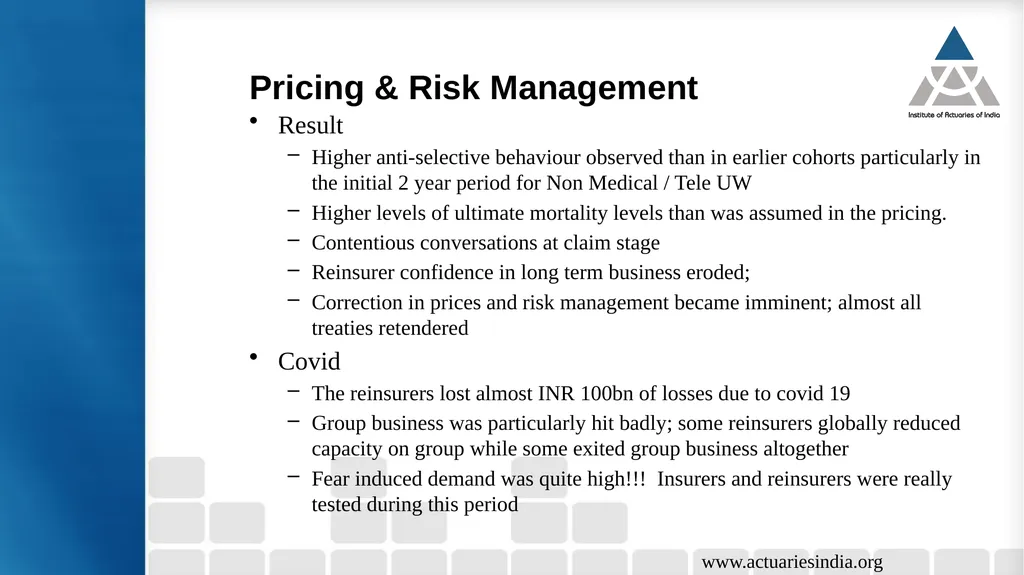
Pricing & Risk Management Result
Higher anti-selective behaviour observed than in earlier cohorts particularly in the initial 2 year period for Non Medical / Tele UW
Higher levels of ultimate mortality levels than was assumed in the pricing.
Contentious conversations at claim stage
Reinsurer confidence in long term business eroded;
Correction in prices and risk management became imminent; almost all treaties retendered
Covid
The reinsurers lost almost INR 100bn of losses due to covid 19
Group business was particularly hit badly; some reinsurers globally reduced capacity on group while some exited group business altogether
Fear induced demand was quite high!!! Insurers and reinsurers were really tested during this period www.actuariesindia.org<br>
Higher anti-selective behaviour observed than in earlier cohorts particularly in the initial 2 year period for Non Medical / Tele UW
Higher levels of ultimate mortality levels than was assumed in the pricing.
Contentious conversations at claim stage
Reinsurer confidence in long term business eroded;
Correction in prices and risk management became imminent; almost all treaties retendered
Covid
The reinsurers lost almost INR 100bn of losses due to covid 19
Group business was particularly hit badly; some reinsurers globally reduced capacity on group while some exited group business altogether
Fear induced demand was quite high!!! Insurers and reinsurers were really tested during this period www.actuariesindia.org<br>
09
Issues to consider
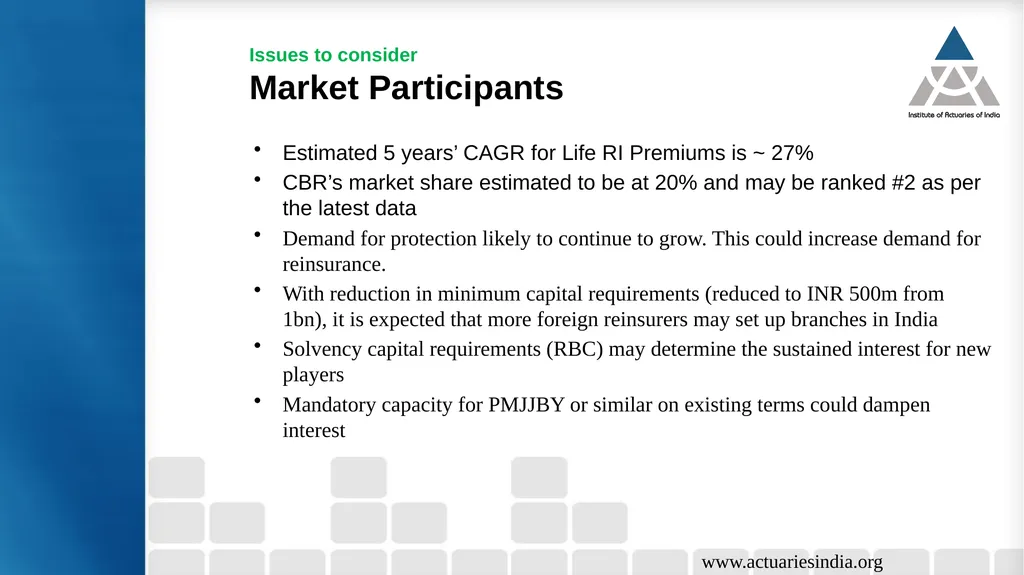
Market Participants Estimated 5 years’ CAGR for Life RI Premiums is ~ 27%
CBR’s market share estimated to be at 20% and may be ranked #2 as per the latest data
Demand for protection likely to continue to grow. This could increase demand for reinsurance.
With reduction in minimum capital requirements (reduced to INR 500m from 1bn), it is expected that more foreign reinsurers may set up branches in India
Solvency capital requirements (RBC) may determine the sustained interest for new players
Mandatory capacity for PMJJBY or similar on existing terms could dampen interest www.actuariesindia.org<br>
Market Participants Estimated 5 years’ CAGR for Life RI Premiums is ~ 27%
CBR’s market share estimated to be at 20% and may be ranked #2 as per the latest data
Demand for protection likely to continue to grow. This could increase demand for reinsurance.
With reduction in minimum capital requirements (reduced to INR 500m from 1bn), it is expected that more foreign reinsurers may set up branches in India
Solvency capital requirements (RBC) may determine the sustained interest for new players
Mandatory capacity for PMJJBY or similar on existing terms could dampen interest www.actuariesindia.org<br>
10
Issues to consider
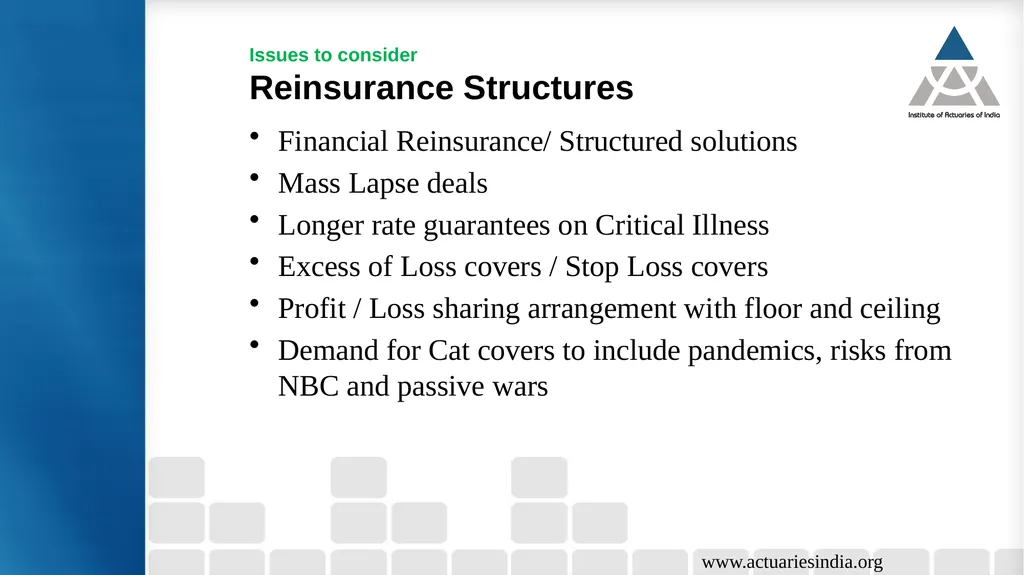
Reinsurance Structures Financial Reinsurance/ Structured solutions
Mass Lapse deals
Longer rate guarantees on Critical Illness
Excess of Loss covers / Stop Loss covers
Profit / Loss sharing arrangement with floor and ceiling
Demand for Cat covers to include pandemics, risks from NBC and passive wars www.actuariesindia.org<br>
Reinsurance Structures Financial Reinsurance/ Structured solutions
Mass Lapse deals
Longer rate guarantees on Critical Illness
Excess of Loss covers / Stop Loss covers
Profit / Loss sharing arrangement with floor and ceiling
Demand for Cat covers to include pandemics, risks from NBC and passive wars www.actuariesindia.org<br>
11
Issues to consider
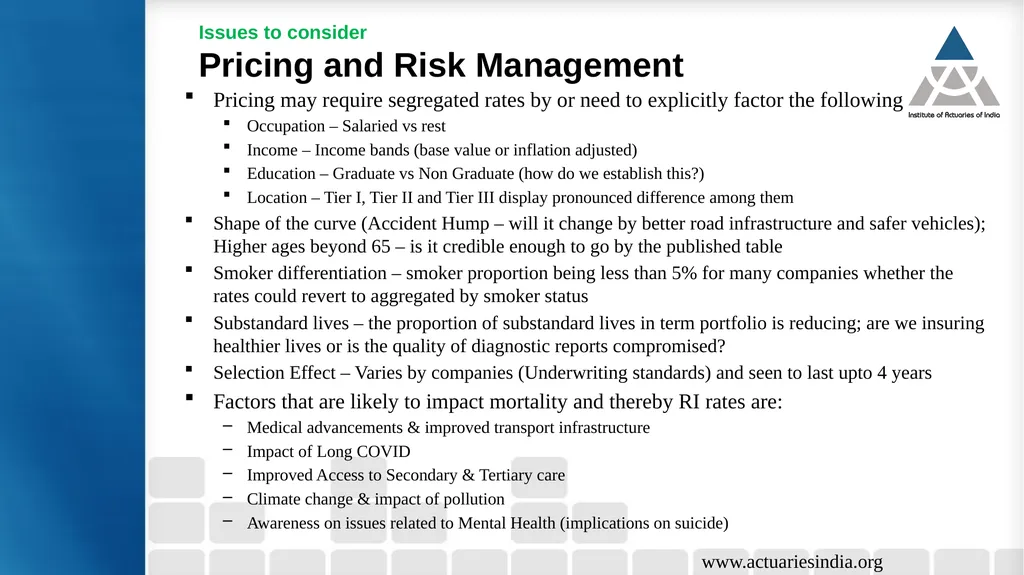
Pricing and Risk Management www.actuariesindia.org Pricing may require segregated rates by or need to explicitly factor the following
Occupation – Salaried vs rest
Income – Income bands (base value or inflation adjusted)
Education – Graduate vs Non Graduate (how do we establish this?)
Location – Tier I, Tier II and Tier III display pronounced difference among them
Shape of the curve (Accident Hump – will it change by better road infrastructure and safer vehicles); Higher ages beyond 65 – is it credible enough to go by the published table
Smoker differentiation – smoker proportion being less than 5% for many companies whether the rates could revert to aggregated by smoker status
Substandard lives – the proportion of substandard lives in term portfolio is reducing; are we insuring healthier lives or is the quality of diagnostic reports compromised?
Selection Effect – Varies by companies (Underwriting standards) and seen to last upto 4 years
Factors that are likely to impact mortality and thereby RI rates are:
Medical advancements & improved transport infrastructure
Impact of Long COVID
Improved Access to Secondary & Tertiary care
Climate change & impact of pollution
Awareness on issues related to Mental Health (implications on suicide)<br>
Pricing and Risk Management www.actuariesindia.org Pricing may require segregated rates by or need to explicitly factor the following
Occupation – Salaried vs rest
Income – Income bands (base value or inflation adjusted)
Education – Graduate vs Non Graduate (how do we establish this?)
Location – Tier I, Tier II and Tier III display pronounced difference among them
Shape of the curve (Accident Hump – will it change by better road infrastructure and safer vehicles); Higher ages beyond 65 – is it credible enough to go by the published table
Smoker differentiation – smoker proportion being less than 5% for many companies whether the rates could revert to aggregated by smoker status
Substandard lives – the proportion of substandard lives in term portfolio is reducing; are we insuring healthier lives or is the quality of diagnostic reports compromised?
Selection Effect – Varies by companies (Underwriting standards) and seen to last upto 4 years
Factors that are likely to impact mortality and thereby RI rates are:
Medical advancements & improved transport infrastructure
Impact of Long COVID
Improved Access to Secondary & Tertiary care
Climate change & impact of pollution
Awareness on issues related to Mental Health (implications on suicide)<br>
12
Issues to consider
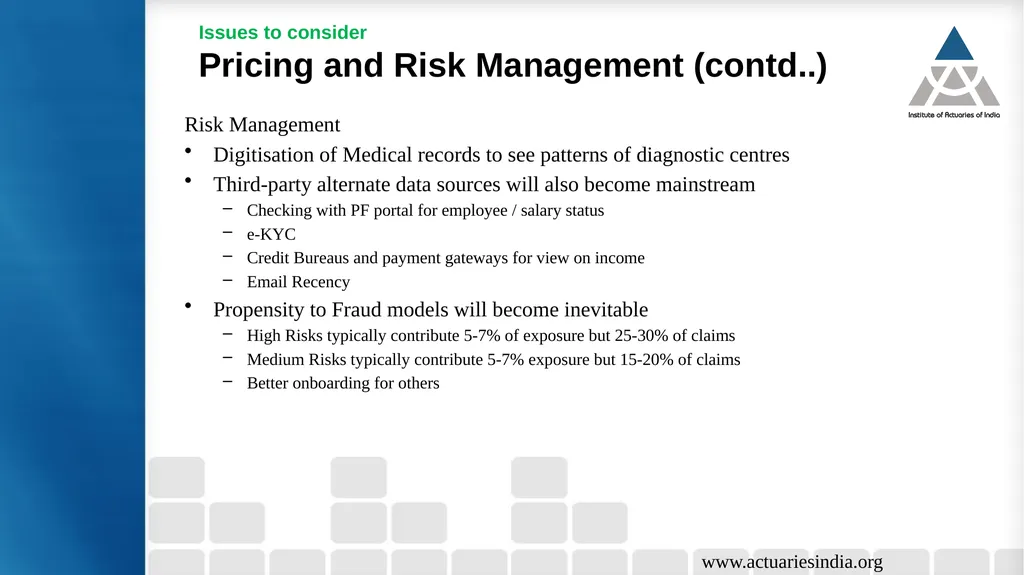
Pricing and Risk Management (contd..) www.actuariesindia.org Risk Management
Digitisation of Medical records to see patterns of diagnostic centres
Third-party alternate data sources will also become mainstream
Checking with PF portal for employee / salary status
e-KYC
Credit Bureaus and payment gateways for view on income
Email Recency
Propensity to Fraud models will become inevitable
High Risks typically contribute 5-7% of exposure but 25-30% of claims
Medium Risks typically contribute 5-7% exposure but 15-20% of claims
Better onboarding for others<br>
Pricing and Risk Management (contd..) www.actuariesindia.org Risk Management
Digitisation of Medical records to see patterns of diagnostic centres
Third-party alternate data sources will also become mainstream
Checking with PF portal for employee / salary status
e-KYC
Credit Bureaus and payment gateways for view on income
Email Recency
Propensity to Fraud models will become inevitable
High Risks typically contribute 5-7% of exposure but 25-30% of claims
Medium Risks typically contribute 5-7% exposure but 15-20% of claims
Better onboarding for others<br>
13
Issues to consider
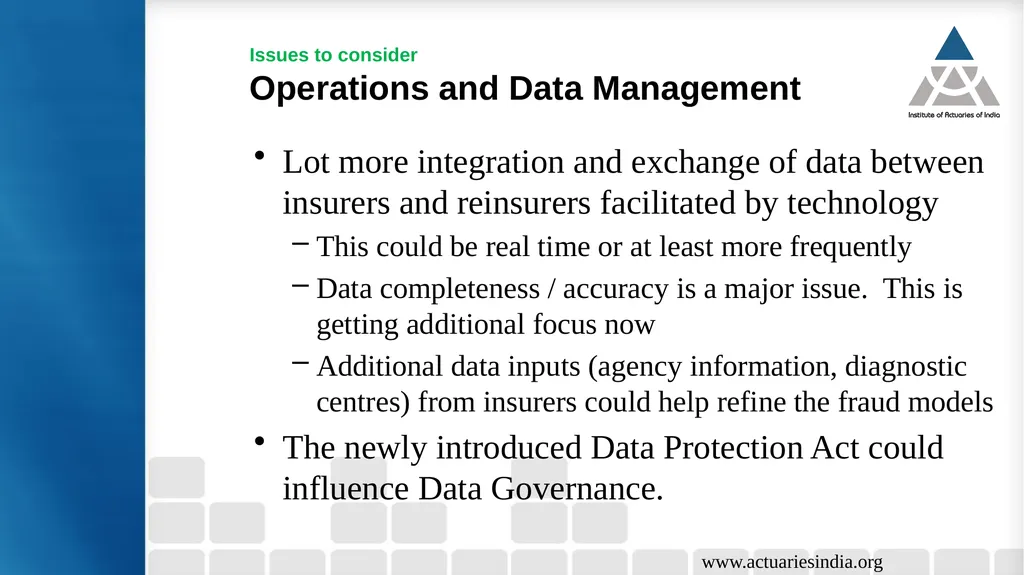
Operations and Data Management Lot more integration and exchange of data between insurers and reinsurers facilitated by technology
This could be real time or at least more frequently
Data completeness / accuracy is a major issue. This is getting additional focus now
Additional data inputs (agency information, diagnostic centres) from insurers could help refine the fraud models
The newly introduced Data Protection Act could influence Data Governance. www.actuariesindia.org<br>
Operations and Data Management Lot more integration and exchange of data between insurers and reinsurers facilitated by technology
This could be real time or at least more frequently
Data completeness / accuracy is a major issue. This is getting additional focus now
Additional data inputs (agency information, diagnostic centres) from insurers could help refine the fraud models
The newly introduced Data Protection Act could influence Data Governance. www.actuariesindia.org<br>
14
Questions? www.actuariesindia.org<br>
15
Thank You for Your Time & Attention !! R. Srinivasa Rao
Managing Director, Life & Health, Munich Re India 7th Seminar on Enterprise Risk Management
Hotel Sea Princess
01 September 2023<br>
Managing Director, Life & Health, Munich Re India 7th Seminar on Enterprise Risk Management
Hotel Sea Princess
01 September 2023<br>