
LIFE/work balance We have started a
Description: LIFEwork balance We have started a LIFEworkbalance campaign and we need your help to complete our LIFEwork balance survey. We hope to publish the results soon, so please give 15 minutes of your time to help us get a true picture of
Related Topics
Download Presentation
"LIFE/work balance We have started a" is the property of its rightful owner. Permission is granted to download and print the materials on this website for personal, non-commercial use only, and to display it on your personal computer provided you do not modify the materials and that you retain all copyright notices contained in the materials. By downloading content from our website, you accept the terms of this agreement.
Presentation Transcript
slide1. LIFE/work balance
We have started a #LIFEworkbalance campaign and we need your help to complete our LIFE/work balance survey.
We hope to publish the results soon, so please give 15 minutes of your time to help us get a true picture of school life.
Want to be a part of this campaign? Take the survey on our website and share it with your colleagues!<br>
slide2. Year 3 – Summer Block 1 – Nouns – Types of Nouns
About This Resource:
This PowerPoint has been designed to support your teaching of this small step. It includes a starter activity and an example of each question from the Varied Fluency and Application and Reasoning resources also provided in this pack. You can choose to work through all examples provided or a selection of them depending on the needs of your class.
National Curriculum Objectives:
No formal objective. However, these words are taken from the year 3/4 non-statutory spelling list and the focus is given to vocabulary of abstract concepts in line with the Spoken Language Guidance.
Spell words from the word list – years 3 and 4.
More resources from our Grammar, Punctuation and Spelling scheme of work.
Did you like this resource? Don’t forget to review it on our website.<br>
slide3. Year 3 – Summer Block 1 – Nouns – Types of Nouns
Notes and Guidance:
In Year 2 Autumn Block 3, children learnt about common, proper and collective nouns, and also noun phrases.
In this step, children will recap the different types of nouns.
Common nouns include everyday objects, people, places, animals etc. They do not require a capital letter.
Collective nouns refer to groups of things or people. For example: a swarm of bees, a crowd of people, a bunch of bananas.
Proper nouns are names given to particular people, places, religions, periods of history etc. They always require a capital letter. For example: I read the Bible; My grandfather died during World War 2; I am going to meet Isaac.<br>
slide4. Year 3 – Summer Block 1 – Nouns
Step 1: Types of Nouns<br>
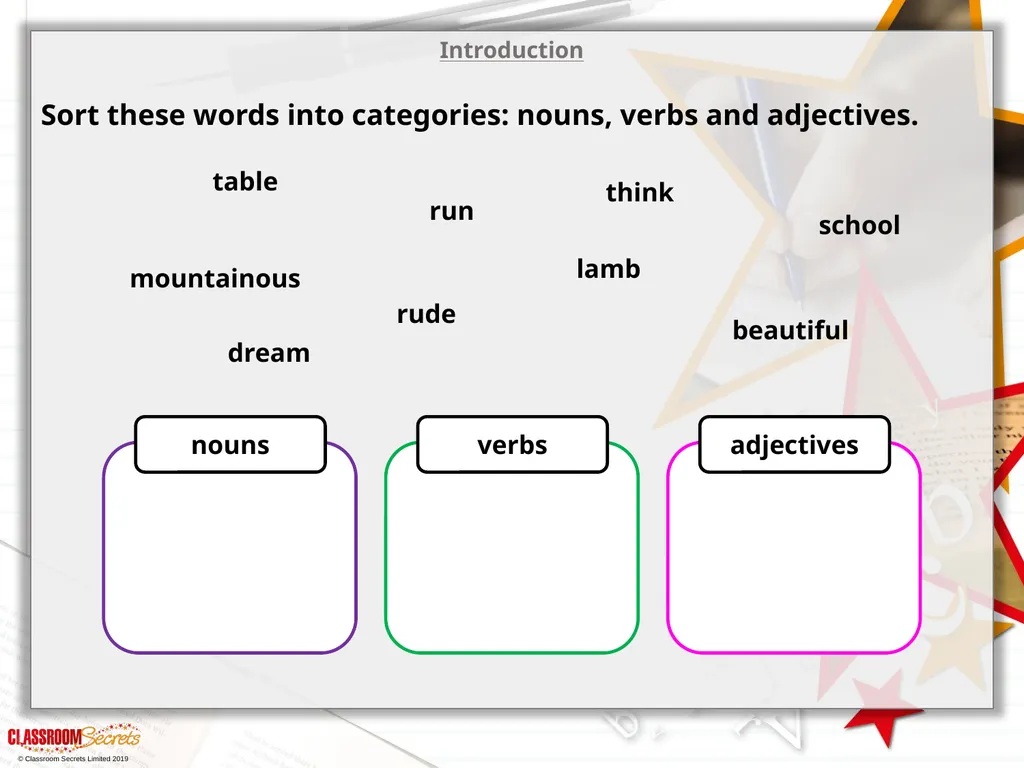
slide5. Introduction
Sort these words into categories: nouns, verbs and adjectives. nouns verbs adjectives<br>
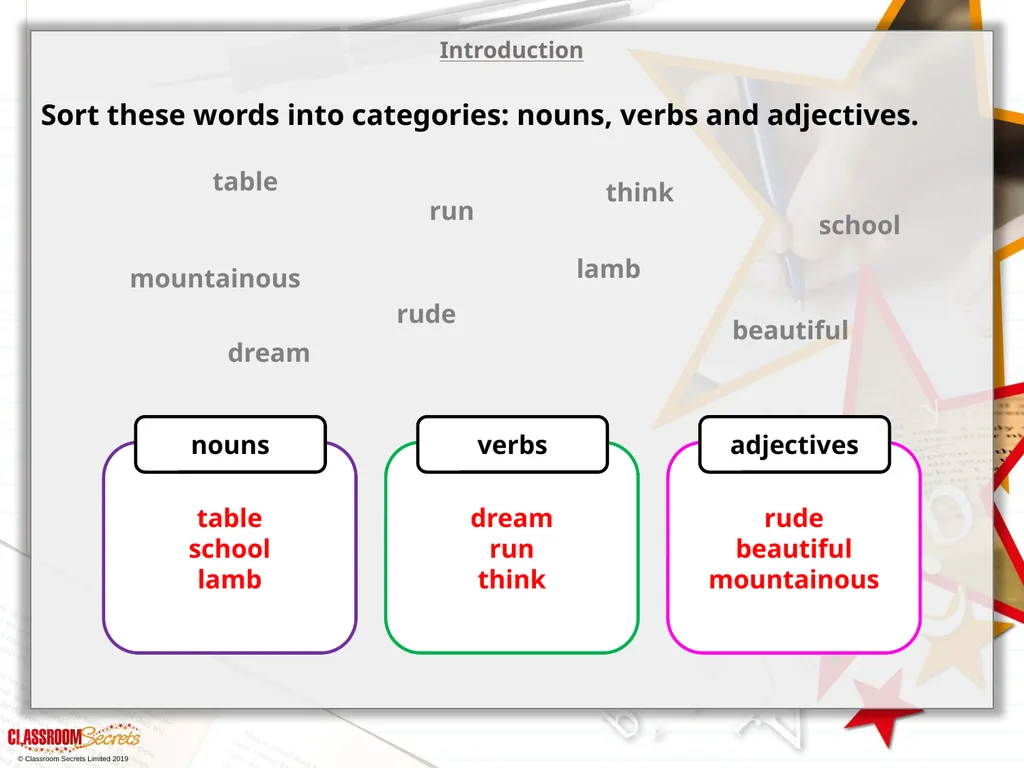
slide6. Introduction
Sort these words into categories: nouns, verbs and adjectives.<br>
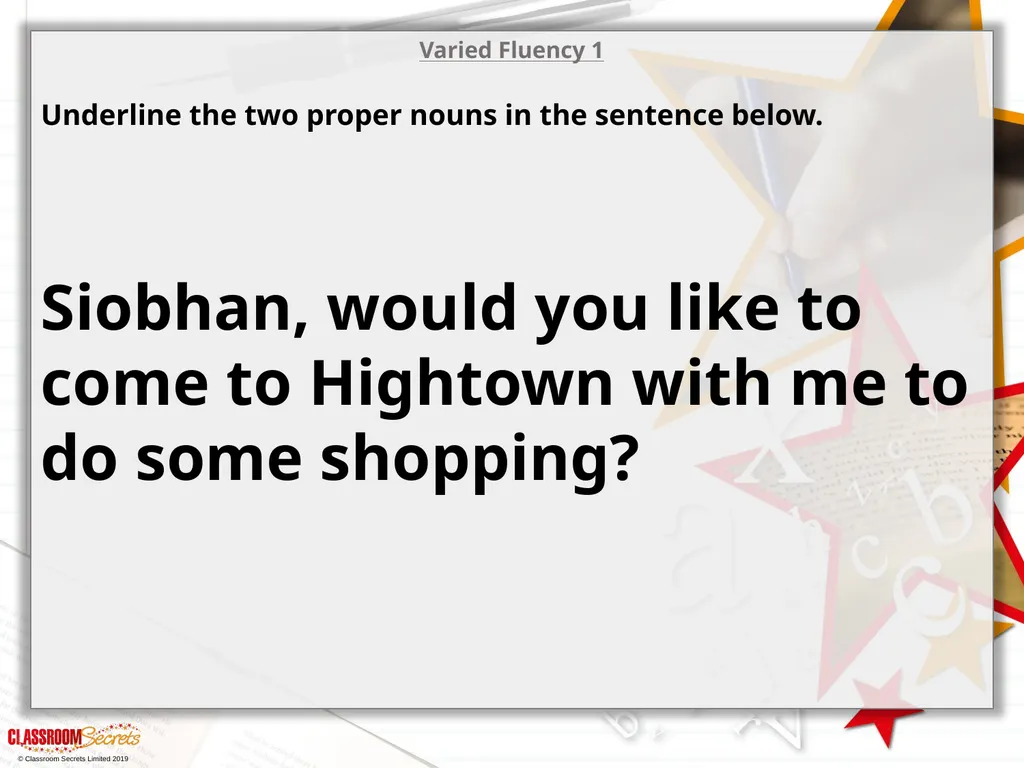
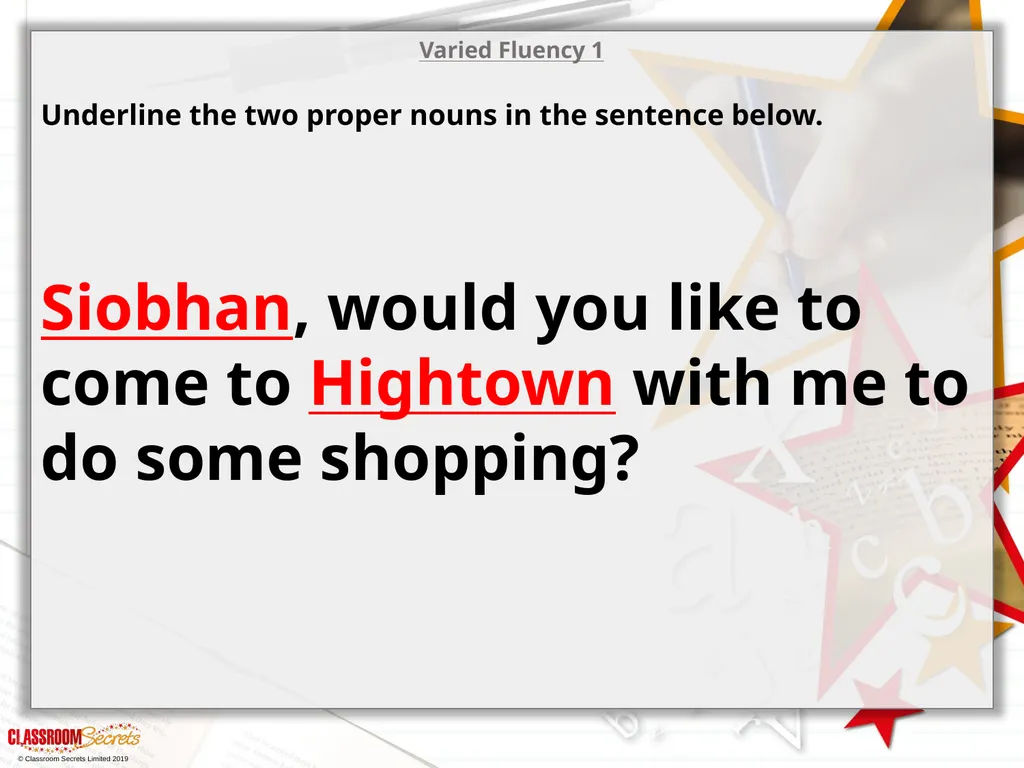
slide7. Varied Fluency 1
Underline the two proper nouns in the sentence below.
Siobhan, would you like to come to Hightown with me to do some shopping?<br>
slide8. Varied Fluency 1
Underline the two proper nouns in the sentence below.
Siobhan, would you like to come to Hightown with me to do some shopping?<br>
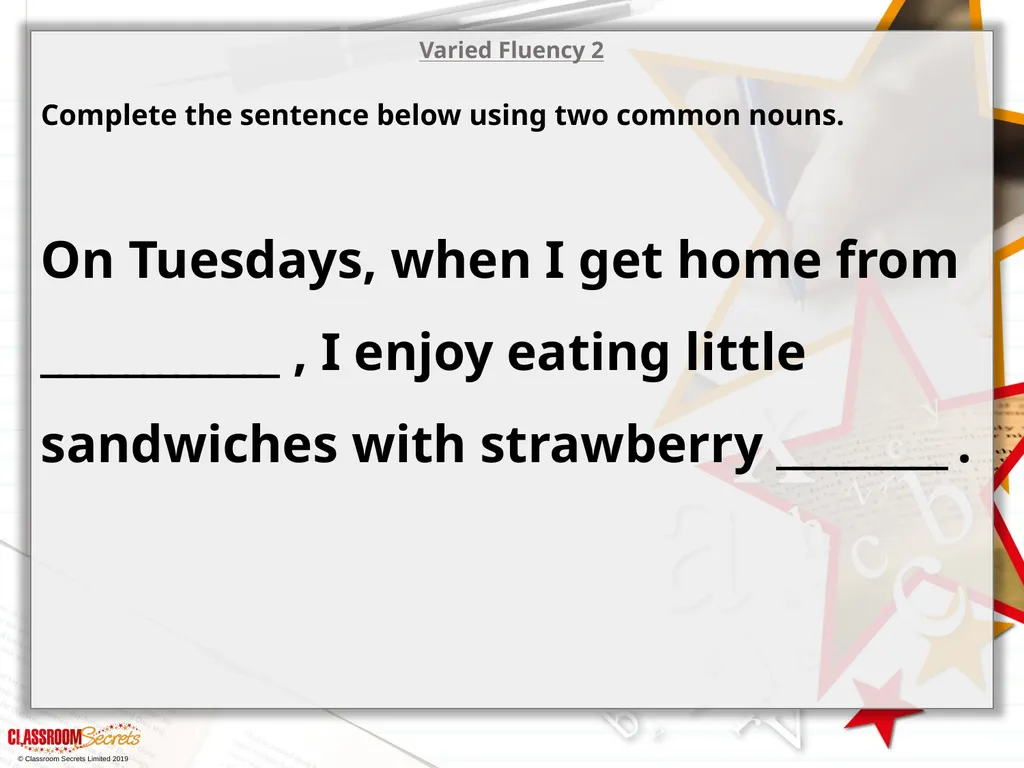
slide9. Varied Fluency 2
Complete the sentence below using two common nouns.
On Tuesdays, when I get home from ______________ , I enjoy eating little sandwiches with strawberry __________ .<br>
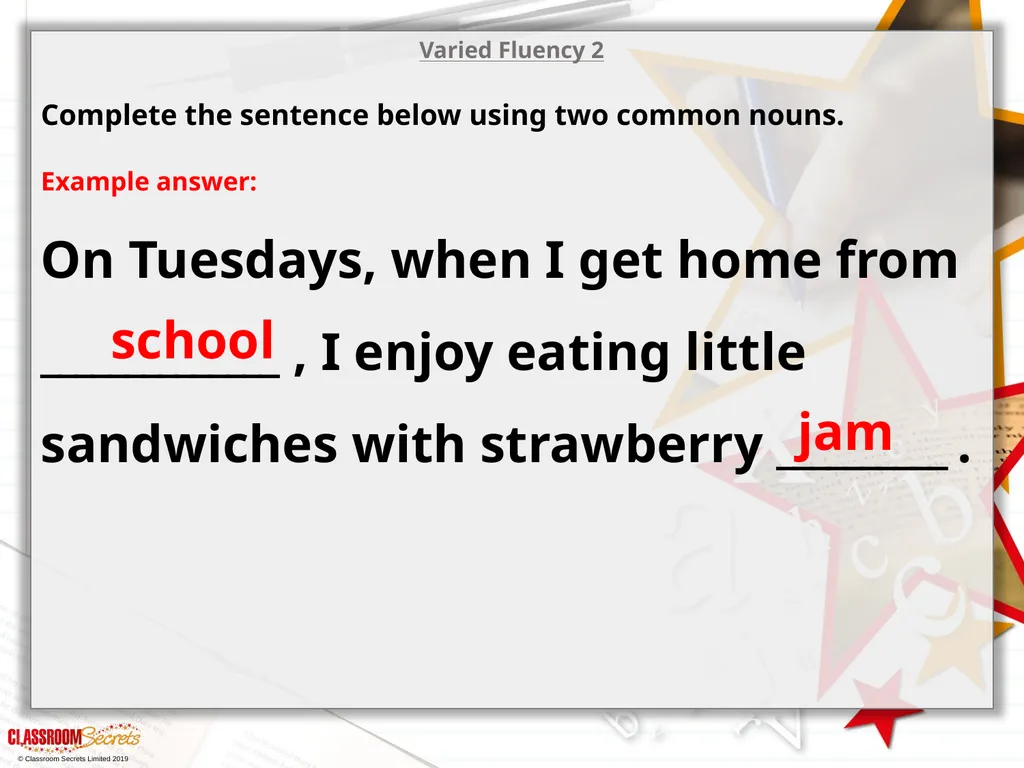
slide10. Varied Fluency 2
Complete the sentence below using two common nouns.
Example answer:
On Tuesdays, when I get home from ______________ , I enjoy eating little sandwiches with strawberry __________ . school jam<br>
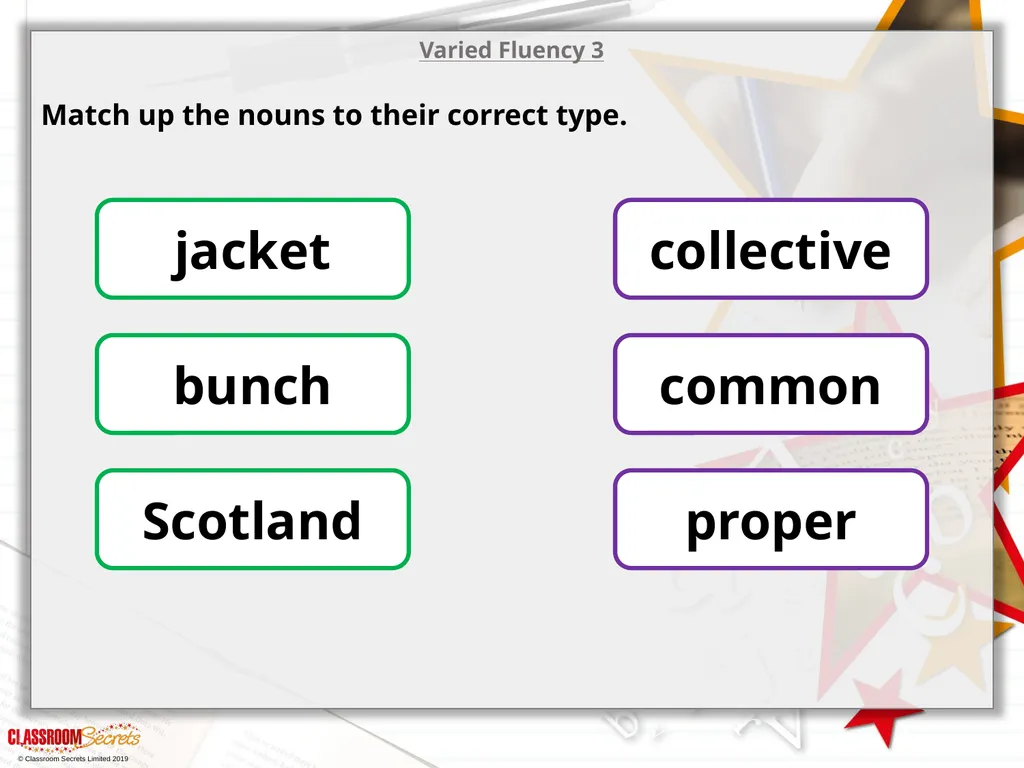
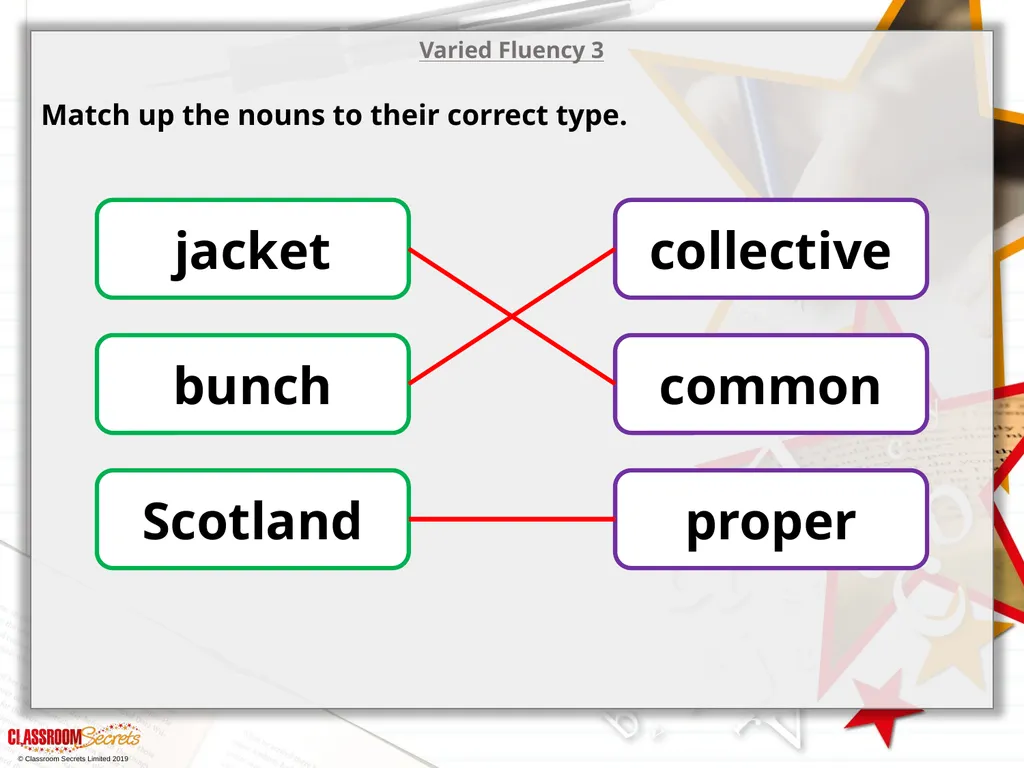
slide11. Varied Fluency 3
Match up the nouns to their correct type.<br>
slide12. Varied Fluency 3
Match up the nouns to their correct type.<br>
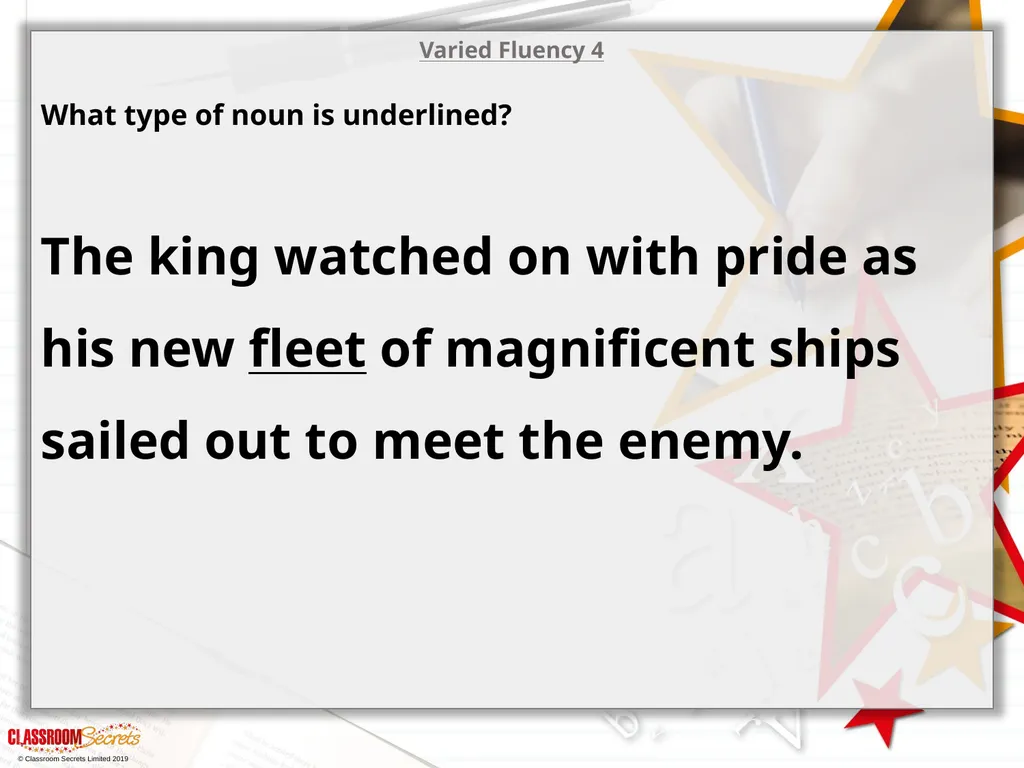
slide13. Varied Fluency 4
What type of noun is underlined?
The king watched on with pride as his new fleet of magnificent ships sailed out to meet the enemy.<br>
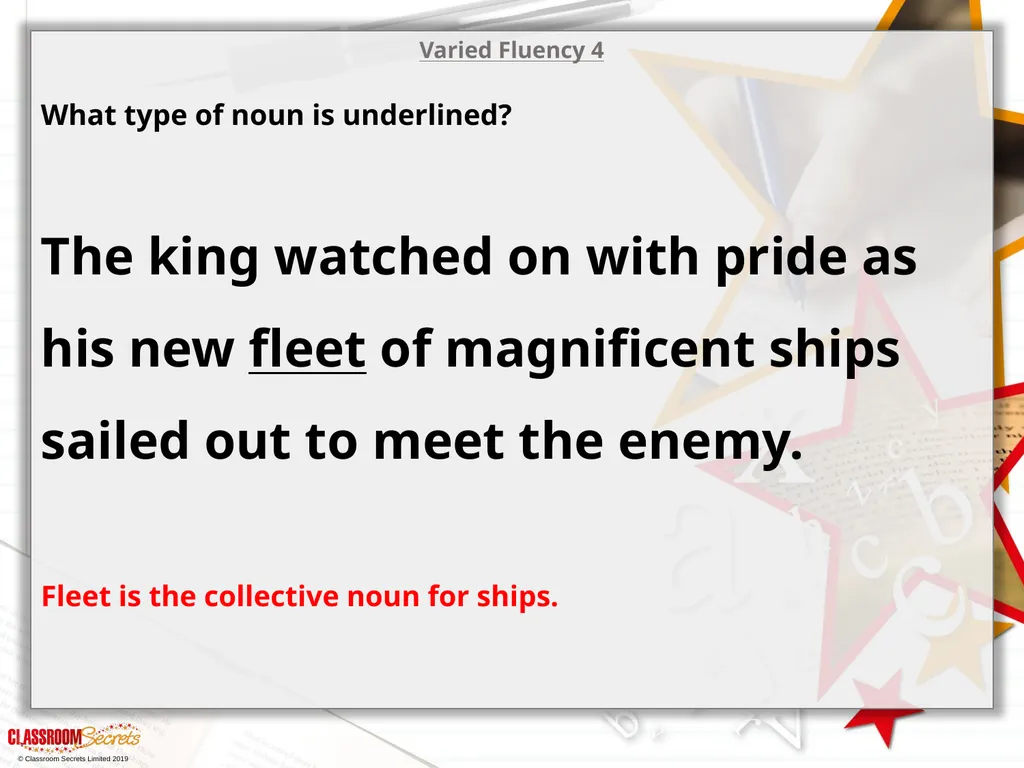
slide14. Varied Fluency 4
What type of noun is underlined?
The king watched on with pride as his new fleet of magnificent ships sailed out to meet the enemy.
Fleet is the collective noun for ships.<br>
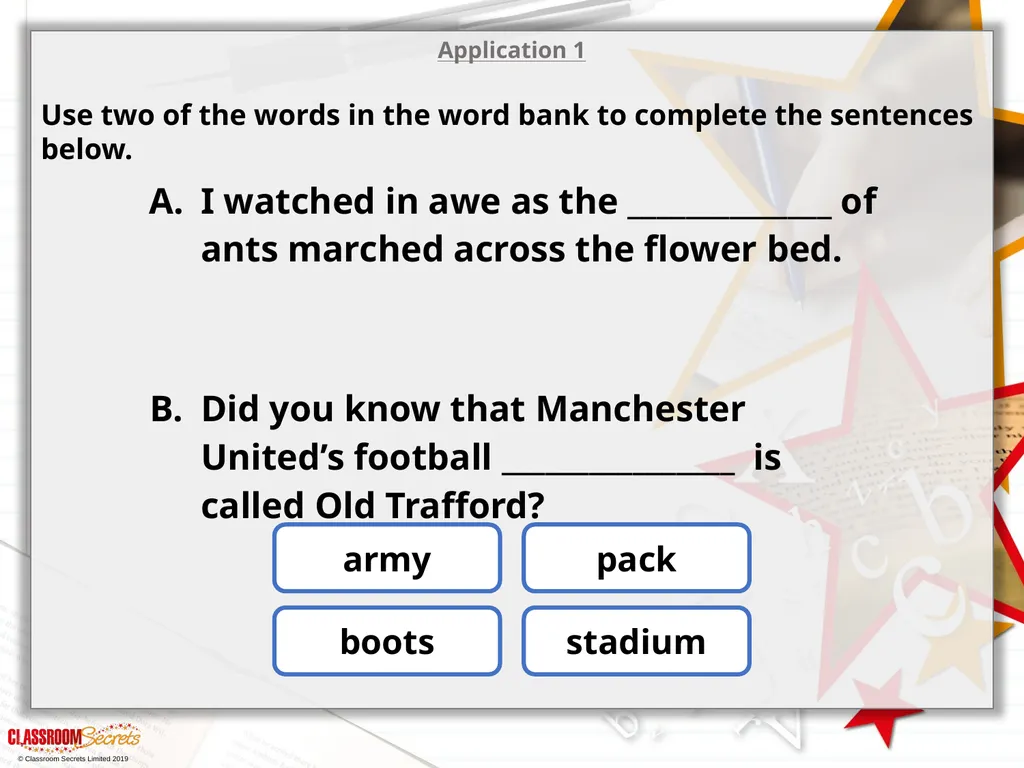
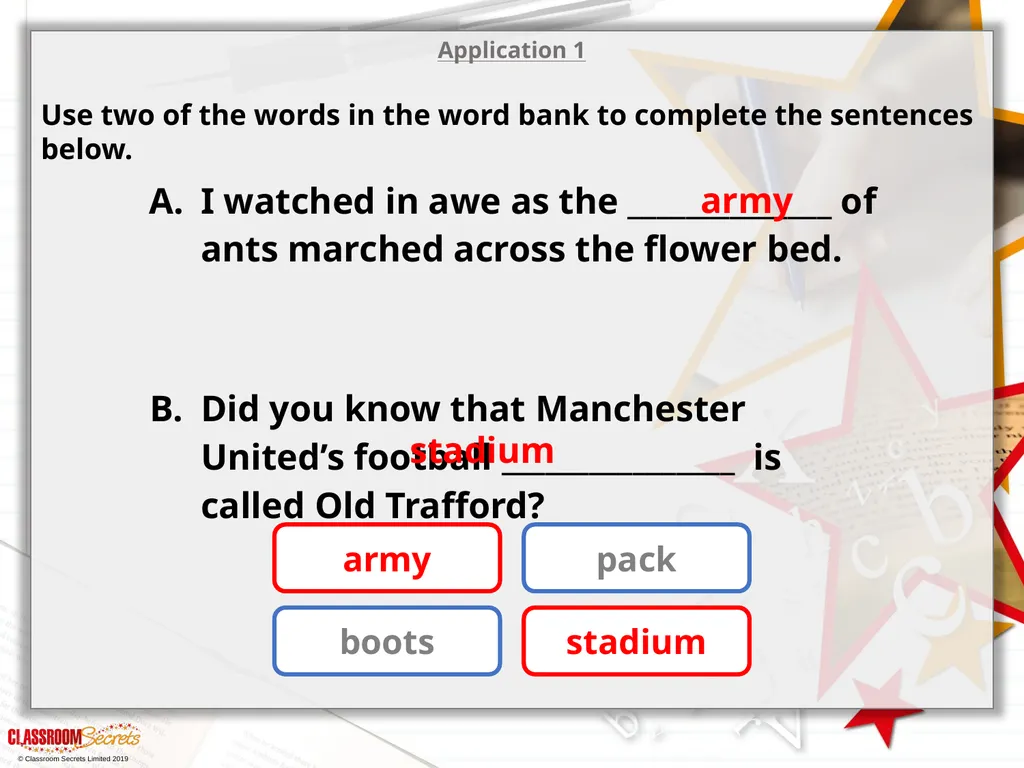
slide15. Application 1
Use two of the words in the word bank to complete the sentences below.<br>
slide16. Application 1
Use two of the words in the word bank to complete the sentences below. army stadium<br>
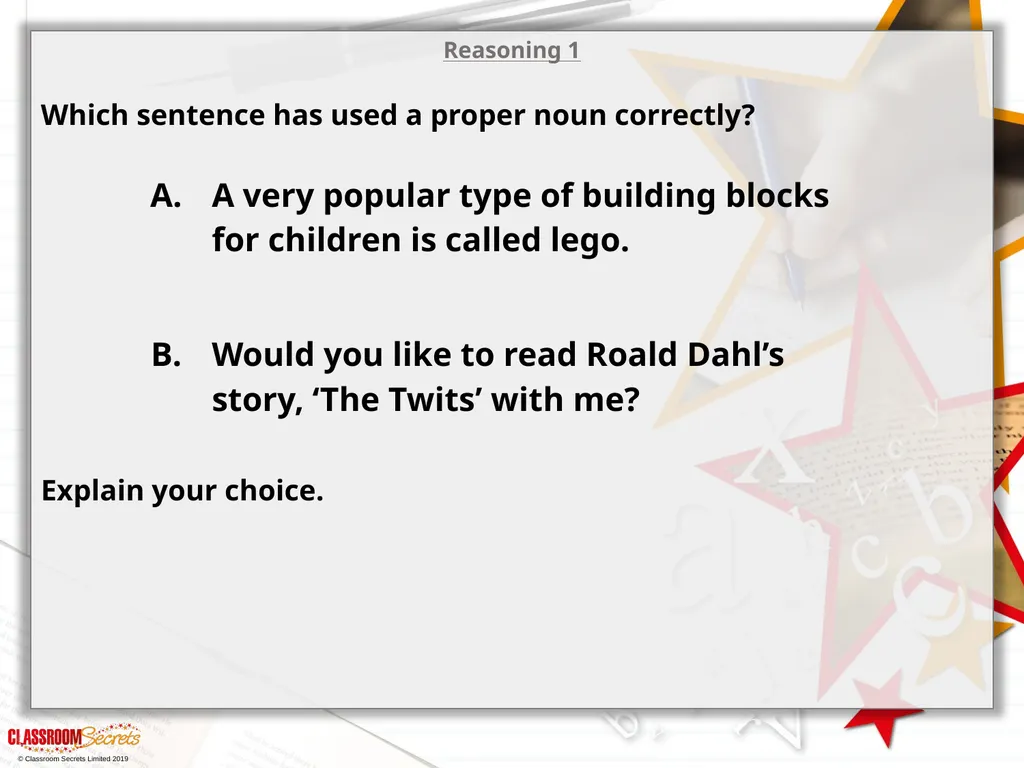
slide17. Reasoning 1
Which sentence has used a proper noun correctly?
Explain your choice.<br>
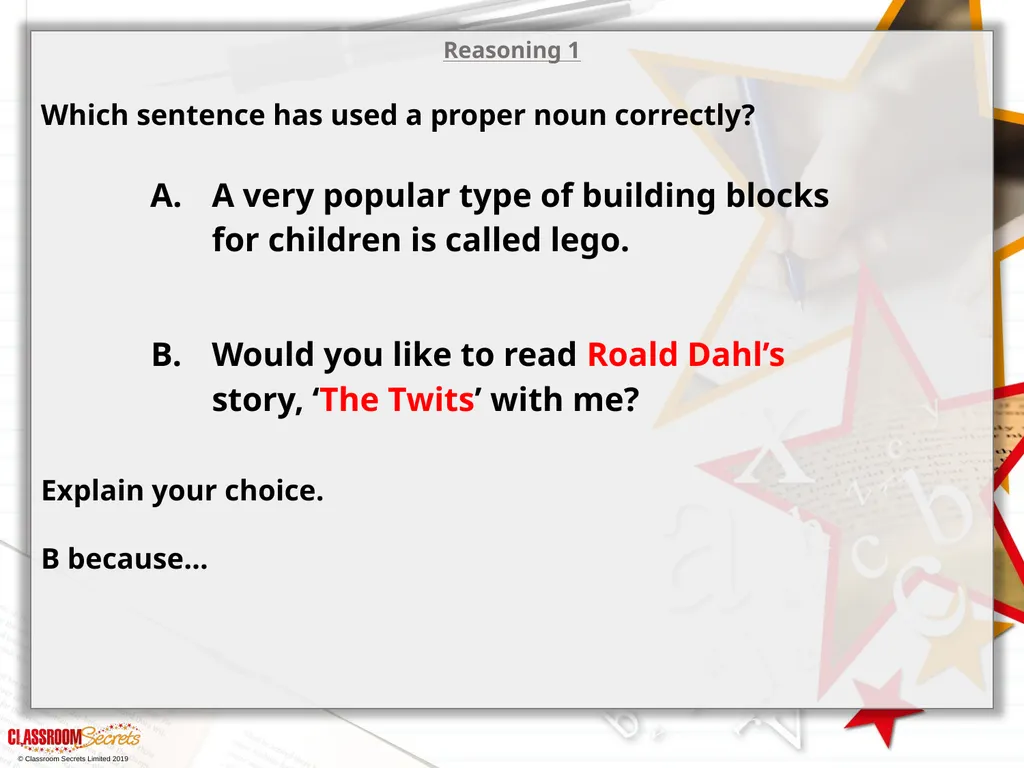
slide18. Reasoning 1
Which sentence has used a proper noun correctly?
Explain your choice.
B because…<br>
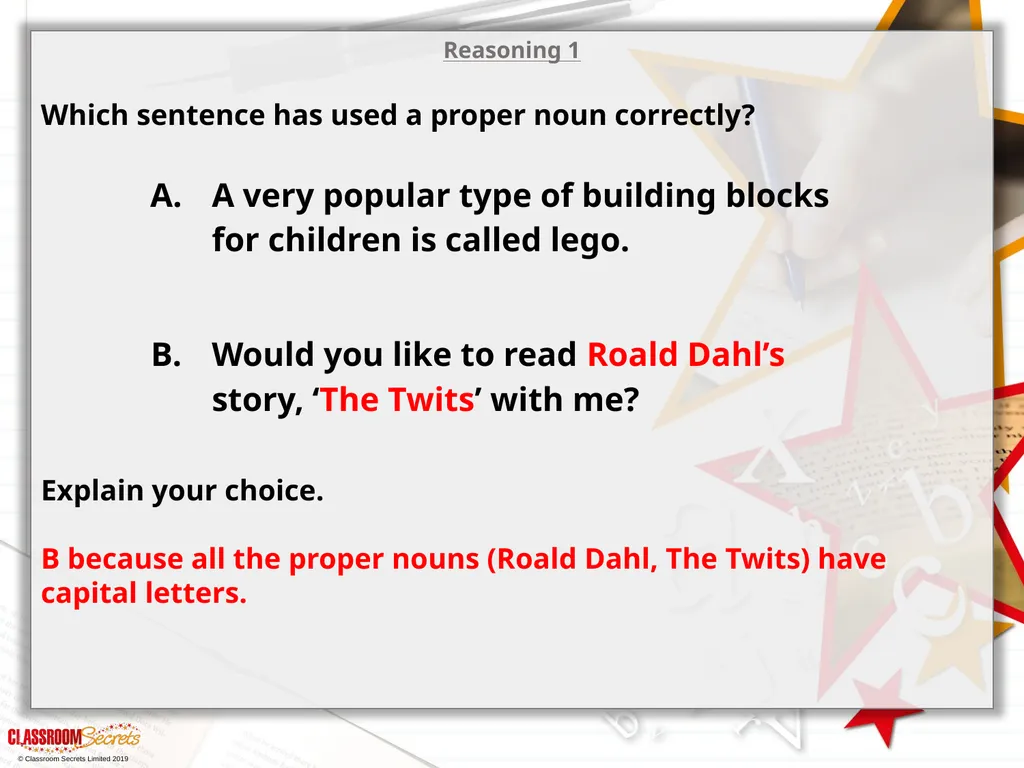
slide19. Reasoning 1
Which sentence has used a proper noun correctly?
Explain your choice.
B because all the proper nouns (Roald Dahl, The Twits) have capital letters.<br>
slide20. Reasoning 2
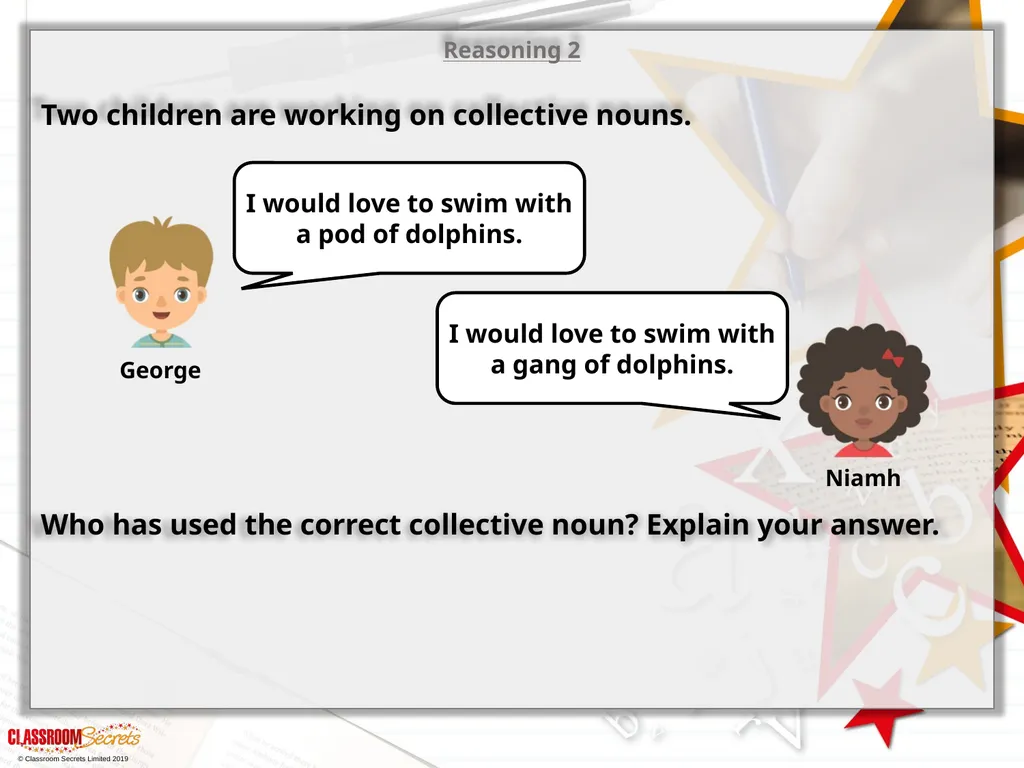
Two children are working on collective nouns.
Who has used the correct collective noun? Explain your answer. I would love to swim with a pod of dolphins. George I would love to swim with a gang of dolphins. Niamh<br>
slide21. Reasoning 2
Two children are working on collective nouns.
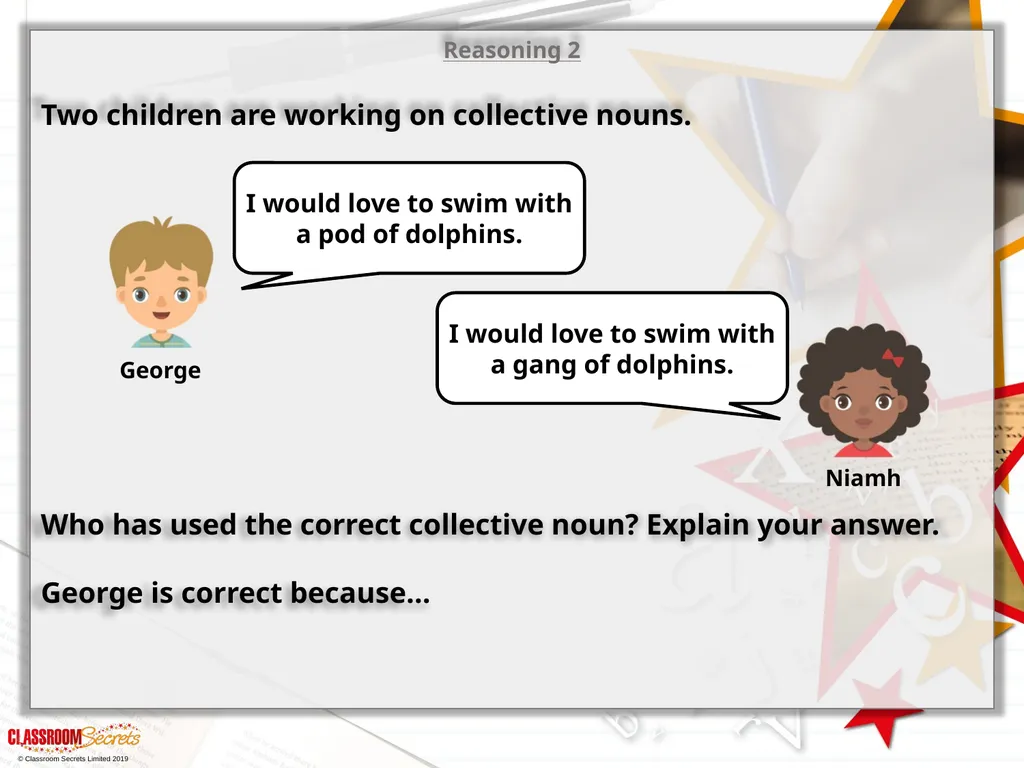
Who has used the correct collective noun? Explain your answer.
George is correct because… I would love to swim with a pod of dolphins. George I would love to swim with a gang of dolphins. Niamh<br>
slide22. Reasoning 2
Two children are working on collective nouns.
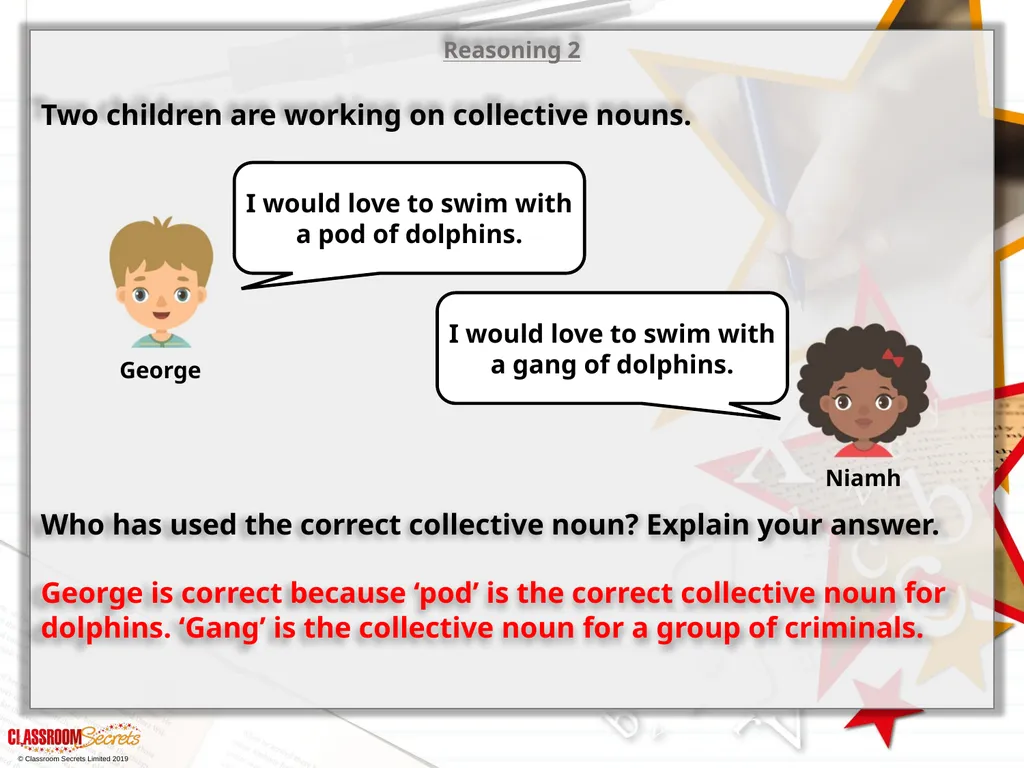
Who has used the correct collective noun? Explain your answer.
George is correct because ‘pod’ is the correct collective noun for dolphins. ‘Gang’ is the collective noun for a group of criminals. I would love to swim with a pod of dolphins. George I would love to swim with a gang of dolphins. Niamh<br>
We have started a #LIFEworkbalance campaign and we need your help to complete our LIFE/work balance survey.
We hope to publish the results soon, so please give 15 minutes of your time to help us get a true picture of school life.
Want to be a part of this campaign? Take the survey on our website and share it with your colleagues!<br>
slide2. Year 3 – Summer Block 1 – Nouns – Types of Nouns
About This Resource:
This PowerPoint has been designed to support your teaching of this small step. It includes a starter activity and an example of each question from the Varied Fluency and Application and Reasoning resources also provided in this pack. You can choose to work through all examples provided or a selection of them depending on the needs of your class.
National Curriculum Objectives:
No formal objective. However, these words are taken from the year 3/4 non-statutory spelling list and the focus is given to vocabulary of abstract concepts in line with the Spoken Language Guidance.
Spell words from the word list – years 3 and 4.
More resources from our Grammar, Punctuation and Spelling scheme of work.
Did you like this resource? Don’t forget to review it on our website.<br>
slide3. Year 3 – Summer Block 1 – Nouns – Types of Nouns
Notes and Guidance:
In Year 2 Autumn Block 3, children learnt about common, proper and collective nouns, and also noun phrases.
In this step, children will recap the different types of nouns.
Common nouns include everyday objects, people, places, animals etc. They do not require a capital letter.
Collective nouns refer to groups of things or people. For example: a swarm of bees, a crowd of people, a bunch of bananas.
Proper nouns are names given to particular people, places, religions, periods of history etc. They always require a capital letter. For example: I read the Bible; My grandfather died during World War 2; I am going to meet Isaac.<br>
slide4. Year 3 – Summer Block 1 – Nouns
Step 1: Types of Nouns<br>
slide5. Introduction
Sort these words into categories: nouns, verbs and adjectives. nouns verbs adjectives<br>
slide6. Introduction
Sort these words into categories: nouns, verbs and adjectives.<br>
slide7. Varied Fluency 1
Underline the two proper nouns in the sentence below.
Siobhan, would you like to come to Hightown with me to do some shopping?<br>
slide8. Varied Fluency 1
Underline the two proper nouns in the sentence below.
Siobhan, would you like to come to Hightown with me to do some shopping?<br>
slide9. Varied Fluency 2
Complete the sentence below using two common nouns.
On Tuesdays, when I get home from ______________ , I enjoy eating little sandwiches with strawberry __________ .<br>
slide10. Varied Fluency 2
Complete the sentence below using two common nouns.
Example answer:
On Tuesdays, when I get home from ______________ , I enjoy eating little sandwiches with strawberry __________ . school jam<br>
slide11. Varied Fluency 3
Match up the nouns to their correct type.<br>
slide12. Varied Fluency 3
Match up the nouns to their correct type.<br>
slide13. Varied Fluency 4
What type of noun is underlined?
The king watched on with pride as his new fleet of magnificent ships sailed out to meet the enemy.<br>
slide14. Varied Fluency 4
What type of noun is underlined?
The king watched on with pride as his new fleet of magnificent ships sailed out to meet the enemy.
Fleet is the collective noun for ships.<br>
slide15. Application 1
Use two of the words in the word bank to complete the sentences below.<br>
slide16. Application 1
Use two of the words in the word bank to complete the sentences below. army stadium<br>
slide17. Reasoning 1
Which sentence has used a proper noun correctly?
Explain your choice.<br>
slide18. Reasoning 1
Which sentence has used a proper noun correctly?
Explain your choice.
B because…<br>
slide19. Reasoning 1
Which sentence has used a proper noun correctly?
Explain your choice.
B because all the proper nouns (Roald Dahl, The Twits) have capital letters.<br>
slide20. Reasoning 2
Two children are working on collective nouns.
Who has used the correct collective noun? Explain your answer. I would love to swim with a pod of dolphins. George I would love to swim with a gang of dolphins. Niamh<br>
slide21. Reasoning 2
Two children are working on collective nouns.
Who has used the correct collective noun? Explain your answer.
George is correct because… I would love to swim with a pod of dolphins. George I would love to swim with a gang of dolphins. Niamh<br>
slide22. Reasoning 2
Two children are working on collective nouns.
Who has used the correct collective noun? Explain your answer.
George is correct because ‘pod’ is the correct collective noun for dolphins. ‘Gang’ is the collective noun for a group of criminals. I would love to swim with a pod of dolphins. George I would love to swim with a gang of dolphins. Niamh<br>