
LIFE/work balance We have started a




Description: LIFEwork balance We have started a LIFEworkbalance campaign and we need your help to complete our LIFEwork balance survey. We hope to publish the results soon, so please give 15 minutes of your time to help us get a true picture of
Related Topics
Download Presentation
"LIFE/work balance We have started a" is the property of its rightful owner. Permission is granted to download and print the materials on this website for personal, non-commercial use only, and to display it on your personal computer provided you do not modify the materials and that you retain all copyright notices contained in the materials. By downloading content from our website, you accept the terms of this agreement.
Presentation Transcript
slide1. LIFE/work balance
We have started a #LIFEworkbalance campaign and we need your help to complete our LIFE/work balance survey.
We hope to publish the results soon, so please give 15 minutes of your time to help us get a true picture of school life.
Want to be a part of this campaign? Take the survey on our website and share it with your colleagues!<br>
slide2. Year 6 – Spring Block 5 – Perimeter, Area and Volume – Area of a Parallelogram
About This Resource:
This PowerPoint has been designed to support your teaching of this small step. It includes a starter activity and an example of each question from the Varied Fluency and Reasoning and Problem Solving resources also provided in this pack. You can choose to work through all examples provided or a selection of them depending on the needs of your class.
National Curriculum Objectives:
Mathematics Year 6: (6M7b) Calculate the area of parallelograms and triangles
Mathematics Year 6: (6M7c) Recognise when it is possible to use formulae for the area of shapes
More Year 6 Perimeter, Area and Volume resources.
Did you like this resource? Don’t forget to review it on our website.<br>
slide3. Year 6 – Spring Block 5 – Perimeter, Area and Volume
Step 6: Area of a Parallelogram<br>
slide4. Introduction
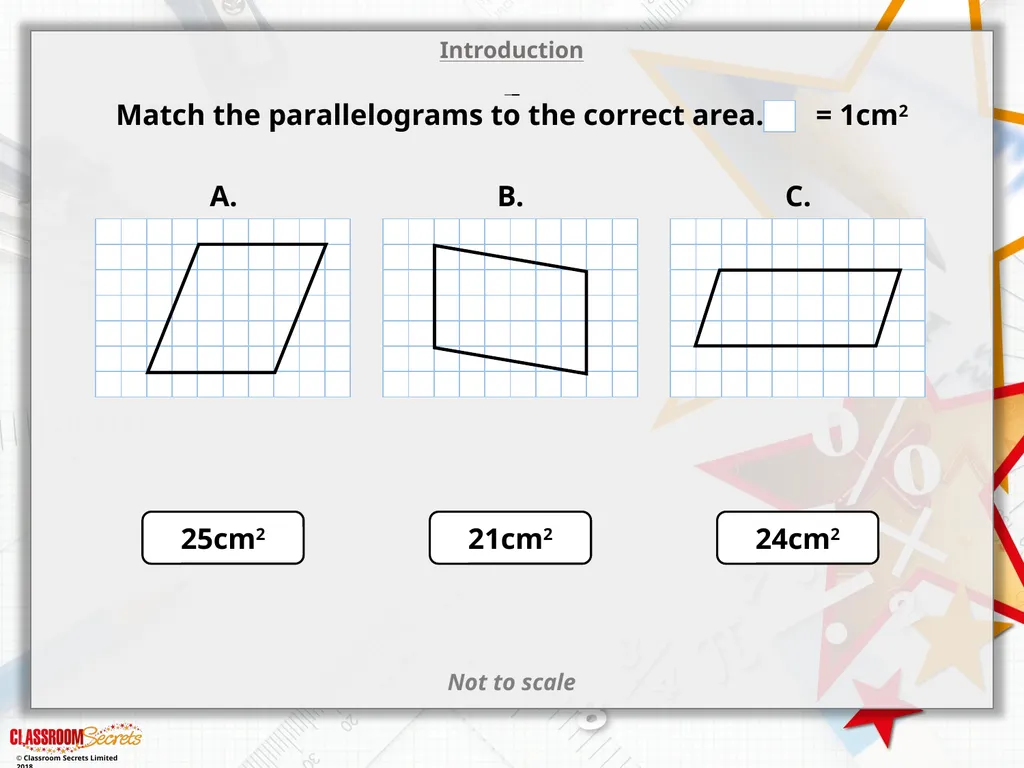
Match the parallelograms to the correct area. = 1cm2 A. B. C. 25cm2 21cm2 24cm2 Not to scale<br>
slide5. Introduction
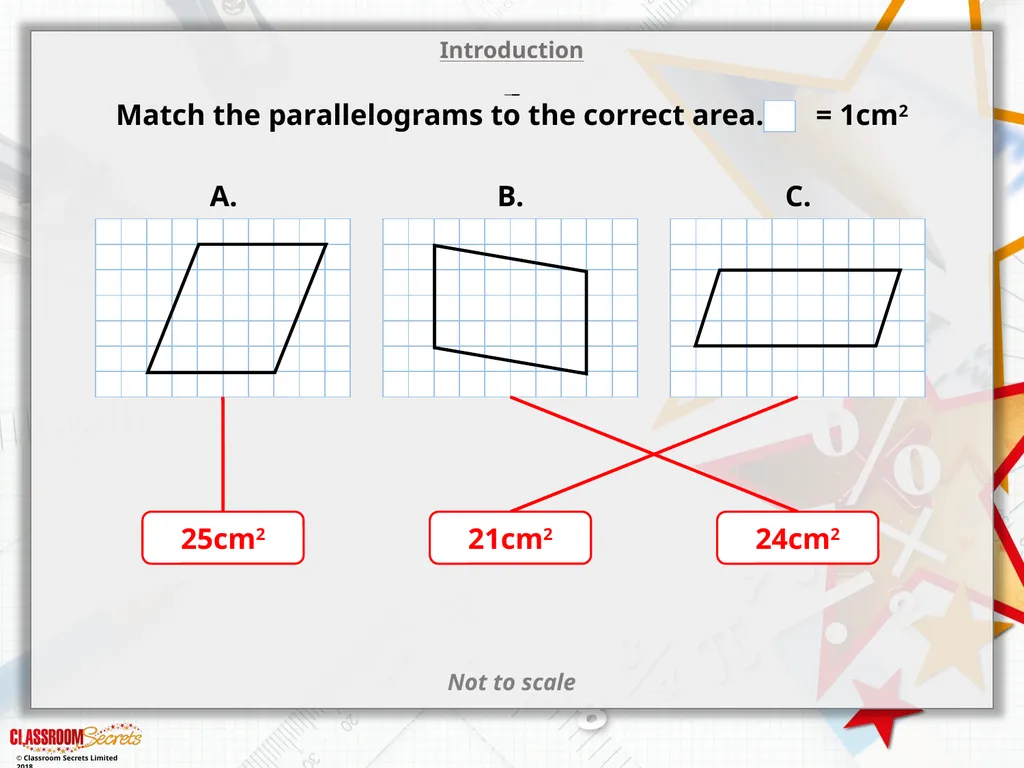
Match the parallelograms to the correct area. = 1cm2 A. B. C. 25cm2 21cm2 24cm2 Not to scale<br>
slide6. Varied Fluency 1
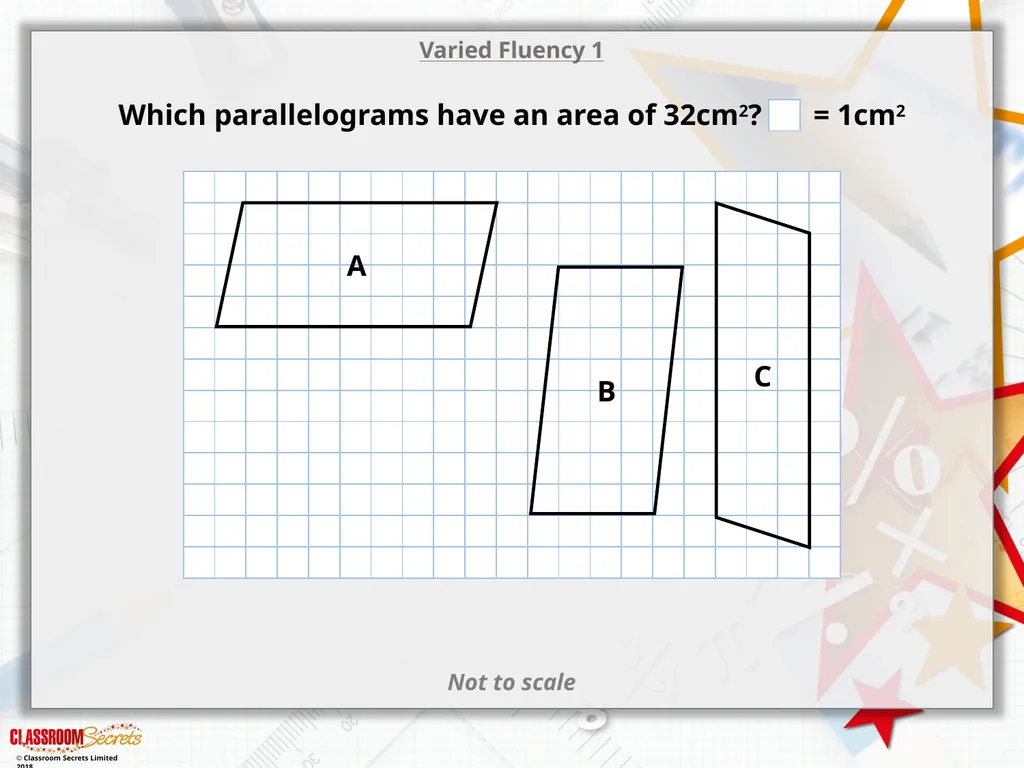
Which parallelograms have an area of 32cm2? = 1cm2 A B C Not to scale<br>
slide7. Varied Fluency 1
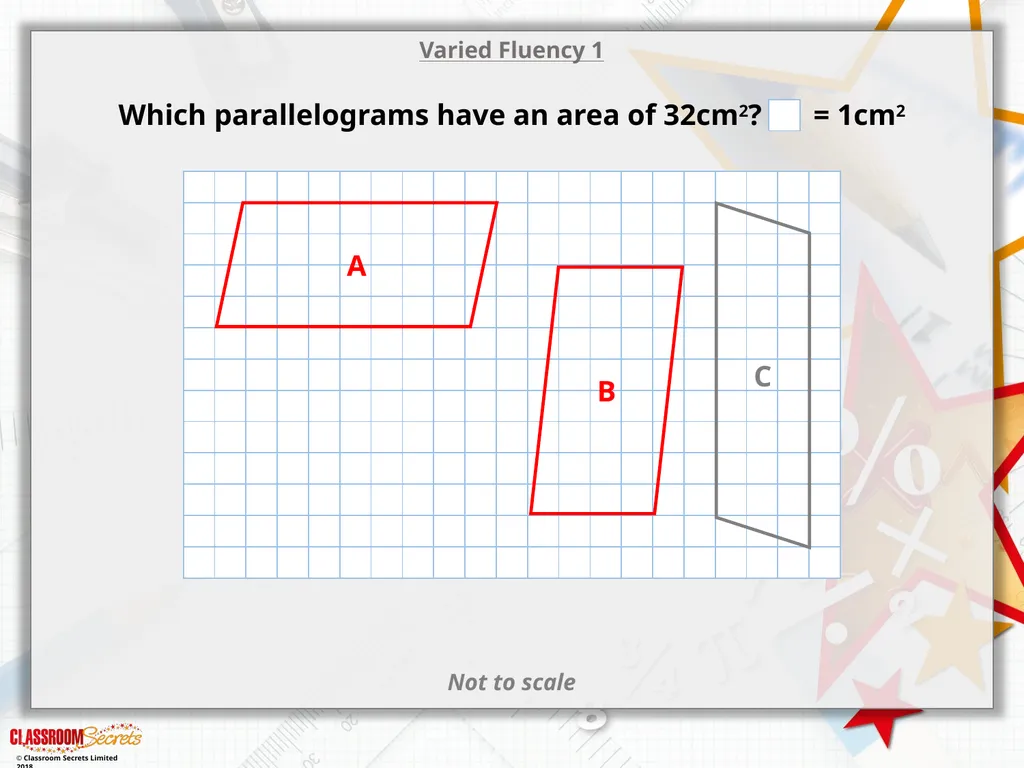
Which parallelograms have an area of 32cm2? = 1cm2
A and B A B C Not to scale<br>
slide8. Varied Fluency 2
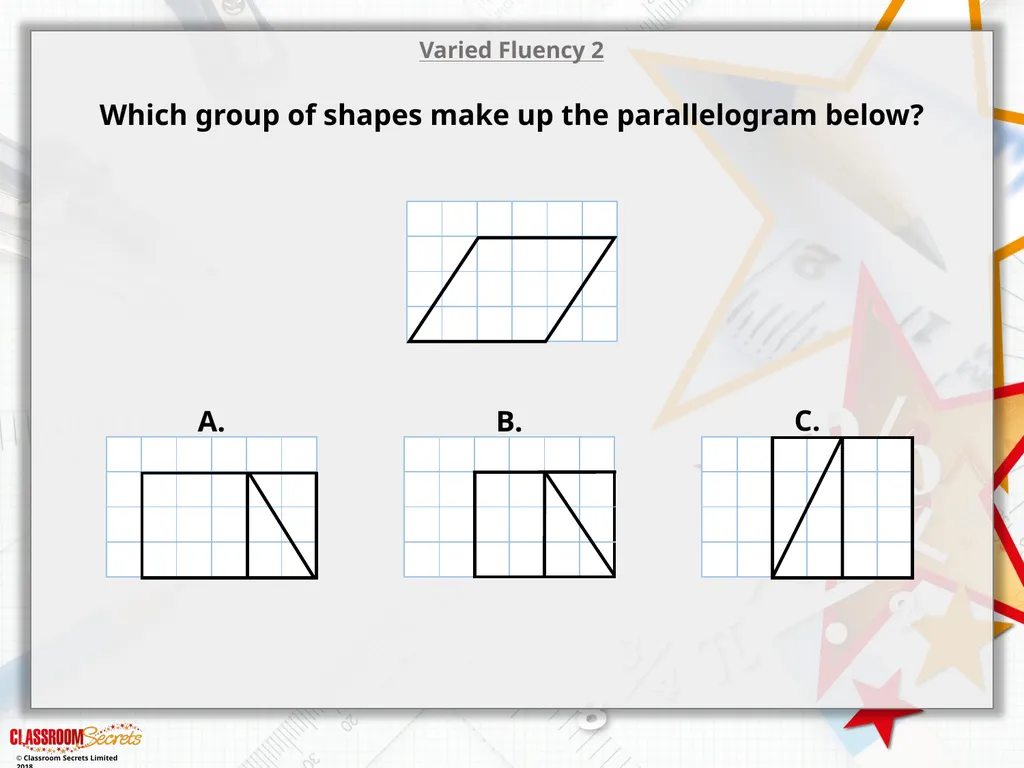
Which group of shapes make up the parallelogram below? A. B. C.<br>
slide9. Varied Fluency 2
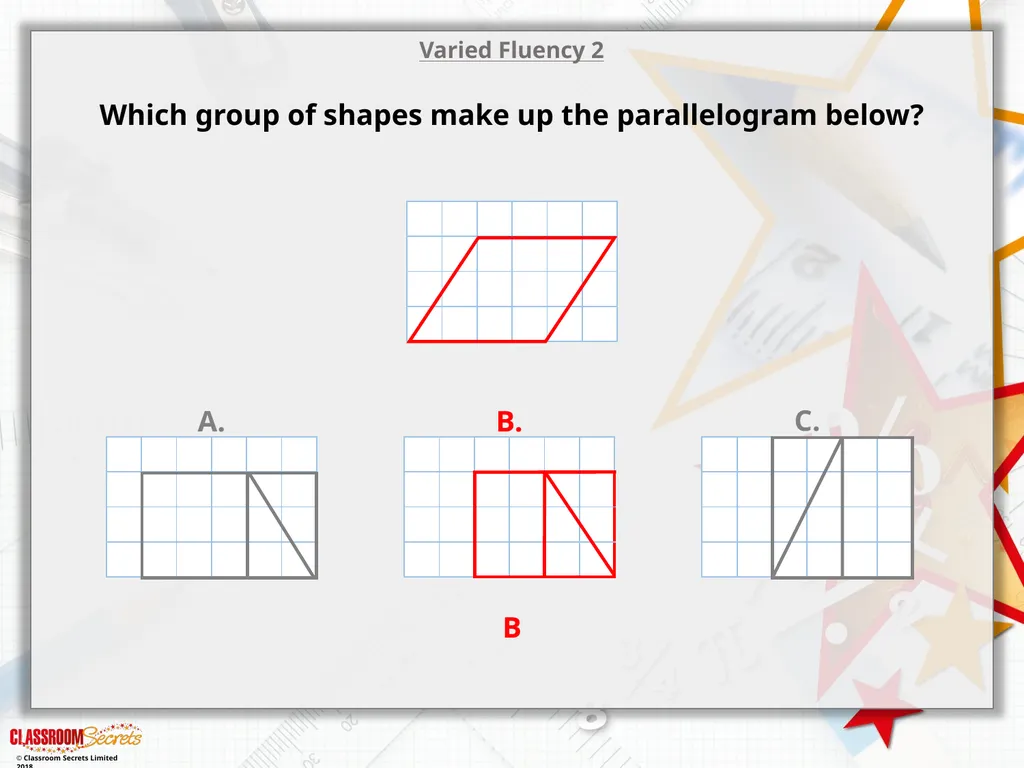
Which group of shapes make up the parallelogram below?
B A. B. C.<br>
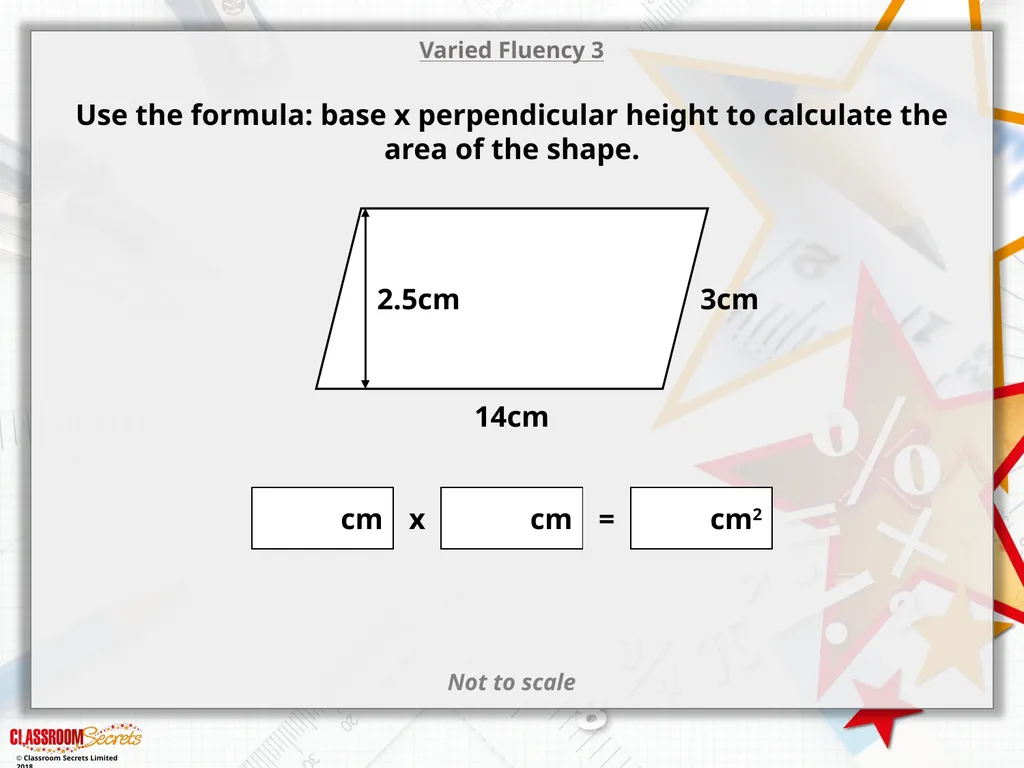
slide10. Varied Fluency 3
Use the formula: base x perpendicular height to calculate the area of the shape. 14cm 2.5cm 3cm Not to scale<br>
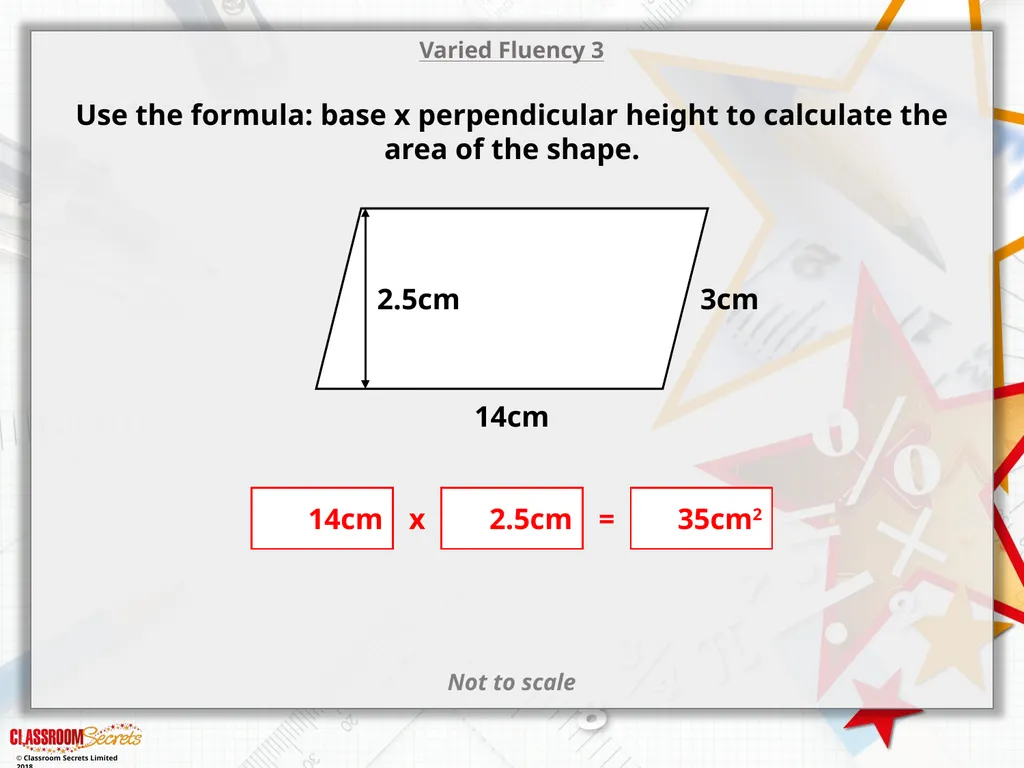
slide11. Varied Fluency 3
Use the formula: base x perpendicular height to calculate the area of the shape. 14cm 2.5cm 3cm Not to scale<br>
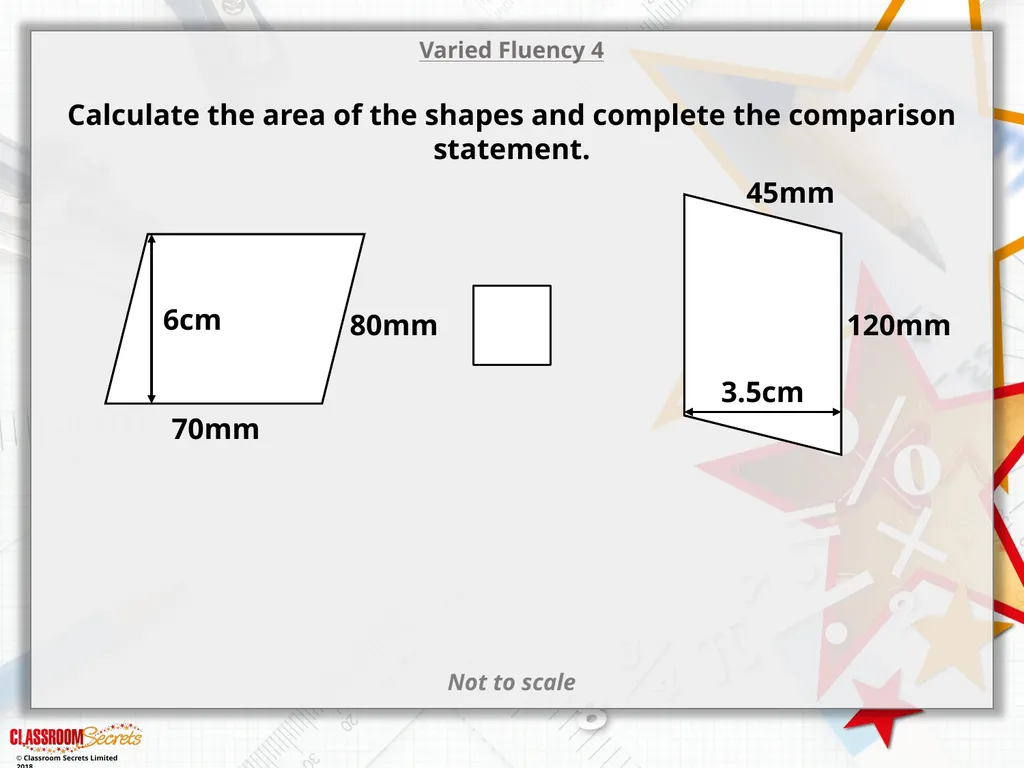
slide12. Varied Fluency 4
Calculate the area of the shapes and complete the comparison statement. 6cm 3.5cm 120mm 45mm 80mm 70mm Not to scale<br>
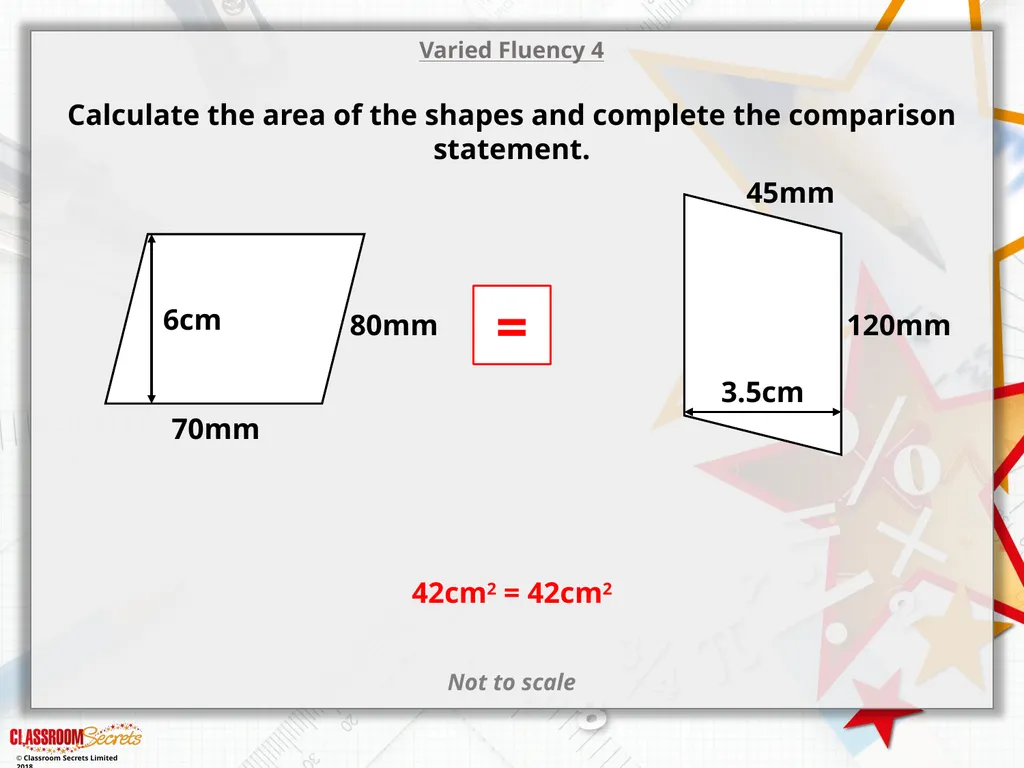
slide13. Varied Fluency 4
Calculate the area of the shapes and complete the comparison statement.
42cm2 = 42cm2 70mm 6cm 3.5cm 120mm = 45mm 80mm Not to scale<br>
slide14. Reasoning 1
Joshua says that half the area of the parallelogram below is 26m2.
Use the formula base x perpendicular height to prove whether Joshua is correct. 8cm 65mm 7cm Not to scale<br>
slide15. Reasoning 1
Joshua says that half the area of the parallelogram below is 26m2.
Use the formula base x perpendicular height to prove whether Joshua is correct.
Various answer, for example:
Joshua is correct because… 8cm 65mm 7cm Not to scale<br>
slide16. Reasoning 1
Joshua says that half the area of the parallelogram below is 26m2.
Use the formula base x perpendicular height to prove whether Joshua is correct.
Various answer, for example:
Joshua is correct because the area of the parallelogram is 8cm x 6.5cm = 52cm2, so half the area of the parallelogram is 52cm2 ÷ 2 = 26cm2. 8cm 65mm 7cm Not to scale<br>
slide17. Problem Solving 1
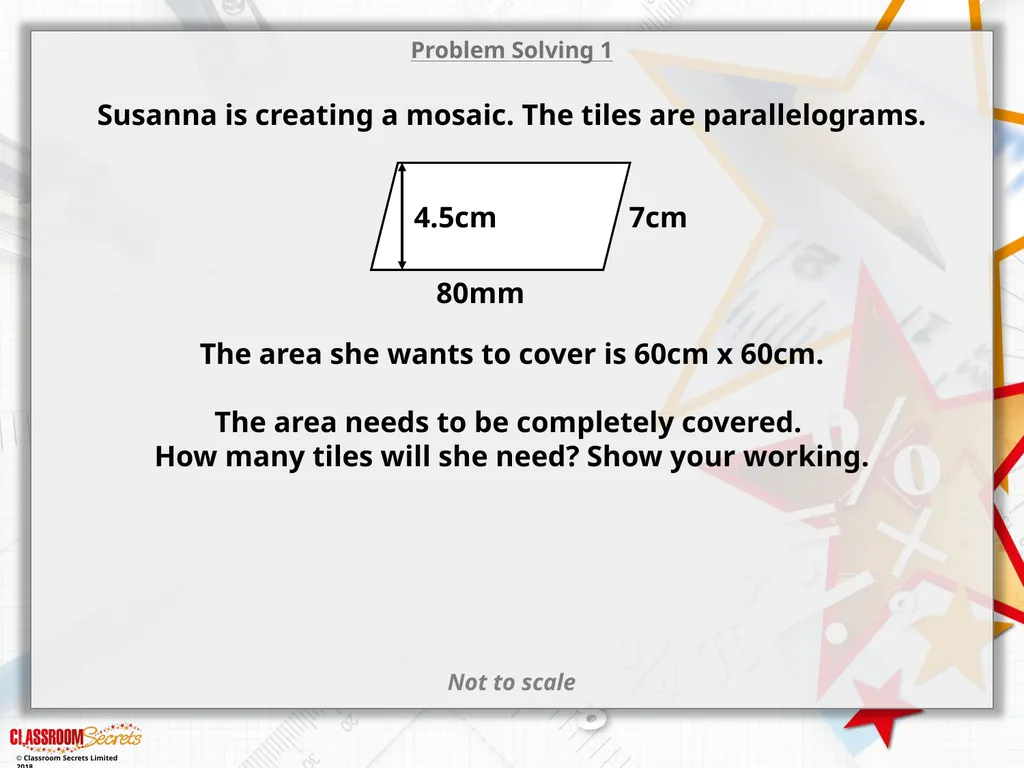
Susanna is creating a mosaic. The tiles are parallelograms.
The area she wants to cover is 60cm x 60cm.
The area needs to be completely covered.
How many tiles will she need? Show your working. 80mm 4.5cm 7cm Not to scale<br>
slide18. Problem Solving 1
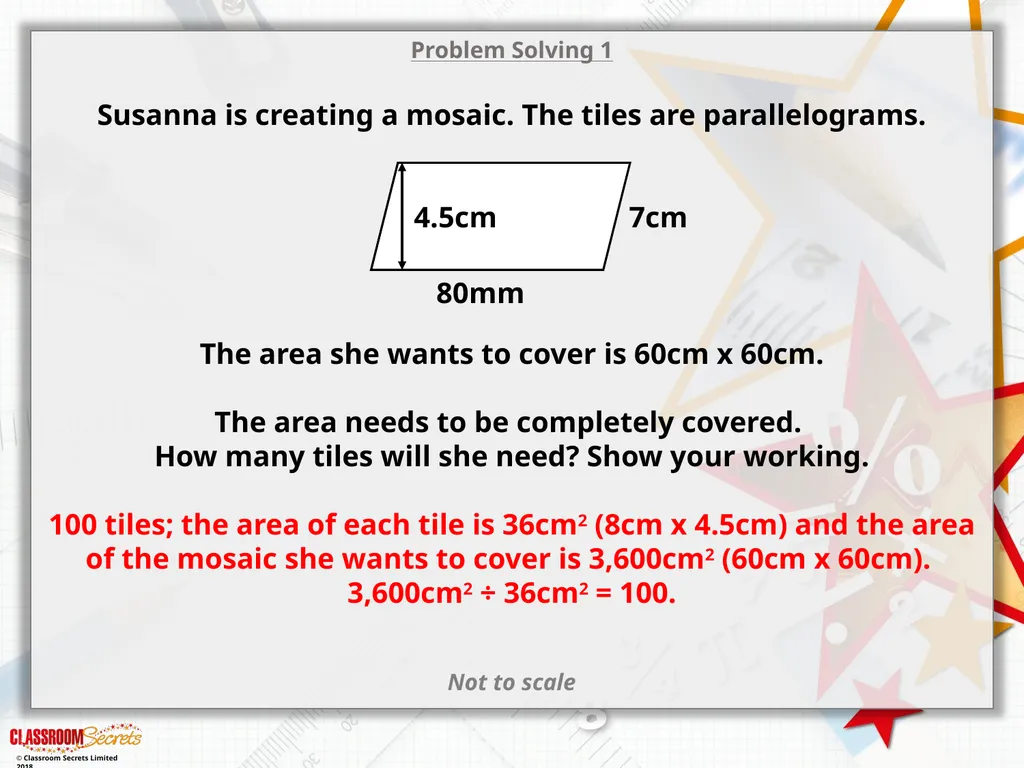
Susanna is creating a mosaic. The tiles are parallelograms.
The area she wants to cover is 60cm x 60cm.
The area needs to be completely covered.
How many tiles will she need? Show your working.
100 tiles; the area of each tile is 36cm2 (8cm x 4.5cm) and the area of the mosaic she wants to cover is 3,600cm2 (60cm x 60cm).
3,600cm2 ÷ 36cm2 = 100. 80mm 4.5cm 7cm Not to scale<br>
slide19. Reasoning 2
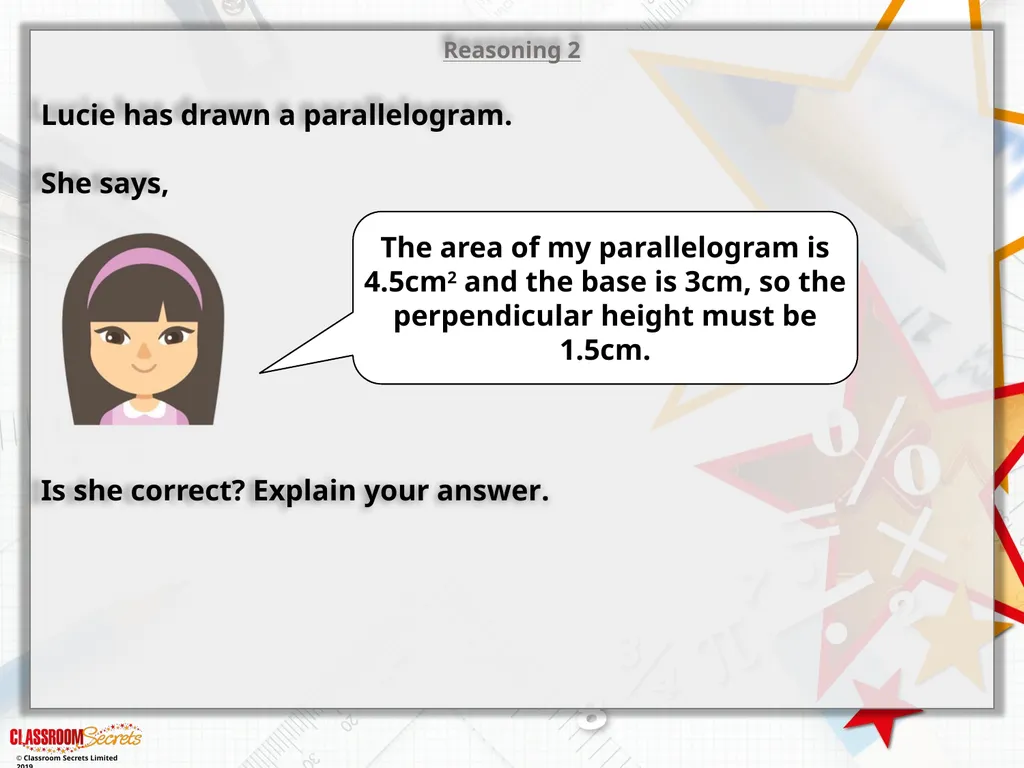
Lucie has drawn a parallelogram.
She says,
Is she correct? Explain your answer. The area of my parallelogram is 4.5cm2 and the base is 3cm, so the perpendicular height must be 1.5cm.<br>
slide20. Reasoning 2
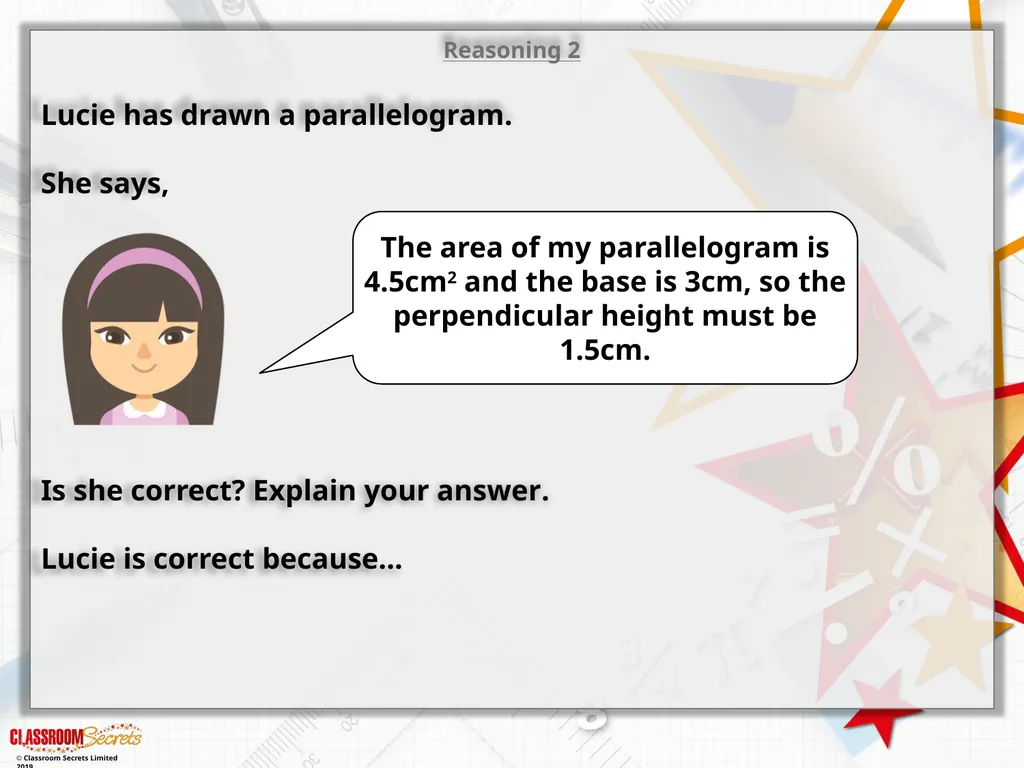
Lucie has drawn a parallelogram.
She says,
Is she correct? Explain your answer.
Lucie is correct because… The area of my parallelogram is 4.5cm2 and the base is 3cm, so the perpendicular height must be 1.5cm.<br>
slide21. Reasoning 2
Lucie has drawn a parallelogram.
She says,
Is she correct? Explain your answer.
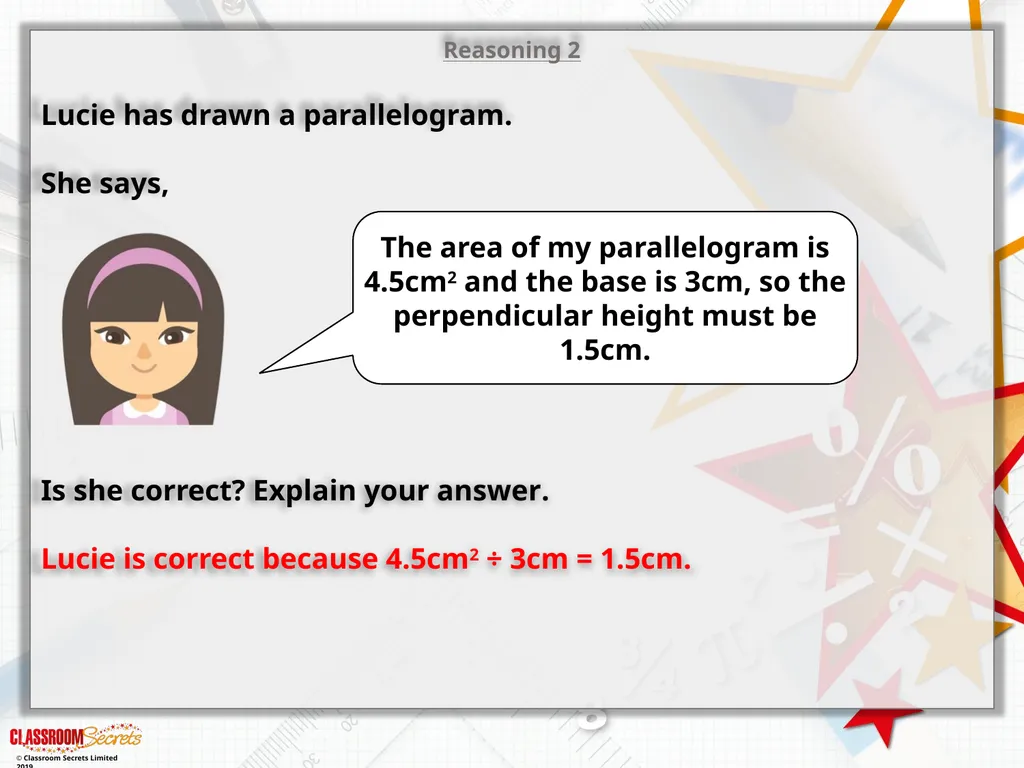
Lucie is correct because 4.5cm2 ÷ 3cm = 1.5cm. The area of my parallelogram is 4.5cm2 and the base is 3cm, so the perpendicular height must be 1.5cm.<br>
We have started a #LIFEworkbalance campaign and we need your help to complete our LIFE/work balance survey.
We hope to publish the results soon, so please give 15 minutes of your time to help us get a true picture of school life.
Want to be a part of this campaign? Take the survey on our website and share it with your colleagues!<br>
slide2. Year 6 – Spring Block 5 – Perimeter, Area and Volume – Area of a Parallelogram
About This Resource:
This PowerPoint has been designed to support your teaching of this small step. It includes a starter activity and an example of each question from the Varied Fluency and Reasoning and Problem Solving resources also provided in this pack. You can choose to work through all examples provided or a selection of them depending on the needs of your class.
National Curriculum Objectives:
Mathematics Year 6: (6M7b) Calculate the area of parallelograms and triangles
Mathematics Year 6: (6M7c) Recognise when it is possible to use formulae for the area of shapes
More Year 6 Perimeter, Area and Volume resources.
Did you like this resource? Don’t forget to review it on our website.<br>
slide3. Year 6 – Spring Block 5 – Perimeter, Area and Volume
Step 6: Area of a Parallelogram<br>
slide4. Introduction
Match the parallelograms to the correct area. = 1cm2 A. B. C. 25cm2 21cm2 24cm2 Not to scale<br>
slide5. Introduction
Match the parallelograms to the correct area. = 1cm2 A. B. C. 25cm2 21cm2 24cm2 Not to scale<br>
slide6. Varied Fluency 1
Which parallelograms have an area of 32cm2? = 1cm2 A B C Not to scale<br>
slide7. Varied Fluency 1
Which parallelograms have an area of 32cm2? = 1cm2
A and B A B C Not to scale<br>
slide8. Varied Fluency 2
Which group of shapes make up the parallelogram below? A. B. C.<br>
slide9. Varied Fluency 2
Which group of shapes make up the parallelogram below?
B A. B. C.<br>
slide10. Varied Fluency 3
Use the formula: base x perpendicular height to calculate the area of the shape. 14cm 2.5cm 3cm Not to scale<br>
slide11. Varied Fluency 3
Use the formula: base x perpendicular height to calculate the area of the shape. 14cm 2.5cm 3cm Not to scale<br>
slide12. Varied Fluency 4
Calculate the area of the shapes and complete the comparison statement. 6cm 3.5cm 120mm 45mm 80mm 70mm Not to scale<br>
slide13. Varied Fluency 4
Calculate the area of the shapes and complete the comparison statement.
42cm2 = 42cm2 70mm 6cm 3.5cm 120mm = 45mm 80mm Not to scale<br>
slide14. Reasoning 1
Joshua says that half the area of the parallelogram below is 26m2.
Use the formula base x perpendicular height to prove whether Joshua is correct. 8cm 65mm 7cm Not to scale<br>
slide15. Reasoning 1
Joshua says that half the area of the parallelogram below is 26m2.
Use the formula base x perpendicular height to prove whether Joshua is correct.
Various answer, for example:
Joshua is correct because… 8cm 65mm 7cm Not to scale<br>
slide16. Reasoning 1
Joshua says that half the area of the parallelogram below is 26m2.
Use the formula base x perpendicular height to prove whether Joshua is correct.
Various answer, for example:
Joshua is correct because the area of the parallelogram is 8cm x 6.5cm = 52cm2, so half the area of the parallelogram is 52cm2 ÷ 2 = 26cm2. 8cm 65mm 7cm Not to scale<br>
slide17. Problem Solving 1
Susanna is creating a mosaic. The tiles are parallelograms.
The area she wants to cover is 60cm x 60cm.
The area needs to be completely covered.
How many tiles will she need? Show your working. 80mm 4.5cm 7cm Not to scale<br>
slide18. Problem Solving 1
Susanna is creating a mosaic. The tiles are parallelograms.
The area she wants to cover is 60cm x 60cm.
The area needs to be completely covered.
How many tiles will she need? Show your working.
100 tiles; the area of each tile is 36cm2 (8cm x 4.5cm) and the area of the mosaic she wants to cover is 3,600cm2 (60cm x 60cm).
3,600cm2 ÷ 36cm2 = 100. 80mm 4.5cm 7cm Not to scale<br>
slide19. Reasoning 2
Lucie has drawn a parallelogram.
She says,
Is she correct? Explain your answer. The area of my parallelogram is 4.5cm2 and the base is 3cm, so the perpendicular height must be 1.5cm.<br>
slide20. Reasoning 2
Lucie has drawn a parallelogram.
She says,
Is she correct? Explain your answer.
Lucie is correct because… The area of my parallelogram is 4.5cm2 and the base is 3cm, so the perpendicular height must be 1.5cm.<br>
slide21. Reasoning 2
Lucie has drawn a parallelogram.
She says,
Is she correct? Explain your answer.
Lucie is correct because 4.5cm2 ÷ 3cm = 1.5cm. The area of my parallelogram is 4.5cm2 and the base is 3cm, so the perpendicular height must be 1.5cm.<br>