
LIFE/work balance We have started a
Description: LIFEwork balance We have started a LIFEworkbalance campaign and we need your help to complete our LIFEwork balance survey. We hope to publish the results soon, so please give 15 minutes of your time to help us get a true picture of
Related Topics
Download Presentation
"LIFE/work balance We have started a" is the property of its rightful owner. Permission is granted to download and print the materials on this website for personal, non-commercial use only, and to display it on your personal computer provided you do not modify the materials and that you retain all copyright notices contained in the materials. By downloading content from our website, you accept the terms of this agreement.
Presentation Transcript
slide1. LIFE/work balance
We have started a #LIFEworkbalance campaign and we need your help to complete our LIFE/work balance survey.
We hope to publish the results soon, so please give 15 minutes of your time to help us get a true picture of school life.
Want to be a part of this campaign? Take the survey on our website and share it with your colleagues! © Classroom Secrets Limited 2019<br>
slide2. Year 2 – Autumn Block 5 – Sentence Types 1 – Recognising Commands
About This Resource:
This PowerPoint has been designed to support your teaching of this small step. It includes a starter activity and an example of each question from the Varied Fluency and Application and Reasoning resources also provided in this pack. You can choose to work through all examples provided or a selection of them depending on the needs of your class.
National Curriculum Objectives:
English Year 2: ((2G2.3) How the grammatical patterns in a sentence indicate its function as a command
Terminology for pupils:
English Year 2: (2G2.3) command
More resources from our Grammar, Punctuation and Spelling scheme of work.
Did you like this resource? Don’t forget to review it on our website. © Classroom Secrets Limited 2018<br>
slide3. Year 2 – Autumn Block 5 – Sentence Types 1 – Recognising Commands
Notes and Guidance
From Year 1, children should know how to recognise and use one word commands with exclamations.
The main focus of this step is recognising commands using simple verbs, and how and where commands may be used.
In this step, children should recognise different verbs that can be used to form a more detailed command. For example: Stand over there. Sit on the carpet.
Children should begin to recognise that a command can be demarcated using either a full stop or an exclamation mark depending on its meaning, such as a polite request versus a direct order. For example, ‘Stop that!’ compared to ‘Walk quietly in school please.’
When used in a command sentence, verbs should be in the imperative form.
Focused Questions
What is a command?
Is this sentence a command? How do you know?
Does this command need an exclamation mark or a full stop? How do you know? © Classroom Secrets Limited 2018<br>
slide4. Year 2 – Autumn Block 5 – Sentence Types 1
Step 3: Recognising Commands © Classroom Secrets Limited 2018<br>
slide5. Introduction
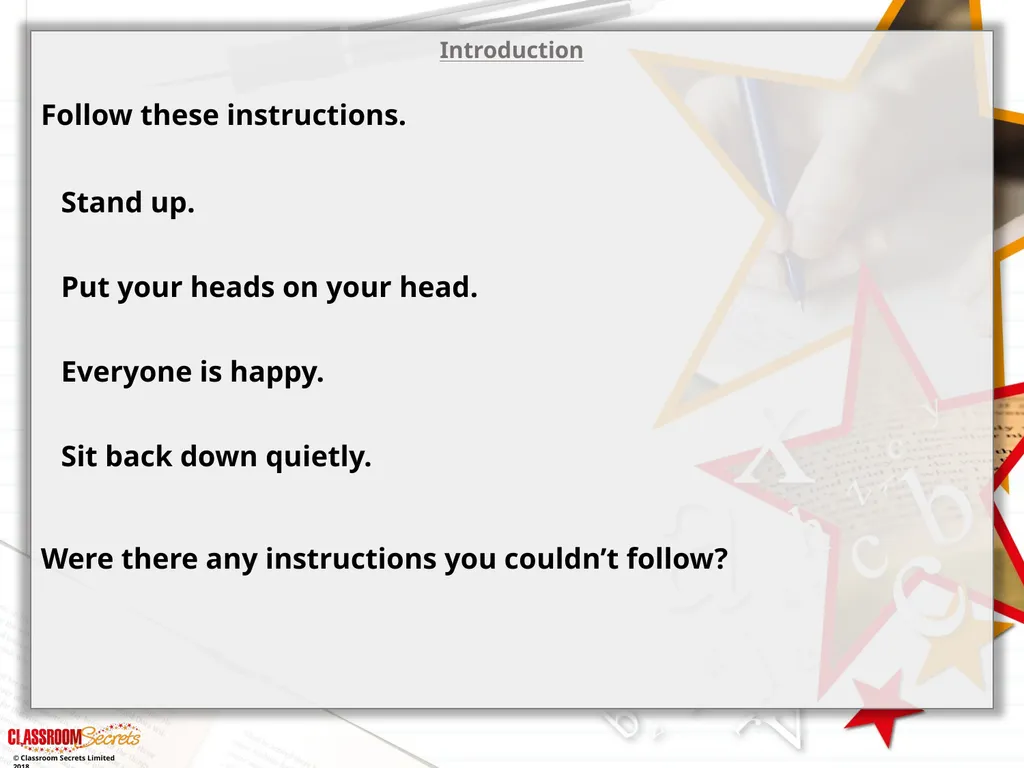
Follow these instructions.
Were there any instructions you couldn’t follow? © Classroom Secrets Limited 2018<br>
slide6. Introduction
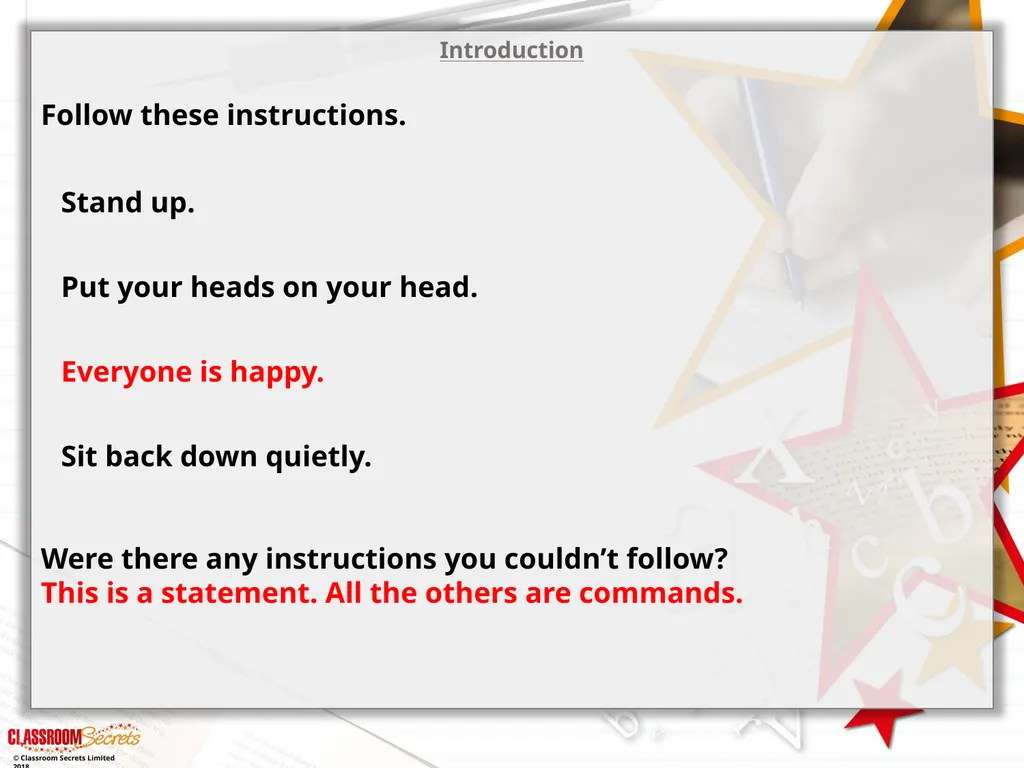
Follow these instructions.
Were there any instructions you couldn’t follow?
This is a statement. All the others are commands. © Classroom Secrets Limited 2018<br>
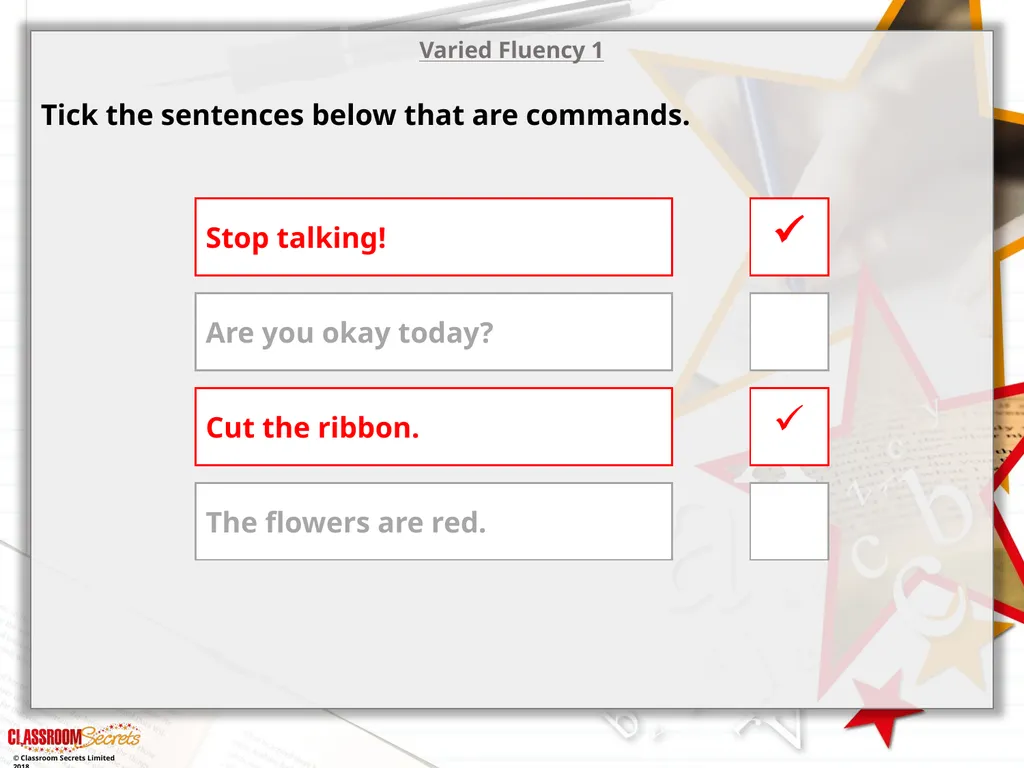
slide7. Varied Fluency 1
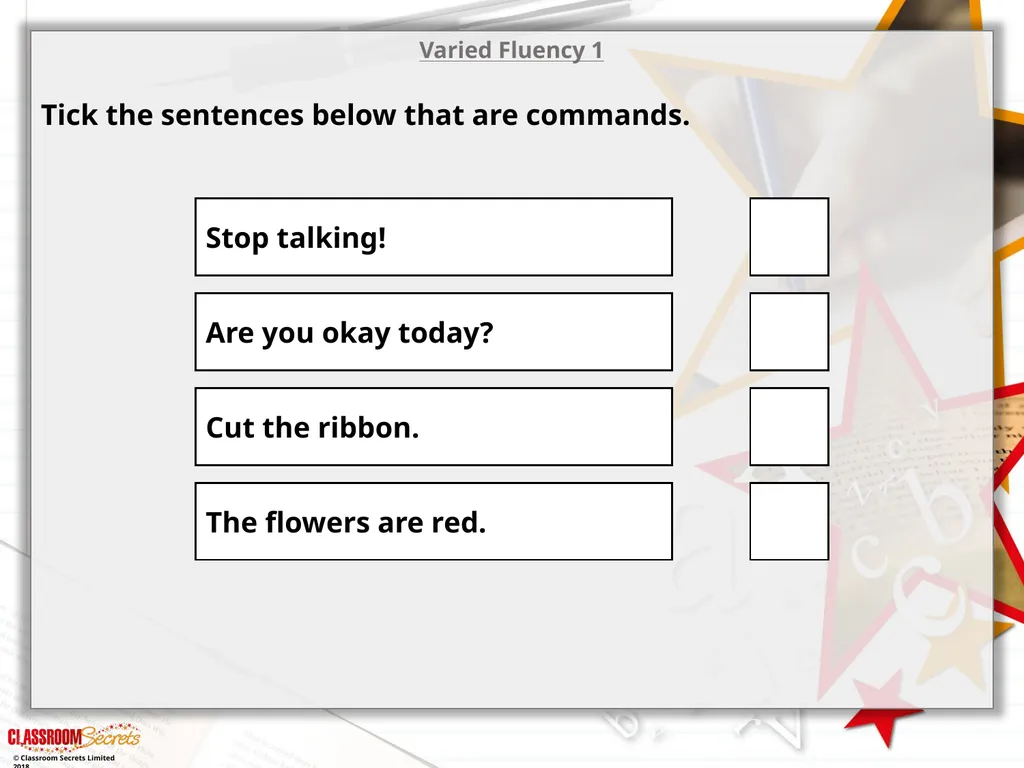
Tick the sentences below that are commands. © Classroom Secrets Limited 2018<br>
slide8. Varied Fluency 1
Tick the sentences below that are commands. © Classroom Secrets Limited 2018<br>
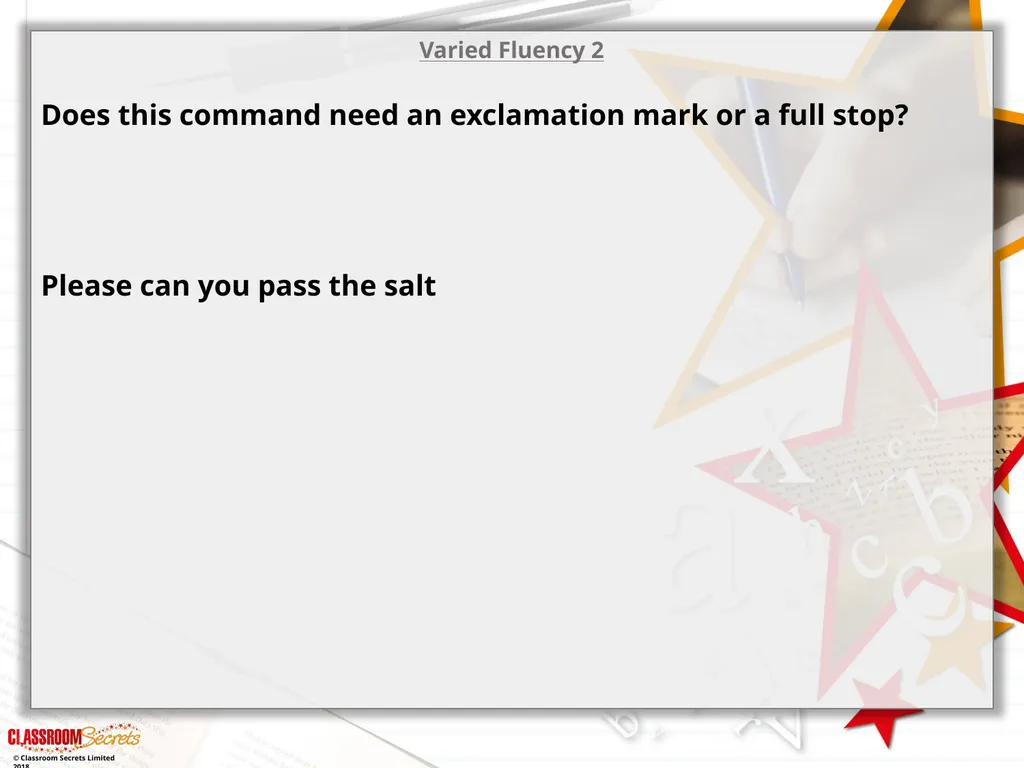
slide9. Varied Fluency 2
Does this command need an exclamation mark or a full stop?
Please can you pass the salt © Classroom Secrets Limited 2018<br>
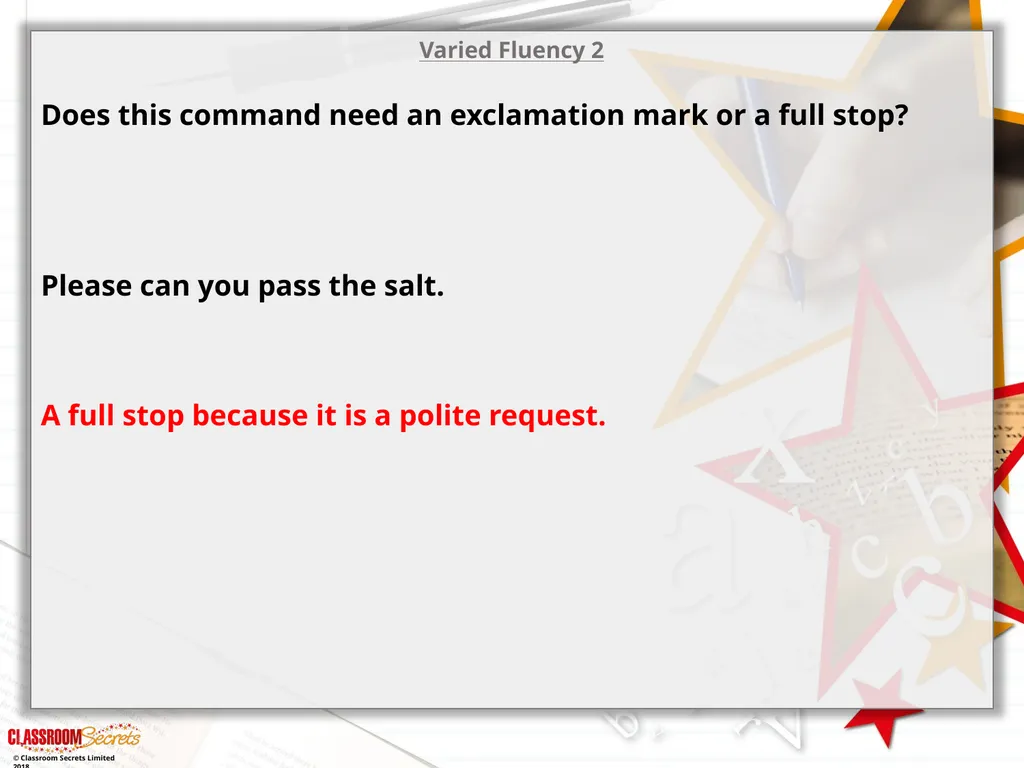
slide10. Varied Fluency 2
Does this command need an exclamation mark or a full stop?
Please can you pass the salt.
A full stop because it is a polite request. © Classroom Secrets Limited 2018<br>
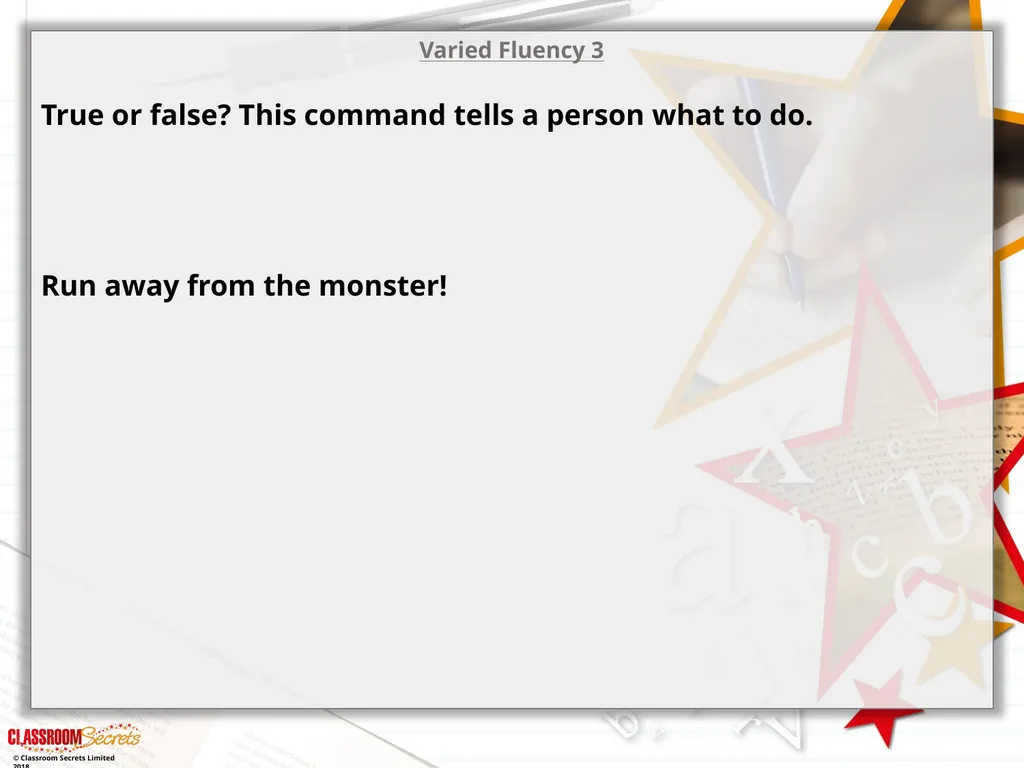
slide11. Varied Fluency 3
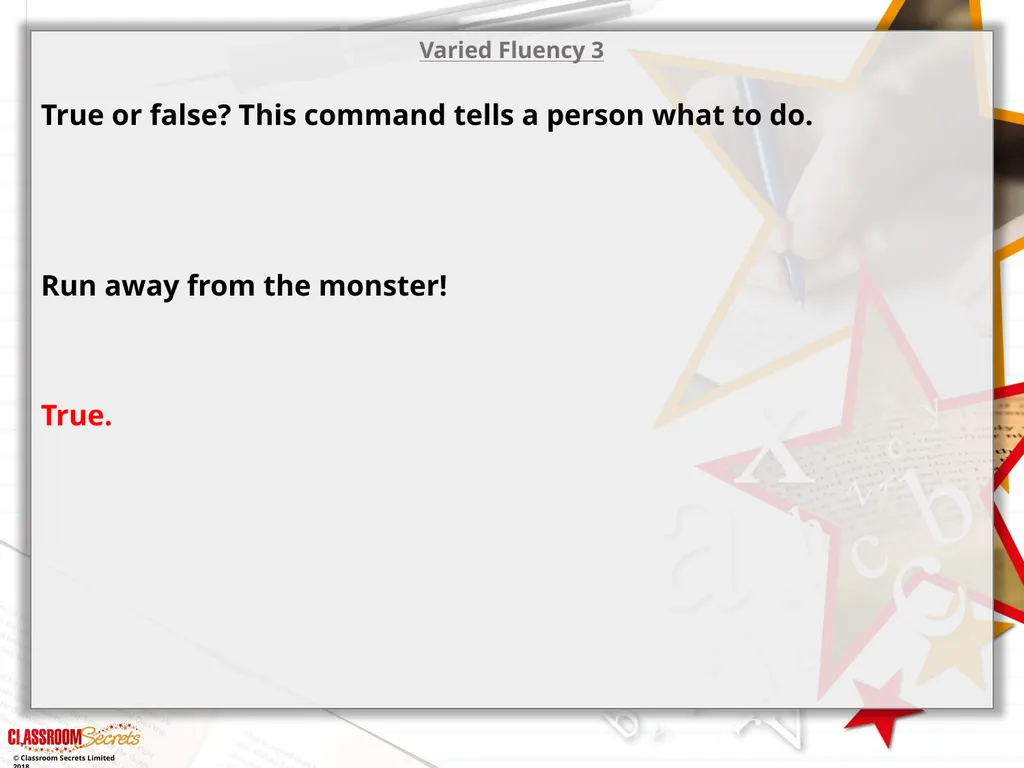
True or false? This command tells a person what to do.
Run away from the monster! © Classroom Secrets Limited 2018<br>
slide12. Varied Fluency 3
True or false? This command tells a person what to do.
Run away from the monster!
True. © Classroom Secrets Limited 2018<br>
slide13. Varied Fluency 4
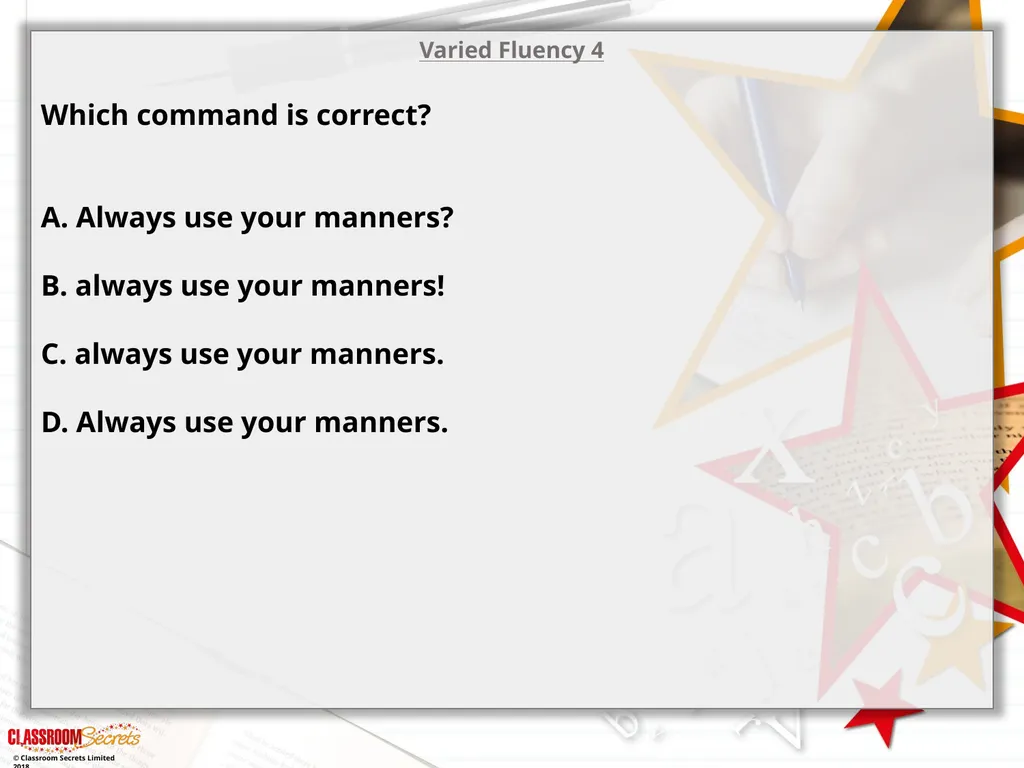
Which command is correct?
A. Always use your manners?
B. always use your manners!
C. always use your manners.
D. Always use your manners. © Classroom Secrets Limited 2018<br>
slide14. Varied Fluency 4
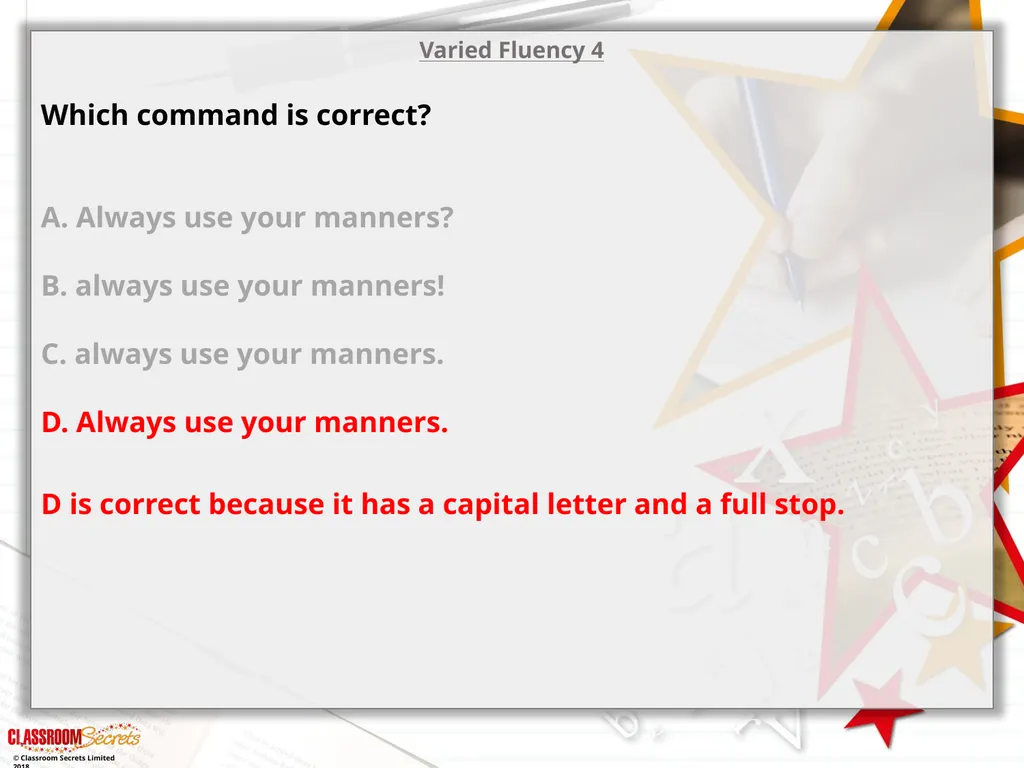
Which command is correct?
A. Always use your manners?
B. always use your manners!
C. always use your manners.
D. Always use your manners.
D is correct because it has a capital letter and a full stop. © Classroom Secrets Limited 2018<br>
slide15. Application 1
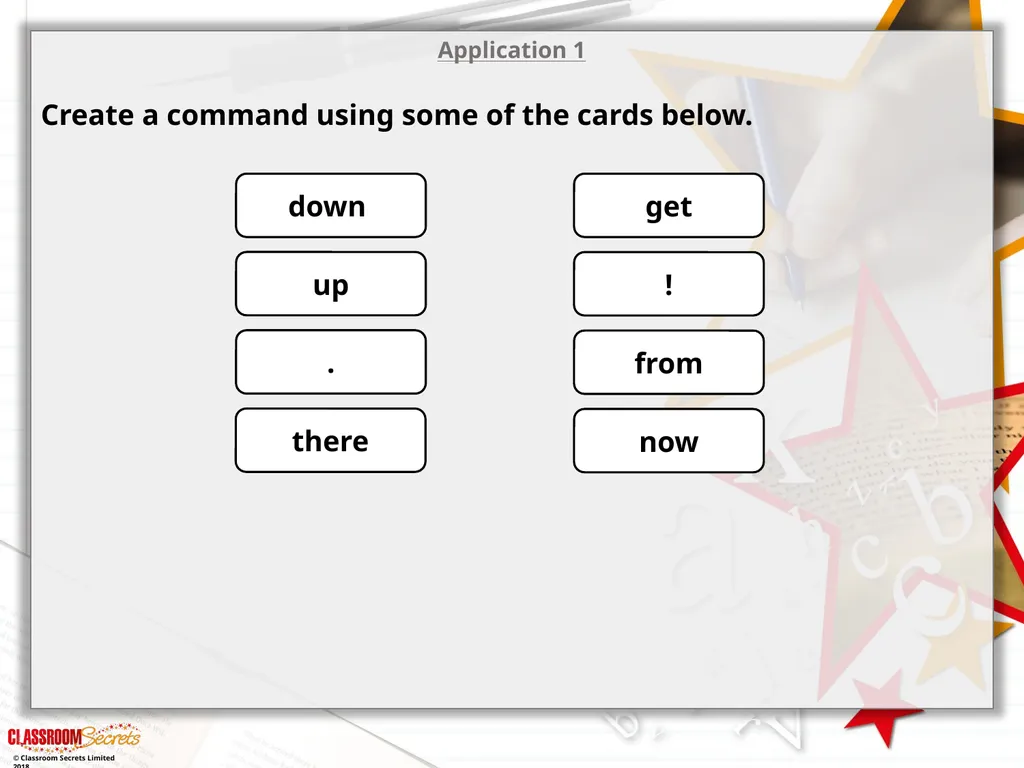
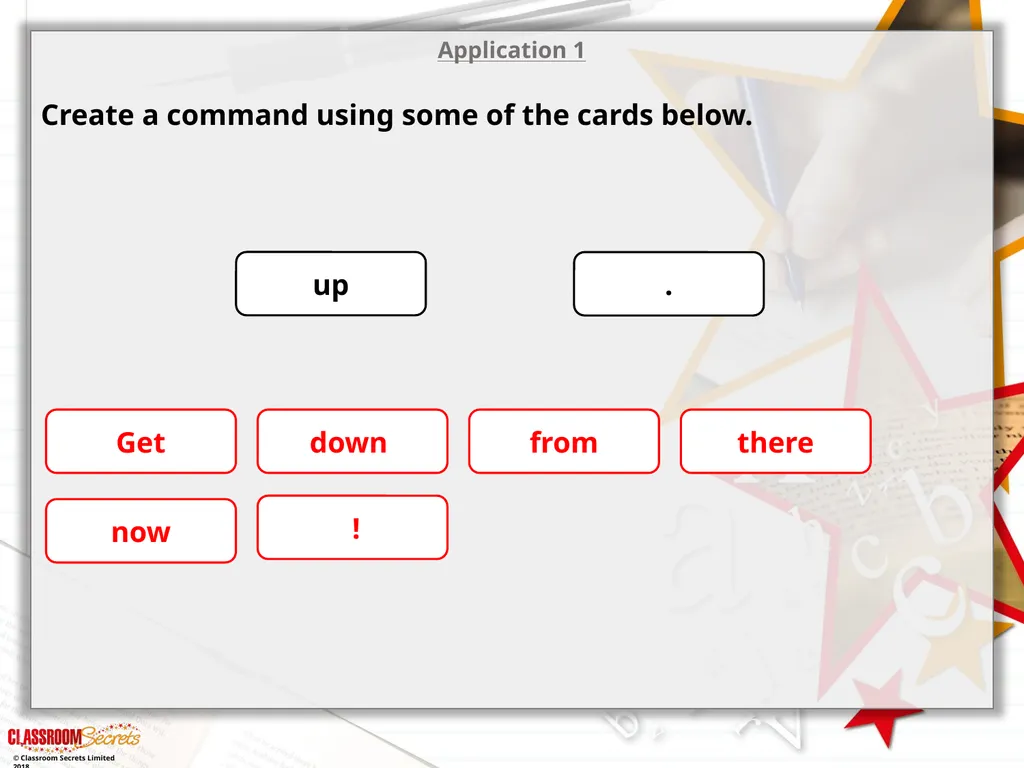
Create a command using some of the cards below. down get up ! . from there now © Classroom Secrets Limited 2018<br>
slide16. Application 1
Create a command using some of the cards below. down Get ! from there now up . © Classroom Secrets Limited 2018<br>
slide17. Reasoning 1
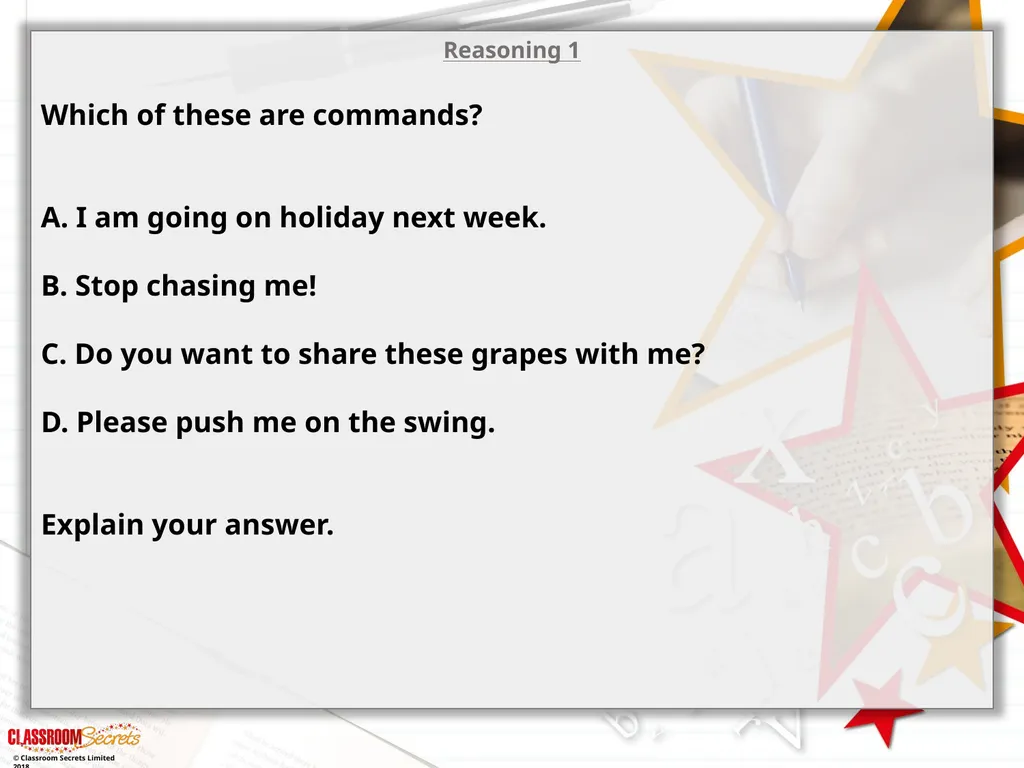
Which of these are commands?
A. I am going on holiday next week.
B. Stop chasing me!
C. Do you want to share these grapes with me?
D. Please push me on the swing.
Explain your answer. © Classroom Secrets Limited 2018<br>
slide18. Reasoning 1
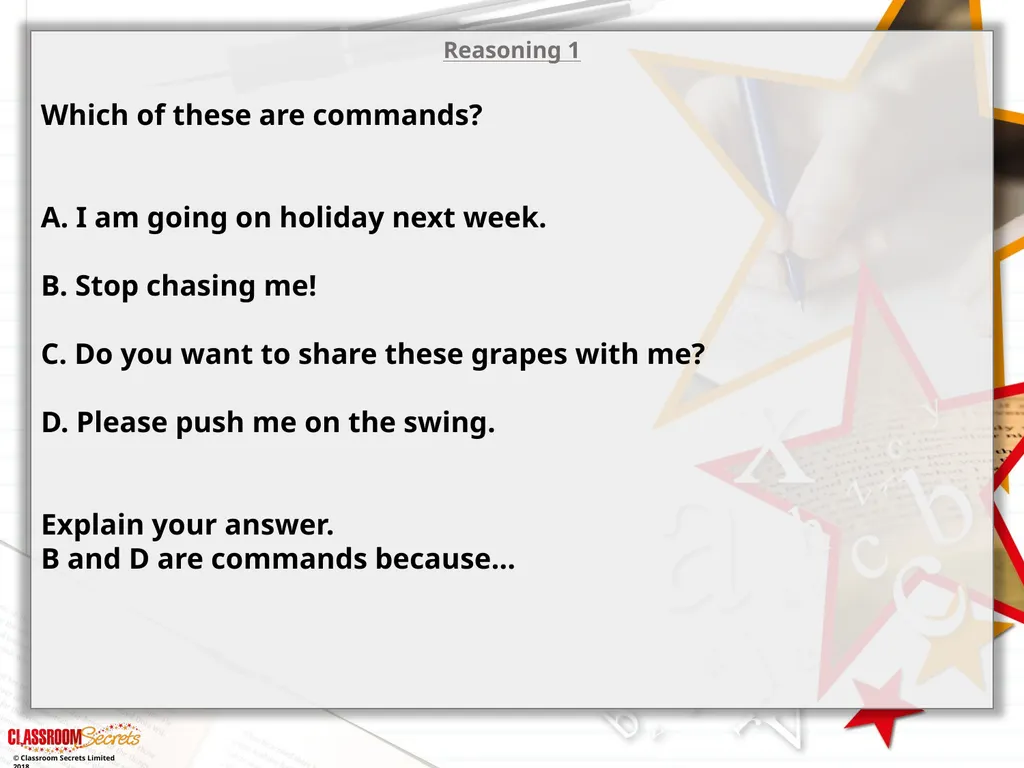
Which of these are commands?
A. I am going on holiday next week.
B. Stop chasing me!
C. Do you want to share these grapes with me?
D. Please push me on the swing.
Explain your answer.
B and D are commands because… © Classroom Secrets Limited 2018<br>
slide19. Reasoning 1
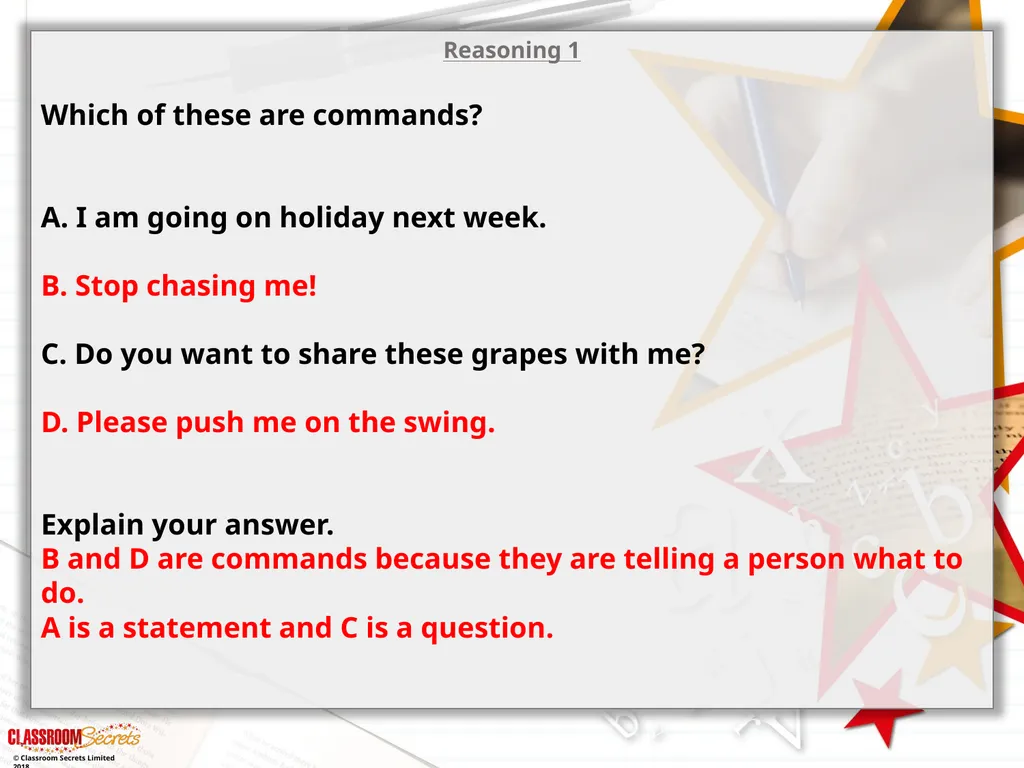
Which of these are commands?
A. I am going on holiday next week.
B. Stop chasing me!
C. Do you want to share these grapes with me?
D. Please push me on the swing.
Explain your answer.
B and D are commands because they are telling a person what to do.
A is a statement and C is a question. © Classroom Secrets Limited 2018<br>
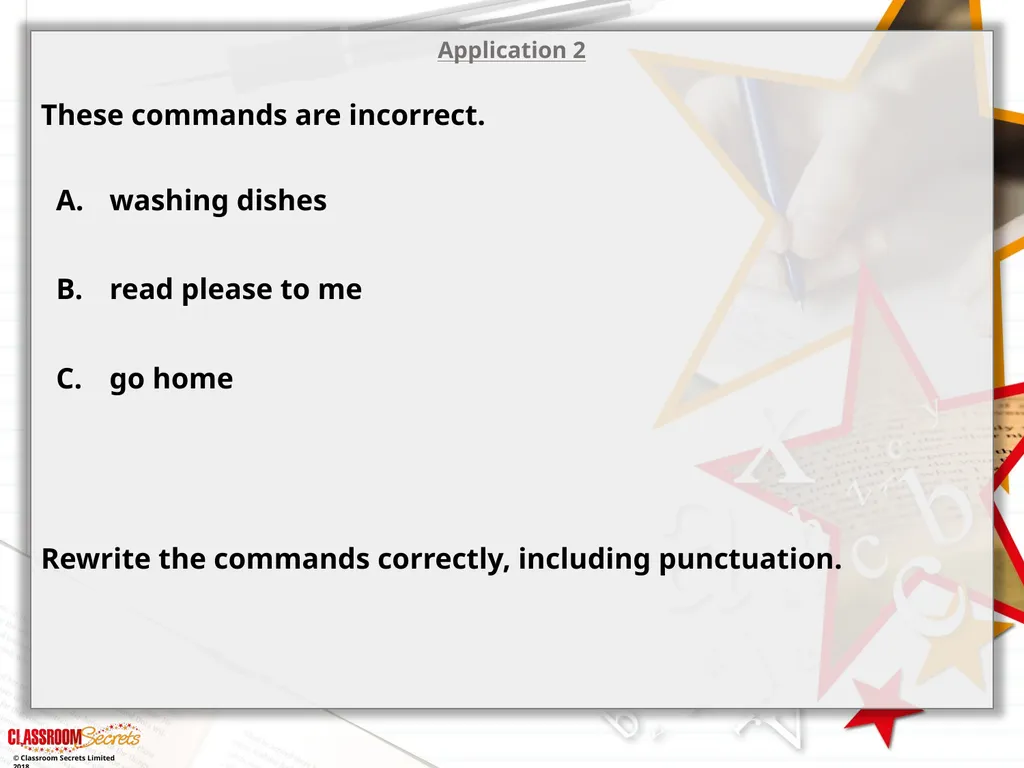
slide20. Application 2
These commands are incorrect.
Rewrite the commands correctly, including punctuation. © Classroom Secrets Limited 2018<br>
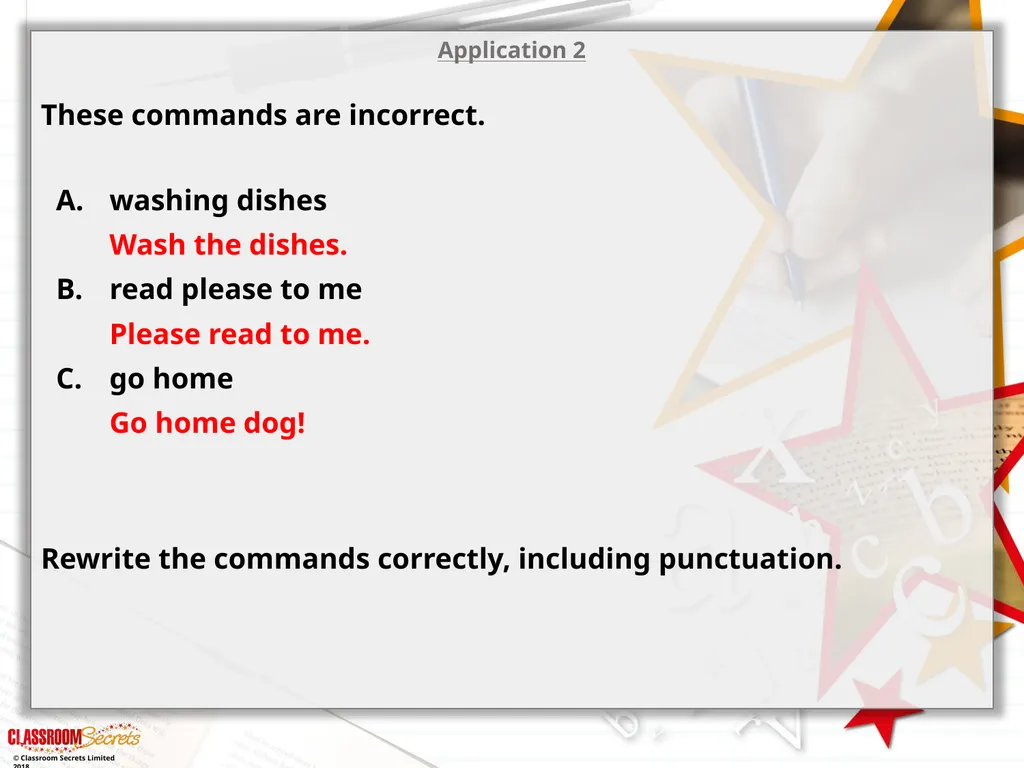
slide21. Application 2
These commands are incorrect.
Rewrite the commands correctly, including punctuation. © Classroom Secrets Limited 2018<br>
We have started a #LIFEworkbalance campaign and we need your help to complete our LIFE/work balance survey.
We hope to publish the results soon, so please give 15 minutes of your time to help us get a true picture of school life.
Want to be a part of this campaign? Take the survey on our website and share it with your colleagues! © Classroom Secrets Limited 2019<br>
slide2. Year 2 – Autumn Block 5 – Sentence Types 1 – Recognising Commands
About This Resource:
This PowerPoint has been designed to support your teaching of this small step. It includes a starter activity and an example of each question from the Varied Fluency and Application and Reasoning resources also provided in this pack. You can choose to work through all examples provided or a selection of them depending on the needs of your class.
National Curriculum Objectives:
English Year 2: ((2G2.3) How the grammatical patterns in a sentence indicate its function as a command
Terminology for pupils:
English Year 2: (2G2.3) command
More resources from our Grammar, Punctuation and Spelling scheme of work.
Did you like this resource? Don’t forget to review it on our website. © Classroom Secrets Limited 2018<br>
slide3. Year 2 – Autumn Block 5 – Sentence Types 1 – Recognising Commands
Notes and Guidance
From Year 1, children should know how to recognise and use one word commands with exclamations.
The main focus of this step is recognising commands using simple verbs, and how and where commands may be used.
In this step, children should recognise different verbs that can be used to form a more detailed command. For example: Stand over there. Sit on the carpet.
Children should begin to recognise that a command can be demarcated using either a full stop or an exclamation mark depending on its meaning, such as a polite request versus a direct order. For example, ‘Stop that!’ compared to ‘Walk quietly in school please.’
When used in a command sentence, verbs should be in the imperative form.
Focused Questions
What is a command?
Is this sentence a command? How do you know?
Does this command need an exclamation mark or a full stop? How do you know? © Classroom Secrets Limited 2018<br>
slide4. Year 2 – Autumn Block 5 – Sentence Types 1
Step 3: Recognising Commands © Classroom Secrets Limited 2018<br>
slide5. Introduction
Follow these instructions.
Were there any instructions you couldn’t follow? © Classroom Secrets Limited 2018<br>
slide6. Introduction
Follow these instructions.
Were there any instructions you couldn’t follow?
This is a statement. All the others are commands. © Classroom Secrets Limited 2018<br>
slide7. Varied Fluency 1
Tick the sentences below that are commands. © Classroom Secrets Limited 2018<br>
slide8. Varied Fluency 1
Tick the sentences below that are commands. © Classroom Secrets Limited 2018<br>
slide9. Varied Fluency 2
Does this command need an exclamation mark or a full stop?
Please can you pass the salt © Classroom Secrets Limited 2018<br>
slide10. Varied Fluency 2
Does this command need an exclamation mark or a full stop?
Please can you pass the salt.
A full stop because it is a polite request. © Classroom Secrets Limited 2018<br>
slide11. Varied Fluency 3
True or false? This command tells a person what to do.
Run away from the monster! © Classroom Secrets Limited 2018<br>
slide12. Varied Fluency 3
True or false? This command tells a person what to do.
Run away from the monster!
True. © Classroom Secrets Limited 2018<br>
slide13. Varied Fluency 4
Which command is correct?
A. Always use your manners?
B. always use your manners!
C. always use your manners.
D. Always use your manners. © Classroom Secrets Limited 2018<br>
slide14. Varied Fluency 4
Which command is correct?
A. Always use your manners?
B. always use your manners!
C. always use your manners.
D. Always use your manners.
D is correct because it has a capital letter and a full stop. © Classroom Secrets Limited 2018<br>
slide15. Application 1
Create a command using some of the cards below. down get up ! . from there now © Classroom Secrets Limited 2018<br>
slide16. Application 1
Create a command using some of the cards below. down Get ! from there now up . © Classroom Secrets Limited 2018<br>
slide17. Reasoning 1
Which of these are commands?
A. I am going on holiday next week.
B. Stop chasing me!
C. Do you want to share these grapes with me?
D. Please push me on the swing.
Explain your answer. © Classroom Secrets Limited 2018<br>
slide18. Reasoning 1
Which of these are commands?
A. I am going on holiday next week.
B. Stop chasing me!
C. Do you want to share these grapes with me?
D. Please push me on the swing.
Explain your answer.
B and D are commands because… © Classroom Secrets Limited 2018<br>
slide19. Reasoning 1
Which of these are commands?
A. I am going on holiday next week.
B. Stop chasing me!
C. Do you want to share these grapes with me?
D. Please push me on the swing.
Explain your answer.
B and D are commands because they are telling a person what to do.
A is a statement and C is a question. © Classroom Secrets Limited 2018<br>
slide20. Application 2
These commands are incorrect.
Rewrite the commands correctly, including punctuation. © Classroom Secrets Limited 2018<br>
slide21. Application 2
These commands are incorrect.
Rewrite the commands correctly, including punctuation. © Classroom Secrets Limited 2018<br>