Lightning Safety in Intercollegiate Athletics Lightning Safety Formalize a EAP specific to lightning safety Identify a designated weather watcher andor check weather updates Establish a chain of command (Insert namespositions of
"Lightning Safety in Intercollegiate Athletics" is the property of its rightful owner. Permission is granted to
download and print the materials on this website for personal, non-commercial use only, and to display it
on your personal computer provided you do not modify the materials and that you retain all copyright
notices contained in the materials. By downloading content from our website, you accept the terms of this
agreement.
Presentation Transcript
01
Lightning Safety in Intercollegiate Athletics<br>
02
Lightning Safety Formalize a EAP specific to lightning safety
Identify a designated weather watcher and/or check weather updates
Establish a chain of command (Insert names/positions of institutional personnel who has the authority/responsibility to suspend game, practice, etc.)
Develop Criteria for Postponement and Resumption of Activities
Be conservative and stick to procedures, even if it’s not raining
Consider Large Venue Planning
Plans will change based on large outdoor venue
Spectator announcements and clearance<br>
03
Lightning Safety Lightning and General Weather Awareness
If thunder can be heard, lightning is a hazard
In the event of impending thunderstorms, those in control of events should fulfill their obligation to warn participants and guests of lightning danger
All individuals have the right to vacate an outdoor or unsafe area without fear of repercussion or penalty if they feel in danger<br>
04
Lightning Safety Use technology to help you monitor lightning strikes
Apps like WeatherBug, Lightning Pro, RadarScope, etc., can give you an idea of where lightning can be coming from
Consider using a source connected to NWS, NLDN, USPLN or other reliable source for more accurate lightning strike data (objectively and independently verified)
Know that radar can be fooled by things that look like lightning, and give you a false reading, but better safe than sorry<br>
05
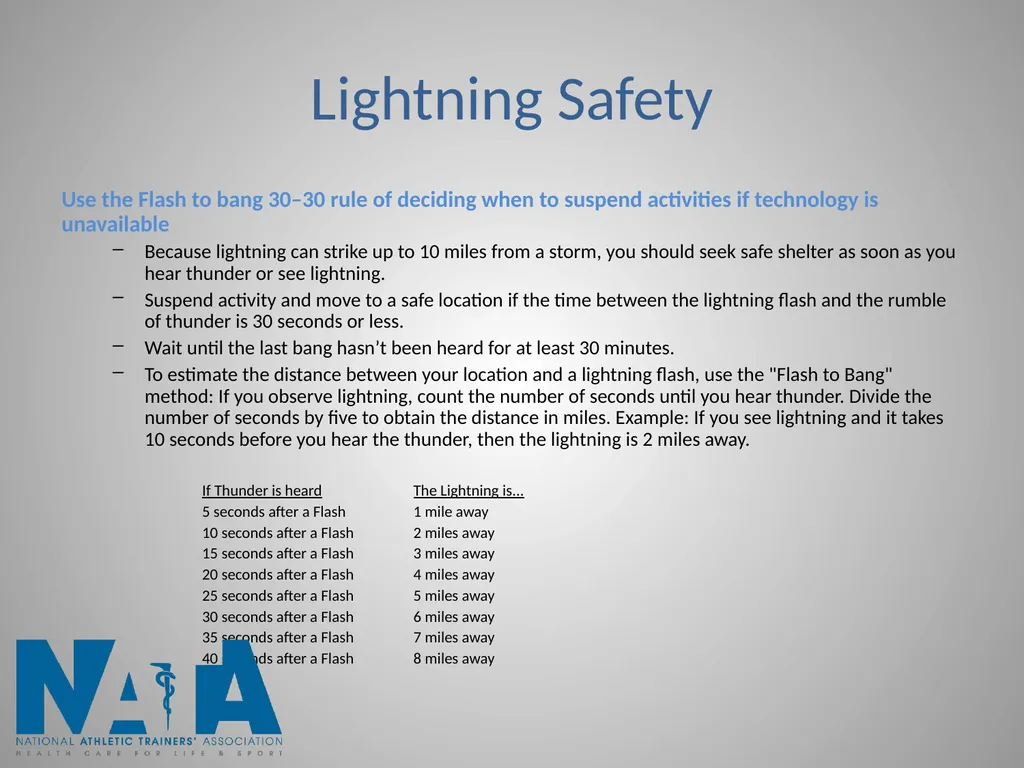
Lightning Safety Use the Flash to bang 30–30 rule of deciding when to suspend activities if technology is unavailable
Because lightning can strike up to 10 miles from a storm, you should seek safe shelter as soon as you hear thunder or see lightning.
Suspend activity and move to a safe location if the time between the lightning flash and the rumble of thunder is 30 seconds or less.
Wait until the last bang hasn’t been heard for at least 30 minutes.
To estimate the distance between your location and a lightning flash, use the "Flash to Bang" method: If you observe lightning, count the number of seconds until you hear thunder. Divide the number of seconds by five to obtain the distance in miles. Example: If you see lightning and it takes 10 seconds before you hear the thunder, then the lightning is 2 miles away.
If Thunder is heard The Lightning is...
5 seconds after a Flash 1 mile away
10 seconds after a Flash 2 miles away
15 seconds after a Flash 3 miles away
20 seconds after a Flash 4 miles away
25 seconds after a Flash 5 miles away
30 seconds after a Flash 6 miles away
35 seconds after a Flash 7 miles away
40 seconds after a Flash 8 miles away<br>
06
Lightning Safety Seek Shelter in a SAFE location
Understand the qualifications of safe structures, and know where they are in relation to each athletic field
Fully enclosed building with plumbing and electric wiring
Fully enclosed vehicle with metal roof and windows up (don’t touch any metal while in car)
Be able to identify unsafe locations around each field or area
In golf carts, under trees, indoor swimming pools, showering in a substantial building, under picnic areas, in storage sheds, and open fields
Insert recommended institutional shelters in case of inclement weather<br>
07
Lightning Safety In the event safe structures cannot be found or identified consider the following:
Avoid elevated places, open areas, tall isolated objects, being in or around large bodies of water (including swimming pools) or being near metal objects.
Avoid sheltering under trees for safety or to stay dry
Assume lightning position for increased safety (feet together, crouched down, hands over ears)<br>
08
Lightning Safety Resuming Activity
Wait a minimum of 30 minutes after the last strike within 10 miles
Person in charge should visit with officials and staff to make sure playing surface is safe from weather changes
Give participants ample time to warm-up prior to resuming activity<br>
09
Lightning Safety First Aid for lightning strike victims
Lightning strike victims need immediate first aid
They do not carry a charge and should be helped like any other victim
Make sure the scene is safe before helping, first move the victim to a safe location
Safe to perform CPR and have an AED on hand to assist with any resuscitation efforts<br>
10
References National Athletic Trainers’ Association Position Statement: Lightning Safety for Athletics and Recreation (2013)
http://natajournals.org/doi/pdf/10.4085/1062-6050-48.2.25<br>