
Linear Combination vs Common Divisor Greatest
TG
Published · 45 slides · 0 views
1 / 1



Description
Linear Combination vs Common Divisor Greatest common divisor d is a common divisor of a and b if da and db gcd(a,b) greatest common divisor of a and b d is an integer linear combination of a and b if dsatb for integers s,t. spc(a,b)
Related Topics
Share
Embed code
Download this presentation From Below
"Linear Combination vs Common Divisor Greatest" is the property of its rightful owner. Permission is granted to download and print the materials on this website for personal, non-commercial use only, and to display it on your personal computer provided you do not modify the materials and that you retain all copyright notices contained in the materials. By downloading content from our website, you accept the terms of this agreement.
Presentation Transcript
01
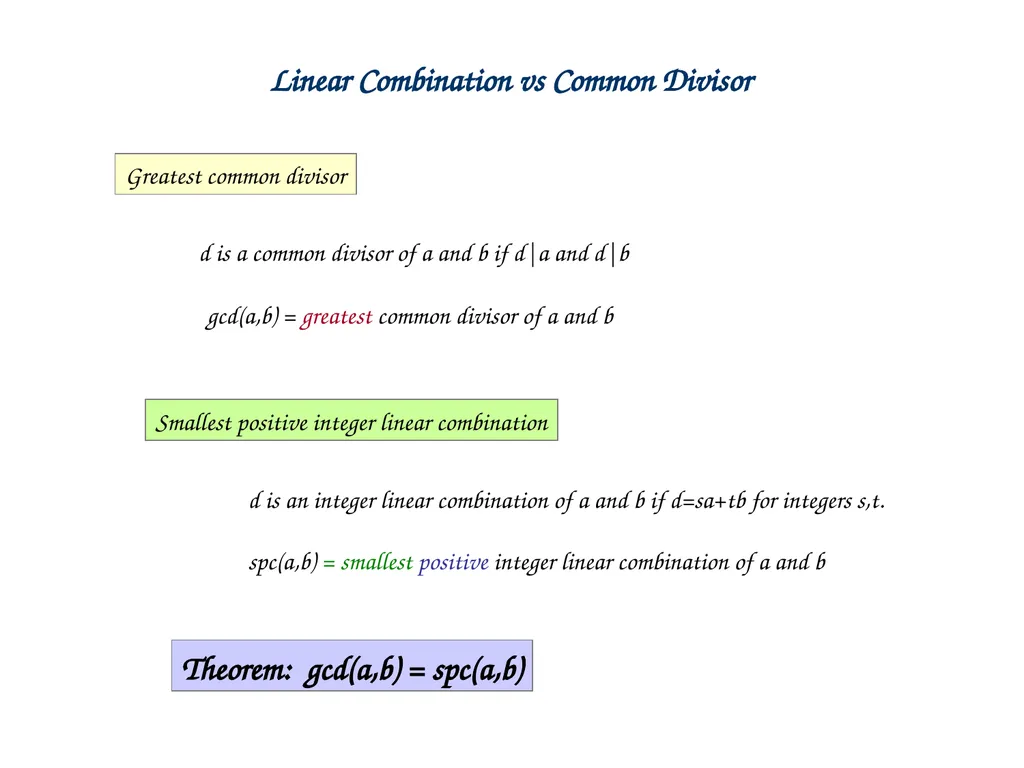
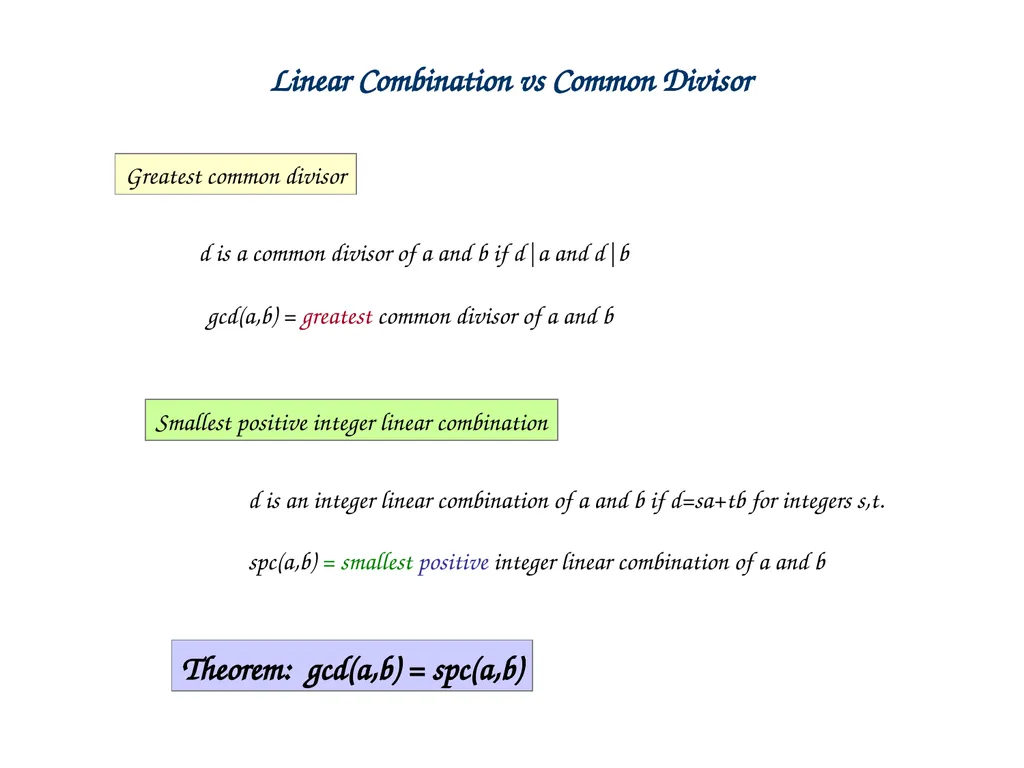
Linear Combination vs Common Divisor Greatest common divisor d is a common divisor of a and b if d|a and d|b gcd(a,b) = greatest common divisor of a and b d is an integer linear combination of a and b if d=sa+tb for integers s,t.
spc(a,b) = smallest positive integer linear combination of a and b Smallest positive integer linear combination Theorem: gcd(a,b) = spc(a,b)<br>
spc(a,b) = smallest positive integer linear combination of a and b Smallest positive integer linear combination Theorem: gcd(a,b) = spc(a,b)<br>
02
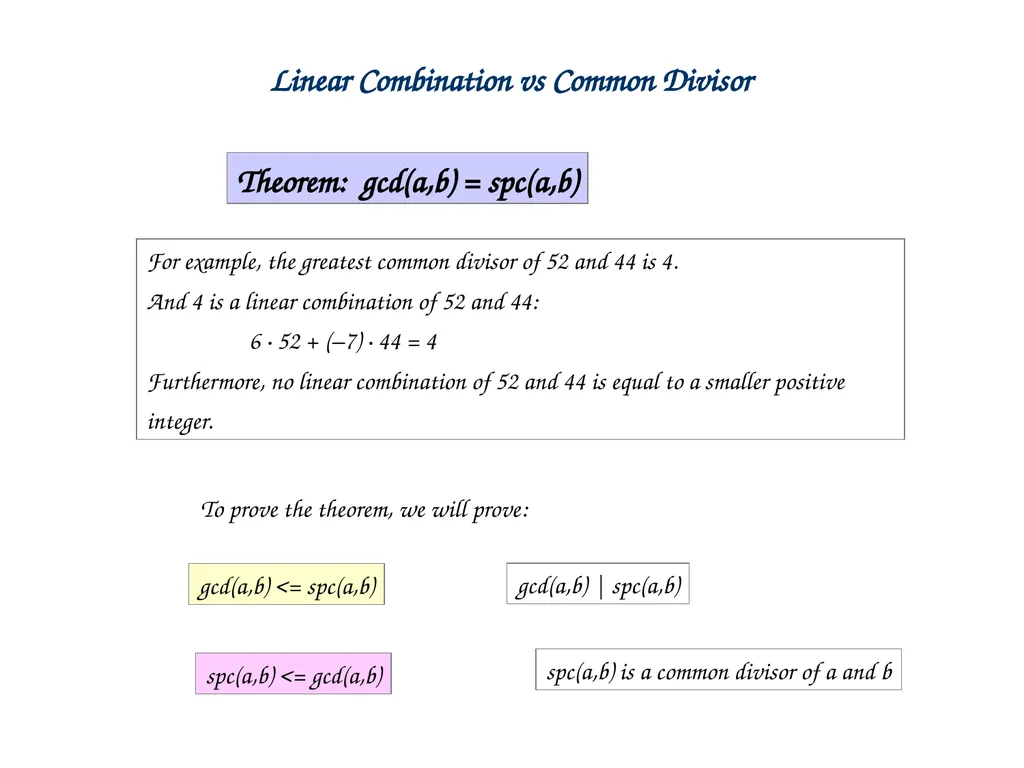
Theorem: gcd(a,b) = spc(a,b) Linear Combination vs Common Divisor For example, the greatest common divisor of 52 and 44 is 4.
And 4 is a linear combination of 52 and 44:
6 · 52 + (−7) · 44 = 4
Furthermore, no linear combination of 52 and 44 is equal to a smaller positive integer. To prove the theorem, we will prove: gcd(a,b) <= spc(a,b) spc(a,b) <= gcd(a,b) gcd(a,b) | spc(a,b) spc(a,b) is a common divisor of a and b<br>
And 4 is a linear combination of 52 and 44:
6 · 52 + (−7) · 44 = 4
Furthermore, no linear combination of 52 and 44 is equal to a smaller positive integer. To prove the theorem, we will prove: gcd(a,b) <= spc(a,b) spc(a,b) <= gcd(a,b) gcd(a,b) | spc(a,b) spc(a,b) is a common divisor of a and b<br>
03
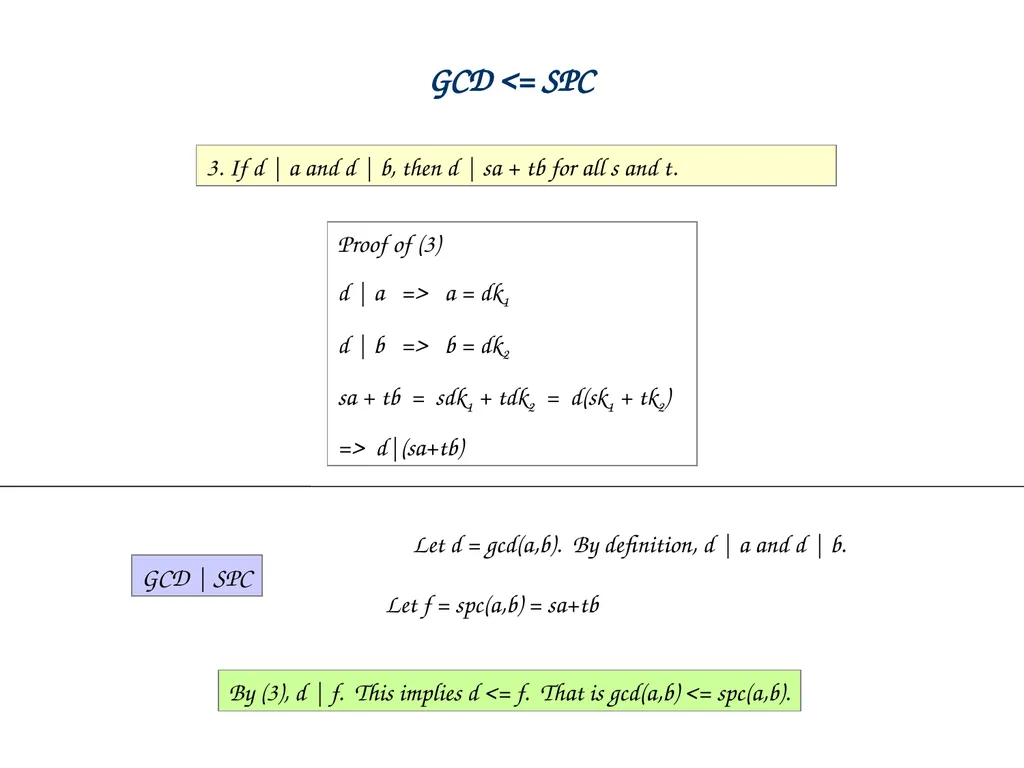
3. If d | a and d | b, then d | sa + tb for all s and t. GCD <= SPC Proof of (3)
d | a => a = dk1
d | b => b = dk2
sa + tb = sdk1 + tdk2 = d(sk1 + tk2)
=> d|(sa+tb) Let d = gcd(a,b). By definition, d | a and d | b. Let f = spc(a,b) = sa+tb GCD | SPC By (3), d | f. This implies d <= f. That is gcd(a,b) <= spc(a,b).<br>
d | a => a = dk1
d | b => b = dk2
sa + tb = sdk1 + tdk2 = d(sk1 + tk2)
=> d|(sa+tb) Let d = gcd(a,b). By definition, d | a and d | b. Let f = spc(a,b) = sa+tb GCD | SPC By (3), d | f. This implies d <= f. That is gcd(a,b) <= spc(a,b).<br>
04
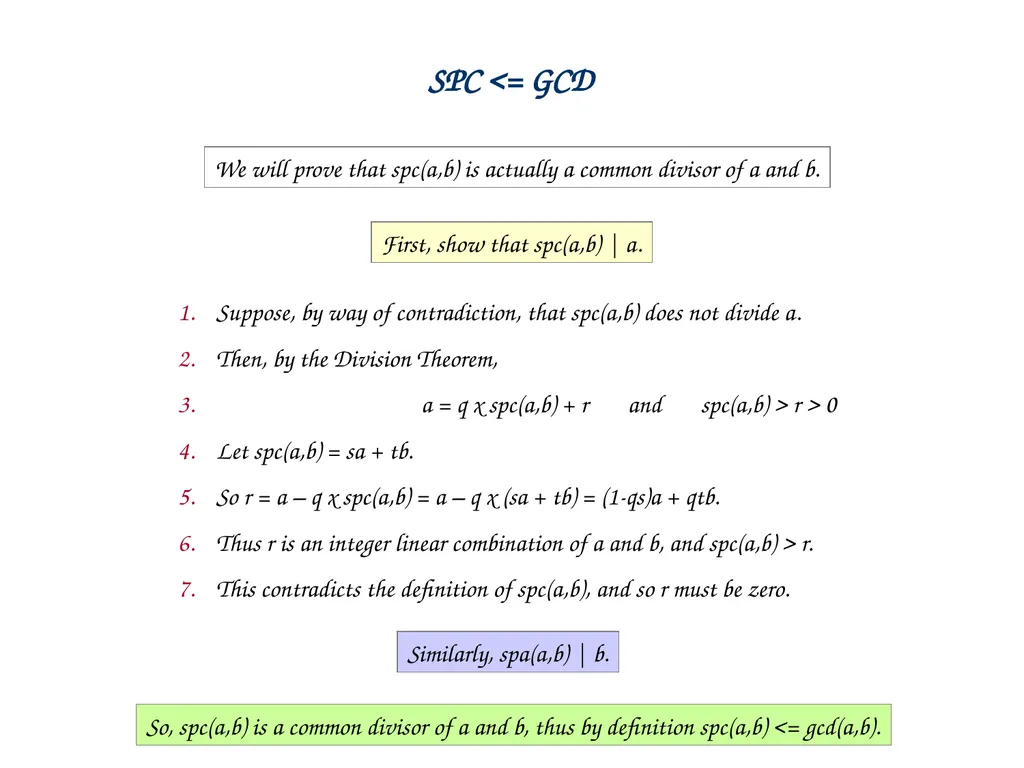
SPC <= GCD We will prove that spc(a,b) is actually a common divisor of a and b. First, show that spc(a,b) | a. Suppose, by way of contradiction, that spc(a,b) does not divide a.
Then, by the Division Theorem,
a = q x spc(a,b) + r and spc(a,b) > r > 0
Let spc(a,b) = sa + tb.
So r = a – q x spc(a,b) = a – q x (sa + tb) = (1-qs)a + qtb.
Thus r is an integer linear combination of a and b, and spc(a,b) > r.
This contradicts the definition of spc(a,b), and so r must be zero. Similarly, spa(a,b) | b. So, spc(a,b) is a common divisor of a and b, thus by definition spc(a,b) <= gcd(a,b).<br>
05
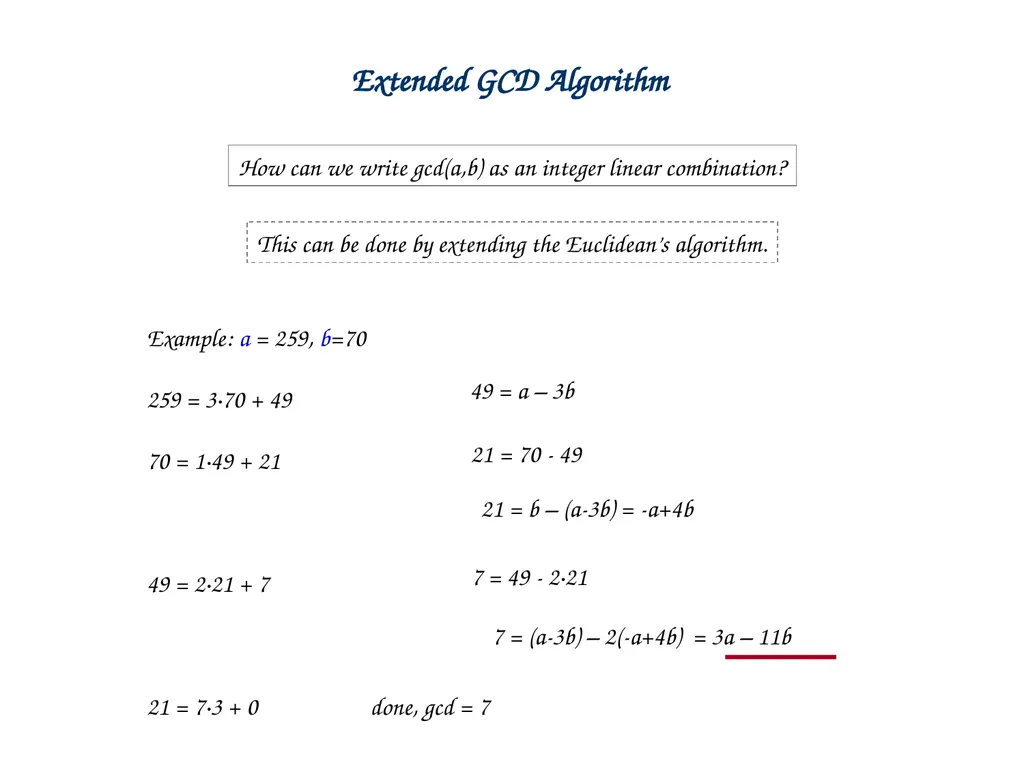
Extended GCD Algorithm How can we write gcd(a,b) as an integer linear combination? This can be done by extending the Euclidean’s algorithm. Example: a = 259, b=70
259 = 3·70 + 49
70 = 1·49 + 21
49 = 2·21 + 7
21 = 7·3 + 0 done, gcd = 7 49 = a – 3b 21 = 70 - 49 21 = b – (a-3b) = -a+4b 7 = 49 - 2·21 7 = (a-3b) – 2(-a+4b) = 3a – 11b<br>
259 = 3·70 + 49
70 = 1·49 + 21
49 = 2·21 + 7
21 = 7·3 + 0 done, gcd = 7 49 = a – 3b 21 = 70 - 49 21 = b – (a-3b) = -a+4b 7 = 49 - 2·21 7 = (a-3b) – 2(-a+4b) = 3a – 11b<br>
06
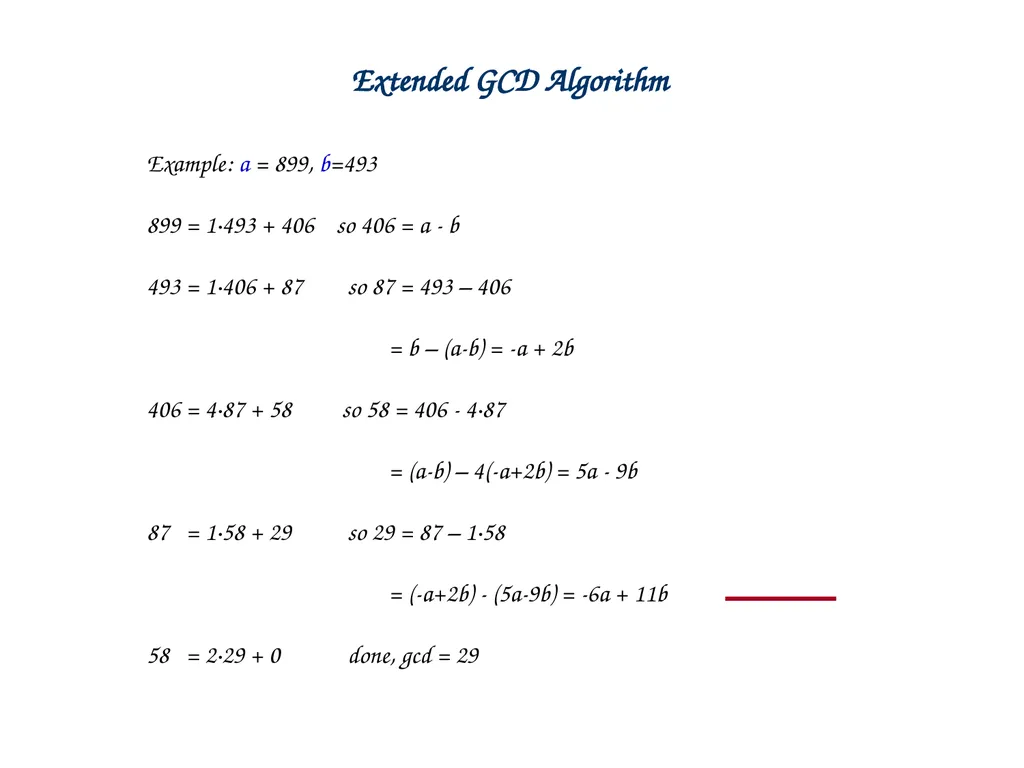
Example: a = 899, b=493
899 = 1·493 + 406 so 406 = a - b
493 = 1·406 + 87 so 87 = 493 – 406
= b – (a-b) = -a + 2b
406 = 4·87 + 58 so 58 = 406 - 4·87
= (a-b) – 4(-a+2b) = 5a - 9b
87 = 1·58 + 29 so 29 = 87 – 1·58
= (-a+2b) - (5a-9b) = -6a + 11b
58 = 2·29 + 0 done, gcd = 29 Extended GCD Algorithm<br>
899 = 1·493 + 406 so 406 = a - b
493 = 1·406 + 87 so 87 = 493 – 406
= b – (a-b) = -a + 2b
406 = 4·87 + 58 so 58 = 406 - 4·87
= (a-b) – 4(-a+2b) = 5a - 9b
87 = 1·58 + 29 so 29 = 87 – 1·58
= (-a+2b) - (5a-9b) = -6a + 11b
58 = 2·29 + 0 done, gcd = 29 Extended GCD Algorithm<br>
07
This Lecture Quotient remainder theorem
Greatest common divisor & Euclidean algorithm
Linear combination and GCD, extended Euclidean algorithm
Prime factorization and other applications<br>
Greatest common divisor & Euclidean algorithm
Linear combination and GCD, extended Euclidean algorithm
Prime factorization and other applications<br>
08
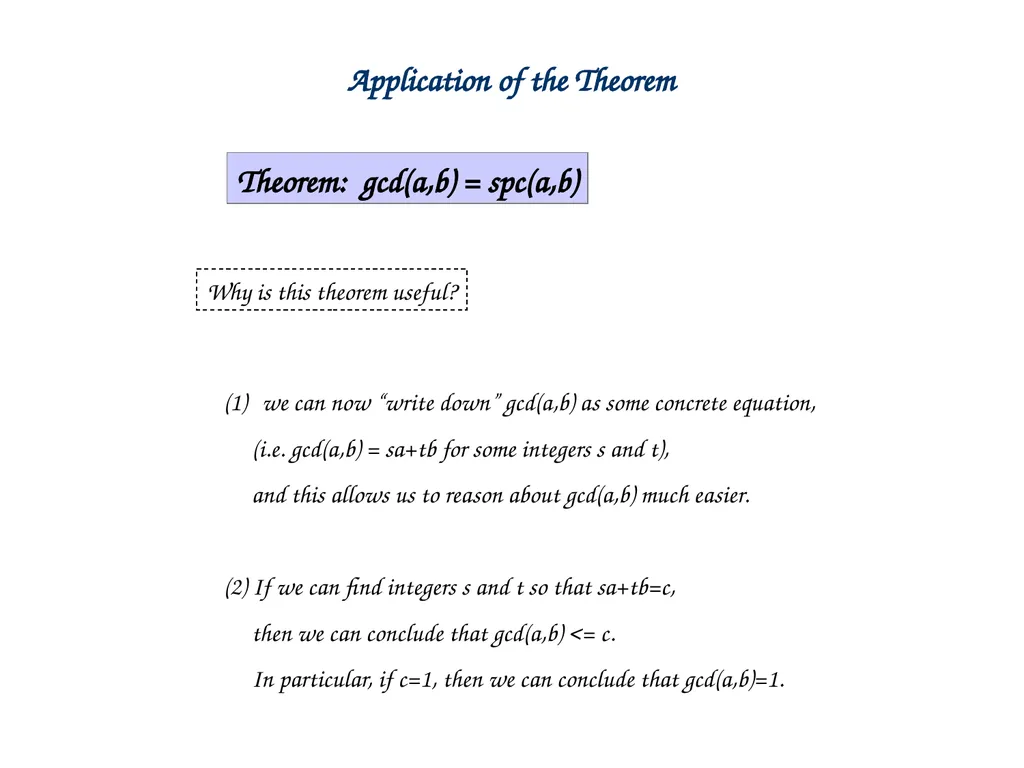
Theorem: gcd(a,b) = spc(a,b) Application of the Theorem Why is this theorem useful? we can now “write down” gcd(a,b) as some concrete equation,
(i.e. gcd(a,b) = sa+tb for some integers s and t),
and this allows us to reason about gcd(a,b) much easier.
(2) If we can find integers s and t so that sa+tb=c,
then we can conclude that gcd(a,b) <= c.
In particular, if c=1, then we can conclude that gcd(a,b)=1.<br>
(i.e. gcd(a,b) = sa+tb for some integers s and t),
and this allows us to reason about gcd(a,b) much easier.
(2) If we can find integers s and t so that sa+tb=c,
then we can conclude that gcd(a,b) <= c.
In particular, if c=1, then we can conclude that gcd(a,b)=1.<br>
09
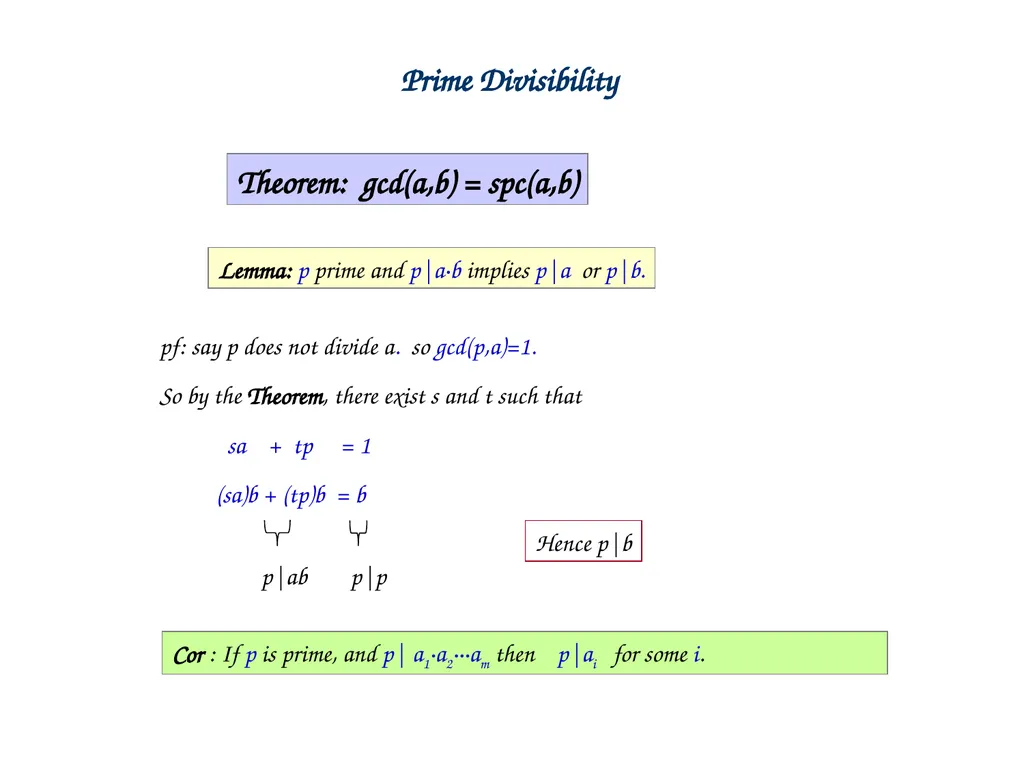
Prime Divisibility pf: say p does not divide a. so gcd(p,a)=1.
So by the Theorem, there exist s and t such that
sa + tp = 1
(sa)b + (tp)b = b Lemma: p prime and p|a·b implies p|a or p|b. p|ab p|p Cor : If p is prime, and p| a1·a2···am then p|ai for some i. Theorem: gcd(a,b) = spc(a,b) Hence p|b<br>
So by the Theorem, there exist s and t such that
sa + tp = 1
(sa)b + (tp)b = b Lemma: p prime and p|a·b implies p|a or p|b. p|ab p|p Cor : If p is prime, and p| a1·a2···am then p|ai for some i. Theorem: gcd(a,b) = spc(a,b) Hence p|b<br>
10
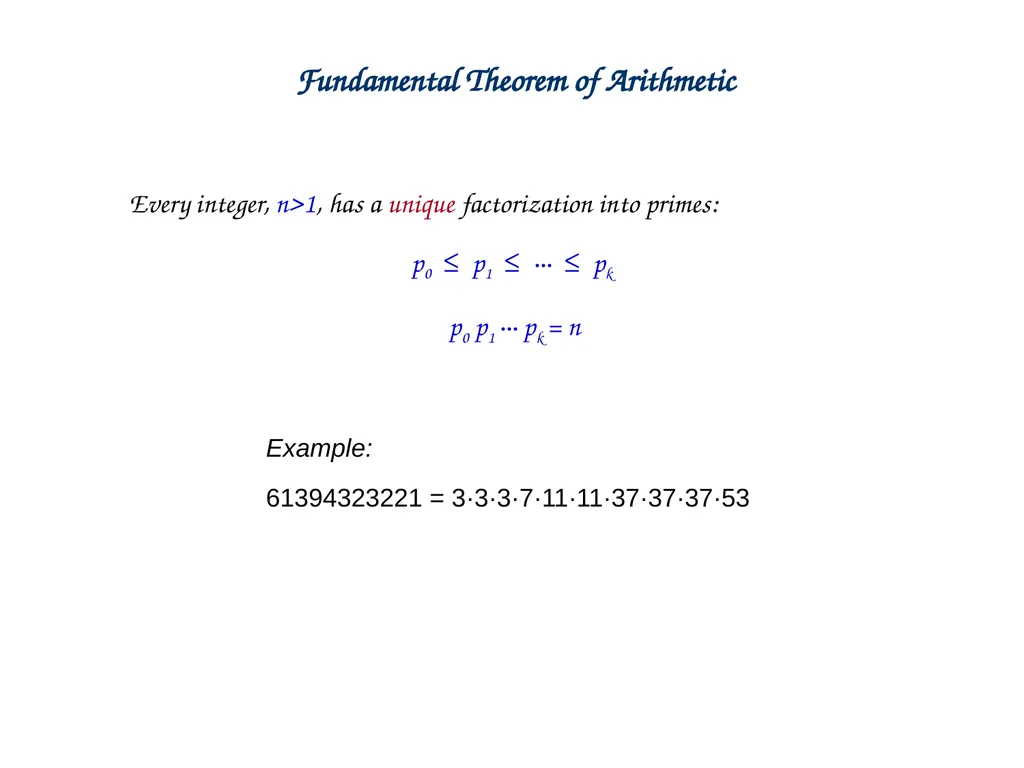
Every integer, n>1, has a unique factorization into primes:
p0 ≤ p1 ≤ ··· ≤ pk
p0 p1 ··· pk = n Fundamental Theorem of Arithmetic Example:
61394323221 = 3·3·3·7·11·11·37·37·37·53<br>
p0 ≤ p1 ≤ ··· ≤ pk
p0 p1 ··· pk = n Fundamental Theorem of Arithmetic Example:
61394323221 = 3·3·3·7·11·11·37·37·37·53<br>
11
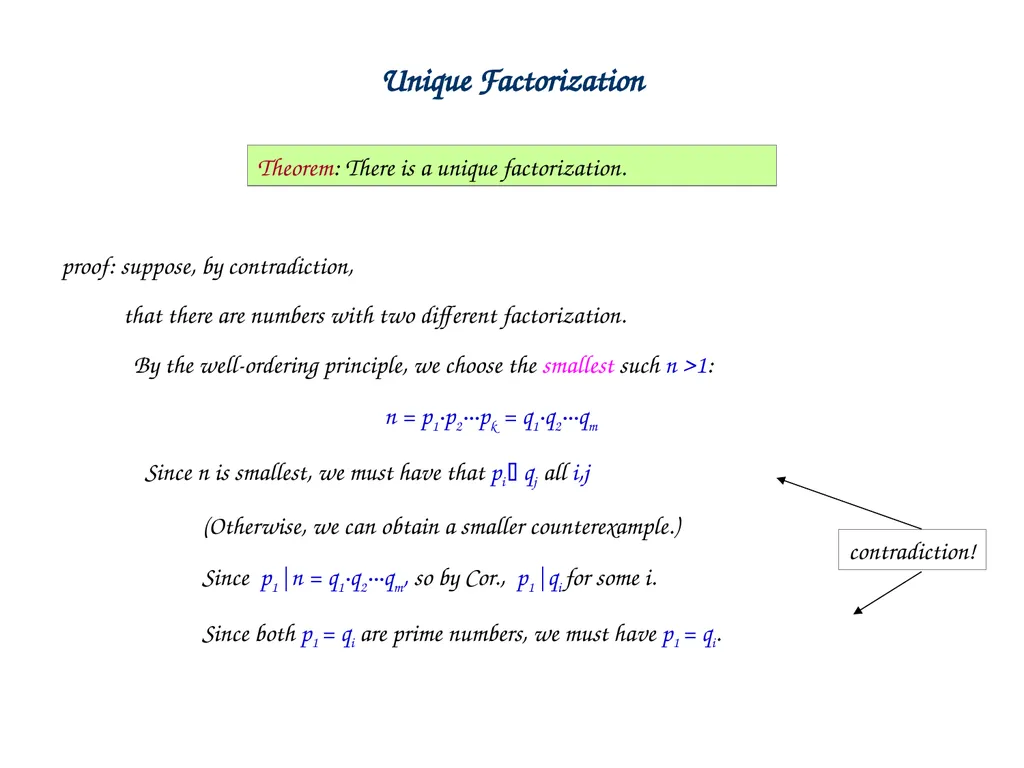
Theorem: There is a unique factorization. Unique Factorization proof: suppose, by contradiction,
that there are numbers with two different factorization.
By the well-ordering principle, we choose the smallest such n >1:
n = p1·p2···pk = q1·q2···qm
Since n is smallest, we must have that pi qj all i,j
(Otherwise, we can obtain a smaller counterexample.)
Since p1|n = q1·q2···qm, so by Cor., p1|qi for some i.
Since both p1 = qi are prime numbers, we must have p1 = qi. contradiction!<br>
12
Lemma. If gcd(a,b)=1 and gcd(a,c)=1, then gcd(a,bc)=1. Theorem: gcd(a,b) = spc(a,b) Application of the Theorem By the Theorem, there exist s,t,u,v such that sa + tb = 1
ua + vc = 1 Multiplying, we have (sa + tb)(ua + vc) = 1
saua + savc + tbua + tbvc = 1
(sau + svc + tbu)a + (tv)bc = 1 By the Theorem, since spc(a,bc)=1, we have gcd(a,bc)=1<br>
ua + vc = 1 Multiplying, we have (sa + tb)(ua + vc) = 1
saua + savc + tbua + tbvc = 1
(sau + svc + tbu)a + (tv)bc = 1 By the Theorem, since spc(a,bc)=1, we have gcd(a,bc)=1<br>
13
Die Hard Simon says: On the fountain, there should be 2 jugs, do you see them? A 5-gallon and a 3-gallon. Fill one of the jugs with exactly 4 gallons of water and place it on the scale and the timer will stop. You must be precise; one ounce more or less will result in detonation. If you're still alive in 5 minutes, we'll speak.<br>
14
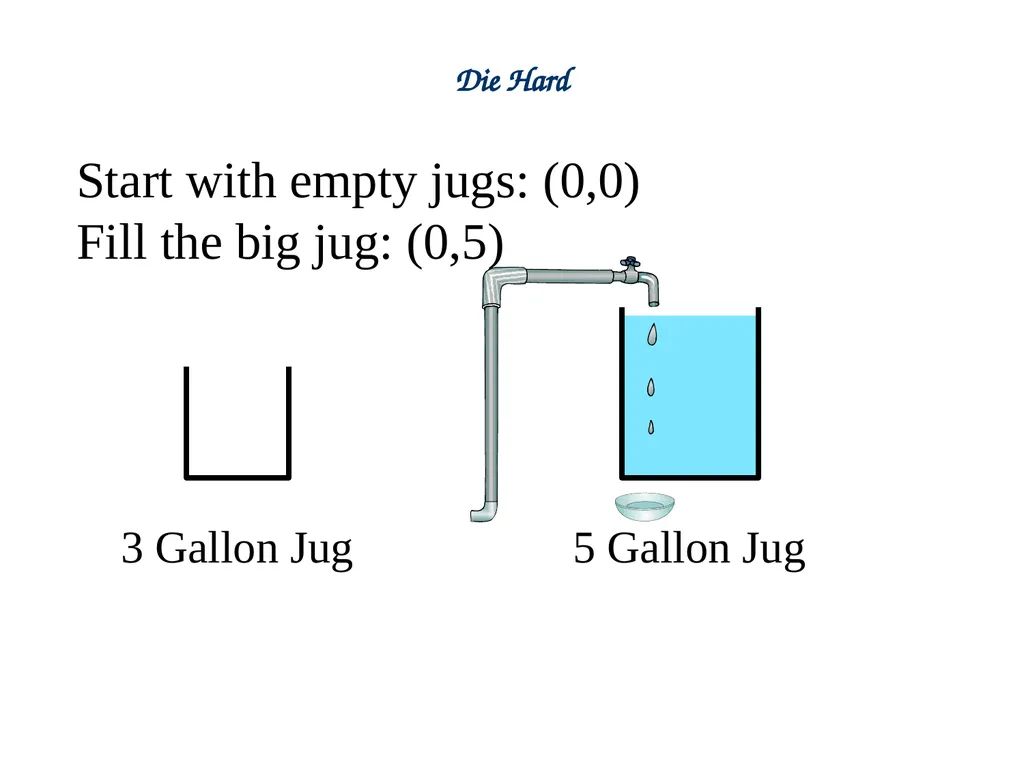
3 Gallon Jug 5 Gallon Jug Start with empty jugs: (0,0)
Fill the big jug: (0,5) Die Hard<br>
Fill the big jug: (0,5) Die Hard<br>
15
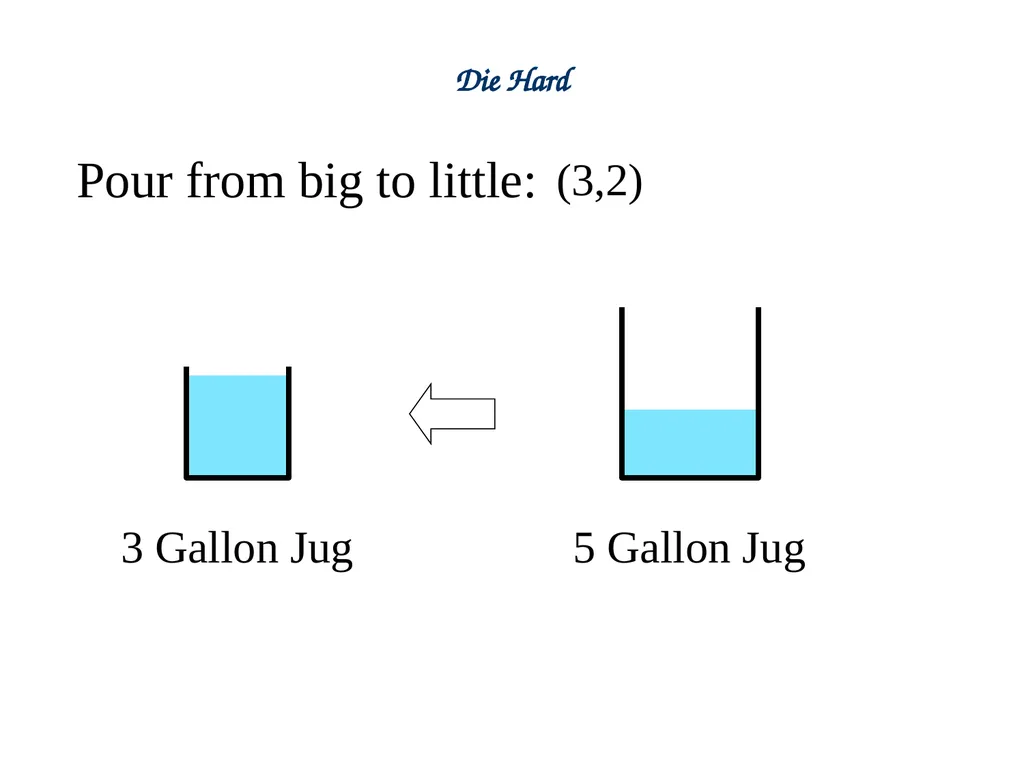
3 Gallon Jug 5 Gallon Jug Pour from big to little: (3,2) Die Hard<br>
16
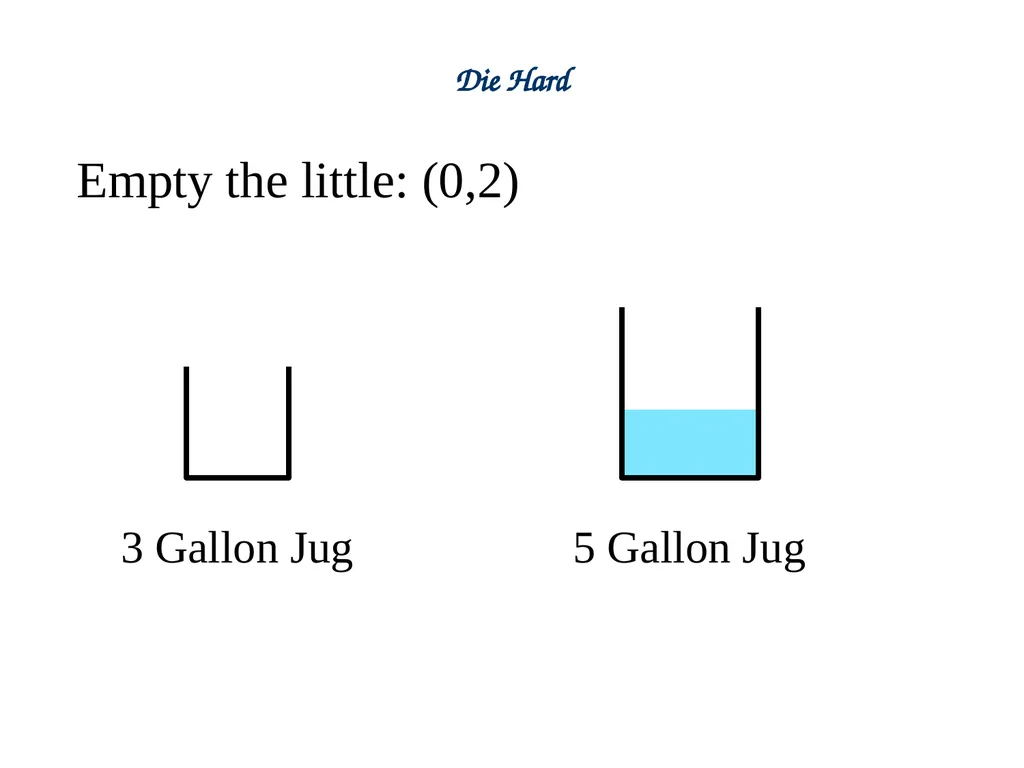
3 Gallon Jug 5 Gallon Jug Empty the little: (0,2) Die Hard<br>
17
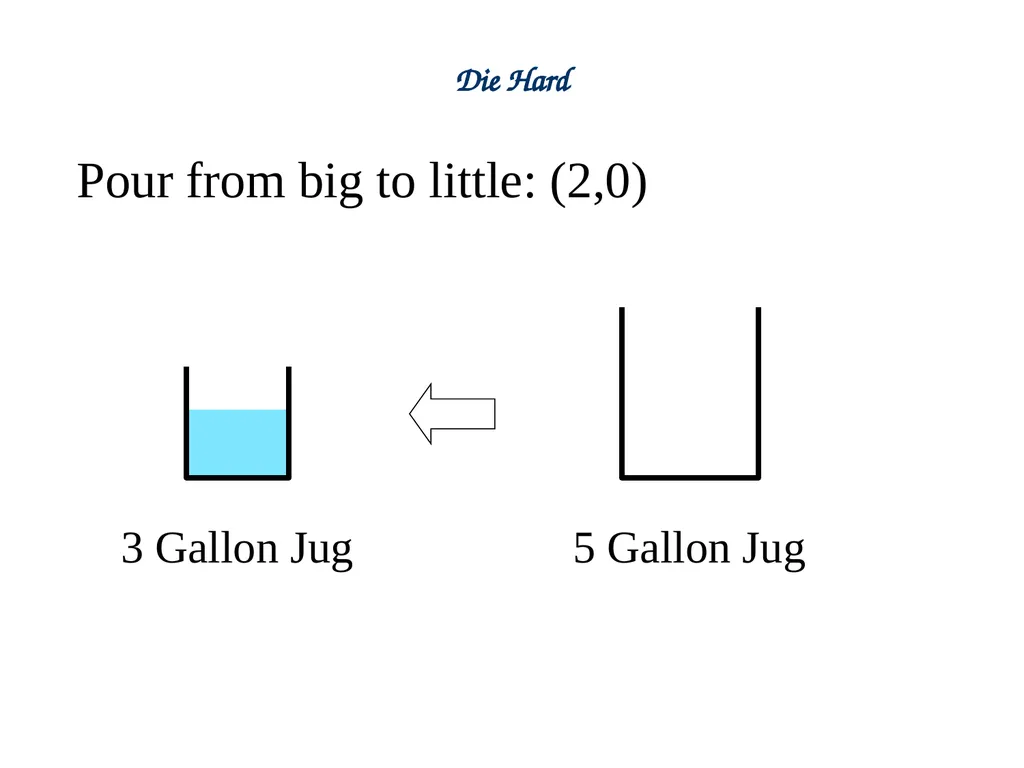
3 Gallon Jug 5 Gallon Jug Pour from big to little: (2,0) Die Hard<br>
18
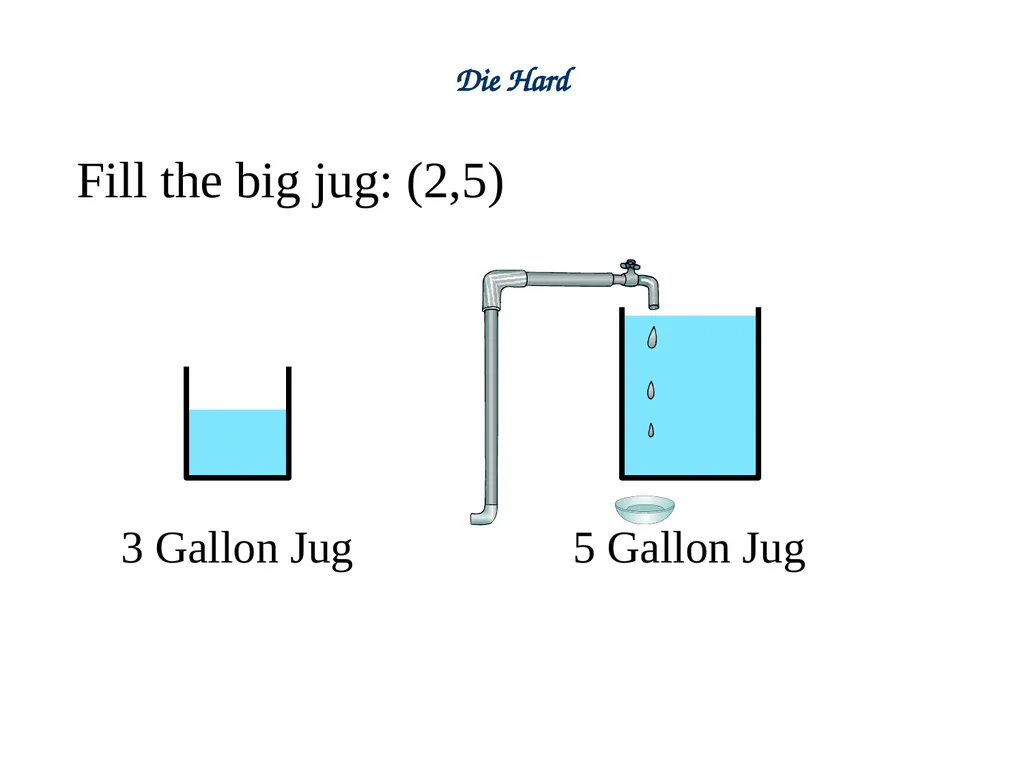
3 Gallon Jug 5 Gallon Jug Fill the big jug: (2,5) Die Hard<br>
19
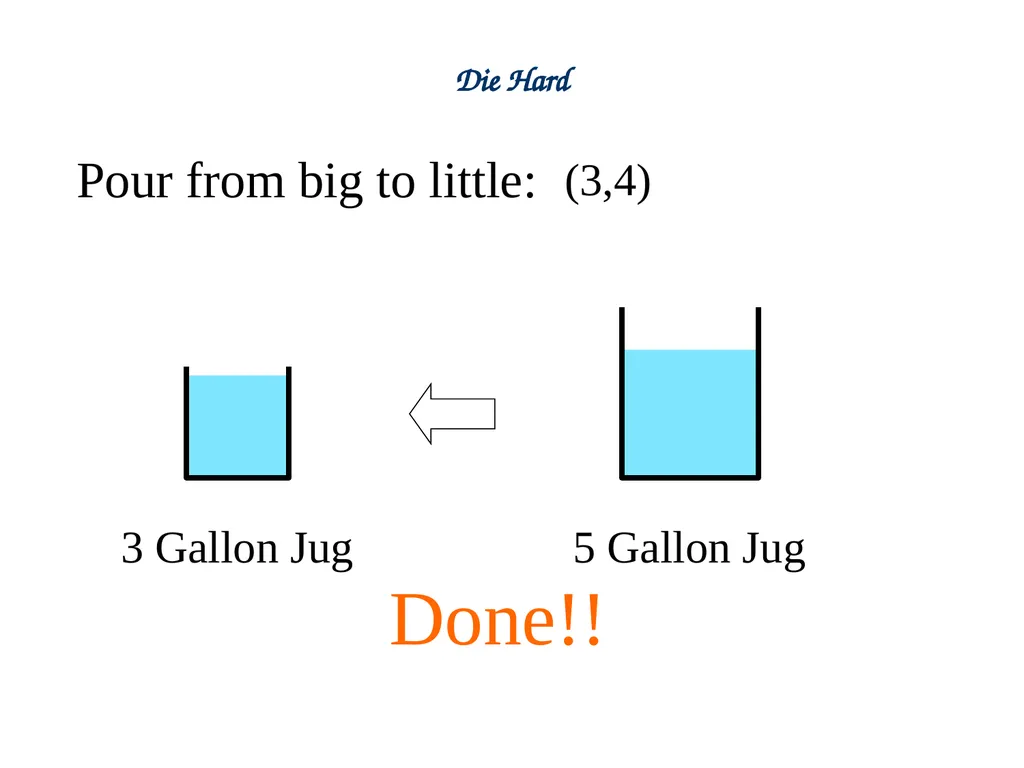
3 Gallon Jug 5 Gallon Jug Pour from big to little: (3,4) Done!! Die Hard<br>
20
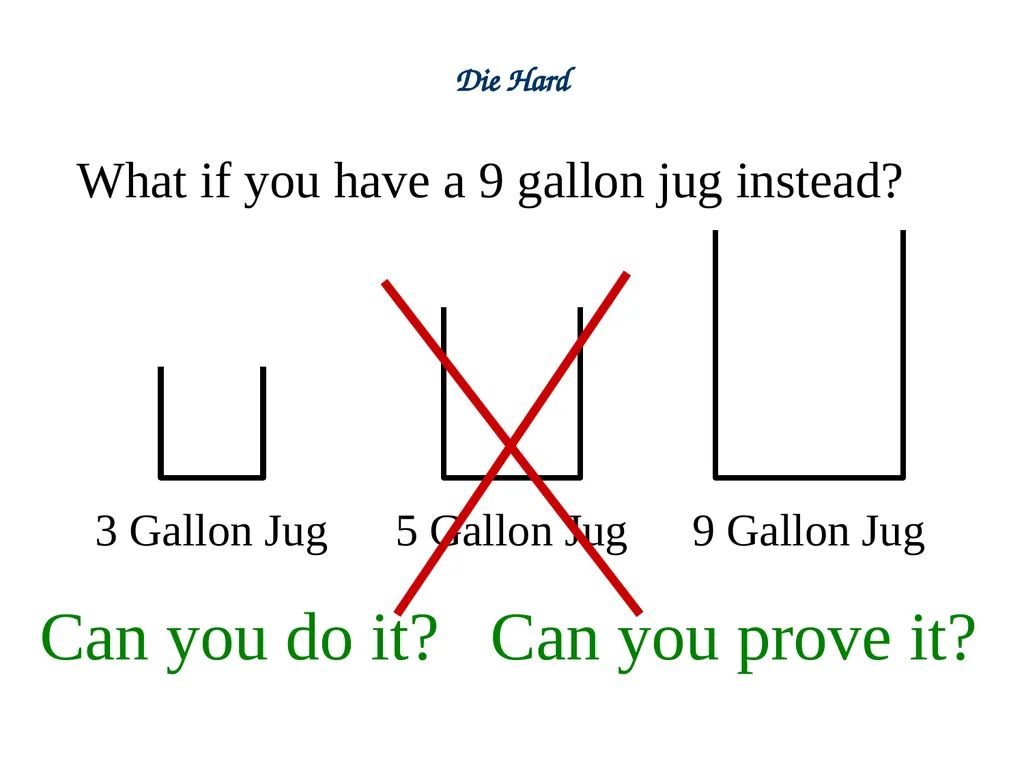
3 Gallon Jug 5 Gallon Jug What if you have a 9 gallon jug instead? Can you do it? Can you prove it? Die Hard<br>
21
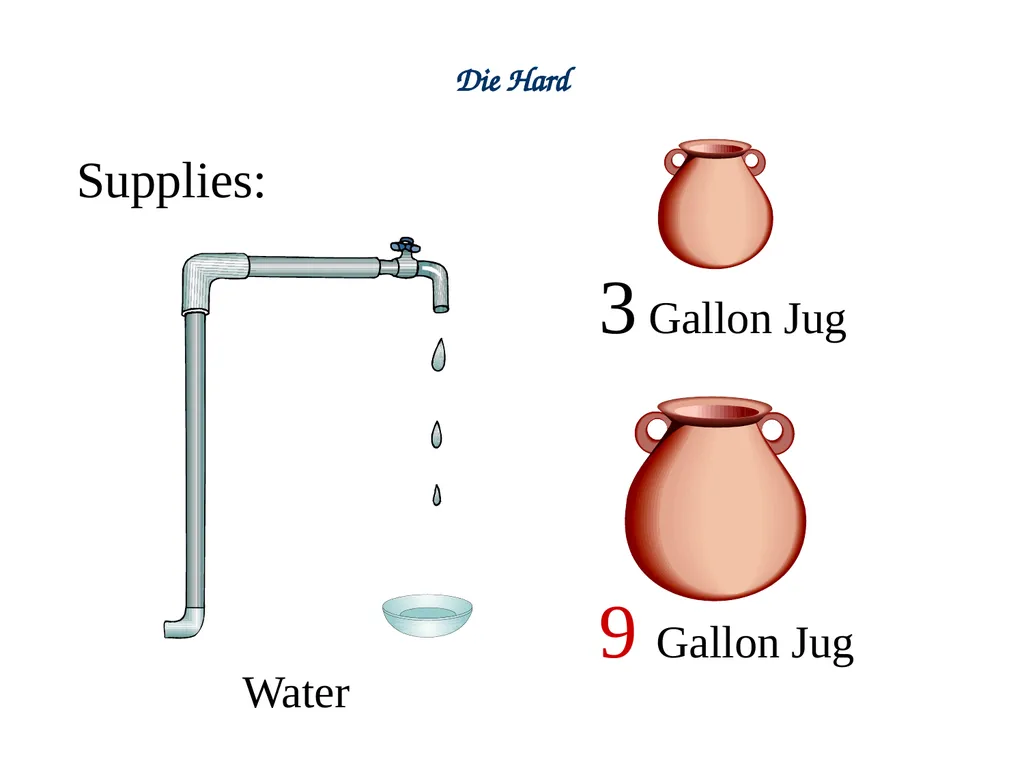
3 Gallon Jug 9 Gallon Jug Supplies: Water Die Hard<br>
22
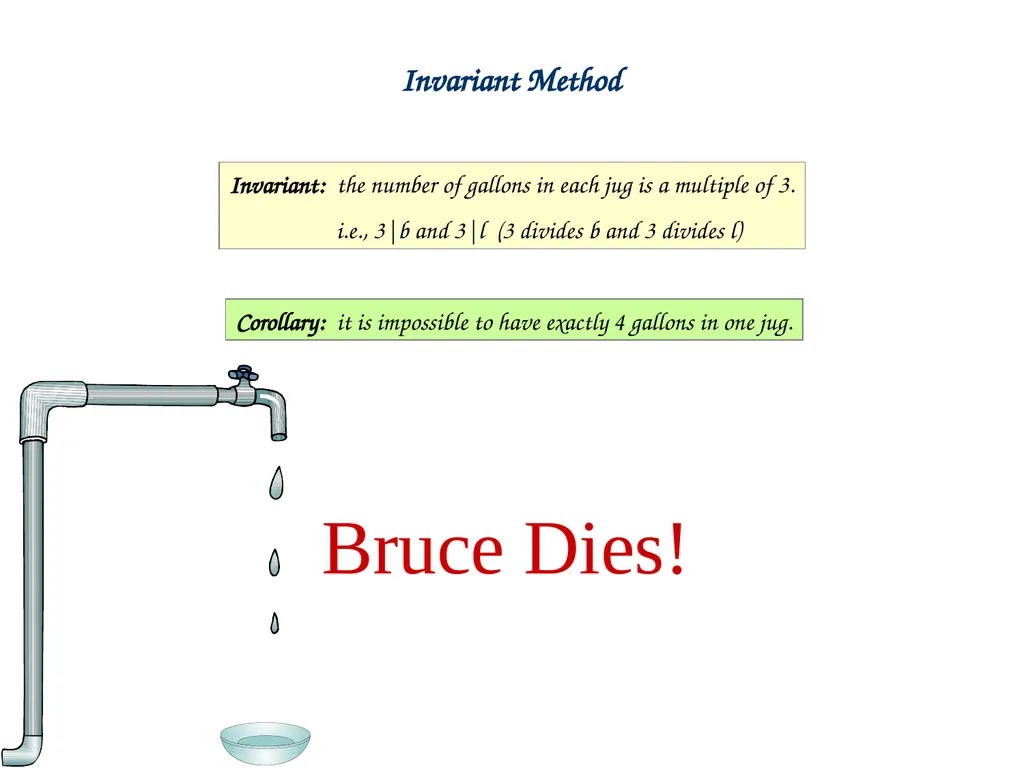
Invariant Method Invariant: the number of gallons in each jug is a multiple of 3.
i.e., 3|b and 3|l (3 divides b and 3 divides l) Corollary: it is impossible to have exactly 4 gallons in one jug. Bruce Dies!<br>
i.e., 3|b and 3|l (3 divides b and 3 divides l) Corollary: it is impossible to have exactly 4 gallons in one jug. Bruce Dies!<br>
23
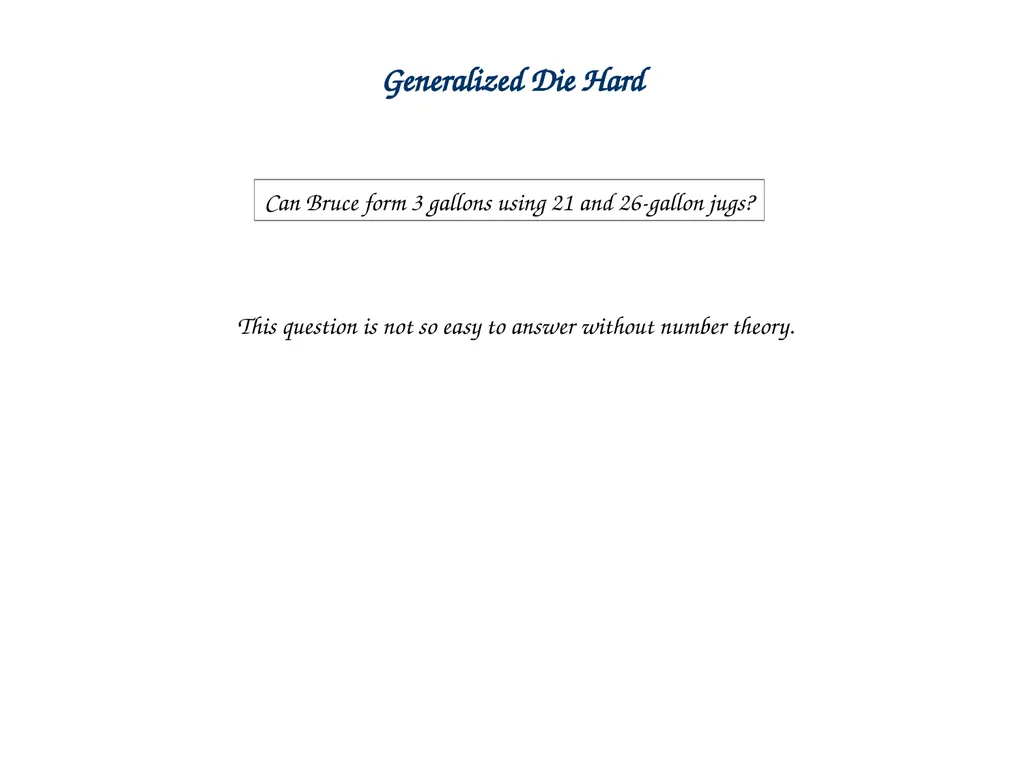
Generalized Die Hard Can Bruce form 3 gallons using 21 and 26-gallon jugs? This question is not so easy to answer without number theory.<br>
24
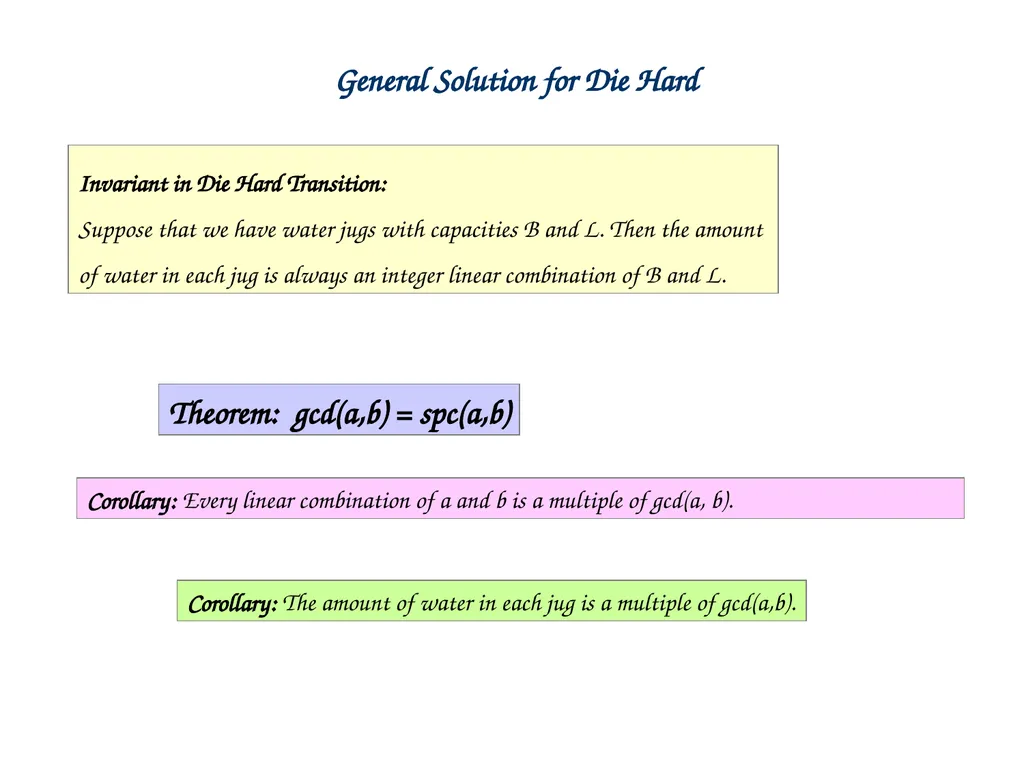
Invariant in Die Hard Transition:
Suppose that we have water jugs with capacities B and L. Then the amount of water in each jug is always an integer linear combination of B and L. General Solution for Die Hard Theorem: gcd(a,b) = spc(a,b) Corollary: The amount of water in each jug is a multiple of gcd(a,b). Corollary: Every linear combination of a and b is a multiple of gcd(a, b).<br>
Suppose that we have water jugs with capacities B and L. Then the amount of water in each jug is always an integer linear combination of B and L. General Solution for Die Hard Theorem: gcd(a,b) = spc(a,b) Corollary: The amount of water in each jug is a multiple of gcd(a,b). Corollary: Every linear combination of a and b is a multiple of gcd(a, b).<br>
25
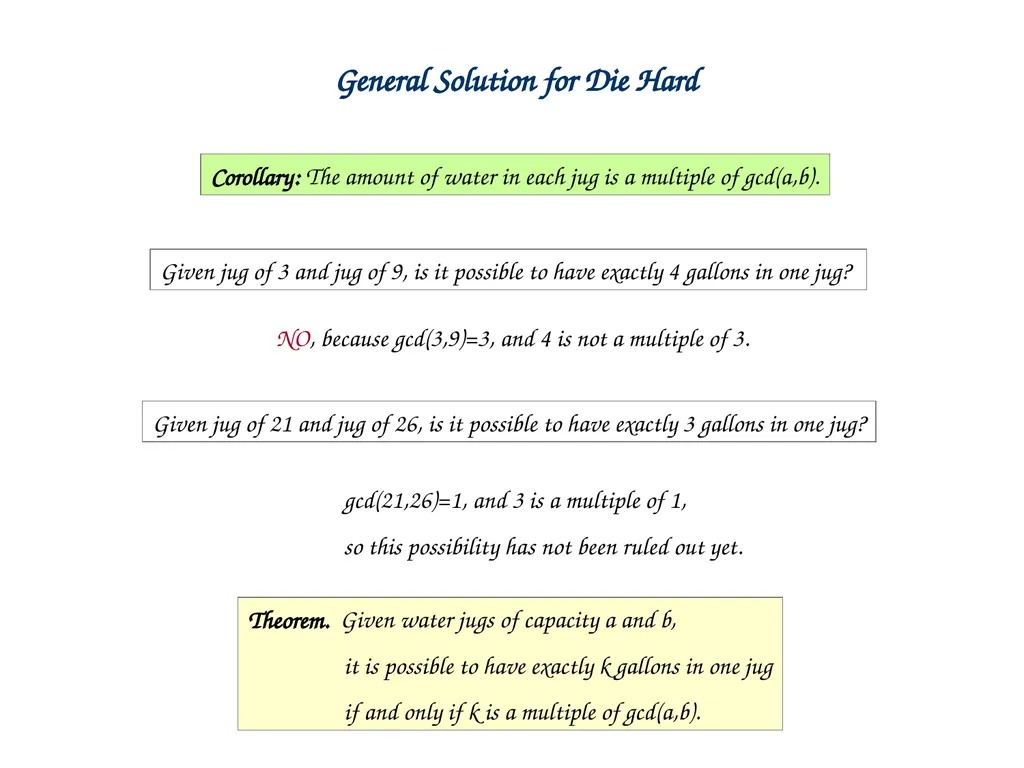
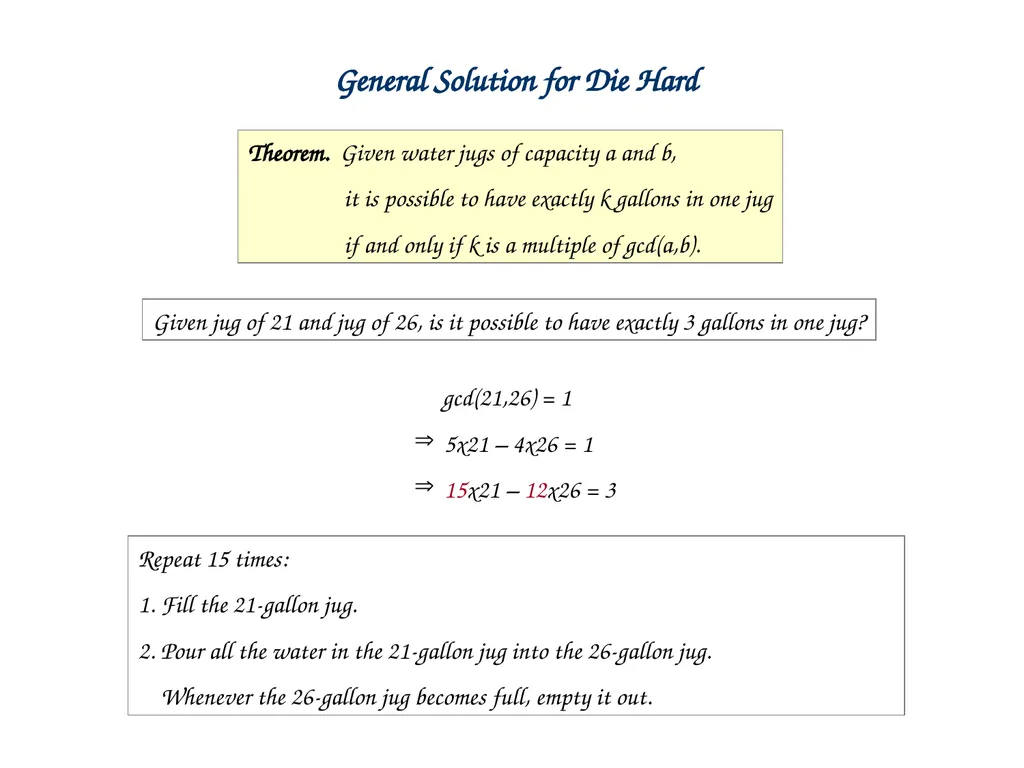
General Solution for Die Hard Corollary: The amount of water in each jug is a multiple of gcd(a,b). Given jug of 3 and jug of 9, is it possible to have exactly 4 gallons in one jug? NO, because gcd(3,9)=3, and 4 is not a multiple of 3. Given jug of 21 and jug of 26, is it possible to have exactly 3 gallons in one jug? gcd(21,26)=1, and 3 is a multiple of 1,
so this possibility has not been ruled out yet. Theorem. Given water jugs of capacity a and b,
it is possible to have exactly k gallons in one jug
if and only if k is a multiple of gcd(a,b).<br>
so this possibility has not been ruled out yet. Theorem. Given water jugs of capacity a and b,
it is possible to have exactly k gallons in one jug
if and only if k is a multiple of gcd(a,b).<br>
26
Theorem. Given water jugs of capacity a and b,
it is possible to have exactly k gallons in one jug
if and only if k is a multiple of gcd(a,b). General Solution for Die Hard Given jug of 21 and jug of 26, is it possible to have exactly 3 gallons in one jug? gcd(21,26) = 1
5x21 – 4x26 = 1
15x21 – 12x26 = 3 Repeat 15 times:
1. Fill the 21-gallon jug.
2. Pour all the water in the 21-gallon jug into the 26-gallon jug.
Whenever the 26-gallon jug becomes full, empty it out.<br>
27
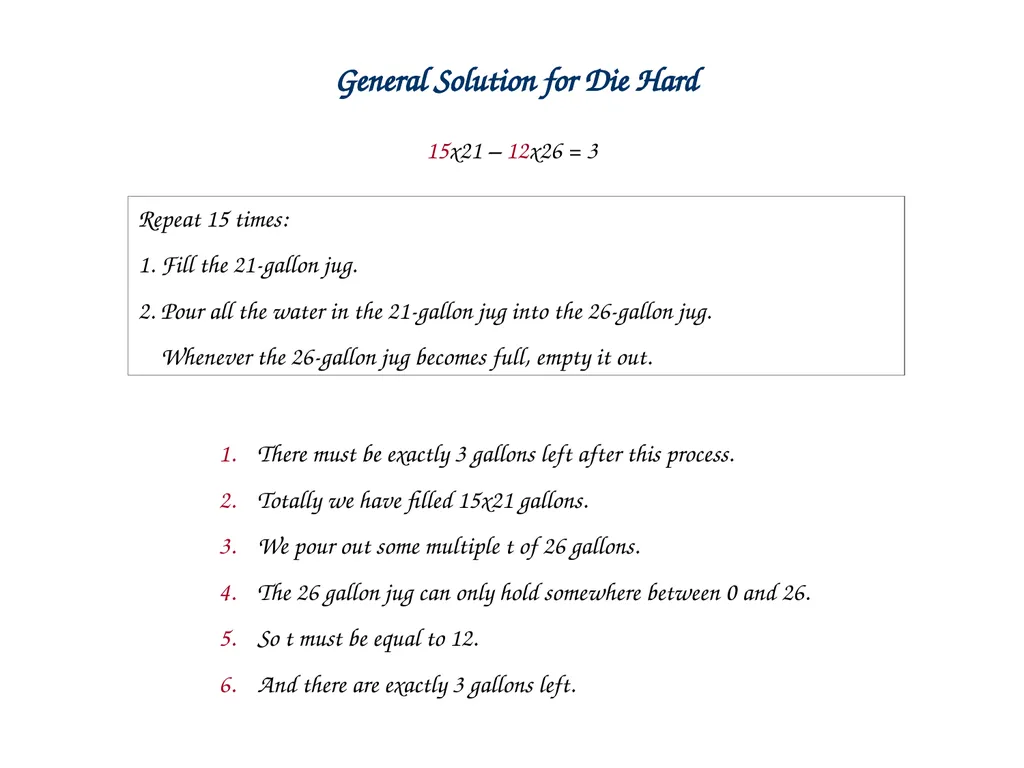
15x21 – 12x26 = 3 Repeat 15 times:
1. Fill the 21-gallon jug.
2. Pour all the water in the 21-gallon jug into the 26-gallon jug.
Whenever the 26-gallon jug becomes full, empty it out. There must be exactly 3 gallons left after this process.
Totally we have filled 15x21 gallons.
We pour out some multiple t of 26 gallons.
The 26 gallon jug can only hold somewhere between 0 and 26.
So t must be equal to 12.
And there are exactly 3 gallons left. General Solution for Die Hard<br>
28
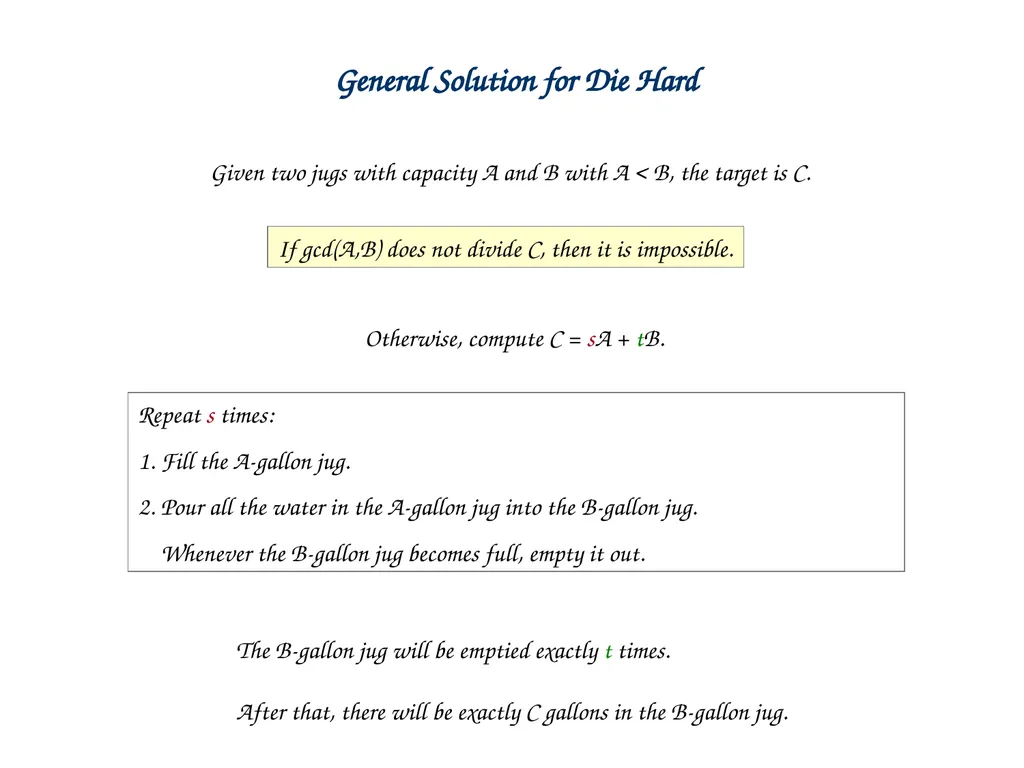
Repeat s times:
1. Fill the A-gallon jug.
2. Pour all the water in the A-gallon jug into the B-gallon jug.
Whenever the B-gallon jug becomes full, empty it out. General Solution for Die Hard Given two jugs with capacity A and B with A < B, the target is C. If gcd(A,B) does not divide C, then it is impossible. Otherwise, compute C = sA + tB. The B-gallon jug will be emptied exactly t times.
After that, there will be exactly C gallons in the B-gallon jug.<br>
29
Modular Arithmetic<br>
30
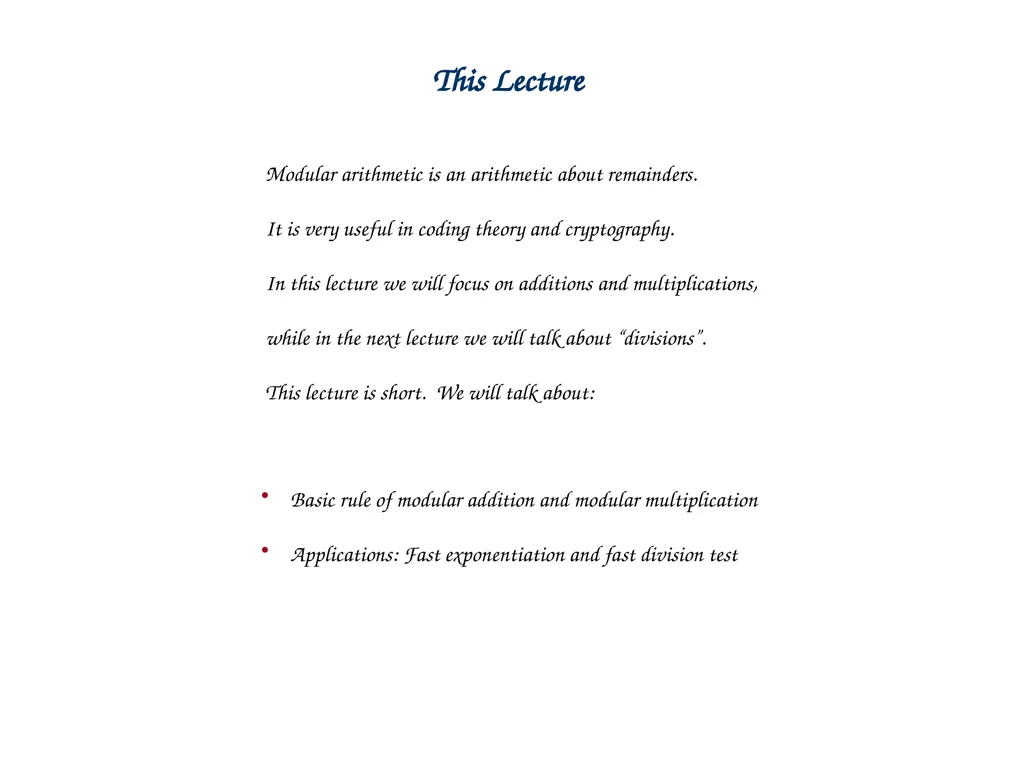
This Lecture Modular arithmetic is an arithmetic about remainders.
It is very useful in coding theory and cryptography.
In this lecture we will focus on additions and multiplications,
while in the next lecture we will talk about “divisions”.
This lecture is short. We will talk about: Basic rule of modular addition and modular multiplication
Applications: Fast exponentiation and fast division test<br>
31
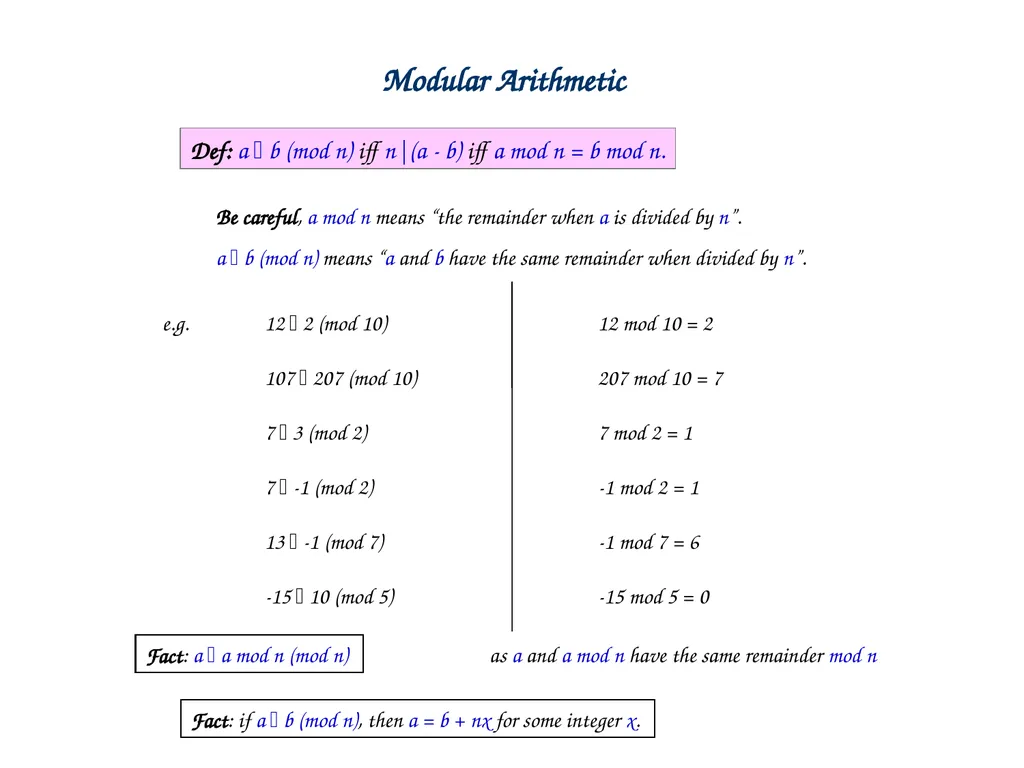
Def: a b (mod n) iff n|(a - b) iff a mod n = b mod n. Modular Arithmetic e.g. 12 2 (mod 10)
107 207 (mod 10)
7 3 (mod 2)
7 -1 (mod 2)
13 -1 (mod 7)
-15 10 (mod 5) Be careful, a mod n means “the remainder when a is divided by n”.
a b (mod n) means “a and b have the same remainder when divided by n”. 12 mod 10 = 2
207 mod 10 = 7
7 mod 2 = 1
-1 mod 2 = 1
-1 mod 7 = 6
-15 mod 5 = 0 Fact: a a mod n (mod n) as a and a mod n have the same remainder mod n Fact: if a b (mod n), then a = b + nx for some integer x.<br>
32
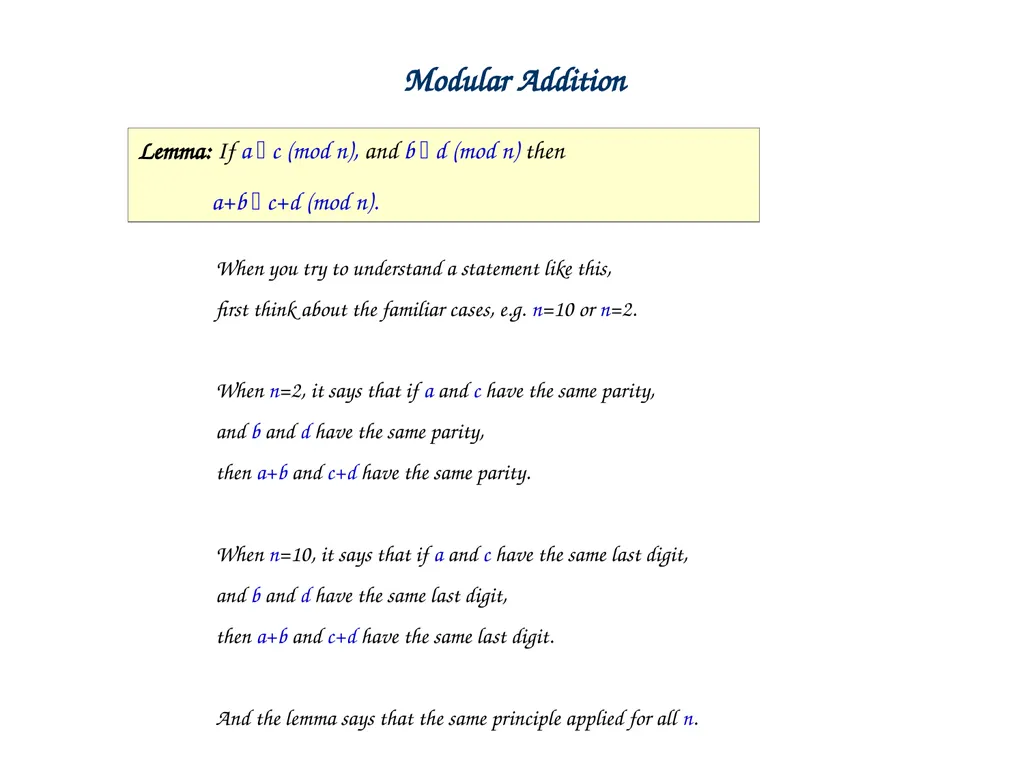
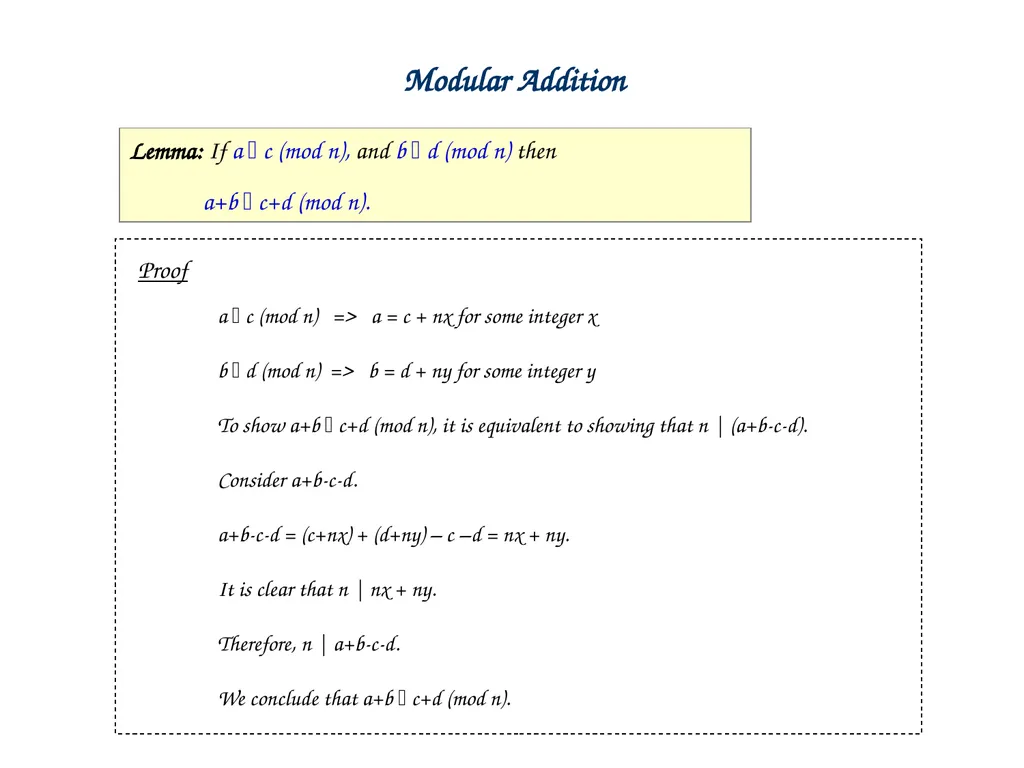
Lemma: If a c (mod n), and b d (mod n) then
a+b c+d (mod n). Modular Addition When you try to understand a statement like this,
first think about the familiar cases, e.g. n=10 or n=2.
When n=2, it says that if a and c have the same parity,
and b and d have the same parity,
then a+b and c+d have the same parity.
When n=10, it says that if a and c have the same last digit,
and b and d have the same last digit,
then a+b and c+d have the same last digit.
And the lemma says that the same principle applied for all n.<br>
33
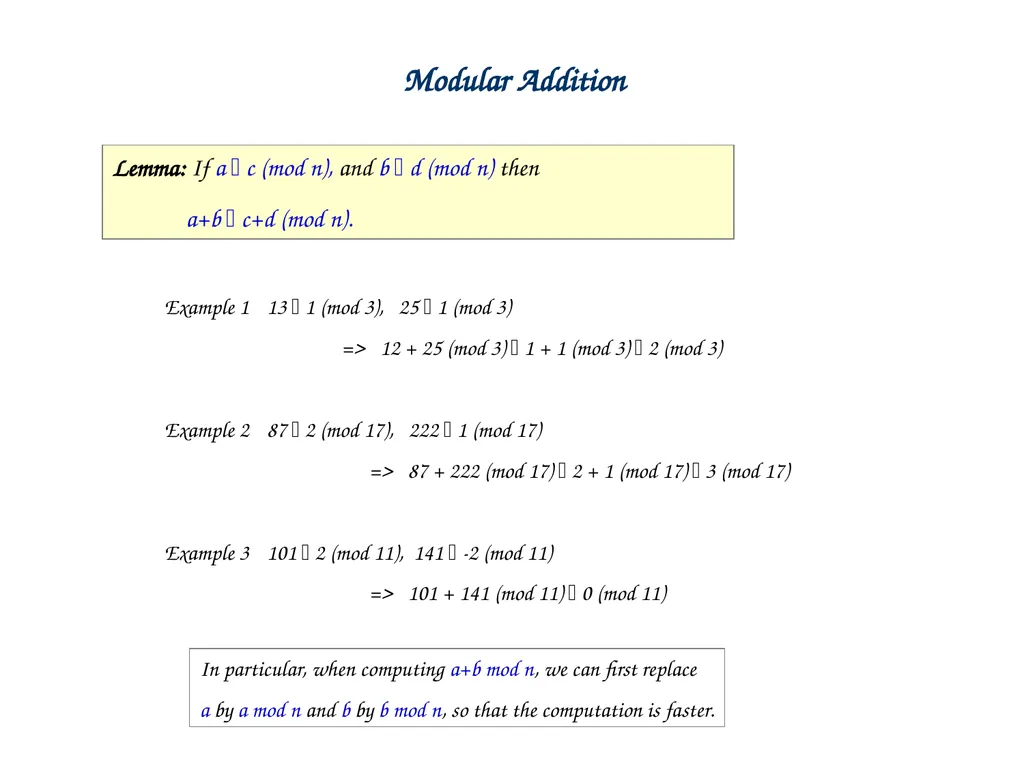
Lemma: If a c (mod n), and b d (mod n) then
a+b c+d (mod n). Modular Addition Example 1 13 1 (mod 3), 25 1 (mod 3)
=> 12 + 25 (mod 3) 1 + 1 (mod 3) 2 (mod 3)
Example 2 87 2 (mod 17), 222 1 (mod 17)
=> 87 + 222 (mod 17) 2 + 1 (mod 17) 3 (mod 17)
Example 3 101 2 (mod 11), 141 -2 (mod 11)
=> 101 + 141 (mod 11) 0 (mod 11) In particular, when computing a+b mod n, we can first replace
a by a mod n and b by b mod n, so that the computation is faster.<br>
34
Lemma: If a c (mod n), and b d (mod n) then
a+b c+d (mod n). Modular Addition a c (mod n) => a = c + nx for some integer x
b d (mod n) => b = d + ny for some integer y
To show a+b c+d (mod n), it is equivalent to showing that n | (a+b-c-d).
Consider a+b-c-d.
a+b-c-d = (c+nx) + (d+ny) – c –d = nx + ny.
It is clear that n | nx + ny.
Therefore, n | a+b-c-d.
We conclude that a+b c+d (mod n). Proof<br>
35
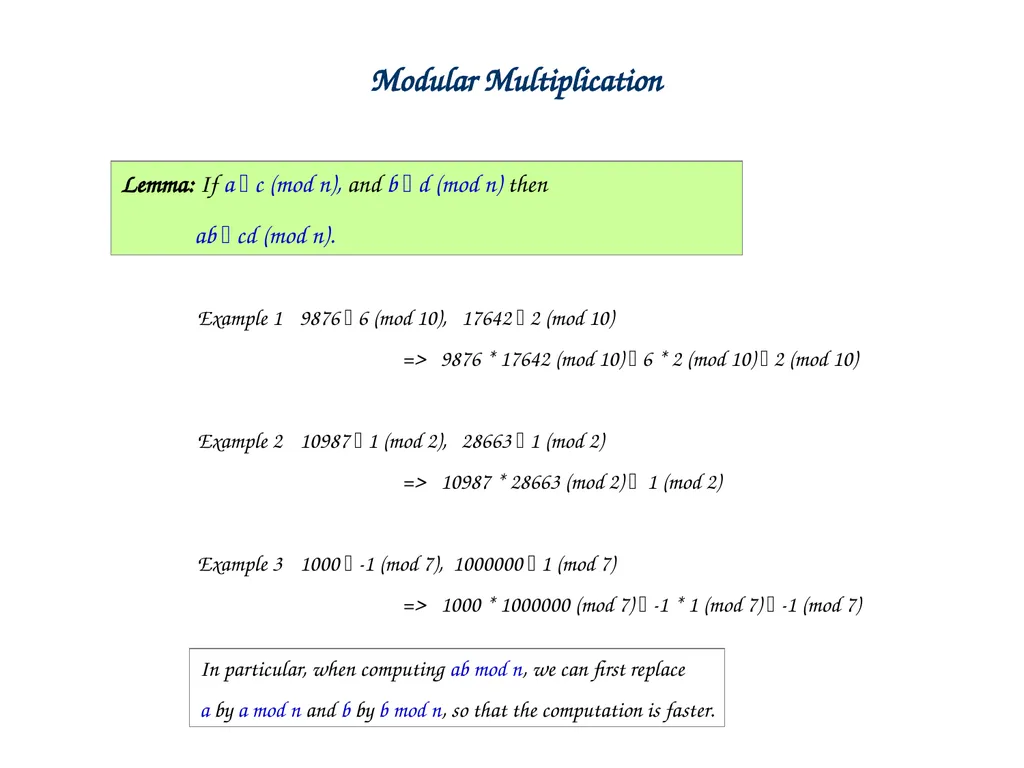
Lemma: If a c (mod n), and b d (mod n) then
ab cd (mod n). Modular Multiplication Example 1 9876 6 (mod 10), 17642 2 (mod 10)
=> 9876 * 17642 (mod 10) 6 * 2 (mod 10) 2 (mod 10)
Example 2 10987 1 (mod 2), 28663 1 (mod 2)
=> 10987 * 28663 (mod 2) 1 (mod 2)
Example 3 1000 -1 (mod 7), 1000000 1 (mod 7)
=> 1000 * 1000000 (mod 7) -1 * 1 (mod 7) -1 (mod 7) In particular, when computing ab mod n, we can first replace
a by a mod n and b by b mod n, so that the computation is faster.<br>
36
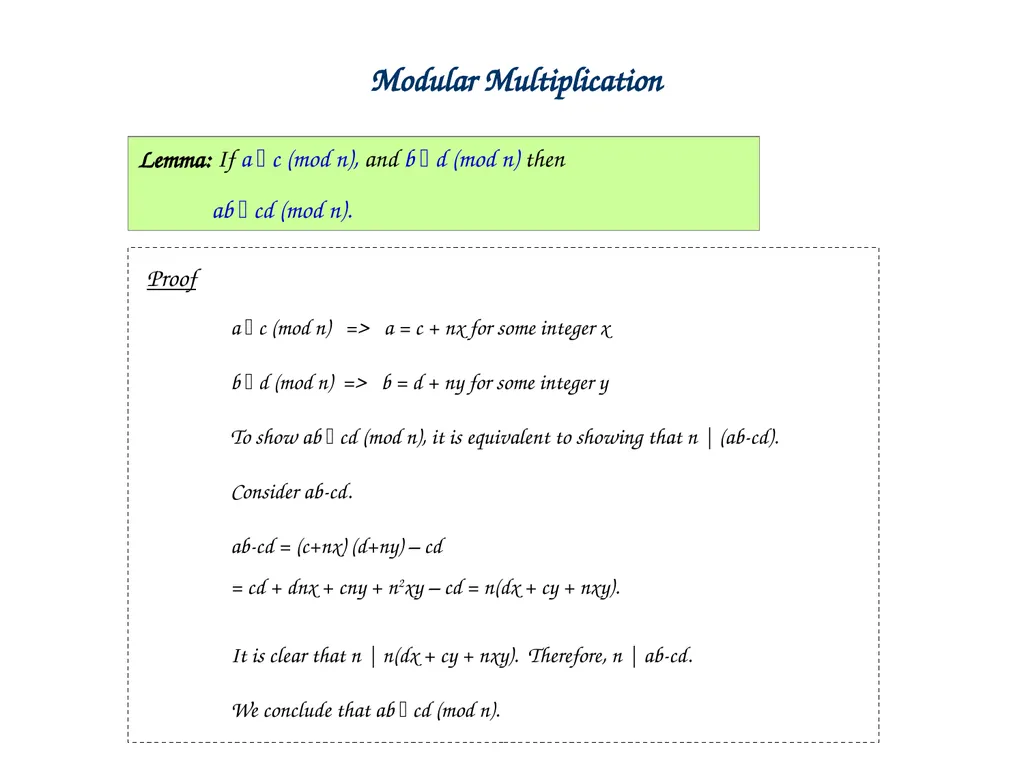
Lemma: If a c (mod n), and b d (mod n) then
ab cd (mod n). Modular Multiplication a c (mod n) => a = c + nx for some integer x
b d (mod n) => b = d + ny for some integer y
To show ab cd (mod n), it is equivalent to showing that n | (ab-cd).
Consider ab-cd.
ab-cd = (c+nx) (d+ny) – cd
= cd + dnx + cny + n2xy – cd = n(dx + cy + nxy).
It is clear that n | n(dx + cy + nxy). Therefore, n | ab-cd.
We conclude that ab cd (mod n). Proof<br>
37
This Lecture Basic rule of modular addition and modular multiplication
Applications: Fast exponentiation and fast division test<br>
Applications: Fast exponentiation and fast division test<br>
38
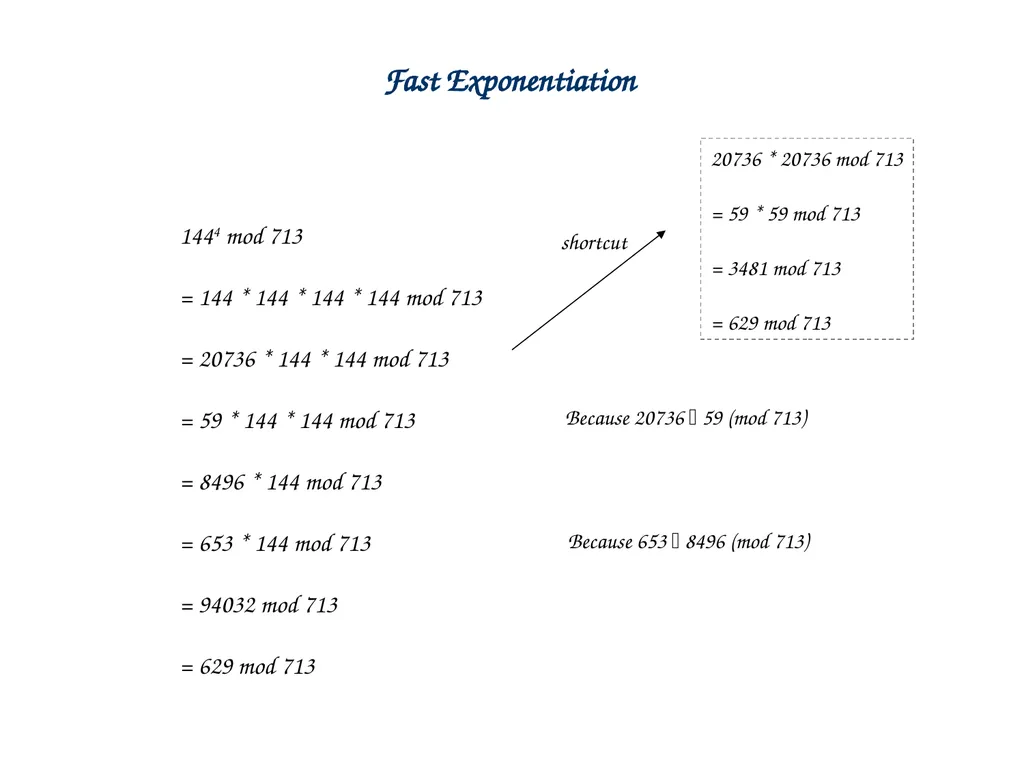
Fast Exponentiation 1444 mod 713
= 144 * 144 * 144 * 144 mod 713
= 20736 * 144 * 144 mod 713
= 59 * 144 * 144 mod 713
= 8496 * 144 mod 713
= 653 * 144 mod 713
= 94032 mod 713
= 629 mod 713 20736 * 20736 mod 713
= 59 * 59 mod 713
= 3481 mod 713
= 629 mod 713 Because 20736 59 (mod 713) Because 653 8496 (mod 713) shortcut<br>
= 144 * 144 * 144 * 144 mod 713
= 20736 * 144 * 144 mod 713
= 59 * 144 * 144 mod 713
= 8496 * 144 mod 713
= 653 * 144 mod 713
= 94032 mod 713
= 629 mod 713 20736 * 20736 mod 713
= 59 * 59 mod 713
= 3481 mod 713
= 629 mod 713 Because 20736 59 (mod 713) Because 653 8496 (mod 713) shortcut<br>
39
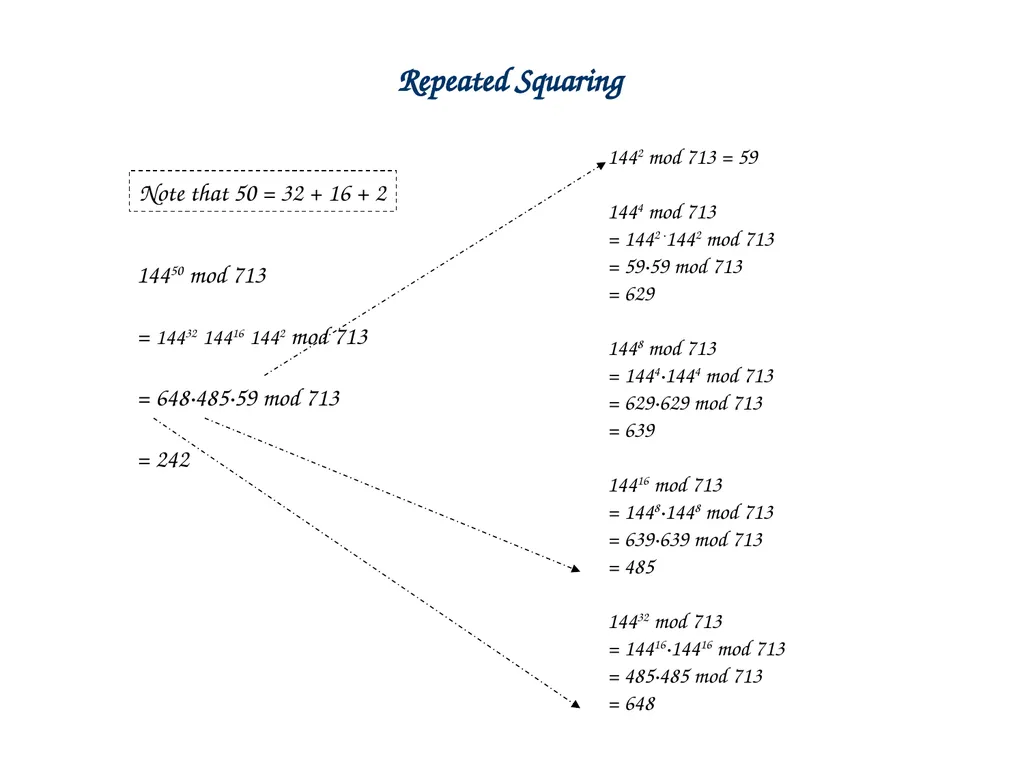
Repeated Squaring 14450 mod 713
= 14432 14416 1442 mod 713
= 648·485·59 mod 713
= 242 1442 mod 713 = 59
1444 mod 713
= 1442 ·1442 mod 713
= 59·59 mod 713
= 629
1448 mod 713
= 1444·1444 mod 713
= 629·629 mod 713
= 639
14416 mod 713
= 1448·1448 mod 713
= 639·639 mod 713
= 485
14432 mod 713
= 14416·14416 mod 713
= 485·485 mod 713
= 648 Note that 50 = 32 + 16 + 2<br>
40
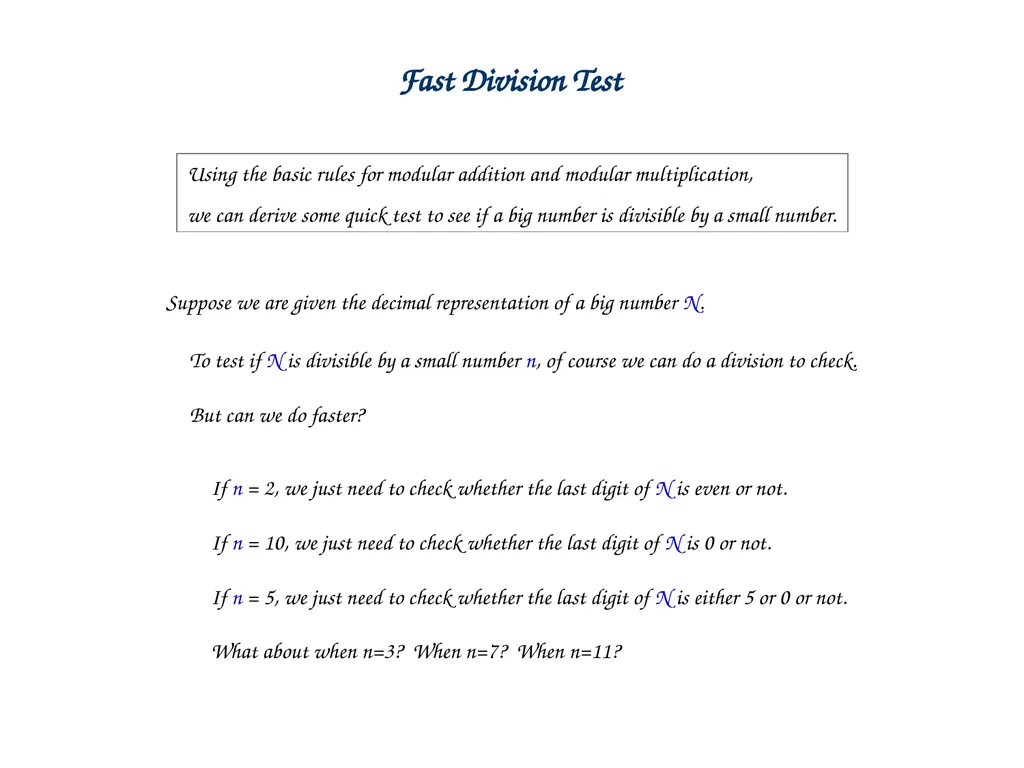
Fast Division Test Using the basic rules for modular addition and modular multiplication,
we can derive some quick test to see if a big number is divisible by a small number. Suppose we are given the decimal representation of a big number N. To test if N is divisible by a small number n, of course we can do a division to check.
But can we do faster? If n = 2, we just need to check whether the last digit of N is even or not.
If n = 10, we just need to check whether the last digit of N is 0 or not.
If n = 5, we just need to check whether the last digit of N is either 5 or 0 or not.
What about when n=3? When n=7? When n=11?<br>
41
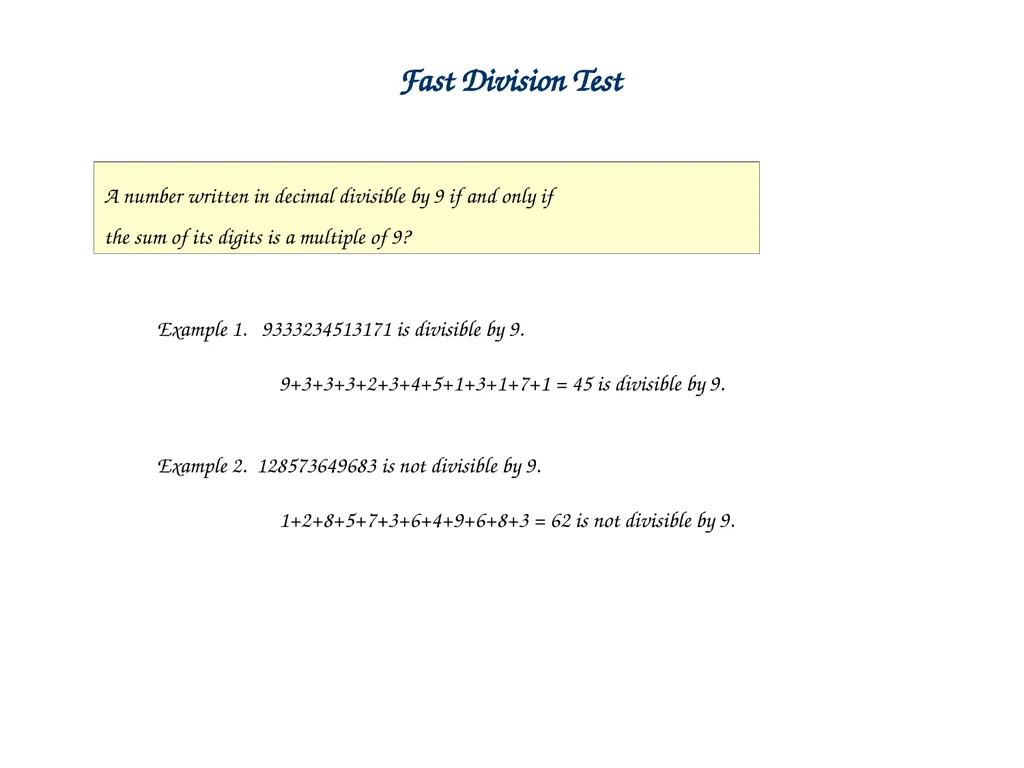
Fast Division Test A number written in decimal divisible by 9 if and only if
the sum of its digits is a multiple of 9? Example 1. 9333234513171 is divisible by 9.
9+3+3+3+2+3+4+5+1+3+1+7+1 = 45 is divisible by 9.
Example 2. 128573649683 is not divisible by 9.
1+2+8+5+7+3+6+4+9+6+8+3 = 62 is not divisible by 9.<br>
the sum of its digits is a multiple of 9? Example 1. 9333234513171 is divisible by 9.
9+3+3+3+2+3+4+5+1+3+1+7+1 = 45 is divisible by 9.
Example 2. 128573649683 is not divisible by 9.
1+2+8+5+7+3+6+4+9+6+8+3 = 62 is not divisible by 9.<br>
42
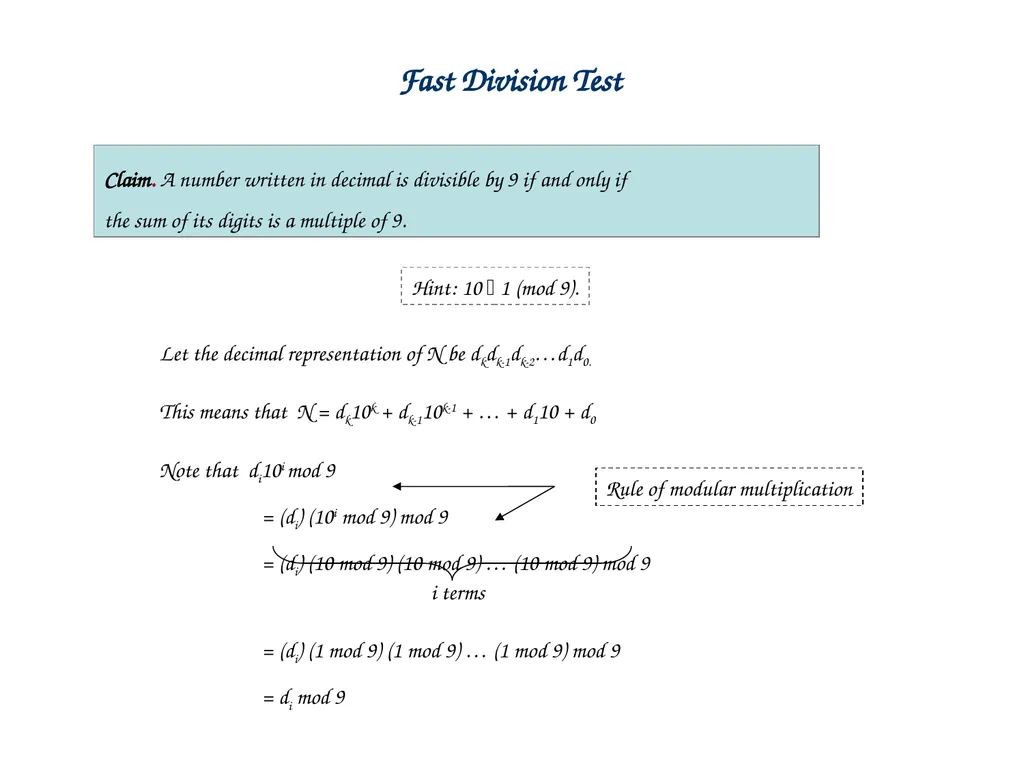
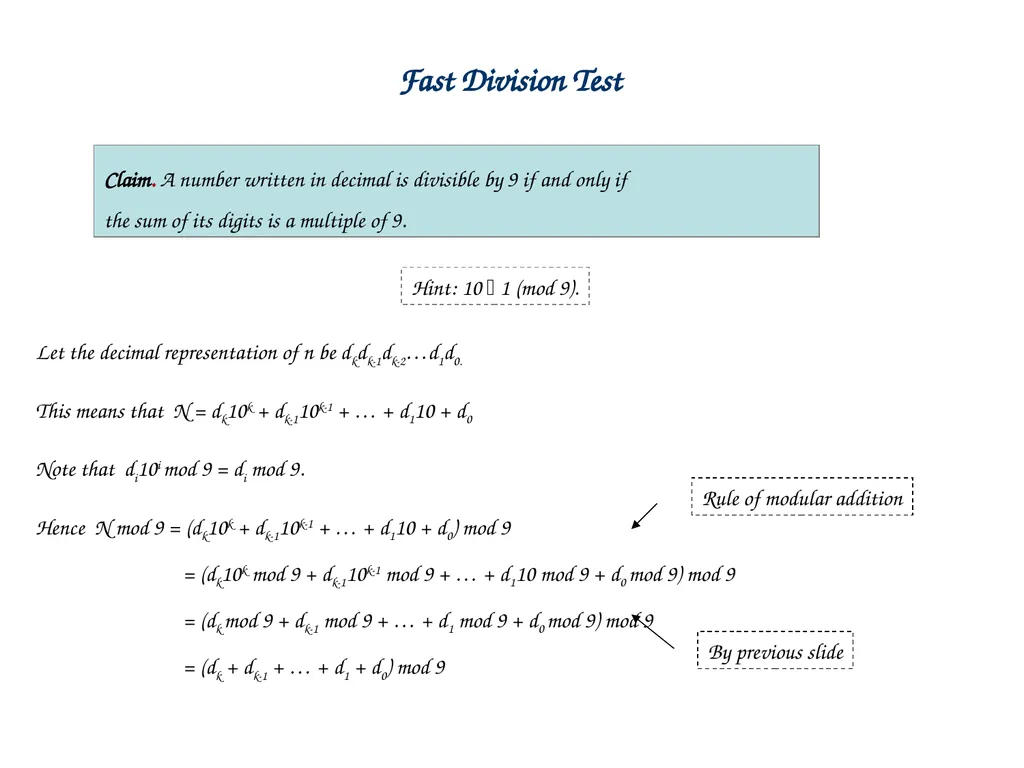
Claim. A number written in decimal is divisible by 9 if and only if
the sum of its digits is a multiple of 9. Hint: 10 1 (mod 9). Let the decimal representation of N be dkdk-1dk-2…d1d0.
This means that N = dk10k + dk-110k-1 + … + d110 + d0
Note that di10i mod 9
= (di) (10i mod 9) mod 9
= (di) (10 mod 9) (10 mod 9) … (10 mod 9) mod 9
= (di) (1 mod 9) (1 mod 9) … (1 mod 9) mod 9
= di mod 9 i terms Fast Division Test Rule of modular multiplication<br>
43
Let the decimal representation of n be dkdk-1dk-2…d1d0.
This means that N = dk10k + dk-110k-1 + … + d110 + d0
Note that di10i mod 9 = di mod 9.
Hence N mod 9 = (dk10k + dk-110k-1 + … + d110 + d0) mod 9
= (dk10k mod 9 + dk-110k-1 mod 9 + … + d110 mod 9 + d0 mod 9) mod 9
= (dk mod 9 + dk-1 mod 9 + … + d1 mod 9 + d0 mod 9) mod 9
= (dk + dk-1 + … + d1 + d0) mod 9 Hint: 10 1 (mod 9). Fast Division Test Claim. A number written in decimal is divisible by 9 if and only if
the sum of its digits is a multiple of 9. Rule of modular addition By previous slide<br>
44
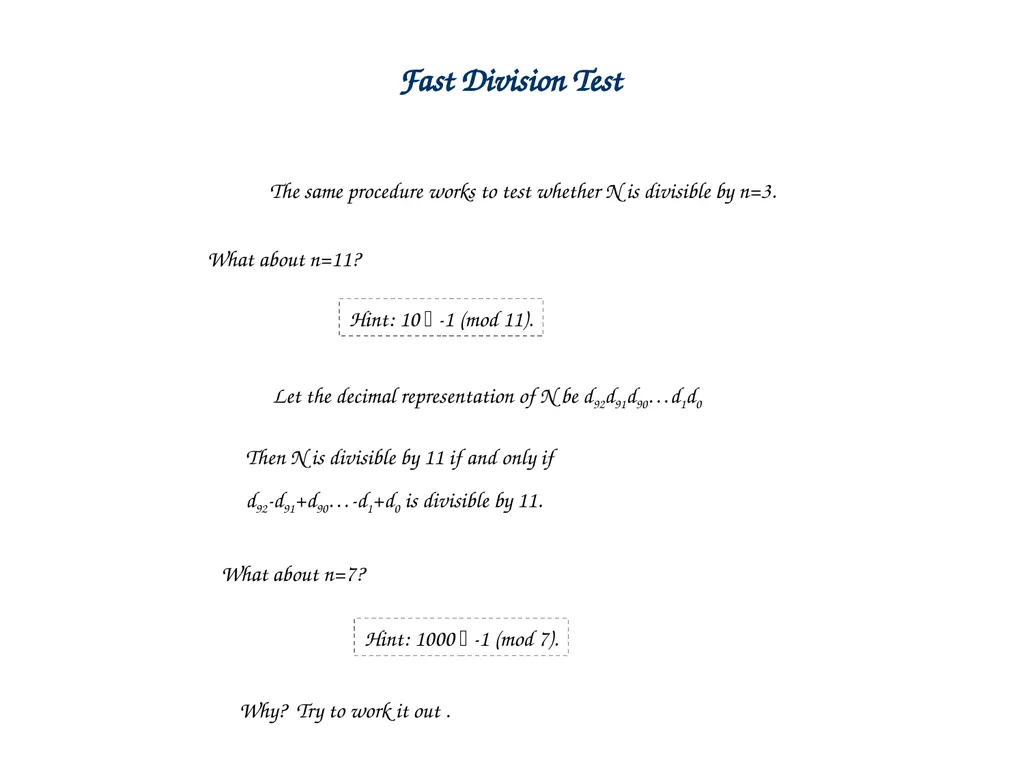
The same procedure works to test whether N is divisible by n=3. Fast Division Test What about n=11? Hint: 10 -1 (mod 11). Let the decimal representation of N be d92d91d90…d1d0 Then N is divisible by 11 if and only if
d92-d91+d90…-d1+d0 is divisible by 11. Why? Try to work it out . What about n=7? Hint: 1000 -1 (mod 7).<br>
d92-d91+d90…-d1+d0 is divisible by 11. Why? Try to work it out . What about n=7? Hint: 1000 -1 (mod 7).<br>
45
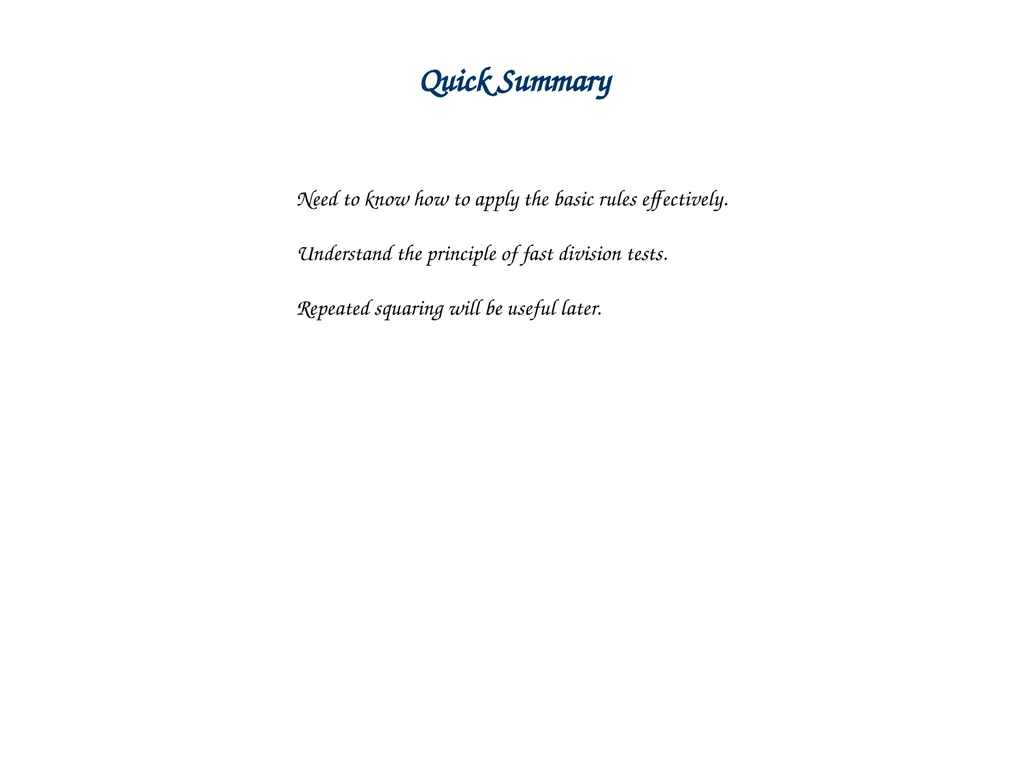
Quick Summary Need to know how to apply the basic rules effectively.
Understand the principle of fast division tests.
Repeated squaring will be useful later.<br>
Understand the principle of fast division tests.
Repeated squaring will be useful later.<br>