Lions Vision Research Foundation Multiple District 22 Over 30 Years of Supporting Vision Services The LVRF mission is to support the Wilmer Eye Institute at Johns Hopkins in the areas of LOW VISION to include: Clinical Services Education
"Lions Vision Research Foundation Multiple District" is the property of its rightful owner. Permission is granted to
download and print the materials on this website for personal, non-commercial use only, and to display it
on your personal computer provided you do not modify the materials and that you retain all copyright
notices contained in the materials. By downloading content from our website, you accept the terms of this
agreement.
Presentation Transcript
01
Lions Vision Research Foundation
Multiple District 22
Over 30 Years of Supporting Vision Services The LVRF mission is to support the Wilmer Eye Institute at Johns Hopkins in the areas of LOW VISION to include:
Clinical Services Education Research<br>
02
LOW VISION is defined as visual acuity of 20/50 or worse in the better eye while wearing glasses or contact lenses and/or blind spots or loss of peripheral vision that interferes with the performance of everyday activities. MOREOVER, low vision cannot be improved by glasses, surgery or medication. What do we mean by Low Vision?<br>
03
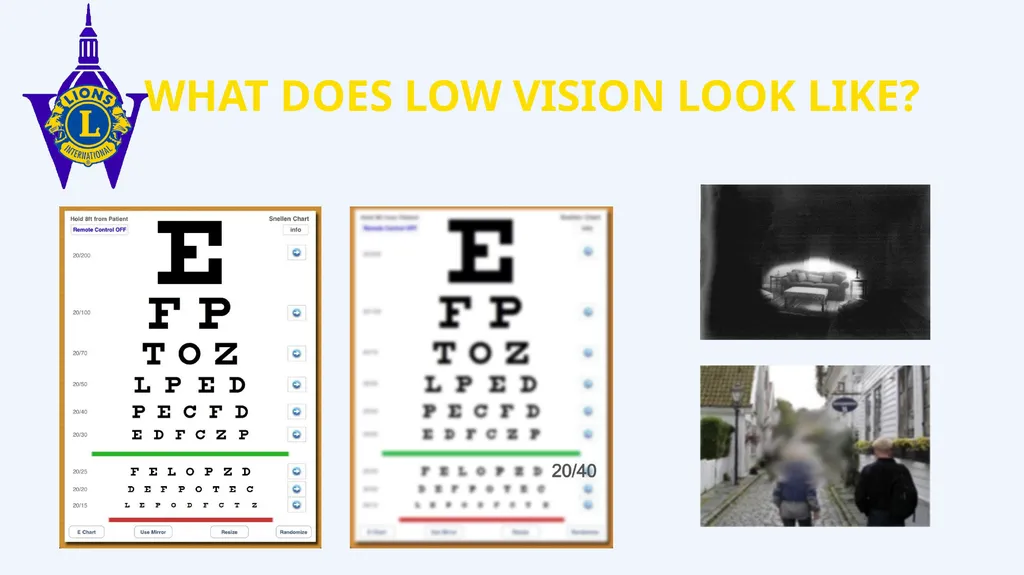
WHAT DOES LOW VISION LOOK LIKE?<br>
04
Doesn’t my regular eye doctor cover this? PROBABLY NOT! Low vision is both a sub-speciality and a condition. Many optometrists and opticians are NOT trained in the area of low vision - low vision rehabilitation is time consuming. WHAT’S INVOLVED IN LOW VISION REHABILITATION? Since low vision cannot be corrected with glasses, surgery, or medication, the goal is to empower patients such that they can live without support or assistance from others and thus maximize their quality of life.<br>
05
WHAT’S THE BIG DEAL? JUST MAKE AN APPOINTMENT WITH A LOW VISION SPECIALIST – RIGHT? There is a shortage of eye care professionals in the field of low vision.
If your regular eye doctor doesn’t specialize in low vision, he or she may only have a limited knowledge of the options that exist with respect to low vision aids.
Because low vision rehabilitation is so time consuming, many optometrists and opticians choose not to train in this area or make this part of their regular practice.
Consequently, most vision care practices don’t have the tools or aids to train individuals to negotiate life with low vision.<br>
06
Just what has LVRF done meet the need in the area of low vision? Following completion of the $4 million endowment in 2007, the LVRF established the Lions Low Vision Fellowship, which provides $100,000 annually to fund a full year of clinical and research training for low vision specialists at Wilmer. MAKING A DIFFERENCE! In 1988, delegates at the MD22 Convention approved the establishment of the LVRF – ultimately, in 1991 the LVRF established the Lions Low Vision Center at Wilmer as well as a $4 million endowment to ensure the Center’s operation.<br>
07
MAKING A DIFFERENCE! In 2013 LVRF and the Wilmer Eye Institute partnered to form the Low Vision Rehabilitation Network (LOVRNET) LOVRNET was formed as a demonstration project to make low vision services more available to the public by matching patients with service providers in their area. The idea is to train Lions to conduct pre-service client interviews thereby reducing the time needed by professionals to provide these services and to assist with outcome evaluations<br>
08
In 2016, the LVRF along with Wilmer agreed to create an endowment to fund the Fellowship Program permanently. The objective is to build the endowment to $2.3 million in order to yield the $100,000 necessary for an annual fellowship.
At the 2019 convention LVRF presented the Wilmer Director with a check for $300,000 officially establishing the Lions Low Vision Fellowship Fund.
Once the endowment is achieved, annual donations from Lions Clubs may be devoted to other vision services. MAKING A DIFFERENCE!<br>
09
Establishment of the Lions Low Vision Center at Wilmer
Establishment & completion of $4 million endowment for the center’s on-going operations
Establishment of an annual $100,000 fellowship
Creation of LOVRNET program to match patients with services
Establishment of $2.3 millon endowment to fund the fellowship in perpetuity MAKING A DIFFERENCE!
RECAP<br>
10
MAKING A DIFFERENCE – HOW IS IT WORKING? There are approximately five million people in the U.S. suffering with low vision and yet, low vision rehabilitation is not available in all states nor in all countries. The Lions Low Vision Center at Wilmer helps to meet this need. Some fellowship recipients have remained at Wilmer while others have gone on to establish low vision practices where no low vision care existed previously. An ophthalmologist from Thailand recently completed the fellowship program and returned to his country to head up a low vision program in a country where one did not exist. The fellowship recipients not only learn low vision rehabilitation techniques, but conduct much needed research in the area of low vision as well.<br>
11
There are currently 27 trained LOVRNET interviewers actively conducting pre-service client interviews thereby reducing the time needed by professionals to provide these services.
Over 1200 interviews have been assigned through LOVRNET since its establishment. That is, Lions have played an integral role in connecting low vision patients with low vision services.
And many more have been helped by the staff at the Lions Low Vision Research Center. That’s thousands of lives improved! MAKING A DIFFERENCE – HOW IS IT WORKING?<br>
12
HOW CAN YOUR CLUB MAKE A DIFFERENCE? Your club can support LVRF by making an annual donation a part of your budget. Members can support LVRF fundraisers and help spread awareness of the LVRF mission and accomplishments. Your club can be an advocate for LOVRNET with eye care professionals in your area and help to educate the public about low vision. LVRF is a MD22 program and is not supported by other Lions Districts so your club’s support is essential. Support from 100% of the clubs in MD22 would be AWESOME!<br>
13
HOW CAN YOU MAKE A DIFFERENCE? You can become a LOVRNET interviewer Learn to properly assist blind and visually impaired people. Consider making a personal donation to LVRF or include LVRF in your estate planning Participate in LVRF fundraising events<br>
14
NEED TO KNOW MORE? Contact your district governor or an LVRF trustee from your district (they are listed in the Roster book) Through the efforts of LVRF and YOU – we hope to make low vision services no more than a 45 minute drive for all patients within MD22. Visit the LVRF website www.lionsvision.org<br>