
Literature Paper 2 Section A: ‘An Inspector Calls’
GB
Published · 8 slides · 0 views

1 / 1

Description
Literature Paper 2 Section A: An Inspector Calls Section B: Power Conflict Poetry Section C: Unseen Poetry Walkthrough Guide Revision Workbook An Inspector Calls: Exam Technique Big Idea 1 How does Priestley explore the generation gap
Related Topics
Share
Embed code
Download this presentation From Below
"Literature Paper 2 Section A: ‘An Inspector Calls’" is the property of its rightful owner. Permission is granted to download and print the materials on this website for personal, non-commercial use only, and to display it on your personal computer provided you do not modify the materials and that you retain all copyright notices contained in the materials. By downloading content from our website, you accept the terms of this agreement.
Presentation Transcript
01
Literature Paper 2
Section A: ‘An Inspector Calls’
Section B: Power & Conflict Poetry
Section C: Unseen Poetry Walkthrough Guide & Revision Workbook<br>
Section A: ‘An Inspector Calls’
Section B: Power & Conflict Poetry
Section C: Unseen Poetry Walkthrough Guide & Revision Workbook<br>
02
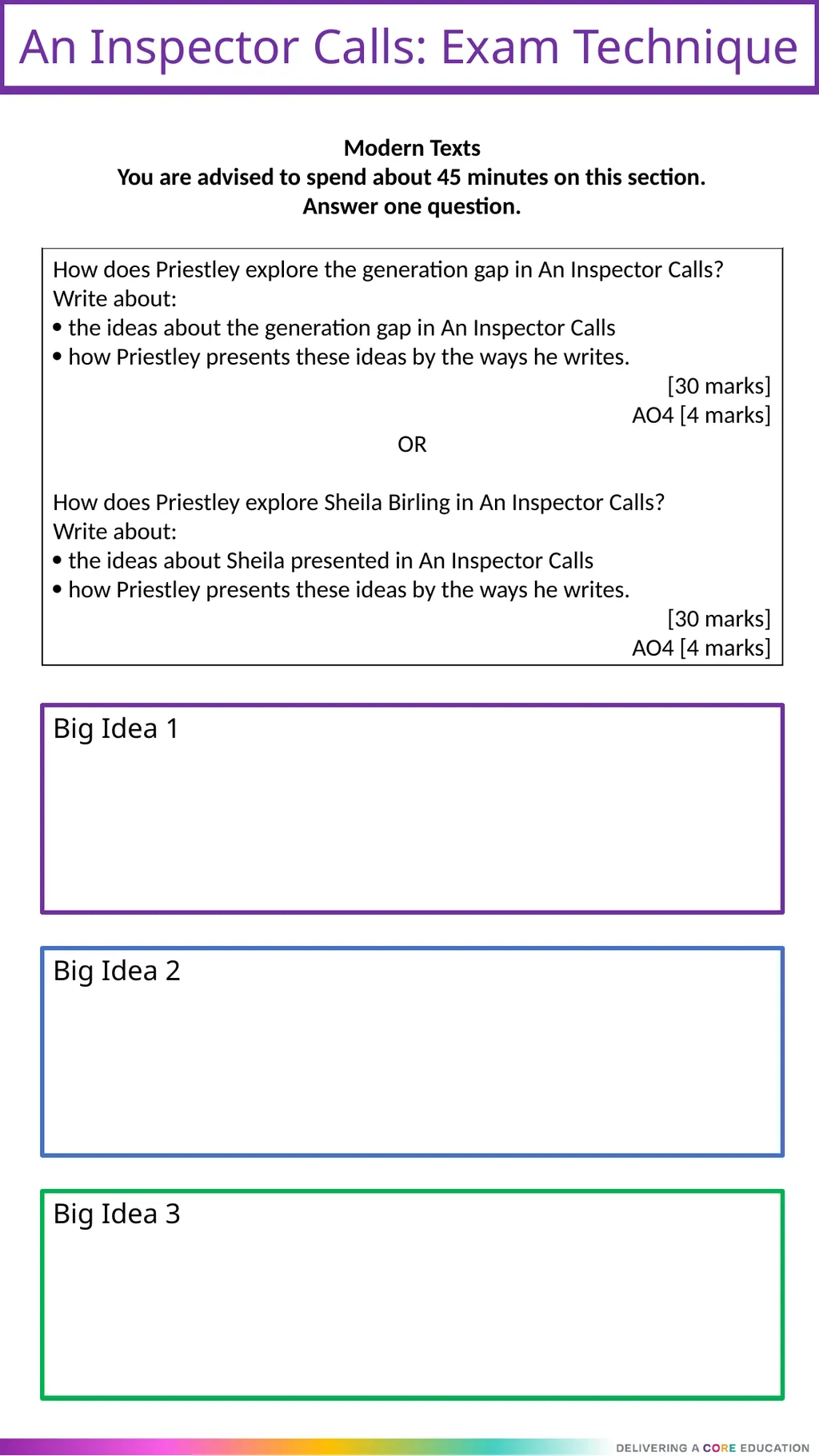
An Inspector Calls: Exam Technique Big Idea 1 How does Priestley explore the generation gap in An Inspector Calls?
Write about:
the ideas about the generation gap in An Inspector Calls
how Priestley presents these ideas by the ways he writes.
[30 marks]
AO4 [4 marks]
OR
How does Priestley explore Sheila Birling in An Inspector Calls?
Write about:
the ideas about Sheila presented in An Inspector Calls
how Priestley presents these ideas by the ways he writes.
[30 marks]
AO4 [4 marks] Modern Texts
You are advised to spend about 45 minutes on this section.
Answer one question. Big Idea 2 Big Idea 3<br>
Write about:
the ideas about the generation gap in An Inspector Calls
how Priestley presents these ideas by the ways he writes.
[30 marks]
AO4 [4 marks]
OR
How does Priestley explore Sheila Birling in An Inspector Calls?
Write about:
the ideas about Sheila presented in An Inspector Calls
how Priestley presents these ideas by the ways he writes.
[30 marks]
AO4 [4 marks] Modern Texts
You are advised to spend about 45 minutes on this section.
Answer one question. Big Idea 2 Big Idea 3<br>
03
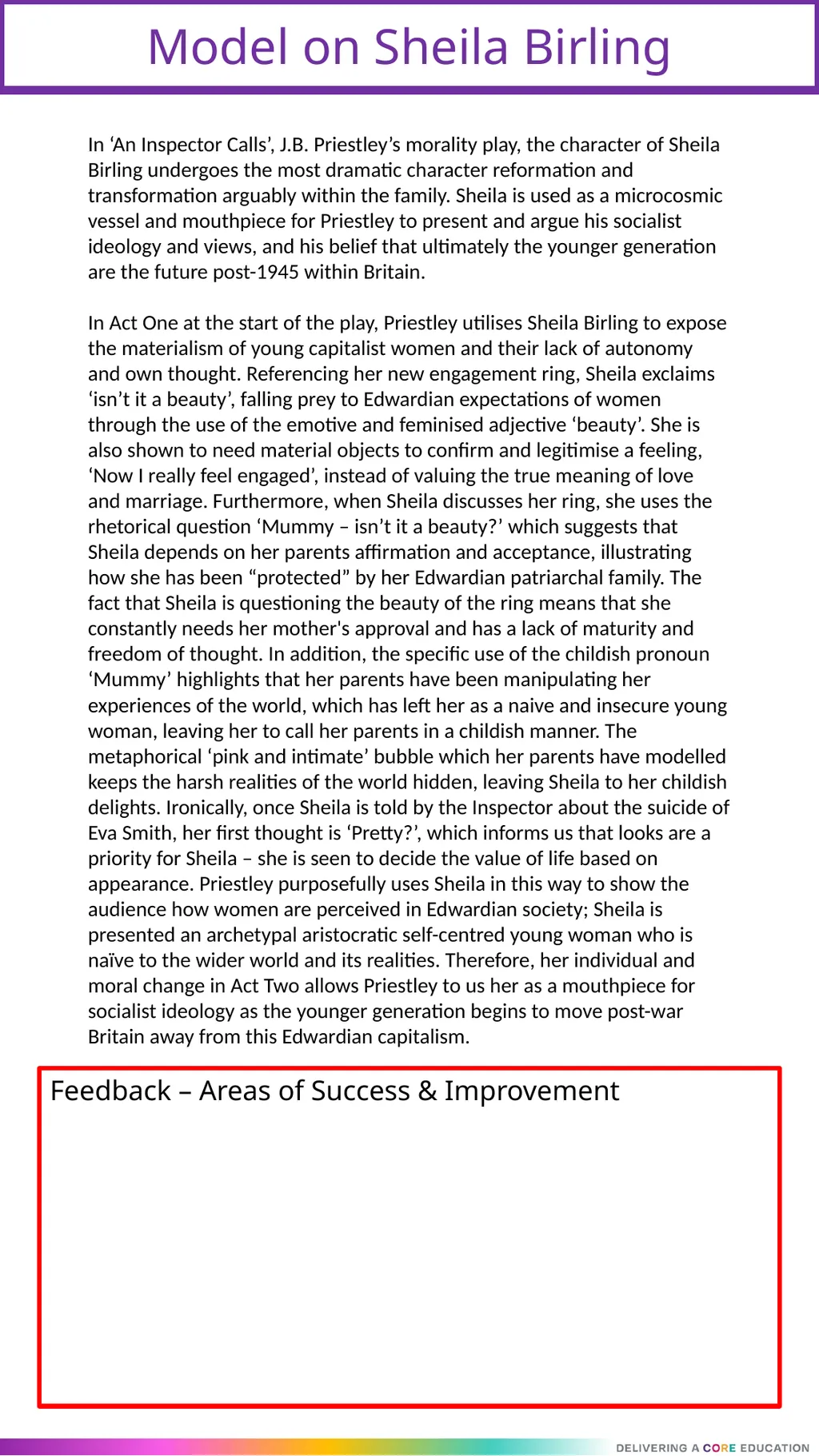
Model on Sheila Birling Feedback – Areas of Success & Improvement In ‘An Inspector Calls’, J.B. Priestley’s morality play, the character of Sheila Birling undergoes the most dramatic character reformation and transformation arguably within the family. Sheila is used as a microcosmic vessel and mouthpiece for Priestley to present and argue his socialist ideology and views, and his belief that ultimately the younger generation are the future post-1945 within Britain.
In Act One at the start of the play, Priestley utilises Sheila Birling to expose the materialism of young capitalist women and their lack of autonomy and own thought. Referencing her new engagement ring, Sheila exclaims ‘isn’t it a beauty’, falling prey to Edwardian expectations of women through the use of the emotive and feminised adjective ‘beauty’. She is also shown to need material objects to confirm and legitimise a feeling, ‘Now I really feel engaged’, instead of valuing the true meaning of love and marriage. Furthermore, when Sheila discusses her ring, she uses the rhetorical question ‘Mummy – isn’t it a beauty?’ which suggests that Sheila depends on her parents affirmation and acceptance, illustrating how she has been “protected” by her Edwardian patriarchal family. The fact that Sheila is questioning the beauty of the ring means that she constantly needs her mother's approval and has a lack of maturity and freedom of thought. In addition, the specific use of the childish pronoun ‘Mummy’ highlights that her parents have been manipulating her experiences of the world, which has left her as a naive and insecure young woman, leaving her to call her parents in a childish manner. The metaphorical ‘pink and intimate’ bubble which her parents have modelled keeps the harsh realities of the world hidden, leaving Sheila to her childish delights. Ironically, once Sheila is told by the Inspector about the suicide of Eva Smith, her first thought is ‘Pretty?’, which informs us that looks are a priority for Sheila – she is seen to decide the value of life based on appearance. Priestley purposefully uses Sheila in this way to show the audience how women are perceived in Edwardian society; Sheila is presented an archetypal aristocratic self-centred young woman who is naïve to the wider world and its realities. Therefore, her individual and moral change in Act Two allows Priestley to us her as a mouthpiece for socialist ideology as the younger generation begins to move post-war Britain away from this Edwardian capitalism.<br>
In Act One at the start of the play, Priestley utilises Sheila Birling to expose the materialism of young capitalist women and their lack of autonomy and own thought. Referencing her new engagement ring, Sheila exclaims ‘isn’t it a beauty’, falling prey to Edwardian expectations of women through the use of the emotive and feminised adjective ‘beauty’. She is also shown to need material objects to confirm and legitimise a feeling, ‘Now I really feel engaged’, instead of valuing the true meaning of love and marriage. Furthermore, when Sheila discusses her ring, she uses the rhetorical question ‘Mummy – isn’t it a beauty?’ which suggests that Sheila depends on her parents affirmation and acceptance, illustrating how she has been “protected” by her Edwardian patriarchal family. The fact that Sheila is questioning the beauty of the ring means that she constantly needs her mother's approval and has a lack of maturity and freedom of thought. In addition, the specific use of the childish pronoun ‘Mummy’ highlights that her parents have been manipulating her experiences of the world, which has left her as a naive and insecure young woman, leaving her to call her parents in a childish manner. The metaphorical ‘pink and intimate’ bubble which her parents have modelled keeps the harsh realities of the world hidden, leaving Sheila to her childish delights. Ironically, once Sheila is told by the Inspector about the suicide of Eva Smith, her first thought is ‘Pretty?’, which informs us that looks are a priority for Sheila – she is seen to decide the value of life based on appearance. Priestley purposefully uses Sheila in this way to show the audience how women are perceived in Edwardian society; Sheila is presented an archetypal aristocratic self-centred young woman who is naïve to the wider world and its realities. Therefore, her individual and moral change in Act Two allows Priestley to us her as a mouthpiece for socialist ideology as the younger generation begins to move post-war Britain away from this Edwardian capitalism.<br>
04
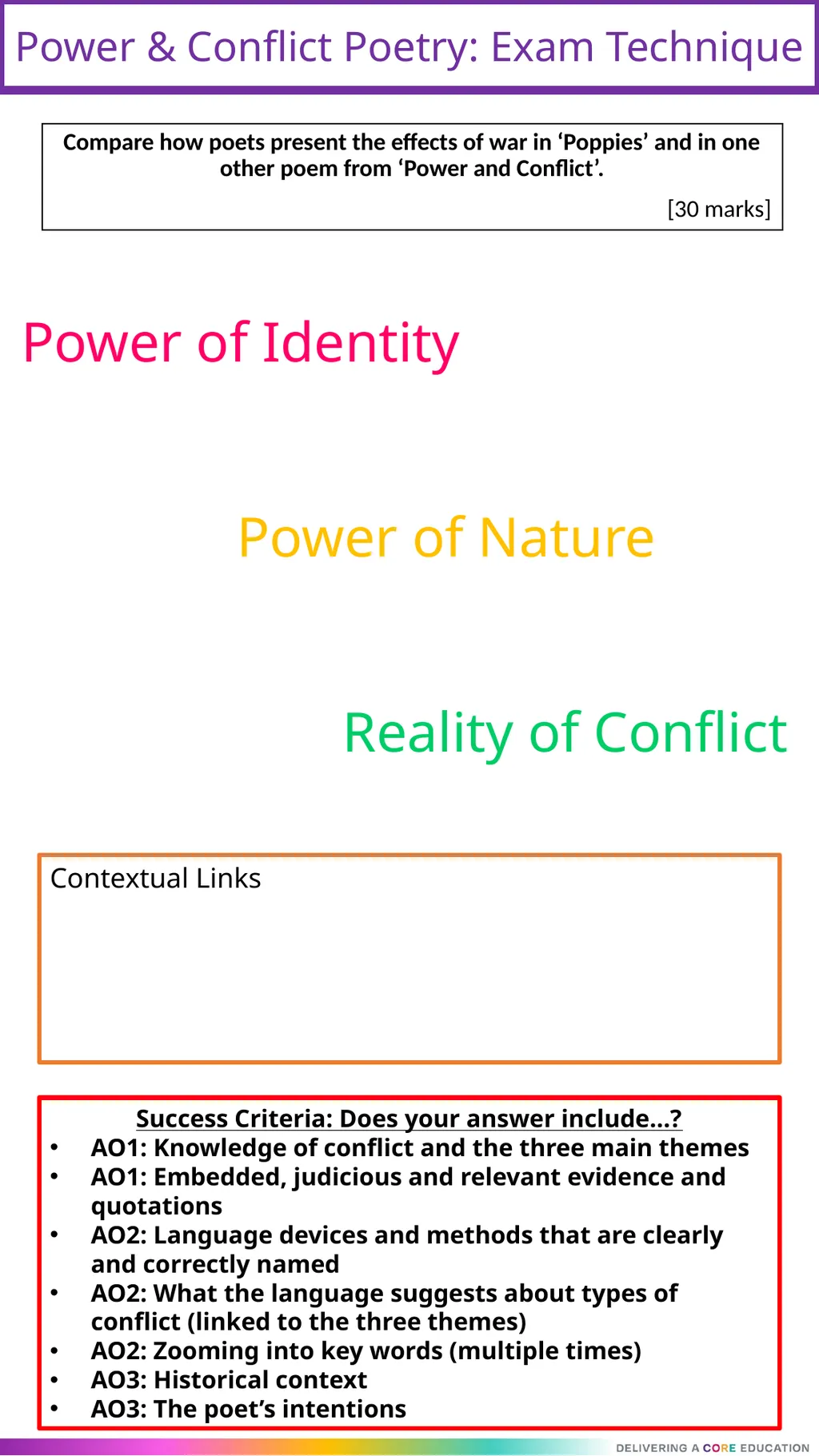
Power & Conflict Poetry: Exam Technique Contextual Links Compare how poets present the effects of war in ‘Poppies’ and in one other poem from ‘Power and Conflict’.
[30 marks] Power of Identity Power of Nature Reality of Conflict Success Criteria: Does your answer include…?
AO1: Knowledge of conflict and the three main themes
AO1: Embedded, judicious and relevant evidence and quotations
AO2: Language devices and methods that are clearly and correctly named
AO2: What the language suggests about types of conflict (linked to the three themes)
AO2: Zooming into key words (multiple times)
AO3: Historical context
AO3: The poet’s intentions<br>
[30 marks] Power of Identity Power of Nature Reality of Conflict Success Criteria: Does your answer include…?
AO1: Knowledge of conflict and the three main themes
AO1: Embedded, judicious and relevant evidence and quotations
AO2: Language devices and methods that are clearly and correctly named
AO2: What the language suggests about types of conflict (linked to the three themes)
AO2: Zooming into key words (multiple times)
AO3: Historical context
AO3: The poet’s intentions<br>
05
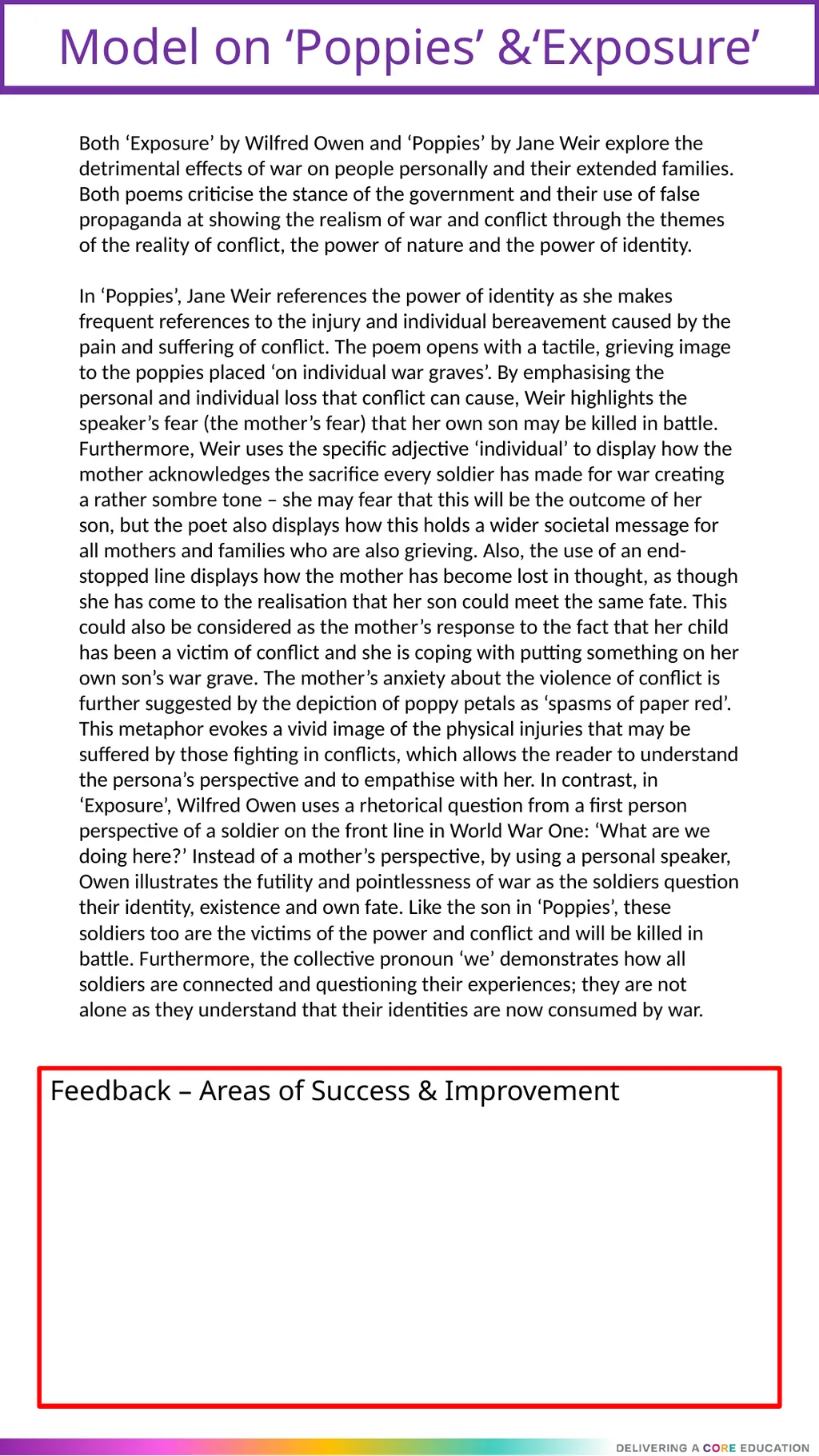
Model on ‘Poppies’ &‘Exposure’ Feedback – Areas of Success & Improvement Both ‘Exposure’ by Wilfred Owen and ‘Poppies’ by Jane Weir explore the detrimental effects of war on people personally and their extended families. Both poems criticise the stance of the government and their use of false propaganda at showing the realism of war and conflict through the themes of the reality of conflict, the power of nature and the power of identity.
In ‘Poppies’, Jane Weir references the power of identity as she makes frequent references to the injury and individual bereavement caused by the pain and suffering of conflict. The poem opens with a tactile, grieving image to the poppies placed ‘on individual war graves’. By emphasising the personal and individual loss that conflict can cause, Weir highlights the speaker’s fear (the mother’s fear) that her own son may be killed in battle. Furthermore, Weir uses the specific adjective ‘individual’ to display how the mother acknowledges the sacrifice every soldier has made for war creating a rather sombre tone – she may fear that this will be the outcome of her son, but the poet also displays how this holds a wider societal message for all mothers and families who are also grieving. Also, the use of an end-stopped line displays how the mother has become lost in thought, as though she has come to the realisation that her son could meet the same fate. This could also be considered as the mother’s response to the fact that her child has been a victim of conflict and she is coping with putting something on her own son’s war grave. The mother’s anxiety about the violence of conflict is further suggested by the depiction of poppy petals as ‘spasms of paper red’. This metaphor evokes a vivid image of the physical injuries that may be suffered by those fighting in conflicts, which allows the reader to understand the persona’s perspective and to empathise with her. In contrast, in ‘Exposure’, Wilfred Owen uses a rhetorical question from a first person perspective of a soldier on the front line in World War One: ‘What are we doing here?’ Instead of a mother’s perspective, by using a personal speaker, Owen illustrates the futility and pointlessness of war as the soldiers question their identity, existence and own fate. Like the son in ‘Poppies’, these soldiers too are the victims of the power and conflict and will be killed in battle. Furthermore, the collective pronoun ‘we’ demonstrates how all soldiers are connected and questioning their experiences; they are not alone as they understand that their identities are now consumed by war.<br>
In ‘Poppies’, Jane Weir references the power of identity as she makes frequent references to the injury and individual bereavement caused by the pain and suffering of conflict. The poem opens with a tactile, grieving image to the poppies placed ‘on individual war graves’. By emphasising the personal and individual loss that conflict can cause, Weir highlights the speaker’s fear (the mother’s fear) that her own son may be killed in battle. Furthermore, Weir uses the specific adjective ‘individual’ to display how the mother acknowledges the sacrifice every soldier has made for war creating a rather sombre tone – she may fear that this will be the outcome of her son, but the poet also displays how this holds a wider societal message for all mothers and families who are also grieving. Also, the use of an end-stopped line displays how the mother has become lost in thought, as though she has come to the realisation that her son could meet the same fate. This could also be considered as the mother’s response to the fact that her child has been a victim of conflict and she is coping with putting something on her own son’s war grave. The mother’s anxiety about the violence of conflict is further suggested by the depiction of poppy petals as ‘spasms of paper red’. This metaphor evokes a vivid image of the physical injuries that may be suffered by those fighting in conflicts, which allows the reader to understand the persona’s perspective and to empathise with her. In contrast, in ‘Exposure’, Wilfred Owen uses a rhetorical question from a first person perspective of a soldier on the front line in World War One: ‘What are we doing here?’ Instead of a mother’s perspective, by using a personal speaker, Owen illustrates the futility and pointlessness of war as the soldiers question their identity, existence and own fate. Like the son in ‘Poppies’, these soldiers too are the victims of the power and conflict and will be killed in battle. Furthermore, the collective pronoun ‘we’ demonstrates how all soldiers are connected and questioning their experiences; they are not alone as they understand that their identities are now consumed by war.<br>
06
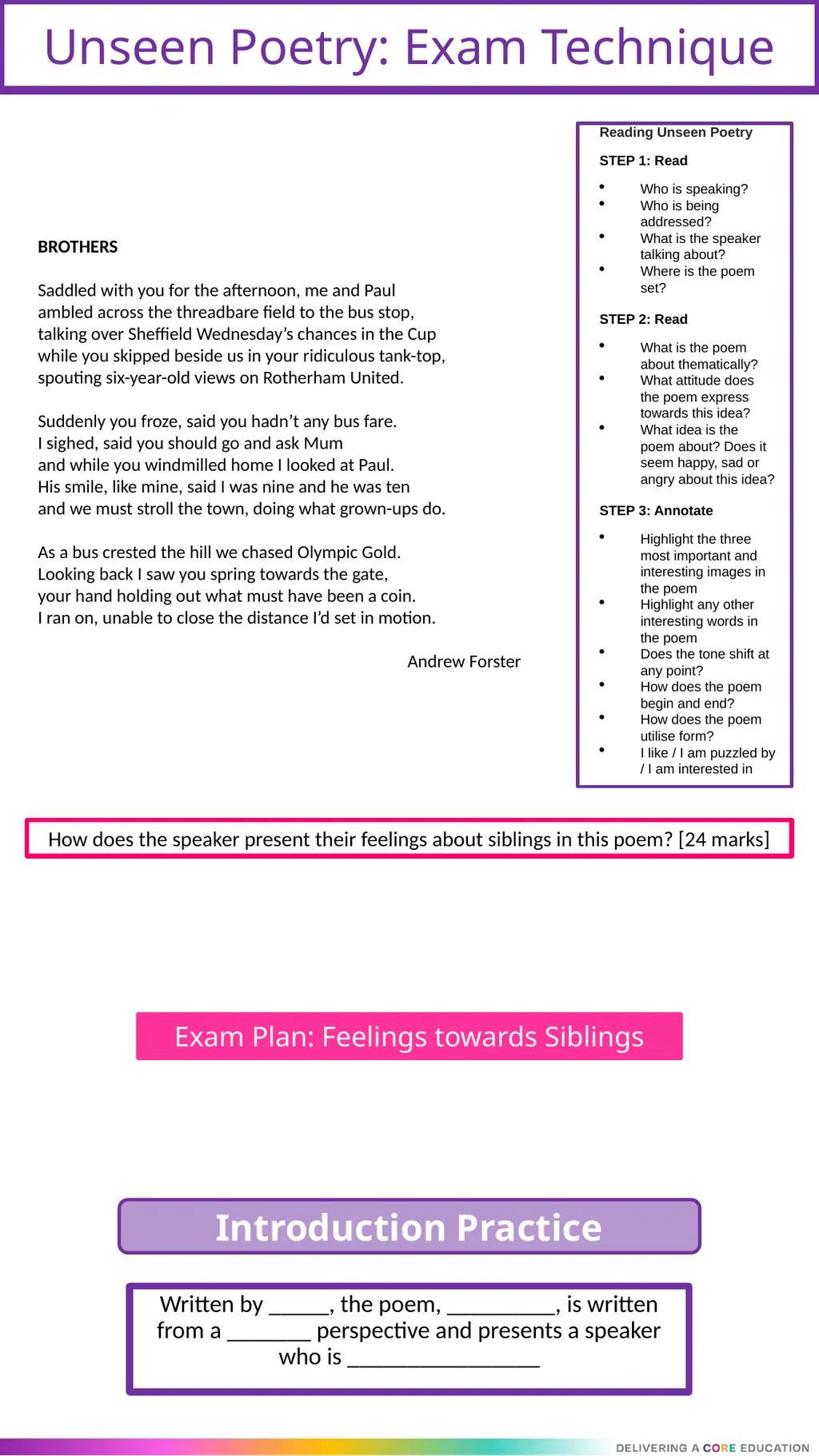
Unseen Poetry: Exam Technique Reading Unseen Poetry
STEP 1: Read
Who is speaking?
Who is being addressed?
What is the speaker talking about?
Where is the poem set?
STEP 2: Read
What is the poem about thematically?
What attitude does the poem express towards this idea?
What idea is the poem about? Does it seem happy, sad or angry about this idea?
STEP 3: Annotate
Highlight the three most important and interesting images in the poem
Highlight any other interesting words in the poem
Does the tone shift at any point?
How does the poem begin and end?
How does the poem utilise form?
I like / I am puzzled by / I am interested in BROTHERS
Saddled with you for the afternoon, me and Paul ambled across the threadbare field to the bus stop, talking over Sheffield Wednesday’s chances in the Cup while you skipped beside us in your ridiculous tank-top, spouting six-year-old views on Rotherham United.
Suddenly you froze, said you hadn’t any bus fare. I sighed, said you should go and ask Mum and while you windmilled home I looked at Paul. His smile, like mine, said I was nine and he was ten and we must stroll the town, doing what grown-ups do. As a bus crested the hill we chased Olympic Gold. Looking back I saw you spring towards the gate, your hand holding out what must have been a coin. I ran on, unable to close the distance I’d set in motion.
Andrew Forster How does the speaker present their feelings about siblings in this poem? [24 marks] Exam Plan: Feelings towards Siblings Written by _____, the poem, _________, is written from a _______ perspective and presents a speaker who is ________________ Introduction Practice<br>
STEP 1: Read
Who is speaking?
Who is being addressed?
What is the speaker talking about?
Where is the poem set?
STEP 2: Read
What is the poem about thematically?
What attitude does the poem express towards this idea?
What idea is the poem about? Does it seem happy, sad or angry about this idea?
STEP 3: Annotate
Highlight the three most important and interesting images in the poem
Highlight any other interesting words in the poem
Does the tone shift at any point?
How does the poem begin and end?
How does the poem utilise form?
I like / I am puzzled by / I am interested in BROTHERS
Saddled with you for the afternoon, me and Paul ambled across the threadbare field to the bus stop, talking over Sheffield Wednesday’s chances in the Cup while you skipped beside us in your ridiculous tank-top, spouting six-year-old views on Rotherham United.
Suddenly you froze, said you hadn’t any bus fare. I sighed, said you should go and ask Mum and while you windmilled home I looked at Paul. His smile, like mine, said I was nine and he was ten and we must stroll the town, doing what grown-ups do. As a bus crested the hill we chased Olympic Gold. Looking back I saw you spring towards the gate, your hand holding out what must have been a coin. I ran on, unable to close the distance I’d set in motion.
Andrew Forster How does the speaker present their feelings about siblings in this poem? [24 marks] Exam Plan: Feelings towards Siblings Written by _____, the poem, _________, is written from a _______ perspective and presents a speaker who is ________________ Introduction Practice<br>
07
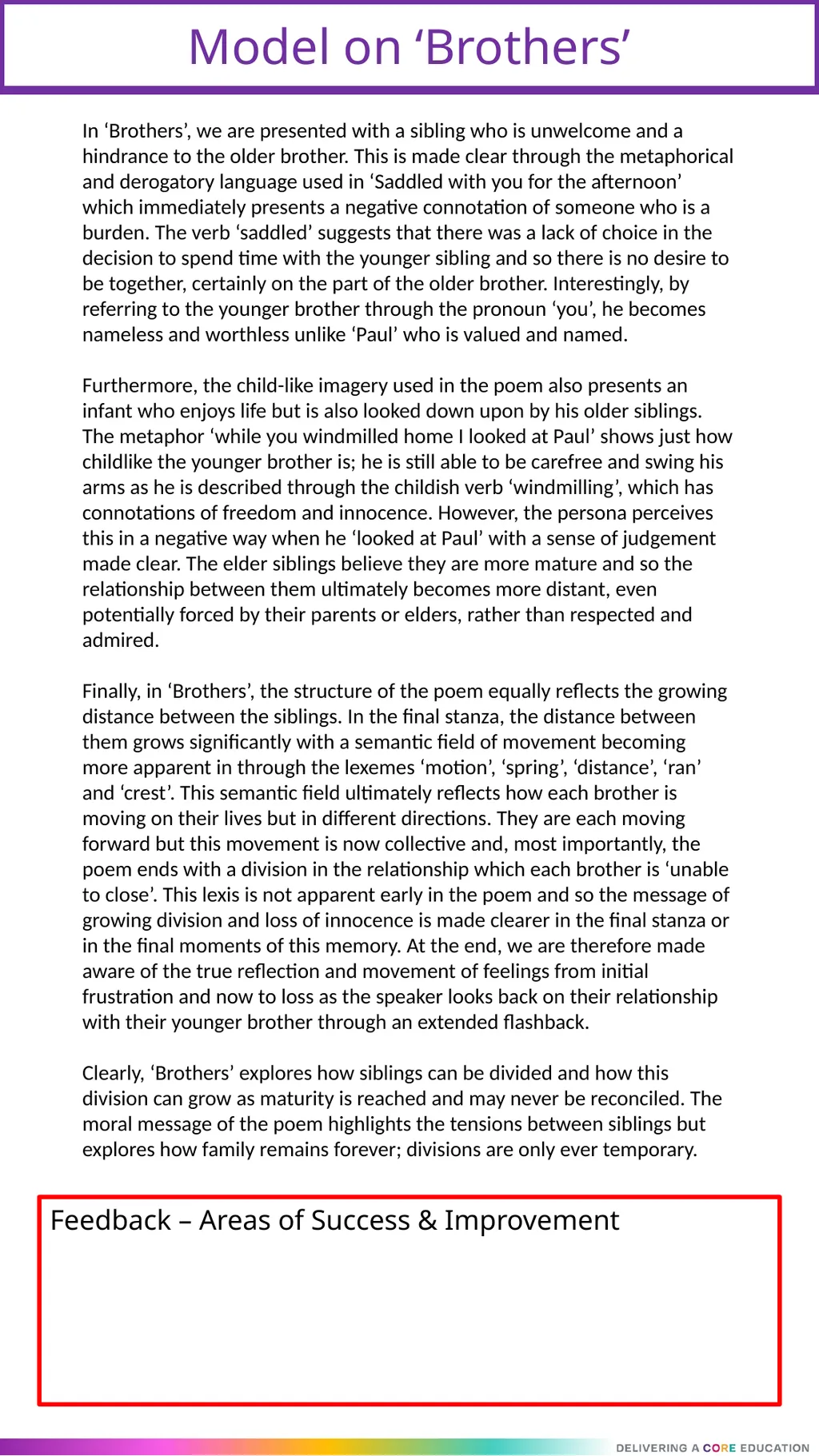
Model on ‘Brothers’ In ‘Brothers’, we are presented with a sibling who is unwelcome and a hindrance to the older brother. This is made clear through the metaphorical and derogatory language used in ‘Saddled with you for the afternoon’ which immediately presents a negative connotation of someone who is a burden. The verb ‘saddled’ suggests that there was a lack of choice in the decision to spend time with the younger sibling and so there is no desire to be together, certainly on the part of the older brother. Interestingly, by referring to the younger brother through the pronoun ‘you’, he becomes nameless and worthless unlike ‘Paul’ who is valued and named.
Furthermore, the child-like imagery used in the poem also presents an infant who enjoys life but is also looked down upon by his older siblings. The metaphor ‘while you windmilled home I looked at Paul’ shows just how childlike the younger brother is; he is still able to be carefree and swing his arms as he is described through the childish verb ‘windmilling’, which has connotations of freedom and innocence. However, the persona perceives this in a negative way when he ‘looked at Paul’ with a sense of judgement made clear. The elder siblings believe they are more mature and so the relationship between them ultimately becomes more distant, even potentially forced by their parents or elders, rather than respected and admired.
Finally, in ‘Brothers’, the structure of the poem equally reflects the growing distance between the siblings. In the final stanza, the distance between them grows significantly with a semantic field of movement becoming more apparent in through the lexemes ‘motion’, ‘spring’, ‘distance’, ‘ran’ and ‘crest’. This semantic field ultimately reflects how each brother is moving on their lives but in different directions. They are each moving forward but this movement is now collective and, most importantly, the poem ends with a division in the relationship which each brother is ‘unable to close’. This lexis is not apparent early in the poem and so the message of growing division and loss of innocence is made clearer in the final stanza or in the final moments of this memory. At the end, we are therefore made aware of the true reflection and movement of feelings from initial frustration and now to loss as the speaker looks back on their relationship with their younger brother through an extended flashback.
Clearly, ‘Brothers’ explores how siblings can be divided and how this division can grow as maturity is reached and may never be reconciled. The moral message of the poem highlights the tensions between siblings but explores how family remains forever; divisions are only ever temporary. Feedback – Areas of Success & Improvement<br>
Furthermore, the child-like imagery used in the poem also presents an infant who enjoys life but is also looked down upon by his older siblings. The metaphor ‘while you windmilled home I looked at Paul’ shows just how childlike the younger brother is; he is still able to be carefree and swing his arms as he is described through the childish verb ‘windmilling’, which has connotations of freedom and innocence. However, the persona perceives this in a negative way when he ‘looked at Paul’ with a sense of judgement made clear. The elder siblings believe they are more mature and so the relationship between them ultimately becomes more distant, even potentially forced by their parents or elders, rather than respected and admired.
Finally, in ‘Brothers’, the structure of the poem equally reflects the growing distance between the siblings. In the final stanza, the distance between them grows significantly with a semantic field of movement becoming more apparent in through the lexemes ‘motion’, ‘spring’, ‘distance’, ‘ran’ and ‘crest’. This semantic field ultimately reflects how each brother is moving on their lives but in different directions. They are each moving forward but this movement is now collective and, most importantly, the poem ends with a division in the relationship which each brother is ‘unable to close’. This lexis is not apparent early in the poem and so the message of growing division and loss of innocence is made clearer in the final stanza or in the final moments of this memory. At the end, we are therefore made aware of the true reflection and movement of feelings from initial frustration and now to loss as the speaker looks back on their relationship with their younger brother through an extended flashback.
Clearly, ‘Brothers’ explores how siblings can be divided and how this division can grow as maturity is reached and may never be reconciled. The moral message of the poem highlights the tensions between siblings but explores how family remains forever; divisions are only ever temporary. Feedback – Areas of Success & Improvement<br>