
Livestock Production Management, MJF, Chomu,
CM
Published · 28 slides · 0 views

1 / 1





Description
Livestock Production Management, MJF, Chomu, JAIPUR AGRONOMICAL PRACTICES FOR FODDER PRODUCTION Dr. Deepesh Garg Assistant Professor FODDER PRODUCTION Introduction Fodder crops are cultivated plant species that are utilized as livestock
Related Topics
Download this presentation From Below
"Livestock Production Management, MJF, Chomu," is the property of its rightful owner. Permission is granted to download and print the materials on this website for personal, non-commercial use only, and to display it on your personal computer provided you do not modify the materials and that you retain all copyright notices contained in the materials. By downloading content from our website, you accept the terms of this agreement.
Share
Embed code
Presentation Transcript
01
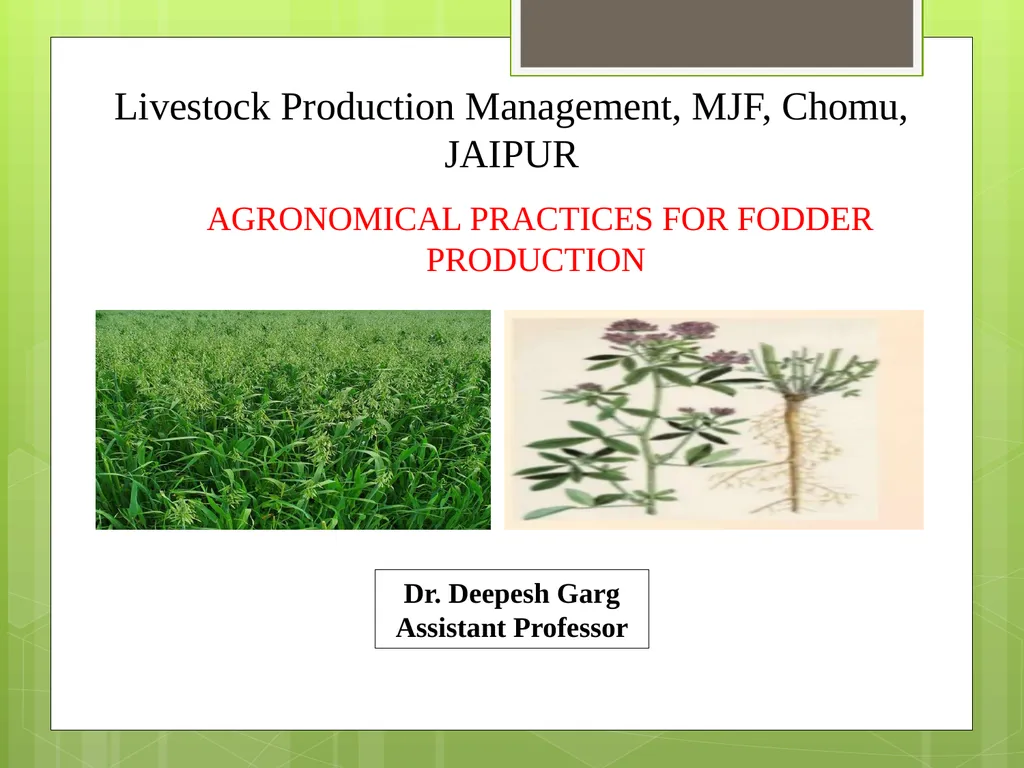
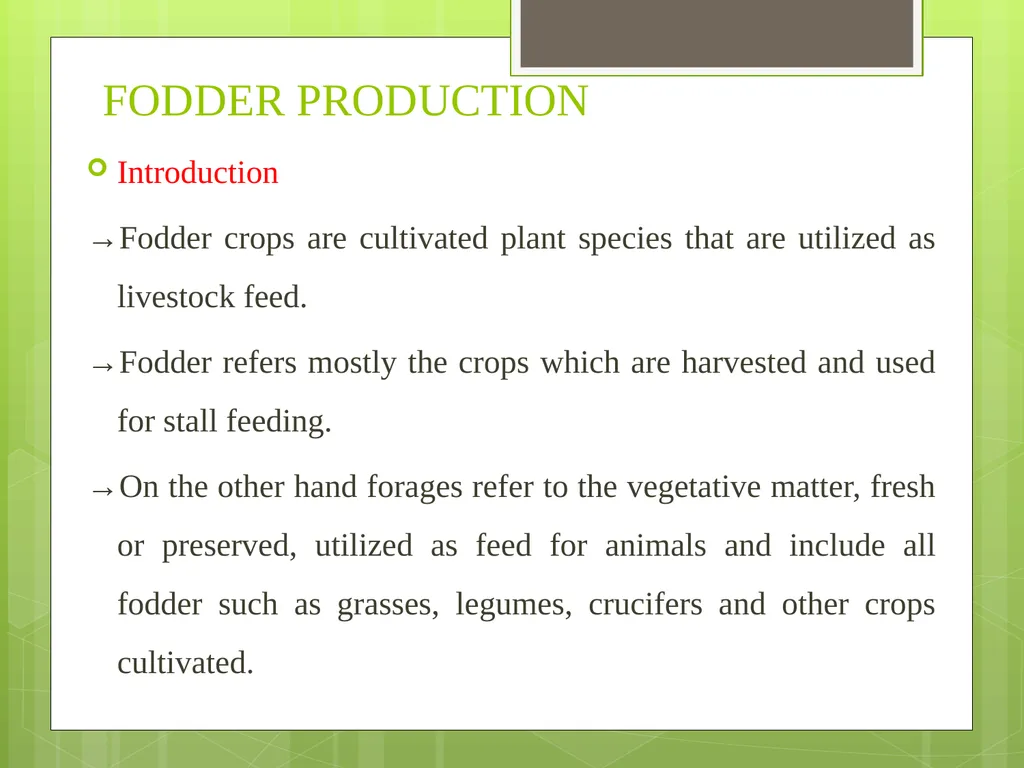
Livestock Production Management, MJF, Chomu, JAIPUR AGRONOMICAL PRACTICES FOR FODDER PRODUCTION Dr. Deepesh Garg
Assistant Professor<br>
Assistant Professor<br>
02
FODDER PRODUCTION Introduction
→Fodder crops are cultivated plant species that are utilized as livestock feed.
→Fodder refers mostly the crops which are harvested and used for stall feeding.
→On the other hand forages refer to the vegetative matter, fresh or preserved, utilized as feed for animals and include all fodder such as grasses, legumes, crucifers and other crops cultivated.<br>
→Fodder crops are cultivated plant species that are utilized as livestock feed.
→Fodder refers mostly the crops which are harvested and used for stall feeding.
→On the other hand forages refer to the vegetative matter, fresh or preserved, utilized as feed for animals and include all fodder such as grasses, legumes, crucifers and other crops cultivated.<br>
03
CHOICE OF FODDER →It is highly essential to select the right choice of crops to cultivate and it is depends on the soil type, soil fertility status, agro climatic condition, water availability and number of livestock reared etc.<br>
04
CLASSIFICATION OF FODDER There are different types of classification available. However, the following two classification are more easy to understand and adopt.
1.) Classification of fodder on the basis of season of cultivation
→Kharif Fodder (June – September):- Ex. Cowpea, Bajra, Sorghum, Maize, Guar.
→Rabi Fodder (October- Dec/Jan):- Ex. Berseem, Leucern, Oats, Barley.
→Summer Fodder (April- June):- Ex. Cowpea, Maize, Sorghum, Bajra.<br>
1.) Classification of fodder on the basis of season of cultivation
→Kharif Fodder (June – September):- Ex. Cowpea, Bajra, Sorghum, Maize, Guar.
→Rabi Fodder (October- Dec/Jan):- Ex. Berseem, Leucern, Oats, Barley.
→Summer Fodder (April- June):- Ex. Cowpea, Maize, Sorghum, Bajra.<br>
05
2.) Classification based on plant family and duration of the crop
These are 2 types:-
→Legumes (Annual and Perennial) : Ex. Berseem, Cowpea, Guar, Lucerne.
→Non- legumes (Annual and Perenial): Ex. Hybrid Napier, Guinea grass, Fodder maize, Fodder Sorghum, Pearl millet (Bajra), Oat.<br>
These are 2 types:-
→Legumes (Annual and Perennial) : Ex. Berseem, Cowpea, Guar, Lucerne.
→Non- legumes (Annual and Perenial): Ex. Hybrid Napier, Guinea grass, Fodder maize, Fodder Sorghum, Pearl millet (Bajra), Oat.<br>
06
Agronomical practices for cultivation of fodder crop 1.Time and method of sowing
2.Manuring,Irrigation and Harvesting
3.Yield and nutritive value
4.Crop rotation
5.Varieties<br>
2.Manuring,Irrigation and Harvesting
3.Yield and nutritive value
4.Crop rotation
5.Varieties<br>
07
Leguminous Fodder Crops Legumes are the most important component of animal fodder in view of their high content of crude protein (20-25%) compared to cereals fodder (8-12%) and grasses fodder (5-10%).
Legumes improve the quality of fodder when mixed with non- leguminous fodder or straw fodder.
Legumes are fed in small quantities (1-2% of body weight).
If legumes are feed in bulk it may create problems like bloat in animals.<br>
Legumes improve the quality of fodder when mixed with non- leguminous fodder or straw fodder.
Legumes are fed in small quantities (1-2% of body weight).
If legumes are feed in bulk it may create problems like bloat in animals.<br>
08
Cow Pea (Vigna sinensis) or Lobia or Black eye Pea Cow pea is an important quick growing legume which fits well in crop rotation. It is widely cultivated in all parts of India and can be grown on all types of soils ranging from sandy loam to heavy loam, if they are well drained.
It is well adopted to warmer summer climate. It is susceptible to water logging condition.If legumes are feed in bulk it may create problems like bloat in animals.<br>
It is well adopted to warmer summer climate. It is susceptible to water logging condition.If legumes are feed in bulk it may create problems like bloat in animals.<br>
09
Time and method of sowing:-
In rain fed condition, the crop is sown in months of June to July which provides green fodder in August, September and October.
If irrigation is available, the crop can be grown in February/March in India and the green fodder is available during the critical period May/June.<br>
In rain fed condition, the crop is sown in months of June to July which provides green fodder in August, September and October.
If irrigation is available, the crop can be grown in February/March in India and the green fodder is available during the critical period May/June.<br>
10
Ploughing:-
After harvesting of rabi crop, the land is ploughed once with soil turning plough followed by two harrowing to increase the yield.
Seed Rate:- 25-30 kg/ha
Manuring and Irrigation: Farm yard manure (FYM) or compost manure, about 50 to 60 quintals/ha is sufficient for the crop.
Application of 4 to 6 Q of superphosphate/ha increases the yield.<br>
After harvesting of rabi crop, the land is ploughed once with soil turning plough followed by two harrowing to increase the yield.
Seed Rate:- 25-30 kg/ha
Manuring and Irrigation: Farm yard manure (FYM) or compost manure, about 50 to 60 quintals/ha is sufficient for the crop.
Application of 4 to 6 Q of superphosphate/ha increases the yield.<br>
11
Yield and nutritive value:-
The yield is 200 to 300 Q/ha of green fodder when sown alone and a little more when mixed with other crops e.g. sorghum or maize<br>
The yield is 200 to 300 Q/ha of green fodder when sown alone and a little more when mixed with other crops e.g. sorghum or maize<br>
12
2. Guar (Cyamopsis tetragonoloba) It is an important drought resistant legume most suitable for dry areas. It is an indigenous crop cultivated in all parts of India. It is a drought resistant kharif crop and also grown as a vegetable crop. It grows well in all types of soils and ready to harvest after 80-90 days of sowing<br>
13
Time and method of sowing:-
The crop is sown from the end of March to the middle of July, either alone or mixed with Jowar and bajra seeds. It can be sown by broadcasting or behind plough.
Ploughing:-
One Ploughing followed by 2 harrowings will prepare the land for cultivation.<br>
The crop is sown from the end of March to the middle of July, either alone or mixed with Jowar and bajra seeds. It can be sown by broadcasting or behind plough.
Ploughing:-
One Ploughing followed by 2 harrowings will prepare the land for cultivation.<br>
14
Seed Rate:- For grains 20-25 kg seeds ha are sufficient. For fodder purpose 35-40 kg seeds/ha when sown alone and 16 kg/ha when mixed with non-legumes can be used.
Manuring and Irrigation: Green manuring is the principal supplementary means of adding organic matter to soil.
Yield and nutritive value: Average green yield is 250-400 ha and harvesting is done before flowering It is a productive fodder and the aver-age protein content is 13-15%.<br>
Manuring and Irrigation: Green manuring is the principal supplementary means of adding organic matter to soil.
Yield and nutritive value: Average green yield is 250-400 ha and harvesting is done before flowering It is a productive fodder and the aver-age protein content is 13-15%.<br>
15
Yield and nutritive value:-
The yield is 200 to 300 Q/ha of green fodder when sown alone and a little more when mixed with other crops e.g. sorghum or maize<br>
The yield is 200 to 300 Q/ha of green fodder when sown alone and a little more when mixed with other crops e.g. sorghum or maize<br>
16
3. Berseem (Trifolium alaxandriurn) or Egyptian Clover It is one of the important highly leguminous fodder crop known as 'king of fodders". Although, it is migrated from Egypt for the last 60 year but is now well established in India as a prominent fodder crop in irrigated area.<br>
17
Time and method of sowing:-
It is sown in plains from middle of September to the end of October and on hills from middle of August to first week of September. It is sown by broadcasting method followed by irrigation.
Ploughing:-
After harvesting of kharif crop, the field is ploughed once with mould board or disc plough followed by 2-3 harrowings and finally by ploughing.<br>
It is sown in plains from middle of September to the end of October and on hills from middle of August to first week of September. It is sown by broadcasting method followed by irrigation.
Ploughing:-
After harvesting of kharif crop, the field is ploughed once with mould board or disc plough followed by 2-3 harrowings and finally by ploughing.<br>
18
Seed Rate:- 20 to 25 kg/ha of land.
Manuring and Irrigation: Like other legumes, it requires phosphatic manures. Manuring with kisan khad or ammonium sulphate @ 150 kg/ha of land along with 500 kg of super phosphate at the time of sowing is necessary for good yield. It requires frequent irrigation after every 10-12 days interval in early winter and 15 days during winter.
Yield and nutritive value: The crop is ready within 55-60 days after sowing for first cutting followed by subsequent cutting at 30 days intervals<br>
Manuring and Irrigation: Like other legumes, it requires phosphatic manures. Manuring with kisan khad or ammonium sulphate @ 150 kg/ha of land along with 500 kg of super phosphate at the time of sowing is necessary for good yield. It requires frequent irrigation after every 10-12 days interval in early winter and 15 days during winter.
Yield and nutritive value: The crop is ready within 55-60 days after sowing for first cutting followed by subsequent cutting at 30 days intervals<br>
19
NON-LEGUMES Among the Kharif non-leguminous fodders Jowar, bajra, maize and sudan grass are most common. The forages have 0.5-1.0% DCP and 11-15% TDN (total digestible nutrients) except maize which is nutritious of all.
Green fodders of non- legumes are fed in bulk quantities (about 10% of body weight the animal).<br>
Green fodders of non- legumes are fed in bulk quantities (about 10% of body weight the animal).<br>
20
It is a principal Kharif crop in India and many Asian countries, which is grow both for production of grains as well as fodder.
It requires warm and temperate climate and grows well on fertile and well drained soils.
The crop grows well in slightly acidic to neutral soils (pH 5.5 to 7.5).
Time and method of sowing:-
Time and method of sowing: Sowing is done from middle of March to middle of September for fodder. 1. Maize (Zea mays)<br>
It requires warm and temperate climate and grows well on fertile and well drained soils.
The crop grows well in slightly acidic to neutral soils (pH 5.5 to 7.5).
Time and method of sowing:-
Time and method of sowing: Sowing is done from middle of March to middle of September for fodder. 1. Maize (Zea mays)<br>
21
Ploughing:-
The land may be ploughed once with mould board plough after irrigation. Thereafter, 2 to 3 harrowings or ploughing with disc plough, followed by planking, may be done.
Seed Rate:-
35-40 kg per hectare of land for fodder production.
Manuring and nutritive value: Application of 300-350 kg of ammonium sulphate per hectare of land increases the forage yield.<br>
The land may be ploughed once with mould board plough after irrigation. Thereafter, 2 to 3 harrowings or ploughing with disc plough, followed by planking, may be done.
Seed Rate:-
35-40 kg per hectare of land for fodder production.
Manuring and nutritive value: Application of 300-350 kg of ammonium sulphate per hectare of land increases the forage yield.<br>
22
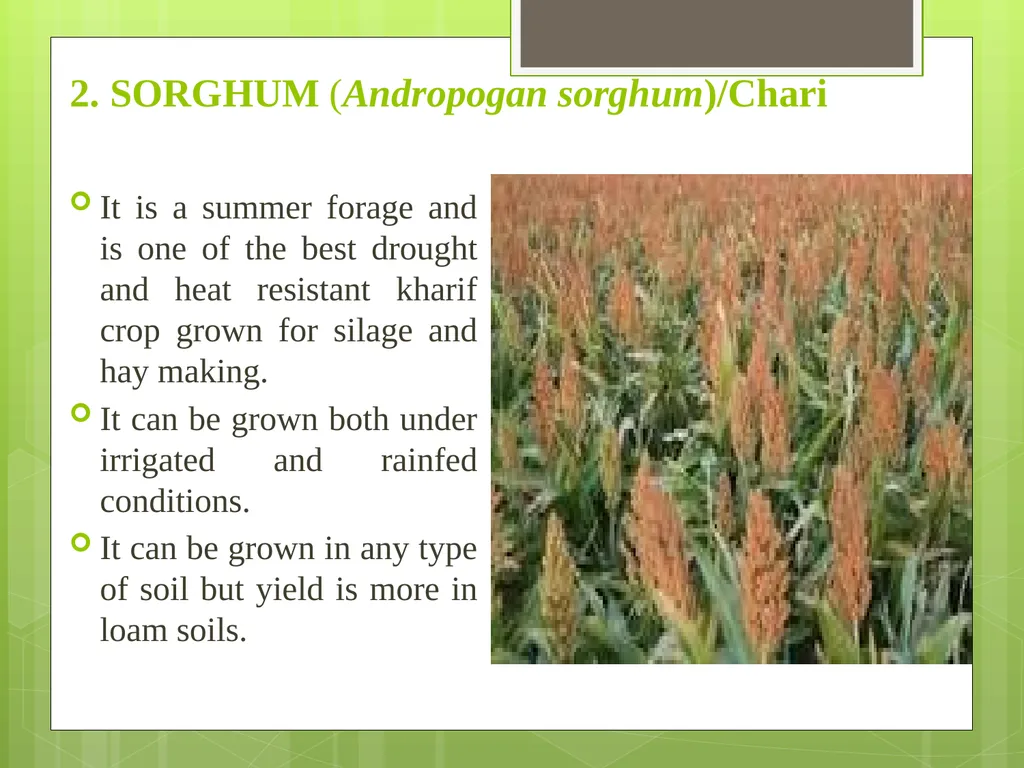
2. SORGHUM (Andropogan sorghum)/Chari It is a summer forage and is one of the best drought and heat resistant kharif crop grown for silage and hay making.
It can be grown both under irrigated and rainfed conditions.
It can be grown in any type of soil but yield is more in loam soils.<br>
It can be grown both under irrigated and rainfed conditions.
It can be grown in any type of soil but yield is more in loam soils.<br>
23
Time and method of sowing:-
Sowing is done between April and august for fodder production.
Sorghum seeds are broadcasted which are than mixed with the soil by various measures such as by harrow or by cultivator and finally seeding is done.
Ploughing:-
The land is generally ploughed once with mould board followed by two ploughing with harrowing's.
Seed Rate:-
Sorghum seeds are broadcast 55-60kg/ha of land production.<br>
Sowing is done between April and august for fodder production.
Sorghum seeds are broadcasted which are than mixed with the soil by various measures such as by harrow or by cultivator and finally seeding is done.
Ploughing:-
The land is generally ploughed once with mould board followed by two ploughing with harrowing's.
Seed Rate:-
Sorghum seeds are broadcast 55-60kg/ha of land production.<br>
24
Yield and nutritive value:-
Fodder is harvested within 70-90days and the average yield 250-450 quintals per hectare.
Some varieties yield about 500 quintals also.
It is a non-maintenance type of roughage containing about 4-5 percent of protein.<br>
Fodder is harvested within 70-90days and the average yield 250-450 quintals per hectare.
Some varieties yield about 500 quintals also.
It is a non-maintenance type of roughage containing about 4-5 percent of protein.<br>
25
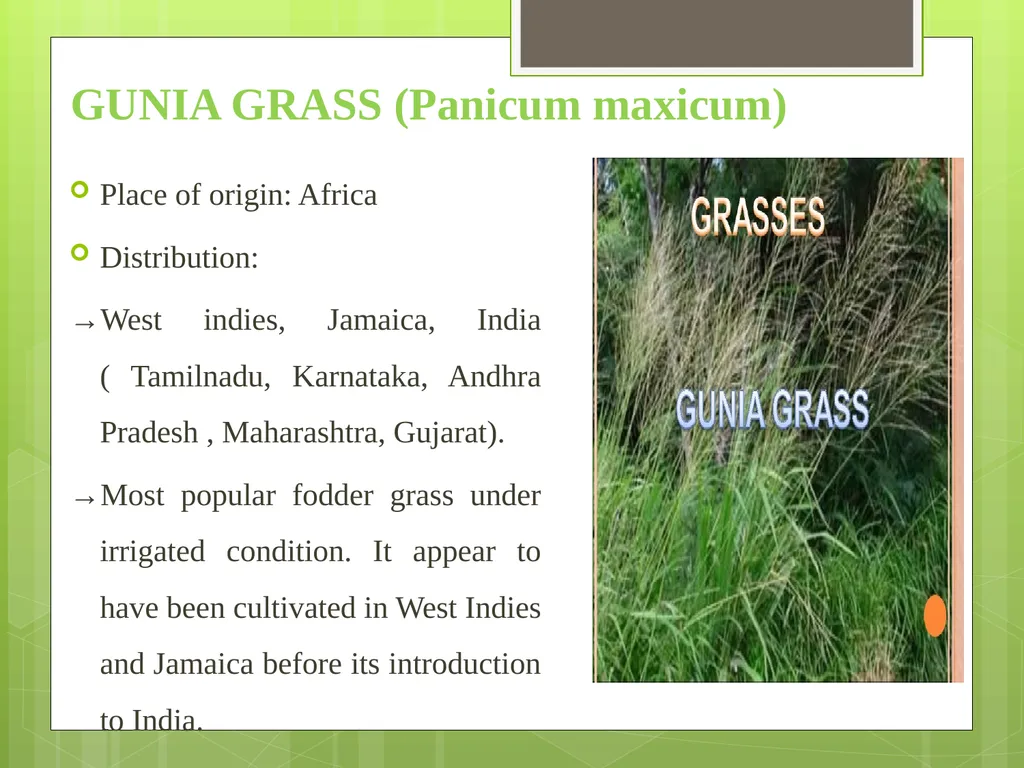
Place of origin: Africa
Distribution:
→West indies, Jamaica, India ( Tamilnadu, Karnataka, Andhra Pradesh , Maharashtra, Gujarat).
→Most popular fodder grass under irrigated condition. It appear to have been cultivated in West Indies and Jamaica before its introduction to India. GUNIA GRASS (Panicum maxicum)<br>
Distribution:
→West indies, Jamaica, India ( Tamilnadu, Karnataka, Andhra Pradesh , Maharashtra, Gujarat).
→Most popular fodder grass under irrigated condition. It appear to have been cultivated in West Indies and Jamaica before its introduction to India. GUNIA GRASS (Panicum maxicum)<br>
26
→Highly palatable grass, with high dry matter content (15%-20%), free from all toxic principles.
→Protein 6-8% with well balanced calcium and phosphorus
→Good soil binder.
→Harvest can be done once 30-40 days.
→Can be grazed, cut and fed used hay silage.<br>
→Protein 6-8% with well balanced calcium and phosphorus
→Good soil binder.
→Harvest can be done once 30-40 days.
→Can be grazed, cut and fed used hay silage.<br>
27
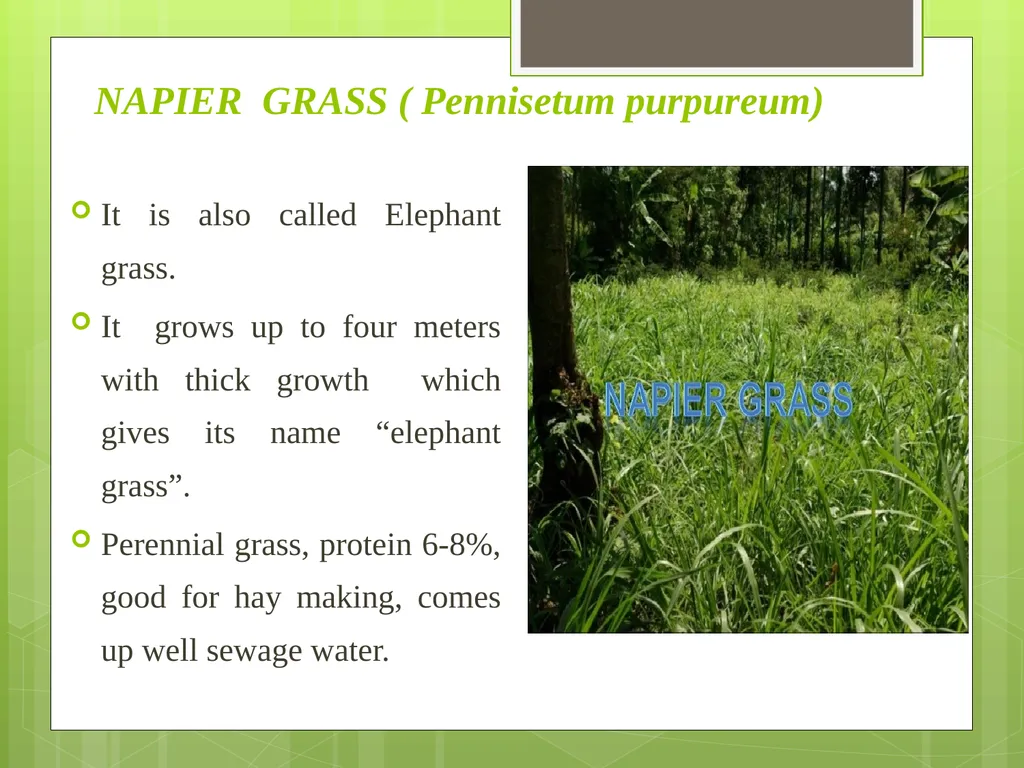
It is also called Elephant grass.
It grows up to four meters with thick growth which gives its name “elephant grass”.
Perennial grass, protein 6-8%, good for hay making, comes up well sewage water. NAPIER GRASS ( Pennisetum purpureum)<br>
It grows up to four meters with thick growth which gives its name “elephant grass”.
Perennial grass, protein 6-8%, good for hay making, comes up well sewage water. NAPIER GRASS ( Pennisetum purpureum)<br>