
Local Government Fundamentals Kara Millonzi



Description: Local Government Fundamentals Kara Millonzi Bradshaw Distinguished Professor of Public Law and Government October 2023 NC Local Government Finance 101 Local Government Finance Is.. Oversight Revenues Expenditure Authority Fund Accounting
Related Topics
Download Presentation
"Local Government Fundamentals Kara Millonzi" is the property of its rightful owner. Permission is granted to download and print the materials on this website for personal, non-commercial use only, and to display it on your personal computer provided you do not modify the materials and that you retain all copyright notices contained in the materials. By downloading content from our website, you accept the terms of this agreement.
Presentation Transcript
slide1. Local Government Fundamentals Kara Millonzi
Bradshaw Distinguished Professor of Public Law and Government October 2023 NC Local Government Finance 101<br>
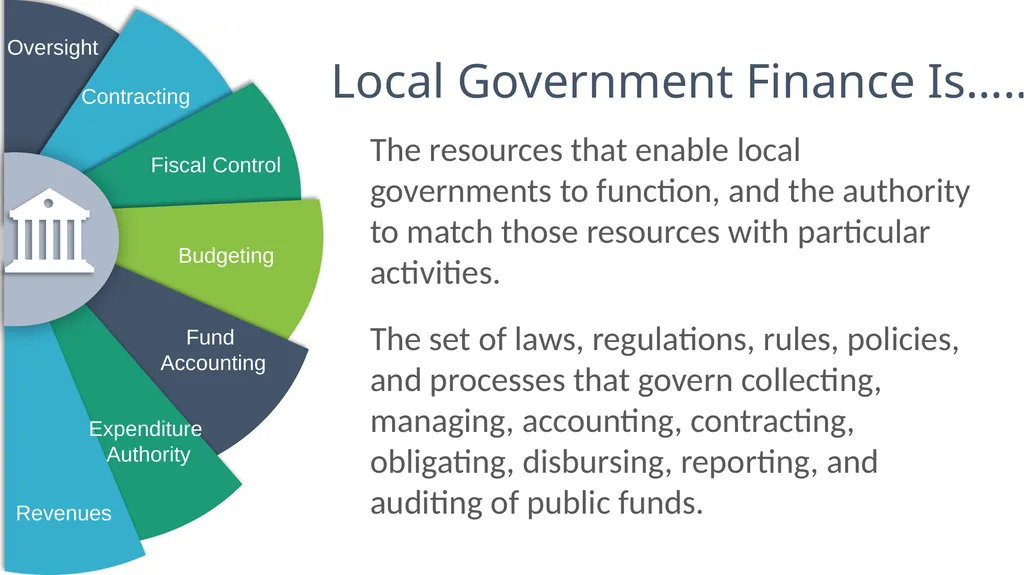
slide2. Local Government Finance Is….. Oversight Revenues Expenditure
Authority Fund
Accounting Budgeting Fiscal Control Contracting The resources that enable local governments to function, and the authority to match those resources with particular activities.
The set of laws, regulations, rules, policies, and processes that govern collecting, managing, accounting, contracting, obligating, disbursing, reporting, and auditing of public funds.<br>
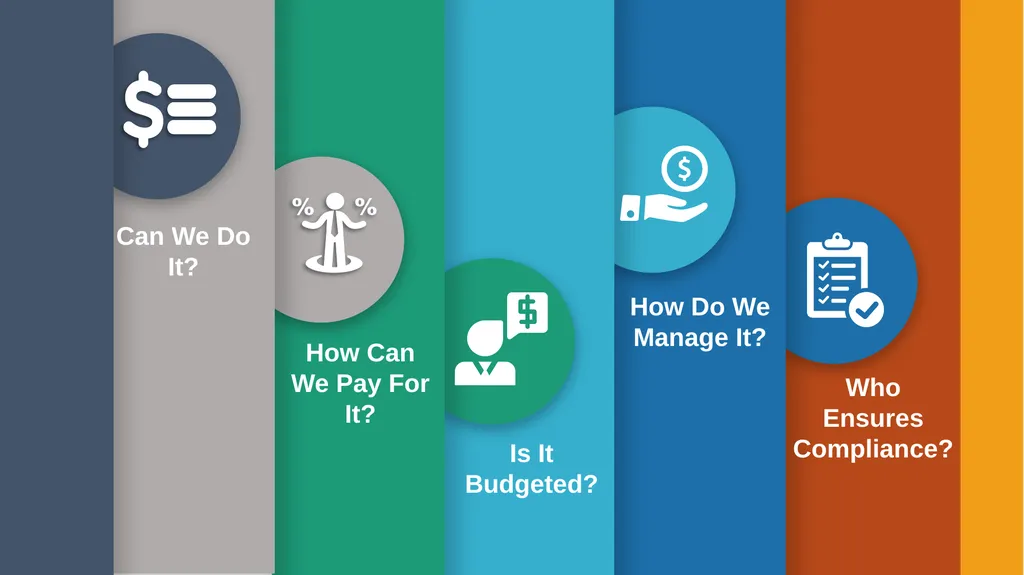
slide3. Can We Do It? Is It Budgeted? Who Ensures Compliance? How Can We Pay For It? How Do We Manage It?<br>
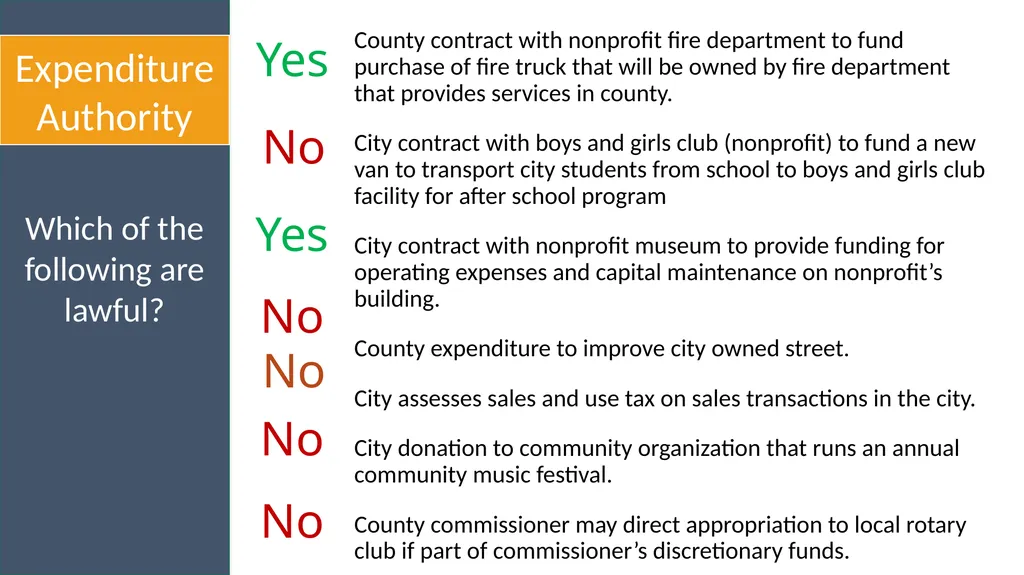
slide4. County contract with nonprofit fire department to fund purchase of fire truck that will be owned by fire department that provides services in county.
City contract with boys and girls club (nonprofit) to fund a new van to transport city students from school to boys and girls club facility for after school program
City contract with nonprofit museum to provide funding for operating expenses and capital maintenance on nonprofit’s building.
County expenditure to improve city owned street.
City assesses sales and use tax on sales transactions in the city.
City donation to community organization that runs an annual community music festival.
County commissioner may direct appropriation to local rotary club if part of commissioner’s discretionary funds. Which of the following are lawful? Yes No No Yes No No No Expenditure Authority<br>
slide5. A local government and public authority must have statutory authority to undertake any activity! Expenditure Authority<br>
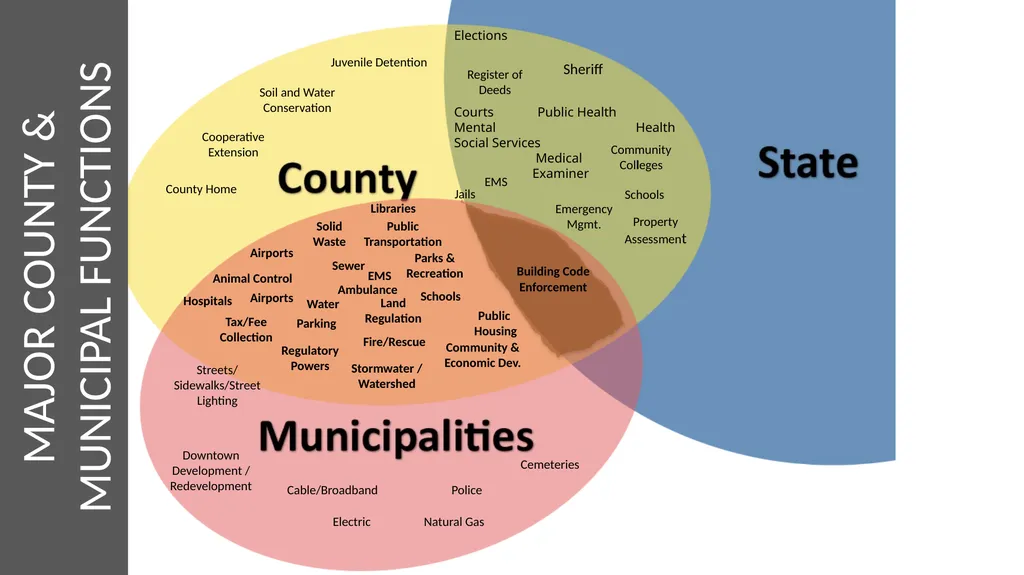
slide6. Ambulance Community Colleges Sheriff Register of Deeds Property Assessment EMS Elections
Courts Public Health Mental Health
Social Services
Medical
Examiner Schools Jails Building Code Enforcement Emergency Mgmt. Soil and Water Conservation Cooperative Extension Downtown Development / Redevelopment Cemeteries Airports Hospitals Parking EMS Stormwater / Watershed Parks & Recreation Fire/Rescue Solid Waste Community & Economic Dev. Sewer Water Public Transportation Land Regulation Tax/Fee Collection Animal Control Regulatory
Powers Libraries Streets/
Sidewalks/Street Lighting Public
Housing Juvenile Detention County Home Cable/Broadband Electric Natural Gas Police Airports Schools MAJOR COUNTY & MUNICIPAL FUNCTIONS<br>
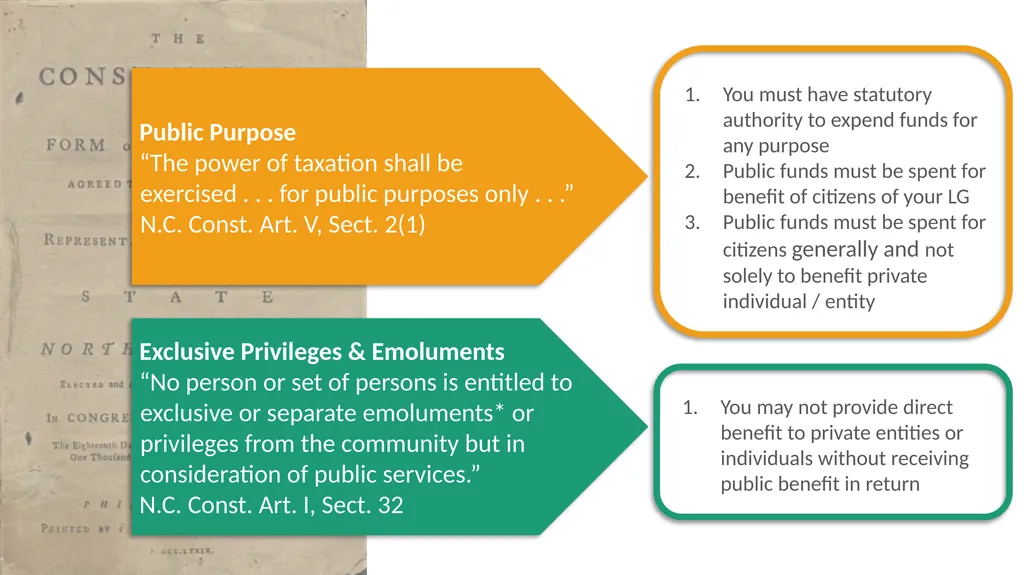
slide7. You must have statutory authority to expend funds for any purpose
Public funds must be spent for benefit of citizens of your LG
Public funds must be spent for citizens generally and not solely to benefit private individual / entity You may not provide direct benefit to private entities or individuals without receiving public benefit in return Public Purpose
“The power of taxation shall be exercised . . . for public purposes only . . .” N.C. Const. Art. V, Sect. 2(1) Exclusive Privileges & Emoluments
“No person or set of persons is entitled to exclusive or separate emoluments* or privileges from the community but in consideration of public services.”
N.C. Const. Art. I, Sect. 32<br>
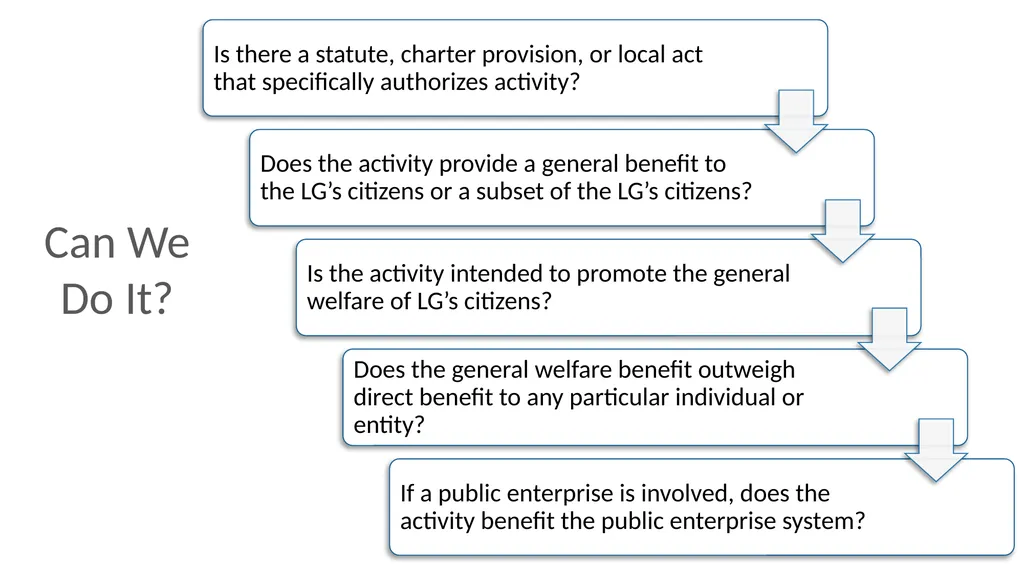
slide8. Can We Do It?<br>
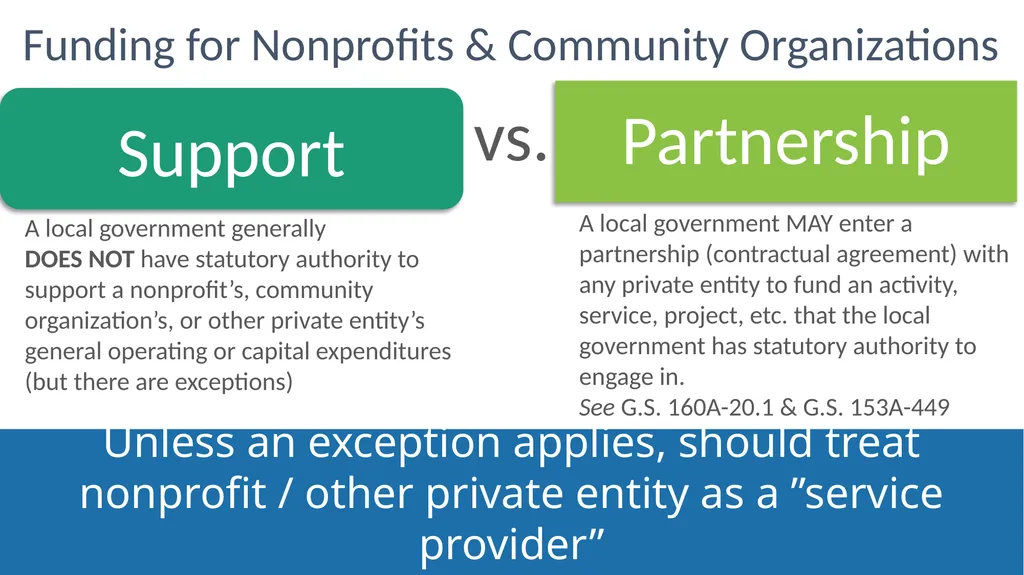
slide9. Support Partnership vs. A local government generally
DOES NOT have statutory authority to support a nonprofit’s, community organization’s, or other private entity’s general operating or capital expenditures (but there are exceptions) A local government MAY enter a partnership (contractual agreement) with any private entity to fund an activity, service, project, etc. that the local government has statutory authority to engage in.
See G.S. 160A-20.1 & G.S. 153A-449 Unless an exception applies, should treat nonprofit / other private entity as a ”service provider” Funding for Nonprofits & Community Organizations<br>
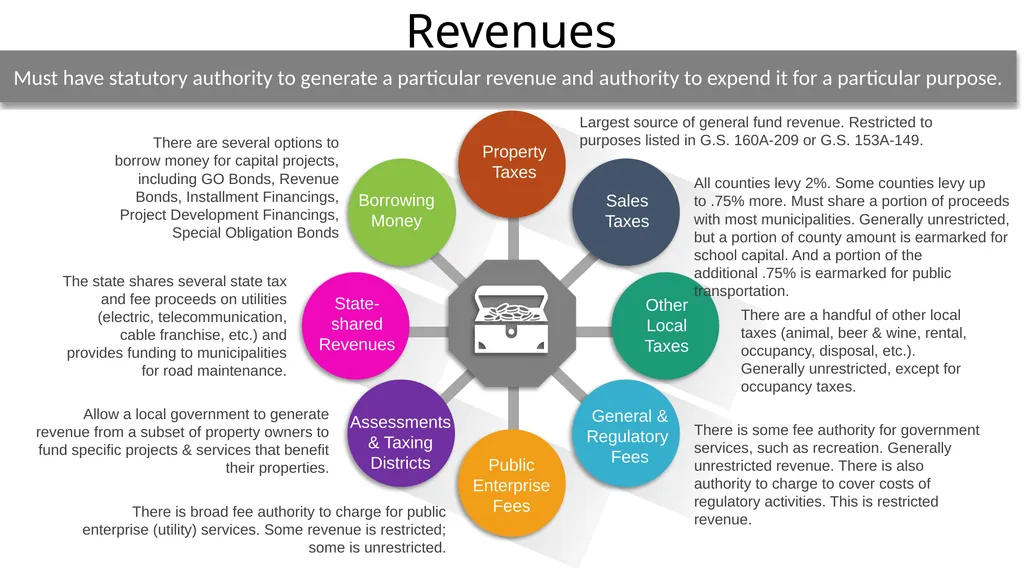
slide10. Revenues Sales Taxes Other Local Taxes General & Regulatory Fees Public Enterprise Fees Assessments & Taxing Districts State-shared Revenues Borrowing Money Property Taxes Largest source of general fund revenue. Restricted to purposes listed in G.S. 160A-209 or G.S. 153A-149. All counties levy 2%. Some counties levy up to .75% more. Must share a portion of proceeds with most municipalities. Generally unrestricted, but a portion of county amount is earmarked for school capital. And a portion of the additional .75% is earmarked for public transportation. There is some fee authority for government services, such as recreation. Generally unrestricted revenue. There is also authority to charge to cover costs of regulatory activities. This is restricted revenue. There are a handful of other local taxes (animal, beer & wine, rental, occupancy, disposal, etc.). Generally unrestricted, except for occupancy taxes. There is broad fee authority to charge for public enterprise (utility) services. Some revenue is restricted; some is unrestricted. Allow a local government to generate revenue from a subset of property owners to fund specific projects & services that benefit their properties. The state shares several state tax and fee proceeds on utilities (electric, telecommunication, cable franchise, etc.) and provides funding to municipalities for road maintenance. There are several options to borrow money for capital projects, including GO Bonds, Revenue Bonds, Installment Financings, Project Development Financings, Special Obligation Bonds Must have statutory authority to generate a particular revenue and authority to expend it for a particular purpose.<br>
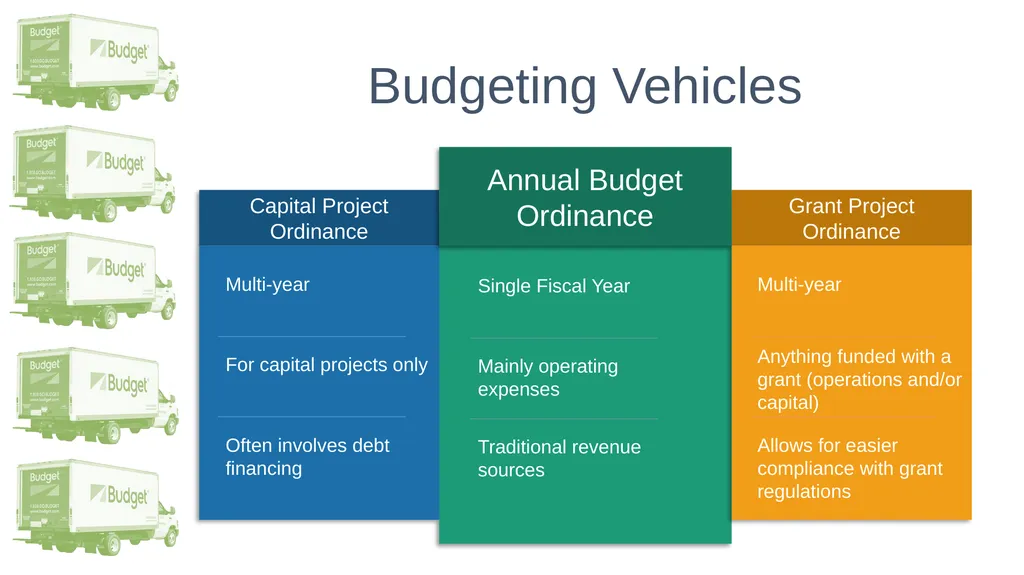
slide11. Capital Project Ordinance Grant Project Ordinance Single Fiscal Year Mainly operating expenses Traditional revenue sources Multi-year For capital projects only Often involves debt financing Multi-year Anything funded with a grant (operations and/or capital) Allows for easier compliance with grant regulations Annual Budget Ordinance Budgeting Vehicles<br>
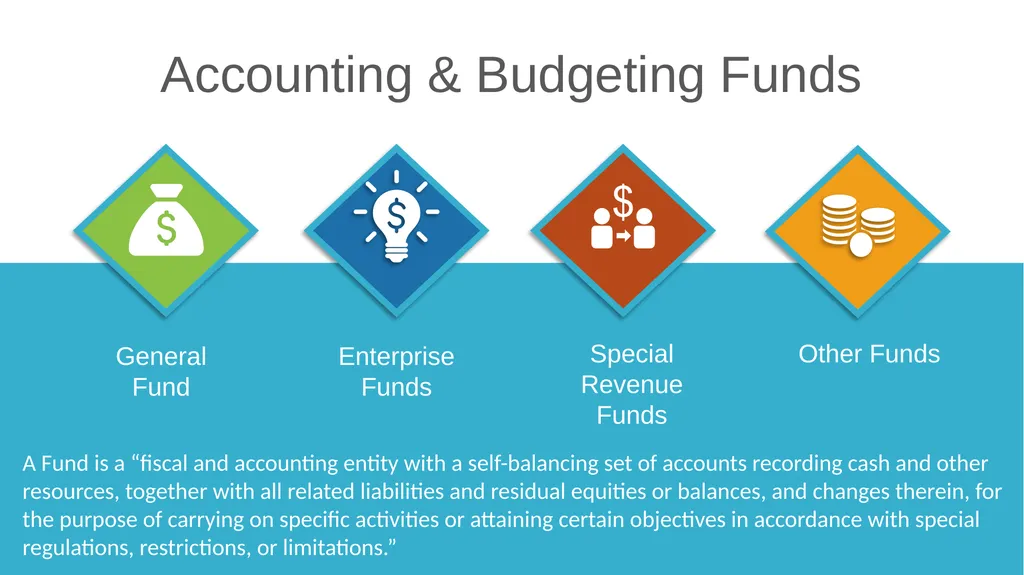
slide12. General Fund Enterprise Funds Special Revenue Funds Other Funds Accounting & Budgeting Funds A Fund is a “fiscal and accounting entity with a self-balancing set of accounts recording cash and other resources, together with all related liabilities and residual equities or balances, and changes therein, for the purpose of carrying on specific activities or attaining certain objectives in accordance with special regulations, restrictions, or limitations.”<br>
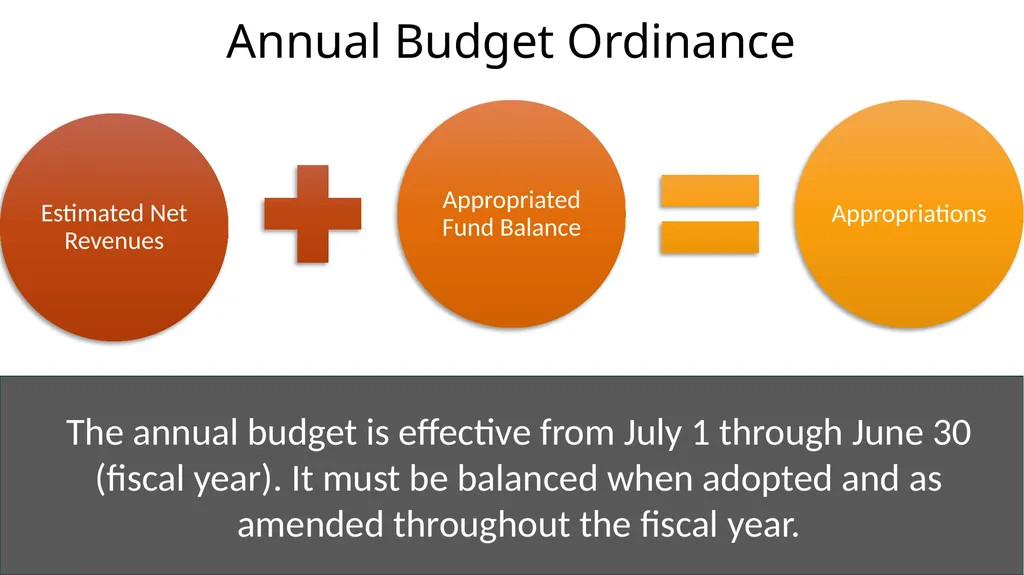
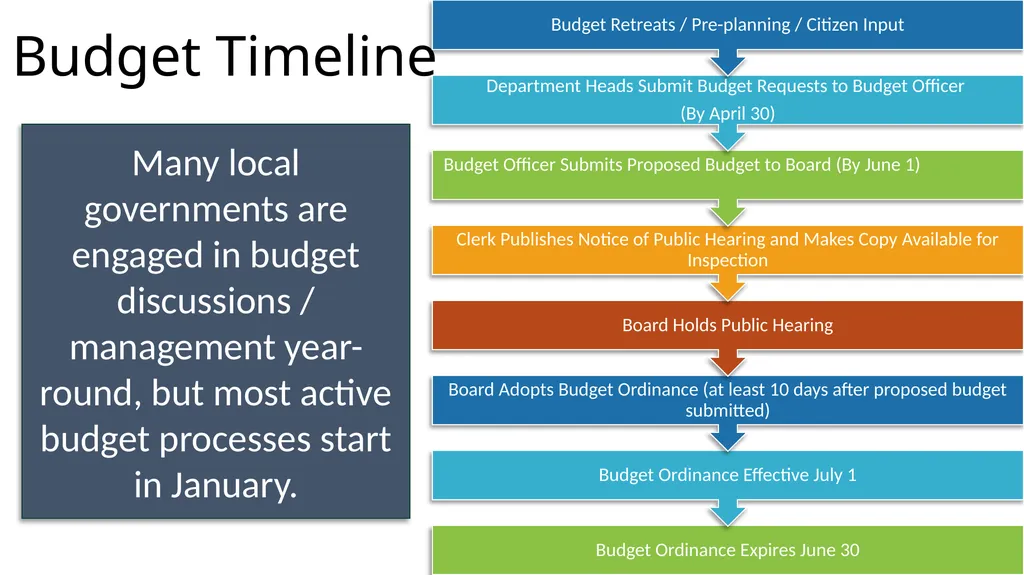
slide13. Annual Budget Ordinance The annual budget is effective from July 1 through June 30 (fiscal year). It must be balanced when adopted and as amended throughout the fiscal year.<br>
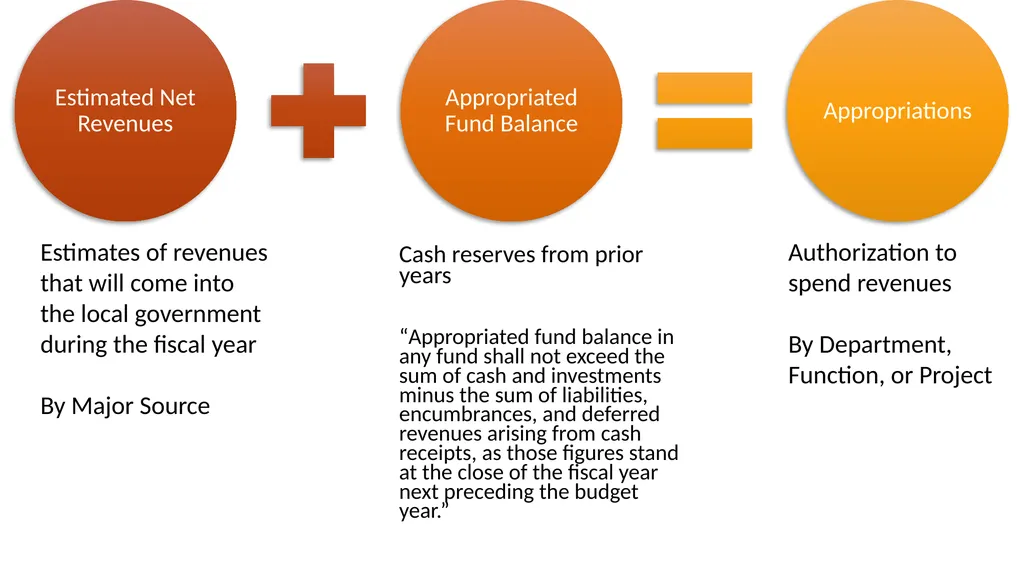
slide14. Cash reserves from prior years
“Appropriated fund balance in any fund shall not exceed the sum of cash and investments minus the sum of liabilities, encumbrances, and deferred revenues arising from cash receipts, as those figures stand at the close of the fiscal year next preceding the budget year.” Authorization to spend revenues
By Department, Function, or Project Estimates of revenues that will come into the local government during the fiscal year
By Major Source<br>
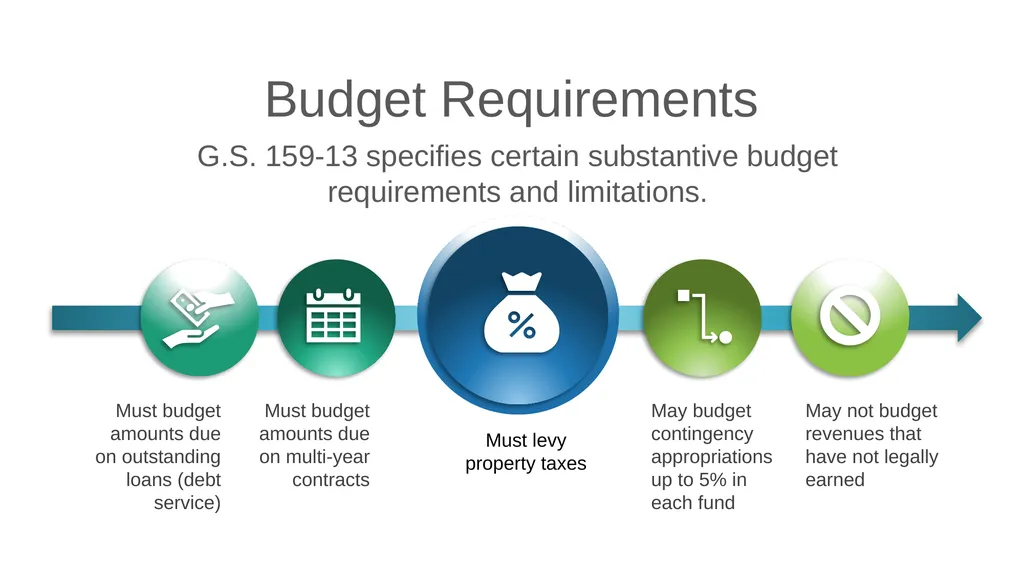
slide15. Budget Requirements Must levy property taxes May not budget revenues that have not legally earned May budget contingency appropriations up to 5% in each fund Must budget amounts due on multi-year contracts Must budget amounts due on outstanding loans (debt service) G.S. 159-13 specifies certain substantive budget requirements and limitations.<br>
slide16. Budget Timeline Many local governments are engaged in budget discussions / management year-round, but most active budget processes start in January.<br>
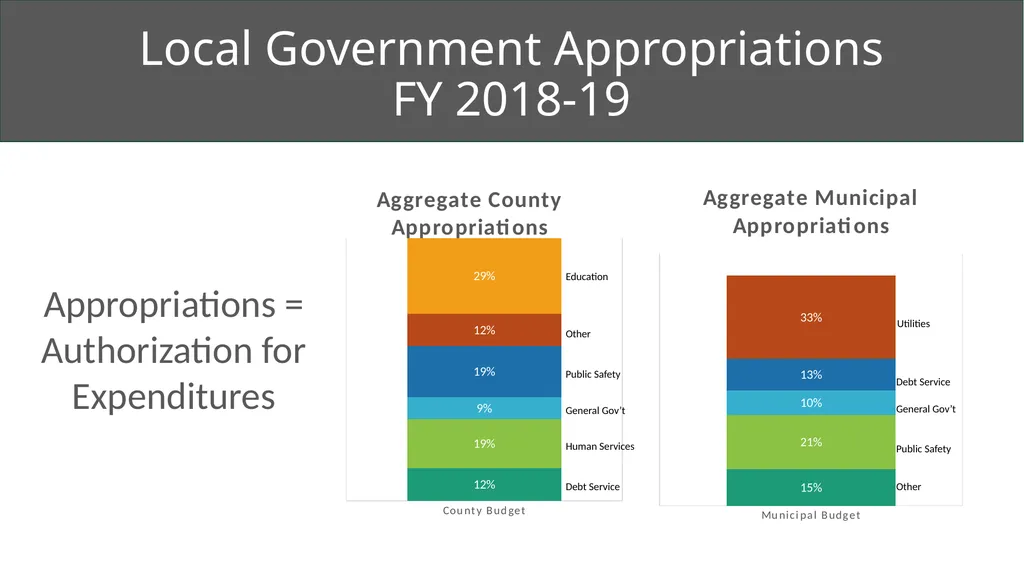
slide17. Appropriations = Authorization for Expenditures Local Government Appropriations FY 2018-19 Education Other Public Safety General Gov’t Human Services Debt Service Other Public Safety General Gov’t Utilities Debt Service<br>
slide18. What Makes NC Gov’t Unique? State has primary responsibility for funding education and highways
Counties have primary responsibility for human services at the local level
Counties have authority to provide most urban-type services
Counties and cities have extensive authority to regulate and direct urban development
Counties and cities have broad authority to enter interlocal agreements and form regional partnerships
Heavy reliance on general-purpose local governments (counties and cities) to perform most local functions (e.g. schools do not have taxing authority)<br>
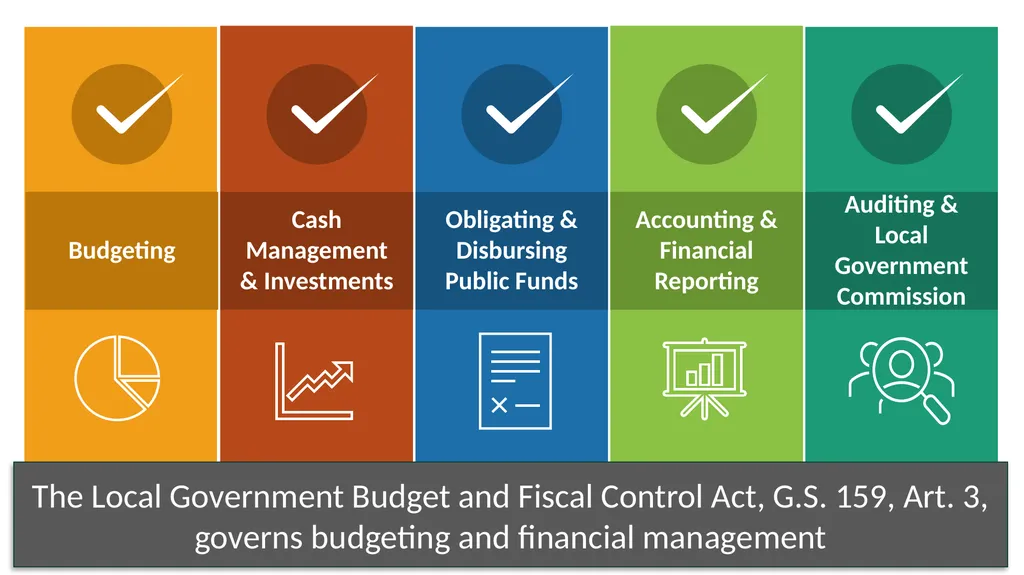
slide19. Budgeting Obligating & Disbursing Public Funds Accounting & Financial Reporting Cash Management & Investments Auditing & Local Government Commission The Local Government Budget and Fiscal Control Act, G.S. 159, Art. 3, governs budgeting and financial management<br>
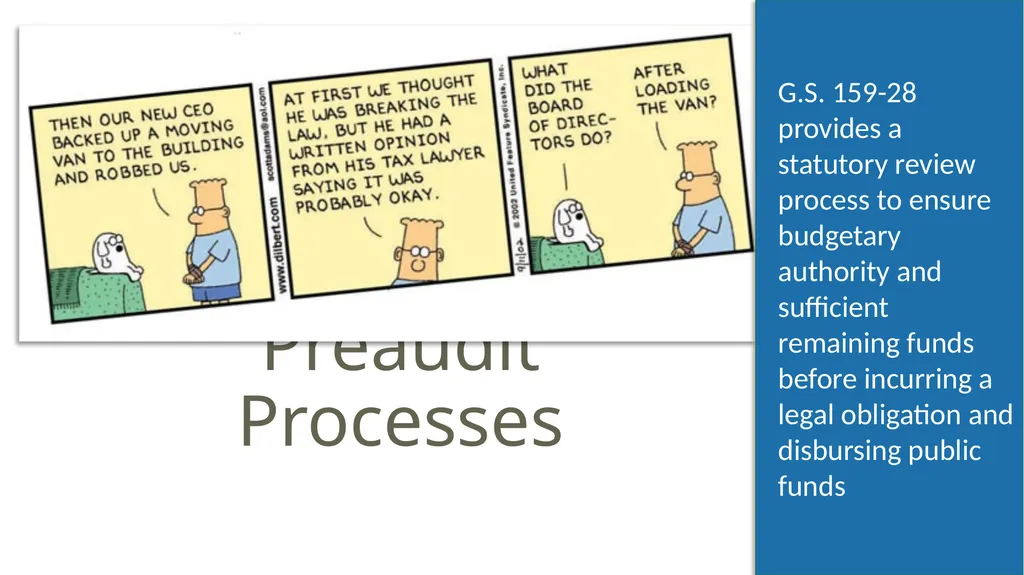
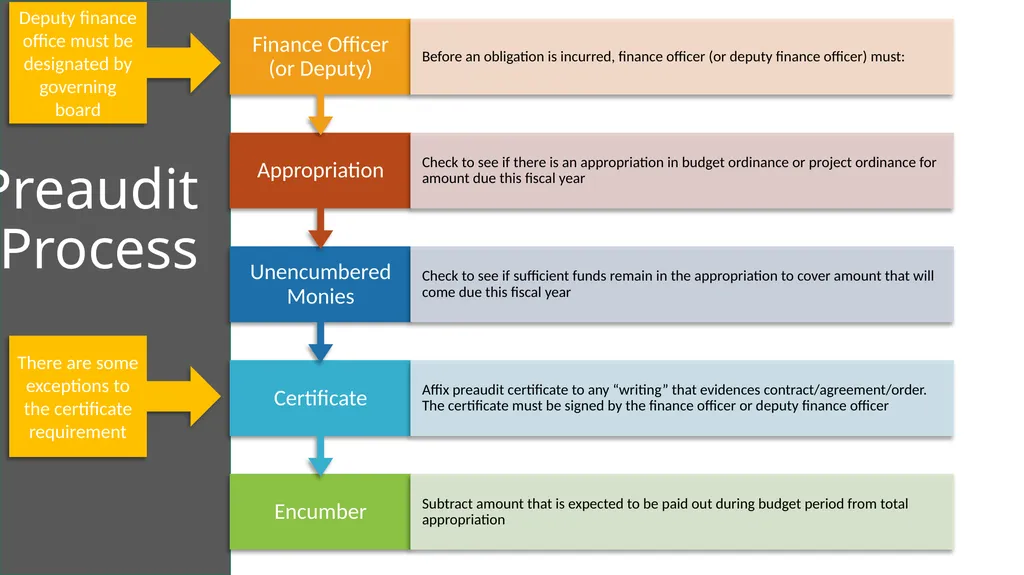
slide20. Preaudit Processes G.S. 159-28 provides a statutory review process to ensure budgetary authority and sufficient remaining funds before incurring a legal obligation and disbursing public funds<br>
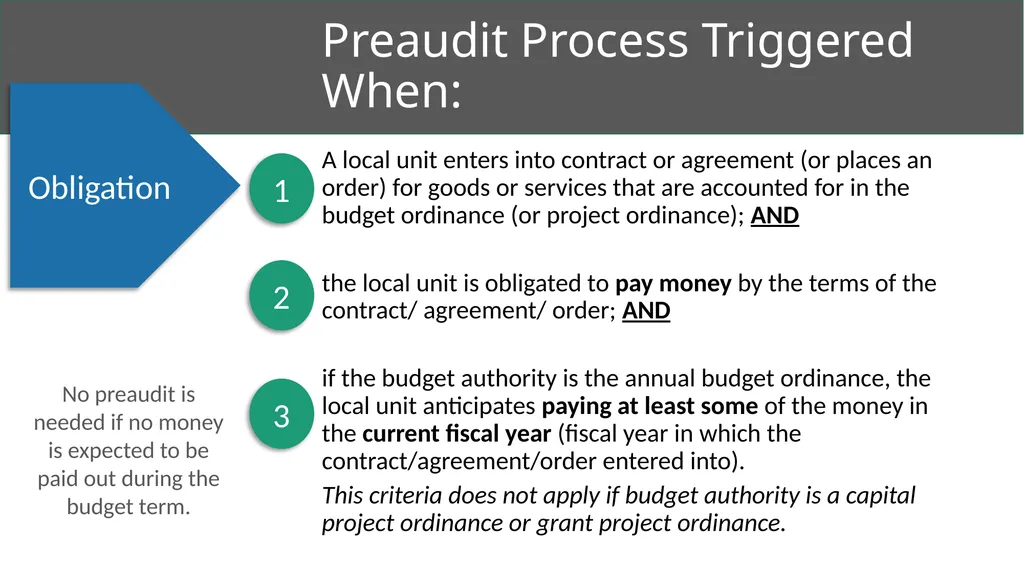
slide21. Preaudit Process Triggered When: A local unit enters into contract or agreement (or places an order) for goods or services that are accounted for in the budget ordinance (or project ordinance); AND
the local unit is obligated to pay money by the terms of the contract/ agreement/ order; AND
if the budget authority is the annual budget ordinance, the local unit anticipates paying at least some of the money in the current fiscal year (fiscal year in which the contract/agreement/order entered into).
This criteria does not apply if budget authority is a capital project ordinance or grant project ordinance. Obligation 1 2 3 No preaudit is needed if no money is expected to be paid out during the budget term.<br>
slide22. Preaudit Process Deputy finance office must be designated by governing board There are some exceptions to the certificate requirement<br>
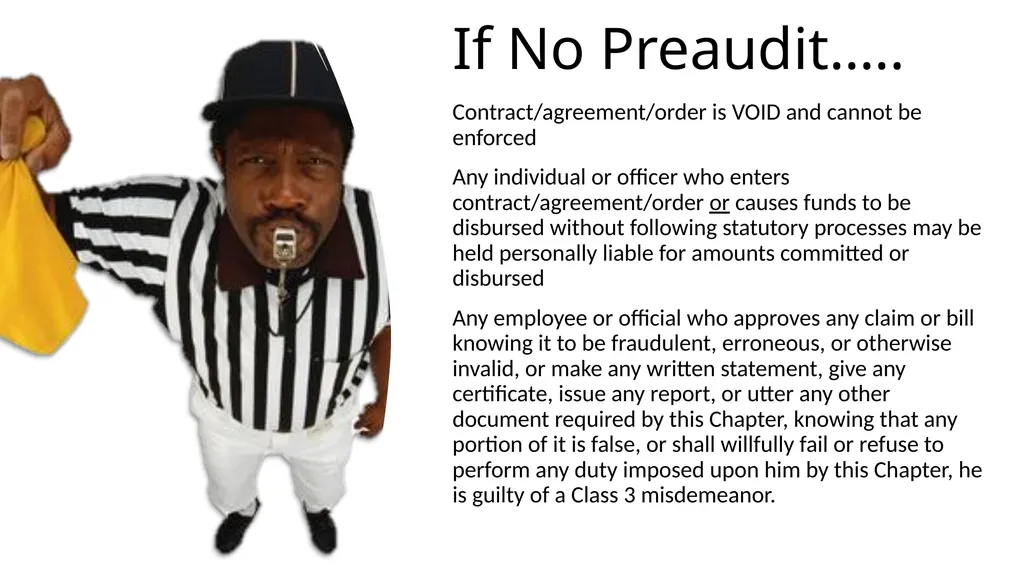
slide23. If No Preaudit….. Contract/agreement/order is VOID and cannot be enforced
Any individual or officer who enters contract/agreement/order or causes funds to be disbursed without following statutory processes may be held personally liable for amounts committed or disbursed
Any employee or official who approves any claim or bill knowing it to be fraudulent, erroneous, or otherwise invalid, or make any written statement, give any certificate, issue any report, or utter any other document required by this Chapter, knowing that any portion of it is false, or shall willfully fail or refuse to perform any duty imposed upon him by this Chapter, he is guilty of a Class 3 misdemeanor.<br>
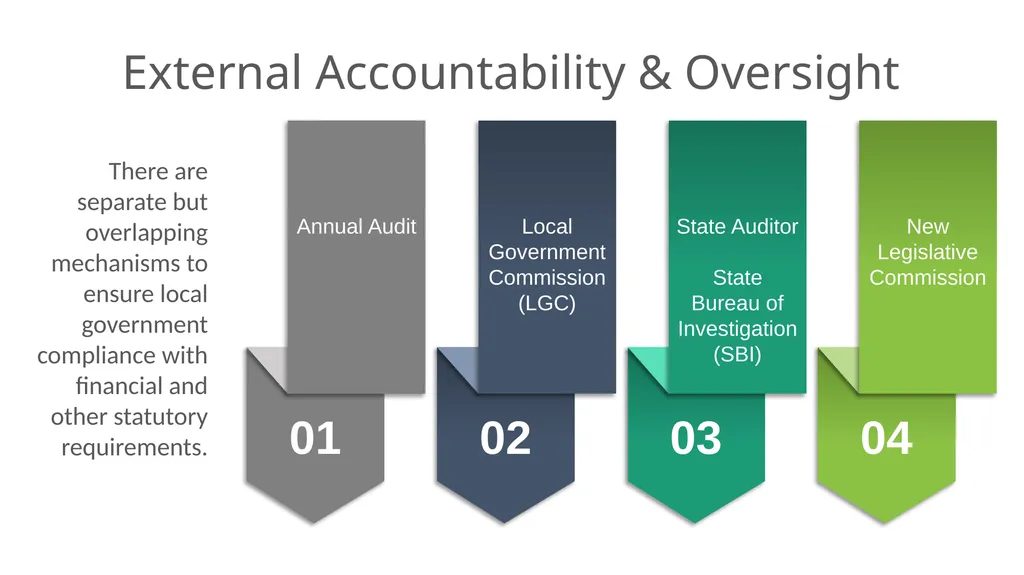
slide24. External Accountability & Oversight 03 02 01 04 New Legislative Commission State Auditor
State Bureau of Investigation (SBI) Local Government Commission
(LGC) Annual Audit There are separate but overlapping mechanisms to ensure local government compliance with financial and other statutory requirements.<br>
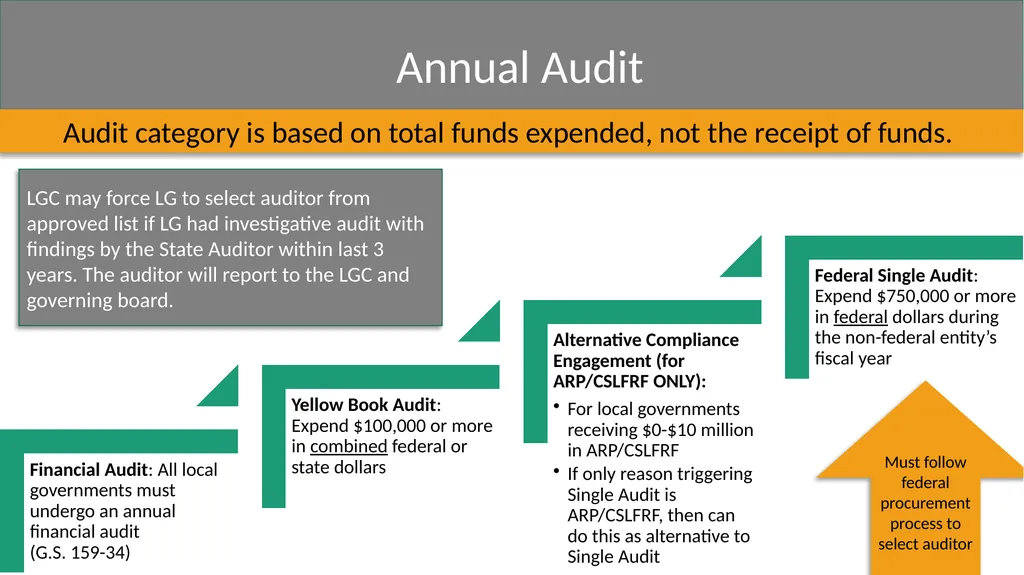
slide25. Annual Audit Audit category is based on total funds expended, not the receipt of funds. Must follow federal procurement process to select auditor LGC may force LG to select auditor from approved list if LG had investigative audit with findings by the State Auditor within last 3 years. The auditor will report to the LGC and governing board.<br>
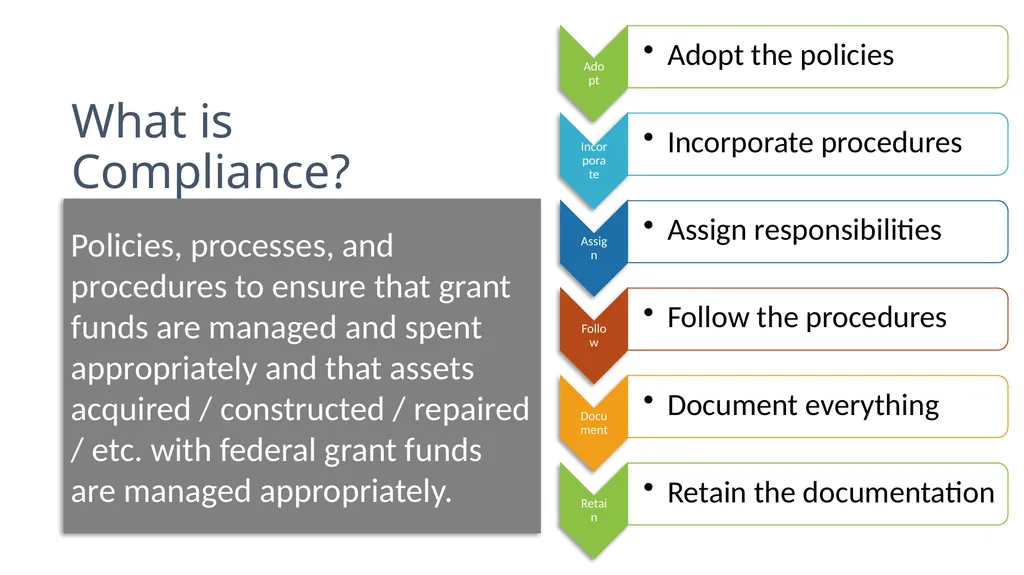
slide26. What is Compliance? Policies, processes, and procedures to ensure that grant funds are managed and spent appropriately and that assets acquired / constructed / repaired / etc. with federal grant funds are managed appropriately.<br>
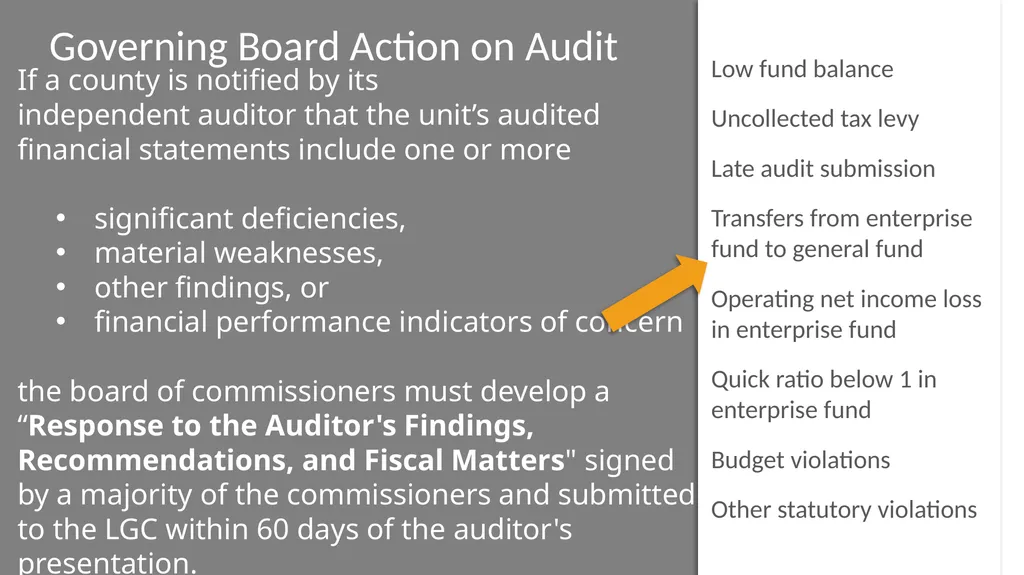
slide27. If a county is notified by its independent auditor that the unit’s audited financial statements include one or more
significant deficiencies,
material weaknesses,
other findings, or
financial performance indicators of concern
the board of commissioners must develop a “Response to the Auditor's Findings, Recommendations, and Fiscal Matters" signed by a majority of the commissioners and submitted to the LGC within 60 days of the auditor's presentation. Governing Board Action on Audit Low fund balance
Uncollected tax levy
Late audit submission
Transfers from enterprise fund to general fund
Operating net income loss in enterprise fund
Quick ratio below 1 in enterprise fund
Budget violations
Other statutory violations<br>
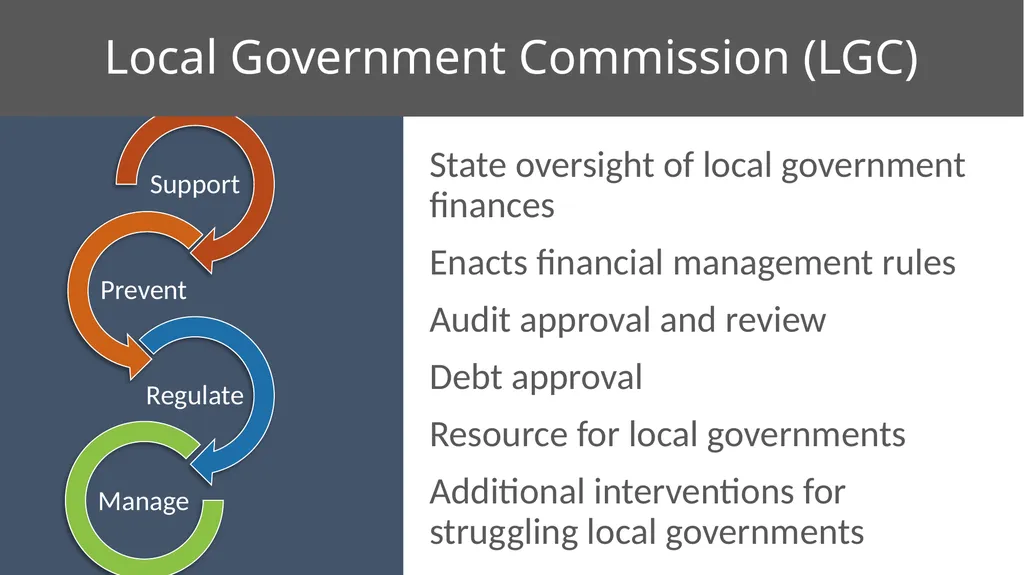
slide28. Local Government Commission (LGC) State oversight of local government finances
Enacts financial management rules
Audit approval and review
Debt approval
Resource for local governments
Additional interventions for struggling local governments<br>
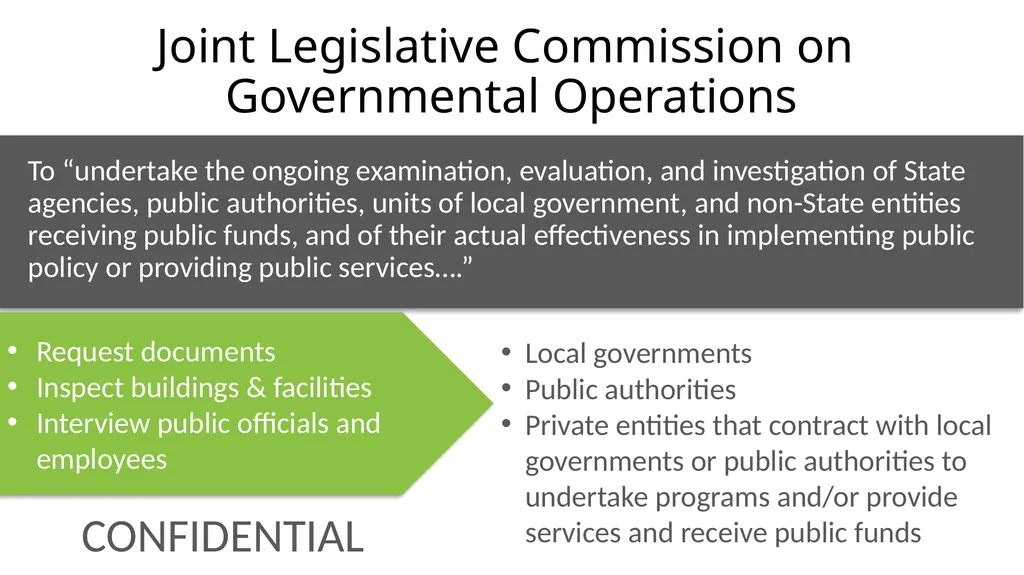
slide29. Joint Legislative Commission on Governmental Operations To “undertake the ongoing examination, evaluation, and investigation of State agencies, public authorities, units of local government, and non-State entities receiving public funds, and of their actual effectiveness in implementing public policy or providing public services….” Local governments
Public authorities
Private entities that contract with local governments or public authorities to undertake programs and/or provide services and receive public funds Request documents
Inspect buildings & facilities
Interview public officials and employees CONFIDENTIALAL<br>
Bradshaw Distinguished Professor of Public Law and Government October 2023 NC Local Government Finance 101<br>
slide2. Local Government Finance Is….. Oversight Revenues Expenditure
Authority Fund
Accounting Budgeting Fiscal Control Contracting The resources that enable local governments to function, and the authority to match those resources with particular activities.
The set of laws, regulations, rules, policies, and processes that govern collecting, managing, accounting, contracting, obligating, disbursing, reporting, and auditing of public funds.<br>
slide3. Can We Do It? Is It Budgeted? Who Ensures Compliance? How Can We Pay For It? How Do We Manage It?<br>
slide4. County contract with nonprofit fire department to fund purchase of fire truck that will be owned by fire department that provides services in county.
City contract with boys and girls club (nonprofit) to fund a new van to transport city students from school to boys and girls club facility for after school program
City contract with nonprofit museum to provide funding for operating expenses and capital maintenance on nonprofit’s building.
County expenditure to improve city owned street.
City assesses sales and use tax on sales transactions in the city.
City donation to community organization that runs an annual community music festival.
County commissioner may direct appropriation to local rotary club if part of commissioner’s discretionary funds. Which of the following are lawful? Yes No No Yes No No No Expenditure Authority<br>
slide5. A local government and public authority must have statutory authority to undertake any activity! Expenditure Authority<br>
slide6. Ambulance Community Colleges Sheriff Register of Deeds Property Assessment EMS Elections
Courts Public Health Mental Health
Social Services
Medical
Examiner Schools Jails Building Code Enforcement Emergency Mgmt. Soil and Water Conservation Cooperative Extension Downtown Development / Redevelopment Cemeteries Airports Hospitals Parking EMS Stormwater / Watershed Parks & Recreation Fire/Rescue Solid Waste Community & Economic Dev. Sewer Water Public Transportation Land Regulation Tax/Fee Collection Animal Control Regulatory
Powers Libraries Streets/
Sidewalks/Street Lighting Public
Housing Juvenile Detention County Home Cable/Broadband Electric Natural Gas Police Airports Schools MAJOR COUNTY & MUNICIPAL FUNCTIONS<br>
slide7. You must have statutory authority to expend funds for any purpose
Public funds must be spent for benefit of citizens of your LG
Public funds must be spent for citizens generally and not solely to benefit private individual / entity You may not provide direct benefit to private entities or individuals without receiving public benefit in return Public Purpose
“The power of taxation shall be exercised . . . for public purposes only . . .” N.C. Const. Art. V, Sect. 2(1) Exclusive Privileges & Emoluments
“No person or set of persons is entitled to exclusive or separate emoluments* or privileges from the community but in consideration of public services.”
N.C. Const. Art. I, Sect. 32<br>
slide8. Can We Do It?<br>
slide9. Support Partnership vs. A local government generally
DOES NOT have statutory authority to support a nonprofit’s, community organization’s, or other private entity’s general operating or capital expenditures (but there are exceptions) A local government MAY enter a partnership (contractual agreement) with any private entity to fund an activity, service, project, etc. that the local government has statutory authority to engage in.
See G.S. 160A-20.1 & G.S. 153A-449 Unless an exception applies, should treat nonprofit / other private entity as a ”service provider” Funding for Nonprofits & Community Organizations<br>
slide10. Revenues Sales Taxes Other Local Taxes General & Regulatory Fees Public Enterprise Fees Assessments & Taxing Districts State-shared Revenues Borrowing Money Property Taxes Largest source of general fund revenue. Restricted to purposes listed in G.S. 160A-209 or G.S. 153A-149. All counties levy 2%. Some counties levy up to .75% more. Must share a portion of proceeds with most municipalities. Generally unrestricted, but a portion of county amount is earmarked for school capital. And a portion of the additional .75% is earmarked for public transportation. There is some fee authority for government services, such as recreation. Generally unrestricted revenue. There is also authority to charge to cover costs of regulatory activities. This is restricted revenue. There are a handful of other local taxes (animal, beer & wine, rental, occupancy, disposal, etc.). Generally unrestricted, except for occupancy taxes. There is broad fee authority to charge for public enterprise (utility) services. Some revenue is restricted; some is unrestricted. Allow a local government to generate revenue from a subset of property owners to fund specific projects & services that benefit their properties. The state shares several state tax and fee proceeds on utilities (electric, telecommunication, cable franchise, etc.) and provides funding to municipalities for road maintenance. There are several options to borrow money for capital projects, including GO Bonds, Revenue Bonds, Installment Financings, Project Development Financings, Special Obligation Bonds Must have statutory authority to generate a particular revenue and authority to expend it for a particular purpose.<br>
slide11. Capital Project Ordinance Grant Project Ordinance Single Fiscal Year Mainly operating expenses Traditional revenue sources Multi-year For capital projects only Often involves debt financing Multi-year Anything funded with a grant (operations and/or capital) Allows for easier compliance with grant regulations Annual Budget Ordinance Budgeting Vehicles<br>
slide12. General Fund Enterprise Funds Special Revenue Funds Other Funds Accounting & Budgeting Funds A Fund is a “fiscal and accounting entity with a self-balancing set of accounts recording cash and other resources, together with all related liabilities and residual equities or balances, and changes therein, for the purpose of carrying on specific activities or attaining certain objectives in accordance with special regulations, restrictions, or limitations.”<br>
slide13. Annual Budget Ordinance The annual budget is effective from July 1 through June 30 (fiscal year). It must be balanced when adopted and as amended throughout the fiscal year.<br>
slide14. Cash reserves from prior years
“Appropriated fund balance in any fund shall not exceed the sum of cash and investments minus the sum of liabilities, encumbrances, and deferred revenues arising from cash receipts, as those figures stand at the close of the fiscal year next preceding the budget year.” Authorization to spend revenues
By Department, Function, or Project Estimates of revenues that will come into the local government during the fiscal year
By Major Source<br>
slide15. Budget Requirements Must levy property taxes May not budget revenues that have not legally earned May budget contingency appropriations up to 5% in each fund Must budget amounts due on multi-year contracts Must budget amounts due on outstanding loans (debt service) G.S. 159-13 specifies certain substantive budget requirements and limitations.<br>
slide16. Budget Timeline Many local governments are engaged in budget discussions / management year-round, but most active budget processes start in January.<br>
slide17. Appropriations = Authorization for Expenditures Local Government Appropriations FY 2018-19 Education Other Public Safety General Gov’t Human Services Debt Service Other Public Safety General Gov’t Utilities Debt Service<br>
slide18. What Makes NC Gov’t Unique? State has primary responsibility for funding education and highways
Counties have primary responsibility for human services at the local level
Counties have authority to provide most urban-type services
Counties and cities have extensive authority to regulate and direct urban development
Counties and cities have broad authority to enter interlocal agreements and form regional partnerships
Heavy reliance on general-purpose local governments (counties and cities) to perform most local functions (e.g. schools do not have taxing authority)<br>
slide19. Budgeting Obligating & Disbursing Public Funds Accounting & Financial Reporting Cash Management & Investments Auditing & Local Government Commission The Local Government Budget and Fiscal Control Act, G.S. 159, Art. 3, governs budgeting and financial management<br>
slide20. Preaudit Processes G.S. 159-28 provides a statutory review process to ensure budgetary authority and sufficient remaining funds before incurring a legal obligation and disbursing public funds<br>
slide21. Preaudit Process Triggered When: A local unit enters into contract or agreement (or places an order) for goods or services that are accounted for in the budget ordinance (or project ordinance); AND
the local unit is obligated to pay money by the terms of the contract/ agreement/ order; AND
if the budget authority is the annual budget ordinance, the local unit anticipates paying at least some of the money in the current fiscal year (fiscal year in which the contract/agreement/order entered into).
This criteria does not apply if budget authority is a capital project ordinance or grant project ordinance. Obligation 1 2 3 No preaudit is needed if no money is expected to be paid out during the budget term.<br>
slide22. Preaudit Process Deputy finance office must be designated by governing board There are some exceptions to the certificate requirement<br>
slide23. If No Preaudit….. Contract/agreement/order is VOID and cannot be enforced
Any individual or officer who enters contract/agreement/order or causes funds to be disbursed without following statutory processes may be held personally liable for amounts committed or disbursed
Any employee or official who approves any claim or bill knowing it to be fraudulent, erroneous, or otherwise invalid, or make any written statement, give any certificate, issue any report, or utter any other document required by this Chapter, knowing that any portion of it is false, or shall willfully fail or refuse to perform any duty imposed upon him by this Chapter, he is guilty of a Class 3 misdemeanor.<br>
slide24. External Accountability & Oversight 03 02 01 04 New Legislative Commission State Auditor
State Bureau of Investigation (SBI) Local Government Commission
(LGC) Annual Audit There are separate but overlapping mechanisms to ensure local government compliance with financial and other statutory requirements.<br>
slide25. Annual Audit Audit category is based on total funds expended, not the receipt of funds. Must follow federal procurement process to select auditor LGC may force LG to select auditor from approved list if LG had investigative audit with findings by the State Auditor within last 3 years. The auditor will report to the LGC and governing board.<br>
slide26. What is Compliance? Policies, processes, and procedures to ensure that grant funds are managed and spent appropriately and that assets acquired / constructed / repaired / etc. with federal grant funds are managed appropriately.<br>
slide27. If a county is notified by its independent auditor that the unit’s audited financial statements include one or more
significant deficiencies,
material weaknesses,
other findings, or
financial performance indicators of concern
the board of commissioners must develop a “Response to the Auditor's Findings, Recommendations, and Fiscal Matters" signed by a majority of the commissioners and submitted to the LGC within 60 days of the auditor's presentation. Governing Board Action on Audit Low fund balance
Uncollected tax levy
Late audit submission
Transfers from enterprise fund to general fund
Operating net income loss in enterprise fund
Quick ratio below 1 in enterprise fund
Budget violations
Other statutory violations<br>
slide28. Local Government Commission (LGC) State oversight of local government finances
Enacts financial management rules
Audit approval and review
Debt approval
Resource for local governments
Additional interventions for struggling local governments<br>
slide29. Joint Legislative Commission on Governmental Operations To “undertake the ongoing examination, evaluation, and investigation of State agencies, public authorities, units of local government, and non-State entities receiving public funds, and of their actual effectiveness in implementing public policy or providing public services….” Local governments
Public authorities
Private entities that contract with local governments or public authorities to undertake programs and/or provide services and receive public funds Request documents
Inspect buildings & facilities
Interview public officials and employees CONFIDENTIALAL<br>