Locke’s argument against innate concepts Michael

Published  . 0 views
↓ Download
Locke’s argument against innate concepts Michael
1 / 1
Locke’s argument against innate concepts Michael - slide 1 of 7 Locke’s argument against innate concepts Michael - slide 2 of 7 Locke’s argument against innate concepts Michael - slide 3 of 7 Locke’s argument against innate concepts Michael - slide 4 of 7 Locke’s argument against innate concepts Michael - slide 5 of 7 Locke’s argument against innate concepts Michael - slide 6 of 7 Locke’s argument against innate concepts Michael - slide 7 of 7
Description: Lockes argument against innate concepts Michael Lacewing enquiriesalevelphilosophy.co.uk Michael Lacewing Innate concepts Some of our concepts are innate Innate: some concepts are somehow part of the structure of the mind rather than

Related Topics

Download Presentation

"Locke’s argument against innate concepts Michael" is the property of its rightful owner. Permission is granted to download and print the materials on this website for personal, non-commercial use only, and to display it on your personal computer provided you do not modify the materials and that you retain all copyright notices contained in the materials. By downloading content from our website, you accept the terms of this agreement.

Presentation Transcript

slide1. Locke’s argument against innate concepts Michael Lacewing
enquiries@alevelphilosophy.co.uk © Michael Lacewing<br>
slide2. Innate concepts Some of our concepts are innate
‘Innate’: some concepts are somehow part of the structure of the mind rather than being gained through experience.
If some propositional knowledge is innate, then some concepts must be innate.
If no concepts are innate, then no propositional knowledge is innate. © Michael Lacewing<br>
slide3. Locke against innate concepts Shared assumption: innate concepts are universal.
Locke’s assumption: we are conscious of our concepts.
Inference: an innate concept is one that every human being has and is conscious of.
But newborn babies don’t have concepts
Certainly not IDENTITY or IMPOSSIBILITY
Locke gives these examples since innatists claimed that ‘It is impossible for the same thing to be, and not to be’ is innate knowledge. © Michael Lacewing<br>
slide4. Locke against innate concepts A concept can only be part of the mind without our being conscious of it if it is in memory.
Memory is consciousness of the past.
A concept that is not remembered is new to the mind – arising from sensation or reflection.
Innate concepts are supposedly neither remembered nor new – how?? © Michael Lacewing<br>
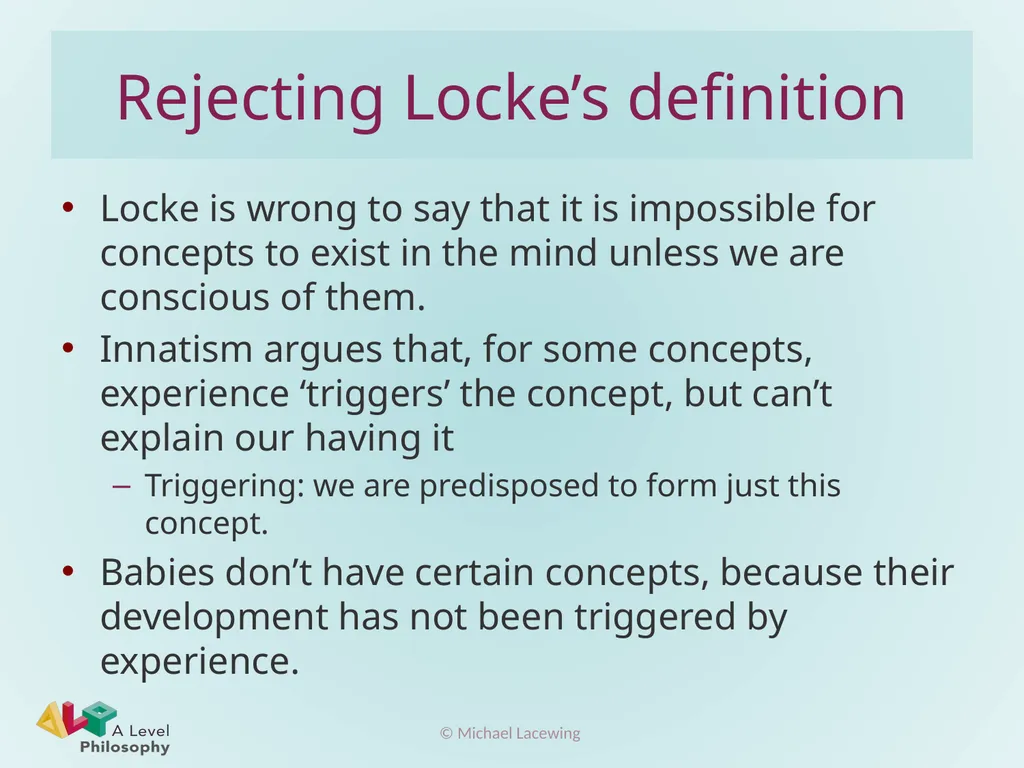
slide5. Rejecting Locke’s definition Locke is wrong to say that it is impossible for concepts to exist in the mind unless we are conscious of them.
Innatism argues that, for some concepts, experience ‘triggers’ the concept, but can’t explain our having it
Triggering: we are predisposed to form just this concept.
Babies don’t have certain concepts, because their development has not been triggered by experience. © Michael Lacewing<br>
slide6. Leibniz’s defence of innate concepts Concepts such as IDENTITY and IMPOSSIBILITY are essential to all thought, but implicit.
Innate concepts, before they are triggered and made explicit, exist as dispositions in the mind – neither remembered nor new.
‘What is innate is what might be called the potential knowledge of them, as the veins of the marble outline a shape that is in the marble before they are uncovered by the sculptor’ © Michael Lacewing<br>
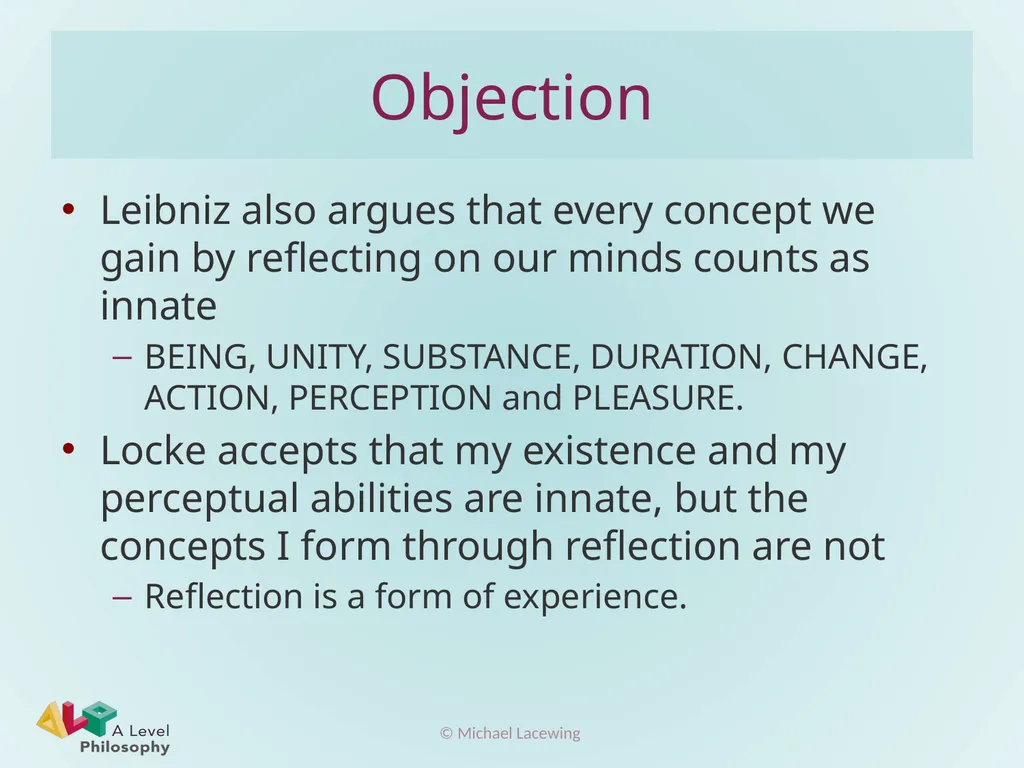
slide7. Objection Leibniz also argues that every concept we gain by reflecting on our minds counts as innate
BEING, UNITY, SUBSTANCE, DURATION, CHANGE, ACTION, PERCEPTION and PLEASURE.
Locke accepts that my existence and my perceptual abilities are innate, but the concepts I form through reflection are not
Reflection is a form of experience. © Michael Lacewing<br>