Logarithms ID1050 Quantitative Qualitative Reasoning History and Uses We noticed that when we multiply two numbers that are the same base raised to different exponents, that the result is the base raised to the sum of the exponents
"Logarithms ID1050– Quantitative & Qualitative" is the property of its rightful owner. Permission is granted to
download and print the materials on this website for personal, non-commercial use only, and to display it
on your personal computer provided you do not modify the materials and that you retain all copyright
notices contained in the materials. By downloading content from our website, you accept the terms of this
agreement.
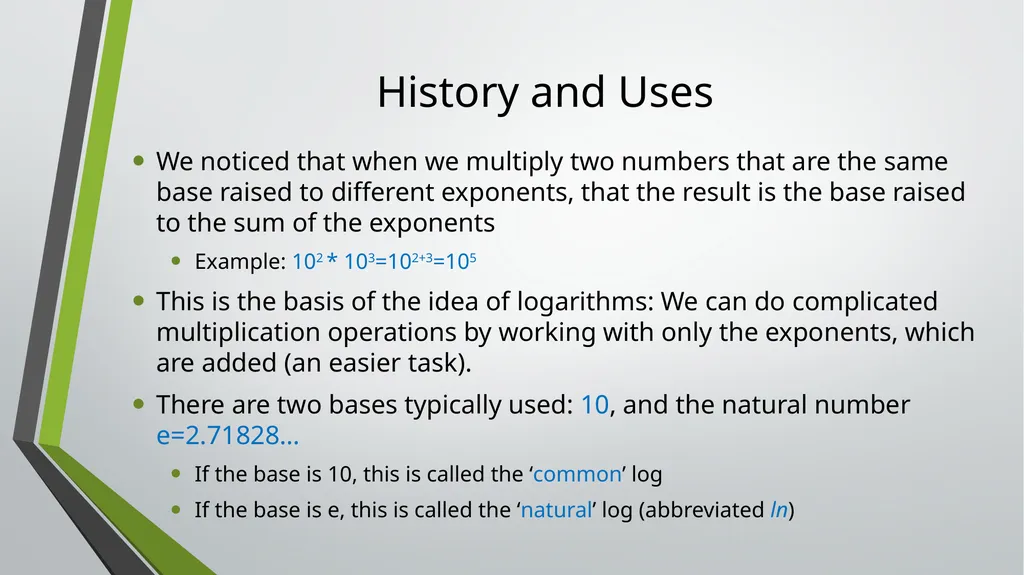
History and Uses We noticed that when we multiply two numbers that are the same base raised to different exponents, that the result is the base raised to the sum of the exponents
Example: 102 * 103=102+3=105
This is the basis of the idea of logarithms: We can do complicated multiplication operations by working with only the exponents, which are added (an easier task).
There are two bases typically used: 10, and the natural number e=2.71828…
If the base is 10, this is called the ‘common’ log
If the base is e, this is called the ‘natural’ log (abbreviated ln)<br>
03
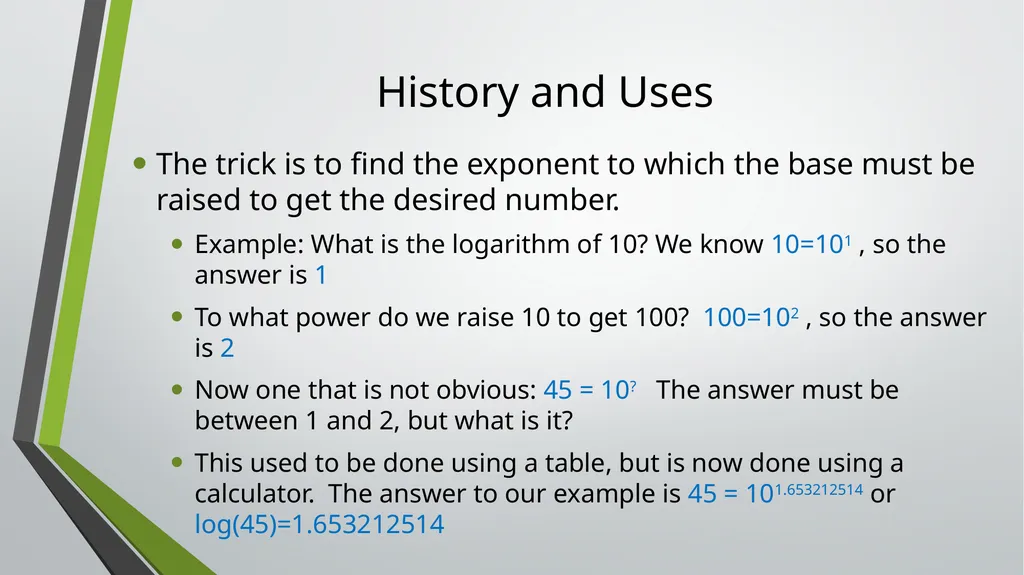
History and Uses The trick is to find the exponent to which the base must be raised to get the desired number.
Example: What is the logarithm of 10? We know 10=101 , so the answer is 1
To what power do we raise 10 to get 100? 100=102 , so the answer is 2
Now one that is not obvious: 45 = 10? The answer must be between 1 and 2, but what is it?
This used to be done using a table, but is now done using a calculator. The answer to our example is 45 = 101.653212514 or log(45)=1.653212514<br>
04
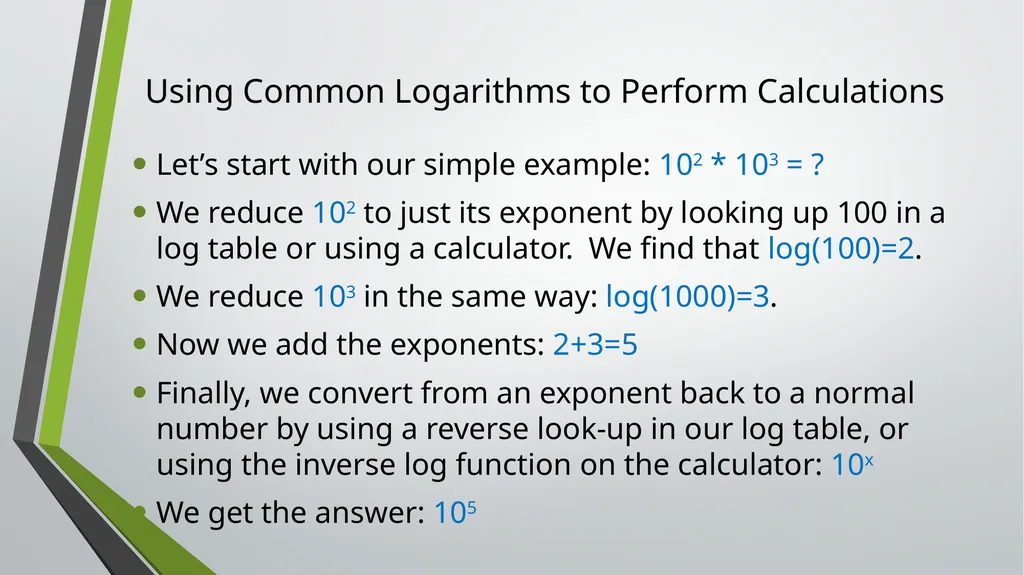
Using Common Logarithms to Perform Calculations Let’s start with our simple example: 102 * 103 = ?
We reduce 102 to just its exponent by looking up 100 in a log table or using a calculator. We find that log(100)=2.
We reduce 103 in the same way: log(1000)=3.
Now we add the exponents: 2+3=5
Finally, we convert from an exponent back to a normal number by using a reverse look-up in our log table, or using the inverse log function on the calculator: 10x
We get the answer: 105<br>
05
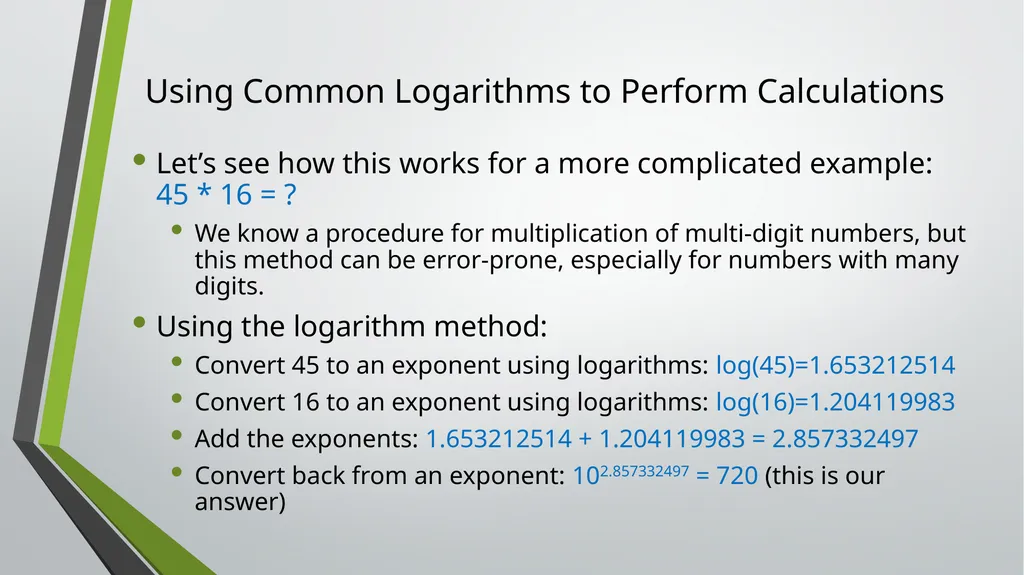
Using Common Logarithms to Perform Calculations Let’s see how this works for a more complicated example: 45 * 16 = ?
We know a procedure for multiplication of multi-digit numbers, but this method can be error-prone, especially for numbers with many digits.
Using the logarithm method:
Convert 45 to an exponent using logarithms: log(45)=1.653212514
Convert 16 to an exponent using logarithms: log(16)=1.204119983
Add the exponents: 1.653212514 + 1.204119983 = 2.857332497
Convert back from an exponent: 102.857332497 = 720 (this is our answer)<br>
06
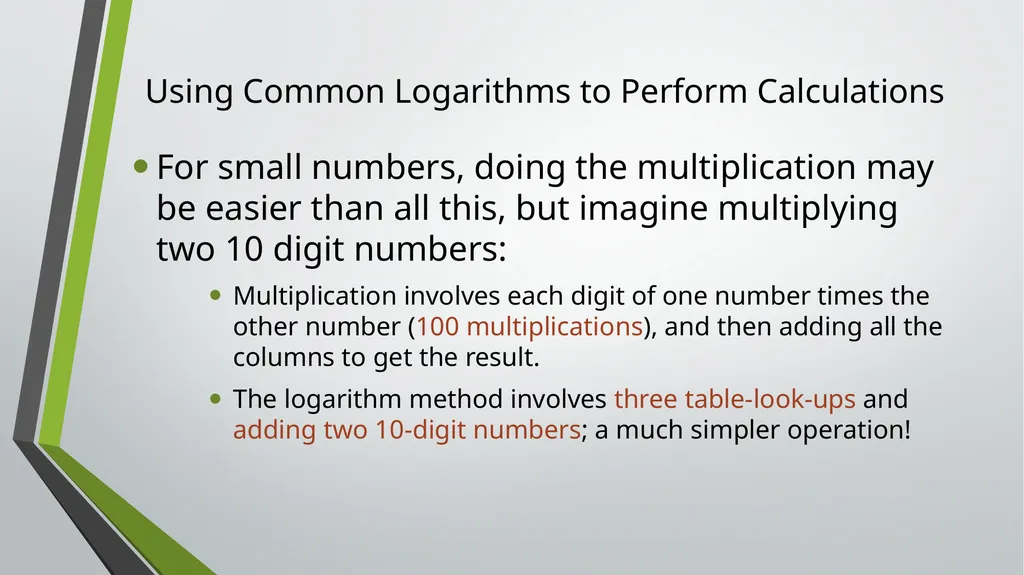
Using Common Logarithms to Perform Calculations For small numbers, doing the multiplication may be easier than all this, but imagine multiplying two 10 digit numbers:
Multiplication involves each digit of one number times the other number (100 multiplications), and then adding all the columns to get the result.
The logarithm method involves three table-look-ups and adding two 10-digit numbers; a much simpler operation!<br>
07
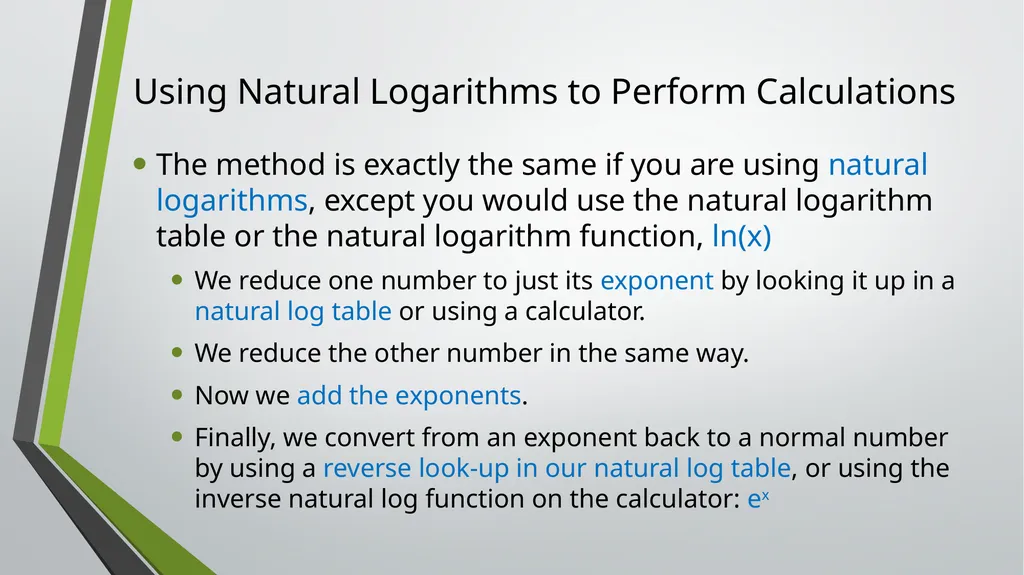
Using Natural Logarithms to Perform Calculations The method is exactly the same if you are using natural logarithms, except you would use the natural logarithm table or the natural logarithm function, ln(x)
We reduce one number to just its exponent by looking it up in a natural log table or using a calculator.
We reduce the other number in the same way.
Now we add the exponents.
Finally, we convert from an exponent back to a normal number by using a reverse look-up in our natural log table, or using the inverse natural log function on the calculator: ex<br>
08
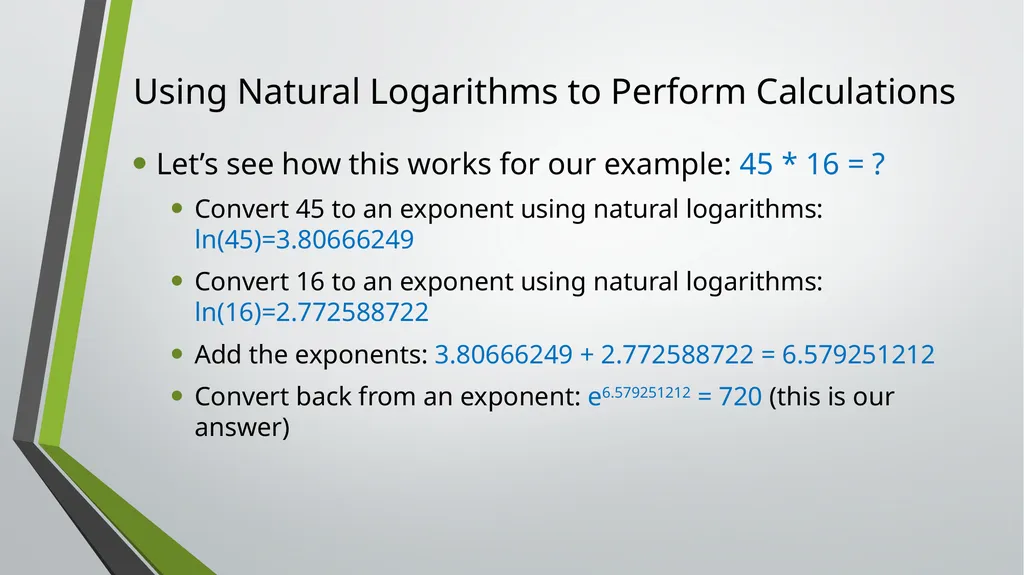
Using Natural Logarithms to Perform Calculations Let’s see how this works for our example: 45 * 16 = ?
Convert 45 to an exponent using natural logarithms: ln(45)=3.80666249
Convert 16 to an exponent using natural logarithms: ln(16)=2.772588722
Add the exponents: 3.80666249 + 2.772588722 = 6.579251212
Convert back from an exponent: e6.579251212 = 720 (this is our answer)<br>
09
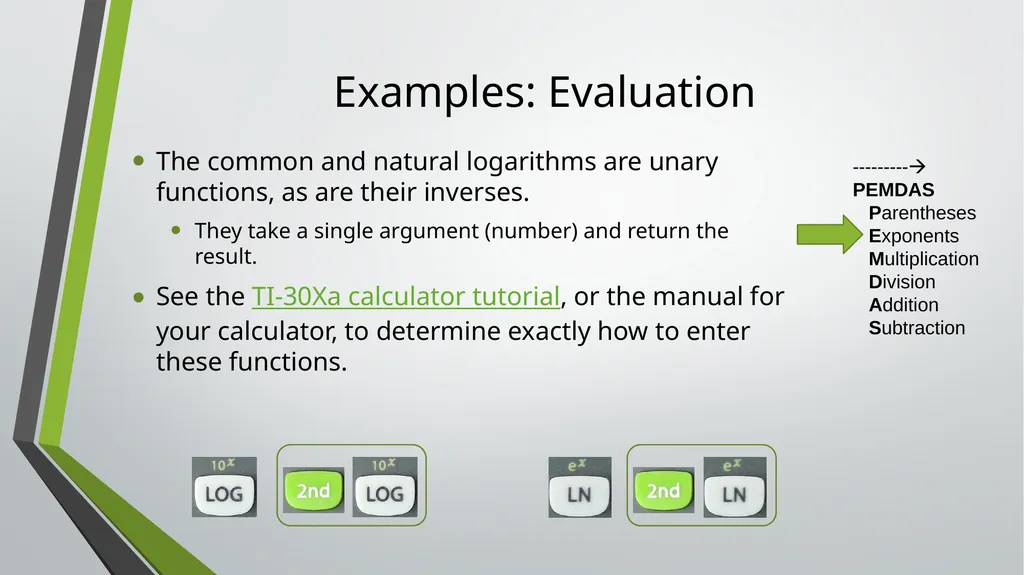
Examples: Evaluation The common and natural logarithms are unary functions, as are their inverses.
They take a single argument (number) and return the result.
See the TI-30Xa calculator tutorial, or the manual for your calculator, to determine exactly how to enter these functions. ---------
PEMDAS
Parentheses
Exponents
Multiplication
Division
Addition
Subtraction<br>
10
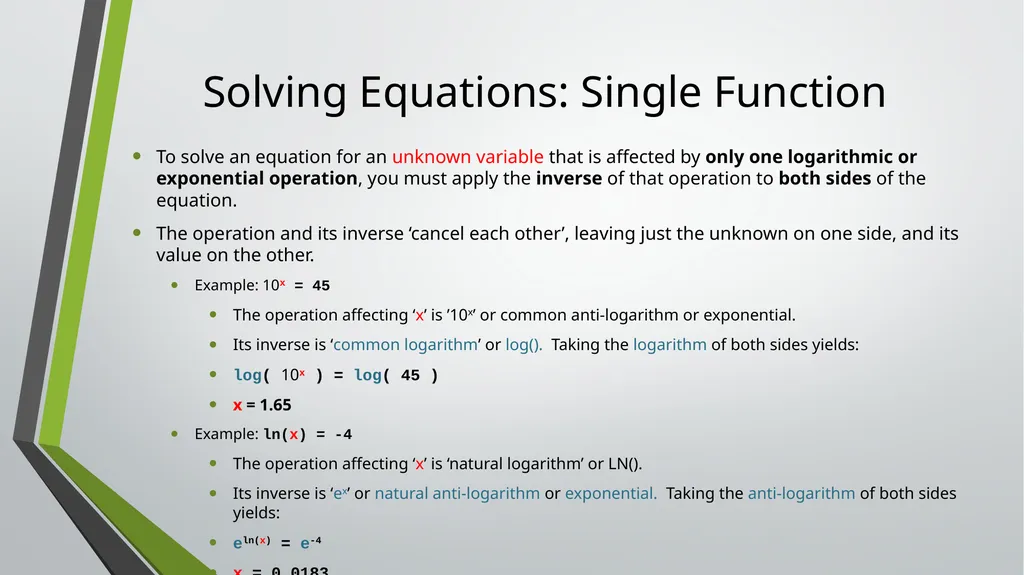
Solving Equations: Single Function To solve an equation for an unknown variable that is affected by only one logarithmic or exponential operation, you must apply the inverse of that operation to both sides of the equation.
The operation and its inverse ‘cancel each other’, leaving just the unknown on one side, and its value on the other.
Example: 10x = 45
The operation affecting ‘x’ is ’10x’ or common anti-logarithm or exponential.
Its inverse is ‘common logarithm’ or log(). Taking the logarithm of both sides yields:
log( 10x ) = log( 45 )
x = 1.65
Example: ln(x) = -4
The operation affecting ‘x’ is ‘natural logarithm’ or LN().
Its inverse is ‘ex’ or natural anti-logarithm or exponential. Taking the anti-logarithm of both sides yields:
eln(x) = e-4
x = 0.0183<br>
11
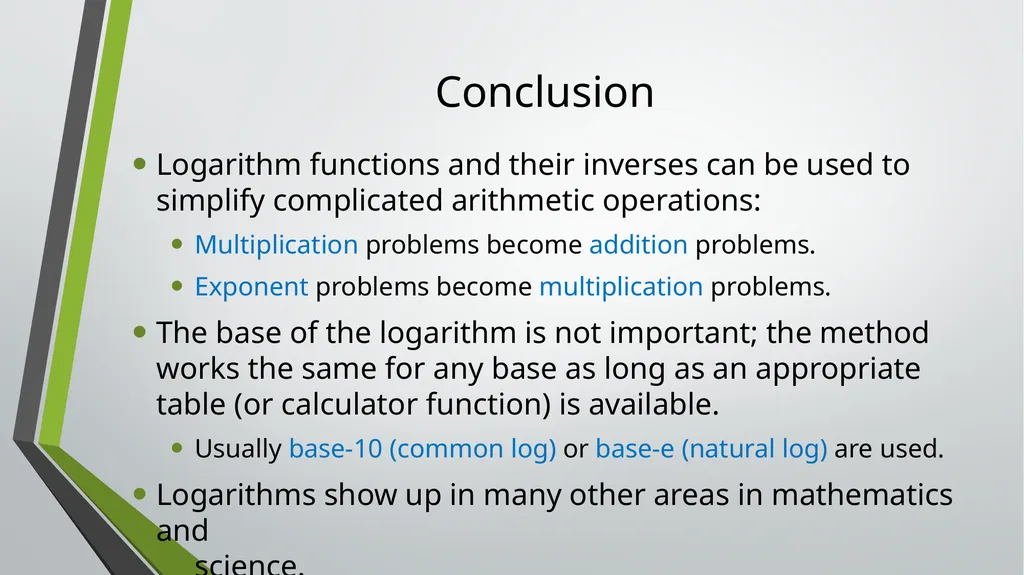
Conclusion Logarithm functions and their inverses can be used to simplify complicated arithmetic operations:
Multiplication problems become addition problems.
Exponent problems become multiplication problems.
The base of the logarithm is not important; the method works the same for any base as long as an appropriate table (or calculator function) is available.
Usually base-10 (common log) or base-e (natural log) are used.
Logarithms show up in many other areas in mathematics and science.<br>