
Logistics HW due next week Midterm also next week
A
Published · 40 slides · 0 views
1 / 1

Description
Logistics HW due next week Midterm also next week on Tuesday But the HW is very essential for the midterm Do the HW! It is preparation for the exam Todays lecture IS in the midterm Some part of Thursdays lecture will be in the midterm as
Related Topics
Share
Embed code
Download this presentation From Below
"Logistics HW due next week Midterm also next week" is the property of its rightful owner. Permission is granted to download and print the materials on this website for personal, non-commercial use only, and to display it on your personal computer provided you do not modify the materials and that you retain all copyright notices contained in the materials. By downloading content from our website, you accept the terms of this agreement.
Presentation Transcript
01
Logistics HW due next week
Midterm also next week on Tuesday
But the HW is very essential for the midterm
Do the HW! It is preparation for the exam
Today’s lecture IS in the midterm
Some part of Thursday’s lecture will be in the midterm as well
Thursday we will concentrate on ‘how can we compute complexity’<br>
Midterm also next week on Tuesday
But the HW is very essential for the midterm
Do the HW! It is preparation for the exam
Today’s lecture IS in the midterm
Some part of Thursday’s lecture will be in the midterm as well
Thursday we will concentrate on ‘how can we compute complexity’<br>
02
P, NP, NP Hard, NP Complete Focus of this lecture = get the definitions across
This will be a part of midterm2
Only some small part of the next lecture will be part of the midterm
Next lecture = some complexity examples (non NP complete)<br>
This will be a part of midterm2
Only some small part of the next lecture will be part of the midterm
Next lecture = some complexity examples (non NP complete)<br>
03
Complexity definitions (seen in 592) Big-Oh
Big-Theta
Big - Omega<br>
Big-Theta
Big - Omega<br>
04
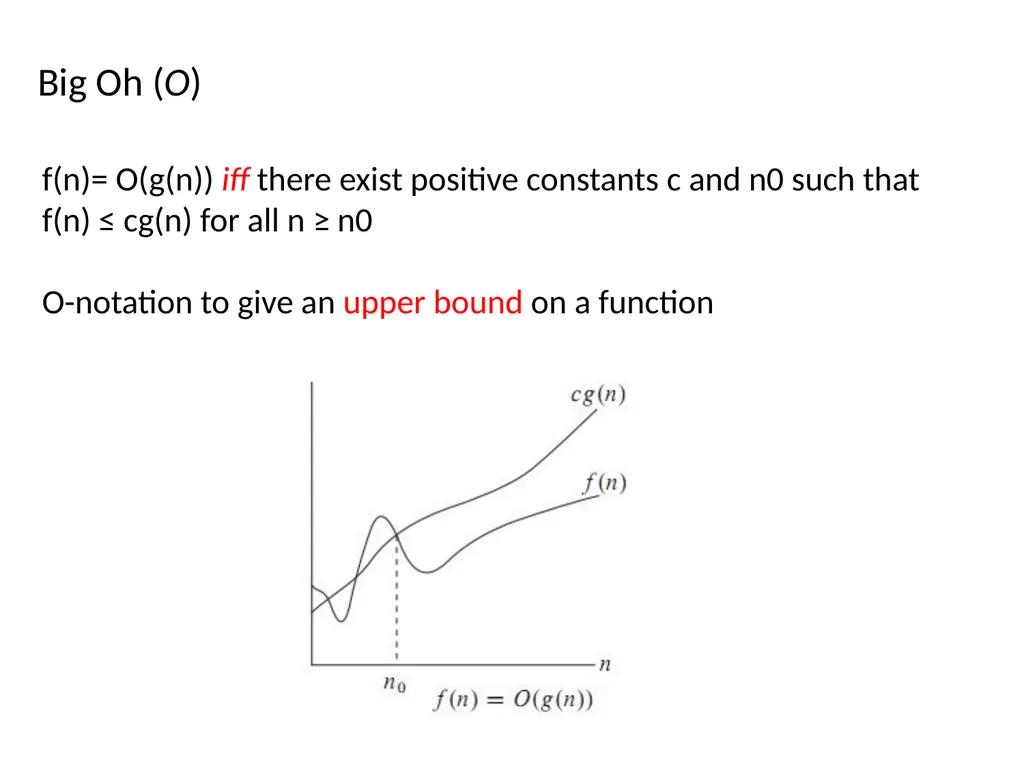
Big Oh (O) f(n)= O(g(n)) iff there exist positive constants c and n0 such that f(n) ≤ cg(n) for all n ≥ n0
O-notation to give an upper bound on a function<br>
O-notation to give an upper bound on a function<br>
05
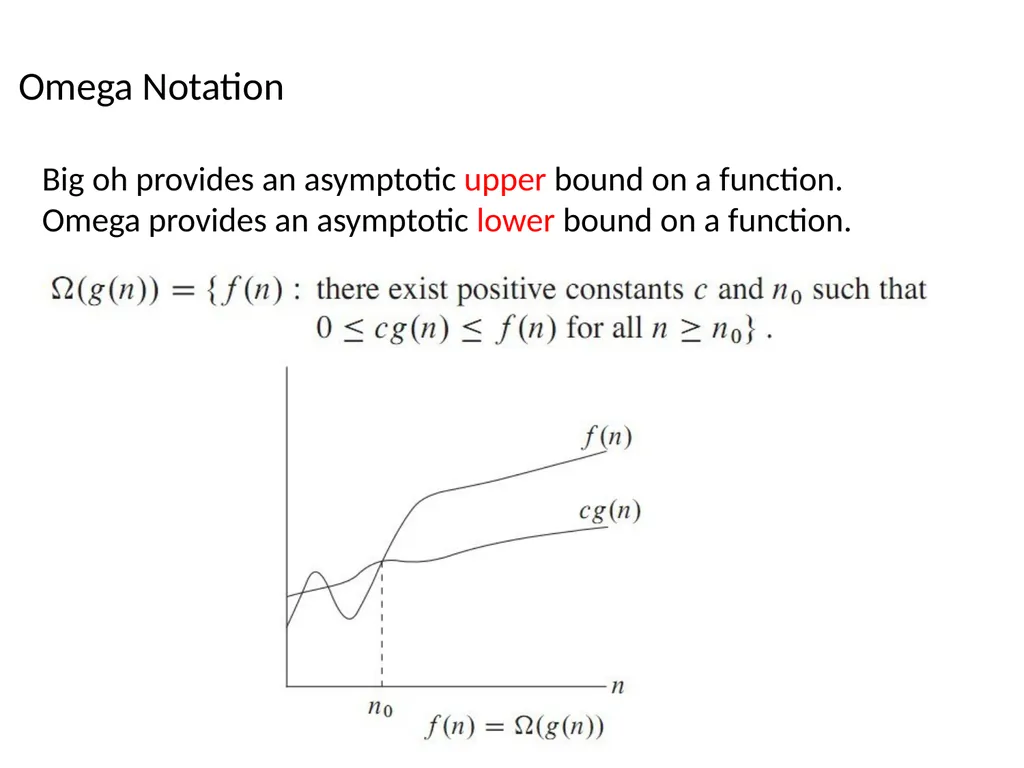
Omega Notation Big oh provides an asymptotic upper bound on a function.
Omega provides an asymptotic lower bound on a function.<br>
Omega provides an asymptotic lower bound on a function.<br>
06
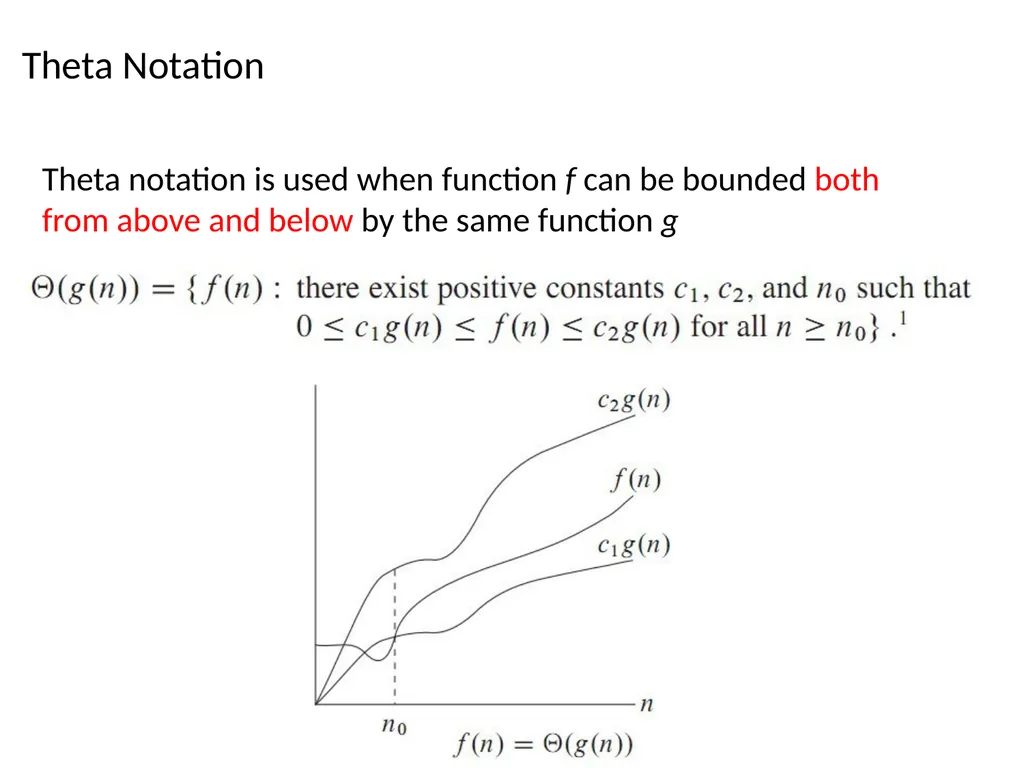
Theta Notation Theta notation is used when function f can be bounded both from above and below by the same function g<br>
07
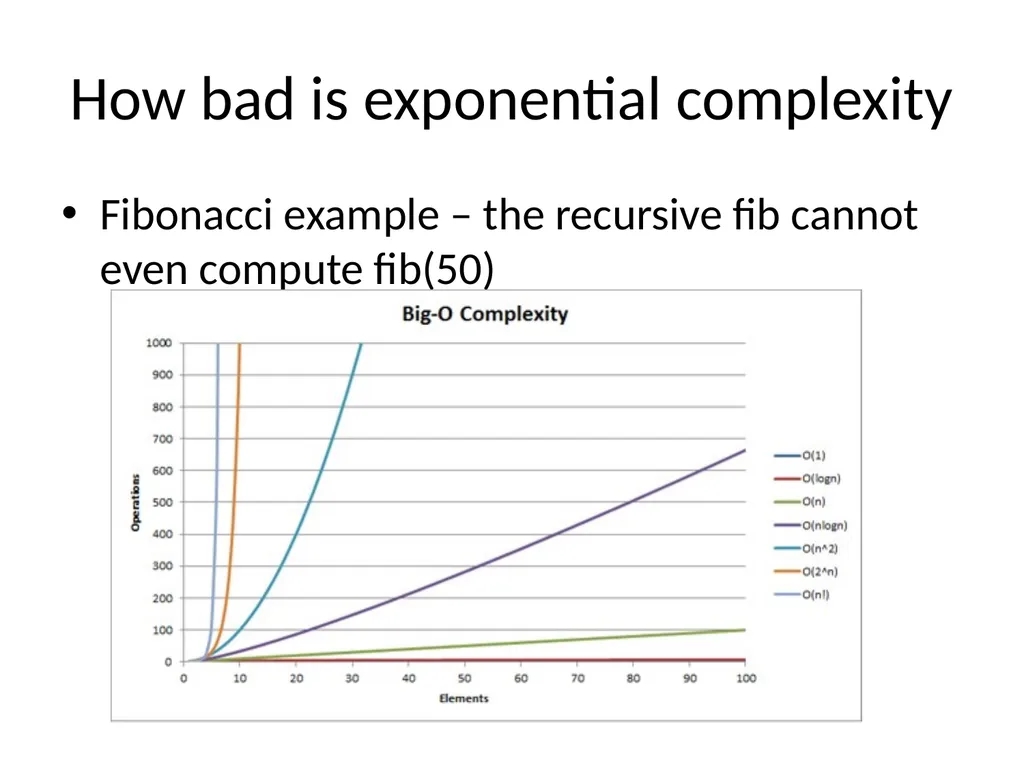
How bad is exponential complexity Fibonacci example – the recursive fib cannot even compute fib(50)<br>
08
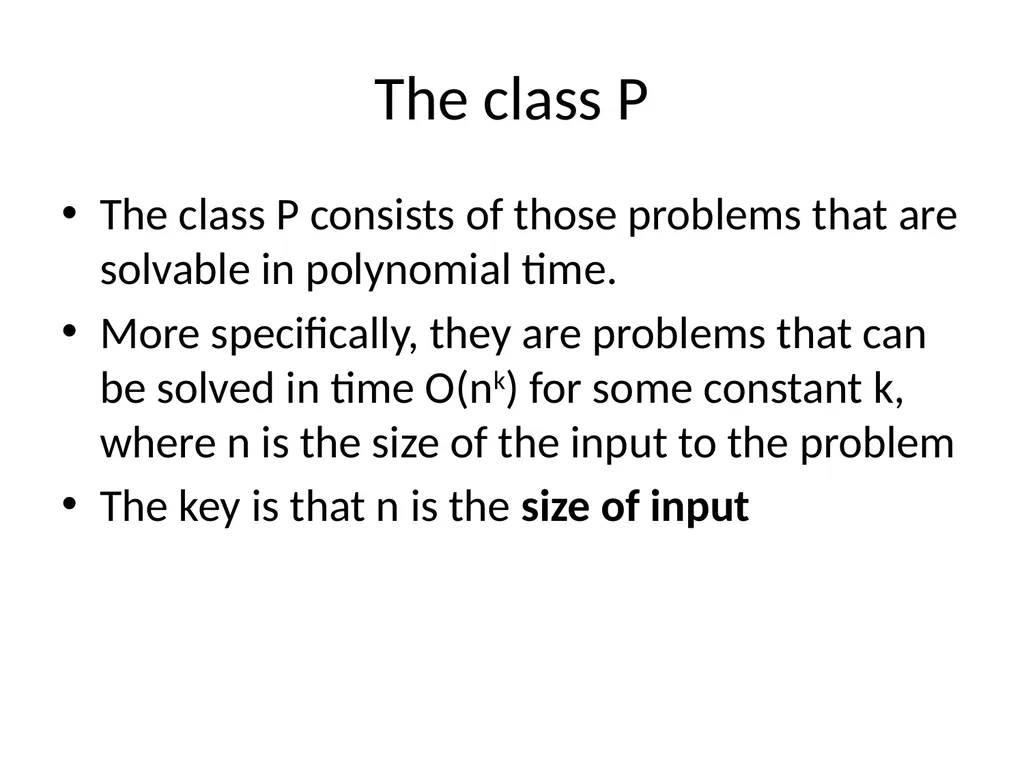
The class P The class P consists of those problems that are solvable in polynomial time.
More specifically, they are problems that can be solved in time O(nk) for some constant k, where n is the size of the input to the problem
The key is that n is the size of input<br>
More specifically, they are problems that can be solved in time O(nk) for some constant k, where n is the size of the input to the problem
The key is that n is the size of input<br>
09
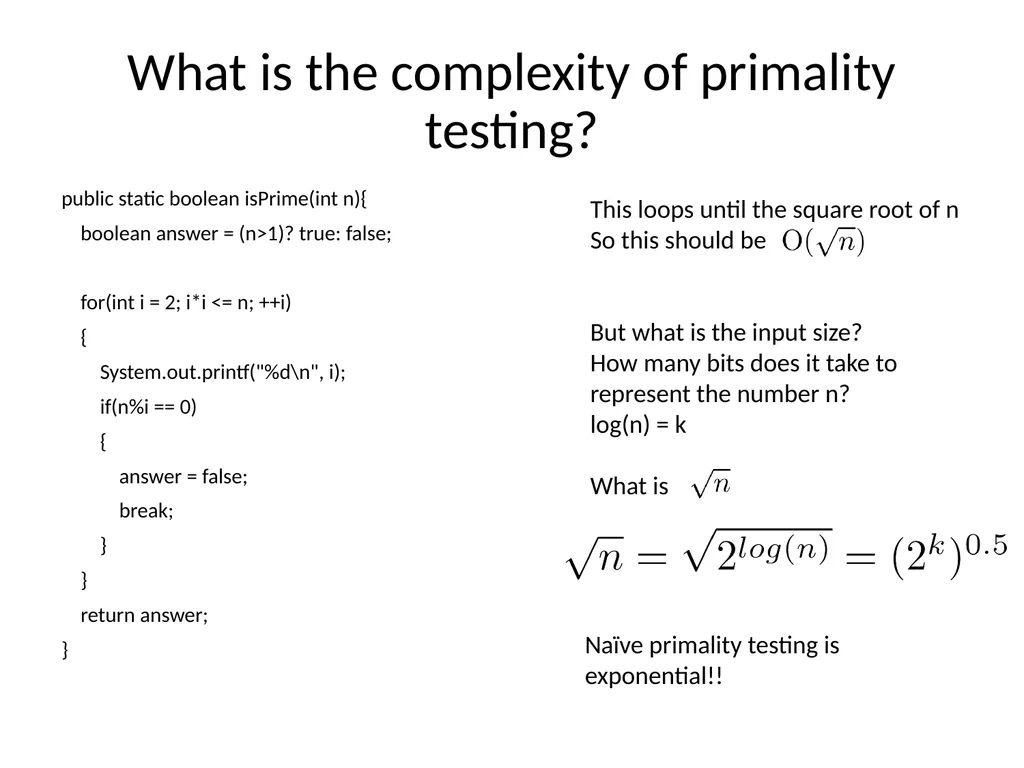
What is the complexity of primality testing? public static boolean isPrime(int n){
boolean answer = (n>1)? true: false;
for(int i = 2; i*i <= n; ++i)
{
System.out.printf("%d\n", i);
if(n%i == 0)
{
answer = false;
break;
}
}
return answer;
} This loops until the square root of n
So this should be
But what is the input size?
How many bits does it take to represent the number n?
log(n) = k
What is Naïve primality testing is exponential!!<br>
boolean answer = (n>1)? true: false;
for(int i = 2; i*i <= n; ++i)
{
System.out.printf("%d\n", i);
if(n%i == 0)
{
answer = false;
break;
}
}
return answer;
} This loops until the square root of n
So this should be
But what is the input size?
How many bits does it take to represent the number n?
log(n) = k
What is Naïve primality testing is exponential!!<br>
10
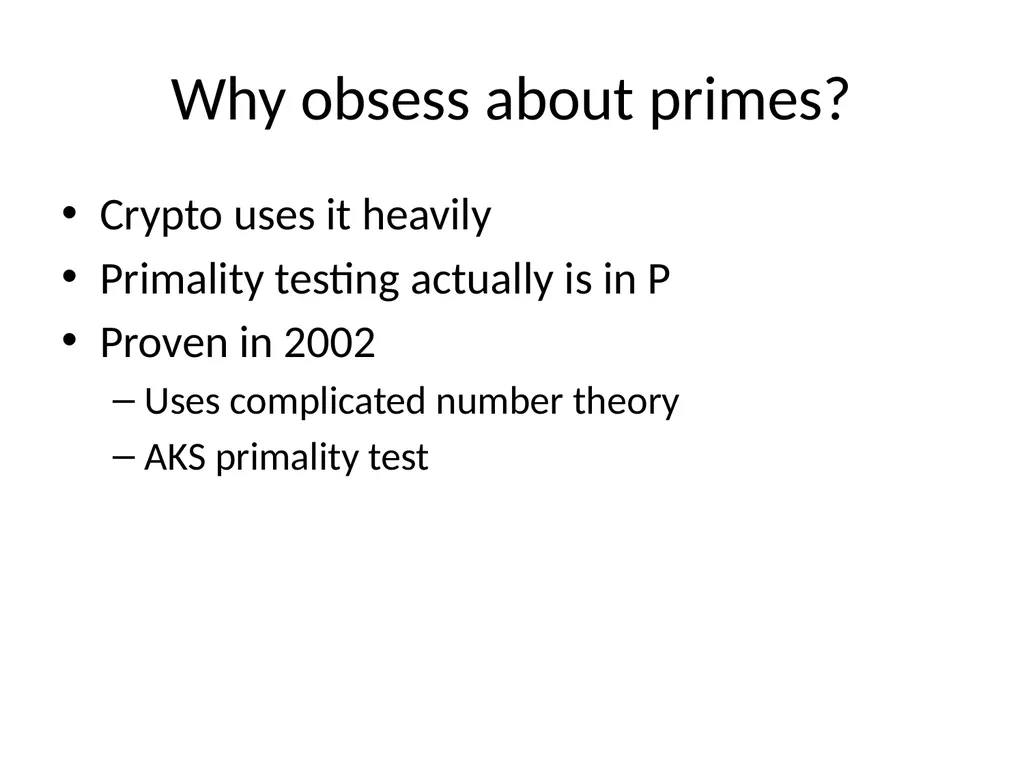
Why obsess about primes? Crypto uses it heavily
Primality testing actually is in P
Proven in 2002
Uses complicated number theory
AKS primality test<br>
Primality testing actually is in P
Proven in 2002
Uses complicated number theory
AKS primality test<br>
11
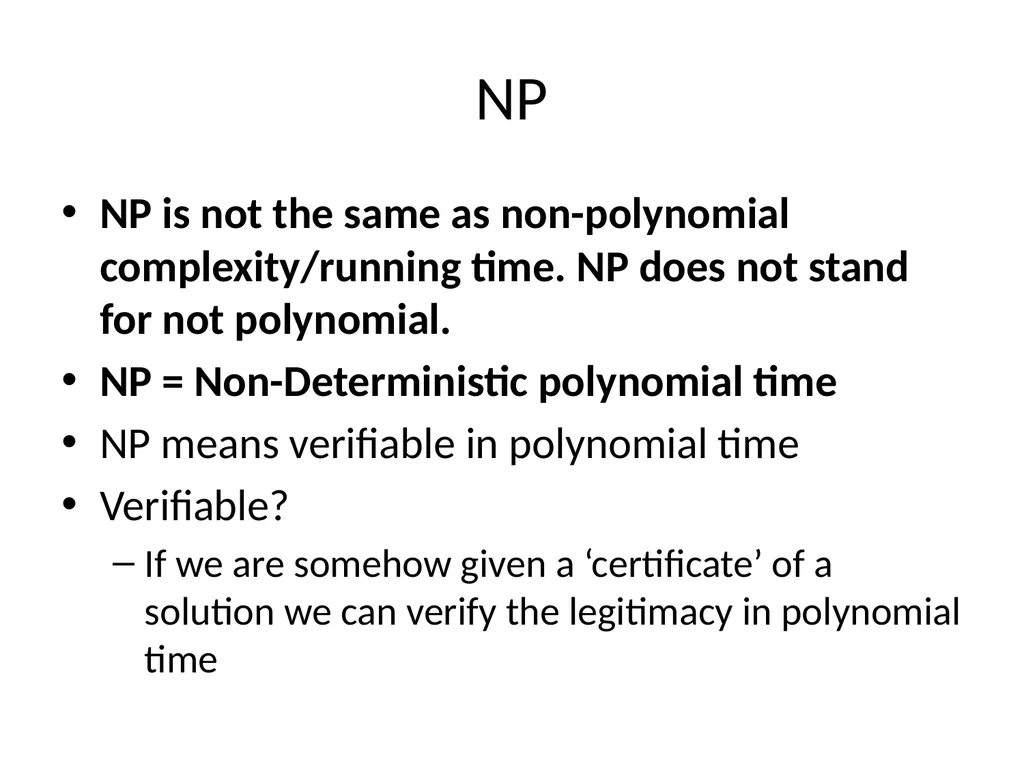
NP NP is not the same as non-polynomial complexity/running time. NP does not stand for not polynomial.
NP = Non-Deterministic polynomial time
NP means verifiable in polynomial time
Verifiable?
If we are somehow given a ‘certificate’ of a solution we can verify the legitimacy in polynomial time<br>
NP = Non-Deterministic polynomial time
NP means verifiable in polynomial time
Verifiable?
If we are somehow given a ‘certificate’ of a solution we can verify the legitimacy in polynomial time<br>
12
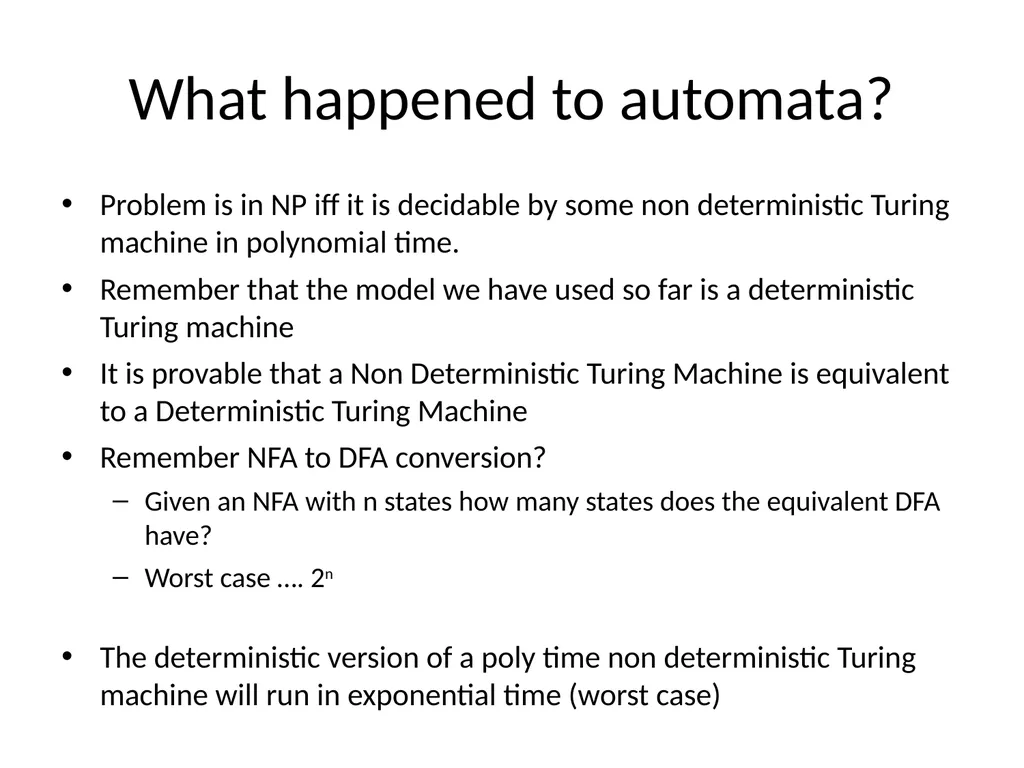
What happened to automata? Problem is in NP iff it is decidable by some non deterministic Turing machine in polynomial time.
Remember that the model we have used so far is a deterministic Turing machine
It is provable that a Non Deterministic Turing Machine is equivalent to a Deterministic Turing Machine
Remember NFA to DFA conversion?
Given an NFA with n states how many states does the equivalent DFA have?
Worst case …. 2n
The deterministic version of a poly time non deterministic Turing machine will run in exponential time (worst case)<br>
Remember that the model we have used so far is a deterministic Turing machine
It is provable that a Non Deterministic Turing Machine is equivalent to a Deterministic Turing Machine
Remember NFA to DFA conversion?
Given an NFA with n states how many states does the equivalent DFA have?
Worst case …. 2n
The deterministic version of a poly time non deterministic Turing machine will run in exponential time (worst case)<br>
13
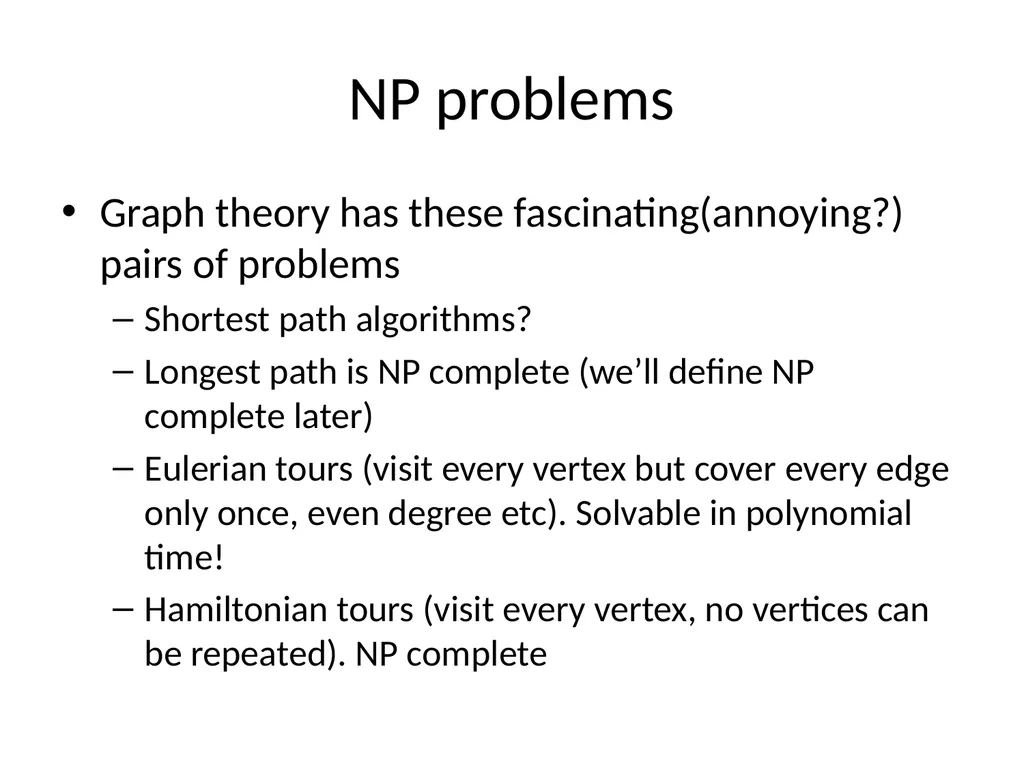
NP problems Graph theory has these fascinating(annoying?) pairs of problems
Shortest path algorithms?
Longest path is NP complete (we’ll define NP complete later)
Eulerian tours (visit every vertex but cover every edge only once, even degree etc). Solvable in polynomial time!
Hamiltonian tours (visit every vertex, no vertices can be repeated). NP complete<br>
Shortest path algorithms?
Longest path is NP complete (we’ll define NP complete later)
Eulerian tours (visit every vertex but cover every edge only once, even degree etc). Solvable in polynomial time!
Hamiltonian tours (visit every vertex, no vertices can be repeated). NP complete<br>
14
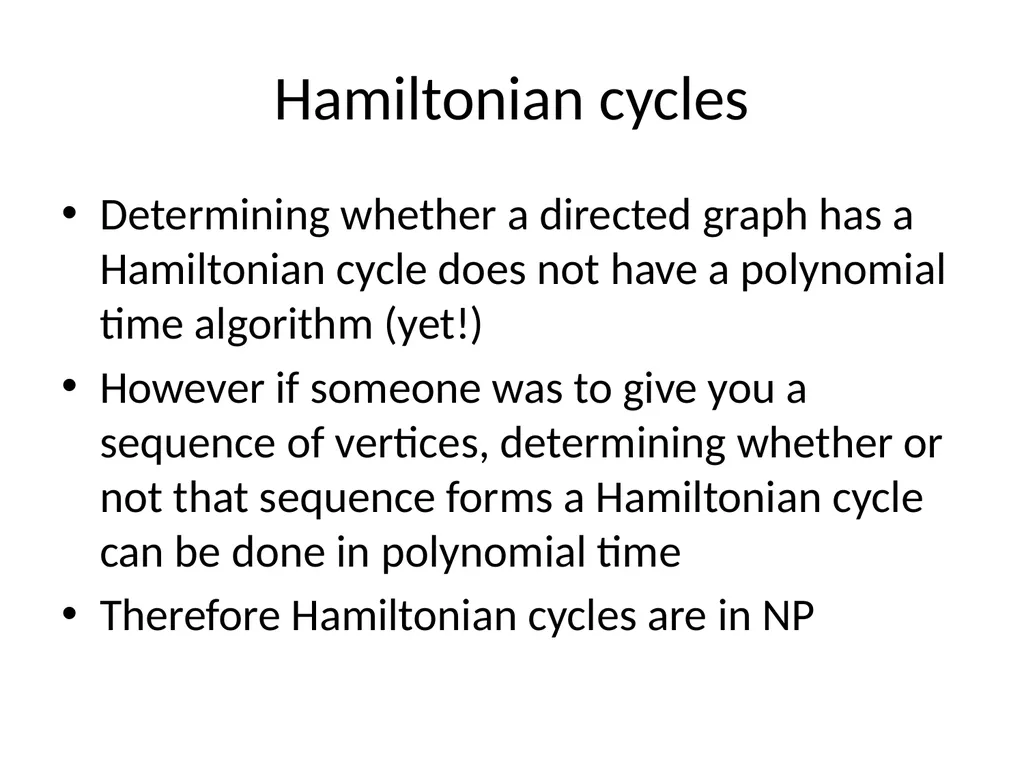
Hamiltonian cycles Determining whether a directed graph has a Hamiltonian cycle does not have a polynomial time algorithm (yet!)
However if someone was to give you a sequence of vertices, determining whether or not that sequence forms a Hamiltonian cycle can be done in polynomial time
Therefore Hamiltonian cycles are in NP<br>
However if someone was to give you a sequence of vertices, determining whether or not that sequence forms a Hamiltonian cycle can be done in polynomial time
Therefore Hamiltonian cycles are in NP<br>
15
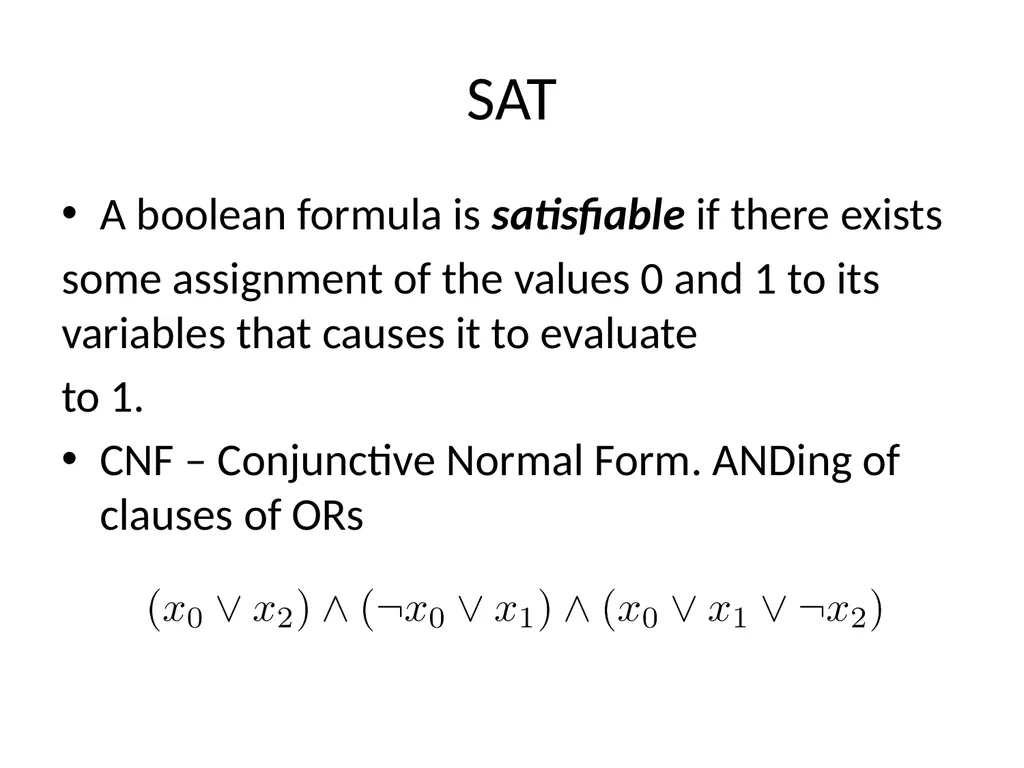
SAT A boolean formula is satisfiable if there exists
some assignment of the values 0 and 1 to its variables that causes it to evaluate
to 1.
CNF – Conjunctive Normal Form. ANDing of clauses of ORs<br>
some assignment of the values 0 and 1 to its variables that causes it to evaluate
to 1.
CNF – Conjunctive Normal Form. ANDing of clauses of ORs<br>
16
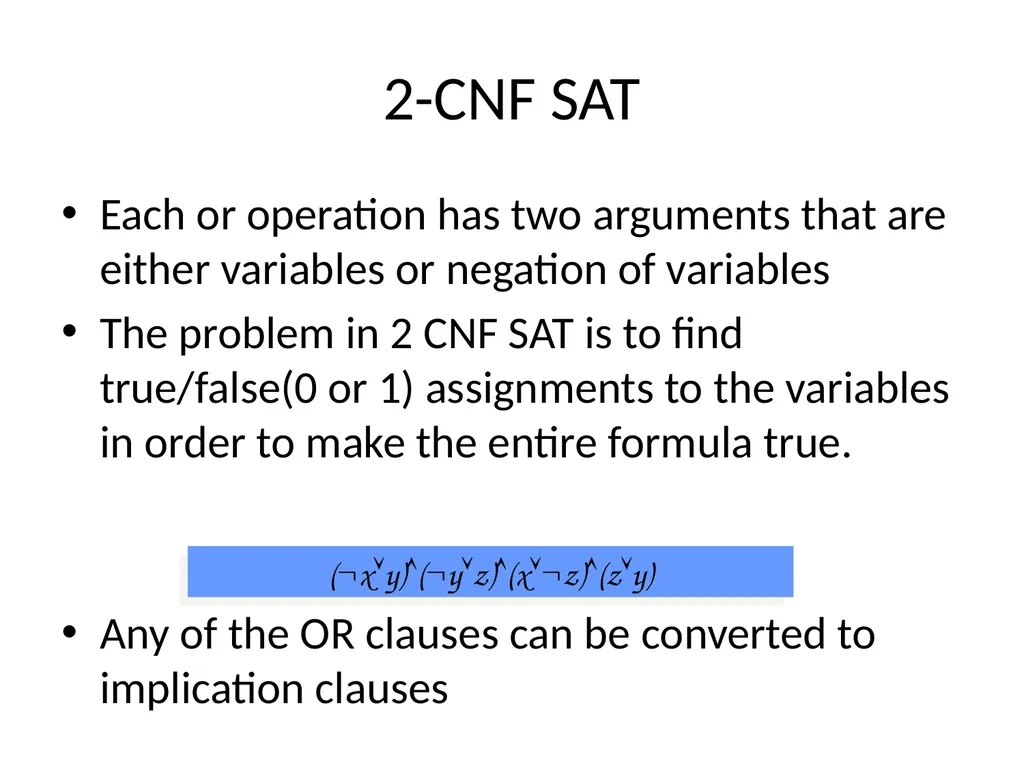
2-CNF SAT Each or operation has two arguments that are either variables or negation of variables
The problem in 2 CNF SAT is to find true/false(0 or 1) assignments to the variables in order to make the entire formula true.
Any of the OR clauses can be converted to implication clauses (xy)(yz)(xz)(zy)<br>
The problem in 2 CNF SAT is to find true/false(0 or 1) assignments to the variables in order to make the entire formula true.
Any of the OR clauses can be converted to implication clauses (xy)(yz)(xz)(zy)<br>
17
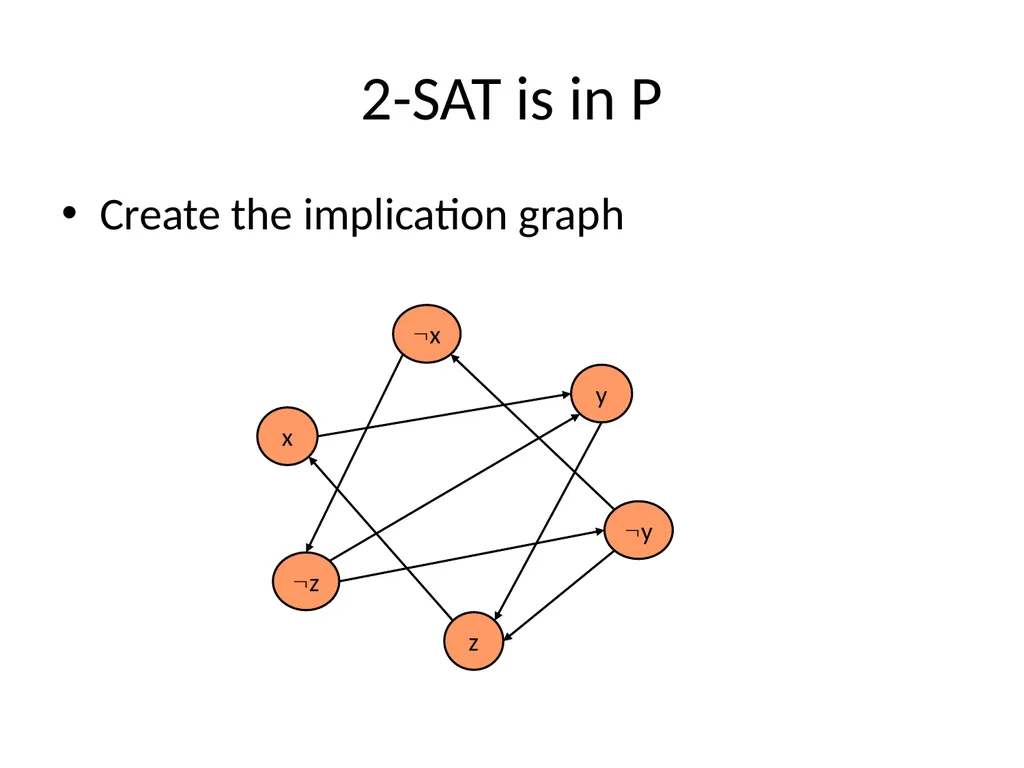
2-SAT is in P Create the implication graph x y x z z y<br>
18
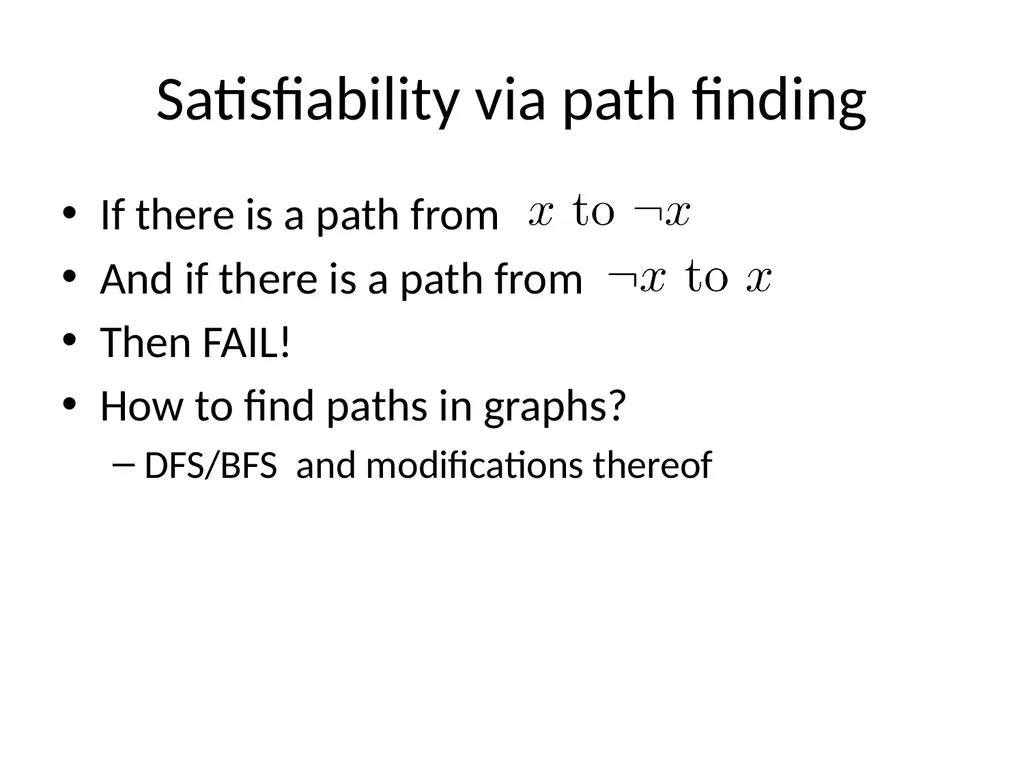
Satisfiability via path finding If there is a path from
And if there is a path from
Then FAIL!
How to find paths in graphs?
DFS/BFS and modifications thereof<br>
And if there is a path from
Then FAIL!
How to find paths in graphs?
DFS/BFS and modifications thereof<br>
19
3 CNF SAT (3 SAT) Not so easy anymore.
Implication graph cannot be constructed
No known polytime algorithm
Is it NP?
If someone gives you a solution how long does it take to verify it?
Make one pass through the formula and check
This is an NP problem<br>
Implication graph cannot be constructed
No known polytime algorithm
Is it NP?
If someone gives you a solution how long does it take to verify it?
Make one pass through the formula and check
This is an NP problem<br>
20
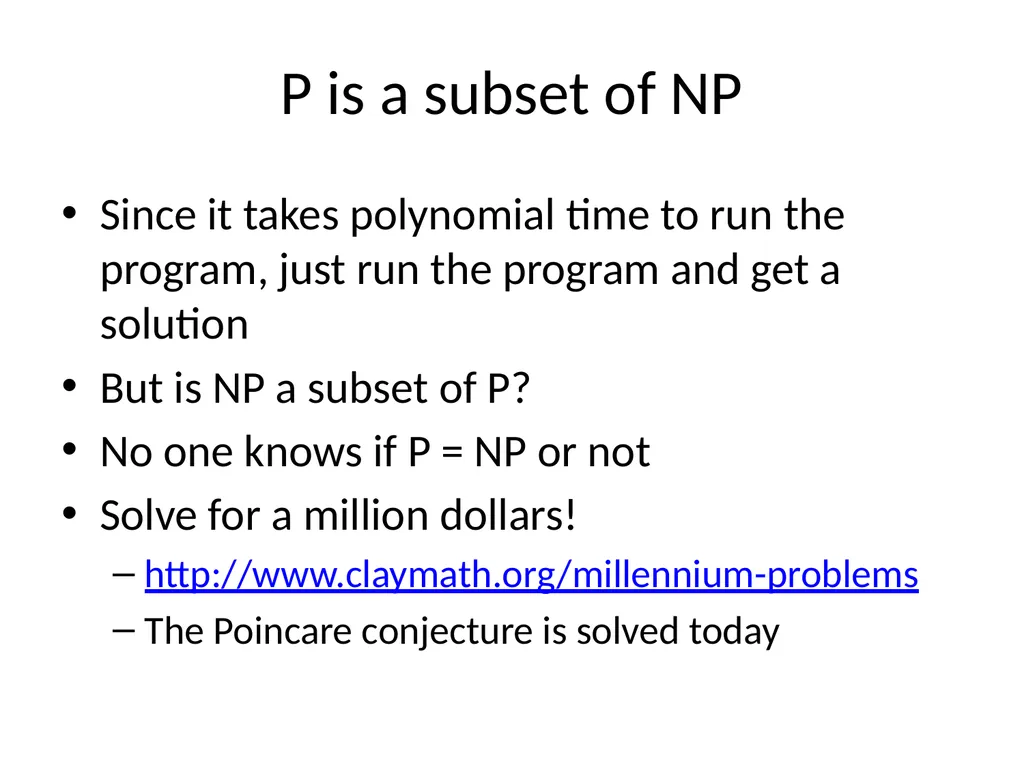
P is a subset of NP Since it takes polynomial time to run the program, just run the program and get a solution
But is NP a subset of P?
No one knows if P = NP or not
Solve for a million dollars!
http://www.claymath.org/millennium-problems
The Poincare conjecture is solved today<br>
But is NP a subset of P?
No one knows if P = NP or not
Solve for a million dollars!
http://www.claymath.org/millennium-problems
The Poincare conjecture is solved today<br>
21
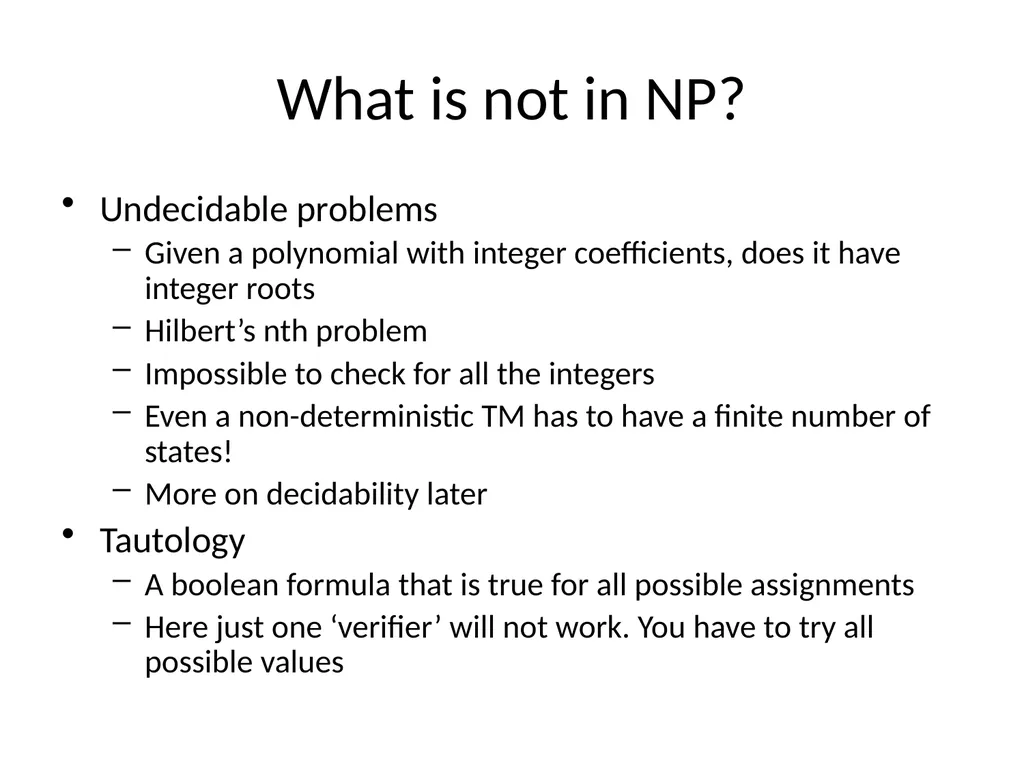
What is not in NP? Undecidable problems
Given a polynomial with integer coefficients, does it have integer roots
Hilbert’s nth problem
Impossible to check for all the integers
Even a non-deterministic TM has to have a finite number of states!
More on decidability later
Tautology
A boolean formula that is true for all possible assignments
Here just one ‘verifier’ will not work. You have to try all possible values<br>
Given a polynomial with integer coefficients, does it have integer roots
Hilbert’s nth problem
Impossible to check for all the integers
Even a non-deterministic TM has to have a finite number of states!
More on decidability later
Tautology
A boolean formula that is true for all possible assignments
Here just one ‘verifier’ will not work. You have to try all possible values<br>
22
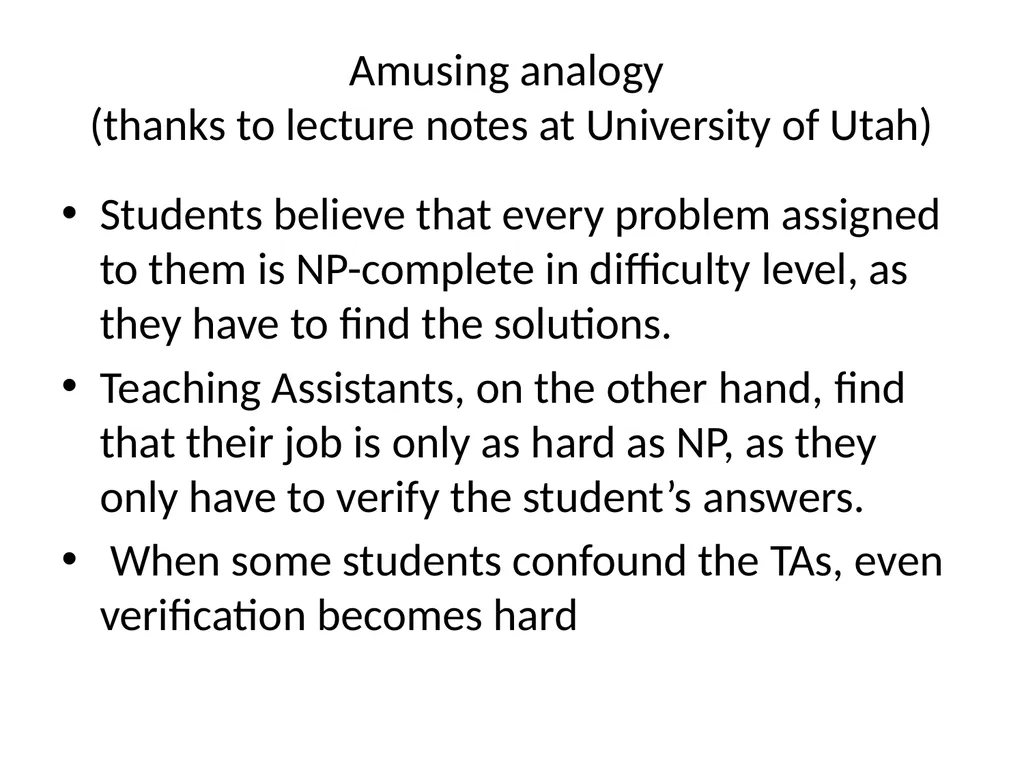
Amusing analogy
(thanks to lecture notes at University of Utah) Students believe that every problem assigned to them is NP-complete in difficulty level, as they have to find the solutions.
Teaching Assistants, on the other hand, find that their job is only as hard as NP, as they only have to verify the student’s answers.
When some students confound the TAs, even verification becomes hard<br>
Teaching Assistants, on the other hand, find that their job is only as hard as NP, as they only have to verify the student’s answers.
When some students confound the TAs, even verification becomes hard<br>
23
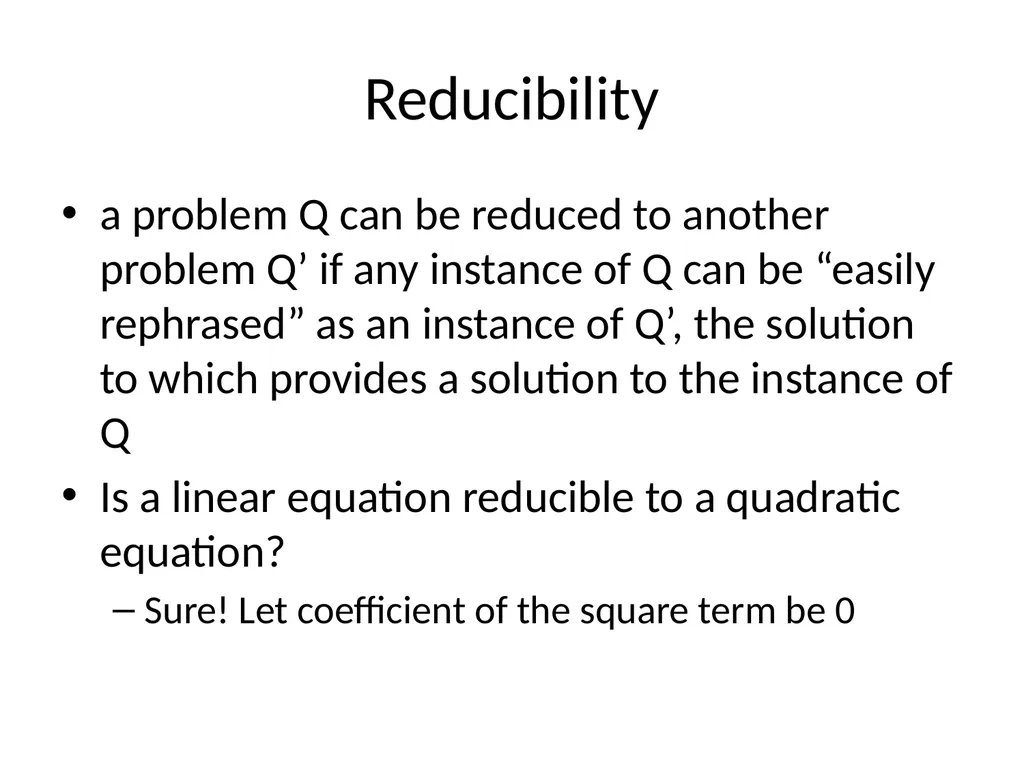
Reducibility a problem Q can be reduced to another problem Q’ if any instance of Q can be “easily rephrased” as an instance of Q’, the solution to which provides a solution to the instance of Q
Is a linear equation reducible to a quadratic equation?
Sure! Let coefficient of the square term be 0<br>
Is a linear equation reducible to a quadratic equation?
Sure! Let coefficient of the square term be 0<br>
24
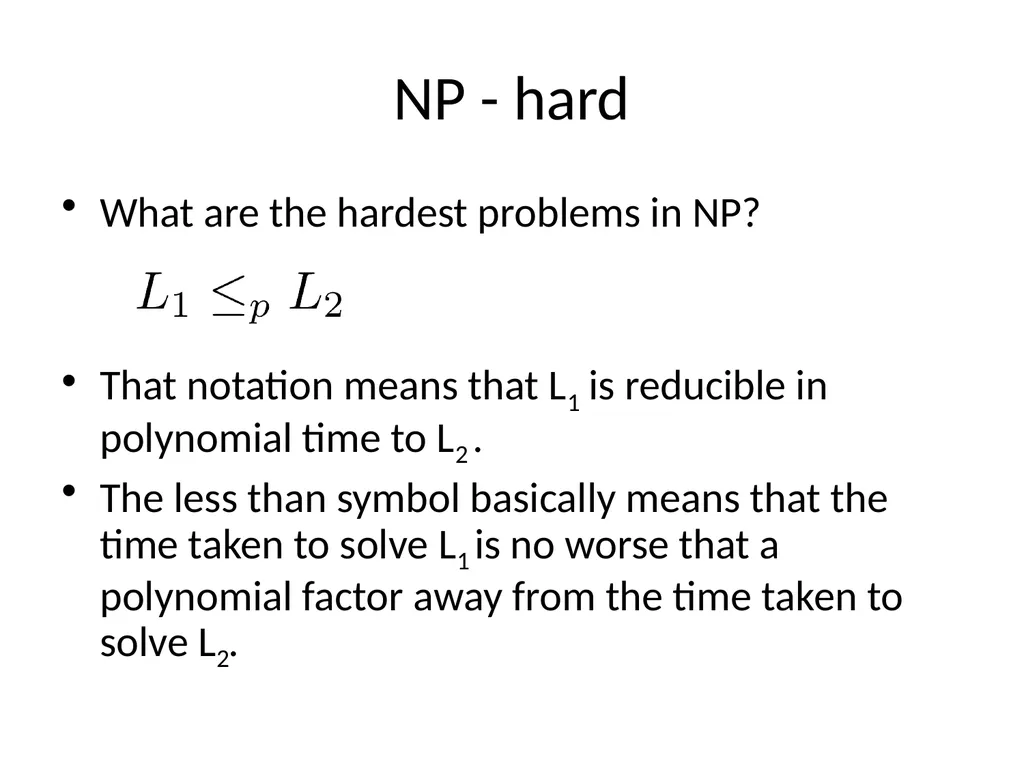
NP - hard What are the hardest problems in NP?
That notation means that L1 is reducible in polynomial time to L2 .
The less than symbol basically means that the time taken to solve L1 is no worse that a polynomial factor away from the time taken to solve L2.<br>
That notation means that L1 is reducible in polynomial time to L2 .
The less than symbol basically means that the time taken to solve L1 is no worse that a polynomial factor away from the time taken to solve L2.<br>
25
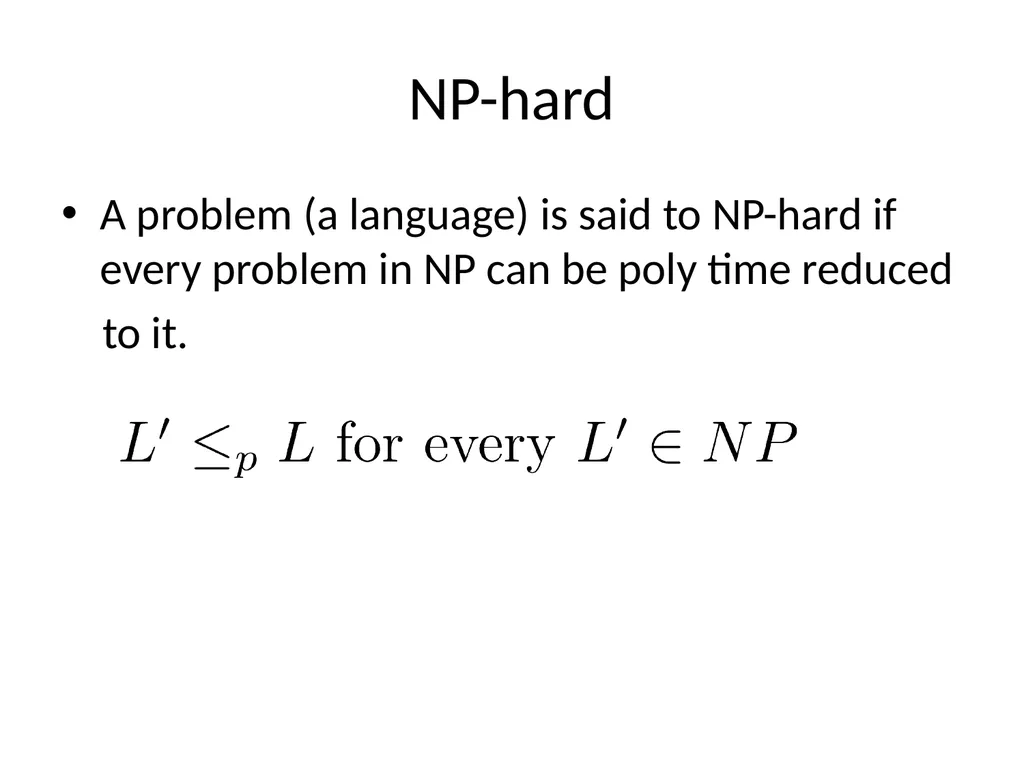
NP-hard A problem (a language) is said to NP-hard if every problem in NP can be poly time reduced
to it.<br>
to it.<br>
26
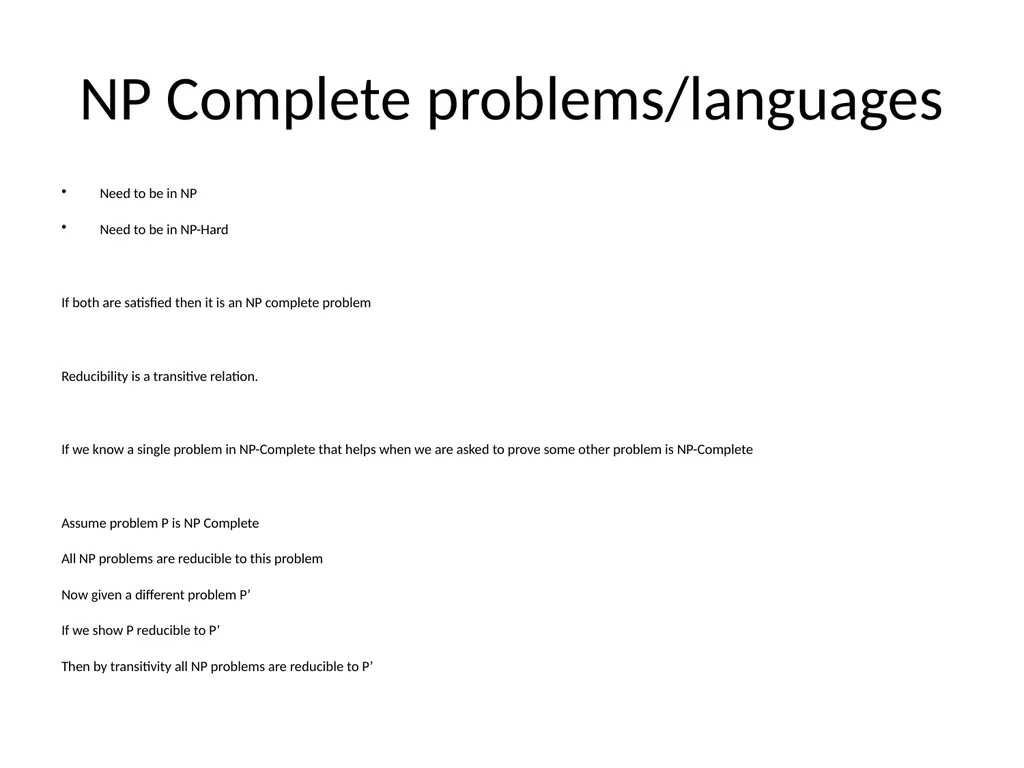
NP Complete problems/languages Need to be in NP
Need to be in NP-Hard
If both are satisfied then it is an NP complete problem
Reducibility is a transitive relation.
If we know a single problem in NP-Complete that helps when we are asked to prove some other problem is NP-Complete
Assume problem P is NP Complete
All NP problems are reducible to this problem
Now given a different problem P’
If we show P reducible to P’
Then by transitivity all NP problems are reducible to P’<br>
Need to be in NP-Hard
If both are satisfied then it is an NP complete problem
Reducibility is a transitive relation.
If we know a single problem in NP-Complete that helps when we are asked to prove some other problem is NP-Complete
Assume problem P is NP Complete
All NP problems are reducible to this problem
Now given a different problem P’
If we show P reducible to P’
Then by transitivity all NP problems are reducible to P’<br>
27
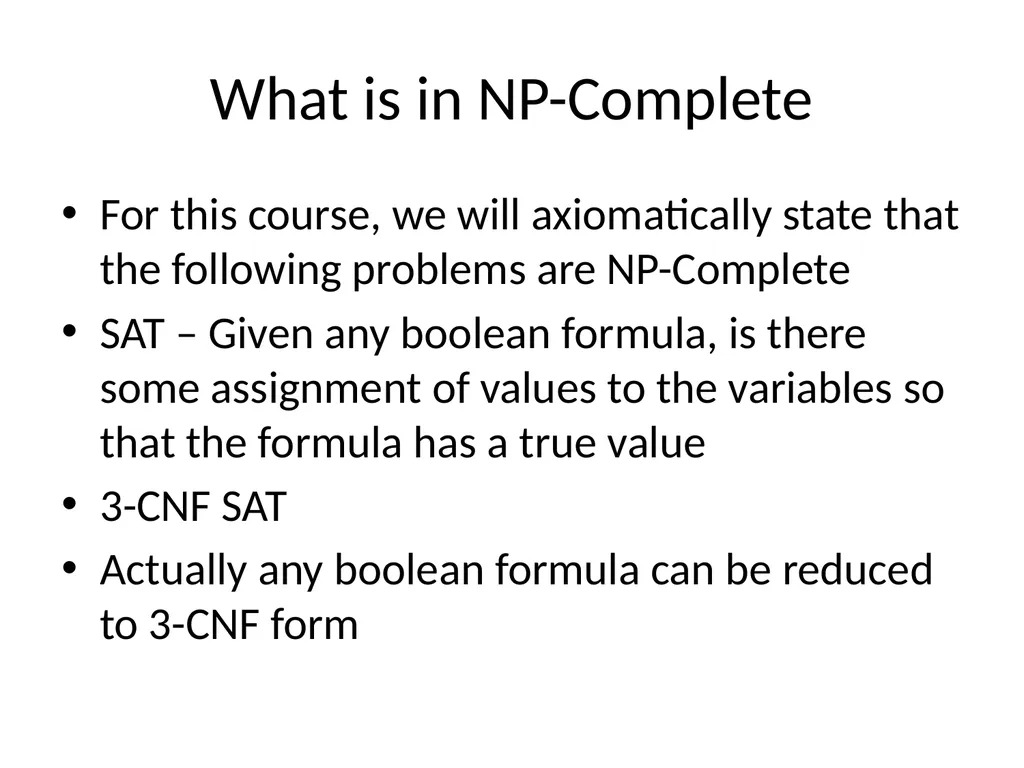
What is in NP-Complete For this course, we will axiomatically state that the following problems are NP-Complete
SAT – Given any boolean formula, is there some assignment of values to the variables so that the formula has a true value
3-CNF SAT
Actually any boolean formula can be reduced to 3-CNF form<br>
SAT – Given any boolean formula, is there some assignment of values to the variables so that the formula has a true value
3-CNF SAT
Actually any boolean formula can be reduced to 3-CNF form<br>
28
An example reduction CLIQUE problem
A clique in an undirected graph is a subset of vertices such that each pair is connected by an edge
We want to take a problem instance in 3-CNF SAT and convert it to CLIQUE finding<br>
A clique in an undirected graph is a subset of vertices such that each pair is connected by an edge
We want to take a problem instance in 3-CNF SAT and convert it to CLIQUE finding<br>
29
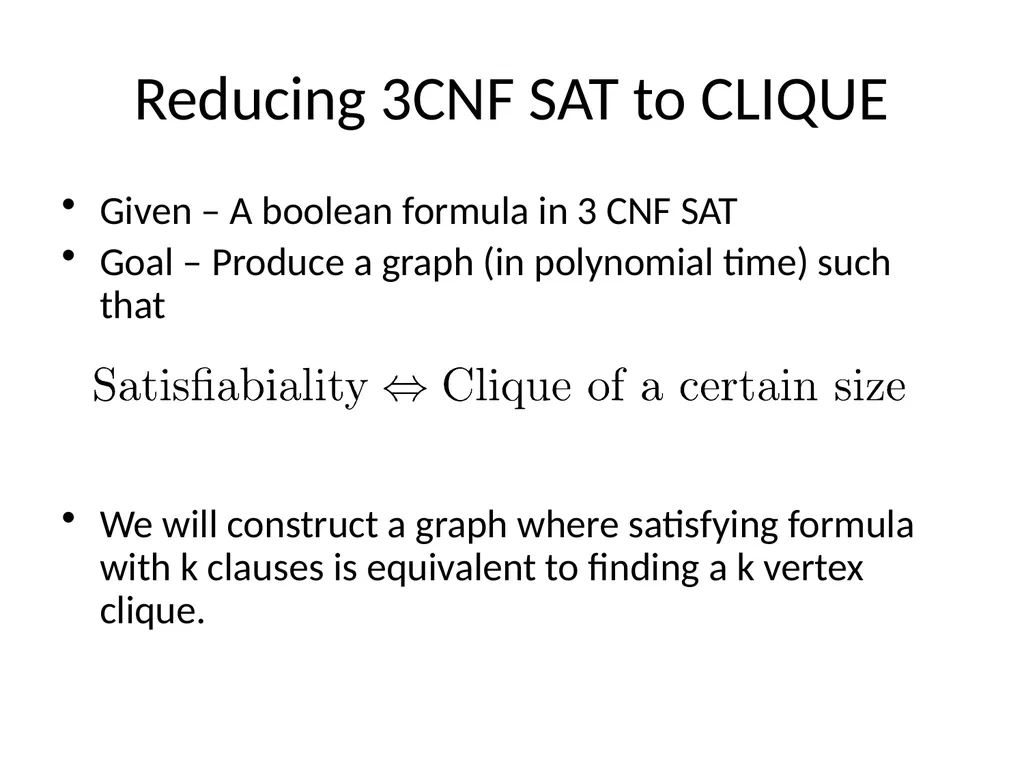
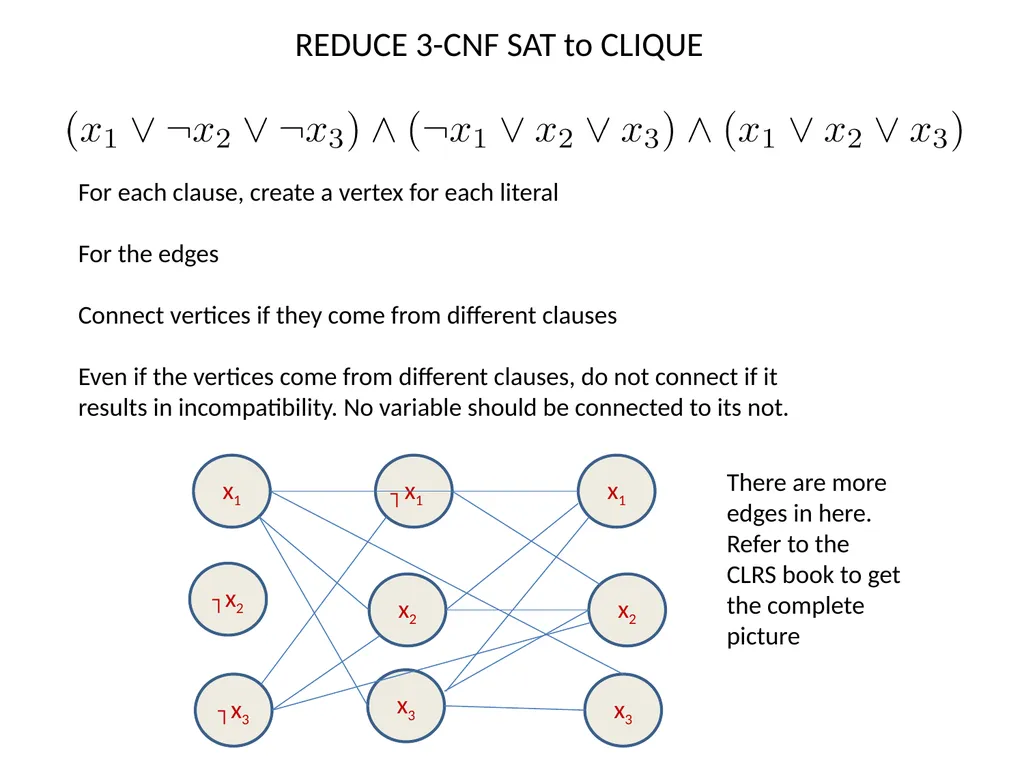
Reducing 3CNF SAT to CLIQUE Given – A boolean formula in 3 CNF SAT
Goal – Produce a graph (in polynomial time) such that
We will construct a graph where satisfying formula with k clauses is equivalent to finding a k vertex clique.<br>
Goal – Produce a graph (in polynomial time) such that
We will construct a graph where satisfying formula with k clauses is equivalent to finding a k vertex clique.<br>
30
CLIQUE An instance of a clique problem gives you 2 things as input
Graph
Some positive integer k
Question being asked = do we have a clique of size k in this graph
Why can’t I just go through and pick all possible k-subsets?<br>
Graph
Some positive integer k
Question being asked = do we have a clique of size k in this graph
Why can’t I just go through and pick all possible k-subsets?<br>
31
Decision problems versus optimization problems Finding the maximum sized clique is an optimization problem
But we can reduce it to a series of decision problems
Can we find a clique of size 3 (why start at 3??)
Can we find a clique of size 4
Etc
In general in our study of NP etc, we will focus on decision problems<br>
But we can reduce it to a series of decision problems
Can we find a clique of size 3 (why start at 3??)
Can we find a clique of size 4
Etc
In general in our study of NP etc, we will focus on decision problems<br>
32
For each clause, create a vertex for each literal
For the edges
Connect vertices if they come from different clauses
Even if the vertices come from different clauses, do not connect if it results in incompatibility. No variable should be connected to its not. x1 x1 x1 ┐x2 x2 x2 ┐x3 x3 x3 ┐ REDUCE 3-CNF SAT to CLIQUE There are more edges in here. Refer to the CLRS book to get the complete picture<br>
For the edges
Connect vertices if they come from different clauses
Even if the vertices come from different clauses, do not connect if it results in incompatibility. No variable should be connected to its not. x1 x1 x1 ┐x2 x2 x2 ┐x3 x3 x3 ┐ REDUCE 3-CNF SAT to CLIQUE There are more edges in here. Refer to the CLRS book to get the complete picture<br>
33
Vertex cover problem A vertex cover of an undirected graph G=(V,E) is a subset of vertices such that every edge is incident to at least one of the vertices
We’re typically interested in finding the minimum sized vertex cover
To show vertex cover is NP-complete
What problem should we try to reduce to it
It sounds like the ‘reverse’ of CLIQUE
Reduction is done from CLIQUE to vertex cover<br>
We’re typically interested in finding the minimum sized vertex cover
To show vertex cover is NP-complete
What problem should we try to reduce to it
It sounds like the ‘reverse’ of CLIQUE
Reduction is done from CLIQUE to vertex cover<br>
34
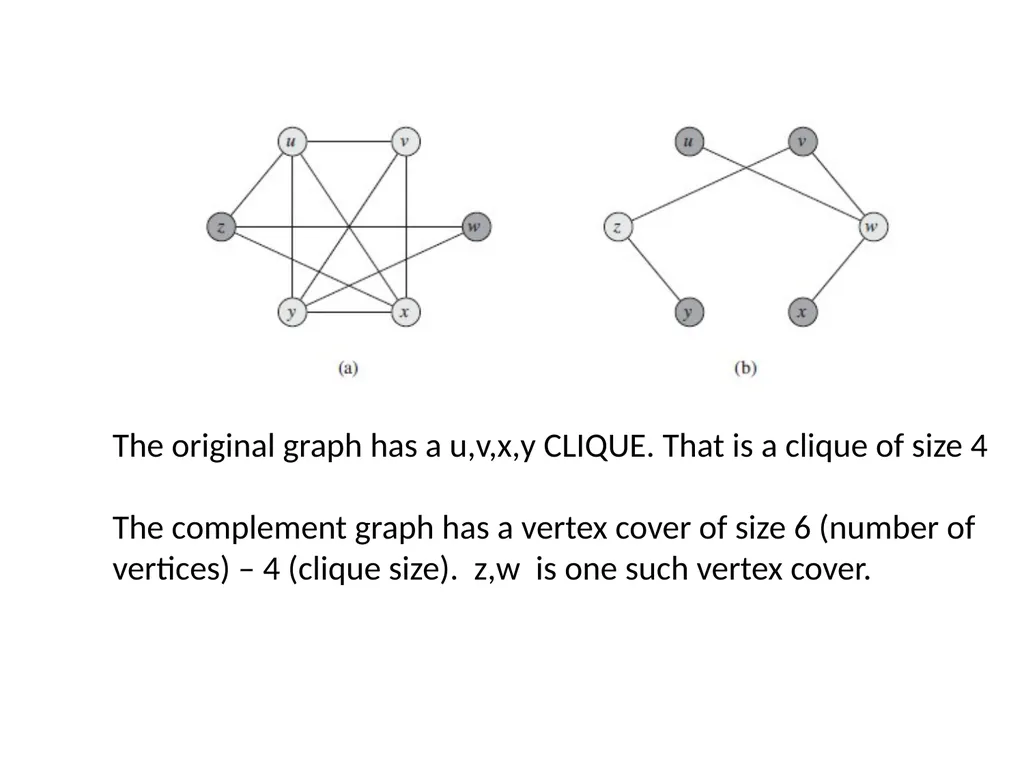
Clique of size k in G exists iff a vertex cover of size |V| - k exists in G’ where G’ is the complement graph (vertices that had an edge between then in G do not have one in G’ and vice versa) G G’ = Complement
Of
G<br>
Of
G<br>
35
The original graph has a u,v,x,y CLIQUE. That is a clique of size 4
The complement graph has a vertex cover of size 6 (number of vertices) – 4 (clique size). z,w is one such vertex cover.<br>
The complement graph has a vertex cover of size 6 (number of vertices) – 4 (clique size). z,w is one such vertex cover.<br>
36
The reducibility ‘tree’ Richard Karp proved 21 problems to be NP complete in a seminal 1971 paper
Not that hard to read actually!
Definitely not hard to read it to the point of knowing what these problems are.
karp's paper<br>
Not that hard to read actually!
Definitely not hard to read it to the point of knowing what these problems are.
karp's paper<br>
37
Amusing/tragic NP story Breaking up over NP<br>
38
Other NP complete problems Subset sum
Given a set of positive integers and some target t > 0,
do we have a subset that sums up to that target set
Why is the naïve algorithm going to be bad?<br>
Given a set of positive integers and some target t > 0,
do we have a subset that sums up to that target set
Why is the naïve algorithm going to be bad?<br>
39
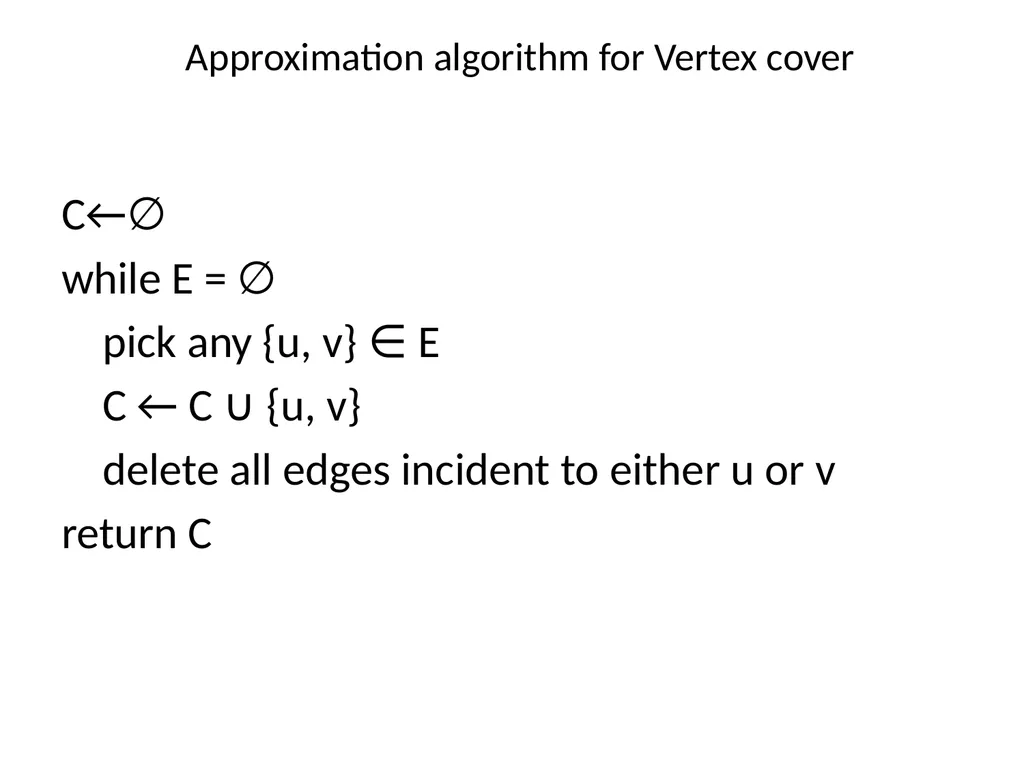
C←∅
while E = ∅
pick any {u, v} ∈ E
C ← C ∪ {u, v}
delete all edges incident to either u or v
return C Approximation algorithm for Vertex cover<br>
while E = ∅
pick any {u, v} ∈ E
C ← C ∪ {u, v}
delete all edges incident to either u or v
return C Approximation algorithm for Vertex cover<br>
40
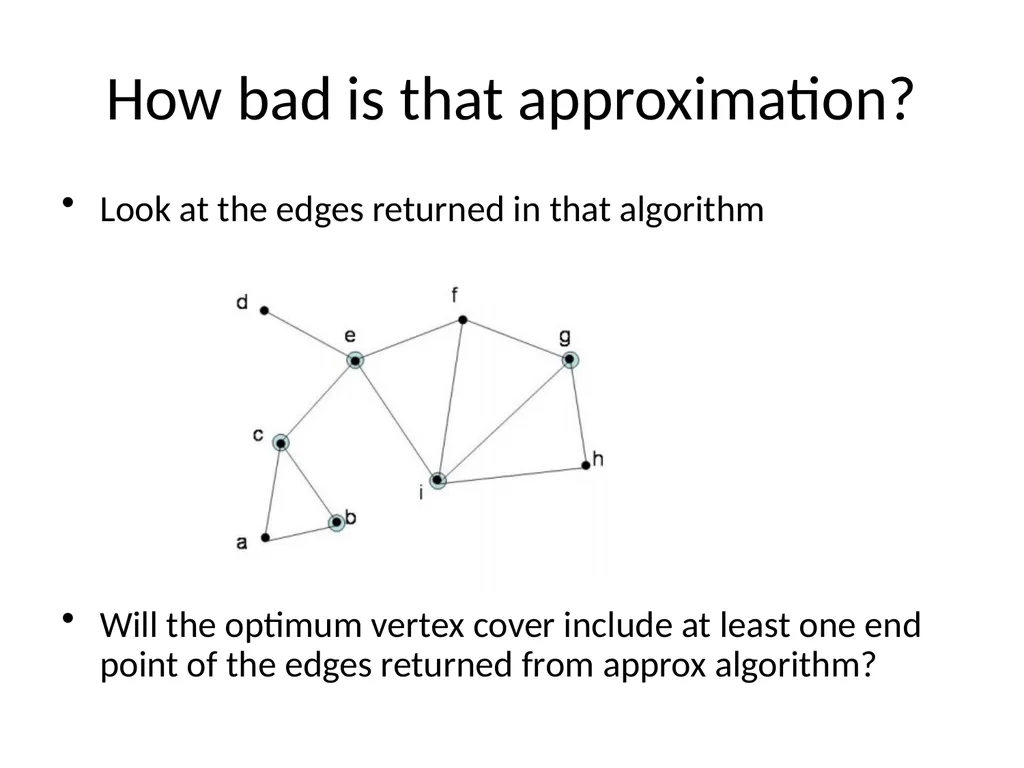
How bad is that approximation? Look at the edges returned in that algorithm
Will the optimum vertex cover include at least one end point of the edges returned from approx algorithm?<br>
Will the optimum vertex cover include at least one end point of the edges returned from approx algorithm?<br>