Low quality education as a poverty trap Introduction and welcoming Servaas van der Berg Department of Economics, Stellenbosch University PSPPD Project 28 March 2011 Welcome and word of thanks to PSPPD This research project was
"Low quality education as a poverty trap –" is the property of its rightful owner. Permission is granted to
download and print the materials on this website for personal, non-commercial use only, and to display it
on your personal computer provided you do not modify the materials and that you retain all copyright
notices contained in the materials. By downloading content from our website, you accept the terms of this
agreement.
Presentation Transcript
01
Low quality education as a poverty trap – Introduction and welcoming Servaas van der Berg
Department of Economics, Stellenbosch University
PSPPD Project – 28 March 2011<br>
02
Welcome and word of thanks to PSPPD This research project was undertaken with financial assistance of the Programme to Support Pro-Poor Policy Development (PSPPD), a partnership programme between the European Union and The Presidency, South Africa. The findings do not reflect the position of The Presidency or the EU.
This funding has made possible research that otherwise could not have been done on this scale or in this timeframe
Almost 20 people were involved in one way or another. The project analysed about 20 major datasets and produced the following outputs:
Ten Working Papers, quite a few of which will become journal articles
Five Policy Briefs, which are distributed to hundreds of policy makers
A summary report that is also widely distributed
A series of policy recommendations, flowing from individual papers, that will in time be digested and carried further in our ongoing discussions with policy makers
All of this would have been impossible without the financial support of EU and Presidency through the PSPPD. It would also have been much more difficult without the enthusiastic assistance of Mastoera Sadan, Nathalie Vereen and Zsa Zsa Milongo. I wish to thank them all on behalf of the whole Stellenbosch team. 2<br>
03
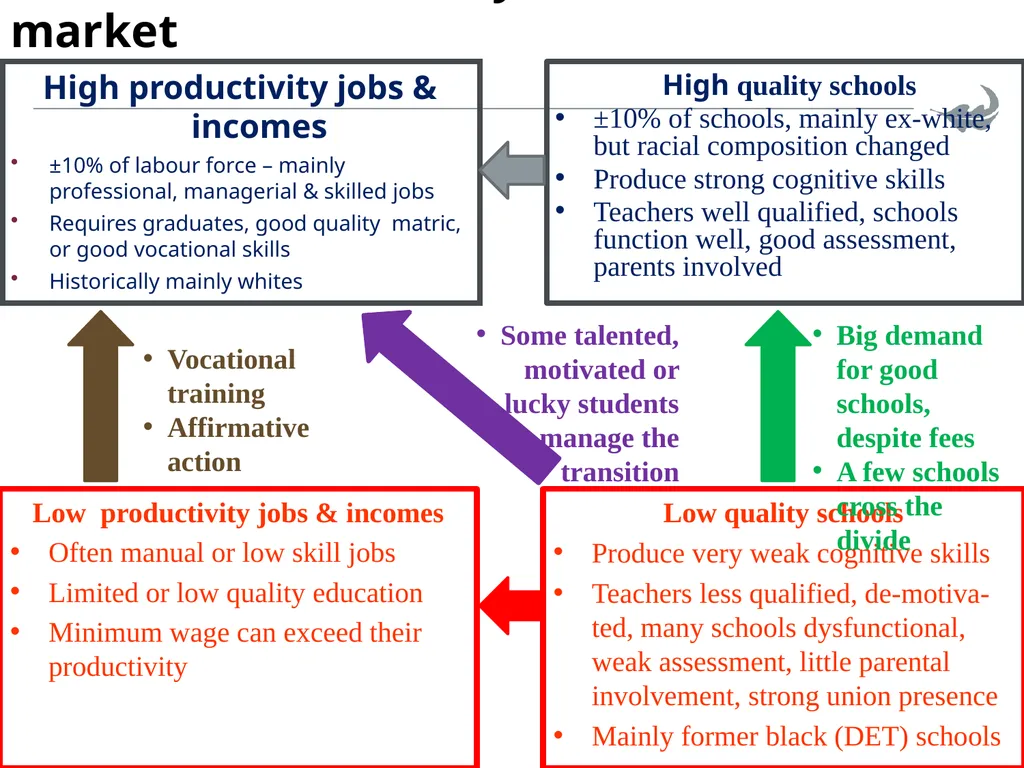
SA’s dualistic school system and labour market High productivity jobs & incomes
±10% of labour force – mainly professional, managerial & skilled jobs
Requires graduates, good quality matric, or good vocational skills
Historically mainly whites Low productivity jobs & incomes
Often manual or low skill jobs
Limited or low quality education
Minimum wage can exceed their productivity High quality schools
±10% of schools, mainly ex-white, but racial composition changed
Produce strong cognitive skills
Teachers well qualified, schools function well, good assessment, parents involved Low quality schools
Produce very weak cognitive skills
Teachers less qualified, de-motiva-ted, many schools dysfunctional, weak assessment, little parental involvement, strong union presence
Mainly former black (DET) schools Big demand for good schools, despite fees
A few schools cross the divide Vocational training
Affirmative action Some talented, motivated or lucky students manage the transition<br>
04
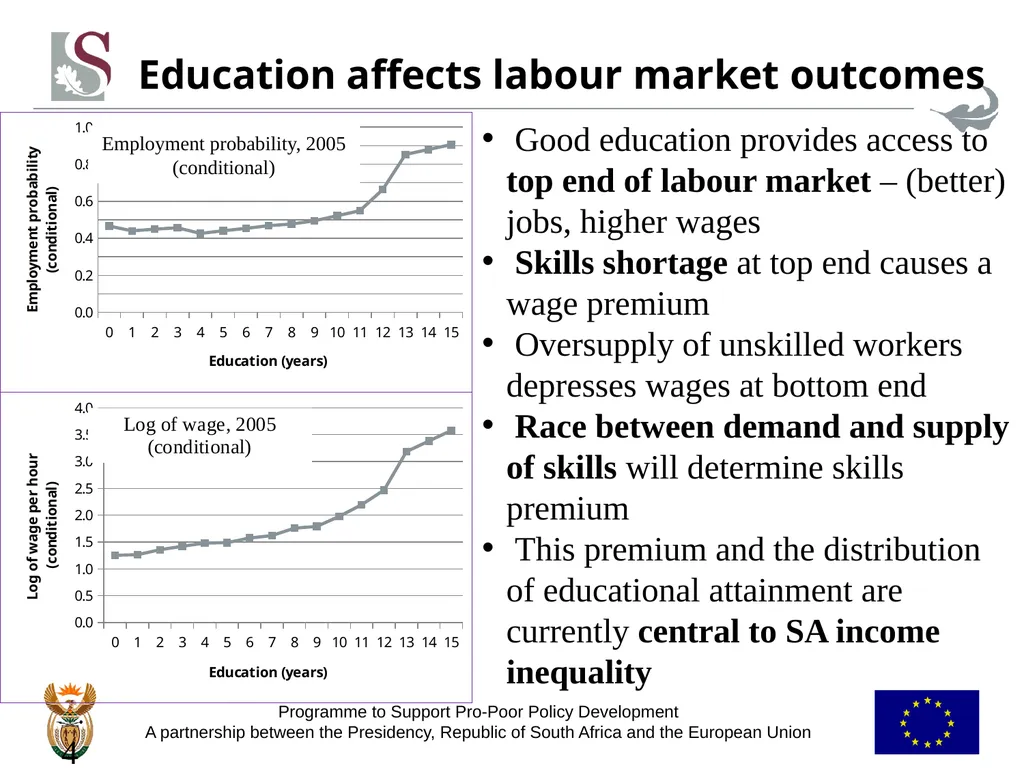
Education affects labour market outcomes 4 Employment probability, 2005
(conditional) Good education provides access to top end of labour market – (better) jobs, higher wages
Skills shortage at top end causes a wage premium
Oversupply of unskilled workers depresses wages at bottom end
Race between demand and supply of skills will determine skills premium
This premium and the distribution of educational attainment are currently central to SA income inequality<br>
05
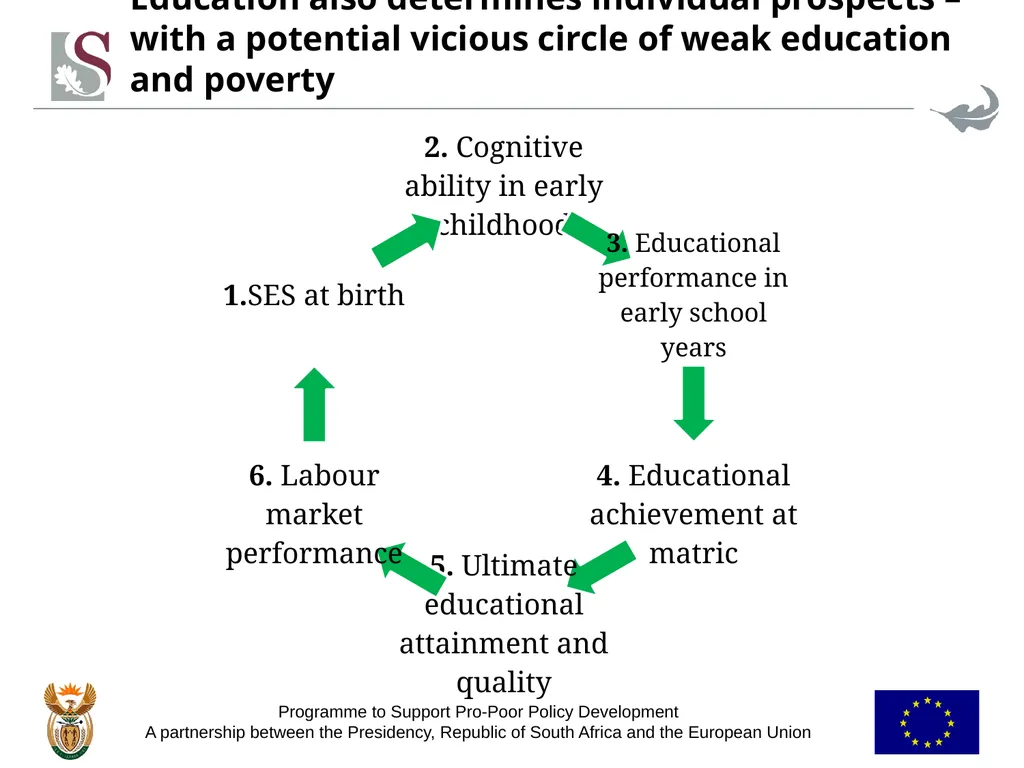
Education also determines individual prospects – with a potential vicious circle of weak education and poverty<br>
06
Issues SA school performance in perspective:
Schools and the labour market
Weak performance, even in African context
Poverty cannot explain this – SA’s poor fare worse than Africa’s poor
The school system has two parts, one functioning fairly well, the other extremely weakly
Resources bring little improvement in weak schools, due to functionality issues
Features of poorly functioning schools:
Slow macro pacing, poor use of instructional time, low curriculum coverage
Low cognitive demand, weak assessment, little feedback
Lack of textbooks/workbooks/reading material (some teachers think textbooks and workbooks are ‘not applicable’ in FP; libraries seldom function)
Problems with second language teaching and learning
Policy directions 6<br>
07
Working Papers Gustafsson, M. 2010. “Policy note on pre-primary schooling: An empirical contribution to the 2009 Medium Term Strategic Framework”. WP05/2010
Du Rand, G., van Broekhuizen, H., & von Fintel, D. 2010. “Who Responds to Voluntary Cognitive Tests in Household Surveys? The role of labour market status, respondent confidence, motivation and a culture of learning in South Africa”. WP27/2010
Shepherd, D. 2011. “Constraints to school effectiveness: What prevents poor schools from delivering results?” WP05/2011
De Vos, M. 2011. “Quantitative and qualitative aspects of education in South Africa: An analysis using the National Income Dynamic Study”. WP06/2011
Moses, E. 2011. “Quality of education and the labour market: A conceptual and literature overview.” WP07/2011
Burger, C., & Van der Berg, S. 2011. “Modelling cognitive skills, ability and school quality to explain labour market earnings differentials". WP08/2011
Gustafsson, M. 2011. “The when and how of leaving school: The policy implications of new evidence on secondary schooling in South Africa”. WP09/2011
Taylor, S. 2011. “Uncovering indicators of effective school management in South Africa using the National School Effectiveness Study”. WP 10/2011
Spaull, N. 2011. “A preliminary analysis of SACMEQ III”. WP11/2011
Du Rand, G., van Broekhuizen, H., & von Fintel, D. 2011. “Numeric competence, confidence and school quality in the South African wage function”. WP12/2011 7<br>
08
Policy briefs - 2011 Martin Gustafsson, New evidence in the case for improving the quality of secondary school learning outcomes Stellenbosch Policy Brief No. 01/2011
Stephen Taylor, The vital role of good school management in improving primary school outcomes Stellenbosch Policy Brief No. 02/2011
Nic Spaull, Identifying policy priorities to improve outcomes for poor primary school learners Stellenbosch Policy Brief No. 03/2011
Gideon du Rand, Hendrik van Broekhuizen & Dieter von Fintel, The role of educational attainment and quality schooling in reducing racial earnings inequality Stellenbosch Policy Brief No. 04/2011
Debra Shepherd, For richer, for poorer? Can lessons learnt from wealthy schools be applied to help poor schools deliver better results? Stellenbosch Policy Brief No. 05/2011 8<br>
09
Data sets used All General Household Surveys (GHS) from 2002 to 2009
A number of Labour Force Surveys (LFS), in particular the last two containing wage data, 2007a and 2007b
Income and Expenditure Survey (IES) of 2005/6
National Income Dynamics Study (NIDS) of 2008
The South African data for SACMEQ III for 1997
PIRLS 2006
All three waves of the National School Effectiveness Study (NSES), entailing Grade 3 for 2008, Grade 4 for 2009 and Grade 5 for 2010
Matriculation (National Senior Certificate) data for 2009 9<br>