04
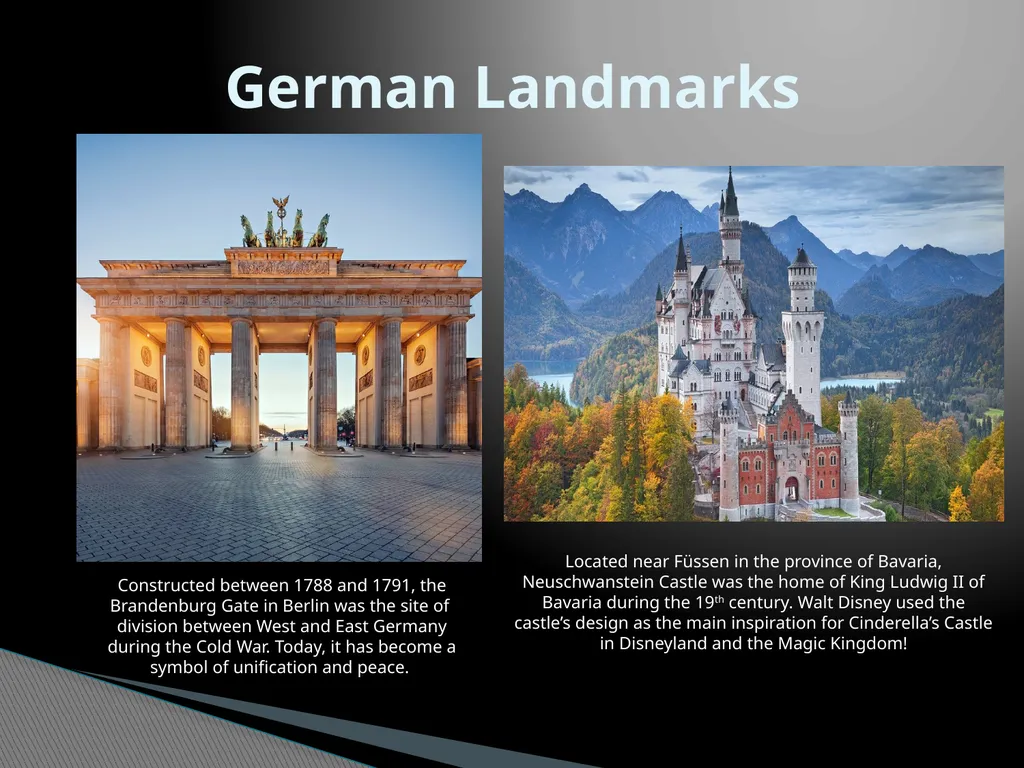
German Landmarks Constructed between 1788 and 1791, the Brandenburg Gate in Berlin was the site of division between West and East Germany during the Cold War. Today, it has become a symbol of unification and peace. Located near Füssen in the province of Bavaria, Neuschwanstein Castle was the home of King Ludwig II of Bavaria during the 19th century. Walt Disney used the castle’s design as the main inspiration for Cinderella’s Castle in Disneyland and the Magic Kingdom!<br>
05
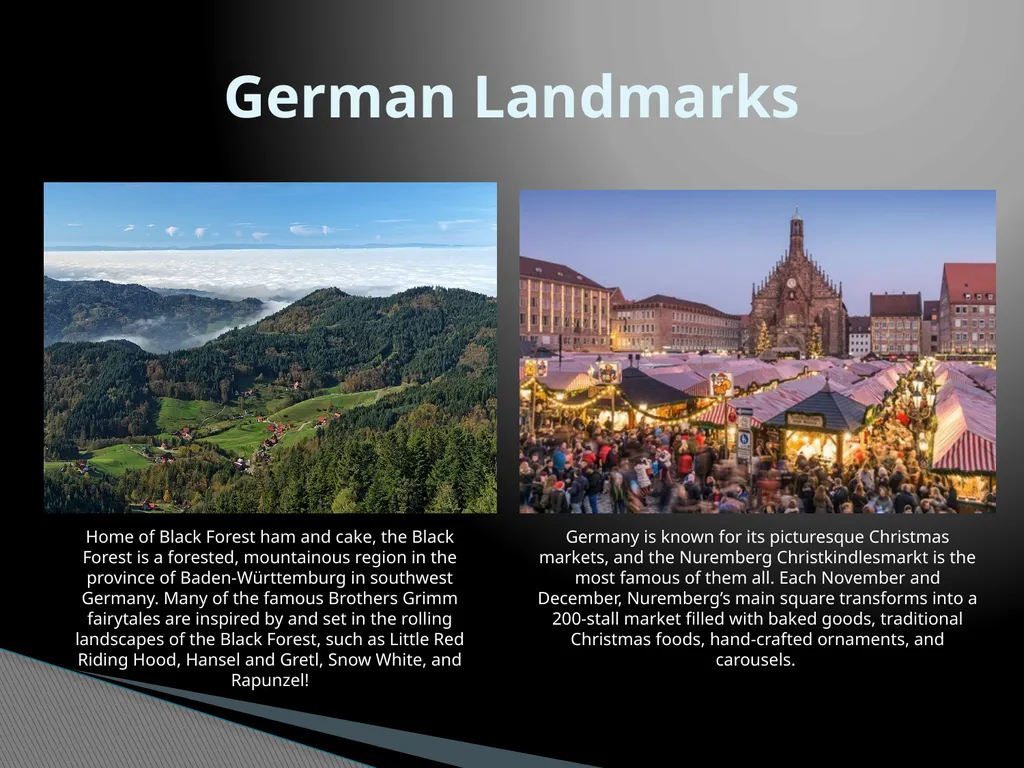
German Landmarks Home of Black Forest ham and cake, the Black Forest is a forested, mountainous region in the province of Baden-Württemburg in southwest Germany. Many of the famous Brothers Grimm fairytales are inspired by and set in the rolling landscapes of the Black Forest, such as Little Red Riding Hood, Hansel and Gretl, Snow White, and Rapunzel! Germany is known for its picturesque Christmas markets, and the Nuremberg Christkindlesmarkt is the most famous of them all. Each November and December, Nuremberg’s main square transforms into a 200-stall market filled with baked goods, traditional Christmas foods, hand-crafted ornaments, and carousels.<br>
06
Oktoberfest is a famous folk festival occurring in Munich each September and October.
Traditional Bavarian dancing, folk music, parades, and beer-drinking are highlights of the event.
Oktoberfest is a major tourist attraction, with over 6 million tourists attending each year!
Fun fact: Approx. 7.7 million litres of beer are consumed each year during the festival. Oktoberfest<br>
07
Born in 1770 in Bonn, Germany.
His first music teacher was his father (a court singer and violinist).
At age 22, he moved to Vienna to pursue a musical career. He even studied with Haydn for two years!
Around 1796, Beethoven started to lose his hearing. He contemplated suicide because of this (detailed in a famous letter to his brothers called the Heiligenstadt Testament) but ultimately decided against committing suicide.
Due to his talent as a pianist and composer, Beethoven was financially supported throughout his career by the Viennese elite, including Prince Karl Lichnowsky and Prince Lobkowitz.
He died in 1827 at age 56. Fast Facts: Ludwig van Beethoven<br>
08
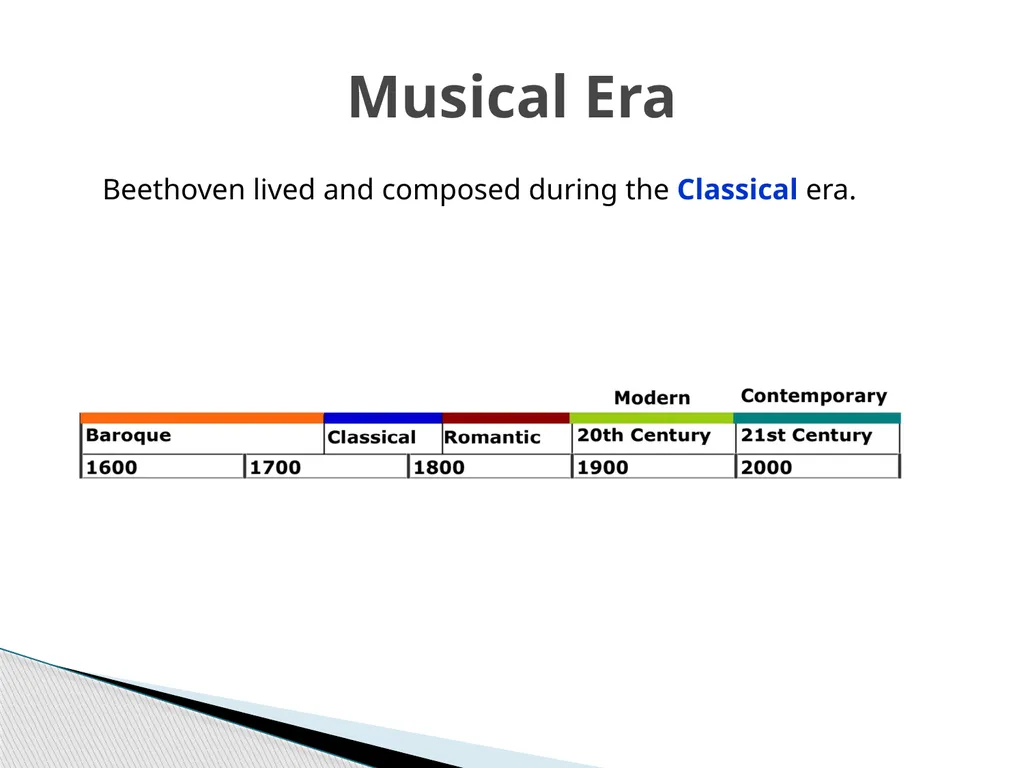
Beethoven lived and composed during the Classical era. Musical Era<br>
09
Beethoven’s music is generally divided into three periods.
These three periods showcase the development and refinement of his unique musical style. Beethoven’s Musical Periods<br>
10
The first period roughly extends from 1792 (Beethoven’s arrival in Vienna) until around 1803.
This period features Beethoven’s mastery (and expansion) of the Viennese classical style exemplified by Haydn and Mozart.
Some unique features of Beethoven’s music during this period are:
Use of four movements in piano sonatas (instead of the traditional three)
Replacement of the minuet with a scherzo (literal translation meaning “a joke”) in symphonies and sonatas.
Use of extreme shifts in dynamics and mood, and expansion of traditional harmonic patterns. Beethoven’s Music: First Period<br>
11
Click the links below to watch a performances of the following works from Beethoven’s first period.
Piano Sonata No. 8 in C minor, Op. 13 (“Pathetique”), 1st movement (Click here)
Symphony No. 2 in D major, Op. 36, 3rd movement (Click here) Beethoven’s Music: First Period<br>
12
Beethoven’s middle period begins with the composition of his Third Symphony (“Eroica”) in 1803 and ends around 1814.
Sometimes referred to as his “heroic” period, many compositions during this time reflect a sense of heroism and/or struggle and conflict (possibly due to his worsening deafness)
Some features of Beethoven’s music during this period are:
Expanded musical forms and length of compositions
Use of modulation to distant keys and further expansion of harmonic patterns.
Use of “germinal” motives” (small musical themes that form the melodic and thematic basis for an entire work). Beethoven’s Music: Middle Period<br>
13
Click the links below to watch a performances of the following works from Beethoven’s first period.
Fidelio, Op. 72 (Overture) (Click here)
Symphony No. 5 in C minor, Op. 67, 1st movement (Click here) Beethoven’s Music: Middle Period<br>
14
Beethoven’s late period begins around 1815 and ends with his death in 1827.
Many compositions the during this period pay homage to J.S. Bach through the use of Baroque styles, in particular fugue and extensive counterpoint.
Beethoven continued to push the boundaries with form, harmony, and instrumentation. His innovations in this period foreshadow and set the stage for the musical developments in the Romantic era. Beethoven’s Music: Late Period<br>
15
Click the links below to watch a performances of the following works from Beethoven’s first period.
String Quartet in C-sharp minor, Op. 131, 1st movement (Click here – watch until 7:26)
Symphony No. 9 in D minor, Op. (“Choral”), 4th movement (Click here) Beethoven’s Music: Late Period<br>
16
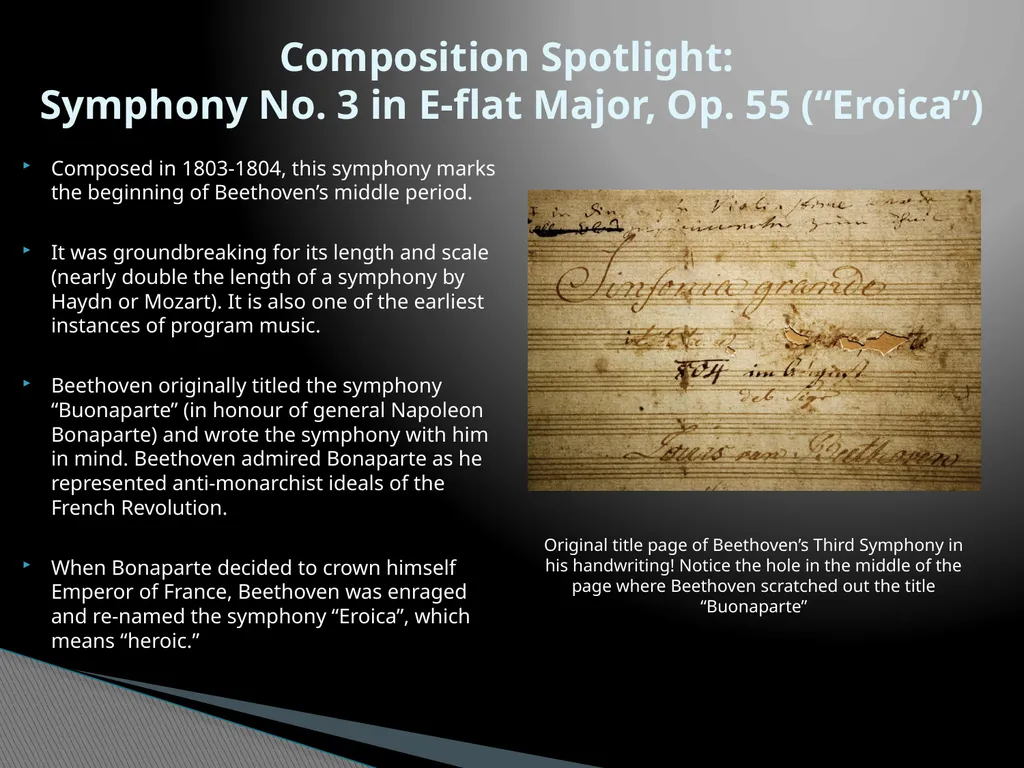
Composed in 1803-1804, this symphony marks the beginning of Beethoven’s middle period.
It was groundbreaking for its length and scale (nearly double the length of a symphony by Haydn or Mozart). It is also one of the earliest instances of program music.
Beethoven originally titled the symphony “Buonaparte” (in honour of general Napoleon Bonaparte) and wrote the symphony with him in mind. Beethoven admired Bonaparte as he represented anti-monarchist ideals of the French Revolution.
When Bonaparte decided to crown himself Emperor of France, Beethoven was enraged and re-named the symphony “Eroica”, which means “heroic.” Composition Spotlight: �Symphony No. 3 in E-flat Major, Op. 55 (“Eroica”) Original title page of Beethoven’s Third Symphony in his handwriting! Notice the hole in the middle of the page where Beethoven scratched out the title “Buonaparte”<br>
17
Listen to a performance of Beethoven’s Third Symphony by the American Youth Symphony (an orchestra composed of only high school students and undergraduate university students!)
Click here and answer the questions on next slide (listen to only the first movement, which ends at 14:36) Hear the Music!<br>
18
Answer the following questions. There are no right or wrong answers, just answer based on your impression of the piece.
What characteristics of this piece do you think make it sound heroic? Reference specific musical devices in your answer (e.g. dynamics, rhythm, instruments, etc.)
What images come to mind when you listen to this symphony? Beethoven’s Third Symphony<br>
19
Answer the following questions based on this presentation:
What is Oktoberfest?
In what region of Germany are many of the Brothers Grimm fairytales set?
What sense did Beethoven lose during his lifetime?
What famous composer did Beethoven study with in Vienna?
What musical era did Beethoven live and compose in?
How many stylistic periods is Beethoven’s music divided into? Name one unique feature of each period.
Pick one composition noted above (not Symphony No. 3) from any of Beethoven’s stylistic periods. Find and describe one example of a feature of that period in the composition. Exit Activity<br>