04
Here are a few important vocabulary terms that will help during this lesson: Capacity – the amount of matter that a container can hold. Weight – the pull of gravity on an object. Mass – the amount of matter that makes up an object. Ratio – the amount of one thing compared to a the amount of another (sometimes written as a fraction).<br>
05
Converting
Customary Units
Of Measure Part 1:<br>
06
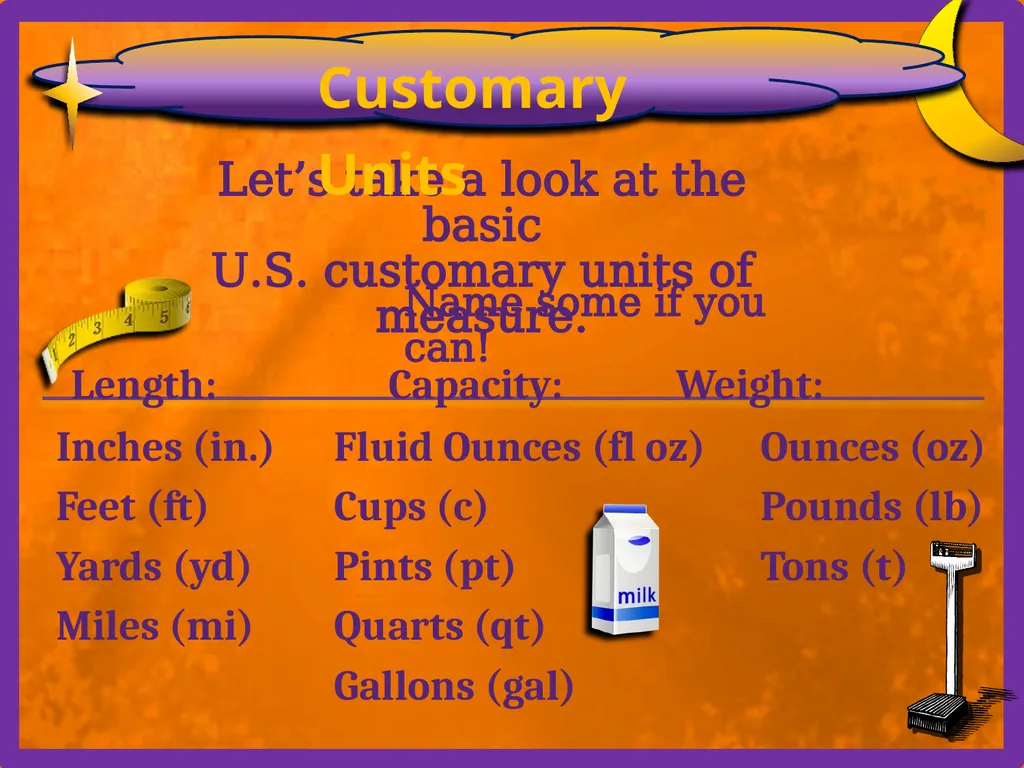
Let’s take a look at the basic
U.S. customary units of measure. Name some if you can! Inches (in.)
Feet (ft)
Yards (yd)
Miles (mi) Fluid Ounces (fl oz)
Cups (c)
Pints (pt)
Quarts (qt)
Gallons (gal) Ounces (oz)
Pounds (lb)
Tons (t)<br>
07
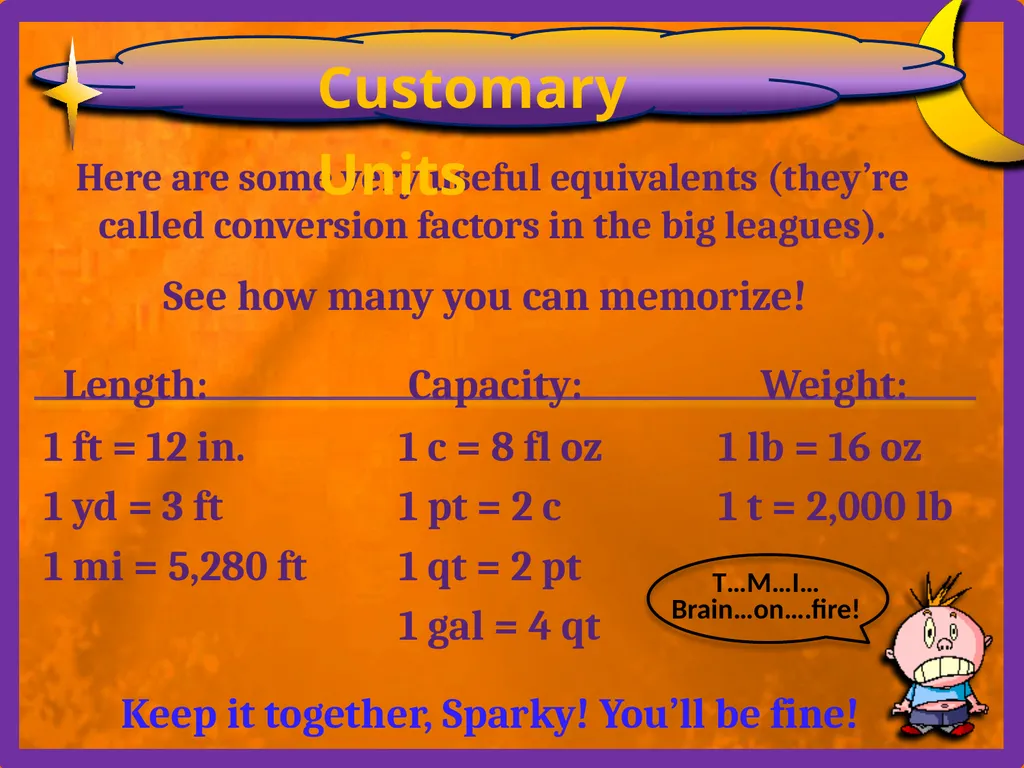
Here are some very useful equivalents (they’re called conversion factors in the big leagues). 1 ft = 12 in.
1 yd = 3 ft
1 mi = 5,280 ft 1 c = 8 fl oz
1 pt = 2 c
1 qt = 2 pt
1 gal = 4 qt 1 lb = 16 oz
1 t = 2,000 lb Keep it together, Sparky! You’ll be fine! See how many you can memorize!<br>
08
I can’t help you with the burrito, Sparticus, but check out a couple of conversion problems and you’ll see that this isn’t so bad! Besides, this over-dramatic behavior is not going to impress the ladies. That’s my boy!<br>
09
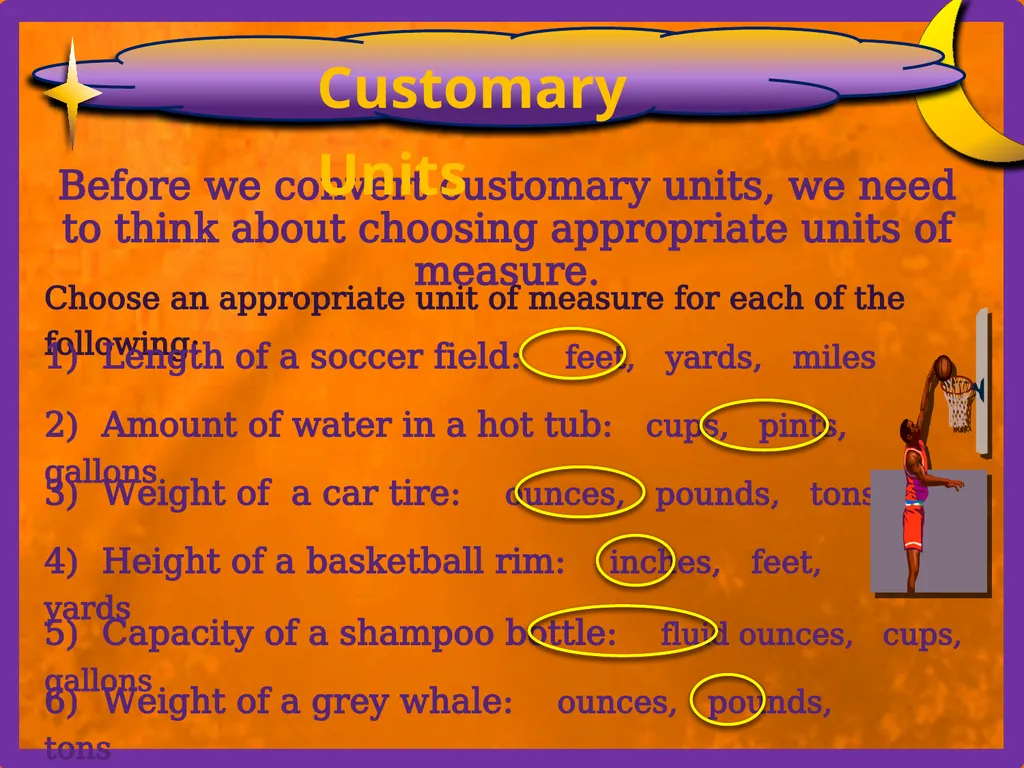
Before we convert customary units, we need to think about choosing appropriate units of measure. Choose an appropriate unit of measure for each of the following: 1) Length of a soccer field: feet, yards, miles 2) Amount of water in a hot tub: cups, pints, gallons 3) Weight of a car tire: ounces, pounds, tons 4) Height of a basketball rim: inches, feet, yards 5) Capacity of a shampoo bottle: fluid ounces, cups, gallons 6) Weight of a grey whale: ounces, pounds, tons Customary Units<br>
10
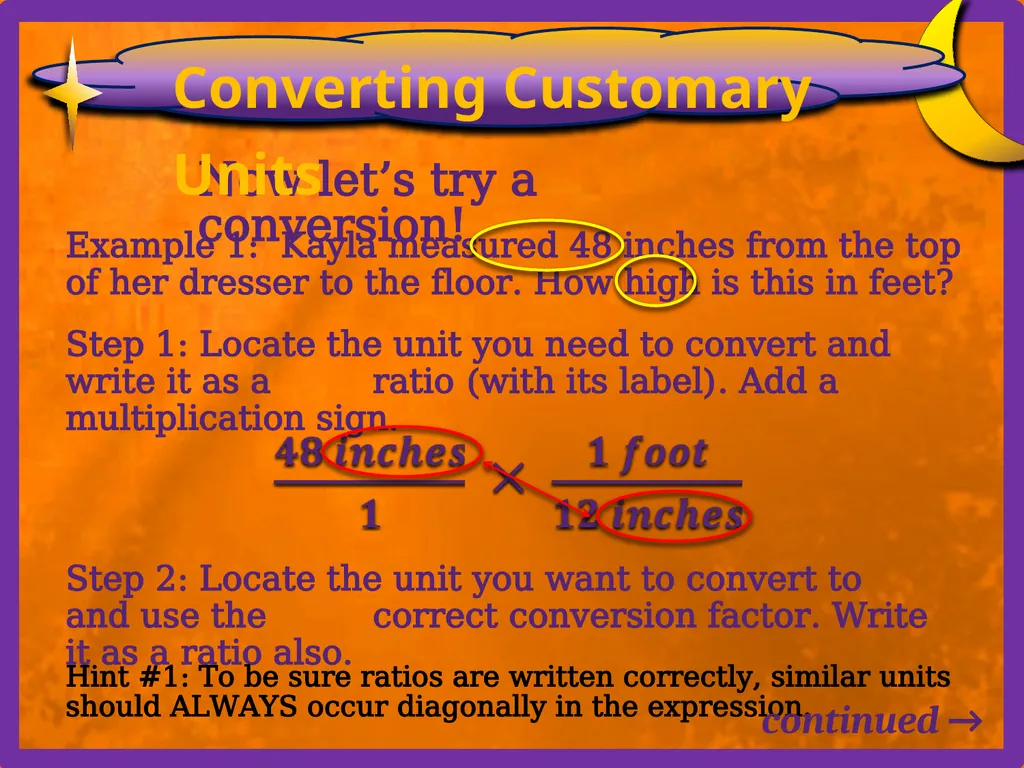
Now let’s try a conversion! Example 1: Kayla measured 48 inches from the top of her dresser to the floor. How high is this in feet? Step 1: Locate the unit you need to convert and write it as a ratio (with its label). Add a multiplication sign. Step 2: Locate the unit you want to convert to and use the correct conversion factor. Write it as a ratio also. Hint #1: To be sure ratios are written correctly, similar units should ALWAYS occur diagonally in the expression. continued →<br>
11
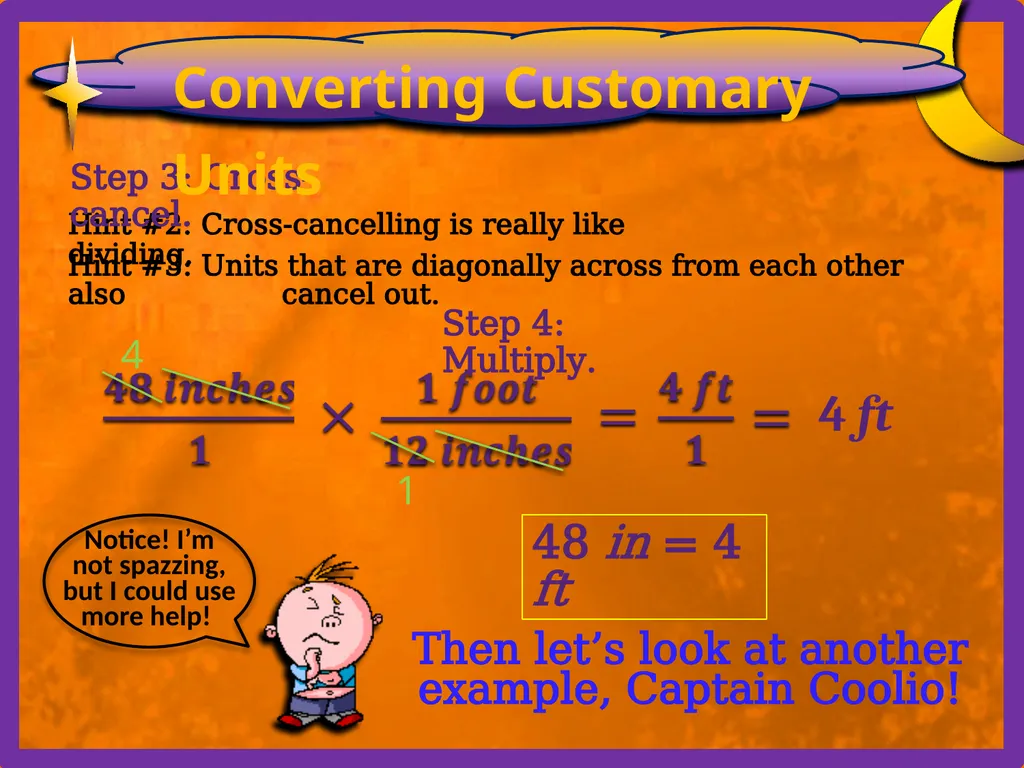
Hint #2: Cross-cancelling is really like dividing. 1 4 Hint #3: Units that are diagonally across from each other also cancel out. 4 ft Then let’s look at another example, Captain Coolio! Step 3: Cross-cancel. 48 in = 4 ft Step 4: Multiply.<br>
12
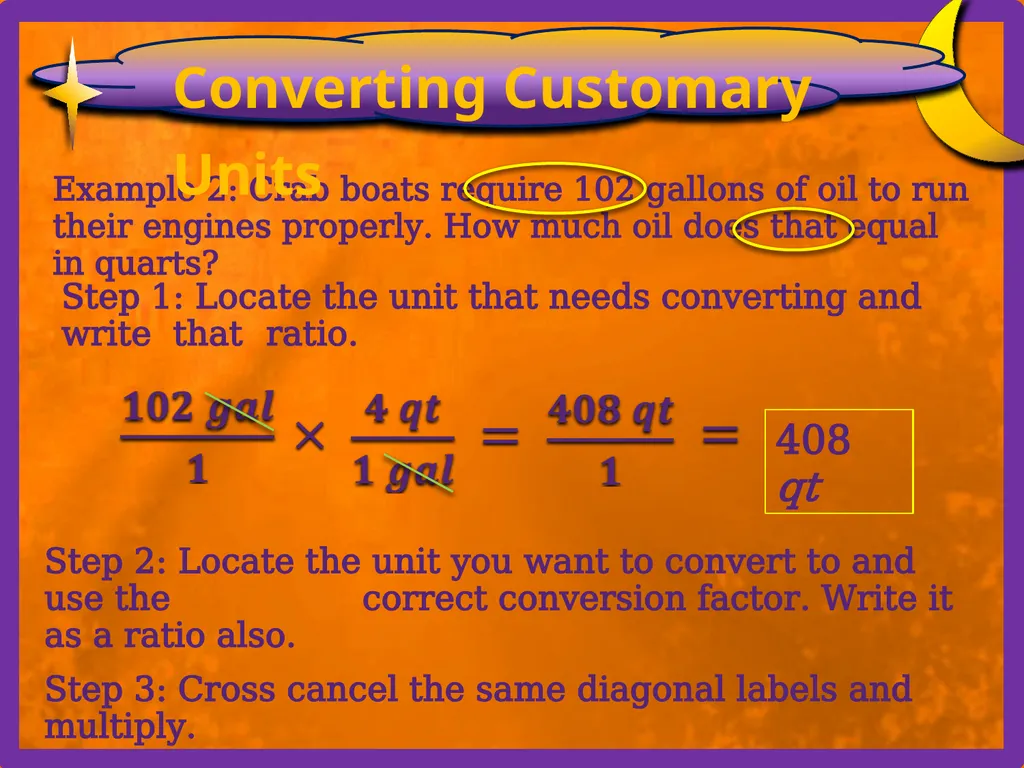
Example 2: Crab boats require 102 gallons of oil to run their engines properly. How much oil does that equal in quarts? Step 1: Locate the unit that needs converting and write that ratio. Step 2: Locate the unit you want to convert to and use the correct conversion factor. Write it as a ratio also. Step 3: Cross cancel the same diagonal labels and multiply. 408 qt<br>
13
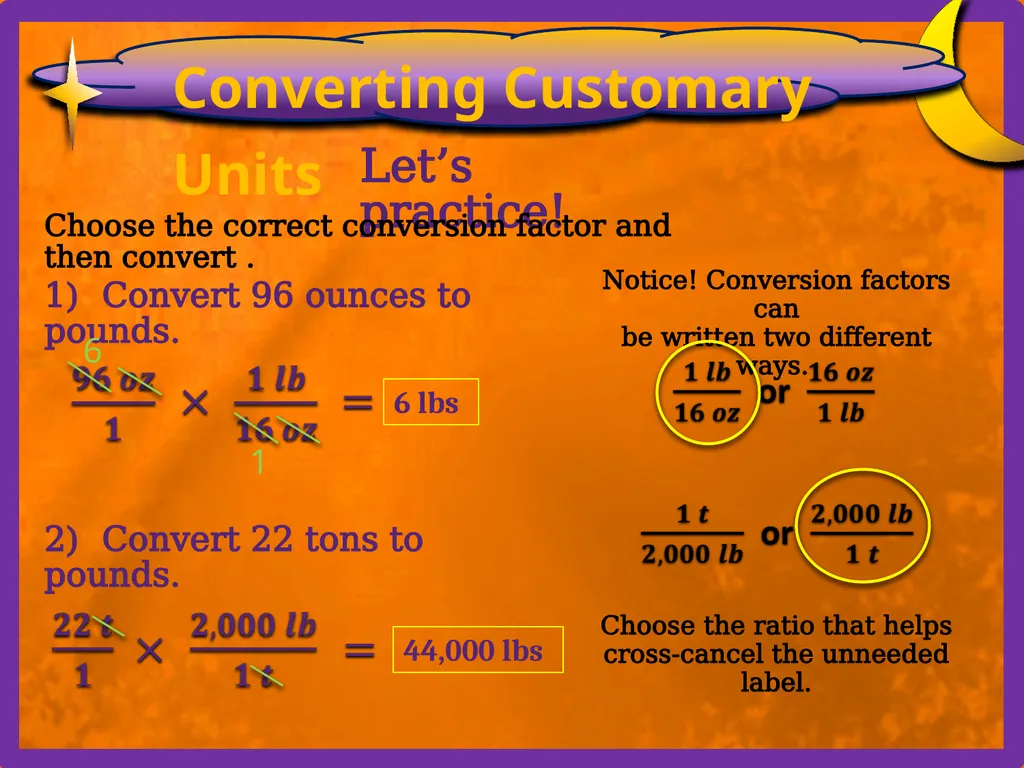
Let’s practice! Choose the correct conversion factor and then convert . Notice! Conversion factors can
be written two different ways. 1) Convert 96 ounces to pounds. Choose the ratio that helps
cross-cancel the unneeded label. 2) Convert 22 tons to pounds. 1 6 6 lbs 44,000 lbs<br>
14
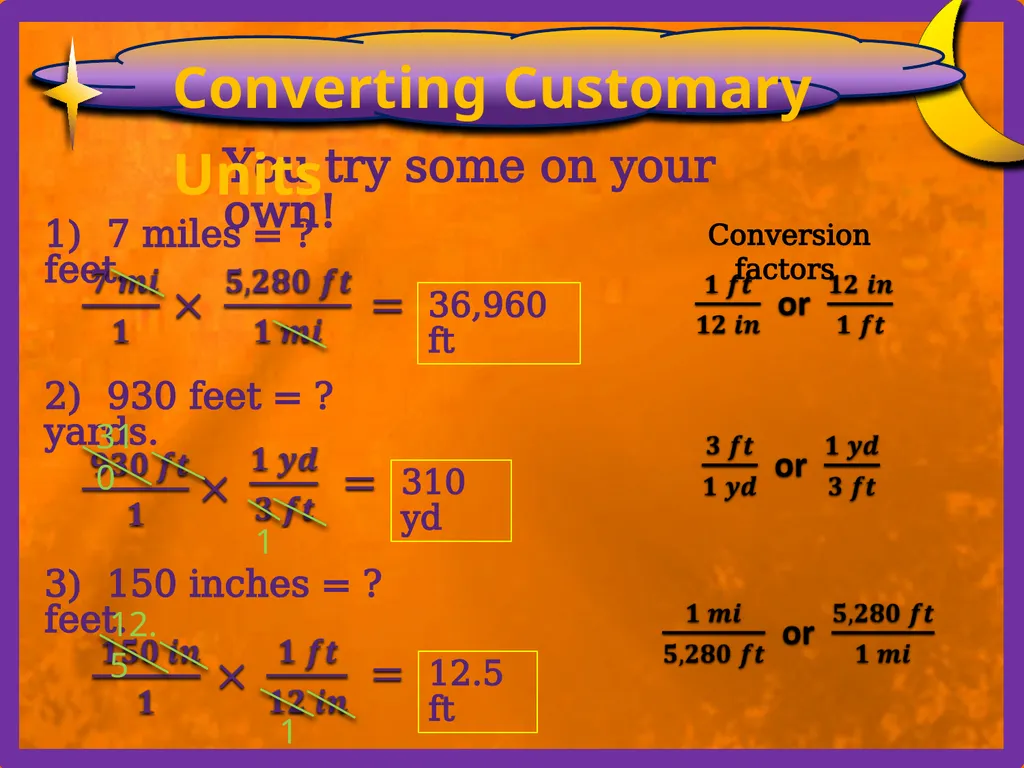
You try some on your own! 1) 7 miles = ? feet. 2) 930 feet = ? yards. 3) 150 inches = ? feet. Conversion factors 36,960 ft 310 yd 1 310 12.5 ft 1 12.5<br>
15
Did you happen to notice anything else? Wow! Someone’s really on their game today!<br>
16
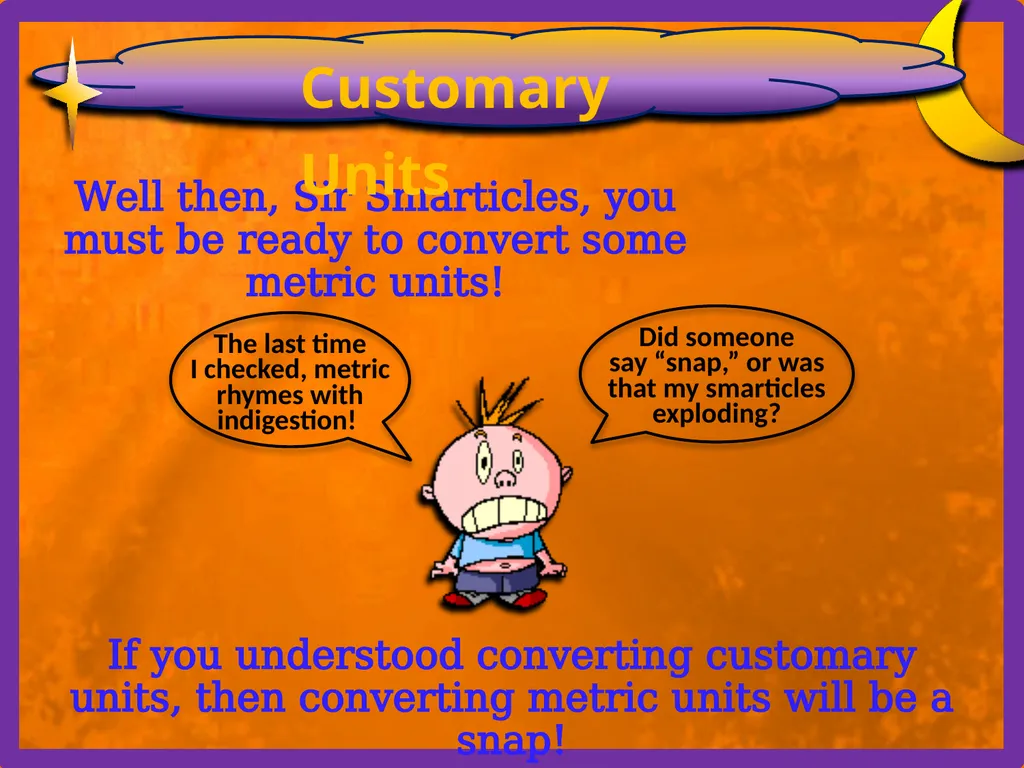
Well then, Sir Smarticles, you must be ready to convert some metric units! If you understood converting customary units, then converting metric units will be a snap!<br>
17
Converting
Metric Units
of Measure Part 2:<br>
18
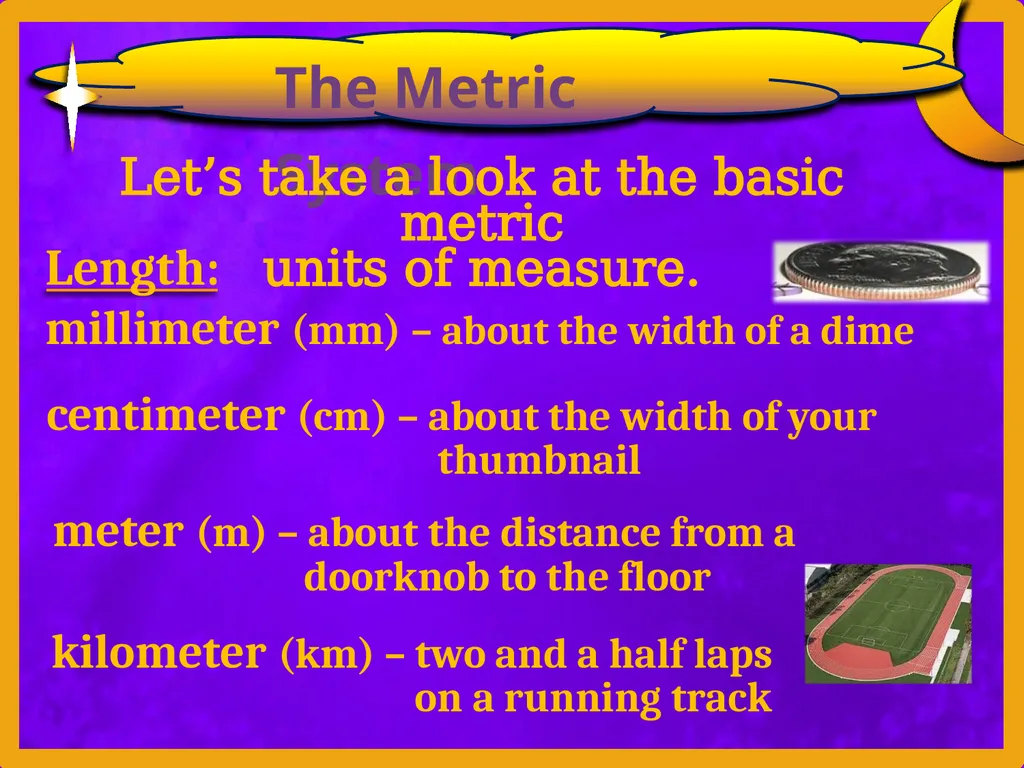
Let’s take a look at the basic metric
units of measure. millimeter (mm) – about the width of a dime centimeter (cm) – about the width of your thumbnail kilometer (km) – two and a half laps
on a running track meter (m) – about the distance from a doorknob to the floor<br>
19
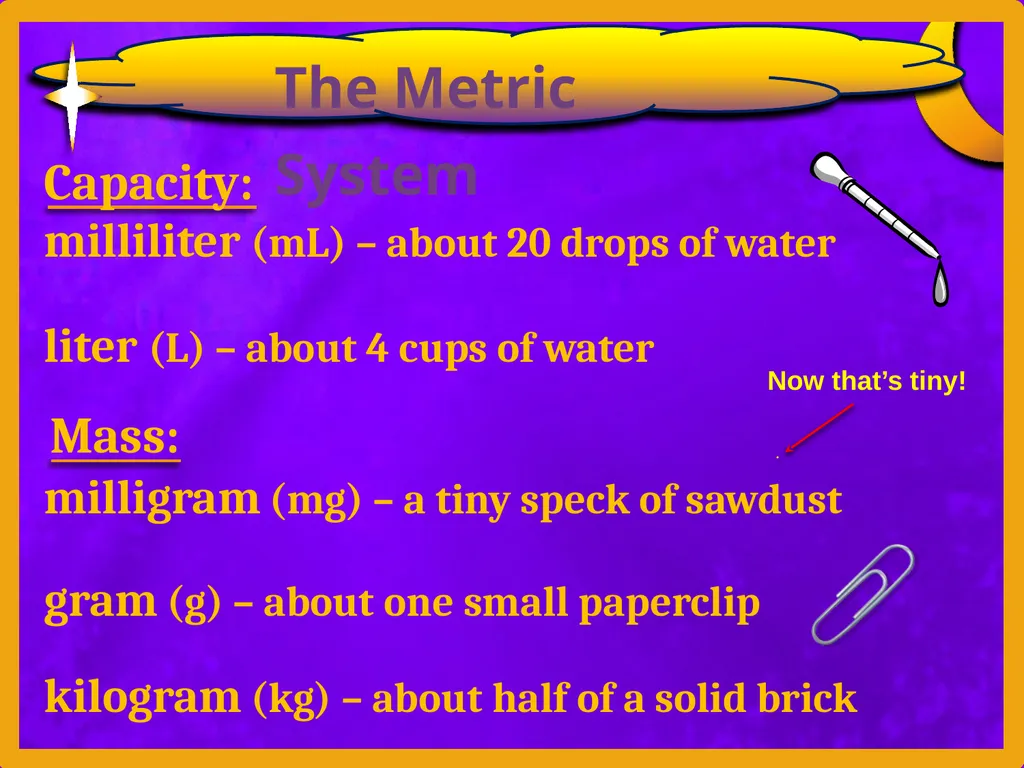
milligram (mg) – a tiny speck of sawdust milliliter (mL) – about 20 drops of water Mass: The Metric System liter (L) – about 4 cups of water kilogram (kg) – about half of a solid brick gram (g) – about one small paperclip Now that’s tiny!<br>
20
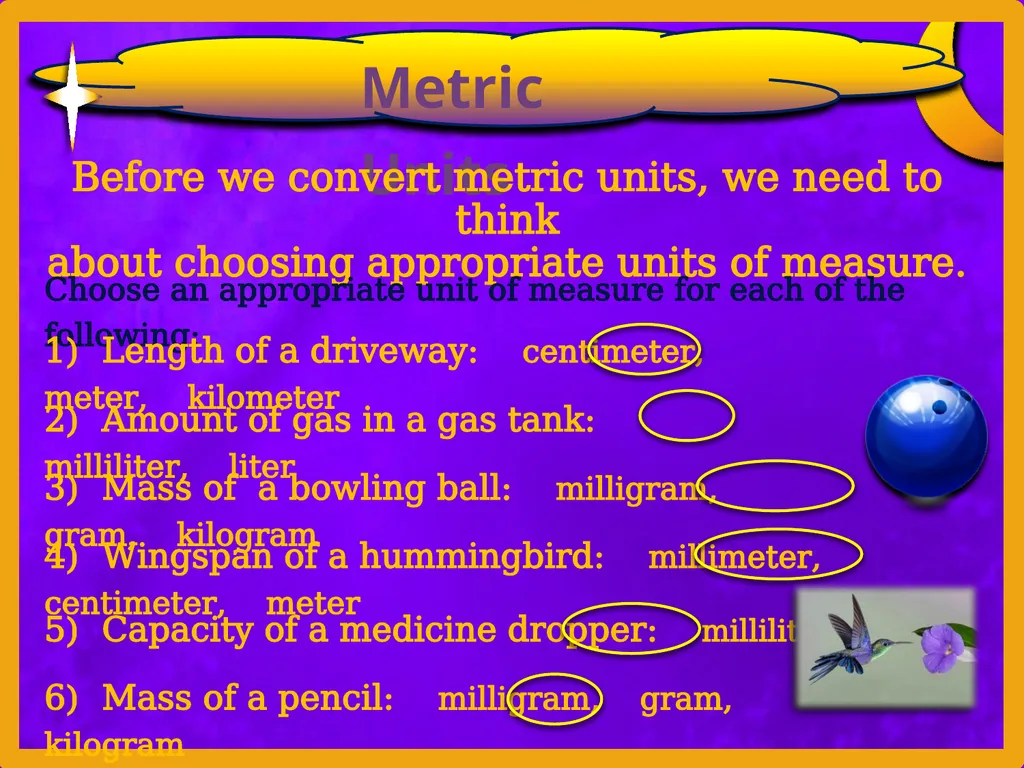
Metric Units Before we convert metric units, we need to think
about choosing appropriate units of measure. Choose an appropriate unit of measure for each of the following: 1) Length of a driveway: centimeter, meter, kilometer 2) Amount of gas in a gas tank: milliliter, liter 3) Mass of a bowling ball: milligram, gram, kilogram 4) Wingspan of a hummingbird: millimeter, centimeter, meter 5) Capacity of a medicine dropper: milliliter, liter 6) Mass of a pencil: milligram, gram, kilogram<br>
21
Converting Metric Units You guessed right! Can you walk up and down
stairs while counting? Then you’re going to
like this!<br>
22
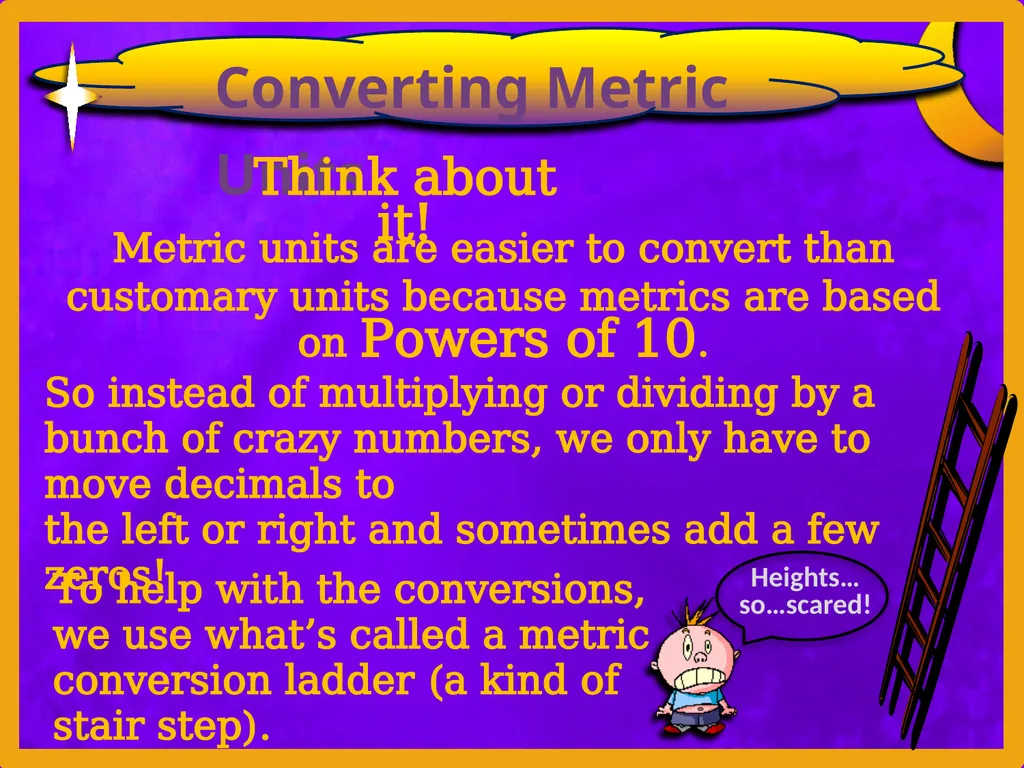
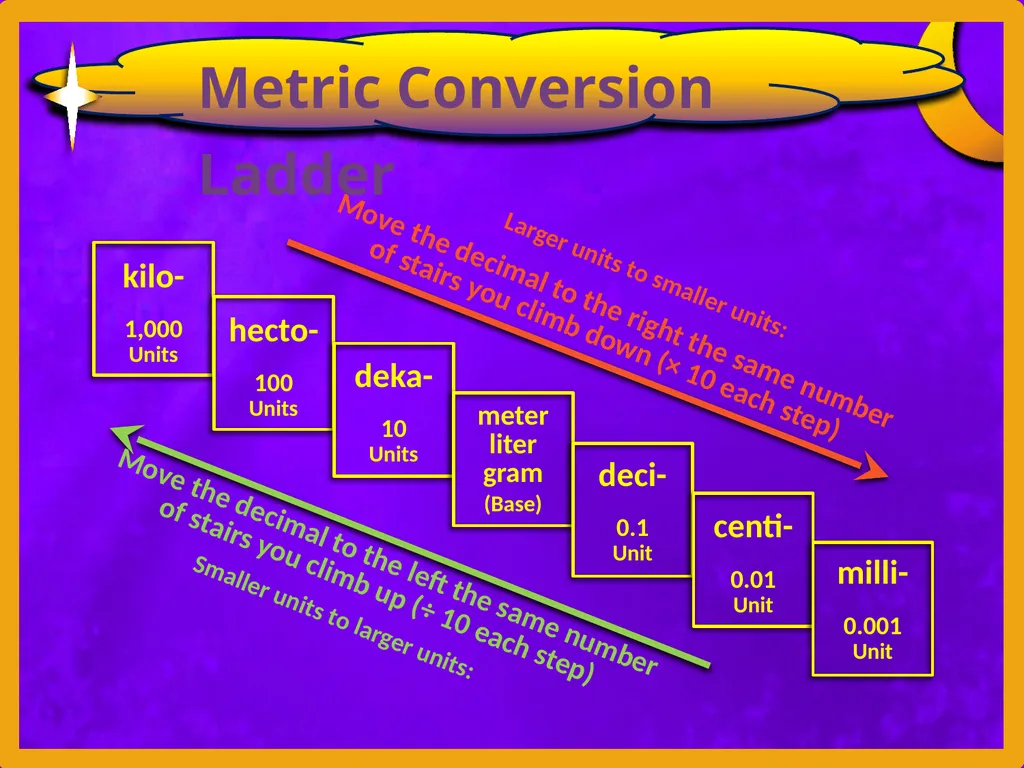
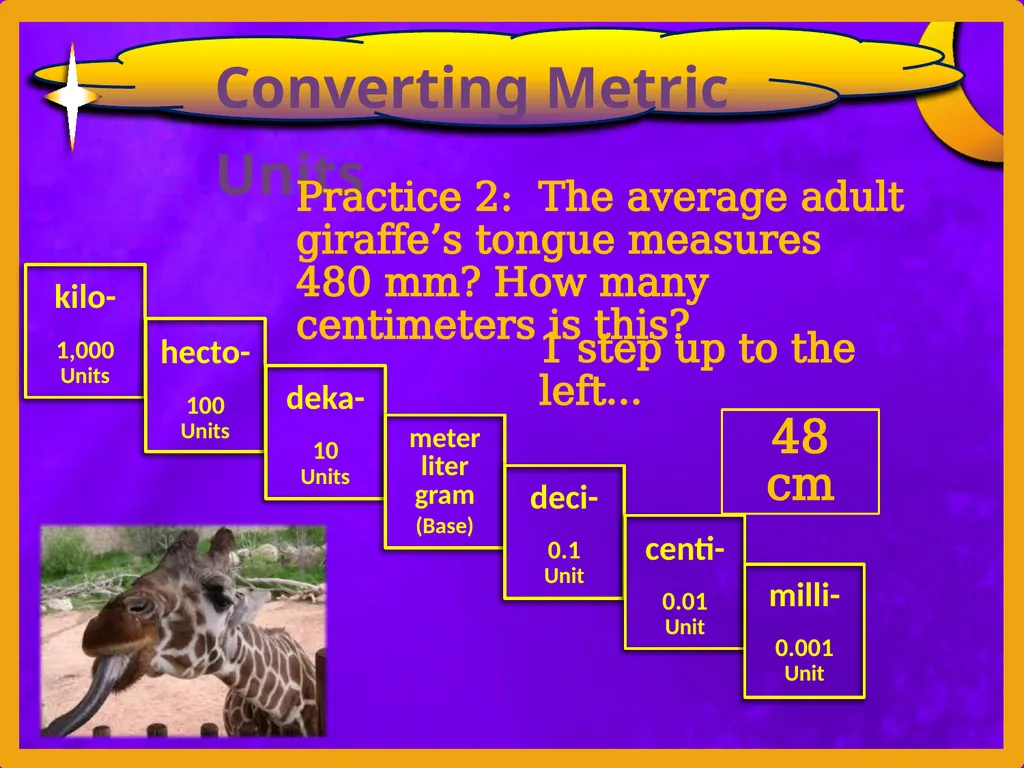
Converting Metric Units Metric units are easier to convert than customary units because metrics are based on Powers of 10. So instead of multiplying or dividing by a bunch of crazy numbers, we only have to move decimals to
the left or right and sometimes add a few zeros! Think about it! To help with the conversions, we use what’s called a metric conversion ladder (a kind of stair step).<br>
23
Metric Conversion Ladder Move the decimal to the right the same number of stairs you climb down (× 10 each step) Move the decimal to the left the same number of stairs you climb up (÷ 10 each step) Smaller units to larger units: Larger units to smaller units:<br>
24
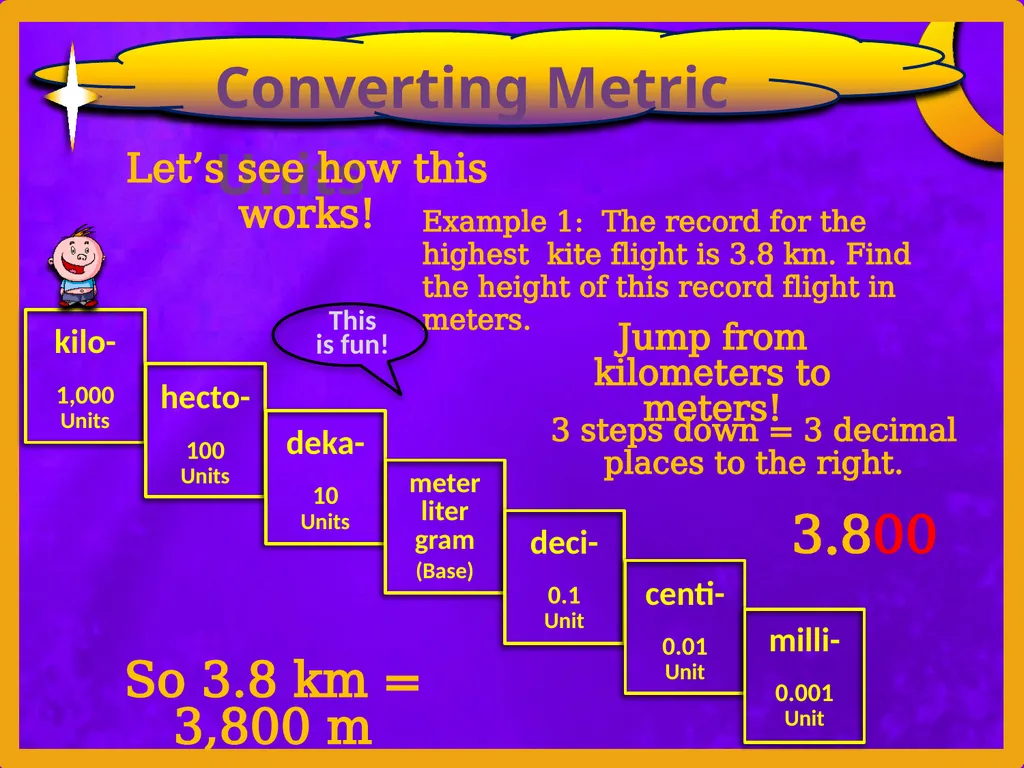
Converting Metric Units Let’s see how this works! Jump from kilometers to meters! 3 steps down = 3 decimal places to the right. 3 8 0 0 . So 3.8 km = 3,800 m Example 1: The record for the highest kite flight is 3.8 km. Find the height of this record flight in meters.<br>
25
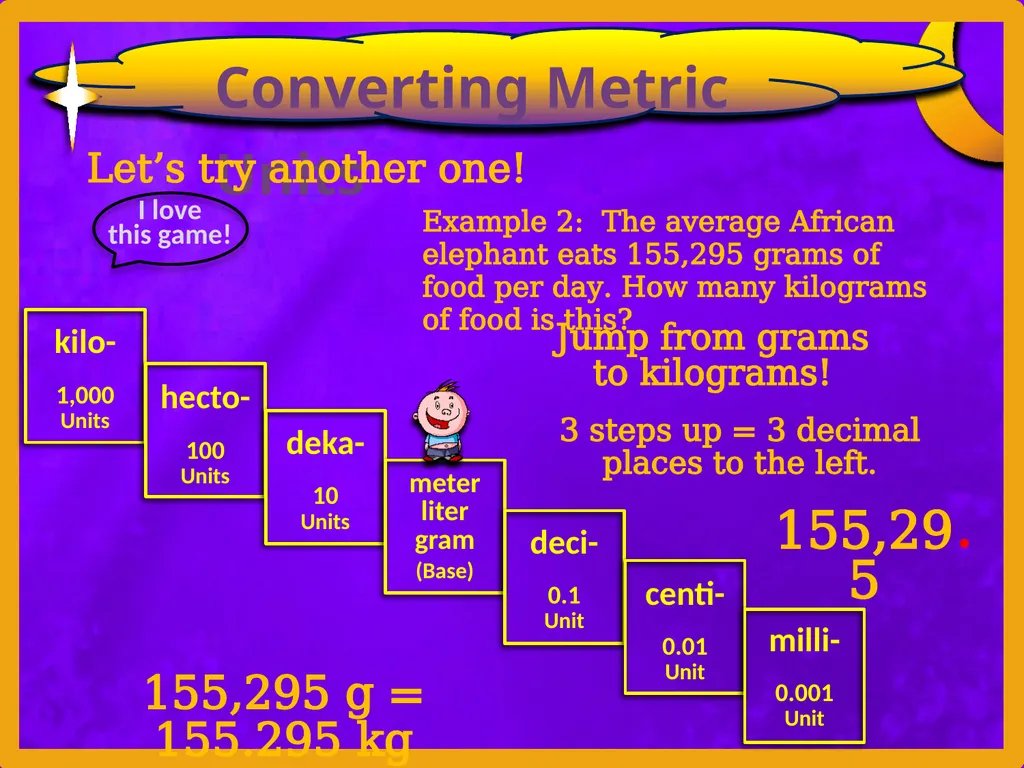
Converting Metric Units Let’s try another one! Example 2: The average African elephant eats 155,295 grams of food per day. How many kilograms of food is this? Jump from grams to kilograms! 3 steps up = 3 decimal places to the left. 155,295 155,295 g = 155.295 kg .<br>
26
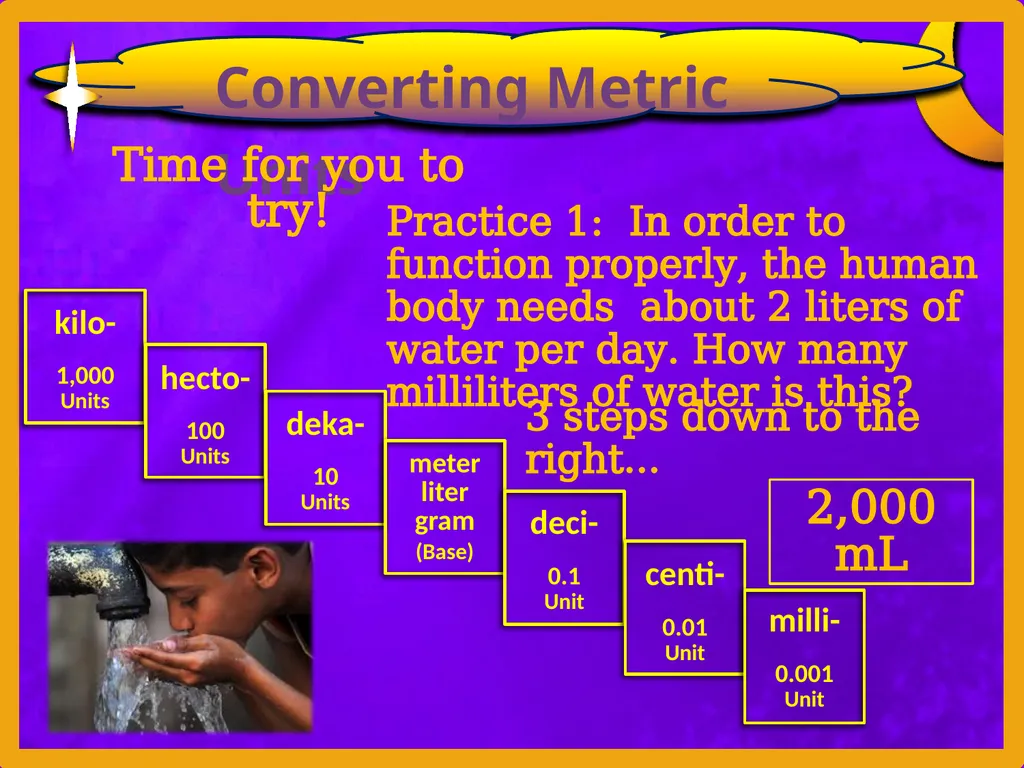
Converting Metric Units Time for you to try! Practice 1: In order to function properly, the human body needs about 2 liters of water per day. How many milliliters of water is this? 2,000 mL 3 steps down to the right…<br>
27
Converting Metric Units Practice 2: The average adult giraffe’s tongue measures 480 mm? How many centimeters is this? 48 cm 1 step up to the left…<br>
28
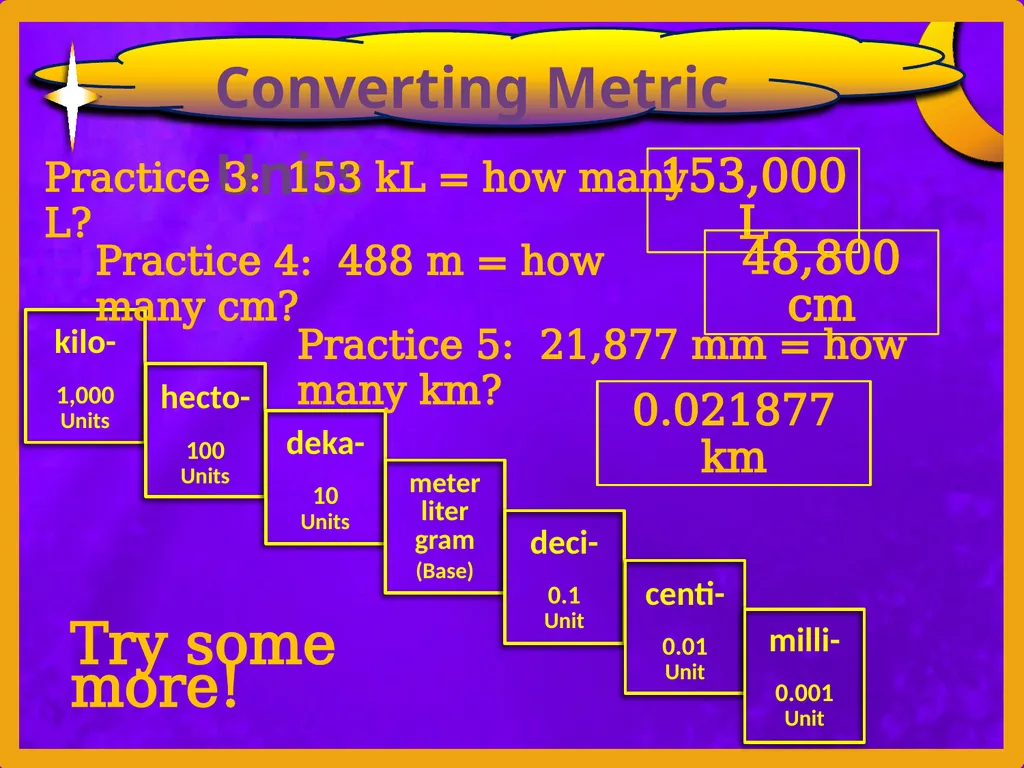
Converting Metric Units 153,000 L 48,800 cm 0.021877 km Try some more!<br>
29
Converting Metric Units So how do you feel about converting customary and metric units? Sparky, why are you speaking with
a British accent? Ok, that’s just weird! Created by: Mike’s Math Mall<br>