Madoff securities Course: Auditing Giulia Surini - 473585 Bernard Lawrence Madoff Born on 29th April 1938, New York City As a teenager he dreamed of becoming a major player in the world of high finance In 1960 he graduated with a
"Madoff securities Course: Auditing Giulia Surini -" is the property of its rightful owner. Permission is granted to
download and print the materials on this website for personal, non-commercial use only, and to display it
on your personal computer provided you do not modify the materials and that you retain all copyright
notices contained in the materials. By downloading content from our website, you accept the terms of this
agreement.
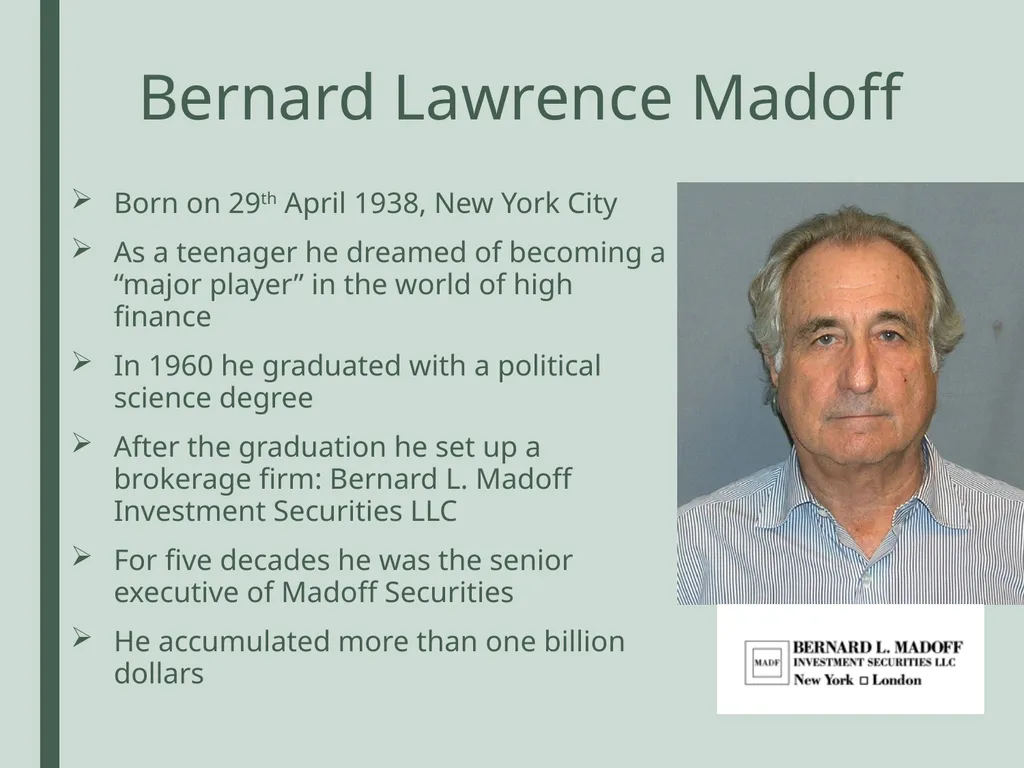
Bernard Lawrence Madoff Born on 29th April 1938, New York City
As a teenager he dreamed of becoming a “major player” in the world of high finance
In 1960 he graduated with a political science degree
After the graduation he set up a brokerage firm: Bernard L. Madoff Investment Securities LLC
For five decades he was the senior executive of Madoff Securities
He accumulated more than one billion dollars<br>
03
During its expansion Madoff Securities traded only securities of small over-the-counter companies Madoff thought that NYSE’s rules were anticompetitive and inconsistent with a free market economy In 1962 Madoff expanded his firm to include investment advisory services, becoming its most important line of business<br>
04
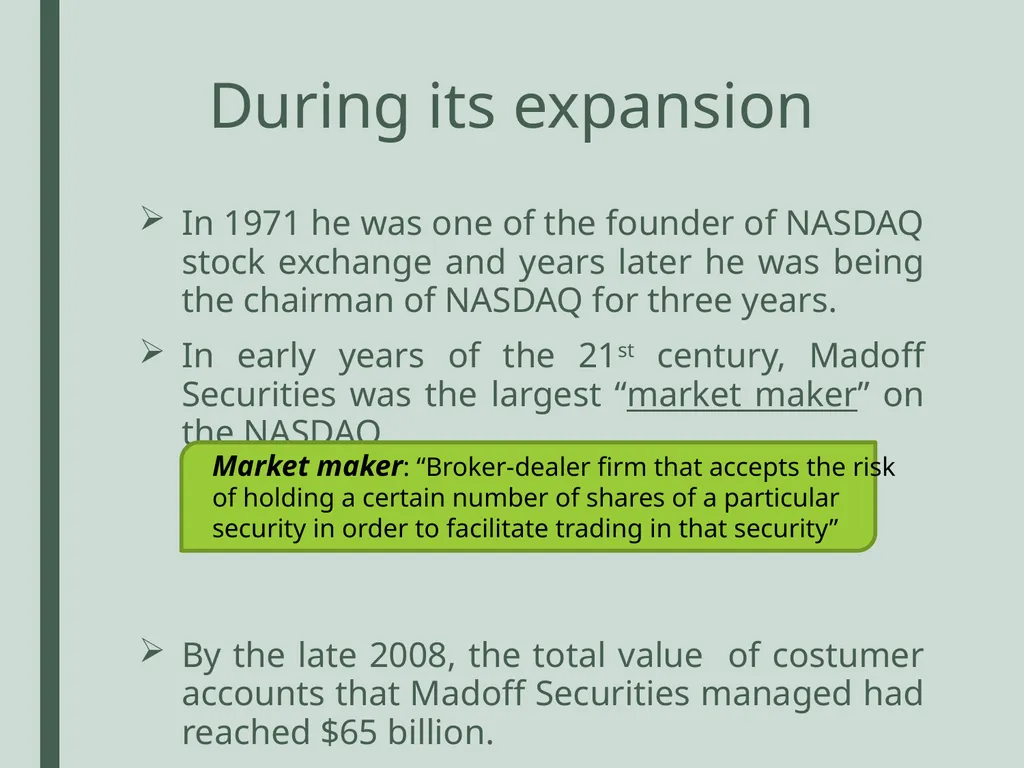
In 1971 he was one of the founder of NASDAQ stock exchange and years later he was being the chairman of NASDAQ for three years.
In early years of the 21st century, Madoff Securities was the largest “market maker” on the NASDAQ
By the late 2008, the total value of costumer accounts that Madoff Securities managed had reached $65 billion. During its expansion<br>
05
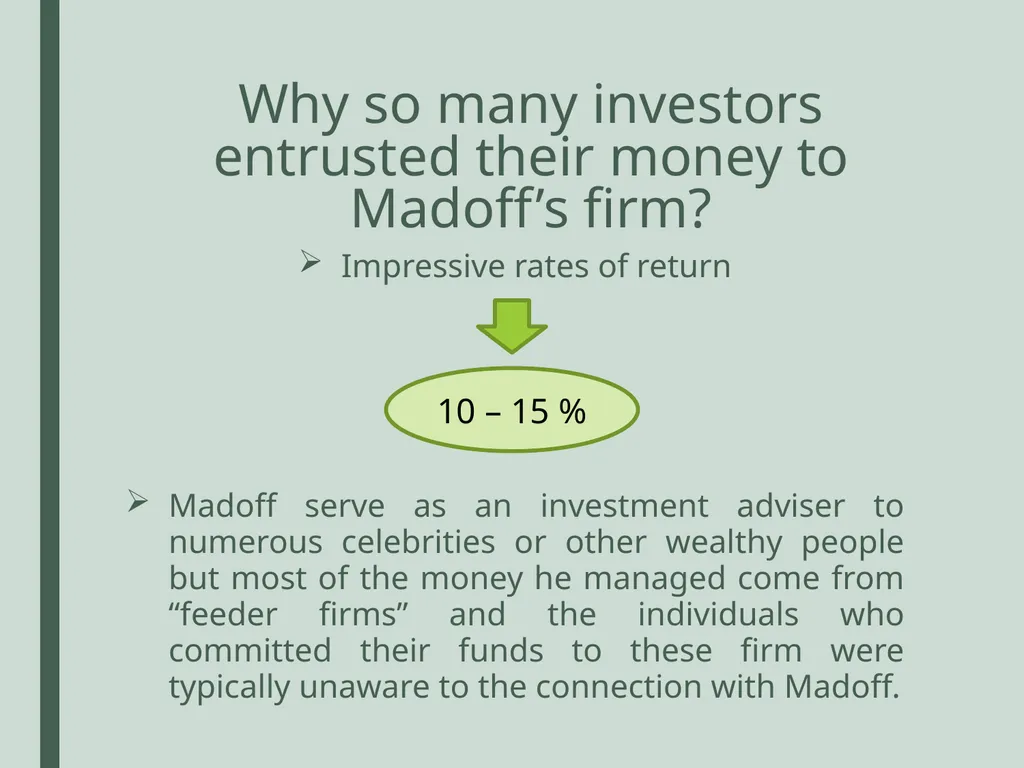
Why so many investors entrusted their money to Madoff’s firm? Impressive rates of return
Madoff serve as an investment adviser to numerous celebrities or other wealthy people but most of the money he managed come from “feeder firms” and the individuals who committed their funds to these firm were typically unaware to the connection with Madoff.<br>
06
The end of success On 10 December 2008, Madoff told his two sons who worked with him that the impressive returns of the previous decades had been fraudulent; those returns had been produced by a Ponzi scheme.
His sons notified the confession to the Securities and Exchange Commission (SEC) and in the evening FBI agents arrested Madoff.
Everyone were shocked to learn that the largest investment fraud could go undetected for decades.<br>
07
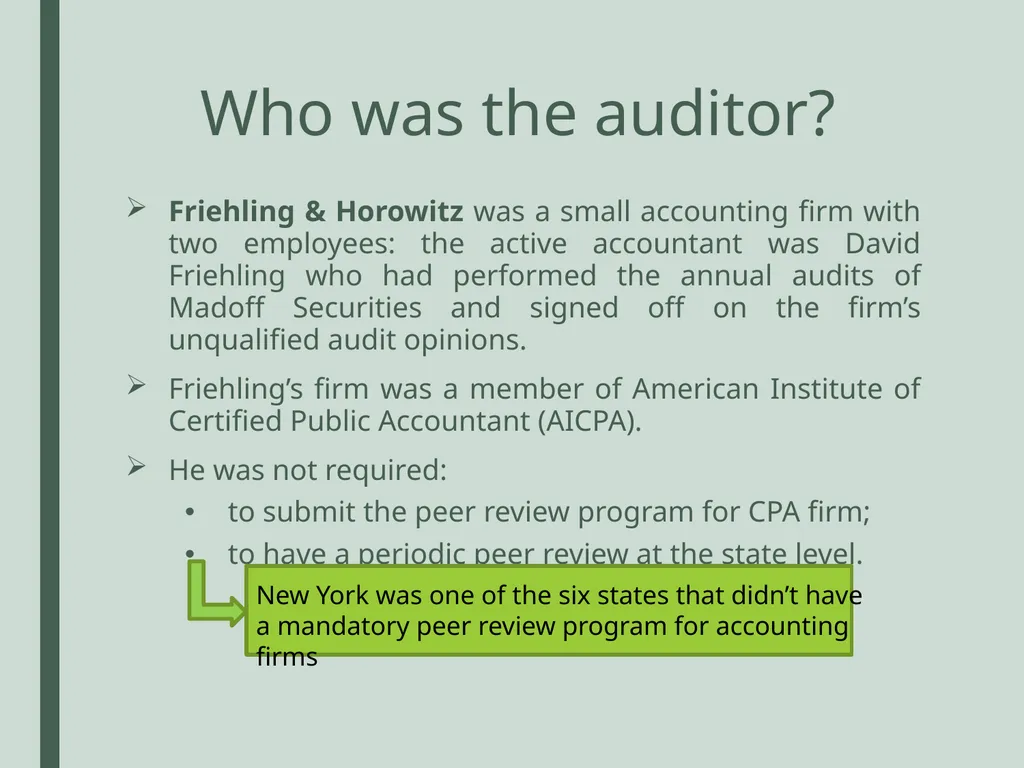
Who was the auditor? Friehling & Horowitz was a small accounting firm with two employees: the active accountant was David Friehling who had performed the annual audits of Madoff Securities and signed off on the firm’s unqualified audit opinions.
Friehling’s firm was a member of American Institute of Certified Public Accountant (AICPA).
He was not required:
to submit the peer review program for CPA firm;
to have a periodic peer review at the state level.<br>
08
In March 2009 they find out that Friehling, his fim and his family members had about $15 million invested in funds managed by Madoff.
These investments were against the independence rules of an auditor.
David Friehling was the second person arrested and the federal prosecutors charged him with securities fraud and aiding and abetting an investment fraud; the prosecutors didn’t declare that Friehling was aware of Madoff’s fraudulent scheme but he had conducted “sham audits” on Madoff Securities<br>
09
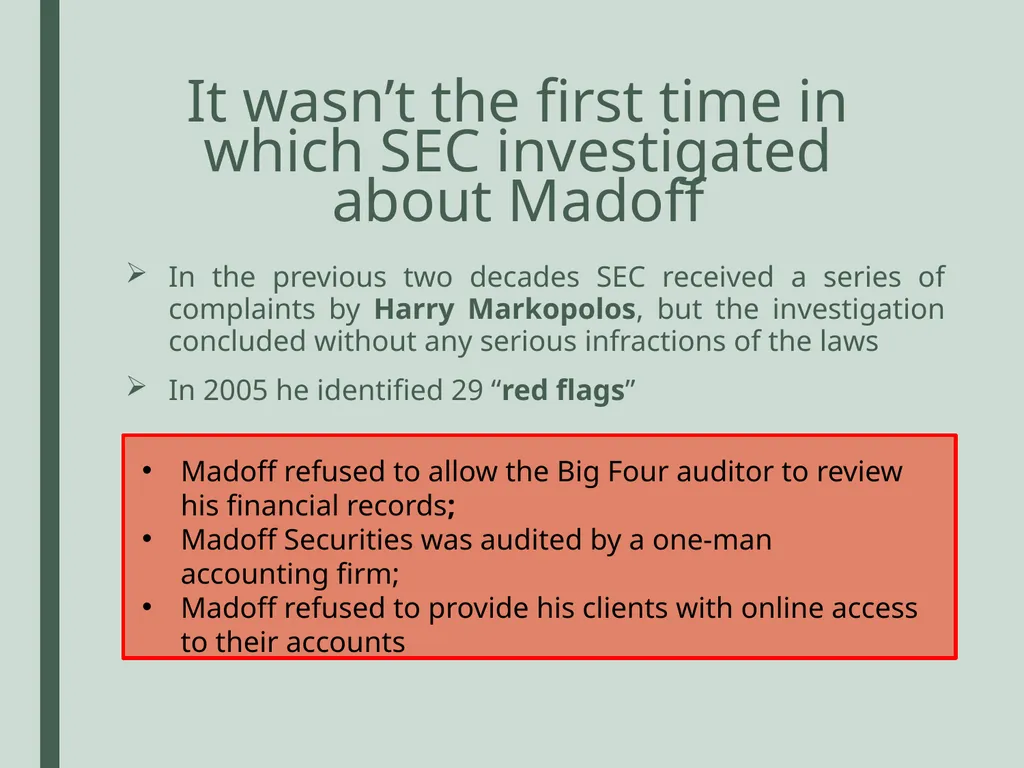
It wasn’t the first time in which SEC investigated about Madoff In the previous two decades SEC received a series of complaints by Harry Markopolos, but the investigation concluded without any serious infractions of the laws
In 2005 he identified 29 “red flags”<br>
10
Markopolos gave to SEC also some mathematical analysis in which he demonstrated that there was not sufficient transaction volume in the options market
Three key factors:
Madoff targeted investors who are unlikely to question his investment strategy
His impeccable credentials all around the financial environment
Failure of the regulatory oversight function for the stock market<br>
11
After the arrest On December 2008 passed legislation requiring New York accounting firms that provide attest services to be peer reviewed every three years
On March 12, 2009 Bernie Madoff appeared in a court-house in New York City with eleven counts of fraud, money laundering, perjury and theft pending
He refused to implicate anyone of his family or subordinates
Three months later the Judge sentenced him to 150 years in federal prison<br>
12
On February 2009, KPMG became the first of the Big Four firms to be named as a defendant in a civil lawsuit triggered by the Madoff fraud
In early 2009, President Obama replaced the SEC chairman; new procedures for investment adviser firms:
Annual “surprise audits”
Internal control audits by independent accounting firms
To ensure that credible allegations would be investigated
Examples Journalists
High-profile politicians
Nobel Prize winners
...<br>
13
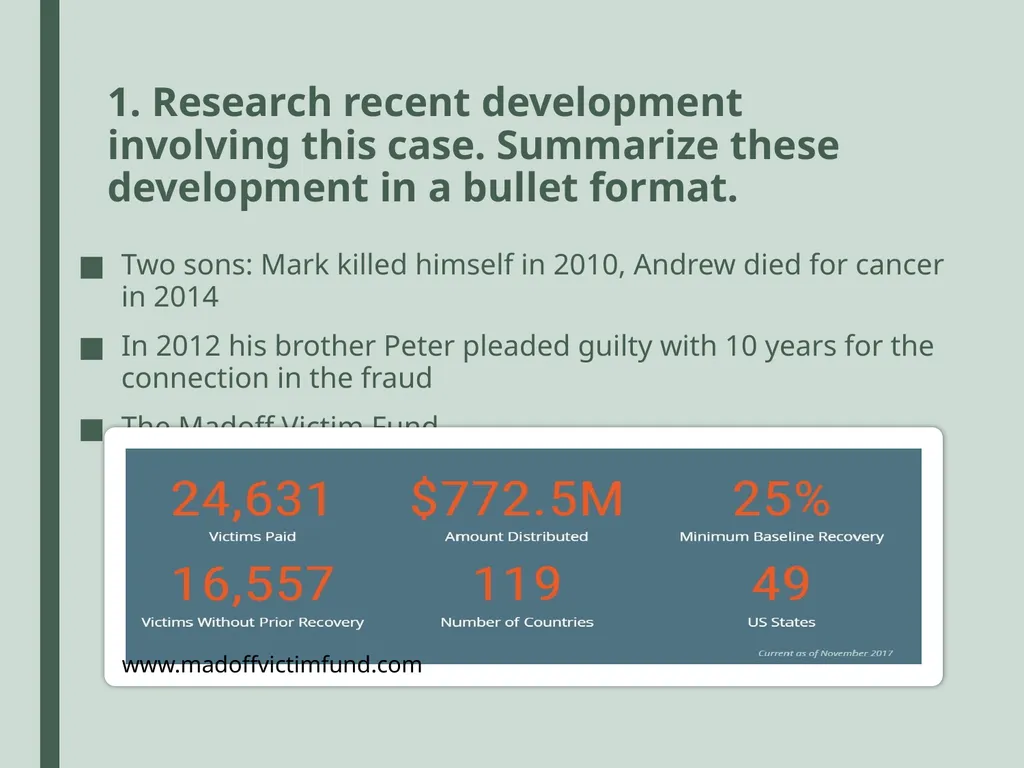
1. Research recent development involving this case. Summarize these development in a bullet format. Two sons: Mark killed himself in 2010, Andrew died for cancer in 2014
In 2012 his brother Peter pleaded guilty with 10 years for the connection in the fraud
The Madoff Victim Fund<br>
14
2. Suppose that a large investment firm had approximately 10% of its total assets invested in funds managed by Madoff Securities. What audit procedures should the investment firm’s independent auditors have applied to those assets? The auditor has to verify the existence and the valuation of the investment; verification of investments may be carried out by employing the following procedures:
Verification of transactions
Physical inspection
Examination of valuation and disclosure
Analytical review procedures<br>
15
3. Describe the nature and purpose of a “peer review”. Would peer reviews of Friehling & Horowitz have likely resulted in the discovery of the Madoff fraud? Why or why not? Peer review is a process by which a qualified CPA firm reviews the operational procedures of another CPA firm to ensure that those procedures meet certain standards.
A peer review of Friehling & Horowitz would have detected the Madoff fraud because it was senseless that a firm with just one accountant could manage a company with the size of Madoff Securities<br>
16
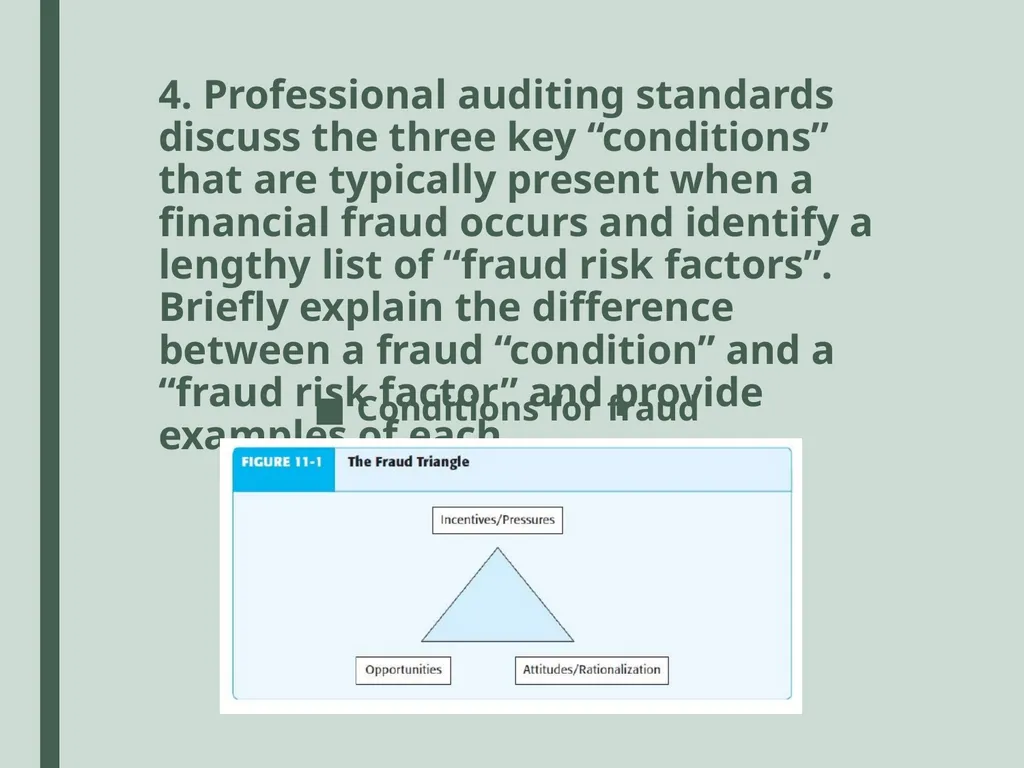
4. Professional auditing standards discuss the three key “conditions” that are typically present when a financial fraud occurs and identify a lengthy list of “fraud risk factors”. Briefly explain the difference between a fraud “condition” and a “fraud risk factor” and provide examples of each. Conditions for fraud<br>
17
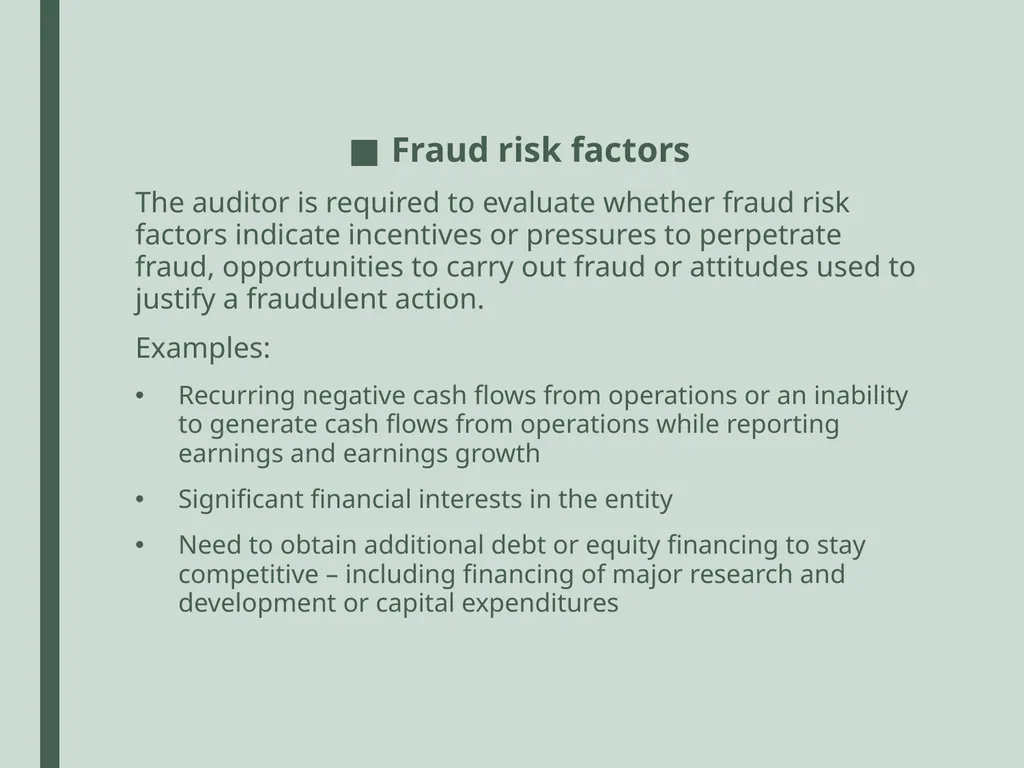
Fraud risk factors
The auditor is required to evaluate whether fraud risk factors indicate incentives or pressures to perpetrate fraud, opportunities to carry out fraud or attitudes used to justify a fraudulent action.
Examples:
Recurring negative cash flows from operations or an inability to generate cash flows from operations while reporting earnings and earnings growth
Significant financial interests in the entity
Need to obtain additional debt or equity financing to stay competitive – including financing of major research and development or capital expenditures<br>
18
5. In addition to the reforms mentioned in this case, recommend other financial reporting and auditing-related reforms that would likely be effective in preventing or detecting frauds similar to that perpetrated by Madoff. Improve transparency on the auditor’s work
Training for auditors focused on corruption and fraud awareness
Training for SEC authorities<br>