
MAGNETISM Physics Unit 9 Credits Slides created by
LS
Published · 75 slides · 0 views

1 / 1











Description
MAGNETISM Physics Unit 9 Credits Slides created by Richard Wright, Andrews Academy rwrightandrews.edu This Slideshow was developed to accompany the textbook OpenStax High School Physics Available for free at
Related Topics
Share
Embed code
Download this presentation From Below
"MAGNETISM Physics Unit 9 Credits Slides created by" is the property of its rightful owner. Permission is granted to download and print the materials on this website for personal, non-commercial use only, and to display it on your personal computer provided you do not modify the materials and that you retain all copyright notices contained in the materials. By downloading content from our website, you accept the terms of this agreement.
Presentation Transcript
01
MAGNETISM Physics Unit 9<br>
02
Credits Slides created by
Richard Wright, Andrews Academy
rwright@andrews.edu This Slideshow was developed to accompany the textbook
OpenStax High School Physics
Available for free at https://openstax.org/details/books/physics
By Paul Peter Urone and Roger Hinrichs
2020 edition
Some examples and diagrams are taken from the OpenStax College Physics, Physics, and Cutnell & Johnson Physics 6th ed.<br>
Richard Wright, Andrews Academy
rwright@andrews.edu This Slideshow was developed to accompany the textbook
OpenStax High School Physics
Available for free at https://openstax.org/details/books/physics
By Paul Peter Urone and Roger Hinrichs
2020 edition
Some examples and diagrams are taken from the OpenStax College Physics, Physics, and Cutnell & Johnson Physics 6th ed.<br>
03
9-01 Magnets and B-Fields In this lesson you will…
Explain where magnetic fields originate.
Diagram magnetic fields.
Explain how the behavior of north and south poles affects the magnetic field they create.<br>
Explain where magnetic fields originate.
Diagram magnetic fields.
Explain how the behavior of north and south poles affects the magnetic field they create.<br>
04
9-01 Magnets and B-Fields Magnets have two ends called poles
North and South poles
There are no single poles
Like poles repel, Opposite poles attract<br>
North and South poles
There are no single poles
Like poles repel, Opposite poles attract<br>
05
9-01 Magnets and B-Fields Electromagnetism
It was discovered that running current through a wire produced a magnet
The magnetism around permanent magnets and currents are very similar, so both must have common cause.
Current is the cause of all magnetism<br>
It was discovered that running current through a wire produced a magnet
The magnetism around permanent magnets and currents are very similar, so both must have common cause.
Current is the cause of all magnetism<br>
06
9-01 Magnets and B-Fields Ferromagnetism
Magnetic materials have an unpaired outer electron.
Atoms near each other line up so that the unpaired electrons spin the same direction.
This spinning creates magnetism<br>
Magnetic materials have an unpaired outer electron.
Atoms near each other line up so that the unpaired electrons spin the same direction.
This spinning creates magnetism<br>
07
9-01 Magnets and B-Fields Ferromagnetism
In permanent magnet the current is electrons in atoms.
Move around nucleus and spin
Most cancels out except in ferromagnetic materials
Ferromagnetic materials
Electron magnetic effects don’t cancel over large groups of atoms.
This gives small magnetic regions size of 0.01 to 0.1 mm called magnetic domains.
In a permanent magnet, these domains are aligned.
Common magnetic materials are iron, nickel, cobalt, and chromium dioxide.<br>
In permanent magnet the current is electrons in atoms.
Move around nucleus and spin
Most cancels out except in ferromagnetic materials
Ferromagnetic materials
Electron magnetic effects don’t cancel over large groups of atoms.
This gives small magnetic regions size of 0.01 to 0.1 mm called magnetic domains.
In a permanent magnet, these domains are aligned.
Common magnetic materials are iron, nickel, cobalt, and chromium dioxide.<br>
08
Induced Magnetism
Usually the magnetic domains are randomly arranged.
When it is placed in a B-field, the domains that are aligned with the B-field grow larger and the orientation of other domains may rotate until they are aligned.
This gives the material an overall magnetism. 9-01 Magnets and B-Fields<br>
Usually the magnetic domains are randomly arranged.
When it is placed in a B-field, the domains that are aligned with the B-field grow larger and the orientation of other domains may rotate until they are aligned.
This gives the material an overall magnetism. 9-01 Magnets and B-Fields<br>
09
9-01 Magnets and B-Fields Around a magnet is a magnetic field (B-field)
At every point in space there is a magnetic force
Can be seen with a compass
Unit is Tesla (T) Magnetic fields can be visualized with field lines.
Start at N pole and end at S pole
The more lines in one area means stronger field<br>
At every point in space there is a magnetic force
Can be seen with a compass
Unit is Tesla (T) Magnetic fields can be visualized with field lines.
Start at N pole and end at S pole
The more lines in one area means stronger field<br>
10
9-01 Homework This homework is attractive.
Read
OpenStax College Physics 2e 22.3-22.5
OR
OpenStax High School Physics 20.1
This is an interesting picture caused by magnetism.<br>
Read
OpenStax College Physics 2e 22.3-22.5
OR
OpenStax High School Physics 20.1
This is an interesting picture caused by magnetism.<br>
11
9-02 Magnetic Force on a Moving Charge In this lesson you will…
Evaluate the force on a charge moving through a magnetic field.
Use the right-hand rule to find the direction on that force.
Describe the path of a charged particle moving perpendicular to a magnetic field.<br>
Evaluate the force on a charge moving through a magnetic field.
Use the right-hand rule to find the direction on that force.
Describe the path of a charged particle moving perpendicular to a magnetic field.<br>
12
9-02 Magnetic Force on a Moving Charge Since currents (moving charges) make B-fields, then other B-fields apply a force to moving charges.
For a moving charge to experience a force
Charge must be moving
The velocity vector of the charge must have a component perpendicular to the B-field<br>
For a moving charge to experience a force
Charge must be moving
The velocity vector of the charge must have a component perpendicular to the B-field<br>
13
Direction of force on positive moving charge
Right Hand Rule
Fingers point in direction of B-field
Thumb in direction of v
Palm faces direction of F on positive charge
Force will be zero if v and B are parallel, so a moving charge will be unaffected 9-02 Magnetic Force on a Moving Charge<br>
Right Hand Rule
Fingers point in direction of B-field
Thumb in direction of v
Palm faces direction of F on positive charge
Force will be zero if v and B are parallel, so a moving charge will be unaffected 9-02 Magnetic Force on a Moving Charge<br>
14
9-02 Magnetic Force on a Moving Charge<br>
15
9-02 Magnetic Force on a Moving Charge Bubble Chamber Mass Spectrometer<br>
16
9-02 Magnetic Force on a Moving Charge<br>
17
9-02 Homework Force yourself to finish this work
Read
OpenStax College Physics 2e 22.7-22.8
OR
OpenStax High School Physics 20.2<br>
Read
OpenStax College Physics 2e 22.7-22.8
OR
OpenStax High School Physics 20.2<br>
18
9-03 Magnetic Force on Current-Carrying Wire In this lesson you will…
Use the right-hand rule to determine the direction of force on a current-carrying wire.
Explain how an electric motor works.<br>
Use the right-hand rule to determine the direction of force on a current-carrying wire.
Explain how an electric motor works.<br>
19
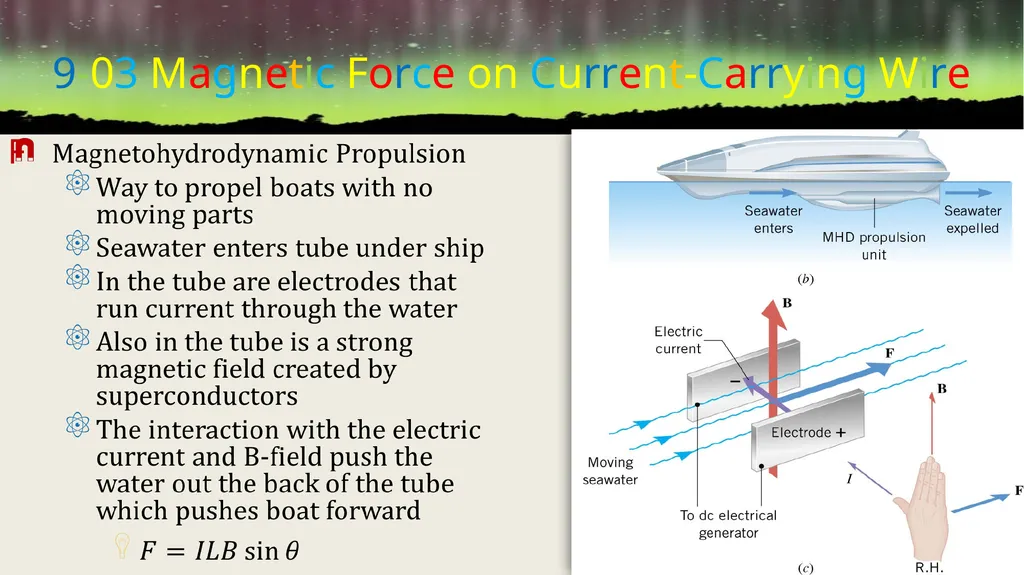
9-03 Magnetic Force on Current-Carrying Wire<br>
20
9-03 Magnetic Force on Current-Carrying Wire Speakers
Coil of wire attached to cone
That is enclose by a magnet
A varying current is run through the wire
The current in the B-field makes the speaker cone move back and forth<br>
Coil of wire attached to cone
That is enclose by a magnet
A varying current is run through the wire
The current in the B-field makes the speaker cone move back and forth<br>
21
9-03 Magnetic Force on Current-Carrying Wire<br>
22
9-03 Magnetic Force on Current-Carrying Wire<br>
23
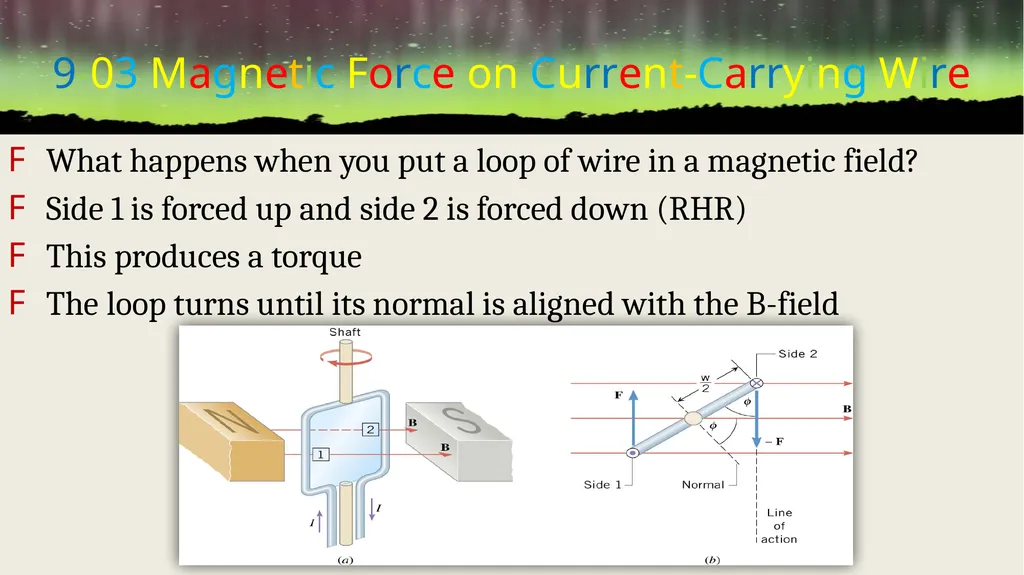
What happens when you put a loop of wire in a magnetic field?
Side 1 is forced up and side 2 is forced down (RHR)
This produces a torque
The loop turns until its normal is aligned with the B-field 9-03 Magnetic Force on Current-Carrying Wire<br>
Side 1 is forced up and side 2 is forced down (RHR)
This produces a torque
The loop turns until its normal is aligned with the B-field 9-03 Magnetic Force on Current-Carrying Wire<br>
24
9-03 Magnetic Force on Current-Carrying Wire<br>
25
9-03 Magnetic Force on Current-Carrying Wire Electric Motor
Many loops of current-carrying wire placed between two magnets (B-field)
The loops are attached to half-rings
The torque turns the loops until the normal is aligned to B-field
At that point the half-rings don’t connect to electric current
Momentum makes the loop turn more
The half-rings connect with the current to repeat the process<br>
Many loops of current-carrying wire placed between two magnets (B-field)
The loops are attached to half-rings
The torque turns the loops until the normal is aligned to B-field
At that point the half-rings don’t connect to electric current
Momentum makes the loop turn more
The half-rings connect with the current to repeat the process<br>
26
9-03 Magnetic Force on Current-Carrying Wire<br>
27
9-03 Homework Don’t get stuck on these magnet problems
Read
OpenStax College Physics 2e 22.9-22.11
OR
OpenStax High School Physics 20.1<br>
Read
OpenStax College Physics 2e 22.9-22.11
OR
OpenStax High School Physics 20.1<br>
28
9-04 Magnetic Fields Produced by Currents In this lesson you will…
Diagram magnetic fields around current-carrying wires.
Use the right-hand rule to find the direction of a magnetic field around a current-carrying wire.
Find the attractive or repulsive force between two current-carrying wires.<br>
Diagram magnetic fields around current-carrying wires.
Use the right-hand rule to find the direction of a magnetic field around a current-carrying wire.
Find the attractive or repulsive force between two current-carrying wires.<br>
29
9-04 Magnetic Fields Produced by Currents<br>
30
9-04 Magnetic Fields Produced by Currents<br>
31
9-04 Magnetic Fields Produced by Currents<br>
32
9-04 Magnetic Fields Produced by Currents<br>
33
A long straight current-carrying wire runs from north to south.
A compass needle is placed above the wire points with its N-pole toward the east. In what direction is the current flowing?
If a compass is put underneath the wire, in which direction will the needle point?
A single straight wire produces a B-field. Another wire is parallel and carries an identical current. If the two currents are in the same direction, how would the magnetic field be affected? What if the currents are in the opposite direction? 9-04 Magnetic Fields Produced by Currents<br>
A compass needle is placed above the wire points with its N-pole toward the east. In what direction is the current flowing?
If a compass is put underneath the wire, in which direction will the needle point?
A single straight wire produces a B-field. Another wire is parallel and carries an identical current. If the two currents are in the same direction, how would the magnetic field be affected? What if the currents are in the opposite direction? 9-04 Magnetic Fields Produced by Currents<br>
34
9-04 Magnetic Fields Produced by Currents<br>
35
9-04 Magnetic Fields Produced by Currents<br>
36
9-04 Homework You can field these questions easily.
Read
OpenStax College Physics 2e 23.1-23.2
OR
OpenStax High School Physics 20.3<br>
Read
OpenStax College Physics 2e 23.1-23.2
OR
OpenStax High School Physics 20.3<br>
37
9-05 Faraday’s Law of Induction and Lenz’s Law In this lesson you will…
Explain the effects of moving a magnet through a coil of wire.
Explain that currents produced by changes in magnetic fields represent systems wanting to avoid change.
Use the Faraday-Lenz law to calculate how the change in magnetic flux generates electromotive force.<br>
Explain the effects of moving a magnet through a coil of wire.
Explain that currents produced by changes in magnetic fields represent systems wanting to avoid change.
Use the Faraday-Lenz law to calculate how the change in magnetic flux generates electromotive force.<br>
38
Magnetic field can produce current.
The magnetic field must be moving to create current.
The current created is called induced current.
The emf that causes the current is called induced emf. 9-05 Faraday’s Law of Induction and Lenz’s Law<br>
The magnetic field must be moving to create current.
The current created is called induced current.
The emf that causes the current is called induced emf. 9-05 Faraday’s Law of Induction and Lenz’s Law<br>
39
9-05 Faraday’s Law of Induction and Lenz’s Law Another way to induce emf is by changing the area of a coil of wire in a magnetic field.<br>
40
9-05 Faraday’s Law of Induction and Lenz’s Law<br>
41
9-05 Faraday’s Law of Induction and Lenz’s Law<br>
42
9-05 Faraday’s Law of Induction and Lenz’s Law<br>
43
9-05 Faraday’s Law of Induction and Lenz’s Law<br>
44
9-05 Faraday’s Law of Induction and Lenz’s Law<br>
45
9-05 Faraday’s Law of Induction and Lenz’s Law Lenz’s Law
The induced emf resulting from a changing magnetic flux has a polarity that leads to an induced current whose direction is such that the induced magnetic field opposes the original flux change.
Reasoning Strategy
Determine whether the magnetic flux is increasing or decreasing.
Find what direction the induced magnetic field must be to oppose the change in flux by adding or subtracting from the original field.
Having found the direction of the magnetic field, use the right-hand rule to find the direction of the induced current.<br>
The induced emf resulting from a changing magnetic flux has a polarity that leads to an induced current whose direction is such that the induced magnetic field opposes the original flux change.
Reasoning Strategy
Determine whether the magnetic flux is increasing or decreasing.
Find what direction the induced magnetic field must be to oppose the change in flux by adding or subtracting from the original field.
Having found the direction of the magnetic field, use the right-hand rule to find the direction of the induced current.<br>
46
9-05 Faraday’s Law of Induction and Lenz’s Law A copper ring falls through a rectangular region of a magnetic field as illustrated. What is the direction of the induced current at each of the five positions?<br>
47
9-05 Homework Follow the Laws
Read
OpenStax College Physics 2e 23.3-23.4
OR
OpenStax High School Physics 20.3<br>
Read
OpenStax College Physics 2e 23.3-23.4
OR
OpenStax High School Physics 20.3<br>
48
9-06 Motional emf and Magnetic Damping In this lesson you will…
• Calculate emf, force, magnetic field, and work due to the motion of an object in a magnetic field.
• Explain the magnitude and direction of an induced eddy current, and the effect this will have on the object it is induced in.
• Describe several applications of magnetic damping.<br>
• Calculate emf, force, magnetic field, and work due to the motion of an object in a magnetic field.
• Explain the magnitude and direction of an induced eddy current, and the effect this will have on the object it is induced in.
• Describe several applications of magnetic damping.<br>
49
9-06 Motional emf and Magnetic Damping<br>
50
9-06 Motional emf and Magnetic Damping<br>
51
9-06 Motional emf and Magnetic Damping It takes a force to move the rod.
Once the electrons are moving in the rod, there is another force. The moving electrons in a B-field create a magnetic force on the rod itself.
According to the RHR, the force is opposite the motion of the rod. If there were no force pushing the rod, it would stop.<br>
Once the electrons are moving in the rod, there is another force. The moving electrons in a B-field create a magnetic force on the rod itself.
According to the RHR, the force is opposite the motion of the rod. If there were no force pushing the rod, it would stop.<br>
52
9-06 Motional emf and Magnetic Damping Damping
When a conductor moves into (or out of) a magnetic field, an eddy current is created in the conductor
As the conductor moves into B-field, the flux increases
This produces a current by Faraday’s Law and is directed in way that opposes change in flux.
This current’s B-field causes a force on the conductor
The direction of the force will be opposite the motion of the conductor<br>
When a conductor moves into (or out of) a magnetic field, an eddy current is created in the conductor
As the conductor moves into B-field, the flux increases
This produces a current by Faraday’s Law and is directed in way that opposes change in flux.
This current’s B-field causes a force on the conductor
The direction of the force will be opposite the motion of the conductor<br>
53
9-06 Motional emf and Magnetic Damping<br>
54
9-06 Motional emf and Magnetic Damping Applications of Magnetic Damping
Stopping a balance from moving
Brakes on trains/rollercoasters
No actual sliding parts, not effected by rain, smoother
Since based on speed, need conventional brakes to finish
Sorting recyclables
Metallic objects move slower down ramp<br>
Stopping a balance from moving
Brakes on trains/rollercoasters
No actual sliding parts, not effected by rain, smoother
Since based on speed, need conventional brakes to finish
Sorting recyclables
Metallic objects move slower down ramp<br>
55
9-06 Motional emf and Magnetic Damping Metal Detectors
Primary coil has AC current
This induces current in metal
The induced current creates a B-field
This induced B-field creates current in secondary coil which sends signal to user<br>
Primary coil has AC current
This induces current in metal
The induced current creates a B-field
This induced B-field creates current in secondary coil which sends signal to user<br>
56
9-06 Homework Don’t let the homework dampen your spirits
Read
OpenStax College Physics 2e 23.5-23.6
OR
OpenStax High School Physics 20.2<br>
Read
OpenStax College Physics 2e 23.5-23.6
OR
OpenStax High School Physics 20.2<br>
57
9-07 Electric Generators and Back Emf In this lesson you will…
• Calculate the emf induced in a generator.
• Calculate the peak emf which can be induced in a particular generator system.
• Explain what back emf is and how it is induced.<br>
• Calculate the emf induced in a generator.
• Calculate the peak emf which can be induced in a particular generator system.
• Explain what back emf is and how it is induced.<br>
58
9-07 Electric Generators and Back Emf A loop of wire is rotated in a magnetic field.
Since the angle between the loop and the B-field is changing, the flux is changing.
Since the magnetic flux is changing an emf is induced.<br>
Since the angle between the loop and the B-field is changing, the flux is changing.
Since the magnetic flux is changing an emf is induced.<br>
59
9-07 Electric Generators and Back Emf<br>
60
9-07 Electric Generators and Back Emf<br>
61
9-07 Electric Generators and Back Emf<br>
62
According to Lenz’s Law, the current will flow the one direction when the angle is increasing and it will flow the opposite direction when the angle is decreasing.
These generators often called alternating current generators. 9-07 Electric Generators and Back Emf<br>
These generators often called alternating current generators. 9-07 Electric Generators and Back Emf<br>
63
You have made a simple generator to power a TV. The armature is attached the rear axle of a stationary bike. For every time you peddle, the rear axel turns 10 times. Your TV needs a Vrms of 110V to operate. If the B-field is 0.2 T, each loop is a circle with r = 3 cm, and you can comfortably peddle 3 times a second; how many loops must you have in your generator so that you can watch TV while you exercise?
1460 loops 9-07 Electric Generators and Back Emf<br>
1460 loops 9-07 Electric Generators and Back Emf<br>
64
9-07 Electric Generators and Back Emf<br>
65
9-07 Homework Please generate plenty of answers
Read
OpenStax College Physics 2e 23.7-23.8
OR
OpenStax High School Physics 20.2<br>
Read
OpenStax College Physics 2e 23.7-23.8
OR
OpenStax High School Physics 20.2<br>
66
9-08 Transformers and Electrical Safety In this lesson you will…
• Explain how a transformer works.
• Calculate voltage, current, and/or number of turns given the other quantities.
• Explain how various modern safety features in electric circuits work, with an emphasis on how induction is employed.<br>
• Explain how a transformer works.
• Calculate voltage, current, and/or number of turns given the other quantities.
• Explain how various modern safety features in electric circuits work, with an emphasis on how induction is employed.<br>
67
The voltage in a wall outlet is approximately 110V.
Many electrical appliances can’t handle that many volts.
Computer speakers 9V
Projection TV 15000V
A transformer changes the voltage for the appliance. 9-08 Transformers and Electrical Safety<br>
Many electrical appliances can’t handle that many volts.
Computer speakers 9V
Projection TV 15000V
A transformer changes the voltage for the appliance. 9-08 Transformers and Electrical Safety<br>
68
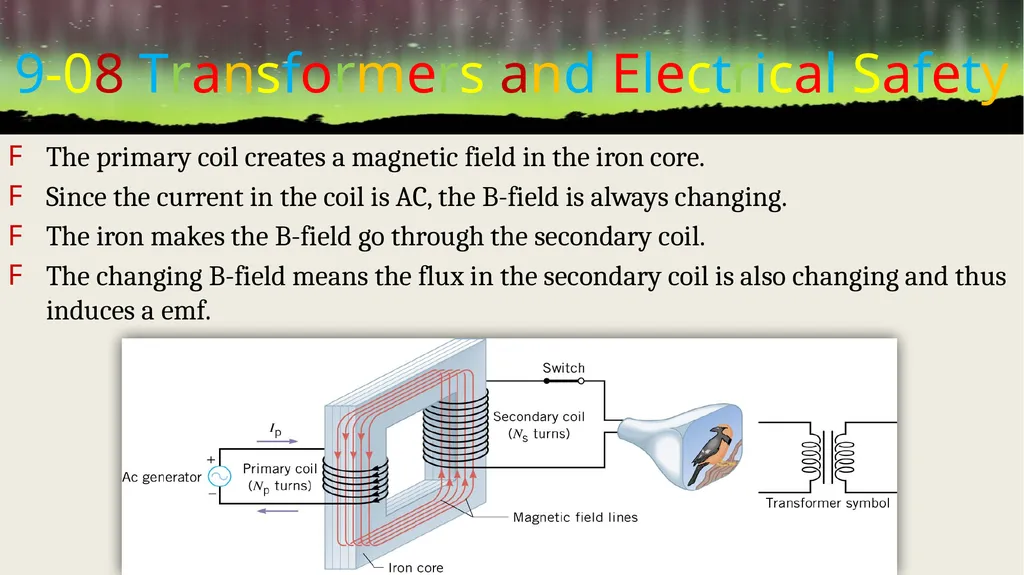
9-08 Transformers and Electrical Safety The primary coil creates a magnetic field in the iron core.
Since the current in the coil is AC, the B-field is always changing.
The iron makes the B-field go through the secondary coil.
The changing B-field means the flux in the secondary coil is also changing and thus induces a emf.<br>
Since the current in the coil is AC, the B-field is always changing.
The iron makes the B-field go through the secondary coil.
The changing B-field means the flux in the secondary coil is also changing and thus induces a emf.<br>
69
9-08 Transformers and Electrical Safety<br>
70
9-08 Transformers and Electrical Safety<br>
71
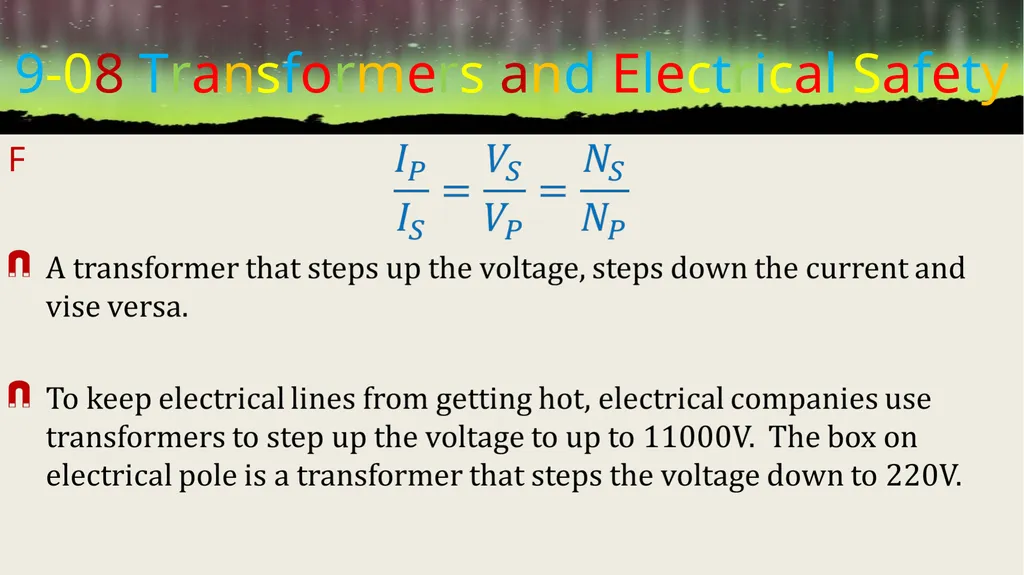
A TV requires 15000V and 0.01 A to accelerate the electron beam. The outlet in the house supplies 120V. The primary coil of the transformer in the TV has 100 turns. How many turns should the secondary coil have?
12500 turns
How much current does the TV draw from the outlet?
1.25 A 9-08 Transformers and Electrical Safety<br>
12500 turns
How much current does the TV draw from the outlet?
1.25 A 9-08 Transformers and Electrical Safety<br>
72
9-08 Transformers and Electrical Safety Safety
Two grounds
White wire
Wide prong
Return through ground
Green wire
3rd prong
Grounds the case
Hot wire
Black/red
Carries the higher voltage<br>
Two grounds
White wire
Wide prong
Return through ground
Green wire
3rd prong
Grounds the case
Hot wire
Black/red
Carries the higher voltage<br>
73
9-08 Transformers and Electrical Safety Circuit Breaker
If the current load gets too large, an electromagnet pulls a switch to stop the current
Stops wires from getting hot in short circuits<br>
If the current load gets too large, an electromagnet pulls a switch to stop the current
Stops wires from getting hot in short circuits<br>
74
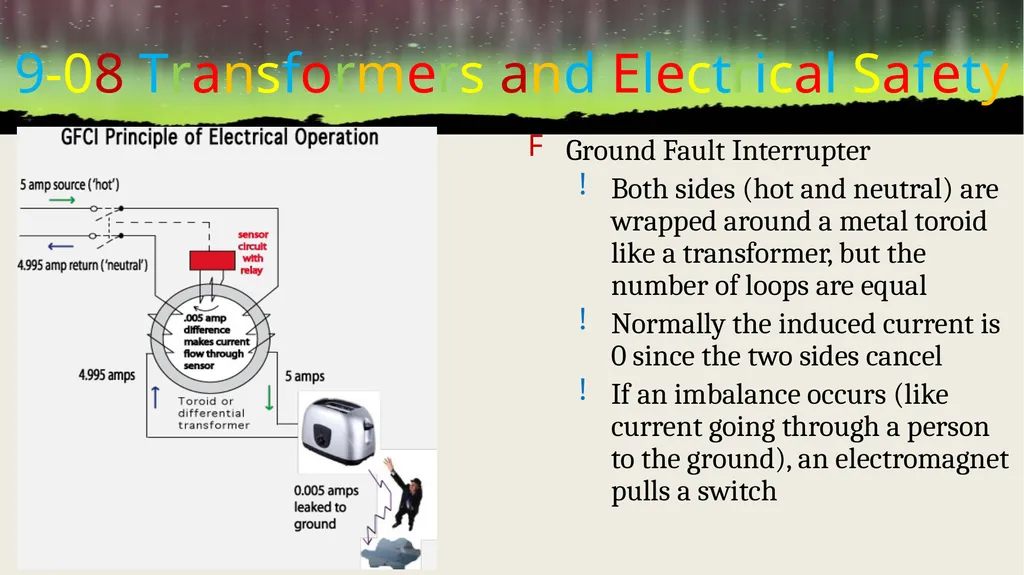
9-08 Transformers and Electrical Safety Ground Fault Interrupter
Both sides (hot and neutral) are wrapped around a metal toroid like a transformer, but the number of loops are equal
Normally the induced current is 0 since the two sides cancel
If an imbalance occurs (like current going through a person to the ground), an electromagnet pulls a switch<br>
Both sides (hot and neutral) are wrapped around a metal toroid like a transformer, but the number of loops are equal
Normally the induced current is 0 since the two sides cancel
If an imbalance occurs (like current going through a person to the ground), an electromagnet pulls a switch<br>
75
9-08 Homework Please transform the questions into answers<br>