
Managing anxiety: practical guidance for schools





Description: Managing anxiety: practical guidance for schools in Cornwall and the Isles of Scilly Dr Lynette Rentoul, Independent Consultant Clinical Psychologist Clinical Lead, CAMHS, NHS Kernow Clinical Commissioning Group Understanding the nature of
Related Topics
Download Presentation
"Managing anxiety: practical guidance for schools" is the property of its rightful owner. Permission is granted to download and print the materials on this website for personal, non-commercial use only, and to display it on your personal computer provided you do not modify the materials and that you retain all copyright notices contained in the materials. By downloading content from our website, you accept the terms of this agreement.
Presentation Transcript
slide1. Managing anxiety: practical guidance for schools in Cornwall and the Isles of Scilly Dr Lynette Rentoul, Independent Consultant Clinical Psychologist
Clinical Lead, CAMHS, NHS Kernow Clinical Commissioning Group<br>
slide2. Understanding the nature of anxiety Anxiety is a normal, human feeling of fear, apprehension or panic –a sense that something fearful or even disastrous may happen. It can be part of a helpful warning system, when there is danger.
It occurs when we don’t feel safe. When we face scary situations, the brain’s built in alarm system warns us that something isn’t right. It makes us feel more alert, stops us thinking about other things (can’t learn) and sets off the alarm (arousal) system to prepare us for action or get help. Affects body, thinking and feelings. Arousal responses: Flight; Flight ore Freeze
Most of us worry at times –about friendships, parents, health, school pressures, natural disasters, news items, but usually worries go away, because we are helped or cope.
Sometimes worries don’t go away, ‘Fears take over our minds’ and affect all aspects of life - anxiety itself becomes a problem, and needs special help to sort out. Child may end up feeling anxious all the time, and no longer know exactly what they fear –simply preoccupied with their fears. Anxiety becomes a problem.<br>
slide3. Understanding the early roots of anxiety: the foundations in neuroscience During the early years, we are dependent on adults to understand & attend to our needs in trusted & consistent ways, -keep us calm & safe.
Young children experience strong emotions and require carers to think for them & sooth and calm them when anxious; contain their anxiety.
Soothing a distressed child supports ‘emotion regulation’ and is vital so that immature brains are not overwhelmed by anxiety (toxic stress).
Responsive parenting soothes & regulates child’s anxiety, they feel safe and free to explore and play; ‘secure base’ & ‘secure attachment’.
Separation or unresponsive/unpredictable/unsafe responses cause great anxiety, which the child can’t regulate –child feels unsafe & anxious.
Children need trusted adults to support feelings of safety & security.
The world can feel scary to children, so adults need to reassure them; help them problem solve when they feel overwhelmed to feel safe again.<br>
slide4. Anxiety may underpin many behaviours that challenge at home and school Facing adversity provokes anxiety, to which children adapt; these adaptations (defences) may themselves cause problems (child sees them as helpful strategies), and not work in safe settings. Child becomes more vulnerable to impact of everyday pressures.
Some children become angry, demanding or controlling because of their fears (Fight) –to make things happen in predictable ways; to avoid feelings of shame; to ensure they are seen (if they fear they are invisible); their ways of managing unpredictable adults; experience dysregulation (Ambivalent attachment strategies).
Some children fear criticism; judgment; punishment; getting things wrong; they are wary of others, & so avoid contact, and may seem rather cut off, isolated, lack social confidence (Flight). May find learning shaming, fear getting things wrong (Avoidant attachment).<br>
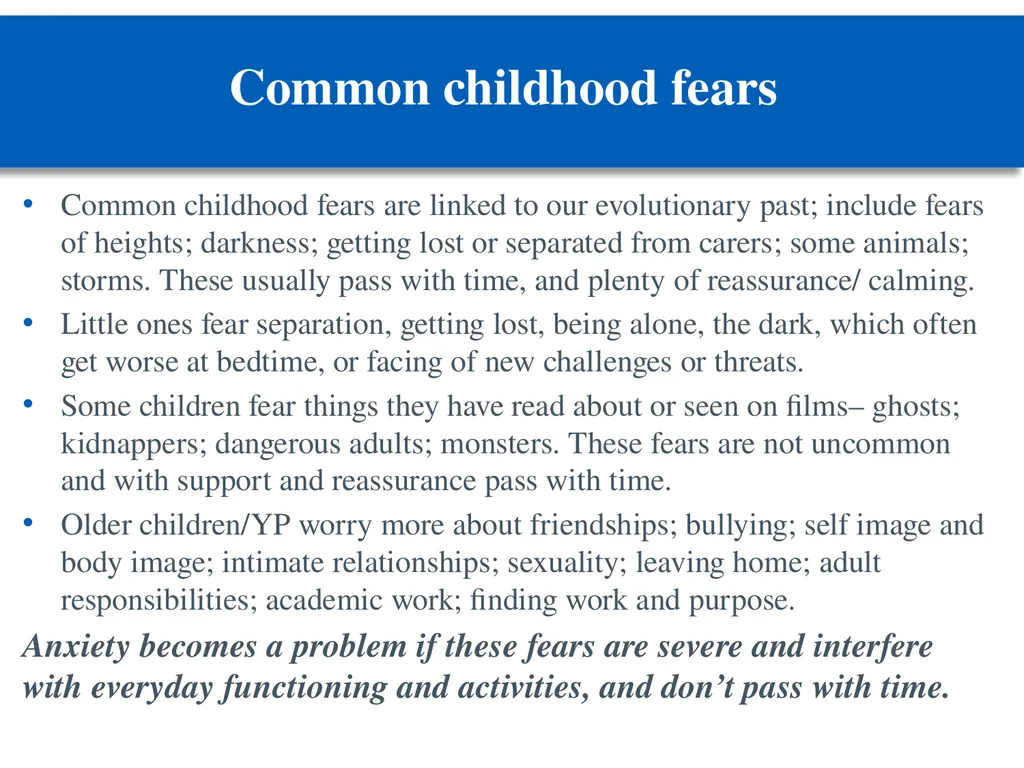
slide5. Common childhood fears Common childhood fears are linked to our evolutionary past; include fears of heights; darkness; getting lost or separated from carers; some animals; storms. These usually pass with time, and plenty of reassurance/ calming.
Little ones fear separation, getting lost, being alone, the dark, which often get worse at bedtime, or facing of new challenges or threats.
Some children fear things they have read about or seen on films– ghosts; kidnappers; dangerous adults; monsters. These fears are not uncommon and with support and reassurance pass with time.
Older children/YP worry more about friendships; bullying; self image and body image; intimate relationships; sexuality; leaving home; adult responsibilities; academic work; finding work and purpose.
Anxiety becomes a problem if these fears are severe and interfere with everyday functioning and activities, and don’t pass with time.<br>
slide6. The signs of anxiety: physical, thoughts and feelings Feeling nervous, on edge, panicky, clingy a lot of the time
Feeling something bad is going to happen; feeling full of dread
Feeling out of control; finding it hard to concentrate, learn or play
Having trouble sleeping; being worried about bedtime; nightmares
Losing appetite; wanting to eat more for comfort; tummy aches.
Feeling tired, grumpy and edgy; increased distress; temper outbursts
Physical feelings, like ‘butterfly tummy’, heart beating faster, dry mouth, trembling, feeling faint, sweating more than usual; fidgety.
Feeling afraid of things that were previously enjoyed, such as afraid of separation from parents; afraid of going to school; or of going out with friends; not wanting to go out to clubs and leisure activities
Wanting to stay at home/school, because that place that feels safe.<br>
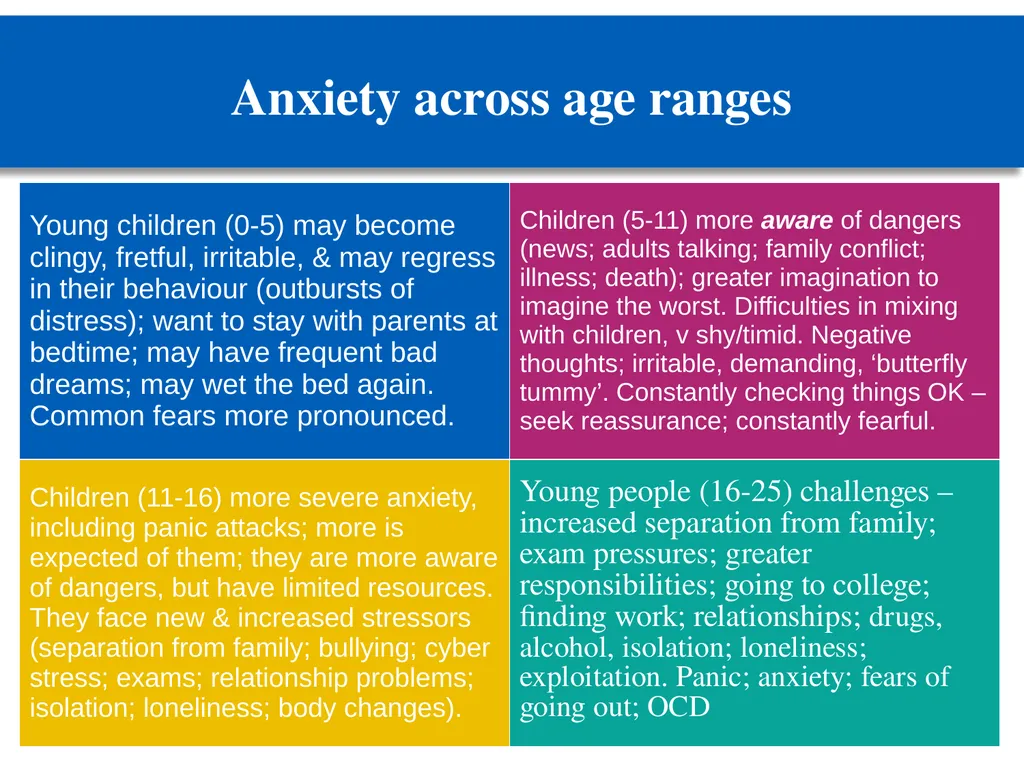
slide7. Anxiety across age ranges<br>
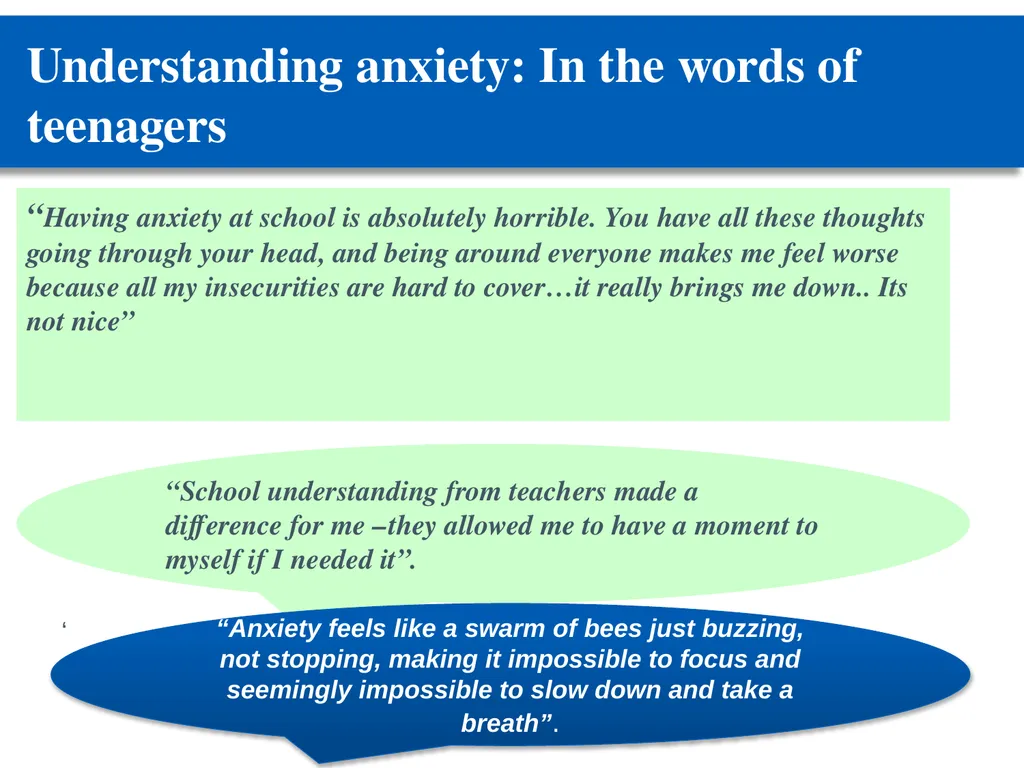
slide8. Understanding anxiety: In the words of teenagers ‘ “Having anxiety at school is absolutely horrible. You have all these thoughts going through your head, and being around everyone makes me feel worse because all my insecurities are hard to cover…it really brings me down.. Its not nice” “School understanding from teachers made a difference for me –they allowed me to have a moment to myself if I needed it”. “Anxiety feels like a swarm of bees just buzzing, not stopping, making it impossible to focus and seemingly impossible to slow down and take a breath”.<br>
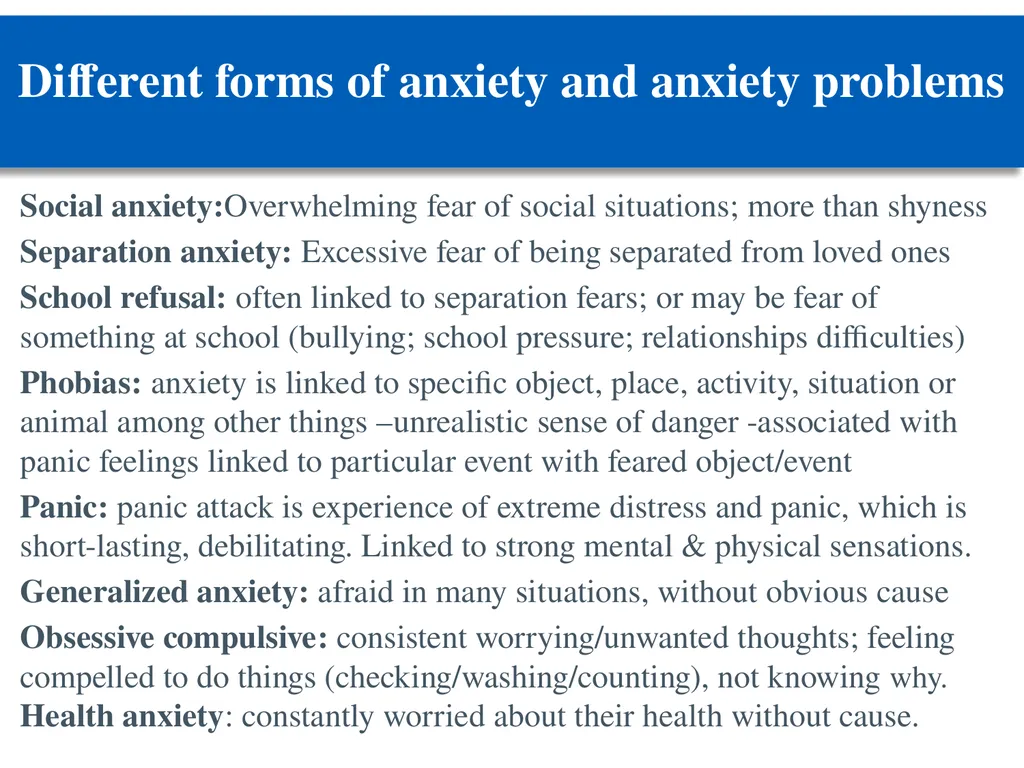
slide9. Different forms of anxiety and anxiety problems Social anxiety:Overwhelming fear of social situations; more than shyness
Separation anxiety: Excessive fear of being separated from loved ones
School refusal: often linked to separation fears; or may be fear of something at school (bullying; school pressure; relationships difficulties)
Phobias: anxiety is linked to specific object, place, activity, situation or animal among other things –unrealistic sense of danger -associated with panic feelings linked to particular event with feared object/event
Panic: panic attack is experience of extreme distress and panic, which is short-lasting, debilitating. Linked to strong mental & physical sensations.
Generalized anxiety: afraid in many situations, without obvious cause
Obsessive compulsive: consistent worrying/unwanted thoughts; feeling compelled to do things (checking/washing/counting), not knowing why. Health anxiety: constantly worried about their health without cause.<br>
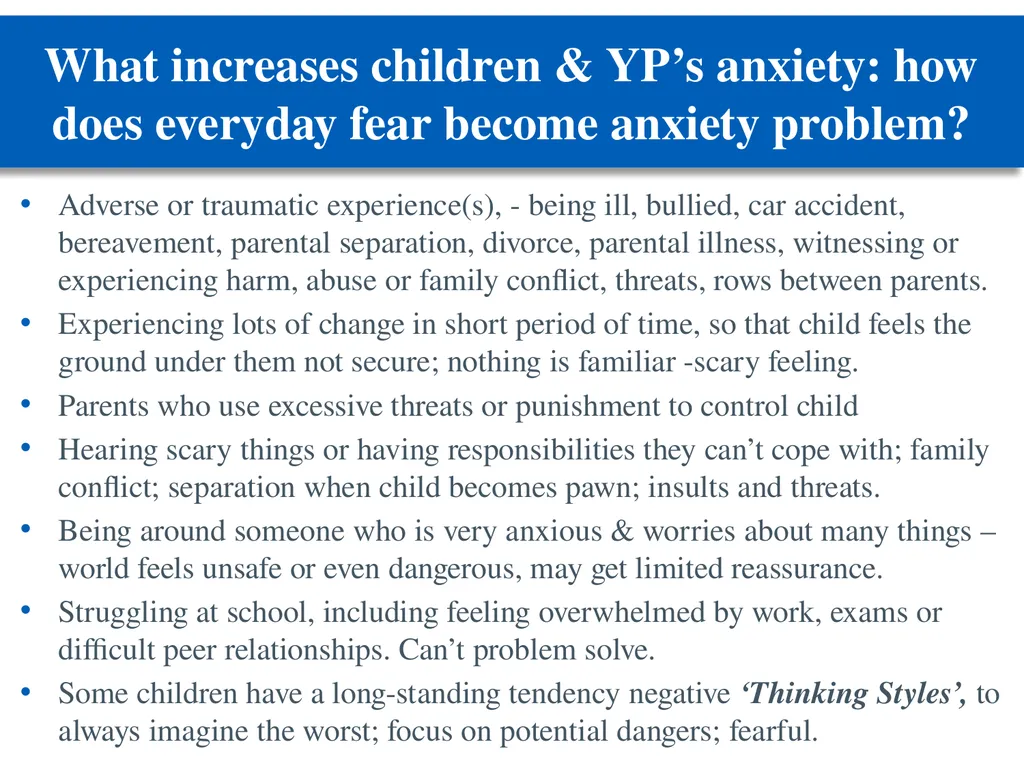
slide10. What increases children & YP’s anxiety: how does everyday fear become anxiety problem? Adverse or traumatic experience(s), - being ill, bullied, car accident, bereavement, parental separation, divorce, parental illness, witnessing or experiencing harm, abuse or family conflict, threats, rows between parents.
Experiencing lots of change in short period of time, so that child feels the ground under them not secure; nothing is familiar -scary feeling.
Parents who use excessive threats or punishment to control child
Hearing scary things or having responsibilities they can’t cope with; family conflict; separation when child becomes pawn; insults and threats.
Being around someone who is very anxious & worries about many things –world feels unsafe or even dangerous, may get limited reassurance.
Struggling at school, including feeling overwhelmed by work, exams or difficult peer relationships. Can’t problem solve.
Some children have a long-standing tendency negative ‘Thinking Styles’, to always imagine the worst; focus on potential dangers; fearful.<br>
slide11. Anxiety and the impact of Covid restrictions Covid and its impact has made many children & YP feel unsafe. Threats associated with it increase our worries about safety; health; wellbeing of family and friends; predictability of the world they know.
Increases our feeling of loneliness and isolation –limits access to friends and families, who are sources of comfort and safety
Our connections and routines are disrupted –these normally support our feelings of security, predictability & safety
Covid threatens our sense that our worlds are safe and predictable –as if the carpet has been pulled from under us.
Pressures on our families, increases parental distress, anxiety and conflict and causes anxiety among children. Parental distress may undermine capacity to attend to and regulate children’s anxieties
Loss of playful, relaxing and learning opportunities increases anxiety.<br>
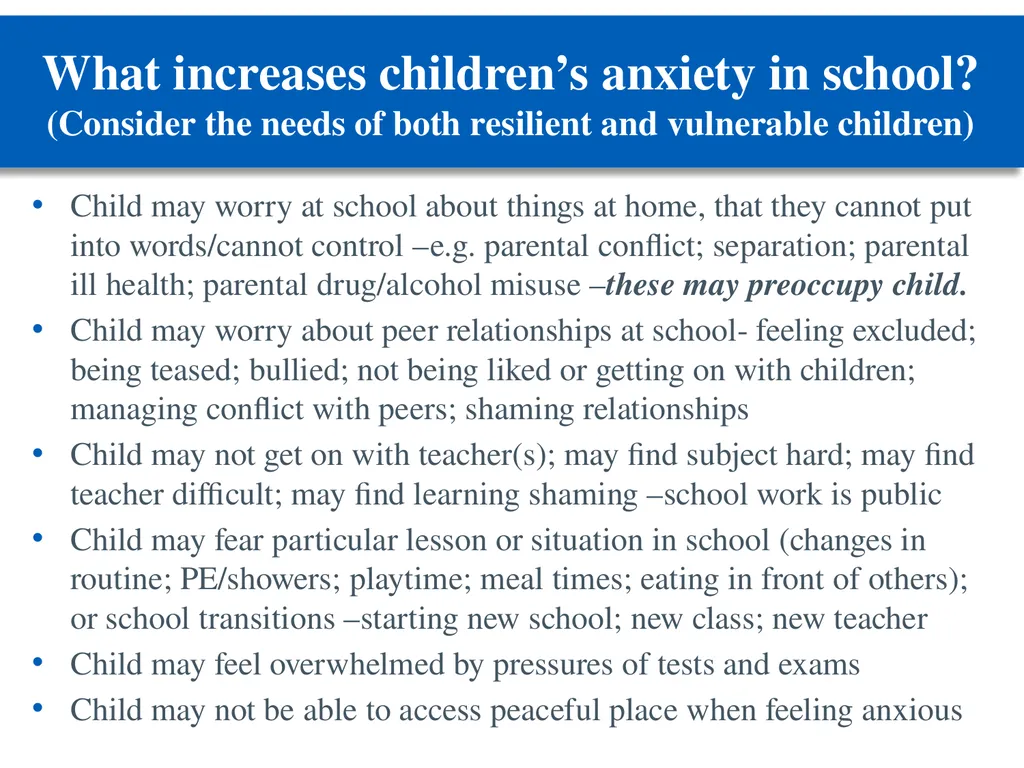
slide12. What increases children’s anxiety in school? (Consider the needs of both resilient and vulnerable children) Child may worry at school about things at home, that they cannot put into words/cannot control –e.g. parental conflict; separation; parental ill health; parental drug/alcohol misuse –these may preoccupy child.
Child may worry about peer relationships at school- feeling excluded; being teased; bullied; not being liked or getting on with children; managing conflict with peers; shaming relationships
Child may not get on with teacher(s); may find subject hard; may find teacher difficult; may find learning shaming –school work is public
Child may fear particular lesson or situation in school (changes in routine; PE/showers; playtime; meal times; eating in front of others); or school transitions –starting new school; new class; new teacher
Child may feel overwhelmed by pressures of tests and exams
Child may not be able to access peaceful place when feeling anxious<br>
slide13. Spotting warning signs of anxiety in schools<br>
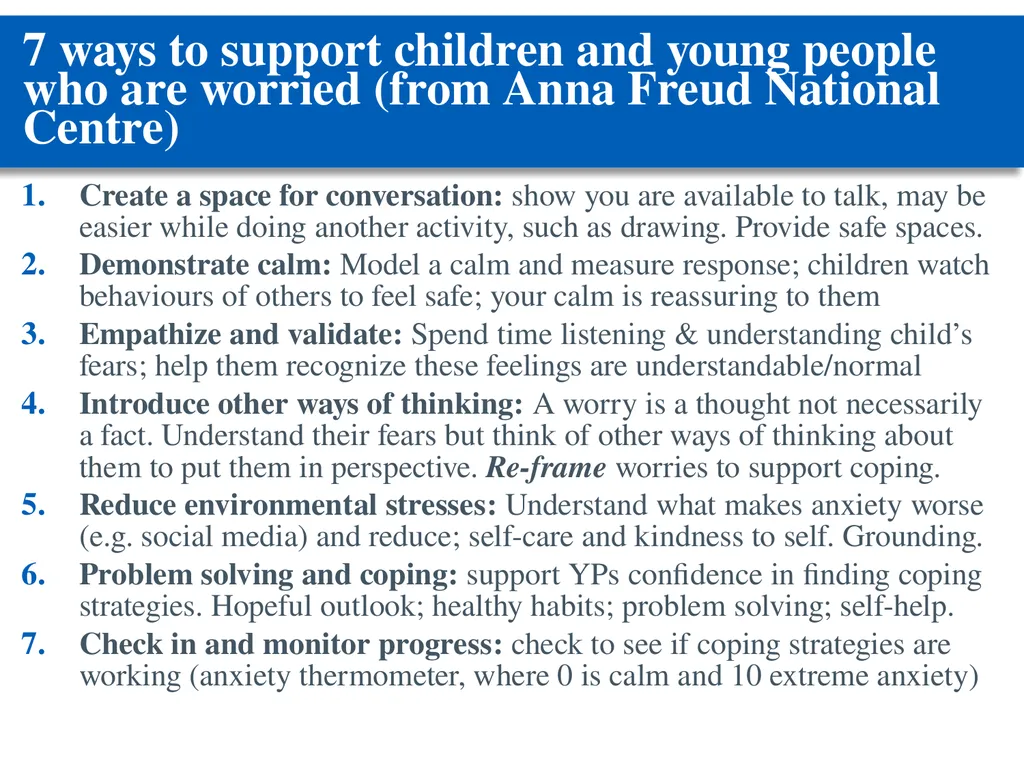
slide14. 7 ways to support children and young people who are worried (from Anna Freud National Centre) Create a space for conversation: show you are available to talk, may be easier while doing another activity, such as drawing. Provide safe spaces.
Demonstrate calm: Model a calm and measure response; children watch behaviours of others to feel safe; your calm is reassuring to them
Empathize and validate: Spend time listening & understanding child’s fears; help them recognize these feelings are understandable/normal
Introduce other ways of thinking: A worry is a thought not necessarily a fact. Understand their fears but think of other ways of thinking about them to put them in perspective. Re-frame worries to support coping.
Reduce environmental stresses: Understand what makes anxiety worse (e.g. social media) and reduce; self-care and kindness to self. Grounding.
Problem solving and coping: support YPs confidence in finding coping strategies. Hopeful outlook; healthy habits; problem solving; self-help.
Check in and monitor progress: check to see if coping strategies are working (anxiety thermometer, where 0 is calm and 10 extreme anxiety)<br>
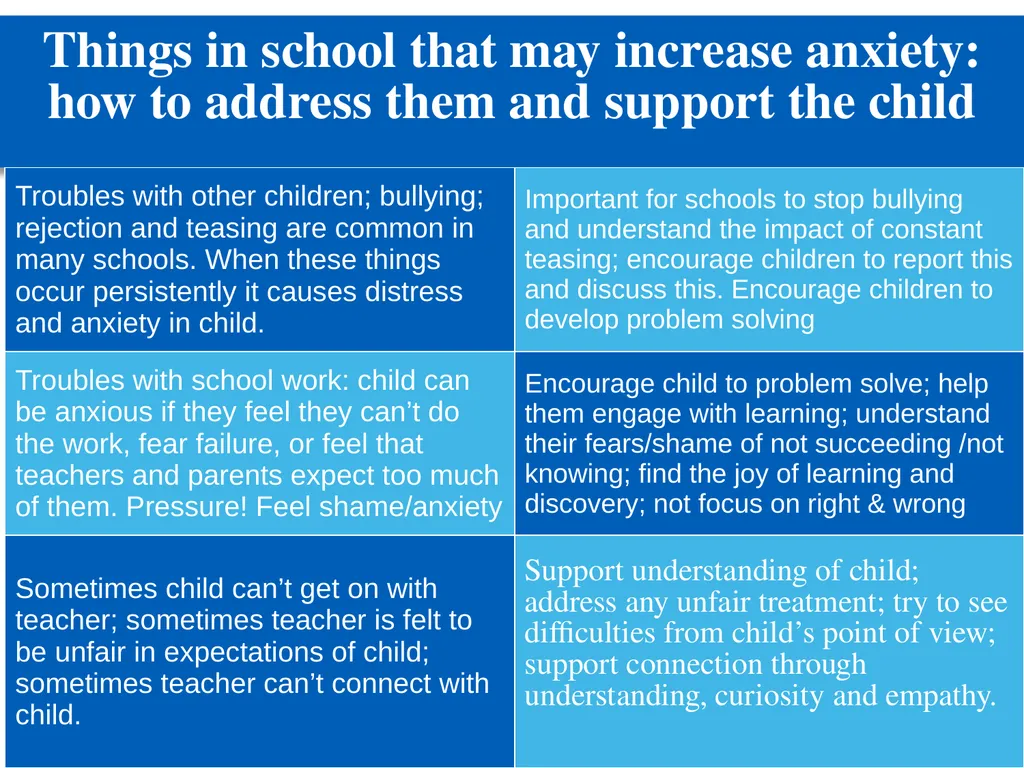
slide15. Things in school that may increase anxiety: how to address them and support the child<br>
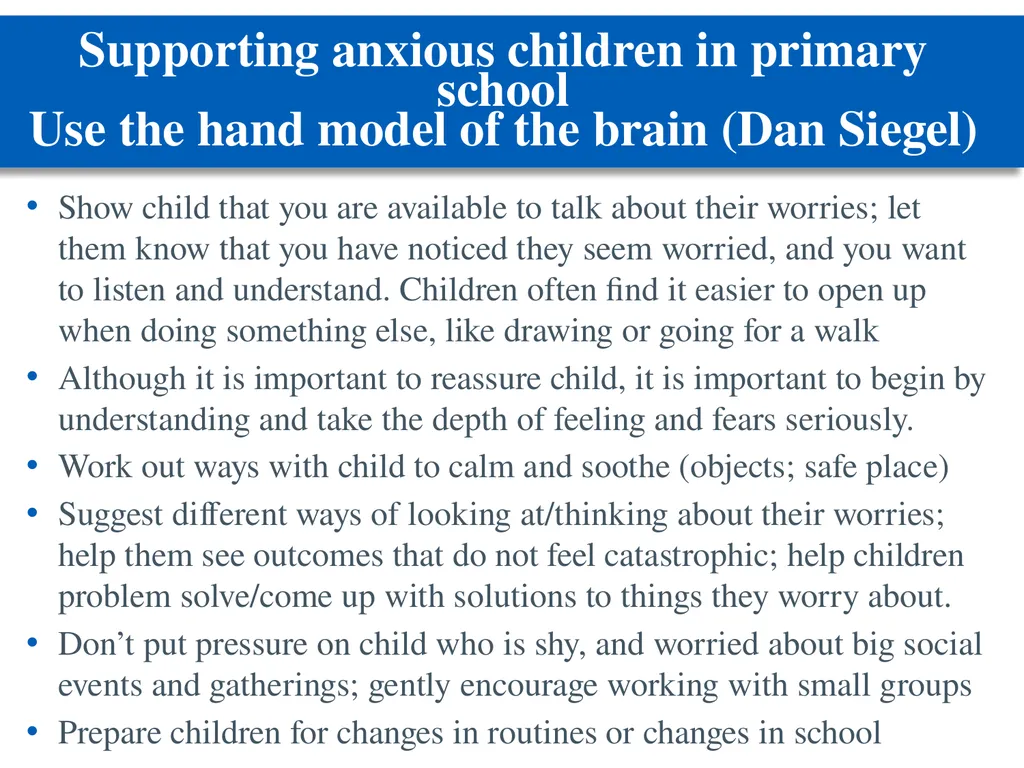
slide16. Supporting anxious children in primary school Use the hand model of the brain (Dan Siegel) Show child that you are available to talk about their worries; let them know that you have noticed they seem worried, and you want to listen and understand. Children often find it easier to open up when doing something else, like drawing or going for a walk
Although it is important to reassure child, it is important to begin by understanding and take the depth of feeling and fears seriously.
Work out ways with child to calm and soothe (objects; safe place)
Suggest different ways of looking at/thinking about their worries; help them see outcomes that do not feel catastrophic; help children problem solve/come up with solutions to things they worry about.
Don’t put pressure on child who is shy, and worried about big social events and gatherings; gently encourage working with small groups
Prepare children for changes in routines or changes in school<br>
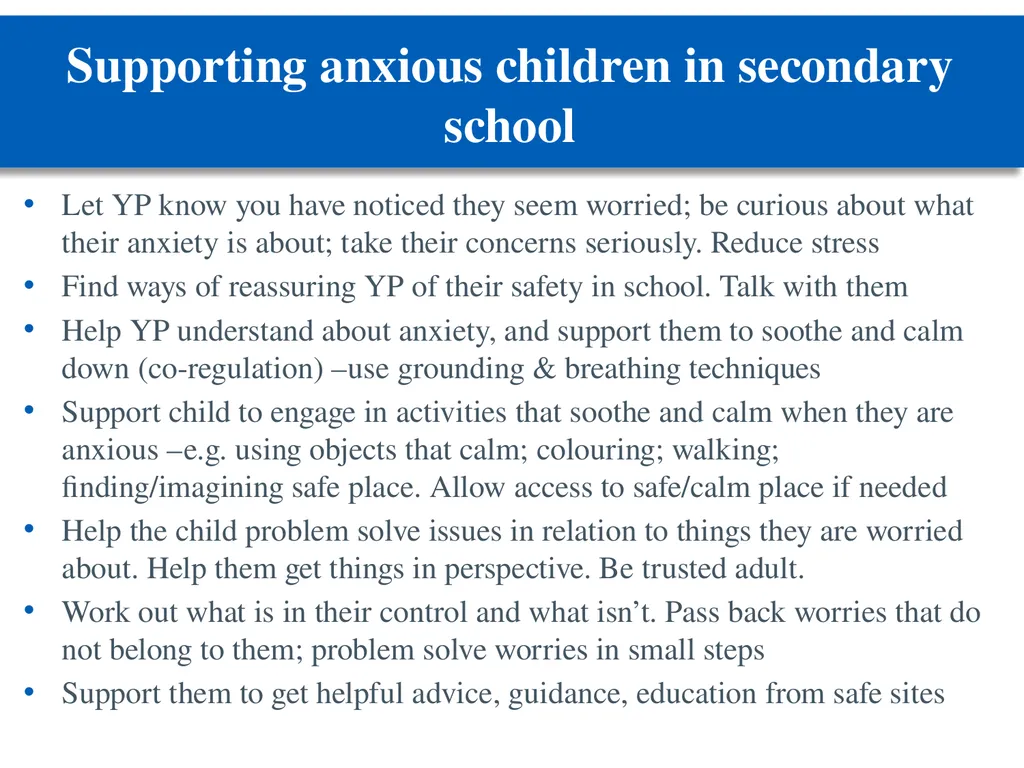
slide17. Supporting anxious children in secondary school Let YP know you have noticed they seem worried; be curious about what their anxiety is about; take their concerns seriously. Reduce stress
Find ways of reassuring YP of their safety in school. Talk with them
Help YP understand about anxiety, and support them to soothe and calm down (co-regulation) –use grounding & breathing techniques
Support child to engage in activities that soothe and calm when they are anxious –e.g. using objects that calm; colouring; walking; finding/imagining safe place. Allow access to safe/calm place if needed
Help the child problem solve issues in relation to things they are worried about. Help them get things in perspective. Be trusted adult.
Work out what is in their control and what isn’t. Pass back worries that do not belong to them; problem solve worries in small steps
Support them to get helpful advice, guidance, education from safe sites<br>
slide18. Helping a child in very anxious moment to calm down and feel safe: grounding techniques Sit with them and offer them calm reassurance: helps the child feel connected and safe with trusted adult –soothing.
Breathe slowly & deeply together: count together as you breathe in & out; this helps the body to relax & helps child feel connected to adult
Reassure them that the anxiety will pass & they will be OK; helpful to describe as a wave they can ride & land safely, as surf gets smaller (panic attacks are transitory and do pass).
Ask them to think of a safe & relaxing place or person. Encourage child to describe ‘safe place’ imagine being in there (use all senses)
Try using all 5 senses together: describe things they can see; smell; touch; hear; taste –this helps child to focus and ground themselves.
Encourage them to do something that helps them to feel calmer: running, walking, listen to music, read book, colouring; safe place.<br>
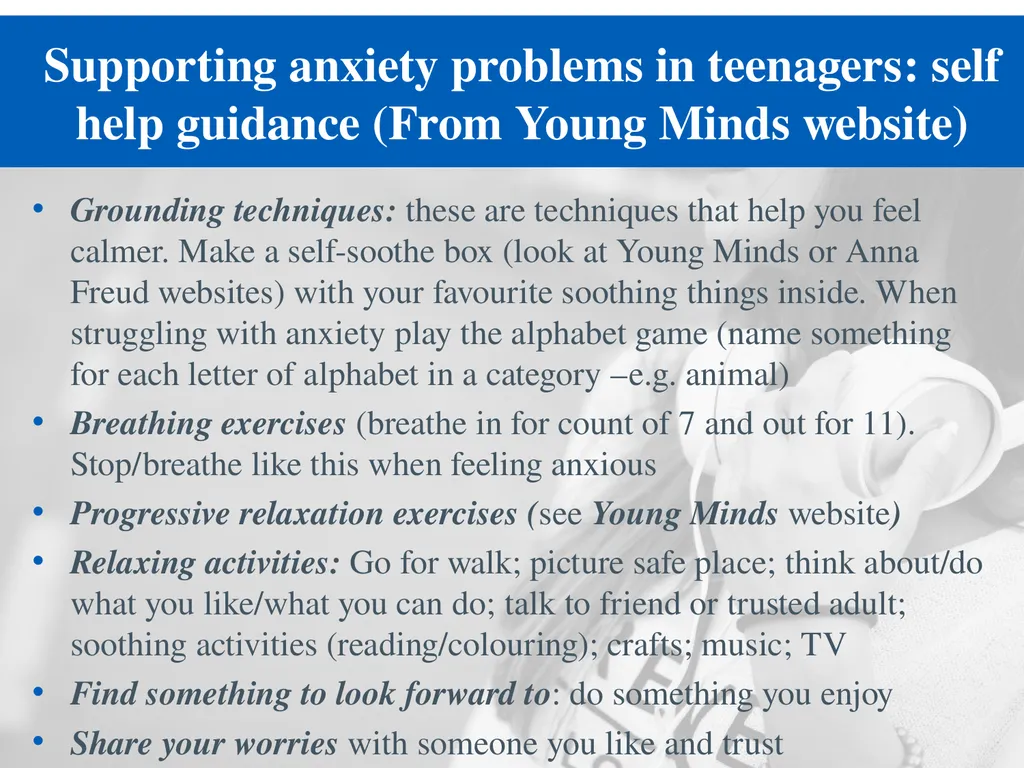
slide19. Supporting anxiety problems in teenagers: self help guidance (From Young Minds website) Grounding techniques: these are techniques that help you feel calmer. Make a self-soothe box (look at Young Minds or Anna Freud websites) with your favourite soothing things inside. When struggling with anxiety play the alphabet game (name something for each letter of alphabet in a category –e.g. animal)
Breathing exercises (breathe in for count of 7 and out for 11). Stop/breathe like this when feeling anxious
Progressive relaxation exercises (see Young Minds website)
Relaxing activities: Go for walk; picture safe place; think about/do what you like/what you can do; talk to friend or trusted adult; soothing activities (reading/colouring); crafts; music; TV
Find something to look forward to: do something you enjoy
Share your worries with someone you like and trust<br>
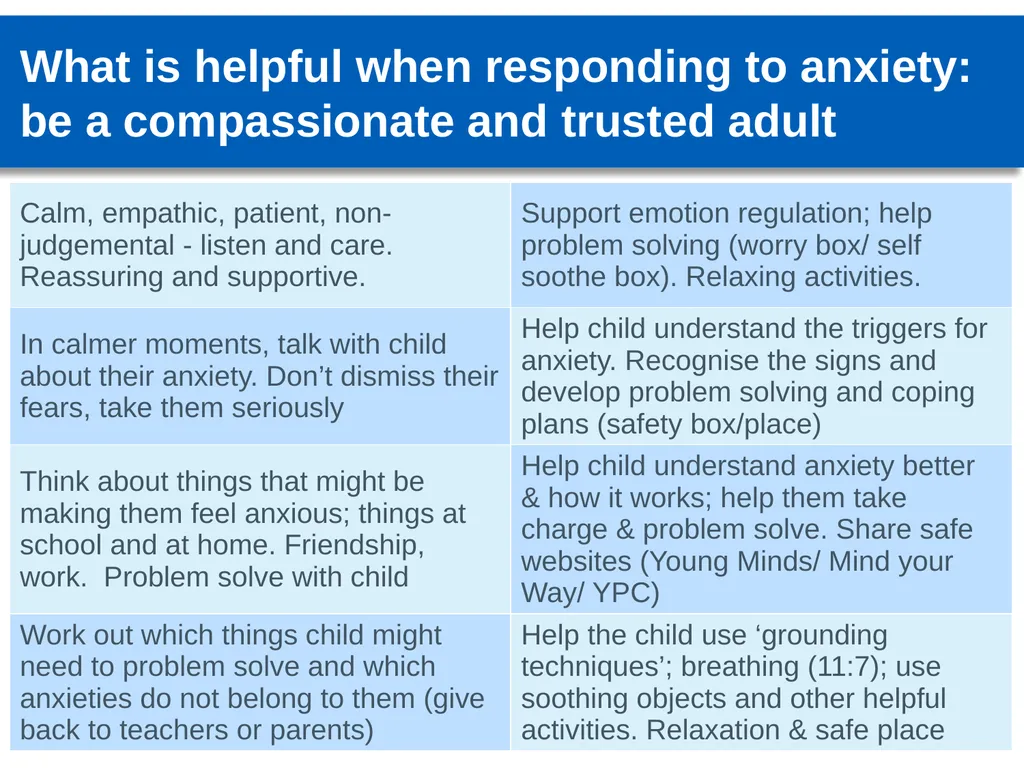
slide20. What is helpful when responding to anxiety: be a compassionate and trusted adult<br>
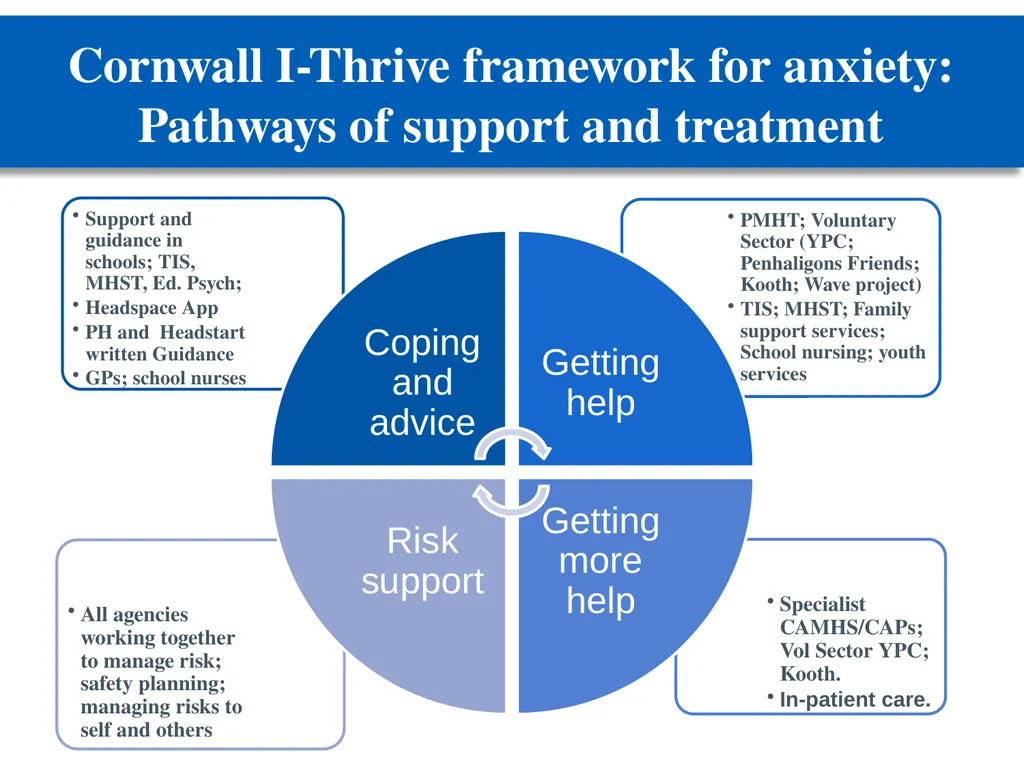
slide21. Cornwall I-Thrive framework for anxiety: Pathways of support and treatment<br>
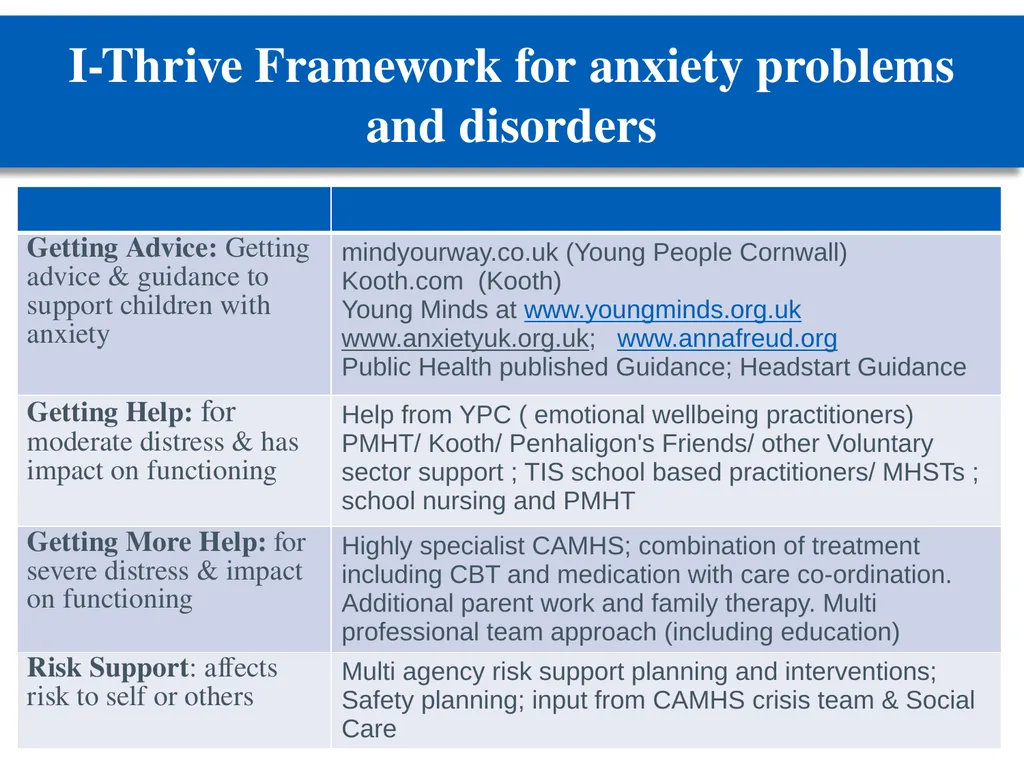
slide22. I-Thrive Framework for anxiety problems and disorders<br>
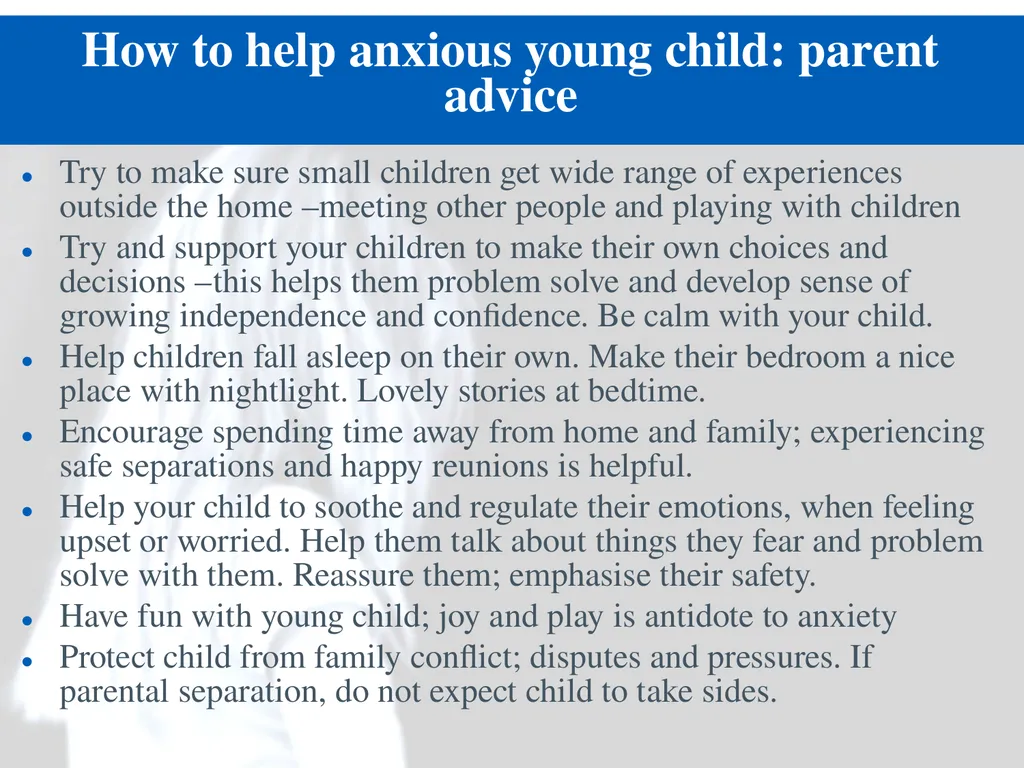
slide23. How to help anxious young child: parent advice Try to make sure small children get wide range of experiences outside the home –meeting other people and playing with children
Try and support your children to make their own choices and decisions –this helps them problem solve and develop sense of growing independence and confidence. Be calm with your child.
Help children fall asleep on their own. Make their bedroom a nice place with nightlight. Lovely stories at bedtime.
Encourage spending time away from home and family; experiencing safe separations and happy reunions is helpful.
Help your child to soothe and regulate their emotions, when feeling upset or worried. Help them talk about things they fear and problem solve with them. Reassure them; emphasise their safety.
Have fun with young child; joy and play is antidote to anxiety
Protect child from family conflict; disputes and pressures. If parental separation, do not expect child to take sides.<br>
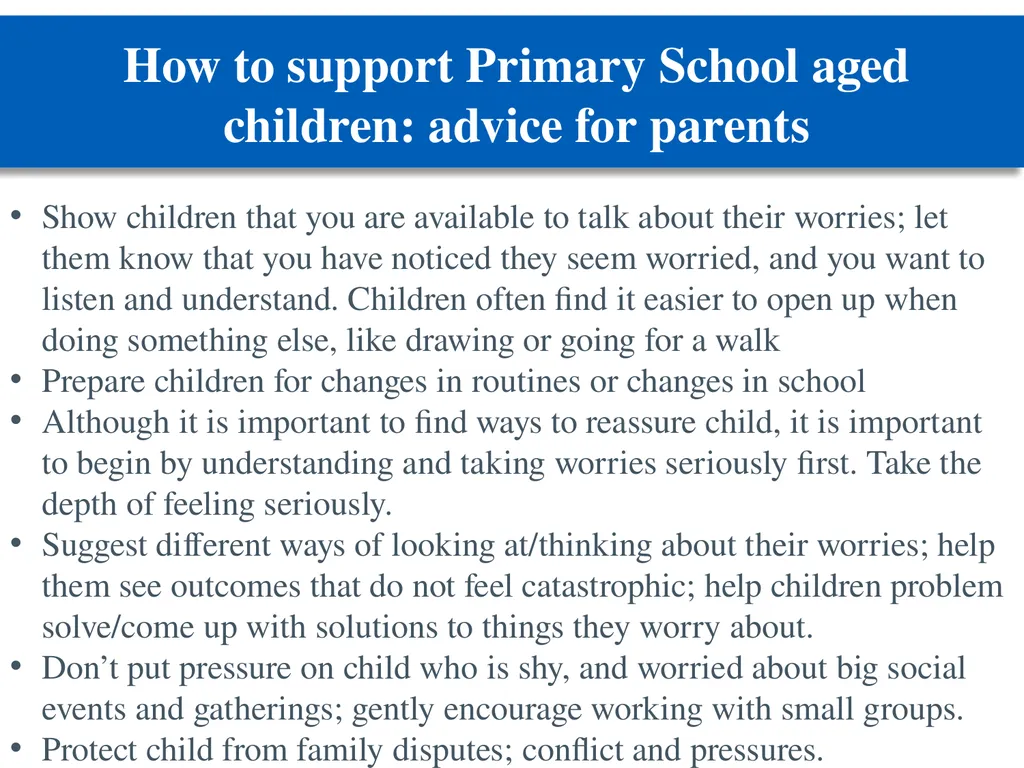
slide24. How to support Primary School aged children: advice for parents Show children that you are available to talk about their worries; let them know that you have noticed they seem worried, and you want to listen and understand. Children often find it easier to open up when doing something else, like drawing or going for a walk
Prepare children for changes in routines or changes in school
Although it is important to find ways to reassure child, it is important to begin by understanding and taking worries seriously first. Take the depth of feeling seriously.
Suggest different ways of looking at/thinking about their worries; help them see outcomes that do not feel catastrophic; help children problem solve/come up with solutions to things they worry about.
Don’t put pressure on child who is shy, and worried about big social events and gatherings; gently encourage working with small groups.
Protect child from family disputes; conflict and pressures.<br>
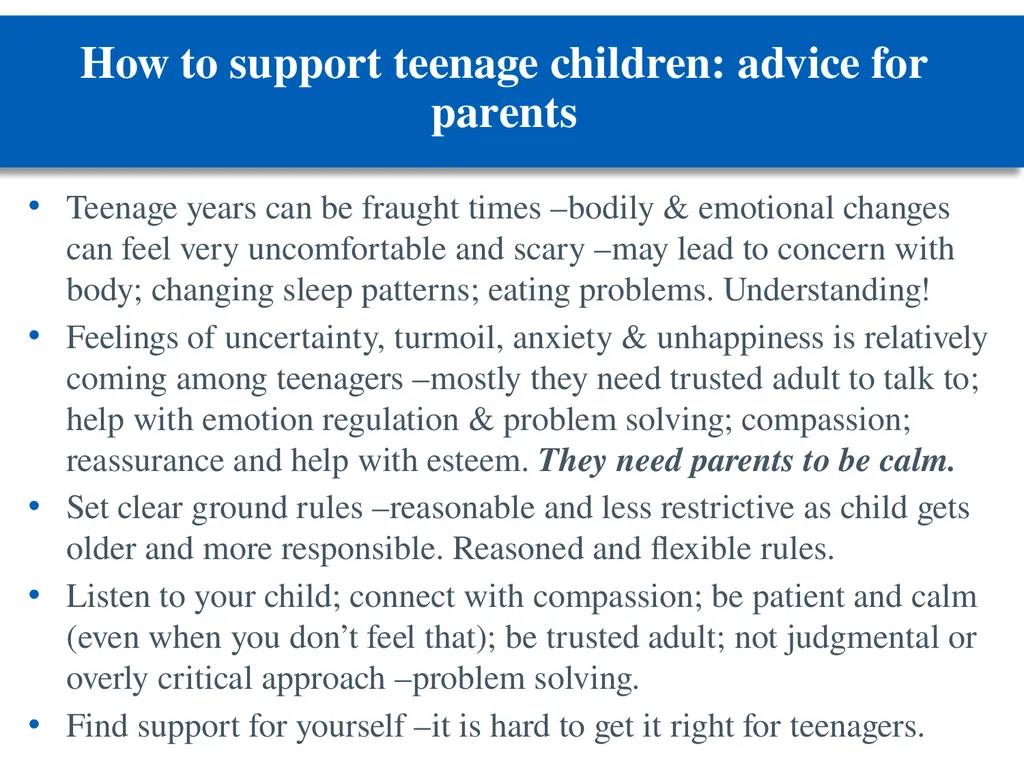
slide25. How to support teenage children: advice for parents Teenage years can be fraught times –bodily & emotional changes can feel very uncomfortable and scary –may lead to concern with body; changing sleep patterns; eating problems. Understanding!
Feelings of uncertainty, turmoil, anxiety & unhappiness is relatively coming among teenagers –mostly they need trusted adult to talk to; help with emotion regulation & problem solving; compassion; reassurance and help with esteem. They need parents to be calm.
Set clear ground rules –reasonable and less restrictive as child gets older and more responsible. Reasoned and flexible rules.
Listen to your child; connect with compassion; be patient and calm (even when you don’t feel that); be trusted adult; not judgmental or overly critical approach –problem solving.
Find support for yourself –it is hard to get it right for teenagers.<br>
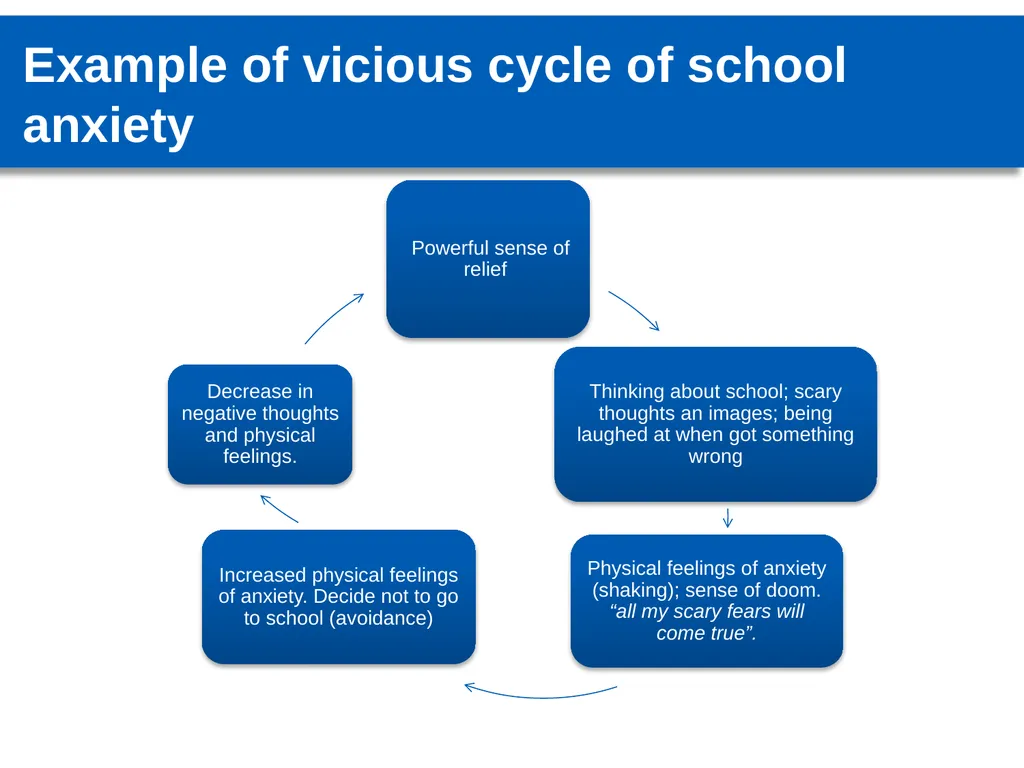
slide26. Example of vicious cycle of school anxiety<br>
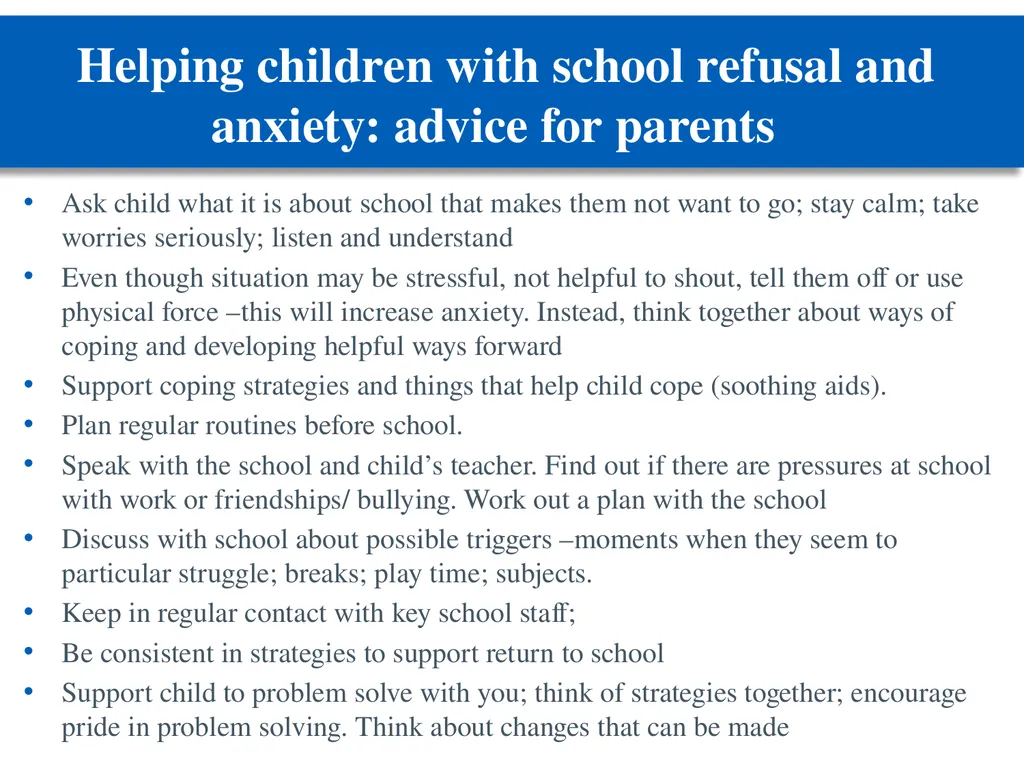
slide27. Helping children with school refusal and anxiety: advice for parents Ask child what it is about school that makes them not want to go; stay calm; take worries seriously; listen and understand
Even though situation may be stressful, not helpful to shout, tell them off or use physical force –this will increase anxiety. Instead, think together about ways of coping and developing helpful ways forward
Support coping strategies and things that help child cope (soothing aids).
Plan regular routines before school.
Speak with the school and child’s teacher. Find out if there are pressures at school with work or friendships/ bullying. Work out a plan with the school
Discuss with school about possible triggers –moments when they seem to particular struggle; breaks; play time; subjects.
Keep in regular contact with key school staff;
Be consistent in strategies to support return to school
Support child to problem solve with you; think of strategies together; encourage pride in problem solving. Think about changes that can be made<br>
Clinical Lead, CAMHS, NHS Kernow Clinical Commissioning Group<br>
slide2. Understanding the nature of anxiety Anxiety is a normal, human feeling of fear, apprehension or panic –a sense that something fearful or even disastrous may happen. It can be part of a helpful warning system, when there is danger.
It occurs when we don’t feel safe. When we face scary situations, the brain’s built in alarm system warns us that something isn’t right. It makes us feel more alert, stops us thinking about other things (can’t learn) and sets off the alarm (arousal) system to prepare us for action or get help. Affects body, thinking and feelings. Arousal responses: Flight; Flight ore Freeze
Most of us worry at times –about friendships, parents, health, school pressures, natural disasters, news items, but usually worries go away, because we are helped or cope.
Sometimes worries don’t go away, ‘Fears take over our minds’ and affect all aspects of life - anxiety itself becomes a problem, and needs special help to sort out. Child may end up feeling anxious all the time, and no longer know exactly what they fear –simply preoccupied with their fears. Anxiety becomes a problem.<br>
slide3. Understanding the early roots of anxiety: the foundations in neuroscience During the early years, we are dependent on adults to understand & attend to our needs in trusted & consistent ways, -keep us calm & safe.
Young children experience strong emotions and require carers to think for them & sooth and calm them when anxious; contain their anxiety.
Soothing a distressed child supports ‘emotion regulation’ and is vital so that immature brains are not overwhelmed by anxiety (toxic stress).
Responsive parenting soothes & regulates child’s anxiety, they feel safe and free to explore and play; ‘secure base’ & ‘secure attachment’.
Separation or unresponsive/unpredictable/unsafe responses cause great anxiety, which the child can’t regulate –child feels unsafe & anxious.
Children need trusted adults to support feelings of safety & security.
The world can feel scary to children, so adults need to reassure them; help them problem solve when they feel overwhelmed to feel safe again.<br>
slide4. Anxiety may underpin many behaviours that challenge at home and school Facing adversity provokes anxiety, to which children adapt; these adaptations (defences) may themselves cause problems (child sees them as helpful strategies), and not work in safe settings. Child becomes more vulnerable to impact of everyday pressures.
Some children become angry, demanding or controlling because of their fears (Fight) –to make things happen in predictable ways; to avoid feelings of shame; to ensure they are seen (if they fear they are invisible); their ways of managing unpredictable adults; experience dysregulation (Ambivalent attachment strategies).
Some children fear criticism; judgment; punishment; getting things wrong; they are wary of others, & so avoid contact, and may seem rather cut off, isolated, lack social confidence (Flight). May find learning shaming, fear getting things wrong (Avoidant attachment).<br>
slide5. Common childhood fears Common childhood fears are linked to our evolutionary past; include fears of heights; darkness; getting lost or separated from carers; some animals; storms. These usually pass with time, and plenty of reassurance/ calming.
Little ones fear separation, getting lost, being alone, the dark, which often get worse at bedtime, or facing of new challenges or threats.
Some children fear things they have read about or seen on films– ghosts; kidnappers; dangerous adults; monsters. These fears are not uncommon and with support and reassurance pass with time.
Older children/YP worry more about friendships; bullying; self image and body image; intimate relationships; sexuality; leaving home; adult responsibilities; academic work; finding work and purpose.
Anxiety becomes a problem if these fears are severe and interfere with everyday functioning and activities, and don’t pass with time.<br>
slide6. The signs of anxiety: physical, thoughts and feelings Feeling nervous, on edge, panicky, clingy a lot of the time
Feeling something bad is going to happen; feeling full of dread
Feeling out of control; finding it hard to concentrate, learn or play
Having trouble sleeping; being worried about bedtime; nightmares
Losing appetite; wanting to eat more for comfort; tummy aches.
Feeling tired, grumpy and edgy; increased distress; temper outbursts
Physical feelings, like ‘butterfly tummy’, heart beating faster, dry mouth, trembling, feeling faint, sweating more than usual; fidgety.
Feeling afraid of things that were previously enjoyed, such as afraid of separation from parents; afraid of going to school; or of going out with friends; not wanting to go out to clubs and leisure activities
Wanting to stay at home/school, because that place that feels safe.<br>
slide7. Anxiety across age ranges<br>
slide8. Understanding anxiety: In the words of teenagers ‘ “Having anxiety at school is absolutely horrible. You have all these thoughts going through your head, and being around everyone makes me feel worse because all my insecurities are hard to cover…it really brings me down.. Its not nice” “School understanding from teachers made a difference for me –they allowed me to have a moment to myself if I needed it”. “Anxiety feels like a swarm of bees just buzzing, not stopping, making it impossible to focus and seemingly impossible to slow down and take a breath”.<br>
slide9. Different forms of anxiety and anxiety problems Social anxiety:Overwhelming fear of social situations; more than shyness
Separation anxiety: Excessive fear of being separated from loved ones
School refusal: often linked to separation fears; or may be fear of something at school (bullying; school pressure; relationships difficulties)
Phobias: anxiety is linked to specific object, place, activity, situation or animal among other things –unrealistic sense of danger -associated with panic feelings linked to particular event with feared object/event
Panic: panic attack is experience of extreme distress and panic, which is short-lasting, debilitating. Linked to strong mental & physical sensations.
Generalized anxiety: afraid in many situations, without obvious cause
Obsessive compulsive: consistent worrying/unwanted thoughts; feeling compelled to do things (checking/washing/counting), not knowing why. Health anxiety: constantly worried about their health without cause.<br>
slide10. What increases children & YP’s anxiety: how does everyday fear become anxiety problem? Adverse or traumatic experience(s), - being ill, bullied, car accident, bereavement, parental separation, divorce, parental illness, witnessing or experiencing harm, abuse or family conflict, threats, rows between parents.
Experiencing lots of change in short period of time, so that child feels the ground under them not secure; nothing is familiar -scary feeling.
Parents who use excessive threats or punishment to control child
Hearing scary things or having responsibilities they can’t cope with; family conflict; separation when child becomes pawn; insults and threats.
Being around someone who is very anxious & worries about many things –world feels unsafe or even dangerous, may get limited reassurance.
Struggling at school, including feeling overwhelmed by work, exams or difficult peer relationships. Can’t problem solve.
Some children have a long-standing tendency negative ‘Thinking Styles’, to always imagine the worst; focus on potential dangers; fearful.<br>
slide11. Anxiety and the impact of Covid restrictions Covid and its impact has made many children & YP feel unsafe. Threats associated with it increase our worries about safety; health; wellbeing of family and friends; predictability of the world they know.
Increases our feeling of loneliness and isolation –limits access to friends and families, who are sources of comfort and safety
Our connections and routines are disrupted –these normally support our feelings of security, predictability & safety
Covid threatens our sense that our worlds are safe and predictable –as if the carpet has been pulled from under us.
Pressures on our families, increases parental distress, anxiety and conflict and causes anxiety among children. Parental distress may undermine capacity to attend to and regulate children’s anxieties
Loss of playful, relaxing and learning opportunities increases anxiety.<br>
slide12. What increases children’s anxiety in school? (Consider the needs of both resilient and vulnerable children) Child may worry at school about things at home, that they cannot put into words/cannot control –e.g. parental conflict; separation; parental ill health; parental drug/alcohol misuse –these may preoccupy child.
Child may worry about peer relationships at school- feeling excluded; being teased; bullied; not being liked or getting on with children; managing conflict with peers; shaming relationships
Child may not get on with teacher(s); may find subject hard; may find teacher difficult; may find learning shaming –school work is public
Child may fear particular lesson or situation in school (changes in routine; PE/showers; playtime; meal times; eating in front of others); or school transitions –starting new school; new class; new teacher
Child may feel overwhelmed by pressures of tests and exams
Child may not be able to access peaceful place when feeling anxious<br>
slide13. Spotting warning signs of anxiety in schools<br>
slide14. 7 ways to support children and young people who are worried (from Anna Freud National Centre) Create a space for conversation: show you are available to talk, may be easier while doing another activity, such as drawing. Provide safe spaces.
Demonstrate calm: Model a calm and measure response; children watch behaviours of others to feel safe; your calm is reassuring to them
Empathize and validate: Spend time listening & understanding child’s fears; help them recognize these feelings are understandable/normal
Introduce other ways of thinking: A worry is a thought not necessarily a fact. Understand their fears but think of other ways of thinking about them to put them in perspective. Re-frame worries to support coping.
Reduce environmental stresses: Understand what makes anxiety worse (e.g. social media) and reduce; self-care and kindness to self. Grounding.
Problem solving and coping: support YPs confidence in finding coping strategies. Hopeful outlook; healthy habits; problem solving; self-help.
Check in and monitor progress: check to see if coping strategies are working (anxiety thermometer, where 0 is calm and 10 extreme anxiety)<br>
slide15. Things in school that may increase anxiety: how to address them and support the child<br>
slide16. Supporting anxious children in primary school Use the hand model of the brain (Dan Siegel) Show child that you are available to talk about their worries; let them know that you have noticed they seem worried, and you want to listen and understand. Children often find it easier to open up when doing something else, like drawing or going for a walk
Although it is important to reassure child, it is important to begin by understanding and take the depth of feeling and fears seriously.
Work out ways with child to calm and soothe (objects; safe place)
Suggest different ways of looking at/thinking about their worries; help them see outcomes that do not feel catastrophic; help children problem solve/come up with solutions to things they worry about.
Don’t put pressure on child who is shy, and worried about big social events and gatherings; gently encourage working with small groups
Prepare children for changes in routines or changes in school<br>
slide17. Supporting anxious children in secondary school Let YP know you have noticed they seem worried; be curious about what their anxiety is about; take their concerns seriously. Reduce stress
Find ways of reassuring YP of their safety in school. Talk with them
Help YP understand about anxiety, and support them to soothe and calm down (co-regulation) –use grounding & breathing techniques
Support child to engage in activities that soothe and calm when they are anxious –e.g. using objects that calm; colouring; walking; finding/imagining safe place. Allow access to safe/calm place if needed
Help the child problem solve issues in relation to things they are worried about. Help them get things in perspective. Be trusted adult.
Work out what is in their control and what isn’t. Pass back worries that do not belong to them; problem solve worries in small steps
Support them to get helpful advice, guidance, education from safe sites<br>
slide18. Helping a child in very anxious moment to calm down and feel safe: grounding techniques Sit with them and offer them calm reassurance: helps the child feel connected and safe with trusted adult –soothing.
Breathe slowly & deeply together: count together as you breathe in & out; this helps the body to relax & helps child feel connected to adult
Reassure them that the anxiety will pass & they will be OK; helpful to describe as a wave they can ride & land safely, as surf gets smaller (panic attacks are transitory and do pass).
Ask them to think of a safe & relaxing place or person. Encourage child to describe ‘safe place’ imagine being in there (use all senses)
Try using all 5 senses together: describe things they can see; smell; touch; hear; taste –this helps child to focus and ground themselves.
Encourage them to do something that helps them to feel calmer: running, walking, listen to music, read book, colouring; safe place.<br>
slide19. Supporting anxiety problems in teenagers: self help guidance (From Young Minds website) Grounding techniques: these are techniques that help you feel calmer. Make a self-soothe box (look at Young Minds or Anna Freud websites) with your favourite soothing things inside. When struggling with anxiety play the alphabet game (name something for each letter of alphabet in a category –e.g. animal)
Breathing exercises (breathe in for count of 7 and out for 11). Stop/breathe like this when feeling anxious
Progressive relaxation exercises (see Young Minds website)
Relaxing activities: Go for walk; picture safe place; think about/do what you like/what you can do; talk to friend or trusted adult; soothing activities (reading/colouring); crafts; music; TV
Find something to look forward to: do something you enjoy
Share your worries with someone you like and trust<br>
slide20. What is helpful when responding to anxiety: be a compassionate and trusted adult<br>
slide21. Cornwall I-Thrive framework for anxiety: Pathways of support and treatment<br>
slide22. I-Thrive Framework for anxiety problems and disorders<br>
slide23. How to help anxious young child: parent advice Try to make sure small children get wide range of experiences outside the home –meeting other people and playing with children
Try and support your children to make their own choices and decisions –this helps them problem solve and develop sense of growing independence and confidence. Be calm with your child.
Help children fall asleep on their own. Make their bedroom a nice place with nightlight. Lovely stories at bedtime.
Encourage spending time away from home and family; experiencing safe separations and happy reunions is helpful.
Help your child to soothe and regulate their emotions, when feeling upset or worried. Help them talk about things they fear and problem solve with them. Reassure them; emphasise their safety.
Have fun with young child; joy and play is antidote to anxiety
Protect child from family conflict; disputes and pressures. If parental separation, do not expect child to take sides.<br>
slide24. How to support Primary School aged children: advice for parents Show children that you are available to talk about their worries; let them know that you have noticed they seem worried, and you want to listen and understand. Children often find it easier to open up when doing something else, like drawing or going for a walk
Prepare children for changes in routines or changes in school
Although it is important to find ways to reassure child, it is important to begin by understanding and taking worries seriously first. Take the depth of feeling seriously.
Suggest different ways of looking at/thinking about their worries; help them see outcomes that do not feel catastrophic; help children problem solve/come up with solutions to things they worry about.
Don’t put pressure on child who is shy, and worried about big social events and gatherings; gently encourage working with small groups.
Protect child from family disputes; conflict and pressures.<br>
slide25. How to support teenage children: advice for parents Teenage years can be fraught times –bodily & emotional changes can feel very uncomfortable and scary –may lead to concern with body; changing sleep patterns; eating problems. Understanding!
Feelings of uncertainty, turmoil, anxiety & unhappiness is relatively coming among teenagers –mostly they need trusted adult to talk to; help with emotion regulation & problem solving; compassion; reassurance and help with esteem. They need parents to be calm.
Set clear ground rules –reasonable and less restrictive as child gets older and more responsible. Reasoned and flexible rules.
Listen to your child; connect with compassion; be patient and calm (even when you don’t feel that); be trusted adult; not judgmental or overly critical approach –problem solving.
Find support for yourself –it is hard to get it right for teenagers.<br>
slide26. Example of vicious cycle of school anxiety<br>
slide27. Helping children with school refusal and anxiety: advice for parents Ask child what it is about school that makes them not want to go; stay calm; take worries seriously; listen and understand
Even though situation may be stressful, not helpful to shout, tell them off or use physical force –this will increase anxiety. Instead, think together about ways of coping and developing helpful ways forward
Support coping strategies and things that help child cope (soothing aids).
Plan regular routines before school.
Speak with the school and child’s teacher. Find out if there are pressures at school with work or friendships/ bullying. Work out a plan with the school
Discuss with school about possible triggers –moments when they seem to particular struggle; breaks; play time; subjects.
Keep in regular contact with key school staff;
Be consistent in strategies to support return to school
Support child to problem solve with you; think of strategies together; encourage pride in problem solving. Think about changes that can be made<br>