
MANAGING PERSONAL FINANCES FOR OPTIMAL PERFORMANCE
PM
Published · 61 slides · 0 views

1 / 1

























Description
MANAGING PERSONAL FINANCES FOR OPTIMAL PERFORMANCE IF YOUR EXPENSES EXCEED YOUR INCOME, THEN YOUR UPKEEP BECOMES YOUR DOWNFALL Wouldnt it be nice if there was a magic formula or one easy trick that one could use so you never had to worry
Related Topics
Share
Embed code
Download this presentation From Below
"MANAGING PERSONAL FINANCES FOR OPTIMAL PERFORMANCE" is the property of its rightful owner. Permission is granted to download and print the materials on this website for personal, non-commercial use only, and to display it on your personal computer provided you do not modify the materials and that you retain all copyright notices contained in the materials. By downloading content from our website, you accept the terms of this agreement.
Presentation Transcript
01
MANAGING PERSONAL FINANCES FOR OPTIMAL PERFORMANCE<br>
02
IF YOUR EXPENSES EXCEED YOUR INCOME,
THEN YOUR UPKEEP BECOMES YOUR DOWNFALL<br>
THEN YOUR UPKEEP BECOMES YOUR DOWNFALL<br>
03
Wouldn’t it be nice if there was a magic formula or one easy trick that one could use so you never had to worry about money again? If you’re tired of constantly being stressed out about money, then maybe it’s time to get a hold on your Personal Finances.<br>
04
There are five keys that can help you get control of your finances. Follow these five steps consistently, and your financial problems will start to diminish–along with the financial stress that goes along with them.<br>
05
The first thing you should do is to write specific goals about what you want to do with your life and your money. Finances can affect many different areas of your life. Your goal to become a home owner affects how you will plan your finances. Your goal to retire early is dependent on how well you handle your finances now. Homeownership, starting a family, will all be affected by how you manage your finances. 1<br>
06
Once you have written down your financial goals, you need to prioritize them. This ensures that you are paying attention to the ones that are most important to you. You can also list them in the order you want to achieve them, but remember for a long-term goal like saving for retirement, you should be working towards it while also working on your other goals 2<br>
07
Below are some tips on how to identify your financial goals:
Start by setting long-term goals like getting out of debt, buying a home, or retiring early. These goals are separate from your short-term goal.
Set short-term goals, like following a budget, decreasing your spending, or not using your credit cards.
Prioritize your goals to help you create a financial plan.<br>
Start by setting long-term goals like getting out of debt, buying a home, or retiring early. These goals are separate from your short-term goal.
Set short-term goals, like following a budget, decreasing your spending, or not using your credit cards.
Prioritize your goals to help you create a financial plan.<br>
08
Create a Plan
A financial plan is absolutely essential in helping you reach your financial goals. The plan should have multiple steps. A sample plan would include getting control of your budget, creating a spending plan, then getting out of debt.
Once you’ve accomplished these three things, you’ve freed up some major cash, and the money you free up from your debt payments can be used to reaching these goals. 3<br>
A financial plan is absolutely essential in helping you reach your financial goals. The plan should have multiple steps. A sample plan would include getting control of your budget, creating a spending plan, then getting out of debt.
Once you’ve accomplished these three things, you’ve freed up some major cash, and the money you free up from your debt payments can be used to reaching these goals. 3<br>
09
At this point, you should decide what priorities are the most important to you. Keep steadily working toward your long-term goals, but also start to focus on the most important goals you have set for yourself. Do you want to take an expensive vacation? Buy a home or further your education? These are all things to consider when deciding on your next step.<br>
10
Your goals, along with an emergency fund, will help you stop making financial decisions based on fear and help you get control of your situation.<br>
11
When creating a financial plan, remember these things:
Your budget is key to success. It is the tool that will give you the most control of your financial future. Your budget is the key to achieving the rest of your plan.
You should keep contributing to long-term goals like saving for retirement no matter what stage of your financial plan you’re in.<br>
Your budget is key to success. It is the tool that will give you the most control of your financial future. Your budget is the key to achieving the rest of your plan.
You should keep contributing to long-term goals like saving for retirement no matter what stage of your financial plan you’re in.<br>
12
Building an emergency fund is another key factor to financial success. 4<br>
13
Stick to Your Budget
Your budget is one of the biggest tools that will help you succeed financially. It allows you to create a spending plan so you can focus your money in a way that will help you to reach your goals. 5<br>
Your budget is one of the biggest tools that will help you succeed financially. It allows you to create a spending plan so you can focus your money in a way that will help you to reach your goals. 5<br>
14
A budget lets you decide how to spend your money. Without the plan, you may spend your money on things that are not important to you, what you want in the moment, and then wonder why you are never reaching the financial milestones you have set for yourself<br>
15
A few things to keep in mind: Even after you are out of debt, you still need to have a budget. It is easy to spend more than you make, and if you stop tracking your spending, you could slide back into debt.
If you are married, you and your spouse need to work together on the budget. This will help you to achieve your financial goals together and prevent fights. Below are some tips for married couples who want to create a budget together:<br>
If you are married, you and your spouse need to work together on the budget. This will help you to achieve your financial goals together and prevent fights. Below are some tips for married couples who want to create a budget together:<br>
16
Get Out of Debt
Debt is a huge obstacle to reaching your financial goals, so eliminating it should be a priority.<br>
Debt is a huge obstacle to reaching your financial goals, so eliminating it should be a priority.<br>
17
Set up a debt elimination plan, which will help you pay it off more quickly. While making minimum payments on all your debt, you focus extra money on one debt at a time and then move all the money you were paying on the first debt to the next debt once the first is paid off, creating a “snowball effect.”<br>
18
Once you are out of debt, you need to make a commitment to stay out of debt. Stop carrying your credit cards around with you, and save up an emergency fund to cover unexpected expenses so you do not need to turn to a credit card to cover them. These tips will help you pay off debt more quickly:<br>
19
Sell items to find extra money to kick start your debt payment plan.
A second job can help speed up this process and may be necessary if you want to make lasting changes to your situation.
Look for areas you can cut your budget to increase your debt payments.<br>
A second job can help speed up this process and may be necessary if you want to make lasting changes to your situation.
Look for areas you can cut your budget to increase your debt payments.<br>
20
Don’t Be Afraid to Ask for Advice
You can find a mentor who would be willing to walk you through your budget the first few months. This can help you if you are overwhelmed with your budget.<br>
You can find a mentor who would be willing to walk you through your budget the first few months. This can help you if you are overwhelmed with your budget.<br>
21
If your parents or family members are good with money, consider asking them for help, or sitting down and talking to them about what worked for them financially and what they would have done differently.
Your local church or community center may be offering classes on personal finances and budgeting. Occasionally, banks and credit unions offer courses, as well.<br>
Your local church or community center may be offering classes on personal finances and budgeting. Occasionally, banks and credit unions offer courses, as well.<br>
22
When you are trying to set up a budget or you are trying to find additional money in your budget, it can be difficult to cut certain items. You may feel like the things listed are a must have for you to get by. You can develop bad financial habits that hurt you in the long run. 10 Budget Busters That You Can Live Without<br>
23
These 10 items are ones that many people have a hard time cutting. Learn cheaper alternatives that will help you save money while still enjoying some of the things that are most important to you. You may want to do some of these things with all of the extra money you save.<br>
24
With subscription prices between $92 to $245 or more a month, cable television can be a big budget buster. Canceling your cable television bill can help you save a significant amount of money each year. You can save between $1104 and $2940 each year by simply canceling your cable. If you have internet you do not need Cable Television. If you still want access to the latest television shows, try Hulu Plus or a similar service to watch the shows over the Internet. This is an easy cut, and once you cancel cable, you may find that you do not miss it at all. Cable Television<br>
25
Paying off your car can free up a lot of cash in your budget, but sometimes you do need to borrow money to get a car. One way to save is to buy used. Shop for a deal and you can keep your car payments lower and more manageable. In the meantime start putting some money away each month to pay for your next car purchase. If you do this, you will find that you can save money on the interest for the car loan. New Car Payments<br>
26
Eating out can add up quickly. If you enjoy eating out because you love really good freshly prepared food, you can save money by learning to cook the items yourself. If you eat out because you are strapped for time, try cooking over the weekend and making your own freezer meals. You can stop eating out and save a lot of money. It is easy to save more than $100 a week if you stop eating out if you are single and even more if you are married or have children. Eating Out<br>
27
Gym memberships can be pricey, especially if you are locked into a contract. Some gym memberships are more reasonably priced than others. If you think you really need a gym to exercise in, try exercising at home or walking or jogging in your neighborhood. Gym Memberships<br>
28
The holidays and birthdays can get very expensive. If you come from a family that expects you to give gifts to every family member, it can add up quickly. You can scale back on the gifts and try to give homemade gifts or shop throughout the year to find sales. You may also want to talk to your family about drawing names at Christmas time. The alternative is to find less expensive gifts by shopping throughout the year. Huge Gifts<br>
29
Vacations are a lot of fun, but if you have a lot of debt or you are struggling to make ends meet, you should not spend a ton of money on vacations each year. You can plan smaller less expensive vacations like camping or to destinations you can reach by car. If you have a dream vacation save up for it, and pay for it with cash. If you are debt free and saving towards retirement, you can take the types of vacations you want to, just make sure you pay cash for it. Expensive Vacations<br>
30
When you are paying more than about 25 percent of your salary to your mortgage or your rent each month, it can be crippling when you try to manage paying all of your other bills. Before you take out a mortgage make up a budget. You need to carefully determine how much home you can afford, instead of just taking whatever the bank is willing to lend to you. Building or Buying a House You Can't Afford (or Renting an Apartment You Can't Afford)<br>
31
It is better to buy or build a less expensive home that you can afford than your dream home that you end up defaulting on. When you live in a high cost of living area, your rent may also be really expensive. You can reduce this by living a bit further out of town.<br>
32
Entertainment costs can add up quickly whether you are a big sports fan, love day passes, or you love to go to expensive restaurants. This is an area that you need to be willing to cut back on when you are in debt or times are tight. Instead of going to every football game, just go to a few this year. You may want to try to find frugal activities that do not cost a lot to do. Entertainment Costs<br>
33
Your shopping habits really affect the way that you spend money. One of the biggest things you can do is to reduce how often you are in a store. This goes for everything from clothes shopping to grocery shopping. Try to do one major trip every week for groceries and always shop with a grocery list. Shopping Habits<br>
34
Try to limit your other shopping trips and if you do not have money to buy an item, do not go into the store looking for it. Another trick is to switch to cash for these budget items. You can make this work by leaving your debit and credit cards at home.<br>
35
An unexpected medical bill or a car repair can bust anyone’s budget. The best way to fix this is to set up an emergency fund to cover these unexpected expenses. Additionally, if you include money for car repairs or medical costs in your budget, and allow unused money to roll over each month, you will build up sinking funds to cover the costs of these expenses over time. Planning can help you handle the costs of emergencies. Emergencies<br>
36
The 30-day rule is a simple method to control impulse spending. Here’s how it works:
Whenever you feel the urge to splurge — whether it’s for new shoes, a new dress, or a new cell phone — force yourself to stop. If you’re already holding the item, put it back. Leave the store. Control Impulse Spending with the 30-Day Rule<br>
Whenever you feel the urge to splurge — whether it’s for new shoes, a new dress, or a new cell phone — force yourself to stop. If you’re already holding the item, put it back. Leave the store. Control Impulse Spending with the 30-Day Rule<br>
37
When you get home, take a piece of paper and write down the name of the item, the store where you found it, and the price. Also write down the date.
Now post this note someplace obvious: a calendar, the fridge, a bulletin board.<br>
Now post this note someplace obvious: a calendar, the fridge, a bulletin board.<br>
38
For the next thirty days, think whether you really want the item, but do not buy it.
If, at the end of a month, the urge is still there, then consider purchasing it. (But do not use credit to do so.)<br>
If, at the end of a month, the urge is still there, then consider purchasing it. (But do not use credit to do so.)<br>
39
That’s all there is to it. But it’s surprisingly effective. The 30-day rule works especially well because you aren’t actually denying yourself — you’re simply delaying gratification. This rule has another advantage: it gives you a chance to research the item you want to purchase. This can save you from grief.<br>
40
Be faithful to God by honoring Him with tithes and offerings! Five Things, Yea Six<br>
41
There are three basic principles which are involved in financial freedom:
God owns
God provides
God must be first<br>
God owns
God provides
God must be first<br>
42
God Owns Psalm 24:1
(NIV) The earth is the Lord’s, and everything in it, the world, and all who live in it
Psalm 50:10-12
10 for every animal of the forest is mine, and the cattle on a thousand hills. 11 I know every bird in the mountains, and the creatures of the field are mine. 12 If I were hungry I would not tell you, for the world is mine, and all that is in it.<br>
(NIV) The earth is the Lord’s, and everything in it, the world, and all who live in it
Psalm 50:10-12
10 for every animal of the forest is mine, and the cattle on a thousand hills. 11 I know every bird in the mountains, and the creatures of the field are mine. 12 If I were hungry I would not tell you, for the world is mine, and all that is in it.<br>
43
Education p. 137
“That which lies at the foundation of business integrity and of true success is the recognition of God’s ownership. The creator of all things, He is the original proprietor. We are His stewards.”<br>
“That which lies at the foundation of business integrity and of true success is the recognition of God’s ownership. The creator of all things, He is the original proprietor. We are His stewards.”<br>
44
God Provides Proverbs 10:22 (NIV)
The blessing of the Lord brings wealth, and he adds no trouble to it.
Phil. 4:19 (NASB)
And my God will supply all your needs according to His riches in glory in Christ Jesus.<br>
The blessing of the Lord brings wealth, and he adds no trouble to it.
Phil. 4:19 (NASB)
And my God will supply all your needs according to His riches in glory in Christ Jesus.<br>
45
God Must Be First Ex. 20:3 (NIV)
You shall have no other gods before me.<br>
You shall have no other gods before me.<br>
46
Mal 3:8-10 (NIV) 8 “Will a man rob God? Yet you rob me. “But you ask, ‘How do we rob you?’ “In tithes and offerings. 9 You are under a curse—the whole nation of you—because you are robbing me. 10 Bring the whole tithe into the storehouse, that there may be food in my house. Test me in this,” says the Lord Almighty, “and see if I will not throw open the floodgates of heaven and pour out so much blessing that you will not have room enough for it.<br>
47
What is the Tithe? Tithe means one tenth
It is holy—Lev. 27:30
A tithe of everything from the land, whether grain from the soil or fruit from the trees, belongs to the Lord; it is holy to the Lord.<br>
It is holy—Lev. 27:30
A tithe of everything from the land, whether grain from the soil or fruit from the trees, belongs to the Lord; it is holy to the Lord.<br>
48
What is the Offering The offering is your gift of gratitude to God for his blessings on your life.
2 Cor. 9:7 Each man should give what he has decided in his heart to give, not reluctantly or under compulsion, for God loves a cheerful giver.<br>
2 Cor. 9:7 Each man should give what he has decided in his heart to give, not reluctantly or under compulsion, for God loves a cheerful giver.<br>
49
Counsels on Stewardship p.80,81
This matter of giving is not left to impulse. God has given us definite instruction in regard to it. He has specified tithes and offerings as the measure of our obligation. And He desires us to give regularly and systematically…Let each regularly examine his income, which is all a blessing from God, and set apart the tithe as a separate fund, to be sacredly the Lord’s. This fund should not in any case be devoted to any other use; it is to be devoted solely to support the ministry of the gospel. After the tithe is set apart, let gifts and offerings be apportioned, “as God hath prospered” you.<br>
This matter of giving is not left to impulse. God has given us definite instruction in regard to it. He has specified tithes and offerings as the measure of our obligation. And He desires us to give regularly and systematically…Let each regularly examine his income, which is all a blessing from God, and set apart the tithe as a separate fund, to be sacredly the Lord’s. This fund should not in any case be devoted to any other use; it is to be devoted solely to support the ministry of the gospel. After the tithe is set apart, let gifts and offerings be apportioned, “as God hath prospered” you.<br>
50
What Happens to the Money You Give to the Church?<br>
51
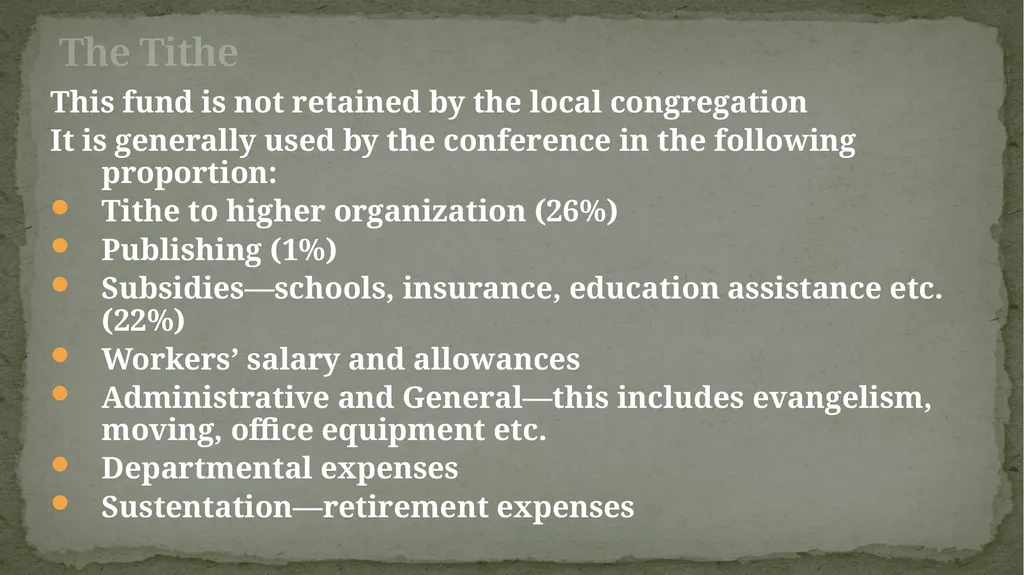
The Tithe This fund is not retained by the local congregation
It is generally used by the conference in the following proportion:
Tithe to higher organization (26%)
Publishing (1%)
Subsidies—schools, insurance, education assistance etc. (22%)
Workers’ salary and allowances
Administrative and General—this includes evangelism, moving, office equipment etc.
Departmental expenses
Sustentation—retirement expenses<br>
It is generally used by the conference in the following proportion:
Tithe to higher organization (26%)
Publishing (1%)
Subsidies—schools, insurance, education assistance etc. (22%)
Workers’ salary and allowances
Administrative and General—this includes evangelism, moving, office equipment etc.
Departmental expenses
Sustentation—retirement expenses<br>
52
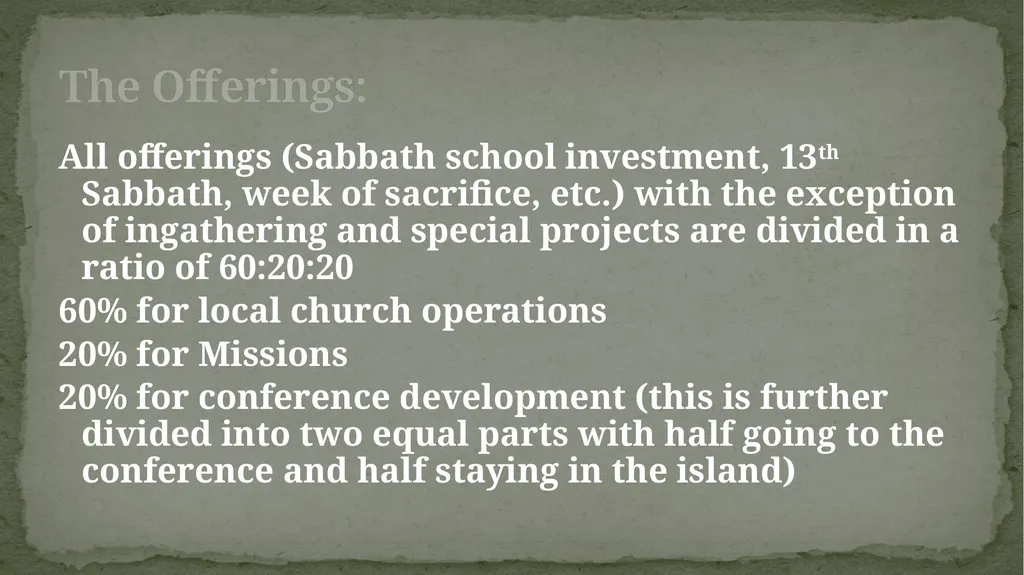
The Offerings: All offerings (Sabbath school investment, 13th Sabbath, week of sacrifice, etc.) with the exception of ingathering and special projects are divided in a ratio of 60:20:20
60% for local church operations
20% for Missions
20% for conference development (this is further divided into two equal parts with half going to the conference and half staying in the island)<br>
60% for local church operations
20% for Missions
20% for conference development (this is further divided into two equal parts with half going to the conference and half staying in the island)<br>
53
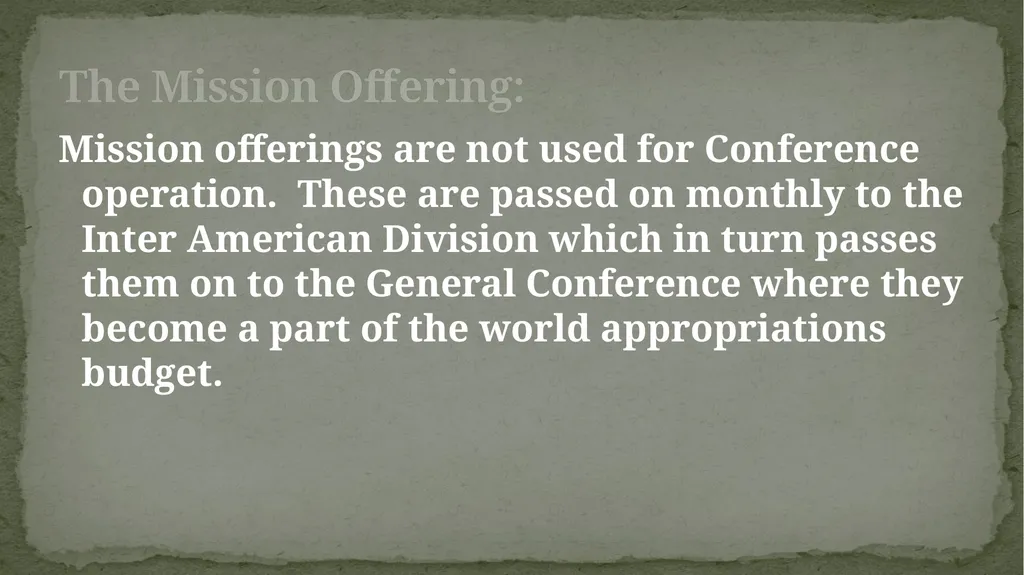
The Mission Offering: Mission offerings are not used for Conference operation. These are passed on monthly to the Inter American Division which in turn passes them on to the General Conference where they become a part of the world appropriations budget.<br>
54
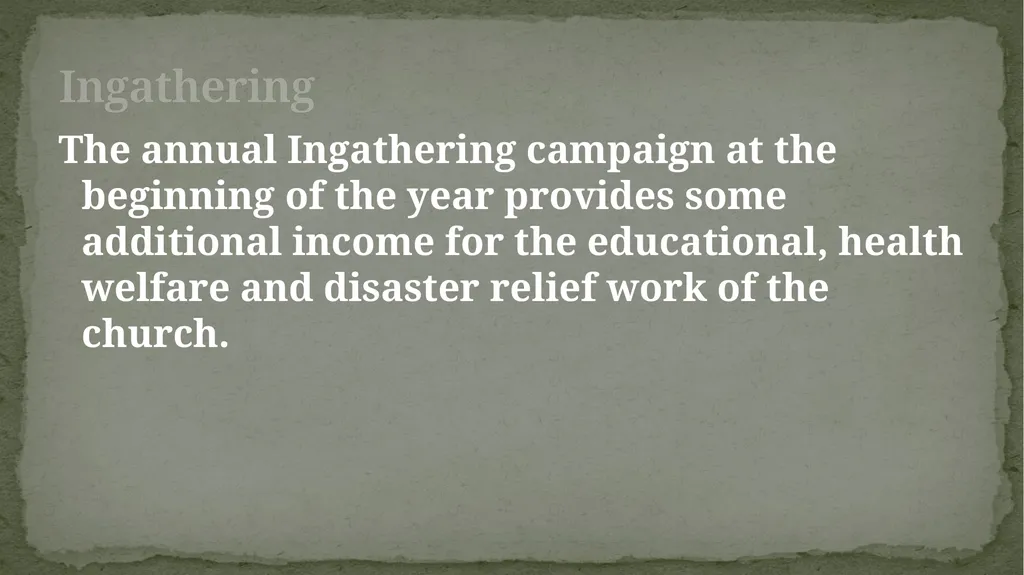
Ingathering The annual Ingathering campaign at the beginning of the year provides some additional income for the educational, health welfare and disaster relief work of the church.<br>
55
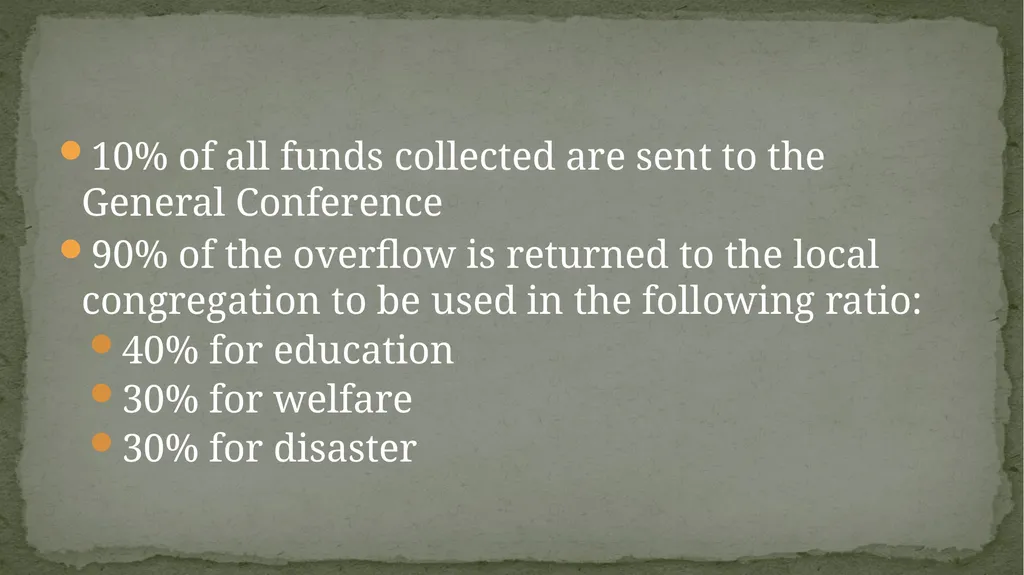
10% of all funds collected are sent to the General Conference
90% of the overflow is returned to the local congregation to be used in the following ratio:
40% for education
30% for welfare
30% for disaster<br>
90% of the overflow is returned to the local congregation to be used in the following ratio:
40% for education
30% for welfare
30% for disaster<br>
56
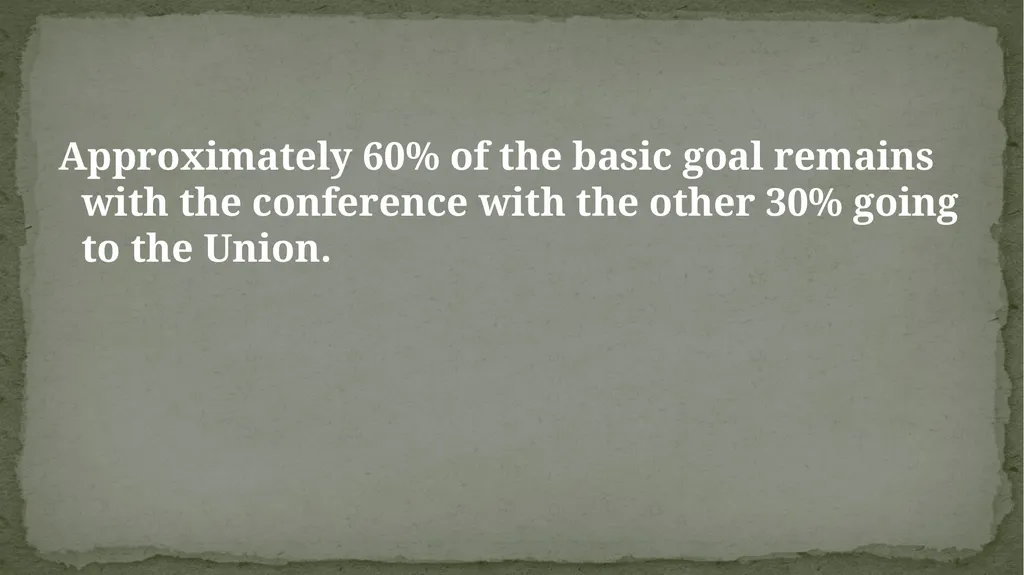
Approximately 60% of the basic goal remains with the conference with the other 30% going to the Union.<br>
57
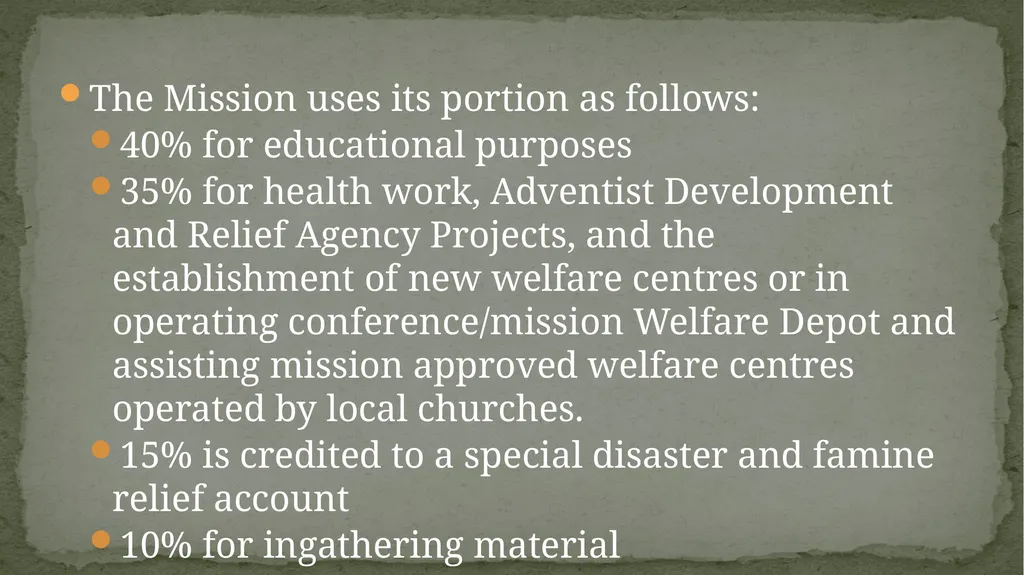
The Mission uses its portion as follows:
40% for educational purposes
35% for health work, Adventist Development and Relief Agency Projects, and the establishment of new welfare centres or in operating conference/mission Welfare Depot and assisting mission approved welfare centres operated by local churches.
15% is credited to a special disaster and famine relief account
10% for ingathering material<br>
40% for educational purposes
35% for health work, Adventist Development and Relief Agency Projects, and the establishment of new welfare centres or in operating conference/mission Welfare Depot and assisting mission approved welfare centres operated by local churches.
15% is credited to a special disaster and famine relief account
10% for ingathering material<br>
58
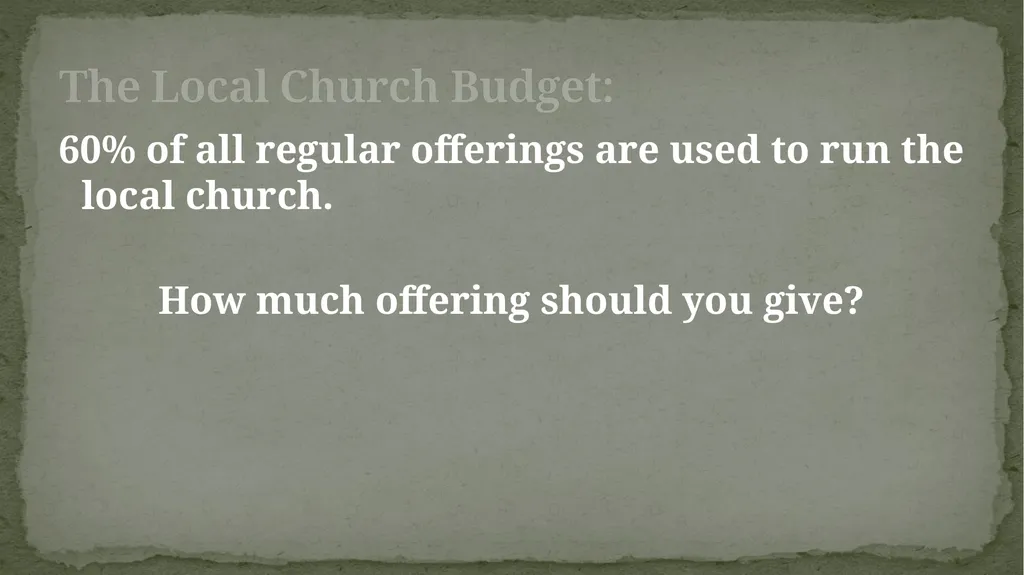
The Local Church Budget: 60% of all regular offerings are used to run the local church.
How much offering should you give?<br>
How much offering should you give?<br>
59
Review: The returning of our tithes and the giving or our offerings is a spiritual obligation
When we do so God blesses us
When we fail to do so we are cursed
Whenever we interfere with sacred things we bring a curse on ourselves.<br>
When we do so God blesses us
When we fail to do so we are cursed
Whenever we interfere with sacred things we bring a curse on ourselves.<br>
60
Sample Budget<br>
61
IF YOUR EXPENSES EXCEED YOUR INCOME,
THEN YOUR UPKEEP BECOMES YOUR DOWNFALL<br>
THEN YOUR UPKEEP BECOMES YOUR DOWNFALL<br>