Mapping SLOs to PLOs The connection between plos and slos Goal: Effective Data for PLO assessment Think of PLOs like a Destination on a map. The SLOs for programmatic courses are like Landmarks leading to the Destination. SLOs should be
Related Topics
Share
Embed code
Download this presentation From Below
"Mapping SLOs to PLOs The connection between plos" is the property of its rightful owner. Permission is granted to
download and print the materials on this website for personal, non-commercial use only, and to display it
on your personal computer provided you do not modify the materials and that you retain all copyright
notices contained in the materials. By downloading content from our website, you accept the terms of this
agreement.
Presentation Transcript
01
Mapping SLOs to PLOs<br>
02
The connection between plos and slos Goal: Effective Data for PLO assessment
Think of PLOs like a Destination on a map.
The SLOs for programmatic courses are like Landmarks leading to the Destination.
SLOs should be mapped to PLOs selectively. SLOs should centrally and directly relate to the PLOs they map to – it is not the goal to “check all that apply.” Not all Landmarks will lead to a Destination!<br>
03
Strategies for mapping<br>
04
Top Down Approach Start with the PLOs
Ask: which courses best support this specific PLO?
From there, examine the course SLOs and selectively map each SLO to the relevant PLO.<br>
05
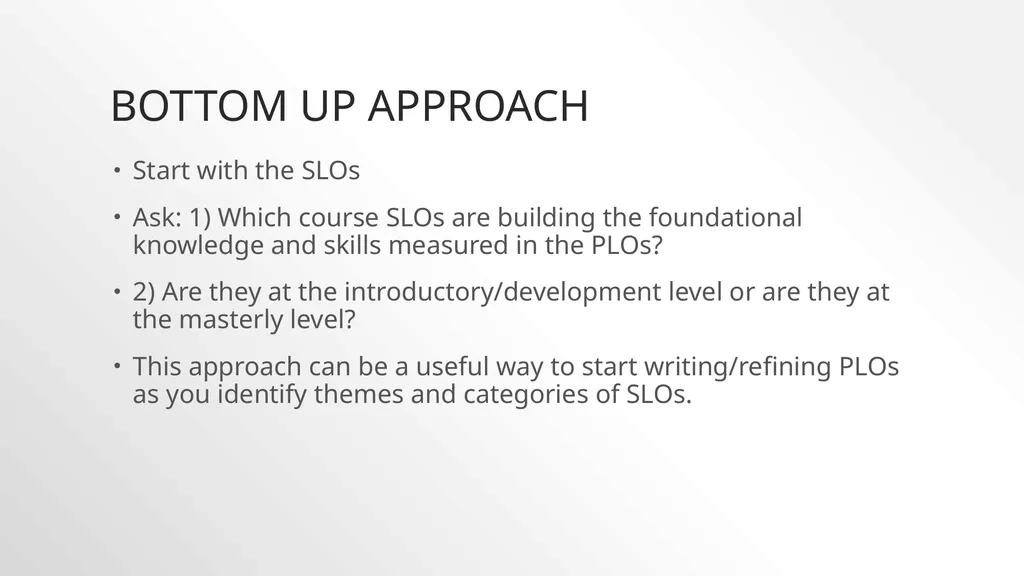
Bottom up approach Start with the SLOs
Ask: 1) Which course SLOs are building the foundational knowledge and skills measured in the PLOs?
2) Are they at the introductory/development level or are they at the masterly level?
This approach can be a useful way to start writing/refining PLOs as you identify themes and categories of SLOs.<br>
06
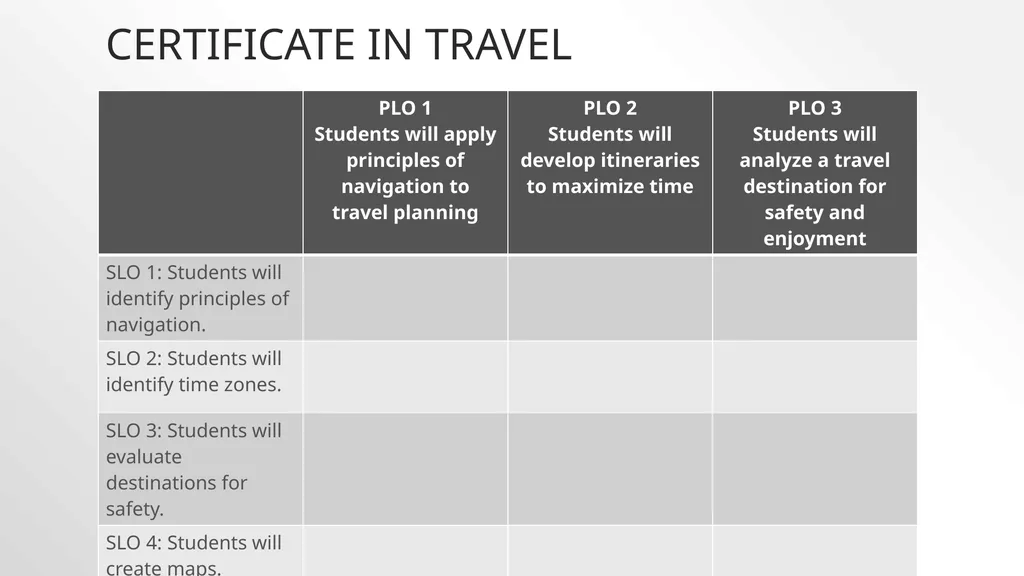
CERTIFICATE IN TRAVEL<br>
07
Avoid Row or Column Mapping<br>
08
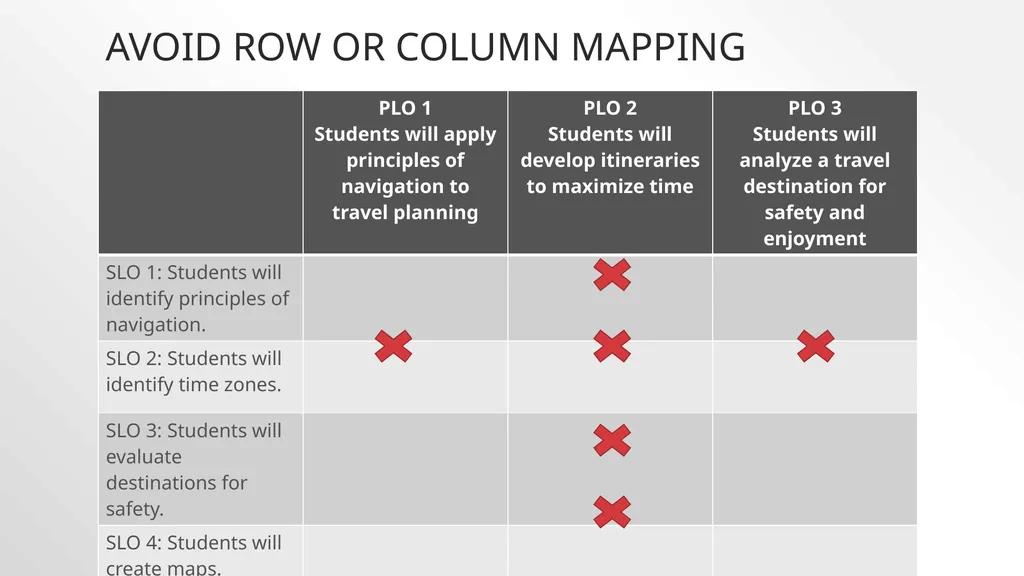
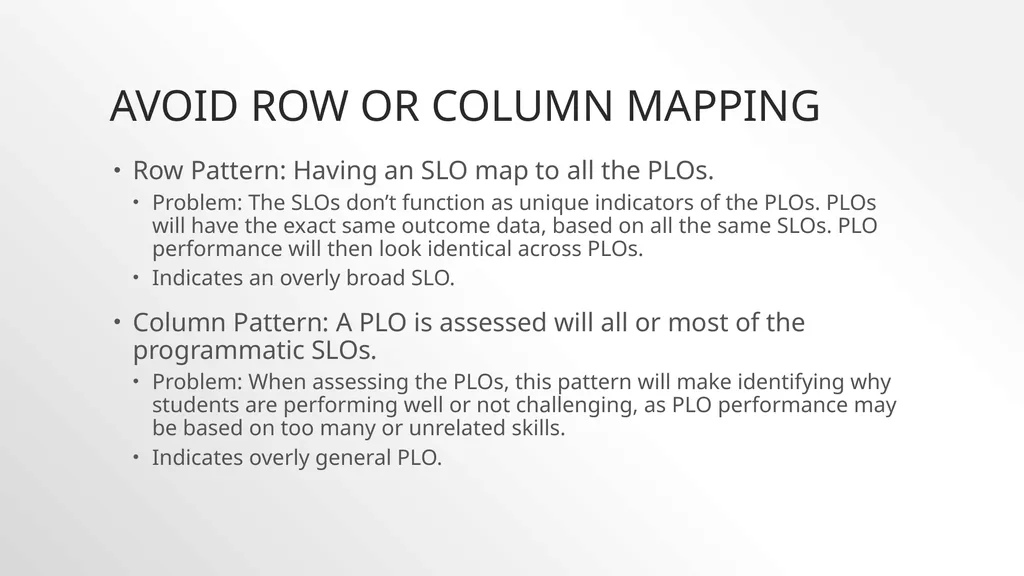
Avoid row or column mapping Row Pattern: Having an SLO map to all the PLOs.
Problem: The SLOs don’t function as unique indicators of the PLOs. PLOs will have the exact same outcome data, based on all the same SLOs. PLO performance will then look identical across PLOs.
Indicates an overly broad SLO.
Column Pattern: A PLO is assessed will all or most of the programmatic SLOs.
Problem: When assessing the PLOs, this pattern will make identifying why students are performing well or not challenging, as PLO performance may be based on too many or unrelated skills.
Indicates overly general PLO.<br>
09
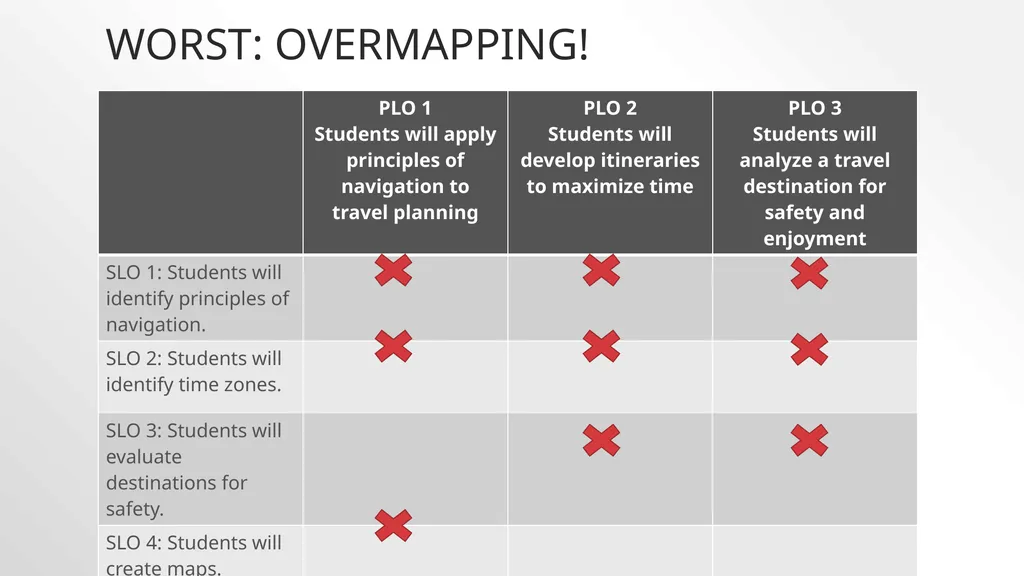
Worst: overmapping!<br>
10
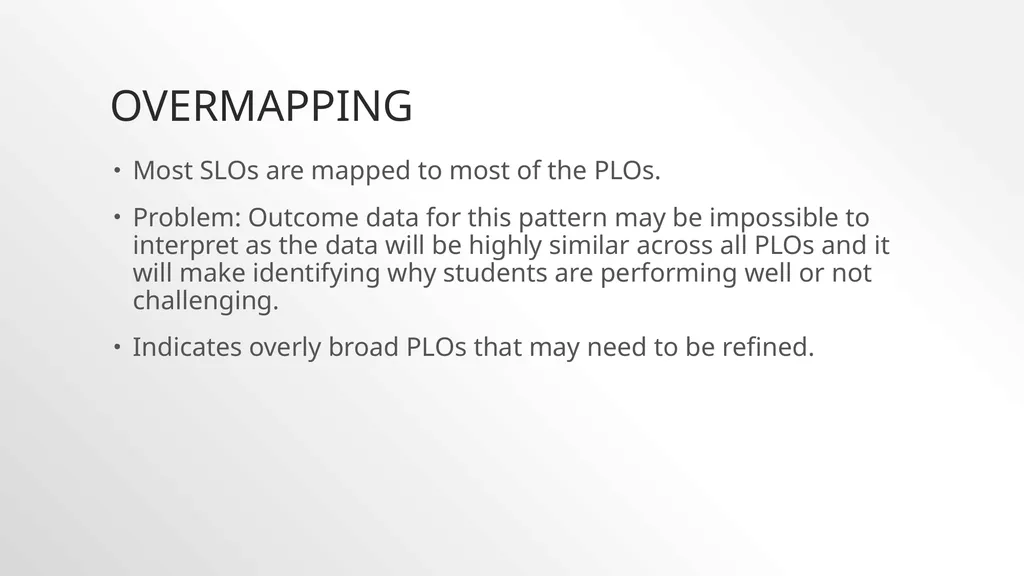
Overmapping Most SLOs are mapped to most of the PLOs.
Problem: Outcome data for this pattern may be impossible to interpret as the data will be highly similar across all PLOs and it will make identifying why students are performing well or not challenging.
Indicates overly broad PLOs that may need to be refined.<br>
11
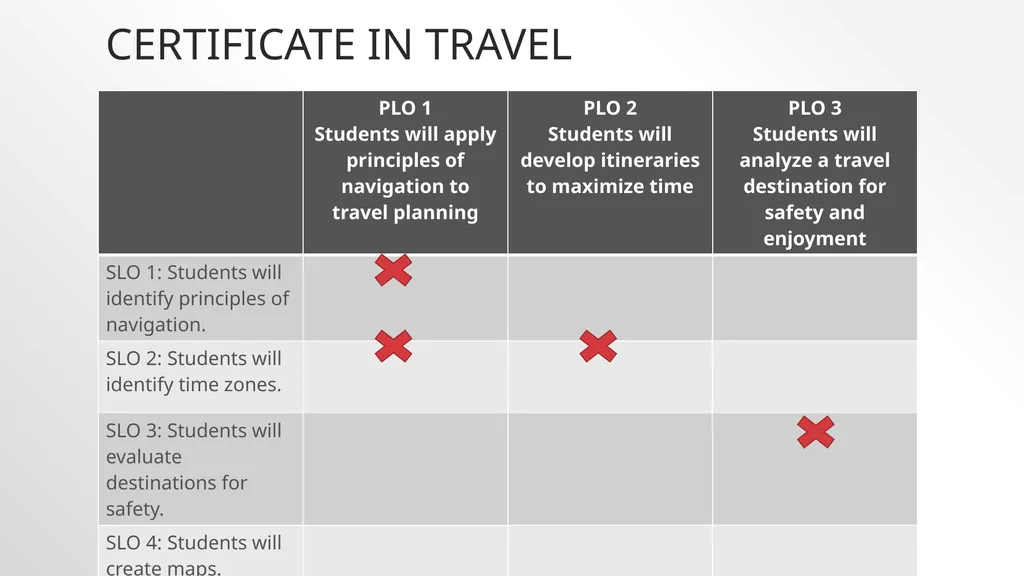
CERTIFICATE IN TRAVEL<br>
12
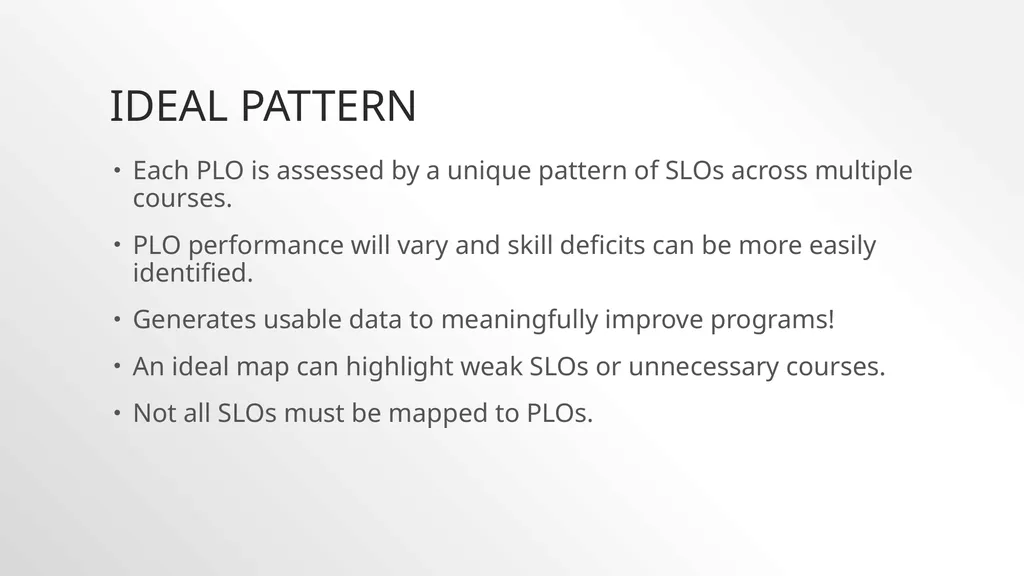
Ideal pattern Each PLO is assessed by a unique pattern of SLOs across multiple courses.
PLO performance will vary and skill deficits can be more easily identified.
Generates usable data to meaningfully improve programs!
An ideal map can highlight weak SLOs or unnecessary courses.
Not all SLOs must be mapped to PLOs.<br>
13
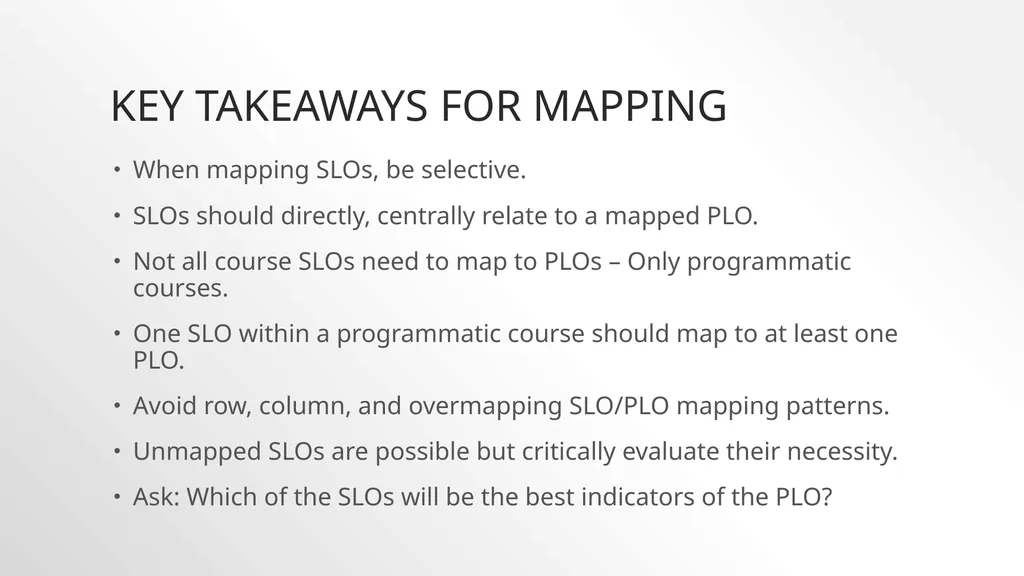
Key takeaways For Mapping When mapping SLOs, be selective.
SLOs should directly, centrally relate to a mapped PLO.
Not all course SLOs need to map to PLOs – Only programmatic courses.
One SLO within a programmatic course should map to at least one PLO.
Avoid row, column, and overmapping SLO/PLO mapping patterns.
Unmapped SLOs are possible but critically evaluate their necessity.
Ask: Which of the SLOs will be the best indicators of the PLO?<br>