
Mapping tidal flat topography using ICESat-2 and
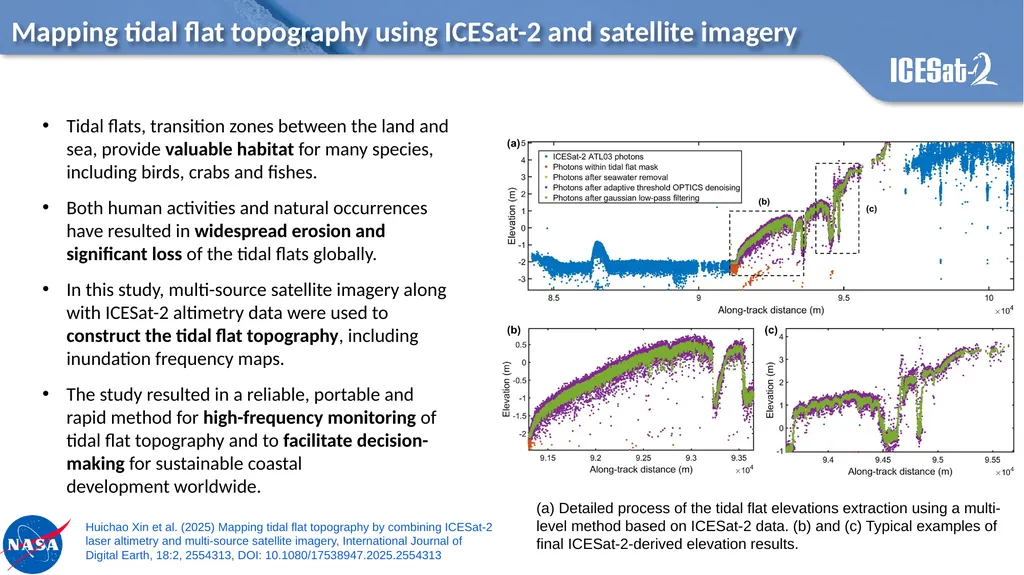
Description: Mapping tidal flat topography using ICESat-2 and satellite imagery (a) Detailed process of the tidal flat elevations extraction using a multi-level method based on ICESat-2 data. (b) and (c) Typical examples of final ICESat-2-derived
Related Topics
Download Presentation
"Mapping tidal flat topography using ICESat-2 and" is the property of its rightful owner. Permission is granted to download and print the materials on this website for personal, non-commercial use only, and to display it on your personal computer provided you do not modify the materials and that you retain all copyright notices contained in the materials. By downloading content from our website, you accept the terms of this agreement.
Presentation Transcript
slide1. Mapping tidal flat topography using ICESat-2 and satellite imagery (a) Detailed process of the tidal flat elevations extraction using a multi-level method based on ICESat-2 data. (b) and (c) Typical examples of final ICESat-2-derived elevation results. Tidal flats, transition zones between the land and sea, provide valuable habitat for many species, including birds, crabs and fishes.
Both human activities and natural occurrences have resulted in widespread erosion and significant loss of the tidal flats globally.
In this study, multi-source satellite imagery along with ICESat-2 altimetry data were used to construct the tidal flat topography, including inundation frequency maps.
The study resulted in a reliable, portable and rapid method for high-frequency monitoring of tidal flat topography and to facilitate decision-making for sustainable coastal development worldwide. Huichao Xin et al. (2025) Mapping tidal flat topography by combining ICESat-2 laser altimetry and multi-source satellite imagery, International Journal of Digital Earth, 18:2, 2554313, DOI: 10.1080/17538947.2025.2554313<br>
Both human activities and natural occurrences have resulted in widespread erosion and significant loss of the tidal flats globally.
In this study, multi-source satellite imagery along with ICESat-2 altimetry data were used to construct the tidal flat topography, including inundation frequency maps.
The study resulted in a reliable, portable and rapid method for high-frequency monitoring of tidal flat topography and to facilitate decision-making for sustainable coastal development worldwide. Huichao Xin et al. (2025) Mapping tidal flat topography by combining ICESat-2 laser altimetry and multi-source satellite imagery, International Journal of Digital Earth, 18:2, 2554313, DOI: 10.1080/17538947.2025.2554313<br>