Marco Maffei Tutor: A. De Maio Co-Tutor: A. Farina, A. Aubry XXIX Cycle - I year presentation Bayesian Inference via Spaceborne Radars for Space Situational Awareness Roadmap Template CONTENT Cover Background Graduation MS, DIETI group,
"Marco Maffei Tutor: A. De Maio Co-Tutor: A." is the property of its rightful owner. Permission is granted to
download and print the materials on this website for personal, non-commercial use only, and to display it
on your personal computer provided you do not modify the materials and that you retain all copyright
notices contained in the materials. By downloading content from our website, you accept the terms of this
agreement.
Presentation Transcript
01
Marco Maffei Tutor: A. De Maio Co-Tutor: A. Farina, A. Aubry XXIX Cycle - I year presentation Bayesian Inference via Spaceborne Radars
for Space Situational Awareness<br>
02
Roadmap Template CONTENT
Cover
Background
Graduation MS, DIETI group, cooperations (mostly written)
Type of fellowship
Problem
Specific (1 minutes)
Research Activity (3 minutes)
idea, methodology, developments, expected results, validation
Products
List and mention
Next Years
I year credits (table, mark in red if discrepancies occurs with PhD web site table)
Specific objects(say)
Table for training (expected credits) no words Marco Maffei 2<br>
03
Cover & Background Marco Maffei 3 Background
Dr. Ing. Degree in Electrical Engineering at the University of Roma TRE, Rome, Italy in 2004.
IN FIERI Ph.D. Degree in Information Technology and Electrical Engineering at the University of Napoli Federico II, Naples, Italy. Department of Information Technology and Electrical Engineering. Dissertation Title: Bayesian Inference via Spaceborne Radars for Space Situational Awareness. Advisors Alfonso Farina (Selex ES retired), Antonio De Maio (University of Napoli Federico II), Augusto Aubry (University of Napoli Federico II). Dissertation expected in 2021.
Affiliations IEEE Senior Member (M’08 - SM’18)
Aerospace and Electronic Systems Society - Vice Chair & Treasurer AES Chapter – IEEE Italy Section
Signal Processing Society<br>
04
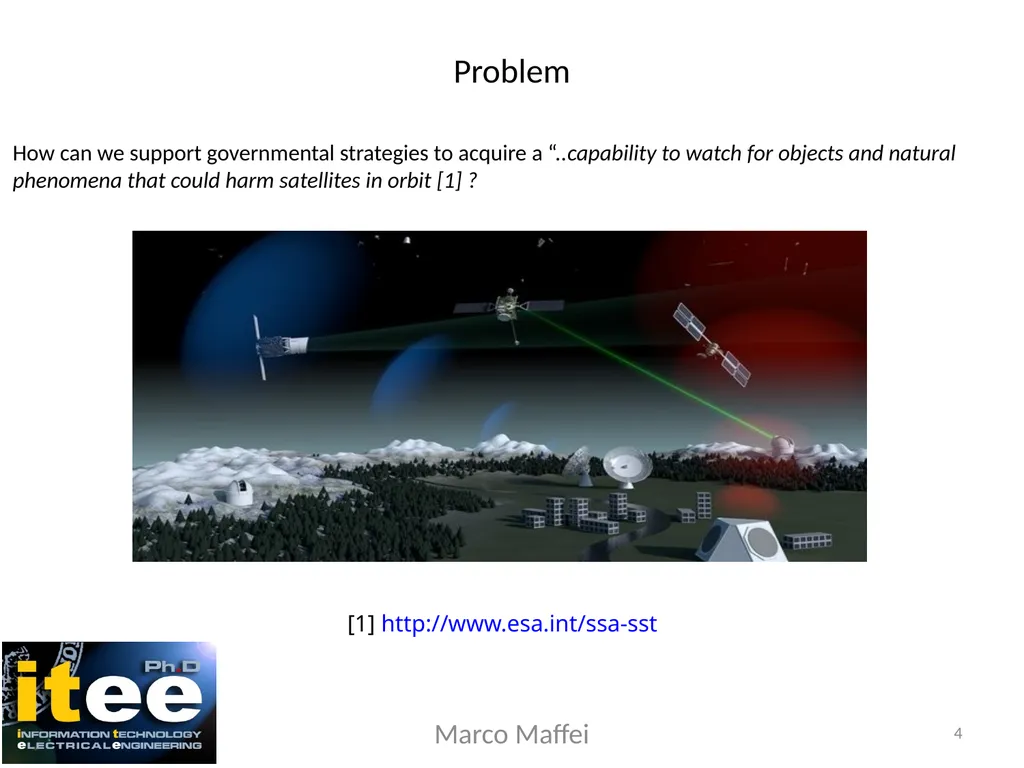
Problem Marco Maffei 4 How can we support governmental strategies to acquire a “..capability to watch for objects and natural phenomena that could harm satellites in orbit [1] ? [1] http://www.esa.int/ssa-sst<br>
05
Research Activity (1/3) Marco Maffei 5 Idea
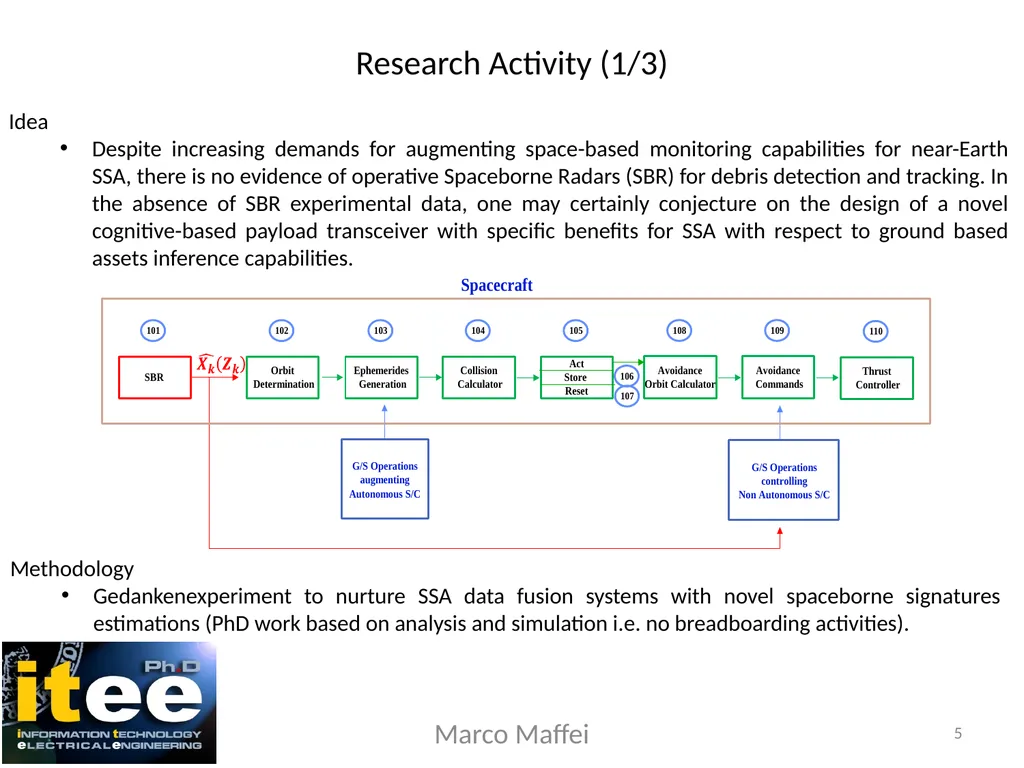
Despite increasing demands for augmenting space-based monitoring capabilities for near-Earth SSA, there is no evidence of operative Spaceborne Radars (SBR) for debris detection and tracking. In the absence of SBR experimental data, one may certainly conjecture on the design of a novel cognitive-based payload transceiver with specific benefits for SSA with respect to ground based assets inference capabilities. Methodology
Gedankenexperiment to nurture SSA data fusion systems with novel spaceborne signatures estimations (PhD work based on analysis and simulation i.e. no breadboarding activities).<br>
06
Research Activity (2/3) Marco Maffei 6 Developments, Expected Results, Validation
Providing a harmonizing ontological framework for the possible environmental scenario to cope with. The objective of such an ontology is strictly related to the conceptual modeling of both channel and target phenomenology, thus paving the way for reasonable a priori formulations needed by Multi Target Tracking (MTT) Bayesian paradigms. (COMPLETE)
Outlining possible SBR payloads archetypes, beyond current Synthetic Aperture Radar (SAR) imaging purposes, as tailored to the general tasks of debris detection and parameter estimation pertaining to air-to-air Real Aperture Radars (RAR) taking into account legacy pulse Doppler radar systems. (IN FIERI)
Harmonizing radar frameworks for target detection and tracking in terms of both multi-target and cognitive perspectives, following the work by Dr. K. Bell (et al.), Dr. A. Farina, A. De Maio, S. Haykin. Considering the limits of Poisson Point Processes (PPP) for hyper-velocity multi-target densities tracking via iFilters, and possibly adopting techniques from stochastic geometry, following the work by Dr. R. Streit (et al.), Dr. R. Mahler (et al.), Dr. A. Farina (et al.), Dr. B.-T. Vo and Dr. B.-N. Vo et al.) and machine learning following the work by Dr. S. Haykin (et al.) (IN FIERI)<br>
07
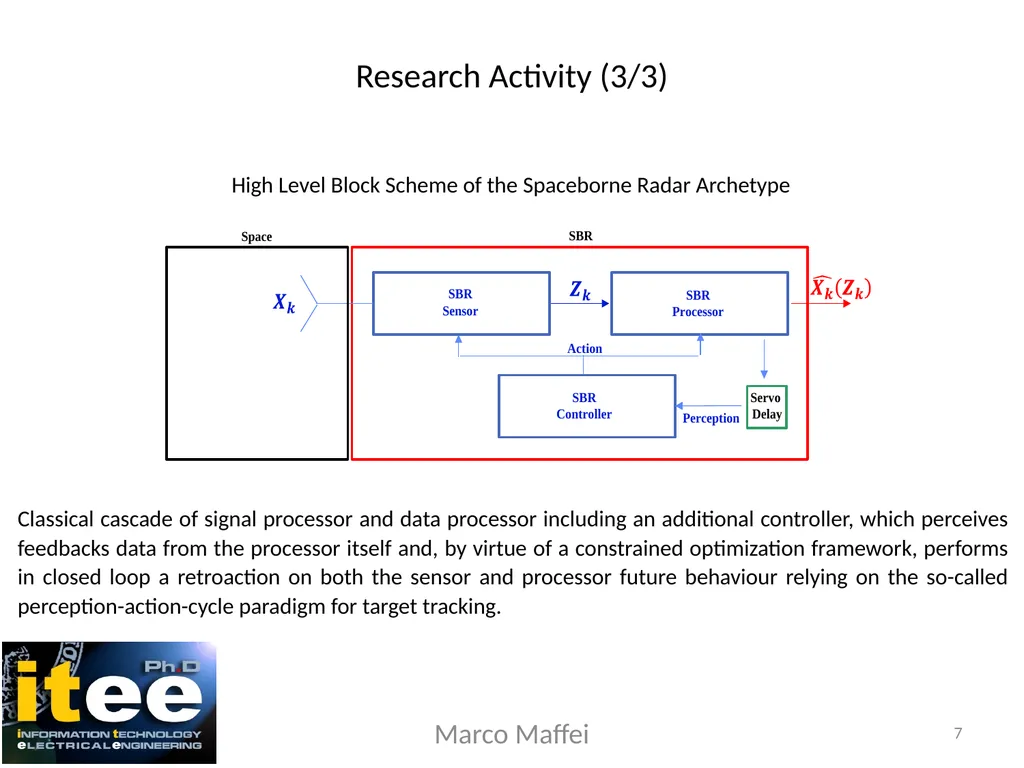
Research Activity (3/3) Marco Maffei 7 High Level Block Scheme of the Spaceborne Radar Archetype Classical cascade of signal processor and data processor including an additional controller, which perceives feedbacks data from the processor itself and, by virtue of a constrained optimization framework, performs in closed loop a retroaction on both the sensor and processor future behaviour relying on the so-called perception-action-cycle paradigm for target tracking.<br>
08
Research Production Marco Maffei 8 M. Maffei, A. Aubry, A. De Maio, A. Farina, “Bayesian Inference via Spaceborne Radars for Space Situational Awareness,” Dissertation Draft
Chapter 1 Introduction (complete – minor revisions)
Chapter 2 Space Situational Awareness via SBR (complete – minor revisions)
Chapter 3 Ontology for Dynamic Environmental Scenarios complete – minor revisions)
Chapter 4 Architectural Archetypes for SBR (in fieri)
Chapter 5 SBR MTT for Individual and Cloud Debris Classes (in fieri)
Chapter 6 Conclusions (in fieri)
M. Maffei, A. Aubry, A. De Maio, A. Farina, “On the Exploitability of the Ka Band for Spaceborne Radar Debris Detection and Tracking Measurements,” 2019 IEEE International Workshop on Metrology for Aerospace, Torino, Italy, June 2019.
M. Maffei, A. Aubry, A. De Maio, A. Farina, “On the Exploitability of the Ka Band for Spaceborne Radar Debris Detection and Tracking,” Poster for Workshop on Mathematical Models for Science and Engineering, University of Napoli Federico II, September 11-13, Napoli, Italy.
M. Maffei, A. Aubry, A. De Maio, A. Farina, “An Ontology for Spaceborne Radar Debris Detection and Tracking,” to be submitted to the IEEE AESS Magazine.<br>
09
Way Forward Marco Maffei 9 Continuing to focus on many books and papers as well as courses, seminars, and research activities under the guidance of the advisors. It is planned to extend the 2018/2019 activities also during 2019/2020 and 2020/2021. Additional courses, seminars, and books on Matrix Analysis (Horn), Optimization (Bertsekas), Machine Learning (Haykin), Radar Systems and Statistical Signal Processing (Farina, De Maio), Stochastic Geometry (Streit).
A Course Syllabus has been prepared - Novel Spaceborne Radars Archetypes in the Space Economy - draft July 2019.
Completing M. Maffei, A. Aubry, A. De Maio, A. Farina, “Bayesian Inference via Spaceborne Radars for Space Situational Awareness,” Dissertation Draft with Chapters 4-5-6.
Dissemination within IEEE AESS, IEEE SPS, IEEE GRSS, ESA, NASA, NATO.<br>