MARINE INVERTEBRATES Animals that do not have a bony internal skeleton. More than 90 of all animals are invertebrates, classified into 33 phyla. Every phylum of invertebrates has members that live in the oceans. Phyla of invertebrates
"MARINE INVERTEBRATES Animals that do not have a" is the property of its rightful owner. Permission is granted to
download and print the materials on this website for personal, non-commercial use only, and to display it
on your personal computer provided you do not modify the materials and that you retain all copyright
notices contained in the materials. By downloading content from our website, you accept the terms of this
agreement.
Presentation Transcript
01
MARINE INVERTEBRATES<br>
02
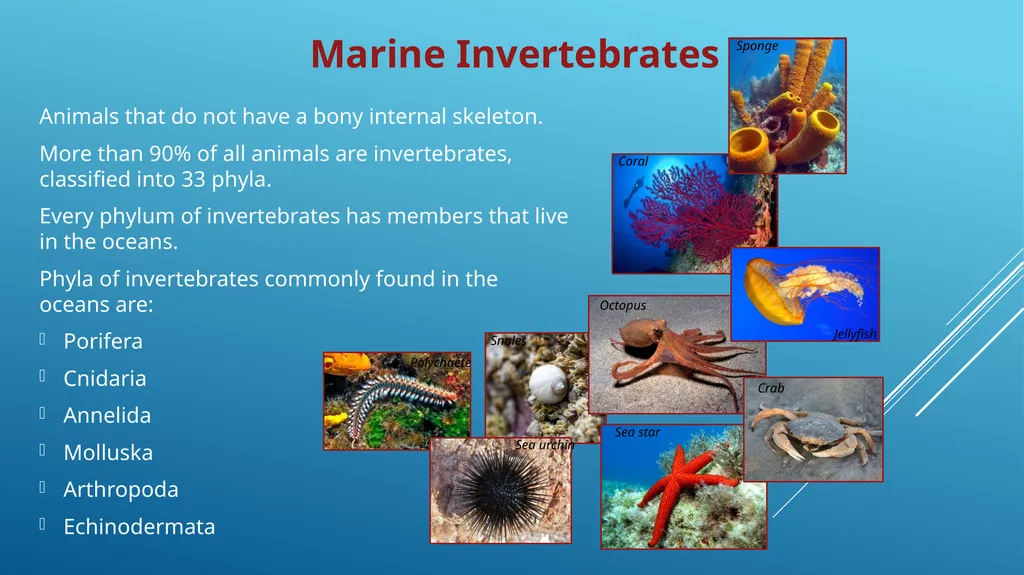
Animals that do not have a bony internal skeleton.
More than 90% of all animals are invertebrates, classified into 33 phyla.
Every phylum of invertebrates has members that live in the oceans.
Phyla of invertebrates commonly found in the oceans are:
Porifera
Cnidaria
Annelida
Molluska
Arthropoda
Echinodermata Marine Invertebrates Sponge Coral Polychaete Octopus Crab Sea star Snales Sea urchin Jellyfish<br>
03
Marine Benthic Invertebrates Organisms living in or on the marine sediment, from tidal pools along the shore, out to the continental shelf, and down to the abyssal depths.
They are dominated by polychaetes, mollusks, crustaceans, and echinoderms, but include members of many lesser known animal phyla.
They include sessile, vagile and sedentary organisms.
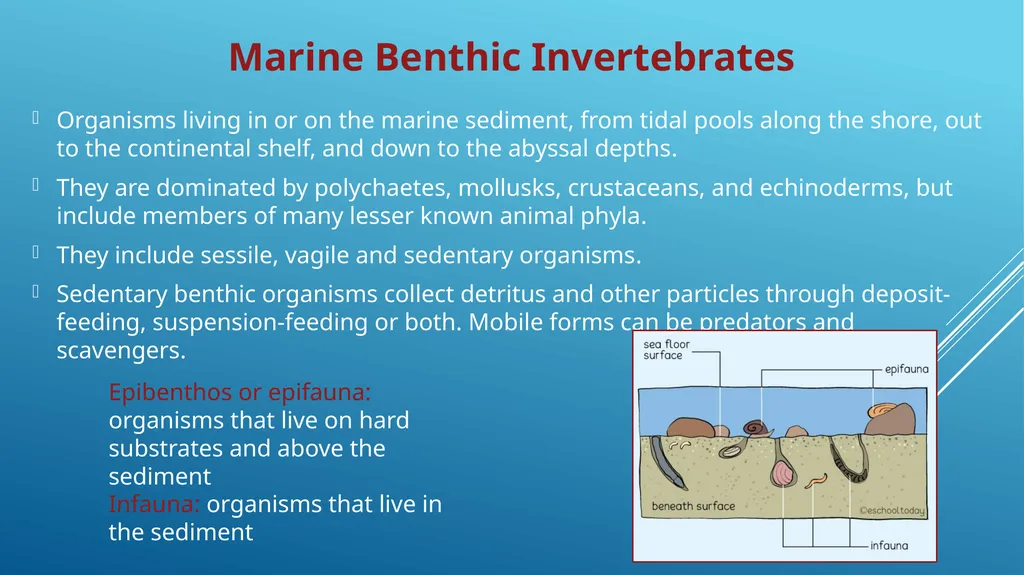
Sedentary benthic organisms collect detritus and other particles through deposit-feeding, suspension-feeding or both. Mobile forms can be predators and scavengers. Epibenthos or epifauna: organisms that live on hard substrates and above the sediment
Infauna: organisms that live in the sediment<br>
04
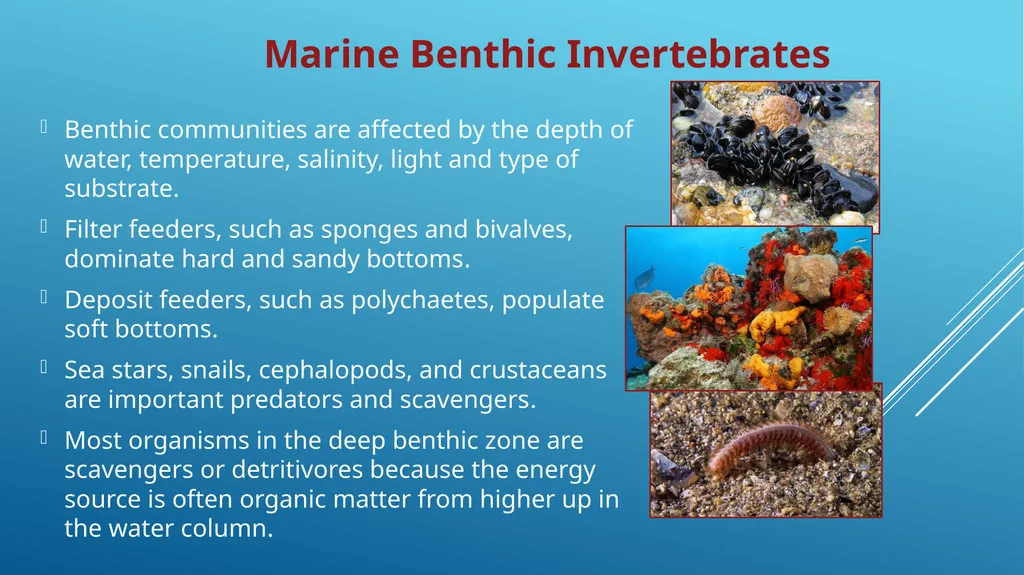
Benthic communities are affected by the depth of water, temperature, salinity, light and type of substrate.
Filter feeders, such as sponges and bivalves, dominate hard and sandy bottoms.
Deposit feeders, such as polychaetes, populate soft bottoms.
Sea stars, snails, cephalopods, and crustaceans are important predators and scavengers.
Most organisms in the deep benthic zone are scavengers or detritivores because the energy source is often organic matter from higher up in the water column. Marine Benthic Invertebrates<br>
05
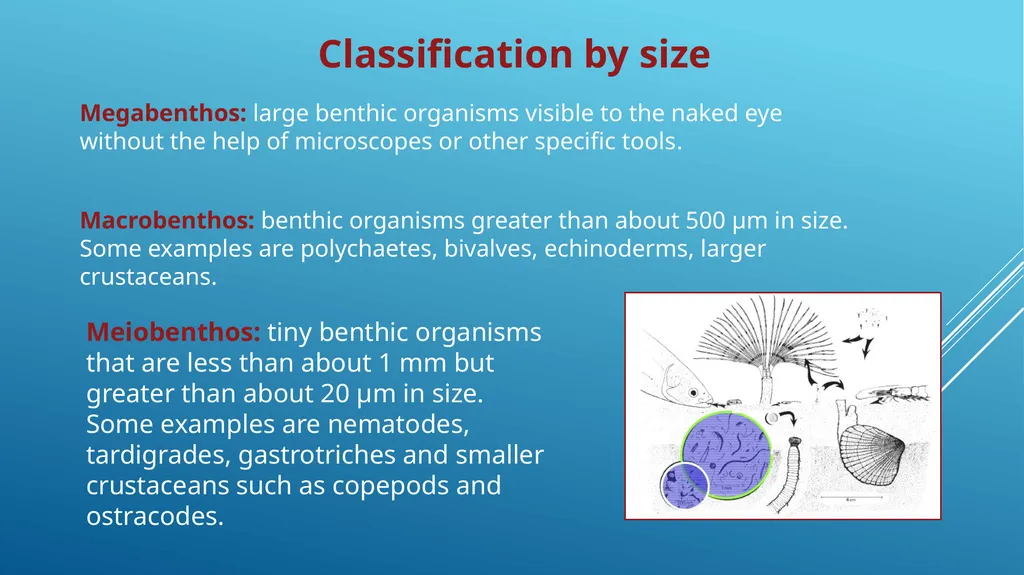
Classification by size Megabenthos: large benthic organisms visible to the naked eye without the help of microscopes or other specific tools.
Macrobenthos: benthic organisms greater than about 500 μm in size. Some examples are polychaetes, bivalves, echinoderms, larger crustaceans. Meiobenthos: tiny benthic organisms that are less than about 1 mm but greater than about 20 μm in size. Some examples are nematodes, tardigrades, gastrotriches and smaller crustaceans such as copepods and ostracodes.<br>
06
course overview: MARINE INVERTEBRATES This is a course for introducing students to the marine invertebrate biology, functions and processes that take place in them.
This course will provide information about their role in the marine ecosystem, and particular attention will be payed to understanding the overall evolution of the animal kingdom.
Aim of this course is to study marine invertebrates and to introduce students the classification, anatomy, physiology, embryological development and ecology of individual invertebrate phyla.
One of the main objectives of the course is to train students for planning and implementation of measures to prevent the negative aquaculture (e.g., fish farm) impact on overall marine wild benthos.
Practical work on different marine invertebrates includeed.<br>