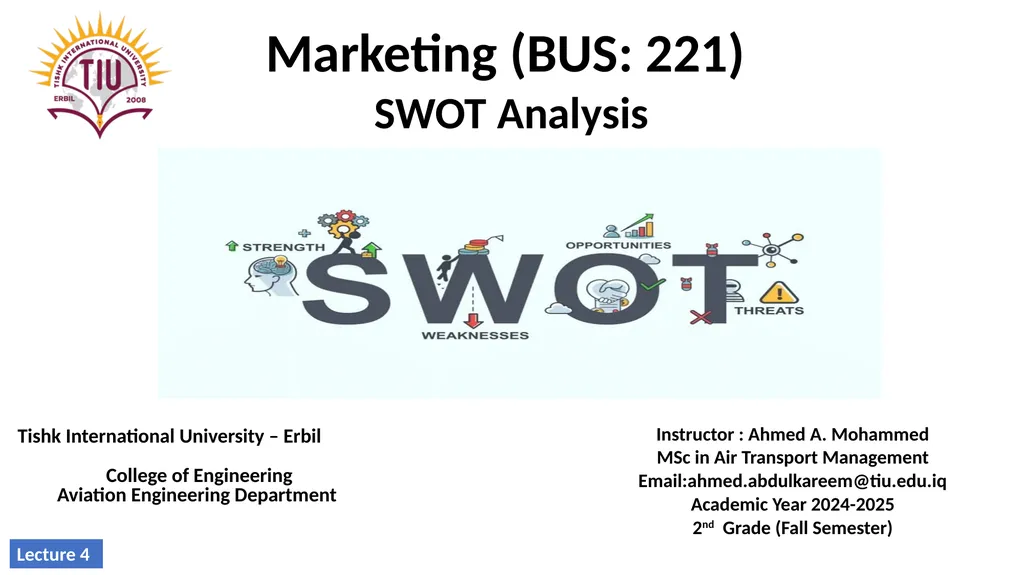
Marketing (BUS: 221) SWOT Analysis Tishk International University Erbil College of Engineering Aviation Engineering Department Outline What is SWOT Analysis.... 2 SWOT Analysis and the Two Environmental
"Marketing (BUS: 221) SWOT Analysis Tishk" is the property of its rightful owner. Permission is granted to
download and print the materials on this website for personal, non-commercial use only, and to display it
on your personal computer provided you do not modify the materials and that you retain all copyright
notices contained in the materials. By downloading content from our website, you accept the terms of this
agreement.
Presentation Transcript
01
Marketing (BUS: 221) SWOT Analysis Tishk International University – Erbil
College of Engineering
Aviation Engineering Department<br>
02
Outline What is SWOT Analysis…..………………………………………………………………………………….. 2
SWOT Analysis and the Two Environmental Factors ………………………………………….. 3
The four parts of SWOT Analysis ……………………………………………………………………….. 4
SWOT Analysis – Internal Factors ………………………………………................................. 5
SWOT Analysis – External Factors ……………………………………………………………………… 8
SWOT Analysis – Example ………………………………………………………………………………... 11
Assignment ………………………………………………………………………………………………………. 12
References ……………………………………………………………………………………………………….. 13<br>
03
Learning Outcomes After studying this course, you should be able to:
Understand the SWOT framework
Use the SWOT framework to analyse a business case study or a workplace situation
Use appropriate language and structuring to organise and write a SWOT analysis report for a business context.
To make a summary analysis of external and internal factors. 1<br>
04
What is SWOT Analysis SWOT Analysis is an analysis tool used to evaluate the Strengths, Weaknesses, Opportunities and Threats involved in an organization, a project, plan, program, or any kind of business activities (Kumar C.R et al., 2023)
SWOT Analytical tool is used for strategic planning and strategic management in organizations (Božić V 2023) 2<br>
05
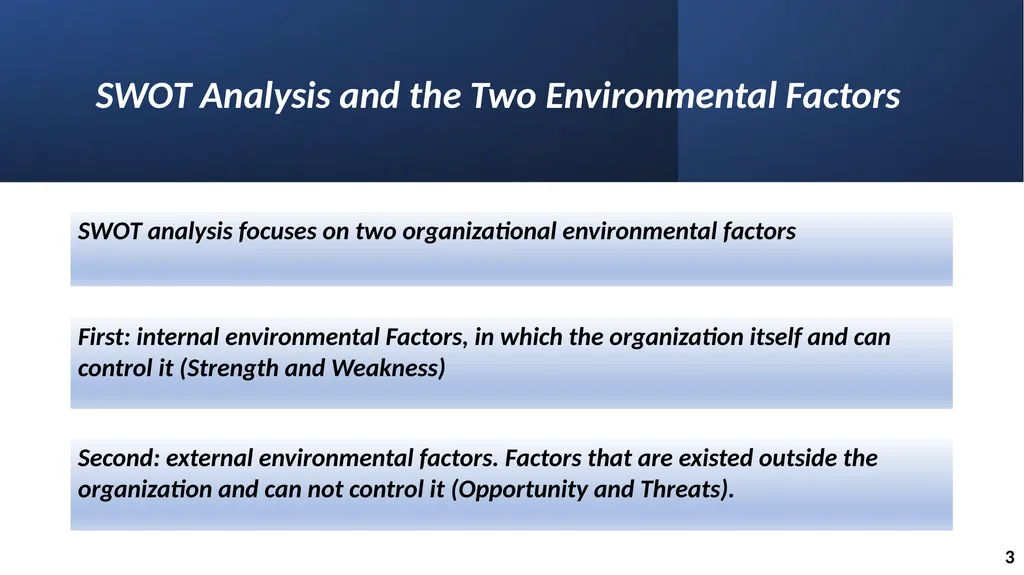
SWOT Analysis and the Two Environmental Factors 3<br>
06
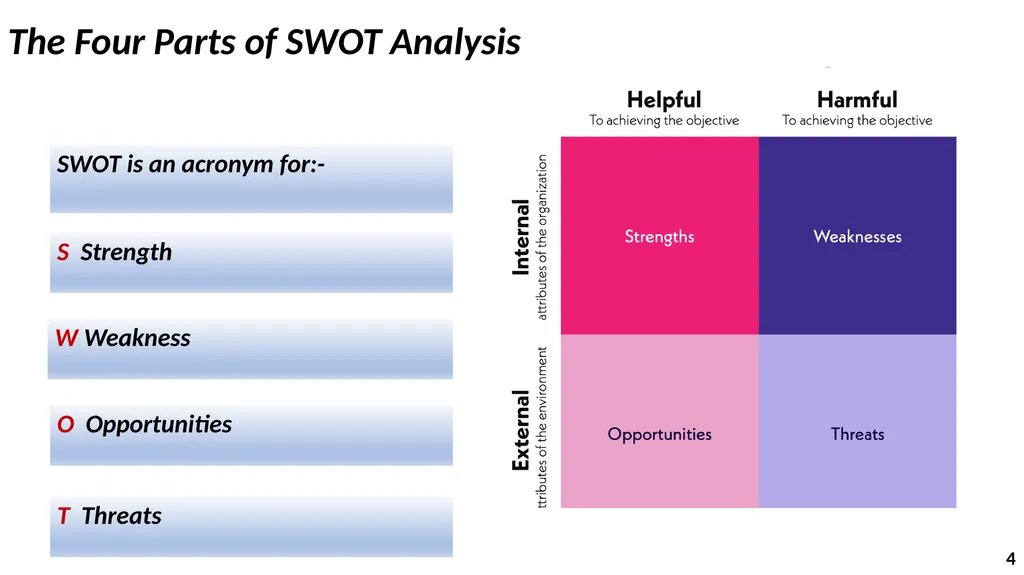
The Four Parts of SWOT Analysis 4<br>
07
SWOT Analysis – Internal Factors (Strength & Weakness) The elements of an organization internal environment are Strength and Weakness
Strength refers to characteristics that enhance the value of an organization, giving it a competitive advantage.
At the organizational level, strengths encompass unique properties and abilities that lead to greater effectiveness and efficiency compared to competitors. 5<br>
08
SWOT Analysis – Internal Factors (Strength & Weakness) Weakness refers to a lack of necessary form and competency, making an organization less advantageous compared to others.
It is a negative characteristic that highlights areas where an organization's capabilities are inferior to competitors, leading to reduced effectiveness and efficiency. 6<br>
09
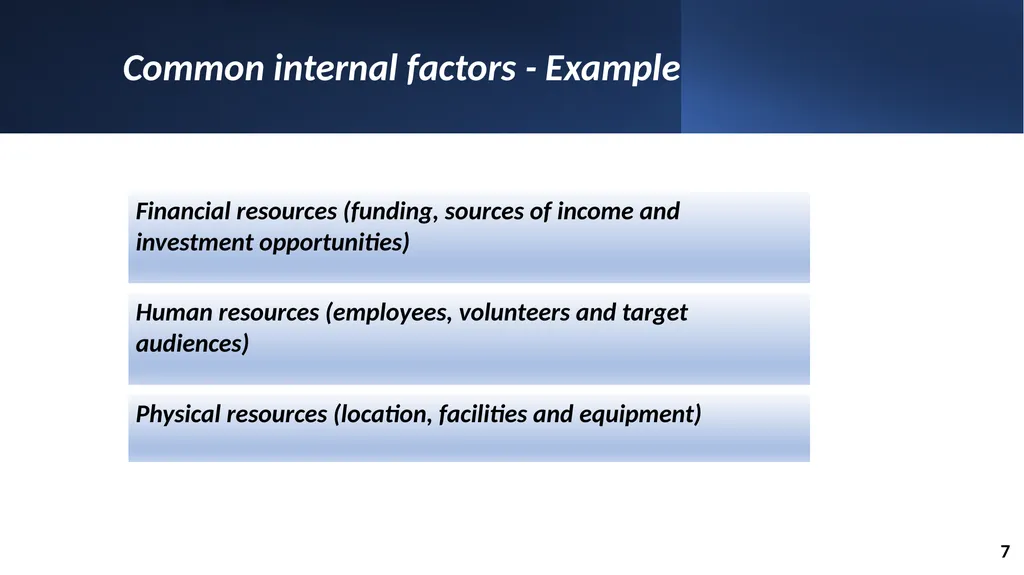
Common internal factors - Example 7<br>
10
SWOT Analysis – External Factors (Opportunities & Threats) External forces influence and affect every company, organization and individual.
Opportunity: Opportunities refer to favorable external factors that could give an organization a competitive advantage 8<br>
11
SWOT Analysis – External Factors (Opportunities & Threats) Threats: Threats are considered external elements in the environment that may cause problems for the company and major unfavorable situations in the environment. Threats are out of the organization control. 9<br>
12
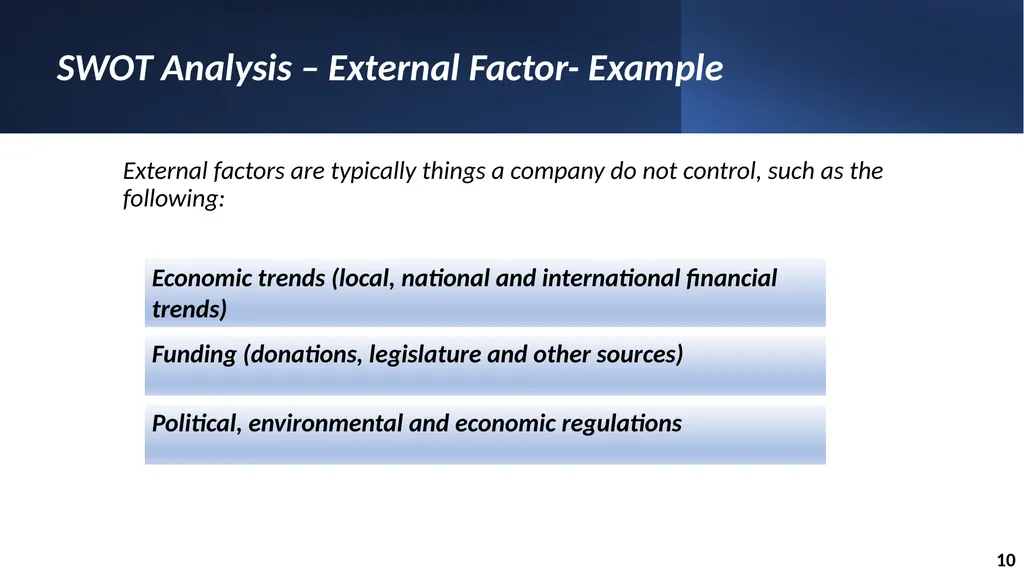
SWOT Analysis – External Factor- Example External factors are typically things a company do not control, such as the following: 10<br>
13
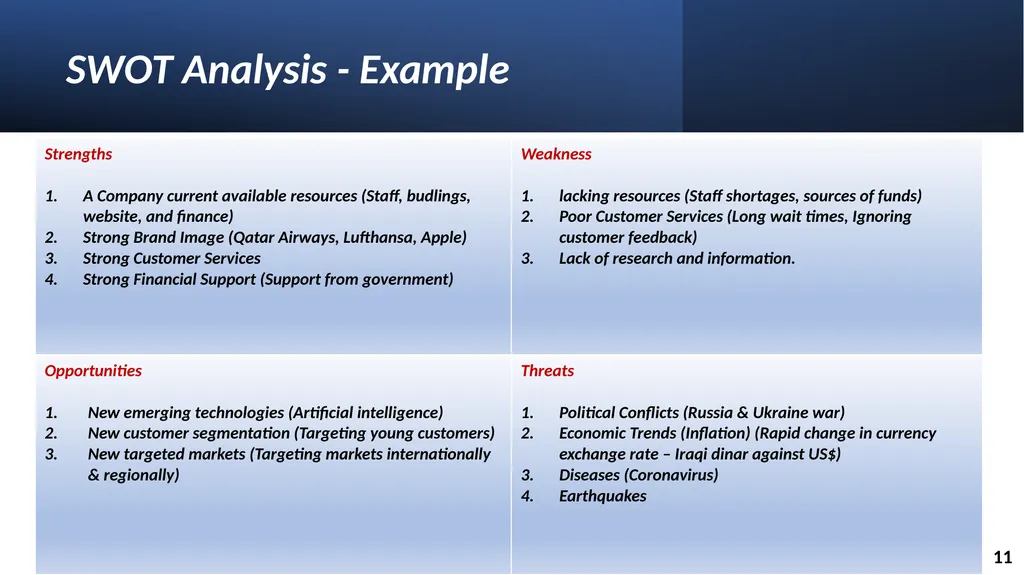
SWOT Analysis - Example 11<br>
14
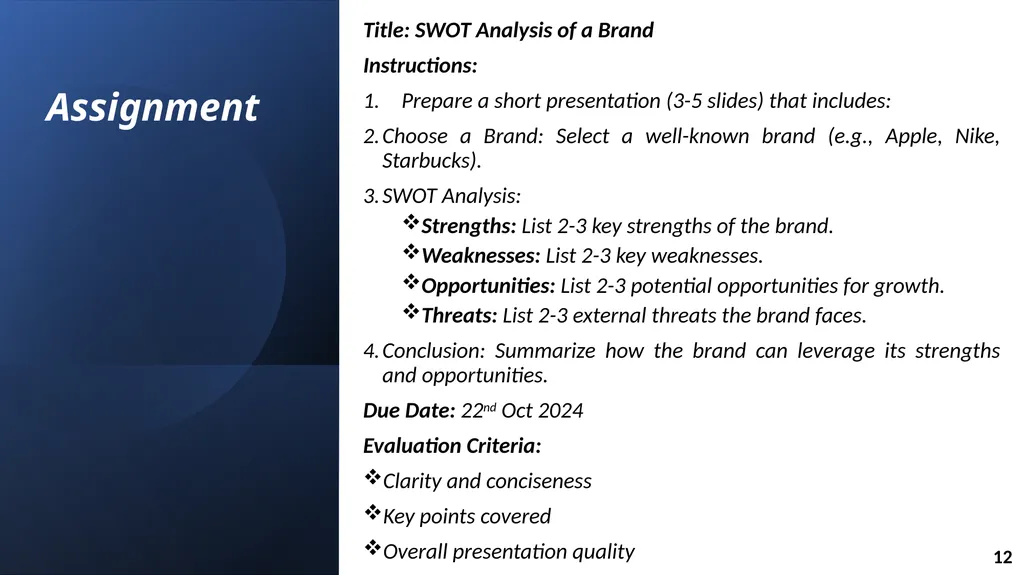
Assignment Title: SWOT Analysis of a Brand
Instructions:
Prepare a short presentation (3-5 slides) that includes:
Choose a Brand: Select a well-known brand (e.g., Apple, Nike, Starbucks).
SWOT Analysis:
Strengths: List 2-3 key strengths of the brand.
Weaknesses: List 2-3 key weaknesses.
Opportunities: List 2-3 potential opportunities for growth.
Threats: List 2-3 external threats the brand faces.
Conclusion: Summarize how the brand can leverage its strengths and opportunities.
Due Date: 22nd Oct 2024
Evaluation Criteria:
Clarity and conciseness
Key points covered
Overall presentation quality 12<br>
15
References Božić, Velibor. (2023). Objectifying SWOT and PESTLE Analysis in Hospital. 10.13140/RG.2.2.18907.34086.
Kumar C.R, S. and K.B, P. (2023) ‘SWOT analysis’, International Journal of Advanced Research, 11(09), pp. 744–748. doi:10.21474/ijar01/17584.
Panteleiev, V. (2023) ‘Application of SWOT analysis to justify the strategy of Hotel Business Enterprises’, Technology audit and production reserves, 1(4(69)), pp. 14–19. doi:10.15587/2706-5448.2023.274918. 13<br>