
Markets committee | October 12-13, 2022 |
LV
Published · 59 slides · 0 views

1 / 1






Description
Markets committee October 12-13, 2022 Westborough, MA Chris Geissler Principal Analyst Procure and transparently price services required for a reliable operating plan in the Day-Ahead Energy Market Day-Ahead Ancillary Services
Related Topics
Share
Embed code
Download this presentation From Below
"Markets committee | October 12-13, 2022 |" is the property of its rightful owner. Permission is granted to download and print the materials on this website for personal, non-commercial use only, and to display it on your personal computer provided you do not modify the materials and that you retain all copyright notices contained in the materials. By downloading content from our website, you accept the terms of this agreement.
Presentation Transcript
01
Markets committee | October 12-13, 2022 | Westborough, MA Chris Geissler Principal Analyst Procure and transparently price services required for a reliable operating plan in the Day-Ahead Energy Market Day-Ahead Ancillary Services Initiative (DASI) 1 Ben Ewing Manager, Economic Analysis<br>
02
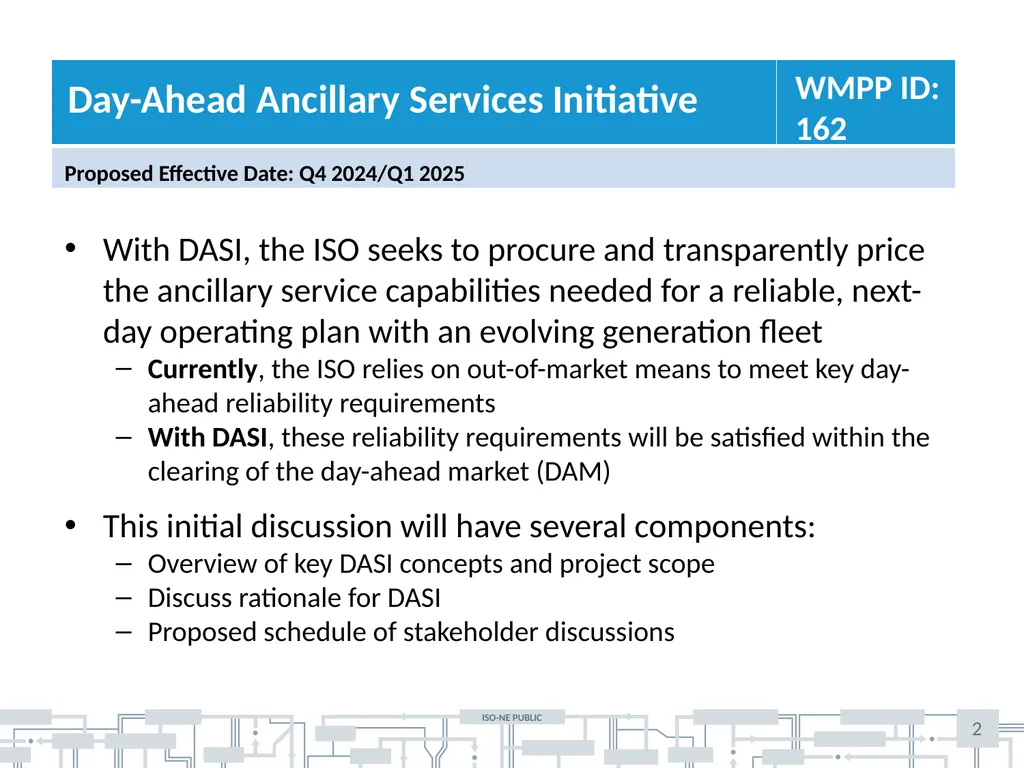
2 Day-Ahead Ancillary Services Initiative WMPP ID:
162 Proposed Effective Date: Q4 2024/Q1 2025 With DASI, the ISO seeks to procure and transparently price the ancillary service capabilities needed for a reliable, next-day operating plan with an evolving generation fleet
Currently, the ISO relies on out-of-market means to meet key day-ahead reliability requirements
With DASI, these reliability requirements will be satisfied within the clearing of the day-ahead market (DAM)
This initial discussion will have several components:
Overview of key DASI concepts and project scope
Discuss rationale for DASI
Proposed schedule of stakeholder discussions<br>
162 Proposed Effective Date: Q4 2024/Q1 2025 With DASI, the ISO seeks to procure and transparently price the ancillary service capabilities needed for a reliable, next-day operating plan with an evolving generation fleet
Currently, the ISO relies on out-of-market means to meet key day-ahead reliability requirements
With DASI, these reliability requirements will be satisfied within the clearing of the day-ahead market (DAM)
This initial discussion will have several components:
Overview of key DASI concepts and project scope
Discuss rationale for DASI
Proposed schedule of stakeholder discussions<br>
03
DASI design concepts and Scope The ISO’s proposal reflects a subset of concepts introduced during 2019-2020 stakeholder discussions on proposed Energy Security Improvements (ESI)
Over the next several slides, we discuss key design concepts that are in scope for DASI, and others that are out-of-scope 3<br>
Over the next several slides, we discuss key design concepts that are in scope for DASI, and others that are out-of-scope 3<br>
04
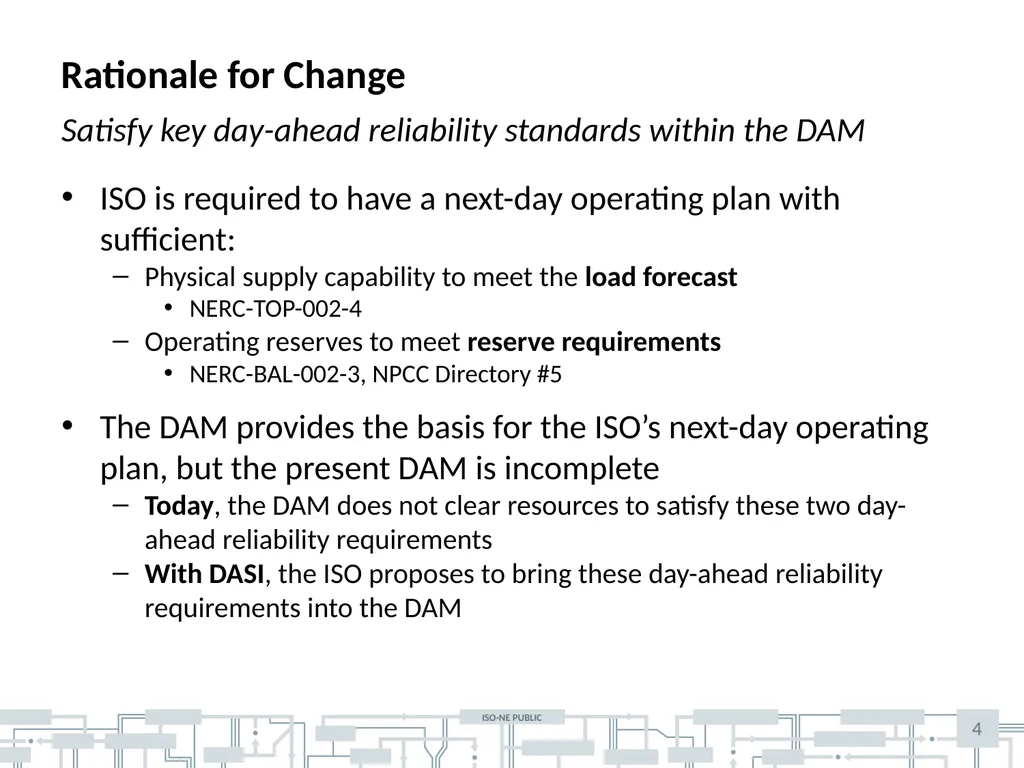
4 ISO is required to have a next-day operating plan with sufficient:
Physical supply capability to meet the load forecast
NERC-TOP-002-4
Operating reserves to meet reserve requirements
NERC-BAL-002-3, NPCC Directory #5
The DAM provides the basis for the ISO’s next-day operating plan, but the present DAM is incomplete
Today, the DAM does not clear resources to satisfy these two day-ahead reliability requirements
With DASI, the ISO proposes to bring these day-ahead reliability requirements into the DAM Rationale for Change Satisfy key day-ahead reliability standards within the DAM<br>
Physical supply capability to meet the load forecast
NERC-TOP-002-4
Operating reserves to meet reserve requirements
NERC-BAL-002-3, NPCC Directory #5
The DAM provides the basis for the ISO’s next-day operating plan, but the present DAM is incomplete
Today, the DAM does not clear resources to satisfy these two day-ahead reliability requirements
With DASI, the ISO proposes to bring these day-ahead reliability requirements into the DAM Rationale for Change Satisfy key day-ahead reliability standards within the DAM<br>
05
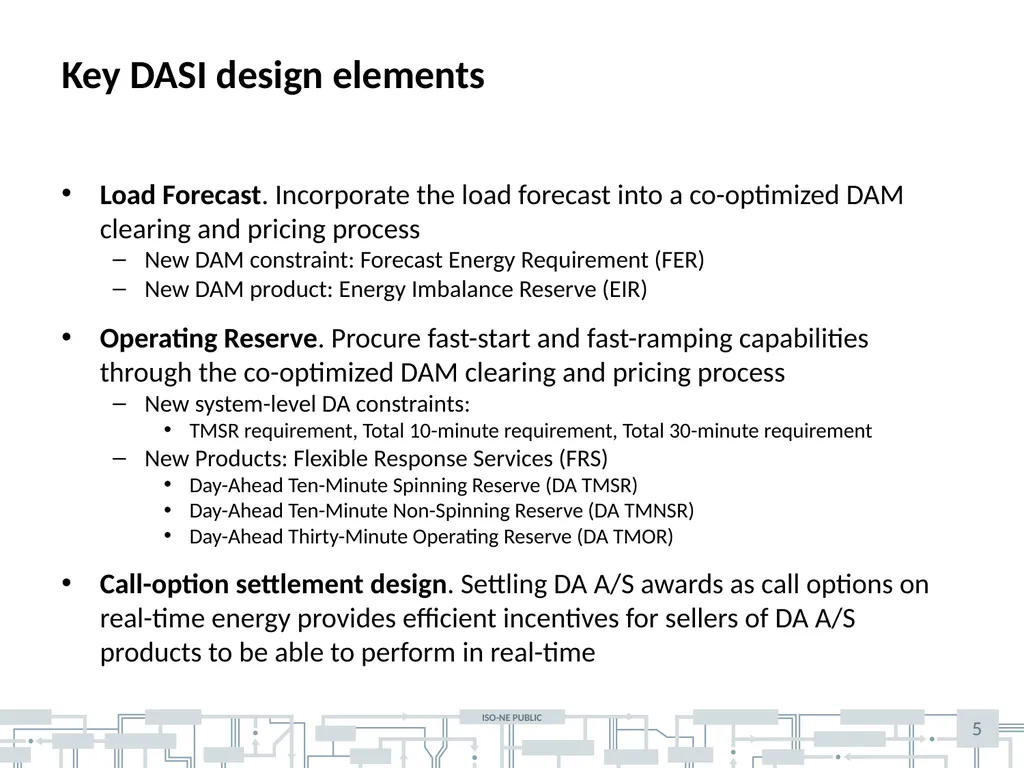
5 Key DASI design elements Load Forecast. Incorporate the load forecast into a co-optimized DAM clearing and pricing process
New DAM constraint: Forecast Energy Requirement (FER)
New DAM product: Energy Imbalance Reserve (EIR)
Operating Reserve. Procure fast-start and fast-ramping capabilities through the co-optimized DAM clearing and pricing process
New system-level DA constraints:
TMSR requirement, Total 10-minute requirement, Total 30-minute requirement
New Products: Flexible Response Services (FRS)
Day-Ahead Ten-Minute Spinning Reserve (DA TMSR)
Day-Ahead Ten-Minute Non-Spinning Reserve (DA TMNSR)
Day-Ahead Thirty-Minute Operating Reserve (DA TMOR)
Call-option settlement design. Settling DA A/S awards as call options on real-time energy provides efficient incentives for sellers of DA A/S products to be able to perform in real-time<br>
New DAM constraint: Forecast Energy Requirement (FER)
New DAM product: Energy Imbalance Reserve (EIR)
Operating Reserve. Procure fast-start and fast-ramping capabilities through the co-optimized DAM clearing and pricing process
New system-level DA constraints:
TMSR requirement, Total 10-minute requirement, Total 30-minute requirement
New Products: Flexible Response Services (FRS)
Day-Ahead Ten-Minute Spinning Reserve (DA TMSR)
Day-Ahead Ten-Minute Non-Spinning Reserve (DA TMNSR)
Day-Ahead Thirty-Minute Operating Reserve (DA TMOR)
Call-option settlement design. Settling DA A/S awards as call options on real-time energy provides efficient incentives for sellers of DA A/S products to be able to perform in real-time<br>
06
6 Key DASI design elements (cont’d) Voluntary Participation, with Mitigation
Participants may choose whether or not to submit DA A/S offers
Mitigation design will address physical and economic withholding concerns
Forward Reserve Market (FRM) sunset
The existing FRM is not compatible with DASI
With DASI implementation, the ISO proposes to retire the FRM
The ISO is open to the concept of a future replacement long-forward market for reserves
Forward markets require sound spot markets
It is important for the ISO and region to develop and fully understand the spot market (DASI) before a forward market could be designed<br>
Participants may choose whether or not to submit DA A/S offers
Mitigation design will address physical and economic withholding concerns
Forward Reserve Market (FRM) sunset
The existing FRM is not compatible with DASI
With DASI implementation, the ISO proposes to retire the FRM
The ISO is open to the concept of a future replacement long-forward market for reserves
Forward markets require sound spot markets
It is important for the ISO and region to develop and fully understand the spot market (DASI) before a forward market could be designed<br>
07
7 Concepts out-of-scope for DASI design 90- and 240-minute DA A/S products are not included (“Replacement Energy Reserves”, or RER)
These products are significantly more complicated to design and implement, and will be considered as part of a future project
Noted previously to the Markets Committee in the ISO’s April 2022 memorandum
A ‘long forward’ market is not included
Consideration of this element with ESI was focused on energy security
DASI is being pursued outside the context of energy security<br>
These products are significantly more complicated to design and implement, and will be considered as part of a future project
Noted previously to the Markets Committee in the ISO’s April 2022 memorandum
A ‘long forward’ market is not included
Consideration of this element with ESI was focused on energy security
DASI is being pursued outside the context of energy security<br>
08
8 Putting today’s discussion in context DASI design discussions will cover a number of important topics
Rationale for DASI (today)
Call-option settlement design
Competitive offer formulation
Mitigation design
Co-optimized clearing and pricing
Credits and cost allocation
Impact analysis
We’ll discuss the timing and expected content of each of these topics at the end of today’s presentation<br>
Rationale for DASI (today)
Call-option settlement design
Competitive offer formulation
Mitigation design
Co-optimized clearing and pricing
Credits and cost allocation
Impact analysis
We’ll discuss the timing and expected content of each of these topics at the end of today’s presentation<br>
09
Overview of Current practice for meeting Day-ahead reliability requirements 9<br>
10
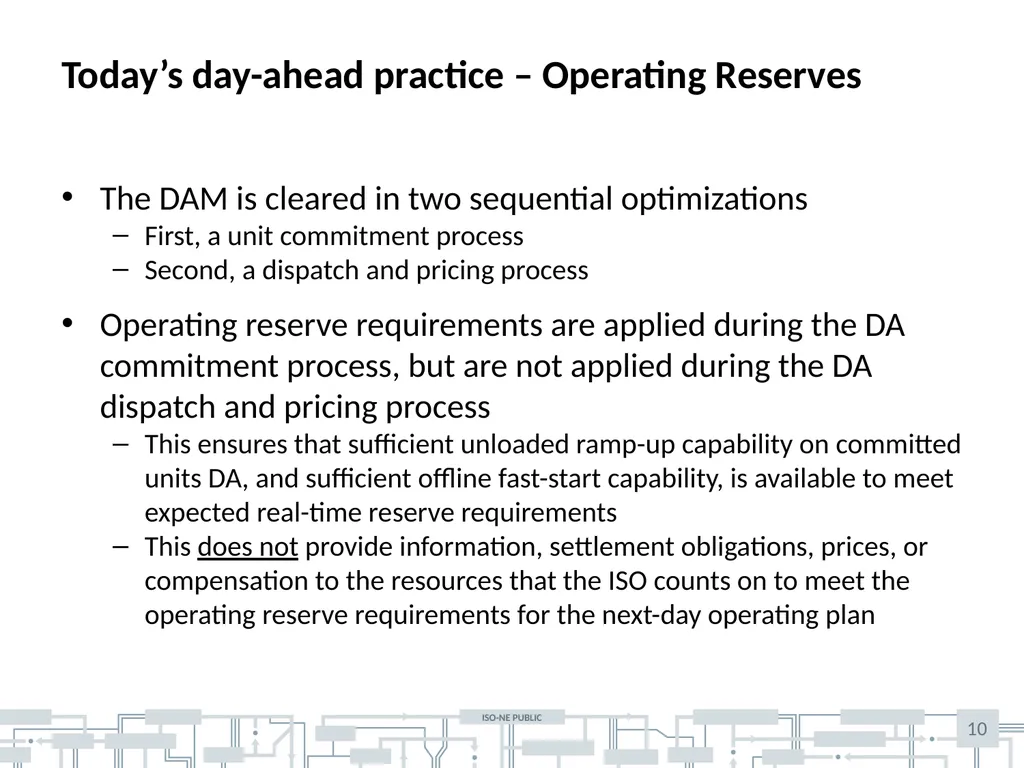
10 Today’s day-ahead practice – Operating Reserves The DAM is cleared in two sequential optimizations
First, a unit commitment process
Second, a dispatch and pricing process
Operating reserve requirements are applied during the DA commitment process, but are not applied during the DA dispatch and pricing process
This ensures that sufficient unloaded ramp-up capability on committed units DA, and sufficient offline fast-start capability, is available to meet expected real-time reserve requirements
This does not provide information, settlement obligations, prices, or compensation to the resources that the ISO counts on to meet the operating reserve requirements for the next-day operating plan<br>
First, a unit commitment process
Second, a dispatch and pricing process
Operating reserve requirements are applied during the DA commitment process, but are not applied during the DA dispatch and pricing process
This ensures that sufficient unloaded ramp-up capability on committed units DA, and sufficient offline fast-start capability, is available to meet expected real-time reserve requirements
This does not provide information, settlement obligations, prices, or compensation to the resources that the ISO counts on to meet the operating reserve requirements for the next-day operating plan<br>
11
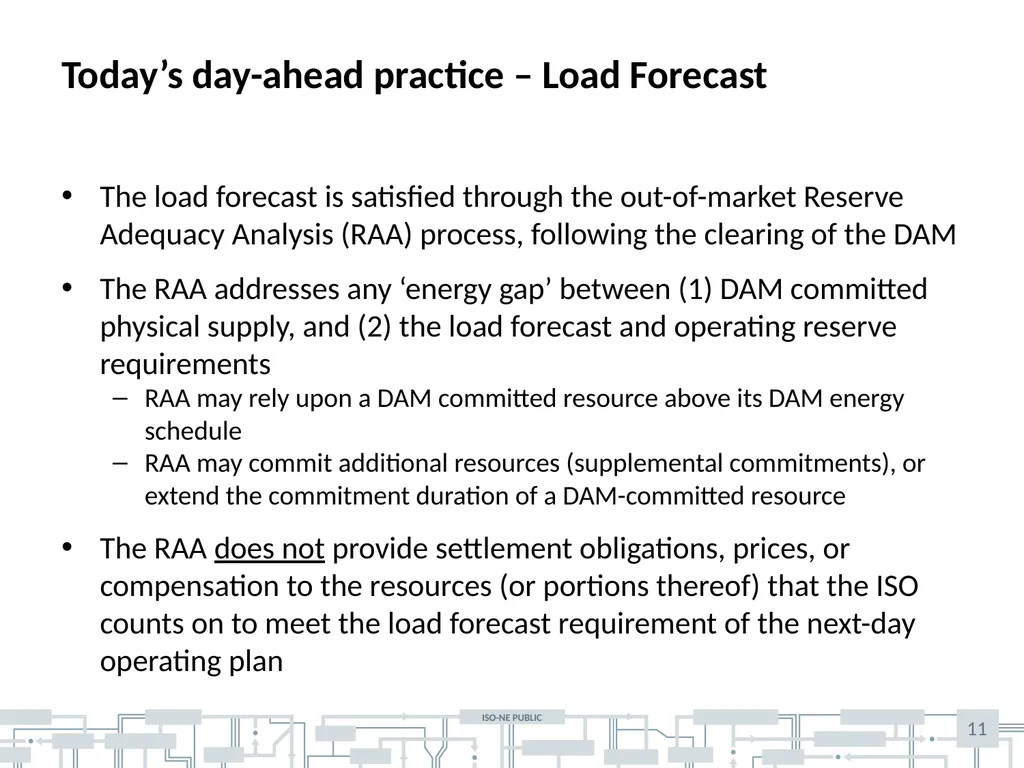
11 Today’s day-ahead practice – Load Forecast The load forecast is satisfied through the out-of-market Reserve Adequacy Analysis (RAA) process, following the clearing of the DAM
The RAA addresses any ‘energy gap’ between (1) DAM committed physical supply, and (2) the load forecast and operating reserve requirements
RAA may rely upon a DAM committed resource above its DAM energy schedule
RAA may commit additional resources (supplemental commitments), or extend the commitment duration of a DAM-committed resource
The RAA does not provide settlement obligations, prices, or compensation to the resources (or portions thereof) that the ISO counts on to meet the load forecast requirement of the next-day operating plan<br>
The RAA addresses any ‘energy gap’ between (1) DAM committed physical supply, and (2) the load forecast and operating reserve requirements
RAA may rely upon a DAM committed resource above its DAM energy schedule
RAA may commit additional resources (supplemental commitments), or extend the commitment duration of a DAM-committed resource
The RAA does not provide settlement obligations, prices, or compensation to the resources (or portions thereof) that the ISO counts on to meet the load forecast requirement of the next-day operating plan<br>
12
rationale FOR DAY-AHEAD Ancillary services 12<br>
13
13 Overview of today’s discussion on the rationale for DASI The impacts of the existing DAM design
Design objectives and proposed solution
Other ancillary service design concepts do not fully address these adverse impacts, and do not satisfy the design objectives<br>
Design objectives and proposed solution
Other ancillary service design concepts do not fully address these adverse impacts, and do not satisfy the design objectives<br>
14
14 Today’s discussion is intended to provide an initial overview We plan to discuss the challenges with the current market design, and the proposed DASI approach to address them, in more detail at future Markets Committee meetings
This future discussion will include more information and numerical examples illustrating how today’s practices can produce inefficient outcomes, and how these inefficiencies are resolved by the ISO’s proposed solution
Welcome stakeholder feedback and questions on these topics<br>
This future discussion will include more information and numerical examples illustrating how today’s practices can produce inefficient outcomes, and how these inefficiencies are resolved by the ISO’s proposed solution
Welcome stakeholder feedback and questions on these topics<br>
15
The impacts of the existing dam design Consequences of managing the reliability requirements of a next-day operating plan without procuring these services through market products 15<br>
16
16 Context: Setting up the system today To meet key day ahead reliability requirements, the ISO must set up the system to have sufficient capability to meet the load forecast and expected real-time reserve requirements
At present, the only product that resources sell in the DAM is energy, where the quantity sold depends on participant DA energy offers and demand bids
Thus, there are two potential gaps between what the DAM clears and the key DA reliability requirements
Energy imbalance when the market clears less physical energy supply than the load forecast
Reserves to cover any system (“source-loss”) contingencies<br>
At present, the only product that resources sell in the DAM is energy, where the quantity sold depends on participant DA energy offers and demand bids
Thus, there are two potential gaps between what the DAM clears and the key DA reliability requirements
Energy imbalance when the market clears less physical energy supply than the load forecast
Reserves to cover any system (“source-loss”) contingencies<br>
17
17 There is a missing market for these reliability services At present, there are not well-defined products corresponding with these key reliability services in the DAM that participants can offer or sell
Instead, ISO relies upon unloaded online fast-ramping capability and offline fast-start capability to meet these requirements for a reliable next-day operating plan
Without market products, there are no settlement obligations, prices, or compensation provided to the resources the ISO counts on to provide these services<br>
Instead, ISO relies upon unloaded online fast-ramping capability and offline fast-start capability to meet these requirements for a reliable next-day operating plan
Without market products, there are no settlement obligations, prices, or compensation provided to the resources the ISO counts on to provide these services<br>
18
18 These missing DA markets can have several adverse impacts on system reliability and efficiency Information: Resources that are being counted on to provide these key reliability services may not know that the ISO is relying upon them to be able to provide energy, possibly on short notice, during all or part of the next operating day
Inefficient DA awards: Without clearly specified offer prices for these services, the DAM optimization cannot efficiently select the resources to provide them
(continued next slide)<br>
Inefficient DA awards: Without clearly specified offer prices for these services, the DAM optimization cannot efficiently select the resources to provide them
(continued next slide)<br>
19
19 These missing DA markets can have several adverse impacts on system reliability and efficiency (cont’d) Poor price signals: ISO’s current practices to satisfy these key reliability requirements are unpriced, which can reduce DA and RT energy prices below resources’ costs, contrary to sound economic principles
Misaligned incentives: Because resources are not compensated for providing these services in the DAM, their incentives to invest in their ability to reliably provide energy in RT are inefficiently low
Next: Discuss each of these adverse impacts in more detail<br>
Misaligned incentives: Because resources are not compensated for providing these services in the DAM, their incentives to invest in their ability to reliably provide energy in RT are inefficiently low
Next: Discuss each of these adverse impacts in more detail<br>
20
20 1. Information: Resources may not know when they are being counted on to provide these key reliability services While the ISO may rely upon a unit in its day-ahead operating plan to fill the energy gap, or for contingency response, this is not signaled to the Market Participant in a clear and transparent manner
This lack of information may reduce efficiency and reliability if the resource would have made different arrangements with better information about its role in satisfying the DA reliability requirements<br>
This lack of information may reduce efficiency and reliability if the resource would have made different arrangements with better information about its role in satisfying the DA reliability requirements<br>
21
21 2. Inefficient DA awards due to missing DA ancillary services markets DAM does not consider resources’ costs associated with providing key reliability services that are (as noted earlier) required of the day-ahead operating plan
Rather, the current practice implicitly assumes that these services can be provided at no cost, by all resources (or portions of resources) that have the capability to do so and that were not scheduled for DA energy
Not including these costs in today’s DAM can produce inefficient DA awards<br>
Rather, the current practice implicitly assumes that these services can be provided at no cost, by all resources (or portions of resources) that have the capability to do so and that were not scheduled for DA energy
Not including these costs in today’s DAM can produce inefficient DA awards<br>
22
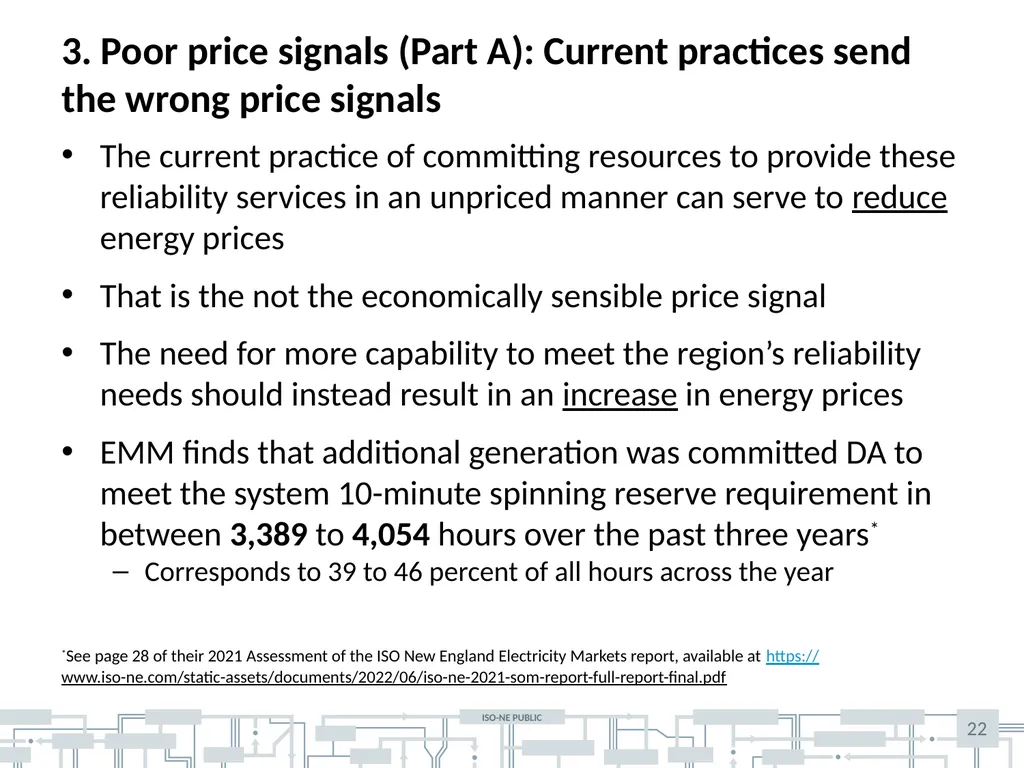
22 3. Poor price signals (Part A): Current practices send the wrong price signals The current practice of committing resources to provide these reliability services in an unpriced manner can serve to reduce energy prices
That is the not the economically sensible price signal
The need for more capability to meet the region’s reliability needs should instead result in an increase in energy prices
EMM finds that additional generation was committed DA to meet the system 10-minute spinning reserve requirement in between 3,389 to 4,054 hours over the past three years*
Corresponds to 39 to 46 percent of all hours across the year *See page 28 of their 2021 Assessment of the ISO New England Electricity Markets report, available at https://www.iso-ne.com/static-assets/documents/2022/06/iso-ne-2021-som-report-full-report-final.pdf<br>
That is the not the economically sensible price signal
The need for more capability to meet the region’s reliability needs should instead result in an increase in energy prices
EMM finds that additional generation was committed DA to meet the system 10-minute spinning reserve requirement in between 3,389 to 4,054 hours over the past three years*
Corresponds to 39 to 46 percent of all hours across the year *See page 28 of their 2021 Assessment of the ISO New England Electricity Markets report, available at https://www.iso-ne.com/static-assets/documents/2022/06/iso-ne-2021-som-report-full-report-final.pdf<br>
23
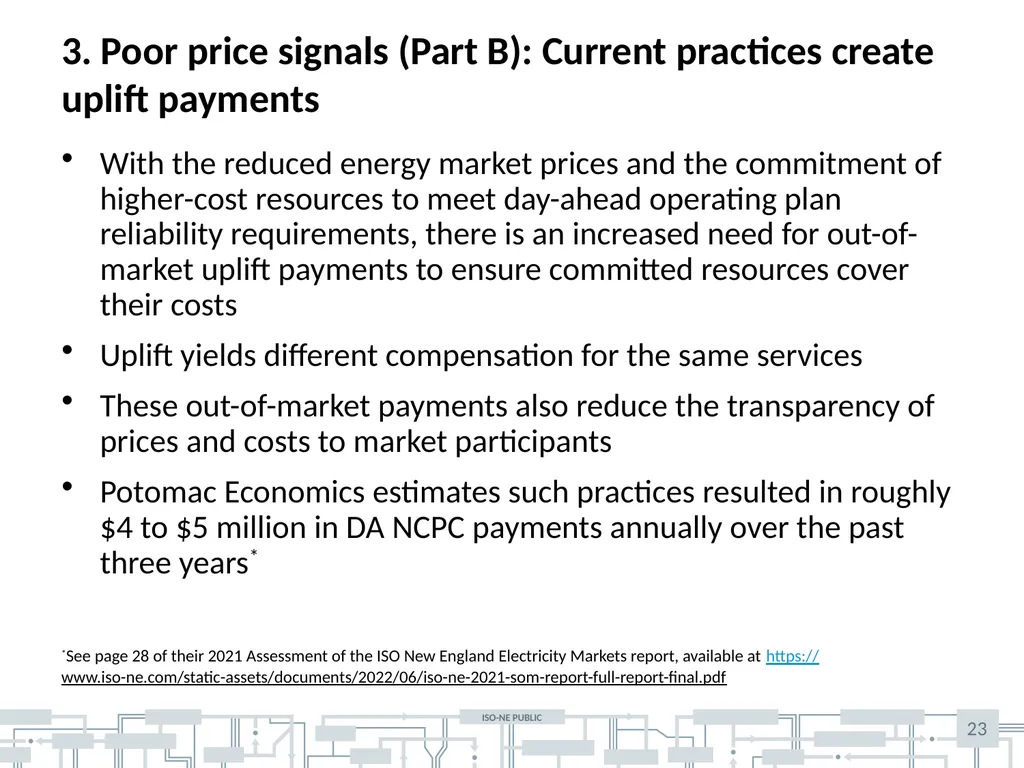
23 3. Poor price signals (Part B): Current practices create uplift payments With the reduced energy market prices and the commitment of higher-cost resources to meet day-ahead operating plan reliability requirements, there is an increased need for out-of-market uplift payments to ensure committed resources cover their costs
Uplift yields different compensation for the same services
These out-of-market payments also reduce the transparency of prices and costs to market participants
Potomac Economics estimates such practices resulted in roughly $4 to $5 million in DA NCPC payments annually over the past three years* *See page 28 of their 2021 Assessment of the ISO New England Electricity Markets report, available at https://www.iso-ne.com/static-assets/documents/2022/06/iso-ne-2021-som-report-full-report-final.pdf<br>
Uplift yields different compensation for the same services
These out-of-market payments also reduce the transparency of prices and costs to market participants
Potomac Economics estimates such practices resulted in roughly $4 to $5 million in DA NCPC payments annually over the past three years* *See page 28 of their 2021 Assessment of the ISO New England Electricity Markets report, available at https://www.iso-ne.com/static-assets/documents/2022/06/iso-ne-2021-som-report-full-report-final.pdf<br>
24
24 4. Misaligned incentives can produce a less efficient and less reliable system As explained during stakeholder discussions in 2019 – 2020 on the Energy Security Initiatives proposal, current rules can lead to misaligned incentives
More specifically, a generator that is being counted on to fill the energy gap, or to prepare for contingencies, does not fully internalize the replacement costs associated with its (potential) real-time non-performance
Misaligned incentives produce a less efficient and less reliable system due to underinvestment<br>
More specifically, a generator that is being counted on to fill the energy gap, or to prepare for contingencies, does not fully internalize the replacement costs associated with its (potential) real-time non-performance
Misaligned incentives produce a less efficient and less reliable system due to underinvestment<br>
25
25 Misaligned incentives can apply to a broad set of resources Misaligned incentives can manifest in several ways
Earlier discussions with stakeholders largely focused on incentives for resources to procure gas after the DAM cleared
However, the adverse impacts of the misaligned incentives extend to a broad set of resources as they undermine incentives to make a range of efficient investments in maintenance, capital expenditures, and other costly actions that improve their RT performance
Upcoming presentation (Nov. MC): Numerical examples showing how the misaligned incentives can occur under current market rules<br>
Earlier discussions with stakeholders largely focused on incentives for resources to procure gas after the DAM cleared
However, the adverse impacts of the misaligned incentives extend to a broad set of resources as they undermine incentives to make a range of efficient investments in maintenance, capital expenditures, and other costly actions that improve their RT performance
Upcoming presentation (Nov. MC): Numerical examples showing how the misaligned incentives can occur under current market rules<br>
26
26 Introducing new DA products to fill the missing markets does not necessarily resolve the misaligned incentives on its own To efficiently address the misaligned incentives, new DA products must lead resources selling these products to fully internalize the replacement costs of not providing RT energy (when needed)
When this condition is met, suppliers providing DA A/S will incur costs (fuel, investment, operational, etc.) when it is socially efficient to do so, and will not incur costs when not<br>
When this condition is met, suppliers providing DA A/S will incur costs (fuel, investment, operational, etc.) when it is socially efficient to do so, and will not incur costs when not<br>
27
27 Key Takeaway 1: The DA product definition will play a critical role in determining if the design is effective in addressing the adverse impacts identified A range of DA products could be introduced to fill the missing DA markets that exist today
However, not all products will create efficient incentives for resources selling these services to incur costs to reliably provide these services when it is socially beneficial to do so
Careful thought must be given to how to design these products to align resource incentives with society’s best interests<br>
However, not all products will create efficient incentives for resources selling these services to incur costs to reliably provide these services when it is socially beneficial to do so
Careful thought must be given to how to design these products to align resource incentives with society’s best interests<br>
28
28 Key Takeaway 2: The adverse consequences of these missing markets will grow with the clean energy transition Presently, there is typically sufficient fast-start and fast-ramping resource capability in the New England system to fill the gaps without a market for these products
However, if we continue to not compensate resources for these reliability services, they may exit the market or choose not to continue to incur the costs necessary to reliably provide them (supply of these services will decrease)
Growth in weather-dependent resources will require more of these capabilities for when the sun does not shine or the wind does not blow (demand for these services will increase)
It is important to address these adverse impacts now, before the efficiency and reliability consequences of inaction increase further<br>
However, if we continue to not compensate resources for these reliability services, they may exit the market or choose not to continue to incur the costs necessary to reliably provide them (supply of these services will decrease)
Growth in weather-dependent resources will require more of these capabilities for when the sun does not shine or the wind does not blow (demand for these services will increase)
It is important to address these adverse impacts now, before the efficiency and reliability consequences of inaction increase further<br>
29
Design objectives and proposed solution 29<br>
30
30 Day-ahead ancillary services: Design objectives Reliable operating plan: Ensure that the ISO satisfies the key day-ahead operating plan reliability requirements
Efficient incentives: Create incentives for resources providing these services to make efficient investments and operating decisions
Transparent prices: Compensate resources at competitive prices that transparently signal the incremental cost of providing these reliability services
Non-discriminatory and technology neutral: Compensate all resources that provide these reliability services similarly, with technology-neutral DA ancillary service obligations
ISO is proposing a DA ancillary services design that addresses each of the adverse impacts identified earlier, and achieves each of these design objectives<br>
Efficient incentives: Create incentives for resources providing these services to make efficient investments and operating decisions
Transparent prices: Compensate resources at competitive prices that transparently signal the incremental cost of providing these reliability services
Non-discriminatory and technology neutral: Compensate all resources that provide these reliability services similarly, with technology-neutral DA ancillary service obligations
ISO is proposing a DA ancillary services design that addresses each of the adverse impacts identified earlier, and achieves each of these design objectives<br>
31
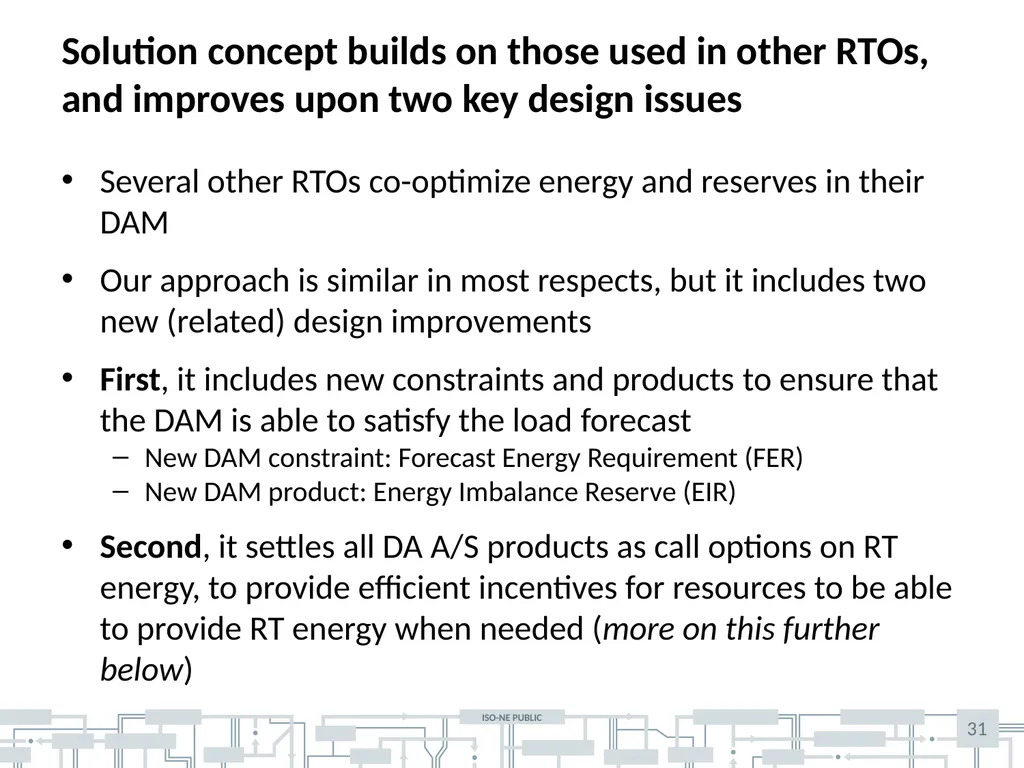
31 Solution concept builds on those used in other RTOs, and improves upon two key design issues Several other RTOs co-optimize energy and reserves in their DAM
Our approach is similar in most respects, but it includes two new (related) design improvements
First, it includes new constraints and products to ensure that the DAM is able to satisfy the load forecast
New DAM constraint: Forecast Energy Requirement (FER)
New DAM product: Energy Imbalance Reserve (EIR)
Second, it settles all DA A/S products as call options on RT energy, to provide efficient incentives for resources to be able to provide RT energy when needed (more on this further below)<br>
Our approach is similar in most respects, but it includes two new (related) design improvements
First, it includes new constraints and products to ensure that the DAM is able to satisfy the load forecast
New DAM constraint: Forecast Energy Requirement (FER)
New DAM product: Energy Imbalance Reserve (EIR)
Second, it settles all DA A/S products as call options on RT energy, to provide efficient incentives for resources to be able to provide RT energy when needed (more on this further below)<br>
32
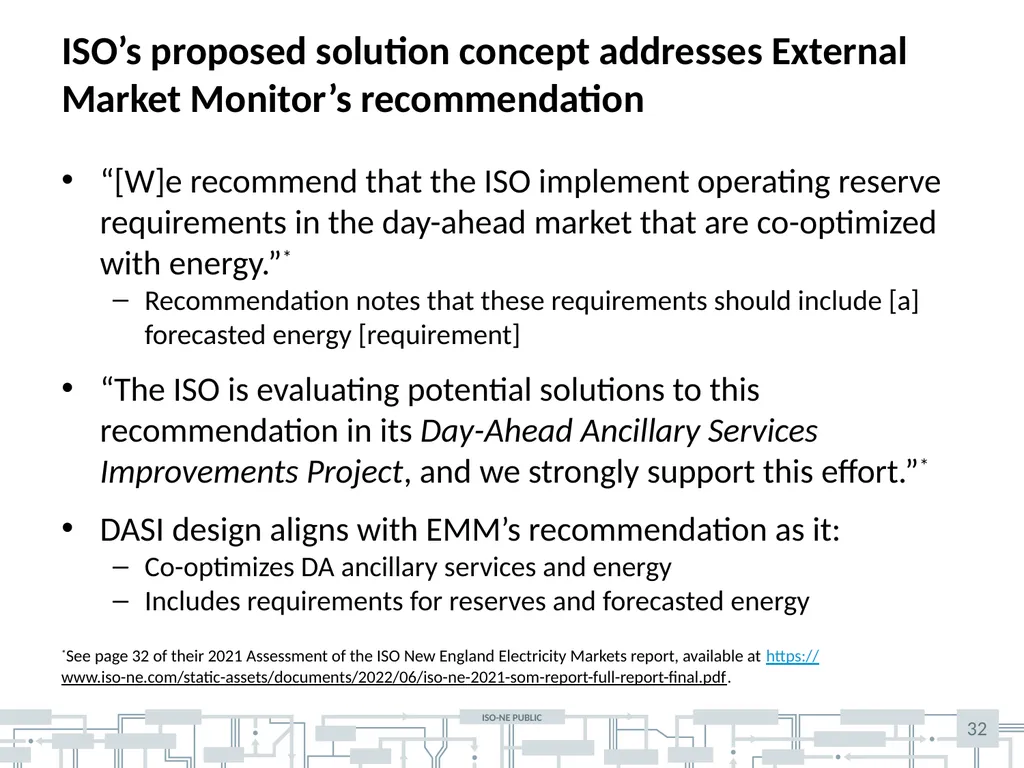
32 ISO’s proposed solution concept addresses External Market Monitor’s recommendation “[W]e recommend that the ISO implement operating reserve requirements in the day-ahead market that are co-optimized with energy.”*
Recommendation notes that these requirements should include [a] forecasted energy [requirement]
“The ISO is evaluating potential solutions to this recommendation in its Day-Ahead Ancillary Services Improvements Project, and we strongly support this effort.”*
DASI design aligns with EMM’s recommendation as it:
Co-optimizes DA ancillary services and energy
Includes requirements for reserves and forecasted energy *See page 32 of their 2021 Assessment of the ISO New England Electricity Markets report, available at https://www.iso-ne.com/static-assets/documents/2022/06/iso-ne-2021-som-report-full-report-final.pdf.<br>
Recommendation notes that these requirements should include [a] forecasted energy [requirement]
“The ISO is evaluating potential solutions to this recommendation in its Day-Ahead Ancillary Services Improvements Project, and we strongly support this effort.”*
DASI design aligns with EMM’s recommendation as it:
Co-optimizes DA ancillary services and energy
Includes requirements for reserves and forecasted energy *See page 32 of their 2021 Assessment of the ISO New England Electricity Markets report, available at https://www.iso-ne.com/static-assets/documents/2022/06/iso-ne-2021-som-report-full-report-final.pdf.<br>
33
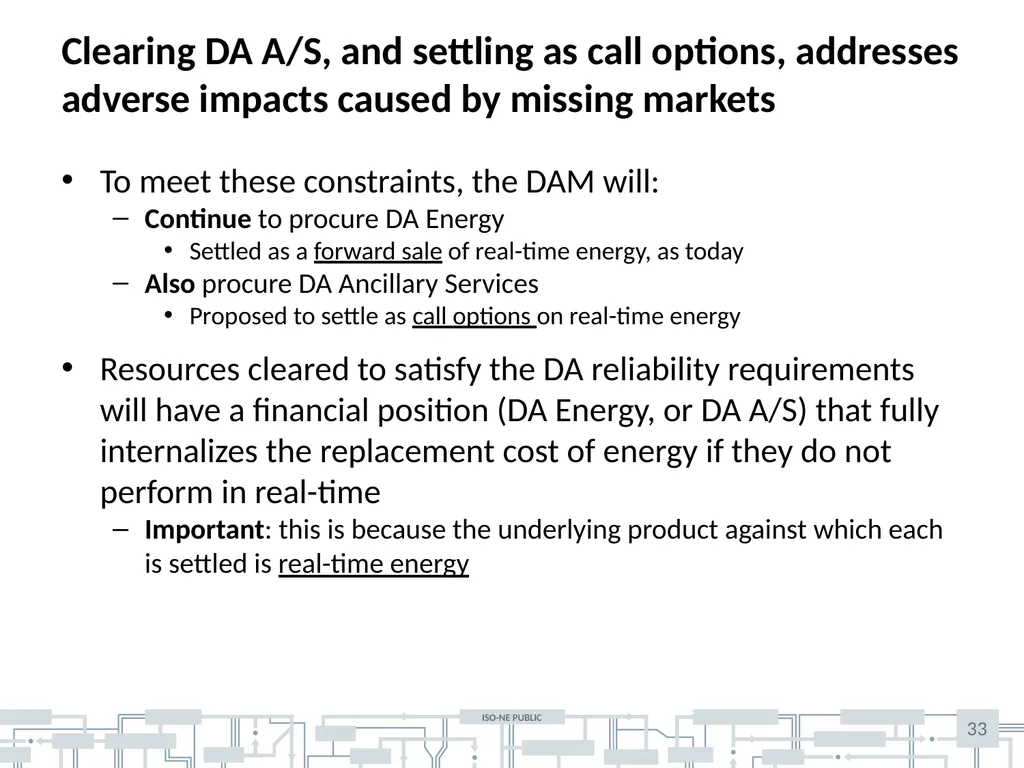
33 Clearing DA A/S, and settling as call options, addresses adverse impacts caused by missing markets To meet these constraints, the DAM will:
Continue to procure DA Energy
Settled as a forward sale of real-time energy, as today
Also procure DA Ancillary Services
Proposed to settle as call options on real-time energy
Resources cleared to satisfy the DA reliability requirements will have a financial position (DA Energy, or DA A/S) that fully internalizes the replacement cost of energy if they do not perform in real-time
Important: this is because the underlying product against which each is settled is real-time energy<br>
Continue to procure DA Energy
Settled as a forward sale of real-time energy, as today
Also procure DA Ancillary Services
Proposed to settle as call options on real-time energy
Resources cleared to satisfy the DA reliability requirements will have a financial position (DA Energy, or DA A/S) that fully internalizes the replacement cost of energy if they do not perform in real-time
Important: this is because the underlying product against which each is settled is real-time energy<br>
34
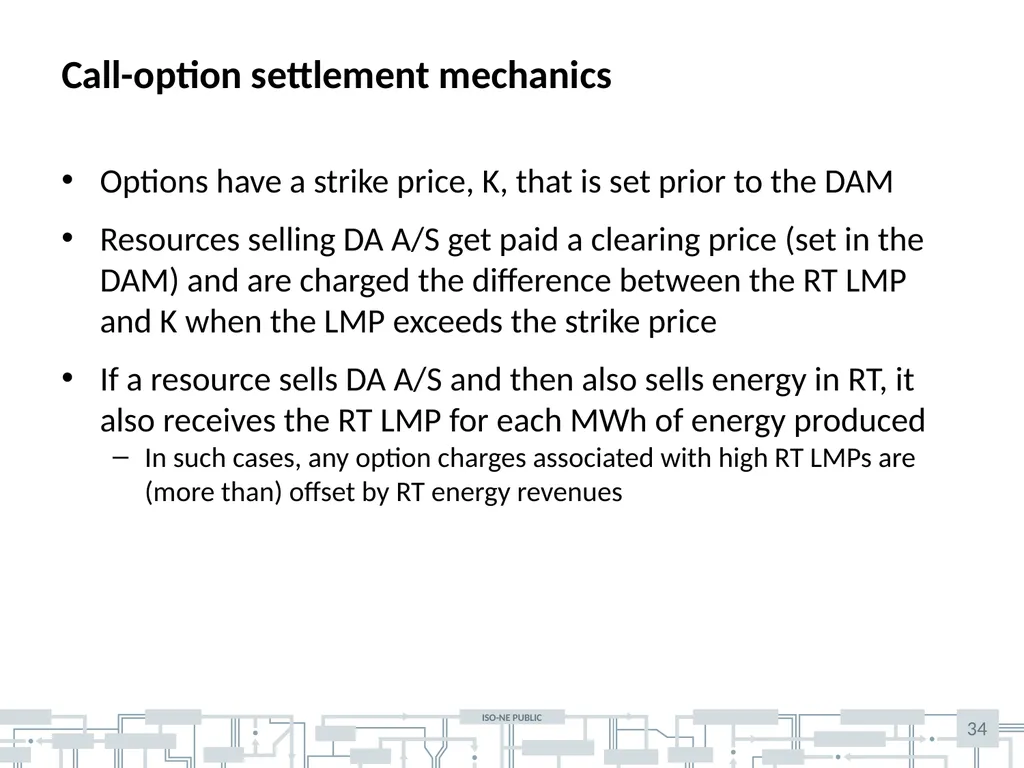
34 Call-option settlement mechanics Options have a strike price, K, that is set prior to the DAM
Resources selling DA A/S get paid a clearing price (set in the DAM) and are charged the difference between the RT LMP and K when the LMP exceeds the strike price
If a resource sells DA A/S and then also sells energy in RT, it also receives the RT LMP for each MWh of energy produced
In such cases, any option charges associated with high RT LMPs are (more than) offset by RT energy revenues<br>
Resources selling DA A/S get paid a clearing price (set in the DAM) and are charged the difference between the RT LMP and K when the LMP exceeds the strike price
If a resource sells DA A/S and then also sells energy in RT, it also receives the RT LMP for each MWh of energy produced
In such cases, any option charges associated with high RT LMPs are (more than) offset by RT energy revenues<br>
35
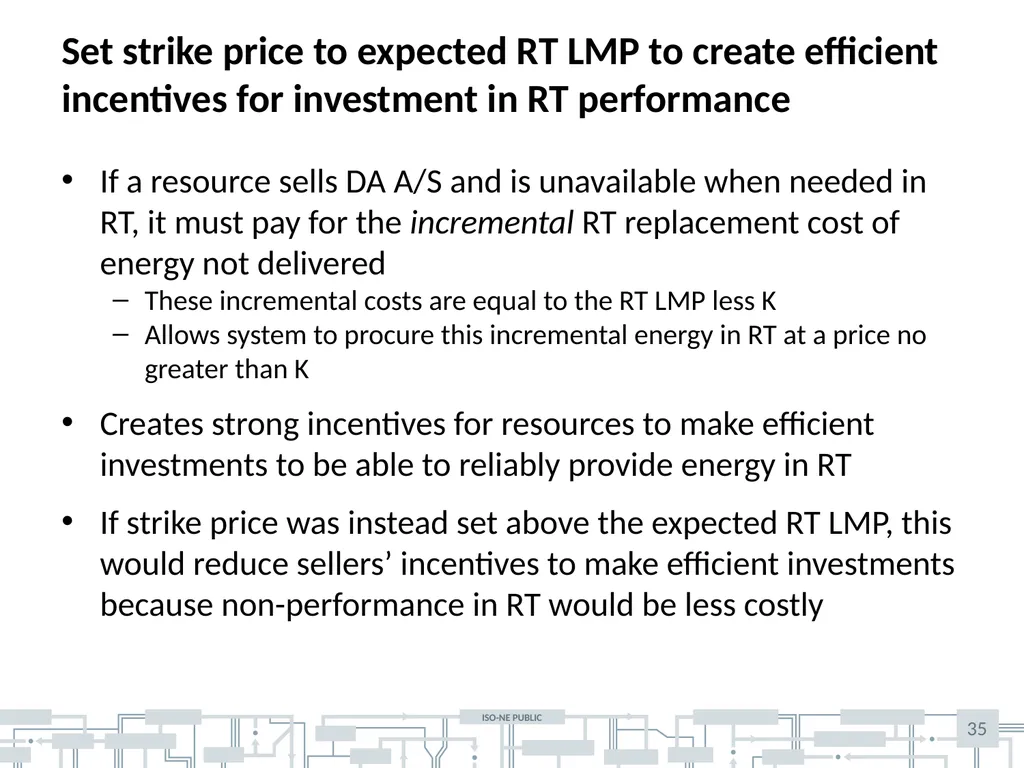
35 Set strike price to expected RT LMP to create efficient incentives for investment in RT performance If a resource sells DA A/S and is unavailable when needed in RT, it must pay for the incremental RT replacement cost of energy not delivered
These incremental costs are equal to the RT LMP less K
Allows system to procure this incremental energy in RT at a price no greater than K
Creates strong incentives for resources to make efficient investments to be able to reliably provide energy in RT
If strike price was instead set above the expected RT LMP, this would reduce sellers’ incentives to make efficient investments because non-performance in RT would be less costly<br>
These incremental costs are equal to the RT LMP less K
Allows system to procure this incremental energy in RT at a price no greater than K
Creates strong incentives for resources to make efficient investments to be able to reliably provide energy in RT
If strike price was instead set above the expected RT LMP, this would reduce sellers’ incentives to make efficient investments because non-performance in RT would be less costly<br>
36
36 DASI solves today’s DA informational shortcoming All resources being counted on to meet the DA reliability requirements will have financial positions coming out of DAM
Provides clear and transparent information on extent to which ISO is counting on them to meet the day ahead operating plan’s reliability requirements
Also ensures such resources have ‘skin in the game’, as their compensation is linked to their ability to perform in real-time and they fully internalize the RT replacement cost of energy not delivered<br>
Provides clear and transparent information on extent to which ISO is counting on them to meet the day ahead operating plan’s reliability requirements
Also ensures such resources have ‘skin in the game’, as their compensation is linked to their ability to perform in real-time and they fully internalize the RT replacement cost of energy not delivered<br>
37
37 DASI solves today’s inefficient DA awards Competitive suppliers will submit DA energy and DA A/S offers reflecting their costs associated with providing each product
DAM co-optimization will solve for the outcome that most efficiently awards energy and DA A/S positions to satisfy the DA energy and reliability requirements
DAM co-optimization between energy and DA A/S therefore addresses the potential for inefficient DA awards that presently exists<br>
DAM co-optimization will solve for the outcome that most efficiently awards energy and DA A/S positions to satisfy the DA energy and reliability requirements
DAM co-optimization between energy and DA A/S therefore addresses the potential for inefficient DA awards that presently exists<br>
38
38 DASI addresses the poor price signals concern Procuring all of the reliability requirements via DAM products eliminates the need to commit generators out-of-market to meet DA operating reserve and load forecast requirements
Addresses External Market Monitor finding that ISO currently commits generators for 10-minute spinning reserves in almost half of all hours, where such commitments are unpriced*
With prices for ancillary services that reflect resource costs, DASI is expected to decrease uplift payments, thereby reducing the extent to which different resources are paid different rates for the same service *See page 32 of their 2021 Assessment of the ISO New England Electricity Markets report, available at https://www.iso-ne.com/static-assets/documents/2022/06/iso-ne-2021-som-report-full-report-final.pdf.<br>
Addresses External Market Monitor finding that ISO currently commits generators for 10-minute spinning reserves in almost half of all hours, where such commitments are unpriced*
With prices for ancillary services that reflect resource costs, DASI is expected to decrease uplift payments, thereby reducing the extent to which different resources are paid different rates for the same service *See page 32 of their 2021 Assessment of the ISO New England Electricity Markets report, available at https://www.iso-ne.com/static-assets/documents/2022/06/iso-ne-2021-som-report-full-report-final.pdf.<br>
39
39 DASI solves the misaligned incentives DA A/S sellers bear the full cost of replacing their energy (if they do not perform) under the call-option settlement design
As a result, resources that sell DA A/S fully internalize the social benefits associated with their fuel, investment, and operational decisions
This key insight is what allows the call-option framework to address the misaligned incentives – it aligns the resource’s incentives with society’s best interests because the resource now bears the full replacement costs when it is not available to provide energy in RT
Upcoming presentation (Nov. MC): Numerical examples showing how the DA option design resolves the misaligned incentives<br>
As a result, resources that sell DA A/S fully internalize the social benefits associated with their fuel, investment, and operational decisions
This key insight is what allows the call-option framework to address the misaligned incentives – it aligns the resource’s incentives with society’s best interests because the resource now bears the full replacement costs when it is not available to provide energy in RT
Upcoming presentation (Nov. MC): Numerical examples showing how the DA option design resolves the misaligned incentives<br>
40
40 DASI meets each of the identified design objectives Relies on market products to produces a reliable operating plan coming out of the DAM
Creates efficient incentives by giving resources relied upon to meet these requirements financial positions in the DAM that lead them to fully internalize their replacement costs, thereby addressing the misaligned incentives
Yields transparent prices that signal the competitive, market-based incremental costs of each key reliability service
Non-discriminatory and technology neutral approach that allows these reliability needs to be met by any technologies physically capable of providing the required ancillary services<br>
Creates efficient incentives by giving resources relied upon to meet these requirements financial positions in the DAM that lead them to fully internalize their replacement costs, thereby addressing the misaligned incentives
Yields transparent prices that signal the competitive, market-based incremental costs of each key reliability service
Non-discriminatory and technology neutral approach that allows these reliability needs to be met by any technologies physically capable of providing the required ancillary services<br>
41
41 DASI proactively supports the clean energy transition DASI framework will help to facilitate the region’s transition to a decarbonized power system with more renewable energy, where investment in fast-start/fast-ramping resources, and the reliability of these services, is even more critical
The design concept, with the inclusion of both energy imbalance and flexible response service products, can be extended in the future to procure new DA services that may be identified to preserve a reliable next day operating plan in a rapidly evolving, weather-dependent power system
Future extensions could include other FRS products or quantities, as supported by future studies and evolving needs<br>
The design concept, with the inclusion of both energy imbalance and flexible response service products, can be extended in the future to procure new DA services that may be identified to preserve a reliable next day operating plan in a rapidly evolving, weather-dependent power system
Future extensions could include other FRS products or quantities, as supported by future studies and evolving needs<br>
42
Other design concepts do not fully resolve the adverse impacts identified and do not satisfy the design objectives 42<br>
43
43 The existing FRM is unable to address these concerns FRM obligations are limited to a subset of hours and products, and demand is specified seasonally
These limitations mean FRM does not address the adverse impacts of the DA missing markets, as its products do not align with the DA reliable operating plan requirements
The FRM offer price threshold restricts the prices at which resources with FRM obligations can offer energy, with the result that the FRM can cause inefficient RT outcomes and energy prices that exceed their competitive level
This inefficiency has been critiqued pointedly by the EMM* *See pages 12-13 of their 2014 Assessment of the ISO New England Electricity Markets report, available at https://www.iso-ne.com/static-assets/documents/2015/06/isone_2014_emm_report_6_16_2015_final.pdf.<br>
These limitations mean FRM does not address the adverse impacts of the DA missing markets, as its products do not align with the DA reliable operating plan requirements
The FRM offer price threshold restricts the prices at which resources with FRM obligations can offer energy, with the result that the FRM can cause inefficient RT outcomes and energy prices that exceed their competitive level
This inefficiency has been critiqued pointedly by the EMM* *See pages 12-13 of their 2014 Assessment of the ISO New England Electricity Markets report, available at https://www.iso-ne.com/static-assets/documents/2015/06/isone_2014_emm_report_6_16_2015_final.pdf.<br>
44
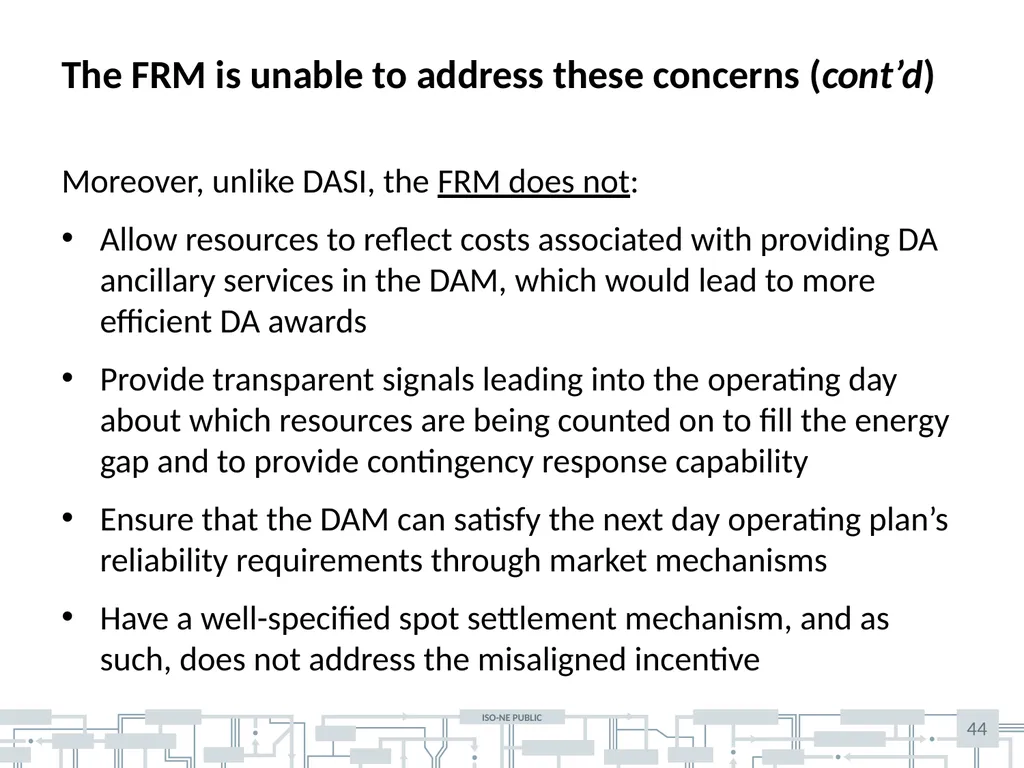
44 The FRM is unable to address these concerns (cont’d) Moreover, unlike DASI, the FRM does not:
Allow resources to reflect costs associated with providing DA ancillary services in the DAM, which would lead to more efficient DA awards
Provide transparent signals leading into the operating day about which resources are being counted on to fill the energy gap and to provide contingency response capability
Ensure that the DAM can satisfy the next day operating plan’s reliability requirements through market mechanisms
Have a well-specified spot settlement mechanism, and as such, does not address the misaligned incentive<br>
Allow resources to reflect costs associated with providing DA ancillary services in the DAM, which would lead to more efficient DA awards
Provide transparent signals leading into the operating day about which resources are being counted on to fill the energy gap and to provide contingency response capability
Ensure that the DAM can satisfy the next day operating plan’s reliability requirements through market mechanisms
Have a well-specified spot settlement mechanism, and as such, does not address the misaligned incentive<br>
45
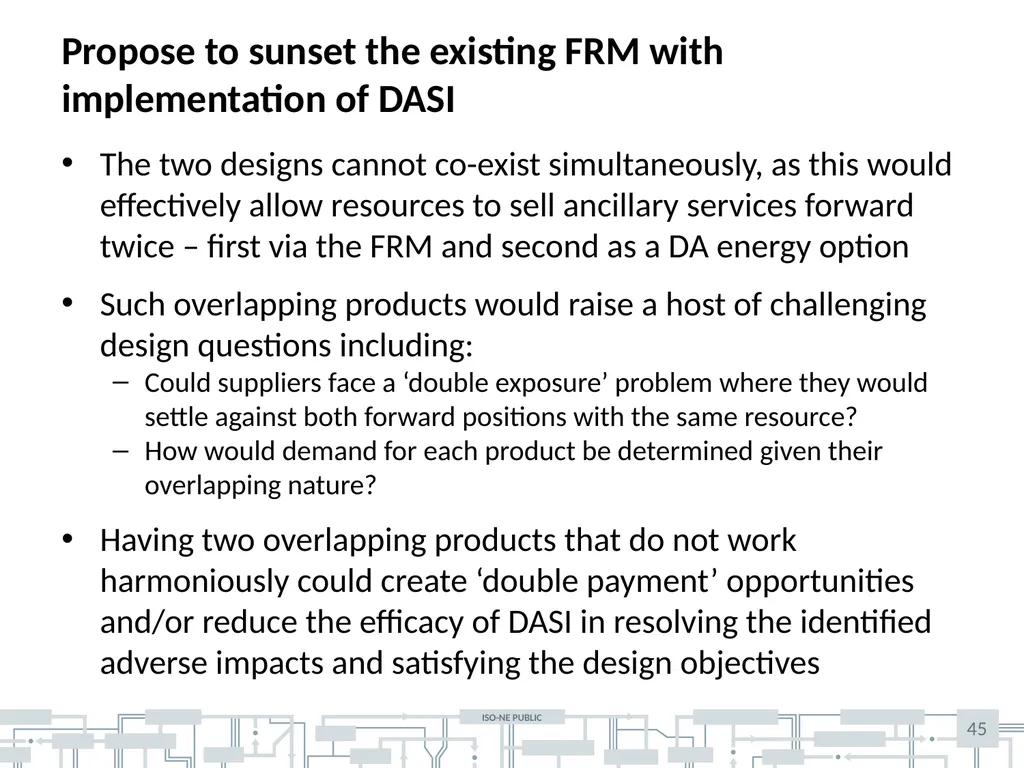
45 Propose to sunset the existing FRM with implementation of DASI The two designs cannot co-exist simultaneously, as this would effectively allow resources to sell ancillary services forward twice – first via the FRM and second as a DA energy option
Such overlapping products would raise a host of challenging design questions including:
Could suppliers face a ‘double exposure’ problem where they would settle against both forward positions with the same resource?
How would demand for each product be determined given their overlapping nature?
Having two overlapping products that do not work harmoniously could create ‘double payment’ opportunities and/or reduce the efficacy of DASI in resolving the identified adverse impacts and satisfying the design objectives<br>
Such overlapping products would raise a host of challenging design questions including:
Could suppliers face a ‘double exposure’ problem where they would settle against both forward positions with the same resource?
How would demand for each product be determined given their overlapping nature?
Having two overlapping products that do not work harmoniously could create ‘double payment’ opportunities and/or reduce the efficacy of DASI in resolving the identified adverse impacts and satisfying the design objectives<br>
46
46 Sun-setting the FRM is consistent with ISO’s earlier recommendation and EMM’s recommendation ISO first explained the incompatibility of the FRM with the introduction of DA ancillary services in a June 2020 Markets Committee presentation*
Such a removal is consistent with EMM’s recommendation to remove FRM, which was first flagged in their 2014 State of the Market Report** * Available at https://www.iso-ne.com/static-assets/documents/2020/06/a4_iso_presentation_frm_sunset.pptx
**Available at https://www.iso-ne.com/static-assets/documents/2015/06/isone_2014_emm_report_6_16_2015_final.pdf<br>
Such a removal is consistent with EMM’s recommendation to remove FRM, which was first flagged in their 2014 State of the Market Report** * Available at https://www.iso-ne.com/static-assets/documents/2020/06/a4_iso_presentation_frm_sunset.pptx
**Available at https://www.iso-ne.com/static-assets/documents/2015/06/isone_2014_emm_report_6_16_2015_final.pdf<br>
47
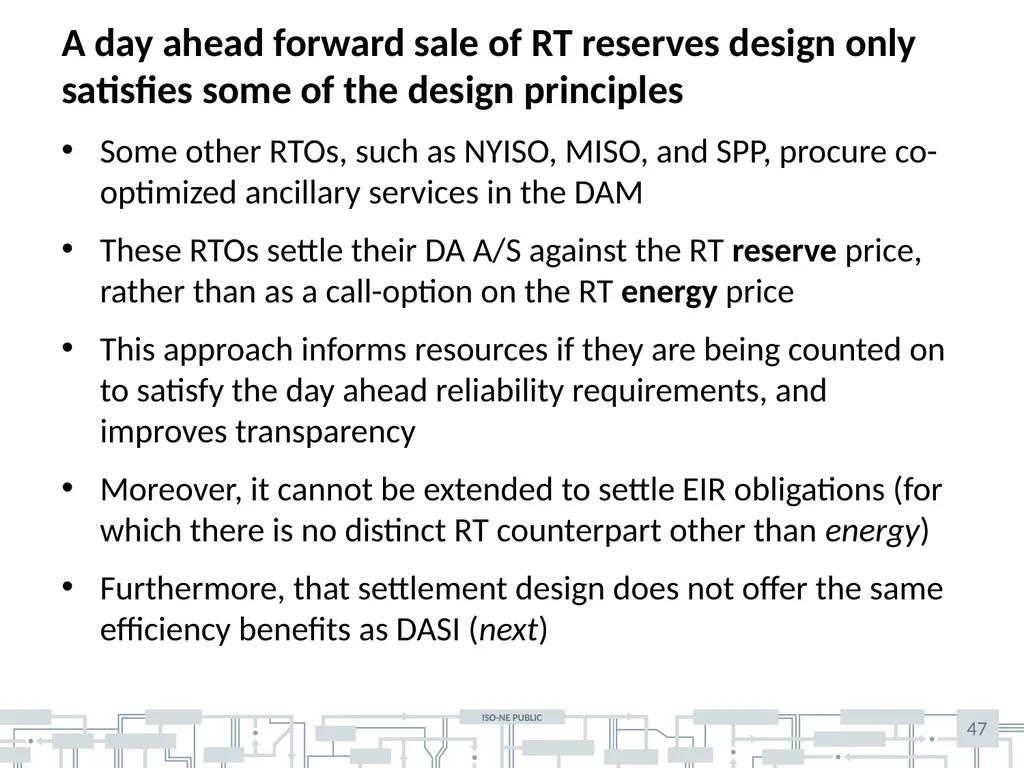
47 A day ahead forward sale of RT reserves design only satisfies some of the design principles Some other RTOs, such as NYISO, MISO, and SPP, procure co-optimized ancillary services in the DAM
These RTOs settle their DA A/S against the RT reserve price, rather than as a call-option on the RT energy price
This approach informs resources if they are being counted on to satisfy the day ahead reliability requirements, and improves transparency
Moreover, it cannot be extended to settle EIR obligations (for which there is no distinct RT counterpart other than energy)
Furthermore, that settlement design does not offer the same efficiency benefits as DASI (next)<br>
These RTOs settle their DA A/S against the RT reserve price, rather than as a call-option on the RT energy price
This approach informs resources if they are being counted on to satisfy the day ahead reliability requirements, and improves transparency
Moreover, it cannot be extended to settle EIR obligations (for which there is no distinct RT counterpart other than energy)
Furthermore, that settlement design does not offer the same efficiency benefits as DASI (next)<br>
48
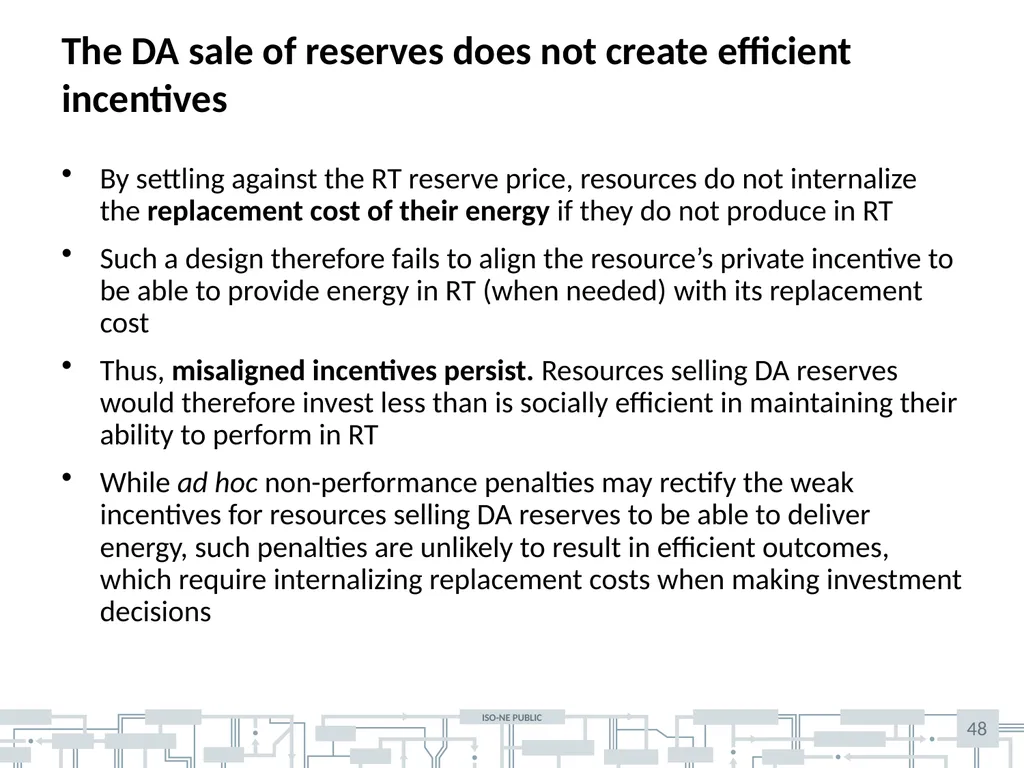
48 The DA sale of reserves does not create efficient incentives By settling against the RT reserve price, resources do not internalize the replacement cost of their energy if they do not produce in RT
Such a design therefore fails to align the resource’s private incentive to be able to provide energy in RT (when needed) with its replacement cost
Thus, misaligned incentives persist. Resources selling DA reserves would therefore invest less than is socially efficient in maintaining their ability to perform in RT
While ad hoc non-performance penalties may rectify the weak incentives for resources selling DA reserves to be able to deliver energy, such penalties are unlikely to result in efficient outcomes, which require internalizing replacement costs when making investment decisions<br>
Such a design therefore fails to align the resource’s private incentive to be able to provide energy in RT (when needed) with its replacement cost
Thus, misaligned incentives persist. Resources selling DA reserves would therefore invest less than is socially efficient in maintaining their ability to perform in RT
While ad hoc non-performance penalties may rectify the weak incentives for resources selling DA reserves to be able to deliver energy, such penalties are unlikely to result in efficient outcomes, which require internalizing replacement costs when making investment decisions<br>
49
Next Steps and stakeholder schedule 49<br>
50
50 Coming soon: Further discussion of missing markets and their adverse impacts, design objectives, and alternative designs Discussion will emphasize the following:
Why current rules can lead to the adverse impacts discussed,
How these adverse impacts are resolved under the DASI design, and
Why they would not be fully resolved under a forward sale settlement design similar to that employed in other RTOs
Discussion will include numerical examples supporting these claims<br>
Why current rules can lead to the adverse impacts discussed,
How these adverse impacts are resolved under the DASI design, and
Why they would not be fully resolved under a forward sale settlement design similar to that employed in other RTOs
Discussion will include numerical examples supporting these claims<br>
51
51 Coming soon: Other topics and anticipated FAQs ISO will discuss the rationale behind setting the call-option strike price at the expected RT LMP
Evaluating the risks associated with DA A/S as call options, relative to (A) selling DA energy, and (B) selling RT energy with no DA position (as occurs for most fast-start resources today)
Discussion of DASI Impact Analysis plan<br>
Evaluating the risks associated with DA A/S as call options, relative to (A) selling DA energy, and (B) selling RT energy with no DA position (as occurs for most fast-start resources today)
Discussion of DASI Impact Analysis plan<br>
52
52 Conclusion: DASI will solve the adverse impacts that can occur due to today’s missing DA ancillary service markets DASI will produce more transparent and efficient DA awards for energy and ancillary services, and address concerns about poor price signals and misaligned incentives
It represents a more efficient, well-developed design improvement over other DA ancillary service settlements, such as a forward-sale-of-RT-reserves settlement design, as it leads resources selling DA ancillary services to fully and efficiently internalize the replacement cost of not providing energy in RT
ISO is targeting DASI implementation for Q4 2024/Q1 2025 to allow sufficient time for software development and testing<br>
It represents a more efficient, well-developed design improvement over other DA ancillary service settlements, such as a forward-sale-of-RT-reserves settlement design, as it leads resources selling DA ancillary services to fully and efficiently internalize the replacement cost of not providing energy in RT
ISO is targeting DASI implementation for Q4 2024/Q1 2025 to allow sufficient time for software development and testing<br>
53
Project timeline and Committee roadmap 53<br>
54
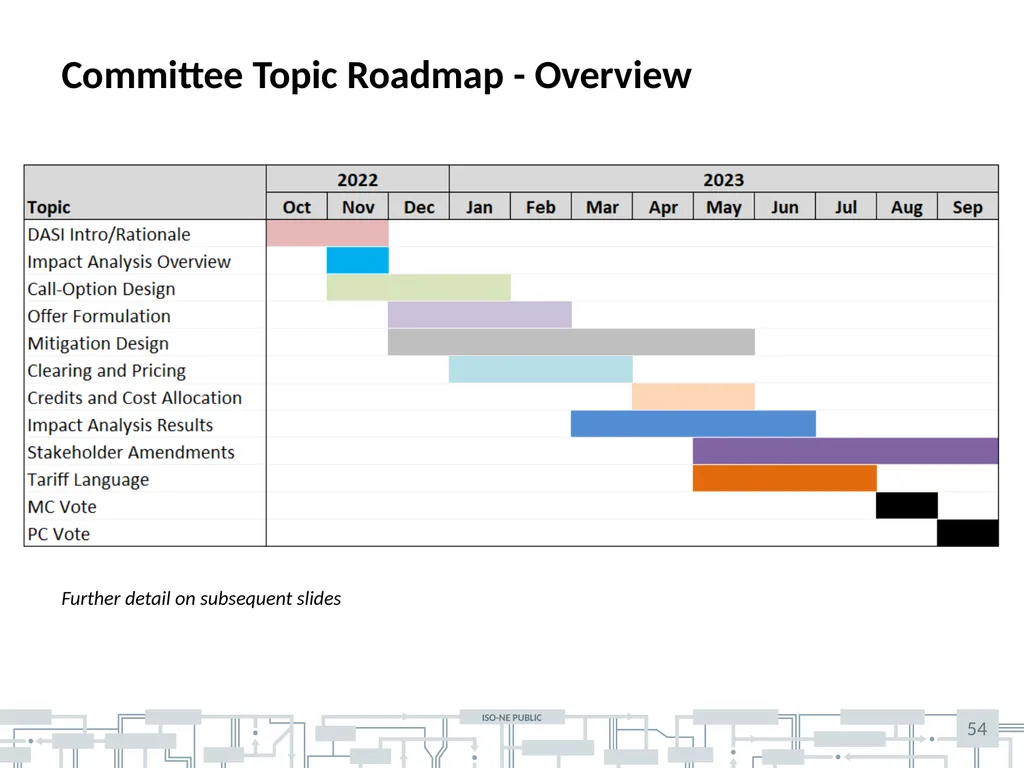
54 Committee Topic Roadmap - Overview Further detail on subsequent slides<br>
55
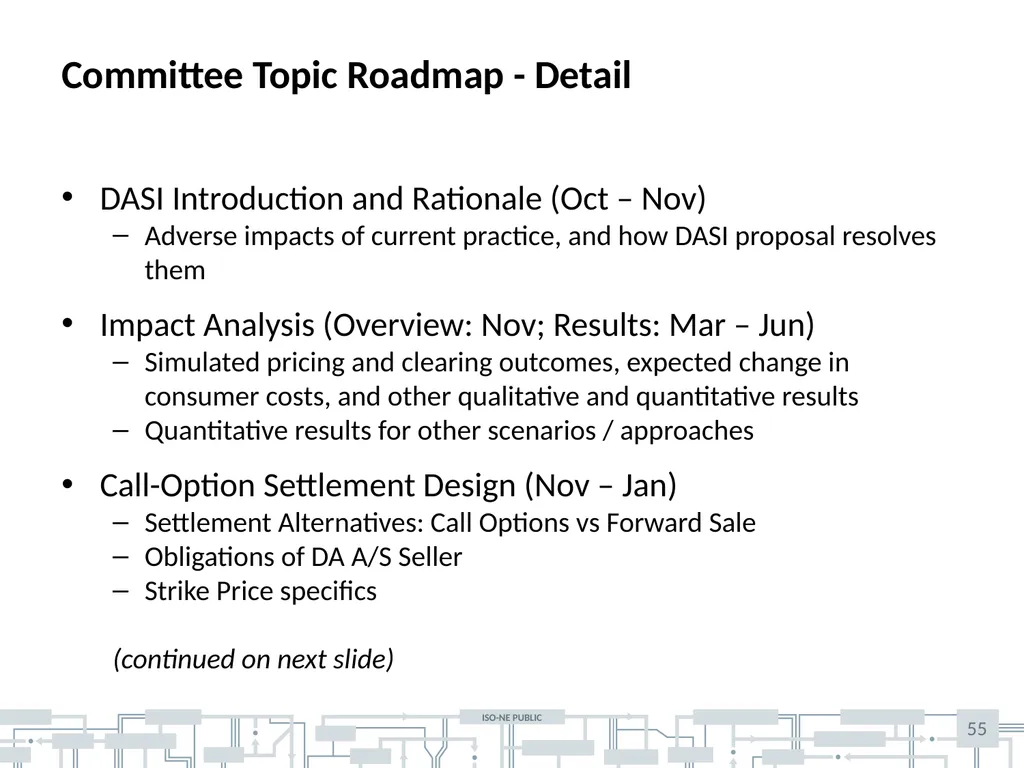
55 Committee Topic Roadmap - Detail DASI Introduction and Rationale (Oct – Nov)
Adverse impacts of current practice, and how DASI proposal resolves them
Impact Analysis (Overview: Nov; Results: Mar – Jun)
Simulated pricing and clearing outcomes, expected change in consumer costs, and other qualitative and quantitative results
Quantitative results for other scenarios / approaches
Call-Option Settlement Design (Nov – Jan)
Settlement Alternatives: Call Options vs Forward Sale
Obligations of DA A/S Seller
Strike Price specifics
(continued on next slide)<br>
Adverse impacts of current practice, and how DASI proposal resolves them
Impact Analysis (Overview: Nov; Results: Mar – Jun)
Simulated pricing and clearing outcomes, expected change in consumer costs, and other qualitative and quantitative results
Quantitative results for other scenarios / approaches
Call-Option Settlement Design (Nov – Jan)
Settlement Alternatives: Call Options vs Forward Sale
Obligations of DA A/S Seller
Strike Price specifics
(continued on next slide)<br>
56
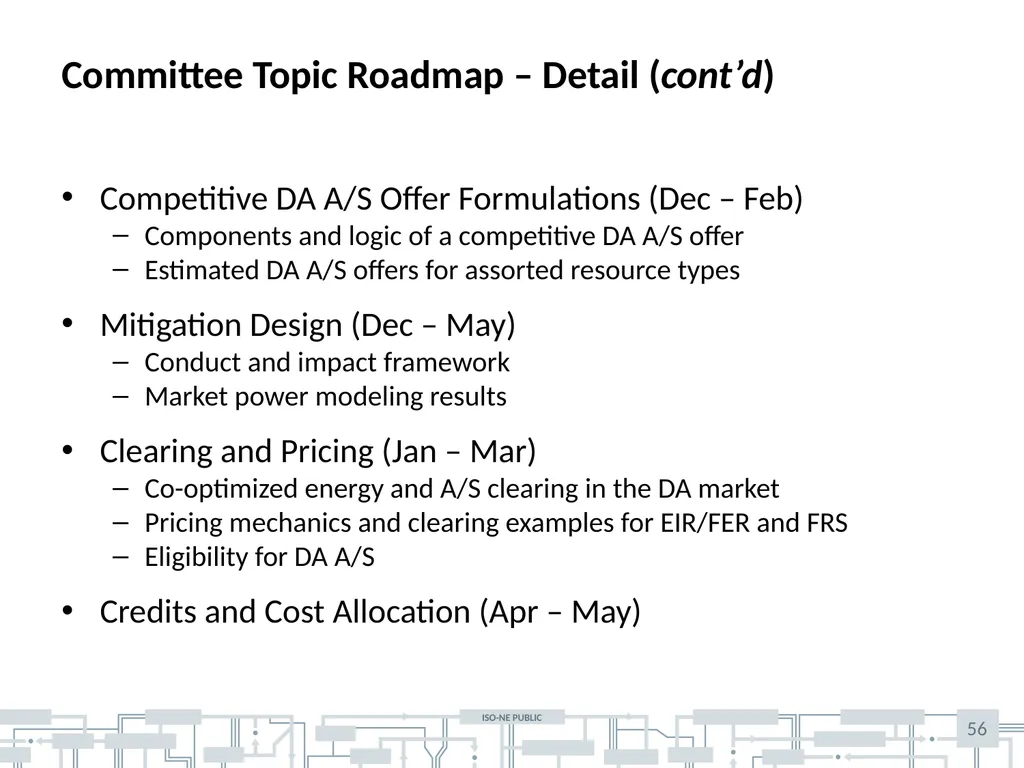
56 Committee Topic Roadmap – Detail (cont’d) Competitive DA A/S Offer Formulations (Dec – Feb)
Components and logic of a competitive DA A/S offer
Estimated DA A/S offers for assorted resource types
Mitigation Design (Dec – May)
Conduct and impact framework
Market power modeling results
Clearing and Pricing (Jan – Mar)
Co-optimized energy and A/S clearing in the DA market
Pricing mechanics and clearing examples for EIR/FER and FRS
Eligibility for DA A/S
Credits and Cost Allocation (Apr – May)<br>
Components and logic of a competitive DA A/S offer
Estimated DA A/S offers for assorted resource types
Mitigation Design (Dec – May)
Conduct and impact framework
Market power modeling results
Clearing and Pricing (Jan – Mar)
Co-optimized energy and A/S clearing in the DA market
Pricing mechanics and clearing examples for EIR/FER and FRS
Eligibility for DA A/S
Credits and Cost Allocation (Apr – May)<br>
57
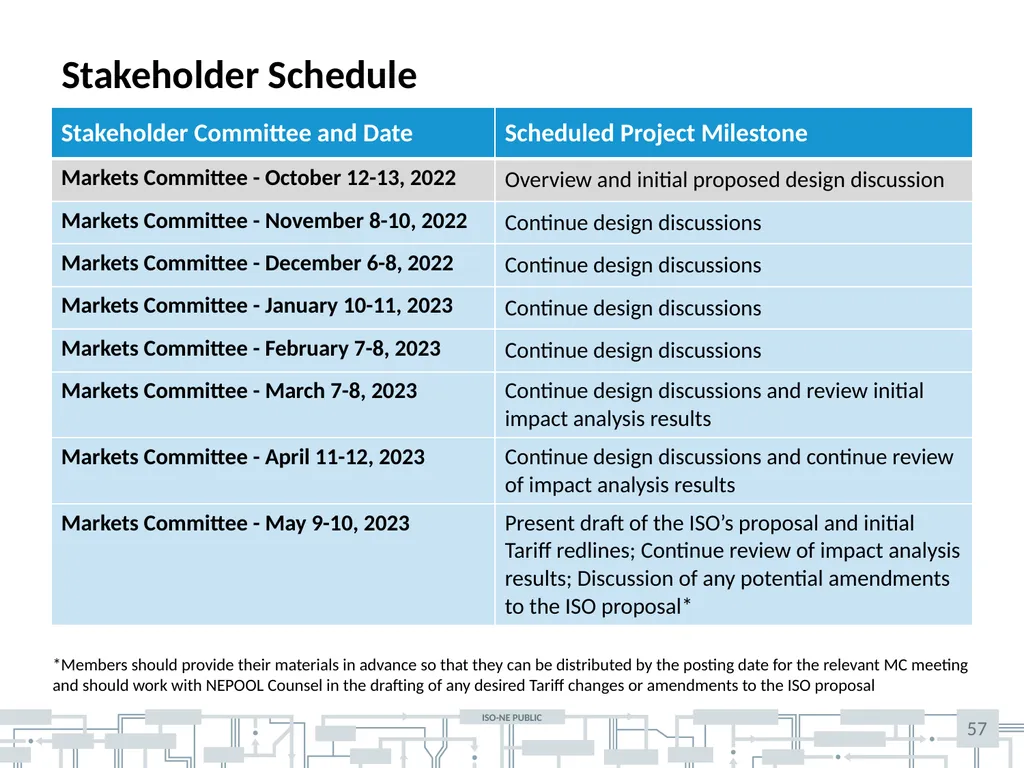
Stakeholder Schedule 57 *Members should provide their materials in advance so that they can be distributed by the posting date for the relevant MC meeting and should work with NEPOOL Counsel in the drafting of any desired Tariff changes or amendments to the ISO proposal<br>
58
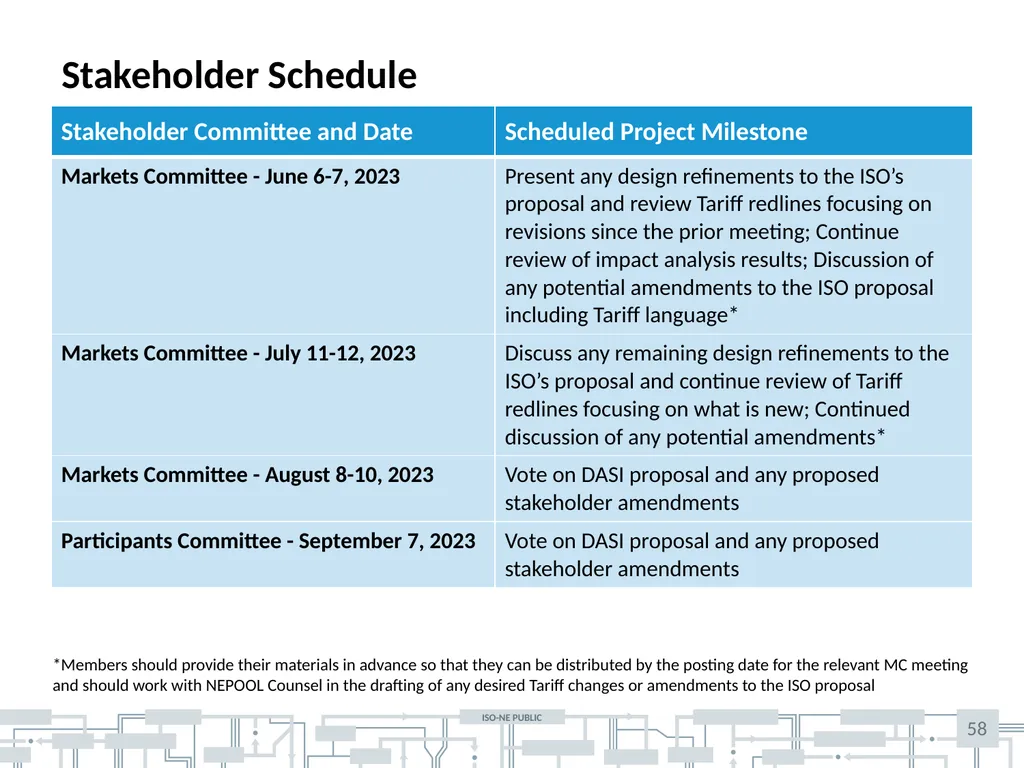
Stakeholder Schedule 58 *Members should provide their materials in advance so that they can be distributed by the posting date for the relevant MC meeting and should work with NEPOOL Counsel in the drafting of any desired Tariff changes or amendments to the ISO proposal<br>
59
59 Ben Ewing (413) 535-4361 | bewing@iso-ne.com Chris Geissler (413) 535-4367 | cgeissler@iso-ne.com<br>