Mason Initiatives: Efficiency & Effectiveness
Description: Mason Initiatives: Efficiency Effectiveness Enterprise Risk Management Beth Brock, Associate VP Controller George Mason University May 21, 2010 1 Agenda Efficiency Effectiveness (EE) How we got started and the process Where we are
Related Topics
Download Presentation
"Mason Initiatives: Efficiency & Effectiveness" is the property of its rightful owner. Permission is granted to download and print the materials on this website for personal, non-commercial use only, and to display it on your personal computer provided you do not modify the materials and that you retain all copyright notices contained in the materials. By downloading content from our website, you accept the terms of this agreement.
Presentation Transcript
slide1. Mason Initiatives:Efficiency & EffectivenessEnterprise Risk Management Beth Brock, Associate VP & Controller
George Mason University
May 21, 2010 1<br>
slide2. Agenda Efficiency & Effectiveness (E&E)
How we got started and the process
Where we are now, observations, questions
Enterprise Risk Management (ERM)
Overview
How we got started and the process
Where we are now, survey, questions 2<br>
slide3. E&E Initiative Late 2010 - some members of BOV requested
All administrative functions in scope; academics excluded
Spring 2011 - explored big firm and boutique/trade assn approaches 3<br>
slide4. E&E Study Advice Do not underestimate:
Disruption in workplace
Time and effort to do properly
Impact on employee moral
Expect to make an investment 4<br>
slide5. E&E Evolution Issued RFP for benchmarking services in seven administrative areas:
Auxiliaries & Affiliated Entities
Facilities
Information Technology
Purchasing
Enrollment Services
Human Resources
Accounting & Finance 5<br>
slide6. RFP for Benchmarking Services Selection criteria emphasized higher ed experience, recommended benchmarks required
Goal - inform a decision on areas for E&E review
Search committee: Controller; Director IA&MS; Fiscal Projects Director
Two firms selected for oral presentations
Senior VP and Chief of Staff attended orals 6<br>
slide7. Benchmarking Project Huron Consulting selected for 3-4 month project:
Reviewed data on budgets and staffing
Interviewed unit heads
Confirmed benchmarks
Performed benchmarking and analysis
Delivered final report – functioning efficiently and effectively
Discussing next phase for some opportunities 7<br>
slide8. Efficiency & Effectiveness Observations and Questions 8<br>
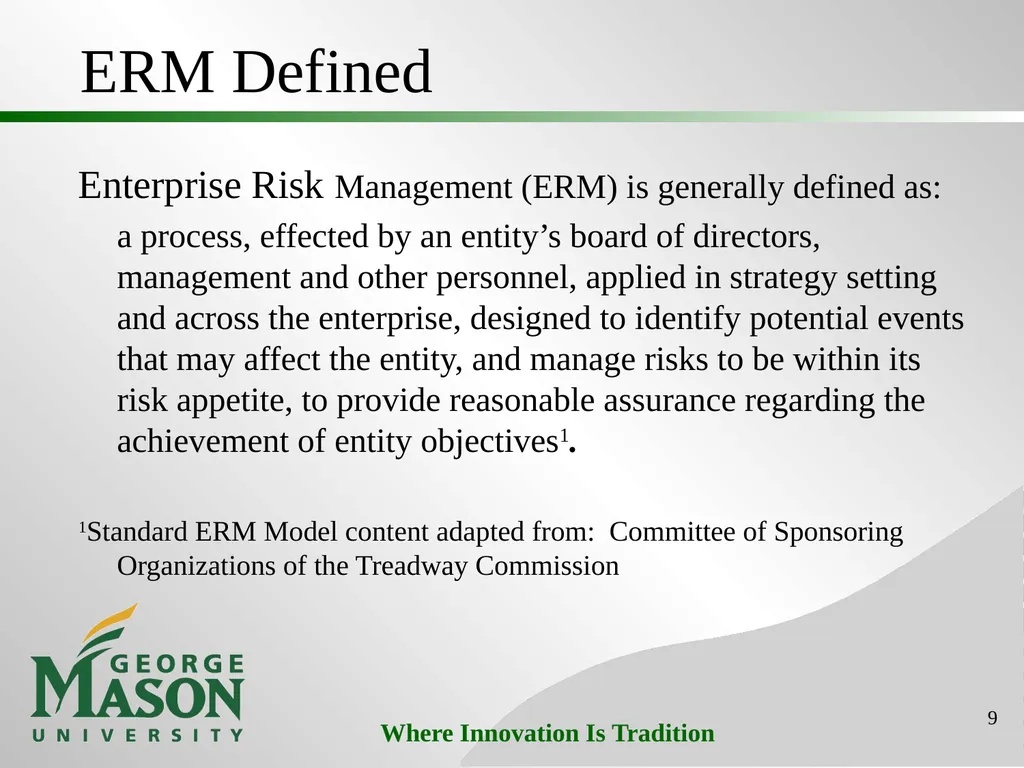
slide9. ERM Defined Enterprise Risk Management (ERM) is generally defined as:
a process, effected by an entity’s board of directors, management and other personnel, applied in strategy setting and across the enterprise, designed to identify potential events that may affect the entity, and manage risks to be within its risk appetite, to provide reasonable assurance regarding the achievement of entity objectives1.
1Standard ERM Model content adapted from: Committee of Sponsoring Organizations of the Treadway Commission 9<br>
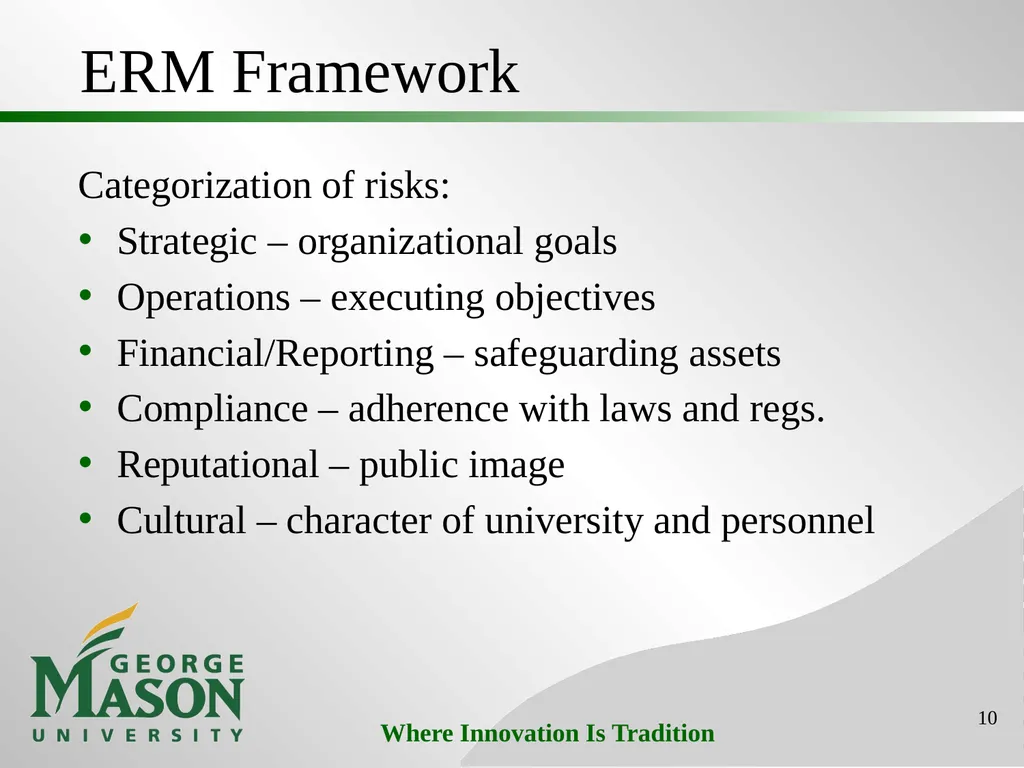
slide10. ERM Framework Categorization of risks:
Strategic – organizational goals
Operations – executing objectives
Financial/Reporting – safeguarding assets
Compliance – adherence with laws and regs.
Reputational – public image
Cultural – character of university and personnel 10<br>
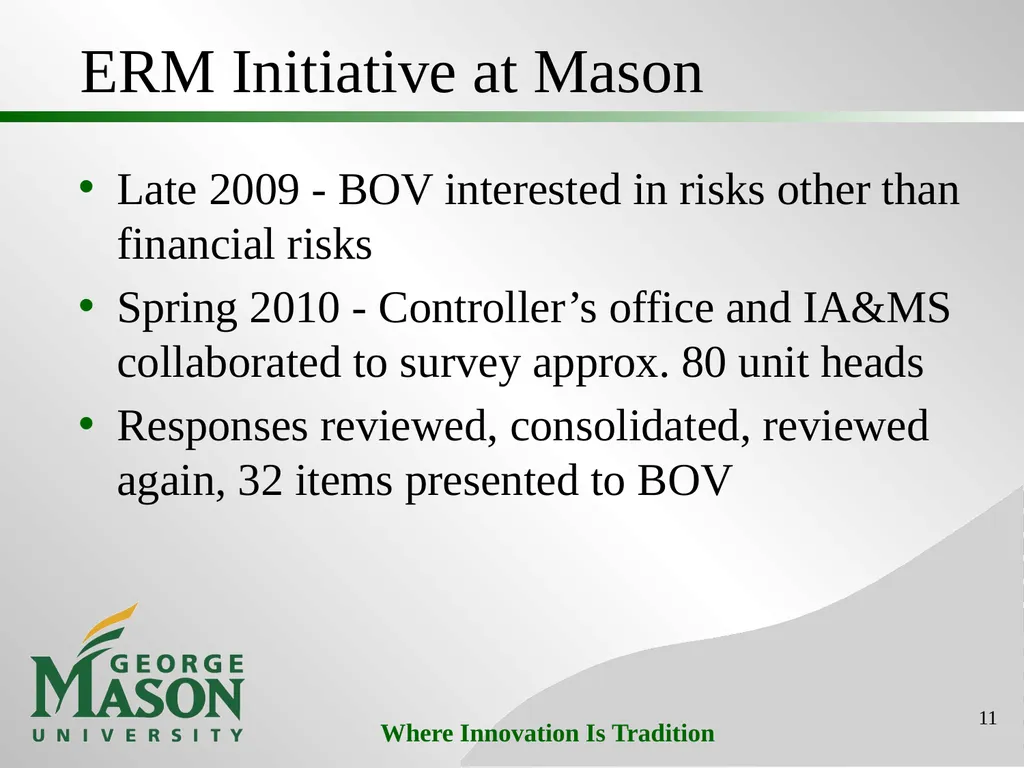
slide11. ERM Initiative at Mason Late 2009 - BOV interested in risks other than financial risks
Spring 2010 - Controller’s office and IA&MS collaborated to survey approx. 80 unit heads
Responses reviewed, consolidated, reviewed again, 32 items presented to BOV 11<br>
slide12. ERM Evolution Funding for next steps in FY11 budget
Issued RFP for assistance with designing a sustainable ERM program
Responses from 14 firms; orals from 5
Sr. VP and Chief of Staff attended orals 12<br>
slide13. ERM Project Huron Consulting selected late 2010
Extensive data requests:
Org charts, audit reports, draft audit findings, budgets, IA&MS work plans, list of affiliates, strategic and/or business plans for IT, research, student, finance, President’s initiatives, ERM work to date 13<br>
slide14. Huron Phase I Evaluated data
Met with about 25 unit heads
Identified common risks at other institutions
Assigned one or more of 6 framework categories
Assigned functional area: facilities, safety, IT, academic, research, fiscal, HR, etc. 14<br>
slide15. Assigning Risk Factors Evaluated each risk using five factors:
External environment – e.g., federal regs
Reputational risk – level of public visibility
Financial exposure – e.g., budget, penalties
Vulnerability – likelihood of occurrence
Internal controls risk assessment 15<br>
slide16. Ranking our Risks Used the collective high, medium, low scores for each factor to assign a relative impact score to each
40 risks prioritized as highest, high, medium
Eleven highest priority include fraud, research compliance, succession planning
Phase I deliverable – modified risk inventory 16<br>
slide17. ERM Implementation Plan Huron phase 2 deliverables:
Recommended organizational structure
Reviewed policies, provided gap analysis
Provided executive level reporting format (heat map)
Provided risk mitigation strategy guidance 17<br>
slide18. Hiring a Chief Risk Officer New admin. faculty position, reporting to Sr. VP
Advertised late November 2011 - late January 2012
Committee: Controller, Director IA&MS, Projects Director, Assoc. Dean College of Science
About 45 applicants, 3 selected for interview
Reopened search April 2012 18<br>
slide19. Interim Efforts Applying the committee-based organizational model
Functional managers appointed to committee
Will develop mitigation strategies for highest priority risks
Will update risk inventory, determine factors for assessing relative degrees of risk 19<br>
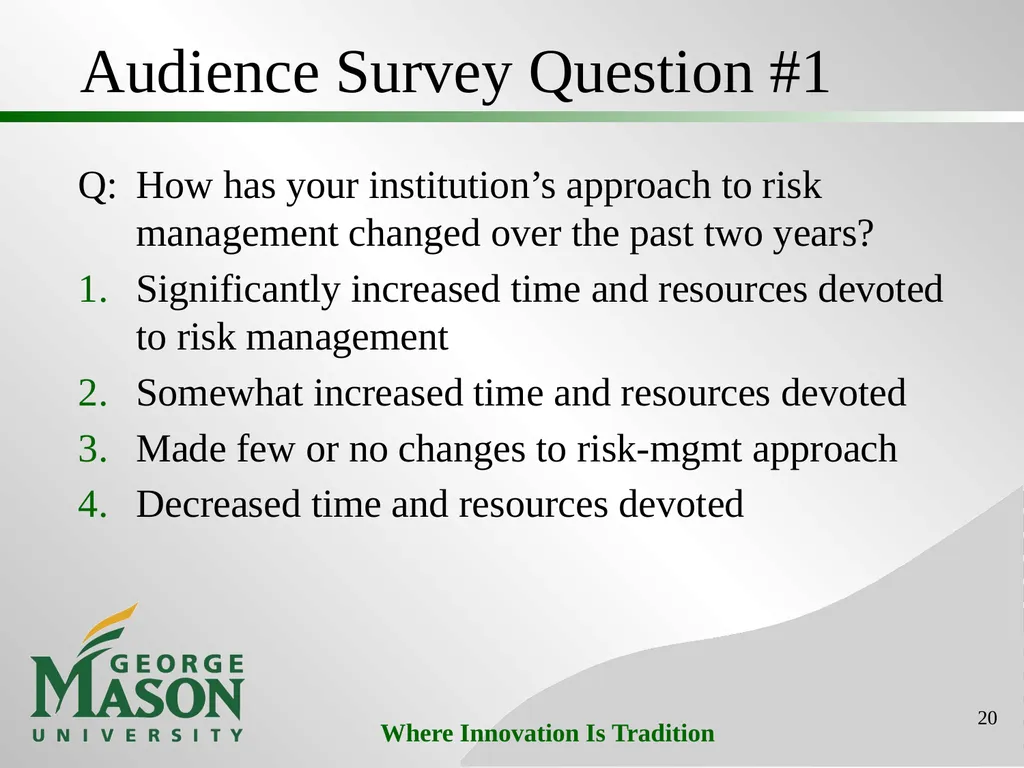
slide20. Audience Survey Question #1 Q: How has your institution’s approach to risk management changed over the past two years?
Significantly increased time and resources devoted to risk management
Somewhat increased time and resources devoted
Made few or no changes to risk-mgmt approach
Decreased time and resources devoted 20<br>
slide21. Survey by CFO Magazine Q#1 21<br>
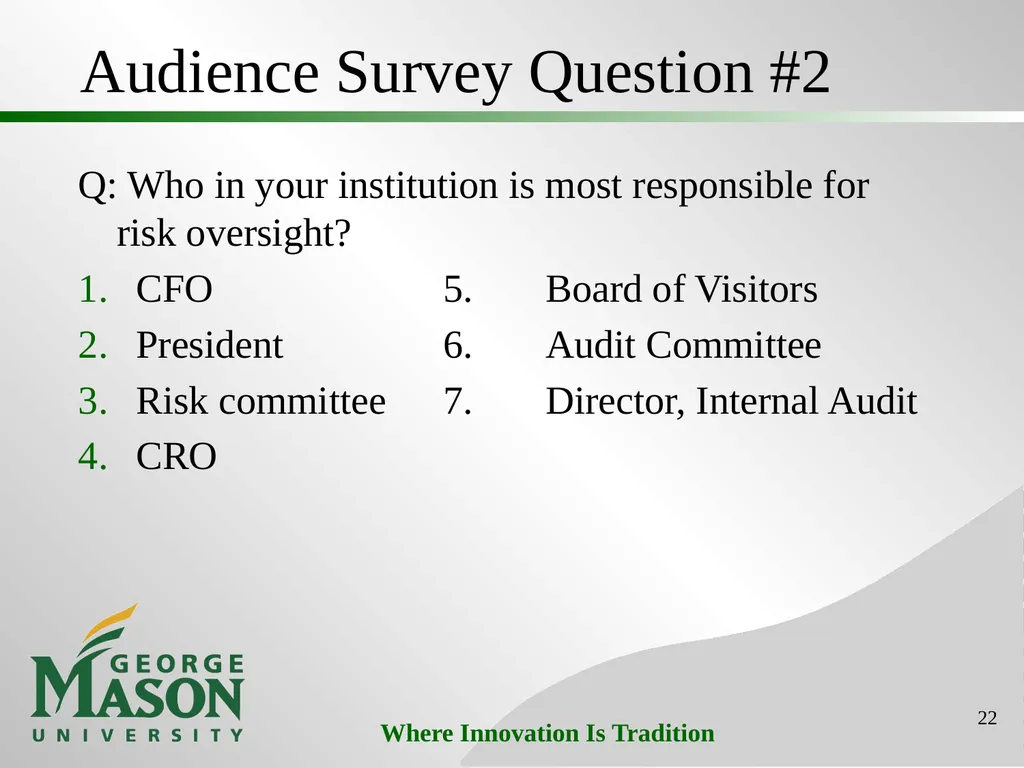
slide22. Audience Survey Question #2 Q: Who in your institution is most responsible for risk oversight?
CFO 5. Board of Visitors
President 6. Audit Committee
Risk committee 7. Director, Internal Audit
CRO 22<br>
slide23. Survey by CFO Magazine Q#2 23<br>
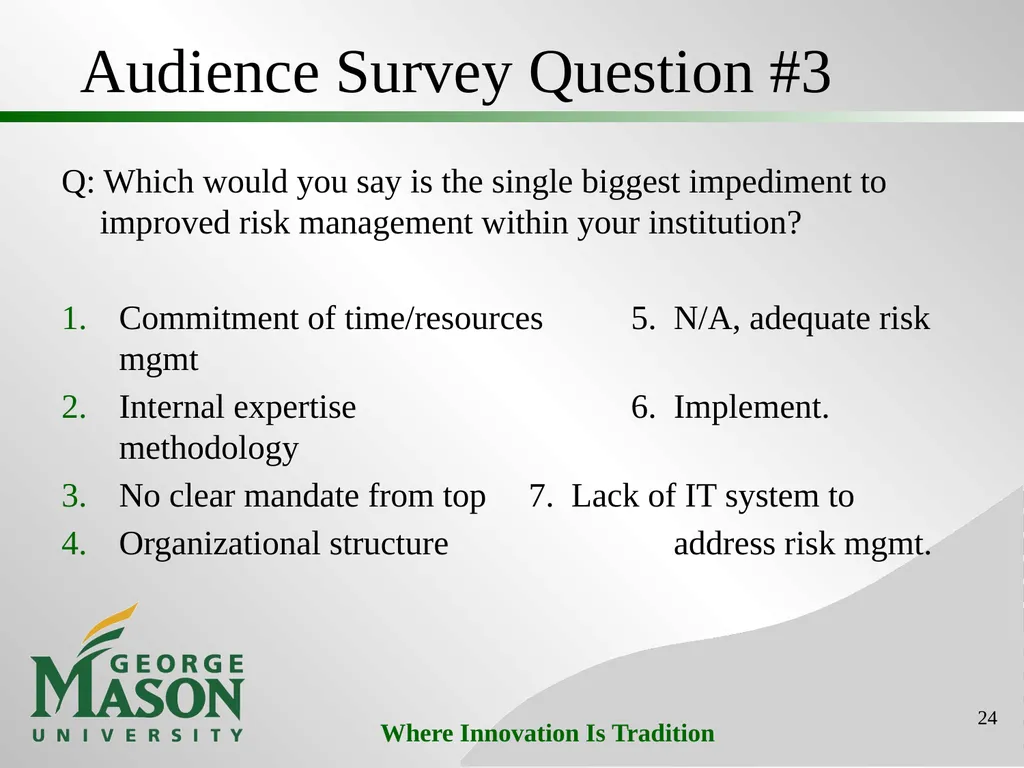
slide24. Audience Survey Question #3 Q: Which would you say is the single biggest impediment to improved risk management within your institution?
Commitment of time/resources 5. N/A, adequate risk mgmt
Internal expertise 6. Implement. methodology
No clear mandate from top 7. Lack of IT system to
Organizational structure address risk mgmt. 24<br>
slide25. Survey by CFO Magazine Q#3 25<br>
slide26. Enterprise Risk Management Observations and Questions
Contact information: Beth Brock
ebrock1@gmu.edu 703-993-2660 26<br>

George Mason University
May 21, 2010 1<br>
slide2. Agenda Efficiency & Effectiveness (E&E)
How we got started and the process
Where we are now, observations, questions
Enterprise Risk Management (ERM)
Overview
How we got started and the process
Where we are now, survey, questions 2<br>
slide3. E&E Initiative Late 2010 - some members of BOV requested
All administrative functions in scope; academics excluded
Spring 2011 - explored big firm and boutique/trade assn approaches 3<br>
slide4. E&E Study Advice Do not underestimate:
Disruption in workplace
Time and effort to do properly
Impact on employee moral
Expect to make an investment 4<br>
slide5. E&E Evolution Issued RFP for benchmarking services in seven administrative areas:
Auxiliaries & Affiliated Entities
Facilities
Information Technology
Purchasing
Enrollment Services
Human Resources
Accounting & Finance 5<br>
slide6. RFP for Benchmarking Services Selection criteria emphasized higher ed experience, recommended benchmarks required
Goal - inform a decision on areas for E&E review
Search committee: Controller; Director IA&MS; Fiscal Projects Director
Two firms selected for oral presentations
Senior VP and Chief of Staff attended orals 6<br>
slide7. Benchmarking Project Huron Consulting selected for 3-4 month project:
Reviewed data on budgets and staffing
Interviewed unit heads
Confirmed benchmarks
Performed benchmarking and analysis
Delivered final report – functioning efficiently and effectively
Discussing next phase for some opportunities 7<br>
slide8. Efficiency & Effectiveness Observations and Questions 8<br>
slide9. ERM Defined Enterprise Risk Management (ERM) is generally defined as:
a process, effected by an entity’s board of directors, management and other personnel, applied in strategy setting and across the enterprise, designed to identify potential events that may affect the entity, and manage risks to be within its risk appetite, to provide reasonable assurance regarding the achievement of entity objectives1.
1Standard ERM Model content adapted from: Committee of Sponsoring Organizations of the Treadway Commission 9<br>
slide10. ERM Framework Categorization of risks:
Strategic – organizational goals
Operations – executing objectives
Financial/Reporting – safeguarding assets
Compliance – adherence with laws and regs.
Reputational – public image
Cultural – character of university and personnel 10<br>
slide11. ERM Initiative at Mason Late 2009 - BOV interested in risks other than financial risks
Spring 2010 - Controller’s office and IA&MS collaborated to survey approx. 80 unit heads
Responses reviewed, consolidated, reviewed again, 32 items presented to BOV 11<br>
slide12. ERM Evolution Funding for next steps in FY11 budget
Issued RFP for assistance with designing a sustainable ERM program
Responses from 14 firms; orals from 5
Sr. VP and Chief of Staff attended orals 12<br>
slide13. ERM Project Huron Consulting selected late 2010
Extensive data requests:
Org charts, audit reports, draft audit findings, budgets, IA&MS work plans, list of affiliates, strategic and/or business plans for IT, research, student, finance, President’s initiatives, ERM work to date 13<br>
slide14. Huron Phase I Evaluated data
Met with about 25 unit heads
Identified common risks at other institutions
Assigned one or more of 6 framework categories
Assigned functional area: facilities, safety, IT, academic, research, fiscal, HR, etc. 14<br>
slide15. Assigning Risk Factors Evaluated each risk using five factors:
External environment – e.g., federal regs
Reputational risk – level of public visibility
Financial exposure – e.g., budget, penalties
Vulnerability – likelihood of occurrence
Internal controls risk assessment 15<br>
slide16. Ranking our Risks Used the collective high, medium, low scores for each factor to assign a relative impact score to each
40 risks prioritized as highest, high, medium
Eleven highest priority include fraud, research compliance, succession planning
Phase I deliverable – modified risk inventory 16<br>
slide17. ERM Implementation Plan Huron phase 2 deliverables:
Recommended organizational structure
Reviewed policies, provided gap analysis
Provided executive level reporting format (heat map)
Provided risk mitigation strategy guidance 17<br>
slide18. Hiring a Chief Risk Officer New admin. faculty position, reporting to Sr. VP
Advertised late November 2011 - late January 2012
Committee: Controller, Director IA&MS, Projects Director, Assoc. Dean College of Science
About 45 applicants, 3 selected for interview
Reopened search April 2012 18<br>
slide19. Interim Efforts Applying the committee-based organizational model
Functional managers appointed to committee
Will develop mitigation strategies for highest priority risks
Will update risk inventory, determine factors for assessing relative degrees of risk 19<br>
slide20. Audience Survey Question #1 Q: How has your institution’s approach to risk management changed over the past two years?
Significantly increased time and resources devoted to risk management
Somewhat increased time and resources devoted
Made few or no changes to risk-mgmt approach
Decreased time and resources devoted 20<br>
slide21. Survey by CFO Magazine Q#1 21<br>
slide22. Audience Survey Question #2 Q: Who in your institution is most responsible for risk oversight?
CFO 5. Board of Visitors
President 6. Audit Committee
Risk committee 7. Director, Internal Audit
CRO 22<br>
slide23. Survey by CFO Magazine Q#2 23<br>
slide24. Audience Survey Question #3 Q: Which would you say is the single biggest impediment to improved risk management within your institution?
Commitment of time/resources 5. N/A, adequate risk mgmt
Internal expertise 6. Implement. methodology
No clear mandate from top 7. Lack of IT system to
Organizational structure address risk mgmt. 24<br>
slide25. Survey by CFO Magazine Q#3 25<br>
slide26. Enterprise Risk Management Observations and Questions
Contact information: Beth Brock
ebrock1@gmu.edu 703-993-2660 26<br>