Material Handling And Storage Material Handling and Storage Hazards 600,000 overexertion injuries, 27 of all lost- workday cases 370,000 injuries caused by lifting 93,000 pushingpulling Strains and sprains from loads that are too heavy or
"Material Handling And Storage Material Handling" is the property of its rightful owner. Permission is granted to
download and print the materials on this website for personal, non-commercial use only, and to display it
on your personal computer provided you do not modify the materials and that you retain all copyright
notices contained in the materials. By downloading content from our website, you accept the terms of this
agreement.
Presentation Transcript
01
Material Handling
And
Storage<br>
02
Material Handling and Storage<br>
03
Hazards 600,000 overexertion injuries, 27% of all
lost- workday cases
370,000 injuries caused by lifting
93,000 pushing/pulling
Strains and sprains from loads that are too heavy or large
Fractures, cuts, and bruises from improper storage<br>
04
General Work Practices Get help for large loads
When blocking a raised load:
Keep hands from underneath before releasing load
Use blocking materials of adequate strength
Look for cracks, splintered pieces, rounded corners, etc.
Attach handles or holder to loads
PPE
Gloves, eye protection, safety boots (for heavy loads)<br>
05
Mechanical Material Handling Do not overload equipment
Refer to equipment rated capacity
General forklift procedures
Center load on forks and close to mast
Do not overload
Do not add extra weight to counterbalance
Travel with load at lowest position<br>
06
Materials Storage Stacked loads correctly piled and cross-tiered
Stored material must not create hazard
Areas free of accumulated material
In buildings, no stored materials within 6 feet of hoist ways or 10 feet of exterior building walls
Store non-compatible material separately<br>
07
Lumber and Brick Storage Lumber
Maximum stack height
16 feet (manual handling)
20 feet (forklift)
Remove nails from used lumber
Stacks stable and self-supporting
Bricks
Maximum 7 feet high
Above 4 feet, taper stacks 2 inches per foot<br>
08
Block and Bag Storage Masonry blocks
Above 6 feet , taper stacks 2 blocks per tier
Bags and bundles
Stack in interlocking rows
Step back at least every 10 layers
Remove from top of stack first
Keep baled paper and rags at least 10 inches from walls, ceilings, or sprinkler heads<br>
09
Box and Drum Storage Boxed materials
Hold in place using cross-ties or shrink plastic
Drums, barrels, kegs
Stacked symmetrically
If stored on side, block bottom tiers to prevent rolling
If stacked on ends, use planks, pallets, etc. between each tier
Block cylindrical material (bars, poles, etc.)
Use bins or shelves for materials that cannot be stacked<br>
10
Manual Lifting Avoid manual lifting when possible
Limit vertical lifting (knuckle-to-shoulder height)
Be in good physical shape
Plan the lifting operation
Get a good grip
Keep the load close to the body
Do not twist or bend sideways
Get help for large or heavy loads<br>
11
Manual Lifting Recommendations for specific tasks
Grasp opposite corners on boxes, cartons & sacks
Use mechanical assistance for barrels and drums
Wear leather gloves when handling sheet metal
Plate glass
Carry with bottom edge in gloved palm, other hand on top edge
Never carry plate glass under the arm
Use a team for long objects<br>
12
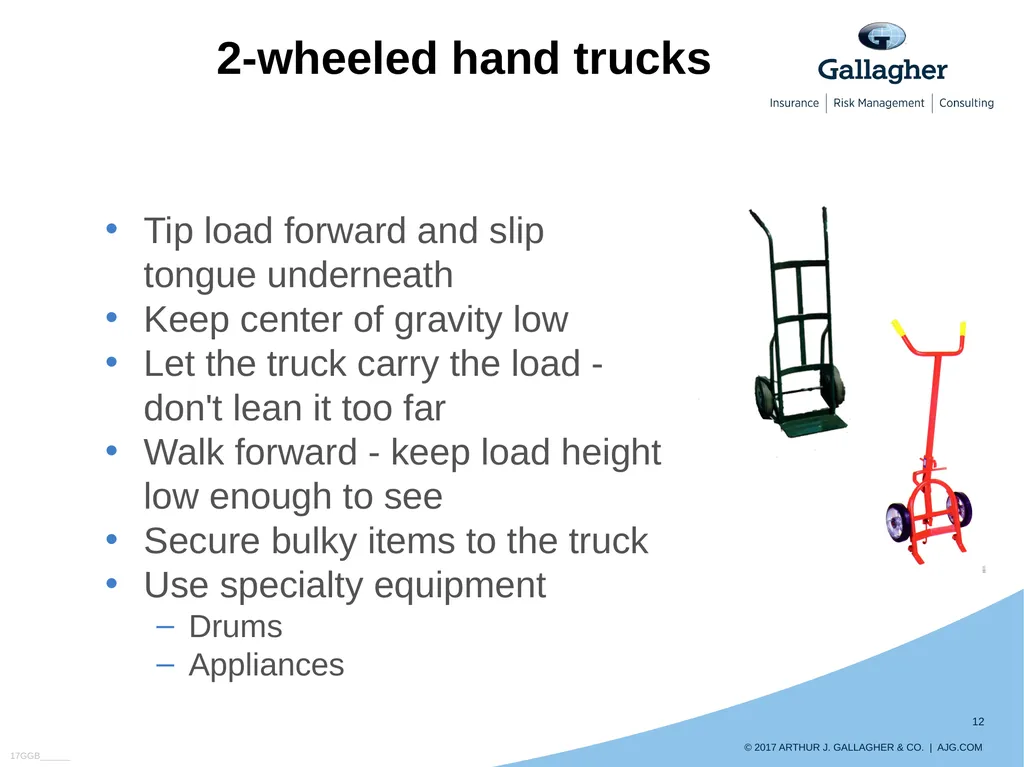
2-wheeled hand trucks Tip load forward and slip tongue underneath
Keep center of gravity low
Let the truck carry the load - don't lean it too far
Walk forward - keep load height low enough to see
Secure bulky items to the truck
Use specialty equipment
Drums
Appliances<br>