
Maxillary Lateral Incisor Dr. Pinar Khalis BDS,


Description: Maxillary Lateral Incisor Dr. Pinar Khalis BDS, MSc in Conservative Dentistry 1 Introduction The maxillary lateral incisors are two in number. Mesially Maxillary Incisors Distally Maxillary canines Function Shearing or cutting food
Related Topics
Download Presentation
"Maxillary Lateral Incisor Dr. Pinar Khalis BDS," is the property of its rightful owner. Permission is granted to download and print the materials on this website for personal, non-commercial use only, and to display it on your personal computer provided you do not modify the materials and that you retain all copyright notices contained in the materials. By downloading content from our website, you accept the terms of this agreement.
Presentation Transcript
slide1. Maxillary Lateral Incisor Dr. Pinar Khalis
BDS, MSc in Conservative Dentistry 1<br>
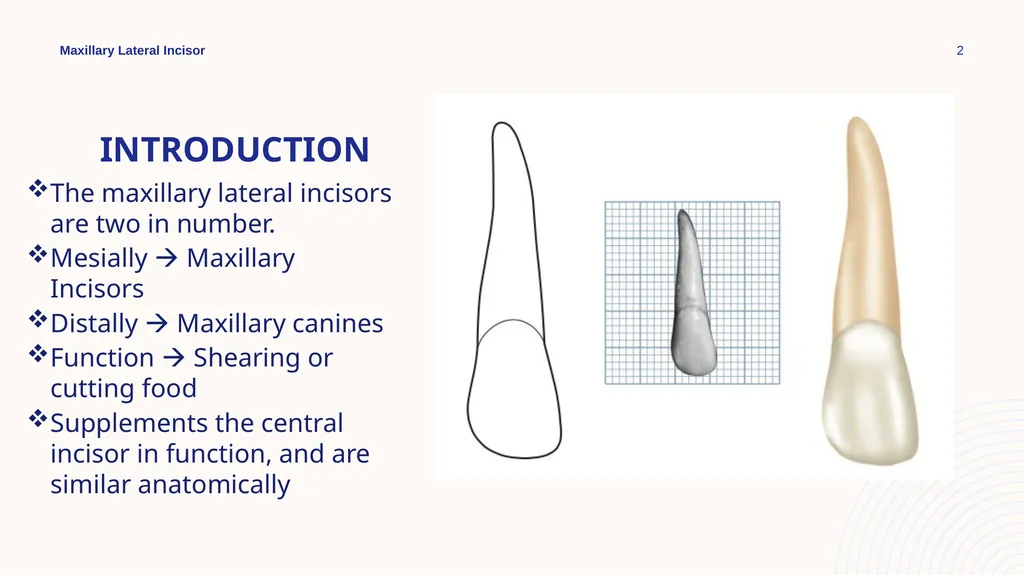
slide2. Introduction The maxillary lateral incisors are two in number.
Mesially Maxillary Incisors
Distally Maxillary canines
Function Shearing or cutting food
Supplements the central incisor in function, and are similar anatomically Maxillary Lateral Incisor 2<br>
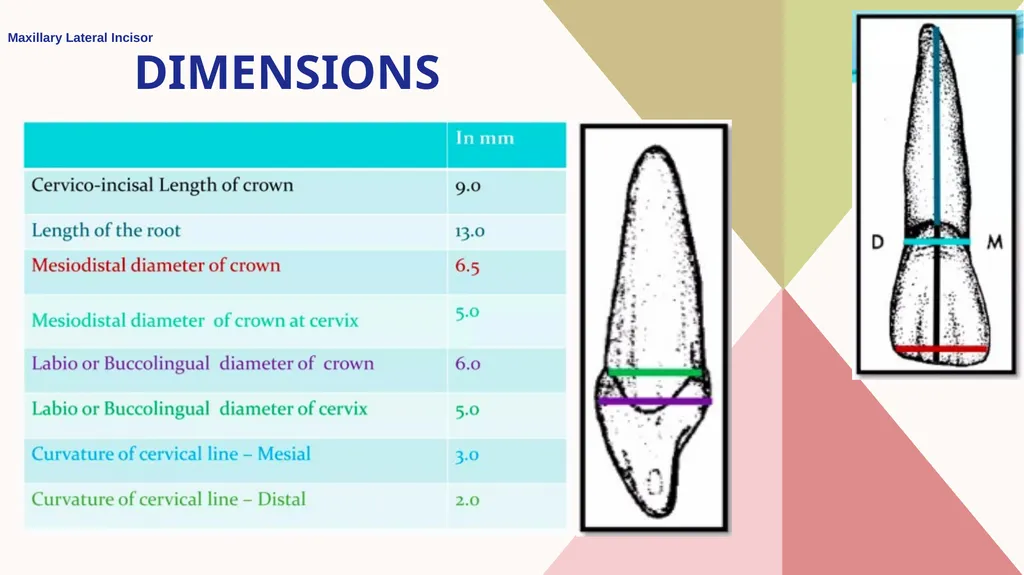
slide3. dimensions Maxillary Lateral Incisor 3<br>
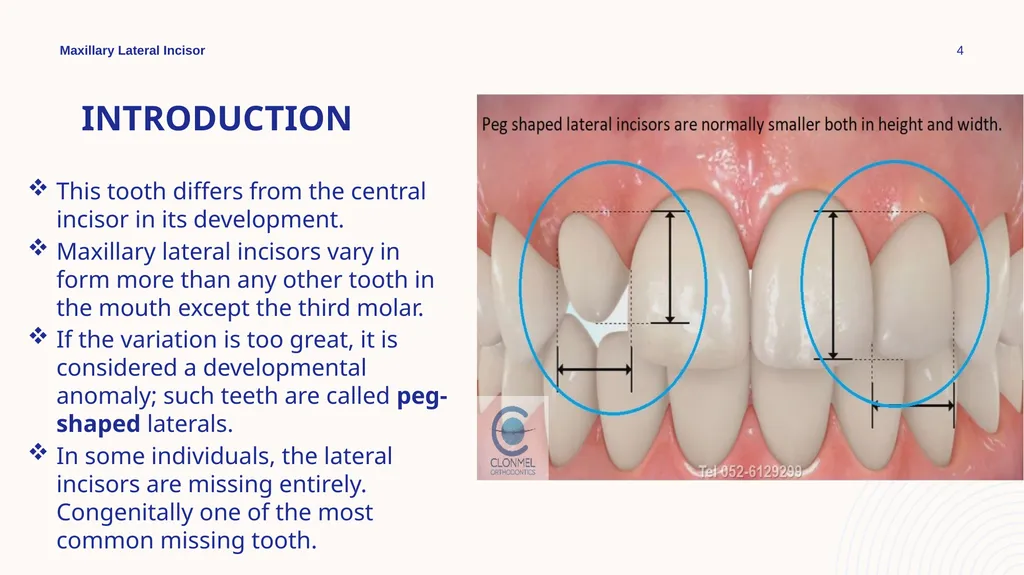
slide4. Introduction This tooth differs from the central incisor in its development.
Maxillary lateral incisors vary in form more than any other tooth in the mouth except the third molar.
If the variation is too great, it is considered a developmental anomaly; such teeth are called peg-shaped laterals.
In some individuals, the lateral incisors are missing entirely. Congenitally one of the most common missing tooth. Maxillary Lateral Incisor 4<br>
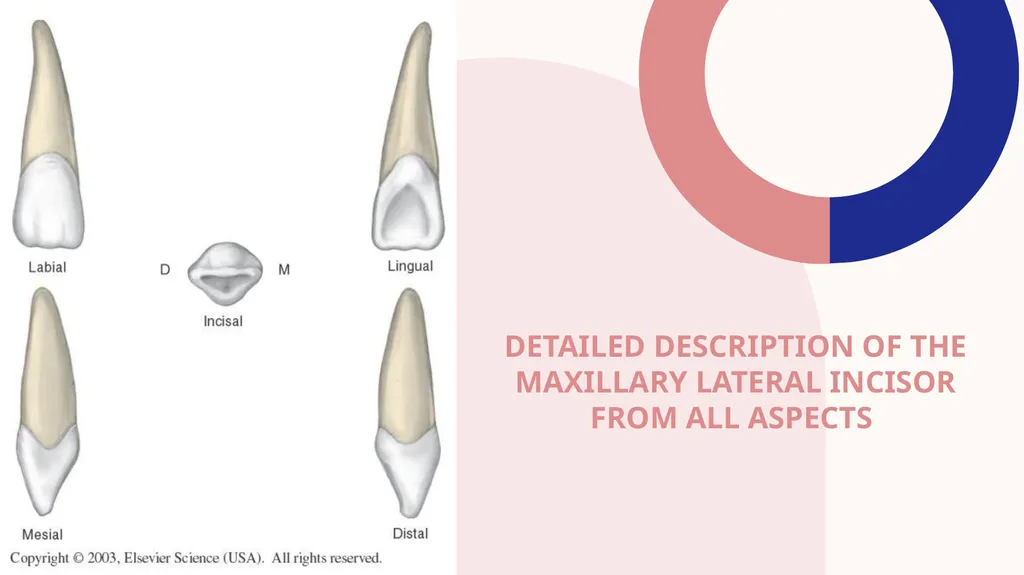
slide5. DETAILED DESCRIPTION OF THE MAXILLARY LATERAL INCISOR FROM ALL ASPECTS<br>
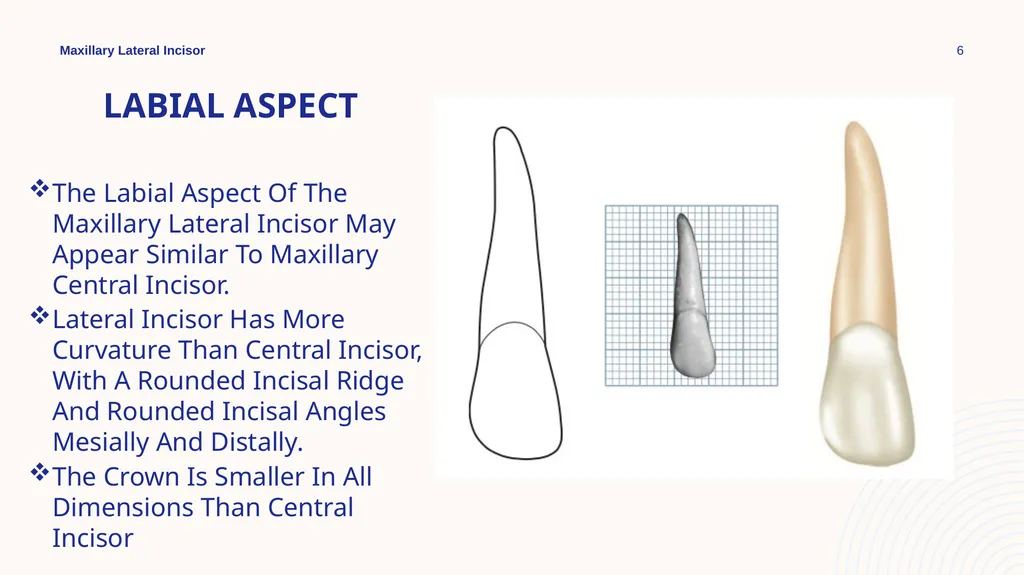
slide6. Labial Aspect The Labial Aspect Of The Maxillary Lateral Incisor May Appear Similar To Maxillary Central Incisor.
Lateral Incisor Has More Curvature Than Central Incisor, With A Rounded Incisal Ridge And Rounded Incisal Angles Mesially And Distally.
The Crown Is Smaller In All Dimensions Than Central Incisor Maxillary Lateral Incisor 6<br>
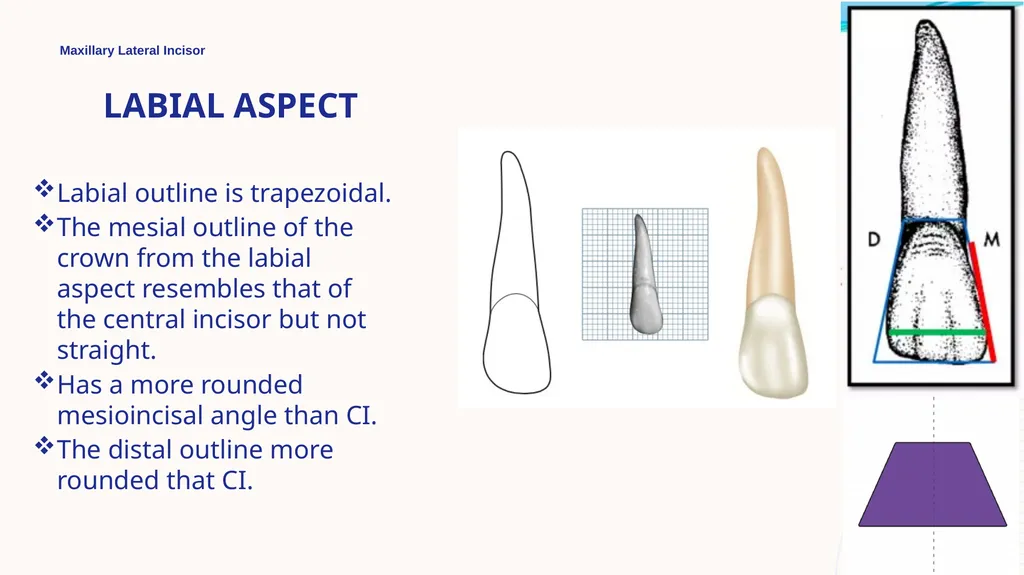
slide7. Labial Aspect Labial outline is trapezoidal.
The mesial outline of the crown from the labial aspect resembles that of the central incisor but not straight.
Has a more rounded mesioincisal angle than CI.
The distal outline more rounded that CI. Maxillary Lateral Incisor 7<br>
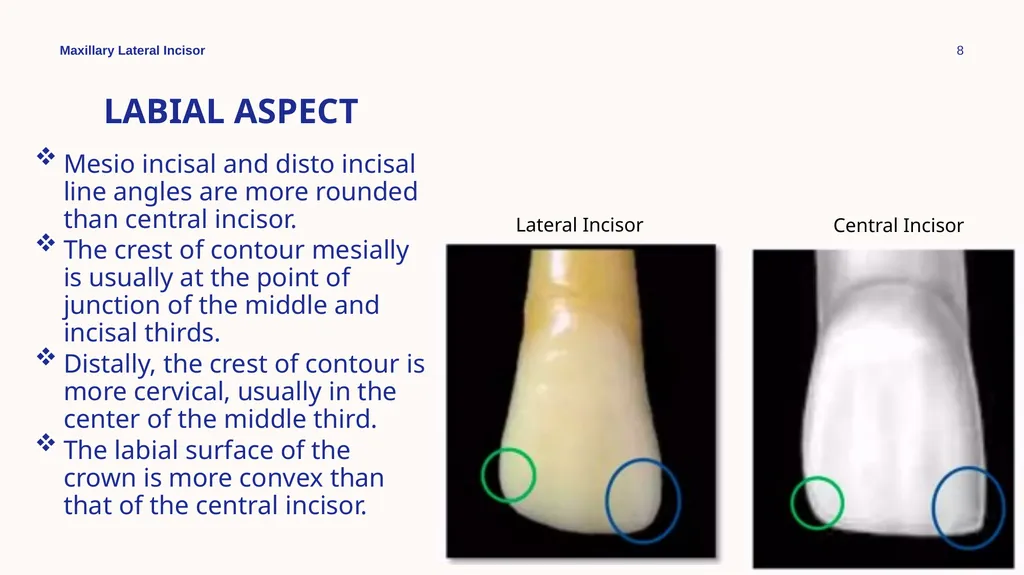
slide8. Labial Aspect Mesio incisal and disto incisal line angles are more rounded than central incisor.
The crest of contour mesially is usually at the point of junction of the middle and incisal thirds.
Distally, the crest of contour is more cervical, usually in the center of the middle third.
The labial surface of the crown is more convex than that of the central incisor. Maxillary Lateral Incisor 8 Lateral Incisor Central Incisor<br>
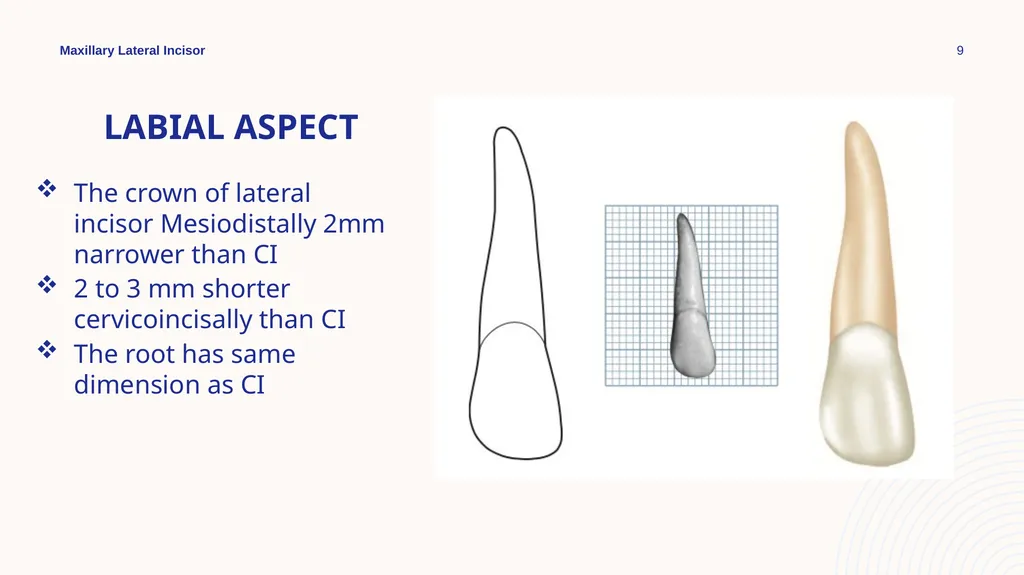
slide9. Labial Aspect The crown of lateral incisor Mesiodistally 2mm narrower than CI
2 to 3 mm shorter cervicoincisally than CI
The root has same dimension as CI Maxillary Lateral Incisor 9<br>
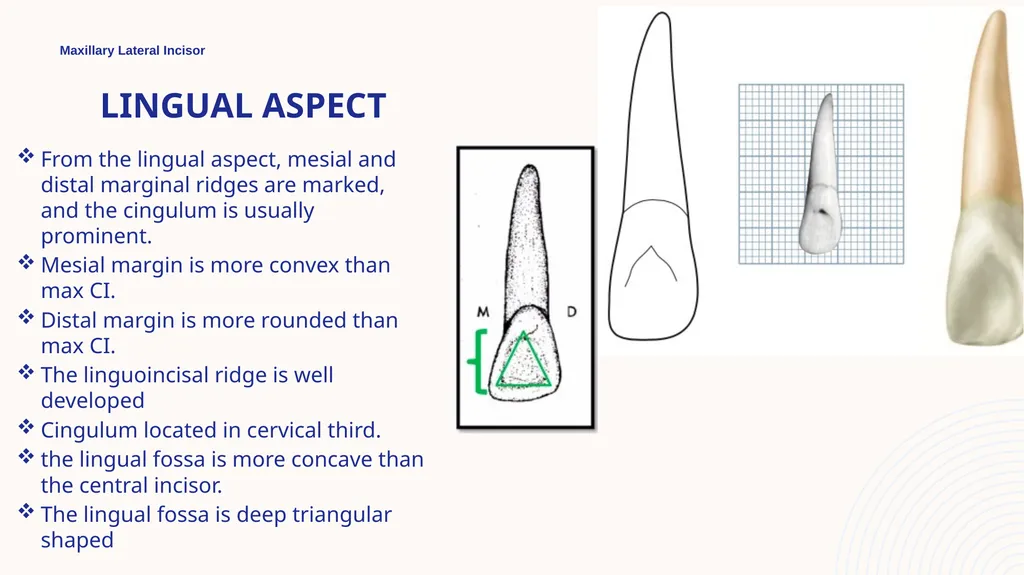
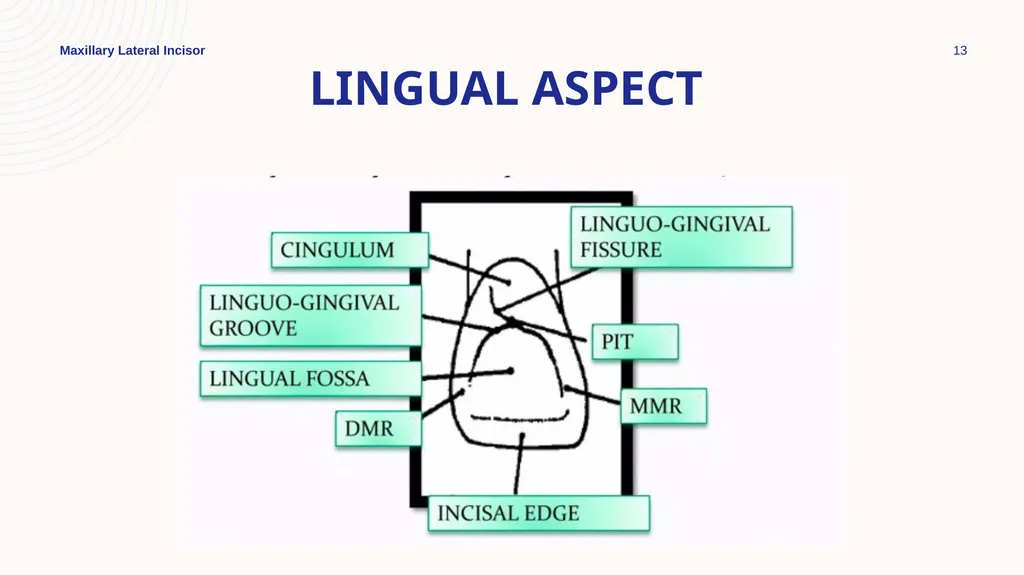
slide10. Lingual aspect From the lingual aspect, mesial and distal marginal ridges are marked, and the cingulum is usually prominent.
Mesial margin is more convex than max CI.
Distal margin is more rounded than max CI.
The linguoincisal ridge is well developed
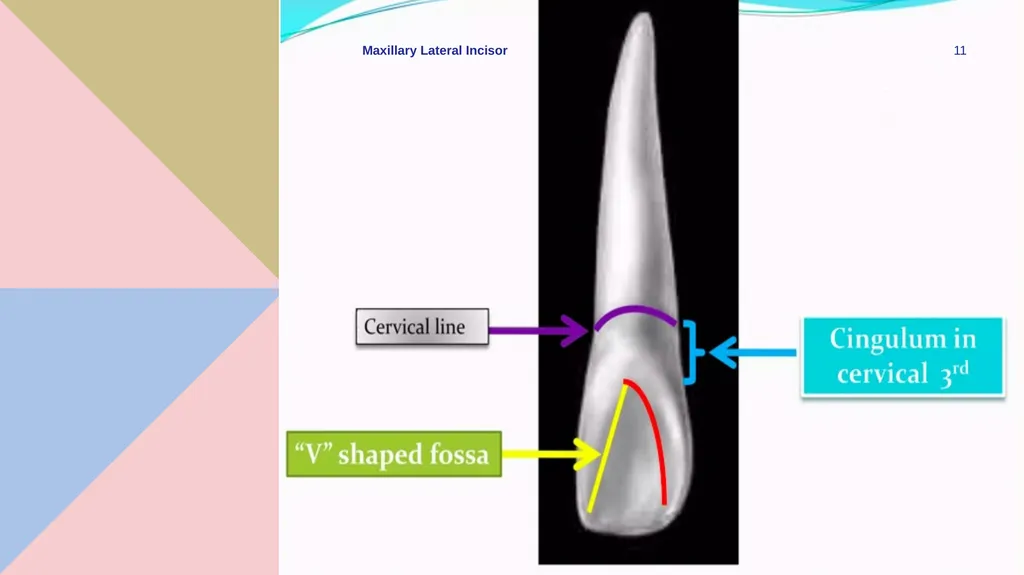
Cingulum located in cervical third.
the lingual fossa is more concave than the central incisor.
The lingual fossa is deep triangular shaped Maxillary Lateral Incisor 10<br>
slide11. Maxillary Lateral Incisor 11<br>
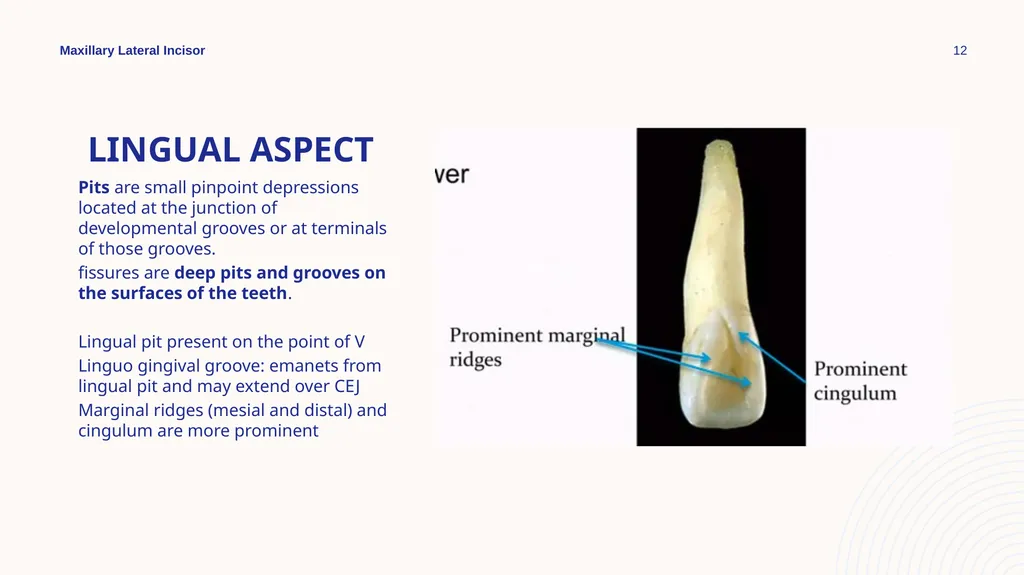
slide12. Lingual aspect Pits are small pinpoint depressions located at the junction of developmental grooves or at terminals of those grooves.
fissures are deep pits and grooves on the surfaces of the teeth.
Lingual pit present on the point of V
Linguo gingival groove: emanets from lingual pit and may extend over CEJ
Marginal ridges (mesial and distal) and cingulum are more prominent Maxillary Lateral Incisor 12<br>
slide13. Lingual aspect Maxillary Lateral Incisor 13<br>
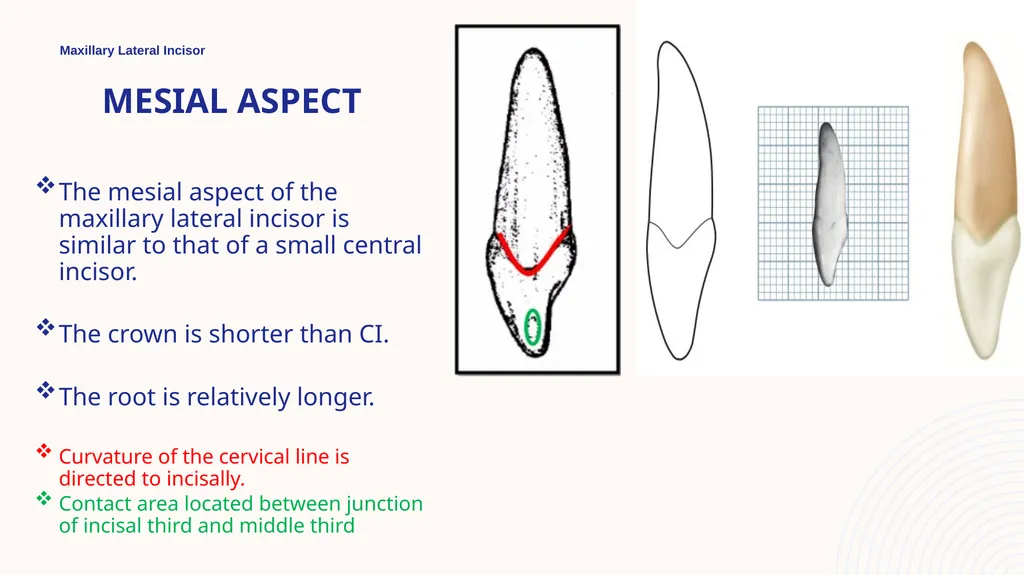
slide14. Mesial aspect The mesial aspect of the maxillary lateral incisor is similar to that of a small central incisor.
The crown is shorter than CI.
The root is relatively longer.
Curvature of the cervical line is directed to incisally.
Contact area located between junction of incisal third and middle third Maxillary Lateral Incisor 14<br>
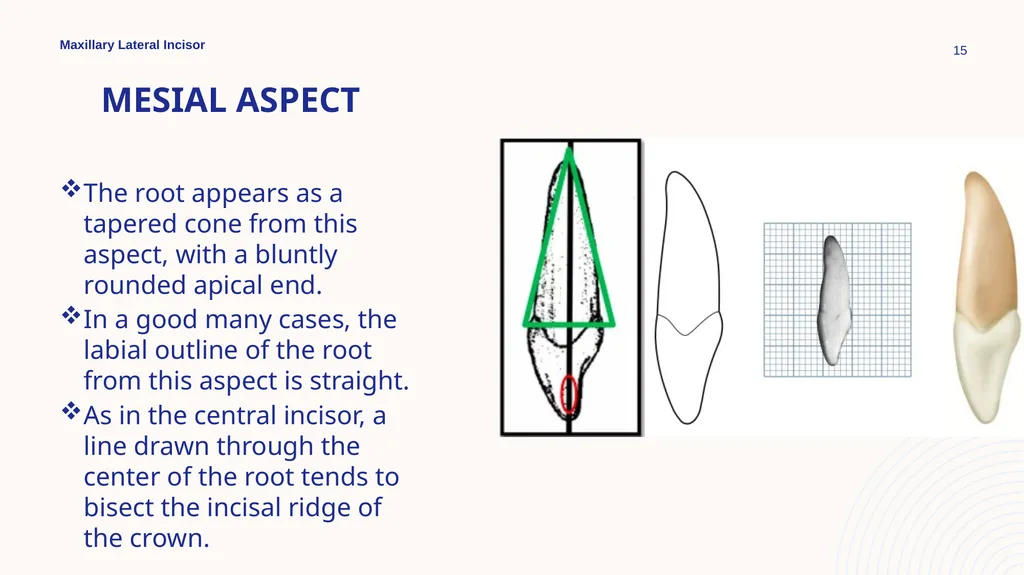
slide15. Mesial aspect The root appears as a tapered cone from this aspect, with a bluntly rounded apical end.
In a good many cases, the labial outline of the root from this aspect is straight.
As in the central incisor, a line drawn through the center of the root tends to bisect the incisal ridge of the crown. Maxillary Lateral Incisor 15<br>
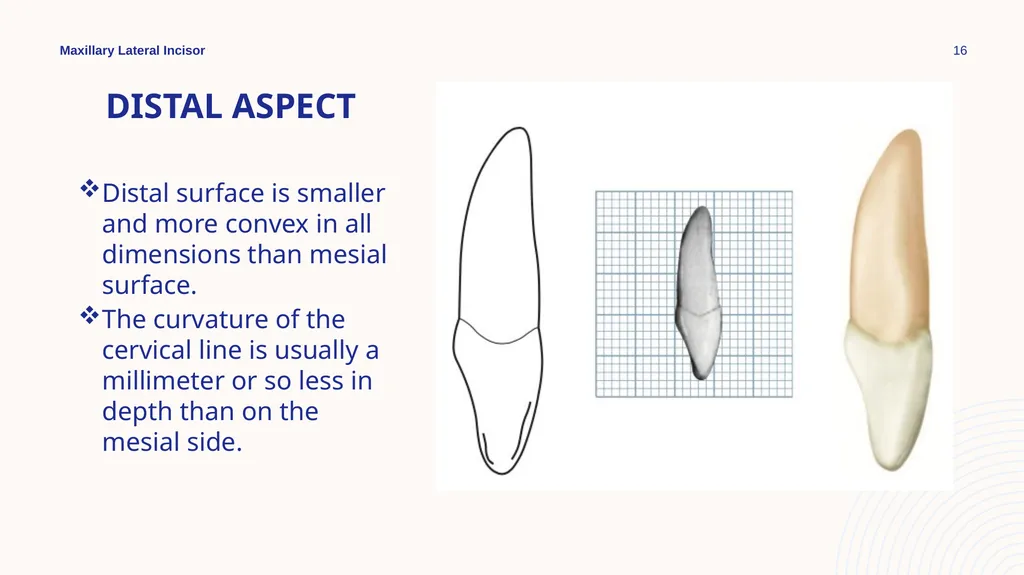
slide16. Distal aspect Distal surface is smaller and more convex in all dimensions than mesial surface.
The curvature of the cervical line is usually a millimeter or so less in depth than on the mesial side. Maxillary Lateral Incisor 16<br>
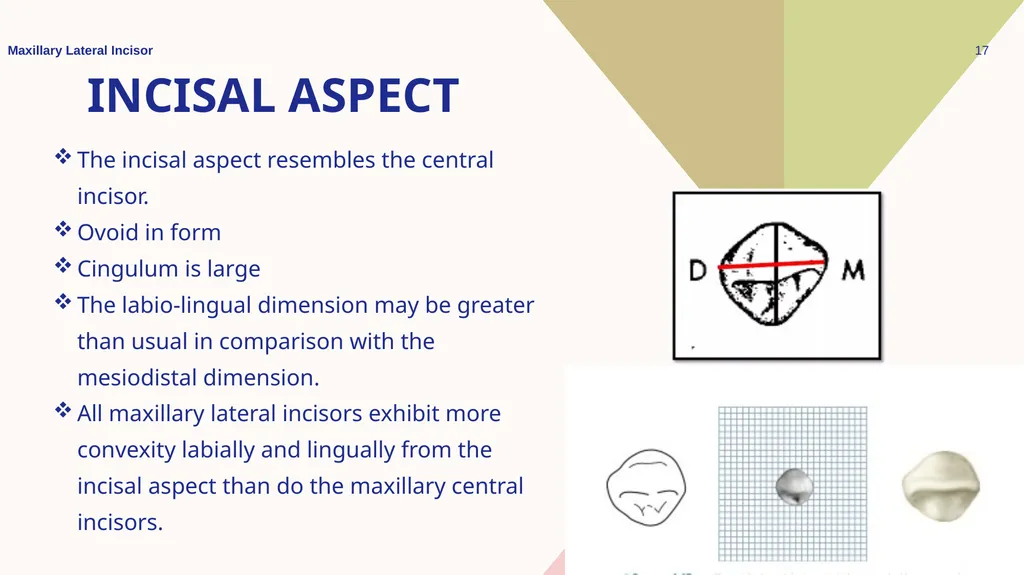
slide17. Incisal aspect The incisal aspect resembles the central incisor.
Ovoid in form
Cingulum is large
The labio-lingual dimension may be greater than usual in comparison with the mesiodistal dimension.
All maxillary lateral incisors exhibit more convexity labially and lingually from the incisal aspect than do the maxillary central incisors. Maxillary Lateral Incisor 17<br>
slide18. Differences Lateral incisor Lateral incisor has more curvature than CI
the crown is smaller in all dimensions
Labial outline is trapezoidal.
The distal outline more rounded that CI.
The labial surface of the crown is more convex than that of the central incisor.
Mesio incisal and disto incisal line angles are more rounded than central incisor.
the lingual fossa is more concave than the central incisor.
the lingual fossa is more concave than the central incisor. Central incisor central incisor has less curvature than CI
the crown is larger in all dimensions
Labial outline is rectangular or squared
The distal outline less rounded.
The labial surface of the crown is less convex than that of the lateral incisor.
Mesio incisal and disto incisal line angles are less rounded than central incisor.
the lingual fossa is less concave than the lateral incisor.
the lingual fossa is less concave than the central incisor. 18 Maxillary Lateral Incisor<br>
slide19. Maxillary Lateral Incisor 19<br>
slide20. THANK YOU for listening<br>
BDS, MSc in Conservative Dentistry 1<br>
slide2. Introduction The maxillary lateral incisors are two in number.
Mesially Maxillary Incisors
Distally Maxillary canines
Function Shearing or cutting food
Supplements the central incisor in function, and are similar anatomically Maxillary Lateral Incisor 2<br>
slide3. dimensions Maxillary Lateral Incisor 3<br>
slide4. Introduction This tooth differs from the central incisor in its development.
Maxillary lateral incisors vary in form more than any other tooth in the mouth except the third molar.
If the variation is too great, it is considered a developmental anomaly; such teeth are called peg-shaped laterals.
In some individuals, the lateral incisors are missing entirely. Congenitally one of the most common missing tooth. Maxillary Lateral Incisor 4<br>
slide5. DETAILED DESCRIPTION OF THE MAXILLARY LATERAL INCISOR FROM ALL ASPECTS<br>
slide6. Labial Aspect The Labial Aspect Of The Maxillary Lateral Incisor May Appear Similar To Maxillary Central Incisor.
Lateral Incisor Has More Curvature Than Central Incisor, With A Rounded Incisal Ridge And Rounded Incisal Angles Mesially And Distally.
The Crown Is Smaller In All Dimensions Than Central Incisor Maxillary Lateral Incisor 6<br>
slide7. Labial Aspect Labial outline is trapezoidal.
The mesial outline of the crown from the labial aspect resembles that of the central incisor but not straight.
Has a more rounded mesioincisal angle than CI.
The distal outline more rounded that CI. Maxillary Lateral Incisor 7<br>
slide8. Labial Aspect Mesio incisal and disto incisal line angles are more rounded than central incisor.
The crest of contour mesially is usually at the point of junction of the middle and incisal thirds.
Distally, the crest of contour is more cervical, usually in the center of the middle third.
The labial surface of the crown is more convex than that of the central incisor. Maxillary Lateral Incisor 8 Lateral Incisor Central Incisor<br>
slide9. Labial Aspect The crown of lateral incisor Mesiodistally 2mm narrower than CI
2 to 3 mm shorter cervicoincisally than CI
The root has same dimension as CI Maxillary Lateral Incisor 9<br>
slide10. Lingual aspect From the lingual aspect, mesial and distal marginal ridges are marked, and the cingulum is usually prominent.
Mesial margin is more convex than max CI.
Distal margin is more rounded than max CI.
The linguoincisal ridge is well developed
Cingulum located in cervical third.
the lingual fossa is more concave than the central incisor.
The lingual fossa is deep triangular shaped Maxillary Lateral Incisor 10<br>
slide11. Maxillary Lateral Incisor 11<br>
slide12. Lingual aspect Pits are small pinpoint depressions located at the junction of developmental grooves or at terminals of those grooves.
fissures are deep pits and grooves on the surfaces of the teeth.
Lingual pit present on the point of V
Linguo gingival groove: emanets from lingual pit and may extend over CEJ
Marginal ridges (mesial and distal) and cingulum are more prominent Maxillary Lateral Incisor 12<br>
slide13. Lingual aspect Maxillary Lateral Incisor 13<br>
slide14. Mesial aspect The mesial aspect of the maxillary lateral incisor is similar to that of a small central incisor.
The crown is shorter than CI.
The root is relatively longer.
Curvature of the cervical line is directed to incisally.
Contact area located between junction of incisal third and middle third Maxillary Lateral Incisor 14<br>
slide15. Mesial aspect The root appears as a tapered cone from this aspect, with a bluntly rounded apical end.
In a good many cases, the labial outline of the root from this aspect is straight.
As in the central incisor, a line drawn through the center of the root tends to bisect the incisal ridge of the crown. Maxillary Lateral Incisor 15<br>
slide16. Distal aspect Distal surface is smaller and more convex in all dimensions than mesial surface.
The curvature of the cervical line is usually a millimeter or so less in depth than on the mesial side. Maxillary Lateral Incisor 16<br>
slide17. Incisal aspect The incisal aspect resembles the central incisor.
Ovoid in form
Cingulum is large
The labio-lingual dimension may be greater than usual in comparison with the mesiodistal dimension.
All maxillary lateral incisors exhibit more convexity labially and lingually from the incisal aspect than do the maxillary central incisors. Maxillary Lateral Incisor 17<br>
slide18. Differences Lateral incisor Lateral incisor has more curvature than CI
the crown is smaller in all dimensions
Labial outline is trapezoidal.
The distal outline more rounded that CI.
The labial surface of the crown is more convex than that of the central incisor.
Mesio incisal and disto incisal line angles are more rounded than central incisor.
the lingual fossa is more concave than the central incisor.
the lingual fossa is more concave than the central incisor. Central incisor central incisor has less curvature than CI
the crown is larger in all dimensions
Labial outline is rectangular or squared
The distal outline less rounded.
The labial surface of the crown is less convex than that of the lateral incisor.
Mesio incisal and disto incisal line angles are less rounded than central incisor.
the lingual fossa is less concave than the lateral incisor.
the lingual fossa is less concave than the central incisor. 18 Maxillary Lateral Incisor<br>
slide19. Maxillary Lateral Incisor 19<br>
slide20. THANK YOU for listening<br>