04
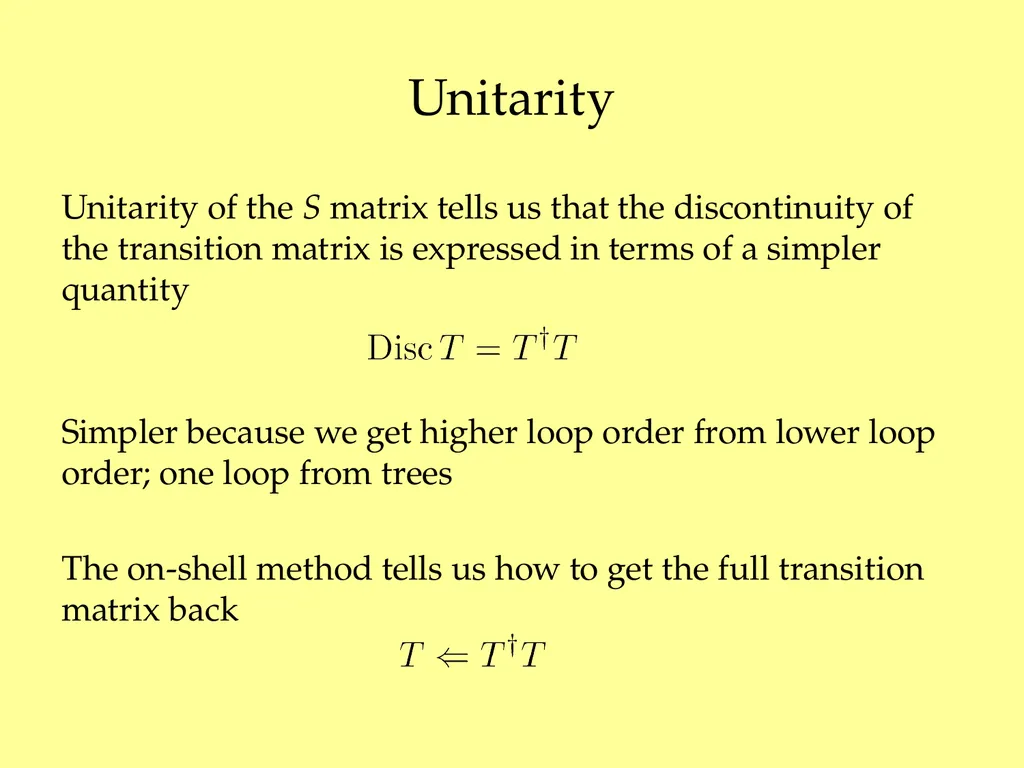
Unitarity Unitarity of the S matrix tells us that the discontinuity of the transition matrix is expressed in terms of a simpler quantity
Simpler because we get higher loop order from lower loop order; one loop from trees
The on-shell method tells us how to get the full transition matrix back<br>
05
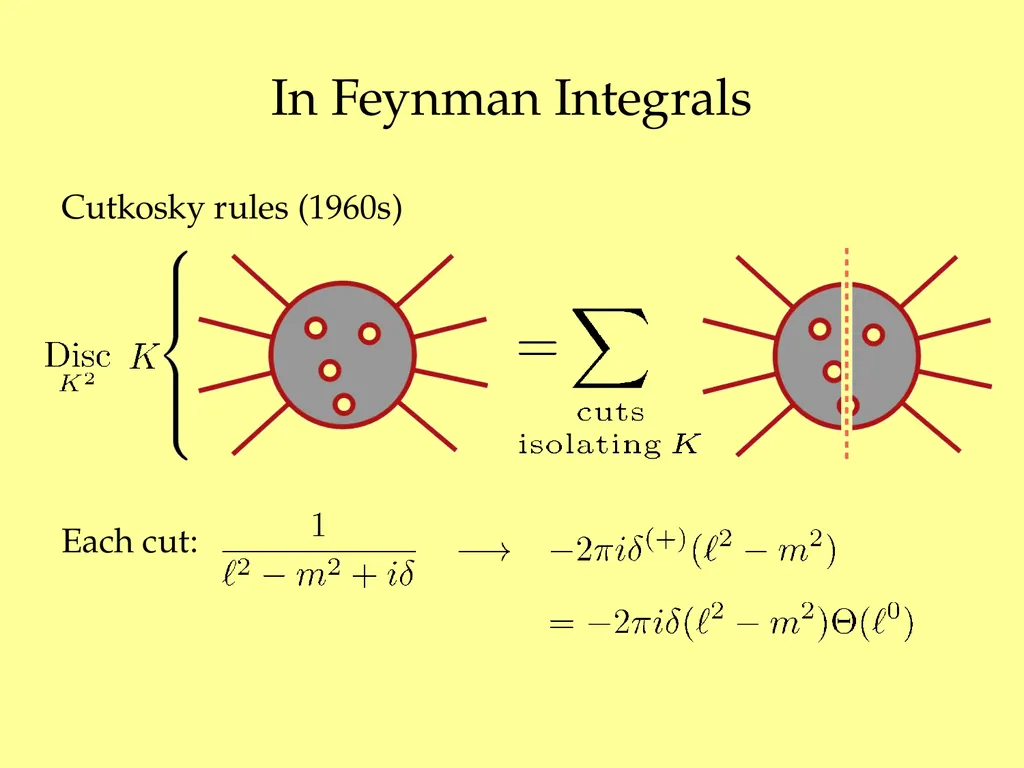
In Feynman Integrals Cutkosky rules (1960s)
Each cut:<br>
06
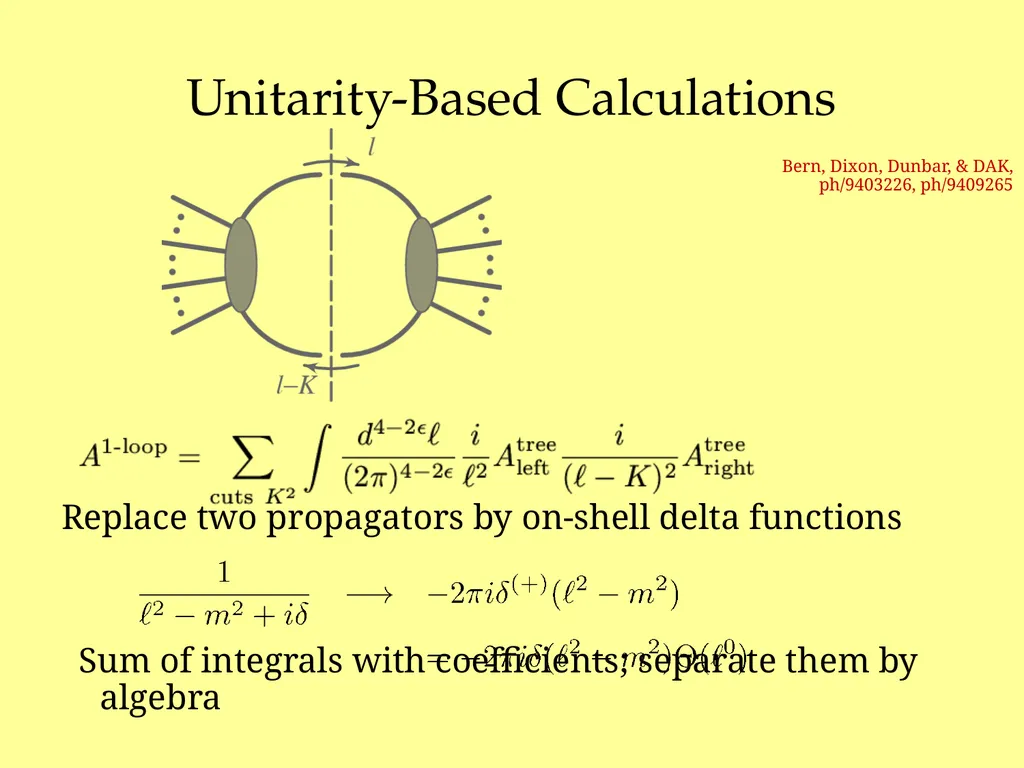
Unitarity-Based Calculations Bern, Dixon, Dunbar, & DAK,�ph/9403226, ph/9409265
Replace two propagators by on-shell delta functions
Sum of integrals with coefficients; separate them by algebra<br>
07
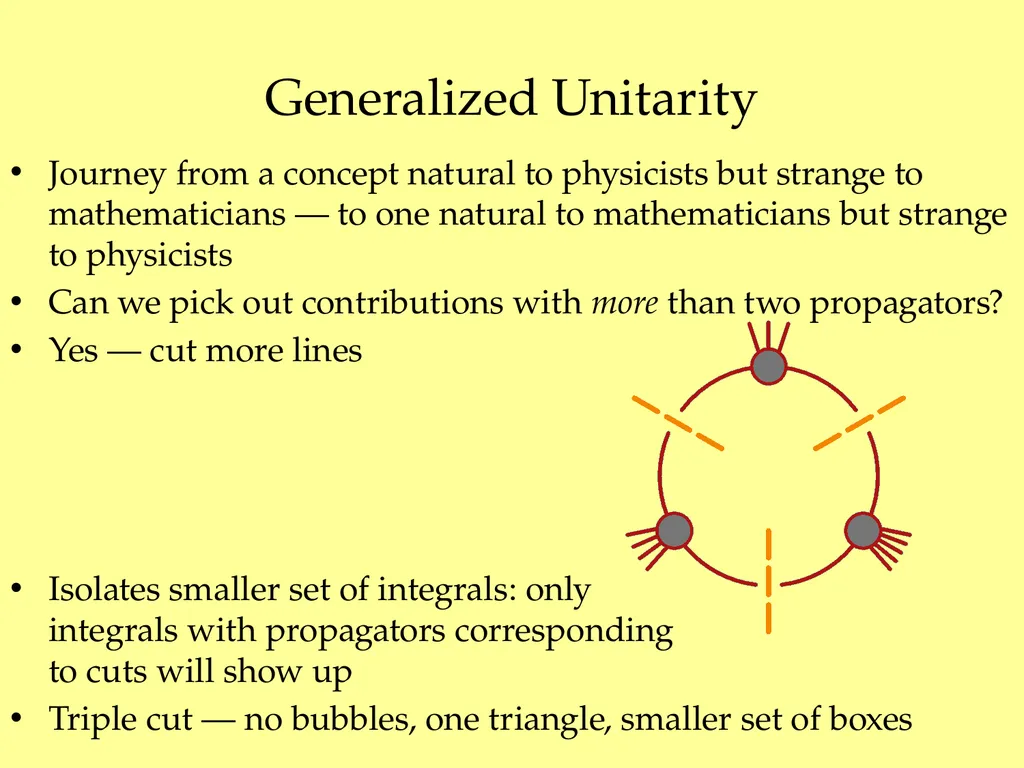
Generalized Unitarity Journey from a concept natural to physicists but strange to mathematicians — to one natural to mathematicians but strange to physicists
Can we pick out contributions with more than two propagators?
Yes — cut more lines
Isolates smaller set of integrals: only �integrals with propagators corresponding �to cuts will show up
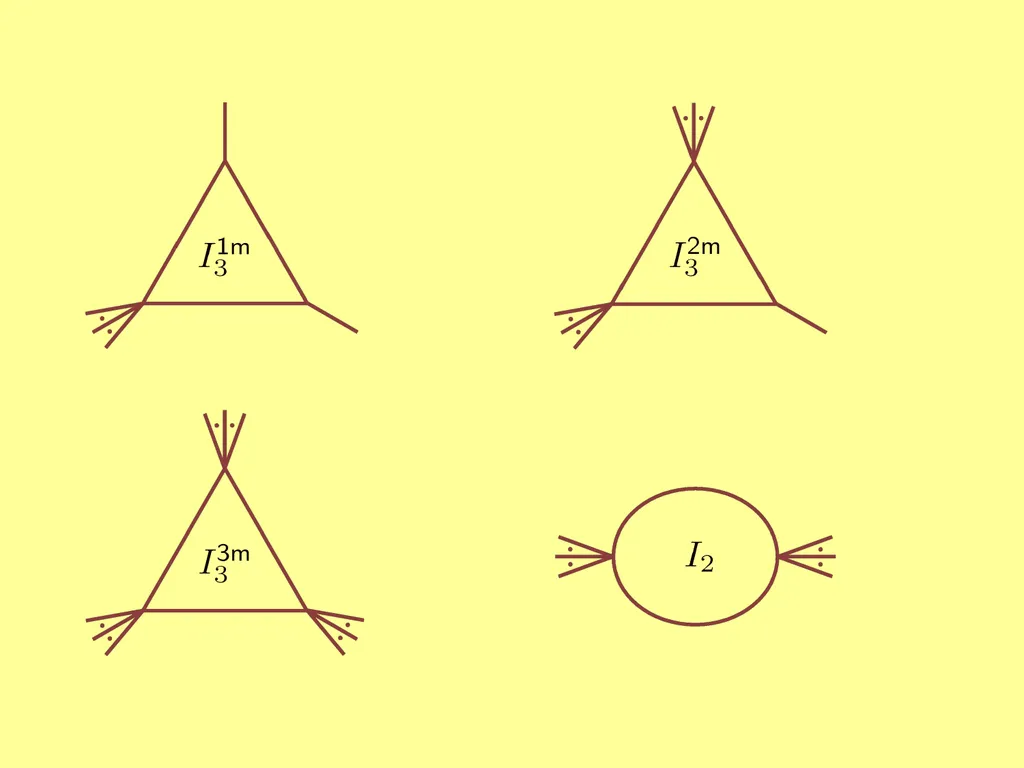
Triple cut — no bubbles, one triangle, smaller set of boxes<br>
08
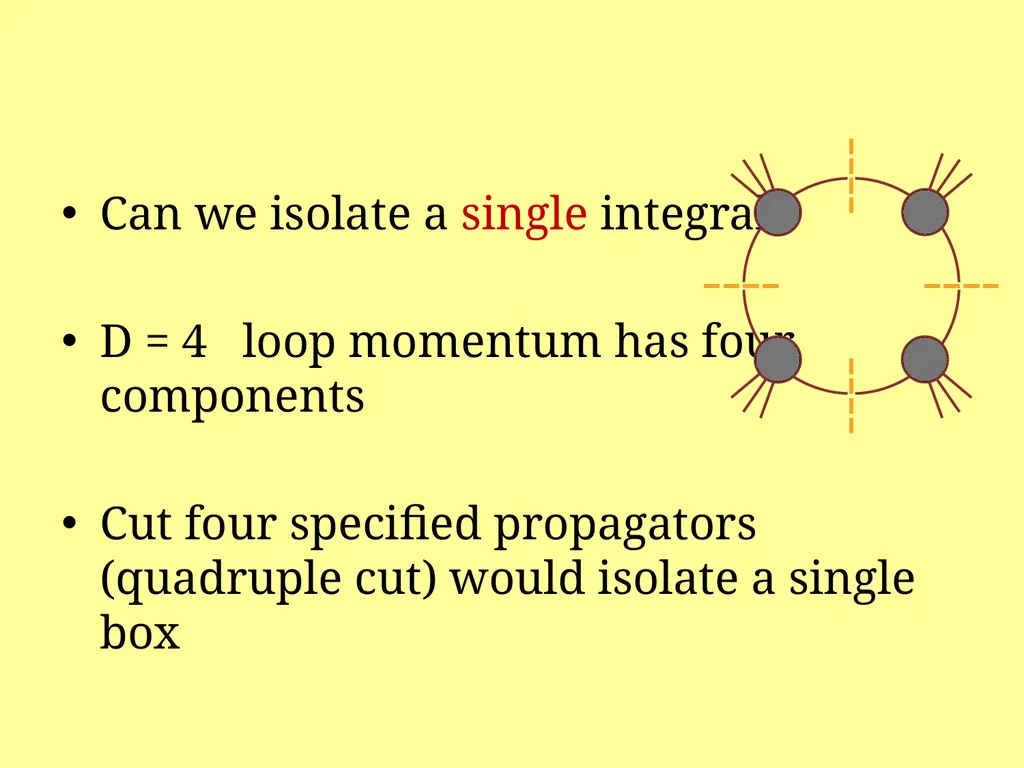
Can we isolate a single integral?
D = 4 loop momentum has four�components
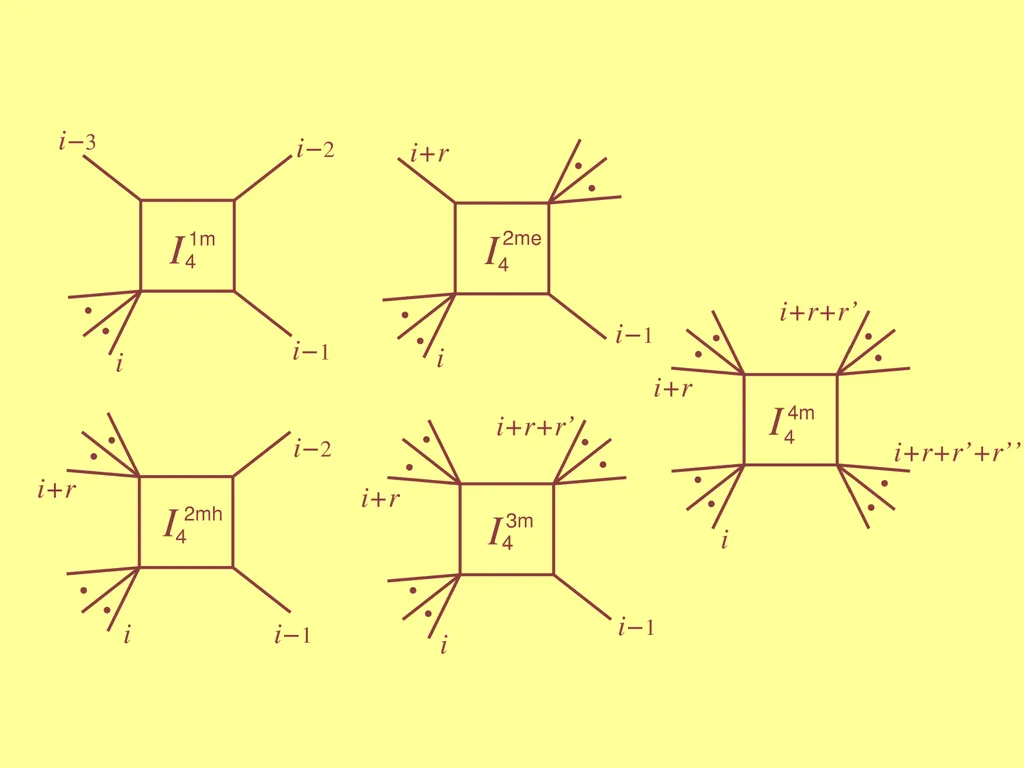
Cut four specified propagators�(quadruple cut) would isolate a single box<br>
09
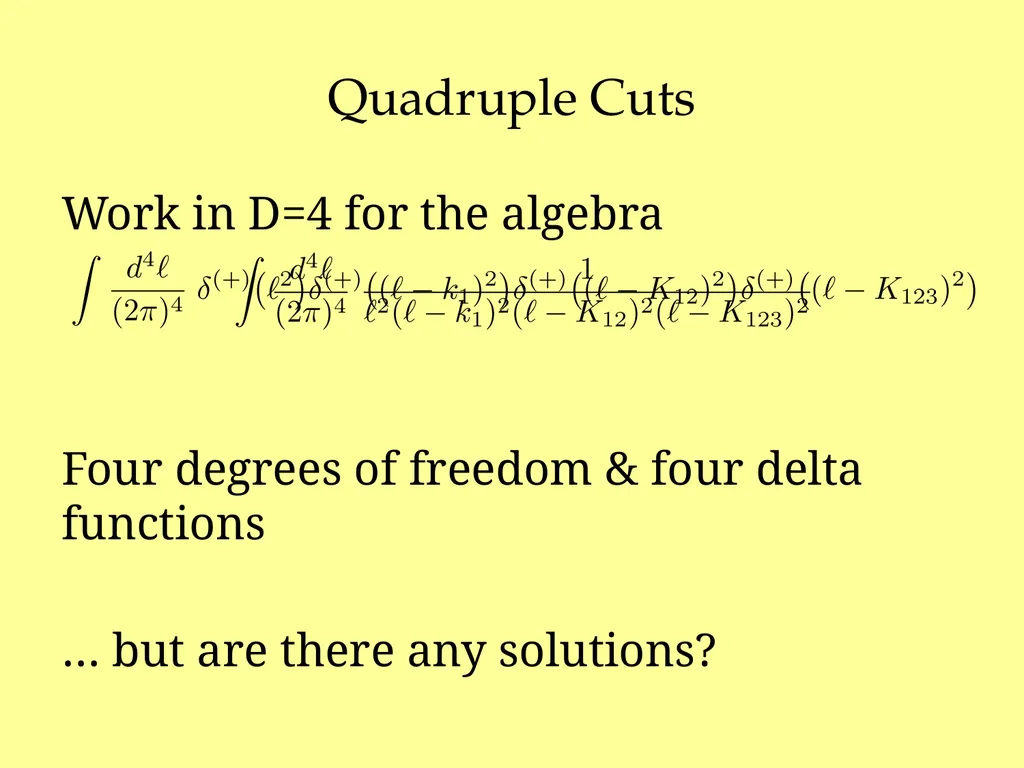
Quadruple Cuts Work in D=4 for the algebra
Four degrees of freedom & four delta functions
… but are there any solutions?<br>
10
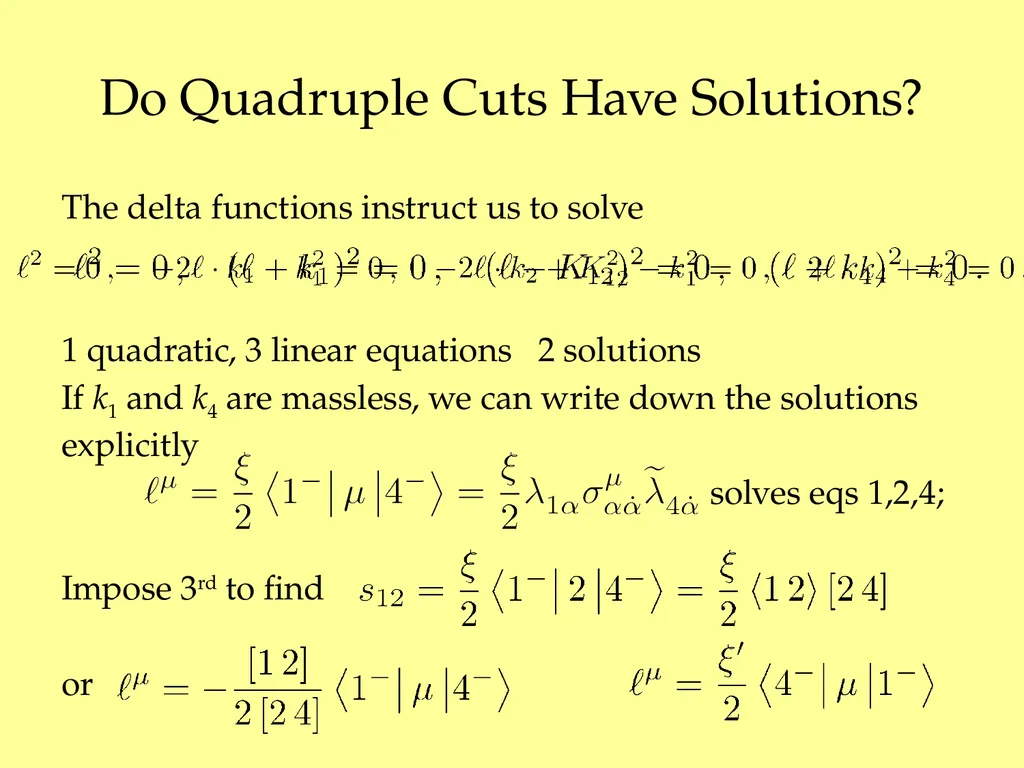
Do Quadruple Cuts Have Solutions? The delta functions instruct us to solve
1 quadratic, 3 linear equations 2 solutions
If k1 and k4 are massless, we can write down the solutions explicitly
solves eqs 1,2,4;
Impose 3rd to find
or<br>
11
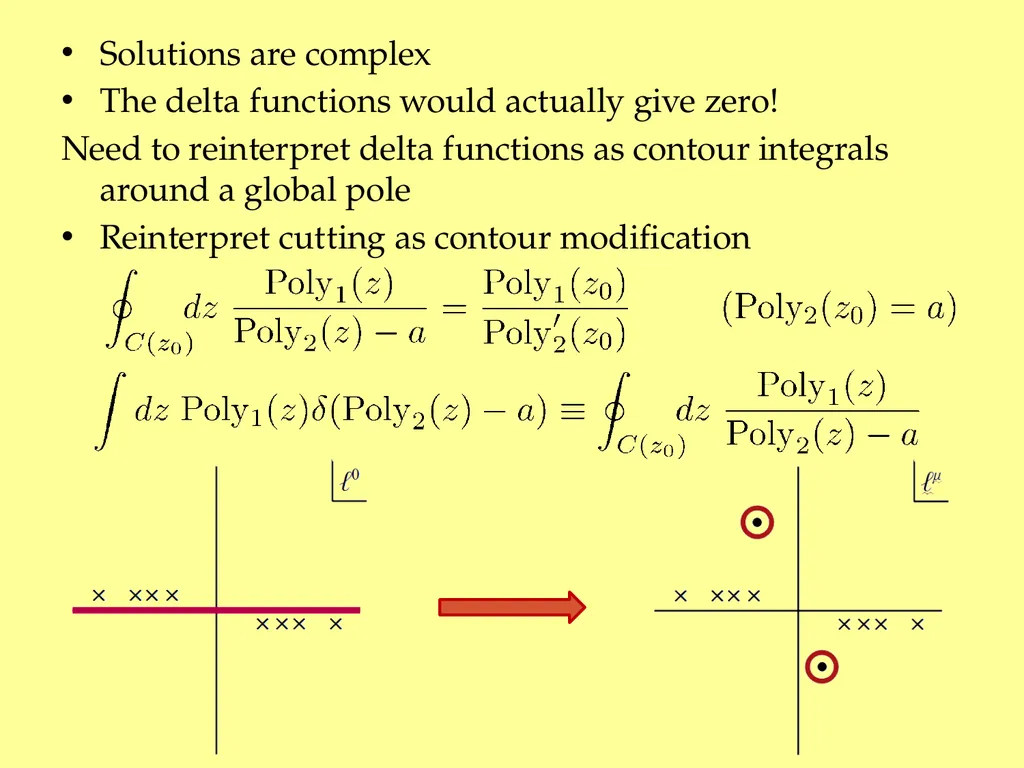
Solutions are complex
The delta functions would actually give zero!
Need to reinterpret delta functions as contour integrals around a global pole
Reinterpret cutting as contour modification<br>
12
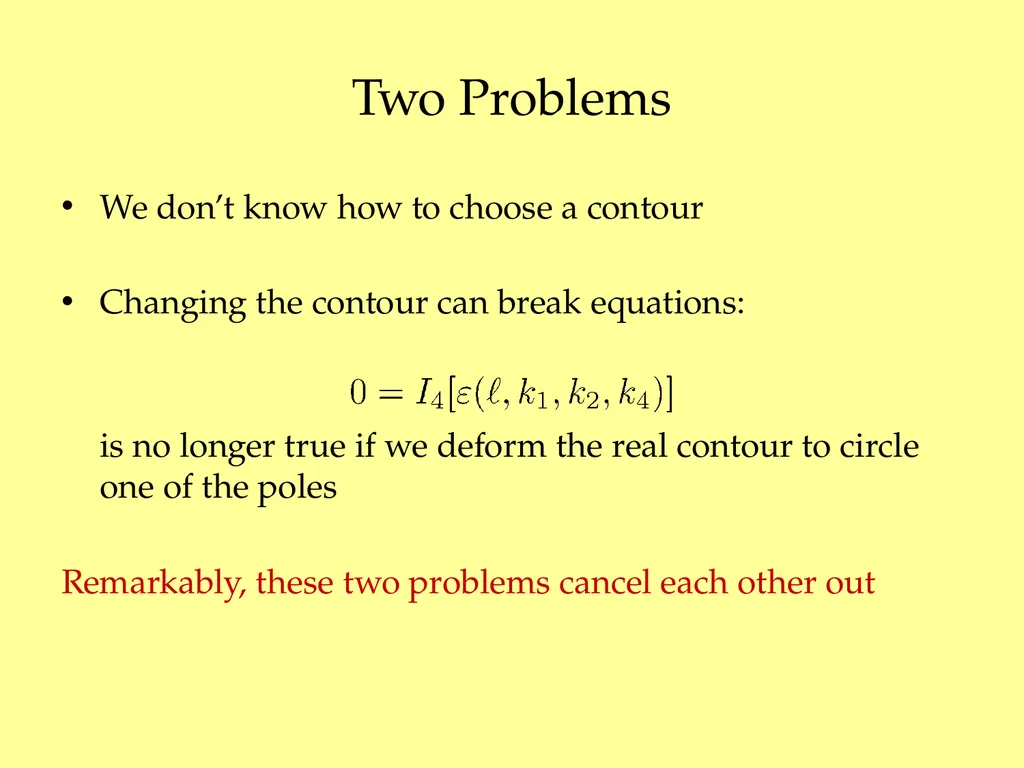
Two Problems We don’t know how to choose a contour
Changing the contour can break equations:
is no longer true if we deform the real contour to circle one of the poles
Remarkably, these two problems cancel each other out<br>
13
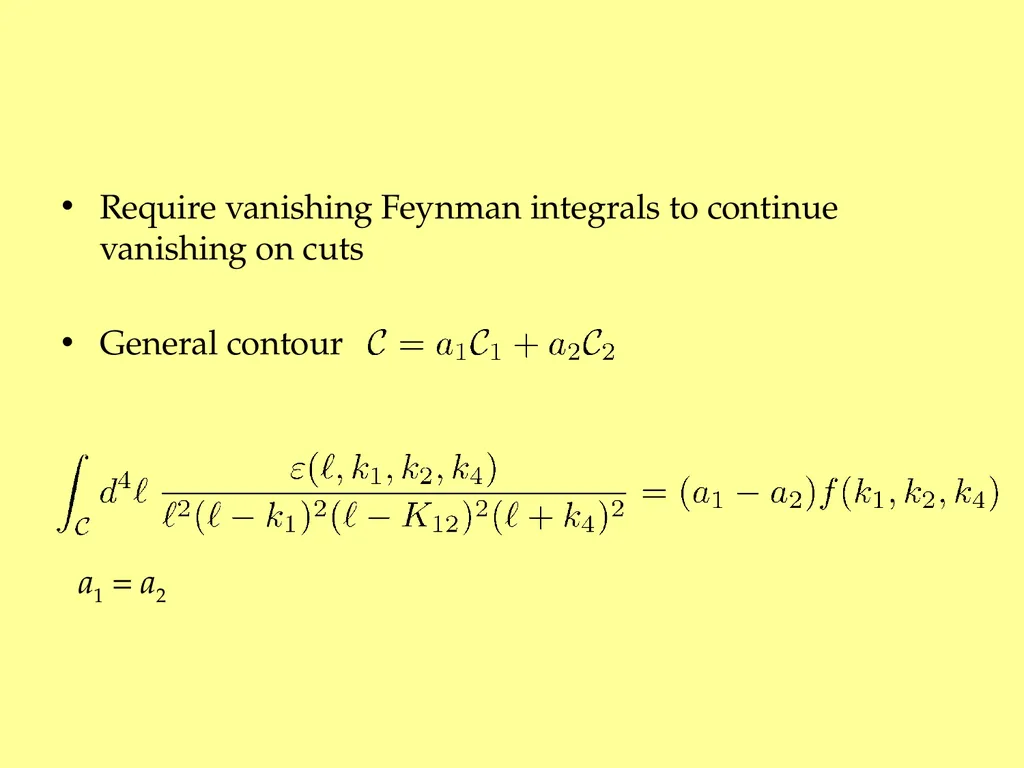
Require vanishing Feynman integrals to continue vanishing on cuts
General contour
a1 = a2<br>
14
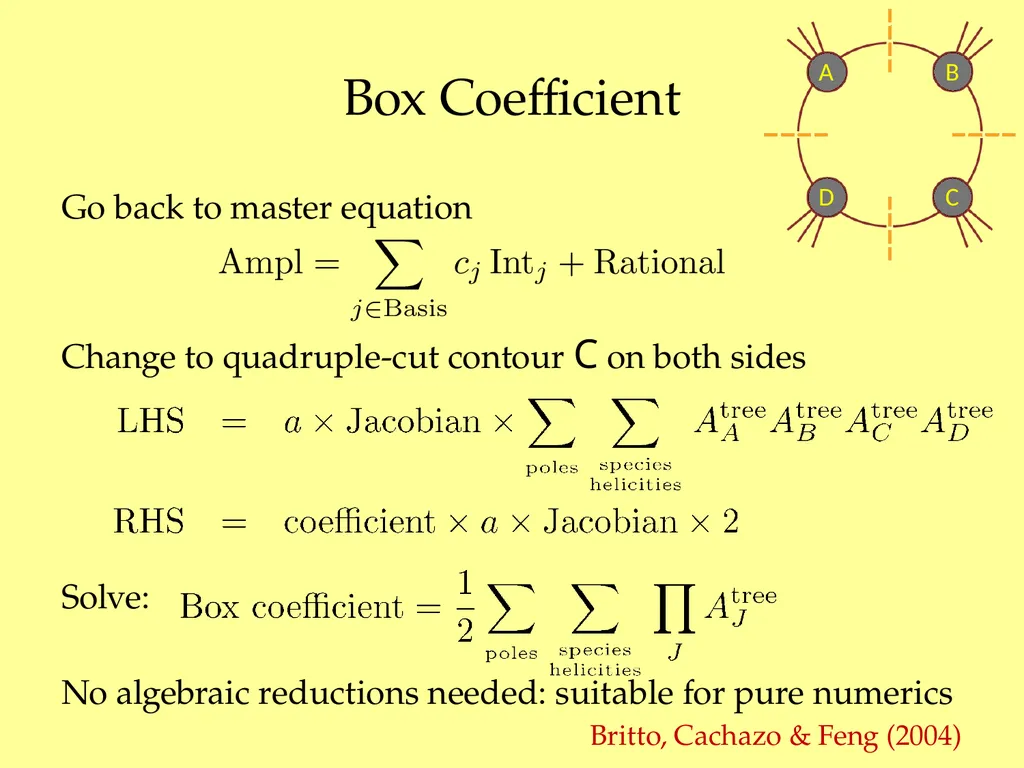
Box Coefficient Go back to master equation
Change to quadruple-cut contour C on both sides
Solve:
No algebraic reductions needed: suitable for pure numerics
Britto, Cachazo & Feng (2004)<br>
15
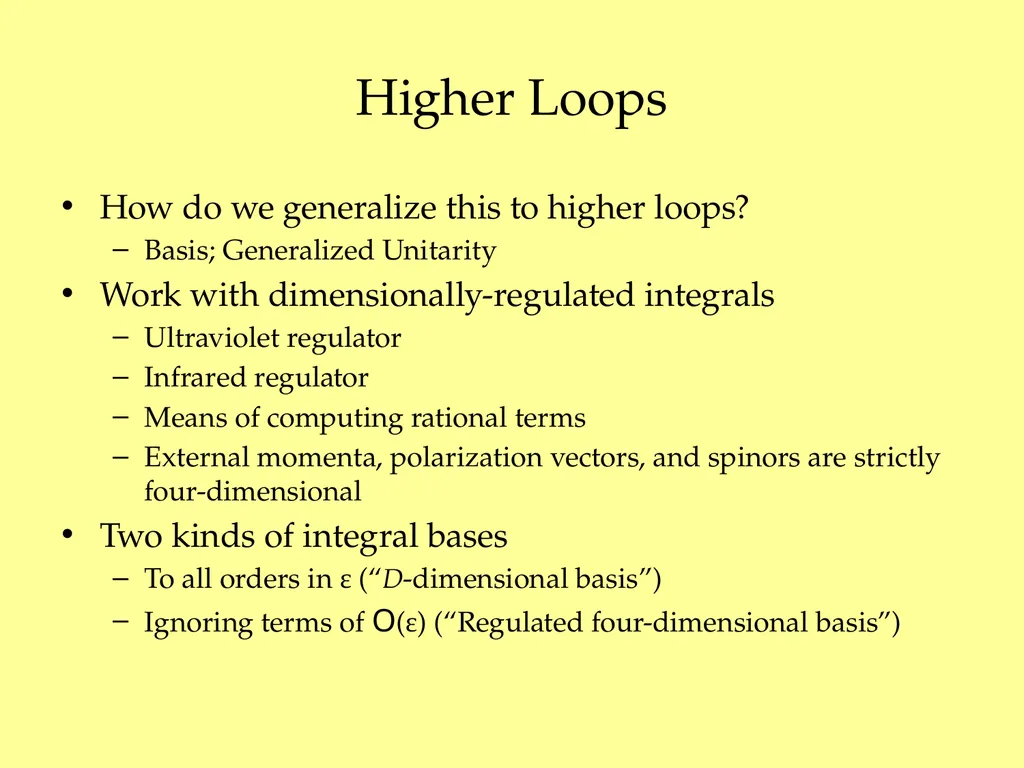
Higher Loops How do we generalize this to higher loops?
Basis; Generalized Unitarity
Work with dimensionally-regulated integrals
Ultraviolet regulator
Infrared regulator
Means of computing rational terms
External momenta, polarization vectors, and spinors are strictly four-dimensional
Two kinds of integral bases
To all orders in ε (“D-dimensional basis”)
Ignoring terms of O(ε) (“Regulated four-dimensional basis”)<br>
16
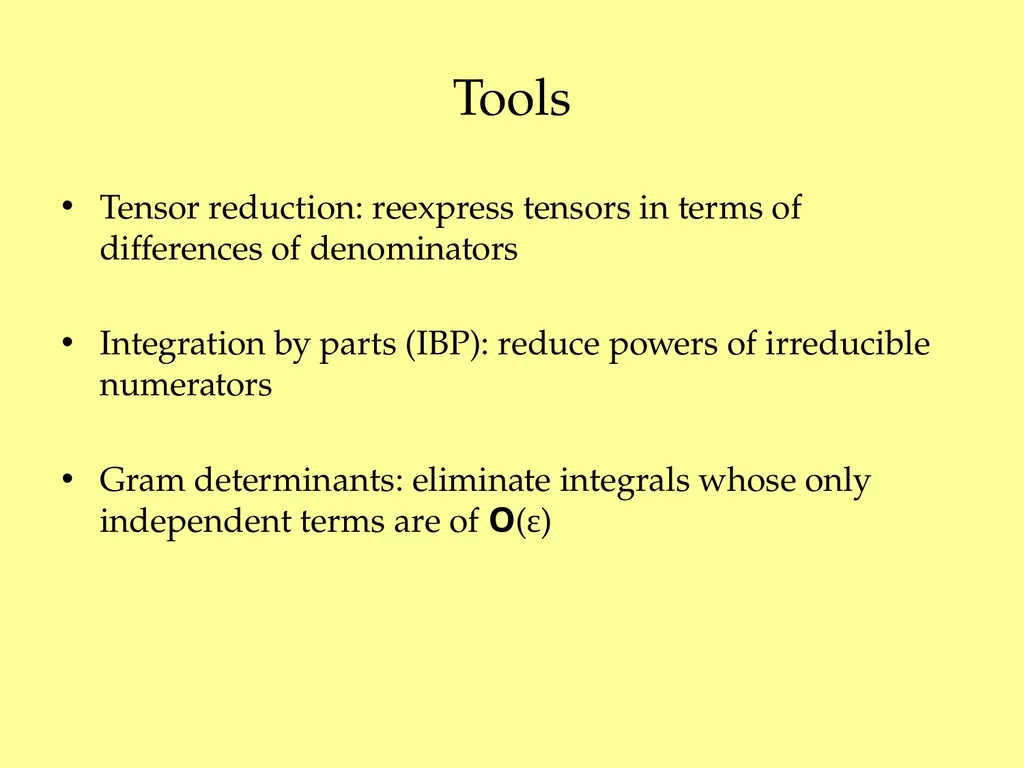
Tools Tensor reduction: reexpress tensors in terms of differences of denominators
Integration by parts (IBP): reduce powers of irreducible numerators
Gram determinants: eliminate integrals whose only independent terms are of O(ε)<br>
17
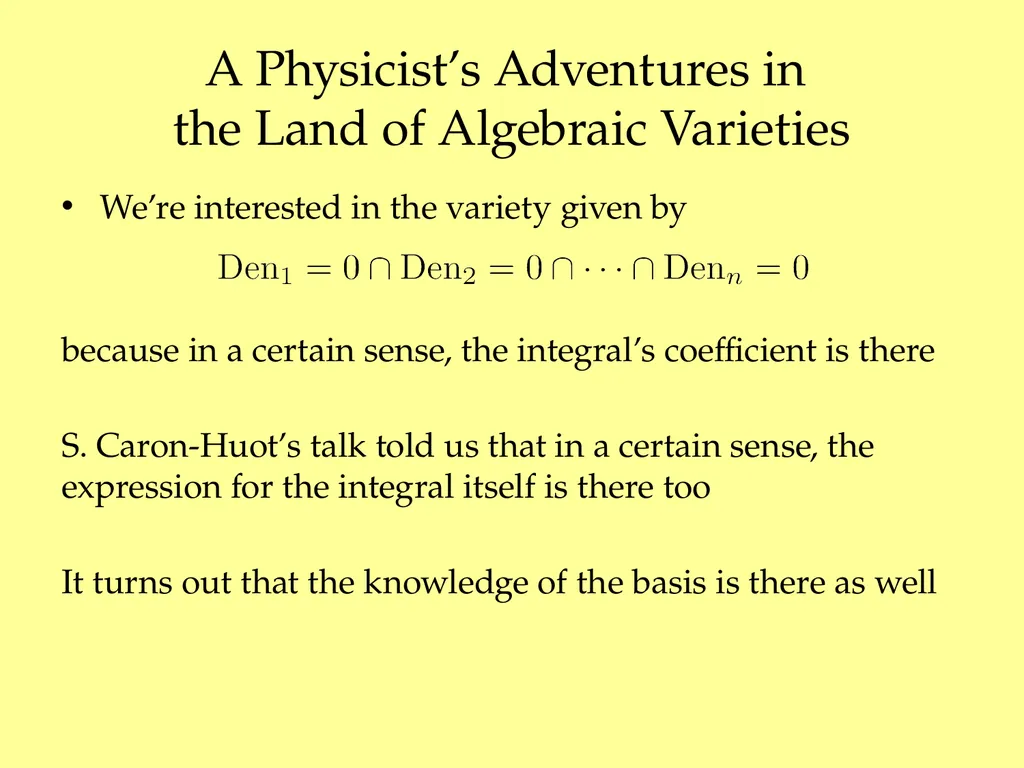
A Physicist’s Adventures in �the Land of Algebraic Varieties We’re interested in the variety given by
because in a certain sense, the integral’s coefficient is there
S. Caron-Huot’s talk told us that in a certain sense, the expression for the integral itself is there too
It turns out that the knowledge of the basis is there as well<br>
18
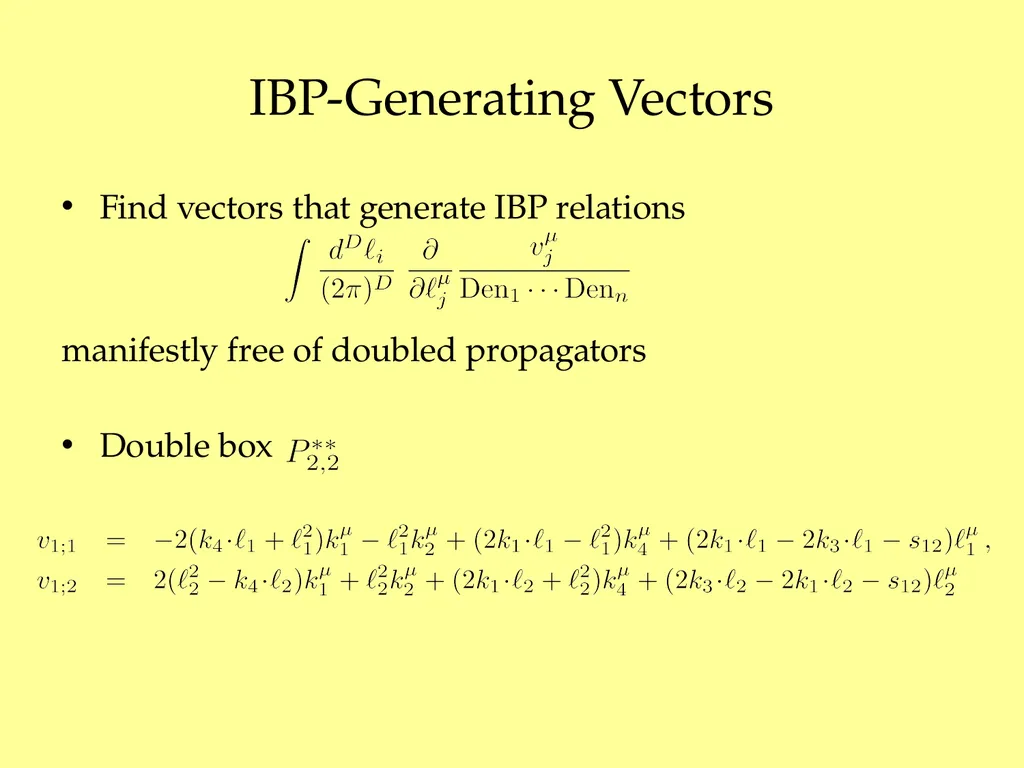
IBP-Generating Vectors Find vectors that generate IBP relations
manifestly free of doubled propagators
Double box<br>
19
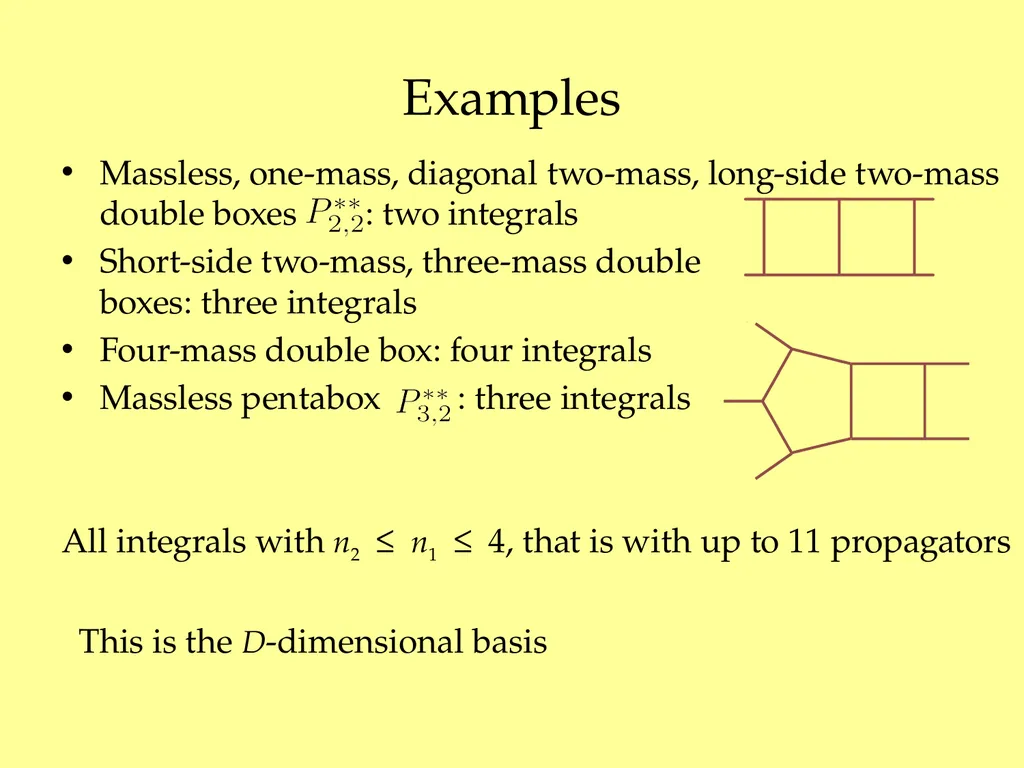
Examples Massless, one-mass, diagonal two-mass, long-side two-mass double boxes : two integrals
Short-side two-mass, three-mass double �boxes: three integrals
Four-mass double box: four integrals
Massless pentabox : three integrals
All integrals with n2 ≤ n1 ≤ 4, that is with up to 11 propagators
This is the D-dimensional basis<br>
20
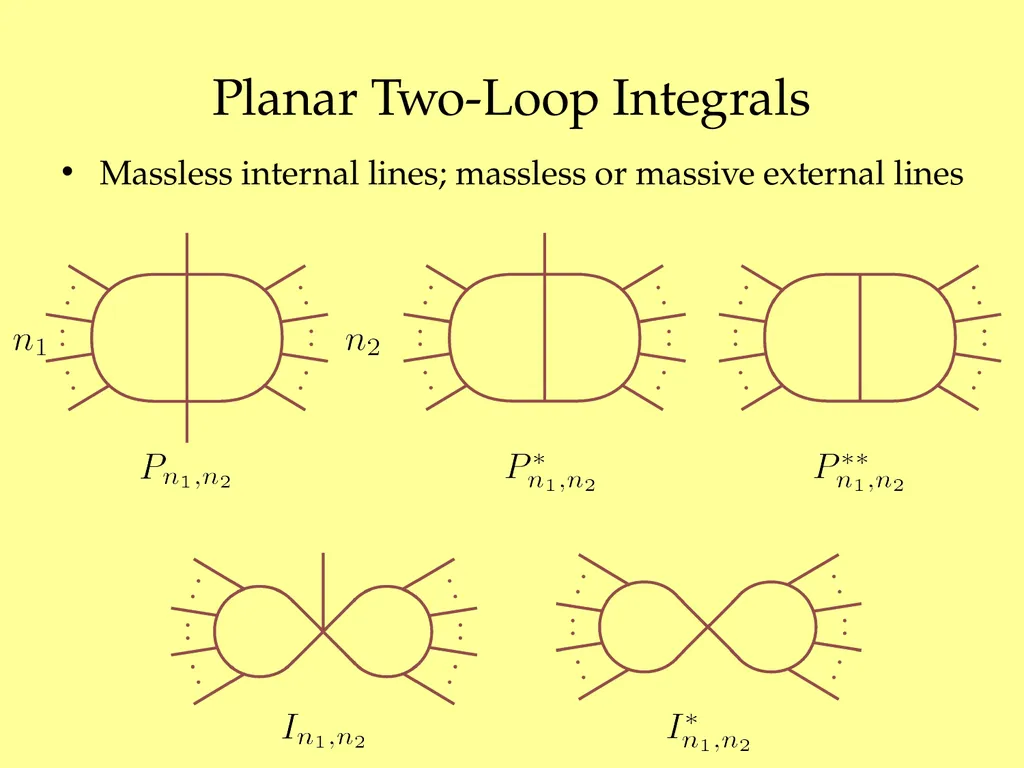
Planar Two-Loop Integrals Massless internal lines; massless or massive external lines<br>
21
Four-Dimensional Basis If we drop terms which are ultimately of O(ε) in amplitudes, we can eliminate all integrals beyond the pentabox , that is all integrals with more than eight propagators<br>
22
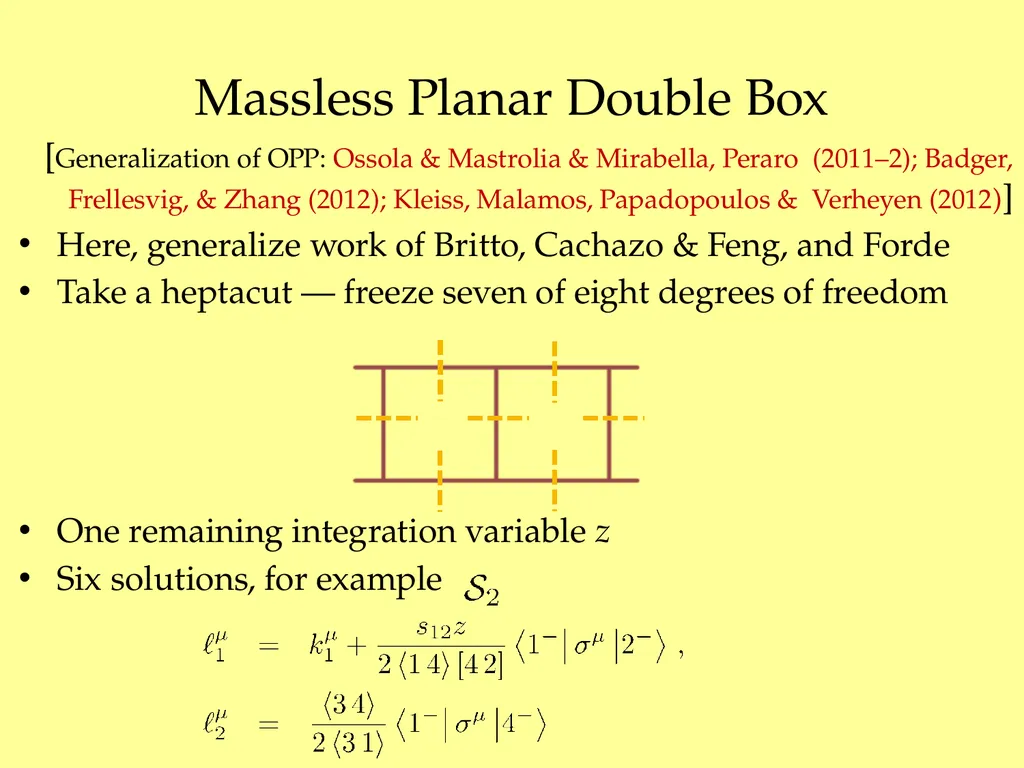
Massless Planar Double Box [Generalization of OPP: Ossola & Mastrolia & Mirabella, Peraro (2011–2); Badger, Frellesvig, & Zhang (2012); Kleiss, Malamos, Papadopoulos & Verheyen (2012)]
Here, generalize work of Britto, Cachazo & Feng, and Forde
Take a heptacut — freeze seven of eight degrees of freedom
One remaining integration variable z
Six solutions, for example<br>
23
Need to choose contour for z within each solution
Jacobian from other degrees of freedom has poles in z: naively, 14 solutions aka candidate global poles
Note that the Jacobian from contour integration is 1/J, not 1/|J|
Different from leading singularities
Cachazo & Buchbinder (2005)<br>
24
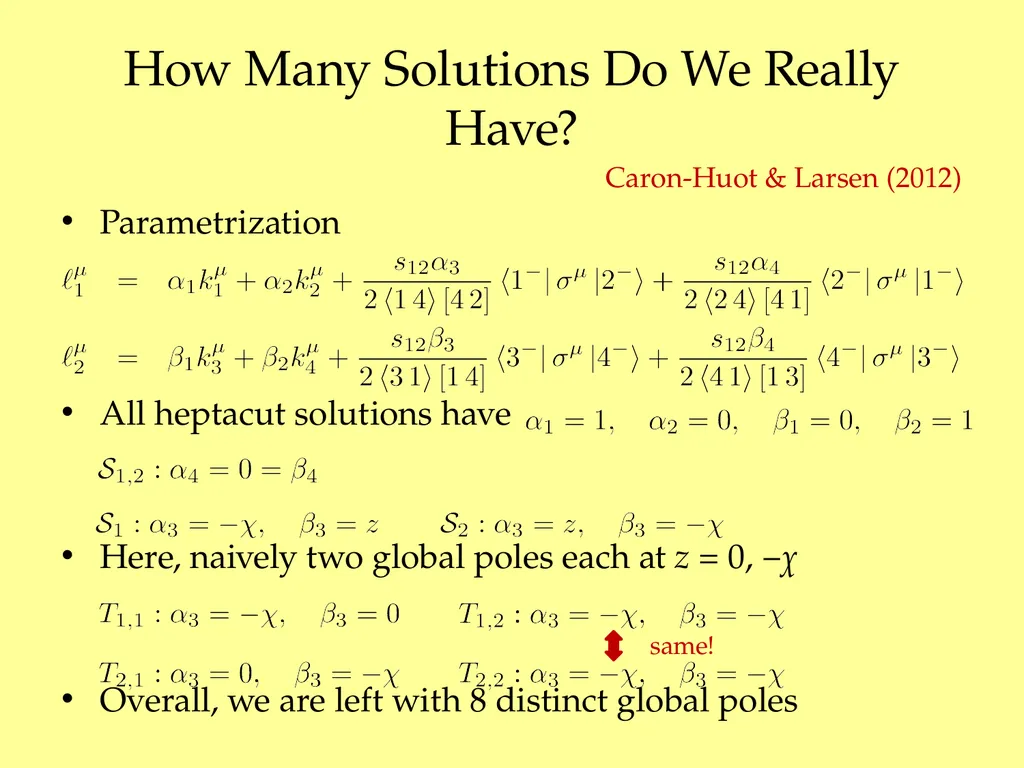
How Many Solutions Do We Really Have? Caron-Huot & Larsen (2012)
Parametrization
All heptacut solutions have
Here, naively two global poles each at z = 0, −χ
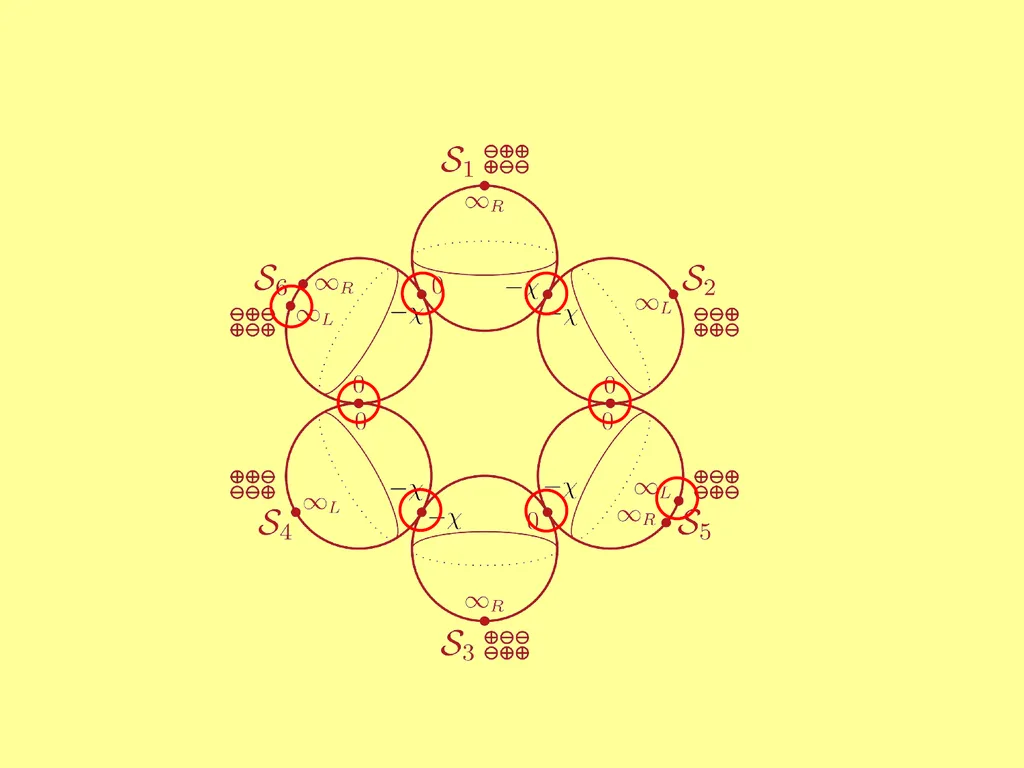
Overall, we are left with 8 distinct global poles same!<br>
25
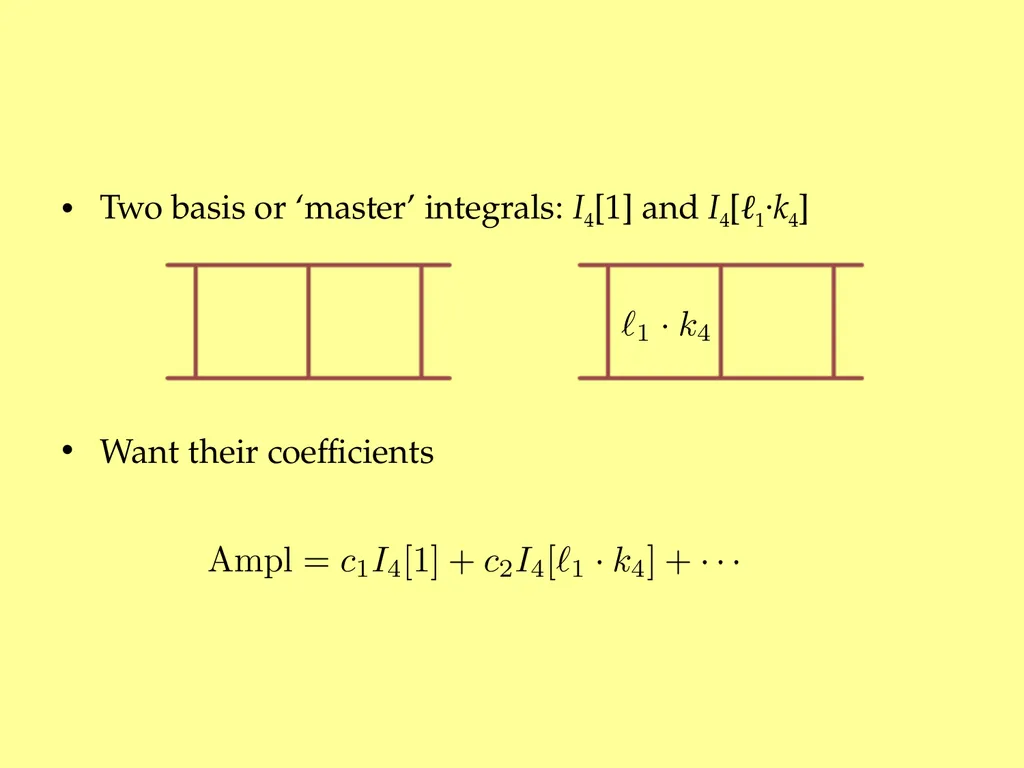
Two basis or ‘master’ integrals: I4[1] and I4[ℓ1∙k4]
Want their coefficients<br>
26
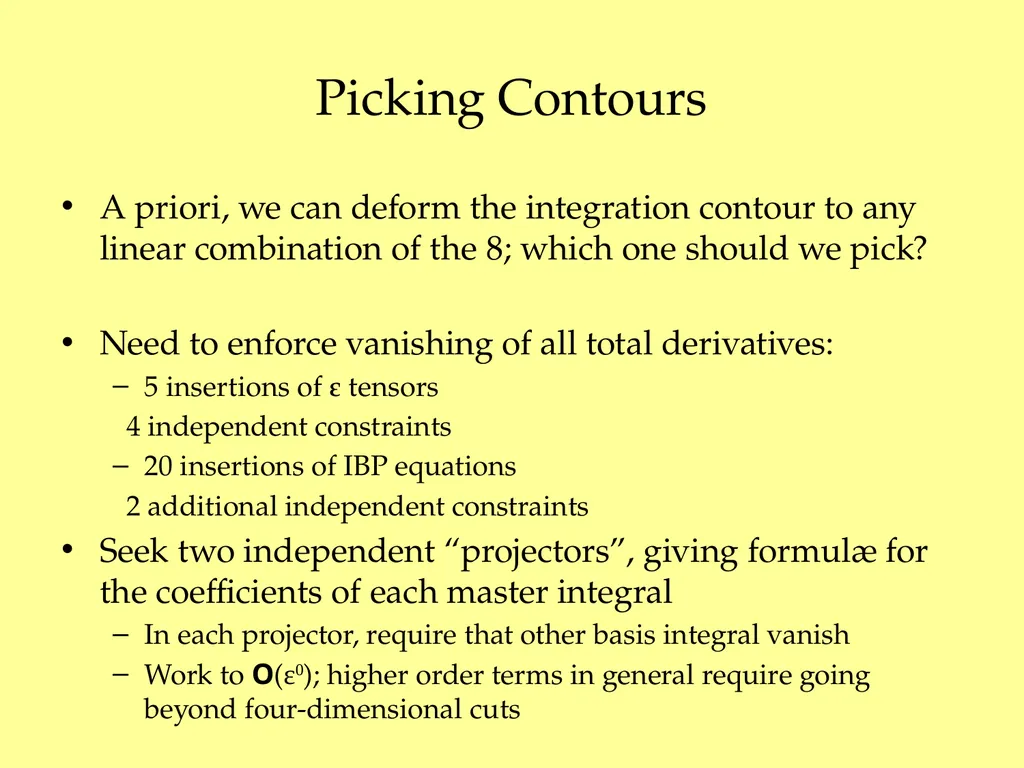
Picking Contours A priori, we can deform the integration contour to any linear combination of the 8; which one should we pick?
Need to enforce vanishing of all total derivatives:
5 insertions of ε tensors
4 independent constraints
20 insertions of IBP equations
2 additional independent constraints
Seek two independent “projectors”, giving formulæ for the coefficients of each master integral
In each projector, require that other basis integral vanish
Work to O(ε0); higher order terms in general require going beyond four-dimensional cuts<br>
27
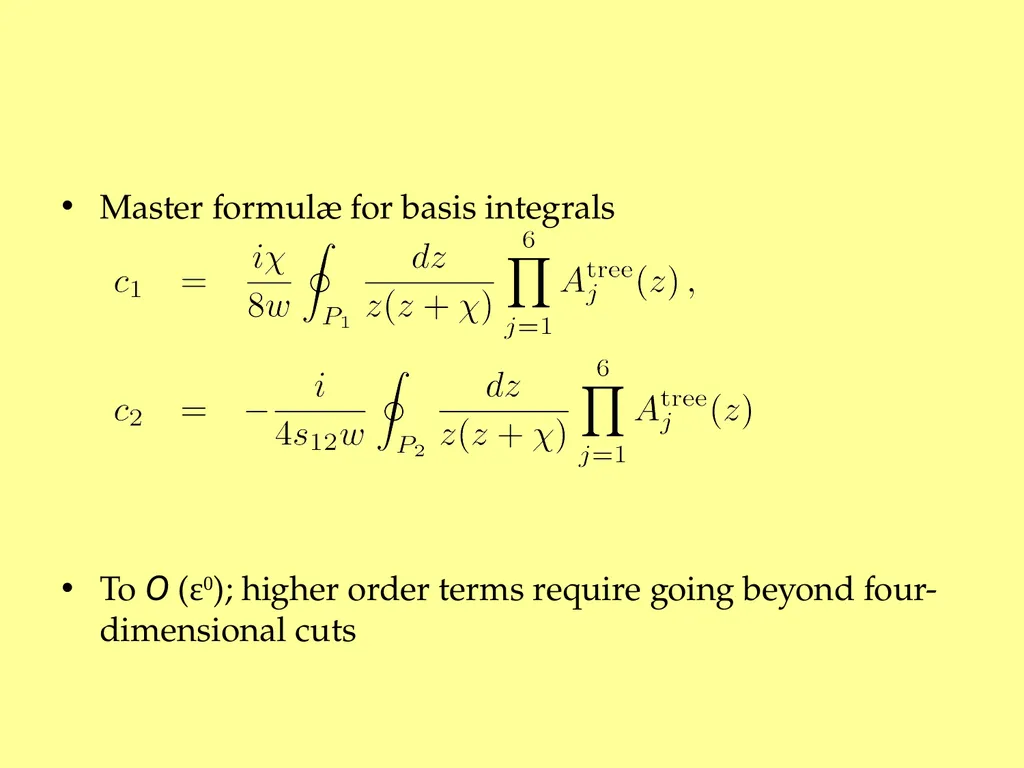
Master formulæ for basis integrals
To O (ε0); higher order terms require going beyond four-dimensional cuts<br>
28
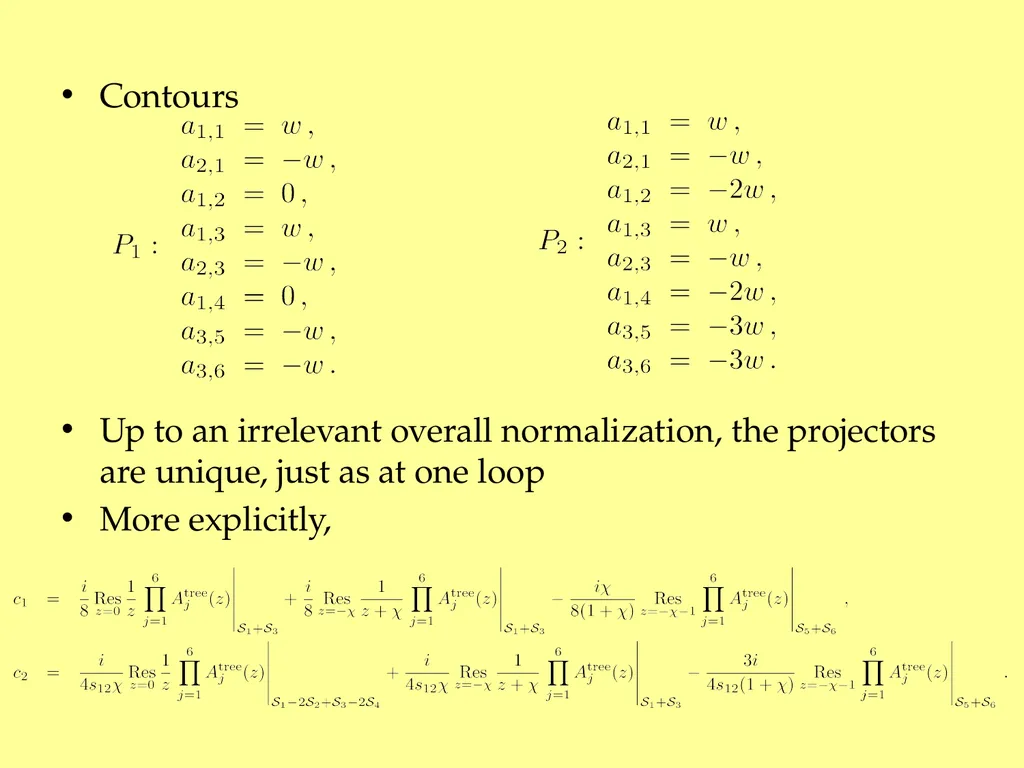
Contours
Up to an irrelevant overall normalization, the projectors are unique, just as at one loop
More explicitly,<br>
29
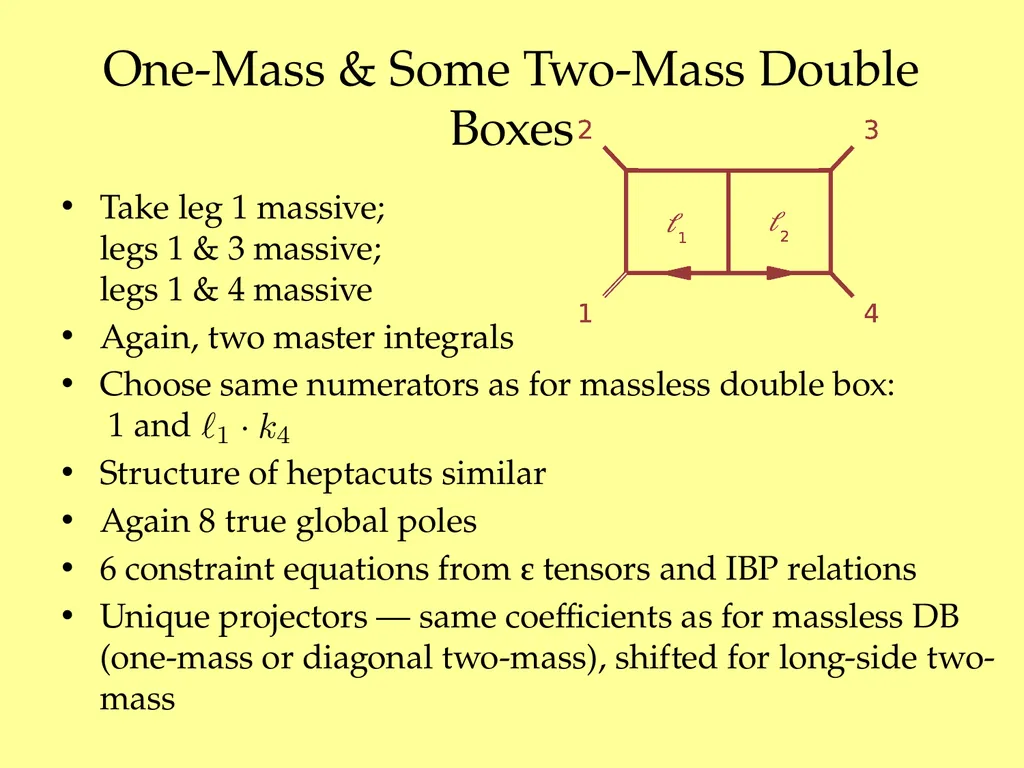
One-Mass & Some Two-Mass Double Boxes Take leg 1 massive;�legs 1 & 3 massive;�legs 1 & 4 massive
Again, two master integrals
Choose same numerators as for massless double box:� 1 and
Structure of heptacuts similar
Again 8 true global poles
6 constraint equations from ε tensors and IBP relations
Unique projectors — same coefficients as for massless DB (one-mass or diagonal two-mass), shifted for long-side two-mass<br>
30
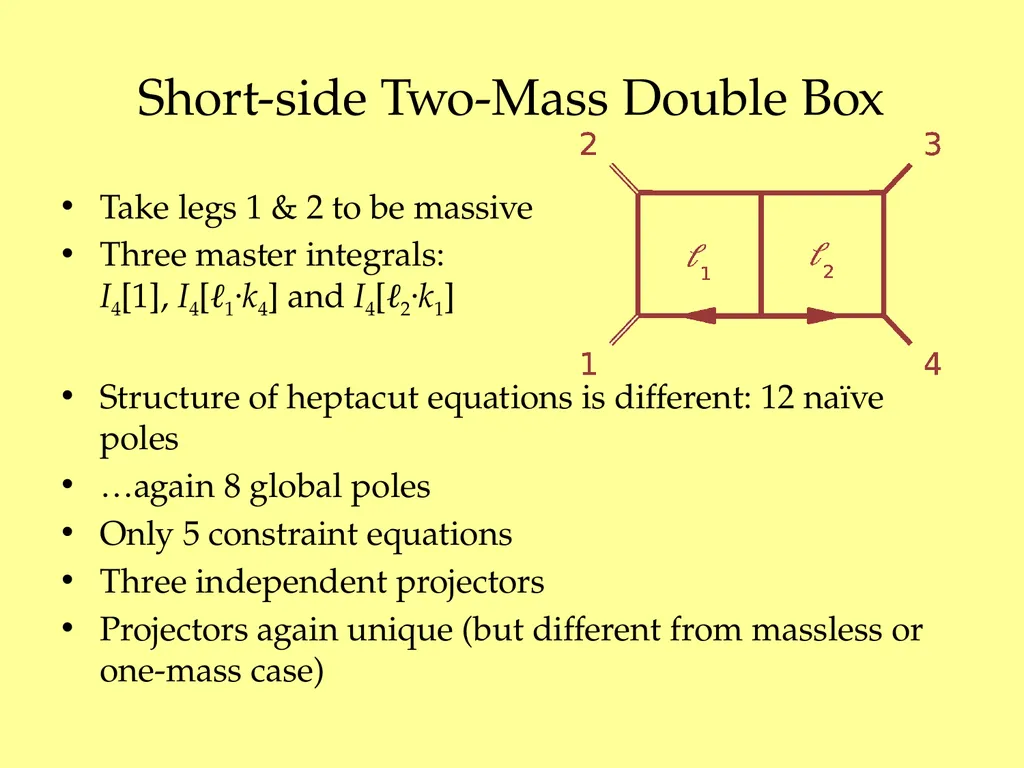
Short-side Two-Mass Double Box Take legs 1 & 2 to be massive
Three master integrals:�I4[1], I4[ℓ1∙k4] and I4[ℓ2∙k1]
Structure of heptacut equations is different: 12 naïve poles
…again 8 global poles
Only 5 constraint equations
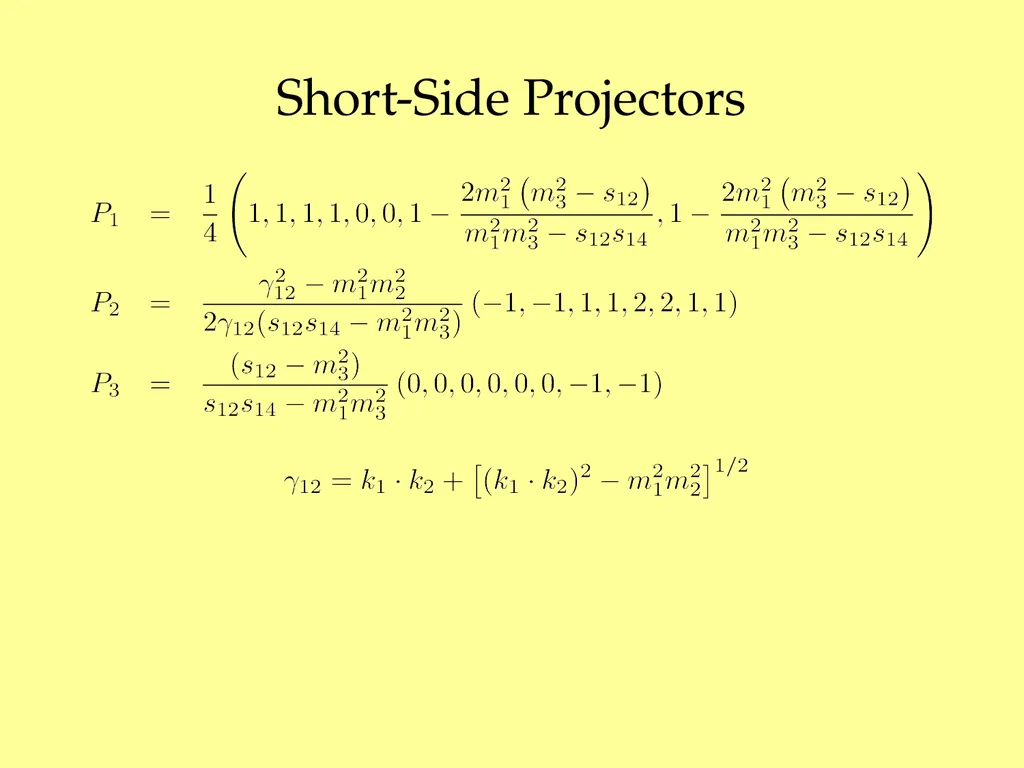
Three independent projectors
Projectors again unique (but different from massless or one-mass case)<br>
31
Short-Side Projectors<br>
32
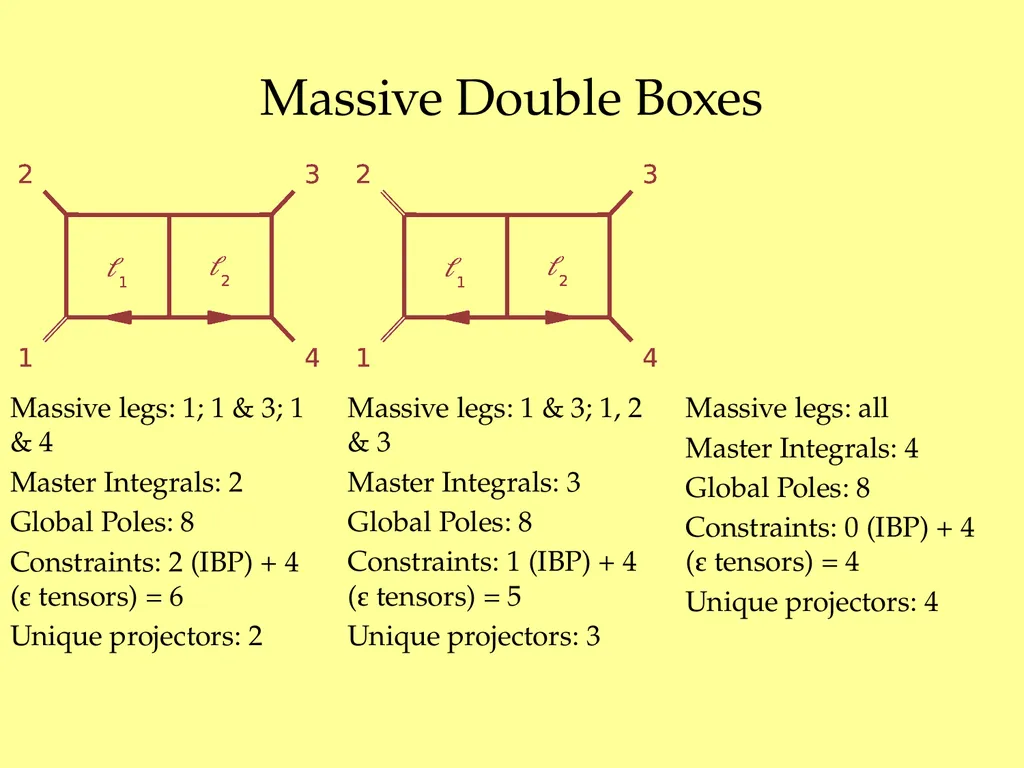
Massive Double Boxes Massive legs: 1; 1 & 3; 1 & 4
Master Integrals: 2
Global Poles: 8
Constraints: 2 (IBP) + 4 (ε tensors) = 6
Unique projectors: 2 Massive legs: 1 & 3; 1, 2 & 3
Master Integrals: 3
Global Poles: 8
Constraints: 1 (IBP) + 4 (ε tensors) = 5
Unique projectors: 3 Massive legs: all
Master Integrals: 4
Global Poles: 8
Constraints: 0 (IBP) + 4 (ε tensors) = 4
Unique projectors: 4<br>
33
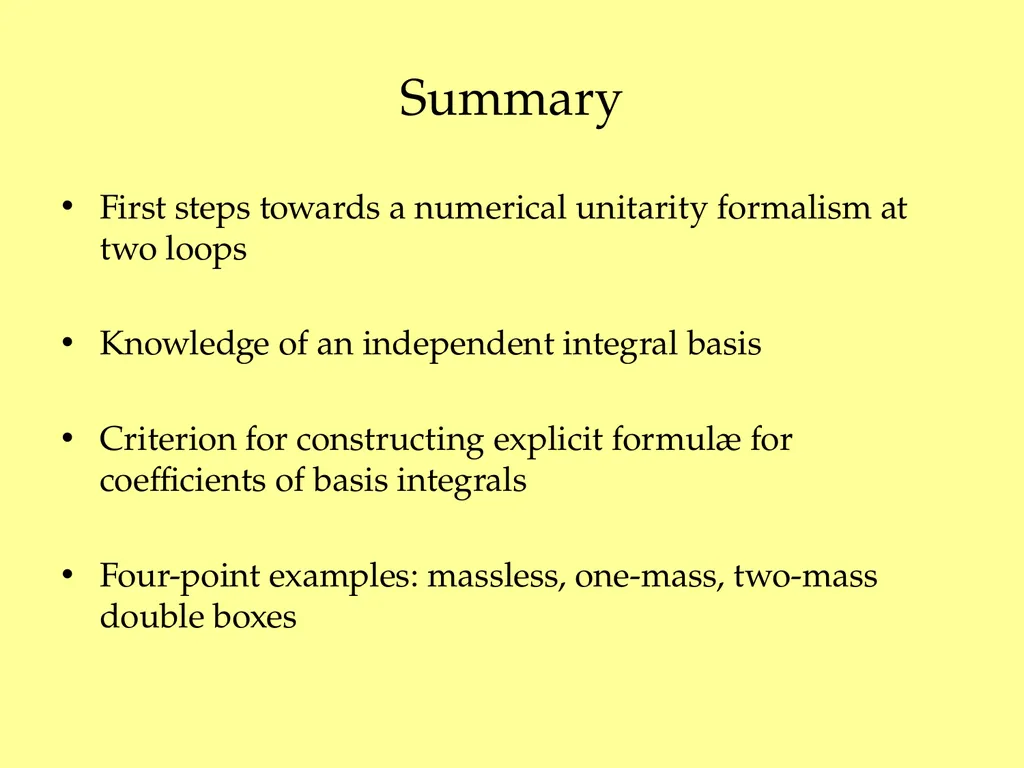
Summary First steps towards a numerical unitarity formalism at two loops
Knowledge of an independent integral basis
Criterion for constructing explicit formulæ for coefficients of basis integrals
Four-point examples: massless, one-mass, two-mass double boxes<br>