
May 19, 2017 Office for Sponsored Programs Cost
Description: May 19, 2017 Office for Sponsored Programs Cost Analysis Team 1 FA Facilities and Administrative Costs The History And Evolution of FA Cost Rates 1947 ONR reimbursed universities for institutional (indirect) costs incurred for Navy
Related Topics
Download Presentation
"May 19, 2017 Office for Sponsored Programs Cost" is the property of its rightful owner. Permission is granted to download and print the materials on this website for personal, non-commercial use only, and to display it on your personal computer provided you do not modify the materials and that you retain all copyright notices contained in the materials. By downloading content from our website, you accept the terms of this agreement.
Presentation Transcript
slide1. May 19, 2017
Office for Sponsored Programs
Cost Analysis Team 1 F&A
Facilities and Administrative Costs<br>
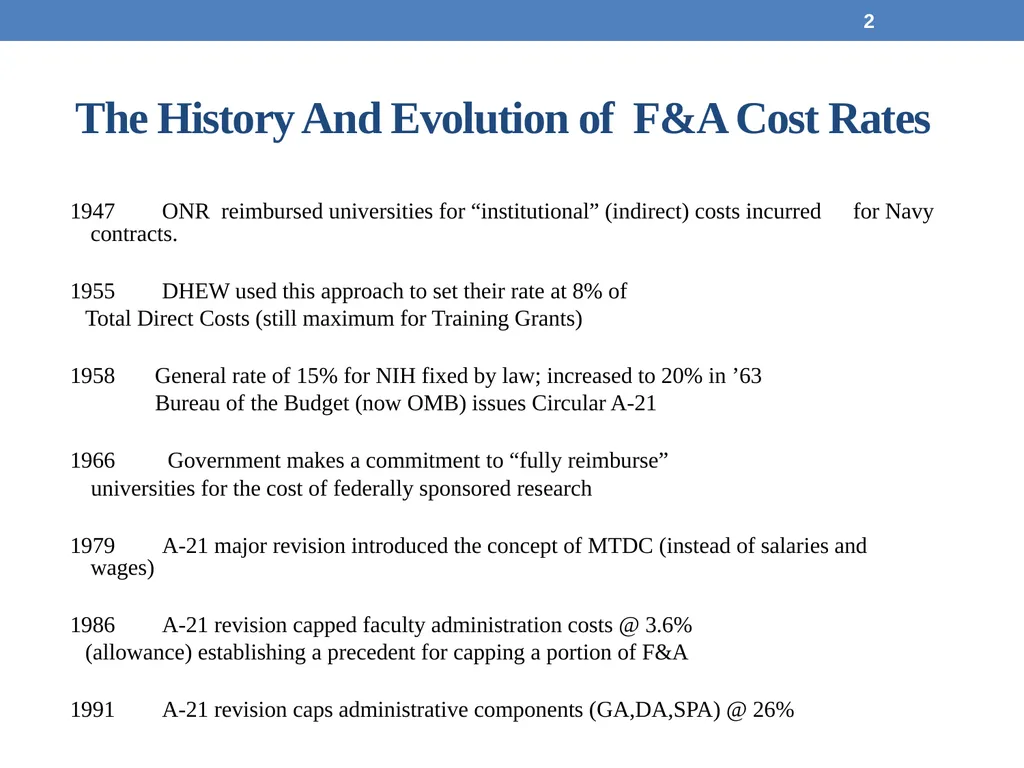
slide2. The History And Evolution of F&A Cost Rates 1947 ONR reimbursed universities for “institutional” (indirect) costs incurred for Navy contracts.
1955 DHEW used this approach to set their rate at 8% of
Total Direct Costs (still maximum for Training Grants)
1958 General rate of 15% for NIH fixed by law; increased to 20% in ’63
Bureau of the Budget (now OMB) issues Circular A-21
1966 Government makes a commitment to “fully reimburse”
universities for the cost of federally sponsored research
1979 A-21 major revision introduced the concept of MTDC (instead of salaries and wages)
1986 A-21 revision capped faculty administration costs @ 3.6%
(allowance) establishing a precedent for capping a portion of F&A
1991 A-21 revision caps administrative components (GA,DA,SPA) @ 26% 2<br>
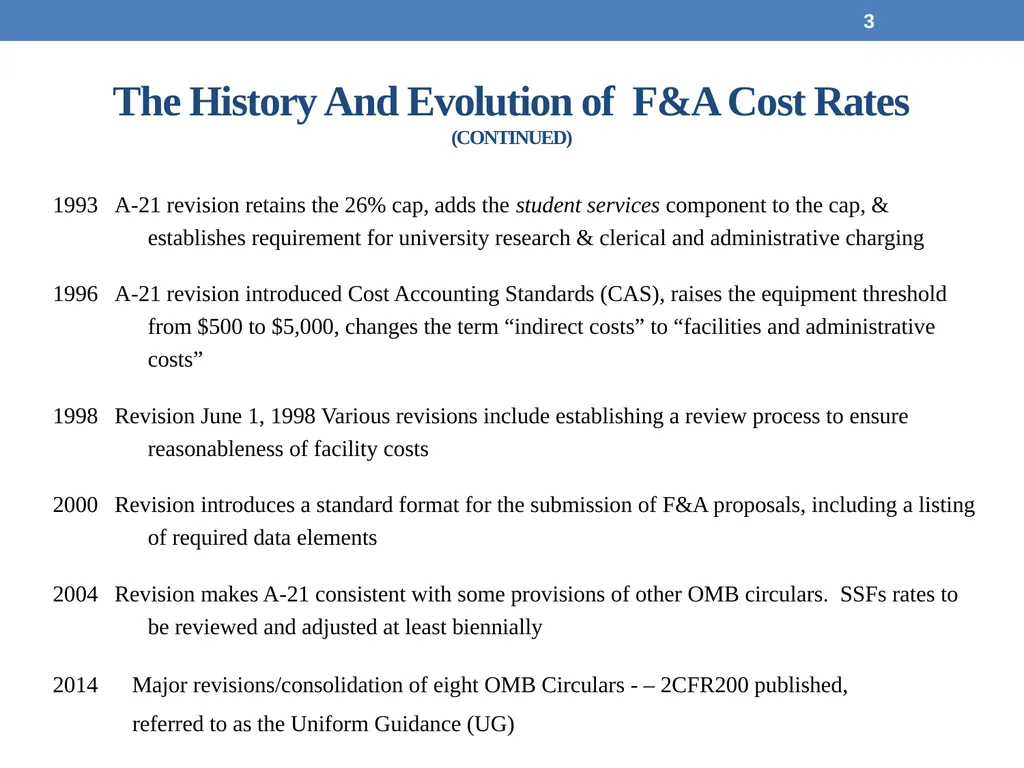
slide3. The History And Evolution of F&A Cost Rates (CONTINUED) 1993 A-21 revision retains the 26% cap, adds the student services component to the cap, & establishes requirement for university research & clerical and administrative charging
1996 A-21 revision introduced Cost Accounting Standards (CAS), raises the equipment threshold from $500 to $5,000, changes the term “indirect costs” to “facilities and administrative costs”
1998 Revision June 1, 1998 Various revisions include establishing a review process to ensure reasonableness of facility costs
2000 Revision introduces a standard format for the submission of F&A proposals, including a listing of required data elements
2004 Revision makes A-21 consistent with some provisions of other OMB circulars. SSFs rates to be reviewed and adjusted at least biennially
2014 Major revisions/consolidation of eight OMB Circulars - – 2CFR200 published,
referred to as the Uniform Guidance (UG) 3<br>
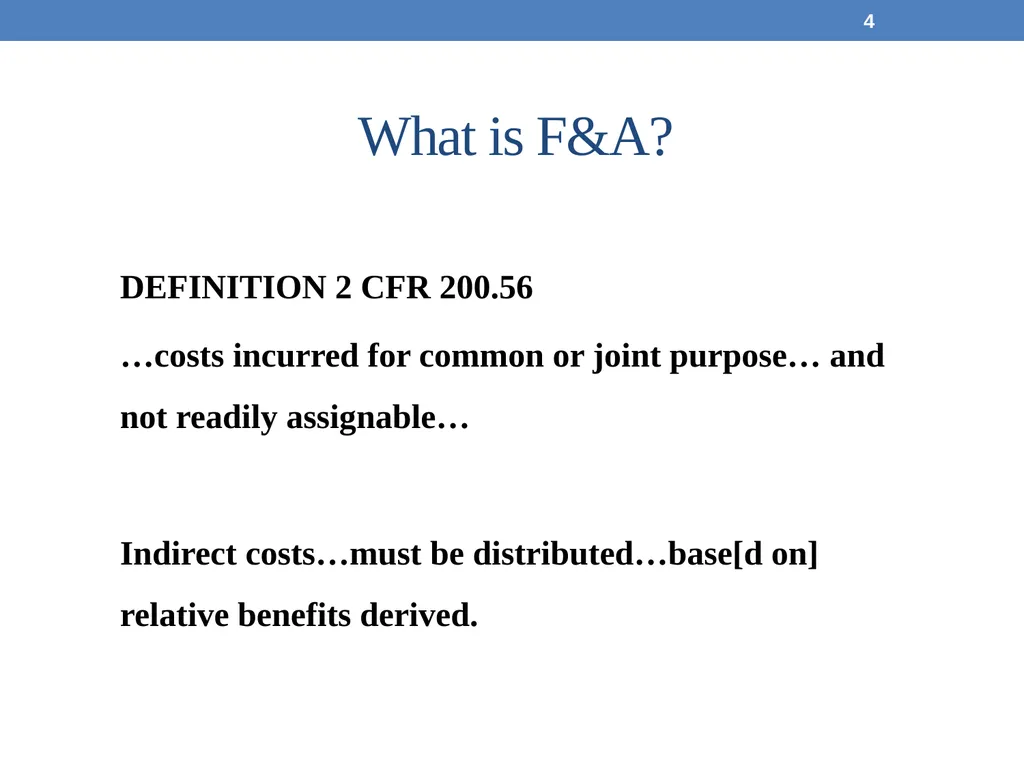
slide4. What is F&A? DEFINITION 2 CFR 200.56
…costs incurred for common or joint purpose… and not readily assignable…
Indirect costs…must be distributed…base[d on] relative benefits derived. 4<br>
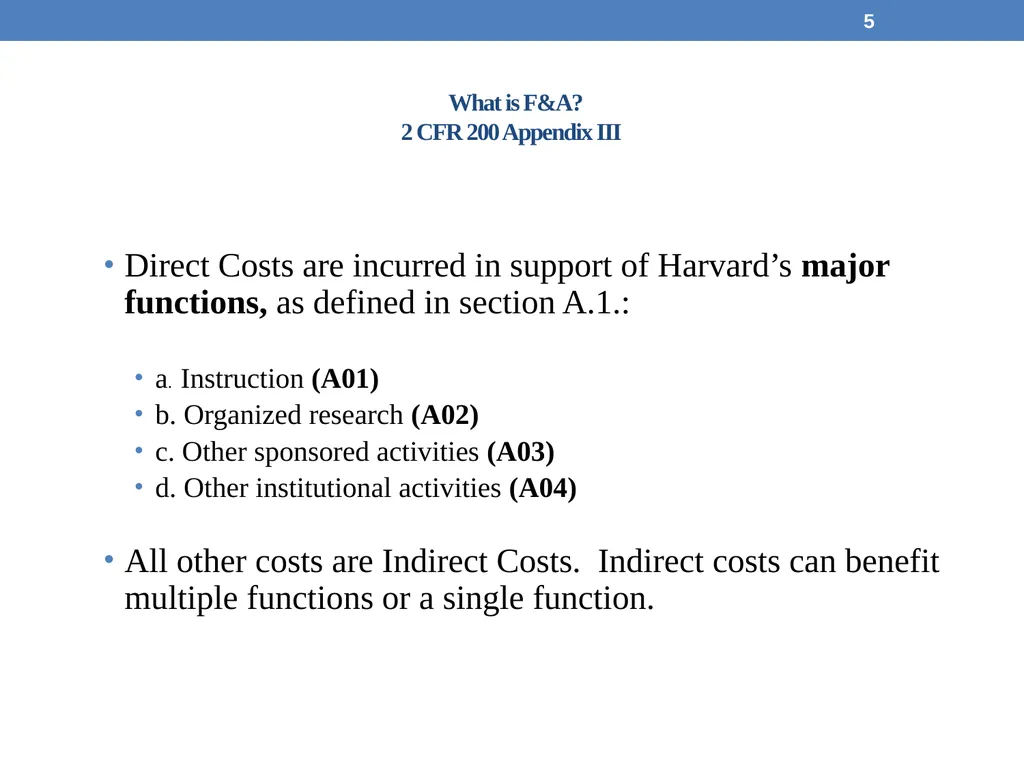
slide5. What is F&A? 2 CFR 200 Appendix III Direct Costs are incurred in support of Harvard’s major functions, as defined in section A.1.:
a. Instruction (A01)
b. Organized research (A02)
c. Other sponsored activities (A03)
d. Other institutional activities (A04)
All other costs are Indirect Costs. Indirect costs can benefit multiple functions or a single function. 5<br>
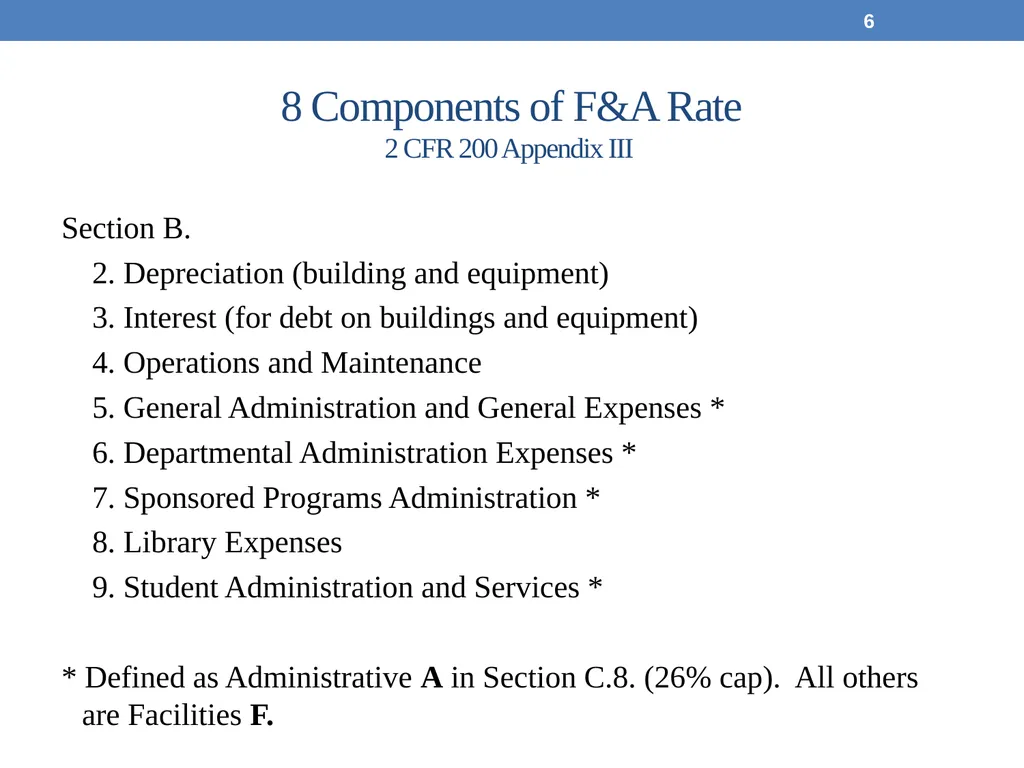
slide6. 8 Components of F&A Rate 2 CFR 200 Appendix III Section B.
2. Depreciation (building and equipment)
3. Interest (for debt on buildings and equipment)
4. Operations and Maintenance
5. General Administration and General Expenses *
6. Departmental Administration Expenses *
7. Sponsored Programs Administration *
8. Library Expenses
9. Student Administration and Services *
* Defined as Administrative A in Section C.8. (26% cap). All others are Facilities F. 6<br>
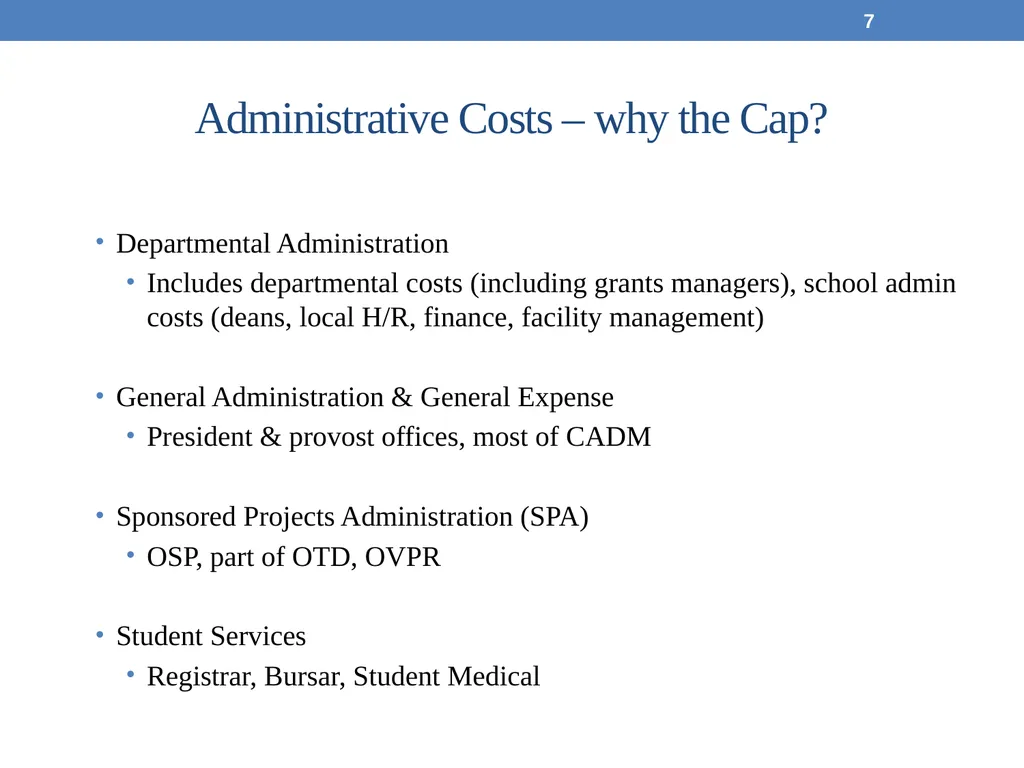
slide7. Administrative Costs – why the Cap? Departmental Administration
Includes departmental costs (including grants managers), school admin costs (deans, local H/R, finance, facility management)
General Administration & General Expense
President & provost offices, most of CADM
Sponsored Projects Administration (SPA)
OSP, part of OTD, OVPR
Student Services
Registrar, Bursar, Student Medical 7<br>
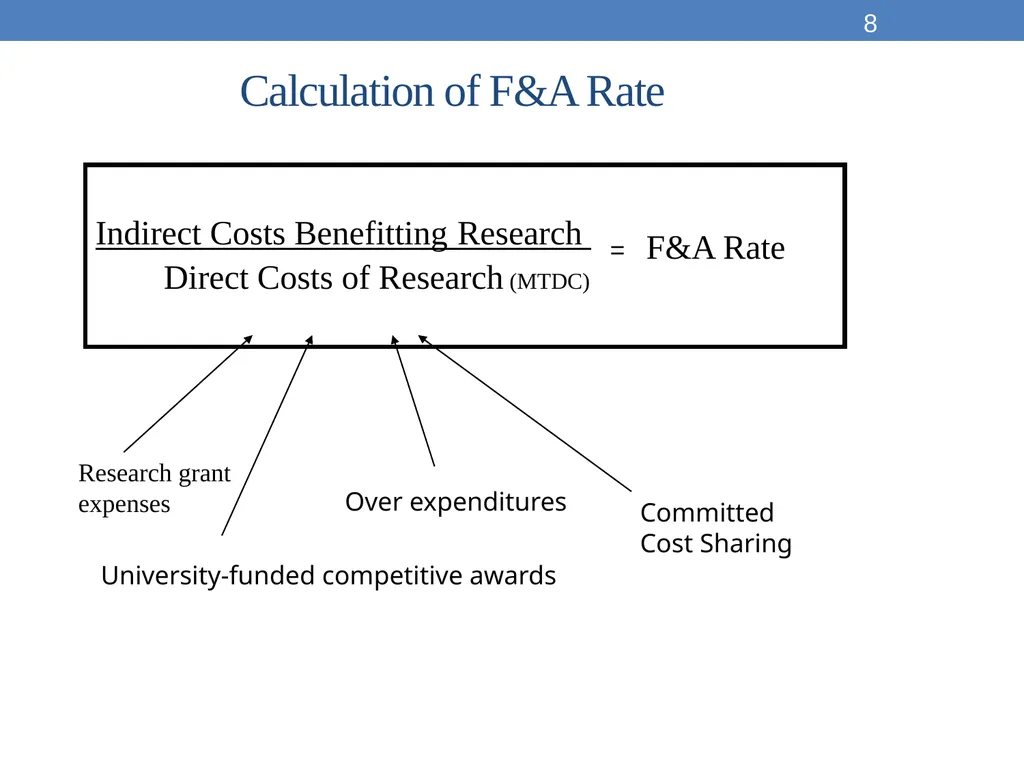
slide8. Calculation of F&A Rate Indirect Costs Benefitting Research
Direct Costs of Research (MTDC) 8 University-funded competitive awards Over expenditures Committed
Cost Sharing Research grant expenses = F&A Rate 8<br>
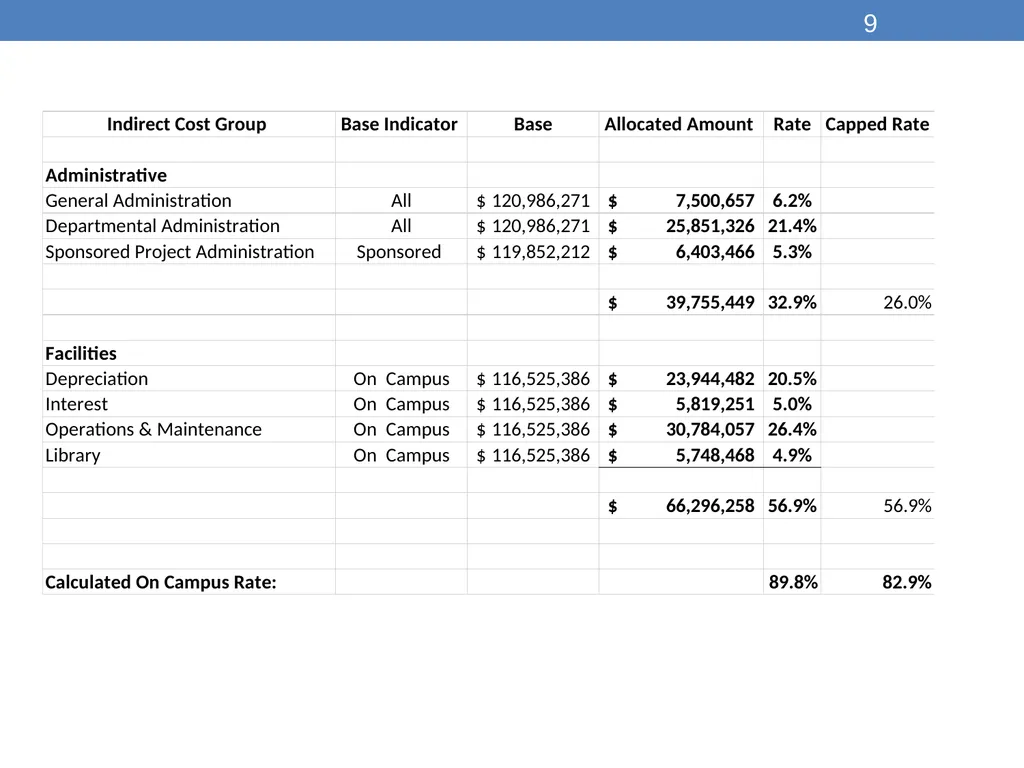
slide9. 9 9<br>
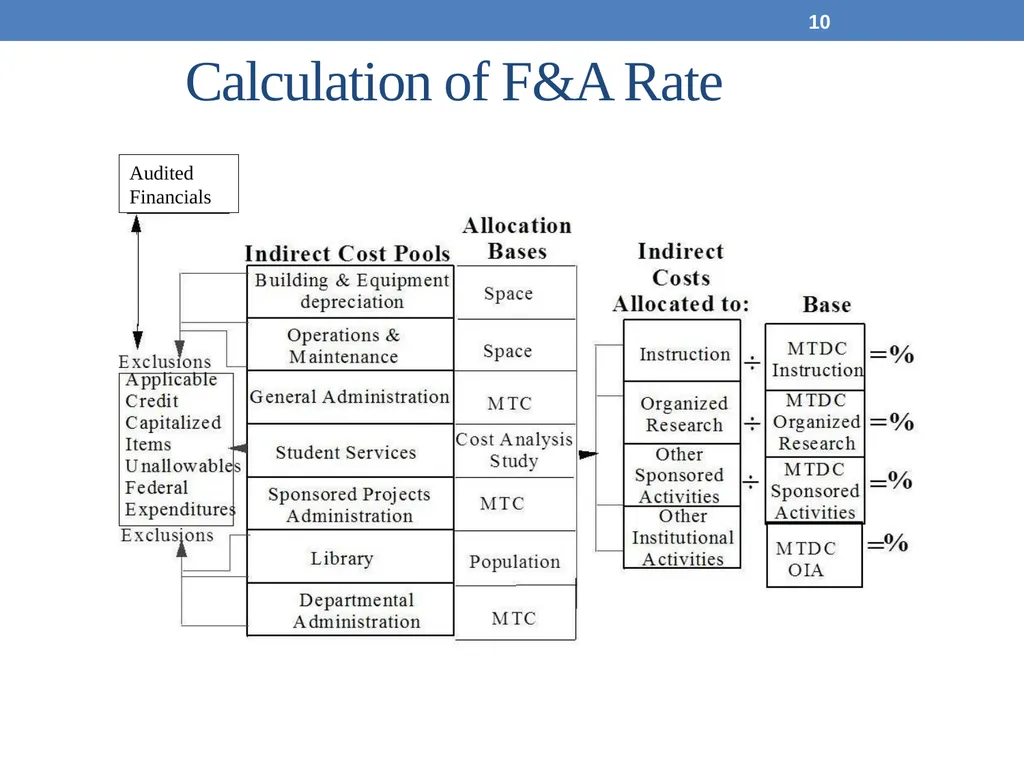
slide10. Calculation of F&A Rate 10 10 Audited
Financials<br>
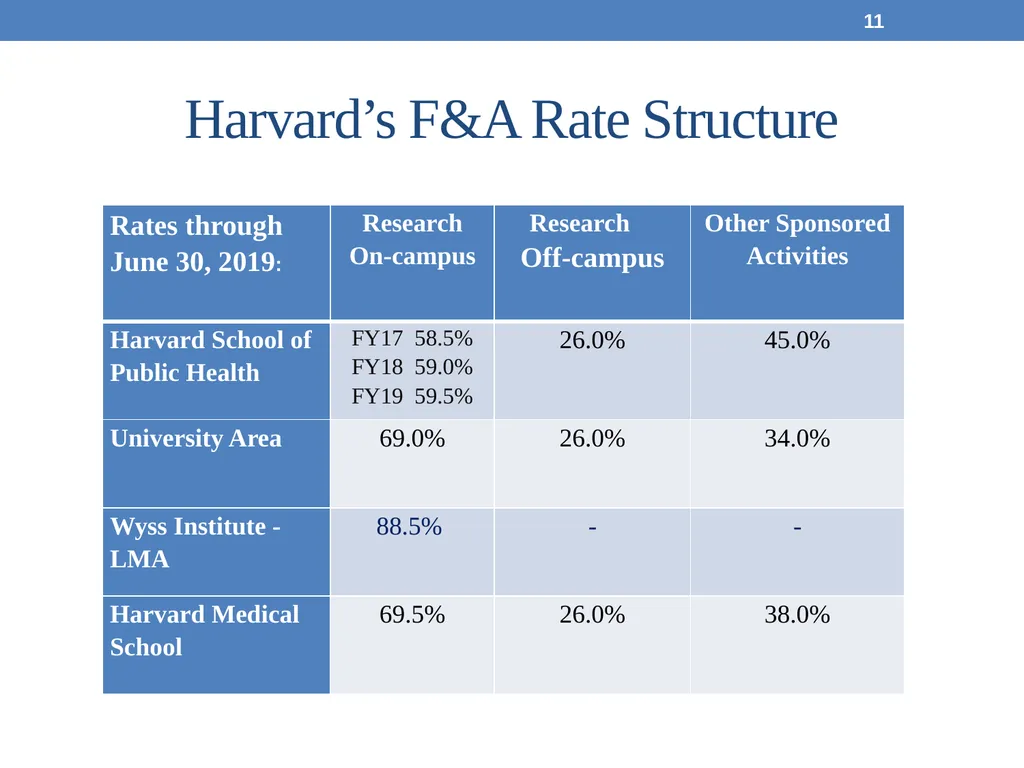
slide11. Harvard’s F&A Rate Structure 11<br>
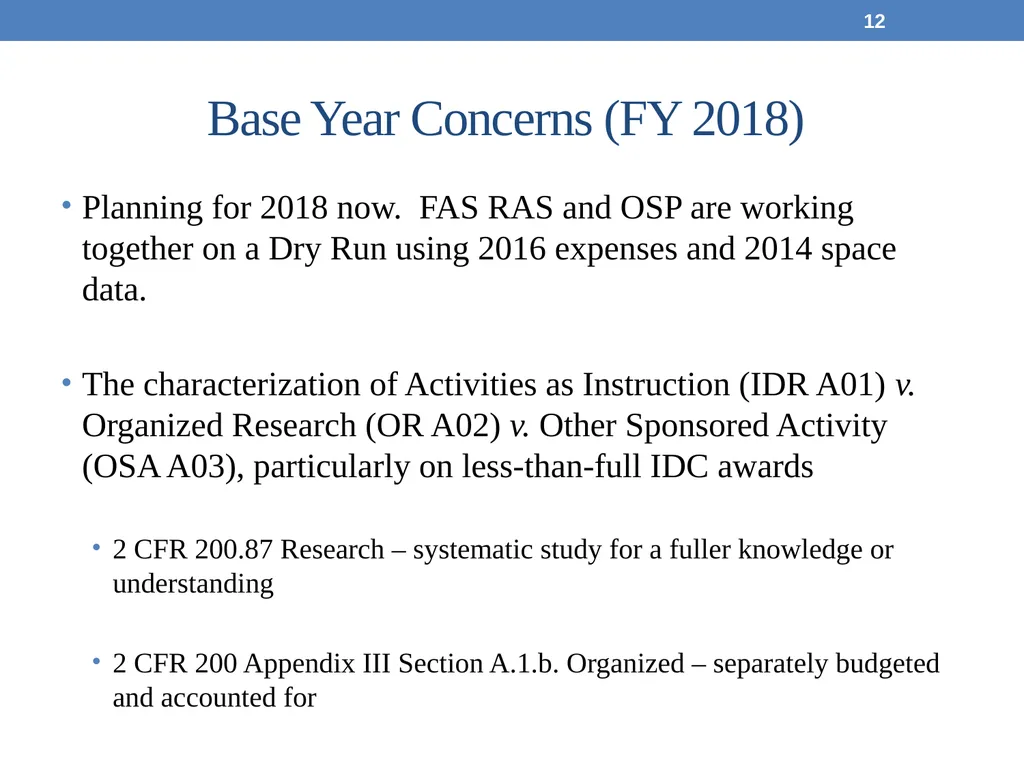
slide12. Base Year Concerns (FY 2018) Planning for 2018 now. FAS RAS and OSP are working together on a Dry Run using 2016 expenses and 2014 space data.
The characterization of Activities as Instruction (IDR A01) v. Organized Research (OR A02) v. Other Sponsored Activity (OSA A03), particularly on less-than-full IDC awards
2 CFR 200.87 Research – systematic study for a fuller knowledge or understanding
2 CFR 200 Appendix III Section A.1.b. Organized – separately budgeted and accounted for 12<br>
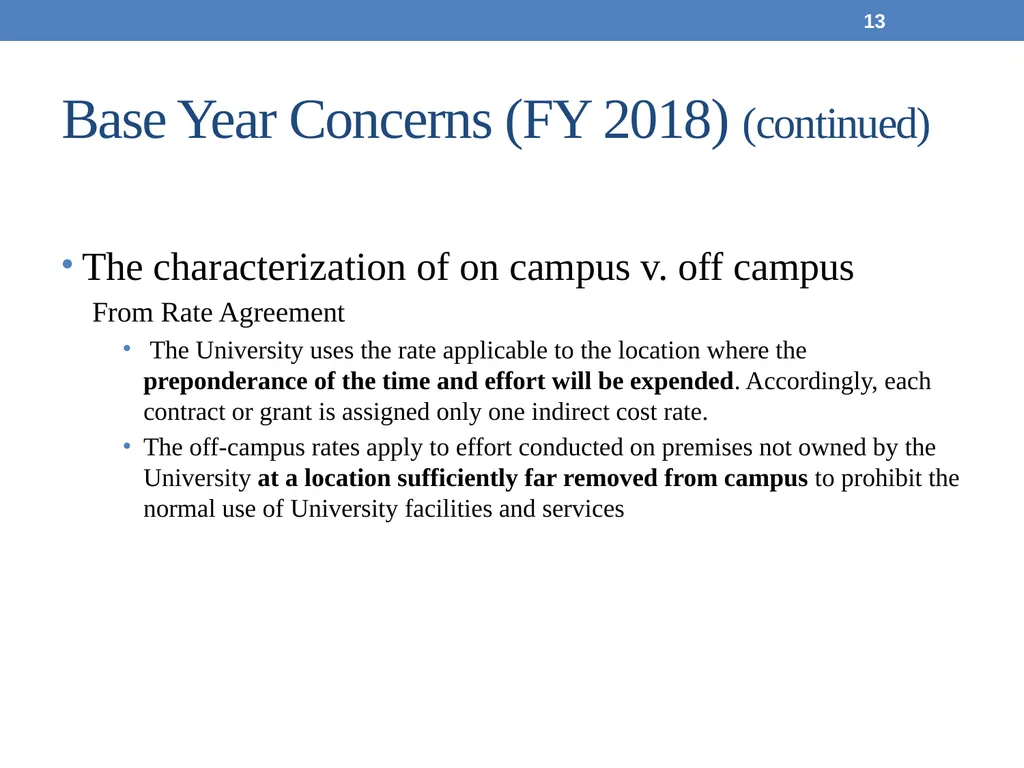
slide13. Base Year Concerns (FY 2018) (continued) The characterization of on campus v. off campus
From Rate Agreement
The University uses the rate applicable to the location where the preponderance of the time and effort will be expended. Accordingly, each contract or grant is assigned only one indirect cost rate.
The off-campus rates apply to effort conducted on premises not owned by the University at a location sufficiently far removed from campus to prohibit the normal use of University facilities and services 13<br>
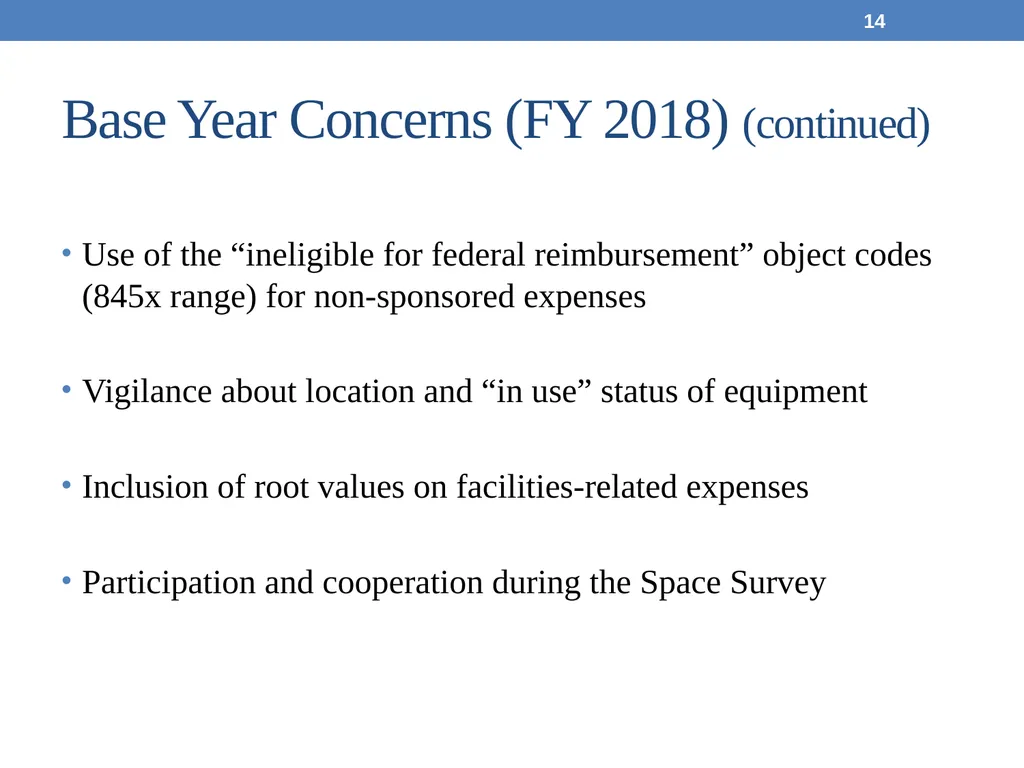
slide14. Base Year Concerns (FY 2018) (continued) Use of the “ineligible for federal reimbursement” object codes (845x range) for non-sponsored expenses
Vigilance about location and “in use” status of equipment
Inclusion of root values on facilities-related expenses
Participation and cooperation during the Space Survey 14<br>
slide15. OSP Cost Analysis Team Jonathan Dutt – jonathan_dutt@harvard.edu (617) 496-2702
Peggy Mui – peggy_mui@harvard.edu (617) 496-4771
Mark (William) O’Brien – mark_w_obrien@harvard.edu (617) 496-2506
Judith (Ann) Ryan – judith_ryan@harvard.edu (617) 496-9047 15<br>
Office for Sponsored Programs
Cost Analysis Team 1 F&A
Facilities and Administrative Costs<br>
slide2. The History And Evolution of F&A Cost Rates 1947 ONR reimbursed universities for “institutional” (indirect) costs incurred for Navy contracts.
1955 DHEW used this approach to set their rate at 8% of
Total Direct Costs (still maximum for Training Grants)
1958 General rate of 15% for NIH fixed by law; increased to 20% in ’63
Bureau of the Budget (now OMB) issues Circular A-21
1966 Government makes a commitment to “fully reimburse”
universities for the cost of federally sponsored research
1979 A-21 major revision introduced the concept of MTDC (instead of salaries and wages)
1986 A-21 revision capped faculty administration costs @ 3.6%
(allowance) establishing a precedent for capping a portion of F&A
1991 A-21 revision caps administrative components (GA,DA,SPA) @ 26% 2<br>
slide3. The History And Evolution of F&A Cost Rates (CONTINUED) 1993 A-21 revision retains the 26% cap, adds the student services component to the cap, & establishes requirement for university research & clerical and administrative charging
1996 A-21 revision introduced Cost Accounting Standards (CAS), raises the equipment threshold from $500 to $5,000, changes the term “indirect costs” to “facilities and administrative costs”
1998 Revision June 1, 1998 Various revisions include establishing a review process to ensure reasonableness of facility costs
2000 Revision introduces a standard format for the submission of F&A proposals, including a listing of required data elements
2004 Revision makes A-21 consistent with some provisions of other OMB circulars. SSFs rates to be reviewed and adjusted at least biennially
2014 Major revisions/consolidation of eight OMB Circulars - – 2CFR200 published,
referred to as the Uniform Guidance (UG) 3<br>
slide4. What is F&A? DEFINITION 2 CFR 200.56
…costs incurred for common or joint purpose… and not readily assignable…
Indirect costs…must be distributed…base[d on] relative benefits derived. 4<br>
slide5. What is F&A? 2 CFR 200 Appendix III Direct Costs are incurred in support of Harvard’s major functions, as defined in section A.1.:
a. Instruction (A01)
b. Organized research (A02)
c. Other sponsored activities (A03)
d. Other institutional activities (A04)
All other costs are Indirect Costs. Indirect costs can benefit multiple functions or a single function. 5<br>
slide6. 8 Components of F&A Rate 2 CFR 200 Appendix III Section B.
2. Depreciation (building and equipment)
3. Interest (for debt on buildings and equipment)
4. Operations and Maintenance
5. General Administration and General Expenses *
6. Departmental Administration Expenses *
7. Sponsored Programs Administration *
8. Library Expenses
9. Student Administration and Services *
* Defined as Administrative A in Section C.8. (26% cap). All others are Facilities F. 6<br>
slide7. Administrative Costs – why the Cap? Departmental Administration
Includes departmental costs (including grants managers), school admin costs (deans, local H/R, finance, facility management)
General Administration & General Expense
President & provost offices, most of CADM
Sponsored Projects Administration (SPA)
OSP, part of OTD, OVPR
Student Services
Registrar, Bursar, Student Medical 7<br>
slide8. Calculation of F&A Rate Indirect Costs Benefitting Research
Direct Costs of Research (MTDC) 8 University-funded competitive awards Over expenditures Committed
Cost Sharing Research grant expenses = F&A Rate 8<br>
slide9. 9 9<br>
slide10. Calculation of F&A Rate 10 10 Audited
Financials<br>
slide11. Harvard’s F&A Rate Structure 11<br>
slide12. Base Year Concerns (FY 2018) Planning for 2018 now. FAS RAS and OSP are working together on a Dry Run using 2016 expenses and 2014 space data.
The characterization of Activities as Instruction (IDR A01) v. Organized Research (OR A02) v. Other Sponsored Activity (OSA A03), particularly on less-than-full IDC awards
2 CFR 200.87 Research – systematic study for a fuller knowledge or understanding
2 CFR 200 Appendix III Section A.1.b. Organized – separately budgeted and accounted for 12<br>
slide13. Base Year Concerns (FY 2018) (continued) The characterization of on campus v. off campus
From Rate Agreement
The University uses the rate applicable to the location where the preponderance of the time and effort will be expended. Accordingly, each contract or grant is assigned only one indirect cost rate.
The off-campus rates apply to effort conducted on premises not owned by the University at a location sufficiently far removed from campus to prohibit the normal use of University facilities and services 13<br>
slide14. Base Year Concerns (FY 2018) (continued) Use of the “ineligible for federal reimbursement” object codes (845x range) for non-sponsored expenses
Vigilance about location and “in use” status of equipment
Inclusion of root values on facilities-related expenses
Participation and cooperation during the Space Survey 14<br>
slide15. OSP Cost Analysis Team Jonathan Dutt – jonathan_dutt@harvard.edu (617) 496-2702
Peggy Mui – peggy_mui@harvard.edu (617) 496-4771
Mark (William) O’Brien – mark_w_obrien@harvard.edu (617) 496-2506
Judith (Ann) Ryan – judith_ryan@harvard.edu (617) 496-9047 15<br>