
‘Medically Unexplained Symptom / MUS & Somatoform
LS
Published · 41 slides · 0 views
1 / 1







Description
Medically Unexplained Symptom MUS Somatoform Disorders Frank Röhricht MD, FRCPsych Honorary Professor of Psychiatry MSc in Family Medicine Programme Module 534: Mental Health The tragedy for doctors is that they spend their time
Related Topics
Share
Embed code
Download this presentation From Below
"‘Medically Unexplained Symptom / MUS & Somatoform" is the property of its rightful owner. Permission is granted to download and print the materials on this website for personal, non-commercial use only, and to display it on your personal computer provided you do not modify the materials and that you retain all copyright notices contained in the materials. By downloading content from our website, you accept the terms of this agreement.
Presentation Transcript
01
‘Medically Unexplained Symptom / MUS & Somatoform Disorders’ Frank Röhricht
MD, FRCPsych
Honorary Professor of Psychiatry MSc in Family Medicine Programme Module 534:
Mental Health<br>
MD, FRCPsych
Honorary Professor of Psychiatry MSc in Family Medicine Programme Module 534:
Mental Health<br>
02
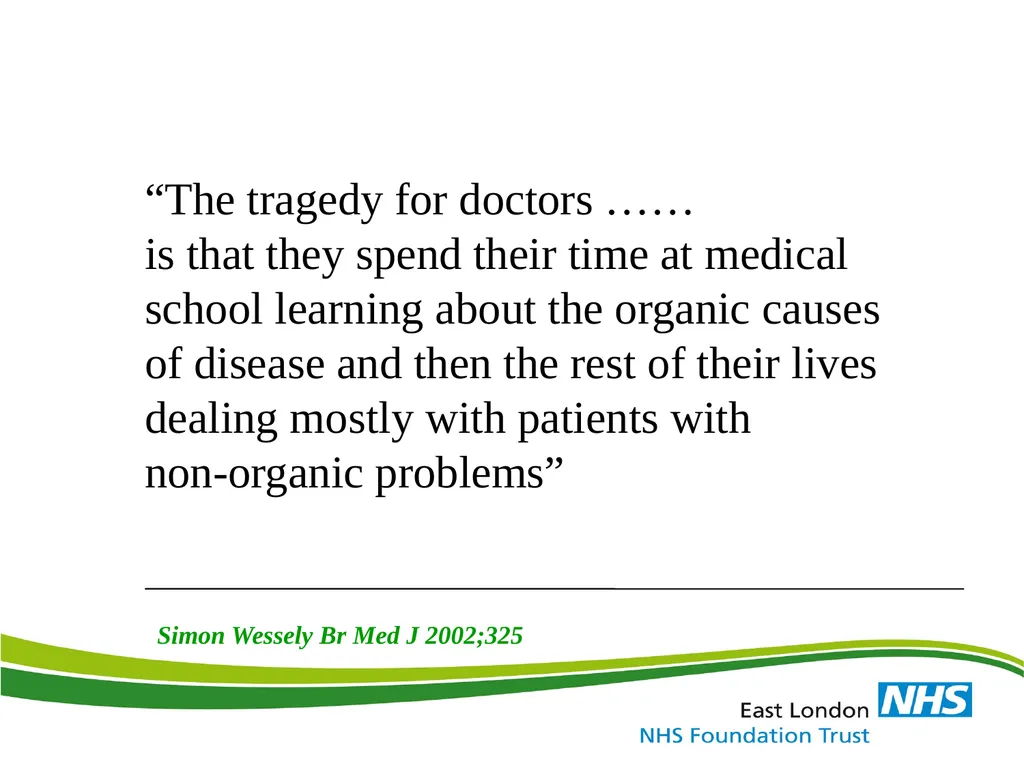
“The tragedy for doctors ……
is that they spend their time at medical
school learning about the organic causes
of disease and then the rest of their lives
dealing mostly with patients with
non-organic problems” Simon Wessely Br Med J 2002;325<br>
is that they spend their time at medical
school learning about the organic causes
of disease and then the rest of their lives
dealing mostly with patients with
non-organic problems” Simon Wessely Br Med J 2002;325<br>
03
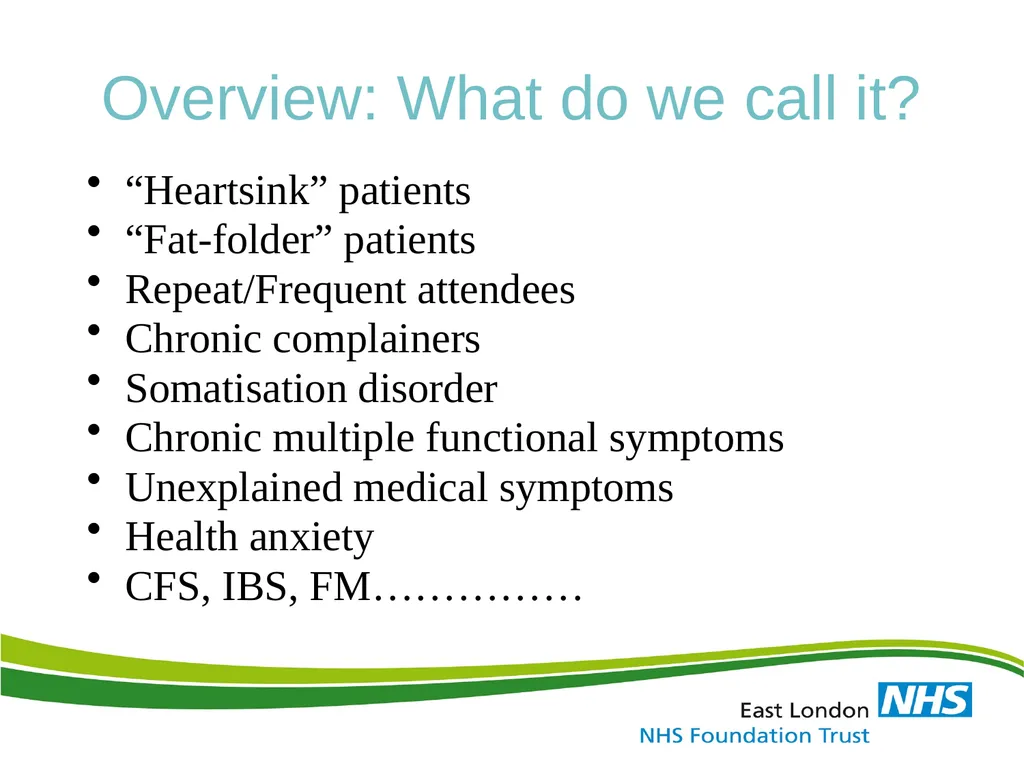
Overview: What do we call it? “Heartsink” patients
“Fat-folder” patients
Repeat/Frequent attendees
Chronic complainers
Somatisation disorder
Chronic multiple functional symptoms
Unexplained medical symptoms
Health anxiety
CFS, IBS, FM……………<br>
“Fat-folder” patients
Repeat/Frequent attendees
Chronic complainers
Somatisation disorder
Chronic multiple functional symptoms
Unexplained medical symptoms
Health anxiety
CFS, IBS, FM……………<br>
04
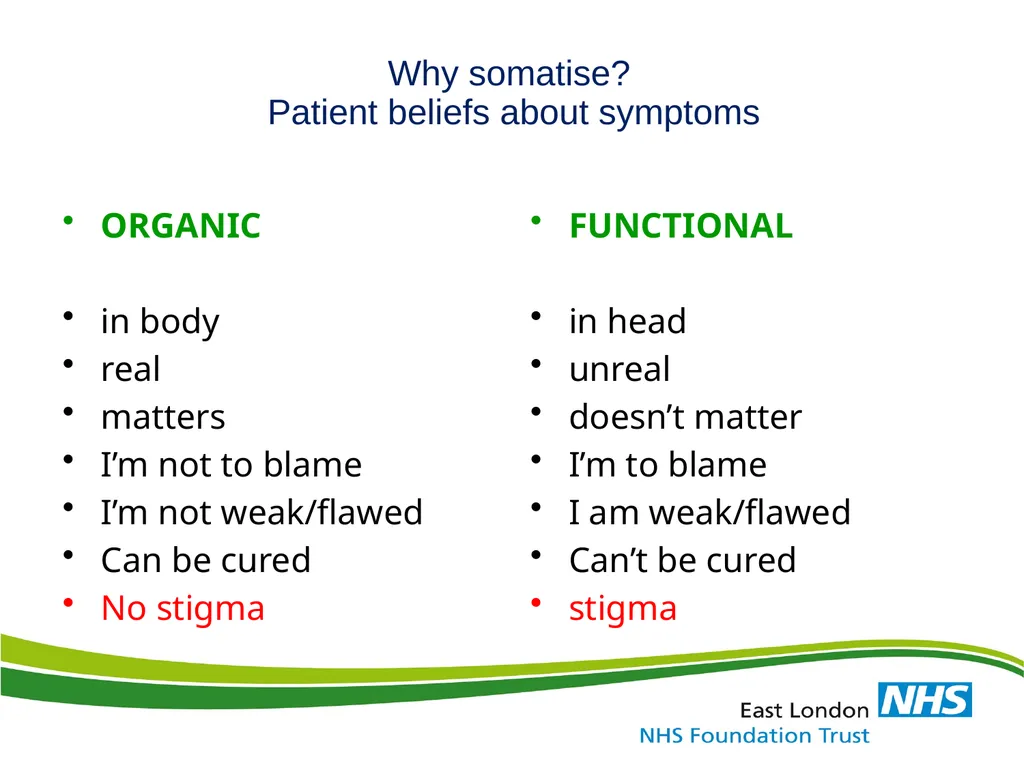
Why somatise?
Patient beliefs about symptoms ORGANIC
in body
real
matters
I’m not to blame
I’m not weak/flawed
Can be cured
No stigma FUNCTIONAL
in head
unreal
doesn’t matter
I’m to blame
I am weak/flawed
Can’t be cured
stigma<br>
in body
real
matters
I’m not to blame
I’m not weak/flawed
Can be cured
No stigma FUNCTIONAL
in head
unreal
doesn’t matter
I’m to blame
I am weak/flawed
Can’t be cured
stigma<br>
05
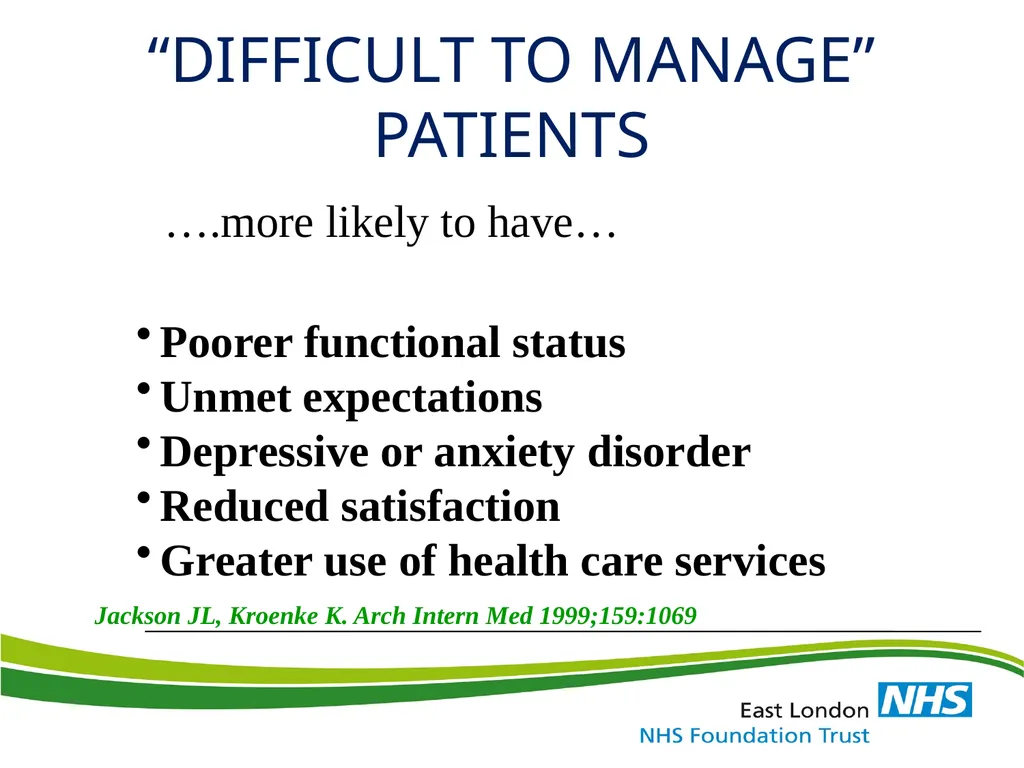
“DIFFICULT TO MANAGE” PATIENTS Poorer functional status
Unmet expectations
Depressive or anxiety disorder
Reduced satisfaction
Greater use of health care services ….more likely to have… Jackson JL, Kroenke K. Arch Intern Med 1999;159:1069<br>
Unmet expectations
Depressive or anxiety disorder
Reduced satisfaction
Greater use of health care services ….more likely to have… Jackson JL, Kroenke K. Arch Intern Med 1999;159:1069<br>
06
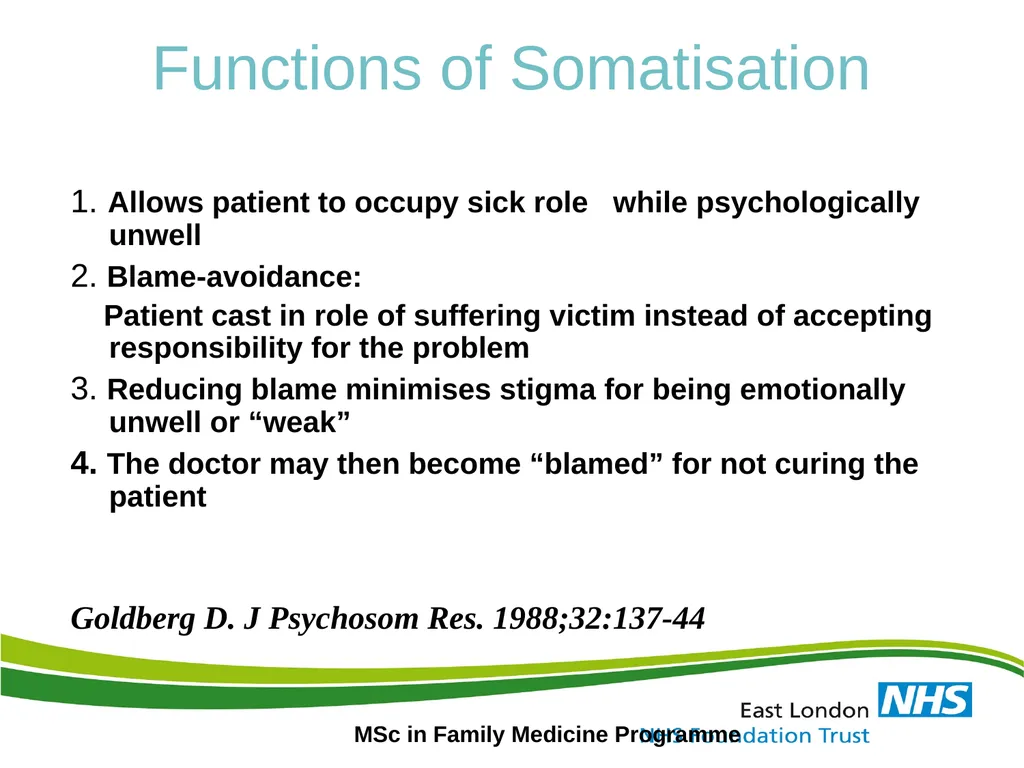
Functions of Somatisation 1. Allows patient to occupy sick role while psychologically unwell
2. Blame-avoidance:
Patient cast in role of suffering victim instead of accepting responsibility for the problem
3. Reducing blame minimises stigma for being emotionally unwell or “weak”
4. The doctor may then become “blamed” for not curing the patient
Goldberg D. J Psychosom Res. 1988;32:137-44 MSc in Family Medicine Programme<br>
2. Blame-avoidance:
Patient cast in role of suffering victim instead of accepting responsibility for the problem
3. Reducing blame minimises stigma for being emotionally unwell or “weak”
4. The doctor may then become “blamed” for not curing the patient
Goldberg D. J Psychosom Res. 1988;32:137-44 MSc in Family Medicine Programme<br>
07
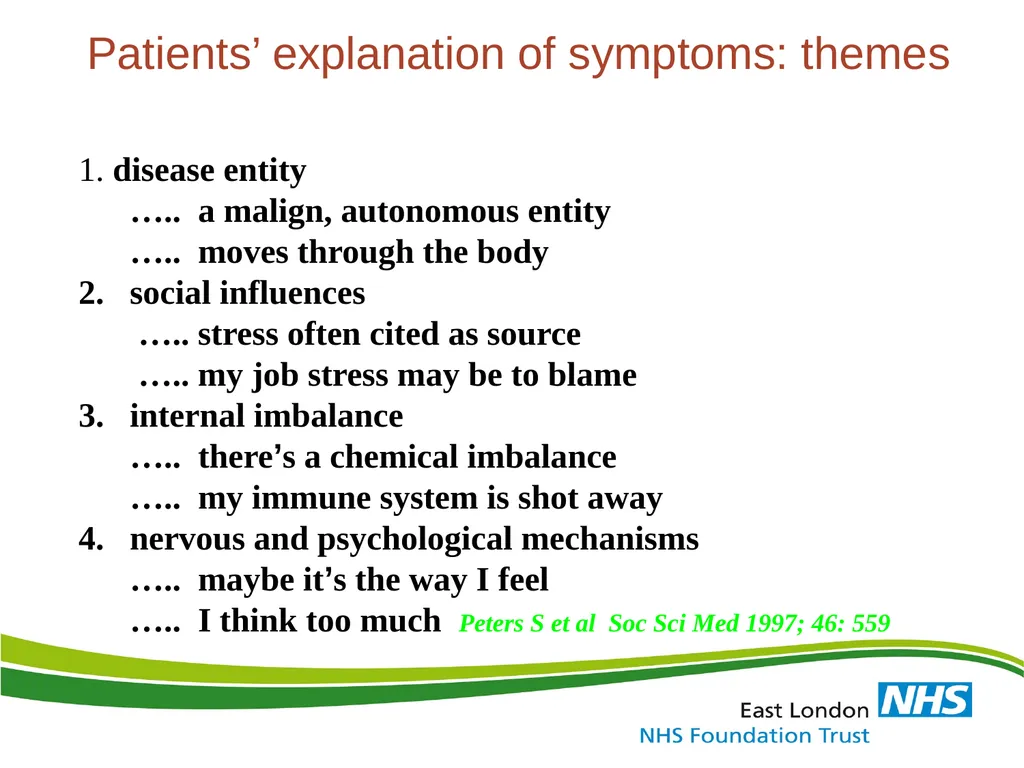
Patients’ explanation of symptoms: themes 1. disease entity
….. a malign, autonomous entity
….. moves through the body
social influences
….. stress often cited as source
….. my job stress may be to blame
internal imbalance
….. there’s a chemical imbalance
….. my immune system is shot away
nervous and psychological mechanisms
….. maybe it’s the way I feel
….. I think too much Peters S et al Soc Sci Med 1997; 46: 559<br>
….. a malign, autonomous entity
….. moves through the body
social influences
….. stress often cited as source
….. my job stress may be to blame
internal imbalance
….. there’s a chemical imbalance
….. my immune system is shot away
nervous and psychological mechanisms
….. maybe it’s the way I feel
….. I think too much Peters S et al Soc Sci Med 1997; 46: 559<br>
08
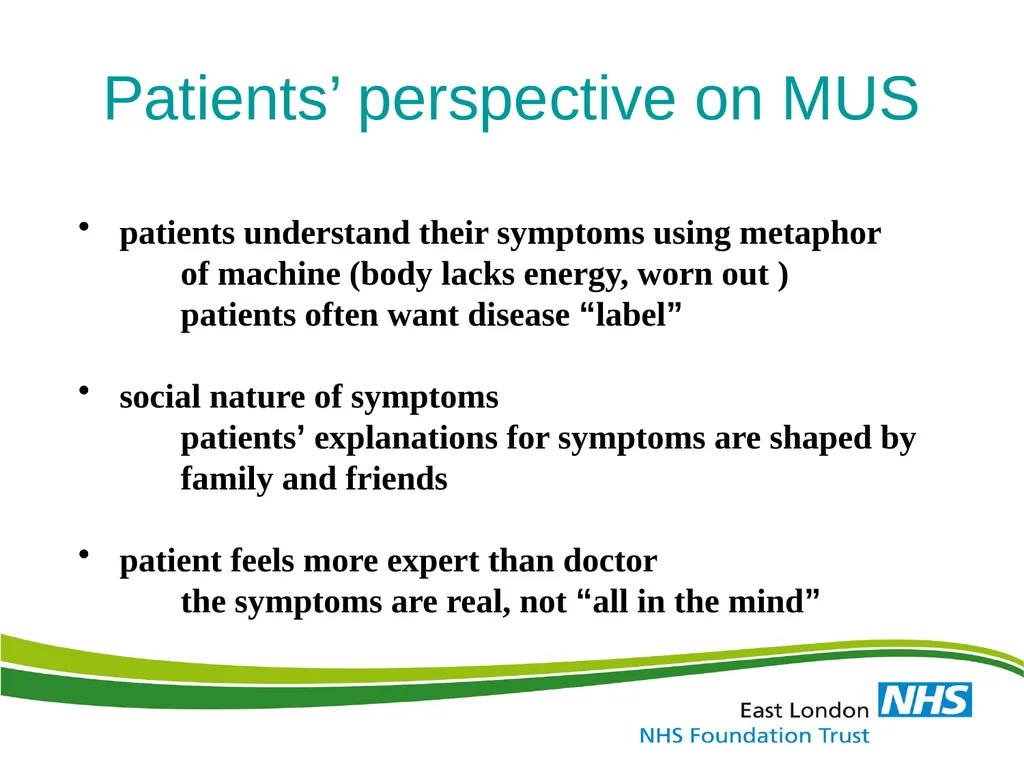
Patients’ perspective on MUS patients understand their symptoms using metaphor
of machine (body lacks energy, worn out )
patients often want disease “label”
social nature of symptoms
patients’ explanations for symptoms are shaped by
family and friends
patient feels more expert than doctor
the symptoms are real, not “all in the mind”<br>
of machine (body lacks energy, worn out )
patients often want disease “label”
social nature of symptoms
patients’ explanations for symptoms are shaped by
family and friends
patient feels more expert than doctor
the symptoms are real, not “all in the mind”<br>
09
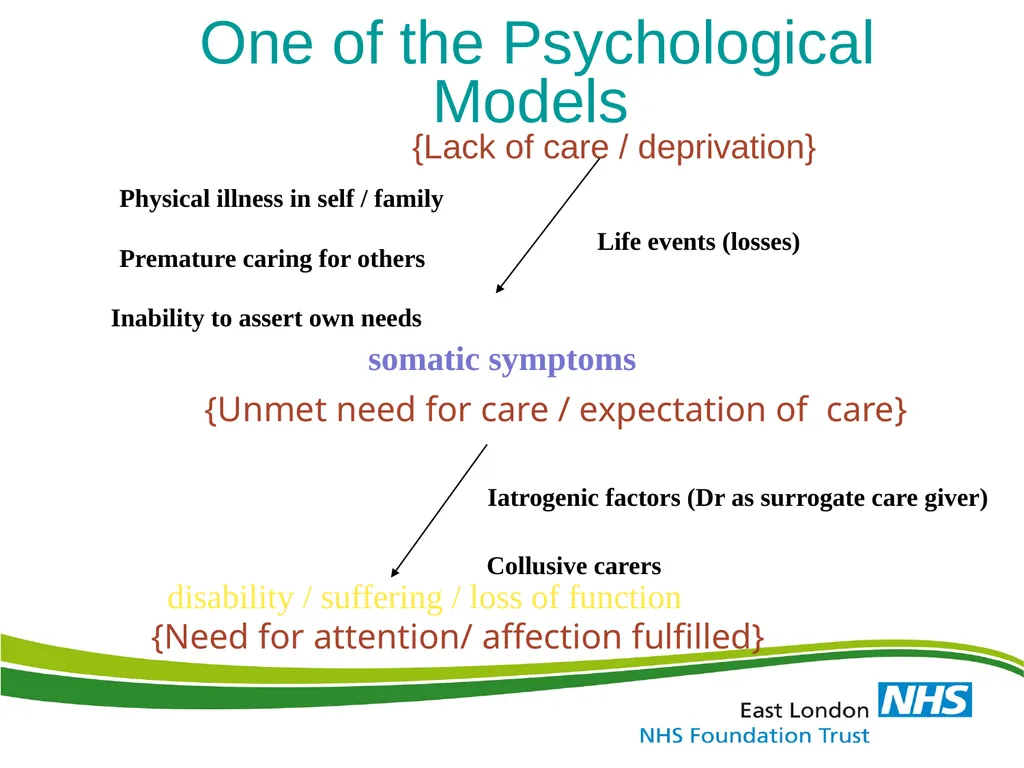
One of the Psychological Models {Lack of care / deprivation} {Unmet need for care / expectation of care} {Need for attention/ affection fulfilled} Physical illness in self / family Premature caring for others Inability to assert own needs Life events (losses) Iatrogenic factors (Dr as surrogate care giver) Collusive carers somatic symptoms disability / suffering / loss of function<br>
10
What patients and doctors say
and do not say Physical intervention proposed more often by GPs than patients
Almost all pts provided psychosocial cues
Most GPs provided explanations other than physical disease
Most also suggested physical disease
Few GPs empathised Ring A et al. Social Science & Medicine 2005;61:1505<br>
Almost all pts provided psychosocial cues
Most GPs provided explanations other than physical disease
Most also suggested physical disease
Few GPs empathised Ring A et al. Social Science & Medicine 2005;61:1505<br>
11
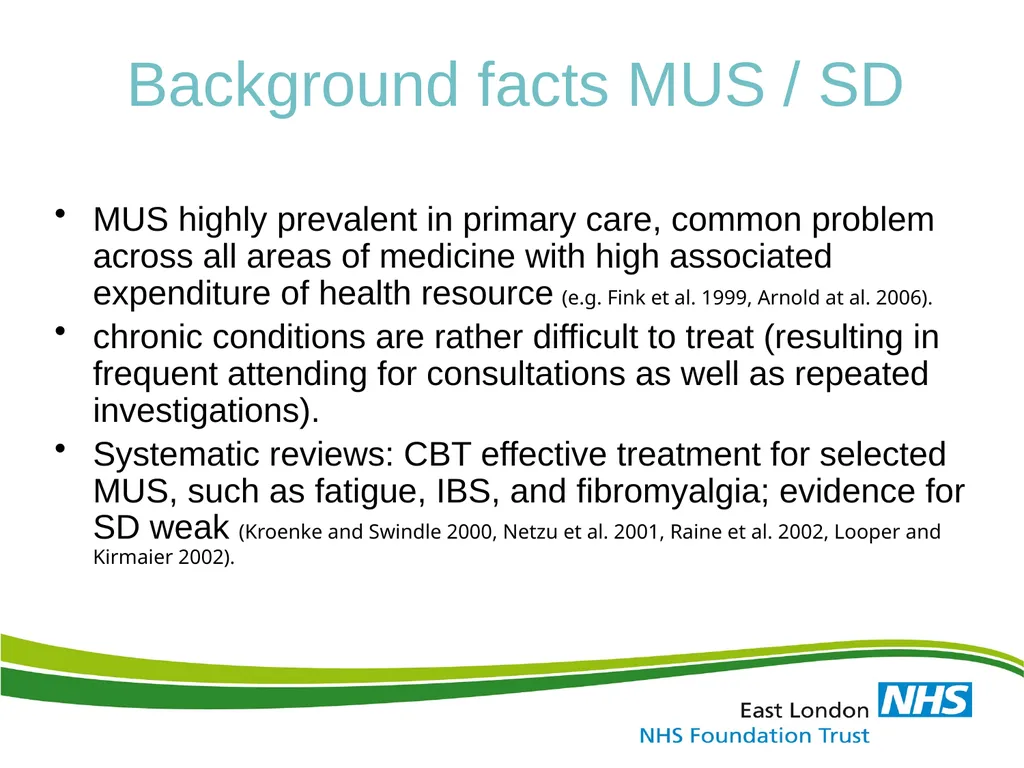
Background facts MUS / SD MUS highly prevalent in primary care, common problem across all areas of medicine with high associated expenditure of health resource (e.g. Fink et al. 1999, Arnold at al. 2006).
chronic conditions are rather difficult to treat (resulting in frequent attending for consultations as well as repeated investigations).
Systematic reviews: CBT effective treatment for selected MUS, such as fatigue, IBS, and fibromyalgia; evidence for SD weak (Kroenke and Swindle 2000, Netzu et al. 2001, Raine et al. 2002, Looper and Kirmaier 2002).<br>
chronic conditions are rather difficult to treat (resulting in frequent attending for consultations as well as repeated investigations).
Systematic reviews: CBT effective treatment for selected MUS, such as fatigue, IBS, and fibromyalgia; evidence for SD weak (Kroenke and Swindle 2000, Netzu et al. 2001, Raine et al. 2002, Looper and Kirmaier 2002).<br>
12
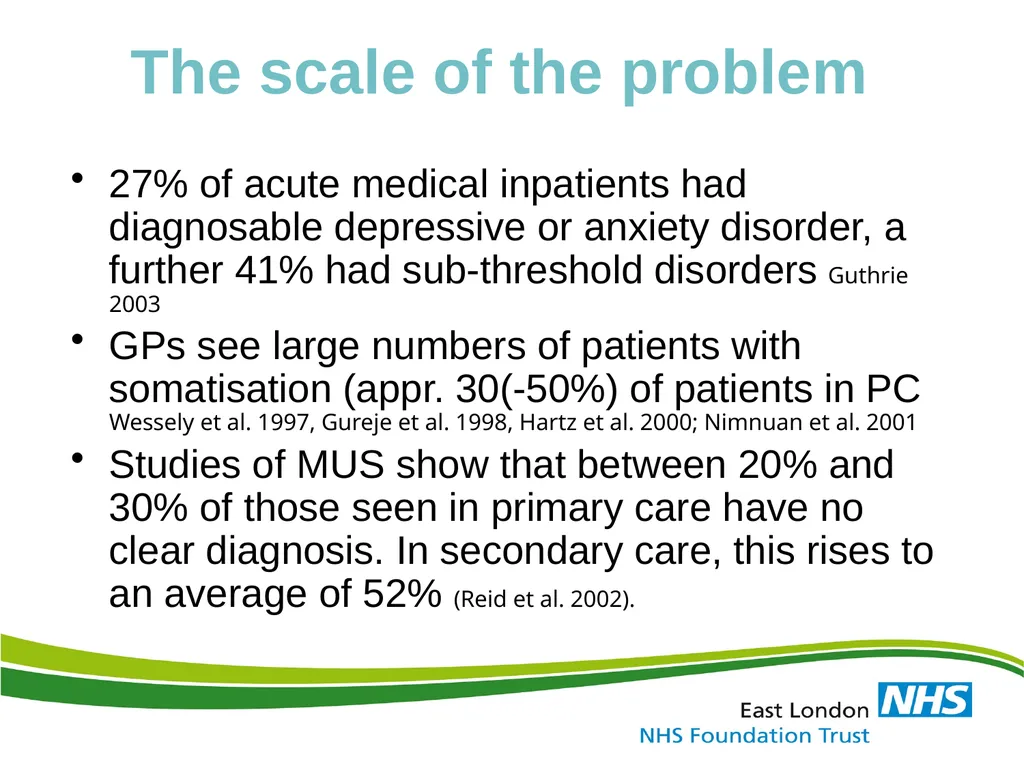
The scale of the problem 27% of acute medical inpatients had diagnosable depressive or anxiety disorder, a further 41% had sub-threshold disorders Guthrie 2003
GPs see large numbers of patients with somatisation (appr. 30(-50%) of patients in PC Wessely et al. 1997, Gureje et al. 1998, Hartz et al. 2000; Nimnuan et al. 2001
Studies of MUS show that between 20% and 30% of those seen in primary care have no clear diagnosis. In secondary care, this rises to an average of 52% (Reid et al. 2002).<br>
GPs see large numbers of patients with somatisation (appr. 30(-50%) of patients in PC Wessely et al. 1997, Gureje et al. 1998, Hartz et al. 2000; Nimnuan et al. 2001
Studies of MUS show that between 20% and 30% of those seen in primary care have no clear diagnosis. In secondary care, this rises to an average of 52% (Reid et al. 2002).<br>
13
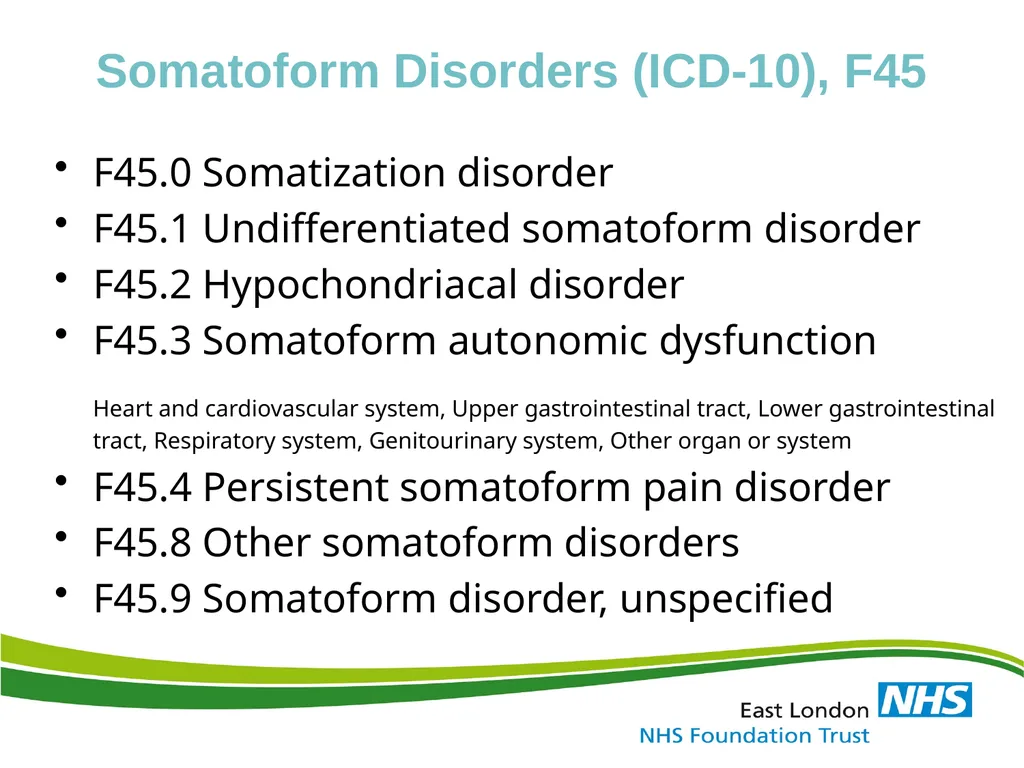
Somatoform Disorders (ICD-10), F45 F45.0 Somatization disorder
F45.1 Undifferentiated somatoform disorder
F45.2 Hypochondriacal disorder
F45.3 Somatoform autonomic dysfunction
Heart and cardiovascular system, Upper gastrointestinal tract, Lower gastrointestinal tract, Respiratory system, Genitourinary system, Other organ or system
F45.4 Persistent somatoform pain disorder
F45.8 Other somatoform disorders
F45.9 Somatoform disorder, unspecified<br>
F45.1 Undifferentiated somatoform disorder
F45.2 Hypochondriacal disorder
F45.3 Somatoform autonomic dysfunction
Heart and cardiovascular system, Upper gastrointestinal tract, Lower gastrointestinal tract, Respiratory system, Genitourinary system, Other organ or system
F45.4 Persistent somatoform pain disorder
F45.8 Other somatoform disorders
F45.9 Somatoform disorder, unspecified<br>
14
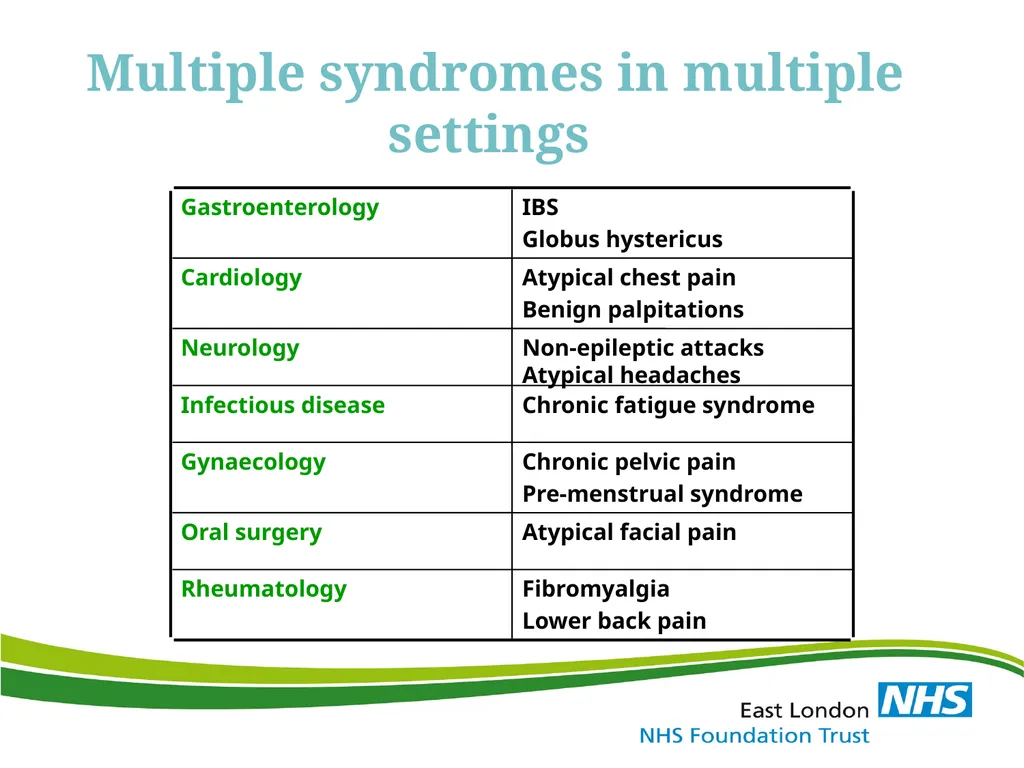
Multiple syndromes in multiple settings<br>
15
SD: ICD-Diagnostic criteria/Definition: repeated presentation of physical symptoms, together with persistent requests for medical investigations, in spite of repeated negative findings and reassurances by doctors that symptoms have no physical basis.
The patient usually resists attempts to discuss the possibility of psychological causation
The degree of understanding,…, that can be achieved about the cause of the symptoms is often disappointing and frustrating
attention-seeking (histrionic) behaviour.<br>
The patient usually resists attempts to discuss the possibility of psychological causation
The degree of understanding,…, that can be achieved about the cause of the symptoms is often disappointing and frustrating
attention-seeking (histrionic) behaviour.<br>
16
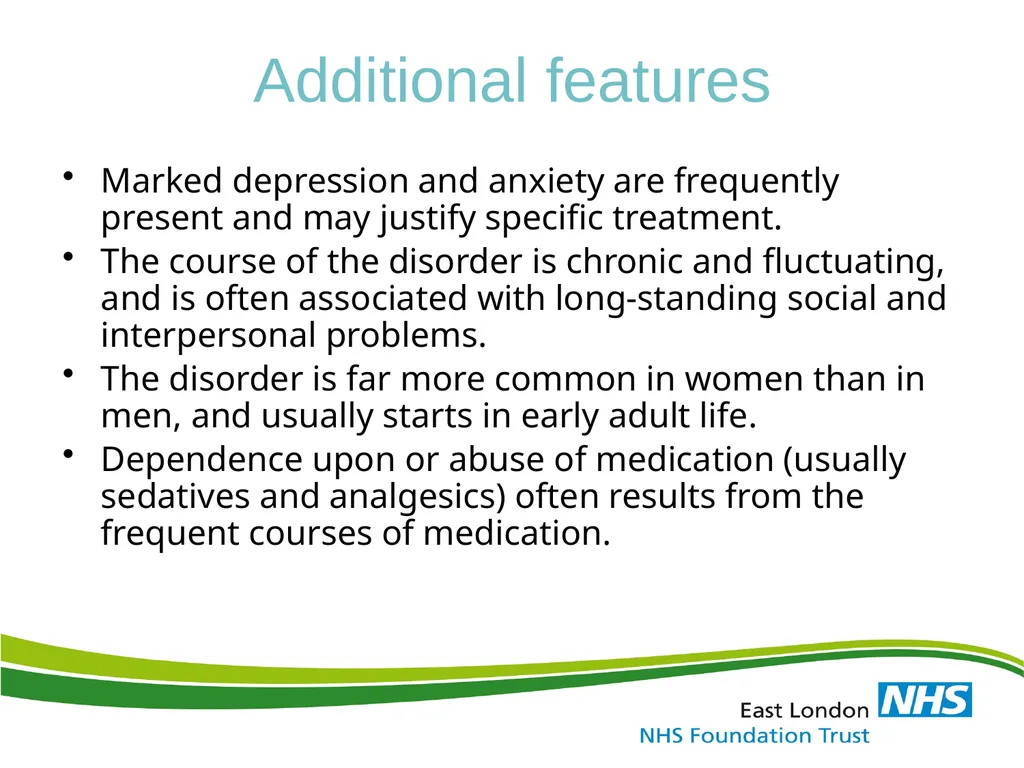
Additional features Marked depression and anxiety are frequently present and may justify specific treatment.
The course of the disorder is chronic and fluctuating, and is often associated with long-standing social and interpersonal problems.
The disorder is far more common in women than in men, and usually starts in early adult life.
Dependence upon or abuse of medication (usually sedatives and analgesics) often results from the frequent courses of medication.<br>
The course of the disorder is chronic and fluctuating, and is often associated with long-standing social and interpersonal problems.
The disorder is far more common in women than in men, and usually starts in early adult life.
Dependence upon or abuse of medication (usually sedatives and analgesics) often results from the frequent courses of medication.<br>
17
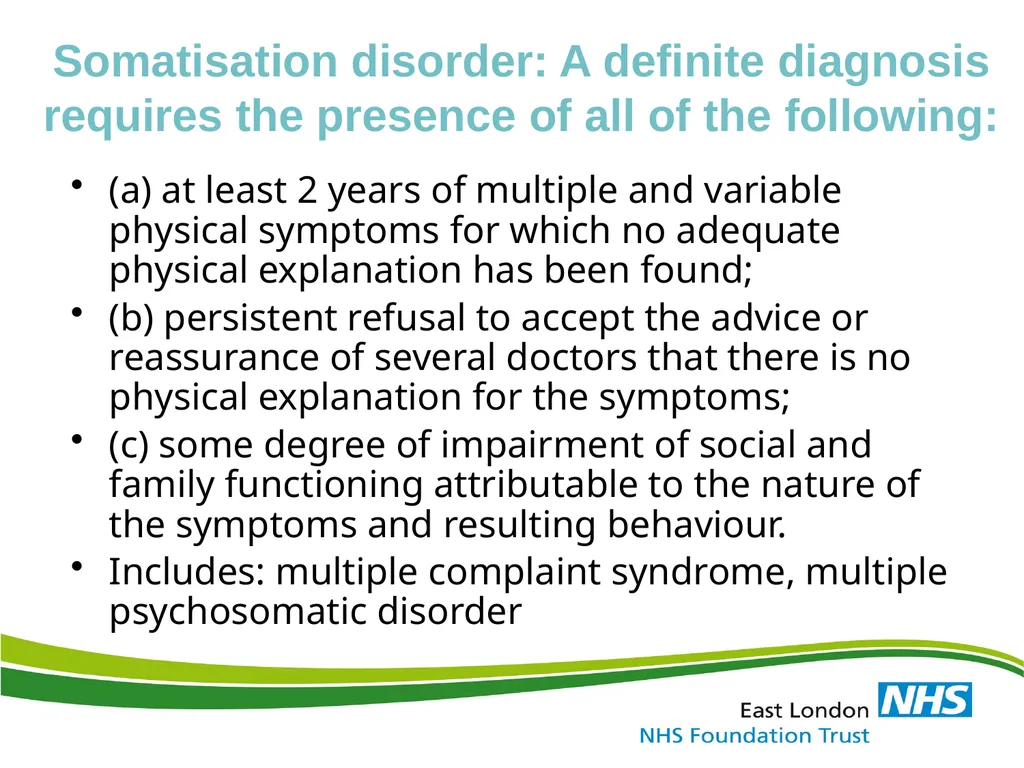
Somatisation disorder: A definite diagnosis requires the presence of all of the following: (a) at least 2 years of multiple and variable physical symptoms for which no adequate physical explanation has been found;
(b) persistent refusal to accept the advice or reassurance of several doctors that there is no physical explanation for the symptoms;
(c) some degree of impairment of social and family functioning attributable to the nature of the symptoms and resulting behaviour.
Includes: multiple complaint syndrome, multiple psychosomatic disorder<br>
(b) persistent refusal to accept the advice or reassurance of several doctors that there is no physical explanation for the symptoms;
(c) some degree of impairment of social and family functioning attributable to the nature of the symptoms and resulting behaviour.
Includes: multiple complaint syndrome, multiple psychosomatic disorder<br>
18
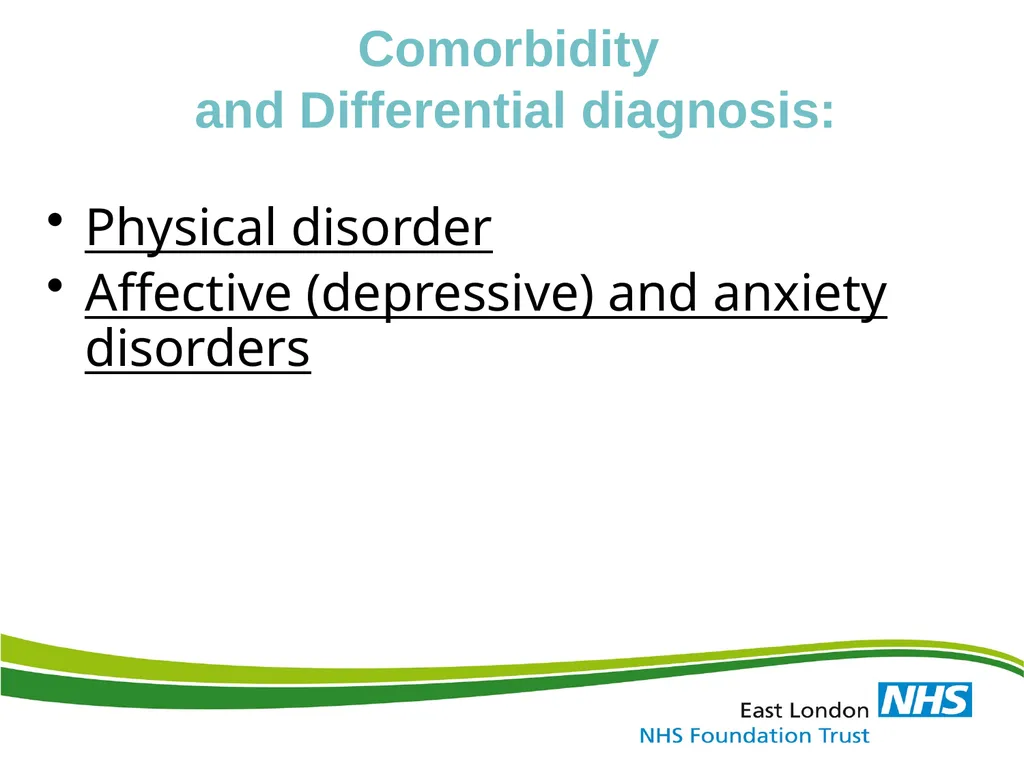
Comorbidity
and Differential diagnosis: Physical disorder
Affective (depressive) and anxiety disorders<br>
Affective (depressive) and anxiety disorders<br>
19
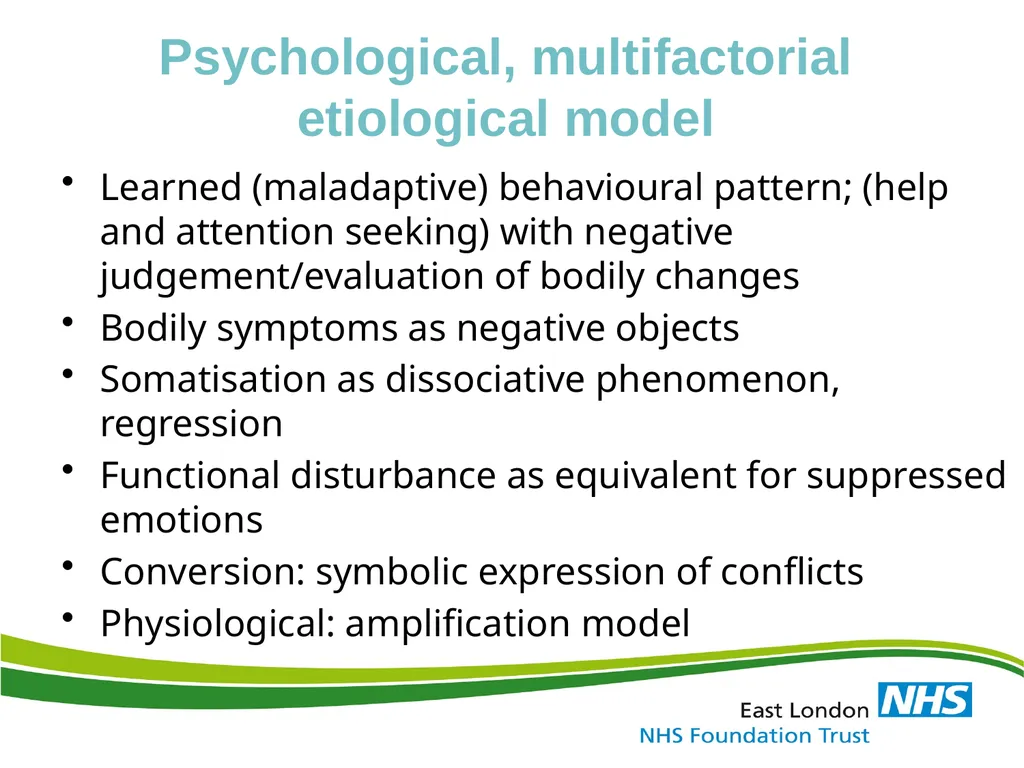
Psychological, multifactorial
etiological model Learned (maladaptive) behavioural pattern; (help and attention seeking) with negative judgement/evaluation of bodily changes
Bodily symptoms as negative objects
Somatisation as dissociative phenomenon, regression
Functional disturbance as equivalent for suppressed emotions
Conversion: symbolic expression of conflicts
Physiological: amplification model<br>
Bodily symptoms as negative objects
Somatisation as dissociative phenomenon, regression
Functional disturbance as equivalent for suppressed emotions
Conversion: symbolic expression of conflicts
Physiological: amplification model<br>
20
Triggers: life events, stress, information from media, etc.<br>
21
Management of MUS conditions<br>
22
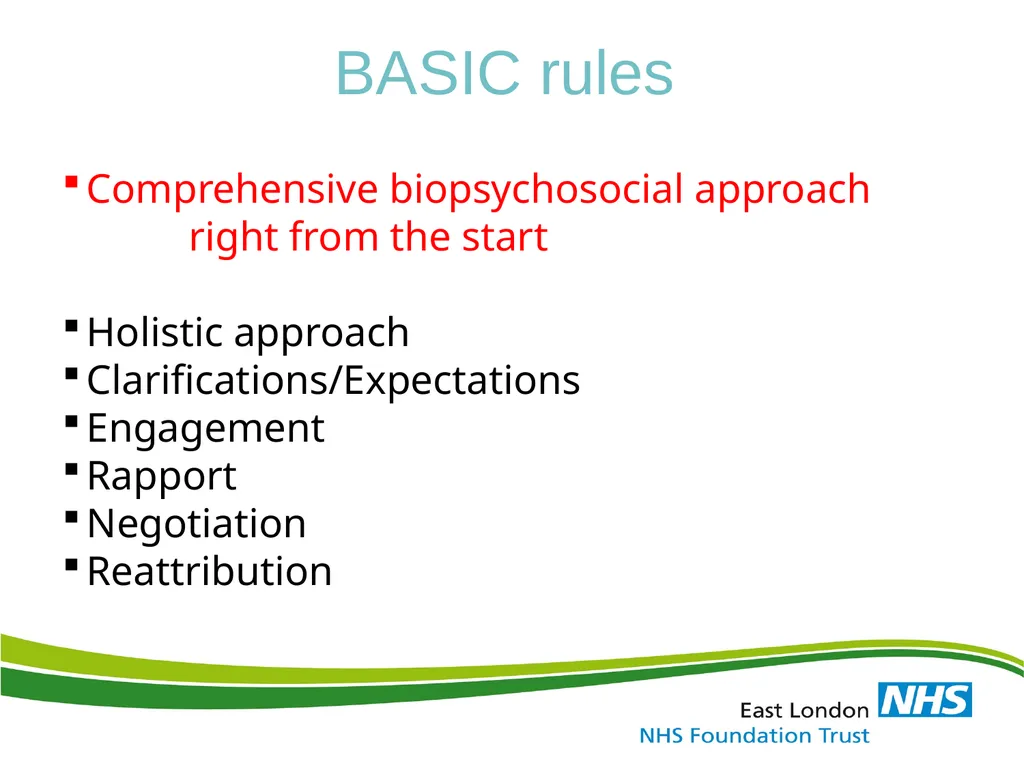
BASIC rules Comprehensive biopsychosocial approach right from the start
Holistic approach
Clarifications/Expectations
Engagement
Rapport
Negotiation
Reattribution<br>
Holistic approach
Clarifications/Expectations
Engagement
Rapport
Negotiation
Reattribution<br>
23
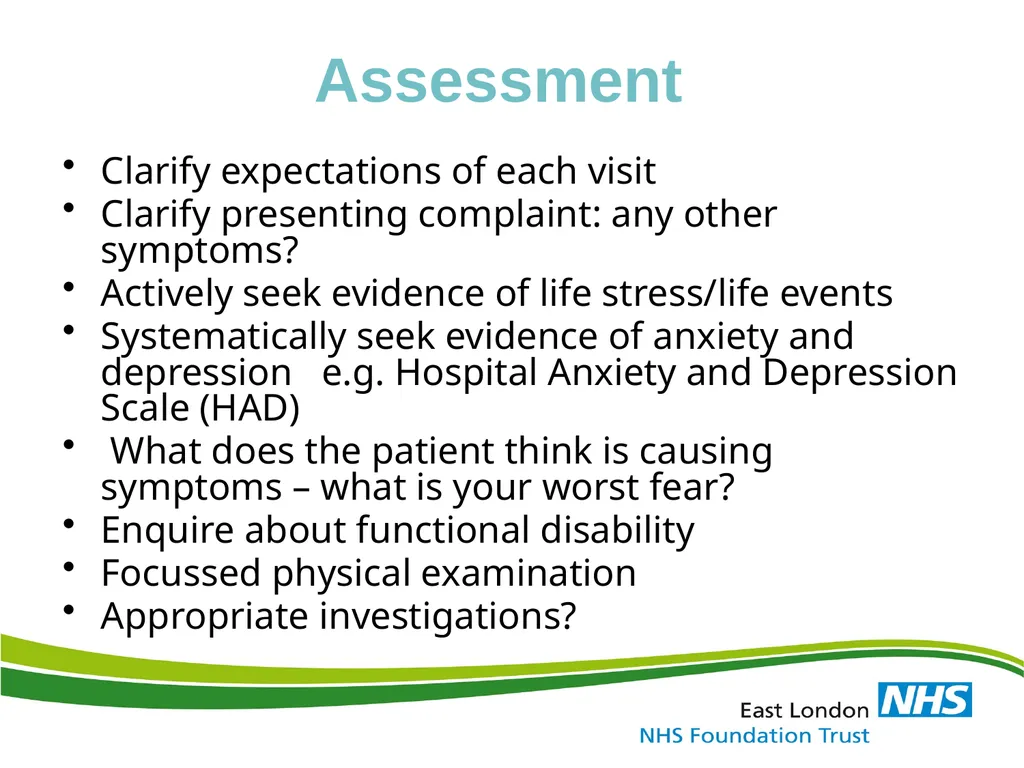
Assessment Clarify expectations of each visit
Clarify presenting complaint: any other symptoms?
Actively seek evidence of life stress/life events
Systematically seek evidence of anxiety and depression e.g. Hospital Anxiety and Depression Scale (HAD)
What does the patient think is causing symptoms – what is your worst fear?
Enquire about functional disability
Focussed physical examination
Appropriate investigations?<br>
Clarify presenting complaint: any other symptoms?
Actively seek evidence of life stress/life events
Systematically seek evidence of anxiety and depression e.g. Hospital Anxiety and Depression Scale (HAD)
What does the patient think is causing symptoms – what is your worst fear?
Enquire about functional disability
Focussed physical examination
Appropriate investigations?<br>
24
Goldberg D et al. J Psychosomatic Res 1989;33:689 Key interviewing skills Acknowledge reality of pain
Flexible, negotiating style
Reframe complaints, i.e. somatic and emotional,
Encourage link-making and reflect back
Respond to mood cues
Empathic statements e.g. disappointment with doctors
Elicit beliefs and assumptions with open questions
Summarise repeatedly, and invite criticism
Involve partner / key other if possible<br>
Flexible, negotiating style
Reframe complaints, i.e. somatic and emotional,
Encourage link-making and reflect back
Respond to mood cues
Empathic statements e.g. disappointment with doctors
Elicit beliefs and assumptions with open questions
Summarise repeatedly, and invite criticism
Involve partner / key other if possible<br>
25
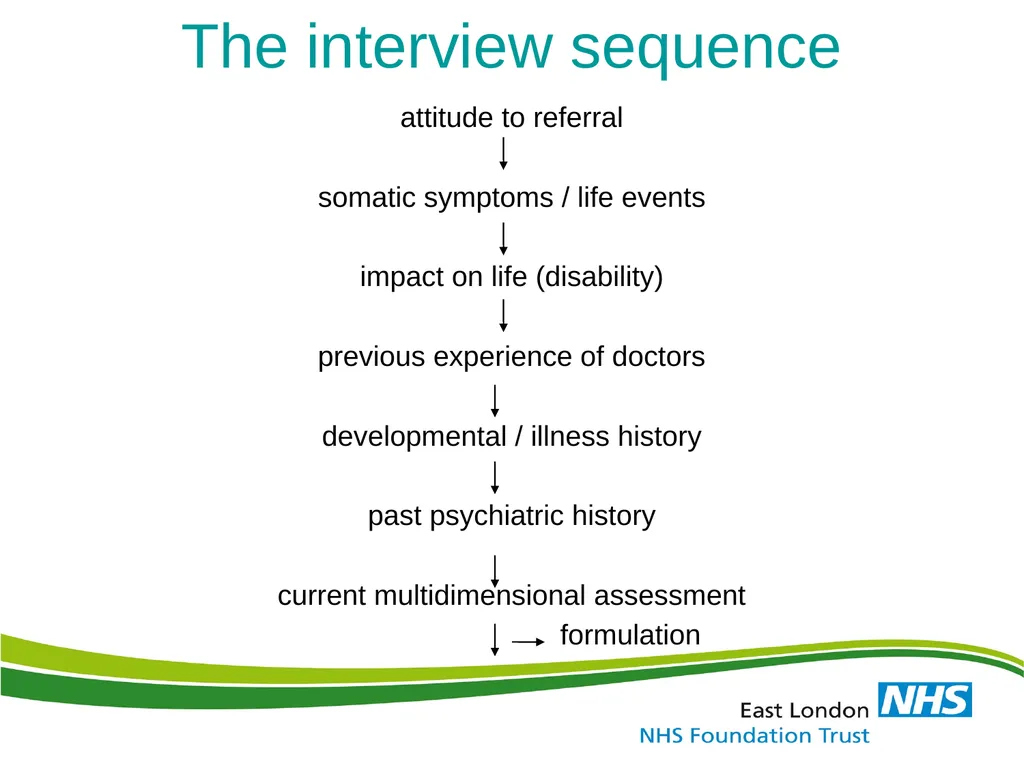
The interview sequence attitude to referral
somatic symptoms / life events
impact on life (disability)
previous experience of doctors
developmental / illness history
past psychiatric history
current multidimensional assessment
formulation<br>
somatic symptoms / life events
impact on life (disability)
previous experience of doctors
developmental / illness history
past psychiatric history
current multidimensional assessment
formulation<br>
26
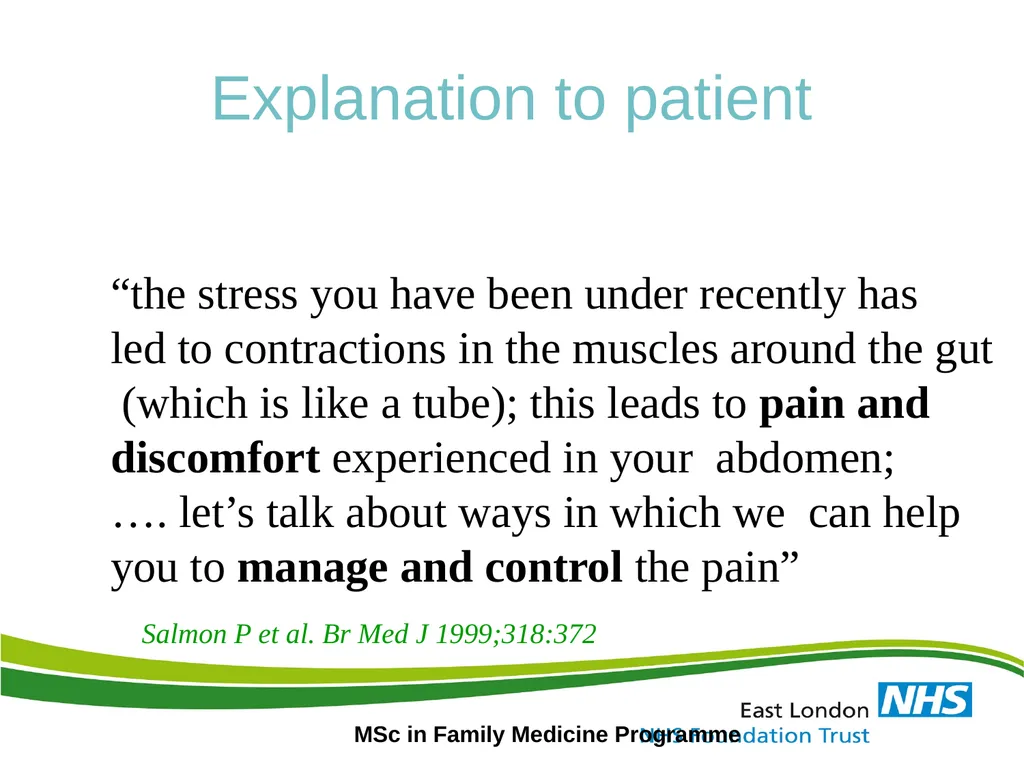
Explanation to patient MSc in Family Medicine Programme “the stress you have been under recently has
led to contractions in the muscles around the gut
(which is like a tube); this leads to pain and
discomfort experienced in your abdomen;
…. let’s talk about ways in which we can help
you to manage and control the pain” Salmon P et al. Br Med J 1999;318:372<br>
led to contractions in the muscles around the gut
(which is like a tube); this leads to pain and
discomfort experienced in your abdomen;
…. let’s talk about ways in which we can help
you to manage and control the pain” Salmon P et al. Br Med J 1999;318:372<br>
27
Explanations that lead to satisfaction
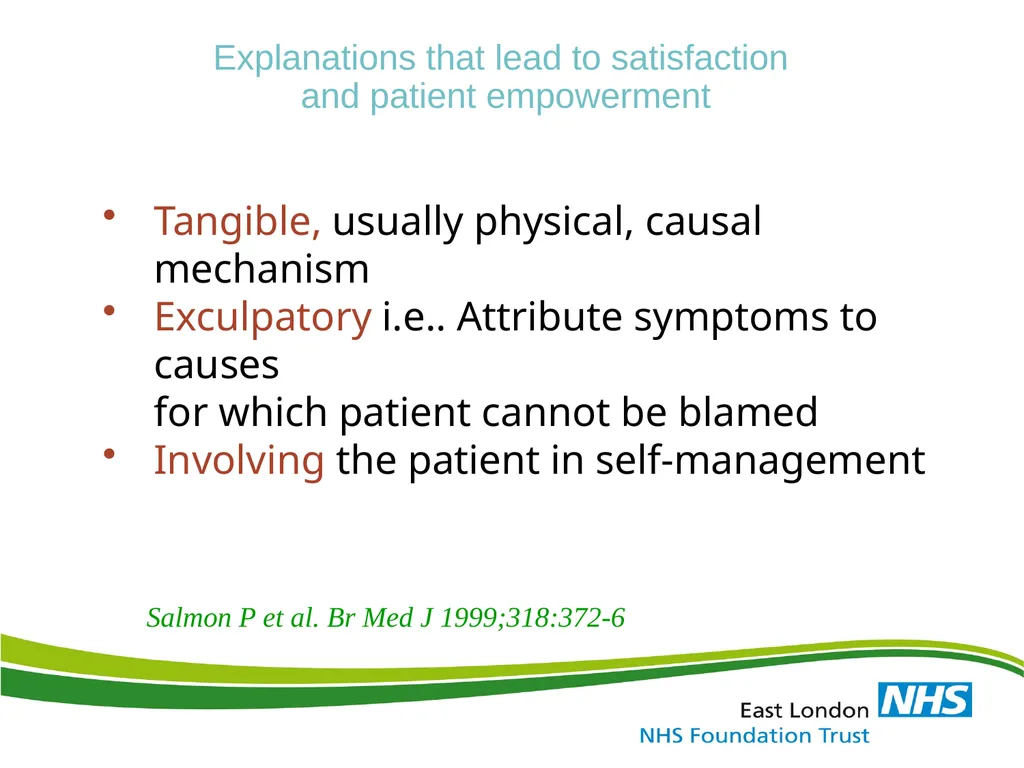
and patient empowerment Tangible, usually physical, causal mechanism
Exculpatory i.e.. Attribute symptoms to causes
for which patient cannot be blamed
Involving the patient in self-management Salmon P et al. Br Med J 1999;318:372-6<br>
Exculpatory i.e.. Attribute symptoms to causes
for which patient cannot be blamed
Involving the patient in self-management Salmon P et al. Br Med J 1999;318:372-6<br>
28
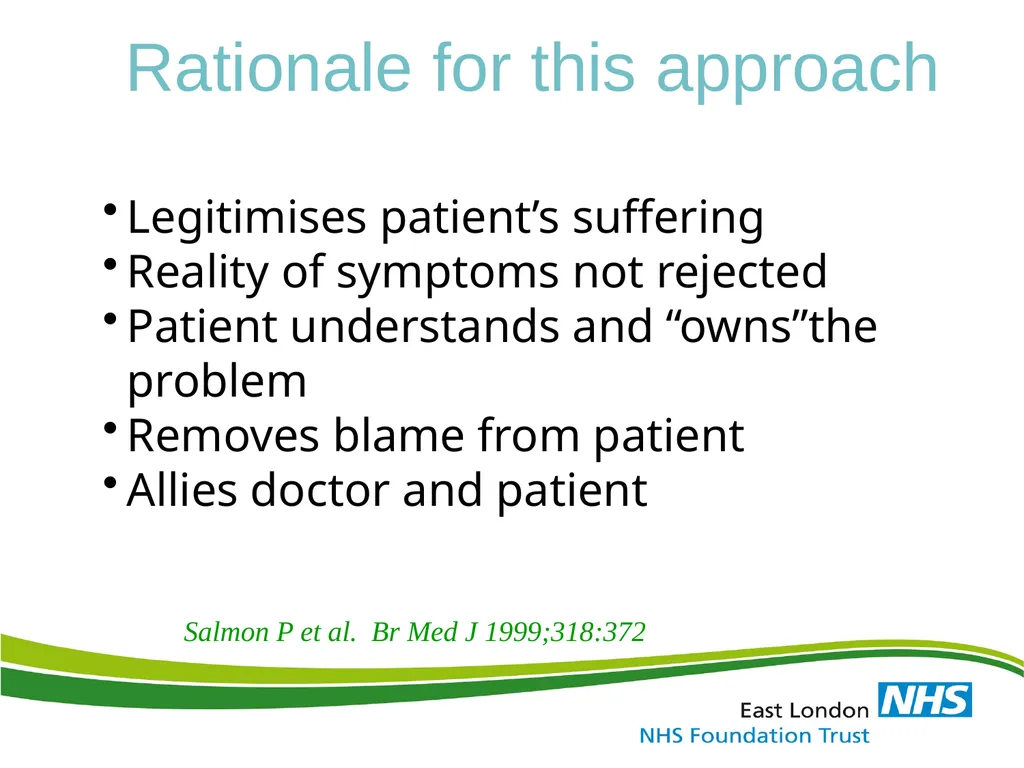
Rationale for this approach Legitimises patient’s suffering
Reality of symptoms not rejected
Patient understands and “owns”the problem
Removes blame from patient
Allies doctor and patient Salmon P et al. Br Med J 1999;318:372<br>
Reality of symptoms not rejected
Patient understands and “owns”the problem
Removes blame from patient
Allies doctor and patient Salmon P et al. Br Med J 1999;318:372<br>
29
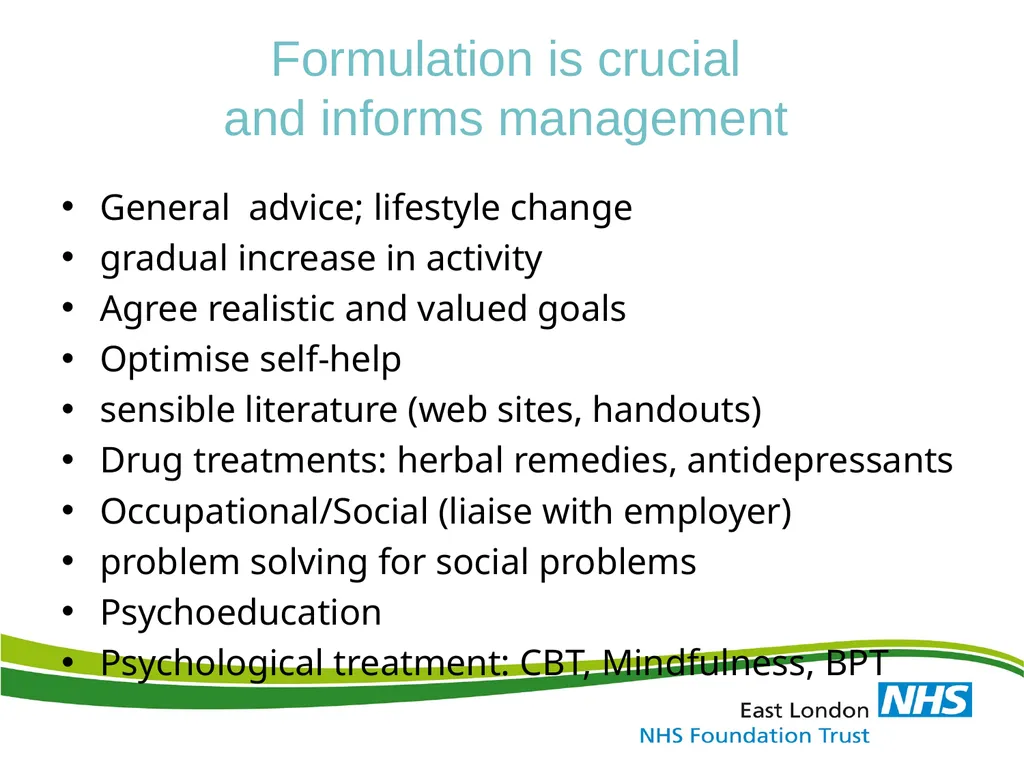
Formulation is crucial
and informs management General advice; lifestyle change
gradual increase in activity
Agree realistic and valued goals
Optimise self-help
sensible literature (web sites, handouts)
Drug treatments: herbal remedies, antidepressants
Occupational/Social (liaise with employer)
problem solving for social problems
Psychoeducation
Psychological treatment: CBT, Mindfulness, BPT<br>
gradual increase in activity
Agree realistic and valued goals
Optimise self-help
sensible literature (web sites, handouts)
Drug treatments: herbal remedies, antidepressants
Occupational/Social (liaise with employer)
problem solving for social problems
Psychoeducation
Psychological treatment: CBT, Mindfulness, BPT<br>
30
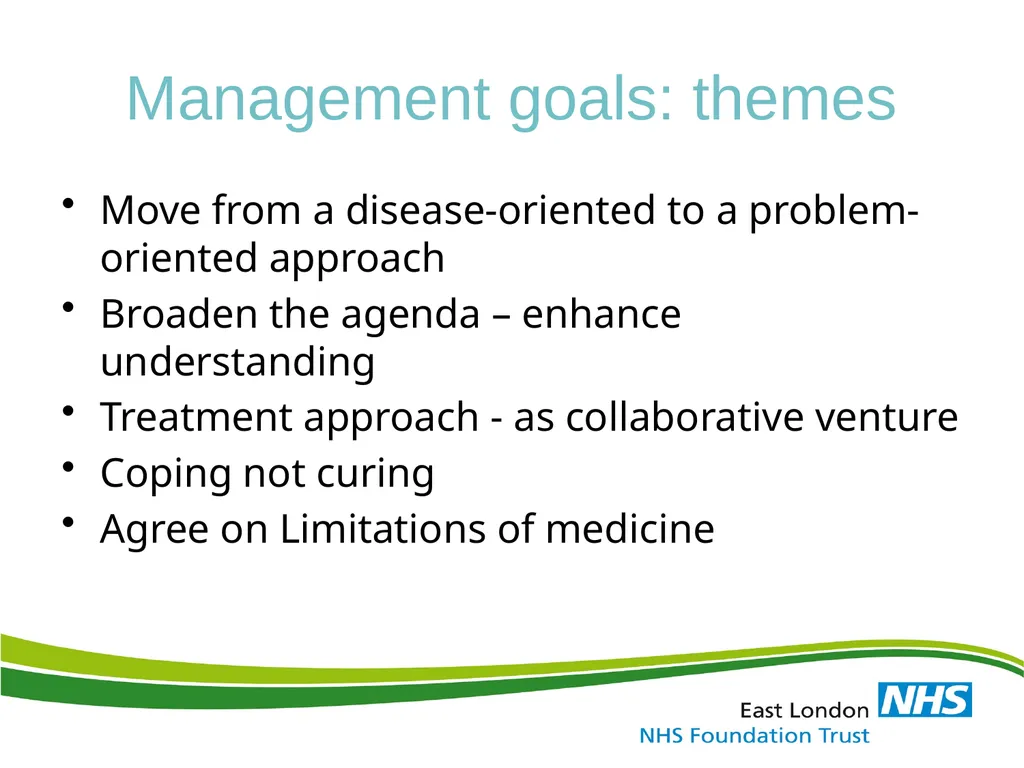
Management goals: themes Move from a disease-oriented to a problem-oriented approach
Broaden the agenda – enhance understanding
Treatment approach - as collaborative venture
Coping not curing
Agree on Limitations of medicine<br>
Broaden the agenda – enhance understanding
Treatment approach - as collaborative venture
Coping not curing
Agree on Limitations of medicine<br>
31
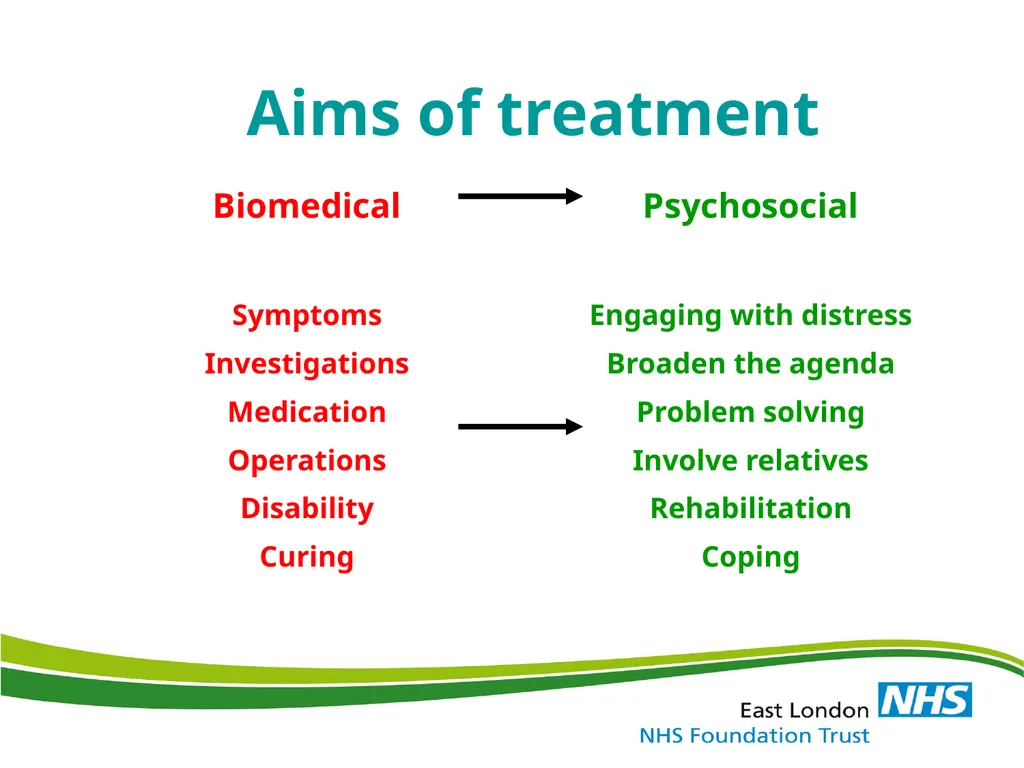
Aims of treatment Biomedical
Symptoms
Investigations
Medication
Operations
Disability
Curing Psychosocial
Engaging with distress
Broaden the agenda
Problem solving
Involve relatives
Rehabilitation
Coping<br>
Symptoms
Investigations
Medication
Operations
Disability
Curing Psychosocial
Engaging with distress
Broaden the agenda
Problem solving
Involve relatives
Rehabilitation
Coping<br>
32
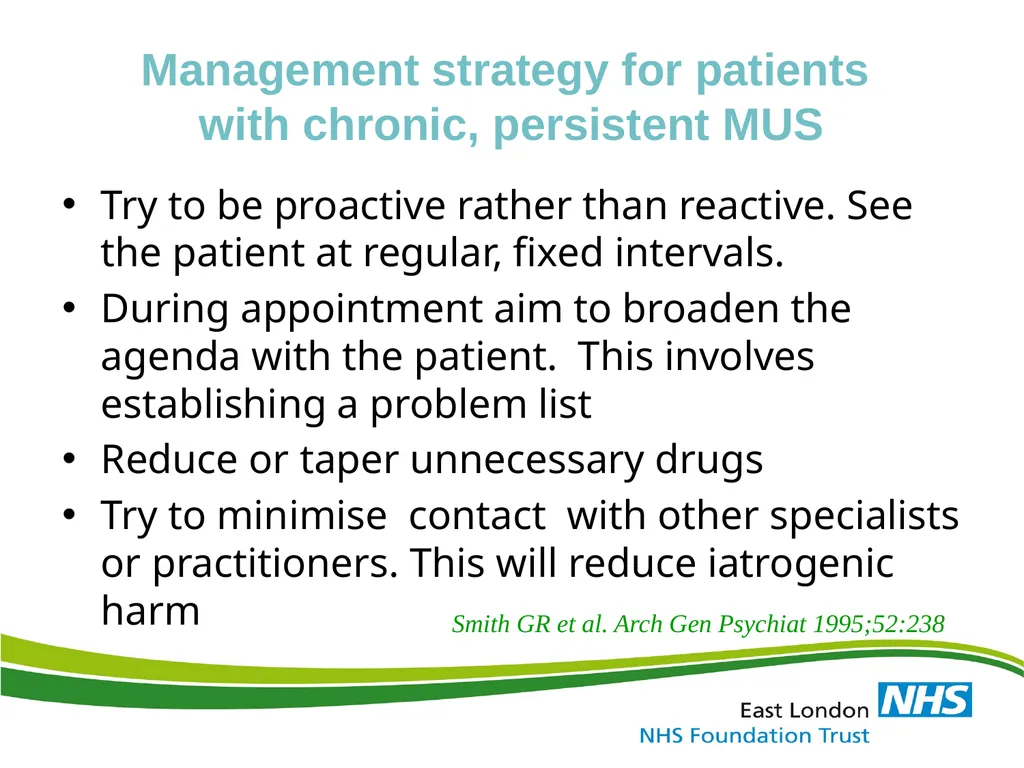
Management strategy for patients
with chronic, persistent MUS Try to be proactive rather than reactive. See the patient at regular, fixed intervals.
During appointment aim to broaden the agenda with the patient. This involves establishing a problem list
Reduce or taper unnecessary drugs
Try to minimise contact with other specialists or practitioners. This will reduce iatrogenic harm Smith GR et al. Arch Gen Psychiat 1995;52:238<br>
During appointment aim to broaden the agenda with the patient. This involves establishing a problem list
Reduce or taper unnecessary drugs
Try to minimise contact with other specialists or practitioners. This will reduce iatrogenic harm Smith GR et al. Arch Gen Psychiat 1995;52:238<br>
33
Cont. Try to co-opt a relative as a therapeutic ally to implement your management goals
Reduce your expectation of cure: instead aim for containment and damage limitation
Encourage the patient (and yourself) to think in terms of coping and not curing<br>
Reduce your expectation of cure: instead aim for containment and damage limitation
Encourage the patient (and yourself) to think in terms of coping and not curing<br>
34
What is my health condition about? - Explanations Many people are faced with problems linked to having to live and cope with physical symptoms that don’t get better with medical treatment.
You may experience these symptoms as being disabling, you may also suffer pain and discomfort.
Your doctor/ nurse may have been unable to explain why you are suffering with your symptoms.
Sometimes it may have felt as if the realities of your symptoms are being doubted.
This may have affected your relationship with the doctors and nurses trying to help you.<br>
You may experience these symptoms as being disabling, you may also suffer pain and discomfort.
Your doctor/ nurse may have been unable to explain why you are suffering with your symptoms.
Sometimes it may have felt as if the realities of your symptoms are being doubted.
This may have affected your relationship with the doctors and nurses trying to help you.<br>
35
The vicious circle:
Body symptoms & Stress Every symptom such as pain or tension causes stress
Every human has a response to stress that is either learned or genetically implanted. Almost all of this response will be triggered by a “survival instinct” to help you to fight off or flee this stress/danger.
The body reacts: Increased heart rate, Breathing usually becomes more rapid, Stress hormones are released, Blood pressure can go up, Muscles that you would use to fight or flee often become tight
All of your senses are heightened when under stress<br>
Every human has a response to stress that is either learned or genetically implanted. Almost all of this response will be triggered by a “survival instinct” to help you to fight off or flee this stress/danger.
The body reacts: Increased heart rate, Breathing usually becomes more rapid, Stress hormones are released, Blood pressure can go up, Muscles that you would use to fight or flee often become tight
All of your senses are heightened when under stress<br>
36
Working to increase activity For many people living with physical symptoms the issue of taking part in activities that require them to take exercise can become troublesome.
Working to increase helpful activity and behaviour can help to make lots of physical symptoms to improve and can also help to overcome stress.
Mental Health Foundation document ‘Moving on Up’ published in 2009 lets us know that regular exercise can help you to stay well.
Exercise can also relieve stress by making you feel good about mastering a new skill, as well as improving your fitness and energy levels.<br>
Working to increase helpful activity and behaviour can help to make lots of physical symptoms to improve and can also help to overcome stress.
Mental Health Foundation document ‘Moving on Up’ published in 2009 lets us know that regular exercise can help you to stay well.
Exercise can also relieve stress by making you feel good about mastering a new skill, as well as improving your fitness and energy levels.<br>
37
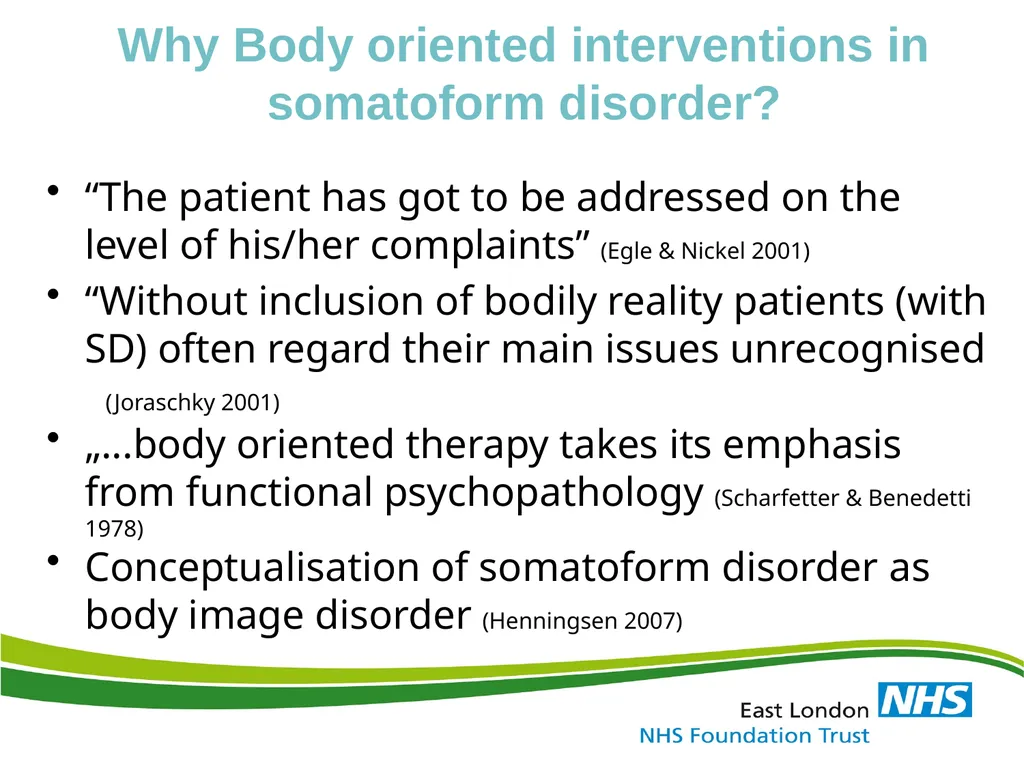
Why Body oriented interventions in somatoform disorder? “The patient has got to be addressed on the level of his/her complaints” (Egle & Nickel 2001)
“Without inclusion of bodily reality patients (with SD) often regard their main issues unrecognised (Joraschky 2001)
„...body oriented therapy takes its emphasis from functional psychopathology (Scharfetter & Benedetti 1978)
Conceptualisation of somatoform disorder as body image disorder (Henningsen 2007)<br>
“Without inclusion of bodily reality patients (with SD) often regard their main issues unrecognised (Joraschky 2001)
„...body oriented therapy takes its emphasis from functional psychopathology (Scharfetter & Benedetti 1978)
Conceptualisation of somatoform disorder as body image disorder (Henningsen 2007)<br>
38
Conclusions Preparation
Sequence of interview
Engaging/Negotiating Style
Developmental perspective to be considered
Long interview may be needed
Treatment flexible and based on formulation
Prevent Iatrogenic harm
Interdisciplinary Approach
Scale down expectation of cure
Exercising & Body oriented interventions<br>
Sequence of interview
Engaging/Negotiating Style
Developmental perspective to be considered
Long interview may be needed
Treatment flexible and based on formulation
Prevent Iatrogenic harm
Interdisciplinary Approach
Scale down expectation of cure
Exercising & Body oriented interventions<br>
39
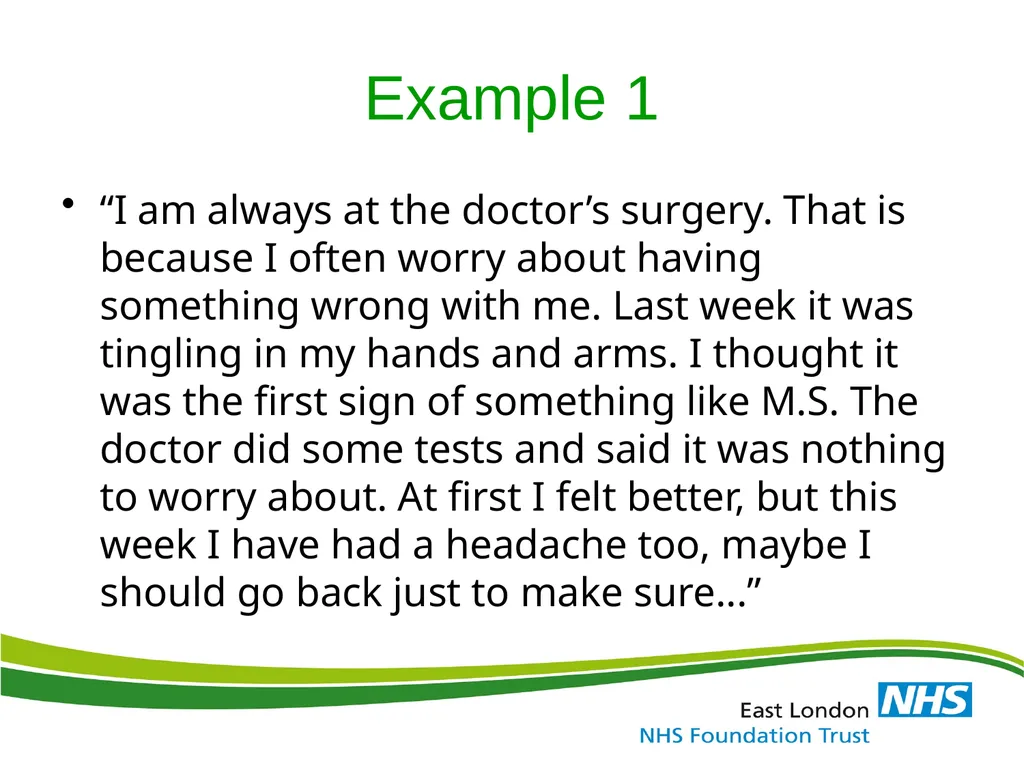
Example 1 “I am always at the doctor’s surgery. That is because I often worry about having something wrong with me. Last week it was tingling in my hands and arms. I thought it was the first sign of something like M.S. The doctor did some tests and said it was nothing to worry about. At first I felt better, but this week I have had a headache too, maybe I should go back just to make sure...”<br>
40
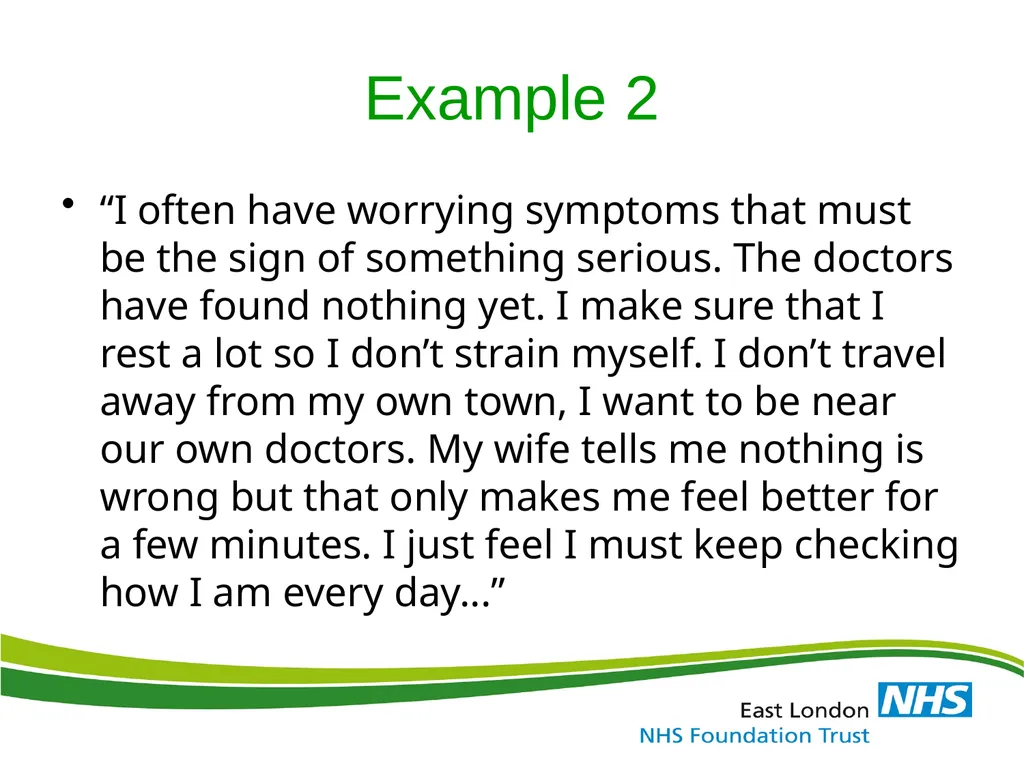
Example 2 “I often have worrying symptoms that must be the sign of something serious. The doctors have found nothing yet. I make sure that I rest a lot so I don’t strain myself. I don’t travel away from my own town, I want to be near our own doctors. My wife tells me nothing is wrong but that only makes me feel better for a few minutes. I just feel I must keep checking how I am every day...”<br>