
Mental Capacity drop-in session for care providers



Description: Mental Capacity drop-in session for care providers June 2023 Chris Hamilton christopher.hamiltonsomerset.gov.uk Last time we discussed The previous set of slides with links to MCA resources is included after the new ones for today
Related Topics
Download Presentation
"Mental Capacity drop-in session for care providers" is the property of its rightful owner. Permission is granted to download and print the materials on this website for personal, non-commercial use only, and to display it on your personal computer provided you do not modify the materials and that you retain all copyright notices contained in the materials. By downloading content from our website, you accept the terms of this agreement.
Presentation Transcript
slide1. Mental Capacity drop-in session for care providers June 2023
Chris Hamilton christopher.hamilton@somerset.gov.uk<br>
slide2. Last time we discussed… The previous set of slides with links to MCA resources is included after the new ones for today
Fluctuating mental capacity
What is a restriction?
Liberty Protection Safeguards – what next?<br>
slide3. What is the aim of the Mental Capacity Act? To enable people – anyone – to have maximum control or influence over decisions which affect them
It provides:
A legal framework for the protection of individual’s rights to autonomy by setting out what it means to have or lack capacity and how decisions should be made on behalf of people who lack capacity<br>
slide4. Somerset mental capacity competency framework Developed by Somerset Council and NHS partners with support from some care providers to test out materials
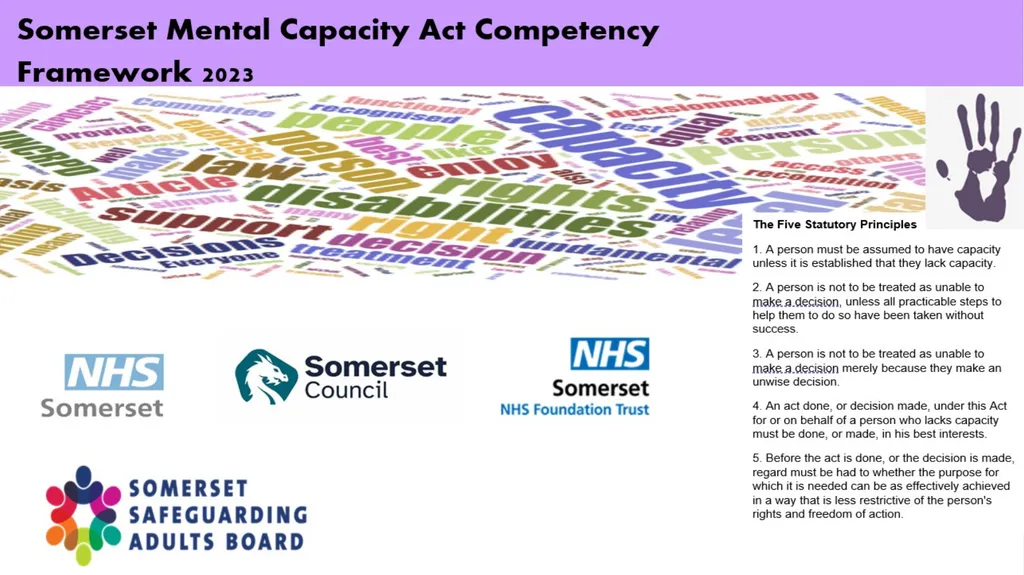
Somerset-Mental-Capacity-Act-Competency-Framework-April-2023.docx (live.com)
Its purpose:
To help organisations apply the Mental Capacity Act effectively by identifying the skills and knowledge required by staff according to their roles
Some people need to know about the basic concepts
Some people need to take action to assess mental capacity and make decisions
Some are responsible for providing more expert advice or planning staff training<br>
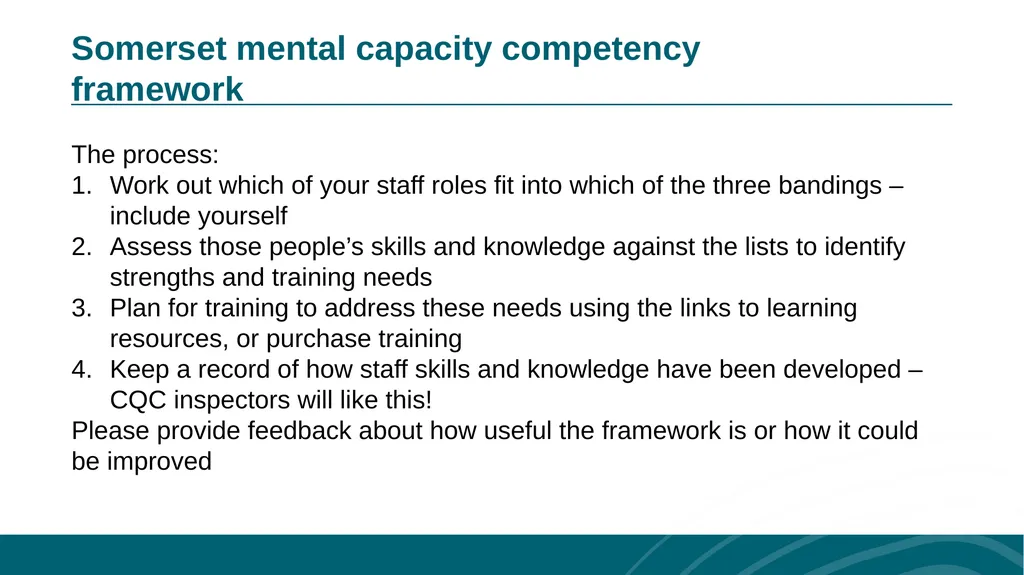
slide6. Somerset mental capacity competency framework The process:
Work out which of your staff roles fit into which of the three bandings – include yourself
Assess those people’s skills and knowledge against the lists to identify strengths and training needs
Plan for training to address these needs using the links to learning resources, or purchase training
Keep a record of how staff skills and knowledge have been developed – CQC inspectors will like this!
Please provide feedback about how useful the framework is or how it could be improved<br>
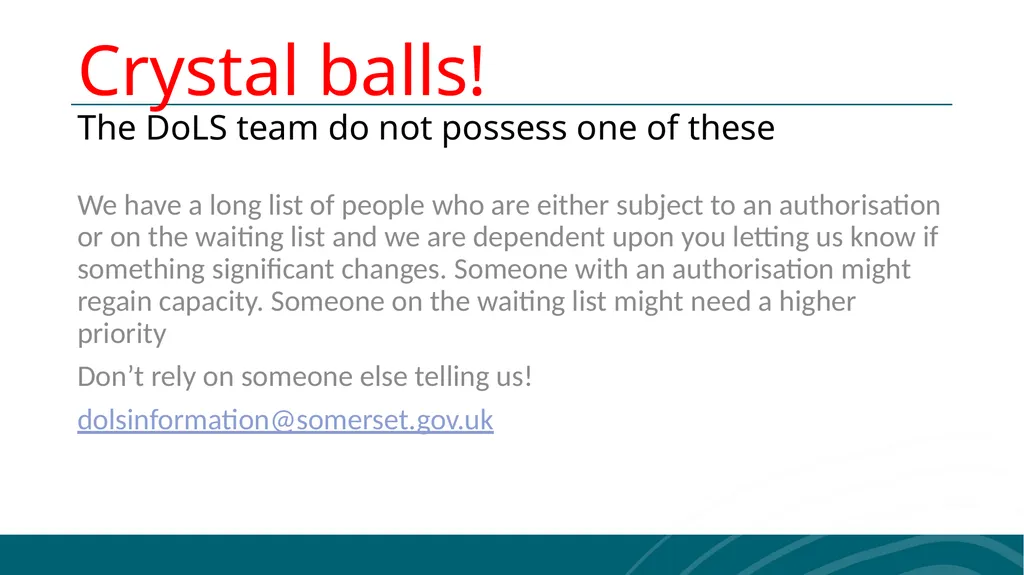
slide7. Crystal balls! The DoLS team do not possess one of these We have a long list of people who are either subject to an authorisation or on the waiting list and we are dependent upon you letting us know if something significant changes. Someone with an authorisation might regain capacity. Someone on the waiting list might need a higher priority
Don’t rely on someone else telling us!
dolsinformation@somerset.gov.uk<br>
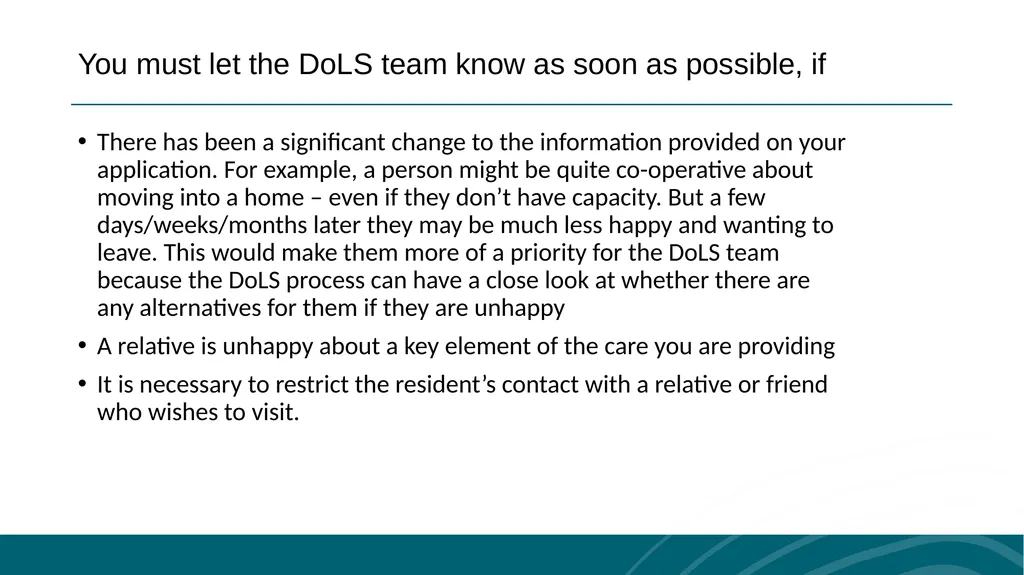
slide8. You must let the DoLS team know as soon as possible, if There has been a significant change to the information provided on your application. For example, a person might be quite co-operative about moving into a home – even if they don’t have capacity. But a few days/weeks/months later they may be much less happy and wanting to leave. This would make them more of a priority for the DoLS team because the DoLS process can have a close look at whether there are any alternatives for them if they are unhappy
A relative is unhappy about a key element of the care you are providing
It is necessary to restrict the resident’s contact with a relative or friend who wishes to visit.<br>
slide9. Mental Capacity drop-in session for care providers April 2023
Chris Hamilton christopher.hamilton@somerset.gov.uk<br>
slide10. What is the aim of the Mental Capacity Act? To enable people – anyone – to have maximum control or influence over decisions which affect them
It provides:
A legal framework for the protection of individual’s rights to autonomy by setting out what it means to have or lack capacity and how decisions should be made on behalf of people who lack capacity<br>
slide11. Fluctuating mental capacity A variation over time of a person’s ability to make a decision or decisions
Caused by a mental disorder, impairment or illness
Not the same as a temporary lack of capacity for example due to delirium or intoxication
Looking after a person whose capacity fluctuates is challenging
Some examples please<br>
slide12. Fluctuating mental capacity 2 Making best use of the periods of lucidity
Can you:
have a conversation to establish the person’s real wishes?
seek agreement for an approach to managing their needs at times when their capacity is poor?
Do document these conversations because this will help you and your staff be more confident about how to make a best interests decision – for example to keep the person safe – when this is needed<br>
slide13. What is a restriction? Legally speaking, anything which interferes with a person’s liberty in some way
Sometimes the word ‘restraint’ is also used to mean the same thing but it has some negative connotations<br>
slide14. Liberty to do what? Physical liberty to move about, to come and go as you please
To choose where to live
To form your own routines
To spend your time as you wish
To spend time with whoever you want to
To make your own decisions
To choose what to eat and whether to take medication
To decide how to spend your money<br>
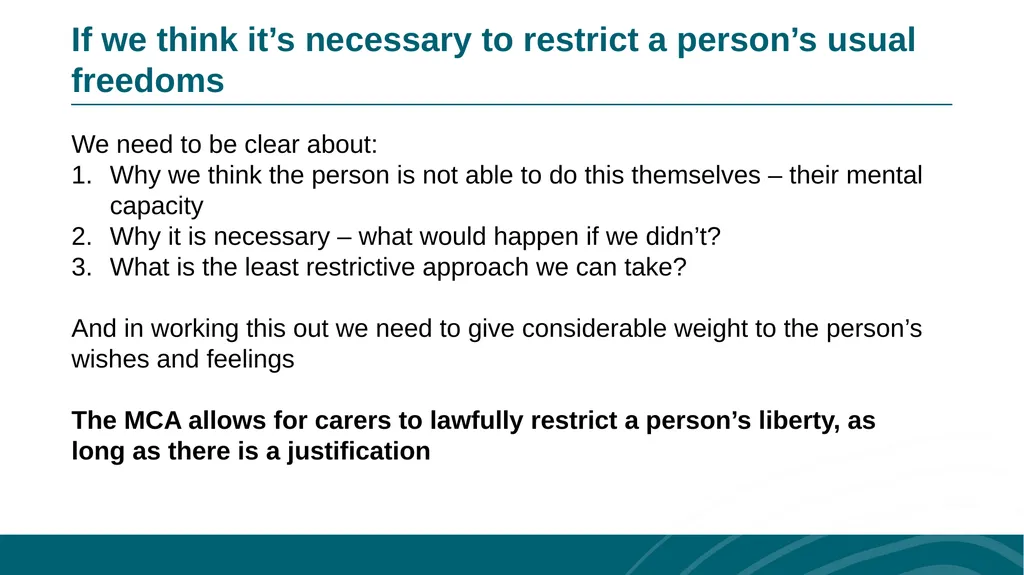
slide15. If we think it’s necessary to restrict a person’s usual freedoms We need to be clear about:
Why we think the person is not able to do this themselves – their mental capacity
Why it is necessary – what would happen if we didn’t?
What is the least restrictive approach we can take?
And in working this out we need to give considerable weight to the person’s wishes and feelings
The MCA allows for carers to lawfully restrict a person’s liberty, as long as there is a justification<br>
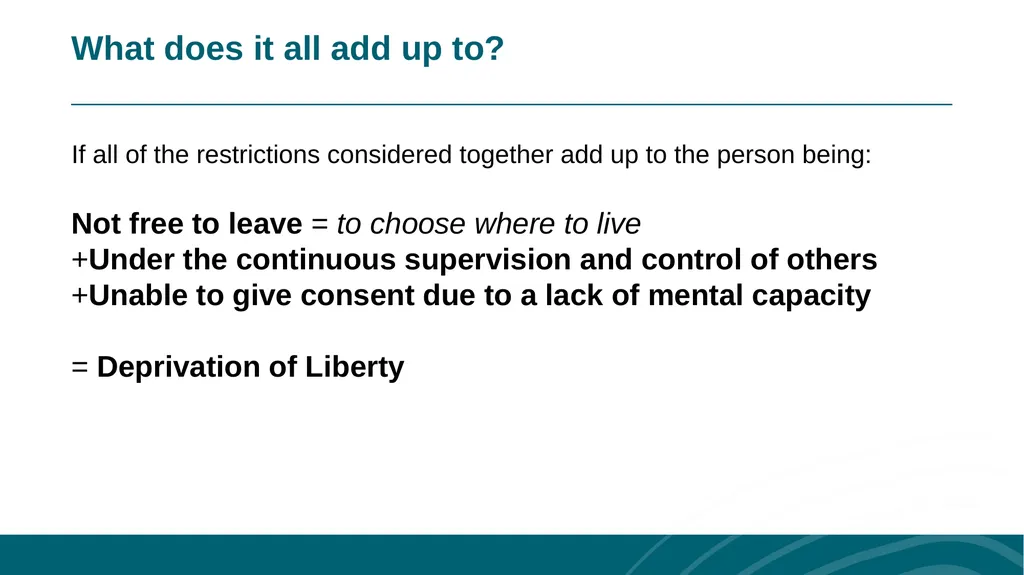
slide16. What does it all add up to? If all of the restrictions considered together add up to the person being:
Not free to leave = to choose where to live
+Under the continuous supervision and control of others
+Unable to give consent due to a lack of mental capacity
= Deprivation of Liberty<br>
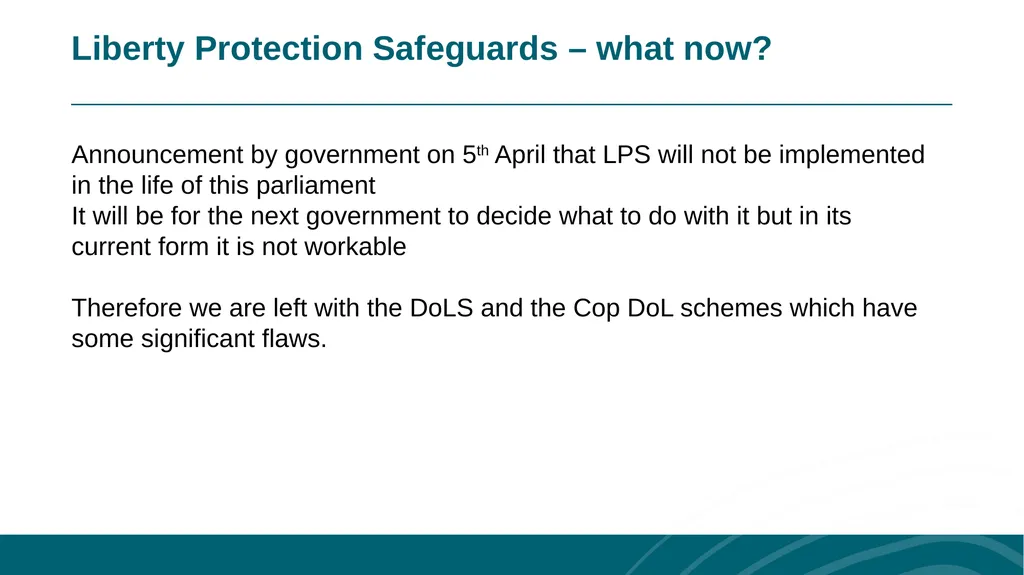
slide17. Liberty Protection Safeguards – what now? Announcement by government on 5th April that LPS will not be implemented in the life of this parliament
It will be for the next government to decide what to do with it but in its current form it is not workable
Therefore we are left with the DoLS and the Cop DoL schemes which have some significant flaws.<br>
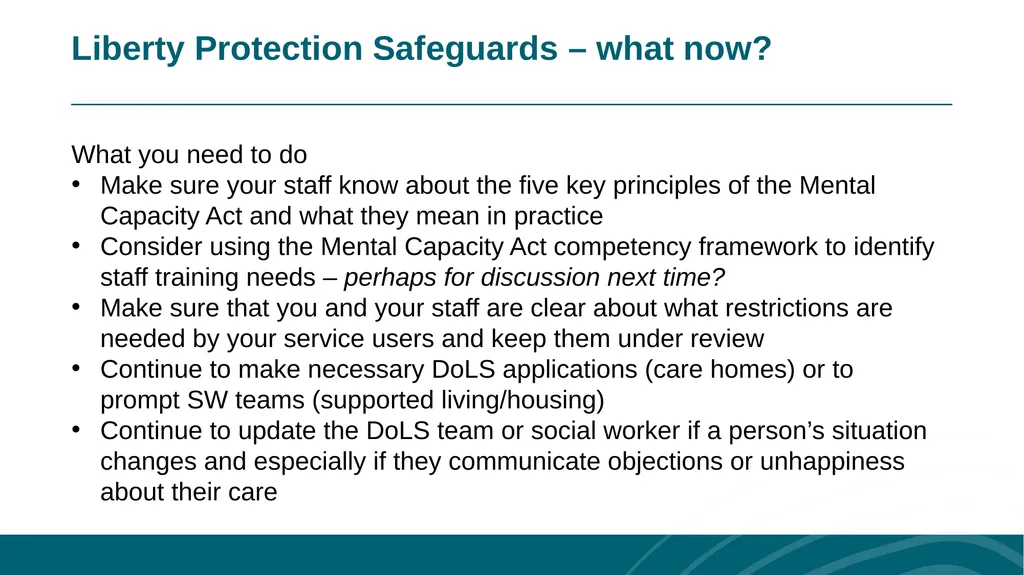
slide18. Liberty Protection Safeguards – what now? What you need to do
Make sure your staff know about the five key principles of the Mental Capacity Act and what they mean in practice
Consider using the Mental Capacity Act competency framework to identify staff training needs – perhaps for discussion next time?
Make sure that you and your staff are clear about what restrictions are needed by your service users and keep them under review
Continue to make necessary DoLS applications (care homes) or to prompt SW teams (supported living/housing)
Continue to update the DoLS team or social worker if a person’s situation changes and especially if they communicate objections or unhappiness about their care<br>
slide19. Further resources for mental capacity Social Care Institute for Excellence (SCIE) – lots of excellent resources about all aspects of mental capacity work. Lots of it free but with access to some training which can be purchased
Mental Capacity Act videos | SCIE
Mental Capacity Act (MCA) and DoLS | SCIE<br>
slide20. Further resources for mental capacity – for families Rethink – Mental Health charity
Mental capacity and mental illness (rethink.org)
Mencap
What is The Mental Capacity Act? | Mencap
Home Farm Trust
Hft | Family Carer Support | The Mental Capacity Act
Alzheimer’s Society
Dementia and the Mental Capacity Act 2005 | Alzheimer's Society (alzheimers.org.uk)<br>
slide21. Contact the DoLS team: dolsinformation@somerset.gov.uk
Paradigm’s ‘Practical Guide to Supported Decision-Making’
https://paradigm-uk.org/wp-content/uploads/2023/01/Print-copy-2023-MASTER-Supported-Decisions-Making-booklet-27-September-A5_Wiro_Bound_SEB.pdf.pdf<br>
Chris Hamilton christopher.hamilton@somerset.gov.uk<br>
slide2. Last time we discussed… The previous set of slides with links to MCA resources is included after the new ones for today
Fluctuating mental capacity
What is a restriction?
Liberty Protection Safeguards – what next?<br>
slide3. What is the aim of the Mental Capacity Act? To enable people – anyone – to have maximum control or influence over decisions which affect them
It provides:
A legal framework for the protection of individual’s rights to autonomy by setting out what it means to have or lack capacity and how decisions should be made on behalf of people who lack capacity<br>
slide4. Somerset mental capacity competency framework Developed by Somerset Council and NHS partners with support from some care providers to test out materials
Somerset-Mental-Capacity-Act-Competency-Framework-April-2023.docx (live.com)
Its purpose:
To help organisations apply the Mental Capacity Act effectively by identifying the skills and knowledge required by staff according to their roles
Some people need to know about the basic concepts
Some people need to take action to assess mental capacity and make decisions
Some are responsible for providing more expert advice or planning staff training<br>
slide6. Somerset mental capacity competency framework The process:
Work out which of your staff roles fit into which of the three bandings – include yourself
Assess those people’s skills and knowledge against the lists to identify strengths and training needs
Plan for training to address these needs using the links to learning resources, or purchase training
Keep a record of how staff skills and knowledge have been developed – CQC inspectors will like this!
Please provide feedback about how useful the framework is or how it could be improved<br>
slide7. Crystal balls! The DoLS team do not possess one of these We have a long list of people who are either subject to an authorisation or on the waiting list and we are dependent upon you letting us know if something significant changes. Someone with an authorisation might regain capacity. Someone on the waiting list might need a higher priority
Don’t rely on someone else telling us!
dolsinformation@somerset.gov.uk<br>
slide8. You must let the DoLS team know as soon as possible, if There has been a significant change to the information provided on your application. For example, a person might be quite co-operative about moving into a home – even if they don’t have capacity. But a few days/weeks/months later they may be much less happy and wanting to leave. This would make them more of a priority for the DoLS team because the DoLS process can have a close look at whether there are any alternatives for them if they are unhappy
A relative is unhappy about a key element of the care you are providing
It is necessary to restrict the resident’s contact with a relative or friend who wishes to visit.<br>
slide9. Mental Capacity drop-in session for care providers April 2023
Chris Hamilton christopher.hamilton@somerset.gov.uk<br>
slide10. What is the aim of the Mental Capacity Act? To enable people – anyone – to have maximum control or influence over decisions which affect them
It provides:
A legal framework for the protection of individual’s rights to autonomy by setting out what it means to have or lack capacity and how decisions should be made on behalf of people who lack capacity<br>
slide11. Fluctuating mental capacity A variation over time of a person’s ability to make a decision or decisions
Caused by a mental disorder, impairment or illness
Not the same as a temporary lack of capacity for example due to delirium or intoxication
Looking after a person whose capacity fluctuates is challenging
Some examples please<br>
slide12. Fluctuating mental capacity 2 Making best use of the periods of lucidity
Can you:
have a conversation to establish the person’s real wishes?
seek agreement for an approach to managing their needs at times when their capacity is poor?
Do document these conversations because this will help you and your staff be more confident about how to make a best interests decision – for example to keep the person safe – when this is needed<br>
slide13. What is a restriction? Legally speaking, anything which interferes with a person’s liberty in some way
Sometimes the word ‘restraint’ is also used to mean the same thing but it has some negative connotations<br>
slide14. Liberty to do what? Physical liberty to move about, to come and go as you please
To choose where to live
To form your own routines
To spend your time as you wish
To spend time with whoever you want to
To make your own decisions
To choose what to eat and whether to take medication
To decide how to spend your money<br>
slide15. If we think it’s necessary to restrict a person’s usual freedoms We need to be clear about:
Why we think the person is not able to do this themselves – their mental capacity
Why it is necessary – what would happen if we didn’t?
What is the least restrictive approach we can take?
And in working this out we need to give considerable weight to the person’s wishes and feelings
The MCA allows for carers to lawfully restrict a person’s liberty, as long as there is a justification<br>
slide16. What does it all add up to? If all of the restrictions considered together add up to the person being:
Not free to leave = to choose where to live
+Under the continuous supervision and control of others
+Unable to give consent due to a lack of mental capacity
= Deprivation of Liberty<br>
slide17. Liberty Protection Safeguards – what now? Announcement by government on 5th April that LPS will not be implemented in the life of this parliament
It will be for the next government to decide what to do with it but in its current form it is not workable
Therefore we are left with the DoLS and the Cop DoL schemes which have some significant flaws.<br>
slide18. Liberty Protection Safeguards – what now? What you need to do
Make sure your staff know about the five key principles of the Mental Capacity Act and what they mean in practice
Consider using the Mental Capacity Act competency framework to identify staff training needs – perhaps for discussion next time?
Make sure that you and your staff are clear about what restrictions are needed by your service users and keep them under review
Continue to make necessary DoLS applications (care homes) or to prompt SW teams (supported living/housing)
Continue to update the DoLS team or social worker if a person’s situation changes and especially if they communicate objections or unhappiness about their care<br>
slide19. Further resources for mental capacity Social Care Institute for Excellence (SCIE) – lots of excellent resources about all aspects of mental capacity work. Lots of it free but with access to some training which can be purchased
Mental Capacity Act videos | SCIE
Mental Capacity Act (MCA) and DoLS | SCIE<br>
slide20. Further resources for mental capacity – for families Rethink – Mental Health charity
Mental capacity and mental illness (rethink.org)
Mencap
What is The Mental Capacity Act? | Mencap
Home Farm Trust
Hft | Family Carer Support | The Mental Capacity Act
Alzheimer’s Society
Dementia and the Mental Capacity Act 2005 | Alzheimer's Society (alzheimers.org.uk)<br>
slide21. Contact the DoLS team: dolsinformation@somerset.gov.uk
Paradigm’s ‘Practical Guide to Supported Decision-Making’
https://paradigm-uk.org/wp-content/uploads/2023/01/Print-copy-2023-MASTER-Supported-Decisions-Making-booklet-27-September-A5_Wiro_Bound_SEB.pdf.pdf<br>