
Mental Health Awareness Presenter name, position,
PT
Published · 63 slides · 0 views

1 / 1









Description
Mental Health Awareness Presenter name, position, trust Date 2 Acknowledgements We would like to thank: Dr Sheila Hardy, Education Fellow at UCLPartners, and author of these materials. The expert reference group, steering group and project
Related Topics
Share
Embed code
Download this presentation From Below
"Mental Health Awareness Presenter name, position," is the property of its rightful owner. Permission is granted to download and print the materials on this website for personal, non-commercial use only, and to display it on your personal computer provided you do not modify the materials and that you retain all copyright notices contained in the materials. By downloading content from our website, you accept the terms of this agreement.
Presentation Transcript
01
Mental Health Awareness
Presenter name, position, trust
Date<br>
Presenter name, position, trust
Date<br>
02
2 Acknowledgements We would like to thank:
Dr Sheila Hardy, Education Fellow at UCLPartners, and author of these materials.
The expert reference group, steering group and project team:<br>
Dr Sheila Hardy, Education Fellow at UCLPartners, and author of these materials.
The expert reference group, steering group and project team:<br>
03
Introductions 3<br>
04
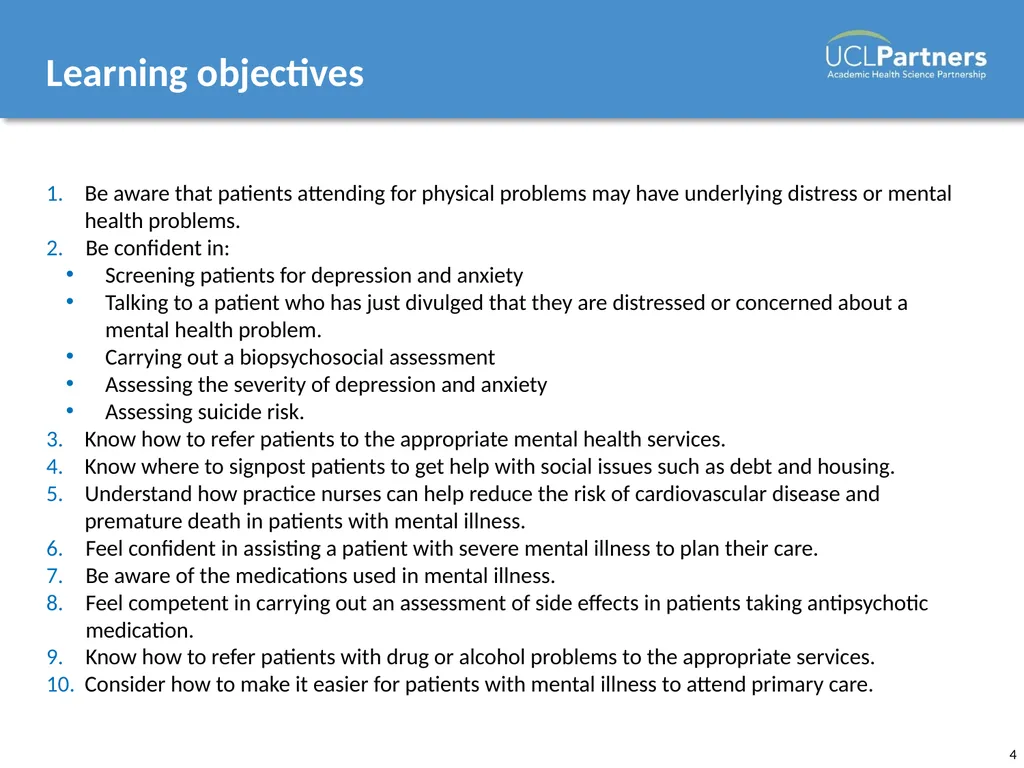
4 Learning objectives Be aware that patients attending for physical problems may have underlying distress or mental health problems.
Be confident in:
Screening patients for depression and anxiety
Talking to a patient who has just divulged that they are distressed or concerned about a mental health problem.
Carrying out a biopsychosocial assessment
Assessing the severity of depression and anxiety
Assessing suicide risk.
Know how to refer patients to the appropriate mental health services.
Know where to signpost patients to get help with social issues such as debt and housing.
Understand how practice nurses can help reduce the risk of cardiovascular disease and premature death in patients with mental illness.
Feel confident in assisting a patient with severe mental illness to plan their care.
Be aware of the medications used in mental illness.
Feel competent in carrying out an assessment of side effects in patients taking antipsychotic medication.
Know how to refer patients with drug or alcohol problems to the appropriate services.
Consider how to make it easier for patients with mental illness to attend primary care.<br>
Be confident in:
Screening patients for depression and anxiety
Talking to a patient who has just divulged that they are distressed or concerned about a mental health problem.
Carrying out a biopsychosocial assessment
Assessing the severity of depression and anxiety
Assessing suicide risk.
Know how to refer patients to the appropriate mental health services.
Know where to signpost patients to get help with social issues such as debt and housing.
Understand how practice nurses can help reduce the risk of cardiovascular disease and premature death in patients with mental illness.
Feel confident in assisting a patient with severe mental illness to plan their care.
Be aware of the medications used in mental illness.
Feel competent in carrying out an assessment of side effects in patients taking antipsychotic medication.
Know how to refer patients with drug or alcohol problems to the appropriate services.
Consider how to make it easier for patients with mental illness to attend primary care.<br>
05
5 Underlying distress or mental health problems<br>
06
Adults with a mental health problem in England:
Anxiety or depression 17.6%
Alcohol dependence 6%
Drug dependence 3%
Hazardous drinking 24%
Nicotine dependence 21% (42% of smokers have a mental health problem)
Severe mental illness 0.4%
Sub-threshold mental health problems 17%
McManus S, Meltzer H, Brugha T, Bebbington P and Jenkins R. (2009) Adult psychiatric morbidity in England, 2007: results of a household survey. Leeds: NHS Information Centre for Health and Social Care. Underlying distress or mental health problems 6<br>
Anxiety or depression 17.6%
Alcohol dependence 6%
Drug dependence 3%
Hazardous drinking 24%
Nicotine dependence 21% (42% of smokers have a mental health problem)
Severe mental illness 0.4%
Sub-threshold mental health problems 17%
McManus S, Meltzer H, Brugha T, Bebbington P and Jenkins R. (2009) Adult psychiatric morbidity in England, 2007: results of a household survey. Leeds: NHS Information Centre for Health and Social Care. Underlying distress or mental health problems 6<br>
07
Mental health in primary care How many patients with a mental health problem do you think are dealt with in primary care?
90%
How many patients with a severe mental illness do you think have no input from a mental health specialist?
30–50%
Gask L, Lester H, Kendrick T and Peveler R. (2009) Primary care mental health. London: Royal College of Psychiatrists. 7<br>
90%
How many patients with a severe mental illness do you think have no input from a mental health specialist?
30–50%
Gask L, Lester H, Kendrick T and Peveler R. (2009) Primary care mental health. London: Royal College of Psychiatrists. 7<br>
08
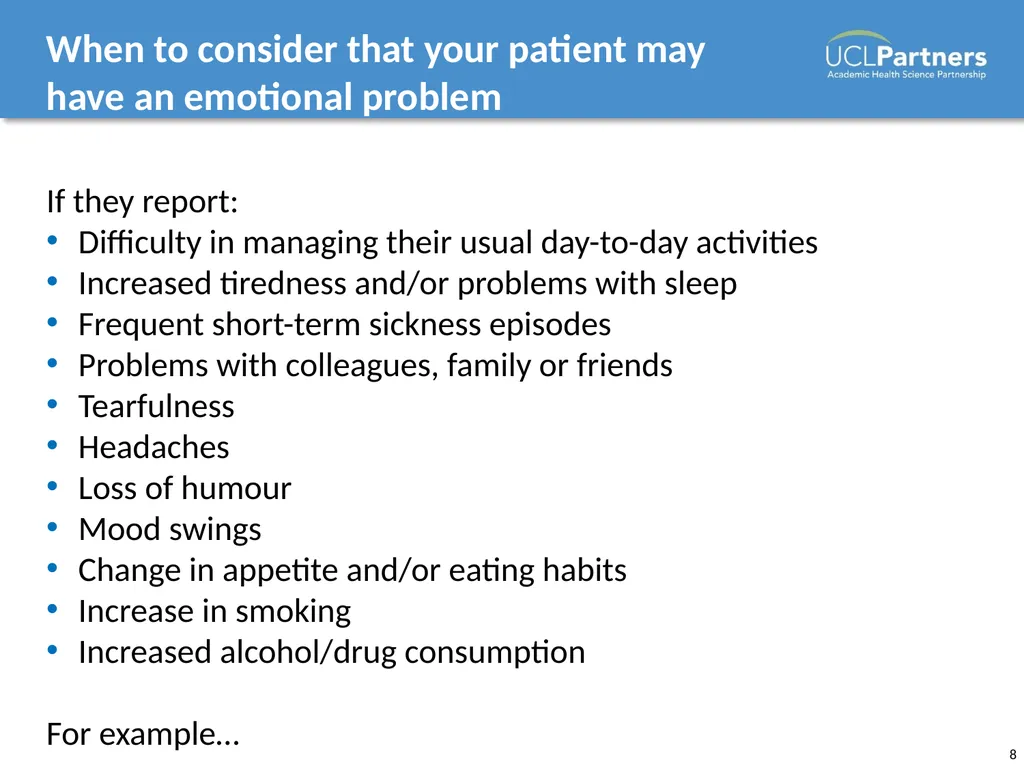
8 When to consider that your patient may have an emotional problem If they report:
Difficulty in managing their usual day-to-day activities
Increased tiredness and/or problems with sleep
Frequent short-term sickness episodes
Problems with colleagues, family or friends
Tearfulness
Headaches
Loss of humour
Mood swings
Change in appetite and/or eating habits
Increase in smoking
Increased alcohol/drug consumption
For example…<br>
Difficulty in managing their usual day-to-day activities
Increased tiredness and/or problems with sleep
Frequent short-term sickness episodes
Problems with colleagues, family or friends
Tearfulness
Headaches
Loss of humour
Mood swings
Change in appetite and/or eating habits
Increase in smoking
Increased alcohol/drug consumption
For example…<br>
09
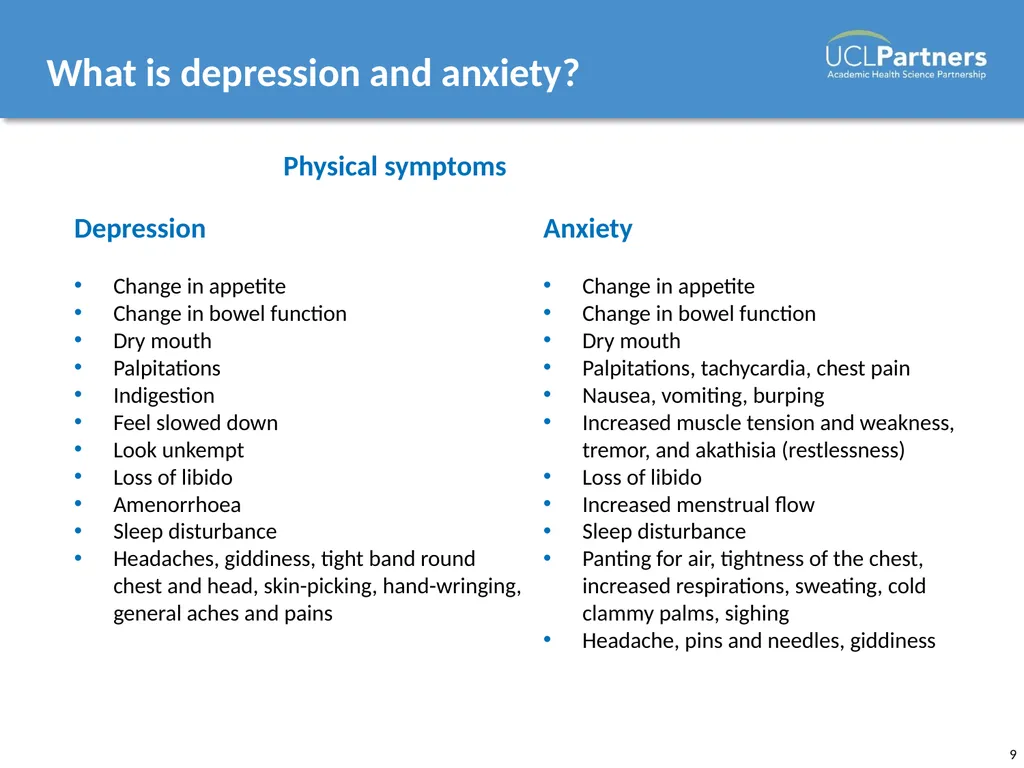
Depression Change in appetite
Change in bowel function
Dry mouth
Palpitations
Indigestion
Feel slowed down
Look unkempt
Loss of libido
Amenorrhoea
Sleep disturbance
Headaches, giddiness, tight band round chest and head, skin-picking, hand-wringing, general aches and pains Anxiety Change in appetite
Change in bowel function
Dry mouth
Palpitations, tachycardia, chest pain
Nausea, vomiting, burping
Increased muscle tension and weakness, tremor, and akathisia (restlessness)
Loss of libido
Increased menstrual flow
Sleep disturbance
Panting for air, tightness of the chest, increased respirations, sweating, cold clammy palms, sighing
Headache, pins and needles, giddiness 9 What is depression and anxiety? Physical symptoms<br>
Change in bowel function
Dry mouth
Palpitations
Indigestion
Feel slowed down
Look unkempt
Loss of libido
Amenorrhoea
Sleep disturbance
Headaches, giddiness, tight band round chest and head, skin-picking, hand-wringing, general aches and pains Anxiety Change in appetite
Change in bowel function
Dry mouth
Palpitations, tachycardia, chest pain
Nausea, vomiting, burping
Increased muscle tension and weakness, tremor, and akathisia (restlessness)
Loss of libido
Increased menstrual flow
Sleep disturbance
Panting for air, tightness of the chest, increased respirations, sweating, cold clammy palms, sighing
Headache, pins and needles, giddiness 9 What is depression and anxiety? Physical symptoms<br>
10
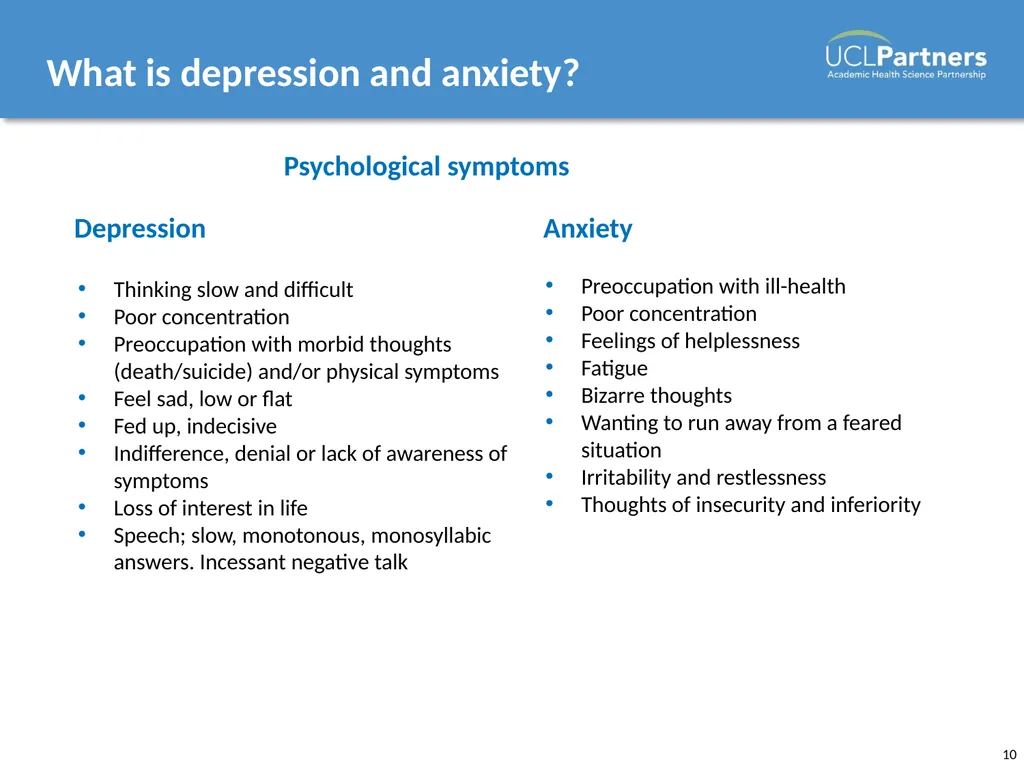
Depression Thinking slow and difficult
Poor concentration
Preoccupation with morbid thoughts (death/suicide) and/or physical symptoms
Feel sad, low or flat
Fed up, indecisive
Indifference, denial or lack of awareness of symptoms
Loss of interest in life
Speech; slow, monotonous, monosyllabic answers. Incessant negative talk Anxiety Preoccupation with ill-health
Poor concentration
Feelings of helplessness
Fatigue
Bizarre thoughts
Wanting to run away from a feared situation
Irritability and restlessness
Thoughts of insecurity and inferiority 10 What is depression and anxiety? Psychological symptoms<br>
Poor concentration
Preoccupation with morbid thoughts (death/suicide) and/or physical symptoms
Feel sad, low or flat
Fed up, indecisive
Indifference, denial or lack of awareness of symptoms
Loss of interest in life
Speech; slow, monotonous, monosyllabic answers. Incessant negative talk Anxiety Preoccupation with ill-health
Poor concentration
Feelings of helplessness
Fatigue
Bizarre thoughts
Wanting to run away from a feared situation
Irritability and restlessness
Thoughts of insecurity and inferiority 10 What is depression and anxiety? Psychological symptoms<br>
11
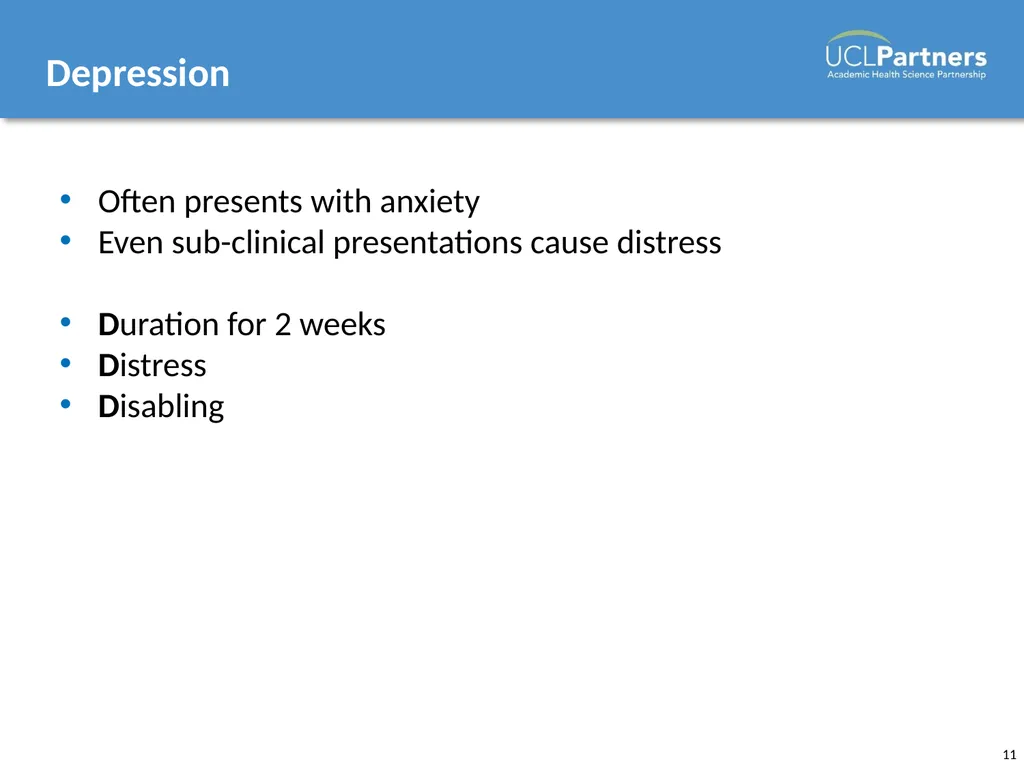
11 Depression Often presents with anxiety
Even sub-clinical presentations cause distress
Duration for 2 weeks
Distress
Disabling<br>
Even sub-clinical presentations cause distress
Duration for 2 weeks
Distress
Disabling<br>
12
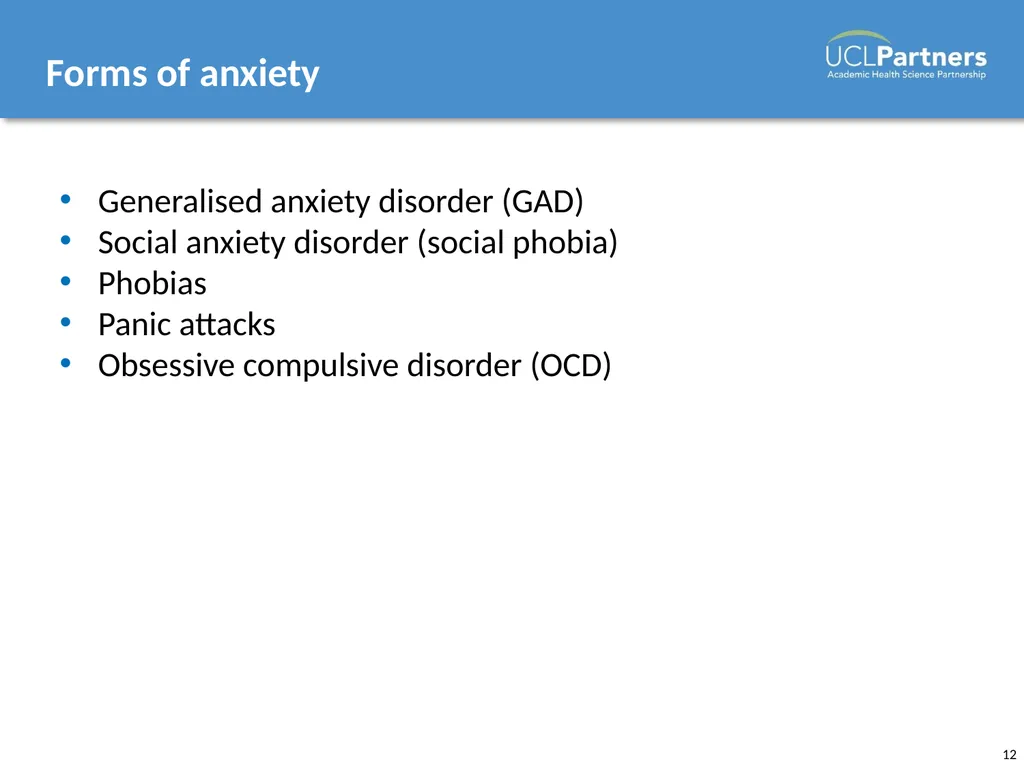
12 Forms of anxiety Generalised anxiety disorder (GAD)
Social anxiety disorder (social phobia)
Phobias
Panic attacks
Obsessive compulsive disorder (OCD)<br>
Social anxiety disorder (social phobia)
Phobias
Panic attacks
Obsessive compulsive disorder (OCD)<br>
13
13 Related modules Comorbidities: using a psychological approach
Wellbeing<br>
Wellbeing<br>
14
14 Screening for depression and anxiety
and supporting patients<br>
and supporting patients<br>
15
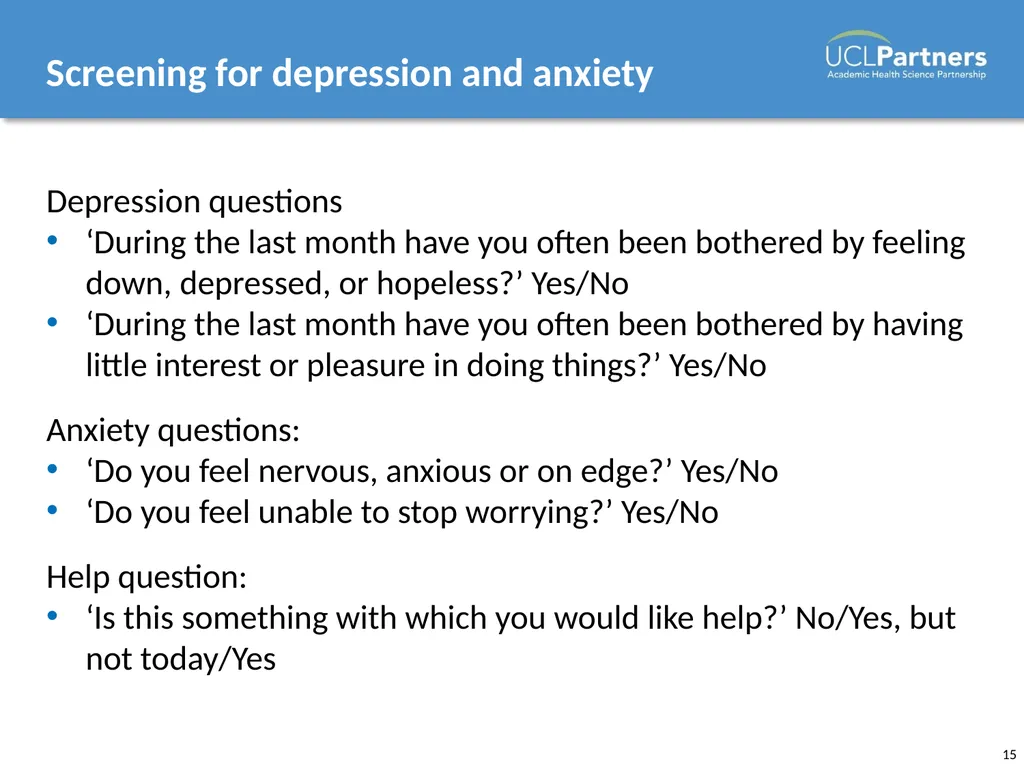
15 Screening for depression and anxiety Depression questions
‘During the last month have you often been bothered by feeling down, depressed, or hopeless?’ Yes/No
‘During the last month have you often been bothered by having little interest or pleasure in doing things?’ Yes/No
Anxiety questions:
‘Do you feel nervous, anxious or on edge?’ Yes/No
‘Do you feel unable to stop worrying?’ Yes/No
Help question:
‘Is this something with which you would like help?’ No/Yes, but not today/Yes<br>
‘During the last month have you often been bothered by feeling down, depressed, or hopeless?’ Yes/No
‘During the last month have you often been bothered by having little interest or pleasure in doing things?’ Yes/No
Anxiety questions:
‘Do you feel nervous, anxious or on edge?’ Yes/No
‘Do you feel unable to stop worrying?’ Yes/No
Help question:
‘Is this something with which you would like help?’ No/Yes, but not today/Yes<br>
16
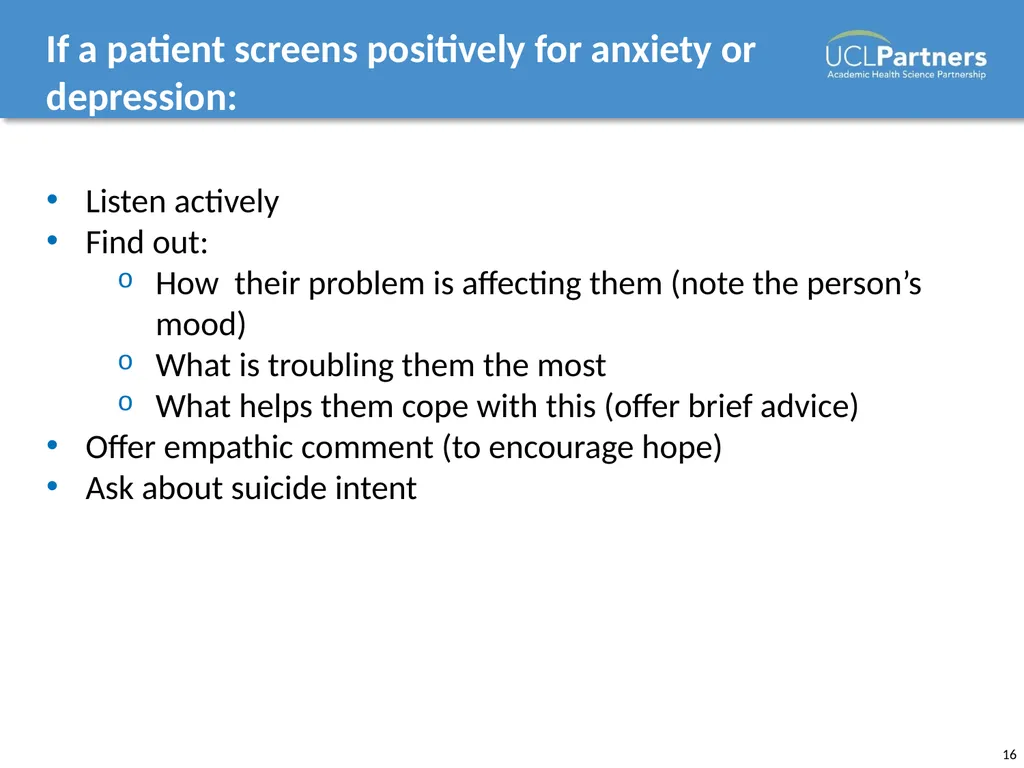
16 If a patient screens positively for anxiety or depression: Listen actively
Find out:
How their problem is affecting them (note the person’s mood)
What is troubling them the most
What helps them cope with this (offer brief advice)
Offer empathic comment (to encourage hope)
Ask about suicide intent<br>
Find out:
How their problem is affecting them (note the person’s mood)
What is troubling them the most
What helps them cope with this (offer brief advice)
Offer empathic comment (to encourage hope)
Ask about suicide intent<br>
17
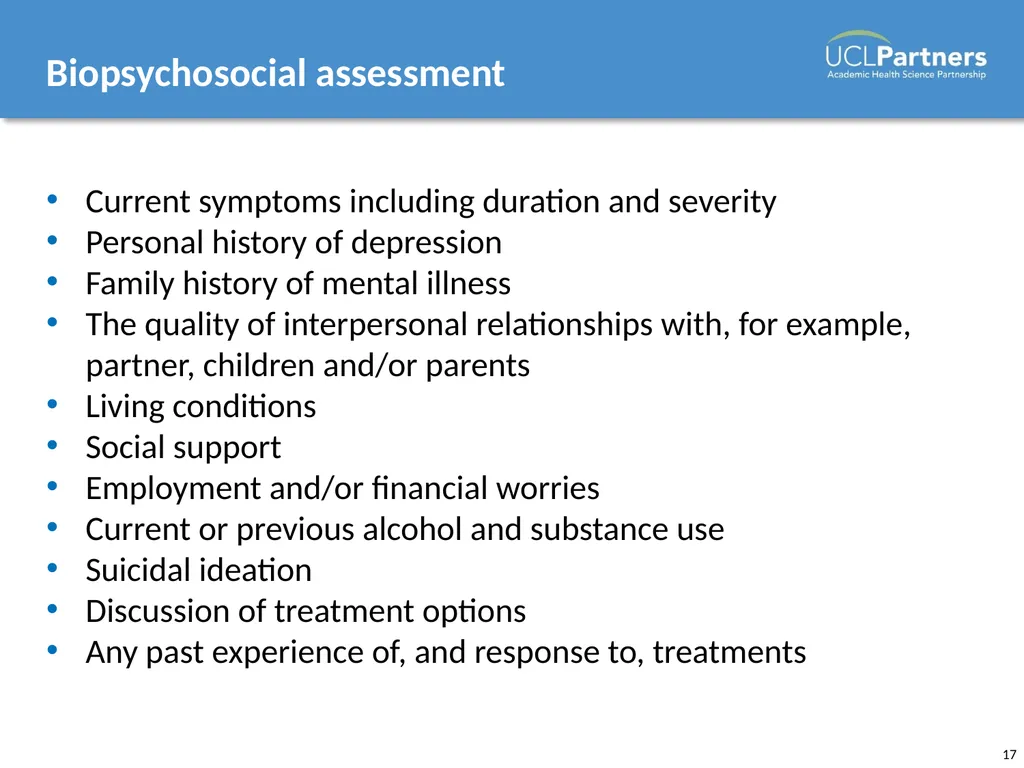
17 Biopsychosocial assessment Current symptoms including duration and severity
Personal history of depression
Family history of mental illness
The quality of interpersonal relationships with, for example, partner, children and/or parents
Living conditions
Social support
Employment and/or financial worries
Current or previous alcohol and substance use
Suicidal ideation
Discussion of treatment options
Any past experience of, and response to, treatments<br>
Personal history of depression
Family history of mental illness
The quality of interpersonal relationships with, for example, partner, children and/or parents
Living conditions
Social support
Employment and/or financial worries
Current or previous alcohol and substance use
Suicidal ideation
Discussion of treatment options
Any past experience of, and response to, treatments<br>
18
18 Tools used to make a detailed assessment of depression and/or anxiety Tools validated for primary care:
PHQ-9 (depression)
GAD-7 (anxiety)
HADs (depression and anxiety)
Beck Depression Inventory (depression)<br>
PHQ-9 (depression)
GAD-7 (anxiety)
HADs (depression and anxiety)
Beck Depression Inventory (depression)<br>
19
19 People most at risk of suicide Family history
Previous attempt
Underlying mental disorder
Long-term physical condition (or pain)
Male
Young adult or elderly
Alcohol or drug abuse
Under extreme distress<br>
Previous attempt
Underlying mental disorder
Long-term physical condition (or pain)
Male
Young adult or elderly
Alcohol or drug abuse
Under extreme distress<br>
20
20 Suicide questions Have you made a suicide attempt in the past?
Do you think that life is not worth living?
Do you think about harming or killing yourself?
Have you got a plan to kill yourself? How would you do it?
Do you aim to carry out this plan?
Have you got access to (the necessary tools) to carry out the plan?
What would stop (or is stopping) you from carrying out your plan?<br>
Do you think that life is not worth living?
Do you think about harming or killing yourself?
Have you got a plan to kill yourself? How would you do it?
Do you aim to carry out this plan?
Have you got access to (the necessary tools) to carry out the plan?
What would stop (or is stopping) you from carrying out your plan?<br>
21
21 Self-harm Prevalence:
>11% of girls and 3% of boys aged 15–16 years self-harmed in the previous year (Hawton 2002)
4.9% of adults have self-harmed (McManus et al 2009)
Self-harm is intentional damage or injury to the body. It is a way of coping with or expressing overwhelming emotional distress.
Causes:
Social factors
Trauma
Mental health conditions
Hawton K. (2002) Deliberate self harm in adolescents: Self report survey in schools in England. British Medical Journal 325 (7374): 1207.
McManus S, Meltzer H, Brugha T, Bebbington P and Jenkins R. (2009) Adult psychiatric morbidity in England, 2007: results of a household survey. Leeds: NHS Information Centre for Health and Social Care.<br>
>11% of girls and 3% of boys aged 15–16 years self-harmed in the previous year (Hawton 2002)
4.9% of adults have self-harmed (McManus et al 2009)
Self-harm is intentional damage or injury to the body. It is a way of coping with or expressing overwhelming emotional distress.
Causes:
Social factors
Trauma
Mental health conditions
Hawton K. (2002) Deliberate self harm in adolescents: Self report survey in schools in England. British Medical Journal 325 (7374): 1207.
McManus S, Meltzer H, Brugha T, Bebbington P and Jenkins R. (2009) Adult psychiatric morbidity in England, 2007: results of a household survey. Leeds: NHS Information Centre for Health and Social Care.<br>
22
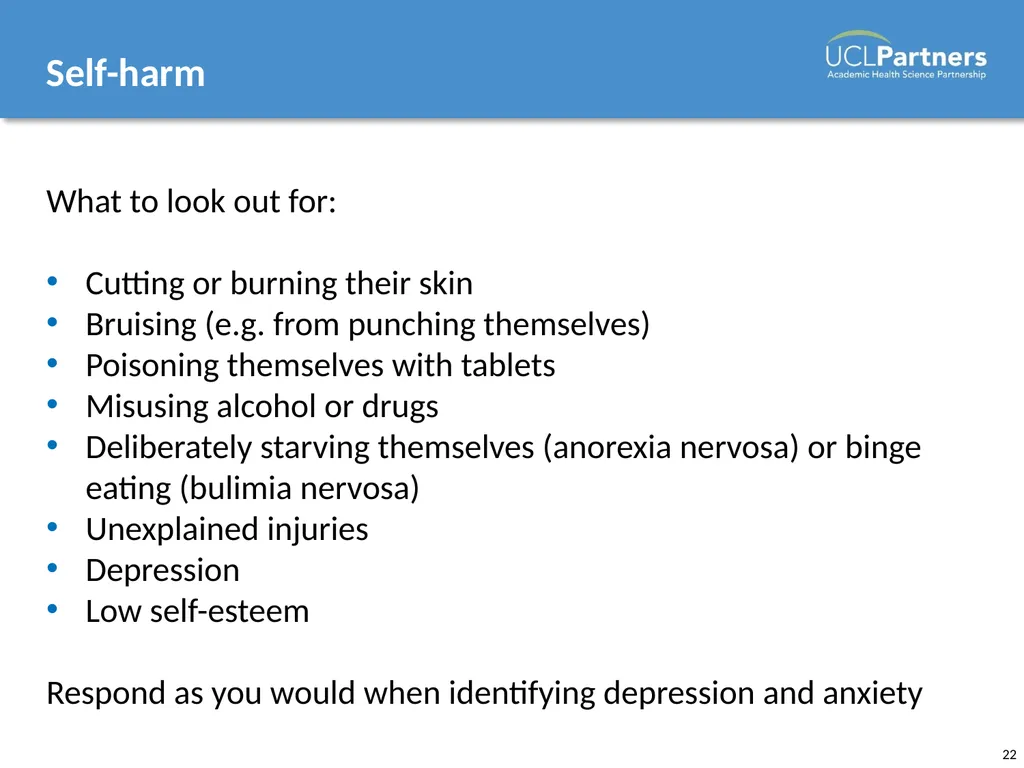
22 Self-harm What to look out for:
Cutting or burning their skin
Bruising (e.g. from punching themselves)
Poisoning themselves with tablets
Misusing alcohol or drugs
Deliberately starving themselves (anorexia nervosa) or binge eating (bulimia nervosa)
Unexplained injuries
Depression
Low self-esteem
Respond as you would when identifying depression and anxiety<br>
Cutting or burning their skin
Bruising (e.g. from punching themselves)
Poisoning themselves with tablets
Misusing alcohol or drugs
Deliberately starving themselves (anorexia nervosa) or binge eating (bulimia nervosa)
Unexplained injuries
Depression
Low self-esteem
Respond as you would when identifying depression and anxiety<br>
23
23 Services for people with mental health problems<br>
24
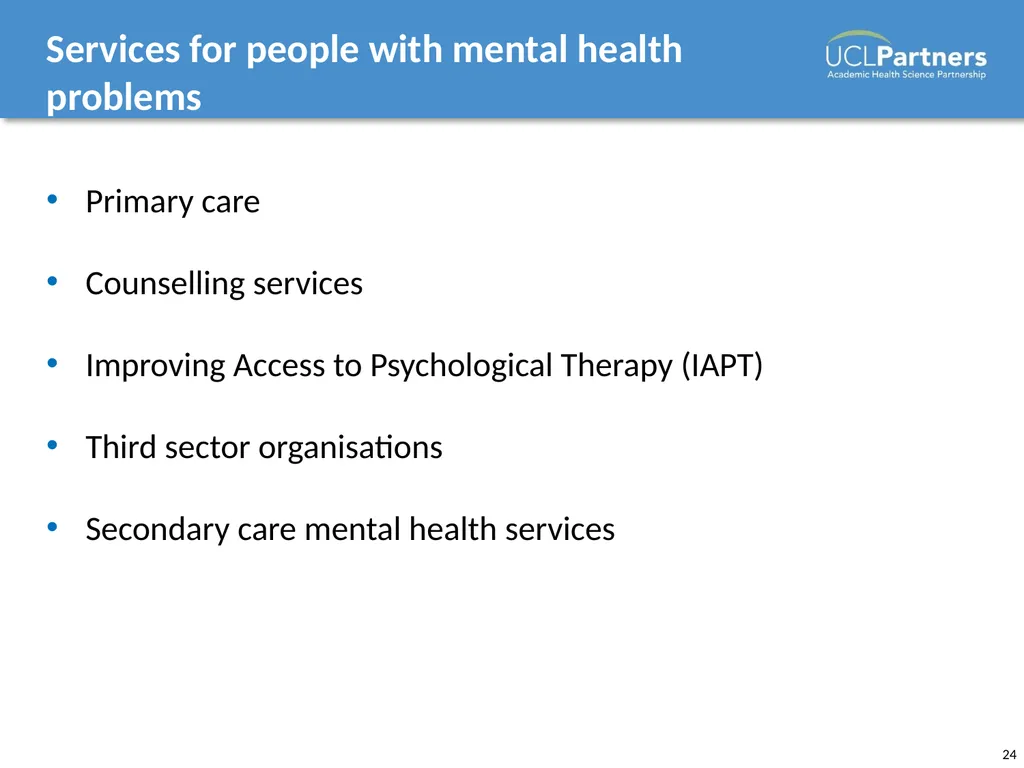
24 Services for people with mental health problems Primary care
Counselling services
Improving Access to Psychological Therapy (IAPT)
Third sector organisations
Secondary care mental health services<br>
Counselling services
Improving Access to Psychological Therapy (IAPT)
Third sector organisations
Secondary care mental health services<br>
25
25 Local services<br>
26
26 National resources Relevant services for people with mental health problems are listed in your manual<br>
27
27 Related modules Your patient’s journey (e-learning)<br>
28
28 Tea break!<br>
29
29 Severe mental illness (SMI)<br>
30
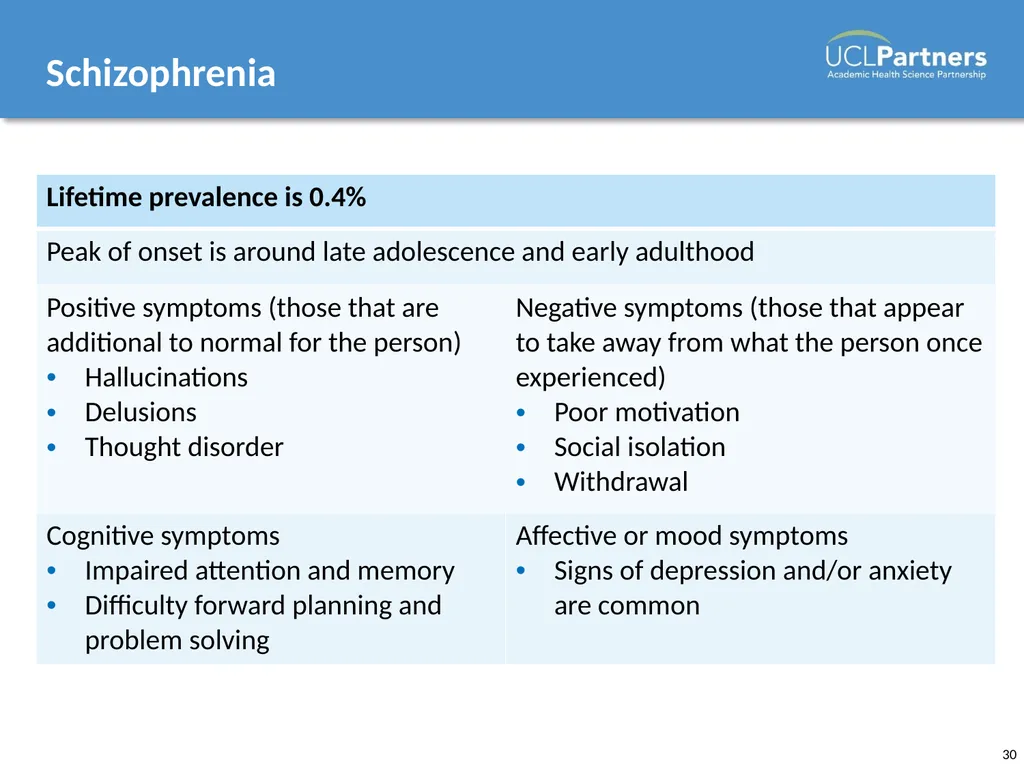
30 Schizophrenia<br>
31
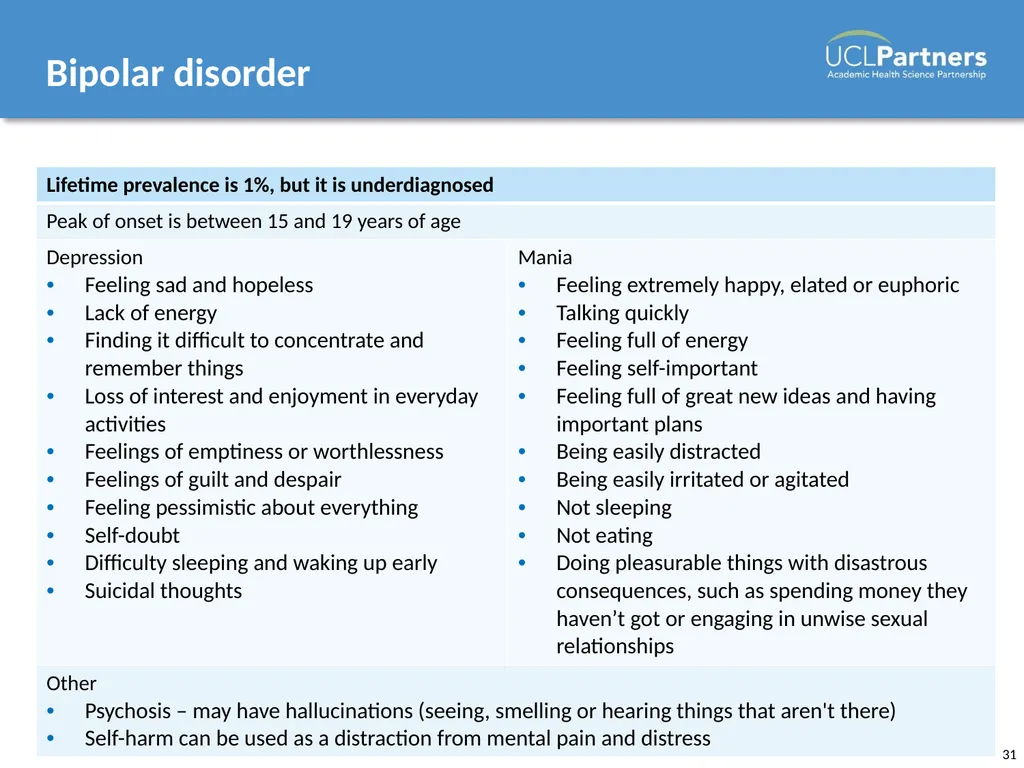
31 Bipolar disorder<br>
32
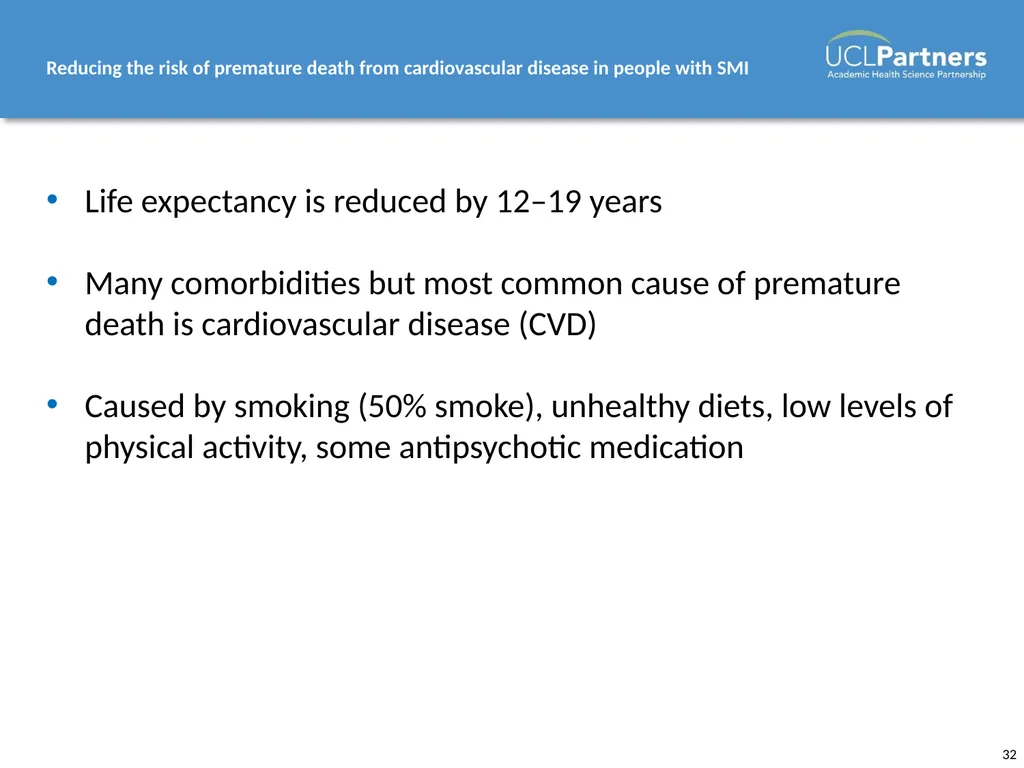
32 Reducing the risk of premature death from cardiovascular disease in people with SMI Life expectancy is reduced by 12–19 years
Many comorbidities but most common cause of premature death is cardiovascular disease (CVD)
Caused by smoking (50% smoke), unhealthy diets, low levels of physical activity, some antipsychotic medication<br>
Many comorbidities but most common cause of premature death is cardiovascular disease (CVD)
Caused by smoking (50% smoke), unhealthy diets, low levels of physical activity, some antipsychotic medication<br>
33
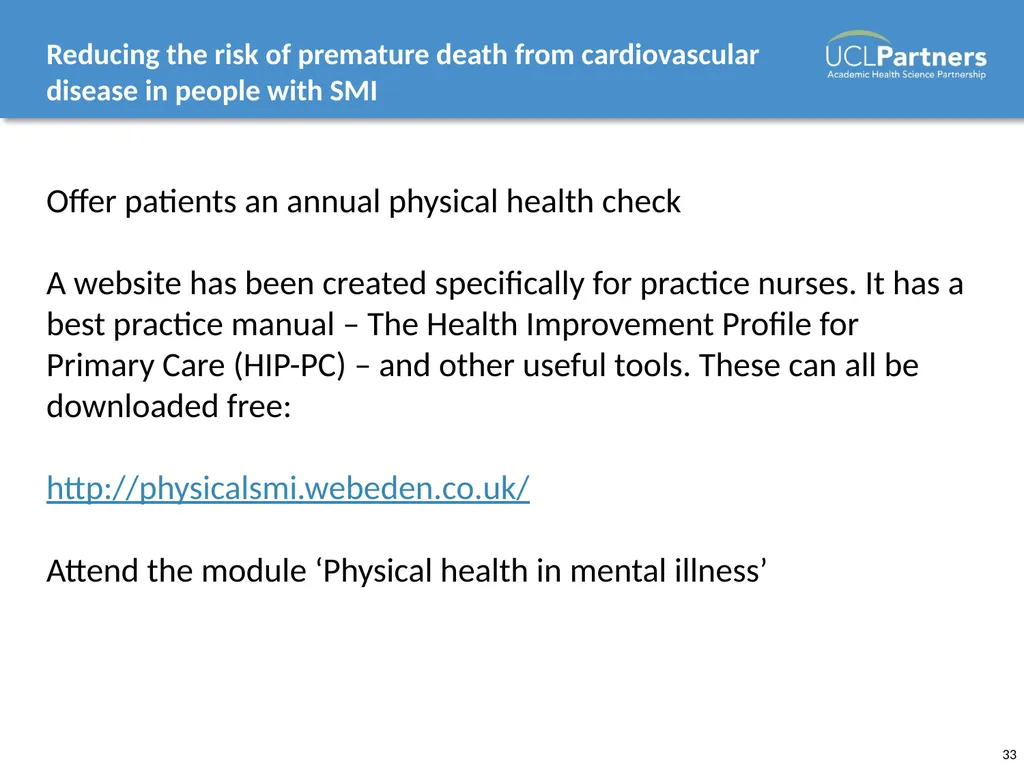
33 Reducing the risk of premature death from cardiovascular disease in people with SMI Offer patients an annual physical health check
A website has been created specifically for practice nurses. It has a best practice manual – The Health Improvement Profile for Primary Care (HIP-PC) – and other useful tools. These can all be downloaded free:
http://physicalsmi.webeden.co.uk/
Attend the module ‘Physical health in mental illness’<br>
A website has been created specifically for practice nurses. It has a best practice manual – The Health Improvement Profile for Primary Care (HIP-PC) – and other useful tools. These can all be downloaded free:
http://physicalsmi.webeden.co.uk/
Attend the module ‘Physical health in mental illness’<br>
34
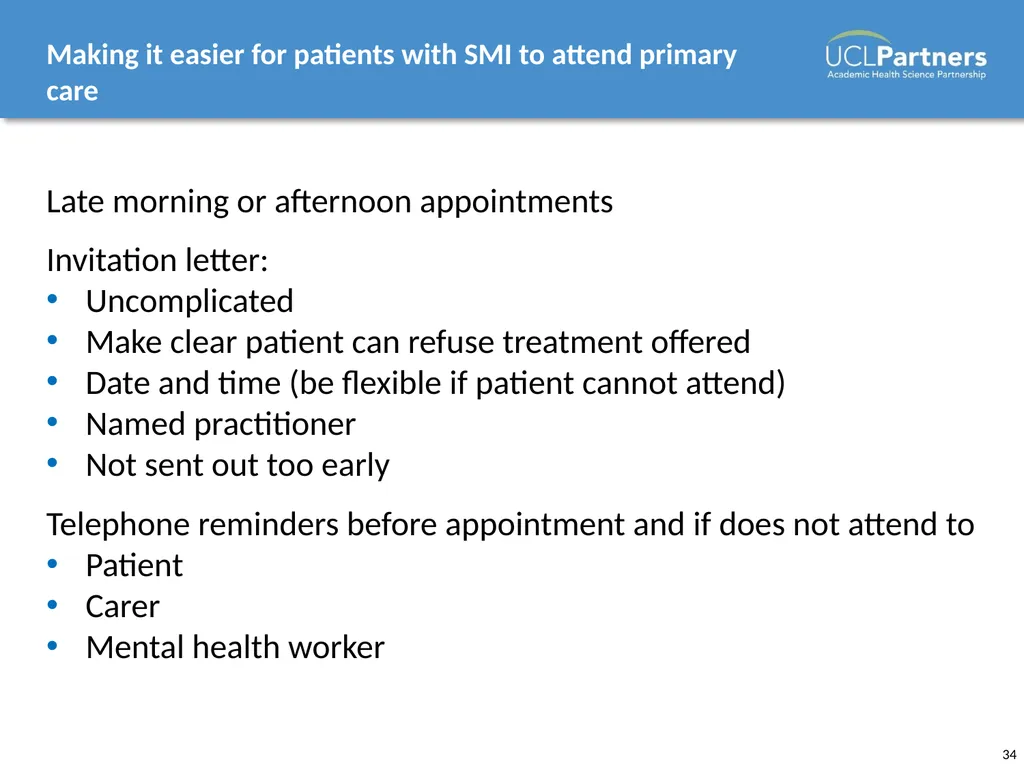
34 Making it easier for patients with SMI to attend primary care Late morning or afternoon appointments
Invitation letter:
Uncomplicated
Make clear patient can refuse treatment offered
Date and time (be flexible if patient cannot attend)
Named practitioner
Not sent out too early
Telephone reminders before appointment and if does not attend to
Patient
Carer
Mental health worker<br>
Invitation letter:
Uncomplicated
Make clear patient can refuse treatment offered
Date and time (be flexible if patient cannot attend)
Named practitioner
Not sent out too early
Telephone reminders before appointment and if does not attend to
Patient
Carer
Mental health worker<br>
35
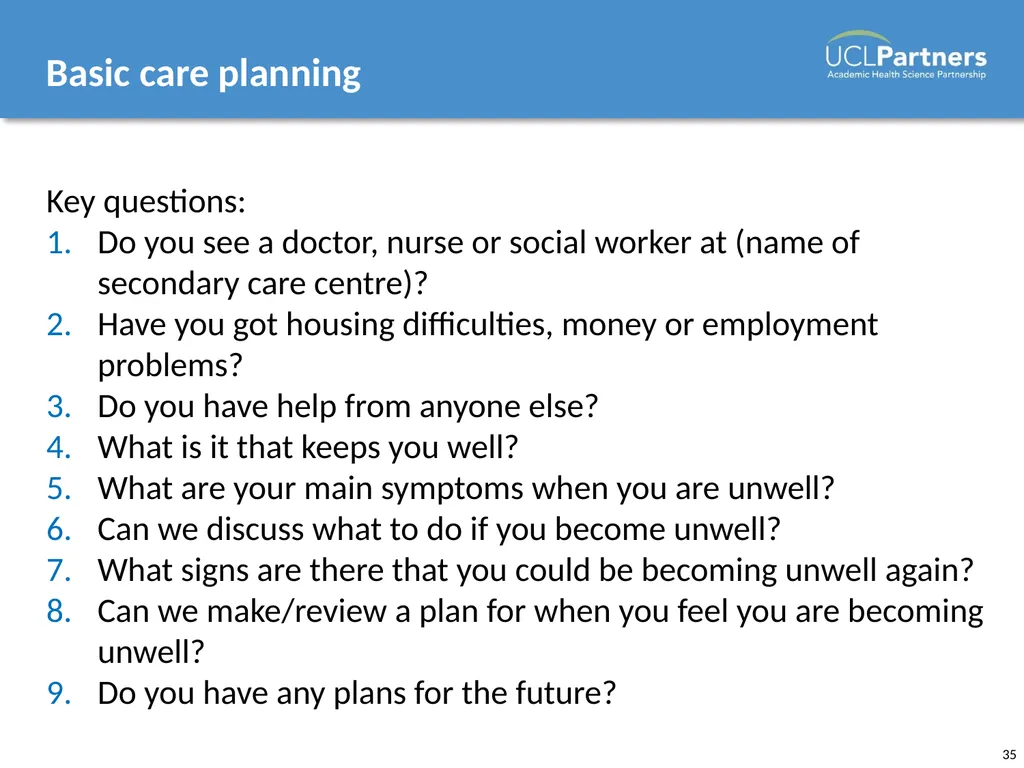
35 Basic care planning Key questions:
Do you see a doctor, nurse or social worker at (name of secondary care centre)?
Have you got housing difficulties, money or employment problems?
Do you have help from anyone else?
What is it that keeps you well?
What are your main symptoms when you are unwell?
Can we discuss what to do if you become unwell?
What signs are there that you could be becoming unwell again?
Can we make/review a plan for when you feel you are becoming unwell?
Do you have any plans for the future?<br>
Do you see a doctor, nurse or social worker at (name of secondary care centre)?
Have you got housing difficulties, money or employment problems?
Do you have help from anyone else?
What is it that keeps you well?
What are your main symptoms when you are unwell?
Can we discuss what to do if you become unwell?
What signs are there that you could be becoming unwell again?
Can we make/review a plan for when you feel you are becoming unwell?
Do you have any plans for the future?<br>
36
36 Related modules Physical health in mental illness (classroom)
Changing patients’ behaviour (classroom)
Care planning (e-learning)<br>
Changing patients’ behaviour (classroom)
Care planning (e-learning)<br>
37
37 Medications used in mental illness<br>
38
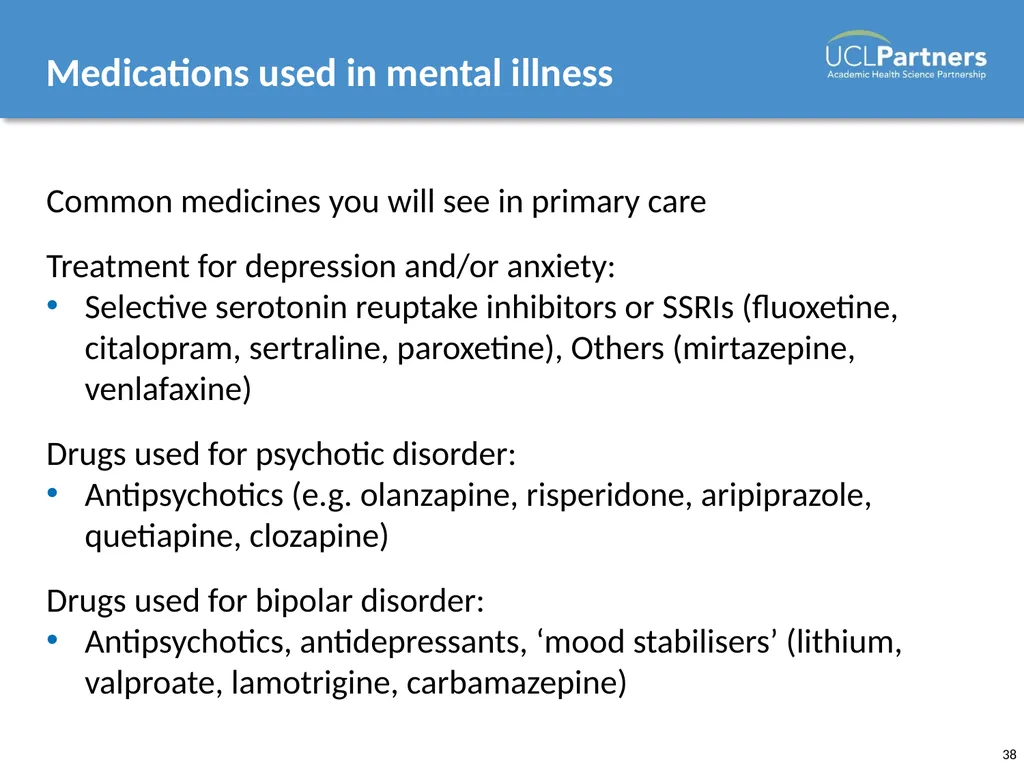
38 Medications used in mental illness Common medicines you will see in primary care
Treatment for depression and/or anxiety:
Selective serotonin reuptake inhibitors or SSRIs (fluoxetine, citalopram, sertraline, paroxetine), Others (mirtazepine, venlafaxine)
Drugs used for psychotic disorder:
Antipsychotics (e.g. olanzapine, risperidone, aripiprazole, quetiapine, clozapine)
Drugs used for bipolar disorder:
Antipsychotics, antidepressants, ‘mood stabilisers’ (lithium, valproate, lamotrigine, carbamazepine)<br>
Treatment for depression and/or anxiety:
Selective serotonin reuptake inhibitors or SSRIs (fluoxetine, citalopram, sertraline, paroxetine), Others (mirtazepine, venlafaxine)
Drugs used for psychotic disorder:
Antipsychotics (e.g. olanzapine, risperidone, aripiprazole, quetiapine, clozapine)
Drugs used for bipolar disorder:
Antipsychotics, antidepressants, ‘mood stabilisers’ (lithium, valproate, lamotrigine, carbamazepine)<br>
39
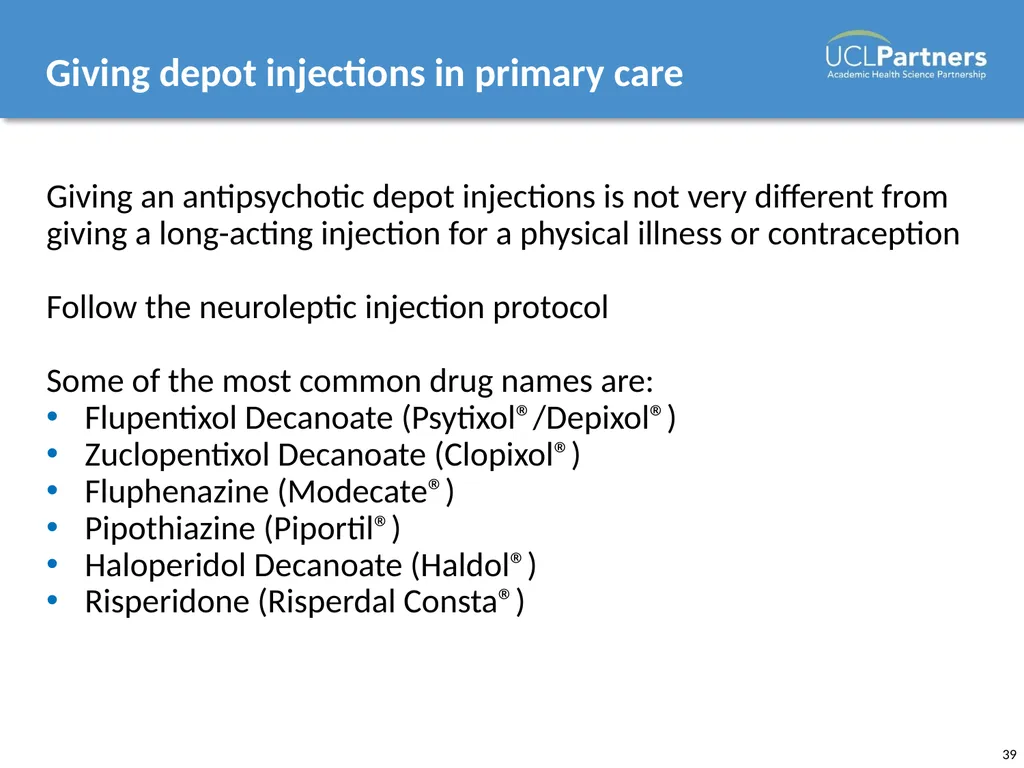
39 Giving depot injections in primary care Giving an antipsychotic depot injections is not very different from giving a long-acting injection for a physical illness or contraception
Follow the neuroleptic injection protocol
Some of the most common drug names are:
Flupentixol Decanoate (Psytixol®/Depixol®)
Zuclopentixol Decanoate (Clopixol®)
Fluphenazine (Modecate®)
Pipothiazine (Piportil®)
Haloperidol Decanoate (Haldol®)
Risperidone (Risperdal Consta®)<br>
Follow the neuroleptic injection protocol
Some of the most common drug names are:
Flupentixol Decanoate (Psytixol®/Depixol®)
Zuclopentixol Decanoate (Clopixol®)
Fluphenazine (Modecate®)
Pipothiazine (Piportil®)
Haloperidol Decanoate (Haldol®)
Risperidone (Risperdal Consta®)<br>
40
40 Monitoring side effects Glasgow Antipsychotic Side-effect Scale (GASS)<br>
41
41 Related modules Medications used in mental illness (e-learning)<br>
42
42 Specific conditions<br>
43
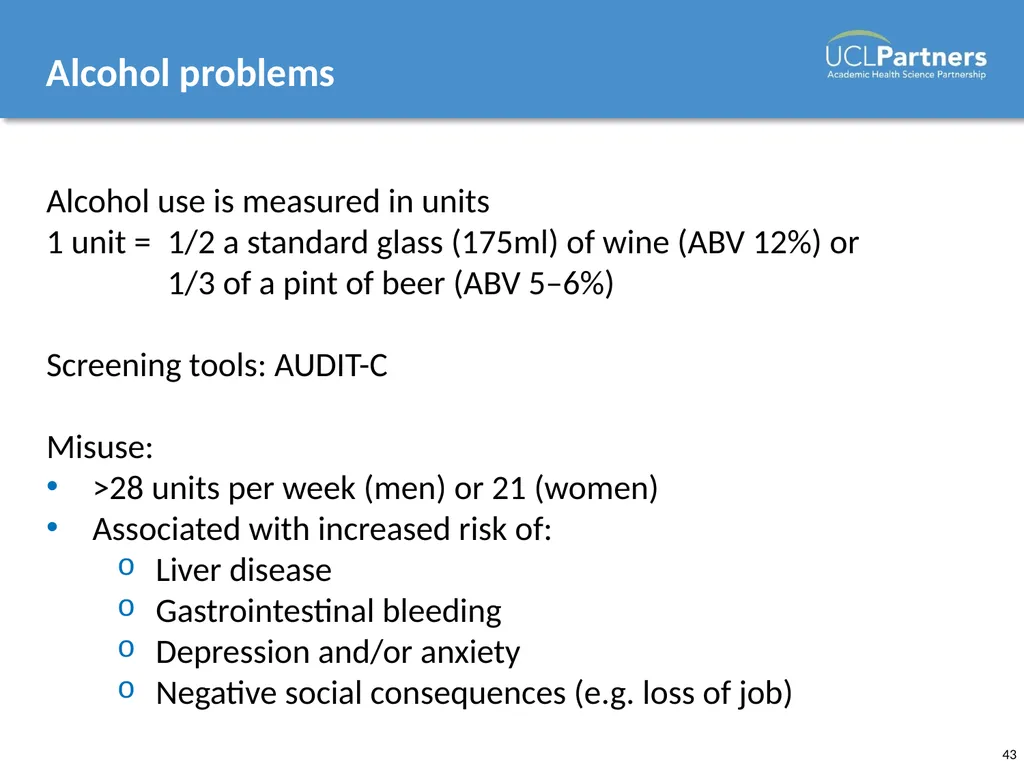
43 Alcohol problems Alcohol use is measured in units
1 unit = 1/2 a standard glass (175ml) of wine (ABV 12%) or
1/3 of a pint of beer (ABV 5–6%)
Screening tools: AUDIT-C
Misuse:
>28 units per week (men) or 21 (women)
Associated with increased risk of:
Liver disease
Gastrointestinal bleeding
Depression and/or anxiety
Negative social consequences (e.g. loss of job)<br>
1 unit = 1/2 a standard glass (175ml) of wine (ABV 12%) or
1/3 of a pint of beer (ABV 5–6%)
Screening tools: AUDIT-C
Misuse:
>28 units per week (men) or 21 (women)
Associated with increased risk of:
Liver disease
Gastrointestinal bleeding
Depression and/or anxiety
Negative social consequences (e.g. loss of job)<br>
44
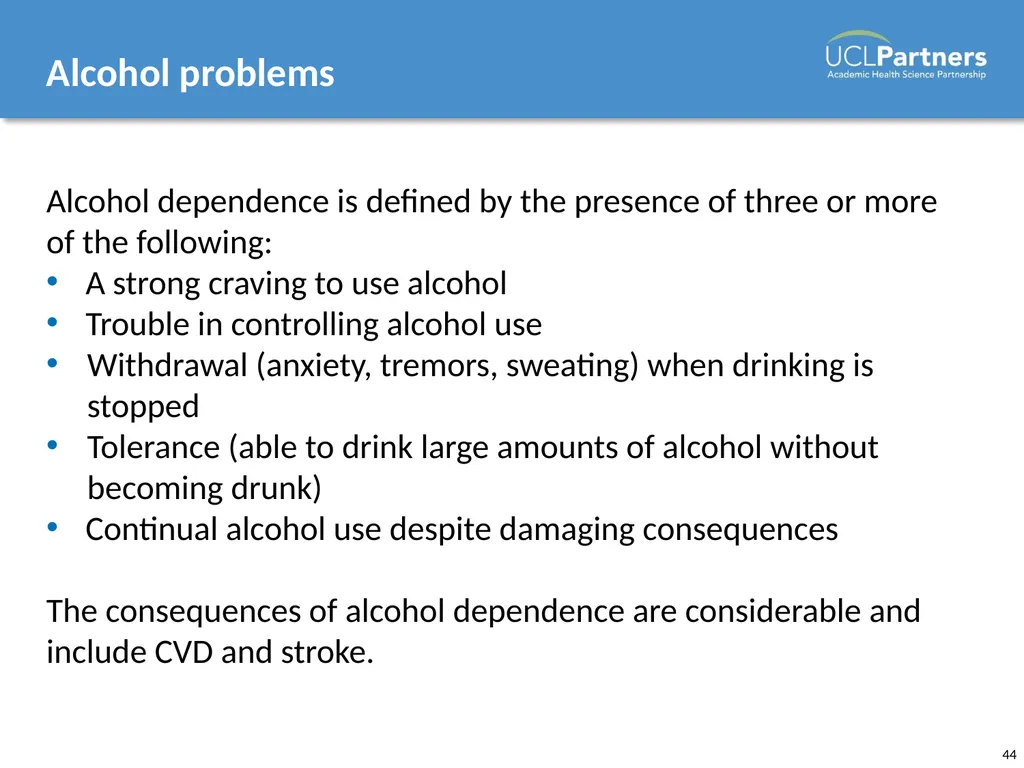
44 Alcohol problems Alcohol dependence is defined by the presence of three or more of the following:
A strong craving to use alcohol
Trouble in controlling alcohol use
Withdrawal (anxiety, tremors, sweating) when drinking is stopped
Tolerance (able to drink large amounts of alcohol without becoming drunk)
Continual alcohol use despite damaging consequences
The consequences of alcohol dependence are considerable and include CVD and stroke.<br>
A strong craving to use alcohol
Trouble in controlling alcohol use
Withdrawal (anxiety, tremors, sweating) when drinking is stopped
Tolerance (able to drink large amounts of alcohol without becoming drunk)
Continual alcohol use despite damaging consequences
The consequences of alcohol dependence are considerable and include CVD and stroke.<br>
45
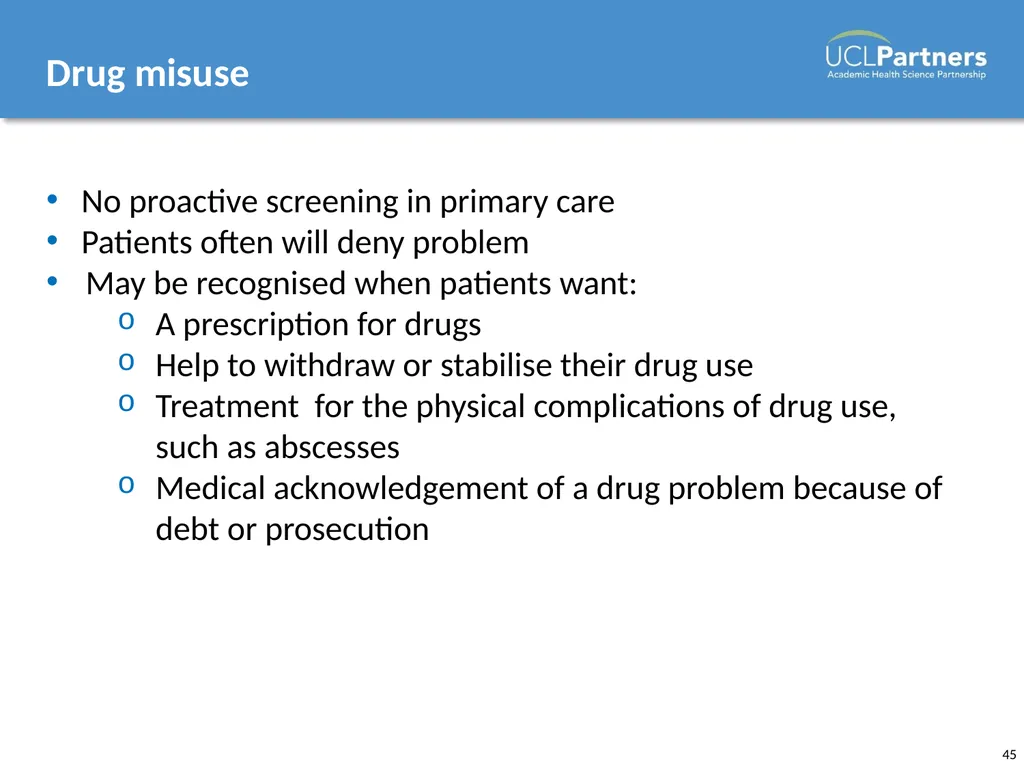
45 Drug misuse No proactive screening in primary care
Patients often will deny problem
May be recognised when patients want:
A prescription for drugs
Help to withdraw or stabilise their drug use
Treatment for the physical complications of drug use, such as abscesses
Medical acknowledgement of a drug problem because of debt or prosecution<br>
Patients often will deny problem
May be recognised when patients want:
A prescription for drugs
Help to withdraw or stabilise their drug use
Treatment for the physical complications of drug use, such as abscesses
Medical acknowledgement of a drug problem because of debt or prosecution<br>
46
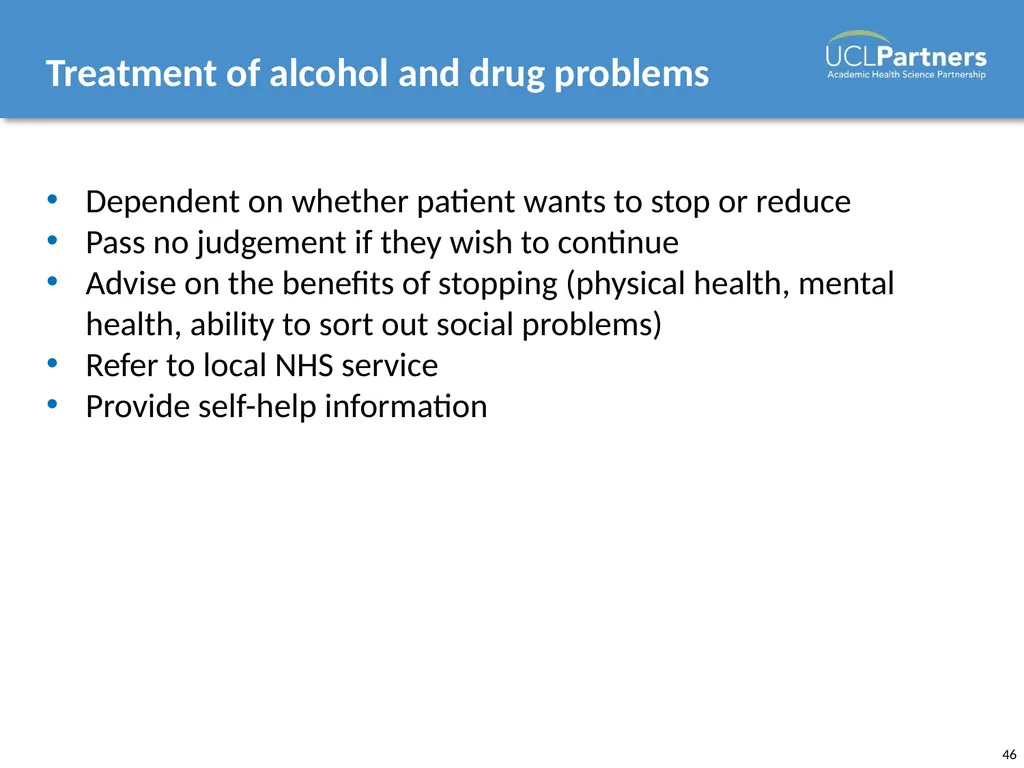
46 Treatment of alcohol and drug problems Dependent on whether patient wants to stop or reduce
Pass no judgement if they wish to continue
Advise on the benefits of stopping (physical health, mental health, ability to sort out social problems)
Refer to local NHS service
Provide self-help information<br>
Pass no judgement if they wish to continue
Advise on the benefits of stopping (physical health, mental health, ability to sort out social problems)
Refer to local NHS service
Provide self-help information<br>
47
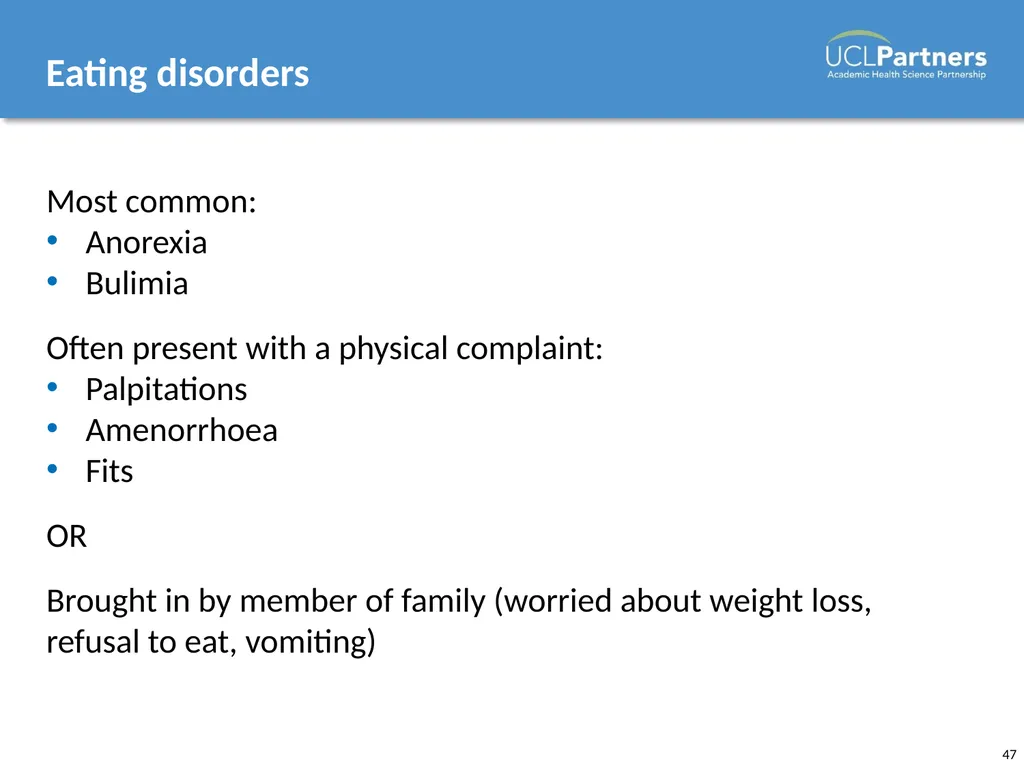
47 Eating disorders Most common:
Anorexia
Bulimia
Often present with a physical complaint:
Palpitations
Amenorrhoea
Fits
OR
Brought in by member of family (worried about weight loss, refusal to eat, vomiting)<br>
Anorexia
Bulimia
Often present with a physical complaint:
Palpitations
Amenorrhoea
Fits
OR
Brought in by member of family (worried about weight loss, refusal to eat, vomiting)<br>
48
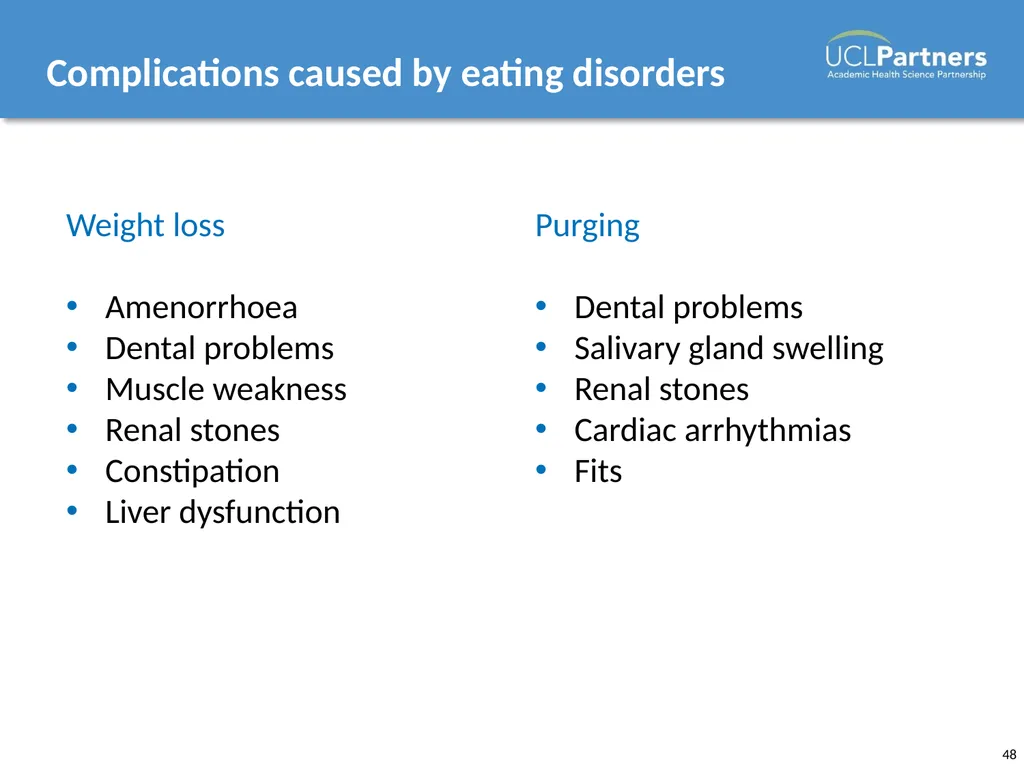
Weight loss Amenorrhoea
Dental problems
Muscle weakness
Renal stones
Constipation
Liver dysfunction Purging Dental problems
Salivary gland swelling
Renal stones
Cardiac arrhythmias
Fits 48 Complications caused by eating disorders<br>
Dental problems
Muscle weakness
Renal stones
Constipation
Liver dysfunction Purging Dental problems
Salivary gland swelling
Renal stones
Cardiac arrhythmias
Fits 48 Complications caused by eating disorders<br>
49
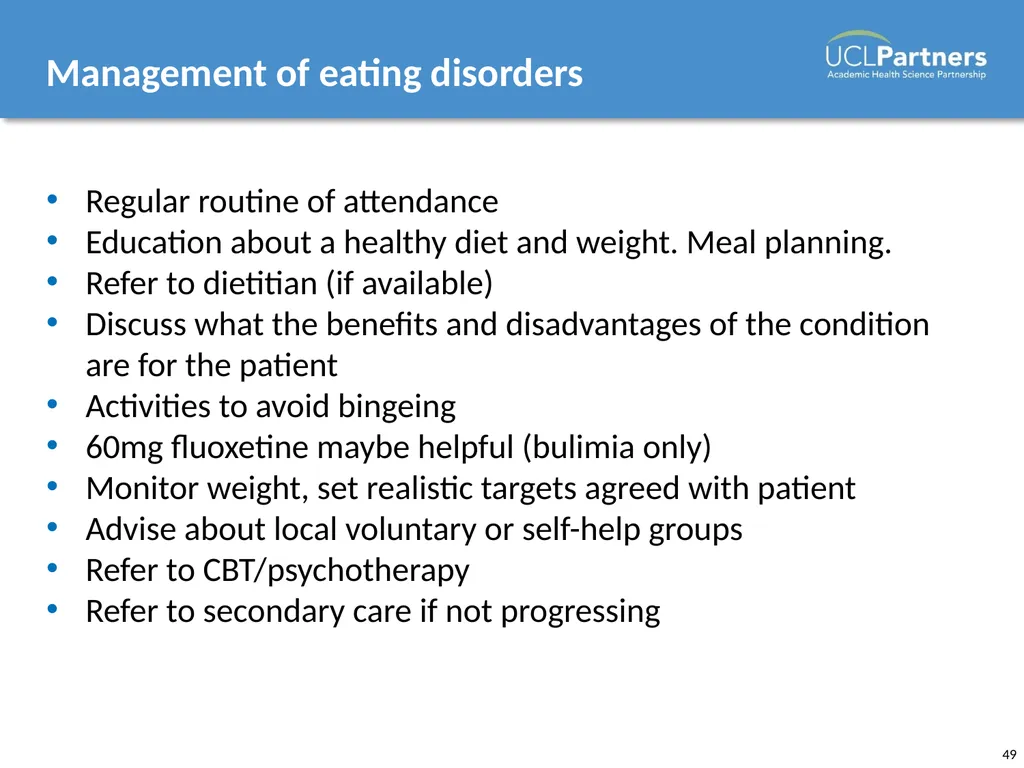
49 Management of eating disorders Regular routine of attendance
Education about a healthy diet and weight. Meal planning.
Refer to dietitian (if available)
Discuss what the benefits and disadvantages of the condition are for the patient
Activities to avoid bingeing
60mg fluoxetine maybe helpful (bulimia only)
Monitor weight, set realistic targets agreed with patient
Advise about local voluntary or self-help groups
Refer to CBT/psychotherapy
Refer to secondary care if not progressing<br>
Education about a healthy diet and weight. Meal planning.
Refer to dietitian (if available)
Discuss what the benefits and disadvantages of the condition are for the patient
Activities to avoid bingeing
60mg fluoxetine maybe helpful (bulimia only)
Monitor weight, set realistic targets agreed with patient
Advise about local voluntary or self-help groups
Refer to CBT/psychotherapy
Refer to secondary care if not progressing<br>
50
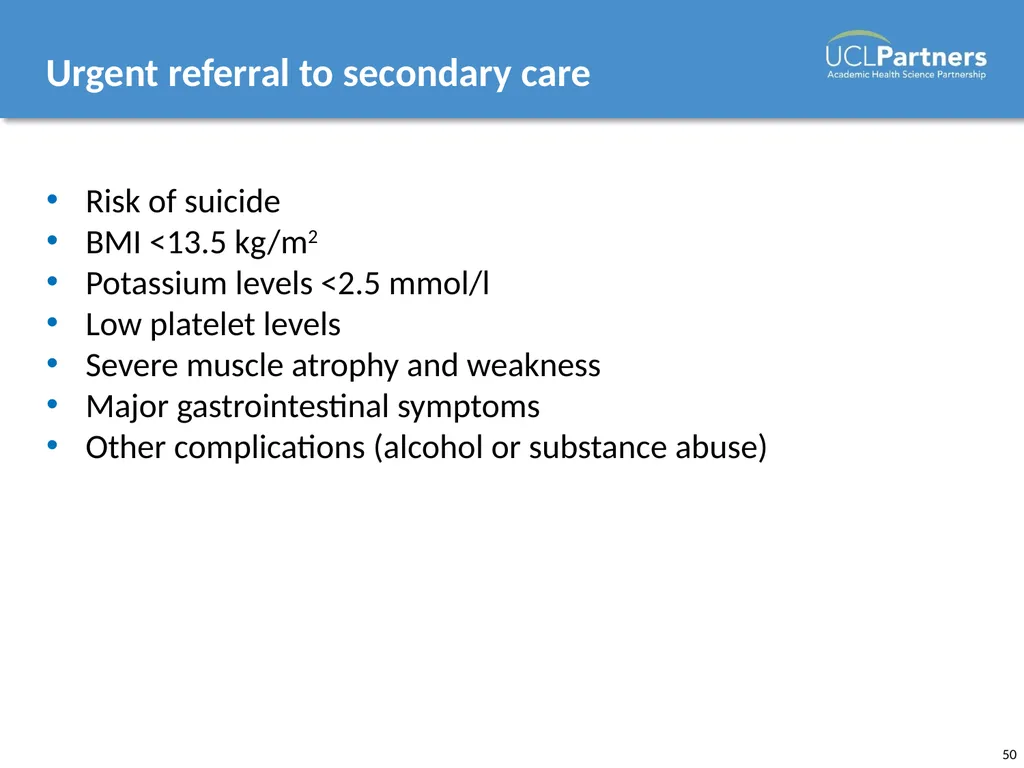
50 Urgent referral to secondary care Risk of suicide
BMI <13.5 kg/m2
Potassium levels <2.5 mmol/l
Low platelet levels
Severe muscle atrophy and weakness
Major gastrointestinal symptoms
Other complications (alcohol or substance abuse)<br>
BMI <13.5 kg/m2
Potassium levels <2.5 mmol/l
Low platelet levels
Severe muscle atrophy and weakness
Major gastrointestinal symptoms
Other complications (alcohol or substance abuse)<br>
51
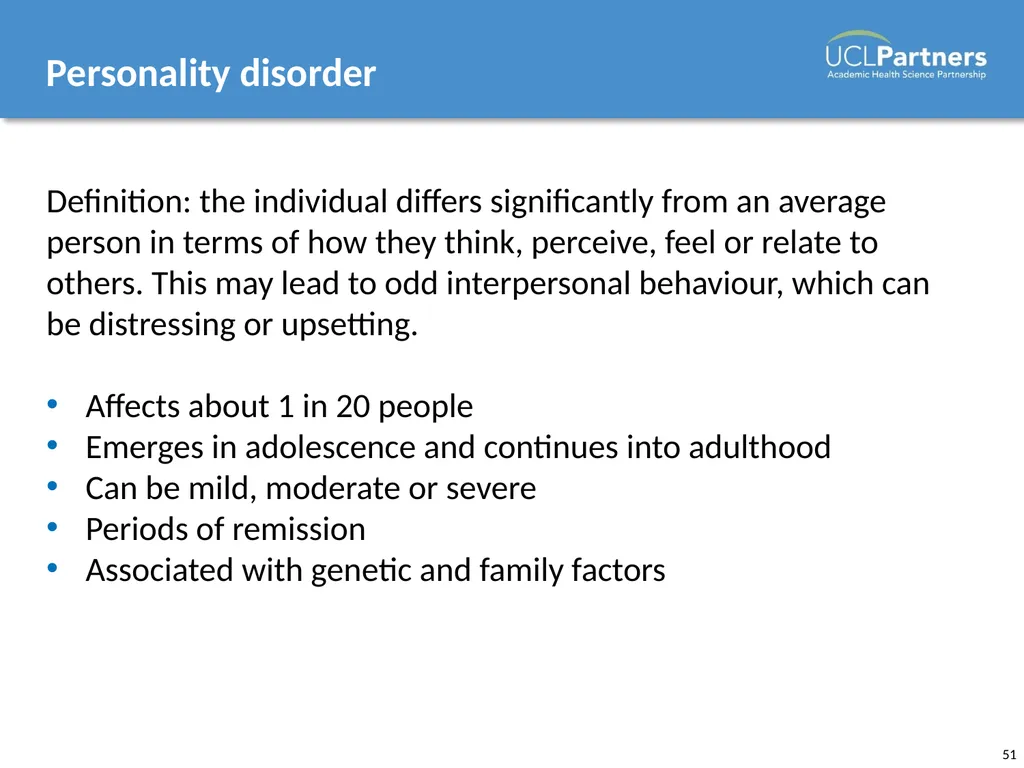
51 Personality disorder Definition: the individual differs significantly from an average person in terms of how they think, perceive, feel or relate to others. This may lead to odd interpersonal behaviour, which can be distressing or upsetting.
Affects about 1 in 20 people
Emerges in adolescence and continues into adulthood
Can be mild, moderate or severe
Periods of remission
Associated with genetic and family factors<br>
Affects about 1 in 20 people
Emerges in adolescence and continues into adulthood
Can be mild, moderate or severe
Periods of remission
Associated with genetic and family factors<br>
52
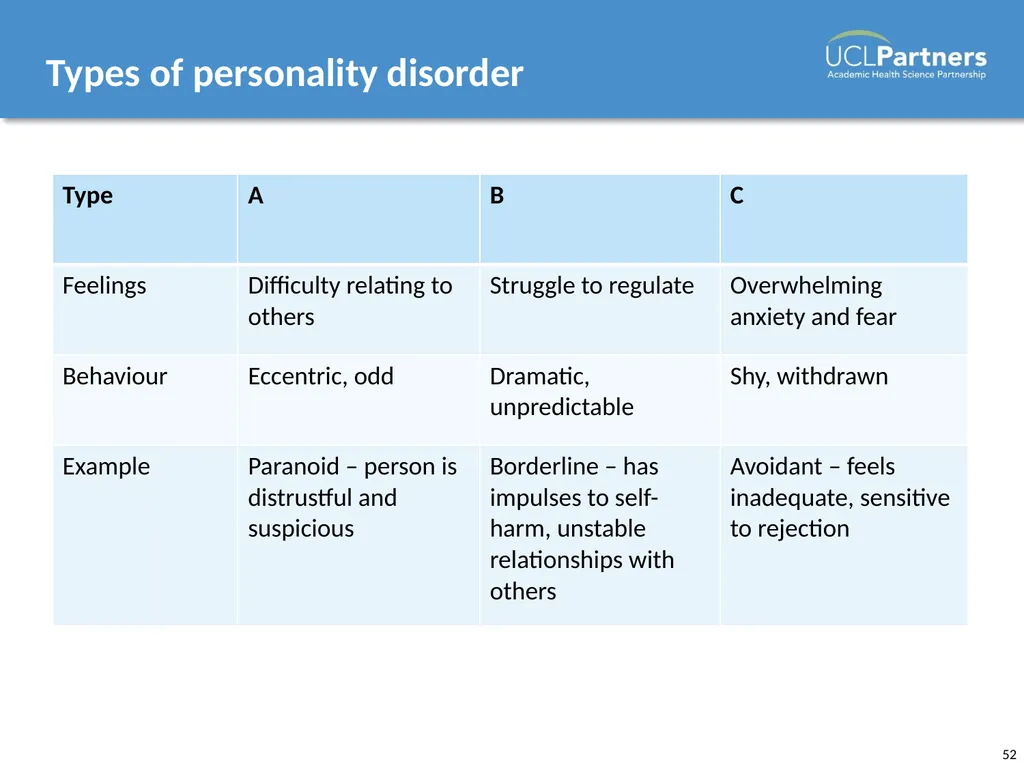
Types of personality disorder 52<br>
53
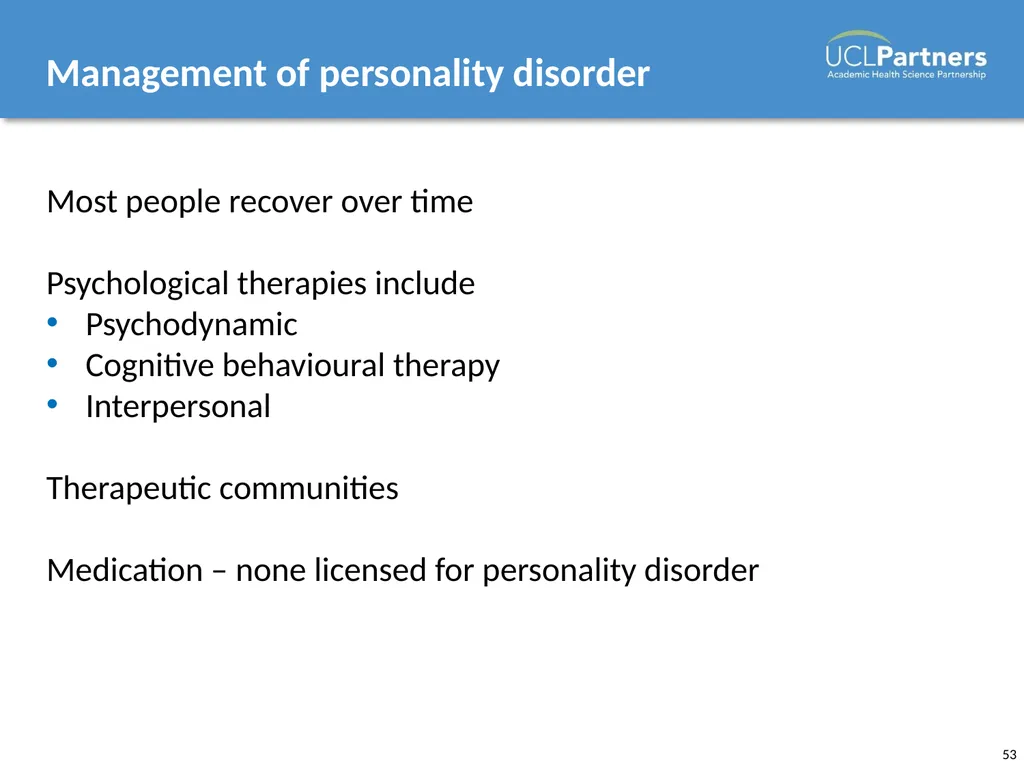
53 Management of personality disorder Most people recover over time
Psychological therapies include
Psychodynamic
Cognitive behavioural therapy
Interpersonal
Therapeutic communities
Medication – none licensed for personality disorder<br>
Psychological therapies include
Psychodynamic
Cognitive behavioural therapy
Interpersonal
Therapeutic communities
Medication – none licensed for personality disorder<br>
54
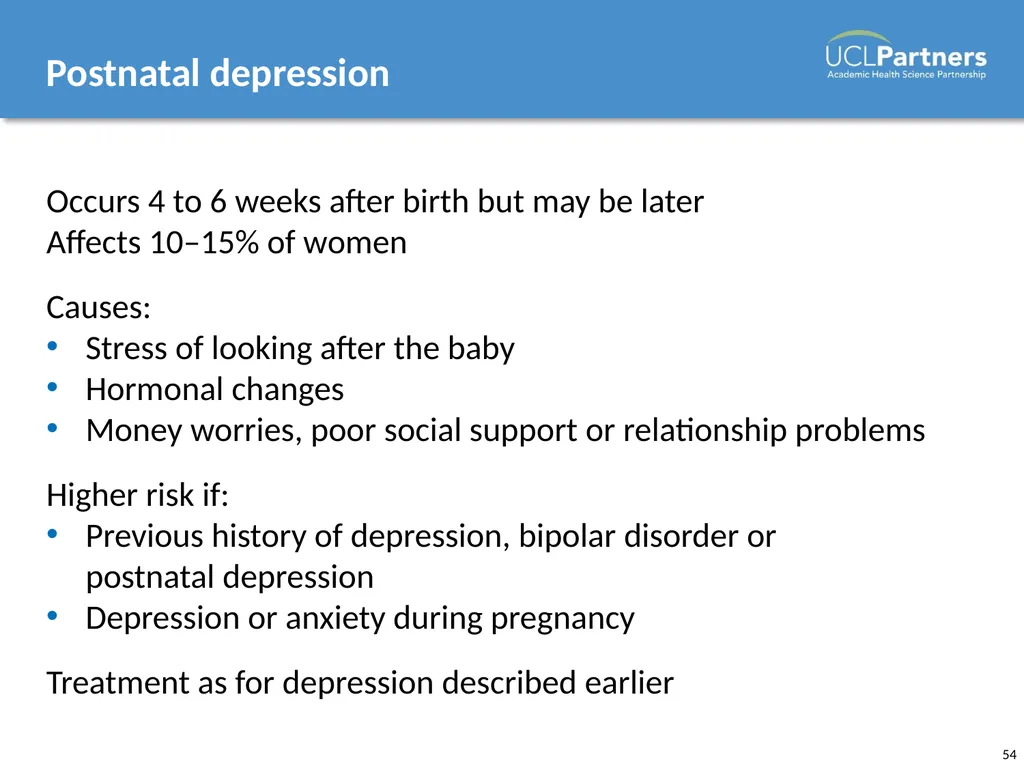
54 Postnatal depression Occurs 4 to 6 weeks after birth but may be later
Affects 10–15% of women
Causes:
Stress of looking after the baby
Hormonal changes
Money worries, poor social support or relationship problems
Higher risk if:
Previous history of depression, bipolar disorder or
postnatal depression
Depression or anxiety during pregnancy
Treatment as for depression described earlier<br>
Affects 10–15% of women
Causes:
Stress of looking after the baby
Hormonal changes
Money worries, poor social support or relationship problems
Higher risk if:
Previous history of depression, bipolar disorder or
postnatal depression
Depression or anxiety during pregnancy
Treatment as for depression described earlier<br>
55
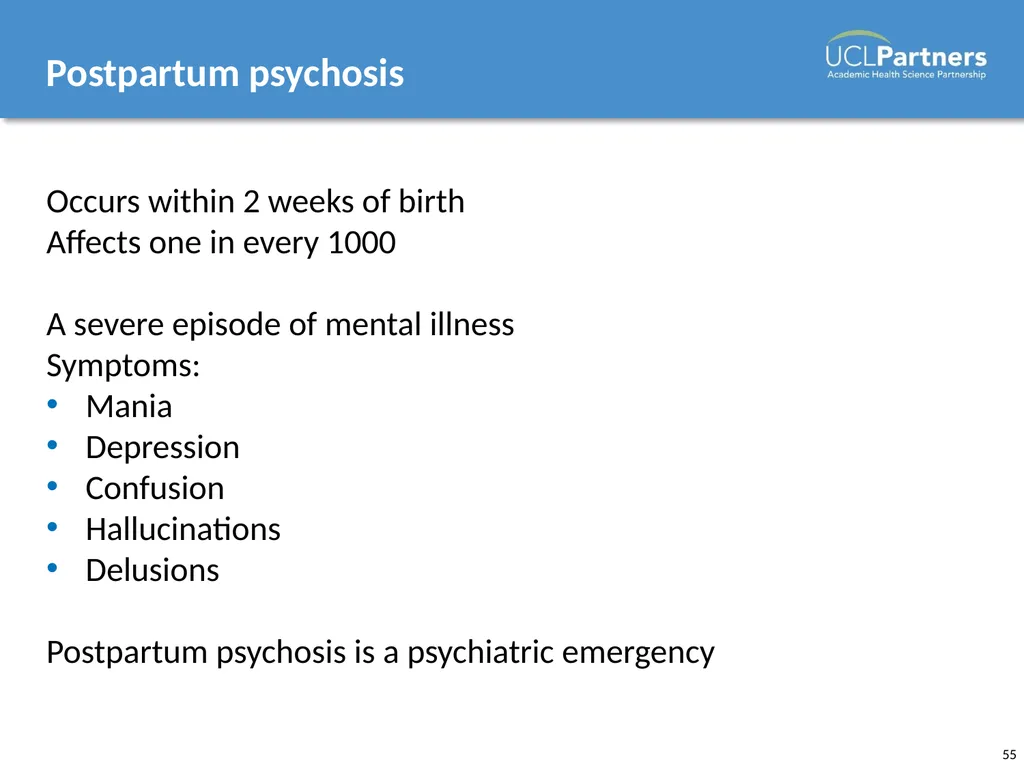
55 Postpartum psychosis Occurs within 2 weeks of birth
Affects one in every 1000
A severe episode of mental illness
Symptoms:
Mania
Depression
Confusion
Hallucinations
Delusions
Postpartum psychosis is a psychiatric emergency<br>
Affects one in every 1000
A severe episode of mental illness
Symptoms:
Mania
Depression
Confusion
Hallucinations
Delusions
Postpartum psychosis is a psychiatric emergency<br>
56
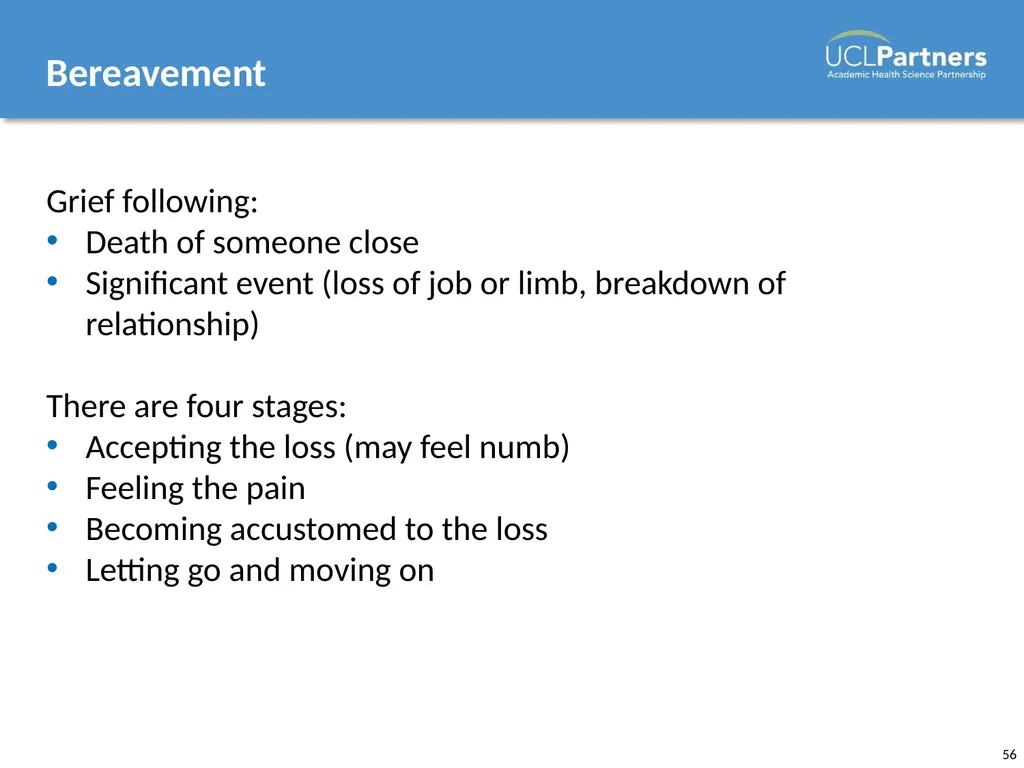
56 Bereavement Grief following:
Death of someone close
Significant event (loss of job or limb, breakdown of relationship)
There are four stages:
Accepting the loss (may feel numb)
Feeling the pain
Becoming accustomed to the loss
Letting go and moving on<br>
Death of someone close
Significant event (loss of job or limb, breakdown of relationship)
There are four stages:
Accepting the loss (may feel numb)
Feeling the pain
Becoming accustomed to the loss
Letting go and moving on<br>
57
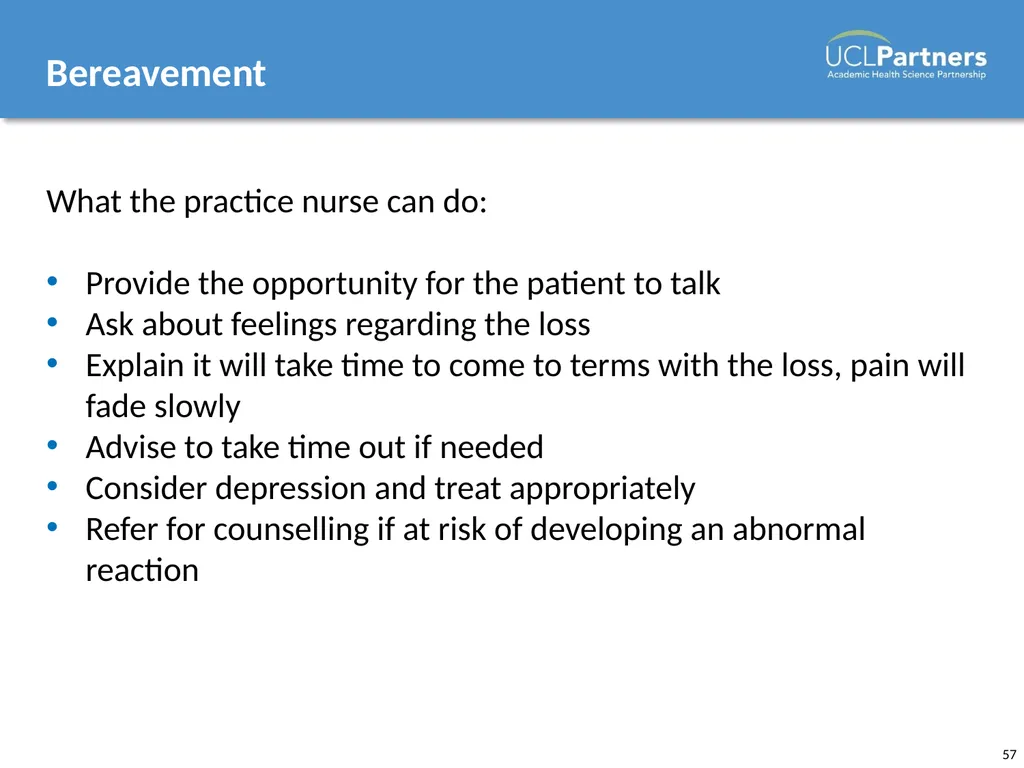
57 Bereavement What the practice nurse can do:
Provide the opportunity for the patient to talk
Ask about feelings regarding the loss
Explain it will take time to come to terms with the loss, pain will fade slowly
Advise to take time out if needed
Consider depression and treat appropriately
Refer for counselling if at risk of developing an abnormal reaction<br>
Provide the opportunity for the patient to talk
Ask about feelings regarding the loss
Explain it will take time to come to terms with the loss, pain will fade slowly
Advise to take time out if needed
Consider depression and treat appropriately
Refer for counselling if at risk of developing an abnormal reaction<br>
58
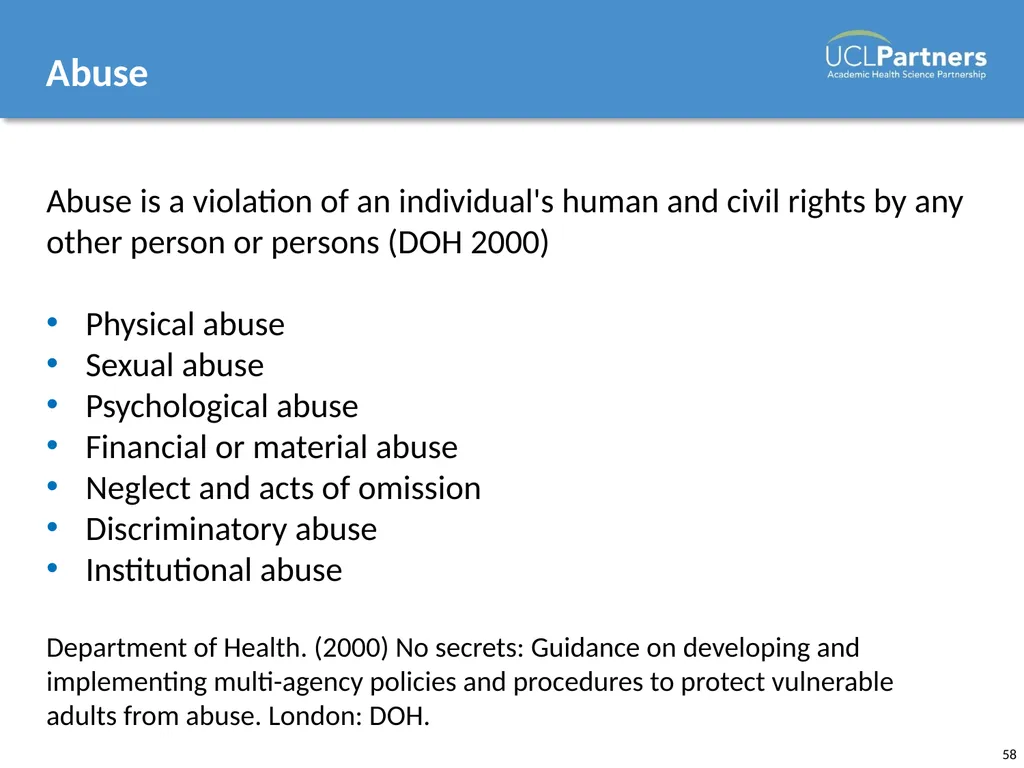
58 Abuse Abuse is a violation of an individual's human and civil rights by any other person or persons (DOH 2000)
Physical abuse
Sexual abuse
Psychological abuse
Financial or material abuse
Neglect and acts of omission
Discriminatory abuse
Institutional abuse
Department of Health. (2000) No secrets: Guidance on developing and implementing multi-agency policies and procedures to protect vulnerable adults from abuse. London: DOH.<br>
Physical abuse
Sexual abuse
Psychological abuse
Financial or material abuse
Neglect and acts of omission
Discriminatory abuse
Institutional abuse
Department of Health. (2000) No secrets: Guidance on developing and implementing multi-agency policies and procedures to protect vulnerable adults from abuse. London: DOH.<br>
59
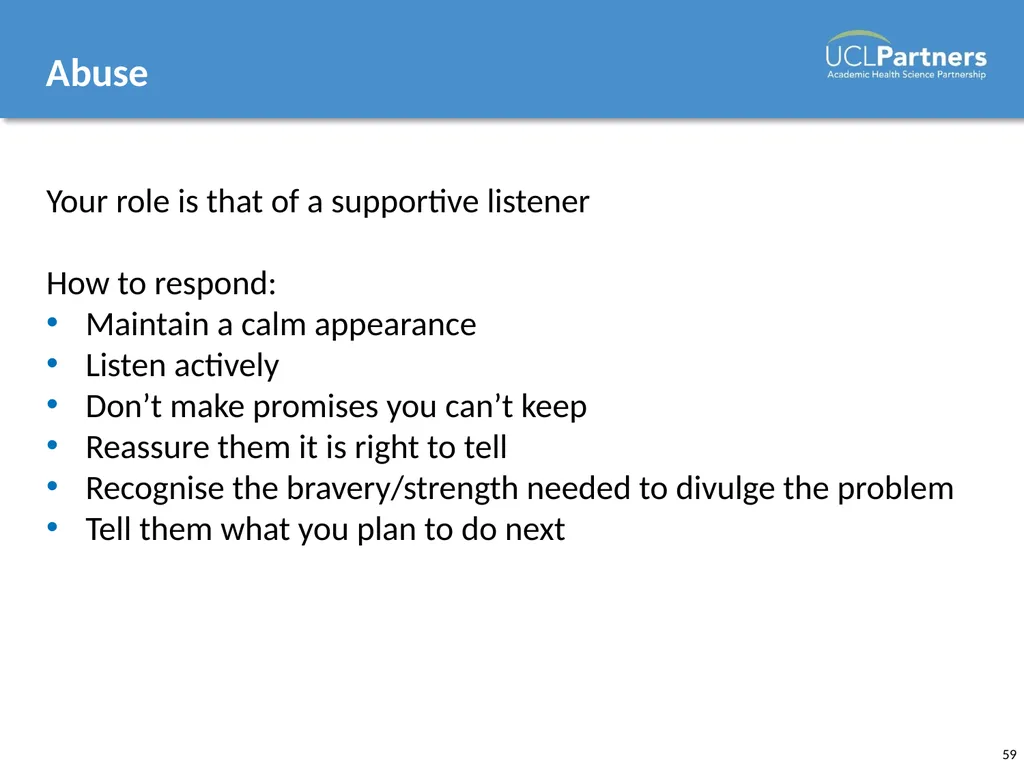
59 Abuse Your role is that of a supportive listener
How to respond:
Maintain a calm appearance
Listen actively
Don’t make promises you can’t keep
Reassure them it is right to tell
Recognise the bravery/strength needed to divulge the problem
Tell them what you plan to do next<br>
How to respond:
Maintain a calm appearance
Listen actively
Don’t make promises you can’t keep
Reassure them it is right to tell
Recognise the bravery/strength needed to divulge the problem
Tell them what you plan to do next<br>
60
60 Related modules Specific conditions (e-learning)<br>
61
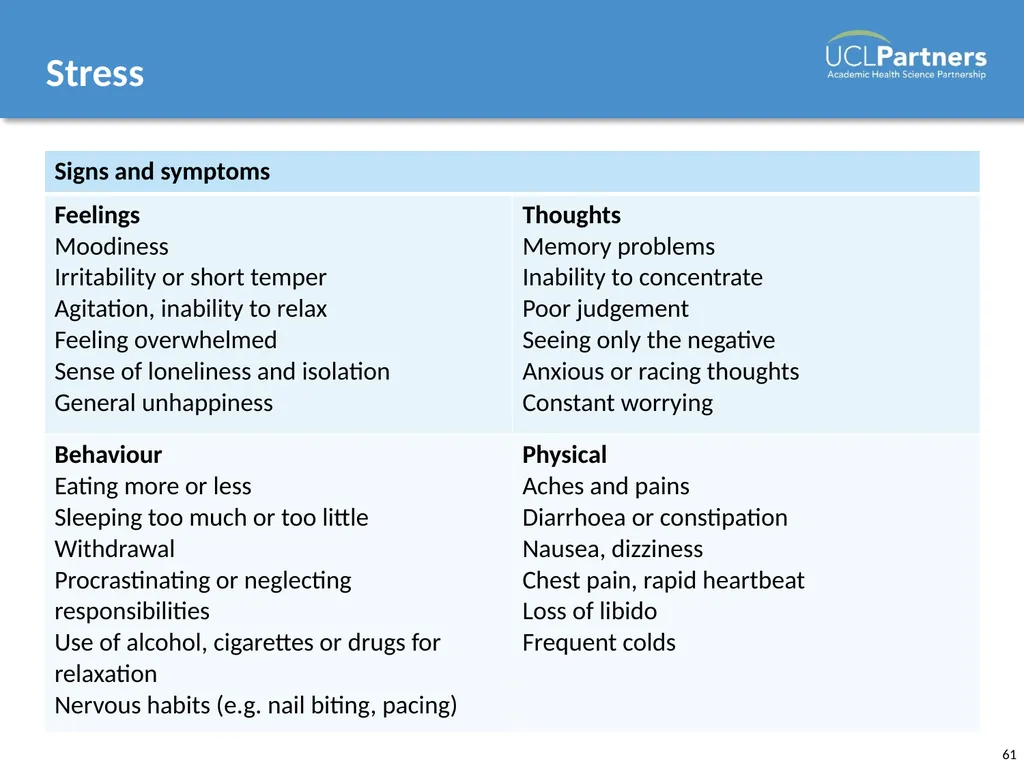
61 Stress<br>
62
62 Related modules Wellbeing (classroom)<br>